Chapter VI · (continued 2)
Reading edition
H. L. P.
Harriet, wife of Sir Thomas Hesketh, was a daughter of Ashley Cowper, the uncle of the poet. The latter died in 1800, and his biography by his friend William Hayley was published 1803.
In 1803 Sophia Lee gave up the school at Belvidere House, and devoted herself to writing. Her first important work, published the following year, took the shape of six volumes of letters, entitled The Life of a Lover.
Thomas Holcroft, shoemaker, actor, and dramatist, had been living for five years on the Continent to escape his creditors. On his return he published in 1804 his Travels from Hamburg through Westphalia, Holland, and the Netherlands, to Paris, in 2 vols. 4to.
It was apparently with the idea of arousing prejudice against England that Bonaparte brought an unfounded charge of plotting his assassination against Mr. Drake and Mr. Spencer Smith, our envoys at Munich and Stuttgard, and procured their expulsion by the courts of Bavaria and Würtemburg.
The treacherous seizure of the Duc d'Enghien in March in the neutral territory of Baden, his condemnation by a court-martial on no specific charges, and hurried execution, was a tragedy which shocked all Europe. It was this inexplicable incident in the career of Bonaparte which gave rise to the well-known mot of Fouche, "It was worse than a crime, it was a blunder."
Brynbella, Sunday Morng, 19 Aug. 1804.
I am the wretchedest Quarreller on earth, dear Mrs. Pennington, and not the most ingenious Reconciler. Like mine Hostess Quickly, I am the worse when one says—quarrel[23]: nor did ever the Country Gentleman in Ben Jonson need London instructions in the art of angry reciprocation more than I do. Let us leave a subject I really understand so little, and lament that the universal Quarreller, Death, has been so busy among our common acquaintance since we parted.
How senseless, not to say offensive, must yours and my Master's mutual complaints appear in the eyes of poor Mrs. Dimond just now! Such a son!—the parents' just pride and joy—so snatched! And that unhappy Mrs. Adams who, you may remember, said she had heard the bell ring for her own execution; she has lost the daughter she alone desired to live for. Few people find the way of being happy, and those who throw little Hedgehogs in one another's paths, like the rioters, to make them stumble and roll about, have none of my approbation....
You will not be talked to (you say), of the Cat, and the Dog, and the times, and the weather; tho' really the first of these subjects is not amiss for you quarrelling disciples, and I will not, like Grumio, talk to you of how bad my poor Master was when your letter came to him, and in what a shocking situation his fingers have been placed by the last fit of gout, no nor what a loss we have sustained in poor Hodgkins, nor what a successor we picked up for him. But all these wonders, as old Shakespeare says, shall now be buried in oblivion,[24] as shall all my true expressions of admiration at your letters, which still exceed every one the last received. Farewell then, and be merry, and believe me with every possible good wish, your ancient Jigg-Maker,
H. L. P.
Renewal of friendship, 1819—Weston-super-Mare—W. A. Conway—Birthday fête, 1820—Conway's love affair—Penzance—The Queen's trial—More law—Land's End—Return to Clifton and death, 1821—Mrs. Pennington's obituary notice—Her relations with the daughters and the executors—Epitaph.
The last letter shows the appearance of the little rift in the lute of friendship, which was destined to silence its tones for so many years. Its origin remains obscure. If Mrs. Pennington received no letters between April and July, she doubtless had some reason to feel aggrieved, but the reference to the "mutual complaints" of Mr. Piozzi and Mr. Pennington suggests that they had met in the interval, and that some disagreement had arisen, which had been taken up by their respective wives, and it is probable that some letters during this period may have been destroyed. Mrs. Piozzi clearly had no desire to keep up the quarrel, whatever it was; but it may be that her attempt at reconciliation was not worded in a way which would commend itself to the sensitive mind of Mrs. Pennington, smarting from some real or fancied slight to her husband or herself. And so the correspondence was not resumed for fifteen years.
Meantime much had happened. In 1807 Sophia Thrale married Henry Merrick, third son of Sir Richard Colt Hoare, Bart., of Stourhead; and in the following year her elder sister, Hester, became the second wife of Viscount Keith. The marriages seem to have brought mother and daughters more closely together, for they paid a visit to Brynbella this year. In 1809, the gout from which he had suffered so long and so severely proved fatal to Mr. Piozzi. He had for some years conformed to the English Church, and in his last illness received the sacrament at the hands of a clergyman at Bath. He was buried 26th March, in the vault he had constructed in what Mrs. Piozzi calls Dymerchion, now Tremeirchion Church. She began her Commonplace Book the same year.
The "little boy," John Salusbury Piozzi, had finished his education at Oxford, and having grown to man's estate, and assumed the additional surname of Salusbury, married in 1814, Harriet Maria, daughter of Edward Pemberton of Ryton Grove, Salop. In 1816 he was appointed High Sheriff of Flint, and was knighted in the following year. To provide for the young couple, Mrs. Piozzi made over to them Brynbella and her Welsh estate, and retired to her beloved Bath, to live on the income from the English property settled on her by Thrale, and some £6000 which Piozzi's careful management had saved from their income. She had therefore—on paper—something like £2000 a year, but her generosity to her adopted son, and to her daughters in the re-fronting and fencing of Streatham Park, added to her love of entertaining, and a carelessness in money matters perhaps inherited from her father, left her in continual monetary difficulties.
Living so near Mrs. Pennington, and with so many common friends, it was hardly possible that they should not be brought together again, though there is no evidence as to how the reconciliation was effected. The correspondence was resumed in July 1819, but letters written by Mrs. Pennington somewhat later show that it was equally desired and equally genuine on both sides.
On Mrs. Pennington's side the rupture of one old friendship almost coincided with the renewal of another. On 18th October 1804, Anna Seward wrote to Mrs. Powys that she had been staying at Mendip Lodge, and that Dr. Whalley had undertaken to bring about a reconciliation with Mrs. Pennington, after twelve years of estrangement. "She received me with tears of returning love, and our reconcilement was perfect. She made me promise to stay with her a few days on my way back."
Her husband had a serious illness in 1813, as the result of which he resigned the office of M.C. at the Hot Wells, which he had held for nearly thirty years, in an address which "powerfully affected the feelings of all present." But his successor turned out to be quite unfitted for the post, and as Pennington's health had been improved by a stay at Weymouth, he was induced to take up the work again for a short time. Not long afterwards Mrs. Pennington's mother died at the age of ninety-seven. She had lost nearly all her faculties, and had been for some time unable to recognise even her daughter.
Mrs. Pennington to Maria Brown
Weston-super-Mare, 9 Oct. 1819.
... I shall not be sorry to return, tho' I leave dear Mrs. Piozzi behind, with whom I have passed some hours of every day, and our evenings always together, in the most perfect harmony. We seem entirely to have regained our former footing, and to revert to past times, persons, and anecdotes with mutual pleasure. She has sought no other, indeed sedulously avoided all other society since we have been here, and is happy and chearful when with us, as I ever saw her. It is not however with me exactly the same thing. I was Prima Donna, I now feel that many new friends and new connexions, with new interests and novel attractions, occupy the ground that I exclusively possessed; and I can only expect, in future, to be one of this larger groupe. I think the character of her mind was always rather kindness than attachment. I know not whether you admit the distinction; I feel it, and that I must henceforth be satisfied with such general proofs of this sentiment as opportunity may throw in our way.
The friend to whom this was written came to occupy much the same position with regard to Mrs. Pennington as the latter had done to Mrs. Piozzi. After Mrs. Pennington's death, the whole of her carefully treasured correspondence passed into her hands, including, besides the present series of letters, those relating to the Siddons-Lawrence tragedy, which were published in An Artist's Love Story, and others from Anna Seward, Helen Williams, the Randolphs, and Whalleys, and others of her correspondents.
In a letter to Miss Brown's mother, dated 28th February 1820, she pursues the same theme. "You judge," she writes, "very correctly of my feelings respecting my dear restored friend. It gives an interest to my life that nothing else could, and what is better, it seems to be felt mutually. We never are so happy as when together, and her letters, which come twice or thrice a week, are a perpetual source of amusement."
Weston-super-Mare, July 1819.
Sick or well, dear Mrs. Pennington is ever kind and obliging, but why empty her veins at such a rough rate? Were they bursting with heat? A Bath friend writes me word that the people there do feel themselves heavily oppress'd by a weight of atmospheric air, and walk about, he says, like somnambulists, with salmon-coloured faces. We have sea-breezes here that refresh our spirits, and send us out at night to stare after the Comet, which looked very pale last evening I saw it, but not, I hope, for anger.
There are other fiery fellows in the North, more dangerous by far, of whom I feel more afraid; but the Regent went safely, and was applauded it is said, and the Reformers will work no reformation at Smithfield under Mr. Hunt's guidance. He tried in vain to make the Basket Women at Bath hate Sinecures; tho' one of them said she knew he meant the Signing Curs, kept by Ministers to sign whatever they bid them,—comical enough!
If all goes on regularly and well, I shall certainly call on you, dear Madam, in my return. When that will be, however, is hard to say, for I have just hired myself a clean Cottage,—the Hotel is very noisy, and surprisingly expensive,—and since the Bathing agrees, I mean to try another tide or two by the way of making myself young, or making myself believe that I am younger than my neighbours of the same standing....
People are visiting-mad here, as everywhere else. Do you remember Mr. Pennington saying he hoped there were no Evening Parties in Heaven? He will not escape them till he gets thither, nor shall, without the utmost difficulty his and your ever faithful and obliged
H. L. Piozzi.
I saw Miss Williams spreading the Bread Fruit with butter, and eating it at her tea, ten days before I left Bath,—but it was kind in you to send me some.
The comet of July 1819 was that now known by the name of Winnecke, who, in 1858, identified it with one previously observed by Encke.
Henry Hunt had for many years been associated with the leading agitators of the time. He made the acquaintance of Horne Tooke in 1800, shared imprisonment with Cobbett in 1810, and allied himself with Thistlewood and his friends in 1816. He took part in the Spa Fields meeting, presided at the Reform meeting at Smithfield which took place on July 21, and at the "Peterloo" meeting, held on August 16 this year.
Weston-super-Mare,
Saturday Night, 4 Sep. 1819.
Dear Mrs. Pennington's letter came late last night; our poor Postman cannot get his walk finished,—how should he?—till near 12 o'clock, which is one of the discomforts incident to our fav'rite Weston. This morning the Grinfields of Laura Chapel, Bath, left us, and you may have half their house for two guineas and a half o' week. They paid five for the whole, and had 7 or 8 Babies inhabiting it, with a proportionate number of nurses, etc. But send an immediate answer, or it will be gone.... If you come quite alone, our Baker, Mr. Cooper, will accommodate you with one chamber up a ladder-like staircase, and one sitting room: but such a lodging too nearly resembles that in Coleman's Broad Grins;—one guinea and a half is, I think, too much for that, though 'tis struggled for!!...
Oh! what heavenly weather here is! And oh! what fools is it flung away upon! who will not gather up the harvest, but run about reforming errors in the State. They have got a wiser head now, who is better qualified to do mischief, and accordingly we read that yesterday's meeting passed off without any mad frolics on which to fix the stigma of treason or insanity:—two things so difficult to prove they oblige us to adopt Elbow's method in Measure for Measure, who says, "they must continue in their courses till we can tell what they are."[25] ...
Weston-super-Mare,
Tuesday, 7 Sept. 1819.
Your letter came too late last night, dear Mrs. Pennington, for me to take any measures concerning the House.... You will have it, as a favour, for three Pounds o' week;—cheaper than mine certainly.
The list of things wanted is just everything: knives, forks, spoons, plate, linnen: Weston affords only beds, tables, and chairs. Yes, yes, they do give us crockery, and there were two books in the town when I came, a Bible and a Paradise Lost. They were the best you know.
I am no better pleased with the complexion of the times than you are, but feel much more sympathy with the Mob than with their Galvanizers, who mean to give just the portion of excitement they choose, in order to deplace, displace I mean, one set of Ministers, and put up another set in which they take deeper interest. In this virtuous cause they care not what lives, or whose peace they endanger. But let them be cautious, or the Mob will make them their tools, to help break down the gates which, when thrown back as those of Hell in Milton, they will start to see
Before their eyes in sudden view appear The secrets of the hoary deep, a dark Illimitable Ocean without bound, Without dimension: where length, breadth, and height, And time and place are lost.[26]
Noblemen and Gentlemen are of necessity Aristocrates in earnest: and the numbers who now stand aloof, looking how it will end, and being—as we used to say of dear Siddons—no-crates at all, will even die with terror, and the conscious certainty that the great folk who assisted in the work at first, broke open, but to shut excelled their power. An ambitious Sovreign meanwhile, might while his army continues true to him, make them all his tools; suffering them so to destroy the House of Commons that he could reign in future without a Parliament, only just cajoling the Reformers between to-day and the year 1820. And such madmen are those who wish the overturn of constituted authorities....
Poor dear Mrs. Lambart can hardly hear these strange tales, I believe; she is at least seven years older than myself, but does not like, it seems, to tell her age. My Register, clearly written, as Bishop Majendie says, points out 1740.
On September 12 Mrs. Pennington writes to Miss Brown that she is going to Weston. "Dear Mrs. Piozzi is there, we shall be within two or three doors of her. She has been as active and anxious to serve us in this particular as she could have been at any former period.... If the air of that place, the fine weather we seem likely to have, and her charming society, does not restore me to something like health and spirits, I shall give up the point altogether."
The Card Table Riddle, which appears in the next letter, is taken from Mrs. Piozzi's Commonplace Book; where she remarks that "it has been plundered, and played tricks with, and published in Pocket Books, &c., but these are the genuine verses."
Sat. Oct. 17, 1819.
My dear Mrs. Pennington charged me to send her the Riddle, and Miss Camplin asking for commands, I thought it a good opportunity, therefore
A place I here describe, how gay the scene! Fresh, bright, and vivid with perpetual green. Verdure attractive to the ravished sight Perennial joys, and ever new delight, Charming at noon, more charming still at night, Fair Pools, where Fish in forms pellucid play, Smooth lies the lawn, swift glide the hours away. The Banks with shells and minerals are crown'd, Hope keeps her court, and Beauty smiles around. No mean dependance here on Summer skies, This spot rough Winter's roughest blast defies. Yet here the Government is curst with change, Knaves openly on either Party range; Assault their Monarch, and avow the deed, While Honour fails, and Tricks alone succeed. For bold Decemvirs here usurp the sway, Now all some single Demagogue obey, False Lights prefer, and curse th' intrusive day. Oh! shun the tempting shore, the dangerous coast, Health, Fame, and Fortune, stranded here, are lost.
This Riddle I gave Salusbury when he was a boy, "But what is it, Aunt? What can it be?" "Why, replied I, can't you perceive that
A Card-table's green is perpetual and bright, A Card-table charms men from morning till night; Where, angling with skill for some innocent fool, Their thoughts are still fixed on the Fish and the Pool; While Guineas and Counters, promiscuously heap'd, With hope fills those pockets whence pelf has escap'd. Thro' Winter and Summer and demi-saison, This occupies Ladies and Lords de Bon Ton. For Knaves are successful at Limited Loo, At Whist the odd Trick makes all Honours look blue. The Ten, at Casino, Decemvir we call, And Aces, at Commerce, take tribute from all. Wax Candles superior to Sunshine they boast, While Time, Fame, and Fortune for ever are lost."
Bath, 29 Oct. 1819.
I certainly do not remember a word about Siddons, and probably I did not get dear Mrs. Pennington's letter. It is no joke that my feelings grow torpid; I have had so much of the torture in my life that it is really a natural consequence, and if some odd things (kindness is one) do keep me awake this year, I shall certainly sleep out the next....
Conway's name is on the Posts as having renew'd his engagements, but he possesses many perfections, and leaves writing letters to you and me. Cecy Mostyn is a most entertaining correspondent. She is at Florence now, making good sport of her Cavaliere Servente, the Marchese Garzoni, but remembers your Mother still, and says I must mind and keep as bright as she did to 90 years old.
All you say of these horrid Blasphemers is said with truth and wisdom, but Dr. Gibbes and Mr. Mangin both protest to me, and they are no strait-laced moralists, that Carlisle and all his crew are white to Lord Byron; whose book is so seducing, so amusing, and so cheap, it will soon be in every hand that can hold one. Upham sent it me, thinking of course it could not hurt an old woman; but I held my crutches fast, for 'tis no fun to have them kicked from under one at fourscore—and the Scriptures are my crutches. If these gay fellows delight in obliterating the direction posts for Youth in the journey through life, they some of them may get into the road again; but as Carter said, my religion is my freehold estate, and whoever tries to shake my title to it is an enemy.
Dr. and Mrs. Whalley seem to have been giving la Comedie gratis here while the Theatres were shut up. Incidents are certainly not wanting, and the Catastrophe kept quite out of sight, as Bayes recommends, for purpose of elevating and surprizing. Those who come to hear what I say on the subject, go home disappointed, for I say nothing, and have indeed nothing to say....
Helen's sinking into oblivion is no proof of the people's good taste, for she is a clever creature, though no one less approved of her Classical Elopement—Helen to Paris—than I did. Is Mr. [Stone] dead, or only his wife? He was a Radical before they had taken root....
Lady Baynton has not improved her beauty by living in France: her son however does surprize me. A Titmouse scarce out of the egg when last we met, a Boy now of elegant carriage and behaviour; not a little manieré, perhaps too much so for rough England....
In this letter occurs the first mention of William Augustus Conway, who engrossed such a large share of Mrs. Piozzi's interest, and even affection, at this period of her life; filling, it may be, to some extent, the place formerly occupied by her adopted son, now launched on an independent career. That she felt a great admiration and real affection for the handsome young actor is obvious, and she set herself to forward his interests with as much assiduity and enthusiasm as if he had been her son. It has been suggested that her feelings towards him were quite other than maternal, and certain "Love Letters," purporting to be written by her, have been adduced in support of this theory. But the way he is spoken of in this and other genuine correspondence of hers should be sufficient to disprove the suggestion. It must be admitted that her admiration led her to credit him with talents which were not obvious to other eyes. He was a man of striking appearance, of gentlemanly and attractive manners, and a tolerably good actor, but gave little indication of the genius which she discerned in him. He had acted with some success at Dublin and Covent Garden before he came to Bath in 1817, where he acted in tragedy and comedy for some three years. Only a few days before her death, according to Macready, she sent him a cheque for £100, but this he returned to the executors. The same year (1821) he left the stage, on account of an attack attributed to Theodore Hook, and sailed for America. He played again at New York in 1824, but seems to have intended to devote himself to the ministry. For some unexplained reason he threw himself overboard, while on a voyage to Charleston, in 1828, but the seven "Love Letters" above referred to were not published till 1843. They are, in the main, undoubtedly from the pen of Mrs. Piozzi, though possibly touched up in places to make them a little more sensational. But, taken by themselves, and without any reference to the circumstances under which they were written, they might easily be misunderstood—as it was perhaps intended they should be. For the editor was either unaware of, or ignored the facts which appear plainly enough in the present correspondence; that Conway was at the time engaged to a lady at Bath; that Mrs. Piozzi was deeply interested in this little romance, and promoted it to the best of her power; and that the most emotional of the letters was written to console him at the moment when the engagement had been broken off. Her attitude all through is that of an anxious mother, seeking to ensure the happiness of a dearly loved son.
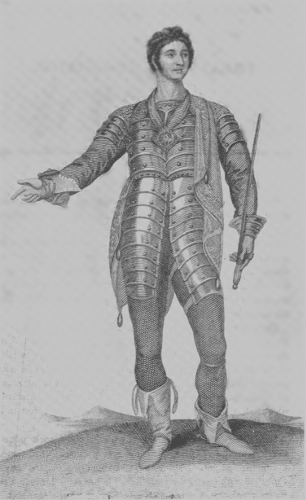
WILLIAM AUGUSTUS CONWAY (AS HENRY V)
By Rivers after de Wilde, 1814.
From the Collection of A. M.Broadley, Esq.
Doctor, afterwards Sir George Smith Gibbes, physician to Queen Charlotte, and author of a Treatise on the Bath Waters, was one of the first explorers of the Bone Caves of the Mendips. He attended Mrs. Piozzi on her death-bed, as described by Mangin.
The Rev. Edward Mangin, who had been a naval chaplain, and Prebendary of Killaloe and St. Patrick's, was a notable dramatic critic, and at this time a recognised leader of the literary coterie of Bath. He was thus brought into close touch with Mrs. Piozzi, and the result of their intimacy was his Piozziana, published anonymously in 1833, now rather a scarce book, which contains many of her letters as well as his personal recollections of her later years.
Carlisle was the publisher of Tom Paine's Age of Reason, and other works of a like character.
Dr. Whalley's first wife had died in 1801, and two years afterwards he married a Miss Heathcote, who died in 1803. In 1813, when nearly seventy, he made a third venture by marrying the widow of General Horneck. The lady was of extravagant habits, and came to him in debt to the extent of some thousands, for which he found himself responsible. Mutual recriminations followed, and in 1814 he went to France, leaving his wife behind. A formal separation took place in 1819, after which he again went abroad, and died at La Fleche, 1828.
Of Byron she remarks in her Commonplace Book: "My own idea is that he resembles the Dead Man's skull animated by a Toad, and made to hop, in such a manner that it attracted notice from the Lord Chief Justice Willes, enabling him to detect a murder."
Sat. Night, 6 Nov. 1819.
Dear Mrs. Pennington will believe the torpor when I confess the Siddons' story not new to me, and it is quite in his character who once quoted Cowley's verses to me in conversation as descriptive of his wife's person.
Merab with spacious beauty fills the sight, But too much awe chastis'd the bold delight: Like a calm sea, which to the enlarged view Gives pleasure, but gives fear and reverence too.
"Too grand a thing." I hope some one will take your Grand Thing off your hands. We shall be wondrous rich if seven's the main. Your friend's fancies about seven are few in comparison with mine. Why seven is the perfect number, and the word implies and expresses perfection in Hebrew. Everything indeed goes by septenaries among us all day long. At seven years old the Baby becomes a Boy, changes his teeth, and his evidence is taken in a Court of Justice. Two sevens produce the change from Childhood to Youth, and the third emancipates the Minor. Don't ask me to go on; my conjectures would take 7 days writing, and all would not be finished this day seven-night. I enclose a Pound Note, and for the seven shillings it will be good luck to wait.
One would be frighted at your prognostics if you were a seventh son instead of an only daughter,—so sadly have the Rogers family justified your odd predictions.... Conway, poor fellow! will sure enough come to the case you assign for him:—work, and die nobly, or starve, and pine away. Old Bartolozzi, a veteran servant of our English Public, was censured for leaving us in the last years of his life. "It is because I know them," he replied. "Whilst I can work for them, and do what no one else can do, they will pay me liberally, and when my eyes fail, I may retreat to an Hospital erected for the Indigent Blind. I will," continued he, "go to Portugal, and accept a moderate annuity from the Sovreign." So he did, and died there,—out of an Hospital:—but Waltzing is better sport; so
The three black Graces, Law, Physic, and Divinity, Walk hand in hand along the Strand, and hum la Poule. Trade quits his Compter, Alma Mater her Latinity, Proud and vain with Mr. Paine to go to School. Should you want advice in Law, you'll little gain by asking it, Your Lawyer's not at Westminster, he's busy Pas-de-Basqu'ing it: D'ye want to lose a tooth, and run to Waite for drawing it? He cannot sure attend, he's Demi-queue-de-Chating it. Run, neighbours, run; all London is Quadrilling it, While Order and Sobriety dance Dos-a-dos.
Brackley or Brockley Combe I know by heart, and very pretty 'tis, and Cheddar Cliffs: more like good genuine mountains than most British imitations are. For your complaints, I do pronounce them the effect of shocks upon the nerves, and sorry am I that the sea air did you so little good. I certainly liked it, and found Weston very agreable, and 'tis the true Ton to say how the place agreed with Mrs. Piozzi. So it will now become the fashionable retreat for old-age and haggardism,—a new word of my own making.
Mr. Stone was a raging Democrate, an Enragé; so he is not wanted, we have enough such. I fear Helen deserves some whipping, but so we do all: as Hamlet says, "Give us our deserts, and who shall escape whipping?"[27]
What, I wonder, put me in mind of poor old long-dead Demosthenes Taylor, a Doctor in the Commons? The torpor, I suppose, for I can tell but one story of him,—who told no stories at all. Johnson said once, "That man had credit for knowledge, perhaps he possess'd it, but I have dined six times in his company, and never heard him utter but one word, and that word was Richard."
My story must necessarily be this. He lived a Scholar's life, you may conclude, threescore years ago at Amen Corner, near St. Paul's Churchyard; studying Greek books and collating manuscripts all morning; smoking his pipe at night, and indulging in a game at All Fours with a distant and dependant relation,—a young Surgeon in the neighbourhood. One evening they were at play together. "Doctor," exclaims old Taylor, "I have got the Belly-ache so bad, we won't above finish this game." "Right, Sir," was the reply, "take something very hot, and go to bed. If you are worse, call me. If not, I shan't come till Wednesday, for very good reasons." "Ay, ay, my lad; mind thy business," was the monitory answer; and they parted at 10 o'clock Monday night. On Wednesday young Stevens came, according to custom. The pipe was smoked, and the game played, and "Doctor!" exclaims our old Demosthenes, "dost remember how bad my Belly ached o' Monday night?" "Yes, sure, Sir; and I beg'd you to take something hot, and go to bed." "Why so I did, a great rummer-full of hot Brandy." "Heavens!" cried the Surgeon, laughing, "I did not mean so." "Well, young man, it cured me. I went to sleep, and lay very late in the morning, and have no feeling in my Belly now at all: none in the least." "Lord! Sir, how you alarm me! No feeling?" "No, on my honour." "Good God! Let me look at it directly." So he did. The mortification had spread rapidly, and good old Taylor was a corpse in four and twenty hours.
Dr. Whalley has seen me at last, and told his tale. The loss of Mrs. Lutwyche's good opinion hurts him; as to mine, it is nothing impair'd. What astonished me was his saying that he was annoyed by Creditors when we were at Mendip in the year 1813;—living like the Dukes of Bedford or Marlborough. Mr. Arnold or Almond, his fine Man, shewed Bessy and me twenty Pounds worth, not 20 lbs. weight of meat in the Larder one day, design'd, he said, for the stew-pan. Is it not time to beg and pray for torpor? Sensibility would drive one distracted, sure. So good night, and give my true regards to those you love best; believing me your fast-asleep Friend,
H. L. P.
Francesco Bartolozzi came to London from Florence in 1764, as engraver to the King, and was one of the Foundation Members of the Royal Academy. He left England to take charge of the National Academy at Lisbon, where he died 1815.
The Rev. John Taylor, LL.D., F.R.S., and F.A.S., was the son of a barber at Shrewsbury. He gained a Fellowship at St. John's, Cambridge, and became Chancellor of Lincoln, Archdeacon of Buckingham, and Canon of St. Paul's. His great work, from which he gained his sobriquet, was what was intended to be a complete edition of Demosthenes, published between 1748 and 1757.
The origin of Dr. Whalley's matrimonial troubles has already been explained: it was about this period that the final rupture took place. In the first of the so-called "Love Letters," written 1st September 1819 from Weston, to Conway at Birmingham, she alludes to the recent scandal of "old Mr. Whalley's wife running away from him, and settling in Freshford."
The reference to Helen Williams is no doubt connected with a letter written by her to Mrs. Pennington, dated 26th June 1819, mentioning that Stone was "now reposing in his grave," and giving an account of her life and connection with him, as previously quoted. She then proceeds to refer to the reconciliation of the long-parted friends. "How much in contrast with my sad details is your brilliant account of Mrs. Piozzi;—what a privileged mortal! But really you seem to me to love her much better than she deserves; what excuses the 16 years of separation? The fault must have been hers: she always seemed to me kind and warm-hearted, but with no deep sensibilities."
The lines on dancing are quoted from her Commonplace Book, where she assigns them, on the authority of Mrs. Hoare, to "Smith, author of Rejected Addresses."
4 Dec. 1819.
To no one else in the world would I have written, dearest Mrs. Pennington; but you are so good and so partial. Other friends can find signs enough of torpor. Miss Williams's Beau, as we call him,—Mr. Wickens,—found me fast asleep on the sopha; he is a good creature and was sorry:—said the world was now coming to an end most surely, when such symptoms attacked, in the middle of the day, your H. L. P. If it goes on, my favourites must contrive to do without me. Our old King came into the world but a short time before his dutyful subject who writes this, and who hopes to get away in his train—if possible.
I have little thought to bestow on Dramatick Exhibitions; but Mr. Mangin, who is a classical Scholar, and has leisure to amuse himself with those who provide pastime for the rich and idle, said, when Conway acted Coriolanus here, that he had never seen the Roman Toga worne so gracefully. He has not yet left London. Macready was a fine promising Actor when I saw him last, three or four years ago: a very gentlemanly man too. We dined together at dear Dr. Gibbes's.
Mr. Pennington has, I hope, taken a new lease. Gout is a pledge of long life, if long life be indeed desirable. I begin to find it very burthensome to myself and my attendants, out of whose power it is to alleviate anything I feel. Dr. Whalley will do well enough among nieces and nephews, devoted to him of course, if he has retained any thing to divide among them at the hour of dissolution.
The Dipper at Weston super Mare came here on a visit yesterday, bringing me Fish and Poultry; how good natured! But I hear of a still cheaper and more charming place along the Cornish Coast, where chickens for 6d. each may yet be had, and Fish for almost nothing.
Meanwhile the Great are not exempt from ill-health or cares, any more than we. A general mourning will come, consequent on the Duchess of Gloster's death as on that of the King, and both will alike ruin my wretched Fête;—a foolish promise! but I must keep it now, and it will be the last folly.
With regard to Politics, they go very ill no doubt. My long life can call up but one year in which the machine went so as to please everybody: and there was printed at the beginning of the new Almanacks these words, observed perhaps by no one but myself,
In seventeen hundred and sixty—tis written, All strife and contention shall cease in Great Britain.
In effect there was but this dispute in Parliament, whether our Success was the cause of our Unanimity, or our Unanimity the cause of our Success. And Garrick's song ending every stanza with
Cheer up, my Lads, with one heart let us sing Our Soldiers, our Sailors, our Statesmen, and King
shews the same spirit. I believe they were never so praised en masse but that one time, which nobody recollects except—Yours and Mr. Pennington's
H. L. P.
In 1760, the year of George the Third's accession, Pitt's vigorous administration had, for the moment, annihilated party feeling. Wolfe's victory at Quebec had terminated the French rule in Canada; the battle of Plassey had given us Bengal; the French power in Southern India was broken by Coote; the engagement in Quiberon Bay testified to our power at sea; and England stood forth as the first maritime and colonial power in the world.
Tuesday, 7 Dec. 1819.
Threatening me as you do, dear, nervous Mrs. Pennington, I will, I must write directly. But surely we are neither of us such younglings as to fancy things at 80 years old can go on as they did at 40. We might then be shown for a show. It would be silly to believe my inside possessed its pristine strength, and the want of that strength leads to various uneasinesses, ill-described in a letter. We will do as well as we can.
Meanwhile assure yourself that one wonder does wait upon your newly-restored friend. At fourscore years old her outside is the best of her. Dr. Gibbes is too wise a man to wish to attend much; he knows there is nothing to be done, and what would you have him do? Mr. Cam the Baby Catcher would have suited me better to-day. The late Duke of Glo'ster kept one in the house the last six weeks of his wretched life's wretched end.
Weston did me nothing but service; gave a power to the unelastic nerves, and consoled body and mind. All is as it should be, though I do not think Conway's all-expressing countenance showed him contented with the looks of his Patroness yesterday, when he dropped in among other morning callers. I will mind Mr. Pennington's good advice and yours, and not disappoint the Boys and Girls of their Gala.
Salusbury and his wife will soon be here, I hope you will like them....
There is a pretty Book come out, very pretty indeed, against the Blasphemers; but I will not put my feeble hand to the Ark, assure yourself. That women should keep silence in the Church is a good injunction, and should be obeyed now more than ever....
Bath, 10 Dec. 1819.
Well now, dearest Mrs. Pennington, I have got a complaint I can talk of, or write about—a sore throat!—tho' never out of this warm room since Sunday. I fancy it is caused by relaxation,—talking about you to Mr. Conway, who saw your charming letter.... Tho' I did say, in a prudent humour, that he should see as little as possible either of your letters or yourself....
How is your fortune going forward? Smilingly I hope; and how will my Gala get forward if I do nothing but write funny letters to Mrs. Pennington, instead of calling names over to fill up the Cards with, or sit and chat with dear Conway concerning past sorrows and future prospects. He says he is come to act Master Slender: and thin he is most certainly: but so young-looking, never. I hope we shall make a full house to witness his first performance in Coriolanus next Monday. Can't you come over anyhow without serious risque? It would be pity to miss such an exhibition, and your retentive memory has Kemble's mode of acting it well impress'd. Mine reflects back only one Scene, I think, and he never saw Emperor John in his short life.
The Salusburys come next Tuesday sennight, and where shall I get them lodgings? I am all in a fuss, as the Ladies say; and wish you were helping me to do the nothings I busy myself about.
The world looks white, but it is not the robe of innocence; gilt and gloom lie under, and will burst out—upon the thaw. Conway's account of Carlisle's tryal froze me with horror....
The last appearance of John Philip Kemble was at his Benefit at Covent Garden in 1817, so there is no reason why Conway should not have seen him, though perhaps not in the part of Coriolanus.
Fryday night, 17 Dec. 1819.
.... On Wednesday Conway acts Iachimo to Warde's Posthumus. They neither of 'em ever performed the characters, and it will be a pleasure worthy of Mrs. Pennington. How will you manage? Better make business subservient to enjoyment, and come. The Coriolanus electrified us all; and my amiable friend gets admirers and invitations every day. We spent our last evening at the Fellowes's. The Hon. Mr. Burrell there promised to introduce him to some Club of Gentlemen, who will all attend when Benefit time comes on, and will, I hope, compensate him in some measure for his past sufferings....
I suppose [the Salusburys] will just come time enough for my Foolery, which plagues me to death already. "Would it were night, Hal! and all well!"[28]
John Prescott, who assumed the additional stage-name of Warde, had appeared at Bath in 1813, and till shortly before this date had been acting at the Haymarket. Mrs. Piozzi had a great admiration for his talents, and had helped to organise a Benefit for him in March.
Monday, 20 Dec. 1819.
Well, dearest Friend, I sent your letter to Conway, who is already in love with you, and wishes the impression he has already made not to be taken off by Iachimo. His wishes of being presented to you are most warm and cordial; he thinks you love his little Patroness, and I feel happy in the fancy that you will one day love each other, and talk confidentially concerning your poor H. L. P. when she is supposed to be far out of hearing....
My winter is not tedious for want of engagements. I am torne to pieces with invitations, and am forced to dine at Archdeacon Thomas's on Thursday, when I wished to be in the Theatre: but our Friend says we have time before us. So he has, if it please God, and so have you; but 80 years of my life are past, and I wish this winter was past too, that spring might make our intercourse more easy.
My Ball and Supper begin to be a plague to me, but I somehow hope and fancy that they may be of use to him whose welfare is really very near the heart of yours faithfully,
H. L. Piozzi.
In a note written three days afterwards Mrs. Piozzi announces that she and Conway are hoping to pay Mrs. Pennington a visit the following week, and then goes on: "Mrs. Stratton bore true witness to your impatience of our Separation; and indeed when the fine Statue we disagreed about has been pulled down a dozen years!!! 'tis fit the cobwebs should remain no longer." Can this really have been the origin of a misunderstanding between two sincerely attached friends, which lasted for fifteen years? It seems almost too ridiculous, but is the nearest approach to an explanation of the mystery afforded by the letters.
In spite of a snowstorm, the proposed visit was duly paid, and Mrs. Pennington writes to be assured that Mrs. Piozzi had taken no harm, and to express her pleasure at the meeting. "It was an hour of true, intellectual enjoyment, of real happiness." Conway evidently made a very good impression. "Of your Friend and mine, since so kindly permitted to use the, to me, always sacred distinction, I can only say he appears worthy of all the esteem and regard he has been so fortunate to obtain in your opinion. If that fine, ingenuous countenance, conciliating voice, and gentle, elegant demeanour deceive me, I will never trust to those tokens again. There is a certain something in his appearance that interests me more strongly in his happiness, than I ever felt on so short an acquaintance; and I long for an opportunity of discussing with you, dearest friend, those points that are most immediately connected with this object."
P.M. Dec. 30, 1819.
My dear Mrs. Pennington is a kind and generous friend, but her anxiety was superfluous. We got home without an atom of anything resembling alarm, or cause for it; and found the way short—I speak for myself—it was shorten'd by talking of you. Conway does certainly merit all our care, and all our admiration; may he be as happy as deserving!...
How good Mr. Pennington was to us! and all your friends: and how far from cold it was going home with that Eider Down bag that covered us so. I wonder where such things are to be had!...
The Salusburys will not come this fortnight, the Ladies God knows when....
In a letter, dated "Friday the last of 1819," Mrs. Pennington writes: "Remember me kindly to dear Conway, towards whom I feel disposed to indulge more kindness than I ever thought to entertain again on so slight an acquaintance. I hope personal knowledge has not injured the impression your partial friendship sought to create on my part. On his, the materials, all in prime keeping, are too excellent and admirable to admit any doubt on the subject. But we are, alas! something fallen into 'the sere and yellow leaf,' and cannot cope with these summer blossoms. If however not downright scarecrows to the young, 'the beautiful, and brave,' we may at least be useful land-marks and monitors, if they will permit us. Pray tell him from me, that in the experience of more years than I think it necessary at this moment to enumerate, I never knew either man or woman compleatly ruined until they were married. Observe, I do not say nor always so then, and I heartily wish him the best luck in the world in that fearful and doubtful Lottery. But I entreat him, by the friendship you have united us in, that he will not be hasty in chusing his Ticket, and that he will endeavour, as coolly and dispassionately as possible, to examine the Number before he makes his election.
"The Eider Down that was so comfortable to your dear Friend, I imagine can be procured at any of the capital Furriers, at least in London, tho' I know Paris is the place to get them in perfection. A Lady of my acquaintance purchased a delightful Pillow there, of an immensely large size, which wrapped about her head, or feet, or served her as the warmest and lightest coverlid possible. The Custom House Officers took it from her at one of the Ports, and she was fearful of not getting it again, or at least not without a heavy premium; when, strolling about, she happened to look into the Custom House to make some enquiries. No one being there, and seeing her treasure of a Pillow lying in a corner, she clapped it under her arm, and walked off with it, fortunately unmolested, on the principle that every one had a right to their own."
In a postscript she expresses a wish that "my dear, and pretty Maria Brown ... was rich enough for our Conway, I would trust his happiness with her."
2 Jan. 1820.
No proof more perfect can be given or received, dear Mrs. Pennington, of our hearts being well united once again, than your sudden as surprising impression in favour of our common Friend's happiness. I have studied nothing else since I knew him: yet must confess his power of raising such real interest is a singular one....
I passed yesterday at Mrs. Lutwyche's, and missed the Comus my heart was set upon, but Sir James Fellowes dropt in while I was writing this letter, and said it was inimitable. "Ay," replied I, "the Scholar's correctness, levigated by the Wit's elegant hiliarity." The answer was that Conway should have a patent for acting, and I should have one for praising him....
A few days later Mrs. Pennington paid a visit to Bath, and on her return was escorted home by Conway. She gives her impressions in a letter dated January 17:
"We had as pleasant a ride as it was possible to have on a road that carried me 12 miles from you. So interesting was our conversation that we felt no cold, and were surprised when we reached the end of our little journey. You may easily guess our subjects; but I am sorry to say that in the discussion of certain points, I cannot find reason to think our dear and amiable Friend so near the goal as your ardent and benevolent spirit is disposed to believe. The fair lady is, I have no doubt, as amiable as he conceives her; but the timidity and diffidence which renders her more lovely in his eyes, creates obstacles and difficulties that demand a bolder spirit, and more self-confidence than she possesses, to overcome. Love, all powerful love, which sees in the object the ultimatum of all its wishes, and overlooks all contingent and subordinate circumstances, only can do this. We shall see whether such is hers. Such only, in my opinion, can deserve the man who gains, every hour that I see more of him, such an increasing interest in my regard, that my anxiety for his happiness is become painful. My dear Husband is highly taken with his fine manners and intelligent conversation. He says he has seen no such man since the prime days of his friend, Governor Tryon, who was reckoned the handsomest man and finest gentleman of his time.
"Oh! no Lady need fear she can lose consequence by the side of such a man, who will always cast a lustre about whatever profession he may follow. Perhaps it is the very circumstance of holding the power of decision wholly in her own hands, that renders her so cautious, lest others should suppose she has not used the responsibility wisely. Oh! love, real love, knows no such reasoning as this! you know, dearest friend, it does not.
"I am on very ill terms with myself respecting the silly speech I made about your pretty Silver Tea Pot. You have shown me you cannot leave it me, and I will not deprive you of the use of it. That would be foolish indeed; for I want no remembrancer of you, and have many: besides I do verily believe I am not likely ever to receive it on the terms I asked it. Sincerely and fervently do I pray and believe you have many more years before you, than I have any right, from constitution and the present state of my feelings, to reckon upon. And it would be worse than absurd to rob you of an article of daily use, to throw it into the hands of other people. All I can consent to therefore is, that you continue to use it, dear Friend. Long may you do so, and should the most fatal deprivation I can now ever feel (but one) befall me, desire Betsey to deposit that with dear Conway's watch, and I will drink my tea from it for the rest of my life, and mingle my tears with the fragrant libation."
The teapot was destined to be a source of much heart-burning, as will be seen later on.
Tuesday, 18 Jan. 1820.
Well, dearest Mrs. Pennington, you sent home our favourite Friend ready to cry: he! whose business it is to make us all cry. But he swears you were so pathetic, and your kindness—so kind! His spirits required spurring for the evening at Mrs. Pennell's. I have not seen him since, save on the Stage....
If the Salusburys are not snow'd up upon the road, they will be here to-night: how shall I thaw them? We will make them a little no Party for the 20th....
Conway surpassed himself in Pierre last night; he has long left all others behind. It would grieve me should he meet mortification where he looks for happiness; though such things do befall the wise, the witty, and the beautiful. I wish he would stand prepared for endurance of an evil 'tis possible may be hanging over him. I have no guess how matters stand but as he tells me; and to-day his not calling, added to your letter, gives me apprehension.
Adieu! I have been to the cold Rooms arranging my supper, etc. Oh Heavens! what a foolery! It will utterly ruin your poor
H. L. P.
Something appears to have gone wrong with this letter, as Mrs. Pennington writes on January 20 in an agitated strain to enquire whether Mrs. Piozzi's silence is due to "a return of those frightful Cramps," or some other ailment. "Keep me not [in] suspense," she continues, "it is not wise to indulge so intense an interest as that I feel for you, and all that relates to you. I live on your letters, and literally think of nothing but you, and our common Friend. Would to God he was as deeply seated in the heart of his Beloved as he is in ours! But is it reasonable to expect that a mere girl should be able properly to appreciate the rich treasure of his love. No, it requires something more, rather more mature in judgement, discrimination and feeling. I was willing to be sceptical as long as I could, as to the nature of his attachment, and its extent; but I am convinced it is ardent, pure, and deep-seated.... She cannot know the value of such love by the objections she makes, and the indecision of her conduct. She thinks perhaps that the next Lover will love as well; but if she lets him go she will lose an unique, a noble fellow, and find too late that such love is seldom any woman's lot, and never more than once.
"I cannot think what has created such an interest in my mind;—yes, I can,—it is you, who have been, and are almost (I must not for shame say more) everything to me.... Give my love to the Chevalier [Conway], Did he tell you that after all the confidence reciprocated in our pleasant ride, I sealed the bond of friendship we have sworn with a kiss (as chaste as Dian ever gave) at parting, which he was to leave on your dear hand?"
Mrs. Piozzi's letter, written on Tuesday, did not reach Clifton till Friday, January 21, when Mrs. Pennington writes complaining of the bad management of the Bath Post Office, and then touches on the subject of Mrs. Piozzi's great Birthday Fête.
"I begin to feel considerable uneasiness on the subject of your Gala. I fear indeed, dear Friend, you will be run to an enormous expence.... I have enquired, and know that the thing was done at Clifton, and very handsomely, at half a Guinea per head, wine included: for after all there is very little drank at a Supper where women are the half, or larger proportion of the company." She then returns to Conway's affairs. "Entre nous, I cannot persuade myself the girl has spirit or stamina to set her above, and carry her through those disadvantages which others (called the World) would see and condemn in such a connexion. If she insists on his giving up his profession, he is shorn of half his beams; more especially as her fortune will not supply that independent respectability which would be some compensation for the loss of the eclât he cannot fail of deriving from the exertion of his talents. If she cannot make up her mind to take him as he is, I verily think she does not deserve him. The objections she lays stress upon are not to be found in Love's Calendar...."
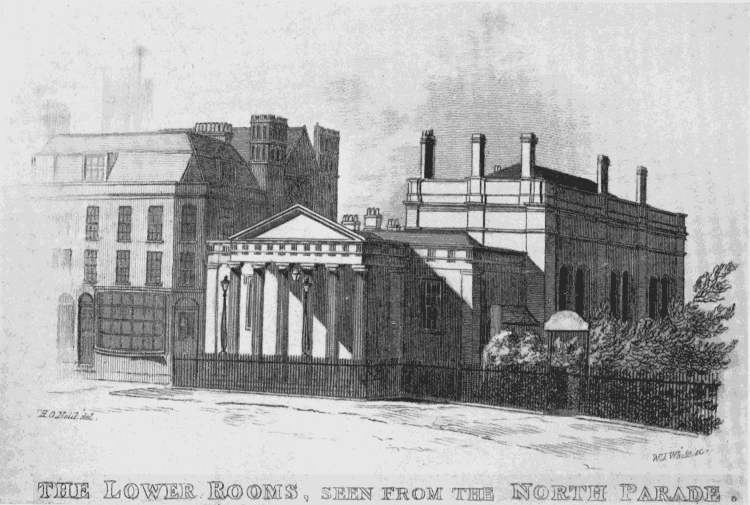
The LOWER ROOMS, seen from the NORTH PARADE.
By W. J. White after H. O. Neill.
From the Collection of A. M. Broadley, Esq.
Fryday, Jan. 21, 1820.
.... Don't be alarmed. Our Chevalier will do well; I hope in every sense of the word. But happy or unhappy, he will do right I am sure, and more than well. James Harris says, you know, nothing can happen that shall prevent a wise man from behaving wisely, an honourable man from behaving honourably; and for his conduct I will stake my life.
He must be diligent to-day, for he is to act Mark Antony to-morrow, and you will not see him, which will mortify us both, but he had no notice till this morning....
I am sick of my Foolery before it begins, very sick indeed, tho' people send me kind encouragement too....
James Harris, M.P. for Christchurch, whom Johnson set down as "a prig, and a bad prig," is best known as the author of Hermes, of which he gave Mrs. Piozzi an interleaved copy before her first marriage.
Monday 24.
My dearest Mrs. Pennington must stay over Saturday; our Chevalier comes out in a new character, and seems to like it. His Mark Antony transcended all I ever saw of scenic perfection,—dramatic rather. The tender pathos with which he said, "Oh! pardon me, thou bleeding piece of earth,"[29] was beyond all praise, and Lady Salusbury liked it. Sir John seems to consider Conway as much inferior to Warde in beauty, voice, and action: and the Chevalier's bright eyes, seeing how opinion goes, drop when he enters the room. They have dined but once together indeed, but both can see into a mill stone as far as most men. We meet at Bourdois' and Burney's to-morrow, and he acts Moranges on Wednesday. He will be introduced to the Masonic Honours on Thursday; and then give you, whom he justly adores, the meeting at my Concert. If he does not dance with the proper Partner, it will vex you and me both: but he will—surely he will. Meanwhile here's a flood to fright one. He, and all the people at the bottom of our town are in real danger....
The weather hurts everybody, and the applications to me for cards make me, like Othello, perplex'd in the extreme.[30] Here comes a tempest of visitants; no gloomy sky keeps them away....
On the following day Mrs. Pennington replies:
.... This weather will thin your room and lessen your expences, notwithstanding the unreasonable demands upon you for additional cards of admission. One half of the people originally invited will be laid up in their beds, as my dear Husband is at this moment with the Gout.... There is not now a chance of his being able to move by Thursday ... I am more than sorry, I am grieved! I feel nobody amongst numbers without my Husband. He will not however hear of my staying at home. He says I must have the satisfaction of seeing you in your glory, surrounded by all those who best love, and most admire you....
Every tribute paid to the dear Chevalier delights me.... I am perfectly up to the preference given to Warde's talents and beauty. I foretold it. Our favourite is so very superior that he is much more likely to excite envy than admiration from his own sex. In this instance it is indeed Hyperion to a Satyr....
Ah! I am just informed of the sad news. The Duke of Kent is no more! What heavy afflictions fall on the House of Coburg! That poor Lady, left a stranger in the land, is much to be pitied! They were happier, as married people, than those of their rank can in general boast of being....
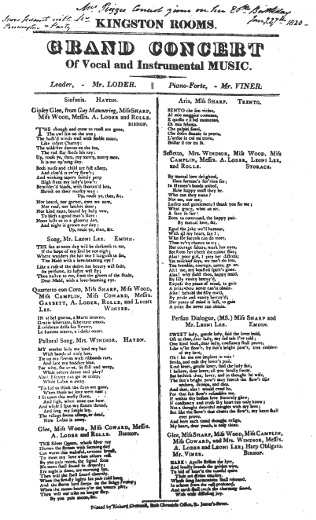
PROGRAMME OF MRS. PIOZZI'S CONCERT, 1820
WITH MS. NOTES BY MRS. PENNINGTON AND MARIA BROWN
Her great fête to celebrate her eightieth birthday passed off most successfully. The concert, ball, and supper drew a crowd of over 600 people to the Assembly Rooms on January 27. Her health was proposed by Admiral Sir James Saumarez, and received by the company with three times three. She opened the ball with Sir John Salusbury, dancing, as Mangin remarks, "with astonishing elasticity," but in spite of her exertions the callers next day found her as well, and as mirthful and witty as usual.
Conway was present among the crowd, but in such a state of suffering, mental and physical, as prevented him from enjoying the entertainment himself, or contributing to the enjoyment of others. A letter from Mrs. Pennington dated Sunday, January 30, gives an account of a visit she had paid him the previous day, just before her return to Clifton, when she found him "like 'mobled Hecuba,'[31] hooded up in handkerchiefs and bandages," suffering from what she calls a tumour.
Sunday, 30 Jan. 1820.
My dearest Mrs. Pennington's sweet silver tongue has done our noble blooded, noble minded Friend more good than all my written wisdom. He promises me now explicitly, (and Conway will keep his word,) that he will in all things take your advice. "Kind, charming Lady!" is his expression, "she has bound me to her with ribs of steel." ...
What a world it is! and you, and I, and he all proud of our talents, if we would confess it. Fine folly!
Is it of intellectual powers, Which time developes, time devours, Which forty years we may call ours, That Man is vain? Of such the Infant shows no sign, And Childhood dreads the dazzling shine Of knowledge, bright with rays divine, As mental pain. Worse still, when passions bear the sway, Unbridled Youth brooks no delay, He drives dull Reason far away, With scorn avow'd. For forty years she reigns at most, Labour and study pay the cost; Just to be raised, is all our boast, Above the crowd. Sickness then fills th' uneasy chair, Sorrow succeeds, with Pain and Care, While Faith just keeps us from despair, Wishing to die. Till the Farce ends as it began, Reason deserts the dying man, And leaves,—to encounter as he can Eternity.
.... Bessy's increasing illness grieves me. Dr. Gibbes tries to save her from Consumption. We could not call him sooner. She is now cover'd with Blisters, after which come Leeches and James's Powder, with orders to eat nothing at all but—Milk.
The noble blood attributed to Conway evidently refers to a story, mentioned later by Mrs. Pennington, that he was a natural son of one of the Marquis of Hertford's family. He appears to have made an attempt to obtain some acknowledgment of his relationship from his putative father, but without much success; and the failure may have had something to do with his determination to leave England.
King George III died on January 29, six days after the Duke of Kent, and the new king, who was too ill to be present at his father's death-bed, nearly followed him to the grave. He had caught a severe chill, and to relieve the inflammation his medical advisers saw fit to relieve him of 130 ounces of blood, which all but killed him. Yet he was convalescent by February 6.
On February 2 Mrs. Pennington writes: "Your verses, my beloved Friend, are above all praise, for yours they must be, as no one else can delineate such profound thinking with the same ease and perspicuity. The late events do indeed give a grave and solemn tone to one's reflections, and these awful death-bells sounding from every quarter in one's ears, fill me with trembling apprehension for everything that is near and dear to me. I rejoice that George IV was not proclaimed on the anniversary of the Martyrdom of Charles the Ist. To my easily alarmed mind it would have seemed frightfully ominous!...
"I do not wish [Conway] to be in too much haste to renew his visits in Camden Place. I would strongly recommend him to play a back game, and see how absence, and some degree of solicitude, which surely his illness must excite, operates there. It is of the first consequence to his and to her future peace and happiness, that she should be able to appreciate, and he to ascertain, the degree of affection existing on her part. If she has mistaken the sentiment, I think she will now be able to detect the mistake; as nothing is more likely to bring out the truth, than any real or imaginary danger respecting the object. And if the same futile objections remain, depend upon it she has mistaken the feeling, whether she knows it or not, and she would do better to put an end at once to all suspense on the subject...."
3 Feb. 1820.
I am glad dear Mrs. Pennington approved my Verses, your taste is so good. They are like lines written in 1712, not at all of a modern sort. You have seen our Chevalier since I did; he keeps close, and Bessy, whom I sent to comfort him in his illness, brings me no good accounts. She is bad enough herself, poor girl, but pities him: I wish they were both at Clifton under your care....
Death is near us all, and after death, judgment. Poor Mr. Eckersall has had a stroke of Apoplexy or Palsy, but the family seem little aware o'nt: and I was seized with such a lethargic stupor after dinner yesterday at Dorset Fellowes's, I was forced to play Loo to keep myself awake, and lost four shillings....
This Recess, shocking as the cause may be, is fortunate for our Chevalier; and I hope he will shine out and dazzle all beholders at his Benefit. Don't you remember Siddons saying she never acted so well as once when her heart was heavy concerning the loss of a child?
I break off to say the present King is dying. God's judgments are abroad. Write to dear Conway, and with your sweet eloquence persuade him to sink all thought of his own calamities in those of the Nation he is an honour to....
On February 5 Mrs. Pennington replies. "Your letter, dearest Friend, nearly paralysed me. Poor Bessy ill!—Dear Conway no better!—Everybody sick or dying! I am absolutely ill with terror and solicitude! I was quite afraid to enquire for the Papers to-day but, thank God! the accounts of the King are more favourable.... The first impressions I had of perfect manly grace, and princely dignity, were drawn from the fine form and gracious manners of our present Sovereign. Early impressions are always the most lasting. Never have I seen, but in our favourite, dear Conway, anything to compare with him, nor ever shall I see his equal again; and I feel that my affliction would be almost personal grief, should anything fatal happen to him at this time.... God, of his mercy, avert this great additional calamity from us, I most heartily pray....
"Everybody was pleased with the respectful and affectionate attention [of Sir John Salusbury] at the Ball.... I was surprised at some hints dropped at the chagrin he felt on the subject of your increased acquaintance; and could not help telling him, tho' in perfect good humour, that my claims in that line were prior to his own. I was sorry I did not recollect to observe to him, that it was a maxim of Dr. Johnson's, whose wisdom no one could question, 'that we should renew, and keep our acquaintance and our friends in repair, as we did our wardrobes, because they would wear out.'"
Bath, Sunday 6 Feb. 1820.
Bessy is safe, dearest Mrs. Pennington, by dint of bleeding, starving, blistering. Bessy is safe, ... and our noble-minded, tender-hearted friend ... is better too; I shall not outlive all that love me. It is a trying time, and some affliction falls on every family, the Royal Family worst.
As if Misfortune made the Throne her seat, And none could be unhappy,—but the Great.
Of the present Sovereign I know nothing personally. From the old King I got a kiss when presented, and the late Regent made application thro' Murphy, for my acquaintance 20 years ago. But as Mr. Thrale's daughters were then upon a visit to Streatham Park, and not their own Father master of the house, I declined all such honours: and therein acted wisely, which I seldom do....
What you say of an exacting, authoritative friend is most true. One thinks immediately of Marmontel, "Je baisse les liens de l'amitie,—j'en redoute la chaine." I'm willing still to kiss the links of friendship, but from the chain I fly. Those I have never found me exacting, or (without request,) interfering. Friendship is far more delicate than love. Quarrels and fretful complaints are attractive in the last, offensive in the first. And the very things which heap fewel on the fire of ardent passion, choke and extinguish sober and true regard. On the other hand, time, which is sure to destroy that love of which half certainly depends upon desire, is as sure to increase a friendship founded on talents, warm with esteem, and ambitious of success for the object of it. Such feelings depend on the merit of the man or woman that excites them, and can be dull'd only by their conduct.
So here's a fine heap of wise nothings, as you call your own preachments,—which I hope our dear Chevalier will thank you for.
The King is safe,—as well as Bessy. Equal in the sight of Him who created and redeem'd them: very unequal in importance to those who look up to them for support and assistance.
They live however, and so for awhile does dear Mrs. Pennington's poor old Friend
H. L. P.
Mrs. Pennington replies in a long letter dated February 9, from which it appears that Conway's love-affair had come to the conclusion she had anticipated. Miss S[tratton] could not stoop to the position of an actor's wife, and insisted on his abandoning his profession, if he was to aspire to her hand, a step which he could not bring himself to take. While full of sympathy for the suffering this decision had caused him, she is quite convinced that, as far as his career is concerned, it is all for the best, and concludes thus:
"I shall hate a Miss something more to the end of my life for his sake, and what is worse, notwithstanding the just and high regard he entertains for you, and his new liking for me, I fear he will contract a hatred for Bath, and I shall see little more of him for the rest of my life: and then what a silly thing have I done to interest myself thus deeply in his concerns! The most astonishing thing of all is the power he possesses of creating so strong and pure an interest in his favour, especially with me, who have long since ceased to feel the influence of that sort of enthusiasm, and am become fastidious from disappointment. In very few instances have I ever experienced the attachment I feel to him! It seems as if that Girl alone was exempt from the power of the magic he bears about him. Well, let her go!—sit down at ease with a Country Squire, 'suckle fools, and chronicle small Beer.' ... But as you say, while we do right, and honourably, and wisely, (and when he has recovered the proper use of his reason—I am sure he will do,) all will ultimately go well, and better than if it had gone our way, depend upon it."
The two "Love Letters," so called, written to Conway on February 2 and 3, when read in connection with those to Mrs. Pennington, show not Mrs. Piozzi's doting fondness for the handsome actor (as the Editor evidently desired to insinuate), but her deep concern for his welfare, and her anxiety lest he should damage his professional prospects by giving way to despondency or despair as the result of his rejection. In the first she subscribes herself "your more than Mother, as you kindly call your H. L. P." In the second she mentions having received a call from the Strattons, and that she could not bring herself to touch the hand of Mrs. S., whom she evidently held responsible for the rupture. She refers to them in her Commonplace Book, in a passage evidently written about this date. "Strattons, a family here, pretended passionate love [for Conway,] and I thought them in earnest, ... dined with me yesterday, and said all was over, because the girl's friends would not agree to the connection." The words in brackets have been carefully obliterated, but there is little doubt about them, as Conway's name has been similarly treated in several other places. The last of the "Love Letters" is dated February 28.
Thursday Evening, 10 Feb. 1820.
My dear Mrs. Pennington's prognostics are always wise, lucky, and fulfilled; and I doubt not but we shall lose our accomplished Chevalier,—after this Season,—for ever. Let us get him a good Benefit first, and send him down the wind, with fav'ring gales. I will leave, in the vulgar phrase, no stone unturned to serve him. Meanwhile he is in London, escaping our wise letters of good advice; of which, if now weary, he will on a future day be proud. The world is full of incident, and some good ones may illuminate his Drama.
Yesterday's post brought word that Lady Salusbury's Father was most alarmingly ill. To-day's post said he was dying. Yesterday at dinner Salusbury broke one of his fine teeth. To-day it was drawn, and they are gone to Shropshire. So runs the world away. Jealous of Aunt's favour, and glad to carry little Wifey far from that widely spreading influence which, as you say, throws an attractive halo round us all: which she feels among the rest, for who can 'scape? Sir John's chagrin won't kill him: and he says he will perhaps come again—by himself—but he will find enough to do at home.
Our Benefit will probably take place towards the end of this month. Conway comes back to open the Theatre with a swarthy face on the 18th, in a new Play written by Mr. Dimond;—St. Clara's Eve. That young man's brother, Charles Dimond, who I used to say resembled a Thames Smelt, and who has long been settled in London, marries a girl with £10,000, and pretty besides, a Miss Wood. Leoni Lee too has found a maid with the love-beaming eye; he took her to St. James's Church yesterday.
The King's calling to his bedside the Duke of Sussex is a pretty and a tender anecdote. "My Father and my Brother are lying dead now," said he, "your life, my dear Augustus, is very precarious, my own saved almost by a miracle. Let us not quarrel more with each other, while Death is at hand so to quarrel with us all." Everybody says that Prince's amiable son will marry a daughter of the Duke of Montrose.
I hope you will begin the next month with me, under St. Taffy's influence: and if you invite me early in the Spring, when our tall Beau is gone, or going, I will come to Clifton, and escape visitors. My door never rests here, and when once out of town, they may knock in vain. But till the Theatre is shut, or the great Light of it extinguished, the halo hangs round me, and I shall neither be willing nor able to stir. The less indeed, because persuaded that his return hither, (unless either the Gentleman or Lady is married,) is very unlikely, and would perhaps be imprudent. I mean his professional return, as now, in the character of principal performer.
Adieu, dear Mrs. Pennington, continue to him your regard; do not willingly lose sight of him; your value is by him duly appreciated, and I depend on living long in both your memories. You will often talk together of yours and his true friend and faithful servant
H. L. P.
The "amiable son" of the Duke of Sussex, Augustus Frederick, born 1794, who took the name of d'Este, died unmarried.
On February 15 Mrs. Pennington replies in two closely-written sheets, full of indignation at the girl who, she is convinced, could never have felt any real love for Conway, or she could not have dismissed him without "one word of sympathy, one token of pity, or sentence of consolation." ... "It was most silly and illiberal to tell him 'she could not support the idea of being sunk in her rank of life, and looked down, on,' etc." ... "I trust, as Dr. Johnson would have said, he will never think of hunting down a Kitten again."
She goes on to refer to the story of his being the son of William Conway, an old college friend of Sir Walter James, who had remarked on the likeness between them. His reputed father must therefore have been Lord William Seymour Conway, sixth son of Francis, first Marquess of Hertford.
Sir Walter "said of his acting, that he was the best Pierre he ever saw, though he had a perfect recollection of Holland, who was thought perfection in the character. That he would advise him by all means to keep clear of the London Theatres for two or three years, and then burst upon them, a finished actor. He said it was remarkable they never received an Actor as such, whatever his merits, so young, or so young-looking, as Conway, until more matured by experience and knowledge of the business; and instanced Mrs. Siddons's failure in early life, Mr. Young's, etc. It was some years before Kemble made his way to the popularity he at last attained.... Sir Walter says your verses are the best he has seen of modern verses, and like those sterling things of 50 years back....
"I wonder what the generality of people would think if they were to pick up our letters?"
16 Feb. 1820.
Thank you kindly, dear Mrs. Pennington, for your kind letters. Our Chevalier longed to see them whilst in London, and I disappointed him by not sending them forward. It was the first pain I ever put him to, and it shall be the last. Our business is to soothe and solace, not to chide him, or add a particle to what he suffers. If female friendship is worth anything, let us benefit and please him all we can. Your part must be to advise, mine to console; and both of us will try to get him a blazing night, when once the time is appointed.... Sir Walter James is very unwell, and I am sorry for it. He always instinctively loved our friend Conway; and the last time we changed a word about him, his expression to me was, "I think that young fellow is all that a man ought to be." ...
Sir Walter James Head, of Langley Hall, Berks, who assumed the name of James, and was created a Baronet 1791, was the great-grandfather of the present Lord Northbourne.
On February 18 Mrs. Pennington writes: "I begin now to get very anxious on the subject of our Benefit. I know, by experience, that only general and simultaneous impulse will fill a Theatre or a Ball Room. The Pit and Galleries are prime objects, a showy play is the best attraction there. The boxes there can be no doubt about, and Bessy must exert all her influence with your tradespeople, not only to take Tickets for the other parts of the House, but to dispose of as many as they can. Not a word however about these sordid matters to our high-minded Friend, whose feelings I would not hurt in any way, intentionally, for the world....
"The King was saved to a minute! Dr. Tierney had the courage to do what others durst not hazard;—but his worst sufferings, I fear, are yet to come with that bad woman,—and what mischief have not such women effected? The Duke of Berri's assassination has congealed us all with horror! It is plain that unfortunate family is to have no successor."
Another letter follows, dated February 22, written in much the same strain, and giving an account of a visit from Conway, who acted as the bearer of Mrs. Piozzi's last.
On the 24th Mrs. Piozzi writes a note to say that the Benefit is fixed for March 11, and to arrange for Mrs. Pennington's visit on the 1st. She concludes: "I hate such short letters, but my goose-quill,—poor old Goosey!—is moulting as it appears. The Pens and Paper are worse than ever I remember. Yours at Bristol are better perhaps, I'm sure it seems so."
Mrs. Pennington replies the next day: "What will the S—ns do on the Night? If they absent themselves, known and marked as they [have] been, as dear Conway's staunch and particular Friends, surely it will excite remark? And yet how can they be there? At any rate, if they are, I trust it will be in a situation not to meet his eyes;—I should dread the consequences, at least I know I shall feel it for him in every Nerve. You talk, (with little reason,) of Bath stationery! I cannot get a sheet of paper that is not greasy and full of hairs, nor a pen that will pass over them without blotting, and when I look at your beautiful writing, I think my own letters only fit to bolster up candles, or for the Pastry Cook's use."
As Mrs. Pennington was staying at Bath, there are no letters to give an account of the Benefit, but there is not much doubt that Mrs. Piozzi made it a success. She evidently returned with Mrs. Pennington to Clifton, and the next letter is written immediately after her return home.
Begun Thursday Night, 24 Mar. 1820.
Dearest Mrs. Pennington will be glad to hear that four horses, and three able-bodied men, brought my little person safe home ... at 9 o'clock last night. Had I died, like Mrs. Luxmore, of cough and strangulation, I should not have seen our tall Beau for 5 minutes after breakfast:—a morning call. He looked in high health and good spirits, said your eloquent praises had produced others, which Miss Williams sends me this moment, and I really think them very good indeed; he does deserve all praise in every situation,—in all situations of life,—and his adoring mother says he was from infancy the best boy upon [earth]. We had no time to talk of plans, present or future, [he] will go to London next week, whether to return again I know not....
Captain Marshall has got what he wished and wanted. How long will he be happy in the Prize he has so contended for? Mr. Mangin said to me once, that if he were to go to Heaven, (unlikely enough, added he,) it would be disagreeable to him for a week at least,—the first week,—but he should grow reconciled to it. Would not that speech make a good note to some of the observations in Johnson's Prince of Abyssinia? It would at least do well for Sophia Lee, whose misanthropism I reverence, while others ridicule it. Why should she let the people in to visit her, as it is called? She knows they come for curiosity, not from affection; and I suppose her means of doing good have been curtailed by accident, her powers of pleasing by infirmity and age. Why should she then exhibit the Skeleton of Wit?—or Beauty, if she ever possessed it? Is there no time when one may be permitted to die in a corner [after] arranging our little matters for the Journey? Lord! I [shall have] to expire in a Curtsey and a Compliment, and request the Spectators [to] honour me with their commands—to the next World....
Mrs. Pennington writes on March 26: "I was indeed glad to get your letter, dearest Friend, for tho' I entertained no fears for your personal safety, I was anxious lest the evening air should increase the choaking, and in great dread of dear Bessy's everlasting displeasure for suffering you to depart at half past 5 o'clock, without anything to sustain you on the way. There was more danger of your dying from inanition than suffocation. Poor Mrs. Luxmore was, I believe, a full liver. You and I shall not hasten the end of life that way. However we certainly carried the starving system to excess the day you honoured Dowry Square with your presence; for if we had had the common sense to have sat down to Dinner an hour sooner, you would have been tempted, from mere good humoured compliance with our wishes, to have taken something and a glass of wine to have supported you. But I was sick at heart, and could feel only regret at parting from you, and the rest of the party lost all their useful recollections in the pleasure of listening to you, and looking at you. They declared they would have gone without dinner for a week to have prolonged the gratification.
"Maria [Brown] is a paintress, and a really good amateur artist;—she says she cannot take her attention from your forehead and eyes,—the unfurrowed smoothness of the one, and the lucid, sweet, and bright lustre of those blue orbs, giving a youthful expression that might pass for 20! It is this that Jagher has hit off so happily, and that Roche could not touch. I must have a copy of that picture some day or other, if I sell my silver spoons, for my Tea Pot I will never part with; but mind, I am not begging, nor whining. I will never have it from your purse." ...
At the close of a long letter she returns to the subject of Conway. "Dare you hint to him before you part our only fear? and venture to tell him that your, and his saucy Friend says that if he goes to that odious Ireland, and pours as much wine down his throat as his strong head will bear, in a few years he will look like a moving steeple, with a blazing Beacon at the top? Oh! if he ever Carbuncles that beautiful nose, or heightens the natural colouring of that charming face, I will never give him another kiss. A tremendous threat, to be sure, considering the time I am looking forward to, especially as I am getting fast to poor Miss Wren's ashey tint: but I intend to be beautiful again one of these days. Ninon was charming at a much more advanced age, and wore spectacles as we do.
"I have been told I have a cast of her in my character, with a total exception, I beg leave to be understood, as to her physical and constitutional propensities, (as also to her erudition,)—but that she was fair and gentle, with my stature and carriage;—often serious;—generally rather tender, interesting, and amusing, than brilliant, tho' sometimes gay and sprightly,—
'From grave to gay,—from lively to severe.'
I wonder how all this nonsense came into my head?... If our dear Chevalier mars what God has made so exquisitely well, and stamped so clearly an impress of the Divinity upon, it will be a great sin."
28 March, 1820.
My dear Mrs. Pennington's gratuitous letter gives me the best certainty of her returning health and spirits. This answer to it will cost no more.
My health has little to do, at 81 years old, with cramming or starving, and if I am to be blest, as you seem to think it, with "second childishness and mere oblivion;"[32] to sit, like old Elspet in her wicker-chair, turned over by kind inquirers, like a last year's Almanack:—why, be it so! This is a week of mortification and resignation, and I will endeavour to endure the degrading idea....
The loss of his company and talents will be a great privation to me, but on his account my heart feels no fears. Conway's virtues are not, I trust, what Johnson would call ambulatory, meaning dependant upon climate and company. He will come home to you I hope, in seven years time, two or three little children at his side, his own incomparable soul unsullied, his merits unmolested, his beauty unimpair'd....
Mr. Hunt's being elected into Parliament is another tub for the whale; so if old Britannia, like her daughters, must live to be sick and superannuated, why, Henry Hunt and Horace Twiss may hold the smelling bottle to her nose.
I have at last seen a man who profess'd himself happy. It was Captain Marshall. But as he left me, and dress'd for the Member's Dinner, to which he went in a Sedan, a wagon overset his little vehicle, ran over his Chairman, breaking both his thighs, and brought him to the Hall—too late for Dinner.
Those who converse with the Great expect our King to be crowned on his birthday, the 12th of August. My dividends will be come in by then, and Salusbury may have his promised £100, to see the Coronation. I hate being worse than my word. Our friend Fellie may not perhaps find her Grandees so scrupulous. But she has had many assurances of the Herb-woman's place in the Procession, which I have heard was £400 or £500 o' year for life. She is a sweet Lady, but ladies are charming creatures, of course; yours most particularly so surely, when they think it fit to fling so much flattery away upon your poor affectione Friend,
H. L. P.
Hunt was tried for his share in the Peterloo meeting this year, and sentenced to two years imprisonment. He was, however, actually returned to Parliament for Preston in 1830, in which capacity he presented the first petition in favour of Women's Rights.
The actual date of the coronation was 19th July 1821, when "Fellie," otherwise Miss Anne Fellowes, the sister of Mrs. Piozzi's friend and executor, Sir James Fellowes, did officiate as Herb-Woman.
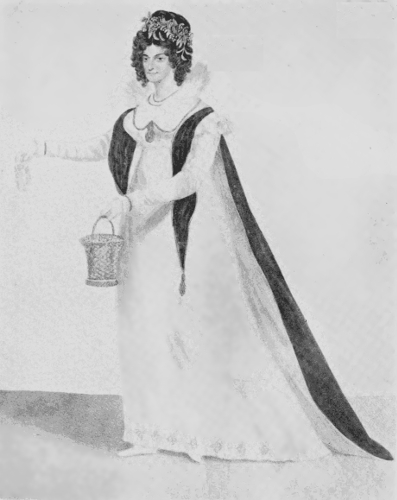
MISS FELLOWES AS HERB-STREWER AT THE CORONATION OF GEO. IV
By M. Gauci after Mrs. Baker.
From the Collection of A. M. Broadley, Esq.
Monday, 10 Apr. 1820.
My dear Mrs. Pennington is but too kind in excusing my peevishness, but this sharp weather freezes all my faculties: it is as cold as January ought to be. You will have a sad loss in Maria Browne, and I have a sad loss in dear Conway; and his steady resolution never to write is such a bad trick. Siddons has the same you know: and Dr. Johnson used to complain, I remember, of David Garrick. "One would believe," said he, "that the little Dog loved one, if it was only by conversation one knew him: but 'out of sight, out of mind,' is an old proverb, and they have all of them so much to do."
If my coming to Clifton depended on my being weary of Bath, you would see me soon indeed: but till July dividends I have no money for move-about. Lord bless me! I wonder how other people's Bank Notes hold out. Mine melt away like butter in the sun. 'Tis a great mercy that the Stocks hold firm with a well organised rebellion in the Island. In my time, had such a state of things existed, people would have laid down knife and fork, and fallen to praying: those I mean who did not fight either on the one side or the other. We do not now lay down even our Cards. My friend Dr. Gray however, whom you do, or you do not remember at Streatham Park, has taken serious fright, and fled to London with his family, from Durham; wishing to change his valuable living for one, even half as profitable, in the South. Altho' Miss Normans told me on Saturday, at Mrs. Pierrepoint's or Mrs. Courtenay's Assembly, that the Bishops were insulted going to Dinner with some of our Ministers of State, last week; and the circumstance created some alarm.
Mr. Eckersall says the Comte d'Artois' life has been attempted, and that it was gave the King of France gout in his stomach. Our gracious Queen's arrival may possibly produce a like effect in the stomach of Louis Dixhuit's personal friend.
... Miss Wroughton, in her zeal for Mr. and Mrs. Ashe, asked half a dozen amateur Gentlemen to mount the Balcony, and sing for their Benefit, because the Theatre supported by Mr. Young took all their best musicians away; just as her friends the Ashes, took away Mr. Windsor, etc.—if you recollect—from my Fête on the 27th of January. And so some laugh, and some are angry, but Miss Wroughton, tho' she cross'd me at every turn this Winter, begs me to take Tickets now for Mr. Ashe!!! I really wonder how she can think of such a thing.
Clifton must be a charming place, sure, where there is no such gossiping nonsense; and all the Devonshire coast too is so quiet, and Penzance in Cornwall will soon be fashionable;—it is so cheap, they say, and so warm....
You do not care much, I think, about these ridiculous reports concerning Queen Caroline; how she is coming—so she is—to do wonders unheard of till now: and Buonaparte!—how he's to be let out, a Bag Fox, for all Europe to hunt again. People find torpor worse than torture 'tis plain. They long for War, a property-tax and a battle in every Newspaper: rebellion and assassination are not hot enough. As Mr. Leo was constrained at last to warm his brandy with Cayenne Pepper before his stomach could feel any effect.
Bath, April 22, 1820.
Dear Mrs. Pennington will be glad to see the spring coming forward so sweetly. She will be glad, too, to hear that her true friends are well; the Little Old Woman, and the Tall Young Beau. She will be glad that the Parties grow hot and disagreeable, and that I feel longing for Clifton and the 10th of June. Whether we are to be glad of the recovery of the Great Lady I know not, for tho' her life does much good, her death—poor Dear!—would have done no harm. Do you remember an impudent Comic Actor on our Bath Stage? A Mr. Edwin, and we said he resembled Dr. Randolph in the face: and how when he was addressing the audience in an epilogue upon his own Night, he suddenly turned to her Stage Box, singing
And the Duchess, who now sits so smiling here Shall come to our Benefits every year. Tol ol derol, Lol, etc.
I never saw any fair Female so confounded in my life. You were with me.
How the ground and the trees do sigh and pine for rain! And what a haze this odious North East wind sheds over all my prospect! The people are right enough that go abroad. I would go myself, but that I have an appointment to keep with dear Piozzi, who I brought out of his own sweet Country, to lie in the vault he made for me and my Ancestors at Dymerchion; where I am most willing to keep him company, when I have performed more than all the promises I ever, in any humour, made his Nephew; and when I have, after paying every debt, saved a silver sixpence or two for those who soften and amuse the closing scenes of a life long drawn out,—perhaps for that very purpose. Meanwhile we have a church building here, for my particular friends, the Blackguards and tatter'd Belles of Avon Street, and my Subscription will be soon expected.