RURAL LIFE IN VIRGINIA: THE "SWALLOW BARN."
Reading edition
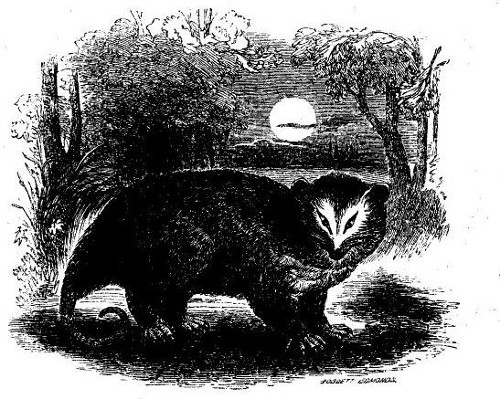
A CUB OF THE BARN-YARD
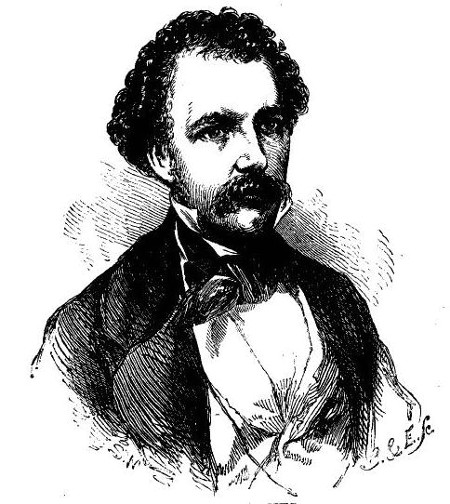
We remember no book of its class altogether more delightful than the "Swallow Barn" of John P. Kennedy. In Irving's "Bracebridge Hall" we have exquisite sketches of English homes, such sketches as could be drawn only by that graceful and genial humorist, but Bracebridge Hall is not in our own country, and we scarcely feel "at our own" in it, as we do in every scene to which we are introduced by the author of "Swallow Barn," the best painter of manners who has ever tried his hand at their delineation in America. The love of nature, the fine appreciation of a country life, the delicate and quiet humor, and hearty joy in every one's enjoyment, which those who know Mr. Kennedy personally will recognize as principal elements of his own character, are reflected in the pages of the book, and with its other good qualities make it one of the most charming compositions in the literature of the present time.
Mr. Putnam in a few days will publish a new edition of "Swallow Barn," profusely illustrated by Mr. Strother, an artist who seems perfectly at home in the Old Dominion, as if—which may be the case—all his life had been spent there. Some of these we shall transfer to our own pages, but first we copy in full Mr. Kennedy's "Word in Advance to the Reader":
"Swallow Barn was written twenty years ago, and was published in a small edition, which was soon exhausted. From that date it has disappeared from the bookstores, being carelessly consigned by the author to that oblivion which is common to books and men—out of sight, out of mind. Upon a recent reviewal of it, after an interval sufficiently long to obliterate the partialities with which one is apt to regard his own productions, I have thought it was worthy of more attention than I had bestowed upon it, and was, at least, entitled to the benefit of a second edition. In truth, its republication has been so often advised by friends, and its original reception was so prosperous, that I have almost felt it to be a duty once more to set it afloat upon the waters, for the behoof of that good-natured company of idle readers who are always ready to embark on a pleasure excursion in any light craft that offers. I have, therefore, taken these volumes in hand, and given them a somewhat critical revisal. Twenty years work sufficient change upon the mind of an author to render him, perhaps more than others, a fastidious critic of his own book. If the physiologists are right, he is not the same person after that lapse of time; and all that his present and former self may claim in common, are those properties which belong to his mental consciousness, of which his aspiration after fame is one. The present self may, therefore, be expected to examine more rigorously the work of that former and younger person, for whom he is held responsible. This weighty consideration will be sufficient to account for the few differences which may be found between this and the first edition. Some quaintness of the vocabulary has been got rid of—some dialogue has been stript of its redundancy—some few thoughts have been added—and others retrenched. I shall be happy to think that the reader will agree with me that these are improvements:—I mean the reader who may happen to belong to that small and choice corps who read these volumes long ago—a little troop of friends of both sexes, to whom I have reason to be grateful for that modicum of good opinion which cheered my first authorship. Health and joy to them all—as many as are now alive! I owe them a thanksgiving for their early benevolence.
"Swallow Barn exhibits a picture of country life in Virginia, as it existed in the first quarter of the present century. Between that period and the present day, time and what is called "the progress," have made many innovations there, as they have done every where else. The Old Dominion is losing somewhat of the raciness of her once peculiar, and—speaking in reference to the locality described in these volumes—insulated cast of manners. The mellow, bland, and sunny luxuriance of her home society—its good fellowship, its hearty and constitutional companionableness, the thriftless gayety of the people, their dogged but amiable invincibility of opinion, and that overflowing hospitality which knew no ebb—these traits, though far from being impaired, are modified at the present day by circumstances which have been gradually attaining a marked influence over social life as well as political relation. An observer cannot fail to note that the manners of our country have been tending towards a uniformity which is visibly effacing all local differences. The old states, especially, are losing their original distinctive habits and modes of life, and in the same degree, I fear, are losing their exclusive American character. A traveller may detect but few sectional or provincial varieties in the general observances and customs of society, in comparison with what were observable in the past generations, and the pride, or rather the vanity, of the present day is leading us into a very notable assimilation with foreign usages. The country now apes the city in what is supposed to be the elegancies of life, and the city is inclined to value and adopt the fashions it is able to import across the Atlantic, and thus the whole surface of society is exhibiting the traces of a process by which it is likely to be rubbed down, in time, to one level, and varnished with the same gloss. It may thus finally arrive at a comfortable insipidity of character which may not be willingly reckoned as altogether a due compensation for the loss of that rough but pleasant flavor which belonged to it in its earlier era. There is much good sense in that opinion which ascribes a wholesome influence to those homebred customs, which are said to strengthen local attachments and expand them into love of country. What belonged to us as characteristically American, seems already to be dissolving into a mixture which affects us unpleasantly as a plain and cosmopolitan substitute for the old warmth and salient vivacity of our ancestors. We no longer present in our pictures of domestic life so much as an earnest lover of our nationality might desire of what abroad is called the "red bird's wing"—something which belongs to us and to no one else. The fruitfulness of modern invention in the arts of life, the general fusion of thought through the medium of an extra-territorial literature, which from its easy domestication among us is scarcely regarded as foreign, the convenience and comfort of European customs which have been incorporated into our scheme of living,—all these, aided and diffused by our extraordinary facilities of travel and circulation, have made sad work, even in the present generation, with those old nationalisms that were so agreeable to the contemplation of an admirer of the picturesque in character and manners.
THE "SWALLOW BARN."
"Looking myself somewhat hopelessly upon this onward gliding of the stream, I am not willing to allow these sketches of mine entirely to pass away. They have already begun to assume the tints of a relic of the past, and may, in another generation, become archæological, and sink into the chapter of antiquities. Presenting, as I make bold to say, a faithful picture of the people, the modes of life, and the scenery of a region full of attraction, and exhibiting the lights and shades of its society with the truthfulness of a painter who has studied his subject on the spot, they may reasonably claim their accuracy of delineation to be set off as an extenuation for any want of skill or defect of finish which a fair criticism may charge against the artist. Like some sign-post painters, I profess to make a strong likeness, even if it should be thought to be hard,—and what better workmen might call a daub,—as to which I must leave my reader to judge for himself when he has read this book. The outward public award on this point was kind, and bestowed quite as much praise as I could have desired—much more than I expected—when the former edition appeared. But "the progress" has brought out many competitors since that day, and has, perhaps, rendered the public taste more scrupulous. A book then was not so perilous an offering as it is now in the great swarm of authorships. We run more risk, just now, of being left alone—unread—untalked of—though not, happily, unpuffed by newspapers, who are favorites with the publisher, and owe him courtesies.
"I wish it to be noted that Swallow Barn is not a novel. I confess this in advance, although I may lose by it. It was begun on the plan of a series of detached sketches linked together by the hooks and eyes of a traveller's notes; and although the narrative does run into some by-paths of personal adventure, it has still preserved its desultory, sketchy character to the last. It is, therefore, utterly unartistic in plot and structure, and may be described as variously and interchangeably partaking of the complexion of a book of travels, a diary, a collection of letters, a drama, and a history,—and this, serial or compact, as the reader may choose to compute it. Our old friend Polonius had nearly hit it in his rigmarole of 'pastoral-comical, tragical-comical-historical-pastoral'—which, saving 'the tragical,' may well make up my schedule: and so I leave it to the 'censure' of my new reader."
VIRGINIA MILL-BOYS RACING.
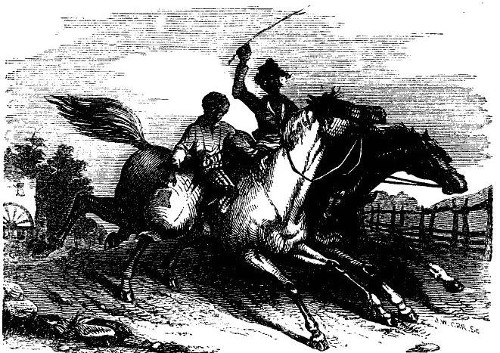
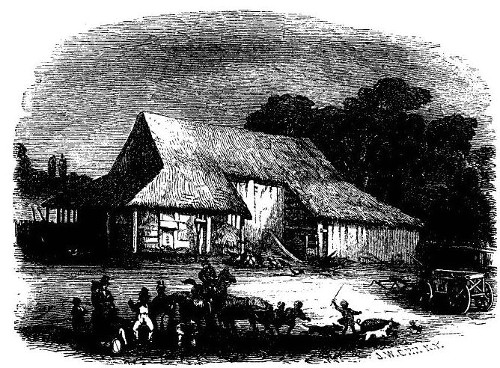
Here the history of the book is admirably told. The work itself, so full of truthful and effective pictures, offers numerous passages for quotation, but though we have nothing better to give our readers, we shall limit our extracts to a few scenes illustrated by Mr. Strother's pencil. We present first the old barn itself.
"Beyond the bridge, at some distance, stands a prominent object in the perspective of this picture,—the most venerable appendage to the establishment—a huge barn with an immense roof hanging almost to the ground, and thatched a foot thick with sunburnt straw, which reaches below the eaves in ragged flakes. It has a singularly drowsy and decrepit aspect. The yard around it is strewed knee-deep with litter, from the midst of which arises a long rack resembling a chevaux de frise, which is ordinarily filled with fodder. This is the customary lounge of half a score of oxen and as many cows, who sustain an imperturbable companionship with a sickly wagon, whose parched tongue and drooping swingle-trees, as it stands in the sun, give it a most forlorn and invalid character; whilst some sociable carts under the sheds, with their shafts perched against the walls, suggest the idea of a set of gossiping cronies taking their ease in a tavern porch. Now and then a clownish hobble-de-hoy colt, with long fetlocks and disordered mane, and a thousand burs in his tail, stalks through this company. But as it is forbidden ground to all his tribe, he is likely very soon to encounter a shower of corn-cobs from some of the negro men; upon which contingency he makes a rapid retreat across the bars which imperfectly guard the entrance to the yard, and with an uncouth display of his heels bounds towards the brook, where he stops and looks back with a saucy defiance; and after affecting to drink for a moment, gallops away with a braggart whinny to the fields."
The life led by the young negroes on the plantations of Virginia is generally easy, and of course utterly free from the cares which beset their youthful masters, compelled to pore over "miserable books."
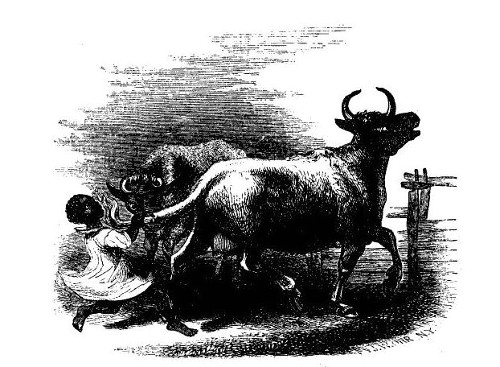
"There is a numerous herd of little negroes about the estate; and these sometimes afford us a new diversion. A few mornings since we encountered a horde of them, who were darting about the bushes like untamed monkeys. They are afraid of me because I am a stranger, and take to their heels as soon as they see me. If I ever chance to get near enough to speak to one of them, he stares at me with a suspicious gaze, and, after a moment, makes off at full speed, very much frightened, towards the cabins at some distance from the house. They are almost all clad in a long coarse shirt which reaches below the knee, without any other garment. But one of the group we met on the morning I speak of, was oddly decked in a pair of ragged trowsers, conspicuous for their ample dimensions in the seat. These had evidently belonged to some grown-up person, but were cut short in the legs to make them fit the wearer. A piece of twine across the shoulder of this grotesque imp, served for suspenders, and kept his habiliments from falling about his feet. Ned ordered this crew to prepare for a foot-race, and proposed a reward of a piece of money to the winner. They were to run from a given point, about a hundred paces distant, to the margin of the brook. Our whole suite of dogs were in attendance, and seemed to understand our pastime. At the word, away went the bevy, accompanied by every dog of the pack, the negroes shouting and the dogs yelling in unison. The shirts ran with prodigious speed, their speed exposing their bare, black, and meager shanks to the scandal of all beholders; and the strange baboon in trowsers struggled close in their rear, with ludicrous earnestness, holding up his redundant and troublesome apparel with his hand. In a moment they reached the brook with unchecked speed, and, as the banks were muddy, and the dogs had become entangled with the racers in their path, two or three were precipitated into the water. This only increased the merriment, and they continued the contest in this new element by floundering, kicking, and splashing about, like a brood of ducks in their first descent upon a pool. These young negroes have wonderfully flat noses, and the most oddly disproportioned mouths, which were now opened to their full dimensions, so as to display their white teeth in striking contrast with their complexions. They are a strange pack of antic and careless animals, and furnish the liveliest picture that is to be found in nature of that race of swart fairies, which, in the old time, were supposed to play their pranks in the forest at moonlight. Ned stood by, enjoying this scene like an amateur—encouraging the negroes in their gambols, and hallooing to the dogs, that by a kindred instinct entered tumultuously into the sport and kept up the confusion. It was difficult to decide the contest. So the money was thrown into the air, and as it fell to ground, there was another rush, in which the hero of the trowsers succeeded in getting the small coin from the ground in his teeth, somewhat to the prejudice of his finery.
DRILLING THE NEGRO BOYS.
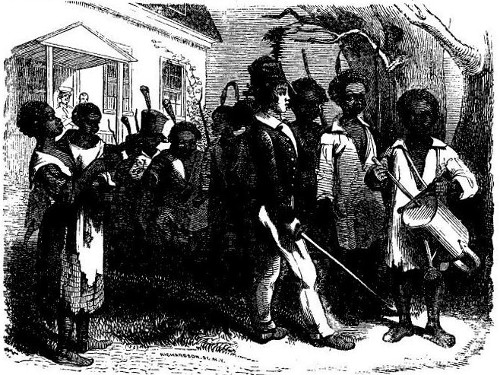
"Rip asserts a special pre-eminence over these young serfs, and has drilled them into a kind of local militia. He sometimes has them all marshalled in the yard, and entertains us with a review. They have an old watering-pot for a drum, and a dingy pocket handkerchief for a standard, under which they are arrayed in military order, and parade over the grounds with a riotous clamor."
TREADING OUT WHEAT.
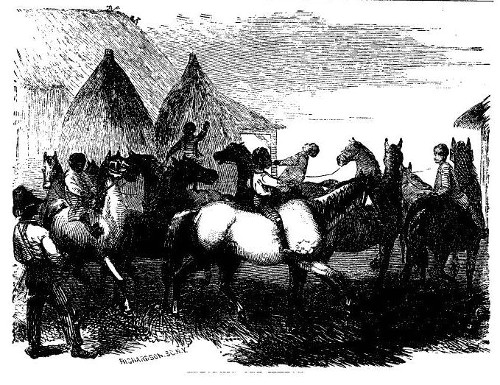
The farmers of Virginia are scarcely as far advanced in the application of science as the more active-minded Yankees, and among the ancient customs which still obtain among them is that of treading out grain with cattle. At Swallow Barn the operation is described:
"Within the farm-yard a party of negroes were engaged in treading out grain. About a dozen horses were kept at full trot around a circle of some ten or fifteen paces diameter, which was strewed with wheat in the sheaf. These were managed by some five or six little blacks, who rode like monkey caricaturists of the games of the circus, and who mingled with the labors of the place that comic air of deviltry which communicated to the whole employment something of the complexion of a pastime."
We hope this edition of Swallow Barn will be so well received that the author will give us all his other works in the same attractive style. Horse-shoe Robinson, Rob of the Bowl, Quodlibet, and all the rest, except the Life of Wirt, are now out of print, and all have been greeted on their first appearance with an approval that should satisfy a more ambitious writer than Mr. Kennedy.