INSTITUTIONS FOR SAILORS, IN NEW-YORK.
Reading edition
HEALTH-OFFICER BOARDING AN IMMIGRANT SHIP, QUARANTINE, STATEN ISLAND.
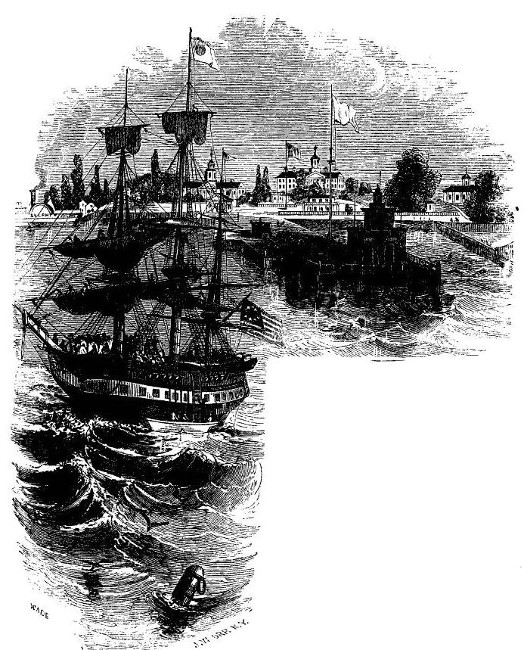
The maritime commerce of New-York has increased so rapidly that it has continually outgrown the space appropriated for its accommodation, so that the docks, wharves, warehouses, and landings, have been found wholly inadequate to the reception of the business which has poured in upon them. But the benevolent institutions of the "Empire City," designed to meliorate the condition of sea-faring men, have been fully equal to the exigencies of this improvident class of laborers, and are among the noblest and best conducted of the many charitable institutions in this great and growing metropolis of the New World. Commerce is the life and soul of New-York, and the most selfish motives should lead to the establishment of suitable retreats and hospitals for the benefit of the class of men without whose labors its wheels could not revolve; but it is not to those who are most benefited by the labors of seamen that they are indebted for the existence of safe havens of retreat, where they may cast anchor in repose, where they can no longer follow their dangerous and storm-tost business. Seamen are the only class who have asylums provided expressly for their use, either in sickness or old age. The nation provides no hospital like that of Greenwich, where the tars who are disabled in the public service find a home and an honorable support, but it lays a capitation tax on all the seamen in the navy for the creation of a fund, out of which the Naval Asylum, the Wallabout Hospital, &c., for the disabled, invalid, and superannuated of the navy have, at their own cost, not altogether disagreeable homes. New-York, however, from the munificence of private individuals and the creation of a fund from a tax on seamen, can boast of excellent institutions for the ample and comfortable accommodation of all the sick and infirm sailors who have earned a right of admission by sailing from this port. In this respect there is no other city in the world that can equal New-York.
The quarantine ground of the port of New-York, which is on the north-eastern point of Staten Island, five and a half miles from the Battery, is admirably located for the purposes of purification, and liberally endowed with all the necessary means for the cure of the sick and the prevention of the spread of disease. The ground appropriated for the purposes of a lazaretto has a frontage on the bay of about fourteen hundred feet, and extends back twelve hundred feet. It is inclosed by a high brick wall, and includes suitable hospitals for the accommodation of the sick, houses for the resident physician, and offices for the numerous persons employed about the grounds. The largest hospital, appropriated for fever patients, is that nearest the water. It is constructed of brick, is three stories high, and one hundred and thirty-six feet long by twenty-eight feet wide. The building on the rising ground next above this is intended for convalescents. It is built of brick, three stories high, fifty feet long, and forty-five feet high, with two wings sixty-six by twenty-six feet each. Higher up, beyond this, is the small-pox hospital, which generally has the largest number of patients. It is but two stories, eighty feet long and twenty-eight feet wide; like the other hospitals, it is built of brick, and has open galleries on the outside, in front, and rear. The quarantine hospitals, although forming no unimportant part of the maritime institutions of New-York, do not properly come under the head of those denominated benevolent, as they are merely sanitary and for the purpose of preventing the spread of contagious diseases.
THE SEAMEN'S RETREAT.
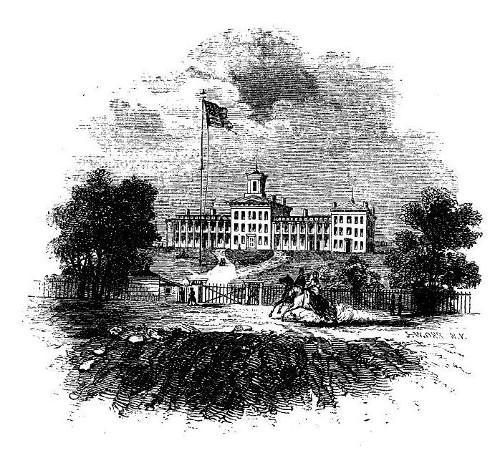
The Seamen's Retreat is also on Staten Island, a mile below the quarantine ground, built upon a natural terrace, about one hundred feet above the water, and fronting the Narrows. The location is one of exceeding beauty, being surrounded by sylvan scenery of unsurpassed loveliness, and commanding a prospect of great extent, which embraces the city, the shore of New Jersey, the Palisades, Long Island, and the highlands of Neversink and Sandy Hook. The Hospital is a noble building, constructed of rough granite, three stories high, and surrounded by piazzas, upon which the patients may inhale the pure air, and beguile their confinement by watching the ever-changing panorama presented by the bay, with its countless ships and steamers. The Retreat is intended solely for sick but not disabled seamen. It is supported by a fund derived from a state capitation tax, levied upon all seamen sailing from this port, and is the only establishment of the kind in the United States, or, we believe, in the world. Seamen are the only class who are compelled by the law of the state to contribute to a fund to form a provision for them in case of sickness. The income for the support of the Retreat is ample, and the most liberal provision is allowed for all whose necessities compel them to seek admission. On the grounds are houses for the residence of the physician and keeper.
SAILOR'S SNUG HARBOR.
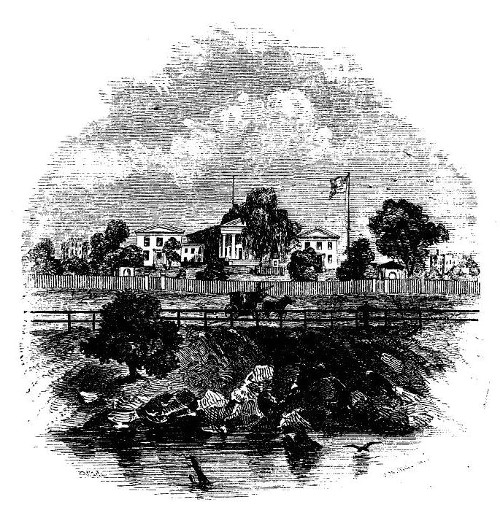
This noble Charity is situated on the north side of Staten Island, about three miles from the Quarantine, and commands a magnificent view, with the city in the distance. It is surrounded with elegant villas, pretty cottages, and well cultivated farms, and is in the midst of the loveliest rural scenery that the neighborhood of New-York can boast of. The grounds belonging to the institution comprise about one hundred and sixty acres of land, which is inclosed by a handsome iron fence that cost, a few years since, thirty-five thousand dollars. The principal building is constructed of brick and faced with white marble, with a marble portico. The corner-stone was laid in 1831, and the institution opened for the reception of its inmates in 1833. The centre building is sixty-five by one hundred feet, with two wings fifty-one by one hundred feet, connected with the main building by corridors. There are two handsome houses for the residences of the governor of the institution, and the physician, and numerous offices and outhouses.
This noble institution owes its existence to Captain James Randall, who, in the year 1801, bequeathed a piece of land in the upper part of the city, for the foundation of a retreat for worn-out seamen, who had sailed from the port of New-York; it was called most appropriately the Snug Harbor, and many a poor mariner has since found safe moorings there, when no longer able to follow his perilous calling. The benevolent-hearted sailor who founded this noble charity could hardly have dreamed that the small property which he bequeathed for that purpose, could ever increase to the magnificent sum which it is now valued at. The income from the estate in the year 1806 was but a little more than four thousand dollars; it is now thirty-seven thousand dollars, and will be, next year, when the leases of the property have to be renewed, at least sixty thousand dollars a year, an income abundantly large to support even in luxurious comfort the worn-out tars who may be compelled by misfortune to seek this magnificent asylum. The trustees of the Snug Harbor are about to build extensive additions to the present accommodations for it inmates, and among the new buildings will be a hospital for the insane. There is no chapel attached to the Snug Harbor, but there is a regular chaplain who performs religious services every Sunday in the large hall in the centre building.
In front of the principal edifice a plain monument of white marble has been erected by the trustees in memory of Captain Randall, the founder of the institution, which is chiefly remarkable for the omission, in the inscription, of any information respecting the birth or death of the person in whose honor it was erected.
THE SAILOR'S HOME.
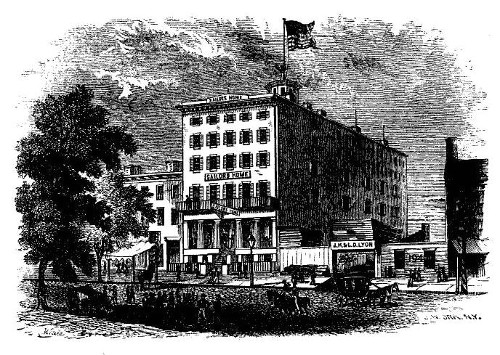
It is somewhat remarkable that New-York has originated every system for bettering the temporal and spiritual condition of seamen, that now exists, and furnished the models of the various institutions for the benefit of sea-faring men which have been successfully copied in other maritime cities of the new and the old world. It was here that the first chapel was built for the exclusive use of sailors and their families, the Mariner's chapel in Roosevelt-street; and it was here, too, that the first Home was erected for the residence, while on shore, of homeless sailors. The corner-stone of the Home in Cherry-street was laid with appropriate ceremonies on the 14th of October, 1841, just twenty-two years from the day on which the corner-stone of the Mariner's chapel was laid in Roosevelt-street. The building is a well constructed house of brick with a granite basement, plain and substantial, without any pretensions to architectural ornamentation. It is six stories high, fifty feet front, and one hundred and sixty feet deep. It contains one hundred and thirty sleeping-rooms, a dining-room one hundred by twenty-five feet, and a spacious reading-room, in which are a well selected library, and a museum of natural curiosities; there are also suitable apartments for the overseer and officers. About five hundred boarders can be accommodated in the Home, but it is not often filled. The Sailor's Home was built by the Seaman's Friend Society, and is intended to furnish sailors with a comfortable and orderly home, where they will not be subject to the rapacities of unprincipled landlords, nor the temptations which usually beset this useful but improvident class of men when they are on shore.
U.S. MARINE HOSPITAL, BROOKLYN.
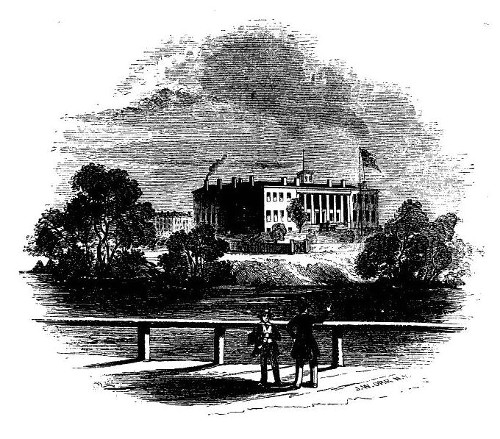
The Marine Hospital at the Wallabout, Brooklyn, near the Navy Yard, belongs to the government of the United States, and is intended for the use of the sailors and officers of the navy, and none others. It was built from a fund called the hospital fund, which is created by a payment of twenty cents a month by all the officers and seamen of the navy. The Hospital stands on high ground, on one of the healthiest and pleasantest spots in the vicinity of New-York, commands a superb view of the East River as it sweeps toward the Sound, and overlooks both Brooklyn and New-York. The buildings constituting the Hospital are two fine large airy edifices constructed of white marble, with galleries and piazzas, and surrounded by well-kept grounds which abound with choice fruit trees, and every requisite for the health and comfort of the invalids. The patients remain there only while under treatment for disease. Our government has no asylum for the support of the sailors or soldiers who lose their health or limbs in its service, like the hospitals of Greenwich and Chelsea, and, in this respect at least, we are behind the government of Great Britain, which makes ample and generous provision for all classes and grades of public servants.
As New-York was the first maritime city that built a chapel expressly for seamen, so it was the first to build a floating church, for although there had been previously in London and Liverpool old hulks fitted up as chapels, and moored in the docks for the use of sailors, there had never been an actual church edifice put afloat before the Floating Church of Our Saviour, which now lies moored at the foot of Pike-street, in the East River. This novel edifice was finished and consecrated in February, 1844. It is under the charge of the Young Men's Church Missionary Society of the City of New-York, by whom it was built, and has been under the pastoral care of the Rev. B. C. C. Parker, of the Episcopal church, from its consecration to the present time. It is seventy feet long, and thirty feet wide, and will comfortably seat five hundred persons. It has an end gallery, in which is an organ. A beautiful baptismal font of white marble, in the shape of a capstan, surmounted by a seashell, chiselled from the same block with the shaft—the gift of St. Mark's church in the Bowery, New-York—stands in front of the chancel rail. The top of the communion-table is a marble slab, and the Ten Commandments are placed on the panels on each side in the recess over it. An anchor in gold, painted on the back-ground between these panels, rests upon the Bible and prayer-book. The roof, at the apex, is twenty-six feet high, and eleven feet at the eaves. The edifice is built on a broad deck, seventy-six by thirty-six feet, covering two boats of eighty tons each, placed ten feet apart. The spire contains a bell, and the top of the flag-staff is about seventy feet from the deck. Divine service is regularly performed on Sundays, commencing in the morning at half-past ten, and in the afternoon at three o'clock. Both the boats on which the edifice rests are well coppered, and protected from injury by booms placed around them.
THE FLOATING CHURCH OF OUR SAVIOUR.
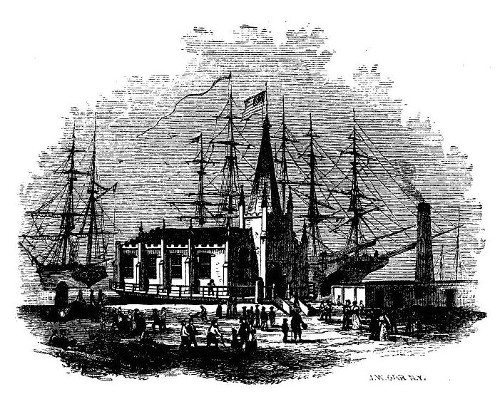
A similar floating church has been built and moored near Rector-street, in the North River, near which is another floating chapel, formed of an old hulk, after the manner of the first floating chapels in London. In addition to these houses of worship for seamen, there is a large and handsome church for sailors near the "Home," in Cherry-street, under the charge of the Baptists, and a small seamen's chapel in Brooklyn, near the Catharine Ferry. To complete this system of benevolent enterprises for the benefit of sailors, there is a Seaman's Savings Bank in Wall-street, a very handsome structure of brown free-stone, in the third story of which are the offices of the Seaman's Friend Society.
In Franklin Square, which, at the time of Washington's last visit to New-York, bore about the same relation to the heart of the city that Union Square and Grammercy Park now do, being the Ultima Thule of fashion, and the very focus of gentility and aristocracy, there is the Sailor's Home for colored seamen, which has been most respectably conducted on the principle of the "Home" in Cherry-street, and under the supervision of, although not belonging to, the Seaman's Friend Society. The Colored Home consists of two respectable three-story brick buildings, and is next door to the old Walton House, which is the last remnant of ante-revolutionary splendor remaining in the commercial metropolis of the Union, which once abounded in stately old mansions full of historical mementoes of the days when we acknowledged to kingly authority.
The principle of compelling men, when they have means, to lay up a trifle against the exigencies of a rainy day, has worked well, as we have seen, when applied to the most improvident of all the laboring classes, and we are not sure but the same principle applied to other classes would not prove equally beneficial. If the law should require every author, or merchant, or broker, or editor, to pay a monthly stipend to provide houses of refuge for the needy of their class, it would be only carrying out the principle of government which has been applied to seamen, and might save many a poor wretch from committing suicide to avoid the fate of a pauper.