Book 5 — Ladies' Fashions for the Season.
Reading edition
In Paris and London the chief novelties have been preparations for the London season. Head-dress is particularly rich, by no means lacking lively colors, and ornamented with gold, silver, and beads. We only speak here of fancy head-dress; for diamonds are always very much admired for a rare and recherchée parure. Never have they been so well set as at the present day, both as regards elegance, lightness, and convenience. Thus, each night a lady may change the disposition of her brilliants: to-day she may form them into a band, like a diadem; to-morrow, a row of pins for the body of her dress; another time she can place them on a velvet necklace, and so forth.
Fancy head-dresses are made of lace, blond, silk, gold, or silver. Flowers of all kinds are also worn, and above all foliage of velvet and satin, deep shaded, enriched with white or gold beads, and gold or silver fruit. We have also seen a coiffure of gold blond, forming a small point at the top of the head, and ornamented on each side with a branch of green foliage and golden fruit in little flexible bunches.
Ball dresses have nearly all two skirts, which are ornamented with a profusion of flounces, trimmed with ribbons or flowers, which follow the shade of the first or upper skirt; or they are used to raise it at the sides, or on one side only. We have also seen a dress of white net with two skirts, the first (the under) trimmed with two net flounces at the extremity with two gathers through the middle, and satin ribbon. On each of these flounces was a trimming of Brussels application lace, with a gather of ribbon at the top, of the same width as those of the extremity. The second skirt was trimmed at the bottom with two gathers of ribbon, and one lace flounce with a ribbon gathering at the top; the body was an intermixture of gathered ribbons and lace flounces.
Capotes will be more in vogue than bonnets, their style allowing spangling, for which bonnets are not suited. We have seen capotes of taffeta, and ribbon applied like flounces as ornaments to the crown; these ribbons are cut into teeth or plain, but with a narrow border of much brighter shade. We have also seen very pretty capotes covered with net, made of very lively colored taffeta. The tops of all these bonnets are widened more than they are high; however, they are drawn near the bottom, and are quite closed.
Dresses, it is certain, will be open in front and heart-shaped to the bottom of the waist. Low square-fronted chemisettes suit this kind of bodice, with breast-plates of embroidery and lace. At concerts, many dresses are seen either with flounces or apron-shaped fronts; that is to say, the front breadth has a much richer pattern, and different from the other breadths of the skirt. This pattern is generally an immense bouquet, whose branches entwine to the top, diminishing in size; or there are two large columns of stripes, which form undulating wreaths.
Dresses of white or other ground of taffeta warped will be the fashion this spring for walking; however, we must wait for Longchamps, at the latter end of April, to decide the question.
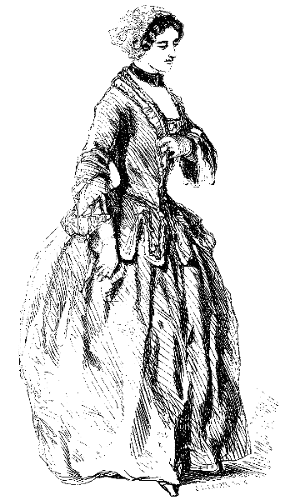
In the illustration on the following page is a lace cap, trimmed with flowers without foliage; African velvet dress; body with Spanish basks or skirts cut out into teeth, trimmed with a small white lace, having at the top a small gathering of ribbon; the body trimmed with lace facing, edged with a gathering of ribbon; black velvet ribbon round the neck, fastened with a diamond buckle; bracelets the same. Bonnet of pink taffeta, very plain; and plain dress of Valencias, with festooned teeth. Small felt bonnet, with bunch of ribbons; Nacaret velvet dress; trowsers of cambric muslin, with embroideries; gaiters of black cloth, and mousquetaire pardessus, trimmed with gimp or lace, put on flat.
Mantelets will certainly enjoy more than their usual vogue this season, and from what we have seen of the new forms, we must own they are very superior to any that have before appeared; the novelty of the forms, and the taste displayed in the garnitures even of those intended for common use, show that the progress of la mode is quite as great as any other sort of progress in this most progressing age. First, then, for the mantelets in plain walking dress; they are for the most part composed of black taffeta; several are embroidered in sentache, and bordered with deep flounces of taffeta; others are trimmed with fringe of a new and very light kind, and a number, perhaps indeed the majority, are finished with lace.
The materials for robes, in plain morning neglige, are silks of a quiet kind, and some slight woollen materials, as coutil de laine, balzerine, striped Valencias; some in very small, others in large stripes; corded muslins, and jaconet muslins, flowered in a variety of patterns. We cannot yet say any thing positively respecting plain white muslins for morning dress, but we have reason to believe they will not be much adopted.
Taffeta has resumed all its vogue for robes; it is adopted both for public promenade, half dress, and evening robes. Some of the most elegant mantelets are of white taffeta.