Volume 5 — THE ANCIENT MONUMENTS OF GREECE.
Reading edition
THE ACROPOLIS.
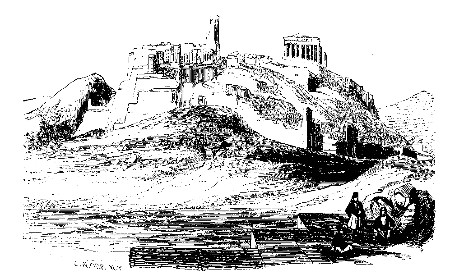
Every one can understand the regret with which we behold the remains of ancient grandeur, and the capitals of buried empires. This feeling, so profound in Jerusalem and Rome, is even more so in Athens,—
"the eye of Greece, mother of arts And eloquence, native to famous wits, Or hospitable—"
a city never so large as New-York, but whose inhabitants produced within the short space of two centuries, reckoning from the battle of Marathon, as Landor says, a larger number of exquisite models, in war, philosophy, patriotism, oratory and poetry—in the semi-mechanical arts which accompany or follow them, sculpture and painting—and in the first of the mechanical, architecture, than the remainder of Europe in six thousand years.
The monuments of antiquity which still exist in Athens have been described by Chandler, Clarke, Gell, Stuart, Dodwell, Leake, and other travellers, the most recent and competent of whom perhaps is Mr. Henry Cook, of London, author of Illustrations of a Tour in the Ionian Islands, Greece, and Constantinople, who has just made, or rather is now making for the Art-Journal a series of drawings of those which are most important, representing them in their present condition. These drawings by Mr. Cook, so far as they have appeared, we reproduce in the International, making liberal use at the same time of his descriptions.
Until the sacrilegious hand of the late Lord Elgin despoiled Athens of "what Goth, and Turk, and Time had spared," the world could still see enough to render possible a just impression of her old and chaste magnificence. It is painful to reflect within how comparatively short a period the chief injuries have been inflicted on such buildings as the Parthenon, and the temple of Jupiter Olympus, and to remember how recent is the greater part of the rubbish by which these edifices have been choked up, mutilated, and concealed. Probably until within a very few centuries, time had been, simply and alone, the "beautifier of the dead," "adorner of the ruin," and, but for the vandalism of a few barbarians, we might have gazed on the remains of former greatness without an emotion except of admiration for the genius by which they were created. The salient feature (probably the only one) in the present rule at Athens is one which affords the highest satisfaction to those interested in this subject. Slowly, indeed, and with an absence of all energy, is going on the restoration of some, the disinterment of others, and the conservation of all the existing monuments; and time will probably ere long give us back, so far as is possible, all that the vandalism or recklessness of modern ages has obscured or destroyed. On the Acropolis the results of these efforts at restoration are chiefly visible; day by day the debris of ruined fortifications, of Turkish batteries, mosques, and magazines, are disappearing; every thing which is not Pentelic marble finds its way over the steep sides of the fortress, and in due time nothing will be left but the scattered fragments which really belonged to the ancient temples. "The above sketch," says Mr. Cook, "represents faithfully the present condition of this most sublime creation. The details of the partial destruction of this old fortress—founded 1556 years before the advent of the Saviour—under the fire of the Venetians, commanded by Morosini, are so well known, that I have thought it unnecessary to repeat them; but it is impossible to recall them without a shudder, as the reflection is forced on one, of what must have been their fate whose wickedness caused an explosion which could scatter, as a horse's hoof may the sands of the sea-shore, the giant masses which for ever bear witness to the power of that mighty agent we have evoked from the earth for our mutual destruction." At the west end of the Acropolis, by which alone it was accessible, stood the Propylæa, its gate as well as its defence. Through this gate the periodical processions of the Panathenaic jubilee were wont to move, and the marks of chariot wheels are still visible on the stone floor of its entrance. It was of the Doric order, and its right wing was supported by six fluted columns, each five feet in diameter, twenty-nine in height, and seven in their intercolumniation. Of the Propylæa itself Mr. Cook gives no individual drawing, the only sketch he had opportunity of making, being in its relation to the Acropolis generally; "it will, however," he says, "serve in some degree to show what has been done. Here perhaps the chief work has been accomplished; all the now detached columns were built up with solid brickwork, batteries were erected on the spot occupied by the Temple of 'Victory without wings,' and on the square which answered to it on the opposite side of the flight of marble steps; the whole of which were deeply buried (not until they had severely suffered), beneath the ruins of the fortification which crumbled away under the Venetian guns. These walls have been removed, the batteries destroyed, and the material of which they were composed taken away; the steps exhumed, and the five grand entrances, by which the fortress was originally entered, opened, although not yet rendered passable. It would be, I imagine, impossible to conceive an approach more magnificent than this must have been. The whole is on such a superb scale, the design, in its union of simplicity and grandeur is so perfect, the material so exquisite, and the view which one has from it of the Parthenon and the Erechtheum so beautiful, that no interest less intense than that which belongs to these temples would be sufficient to entice the stranger from its contemplation."
THE PARTHENON.
On the right wing of the Propylæa stood the temple of Victory, and on the left was a building decorated with paintings by the pencil of Polygnotus, of which Pausanias has left us an account. In a part of the wall still remaining there are fragments of excellent designs in basso-relievo, representing the combat of the Athenians with the Amazons; besides six columns, white as snow, and of the finest architecture. Near the Propylæa stood the celebrated colossal statue of Minerva, executed by Phidias after the battle of Marathon, the height of which, including the pedestal, was sixty feet.
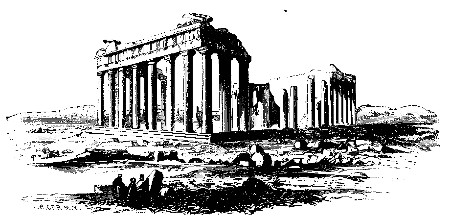
The chief glory of the Acropolis was the Parthenon, or temple of Minerva. It was a peripteral octostyle, of the Doric order, with seventeen columns on the sides, each six feet two inches in diameter at the base, and thirty-four feet in height, elevated on three steps. Its height, from the base of the pediments, was sixty-five feet, and the dimensions of the area two hundred and thirty-three feet, by one hundred and two. The eastern pediment was adorned with two groups of statues, one of which represented the birth of Minerva, the other the contest of Minerva with Neptune for the government of Athens. On the metopes was sculptured the battle of the Centaurs with the Lapithæ; and the frieze contained a representation of the Panathenaic festivals. Ictinus, Callicrates, and Carpion, were the architects of this temple; Phidias was the artist; and its entire cost has been estimated at seven million and a half of dollars. Of this building, eight columns of the eastern front and several of the lateral colonnades are still standing. Of the frontispiece, which represented the contest of Neptune and Minerva, nothing remains but the head of a sea-horse and the figures of two women without heads. The combat of the Centaurs and Lapithæ is in better preservation; but of the numerous statues with which this temple was enriched, that of Adrian alone remains. The Parthenon, however, dilapidated as it is, still retains an air of inexpressible grandeur and sublimity; and it forms at once the highest point in Athens, and the centre of the Acropolis.
THE ERECHTHEUM.
To stand at the eastern wall of the Acropolis, and gaze on the Parthenon, robed in the rich colors by which time has added an almost voluptuous beauty to its perfect proportions—to behold between its columns the blue mountains of the Morea, and the bluer seas of Egina and Salamis, with acanthus-covered or icy-wedded fragments of majestic friezes, and mighty capitals at your feet—the sky of Greece, flooded by the gorgeous hues of sunset, above your head—Mr. Cook describes as one of the highest enjoyments the world can offer to a man of taste. He is opposed to the projects of its restoration, and says that, "to real lovers of the picturesque, the Parthenon as it now stands—a ruin in every sense of the term, its walls destroyed, its columns shivered, its friezes scattered, its capitals half-buried by their own weight, but clear of all else—is, if not a grander, assuredly a more impressive object than when, in the palmiest days of Athenian glory, its marble, pure as the unfallen snow, first met the rays of the morning sun, and excited the reverential admiration of the assembled multitudes."
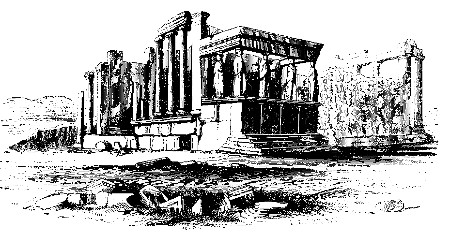
On the northeast side of the Parthenon stood the Erechtheum, a temple dedicated to the joint worship of Neptune and Minerva. There are considerable remains of this building, particularly those beautiful female figures called Caryatides, which support, instead of columns, three of the porticoes; besides three of the columns in the north hexastyle with the roof over these last columns, the rest of the roof of this graceful portico fell during the siege of Athens, in 1827. Lately, much has been done in the way of excavation; the buried base of this tripartite temple has been cleared; the walls, which had been built to make it habitable, have been removed; the abducted Caryatid replaced by a modern copy, the gift of Lord Guildford, and the whole prepared for a projected restoration.
The Temple of Victory without wings, already mentioned is, with the exception of the pavement, entirely a restoration; for nearly two centuries all trace of it was lost, all mention omitted. In removing one of the Turkish batteries, in order to clear the entrance to the Propylæa, some fragments were found which led to a more minute investigation; and, after a short time, the foundation, the pavement, and even the bases of some of the columns were disinterred, making its reconstruction not only very easy, but extremely satisfactory. It is small, but of exquisite proportions, and now perfect, with the exception of a portion of the frieze, which is in the British Museum. A peculiarity of this temple is, that it stands at an angle slightly differing from that of the Propylæa itself,—a fact for which, as it clearly formed one of the chief ornaments to, and was certainly built after, this noble portico, it is difficult to assign any very good reason.
Such is an outline of the chief buildings of the Acropolis, which, in its best days, had four distinct characters: being at once the fortress, the sacred inclosure, the treasury, and the museum of art, of the Athenian nation. It was an entire offering to the deity, unrivalled in richness and splendor; it was the peerless gem of Greece, the glory and the pride of genius, the wonder and envy of the world.
Beneath the southern wall of the Acropolis, near its extremity, was situated the Athenian or Dionysiac theatre. Its seats, rising one above another, were cut of the sloping rock. Of these, only the two highest rows are now visible, the rest being concealed by an accumulation of soil, the removal of which would probably bring to light the whole shell of the theatre. Plato affirms it was capable of containing thirty thousand persons. It contained statues of all the great tragic and comic poets, the most conspicuous of which were naturally those of Æschylus, Sophocles, and Euripides, among the former, and those of Aristophanes and Menander among the latter. On the southwest side of the Acropolis is the site of the Odeum, or musical theatre of Herodes Atticus, named by him the theatre of Regilla, in honor of his wife. On the northeast side of the Acropolis stood the Prytaneum, where citizens who had rendered services to the state were maintained at the public expense. Extending southwards from the site of the Prytaneum, ran the street to which Pausanias gave the name of Tripods, from its containing a number of small temples or edifices crowned with tripods, to commemorate the triumphs gained by the Choragi in the theatre of Bacchus. Opposite to the west end of the Acropolis is the Areopagus, or hill of Mars, on the eastern extremity of which was situated the celebrated court of the Areopagus. This point is reached by means of sixteen stone steps cut in the rock, immediately above which is a bench of stone, forming three sides of a quadrangle, like a triclinium, generally supposed to have been the tribunal. The ruins of a small chapel consecrated to St. Dionysius the Areopagite, and commemorating his conversion by St. Paul, are here visible. About a quarter of a mile southwest from the centre of the Areopagus stands Pnyx, the place provided for the public assemblies at Athens in its palmy days. The steps by which the speaker mounted the rostrum, and a tier of three seats hewn in the solid rock for the audience, are still visible. This is perhaps the most interesting spot in Athens to the lovers of Grecian genius, being associated with the renown of Demosthenes, and the other famed Athenian orators,
"whose resistless eloquence Wielded at will that fierce democratie, Shook the arsenal and fulmined over Greece, To Macedon, and Artaxerxes' throne."
THE ARCH OF HADRIAN.
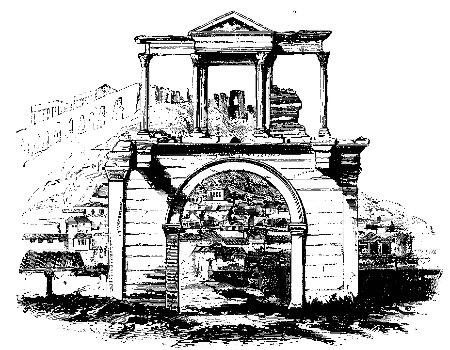
Descending the Acropolis, the eye is at once arrested by the magnificent remains of the temple of Jupiter Olympus, and by the Arch of Hadrian. Whether from its proximity to the gorgeous monument first named, or that it is intrinsically deficient in that species of merit which appeals directly to the senses, the Arch of Hadrian attracts comparatively little notice. It is, however, a highly interesting monument, bearing unmistakable marks of the decline of art; yet distinguished for much of that quality of beauty which gives so peculiar a character to the architecture of the Greeks. The inscriptions on the sides of the entablature have given rise to much learned discussion, and have led to a far more lucid arrangement of the city and its chief ornaments, than would in all probability have been accomplished, had not inquiry and investigation been spurred on by the difficulty of comprehending their exact meaning.
TEMPLE OF JUPITER OLYMPUS.
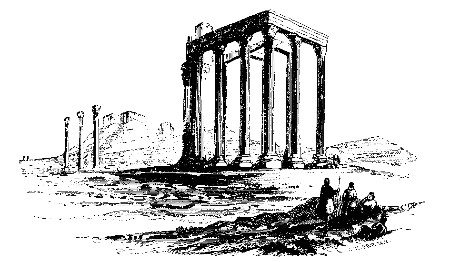
ANOTHER VIEW OF THE TEMPLE OF JUPITER OLYMPUS.
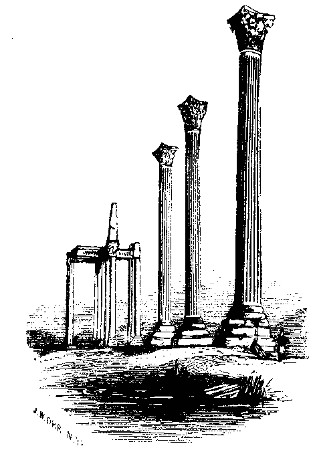
Of two views of the temple of Jupiter Olympus, Mr. Cook chose that in which the Acropolis is seen in the distance. The three lofty Corinthian columns in the other engraving are diminished to the scale of the arch, while the Acropolis, from its greater complexity of parts, adds, perhaps, something of a quality in which the subject is rather wanting. "I am not sure," says Mr. Cook, "that the remains of the temple of Jupiter Olympus are not the most impressive which Athens offers to the eye and heart of the traveller, partly from their abstract grandeur—a grandeur derived from every element which could contribute to such an end—and partly from a position than which it would be impossible to conceive any thing more magnificent. The gigantic columns struck me with a sense of awe and bewilderment, almost oppressive; they consist, as may be seen by the engraving, of sixteen, the sole representatives of the one hundred and twenty which once formed this mightiest of Athenian temples. The least thoughtful person could scarcely avoid the question of where and how the remaining one hundred and four of these enormous masses can have vanished; and assisted by the fullest information which is to be acquired on the subject, it remains a matter of wonder to all. That time itself has had but little to answer for, the almost perfect preservation of portions is sufficient to prove; in some cases the flutings are as sharp and clean as when the hand of the sculptor left them, while, more generally, they bear disgraceful evidence of ill-usage of every kind, from that of the cannon ball to the petty mischief of wanton idleness. The proportion of these columns is quite perfect, and the mind is lost in charmed wonder, as wandering from part to part of the vast platform, it is presented at every step with combinations perpetually changing, yet always beautiful. So difficult do I find it to determine from what point of view these ruins are seen to the greatest advantage, that I have appended two engravings, from which the reader may select that which best conveys to him the magnificence of the structure which has been thus slightly described." The temple of Jupiter Olympus was one of the first conceived, and the last executed of the sacred monuments of Athens. It was begun by Pisistratus, but not finished till the time of the Roman emperor Adrian, seven hundred years afterwards.
MONUMENT OF LYSICRATES.
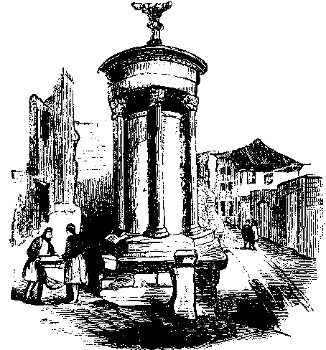
A proof of the varied character of the Athenian architectural genius may be found in the exquisite model, the lantern of Demosthenes, or, as it is more properly called, the Choragic monument of Lysierates. It is, in common with the greater number of the remains of which we speak, of Pentelic marble. By whomever conceived, designed, or executed, this must have been a labor of love, and the result is such as might be anticipated from the consequent development of the highest powers of one to whom a people like the Athenians would entrust the task of doing honor to those who had paid to their native land a similar tribute. It is small, and formed of a few immense masses: the roof is one entire block; the temple or monument itself is circular, and is formed of six slabs of pure white marble, the joints of which are concealed by an equal number of beautiful Corinthian columns, partly imbedded into, and partly projecting from them. These have been fitted with such exactness, that before the "fretting hand of time and change" had done its work, the whole must have appeared as if cut from one solid mass. We have this single example of a class of buildings once so numerous that they formed an entire street; but however grateful one may feel to the hospice, which, being built over, protected it from the ruin of its companions, we can scarcely regret its disappearance, through which alone this exquisite result of intellect and refined taste may be seen as represented in the engraving.
TEMPLE OF THE WINDS.
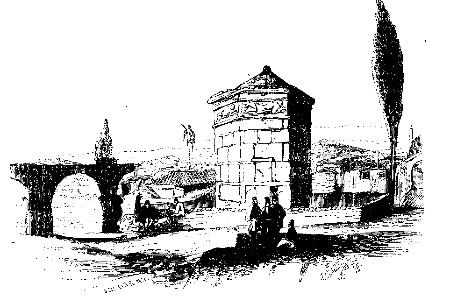
The Temple or Tower of the Winds, has been very justly termed "the most curious existing monument of the practical gnomonics of antiquity." In architecture no very elevated rank can be assigned to this edifice, nor is there, even in its ornamental portions, any very remarkable evidence of the higher order of Grecian art; the execution, indeed, can in nowise be considered equal to the conception, which, if somewhat fancifully elaborated, is at least highly to be esteemed, as uniting in a more than ordinary degree the practically useful with the poetical ideal. Near the new Agora, and consequently in the heart of the more densely populated division of the city, this indicator of the wind and hour must have been a valuable contribution to the Athenians, and must have given to its founder, Andronicus Cyrrestes, a proud position among the bene merenti of the moment. Its form is octagonal, the roof being of marble, so cut as to represent tiles; upon the upper portion of each face is sculptured the figure of one of the eight Winds; these floating in an almost horizontal position convey, either by their dress, the emblems which they bear, or the expression of their features, the character of the wind they are respectively intended to personify. Within a very recent period this building, which was more than half buried, has been exhumed, and many important facts have been discovered during the process of excavation. The interior has been cleared, and in the pavement may be seen the channels by which the water was conveyed to the machinery by whose agency the hour was indicated, when the absence of the sun rendered the dials described upon the marble faces of the tower of no avail. These dials have been tested and pronounced perfectly correct, by a no less celebrated authority than Delambre. The two arches on the left of the illustration are the only remaining portions of the aqueduct by which the necessary supply was conveyed, according to Stuart, from the spring in the grotto of Pan; it is a matter of gratulation alike to the antiquarian and the lover of the picturesque, that these have been spared. From the amount of excavation necessary to arrive at its basement, it is clear that this portion of the town must have been raised, by ruins and atmospheric deposits, at least eight or nine feet above its original level.
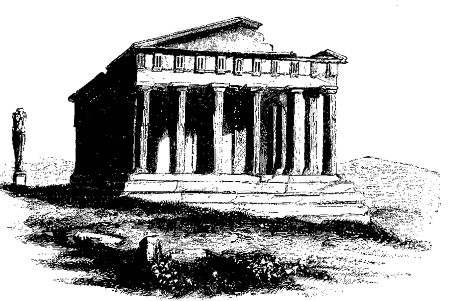
The temple of Theseus, apart from the present town, and in a comparatively elevated and isolated position, built by Cimon, shortly after the battle of Salarnis, is one of the most noble remains of the ancient magnificence of Athens, and the most perfect, if not the most beautiful, existing specimen of Grecian architecture. It is built of Pentelic marble; the roof, friezes, and cornices still remain; and so gently has the hand of time pressed upon this venerable edifice, that the first impression of the mind in beholding it, is doubt of its antiquity. It was raised thirty years before the Parthenon, unlike which it appears to have been but sparingly supplied with sculptural decoration; but that which was so dedicated was of the highest merit, and remaining in an almost perfect condition, is most deeply interesting to the artist and the historian: supplying to the one models of beauty, and to the other the most undeniable data, upon which to establish the identity of this with the temple raised by the Athenians to the Hero-God.
TEMPLE OF THESEUS.
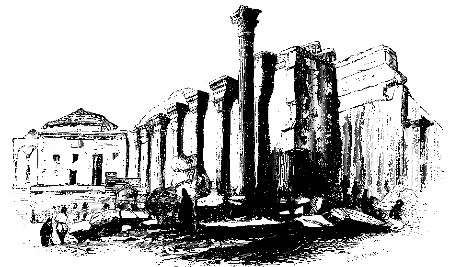
After having been successively denominated the remains of the Palace of Pericles, of the temple of Jupiter Olympus (an unaccountable blunder), the Painted Portico, the Forum of the inner Ceremeicus, the magnificent wreck of which the following engraving may convey a general idea, has been finally decided to have formed a portion of the Pantheon of Hadrian. For some time after this opinion had been started by Mr. Wilkins, and sanctioned by Sir William Gell, great doubts, despite the remarkable verification afforded by the language of Pausanias, remained as to its truth; but the Earl of Guildford has at length placed the matter beyond question. Some extensive excavations made under his personal direction resulted in the discovery of the Phrygian stone so minutely described by the enthusiastic traveller.
PANTHEON OF HADRIAN.
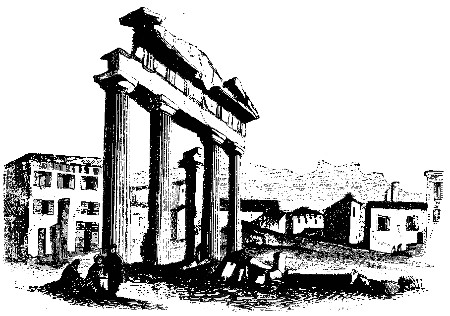
The portico forming the next illustration was a long time considered the only remaining portion of a temple dedicated to the Emperor Augustus, but it is now clearly established as having been one of the entrances to a market-place. This idea, suggested to the mind of Stuart, by certain minute yet well marked variations in the proportion of the columns from those devoted to sacred purposes, has been sustained by research, and finally demonstrated to be correct by the discovery of an inscription which has put the question at rest for ever. In one of these the names of two prefects of the market are preserved; and another, still perfect, is an edict of Hadrian respecting the duties to be levied on certain articles of consumption, and regulating the sale of oils, &c. Nothing can be more picturesque than the present condition of this portico, the latest specimen of the pure Greek Art. Its coloring is rich and varied, while its state of ruin is precisely that in which the eye of the painter delights, sufficient to destroy all hardness or angularity, yet not so great as to rob it of one element of grandeur.
ENTRANCE TO THE MARKET-PLACE: FORMERLY SUPPOSED TO BE PART OF A TEMPLE DEDICATED TO AUGUSTUS.
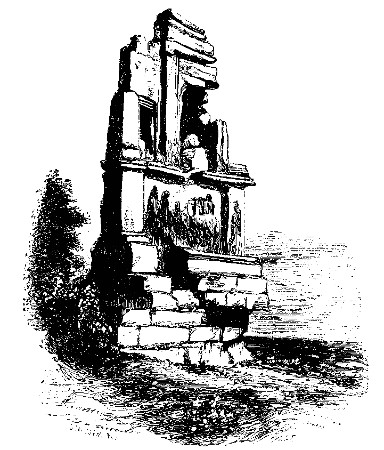
The building called the Monument of Philopappus, despite its somewhat fantastic elaboration of detail, is very remarkable and interesting; it was created either during the lifetime, or as a memorial immediately after his death, to Caius Julius Antiochus Philopappus, a descendant of the royalty of Syria, and an adopted citizen of Athens. It consists of a basement supporting a pilastrade of semi-circular form, and presenting upon its concave surface three niches, containing sitting statues, and three recesses richly ornamented with the representation in strong relief of a Roman triumph. Upon the basement also were various sculptures in honor of the Emperor Trajan. These, and, indeed, all the decorative sculpture, &c., profusely lavished upon this building have suffered greatly. The two remaining statues are much dilapidated. From this point a magnificent view of the Acropolis is obtained, and few are the sights presented to the traveller, which surpass in historic interest or actual beauty that meeting his eye, to whichever point of the compass he may turn when standing at the foot of this remarkably picturesque monument.
MONUMENT OF PHILOPAPPUS.
The ages which produced these marvellous works in architecture had other and different glories. Painting and sculpture reached the highest perfection; and poetry exhibited all the grace and vigor of the Athenian imagination. And though time has effaced all traces of the pencil of Parrhasius, Zeuxis, and Apelles, posterity has assigned them a place in the temple of fame beside Phidias and Praxiteles, whose works are, even at the present day, unrivalled for classical purity of design and perfection of execution. And after the city had passed her noon in art, and in political greatness, she became the mother of that philosophy at once subtile and sublime, which, even at the present hour, exerts a powerful influence over the human mind. This era in her history has been alluded to by Milton:
"See there the olive grove of Academe, Plato's retirement, where the Attic bird Trills her thick-warbled notes the summer long; There flowery hill Hymettus with the sound Of bees' industrious murmur oft invites To studious musing; there Ilyssus rolls His whispering stream; within the walls then view The schools of ancient sages; who bred Great Alexander to subdue the world, Lyceum there and painted Stoa next; ... To sage philosophy next lend thine ear. From Heaven descended to the low roof'd house Of Socrates; see there his tenement, Whom, well inspired, the oracle pronounced Wisest of men; from whose mouth issued forth Mellifluous streams that water'd all the schools Of Academics old and new, with those Surnamed Peripatetics, and the sect Epicurean, and the Stoic severe."
Such is an outline of the remains of the chief Athenian edifices, which link ancient times with the present, and which, as long as there is taste to appreciate or genius to imitate, must arrest the attention and command the admiration of all the generations of mankind.