Volume 5 — AMERICAN WAR-ENGINES.
Reading edition
The probabilities of a general war in Europe invest the subject of the following paper with an unusual interest. It is worthy of notice that America has furnished so large a proportion of the improvements in war-engines of every description. Fulton's schemes are well known; we all remember something of the guns invented by Perkins; there is a gentleman now in daily conference with Mazzini and the revolutionary committees, in London, who proposes the noiseless discharge of twenty thousand missiles in a minute, by means of a machine invented in Ohio; and we find in the Times an abstract of a paper read at the Institution of Civil Engineers, on the 25th of November, by our famous countryman Colonel Colt, "On the Application of Machinery to the Manufacture of Rotating Chambered-Breech Fire-Arms, and the Peculiarities of those Arms." The communication commenced with a historical account of such rotating chamber fire-arms as had been discovered by the author, in his researches after specimens of the early efforts of armorers for the construction of repeating weapons, the necessity for which appears to have been long ago admitted; and with the attention of such an intelligent class devoted to the subject, it is certainly remarkable that during so long a period so little was really effected towards the production of serviceable weapons of this sort. The collections in the Tower of London, the United Service Museum, the Rotunda at Woolwich, Warwick Castle, the Musée d'Artillerie, and the Hotel Cluny, at Paris, as well as some ancient Eastern arms brought from India by Lord William Bentinck, demonstrated the early efforts that had been made to produce arms capable of rapidly firing several times consecutively, without the delay of loading after each discharge. Drawings of these specimens were exhibited, comprising the match-lock, the pyrites wheel-lock, the flint-lock, down to the percussion-lock, as adapted by the author. Among the match-lock guns, some had as many as eight chambers, rotating by hand. Some of the pyrites wheel-lock guns had also as many as eight chambers, and rotated by hand; one of them, made in the seventeenth century, had the peculiarity of igniting the charge close behind the bullet, burning backwards towards the breech—an arrangement identical in principle with that of the modern Prussian "needle gun," for which great merit has been claimed. The flint-locks induced more determined efforts, but all were abortive, as the magazines for priming and the pan covers were continually blown off on the explosion of the charge. Indeed, from the earliest match-lock down to the present time, the premature explosion of several chambers, owing to the simultaneous ignition of the charges, from the spreading of the fire at their mouths, had been the great source of difficulty. In some of the most ancient specimens, orifices were provided in the butt of the barrel for the escape of the bullets in case of explosion, whilst others had evidently been destroyed by this action. In a brass model of a pistol of the time of Charles II., from the United Service Museum, there was an ingenious attempt to cause the chamber to rotate, by mechanical action, in some degree similar, but more complicated than the arms constructed by the author. The "Coolidge" and the "Collier" guns, both flint guns of comparatively modern manufacture, exhibited the same radical defects of liability to premature explosion.
The invention of Nock's patent breech, and the Rev. Mr. Forsyth's introduction of the detonating or percussion guns, which latter principle, with the necessary mechanical arrangements for the caps, was essential to the safe construction of repeating fire-arms, constituted a new era in these weapons.
Colonel Colt gave a detailed and interesting account of his experiments, which resulted in the invention of his celebrated revolvers. His communication, the first that had been brought before the institution, by an American, was received with acclamations; and in the discussion which ensued, in which our Minister, the Hon. Abbott Lawrence, Captain Sir Thomas Hastings, R.N., Captain Sir Edward Belcher, R.N., Captain Riddell, R.N., Mr. Miles, and the members of the council took part, the most flattering testimony was given of the efficiency of the revolvers in active service, and the strongest opinions as to the necessity of their use in all frontier warfare; and that without this arm it was almost impossible, except with an overwhelming force of troops, to cope with savage tribes. The discussion was resumed at a meeting of the Institution, held on the second of December.
A new, and, we understand, a very important invention, in this line, is also described in the following interesting article by a contributor to the International:
SKETCH OF THE PROGRESS OF INVENTION IN OFFENSIVE ARMS: JENNING'S RIFLE.
WRITTEN FOR THE INTERNATIONAL MAGAZINE,
BY W. M. FERRIS.
It may be justly considered that mechanical invention has been the most prominent characteristic of history for the last four centuries. The application of science to the useful arts has been pushed to an extent of which preceding ages never dreamed. In poetry, in painting, in sculpture, the great masters of ancient times are still the teachers of mankind. But in all those arts which administer to the necessities, increase the comforts, or multiply the enjoyments of men, the present is marvellously in advance of every former age. Prominent among those arts which have shared in this advancement, is that of war. At first sight it may appear improper to distinguish as useful, improvements in the method of taking life. But, experience and philosophy unite in teaching that every improvement in military skill tends to render war less frequent, and the nearer its operations approach to those of an exact science, the more reluctant is each nation to engage in it, and the more careful not to commit those offences which render a resort to it on the part of other nations unavoidable.
We purpose to trace a brief sketch of the progress of invention in offensive weapons, and more particularly in that class of fire-arms used either in hunting or war, by a single individual, and generally denominated small-arms, in contradistinction to artillery. Such a sketch will be interesting, not only in its subject-matter, but also as a chapter in the general history of human progress.
The learned reader who is curious in such matters, will find in the Natural History of Pliny (vol. vii. cap. 56, 67), a statement of the source whence originated most of the mechanical implements, the manners and customs, and the political and religious institutions known in the author's time. It is to be presumed that Pliny did not intend to vouch for the truth of all he has there stated. He probably meant merely to give a synopsis of the traditions most generally received, and which assigned to a divine energy almost every thing that contributed to the happiness of men. He tells us here that "the first combats were made by the Africans against the Egyptians with a kind of stick, which they called phalanges." The evident Greek origin of this word renders the story absurd enough, and doubtless most of our readers will continue to acquiesce in the account given in Holy Writ, that the origin of war was but little subsequent to the origin of the race, and that fraternal blood first stained the breast of our mother earth. But this statement of Pliny contains a grain of truth. The stick, or club, was undoubtedly the first weapon made use of by men in their combats with each other, though the spear and the sword followed at a period long anterior to any known in historical records.
But from the earliest ages men have sought to avoid hand-to-hand conflicts, and to make skill supply the place of strength. In contests with wild beasts this was indispensable. Nature had provided man with no weapon with which he could contend against the boar's tusks, the lion's teeth, or the tiger's paw. Hence, the substitution of missiles for manual weapons, has been the end towards which ingenuity has been constantly directed.
The conversion of the spear into the javelin, as it was the most obvious, so probably it was the earliest step in advance. Close upon this followed the sling, and last the arrow and the bow. The invention of the latter weapon is ascribed by Pliny, in the chapter above cited, to a son of Jupiter. In the days of Homer it was the weapon of the gods; and thousands of years after, it was the pride and glory of the English yeoman. The classical scholar will remember the description in the fourth book of the Iliad, of the bow with which Pandaros shot at Menelaus an arrow which would have sent to Hades the hero dear to Mars, had not the daughter of Jove brushed it aside with her hand, as a mother doth a fly from her sleeping child. The bow does not appear to have been extensively used in later times in either the Greek or Roman armies. The ferocious Spartan preferred the close combat with manual weapons, the Athenian won his glory upon the sea, and it was with the pike that Alexander overcame the hosts of Persia. The Cretans, who were the most celebrated archers in Europe, sometimes formed a separate division in the Grecian and afterward in the Roman armies. The Romans, however, generally preferred heavy-armed troops. But it was a peculiarity of Roman policy always to adopt every improvement in the art of war with which they became acquainted, whether it originated with friend or foe. Rome never let slip any opportunity to add to the efficiency of her legions, and they repaid her care by carrying her eagles in triumph from the Thames to the Euphrates, and from the Danube to the Nile.
It was in the west of Europe, and from about the eleventh to the fifteenth century, that archery flourished in the greatest perfection. The early chronicles are filled with the exploits of the English archers, and old and young still read with delight those ballads which tell of the wondrous achievements of "Robin Hood and his merry men." Indeed, with the name of that famous outlaw are connected all our ideas of perfect skill in the use of the bow, and in the directions which in his dying hour, he gave to his faithful man, "Little John," we seem to hear the dirge of archery itself:
"Give me my bent bow in my hand, And a broad arrow I'll let flee, And where that arrow is taken up, There shall my grave digg'd be. "And lay me a green sod under my head, And another at my feet, And lay my bent bow by my side, Which was my music sweet."
We shall not stop to dwell on the defects of the bow. The great and insuperable one was its want of power. The strength of a man was the limit of its capacity, and something more was necessary to pierce the ironclad breast of the knight. But, until the invention of gunpowder, it stood at the head of missile engines.
When and where gunpowder was invented it is impossible now to ascertain. It seems to be described in the pages of Roger Bacon, while many are of opinion that the returning Crusaders brought it from the east. Certain it is that it had been known in China for many centuries, and applied to the blasting of rocks and other useful purposes, though never to the art of war. But the latter application of it was made by the Europeans almost contemporaneously with their knowledge of its properties, and for war it has been chiefly employed until the present time. The invention of cannon preceded by a century that of small-arms, and it was by a gradual reduction in the size of the former that the latter were produced. Barbour, in his metrical Life of Robert Bruce, says, that cannon were used by Edward III. in his first campaign against the Scots, in 1327. He calls them "Crakys of war." They are also supposed to have been employed by the French in the siege of Puy Guillaume, in 1338. But the first use of them which rests on unimpeachable evidence, and which seems to have been productive of much effect, was at the battle of Cressy, in 1346. It is from this epoch that it is most usual to date the employment of artillery. That day which witnessed the first efficient use of a weapon destined to revolutionize the art of war, also witnessed the most splendid achievements of the archers of England. The bowstrings of the French had become useless by the dampness of the weather, while those of the English, either on account of greater care or the different material of which they were made, were uninjured. The cloth-yard arrows of the English bowmen, directed with unerring skill, made terrible havoc in the ranks of their enemies, while four pieces of artillery stationed on a little hill contributed to their victory. The French troops had none of them ever seen, and most of them never heard of such a weapon, and the terror inspired by the noise and the smoke did more than the balls to hasten their defeat.
The first cannons were rude in the extreme. They were made of bars of iron hooped together like the staves of a barrel, and were larger at the muzzle than at the breech. The size was very soon decreased, so that two men could carry one, and fire it from a rest. The 400 cannon with which Froissart said that the English besieged St. Malo, in 1378, were probably of this kind. Nearly a century elapsed before small-arms were invented. Sir S. Meyrick, to whom subsequent writers have been indebted for most of their knowledge upon this subject, has given, upon the authority of an eye-witness, the time and place of their invention. "It was in 1430," says Bilius, "that they were contrived by the Lucquese, when they were besieged by the Florentines." A French translation of Quintus Curtius made by Vasqua de Lucene, a Portuguese, in 1468, preserved among the Burney MSS. of the British Museum, exhibits in one of its illuminations the earliest representation of hand fire-arms which has yet been discovered. The following engraving is from a copy of this illumination, contained in the Penny Cyclopædia.
B.d.E.K.
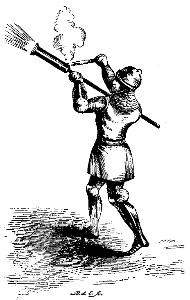
It will be observed that this gun much resembles one of those small lead cannons with which patriotic boys, upon each return of our national anniversary, manifest their appreciation of the blessings of liberty. It was fastened to a stick, and fired by a match held in the hand. We proceed to sketch the progress of improvement from this the first gun until we reach the repeating rifle.
If we analyze the manipulation of fire-arms, it will be found to consist of three principal operations—namely, to charge the piece, to direct it toward the object of attack, and to discharge it by in some manner igniting the powder; or more concisely, to load, take aim, and fire. That gun with which these operations can be performed most safely, accurately, and rapidly, is the best.
The process of loading has continued to be essentially the same from the invention of the gun to the present time. The charge is put in at the muzzle, and rammed down to the lower end of the barrel. At a very early period, efforts were made to construct guns which would load at the breech; but hitherto no such gun has been able to supplant those which load at the muzzle. The great complication of their parts, their liability to get out of repair, their insecurity, and the long practice required to learn their use, have been among the reasons which have prevented any of these inventions from being adopted. Hence it is that the muskets with which our soldiers are armed at the present day, possess no advantage in this respect over the rude little cannon fastened to the end of a stick, used by the soldiers of Europe four centuries ago. But in other respects the progress of invention has been steady and secure.
With the gun represented in the above engraving it was impossible to take aim. Being perfectly straight, it could not be brought in the range of the eye. The most that could be expected was, that by pointing it in the direction of the enemy, it might chance to hit some one, in a crowd.
The inconveniences attending the discharge of the piece were almost as great. A puff of wind, or the slightest motion of the soldier himself, would throw the priming from the touch-hole, and it is almost unnecessary to add, that in rainy or even very damp weather, such a gun was utterly useless. The first step in improvement was to place the touch-hole on the right side of the barrel instead of upon the top, and to attach a small pan which held the priming. By this means the priming was kept from being blown away by the wind, though scarce any other advantage was attained.
About the year 1475 a great advance was made by the invention of the arquebus or bow-gun. A spring let loose by a trigger threw the match, which was fastened to it, forward, into the pan which contained the priming. It was from this spring that the gun took its name.
The arquebus is mentioned by Philip de Comines, in his account of the battle of Morat, in 1476. It appears to have been used in England in 1480.
But as yet no improvement had been made by which the soldier was enabled to take aim. The butt of the arquebus was perfectly straight, and placed against the breast when the gun was fired. The danger of being knocked over by the recoil of the piece was great, that of hurting the enemy very small. The Germans first conceived the idea of bending the butt downward, and thus elevating the barrel so as to bring it in the range of the eye. They also sloped it so as to fit the shoulder instead of being held against the breast. The arquebus constructed in this manner was used in England in the time of Henry VIII., and was variously called haquebut, hakebut, hagbut, and hagbus, names all derived from the hooked shape of the butt. A small sized arquebus, with a nearly semi-circular butt, and called a demihaque, was probably the origin of the modern pistol.
JENNINGS'S RIFLE.

The musket, invented in Spain, was introduced into France in the reign of Charles IX., by De Strozzi, Colonel-General of the King's infantry, and thence into England. At first it was so heavy that each musketeer was accompanied by a boy to assist him in carrying it. It was, however, soon decreased in weight sufficiently to enable the musketeer to carry it himself, though it was still so heavy that he could only fire it from a rest. This rest, which each musketeer carried with him, consisted of a stick the height of his shoulder, pointed at the lower end, and having at the upper an iron fork in which the musket barrel was laid. In a flask the musketeer carried his coarse powder for loading. His fine powder for priming was in a touch-box. His bullets were in a leathern bag, shaped much like a lady's work-bag, the strings of which he was obliged to draw in order to get at them. In his hand were his burning match and musket rest, and after discharging his piece he was obliged to defend himself with his sword. The match was fixed to the cock by a kind of tongs. Over the priming-pan was a sliding cover, which had to be drawn back with the hand before pulling the trigger. It was necessary to blow the ashes from the match, and take the greatest care that the sparks did not fall upon the priming. After each discharge the match had to be taken out of the cock and held in the hand until the piece was reloaded; then, in order that it might come down exactly upon the priming, the greatest care and nicety were required in fitting it again to the cock. Other inconveniences attended the use of the match-lock musket. The light of the burning match betrayed the position of the soldier, and hence it could not be used by sentinels or on secret expeditions. Various contrivances were resorted to in order to obviate these difficulties. Walhuysen, a captain of the town of Danzig, in a treatise entitled L'Art Militaire pour l'Infantrie, printed in 1615, says: "It is necessary that every musketeer should know how to carry his match dry in moist or rainy weather, that is, in his pocket or in his hat, by putting the lighted match between his head and hat, or by some other means to guard it from the weather. The musketeer should also have a little tin tube, about a foot long, big enough to admit a match, and pierced full of little holes, that he may not be discovered by his match when he stands sentinel or is gone on any expedition."
The learned captain does not state whether the hair of those soldiers who carried their lighted matches between their heads and hats, was insured. These inconveniences were so great that many able military men regarded fire-arms as a failure, and recommended a return to the long-bow, which had been so terrible a weapon in the hands of the English archers. But the art of war, like every other, never goes backward, and men were not disposed to abandon the use of so mighty an agent as gunpowder, merely for the want of some weapon adapted to its use.
The fire-lock, named from its producing fire by friction, was the first improvement upon the match-lock. Its earliest form was that known as the wheel-lock, which is mentioned in a treatise on artillery by Luigi Collado, printed at Venice in 1586. He says that it had been lately invented in Germany. This lock consisted of a solid steel wheel, with an axle, to which was fastened a chain. The axle was turned by a small lever, and thus winding around it the chain, drew up a very strong spring. By pulling the trigger the spring was let go, and the wheel whirled around with great velocity. The cock was so constructed as to bring a piece of sulphuret of iron down upon the edge of the wheel, which was notched, and touched the priming in the pan. The friction produced the sparks. It was from this use that the sulphuret of iron derived the name of pyrites, or fire-stone. Afterwards a flint or any common hard pebble was used. The complicated nature of this lock, and its uncertainty, prevented its general adoption. The next improvement was due to the Dutch. About the year 1600 there was in Holland a band of marauders known as snaphausen, or poultry-stealers. However free they were in using the property of others, they were yet unable to incur the expense of the wheel-lock, and the match-lock, by its burning light, exposed them on their nightly expeditions. The wit which had been sharpened by laying "plots" and "inductions dangerous" against unoffending hens and chickens, was turned to the invention of a gun-lock better adapted to their purposes. The result of their cogitations was the lock which, after its inventors, was called the snaphause. It consisted of a flat piece of steel, furrowed like the edge of the wheel in the wheel-lock, which was screwed on the barrel beyond the priming-pan in such a manner as to be movable. By bringing it over the pan, and pulling the trigger, the flint in the cock struck against the steel, and the spark was produced. The simplicity and cheapness of this lock soon rendered it common, and the transition from it to the ordinary flint-lock followed almost as a matter of course. The last improvement which we shall notice was the percussion-lock. This is due to the Rev. Mr. Forsyth, of Belhelvie, in Scotland, though the original form of the lock has been entirely changed by the introduction of the copper cap.
INTERIOR OF JENNINGS'S BREECH.
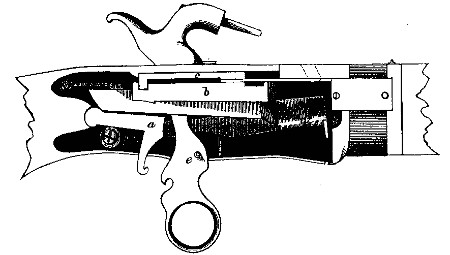
Whilst these improvements were being made in locks, the other parts of the gun were gradually approaching in lightness, strength, and accuracy of finish, to the modern standard. The most valuable improvement was the invention of the rifle barrel. It is mentioned by Pere Daniel, who wrote in 1693, as being then well known; but the time and place of its origin has never been ascertained. It was first employed as a military weapon by the Americans, in the Revolutionary war, and it is in their hands that it acquired its world-wide reputation.
It would be impossible, in an article like the present, to detail all the various attempts which have been made, during the last half century, to increase the efficiency of the rifle. The efforts of scientific men and mechanics have been constantly directed towards the invention of a gun which should fire, with the greatest possible rapidity, a number of times without reloading, and which should possess the indispensable requisites of safety, durability, and simplicity, both in construction and in use. Hitherto no invention has combined these advantages in a sufficient degree to supplant the common rifle.
In our opinion, these ends are all most simply and beautifully attained by the invention of Mr. Jennings. But of this our readers will be able to judge for themselves, by the above engravings and the directions for its use.
CARTRIDGES AND MACHINERY OF JENNINGS'S RIFLES.
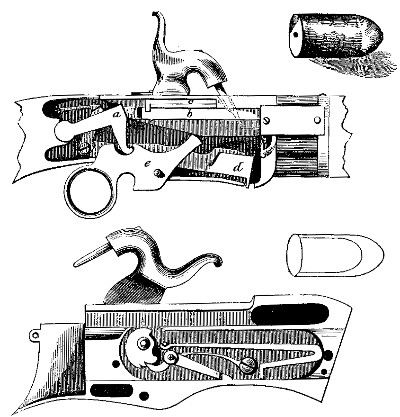
Fill the magazine, on the top of the breech, with percussion pills or primings, and the tube, under the barrel, with the hollow cartridges containing gunpowder. Of these cartridges the tube will hold twenty-four. Place the forefinger in the ring which forms the end of the lever, e, and the thumb on the hammer, elevating the muzzle sufficiently to let the cartridge nearest the breech slip, by its gravity, into the carrier d; swing the lever forward, and raise the hammer which moves the breech-pin back, and the carrier up, placing the cartridge level with the barrel; pull the lever back, and thus force the breech-pin forward, and shove the cartridge into the barrel, by which motion a percussion priming is taken from the magazine by means of the priming-rack c, revolving the pinion which forms the bottom of the magazine, and it also throws up the toggle a, behind the breech-pin, thus placing the piece in the condition to be discharged by a simply upward pressure of the finger in the ring. After the discharge release the pressure and repeat the process.
In conclusion, the reader is invited to look at the engraving we have given of the first gun, and to compare it with the offspring of American ingenuity we have just described.
Fire-arms are the great pioneers which have opened a way for the progress of civilized man, and given him victory over the savage beasts and still more savage men who have opposed his course. Civilization has in its turn reacted upon fire-arms, and brought them to their present state of wonderful efficiency.
The heavy match-lock of three centuries ago was almost as dangerous to him who used it as to the enemy against whom it was directed. It would be almost impossible for a person to injure himself by the repeating rifle except by deliberate intention. Skilful military men advised the abandonment of the match-lock for the bow. A good marksman with the repeating rifle would kill a score of bowmen, before they could approach near enough to reach him with their arrows. The practised musketeer, in the reign of Elizabeth, could hardly fire his piece once in twenty minutes; the merest novice can fire the repeating rifle twenty times in one minute.