Volume 5 — TAYLOR AND STODDARD[A]
Reading edition
TAYLOR AND STODDARD[A]
We have placed these names together, not on account of any fancied resemblance between the two poets, but for the very opposite reason. We wish to trace the contrasts which may be exhibited by writers living in the same age, the same country, and under the same system of social relations. Mr. Stoddard's volume is dedicated with evident warmth of feeling to Bayard Taylor, and the natural conclusion is that the poets are personal friends; yet so far from the intellectual nature of the one having influenced that of the other, they are as strikingly opposed in thought, feeling, and manner of expression, as two men well can be.
The time has gone by when a volume from the pen of Mr. Taylor can be dismissed with a careless line or two. Few writers of our day have made more rapid advances into popular favor, and no one is more justly entitled to the place which he holds. If we are to trust contemporary criticism, a goodly army of what are called "promising young poets" might be raised from any state in the Union. But what becomes of them? It is one thing to promise, and another to perform, and we fear that this suggestion contains a hint at the whole mystery. It seems to be comparatively easy for educated men, blinded to their incapacity by an unwholesome passion for notoriety which is never the inspiring motive of a real poet, to reach a certain degree of excellence which may be denominated "promising." Many a feather has been shed, and many a wing broken, in attempting to soar beyond it. We shall not describe Mr. Taylor with the epithet. We see nothing to justify it in his volume, on every page of which there is actual performance. Maturity may indeed add to his powers, and further increase his poetical insight; but there is no necessity for waiting, lest we commit ourselves by a favorable opinion, and no fear that such an opinion will be falsified by succeeding efforts.
Richard Henry Stoddard doubtless has been styled a promising young poet by half the newspaper press; therefore if we venture to say that Mr. Stoddard has performed, and that the promising season is over with him, it is not because we do not think that his future poems will exhibit new and greater excellencies, but because we recognize merits in his present collection which eminently entitle him to respectful consideration.
The evident source of Mr. Stoddard's inspiration is a love for ideal beauty, in whatever form it may be manifested. Like all admirers of ideal beauty, he has a strong sensual element in his composition. He is not satisfied with the mere dreams of his imagination, but he must also attempt to realize them through the medium of imitative art. Among the various modes for expressing the same feelings and ideas, painting, poetry, sculpture and music, he has chosen poetry as the one best adapted to his purpose. We would not be understood to assert that an artist may, at will, express his emotions in any of the arts; for a man may be insensible to an idea expressed in sculpture or music, which is perfectly clear to him in poetry or painting; but we assert that all the arts are but different languages to convey the same ideas. True art addresses itself to the moral, the intellectual, or the sensual man; and by the predominance of one of these qualities in the artist, or by various combinations of the three, all the radical differences between men of genius can be accounted for, and all the seeming mysteries explained. This truth is the groundwork of genuine criticism; and the critic who busies himself about the accidental circumstances, which have influenced an artist, is only prying into his history, without sounding the depth of his nature. At least let criticism start here: it may afterward indulge in microscopic comparisons of style, and in worn-out accusations of imitation: but it is a sorry thing to see persons assuming the dignified office of the critic magnifying molehills into mountains, and similarities into thefts. All men are gifted with various faculties, but it is not in the superiority of any or all of them that we can account for the existence of the poet, who has something of the divine nature in him, having a creative energy that is not a result of the degree in which he possesses one or more of the ordinary faculties, but is a special distinction with which he is clothed by the deity.
We will proceed to examine our two poets by the principles before stated, not forgetting to compare or contrast them, as there may be opportunity. In Mr. Taylor there is a just equipoise of the moral and intellectual natures, while the sensual nature, if not so strong as the former two, is at least calmed and subdued by their united power. With fine animal spirits, he has but little taste for gross animal enjoyments; and the mischief which his unlicensed spirits might commit, is foreseen by a sensitive conscience, and checked by a mind that sees the end in the act, and provides to-day against the future. Mr. Taylor's inclinations are for scenes of grandeur. Sublime human actions, nature in her awful revolutionary states, the wild desolation of a mountain peak or a limitless desert, the storm, the earthquake, the cataract, the moaning forest—these are the chief inspirations of his powers. Whatever is suggestive of high emotions, that act upon his moral nature, and in turn are acted upon by it, forms an unconquerable incentive to his poetical exertions. Mere word-painting he has no affection for. A scene of nature, however beautiful, would be poetically valueless to him, unless it moved his feelings past the point of silent contemplation. The first poem in his volume affords a striking illustration of his apprehension of intellectual bravery. Through fasting that approaches starvation, unanswered prayers, and repeated discomfitures, the soul of the hero burns undimmed, and his eyes remain steadily fixed on his purpose. Physical suffering only strengthens his resolution, and defeat only nerves him to renewed efforts. Round these ideas the poet lingers with a triumphant emotion, that proves his sympathies to be centred less in the outward action of the poem, than in the power of human will—a power which he conceives to be capable of overcoming all things, even the gods themselves. We have before stated that nature, unless suggestive of some intellectual emotion, is nothing to Mr. Taylor. To arouse himself to song, he must vitalize the world, must make it live, breathe and feel, must find books in the running brooks, and sermons in stones, or brooks and stones are to him as if they had not been. In the "Metempsychosis of the Pine," this characteristic is finely displayed. The poet imagines himself to have been a pine, and retraces his experiences while in that state of being. The pine becomes a conscious creature, revelling in the joys of its own existence, feeling the sap stir in its veins, and pour through a heart as susceptible as man's. Many poets have recalled the memories which linger around a particular tree, or, apostrophising it, have bid it relate certain histories; but in Mr. Taylor's poem the tree speaks from within its own nature—not with the feelings of a man, not with what we might suppose would be the feelings of a common tree, but as a pine of many centuries—and no one can mistake its voice. A nobler use of the dramatic faculty, in lyrical poetry, is not within our recollection.
As may be supposed, Mr. Taylor's poetry is written under the excitement of passion, and does not proceed from that laborious process of constructing effects, to which a large number of poets owe their success. The consequence is that his language is vividly metaphorical, only dealing in similes when in a comparative repose, and never going out of the way to hunt up one of those eternal likes, which have emasculated our poetic style, and are fast becoming a leading characteristic in American verse, to the utter destruction of every thing like real passion. Mr. Taylor is an instructive study in this respect. He uses ten metaphors to one simile. His ideas come forth clothed in their figurative language, and do not bring it along neatly tied up in a separate bundle. From this cause there is a sturdy strength and genuine feeling about his poems, that more than compensate for the ingenious trinkets which he despises, and leaves for the adornment of those who need them. In him imagination predominates over fancy, and the latter is always sacrificed to the former. We do not intend to say that Mr. Taylor is without fancy. Far from it—he has fancy, but it never leads him to be fanciful. His versification is polished, correct and various, but more harmonious than melodious; that is to say, the whole rhythmical flow of his verse is more striking than the sweetness of particular lines. We have not mentioned all the phases of Mr. Taylor's genius. Some of the smaller poems in his volume border on the sensuous; and in "Hylas" he has paid a tribute to ancient fable worthy of its refined inventors; but scenes of moral and natural sublimity are those in which he succeeds best, and by them he should be characterized.
RICHARD H. STODDARD.
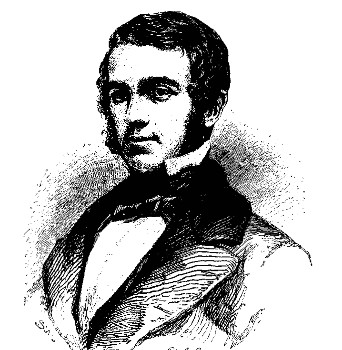
Mr. Stoddard is the precise opposite to his friend. In him the sensual vastly outranks the moral or the intellectual quality. Let it not be supposed that we wish to hold the two latter elements as superior to the former for poetical purposes; nor do we by asserting the greater preponderance of any one, deny the possession of the other two. To the sensuous in man we are indebted for the great body of Grecian poetry, and Keats wholly, and Tennyson in part, are modern instances of what may be achieved by imbibing the spirit of the ancient classics. Shallow critics have professed to discover a resemblance between these English poets and Mr. Stoddard, and Mr. Taylor has also fallen under the same accusation, for no better reason, that we can conceive, than that all four have drunk at the same fountain, and enjoyed its inspirations.
Mr. Stoddard's sympathies are almost entirely given up to ancient Grecian art. He can scarcely realize that the dream has passed forever. He sees something vital in its very ruins. For him the Phidian friezes yet crown the unplundered Parthenon; the gigantic Athena yet gleams through sacerdotal incense, in all her ivory whiteness, smiling upon reeking altars and sacrificing priests; Delphos has yet an oracular voice; Bacchus and Pan and his Satyrs yet lead their riotous train through a forest whose every tree is alive with its dryad, and whose every fountain is haunted by its potamid; there are yet patriot veins to glow at the Iliad; Æschylus can yet fill a theatre; Pericles yet thunders at Cimon from the Cema, or woos Aspasia, or tempers the headlong Alcibiades, or prepares his darling Athens for the Peloponnesian war. These things Mr. Stoddard feels while the locomotive shrieks in his ears, while the omnibus, speeding to the steamship, rattles the glass of his window, while the newsboy cries his monotonous advertisement, or his servant hands to him a telegraphic dispatch; and he is right. The body in which Grecian art existed, is indeed dead, but the spirit which animated it is indestructible. There will be poets to worship and reproduce it, there will be scholars to admire and preserve it, when every man's field is bounded by a railway, when every housetop is surmounted by a telegraph wire, and when the golden calf is again set up amid the people, to be worshipped as the living God.
From the force of his sympathies, Mr. Stoddard can lean but in that direction. Throughout his volume there is scarcely a poem which is not the offshoot of these feelings. Some of them are confessedly upon Grecian subjects, and all of them are animated by a corresponding spirit. Even his few domestic poems are not treated after that modern manner, which moralizes in the last stanza, simply to let the reader understand how well the poet knows his own meaning. Whatever is beautiful in Mr. Stoddard's themes is distinctly brought forward, while the darker side of his subject is scarcely touched upon. Take, for example, a poem of great simplicity and tenderness, filled with a sorrow so beautiful as almost to make one in love with grief, and contrast it with a poem, on a similar subject, by Bayard Taylor:
"Along the grassy slope I sit, And dream of other years; My heart is full of soft regrets, My eyes of tender tears! The wild bees hummed about the spot, The sheep-bells tinkled far, Last year when Alice sat with me Beneath the evening star! The same sweet star is o'er me now, Around, the same soft hours, But Alice moulders in the dust With all the last year's flowers! I sit alone, and only hear The wild bees on the steep, And distant bells that seem to float From out the folds of sleep!" Stoddard, page 116.
This is very fine and delicate feeling, softened down to the mildest point of passion; but it does not at all resemble the frenzy of grief which follows:
"Moan, ye wild winds! around the pane, And fall, thou drear December rain! Fill with your gusts the sullen day, Tear the last clinging leaves away! Reckless as yonder naked tree, No blast of yours can trouble me. Give me your chill and wild embrace, And pour your baptism on my face; Sound in mine ears the airy moan That sweeps in desperate monotone, Where on the unsheltered hill-top beat The marches of your homeless feet! Moan on, ye winds! and pour, thou rain! Your stormy sobs and tears are vain, If shed for her whose fading eyes Will open soon on Paradise; The eye of Heaven shall blinded be, Or ere ye cease, if shed for me." Taylor, page 92.
What a desolation of wo! how the whole man is carried away in one overwhelming passion! A contrast of the opening poems of these two volumes, would be a pleasant employment, but their length forbids it. Mr. Taylor's "Romance of the Maize" we have mentioned already; Mr. Stoddard's "Castle in the Air" is its complete antithesis. The latter poem is a magnificent day-dream, abounding in luscious imagery, and unrivalled for its minute descriptions of ideal scenery and its voluptuous music of versification, by any similar creation since Spenser's "Bower of Bliss."
To sum up Mr. Stoddard's poetical character, he has more fancy than imagination, he is rather exquisitely sensitive than profoundly passionate, and oftener works up his feelings to the act of composition, than seeks it as an outlet for uncontrollable emotion. He thoroughly, and at every point, an artist. His genius is never allowed to run riot, but is always subjected to the laws of a delicate, but most severe taste. His poems are probably planned with views to their artistic effects, and are then constructed from his exhaustless wealth of poetical material, by a nice adaptation of each part to the perfect whole of his design. If he has less imagination than Mr. Taylor, he has a richer and more glowing fancy; if his figures are less apt and striking, they are more elegant and symmetrical; if the harmonious dignity of his versification is less, its melodious sweetness is more; if he has less passion, he has more sensibility; if moral and physical grandeur are not so attractive to him, ideal and natural beauty are the only elements in which his life is endurable. We might pursue these contrasts to the end of our magazine; but if we have called the reader's attention to them, we have done enough.
From "Love and Solitude," by Mr. Taylor, we extract the following picture, in order to contrast it with the handling of the same subject by Mr. Stoddard in "The South:"
"Some island, on the purple plain Of Polynesian main, Where never yet adventurer's prore Lay rocking near its coral shore: A tropic mystery, which the enamored deep Folds, as a beauty in a charméd sleep. There lofty palms, of some imperial line, That never bled their nimble wine, Crowd all the hills, and out the headlands go To watch on distant reefs the lazy brine Turning its fringe of snow. There, when the sun stands high Upon the burning summit of the sky, All shadows wither: Light alone Is in the world: and pregnant grown With teeming life, the trembling island earth And panting sea forebode sweet pains of birth Which never come;—their love brings never forth The human Soul they lack alone." Taylor, page 16.
Half-way between the frozen zones, Where Winter reigns in sullen mirth, The Summer binds a golden belt About the middle of the Earth, The sky is soft, and blue, and bright, With purple dyes at morn and night: And bright and blue the seas which lie In perfect rest, and glass the sky; And sunny bays with inland curves Round all along the quiet shore; And stately palms, in pillared ranks Grow down the borders of the banks, And juts of land where billows roar; The spicy woods are full of birds, And golden fruits, and crimson flowers; With wreathéd vines on every bough, That shed their grapes in purple showers; The emerald meadows roll their waves, And bask in soft and mellow light; The vales are full of silver mist, And all the folded hills are bright; But far along the welkin's rim The purple crags and peaks are dim; And dim the gulfs, and gorges blue, With all the wooded passes deep; All steeped in haze, and washed in dew, And bathed in atmospheres of Sleep! Stoddard, page 14.
Passages like these say more for their authors than could any commendation from the critic. Observe how soon mere description is abandoned by Mr. Taylor, and he begins to put life and feeling into his scene. The deep is "enamored," the island is "in a charméd sleep," the palms are "imperial," and "crowd the hills," and "out the headlands go to watch the lazy brine," &c. All nature is alive. On the other hand, Mr. Stoddard loves nature for its beauty alone, without desiring in it any imaginable animation. The man who can read Mr. Taylor's "Kubla," without feeling the blood dance in his veins, should never confess it, for he is hardening into something beyond the reach of sympathy. In "The Soldier and the Pard," a poem of curious originality, Mr. Taylor pushes his belief in the all-pervading existence of moral nature to its last extreme. It closes with the following emphatic lines:
"And if a man Deny this truth she [the Pard] taught me, to his face I say he lies: a beast may have a soul!"
Without drawing too much on the tables of contents, we could not enumerate the many note-worthy pieces in these volumes; and it would much exceed our limits to give them even a passing word of comment. Among Mr. Stoddard's unmentioned poems, the "Hymn to Flora," an "Ode" of delicious melancholy, full of exquisite taste and finely-wrought fancies, "Spring," "Autumn," a "Hymn to the Beautiful," "The Broken Goblet," and "Triumphant Music," give the reader a clear insight into his peculiar characteristics, and open a vision of ideal beauty that no poet has exhibited in such Grecian perfection since the death of Keats. A poem, on page 115, is one that awakens peculiar emotions; it describes a state of half consciousness, when the senses are morbidly alive, and the perceptive faculties are fettered with dreams, or inspired by a strange memory that bears within it things not of this world, and hints at a previous and different existence.
"The yellow moon looks slantly down, Through seaward mists, upon the town; And like a mist the moonshine falls Between the dim and shadowy walls. I see a crowd in every street, But cannot hear their falling feet; They float like clouds through shade and light, And seem a portion of the night. The ships have lain, for ages fled, Along the waters, dark and dead; The dying waters wash no more The long black line of spectral shore. There is no life on land or sea, Save in the quiet moon and me; Nor ours is true, but only seems, Within some dead old world of dreams!" Stoddard, page 115.
With this shadowy poem we close, begging our readers not to be terrified at the boldness with which we claim so high a place for the subjects of our review. They have that within them which will prove our commendations just, and establish them in the rank assigned by us, with a firmness that will need no critic's aid, and can be shaken by no critic's assault. We but add, let them remember that the fear of the world is the beginning of mischief. George H. Boker.