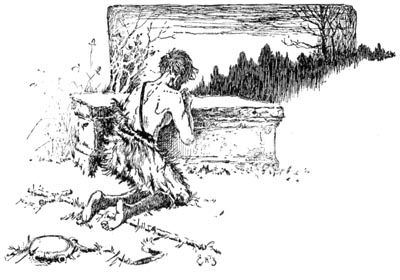
Novel Notes.
Reading edition
By Jerome K. Jerome.
Illustrations by Hal Hurst and J. Gülich.
PART XI.
(Copyrighted 1892 in the United States of America, by Jerome K. Jerome.)
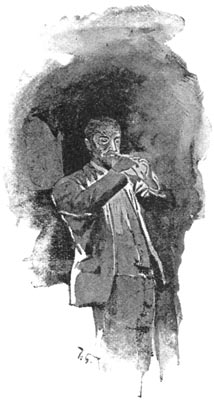
“lighting his pipe.”
Said Brown one evening, “There is but one vice, and that is selfishness. Selfishness is the seed of all sin.”
Jephson was standing before the fire lighting his pipe. He puffed the tobacco into a glow, threw the match into the embers, and then said:
“And the seed of all virtue, also. Don’t let us forget that.”
“Sit down and get on with your work,” said MacShaugnassy from the sofa where he lay at full length with his heels on a chair; “we’re discussing the novel, Paradoxes not admitted during business hours.”
Jephson, however, was in an argumentative mood. “Selfishness,” he continued, “is merely another name for Will. Every deed, good or bad, that we do is prompted by selfishness. We are charitable to secure ourselves a good place in the next world, to make ourselves respected in this, to ease our own distress at the knowledge of suffering. One man is kind because it gives him pleasure to be kind, just as another is cruel because cruelty pleases him. A great man does his duty because to him the sense of duty done is a deeper delight than would be the ease resulting from avoidance of duty. The religious man is religious because he finds a joy in religion; the moral man moral because with his strong self-respect, viciousness would mean wretchedness. Self-sacrifice itself is only a subtle selfishness: we prefer the mental exaltation gained thereby to the sensual gratification which is the alternative reward. Man cannot be anything else but selfish. Selfishness is the law of all life. Each thing, from the farthest fixed star to the smallest insect crawling on the earth, fighting for itself according to its strength; and brooding over all, the Eternal, working for Himself: that is the universe.”
“Have some whiskey,” said MacShaugnassy; “and don’t be so complicatedly metaphysical. You make my head ache.”
“If all action, good and bad, spring from selfishness,” replied Brown; “then there must be good selfishness and bad selfishness; and your bad selfishness is my plain selfishness, without any adjective, so we are back where we started. I say selfishness—bad selfishness—is the root of all evil, and there you are bound to agree with me.”
“Not always,” persisted Jephson; “I’ve known selfishness—selfishness according to the ordinarily accepted meaning of the term—to be productive of good actions. I can give you an instance, if you like.”
“Has it got a moral?” asked MacShaugnassy, drowsily.
Jephson mused a moment. “Yes,” he at length said; “a very practical moral—and one very useful to young men.”
“That’s the sort of story we want,” said MacShaugnassy, raising himself into a sitting position. “You listen to this, Brown.”
Jephson seated himself upon a chair, in his favourite attitude, with his elbows resting upon the back, and smoked for awhile in silence.
“There are three people in this story,” he began; “the wife, the wife’s husband, and the other man. In most dramas of this type, it is the wife who is the chief character. In this case, the interesting person is the other man.
“The wife—I saw her once: she was the most beautiful woman I have ever seen, and the most wicked-looking; which is saying a good deal for both statements. I remember, during a walking tour one year, coming across a lovely little cottage. It was the sweetest place imaginable. I need not describe it. It was the cottage one sees in pictures, and reads of in sentimental poetry. I was leaning over the neatly-cropped hedge, drinking in its beauty, when at one of the tiny casements I saw, looking out at me, a face. It stayed there only for a moment, but in that moment the cottage had become ugly, and I hurried away with a shudder.
“That woman’s face reminded me of the incident. It was an angel’s face, until the woman herself looked out of it: then you were struck by the strange incongruity between tenement and tenant.
“That at one time she had loved her husband, I have little doubt. Vicious women have few vices, and sordidness is not usually one of them. She had probably married him, borne towards him by one of those waves of passion upon which the souls of animal natures are continually rising and falling. On possession, however, had quickly followed satiety, and from satiety had grown the desire for a new sensation.
“They were living at Cairo at the period; her husband held an important official position there, and by virtue of this, and of her own beauty and tact, her house soon became the centre of the Anglo-Saxon society ever drifting in and out of the city. The women disliked her, and copied her. The men spoke slightingly of her to their wives, lightly of her to each other, and made idiots of themselves when they were alone with her. She laughed at them to their faces, and mimicked them behind their backs. Their friends said it was cleverly.
“she laughed at them.”
“One year there arrived a young English engineer, who had come out to superintend some canal works. He brought with him satisfactory letters of recommendation, and was at once received by the European residents as a welcome addition to their social circle. He was not particularly good-looking, he was not remarkably charming, but he possessed the one thing that few women can resist in a man, and that is strength. The woman looked at the man, and the man looked back at the woman; and the drama began.
“Scandal flies swiftly through small communities. Before a month, their relationship was the chief topic of conversation throughout the quarter. In less than two, it reached the ears of the woman’s husband.
“He was either an exceptionally mean or an exceptionally noble character, according to how one views the matter. He worshipped his wife—as men with big hearts and weak brains often do worship such women—with dog-like devotion. His only dread was lest the scandal should reach proportions that would compel him to take notice of it, and thus bring shame and suffering upon the woman he would have given his life to. That a man who saw her should love her seemed natural to him; that she should have grown tired of himself, a thing not to be wondered at. He was grateful to her for having once loved him, for a little while.
“As for ‘the other man,’ he proved somewhat of an enigma to the gossips. He attempted no secrecy; if anything, he rather paraded his subjugation—or his conquest, it was difficult to decide which term to apply. He rode and drove with her; visited her in public and in private (in such privacy as can be hoped for in a house filled with chattering servants, and watched by spying eyes); loaded her with expensive presents, which she wore openly, and papered his smoking den with her photographs. Yet he never allowed himself to appear in the least degree ridiculous; never allowed her to come between him and his work. A letter from her, he would lay aside unopened until he had finished what he evidently regarded as more important business. When boudoir and engine-shed became rivals, it was the boudoir that had to wait.
“The woman chafed under his self-control, which stung her like a lash, but clung to him the more abjectly.
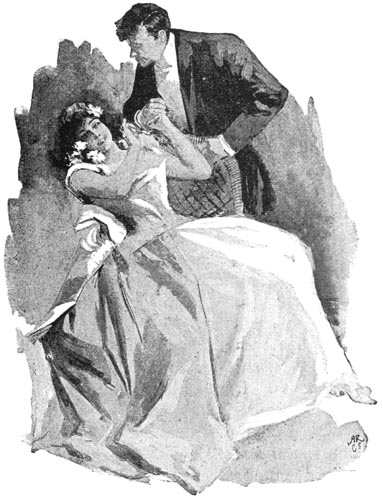
“‘Tell me you love me!’ she would cry fiercely, stretching her white arms towards him.
“‘I have told you so,’ he would reply calmly, without moving.
“‘I want to hear you tell it me again,’ she would plead with a voice that trembled on a sob. ‘Come close to me and tell it me again, again, again!’
“Then, as she lay with half-closed eyes, he would pour forth a flood of passionate words sufficient to satisfy even her thirsty ears, and afterwards, as the gates clanged behind him, would take up an engineering problem at the exact point at which half-an-hour before, on her entrance into the room, he had temporarily dismissed it.
“One day, a privileged friend put bluntly to him this question: ‘Are you playing for love or vanity?’
“To which the man, after long pondering, gave this reply: ‘’Pon my soul, Jack, I couldn’t tell you.’
“Now, when a man is in love with a woman who cannot make up her mind whether she loves him or not, we call the complication comedy; where it is the woman who is in earnest the result is generally tragedy.
“They continued to meet and to make love. They talked—as people in their position are prone to talk—of the beautiful life they would lead if it only were not for the thing that was; of the earthly paradise—or, maybe, ‘earthy’ would be the more suitable adjective—they would each create for the other, if only they had the right which they hadn’t.
“she lay with half-closed eyes.”
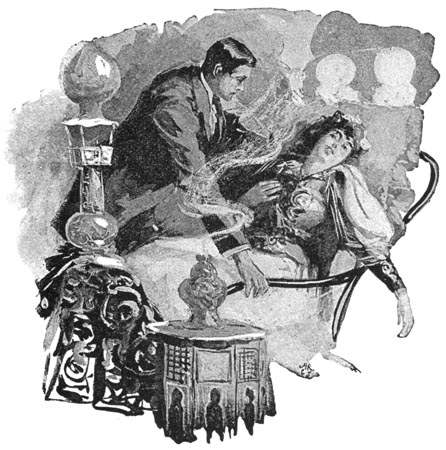
“In this work of imagination the man trusted chiefly to his literary faculties, which were considerable; the woman to her desires. Thus, his scenes possessed a grace and finish which hers lacked, but her pictures were the more vivid. Indeed, so realistic did she paint them, that to herself they seemed realities, waiting for her. Then she would rise to go towards them only to strike herself against the thought of the thing that stood between herself and them. At first the woman only hated the thing, but after a while there came an ugly look of hope into her eyes.
“The time drew near for the man to return to England. The canal was completed, and a day appointed for the letting in of the water. The man determined to make the event the occasion of a social gathering. He invited a large number of guests, among whom were the woman and her husband, to assist at the function. Afterwards the party were to picnic at a pleasant wooded spot some three-quarters of a mile from the first lock.
“The ceremony of flooding was to be performed by the woman, her husband’s position entitling her to this distinction. Between the river and the head of the cutting had been left a strong bank of earth, pierced some distance down by a hole, which hole was kept closed by means of a closely-fitting steel plate. The woman drew the lever releasing this plate, and the water rushed through and began to press against the lock gates. When it had attained a certain depth, the sluices were raised and the water poured down into the deep basin of the lock.
“It was an exceptionally deep lock. The party gathered round and watched the water slowly rising. The woman looked down, and shuddered; the man was standing by her side.
“‘How deep it is,’ she said.
“‘Yes,’ he replied, ‘it holds thirty feet of water, when full.’
“The water crept up inch by inch.
“‘Why don’t you open the gates, and let it in quickly?’ she asked.
“‘It would not do for it to come in too quickly,’ he explained to her; ‘we shall half fill this lock, and then open the sluices at the other end, and so let the water pass through.’
“The woman looked at the smooth stone walls and at the iron-plated gates.
“‘I wonder what a man would do,’ she said, ‘if he fell in, and there was no one near to help him.’
“The man laughed. ‘I think he would stop there,’ he answered. ‘Come, the others are waiting for us.’
“‘if a man fell in, and there was no one near to help him?’”
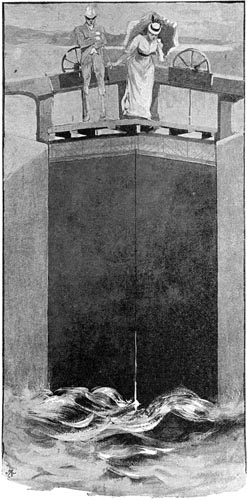
“He lingered a moment to give some final instructions to the workmen. ‘You can follow on when you’ve made all right,’ he said, ‘and get something to eat. There’s no need for more than one to stop.’ Then they joined the rest of the party, and sauntered on, laughing and talking, to the picnic ground.
“After lunch the party broke up, as is the custom of picnic parties, and wandered away in groups and pairs. The man, whose duty as host had hitherto occupied all his attention, looked for the woman, but she was gone.
“A friend strolled by, the same that had put the question to him about love and vanity.
“‘Have you quarrelled?’ asked the friend.
“‘No,’ replied the man.
“‘I fancied you had,’ said the other. ‘I met her just now walking with her husband, of all men in the world, and making herself quite agreeable to him.’
“The friend strolled on, and the man sat down on a fallen tree, and lighted a cigar. He smoked and thought, and the cigar burnt out, but he still sat thinking.
“After a while he heard a faint rustling of the branches behind him and peering between the interlacing leaves that hid him, saw the crouching figure of the woman creeping through the wood.
“His lips were parted to call her name, when she turned her listening head in his direction, and his eyes fell full upon her face. Something about it, he could not have told what, struck him dumb, and the woman crept on.
“Gradually the nebulous thoughts floating through his brain began to solidify into a tangible idea, and the man unconsciously started forward. After walking a few steps he broke into a run, for the idea had grown clearer. It continued to grow still clearer and clearer, and the man ran faster and faster, until at last he found himself racing madly towards the lock. As he approached it he looked round for the watchman who ought to have been there, but the man was gone from his post. He shouted, but if any answer was returned, it was drowned by the roar of the rushing water.
“he broke into a run.”
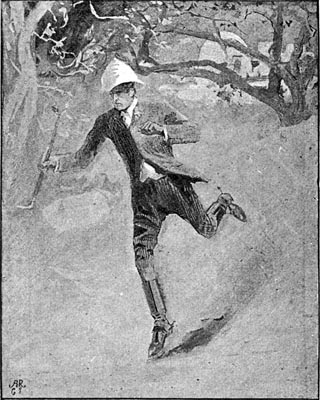
“He reached the edge and looked down. Fifteen feet below him was the reality of the dim vision that had come to him a mile back in the woods: the woman’s husband swimming round and round like a rat in a pail.
“The river was flowing in and out of the lock at the same rate, so that the level of the water remained constant. The first thing the man did was to close the lower sluices and then open those in the upper gate to their fullest extent. The water inch by inch began to rise.
“‘Can you hold out?’ he cried.
“The drowning man turned to him a face already contorted by the agony of exhaustion, and answered with a feeble ‘No.’
“He looked around for something to throw to the man. A plank had lain there in the morning, he remembered stumbling over it, and complaining of its having been left there; he cursed himself now for his care.
“A hut used by the navvies to keep their tools in stood about two hundred yards away; perhaps it had been taken there, perhaps there he might even find a rope.
“‘Just one minute, old fellow!’ he shouted down, ‘and I’ll be back.’
“But the old fellow did not hear him. The feeble struggles ceased. The face fell back upon the water, the eyes half closed as if with weary indifference. There was no time for him to do more than kick off his riding boots and jump in and clutch the unconscious figure as it sank.
“Down there, in that walled-in trap, he fought a long fight with Death for the life that stood between him and the woman. He was not an expert swimmer, his clothes hampered him, he was already blown with his long race, the burden in his arms dragged him down, the water rose slowly enough to make his torture fit for Dantë’s hell.
“he fought a long fight with death.”
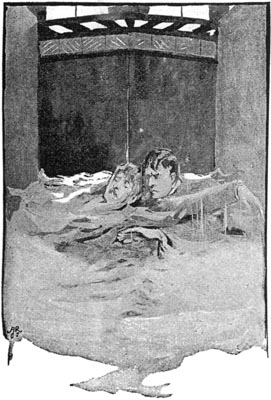
“At first he could not understand why this was so, but in glancing down he saw to his horror that he had not properly closed the lower sluices; in each some eight or ten inches remained open, so that the stream was passing out nearly half as fast as it came in. It would be another five and twenty minutes before the water would be high enough for him to grasp the top.
“He noted where the line of wet had reached to on the smooth stone wall, then looked again after what he thought must be a lapse of ten minutes, and found it had risen half an inch, if that. Once or twice he shouted for help, but the effort taxed severely his already failing breath, and his voice only came back to him in a hundred echoes from his prison walls.
“Inch by inch the line of wet crept up, but the spending of his strength went on more swiftly. It seemed to him as if his inside were being gripped and torn slowly out: his whole body cried out to him to let it sink and lie in rest at the bottom.
“At length his unconscious burden opened its eyes and stared at him stupidly, then closed them again with a sigh; a minute later opened them once more and looked long and hard at him.
“‘Let me go,’ he said, ‘we shall both drown. You can manage by yourself.’
“He made a feeble effort to release himself, but the other held him.
“‘Keep still, you fool!’ he hissed; ‘you’re going to get out of this with me, or I’m going down with you.’
“So the grim struggle went on in silence, till the man, looking up, saw the stone coping just a little way above his head, made one mad leap and caught it with his finger-tips, held on an instant, then fell back with a ‘plump,’ and sank; came up and made another dash, helped by the impetus of his rise, caught the coping firmly this time with the whole of his fingers, hung on till his eyes saw the grass, till they were both able to scramble out upon the bank and lie there, their breasts pressed close against the ground, and their hands clutching the earth, while the overflowing water swirled softly round them.
“caught it with his finger-tips.”
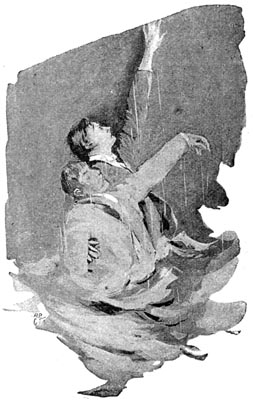
“After a while, they raised themselves and looked at one another.
“‘Tiring work, that sort of thing,’ said the other man, with a nod towards the lock.
“‘Yes,’ answered the husband, ‘beastly awkward not being a good swimmer. How did you know I had fallen in? You met my wife, I suppose?’
“‘Yes,’ said the other man.
“The husband sat staring at a point in the horizon for some minutes. ‘Do you know what I was wondering this morning?’ said he.
“‘No,’ said the other man.
“‘Whether I should kill you or not.’
“‘They told me,’ he continued, after a pause, ‘a lot of silly gossip which I was cad enough to believe. I know now it wasn’t true, because—well, if it had been, you would not have done what you have done.’
“He rose and came across. ‘I beg your pardon,’ he said, holding out his hand.
“‘I beg yours,’ said the other man, rising and taking it; ‘do you mind giving me a hand with the sluices?’
“They set to work to put the lock right.
“‘How did you manage to fall in?’ asked the other man, who was raising one of the lower sluices, without looking round.
“The husband hesitated, as if he found the explanation somewhat difficult. ‘Oh,’ he answered carelessly, ‘the wife and I were chaffing, and she said she’d often seen you jump it, and’—he laughed a rather forced laugh—‘she promised me a—a kiss if I cleared it. It was a foolish thing to do.’
“‘Yes, it was rather,’ said the other man.
“A few days afterwards the man and woman met at a reception. He found her in a leafy corner of the garden talking to some friends. She advanced to meet him, holding out her hand. ‘What can I say more than thank you,’ she murmured in a low voice.
“The others moved away leaving them alone. ‘They tell me you risked your life to save his?’ she said.
“‘Yes,’ he answered.
“She raised her eyes to his, then struck him across the face with her ungloved hand.
“struck him across the face.”
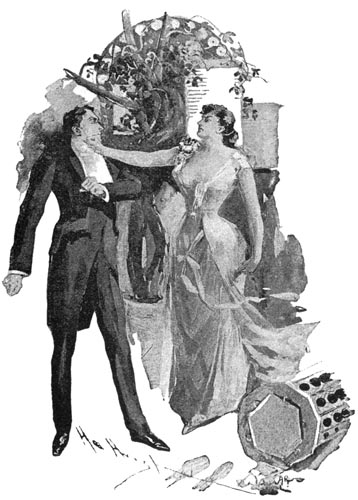
“‘You damned fool!’ she whispered.
“He seized her by her white arms, and forced her back behind the orange trees. ‘Do you know why?’ he said, speaking slowly and distinctly; ‘because I feared that with him dead you would want me to marry you, and that, talked about as we have been, I might find it awkward to avoid doing so; because I feared that without him to stand between us you might prove an annoyance to me—perhaps come between me and the woman I love, the woman I am going back to. Now do you understand?’
“‘Yes,’ whispered the woman, and he left her.
“But there are only two people,” concluded Jephson, “who do not regard his saving of the husband’s life as a highly noble and unselfish action, and they are the man himself and the woman.”
We thanked Jephson for his story, and promised to profit by the moral, when discovered. Meanwhile, MacShaugnassy said that he knew a story dealing with the same theme, namely, the too close attachment of a woman to a strange man, which really had a moral, which moral was: don’t have anything to do with inventions.
Brown, who had patented a safety gun, which he had never yet found a man plucky enough to let off, said it was a bad moral. We agreed to hear the particulars, and judge for ourselves.
“This story,” commenced MacShaugnassy, “comes from Furtwangen, a small town in the Black Forest. There lived there a very wonderful old fellow named Nicholaus Geibel. His business was the making of mechanical toys, at which work he had acquired an almost European reputation. He made rabbits that would emerge from the heart of a cabbage, flop their ears, smooth their whiskers, and disappear again; cats that would wash their faces, and mew so naturally that dogs would mistake them for real cats, and fly at them; dolls, with phonographs concealed within them, that would raise their hats and say, ‘Good morning; how do you do,’ and some that would even sing a song.
“he had contrived a mechanical donkey.”
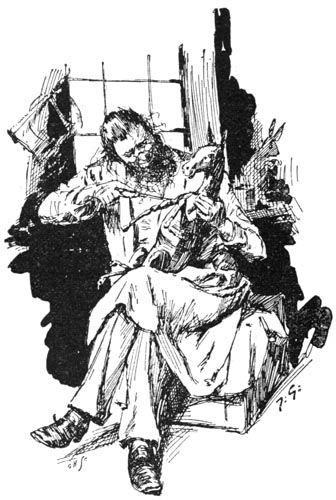
“But he was something more than a mere mechanic; he was an artist. His work was with him a hobby, almost a passion. His shop was filled with all manner of strange things that never would, or could, be sold—things he had made for the pure love of making them. He had contrived a mechanical donkey that would trot for two hours by means of stored electricity, and trot, too, much faster than the live article, and with less need for exertion on the part of the driver; a bird that would shoot up into the air, fly round and round in a circle, and drop to earth at the exact spot from where it started; a skeleton that, supported by an upright iron bar, would dance a hornpipe; a life-size lady doll that could play the fiddle; and a gentleman with a hollow inside who could smoke a pipe and drink more lager beer than any three average German students put together, which is saying much.
“Indeed, it was the belief of the town that old Geibel could make a man capable of doing everything that a respectable man need want to do. One day he made a man who did too much, and it came about in this way.
“Young Doctor Follen had a baby, and the baby had a birthday. Its first birthday put Doctor Follen’s household into somewhat of a flurry, but on the occasion of its second birthday, Mrs. Doctor Follen gave a ball in honour of the event. Old Geibel and his daughter Olga were among the guests.
“During the afternoon of the next day some three or four of Olga’s bosom friends, who had also been present at the ball, dropped in to have a chat about it. They naturally fell to discussing the men, and to criticising their dancing. Old Geibel was in the room, but he appeared to be absorbed in his newspaper, and the girls took no notice of him.
“‘There seem to be fewer men who can dance at every ball you go to,’ said one of the girls.
“‘Yes, and don’t the ones who can give themselves airs,’ said another; ‘they make quite a favour of asking you.’
“‘And how stupidly they talk,’ added a third. ‘They always say exactly the same things: “How charming you are looking to-night.” “Do you often go to Vienna? Oh, you should, it’s delightful.” “What a charming dress you have on.” “What a warm day it has been.” “Do you like Wagner?” I do wish they’d think of something new.’
“‘Oh, I never mind how they talk,’ said a fourth. ‘If a man dances well he may be a fool for all I care.’
“‘He generally is,’ slipped in a thin girl, rather spitefully.
“‘I go to a ball to dance,’ continued the previous speaker, not noticing the interruption. ‘All I ask of a partner is that he shall hold me firmly, take me round steadily, and not get tired before I do.’
“‘A clockwork figure would be the thing for you,’ said the girl who had interrupted.
“‘Bravo!’ cried one of the others, clapping her hands, ‘what a capital idea!’
“‘What’s a capital idea?’ they asked.
“‘Why, a clockwork dancer, or, better still, one that would go by electricity and never run down.’
“The girls took up the idea with enthusiasm.
“‘Oh, what a lovely partner he would make,’ said one; ‘he would never kick you, or tread on your toes.’
“‘Or tear your dress,’ said another.
“‘Or get out of step.’
“‘Or get giddy and lean on you.’
“‘And he would never want to mop his face with his handkerchief. I do hate to see a man do that after every dance.’
“‘And wouldn’t want to spend the whole evening in the supper room.’
“‘Why, with a phonograph inside him to grind out all the stock remarks, you would not be able to tell him from a real man,’ said the girl who had first suggested the idea.
“‘Oh, yes, you would,’ said the thin girl, ‘he would be so much nicer.’
“Old Geibel had laid down his paper, and was listening with both his ears. On one of the girls glancing in his direction, however, he hurriedly hid himself again behind it.
“After the girls were gone, he went into his workshop, where Olga heard him walking up and down, and every now and then chuckling to himself; and that night he talked to her a good deal about dancing and dancing men—asked what they usually said and did—what dances were most popular—what steps were gone through, with many other questions bearing on the subject.
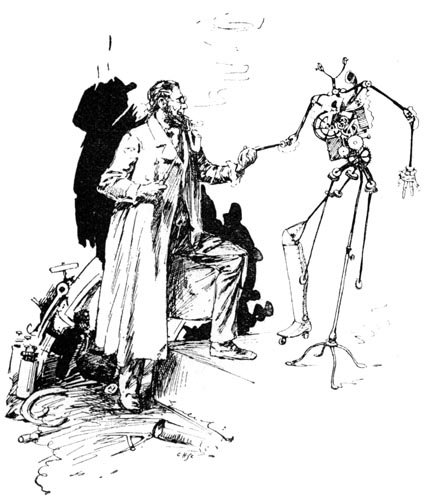
“Then for a couple of weeks he kept much to his factory, and was very thoughtful and busy, though prone at unexpected moments to break into a quiet low laugh, as if enjoying a joke that nobody else knew of.
olga showing him what steps were gone through.
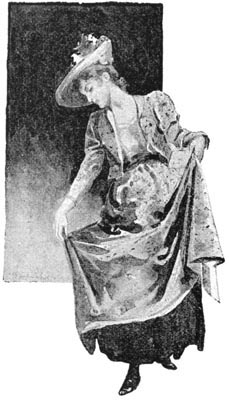
“A month later another ball took place in Furtwangen. On this occasion it was given by old Wenzel, the wealthy timber merchant, to celebrate his niece’s betrothal, and Geibel and his daughter were again among the invited.
“When the hour arrived to set out, Olga sought her father. Not finding him in the house, she tapped at the door of his workshop. He appeared in his shirt-sleeves, looking hot but radiant.
“‘Don’t wait for me,’ he said, ‘you go on, I’ll follow you. I’ve got something to finish.’
“As she turned to obey he called after her, ‘Tell them I’m going to bring a young man with me—such a nice young man, and an excellent dancer. All the girls will like him.’ Then he laughed and closed the door.
“Her father generally kept his doings secret from everybody, but she had a pretty shrewd suspicion of what he had been planning, and so, to a certain extent, was able to prepare the guests for what was coming. Anticipation ran high, and the arrival of the famous mechanist was eagerly awaited.
“At length the sound of wheels was heard outside, followed by a great commotion in the passage, and old Wenzel himself, his jolly face red with excitement and suppressed laughter, burst into the room and announced in stentorian tones:
“‘Herr Geibel—and a friend.’
“Herr Geibel and his ‘friend’ entered, greeted with shouts of laughter and applause, and advanced to the centre of the room.
“‘Allow me, ladies and gentlemen,’ said Herr Geibel, ‘to introduce you to my friend, Lieutenant Fritz. Fritz, my dear fellow, bow to the ladies and gentlemen.’
“Geibel placed his hand encouragingly on Fritz’s shoulder, and the lieutenant bowed low, accompanying the action with a harsh clicking noise in his throat, unpleasantly suggestive of a death rattle. But that was only a detail.
“‘He walks a little stiffly’ (old Geibel took his arm and walked him forward a few steps. He certainly did walk stiffly), ‘but then, walking is not his forte. He is essentially a dancing man. I have only been able to teach him the waltz as yet, but at that he is faultless. Come, which of you ladies may I introduce him to as a partner. He keeps perfect time; he never gets tired; he won’t kick you or tread on your dress; he will hold you as firmly as you like, and go as quickly or as slowly as you please; he never gets giddy; and he is full of conversation. Come, speak up for yourself, my boy.’
“The old gentleman twisted one of the buttons at the back of his coat, and immediately Fritz opened his mouth, and in thin tones that appeared to proceed from the back of his head, remarked suddenly, ‘May I have the pleasure?’ and then shut his mouth again with a snap.
“That Lieutenant Fritz had made a strong impression on the company was undoubted, yet none of the girls seemed inclined to dance with him. They looked askance at his waxen face, with its staring eyes and fixed smile, and shuddered. At last old Geibel came to the girl who had conceived the idea.
“‘It is your own suggestion, carried out to the letter,’ said Geibel, ‘an electric dancer. You owe it to the gentleman to give him a trial.’
“She was a bright, saucy little girl, fond of a frolic. Her host added his entreaties, and she consented.
“Herr Geibel fixed the figure to her. Its right arm was screwed round her waist, and held her firmly; its delicately-jointed left hand was made to fasten itself upon her right. The old toymaker showed her how to regulate its speed, and how to stop it, and release herself.
“‘It will take you round in a complete circle,’ he explained; ‘be careful that no one knocks against you, and alters its course.’
“for a couple of weeks he kept to his factory.”
“The music struck up. Old Geibel put the current in motion, and Annette and her strange partner began to dance.
“For a while everyone stood watching them. The figure performed its purpose admirably. Keeping perfect time and step, and holding its little partner tight clasped in an unyielding embrace, it revolved steadily, pouring forth at the same time a constant flow of squeaky conversation, broken by brief intervals of grinding silence.
“‘How charming you are looking to-night,’ it remarked in its thin, far-away voice. ‘What a lovely day it has been. Do you like dancing? How well our steps agree. You will give me another, won’t you? Oh, don’t be so cruel. What a charming gown you have on. Isn’t waltzing delightful? I could go on dancing for ever—with you. Have you had supper?’
“As she grew more familiar with the uncanny creature, the girl’s nervousness wore off, and she entered into the fun of the thing.
“‘Oh, he’s just lovely,’ she cried, laughing, ‘I could go on dancing with him all my life.’
“Couple after couple now joined them, and soon all the dancers in the room were whirling round behind them. Nicholaus Geibel stood looking on, beaming with childish delight at his success.
“my friend, lieutenant fritz.”
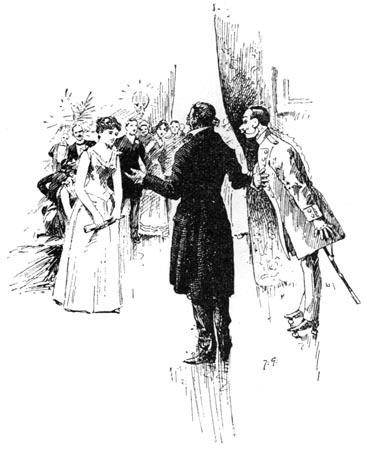
“Old Wenzel approached him, and whispered something in his ear. Geibel laughed, and nodded, and the two worked their way quietly towards the door.
“‘This is the young people’s house to-night,’ said Wenzel, so soon as they were outside; ‘you and I will have a quiet pipe and a glass of hock, over in the counting-house.’
“Meanwhile the dancing grew more fast and furious. Little Annette loosened the screw regulating her partner’s rate of progress, and the figure flew round with her swifter and swifter. Couple after couple dropped out exhausted, but they only went the faster, till at length they remained dancing alone.
“Madder and madder became the waltz. The music lagged behind: the musicians, unable to keep pace, ceased, and sat staring. The younger guests applauded, but the older faces began to grow anxious.
“‘Hadn’t you better stop, dear,’ said one of the women, ‘you’ll make yourself so tired.’
“But Annette did not answer.
“‘I believe she’s fainted,’ cried out a girl who had caught sight of her face as it was swept by.
“One of the men sprang forward and clutched at the figure, but its impetus threw him down on to the floor, where its steel-cased feet laid bare his cheek. The thing evidently did not intend to part with its prize easily.
“Had anyone retained a cool head, the figure, one cannot help thinking, might easily have been stopped. Two or three men acting in concert might have lifted it bodily off the floor, or have jammed it into a corner. But few human heads are capable of remaining cool under excitement. Those who are not present think how stupid must have been those who were; those who are reflect afterwards how simple it would have been to do this, that, or the other, if only they had thought of it at the time.
“The women grew hysterical. The men shouted contradictory directions to one another. Two of them made a bungling rush at the figure, which had the result of forcing it out of its orbit in the centre of the room, and sending it crashing against the walls and furniture. A stream of blood showed itself down the girl’s white frock, and followed her along the floor. The affair was becoming horrible. The women rushed screaming from the room. The men followed them.
“One sensible suggestion was made: ‘Find Geibel—fetch Geibel.’
“No one had noticed him leave the room, no one knew where he was. A party went in search of him. The others, too unnerved to go back into the ball-room, crowded outside the door and listened. They could hear the steady whir of the wheels upon the polished floor as the thing spun round and round; the dull thud as every now and again it dashed itself and its burden against some opposing object and ricocheted off in a new direction.
“And everlastingly it talked in that thin ghostly voice, repeating over and over the same formula: ‘How charming you are looking to-night. What a lovely day it has been. Oh, don’t be so cruel. I could go on dancing for ever—with you. Have you had supper?’
“Of course they sought for Geibel everywhere but where he was. They looked in every room in the house, then they rushed off in a body to his own place, and spent precious minutes in waking up his deaf old housekeeper. At last it occurred to one of the party that Wenzel was missing also, and then the idea of the counting-house across the yard presented itself to them, and there they found him.
“He rose up, very pale, and followed them; and he and old Wenzel forced their way through the crowd of guests gathered outside, and entered the room, and locked the door behind them.
“From within there came the muffled sound of low voices and quick steps, followed by a confused scuffling noise, then silence, then the low voices again.
“After a time the door opened, and those near it pressed forward to enter, but old Wenzel’s broad shoulders barred the way.
“‘I want you—and you, Bekler,’ he said, addressing a couple of the elder men. His voice was calm, but his face was deadly white. ‘The rest of you, please go—get the women away as quickly as you can.’
“From that day old Nicholaus Geibel confined himself to the making of mechanical rabbits and cats that mewed and washed their faces.”
We agreed that the moral of MacShaugnassy’s story was a good one.
(To be continued.)

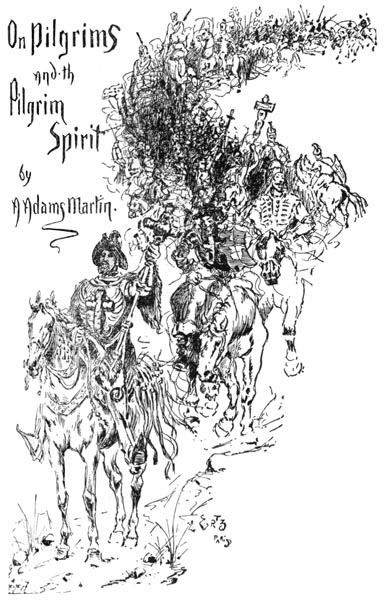
“Then longe folk to go on pilgrimages, And palmers for to seeke strange strands To ferne hallows couth in sundry lands.”
In the good old times, when a man wanted a little change from the bosom of his family—in those days a somewhat restricted bosom—he went on a crusade, or a pilgrimage.
What if he did spend his time and substance on that which, from a worldly standpoint, profited not—absenting himself from home and friends for periods of time lengthy enough to afford a modern wife good grounds for a divorce—was it not all meritorious? Heaven, he fondly believed, would more than pay his travelling expenses by a large cheque to his credit on the next world, whilst he had the pleasure of the journey in this: an ingenious method of seeing something of both! And so he donned his pilgrim weeds, and his “cockle hat and shoon”—as all good chroniclers tell us—and hied him off to Canterbury or Cologne, Rome, Jerusalem, or Timbuctoo. Mrs. Pilgrim was left at home to play “patience,” and to keep the house and bairns. She was generally a long-suffering creature, but sometimes she did get into mischief. She could not always spin yarn, so she occasionally varied her task by weaving nets—traps for the unwary who was not a pilgrim.
But if she got into mischief, she paid the penalty; my lord invariably cut off her head with his scimitar when he returned home—if she waited for that—and there was an end of the matter. There was no Divorce Court in the good old days, and a woman’s head did not count for much. But these slight casualties never diminished the ardour of the pilgrim spirit: the pilgrim increased and multiplied, and sought new shrines as well as new wives. To slightly vary the words of the poet, “Shrine after shrine his rising raptures fill. But still he sighs—for shrines are wanting still.” The law of supply and demand, however, worked as surely then as now; and as pilgrims increased to venerate, objects increased to be venerated. There is a good story told by the Arabs—it was given by Dr. Samuel Jessup in one of his contributions to “Picturesque Palestine” some years ago—and it is an apt illustration of this supply and demand principle.
“ran away with his master’s donkey.”
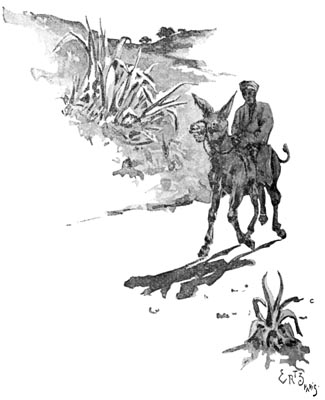
There was a certain Sheik-Mohammed who, once upon a time, was the keeper of a “wely” or shrine, supposed by the faithful to be the tomb of an eminent Saint, and so largely frequented by them that the Sheik grew rich from their costly offerings. His servant Ali, however, receiving but a small share of the profits, ran away to the south of the Jordan, taking with him his master’s donkey. The animal died on the way, and Ali, having covered his body with a heap of stones, sat down in despair. A passer-by enquired the cause of his sorrow, and Ali replied that he had just found the tomb of an eminent Saint; the man kissed the stones, gave Ali a present, and passed on his way.
The news of the holy shrine spread throughout the land, and pilgrims thronged to visit it: Ali became rich, built a fine “Kubbeh” (Dome), and was envied by all the Sheiks.
Mohammed, hearing of the new shrine, and finding his own eclipsed by it, made a pilgrimage to it himself, in hopes of finding out the source of its great repute. Finding Ali in charge, he asked, in a whisper, if he would tell him the name of the Saint whose tomb he kept charge of. “I will,” replied Ali, “on condition that you tell me the name of your Saint.” Mohammed consented, and Ali then whispered, “God alone is great! This is the tomb of the donkey I stole from you.”
“Mashallah!” cried Mohammed, “and my ‘wely’ is the tomb of that donkey’s father!” Methinks Palestine has not a monopoly of the long-eared and long-suffering race, either living or dead!
But we have changed all that; as we have a good many other things. Saints and their shrines are out of fashion. “It is an age of seeing, not believing,” we say complacently; and we laugh with superior wisdom at the follies of our forefathers, and the relics they went so far to adore—relics which, like the fabled frog, by trying to swell themselves to greater and still greater dimensions, ended in growing a little too extensive for their ultimate good. Saints, like sinners, can only have two legs apiece, we all know; but the saints of our ancestors, if their relics spoke truly, must have been saintly centipedes: of making new limbs there was no end, and, as their numbers increased, reverence waned, till hey!—the bubble of credulity burst at last, as did the frog!
But if the heavenly profitability was cut off by this collapse of superstition, or eclipse of faith—call it which you will—the habit of pleasurable moving remained; stronger by the force of repeated custom throughout all past times: we keep the shell, but we cunningly substitute a new kernel in the place of the exploded core of heretofore.
We go a pilgrimage still, but your modern spirit is now the pilgrim of Health, Pleasure, Science, Art, and such-like—all high-sounding names to conjure by; and the world, that old time-server, ever seeking to accommodate itself to the new ways of its inhabitants, is ever supplying us with a new Spa, a new “old master,” or masterpiece, a newly dug-up ruin, or hieroglyph, or Dark Continent, or—for even the humblest “tripper” is not forgotten—a new Mudport-on-Sea.
The shrines of our forefathers’ worship have crept back into favour by hiding themselves in the voluminous draperies of History or Art. Our appetite for shows is omnivorous, and we don’t object to a shrine if it has a Gothic moulding sufficiently “cute,” or a Byzantine roof, or some other attraction—are we not pilgrims of Art?—though if called upon to define our roof or moulding many of us might be considerably nonplussed, taking refuge in describing one as a “thing with a round top,” and the other as “a sort of stone trimming, don’t you know.”
I remember once reading a child’s tale—I have forgotten where, for it was many years ago—but the drift of the story was too good to forget. It was about a small pig who lived with his mother in a stye which possessed but a limited front yard. Piggy had the pilgrim spirit, and sighed to escape to pastures new, to see what lay beyond his little wall. One day his chance came—he escaped somehow, and made a pilgrimage round the farmyard, where the strange things he saw either frightened him dreadfully, or were utterly unintelligible to his piggish mind. He was so frightened by the roaring of a bull that he fled with great precipitation home, where he gave a glowing account of his travels to his mother.
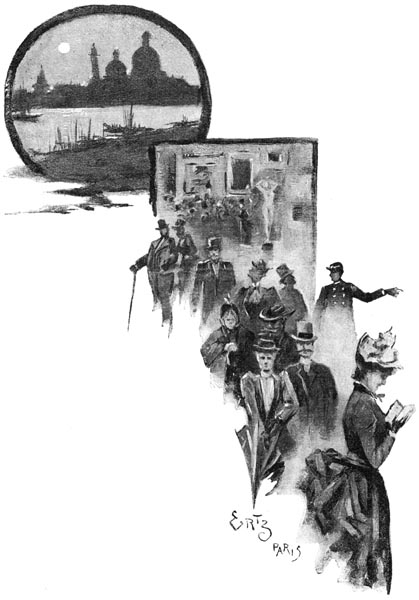
“pilgrims of art.”
“Yes,” he said, “I have seen the world. It is square, and it has a wall all round it, to keep the pigs from falling off, of course. I saw some queer white pigs, with only two legs—think of that! They said ‘Quack, quack’—that is what they say in the world, you know, but, of course, you don’t understand. Then I saw a great red pig, who cried, ‘Mou-e-e-e!’ There is but one such pig in the world, and I have seen it. I am content to live quietly now, for I have seen the whole world!”
Who has not seen that smug satisfaction of small souls as reflected by piggy?
There is a great deal in looking wise even if you don’t feel so. Talk always of your “dones,” and leave out the “undones.”
Most of us have heard of the apocryphal American who “does Europe” in a fortnight! I cannot say that I have actually met that gentleman, but I have met pilgrims, both English and American, who will tell you grandly that they have “done”—say Rome, in two, nay in one day! All the antiquities, of course, and the Museums; and then comes a string of names of churches, and galleries, until you gasp for breath! You go away and lean against something to recover your breath, and your gravity, but the pilgrimage is an accomplished fact. They have a right to stick to the cockle-shell in their cap, so to speak, and go home saying, “Oh, yes! We have done Rome, or Italy, or Egypt, thoroughly; missed nothing!”
If one could take an impression of one of these pilgrim’s brains by “Kodak,” one would get some queer results in chaos, rather like the game of family post—the Raphael frescoes transferring themselves to Karnak, and the Sphinx hiding in the Catacombs, whilst pictures, statuary, and shrines of “cult” executed a Bacchanalian dance on a gigantic scale all round.
But results do not alter facts; and in these busy days people are generally content to see your tree of knowledge; they have no time to climb its branches to look for the fruit of wisdom!
We have changed our pilgrim weeds for an ulster of the latest cut, and our Missal for a “Murray” or “Baedeker,” but are we really so much wiser than our forefathers?
Alas! we have but changed the object, and human nature, gullible ever, sees no reason why it should not flock in thousands to drop a visiting card into the tomb (so called) of “Juliet” at Verona, with as fond credulity as their fathers, when they deposited their candle at the tomb of some miracle-working saint; with this difference, however—that the latter was deposited for the glory and praise of the saint, and the former of the sinner himself. Who could say, after that, that he had not seen it!
I happened, when there, to make some irreverent remarks about that tomb. I had walked out to see it on a hot afternoon, and I found it inconveniently far. One is accustomed to have these places “grouped,” and I was displeased with Juliet for not being buried nearer home—it was an oversight—but perhaps it had been arranged for the benefit of the carriage-drivers. Juliet was public-spirited, and thought of all classes, and their interests. I did not think of all these extenuating circumstances then, however, and so I said unbelieving things about her tomb.
The custode was deeply pained, as an orthodox custode ought to be. He remonstrated with me first, and then he pointed to the wall. “Ecco, Signor! è scritto, è scritto è verissimo!”
“ecco, signor!”
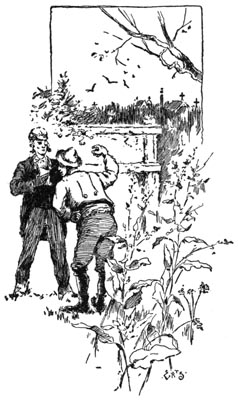
And there indeed it was written, in good set terms, and in two or three languages, for the benefit of all non-literary or unbelieving pilgrims.
I have often thought since how many people there are, like my friend the custode, to whom the magic “it is written” is sufficient ground for their faith, without further consideration as to when and how.
Some time ago a friend of mine encountered a portly Western American tourist at Kenilworth. He came in a hurry, and asked to be shown the part “wrote up” by Scott. He gazed for a few minutes, and then departed as quickly as he came. To him Kenilworth was merely a place “wrote up” by Scott, and no doubt he had Warwick and Stratford-on-Avon to see that same afternoon, before going on to Liverpool.
There are pilgrims who certainly carry a feeling of duty into all things. Wherever they go they mean work!
This quality pre-eminently distinguishes the English-speaking world, and it always fills our Continental, or Oriental, neighbours with lazy wonder. “Oh, these Englishwomen! they have legs and stomachs of bronze!” I once heard an Italian say.
We are inclined to overdo it. I think an occasional rest-day is as necessary to the tired brain as the photographer’s dark room is to the development of the negative impression—without it the brain would, indeed, record a “negative impression.”
But I am straying from Juliet’s tomb, and the subject of unlimited faith. Only make a thing possible, and, if there is an undercurrent of desire to believe it, the large majority will swallow almost anything with what theologians call “simple faith.” The “if” is an important one—the key to the situation. We believe readily when it is agreeable to do so, and all pilgrims have ever sought to heighten the attractions of the objects of their interest. It adds to their own enjoyment of them, and, after all, is it not a reflex compliment to ourselves? If “there is but one such pig in the world,” have not I seen it?
“lured men to destruction.”
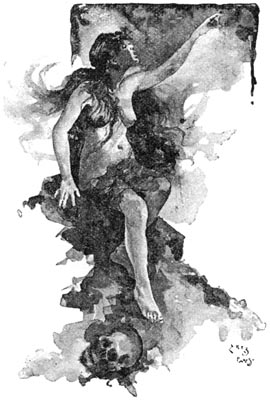
Have you ever noticed the effect of the expression, “They say?” If we say “Tom,” or “Dick,” or “Harry,” says “so and so,” “Tom” is no better authority than “Dick,” nor are both together much better than “Harry.” But if we say, indefinitely, “They say” “so and so,” there is a mysterious potency in the unknown quantity which leads, if not to universal belief, at least to universal transmission.
“Yes, it is an interesting spot. They say that a princess is buried here who was laid under a potent spell by a mighty wizard, long, long ago,” etc.; or “They tell of a beauteous maiden who sat on this rock, in the far past, and sang, and thus lured men to destruction,” etc.
He or she is always swallowed up by the mists of obscurity—oh, ye mists of obscurity, ye have much to answer for!
We do not care to dispute with “They” his superior information—even if we could find him; for he seems to reside permanently in the aforesaid mists himself; only issuing forth, like a valiant knight, to rescue the fair maidens—Fact, or Fiction—from the jaws of the dragon Oblivion! What he is, we leave to the learned, who could no doubt dispose of him suitably in connection with the highly convenient solar myths, as a Potent Rescuing Power! As for us, we meddle not with the mists: we rather like the delicious glow of their luminous dimness, which glorifies the past if it clouds it; and which softens off the hardness of our prosaic modern life, as a summer haze our English landscape.
We are delighted to get hold of an ancient legend, whether of headless horseman or housekeeper, pixie or wizard. Even in that “happy hunting ground” of the Modern Spirit, the United States of America, the old legends linger still, if but faintly. The soil of a new country does not grow sentiment of this sort readily, but the plant is indigenous to the human heart; and its fair flowers have been gathered and wreathed around their pages by many an essayist and poet. We cannot do without the element of mystery in our life, however we may represent it. It is part of the spirit within us, and we find it in everything around us. It is the veil of “Isis” which science, her worshipper, is ever trying to lift, but cannot. The muse of Inspiration pours forth her melodious voice, like the nightingale, in the darkness and the shady covert. We listen to her song with entranced ears; a few whose spirits are “finely touched,” try to repeat it; but who has ever seen her; the soul that animates, the spirit that inspires! Our life itself is a mystery—the Past and Future—are they not the wings of the Spirit of Time which are brooding over our Present? When they are lifted—when the mighty pinions are outspread for flight—then the shadows will flee for ever, for the great Daybreak of Eternity will have begun!
science lifting the veil of isis.
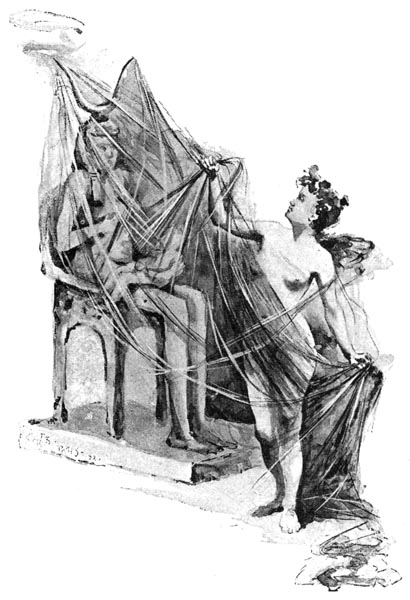
Without the spirit of mystery, the mother of enquiry—of romance, the days of pilgrimage would be ended. If it is a mere matter of rest, and of oiling the wheels of the machine for a fresh grind, Mudport-on-Sea will do well enough; but Mudport-on-Sea can never satisfy the hunger of the curious soul for the beautiful; the marvellous; all that is in itself lovely, or that has lived in the past, and caught a brighter glow from its rainbow reflections. One spot of ground may content the naturalist, or the Buddhist sage, for one can find a world of wondrous thought in the smallest leaf—a microcosm in a dew-drop; and the other can send his soul off on aerial pilgrimages, though his body may be in chains! But we are not all either natural or transcendental philosophers; our appetite requires not one leaf, but many, for our powers of assimilation are not great enough to draw spiritual sustenance from one alone; and so, like the caterpillar, when we have finished our leaf, we crawl to another.
“But this spirit of curiosity, or unrest, is all owing to lack of self-culture,” cry some. Perhaps it is—some of it. No doubt the cocoon stage of rest and self-development is higher, and nearer to the ultimate perfection—the winged creature which soars above where others crawl—but until we are fit to be cocoons, and evolve butterflies, we must be content with our caterpillar instincts.
People speak scornfully of “mere curiosity,” but it is only worthless when it bears no fruit. Curiosity, in itself, is a healthy, natural instinct, which we see to perfection in the small child. Toddie’s speech in “Helen’s Babies,” “Want to shee wheels go wound,” is the pilgrim spirit epitomised. We hear of the watch, and we want to see it; we see it, and then we want to hold it; we hear it tick, and we want to open it; and then we would like to “shee wheels go wound” constantly, and if we cannot, we kick at the prohibition!
Curiosity may be a worthless element in life when idle, but when otherwise, is it not the mainspring of the watch? Think of the manifold results of “mere curiosity,” when rightly persevered in! But then we change the name—it becomes insight—research—it becomes a power which can climb the dizziest height, and dive the deepest depths, to bring to us their treasures—the star—the pearl!