Experiences of a ’Varsity Oar.
Reading edition
By an “Old Blue.”
(F. C. Drake.)
Illustrations by Ernest Prater.
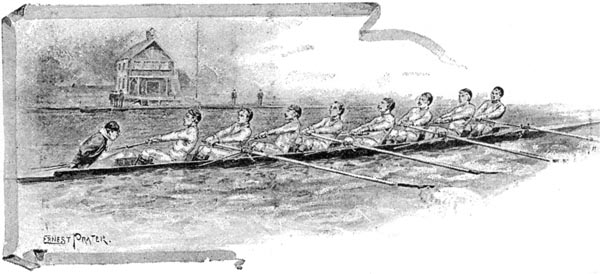
Rowing in the University Boat Race is not a thing to be undertaken lightly. To begin with, it involves great muscular exertion; but this is not unpleasant, and, as I shall presently show, is not dangerous. Further, it ties the aspirant to his oar for at least ten weeks, which is perhaps its greatest disadvantage; and it involves intense application and a pretty good temper under remarks from the “coach” that are sometimes almost more than caustic. But against these drawbacks are to be set the pleasure of gratified ambition, the healthy life, and, best of all, the sensation of the flight of the boat driven by eight men, of whom none are really bad oarsmen, and some are uncommonly good. Putting these side by side, no one need wonder that an old Blue should look on the time he spent at Putney as one of the best in his life.
I will pass over the preliminary work at the University, for it contains nothing novel or interesting, and is mainly consumed in settling the crew who are finally to row, and in getting the men “hard” by long, steady work, to get rid of fat and replace it by muscle. The real interest begins when the crew has been settled, and the men have had their colours given them, and are looking forward shortly to leaving the home waters. By this time they are fairly “fit,” and, as they have in all cases of doubt had the very best medical opinions, they are not very likely to go wrong. There is a good deal of nonsense talked about the dangers of this race to health. No man who is not absolutely sound in wind and limb is allowed to begin training at all, for the obvious reason that the captain does not want one of his men to fail him at the last moment. It is about as probable that a man should go tiger shooting without looking to see if his rifle is loaded, as that the President of a University Boat Club should select an oarsman who is likely to “crock up.”
It is when the crew leave the home waters that the really enjoyable part of the training begins. The Cambridge crew generally, and the Oxford men not infrequently, go straight to Putney, but a far more pleasant plan is to spend a week or so on the up-river waters before going to the Metropolitan course. Everyone knows Cookham in its summer dress, with a plentiful crowd of holiday-makers on the water; but in the very early spring, before the foliage has begun to appear, and when the light-hearted champagne bottle still nestles in its straw, it has also a very great charm of its own. The fresh air, and the change to new scenes, together with the strong stream caused by winter rains, make the men feel like young bullocks, and the boat moves with twice the spring it had before. The jolly lounging life in between whiles, diversified with songs, saloon-pistols, and the like, the pleasant walk over the hills on Sunday, and the total freedom from all thoughts and cares, beyond the beating of a record over the course next day, all go to make up an Elysian life.
Every now and then the amusement is varied by the rather boisterous humour of the elements. Some five years ago the state of the tide at Putney rendered it necessary to do most of the work early in the morning. It was freezing hard, with occasional showers of snow, and the coxswain absolutely was able to stand his coat up when he took it off. It had got drenched, and was frozen stiff! I have several times been in a boat when we had to land and empty out the water, that had broken over the bow oars in such quantities as almost to sink us. Occasionally, boats have quite sunk from the same cause, while the men stuck to their thwarts, presenting a comic appearance as they rowed away, seated, as it seemed, in the water.
“a work of genius.”
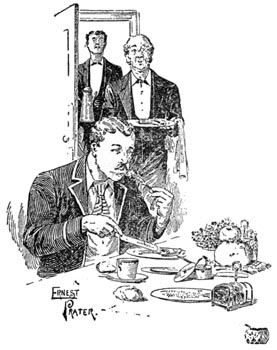
A great consideration in estimating the happiness of such a time as this is the question, “What did you have to eat?” But the answer to this has been given so many times that it would be merely wearisome now to detail the various dishes that are or are not “good for training.” Enough to say that, as everybody knows, the old rigorous system of raw beef and beer is a thing of the past—except the beer. Nowadays, it is considered sufficient to banish all very unwholesome things from the table, while keeping as nearly as possible to each man’s ordinary diet. In point of quantity there are practically no restrictions, unless the Captain considers that any man does not know when he has had enough (which, alas! may occur); in which case he may remonstrate with him gently, but firmly. I have seen a man eat for breakfast a sole and a half, three chops, a poached egg, and some watercress; but I confess that this was regarded as a work of genius. The ordinary man in training eats only about twice as much as any sane person, or perhaps a little more; and as, of course, the system needs recuperating under the great strains that are put upon it, this trifling excess has its justification.
However, the result of this wear and tear and repair of the muscular tissue is that the activity of the mind decreases in inverse proportion to that of the body; and during a hard course of training the rowing man is generally rather sleepy and unintellectual. This matters all the less that studies are forbidden—not a very difficult rule to enforce—during the latter part of the time. But training once over, the strength and health accumulated can certainly do no harm either physical or mental, and a healthy body is the best guarantee for an active mind (see Latin authors and copybooks passim).
“lapped in profoundest sleep.”
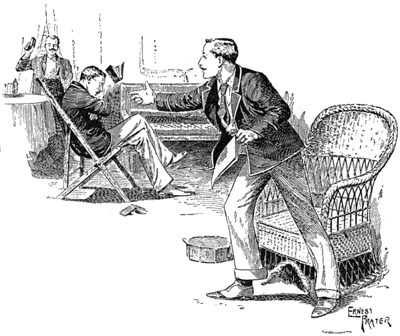
About three weeks or less before the race a move is made to Putney, where, as a general rule, very comfortable quarters are provided. The pleasantest of all that the Oxford crew have had lately has been the Lyric Club House; but it is not really a good place for the men’s health. Lying, as it does, just down by the river, the air is not half so bracing as that of the higher ground. Still, it is undoubtedly very convenient to have a billiard-table or two to while away the men’s time in the evening. Without something of the kind time is apt to hang very heavily on their hands. Conversation flags, the chairs feel very comfortable after the day’s work, and Morpheus, drowsy god, steals in unawares. Now, this is not only bad hygienically, but is apt to have very awkward consequences of a different kind. One man more wakeful than the rest casts his eye around, seeking for his prey. He spies an unfortunate lapped in profoundest sleep. His hand steals out and clutches a book. He hurls it—and in a moment all is confusion. Each man, starting from his guilty slumbers, springs up to cast the proverbial stone, and in this case usually a book, at his fellow-sinner, vowing that he has been watching the nodding of the victim, and only waiting for the proper moment to visit him with condign punishment. And so, with protestations, objurgations, and such light and cheerful pastime, the hours roll away till the happy 10.30 comes, when all incontinently roll off to bed.
“‘take it off.’”
But if the men go to bed early, they make up for it by rising early too; and if they are sleepy at night, they feel delightfully fresh in the morning. A brisk walk over the common sends the human barometer spinning upwards; they feel ready for any fun that comes in their way. And, alas! did not this same buoyancy of spirit not many years ago involve certain respectable oarsmen in a difference with the executive? Tacenda, indeed! Yet if a rabbit springs up out of the gorse, and the dogs are off in full cry, can nature in such a mood be stubborn?
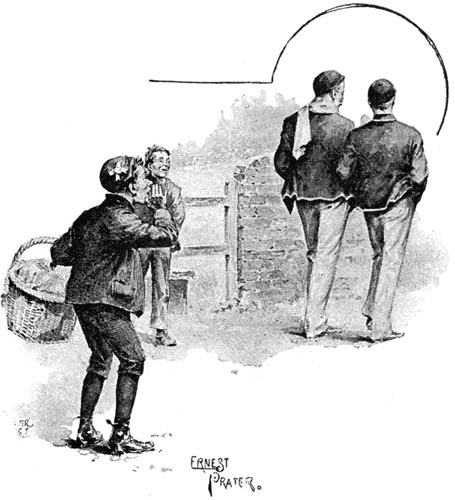
In between whiles the men are left almost entirely to themselves, and are free to seek what innocent diversion they please. The choice certainly is not very varied. Beyond paying a visit to the opposing crew, chatting with friends who have come to see the practices, or looking in at the local skittle alley, there is very little to do. But if they lack diversion themselves, they do not fail to cause great delight to the juvenile population of Barnes and Putney. It must be premised, for the benefit of all who are not habitués of Putney, that the crews always wear during their training the coat and cap of their University Boat Club, and flannel trousers. There are reasons which make this a very necessary and laudable practice; but in the juvenile mind it gives rise to the most uncompromising scorn, which finds various ways of expressing itself. “Take it off” is one of the most popular of these, and though it certainly suffers from a lack of originality, it appears to give great satisfaction. Another, more recondite, but perhaps ironical, is “Put it on.” “Where’s yer trousers?” “Go it, white legs!” “Who’s yer hatter?” and many similar cries, all testify to the joyous humour of the riverside youth.
Hardly less amusing are the comments of the crowd as the men pass through to their boat-house. “That’s Nickalls,” explains the well-informed gentleman as a Cambridge man goes by. Or, as the lightweight hurries past, “Don’t look as if ’e could do it,” remarks a bystander, “looks to want a day out at grass for them calves.” Or, “’Ere, I say, ’e’s eat a bit of beef in his day, I know,” as the heavy man comes in sight. It is a good-humoured crowd, and if the strong tobacco is a bit offensive when one’s not allowed to smoke oneself, things can’t be always as we should like them to be.
“’e’s eat a bit of beef in his day.”
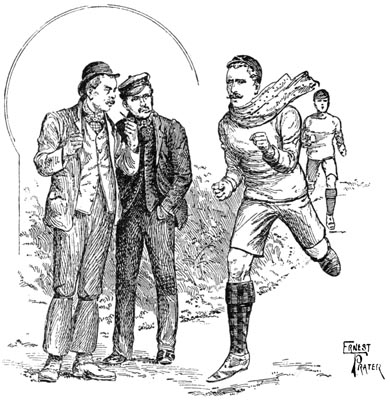
“getting rid of fat.”
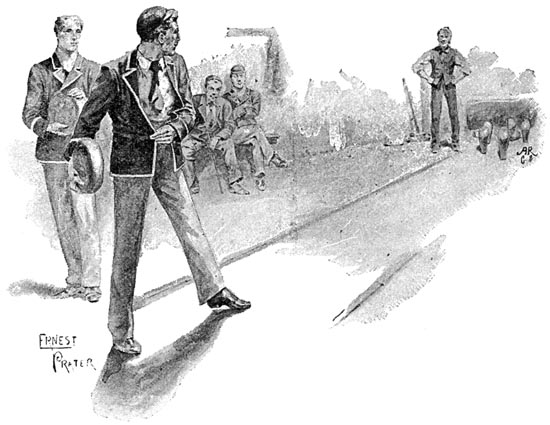
It is the custom for the Oxford crew to use the London Rowing Club boat-house, while the Cambridge men are accommodated at the Leander Club next door, and there is accordingly a good crowd in front of each at practice times, eager to see the men on whose prowess their own modest half-crowns are staked. Unfortunately, as some of my readers may have experienced, it is not always easy to find out the exact time when the crews are going out. In fact, the Captain is an autocrat on these occasions, who rules alike over crew, critics, and the general public without distinction of persons, and who shows a splendid indifference for the latter’s convenience. He launches the boat at all kinds of wondrous times, not shrinking from starting half-an-hour or more before the time he has arranged, and thus disappointing a number of would-be spectators. It is even said that he often chooses parts of the river for doing the hard work where there are no well-known landmarks, so that no clear “line” can be given to the outside public. This may be so. The workings of the Presidential mind are dark and mysterious. But I doubt if the convenience of the public has sufficient weight with him either one way or the other to influence his plans in that manner. And though perhaps this indifference may be carried too far, yet the idea which underlies it is a perfectly just one. The University Boat Race began as a private match, of a more or less impromptu character (those were the days when they rowed from Westminster to Putney in a huge Noah’s Ark of a boat, and stopped for beer and biscuits on the way down, and when, it is said, the Speaker of the House of Commons used to leave the chair to let the M.P.’s run out and see the start—but we digress). Then, by degrees, it attained to its present position of a great festive gathering of the many-headed, where only about one in every ten cares to glance at the race as it goes by. But, above all things, the race is, and has been, a purely sporting event. The British lion may put on his holiday suit and gamble to his heart’s content on the bank, but the sole concern of the Captain of either crew is to bring his men well up to the scratch, and have a thoroughly good, honest race. He has nothing to do with letting the spectators know the real state of the odds, or helping them to win their money.
It must be confessed that, in spite of the many pleasures indicated as belonging to this training, one gets very tired of it, just as one might tire of living in Arcadia, if, as is probable, there were no Club or Italian Opera there. It is with considerable joy, therefore, that one hails the approach of the race when it is still a week off; but this feeling is apt to be modified as the days draw on after that. “Funk,” of course, attacks everybody more or less; but its violence differs very widely in different men. Many of the most unlikely people are most liable to it; and it would probably astonish a good many people were I to say who is the “funkiest” oarsman before a race that I know. I mean by “funk,” not the under-estimating of one’s chances—for some of the most nervous men have a very shrewd idea of them—but the irrational excitement which keeps the brain constantly thinking of the impending race, and prevents the sufferer from sitting still or having any comfort, or, in the most serious cases, any sleep, for two or three days before it. It is a real malady, which is most distressing to those who are subject to it, but which, luckily, does not do any harm when once the race is begun.
Of the race itself there is very little to say, except one thing, that could not be said equally well of a hard game of football or a foot race across country. The exertion is, no doubt, considerably greater than is involved in either of these, but the physical sensations are very much the same, and anyone who has entered for any race at all knows the sort of feeling of desperate resolve which is the pleasure that racing gives. Except one thing, I said, and it is that thing which puts boat racing, in many people’s minds, far above any other form of sport. It is this, that while in a foot race a man can leave off as soon as he finds the exertion more than the prize is worth, and while in football a man may recover his breath in the scrimmage or justifiably leave the work for a moment to the others, in rowing every man knows that, by a single careless stroke, he may throw the whole boat into a confusion from which they often cannot recover for many hundred yards. Everyone is expected in a boat race, and in a University race as much as anywhere, to row his best and hardest every stroke he takes, and never to slack off at all. If it is considered desirable to save up for a spurt at the finish, the “stroke” will do that by putting in a few less strokes to the minute till the time comes. Every man behind him is bound in honesty to the rest to shove every stroke through “as if there were no hereafter”; and when the “hereafter” comes, as it does about Chiswick Eyot, he will have to rely on the thorough condition he is in to pull him through. It follows that the whole secret of a good crew is that each man rows hard because it would not be fair to his neighbours in the boat if he rowed lightly, not entirely because he wants to win the race. I do not want to disparage other sports in the least degree; pluck enters into them fully as much as into rowing. The difference lies in the incentive.
Boat races, of course, vary very much in the amount of excitement they afford; not differing in this from any other sort of contest. Of the last five races, that of ’91 was the most keenly contested, though the ’90 race runs it very close. Both of them were ding-dong struggles all the way, now one boat and then the other taking the lead, and neither of them were really won till the post was passed. Closer finishes have been known, though hardly beating these in point of excitement during the race itself. The well-known dead heat of ’77 is an instance; on which occasion legend hath it that the ancient umpire had been regaling himself hard by, and arrived on the scene as the boats shot by the post, too flustered to take any very accurate observations. However, as both crews were pretty confident that they had won, his decision displayed no small share of that low cunning that used to make a successful umpire.
But all things have an end. The long training is passed, and you are seated in the boat. The race gets finished, one way or the other, and you are seated at the festive board. The dinner vanishes from the table, and you wake up next morning feeling very glad when you remember you can stop an hour longer in bed. And the vision of an editor is at hand to hint that these reminiscences must not prove an exception to the general rule, but must also come to a conclusion.