“Lions in Their Dens.”
Reading edition
III.—GEORGE NEWNES AT PUTNEY.
By Raymond Blathwayt.
Illustrations by Geo. Hutchinson.
(Photographs by Messrs. Fradelle & Young.)
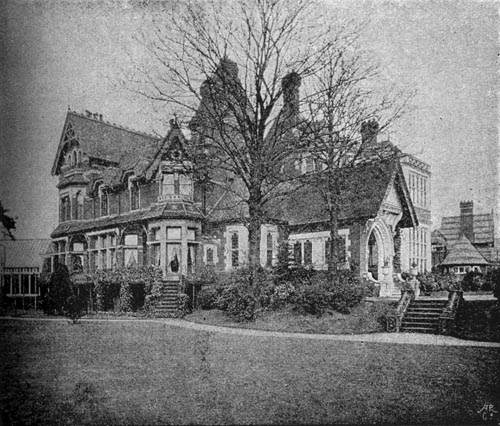
mr. newnes’s house at putney.
the obelisk in the garden.
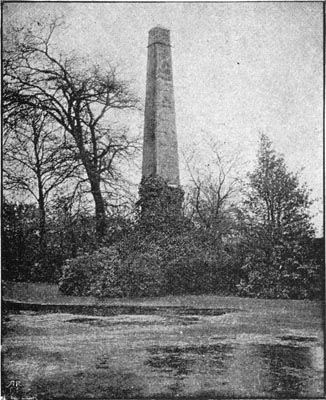
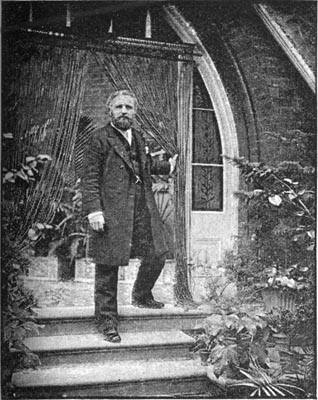
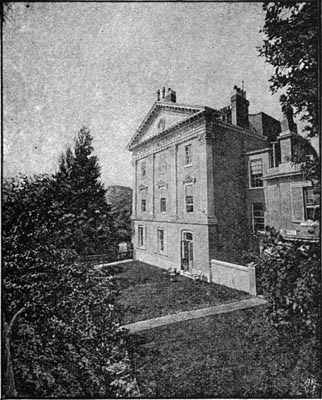
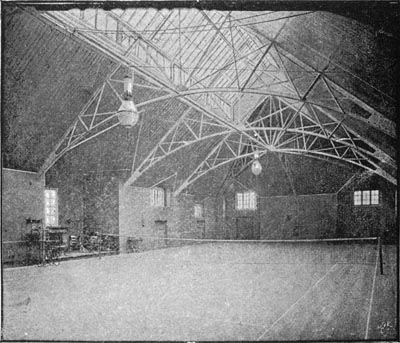
As I toiled up the hill which leads to Putney Heath, I met a small boy, of whom I asked the way to Mr. George Newnes’s house. To my astonishment he did not know where it was. I gazed at him more in sorrow than in anger. “What! not know where Tit-Bits lives!” a smart lad standing by ejaculated, as he pointed out to me the right direction in which to go. “George Newnes! ’im wot writes Tit-Bits! wy I thought everyone knowed w’ere ’ee lived!” I thanked him, and wandered on half-a-mile or so until I reached the beautiful house which the “writer” of Tit-Bits built for himself some years ago. Here I was received by Mr. George Newnes with a welcome which left nothing to be desired in the way of hearty kindness. Mr. Newnes is a man of middle height, very good-looking, with auburn beard, and hair dashed with grey. Though exceedingly wealthy, he is not, as somebody has well expressed it, “beastly rich.” No feeling of the oppression of newly-acquired wealth flooded my soul as I walked about the pretty house and grounds in his company. He and his surroundings have the good taste not to obtrude themselves upon the casual visitor. The man is simplicity itself, and the most genial and cordial of hosts. I thoroughly enjoyed my visit, nor was it without infinite interest, for George Newnes is a companion always amusing, and with always something new and original to say. As we wandered through the beautiful grounds, some of which are reclaimed from the wild heath which stretches for miles round the house, he pointed out to me the curious obelisk, grey and time-worn, which still perpetuates the memory of the historic mansion once known as “Fireproof.” For it was here that George III. and Queen Charlotte once breakfasted in peace in the drawing room upstairs, whilst the dining-room below was purposely ignited to prove that the house was really fireproof. Upon one side of the house stand the stables, just beyond them a beautiful covered lawn-tennis court lighted by electricity and heated with hot water, in which play can go on by night as well as by day, in winter just as much as in summer. “We miss this tennis court dreadfully when we are in Devonshire,” said Mr. Newnes, as we quitted the beautiful hall for the house. “I am myself devoted to tennis and golfing, and, indeed, I sometimes think it is that that has helped me to get through so much work. Good players generally make good workers,” he added, with a laugh. “Now will you come and join our party at luncheon?” and as he spoke he led the way into a handsome dining-room. At luncheon the conversation dealt chiefly with sport and games, to my own great relief be it added, for the dweller in the tents of the literary world hears but little of the ordinary topics of conversation, and becomes suffocated, if he be not to the manner born, with the nauseating cant and self-sufficiency which is so typical of the literary world of to-day, and more especially typical of its younger members. But at George Newnes’s house you hear but little shop. We discussed golf and its rapidly increasing popularity, the newest “serve” at tennis, and some of the most remarkable cricket scores made during the past season.
mr. newnes.
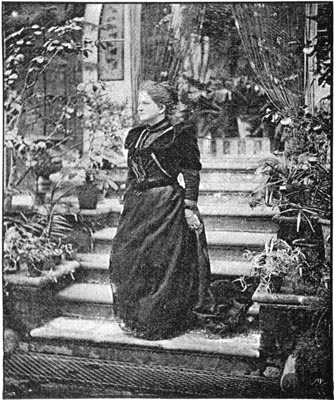
mrs. newnes.
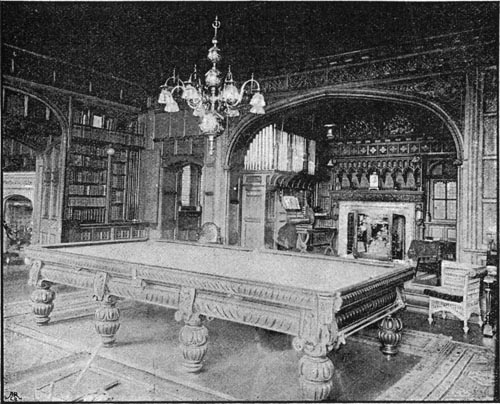
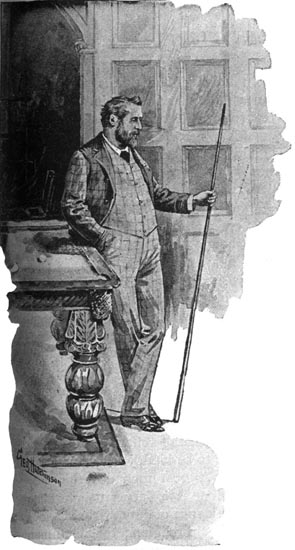
the billiard-room.
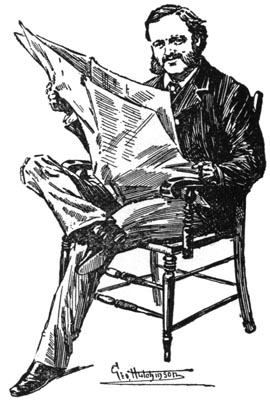
the conception of “tit-bits.”
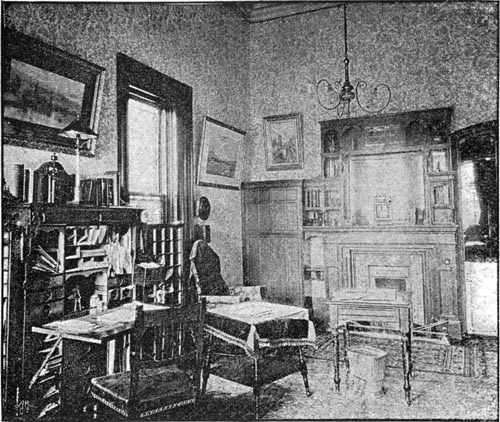
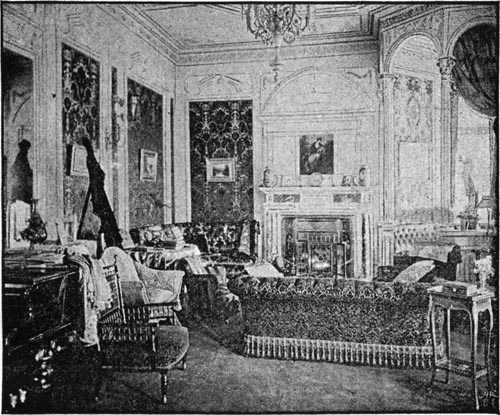
The host joined eagerly in our talk until interrupted by the servant, who brought in a message. Quitting us for a moment, he returned with a smiling apology, and told me that in that brief space of time he had transacted a piece of business which certainly was not without its interest. A gentleman, it appeared—the son of a celebrated littérateur of a past day—had called to show some beautiful drawings by the celebrated “Dicky” Doyle, a relation of Dr. Conan Doyle. With Mr. Newnes—and it is thoroughly characteristic of the man—to close with a good bargain is but the work of a moment, and therefore I was not surprised, as he placed the dainty pictures before me, to learn that he had purchased them for reproduction in his world-famed magazine. After luncheon, Mr. Newnes suggested that we should retire to his billiard-room, to reach which we had to pass through his own special sanctum in which he dictates his letters, &c., to his private secretary—energetic Mr. William Plank, who has been with him for five hard working years—while he walks up and down the room. “I can always think better whilst I walk,” he explained to me; “indeed, I have recently had the study lengthened to give me more room.” By this time we were in the billiard-room, wherein stands a large English organ with upwards of four hundred pipes. And in this room, prowling round and round the billiard-table like a couple of wild beasts—for I also, like my host, think best upon my legs—and occasionally cannoning up against one another and recoiling with a laugh and a start, George Newnes told me the history of his interesting and successful life.
“My father,” he began, “was, at the time of my birth, the minister of Glenorchy Chapel, Matlock Bath. He was a very able man, and the best informed man you could meet. He kept me at school till I was about sixteen. I finished up at the City of London School, and, curiously enough, I am going to-night to reply for the House of Commons at a banquet given by the John Carpenter Club in honour of the Home Secretary, who was a City of London School boy. My father put me into a house of business in the City, at which I remained for a number of years, and then I went down to Lancashire to open up a branch of the business there. I settled in Manchester and married, there. One night, in 1880, when I was sitting at home reading the Manchester Evening News—and, by the way, it has never occurred to me before,” added Mr. Newnes, as a sudden thought flashed into his mind, “the very people who printed that paper were the same people who afterwards printed Tit-Bits for ten years—I came across a story, or some interesting account, which very much pleased me. I read it to my wife and said, ‘There, that’s what I call a real “tit-bit.” This paper, but for it, is to-day decidedly dull, because there is absolutely no news to put in it. Now, why cannot a paper be brought out which should contain nothing but “tit-bits” similar to this?’”
“And that really,” said I, much interested, as Mr. George Newnes paused for a moment in his journey round the billiard-table, and gazed absently at me while I lit a cigar and threw myself into an armchair, “and that really is how Tit-Bits came to be first thought of?”
the study.
“Yes,” he replied, as he started off once more, and I rose to follow in his track, “that was the first idea of my little green paper. But I was a whole year before I was able to carry it out. I was very busy in other matters, and had not much time to attend to it. But I never lost sight of the idea, and ever and anon the word ‘tit-bits’ would come to me with the force of a warning dream. I worked continually at the idea in my mind, and all my leisure thoughts were given up to it. In fact, I was constantly afraid—so convinced was I that the idea was a good one—that someone would bring it out before I could do so, and every Saturday morning, the usual day for new weekly papers, I used to look almost with painful anxiety to see whether there was a placard announcing that such a paper had appeared. But, however, nothing of the sort was brought out. The more I thought of it the more enamoured I became of the idea, till, in October, 1881, the first number appeared.” And as he spoke Mr. Newnes handed me the very first number of the now celebrated paper. “As soon as it was fairly started,” continued my host, “I gave up my other business and devoted myself to the editing and publishing of the paper. At first, the chief pieces in it were selected from books and periodicals—any sources, in short, that were not copyright. I would get an anecdote from one book, and something else from another, anything interesting, in fact, from wherever I could pick it up; of course, now we have a large list of original contributors, but at first that was the way in which it was compiled. In the early days, naturally enough, its circulation was confined chiefly to Manchester. There it simply ‘caught on’ immediately, and sold like wildfire. Why, the newspaper boys’ brigade,” continued Mr. Newnes, now fairly excited at the memory of that eventful Saturday morning, “sold something like 5,000 copies in two hours of the first number in Manchester alone. They came rushing back to the office, where I sat anxiously awaiting their news, full of the wonderful result. Tit-Bits was then, I felt certain, an assured success, and the public used to write to me to tell me of its popularity. I receive letters to this day, and especially from ministers and clergymen, who write to say that they recommend it because of the information it contains, and its instructive character, and, above all, because of the purity of its contents. Yet there are some clergymen who think there is some double entendre in the title Tit-Bits, and from its title that it is probably a paper they ought to speak against; and often, solely on account of its title, I believe they bracket it with all kinds of other literature of a low-class type, and in this way I suffer from the name.”
the birth of “tit-bits.”
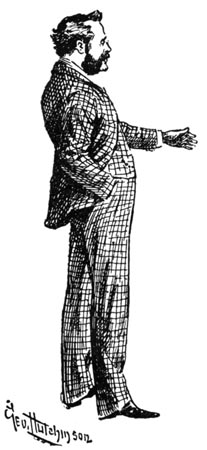
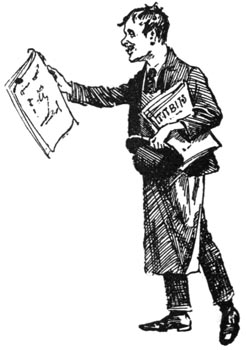
“And how was it you came to inaugurate your system of insurance against railway accidents?” I asked Mr. Newnes, after a brief discussion on the ridiculous and narrow-minded behaviour of these worthy clerics. “It was in this way,” he replied, as he brought himself to an anchor against the billiard-table, where he rested for a brief moment. “It was in this way: A woman wrote to me saying that her husband had been killed on the railway, and as he had a copy of Tit-Bits upon him at the time, she asked whether I would make her some allowance of money. At once the idea of an insurance system occurred to me, and you know now how widespread this system has become.”
I smiled as I noted how in each case his wonderful successes are owing not more to the flash of a striking idea than to the wonderful promptitude which follows on the thought; how remarkable an instance his whole career affords of the benefit and wisdom of striking while the iron is hot.
“And then after Tit-Bits came the Review of Reviews, I suppose?” I queried, as my host jotted down some notes in his pocket-book.
hesketh house, torquay.
“Yes,” he replied, as he once more took the floor. “That was one of the quickest arranged things I have ever heard of. It was all done in a month. I was staying down at Torquay, where I have a house for the winter, and Mr. Stead wrote to me to say he contemplated leaving the Pall Mall Gazette, and would like to be associated with me in some journalistic scheme. He sent descriptions of three which were passing through his mind, asking if I would care to take either of them into consideration. I replied by return, saying that I did not care for two of them much, but that I was delighted with the third. I then and there told him the terms upon which I would work with him. He wrote back, saying that he would accept them, and I came to London the following week, in order that I might make arrangements, and in thirty days from the first proposal of the idea, the Review of Reviews was published. At first it was decided to call it The Sixpenny Monthly, with a sub-title, A Review of the Reviews; as such, indeed, it appeared upon the cover till the day before going to press, which was a Sunday. I was so convinced that the title ought to be reversed, and that it should be The Review of Reviews, a Sixpenny Monthly, that I went over and waylaid Mr. Stead as he was coming with his family out of church. I explained my views to him, and in a few minutes he agreed that I was right, and the title was altered to that which has now become so familiar. Well, when the Review of Reviews went out of my field of vision, I had made certain arrangements with people for publishing magazine work, and so on, and I wanted something to take its place. Then came to me a very old and favourite idea of mine—the idea of a magazine with a picture on every page! I engaged the services of Mr. Greenhough Smith, now my assistant editor on the Strand Magazine, who had the idea of largely producing translations from foreign authors, and as soon as the Review of Reviews had gone, I was at work on the new venture.”
the drawing-room.
“And, with regard to its title, Mr. Newnes,” said I, “you are great on titles, are you not?” “I attach great importance to them, certainly,” he vigorously replied. “I thoroughly agree with Shakespeare that there is much in a name. Why, indeed, should names be valueless? They are as great facts as anything else in the constitutions of humanity. And in the journalistic world a name is half the battle. The Strand was a good title, it appeared to me, short, and at the same time attractive. After all, it is through the Strand itself that the tide of life flows fullest and strongest and deepest. I felt that with a good picture on the cover it would sell well on the book-stalls. The picture was rather difficult, and much depended on that picture. At first I did not succeed in getting the artist to embody my idea of a picture of a street. Now I had here at home an oil painting which I thought would help him.” And as he spoke, Mr. Newnes led me to the staircase and showed me a very charming perspective of some street in an English town. “I showed Mr. Haite this picture,” he continued, “and I asked him if he could do a similar perspective of the Strand.”
“i work very quickly.”
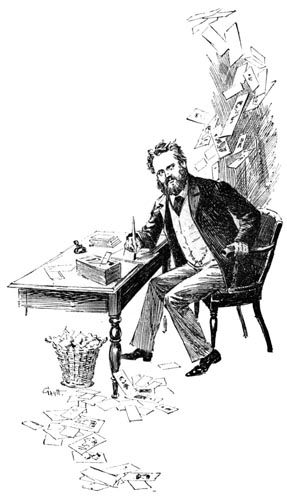
The Picture Magazine, which started with this year, is likely to be nearly as successful as The Strand. After we had discussed the position and the prospects of the new paper which Mr. Newnes has started to fill the place in the Radical journalistic ranks of the P.M.G., we drifted into a general conversation on his habits of life, his occupations, and the varied qualities which go to the making of a successful business man, the future of popular journalism, and the like. “How do you manage to keep all your irons hot?” I asked my host; “you edit three papers, you are a member of Parliament, you build railways up the cliffs of popular watering-places, you play games, you do everything. How is it all done, pray, Mr. Newnes? What is the secret of your life?” “Well,” he slowly replied, and with a certain shy hesitation, for though prompt and energetic enough in actual business, no more modest man, or one more reluctant to speak of himself and his doings walks this earth—“well, though I don’t want to boast about it, yet the simple fact is, I work very quickly, and I get through my business much faster than most men do. I make up my mind, form my plans, and arrive at conclusions very rapidly. With regard to my editorial work, for instance, all ‘copy’ for the papers is sifted for me at the office, then it is sent up here, where I work three days a week, selecting that which I think shall go in, and marking it for press. I dictate the ‘Answers to Correspondents’ page to my private secretary. This page always takes up three hours a week. I get through my editorial, parliamentary and business work, and manage to get a good deal of leisure besides. Golf, tennis and chess take up my leisure. When I am in the country I have all my work sent there. The fact is, I work hard and I play hard, and I believe each is equally necessary for good health and real happiness. Curiously enough, I do not believe that naturally I am of a very systematic nature, but so much business forces me to be so.”
the tennis court.
“And as to the future of journalism generally, and of such papers as yours in particular, Mr. Newnes?” I queried. “With the spread of education and the increase of Board Schools, there is a great change coming over the masses, is there not?” “I think this,” he replied, “that many of the papers of the day are developing too much the gambling and lottery spirit, which I regard as a very evil one, and would not for a moment countenance. I think, as you say, that the Board Schools have immensely increased the number of buyers of papers of this kind, and it is a great source of satisfaction to me that I should have inaugurated a popular paper which should be taken largely by the masses, and which is absolutely pure. When I came out with Tit-Bits there was not a single popular paper containing fun or jokes or anything of the kind—except the illustrated ones—but what relied more or less upon prurient matter to tickle the fancies of prurient minds. Besides, my idea is that, just at present, the Board Schools tend to a certain hardness and narrowness of character, which is perhaps softened down by the development by these papers of the lighter side of human nature. Tit-Bits, I have reason to know, has in many cases induced the study of some science or literature on the part of a man or boy who has read some interesting ‘tit-bit’ on one of these subjects, and has desired, naturally enough, to know more about it.”
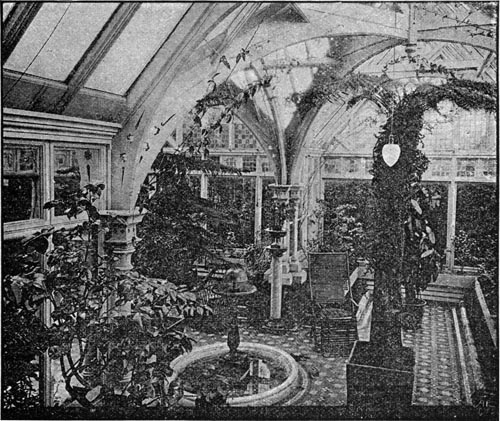
the conservatory.
in the billiard-room.
“Will it ever be possible, Mr. Newnes, do you think, to provide the masses with the higher journalism, with a sort of Saturday Review, or Nineteenth Century?” I asked. “I don’t think,” he slowly replied, shaking his head, “I don’t think, Radical as I am, and absolute believer in the sovereignty of the people, that the masses will ever take to any paper which consists mainly of essays or leaders. They want things served up with other interesting matter, and with as much of the personal element as it is possible to give them. The masses still incline entirely to the lighter side of literature. They work hard enough in everyday life, their recreation and their literature must, therefore, be as light as possible.”
“And now, Mr. Newnes, for one more question—a good long one,” I laughingly added. “Having all your life been so successful yourself, as you look round London, with the struggle for existence, and the mingling of classes which makes that struggle for existence still harder, how do you really account for your own wonderful success, and how would you recommend others to be successful too, even though only in a small way?” “I really don’t know how I can answer that question,” he replied. “The only thing is, I have always been struck with the fact that so many people go about with their eyes shut, and do not see the chances which may be before them. They have no idea of doing anything beyond what they may have seen done before, and what they are told to do. They are frightened by originality lest it might be disastrous. I suppose I have been inclined to do things differently rather than the same as other people, and I have always struck while the iron was hot. That, I think, to put it very briefly, is the secret of any success which has attended my efforts.”