A Blessing Disguised.
Reading edition
By F. W. Robinson.
Illustrated by A. Birkenrauth and St. M. Fitzgerald.
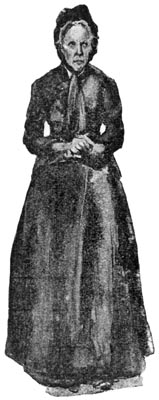
“my housekeeper.”
When I came home from my fortnight’s holiday, amongst Tom Brisket’s cows, in Huntingdonshire—once a year, for just fourteen days, do I unbend from the cares of business and seek relaxation far away from Bermondsey—and let myself in, with my patent latchkey, and walked with my usual confidence into my front parlour, you might have knocked me down with a feather. Any feather would have done it—a butterfly’s, say—I was thrown so completely off my guard. I had been so confident. I was not in any way prepared for it.
The house was desolate enough, but that was not it. Mrs. Kibbey had failed to put in an appearance at the end of her holiday, although I had wired to her only yesterday that I should be home at precisely 8.15 p.m.; but it was not the unlooked for absence of Mrs. Kibbey—my housekeeper—that upset me thoroughly, oh, no. The gas was not lighted, and the supper was not likely to come off in the absence of Kibbey, certainly, but these were only minor features of a colossal surprise—bagatelles, or anything you may like to call them. Golden Birch Villa, Streatham, S.E., was simply chaos—that is the mildest and easiest way of explaining the matter to begin with. One word suffices—Chaos. It will take a great many words to explain why my little suburban retreat, on which I had prided myself for so many years of my bachelor life, was a mass of conglomerated wreckage. I will be as brief as I can. I am not a prolix man; I know the value of time, and of other people’s time. I should not have had a flourishing business in Bermondsey, if I didn’t know. Golden Birch Villa, Streatham, then, had been burgled. Broken into, despoiled and defaced, was my little country retreat from the turmoil of town, and it was this which had confronted me after fourteen days of pastoral simplicity, during which I had got very sick of Tom Brisket, and Tom’s wife, and Tom’s cows, and Tom’s children—especially his children—which palled upon one badly and became unbearable, and beastly personal. The country soon tells upon me, and I am not fond of children—yet a while—because—but this is mere babbling of green fields and babies. In describing my return to Golden Birch Villa that evening, I still feel a confusion in the brain which whirls and whirls gently round with me. It was the greatest surprise of my life, the first chapter in a series of surprises, the reader will say presently. I shall leave the story in his hands, and a remarkable story it is, take it altogether. It illustrates clearly the old axiom, that one never knows what is for the best, and that to be robbed—“cleaned out”—and one’s premises generally done for, should turn out to be a blessing in disguise, will not be very clearly apparent to the reader until I have explained the whole affair and he has heard my story to the end.
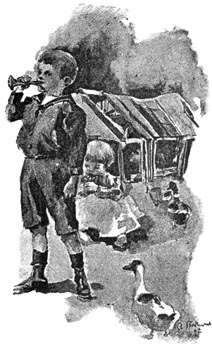
“tom’s children.”
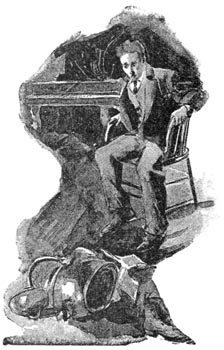
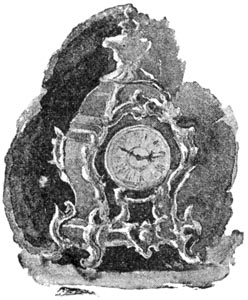
At the precise moment of which I write now—8.15—I felt as if utter ruin had overtaken me, as if there were no getting over this gigantic trouble—this shock, as it were, of a moral earthquake. The usual kind of earthquake would have been very much the same kind of article, things a little more askew, perhaps, but not half so “messy.” I staggered into an easy chair—after lighting one of my gas-burners—and took a survey of the situation, with my mouth open, my chin on my chest, my knees knocking gently together, and my hair slowly rising upon my head. All the doors had been locked before the departure of Mrs. Kibbey—my housekeeper—and myself on our separate ways of recreation, and all the doors were now wrenched open, and the locks hanging, as it were, by bits of skin! Everything in the room of any real value had vanished like a beautiful dream, and everything “of no value to anyone but the owner” had been tilted into the middle of the room for the convenience of a hasty analysis before departure. The contents of two desks, of my carved oak sideboard (“late the property of a gentleman”), of my bookcase (to make sure that nothing had been stowed away behind the books), of all the drawers in all the tables, were in one large heap upon the carpet; bills, letters, tablecloths, tablecovers, dinner knives, decanters, chimney ornaments, books, purses, lead pencils, corkscrews, my silver-mounted flute, with all the mounts gone, and the cruets minus their silver tops. Also all the silver spoons, the electros being turned out upon the heap as “non-negotiables.” The piano had been split open and gutted—it was an unredeemed Grand—the burglar or burglars having been seized with the suspicion that I had secreted articles of value in the body of the instrument. And so I had! one valuable in particular being a favourite hand or carriage-clock mosaic, and a mass of miniature dials, gold-mounted, the dials at one time having been capable of giving all kinds of unnecessary information, before the death of the manufacturer, who departed this life leaving no one skilled enough in the world to undertake the repairs; but it was a great curiosity, and I set great store by it. So did the burglars, for they had found it and carried it away, along with a large quantity of portable property too numerous to mention in the pages of this magazine without changing their appearance to a kind of “Catalogue of Sale.”
“i staggered to an easy chair.”
Yes—I was robbed. And I had been so very sure that to leave the premises to take care of themselves was so exceedingly wise an expedient. “Cocksure Kippen” had been my nickname in Bermondsey since I had been in the pawnbrokering, just because I had opinions of my own, and did not call on other people to let me know their views of a question upon which I had made up my mind. What did I want with other people’s opinions, when I knew my own were ever so much better? But I was a little crestfallen on the present occasion—I will say that. And it was my own fault for going down to Tom’s—I will say that too. What did I want with country air? I had not been ailing anything. I had always considered a fortnight in Tom Brisket’s company a frightful waste of time. I was never without an excellent appetite, and I measured forty-one inches round the chest, one inch for every year of my life, I had said jocosely, only yesterday, before I returned to town, but there was no jocosity in me when I was at home again—if this bear-garden could be called home, that is, or made to look like home ever any more!
“‘it was a clean job,’ the policeman said.”
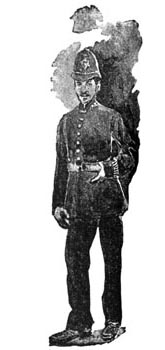
It was a clean job, the policeman said—quite admiringly—when I had strength to reach the front door and call him in. Why had I not gone round to the station-house, the policeman asked, and told the Inspector I was off for a holiday, as other people generally did? Oh, yes, that was very likely! Why had not I insured in a Burglary Company? Oh, yes—and let no end of people know that there was a furnished house at Streatham with nobody inside of it for a fortnight. Did I think I could trust my housekeeper? Trust Martha Kibbey, who was my father’s housekeeper before me—dear, deaf, old, palsy-stricken Kibbey, with a sister in the Cookshops Almshouses, Caterham, and with whom she spent her holiday invariably. Kibbey, whom the policeman and I found upstairs in a fit, in her own bedroom, having it all to herself, like a quiet, unobtrusive old soul as she always was. She had come into the house in good time, and realising the position, had rushed upstairs to her room, first of all, to see what had been taken of those worldly goods of her own, in which she was more naturally interested than anybody else. And when she discovered that her chest of drawers had been opened with an indifferent chisel, and that a silver watch of her grandfather’s—weighing one pound and a quarter—had disappeared, along with an apple-scoop, also of precious metal, belonging to her late husband, who was “gummy,” Mrs. Kibbey became a physical wreck, fit for nothing, and comprehending next to nothing. When she understood that I was in the house—safe and sound—she went into hysterics of thankfulness of so violent a description that I had to leave her with police-constable 906, and run across the road for the doctor.
The police made a great fuss over the robbery. The Inspector called later on and entered all the particulars in a notebook, and looked at the broken doors and the hole in the breakfast parlour shutters, through which admittance had been obtained, and the general turn-out of everything in the middle of each room, and then adding his testimony to the neatness of the job, took his departure, promising to let me know when anything turned up.
“We shall want a complete list of the articles you miss, so that we can send round to the pawnbrokers,” he had said before leaving me.
“I’m a pawnbroker myself,” I replied.
“Ah! then you’ll get one.”
“Thankee. Perhaps I shall get one of the thieves too.”
“Well, you’ll know your own property, I expect, sir,” he said, with a most unbecoming grin, as he took himself off the premises. I did not see him again. I hope I never shall, the unsympathetic beast.
Time passed on and brought no tidings of the robbers or the stolen property. I was very much distressed over the whole affair, and my neighbours tried to comfort me by telling me that I could afford the loss, and that it was a good job it had not happened to a poorer man. How did they know I could afford the loss, or that I was not utterly ruined? I had never posed as a wealthy man—I was not wealthy, in the strict sense of the term. I had been only careful, I had spent nothing in waste, and I had put by a little money for a rainy day. If people in Bermondsey called me a money-grubber, it was no fault of my own; but there were a few who did, because I held to the strict letter of the law in my contracts. That was praiseworthy, but they could not see it. I believe a few of them were actually glad that I had been robbed.
“he was very lame.”
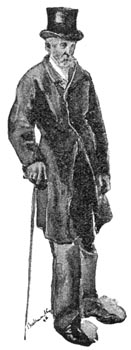
Some six months after the burglary, in the dusk of an early winter’s afternoon, a tall, sunken-cheeked man, with a huge white moustache and a vermilion face, which seemed put on expressly to show it up by, came limping into my shop at Bermondsey. He was very lame, or pretended to be, I thought, to throw me off my guard. As if I, Edwin Kippen, was likely to be off guard in business hours, as if it were possible to be off one’s guard and get one’s living, Bermondsey way.
I told my apprentice, who was behind the counter polishing up a few window goods for next Saturday, to light up, though there was quite half-an-hour’s daylight left in the street. But, somehow—such is instinct—I did not like the get-up of this man. I had never seen him before; he did not look “made in Bermondsey,” and he was seedy, and a little nervous, though he talked in strident tones, in a Sir Anthony Absolute kind of manner, which made the gas glasses jingle.
“Do you buy articles outright, Mr. Kippen, as well as lend money on them?” he asked abruptly as he entered.
“Yes, sir, I do.”
“And at a fair price?”
“Certainly. May I ask what——”
But he was an impetuous man, and so full of his own mission, that he did not wait for me to conclude my inquiry.
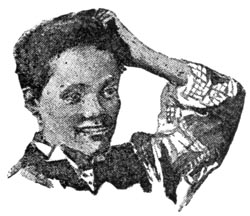
“my apprentice.”
“Then what will you give me for this article, money down?” he asked, producing from his pocket, to my complete astonishment, the identical little carriage clock, all dials and complications and internal irregularities, which I had hidden in my piano before going down to Brisket’s farm—the clock that had been stolen from my Streatham villa. The same feeling came over me which I had had in that residence on the night of my return. I was swimmy for a moment, and saw stars, and then thought that a thick fog had broken out in Bermondsey. I recovered myself by a mighty effort of will. Here was to be a battle of the wits. Here was one item of my lost property within a hand’s grasp of me. I couldn’t keep that hand from trembling as I took the clock from him.
“Don’t shake it up like a bottle of medicine,” said the old gentleman, irritably; “it’s a delicate piece of workmanship, and won’t stand bobbing up and down like that; it upsets the mechanism, and it isn’t easily set right.”
“Is it in working order, then?” I inquired, with suppressed amazement.
“Yes, of course it is.”
“Good gracious! is it though?” I said, nearly dropping it in my surprise.
“It tells the days of the month, the dates of the month,” he went on, “the phases of the moon, the month of the year, the year of the century, the variations in the weather; it chimes the quarters, halves, and three-quarters; it plays a waltz after it strikes the hour; it acts as a revolver—I mean as a repeater—and it is mounted in solid gold of 20 carat, almost pure gold. A timepiece fit for a prince, and belonged originally to Louis Seize. What is it worth to you, money down—on the nail—as you tradesmen say?”
“I shall want a little time to consider the matter.”
“Take your own time, sir, only, for God’s sake, look sharp,” said the old man irreverently, as he removed his hat and wiped his forehead with a big, old-fashioned silk bandanna.
“A clock of this description cannot be reckoned up in a hurry,” I said. “I haven’t examined the works yet.”
“You’ll find them perfect, wonderfully perfect. But don’t breathe into them if you can help it. It affects the waltz movement particularly.”
“a timepiece fit for a prince.”
“Oh, does it, indeed?” I said, ironically.
I professed to be examining the works with the closest attention, but I was only resolving on my plan of future action. I was playing with my prey—an angler with his “catch,” a cat with a mouse. This was the man who had broken into Golden Birch Villa, and walked off with the pick of the property. An ingenious burglar, who was an expert in clocks, and—I smiled grimly at the joke—who had actually put the article into my own hands again in perfect order. I could have imagined that it was a duplicate copy of mine, and in better condition altogether, had it not been for my private mark, which I was focussing now through a single-barrelled magnifier. I could talk to the man better in this fashion; had I looked him straight in his brazen chaps, my virtuous indignation would have betrayed me. And my policy was to dissemble, like the man in a melodrama.
“You have had this a long time in the family, I suppose?” I said quietly—very quietly—but tentatively.
“It’s not new. Any fool can see that it is a Louis Seize clock, and of considerable value.”
“It’s a valuable thing in its way, no doubt, but it would suit a West End house better than my establishment.”
“I know that, sir, as well as you do,” was the testy reply, “but I haven’t got the time to run to the other side of the water, and I want money in a hurry—in a great hurry, or I should not have come to you,” he added bluntly.
“Are you living in this neighbourhood?”
“What business is that of yours?” he cried. “What—yes, I do live in the neighbourhood—round the corner in Tan Yard Road—if you want to know. No. 239 is my address, if it is likely to do you any good, and my name is Youson. I see you have your doubts as to my rightful possession of the article; pawnbrokers are all alike, have exactly the same tricks of the trade. I know their ways, no one better, and I know what you are going to say to me next.”
“I really do not think that is possible.”
“You’ll tell me it is unsaleable—that not one in ten thousand would think of buying such a thing—that at the price of the metal it will be worth to you—well, what the devil is it worth? You have been staring at it long enough to know now.”
“I am sorry you are in such a tremendous hurry,” I said, nettled a little by his unceremonious deportment.
“I am in a hurry. It is a question of life and death to me that I should have that money quickly, don’t you see? No—you don’t see—how can you see—how can you know anything about me, save that I want money? You see that fast enough. Well, sir, you are welcome to your knowledge,” he went on excitedly, “and I am not clever enough to disguise it, though I know you’ll take advantage of my extremity—a man of business, and in your line of business, is sure to do that. But give me a fair price. I—I—don’t want the money for myself, I don’t want a penny of it—shan’t take a penny of it, by God!”
This was an odd way of trying to get rid of stolen goods, but it was ingenious, and there was a refreshing novelty in the style of it. But I was not the man to be done. I flattered myself that I was as shrewd as this artful and red-faced old fox, and that I held the trump card in my hand to play at any moment.
“I have a friend only a few doors off who will know the value of this article far better than I,” I said; “he is a collector of—of clocks, and will give you a better price than I can afford. This is not in my line at all; I should never get a bid for it. Ten pounds would be too much for me to pay, or even to lend upon it.”
“It’s worth a hundred pounds, you know that well enough.”
“I should not like to say what it is actually worth. I don’t buy things like these without Bender’s opinion; he’s a sleeping partner of mine, and only just round the corner.”
“Ah, is he?”
“Heaven forgive me these dreadful lies,” I whispered softly to myself.
“Let us go to him,” he said, snatching the clock suddenly from my hands. And I had never intended to let the property get out of my possession again! This man was adroit; he might be one too many for me after all, if I betrayed the slightest doubt of him, or made anything like a scene. He was fidgeting with something in the right pocket of his snuffy, old greatcoat too—perhaps there was a pistol there—I was almost sure there was a pistol!
“Yes, let us go to him, Mr. Youson,” I said. “I’m sure he or I will make you a handsome offer; he’s just the fellow to put down his hundreds. Isaac, get me my hat—any hat or cap, anything you can find—only look alive. I am going round to Mr. Bender’s with this gentleman.”
“Where’s Ben——” began that stupid ass of a boy, but I checked him with a malevolent and meaning glance, and the youth, looking frightened, dived into the back parlour in search of my head-gear. He came out with a straw hat, with a ticket on it, but I did not notice anything in my excitement. I pined to be in the open with this miscreant, who had put the clock into his pocket. With a policeman in view, on the far horizon at the end of the street, my happiest hour would have arrived.
“people were streaming home from work.”
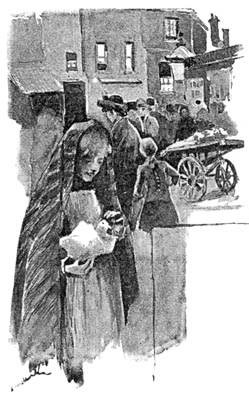
We sallied forth together, I keeping very close to him, lest he should grow suspicious and make up his mind to run. Every minute did I expect that he would plunge into the middle of the road and tear madly down the street. And it was a trouble to keep by the side of him; the people were streaming home from work, were out marketing, looking for something cheap for tea or supper to be bought off the barrows which were flanking the kerbstones. Side by side, we got jostled occasionally, the pavement being narrow and the people thickish, and twice I caught surreptitiously at the hem of his garment when I thought that we were going to be separated. And, as usual, there was not a policeman on the beat anywhere—no sign of official force—nothing but men and women, boys and girls, the boys terribly in the way, and after the girls!
“Do you call this a few doors off?” said Youson, snappishly, at last.
“Comparatively—oh, yes.”
“It looks like half-a-mile,” he grumbled.
“Another minute or two, Mr. Youson. I am sorry you are so pressed for time.”
“So am I. Not but what I have had about enough of your company, with that ridiculous hat of yours over your eyes,” he added, ungraciously. “I wish I had never come near your infernal shop. You are about the slowest tradesman I have ever encountered.”
“It does not pay to be too fast in my line of business.”
“Oh, I don’t blame you, I don’t blame you, sir; I only say I wish——what are you jumping at? Ain’t you well? Are you subject to anything?” he asked. “Spasms or twitches?”
I had seen a policeman on the other side of the way, standing under the shop-blind of a cheesemonger’s shop, talking to the young man with the apron who was in charge, grinning from ear to ear with him, and grossly neglecting his duty, which was to keep a sharp look out at what was going on up and down the street.
“Where are you off to now?” asked Mr. Youson.
“Bender’s is over the way.”
“What, the butterman’s?”
“No, no, but just by there. Come along. Mind this horse and cart; I should not like you to get run over with that in your pocket,” I said, almost incoherently.
Mr. Youson gave a short double-knock sort of a laugh.
“What, you are getting anxious about the clock, after all?”
“I am indeed.”
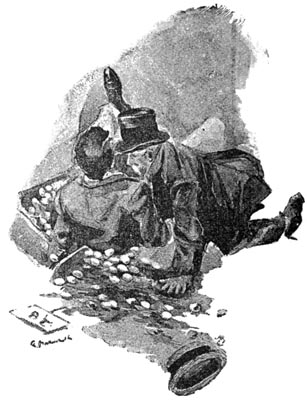
We had reached the other side of the way, and the policeman had turned his back upon us—just like him!—and was staring straight into the shop. There was a row of egg-boxes full of eggs of all sizes and prices and ages in front of the premises. Suddenly, I sprang like a panther upon my prey, flung my arms round Youson’s neck, and yelled, at the top of my lungs, for “Help!” and for the “Police!”
“Damn—confound it, sir—what!”—gurgled forth Youson, in his supreme astonishment; then we both staggered, our feet went from under us, and, locked in each other’s arms, we sat down, all of a heap, in the “28 a shilling, not warranted,” compartment, and a hideous crackling, as of a subdued and squashy landslip, went on beneath our writhing forms.
“Oh, good Lord!” exclaimed the young butterman, throwing up both arms in his despair, “here’s a go!”
“Here—hullo—what the blazes are you two blokes hup to?” cried the policeman, catching us both by the collars of our coats and shaking us; “this is a nice place to begin larking, I must say.”
“It is not larking,” I exclaimed, getting on my feet, a hideous mass of egg-shells and indifferent egg-flip; “it’s highway robbery! This man is in possession of my property—proceeds of a burglary—I’m Kippen, the pawnbroker, No. 319; he’s got my clock in his pocket now. I—I give him in charge, constable, I give him in charge! Why don’t you catch hold of him?”
“our feet went from under us.”
“The man’s mad!” ejaculated Mr. Youson, “raving mad. Somebody catch hold of him.”
There was a big crowd round us—it doesn’t take long to get up a mob in Bermondsey—and the proprietor of the cheesemonger’s shop, who had emerged from his caves of double Gloucester, was wanting to make a case of his own out of it all, and run the two of us in. The policeman was bewildered, and Mr. Youson was beside himself with ungovernable rage.
“He has got the clock in his pocket,” I repeated.
“Yes, I know I have a clock in my pocket,” he spluttered, “you—you rascal—you unmitigated——”
“It’s my clock. I can swear to it,” I yelled. “I’ve plenty of witnesses to prove it’s mine.”
“You’d better both come round to the station-house,” said the policeman; “do you charge him with taking your clock, sir?” he added to me.
“I do.”
“Very well.”
We went off to the station-house, Mr. Youson and I, the policeman and the cheesemonger, and a grand procession in the rear of about fifteen hundred persons with nothing to do. The cheesemonger and I conversed amicably en route, when he had become thoroughly convinced that I was a brother tradesman, resident at the far end of the street. He understood the case then—he grasped the situation—but he could not for the life of him make out, he said, why we had sat down in the middle of his eggs to argue the point. Who was answerable for all the damage, he should like to know? I didn’t know, I told him, and I was damaged materially so far as wearing apparel went, I delicately intimated, by the indifferent quality of his eggs. That you cannot get reliable eggs for twenty-eight a shilling in the winter season, in Bermondsey, is a miserable fact, and discreditable to the reputation of French poultry.
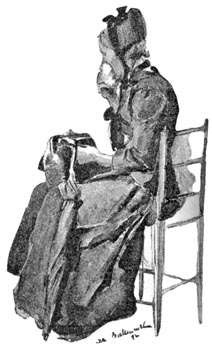
I had never been in such a mess in my life, but I was in a greater mess the next day. It’s a long story, that of the examination at the police station, and I will spare the reader the harassing details. Mr. Youson, in his confusion, made a very rambling statement of how he came into possession of the clock, prejudiced the Inspector against him, and got himself locked up, and I was told to call the next day at the Police Court in Blackman Street and explain matters, and bring my witnesses. I did so, and brought a neighbour or two who had seen the clock upon my mantelpiece at Streatham, and I clinched the argument with Mrs. Kibbey, who shed copious tears during the evidence, till the magistrate asked her sharply what she was snivelling at, when she fainted dead away under the reproof, and had to be carried from the witness-box into the fresh air to recover.
“mrs. kibbey shed copious tears.”
It was a clear case, however, against Mr. Youson, everybody considered, and he was remanded for a week, without bail, whilst enquiries as to his antecedents were to be vigorously made. There was a very grave suspicion, the Inspector whispered confidentially into my ear, along with some strong puffs of gin and peppermint which impregnated his breathing apparatus dreadfully, that Youson was one of a desperate gang of Lambeth burglars, for whom the police had been searching for some time.
There was a woman’s scream in court when Youson was remanded, and the magistrate, who was certainly in a bad temper that morning, said that he would commit anybody for contempt who made such a noise as that again, and then the next case was called, and I was outside in Blackman Street, Borough.
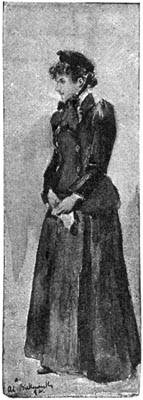
I had, with some difficulty and a little pleasure, lodged the hysterical Mrs. Kibbey in a Streatham omnibus, and was making my way thoughtfully down King Street to my Bermondsey premises, when someone touched me on the arm. I looked round, and was considerably surprised to find a pale, grave young woman of some thirty years of age, poorly but neatly clad, keeping step with me on the narrow pavement.
“I beg pardon, sir, but you are Mr. Kippen, I think?”
“Yes, my name is Kippen.”
“I wanted to speak to you. I wanted so much to see you before this case came on. My name is Youson, Lucinda Youson,” she said, hurriedly.
“God bless me, is it though? You are——”
“Mr. Youson’s daughter.”
“My good woman, I hope you are not going to bother me,” I said, imploringly; “the case is out of my hands. I am bound over to prosecute. It was a shameful robbery.”
“My father did not rob you, Mr. Kippen. Does he look like a thief?”
“I don’t know what he looks like.”
“mr. youson’s daughter.”
“You don’t know the truth,” she said quickly. “Perhaps you don’t know what kindness is, or charity—some people don’t. You would not wait for him to explain, and you have nearly killed us with anxiety. We—we did not know what had become of him.”
“Killed us,” I repeated, vacantly; “are there many of you?”
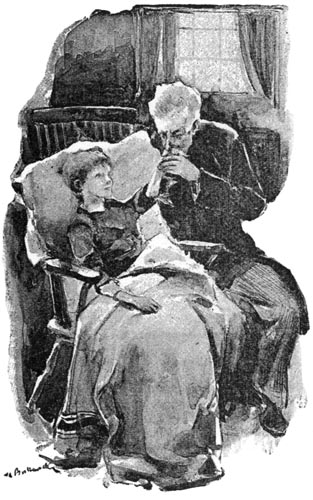
“My sister-in-law and her little boy, and myself. And the boy is dying—that’s the worst of it—oh! poor little chap, that is the worst of it! And his grandfather was so fond of him; he was selling the clock so that the boy and his mother should go away to Madeira, the only chance to save him, sir. The only chance that was left.
“the boy is dying.”
“And so he thought he would sell something valuable that did not belong to him, and go to Madeira at my expense, and——”
“You must not say my father stole it—you dare not!” she cried, and her eyes literally flashed fire at me. This young woman was as impulsive as her felonious father. Here was another scene likely to spring up in the street if I were not particularly careful, and I had had enough of demonstrations in the public highway.
“My good woman, what is it that you want with me?”
“I want you to hear how that clock came into my father’s possession, and then—and then prosecute him if you can. And at your peril, sir—please to understand, at your peril, though I utter no threats.”
“It strikes me you do.”
“No—no—I don’t mean that,” she cried. “Heaven help me, I am almost distracted, I am not myself to-day, and you will listen? It will not cost you anything to listen to me, sir, will it?”
She laid her hand upon my arm entreatingly—she had very earnest brown eyes, and I was not, as I thought, wholly unsusceptible to the influence of brown eyes upon the nervous system. And as she had delicately intimated that listening would not cost me anything, why should I object to listen to her? We were both going the same way. Of course, I should hear a good roundabout story—a second edition of her father’s rigmarole which had prejudiced the magistrate against him—but I was not bound in any way to believe a word that she said.
It sounded uncommonly like truth though, and took me very much aback when she said suddenly—
“Yes, that clock was stolen from you. We knew it was stolen—and who stole it.”
“But you just said——”
“That my father did not steal it. God bless him, no. He did not know—did not dream that we knew—did not know anything about it in any way—does not to this day. It was his property, he thought—all that was left of any value in the world to him; and it had belonged to his son—his eldest son, my half-brother, who——”
“Who was the thief. The infernal——”
“Please don’t, sir. He is dead.”
“Oh! I beg your pardon. I didn’t—know,” I found myself saying in an apologetic manner which really surprised myself.
“Yes, sir, he was the thief,” she said, sinking her voice into a whisper almost. “He committed suicide two months ago abroad, but we have kept the truth back from father. He wasn’t to know—it would have broken his heart, he was so proud of his son, always. But before my half-brother died—he had gone to Canada, to make a home for Kitty and her boy, he said—he wrote to Kitty that he was a repentant man, and that, unknown to any of us, he had been for years in bad hands, working with them, stealing with them. Our poor father thought he was a traveller for a Manchester firm, and so did we, until that terrible confession came across the sea to us. We were not to tell father—we were to make all the restitution that we could presently; he would send full instructions what we were to do by the next mail, he wrote, and the next mail only told us of his death.”
“i was always handy with my fingers.”
“And your father?”
“Kitty and I have fought hard to keep the truth from him—the truth would have broken his heart. Why the news of his son’s death nearly did, sir. And he has had so much trouble—so many losses too—and we have been for the last six months so very hard driven to live. Of late days father wished to sell this clock, but we would not let him—we were sure it had been stolen, and we hoped to find the owner some day.”
“But not like this, I suppose?”
“Oh! no, not like this. But when little Willie got very ill; when residence abroad for a few months might save him, the doctor said—it was only yesterday he told us that—father took the clock out of the house unknown to us, and—and came at once to you. He is so very impetuous, poor father.”
“Ah! is he? And who put the clock in working order, may I ask?”
“I did.”
“You!”
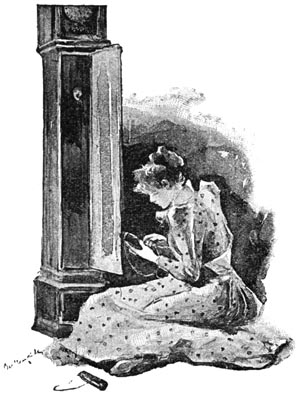
“I was brought up to the watch-making—I am rather clever at it, they say.”
“went to madeira with kitty and the boy.”
“Clever. By George, I should think you were! Why, in a business like mine you would be invaluable.”
“I was always handy with my fingers.”
“So was your half-brother—it seems to run in the family.”
“living with her sister now.”
“Oh!”
“I beg pardon,” I said, for the second time. “I—I did not mean to say that. It slipped out promiscuously.”
“Never mind, sir—never mind,” she said hurriedly. “What are you going to do? Pray tell me what you think of doing when I prove the truth of this.”
“If it’s all true—and I believe it is already, Miss Youson—I—I am going to withdraw from the prosecution, and ask your father to bring an action against me for illegal detention.”
“Oh! he would never think of such a thing.”
And he never did. The story was quite true, every word of it, and we arranged to keep it from the old man, so far as the peculiar profession of his first-born was concerned. He never knew that. I got rather intimate with the Youson family by degrees, although our acquaintance had begun so inauspiciously. Rather intimate, I say—well, very intimate, rather! would be a clear expression, if a trifle inelegant.
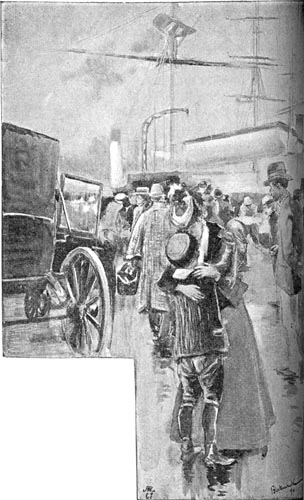
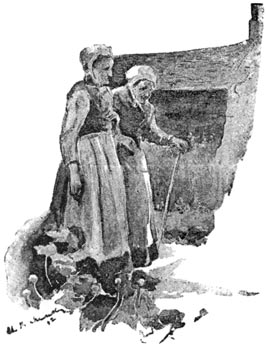
For I married that girl, and pensioned off Mrs. Kibbey, and I never did such a fine stroke of business in all my life. The old man—he was a fine old fellow, too—went to Madeira with Kitty and the boy, and I bore Lucinda off to Streatham. She is one of the best of wives, and so very handy in the business too—saves me a heap of money. It was a lucky day for me when that rascal of a half-brother of hers broke burglariously into Golden Birch Villa, and took away everything that had an atom’s worth of precious metal in its composition. It was a blessing very much in disguise, but it has answered its purpose thoroughly well. I am as happy as the day is long—and so is Lucinda. Everybody tells me that I secured a treasure when I took her for better, for worse. Everybody but Mrs. Kibbey—past housekeeper, and living with her sister now in the Cookshops Almshouses at Caterham—and she says I could have done much better for myself, long before, if I had only looked about me in a sensible and practical sort of way.
mr. george newnes.