“WHOM FIRST WE LOVE.”
Reading edition
May 1.—I love him! Only thou, my journal, shalt know it, thou silent confidant of all my sorrows and my hopes. Without it is spring-time, and the nightingales warble and the lilacs are in bloom. What a lovely time for one’s first love!
May 2.—All night I lay awake and thought of him, and made poetry. It seems like the bitterest irony of fate that I must go to school to-day, as if I were a child!
May 3.—He is perfectly heavenly, handsome, raven-locked, with dark, glowing eyes, and a pale Roman face; his moustache is simply enchanting. There is certainly something demoniacal about him. I adore demoniacal men. They are so exciting and interesting. He looks marvellously like Lord Byron. Perhaps he is a poet, or a Polish prince in exile. He looks so melancholy and aristocratic. I imagine Max Piccolomini looked like that as Mortimer in Mary Stuart.
May 4.—How he looked at me as he passed me on the way to school to-day! I put that provoking school-bag behind my back. I trust he did not see it.
May 6.—I have confided my secret to Lina. She is my most intimate friend; our hearts are joined for now and eternity. We wept together for hours. Lina understands me perfectly. She too has loved and has suffered unspeakably, poor girl! He was an officer of the Dragoons, I believe, and came to their house a great deal; at last he came nearly every day. Lina expected his declaration from hour to hour, but he went and proposed to her elder sister. Lina thought her heart was broken. I should never have survived such perfidy. Men are very wicked and false. Lina has read Faust. He reminds her of Faust a little, she says. I must try to get the book. Lina raves over it, although she says it is very immoral.
May 7.—I have seen him again, and am in a state of unbounded felicity. Lina and I were sitting in the park, eating candy and talking of him, of course, when he came walking up the path. I pinched Lina’s arm; I could not speak, but she understood me. Oh, heavens! he sat down on the seat beside us! I felt my blood rush to my heart. Lina blushed too, which was very silly of her. I studied his noble profile; he was rapt in thought, and did not move. Lina talked and laughed quite loud; she is really very much of a flirt. Of course he paid no attention to her.
May 8, Sunday.—The whole afternoon I read in the “Book of Songs.” Heinrich Heine is simply sweet. What a pity it is he wrote so many things they won’t let me read! Mamma does not like him at all, but then mamma is so very matter-of-fact. I wonder if I could ever grow to be so prosaic? At his side surely not.
May 9.—No one knows him here. I have made some cautious inquiries. He is probably spending some time here incognito. I feel pretty sure he is a political exile from Russia perhaps, or Siberia. Perhaps he is a revolutionary hero like Lafayette, or Brutus, or Kosciusko. Maybe he has killed somebody in a duel—he always looks so sad and unhappy; or he is the captain of a band of robbers, like Carl Moor, awfully noble and gallant of course. Heavens! what if his pursuers should come upon him! But I love him all the same; it is not a matter of choice or volition. “Man cannot loose what heaven binds,” says Schiller. I think that is quite well put. We went through the “Bride of Messina” to-day. I find a great deal in it that applies to me nowadays. I think Dr. Strempel saw me blush once or twice.
May 10.—I have taken him for my hero. All the girls in the class have a hero. Alexander the Great, or Nikolaus Lenau. Before this I had Count Adolar, in “The Pearl of Venice.” I call him Lohengrin, that sounds so poetic and unusual; and I too do not know where he comes from, like Elsa von Brabant.
May 11.—Mamma looks at me so queerly sometimes. She does not want me to sit in my room alone so much instead of taking a share in her household cares. It is very sad to think that parents so often have little sympathy with the deepest emotions of their children’s hearts.
May 13.—All is over. My ideals are broken, my faith in humanity is gone for ever. Would I could die or enter a convent! I can write no more to-day—I have naught but tears and sighs to record. I only ate two apple-dumplings for dinner; they all noticed it.
May 14.—No one knows what I suffer. This terrible secret of my poisoned youth shall follow me to my grave. Lohengrin! How absurd the name sounds now, like a cruel irony of Fate.
What would the girls at school say if they knew that Lohengrin, my interesting exiled Count, my Knight of the Swan—oh, horrors!—is nothing but a waiter?
May 16.—Did ever maiden’s heart suffer like mine? Ophelia or Margaret? Hamlet was at least a prince, and Faust had his college-degree, entitling him to social distinction. Ah, if he were but a shepherd or a hunter! There are such pretty poems about such with princesses and noble ladies—but a waiter? It is too horrible!
It was on the 12th of May, the most tragic day of my life. Can I ever be happy again, can I ever forget it? Aunt Hedwig was visiting us, and in the evening papa and I went with her to the winter garden of the Victoria Hotel. Papa and auntie were talking together, and I sat quite still,—I have grown very quiet of late,—and as I was sipping my iced lemonade my thoughts hovered tenderly about my beloved. A mysterious power suddenly constrained me to look up. Near me, leaning against the trunk of a palm-tree, stood Lohengrin. How distinguished and elegant he looked! His dress-coat fitted him like a glove, the one softly-curled lock of hair falling over his brow gave him an air of classic grace. A heavy ring of gold gleamed on his slender hand. Thank God, it was no wedding ring!
“Waiter!” called papa—I heard it as in a dream. His eyes grew larger and more lustrous, a beam of light seemed to flit across his countenance. My heart almost stood still. He approached our table. Does he not see papa and Aunt Hedwig? Does he not see all the people about us? He bows, he says: “Do you require anything, sir?”
“A bottle of Médoc,” says papa. I hear his voice as if it came from a great distance. I felt as if something within me had snapped asunder at that moment.
“What a nice-looking fellow!” remarked Aunt Hedwig.
“A Pole,” said my father. “He looks like the veriest fashion plate. Dear me, little girl, how pale you are! The wine will do you good, and you must order your iron pills again to-morrow. Here waiter, the rest is for you!”
Lohengrin, my Lohengrin, and twopence for his tip! Even now it is a mystery to me that I did not faint away.
Three days later.—I have scratched out the last nine pages of my journal word for word. The occupation did me good. This episode is wiped out from the pages of my life. Lohengrin is dead to me. There is one thing that comforts me—I now have an unhappy love. I always envied Lina a little for hers, she put on such airs about it. Unhappy loves are so very interesting and poetic.
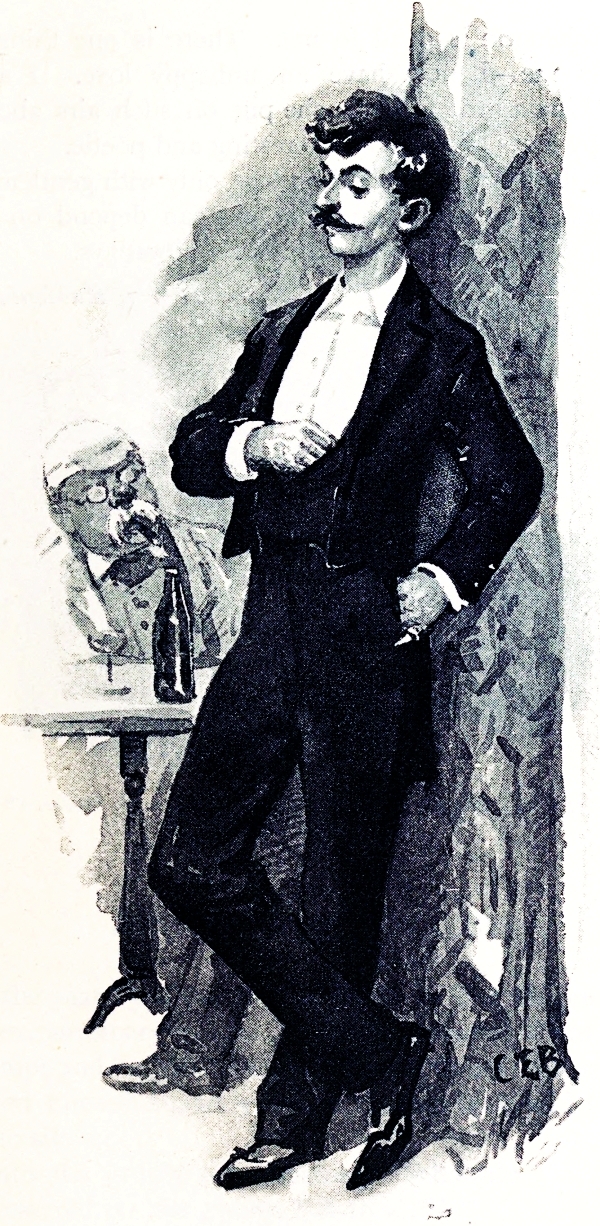
“HOW DISTINGUISHED AND ELEGANT HE LOOKED.”
P.S.—In future I shall fall in love only with gentlemen in uniforms. You have something you can depend on then, and the world is so false and deceitful nowadays.
H. von Kahlenberg.
“PLANTED HIMSELF SQUARELY BEFORE THE SCRIBENT, AND STARED AT HIM IN SILENCE.”