THE DUEL WITH THE DEVIL.
Reading edition
MEANWHILE something occurred which I[4] must not pass over, as it may serve as a commentary to the customs of this peculiar nation. I had been for some time an ardent visitor at the anatomy-rooms, for I was anxious to make the acquaintance of medical students. It happened one day that I was busying myself about a corpse with several friends, dissecting the organs of the mind, the brain, and heart in order to deduce the absurdity of the belief in immortality.
Suddenly I heard a voice behind me, “The devil, how stifling!”
I quickly turned and saw a young student of theology, who had already excited my wrath in a dogmatic lecture by the ardour and gusto with which he had taken notes of the ridiculous conjectures of the professor on the nature of the diabolical. Hearing him make this remark, which at that moment, and from him, I took as referring wholly to myself, I told him pretty strongly that I objected to such personal and insinuating expressions.
According to the ancient sacred law called “Comment,” this was an insult which could only be obliterated with blood. The theologian, a famous bravo, sent me his challenge the next day. This was just such a lark as I had been hoping for. Whoever cared for the good opinion of his fellow-students was expected to have a duel on record, although all of my friends admitted the custom to be utterly irrational and unnatural. I had prevailed upon my opponent to have the affair come off at a public resort, a couple of miles outside the town, and both parties put in an appearance at the designated place and time.
Solemnly each arrival was conducted into a room, where his coat was removed and replaced by the “paukwichs,” a sort of armour in which the duel was to be fought. This “paukwichs,” or armour, consisted in a hat with a broad brim sufficiently protecting the face; an enormously broad bandage made of leather, wadded and decorated with the colours of the society, to be strapped over the abdomen; an immense cravat standing stiffly about the neck, and affording protection to the chin, throat, part of the shoulders, and the upper portion of the chest. The arms were covered from the hands to the elbows with gloves made of old silk stockings. It must be confessed a figure in this unique armour looked funny enough. However, there was great safety in it, for only a part of the face, the upper half of the arm, and a part of the chest were at the mercy of the opponent’s rapier.
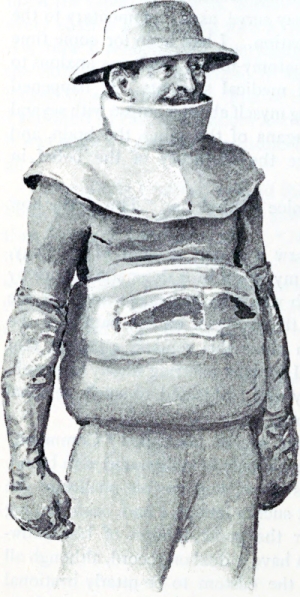
“A FIGURE IN THIS UNIQUE ARMOUR.”
A strong impulse to laugh came over me as I examined myself in the mirror. “The devil, in such attire, and about to enter the lists on behalf of the odour in the anatomy-room!”
My companions took my hilarity as an expression of courage and valour. Thinking, therefore, the right moment had now come, they conducted me into a large hall where the position of the enemy had been marked on the floor with chalk. A freshman considered it a high honour to be permitted to carry my rapier, as sword and sceptre were carried before the ancient emperors. It was a well-made weapon of finest steel, with a large hilt offering at the same time a protection for the hand.
At last we stood facing each other. The student of theology put on a fierce expression and looked upon me with an air of disdain, which strengthened me in my purpose of setting a right handsome mark upon him.
We put ourselves into the traditional posture, the blades were crossed, the seconds yelled “Ready!” and our rapiers whizzed through the air, and fell clinking upon the hilts. I confined myself to parrying the really masterly and artistic cuts of my opponent. I knew that my glory would be the greater if I merely defended myself at first and then gave him his deserts in the fourth or fifth round.
Applause followed each pass. Never had there been such bold and decisive attacks, never such dignified and cold-blooded self-defence. My skill in fencing was lifted up into the seventh heaven by old hands, and there was much curiosity and conjecture as to my tactics of retaliation. No one dared urge me to the onset.
Four rounds had passed without one thrust that had drawn blood. Before stepping forth for the fifth, I pointed out to my comrades the spot on my theologian’s right cheek where I intended to hit him. He seemed to get wind of my purpose, put himself under cover as much as possible, and carefully abstained from venturing an attack on his part. I began with a superb feint, which was received with an admiring “Ah!”, made a couple of regular thrusts, and with a clap my rapier was in his cheek.
The honest theologian was very much taken aback. My second and witness rushed up to him with a tape-measure, examined the wound, and said in a solemn voice, “It is more than an inch, and it gaps horribly, so ‘Abfuhr!’” Which is as much as to say, the poor boy having a hole in his face an inch long, his honour has been vindicated.
Now my friends crowded about me; the elder grasped my hands, the younger gazed with veneration upon the weapon with which the deed, surpassing anything in history, had been done. For who could boast of first having designated the spot he intended to hit, and then hitting it with such marvellous precision?
With a serious mien my opponent’s second stepped up to me, and in the name of the former offered me amity. I approached the invalid, whose wound was just being attended to with needle and thread, and made friends.
“I am greatly indebted to you,” he said, “for having marked me thus. I have been forced to study theology against my will. My father is a country parson, my mother is a pious lady, who would like above all things to see her son in a surplice. But your decisive stroke has altered matters; with a scar reaching from my ear to my mouth there is no church that would have me.”[5]
The companions of the brave theologian looked upon him sympathisingly. Who could measure his sad regrets at the thought of the old parson’s grief, the pious mamma’s despair, when the news of this disaster should reach them? But to me it seemed like a great piece of good luck for the youth to be given back to the world by so short an operation. I asked him to what studies he would now devote himself, and he frankly confessed that the calling of a cuirassier or of an actor had always seemed chiefly attractive to him.
I felt like embracing him for this happy thought, for it is in these very professions that I have most of my friends and adherents. I advised him urgently to follow the bend of nature, and promised to supply him with the best recommendations to distinguished generals and to the most notable stages.
As for all the persons in any way connected with this remarkable duel, I gave them an excellent dinner, in which of course I included my opponent and his followers. I then privately paid the debts of the quondam theologian, and when he had recovered I supplied him with money and letters, which opened a right jolly and brilliant career to him.
Neither the elegant conclusion of the duel nor my unobtrusive charity remained a secret. I was now looked upon as a being of a higher order, and I know many a young lady who shed tears over my generous sentiments.
The students of medicine sent a deputation presenting me with a superb rapier, because, as they thought, I had fought on behalf of the faultless odour of their anatomy-room.
Wilhelm Hauff.