← Table of contents
The History of Sulu

Chapter II · Genealogy of Sulu

Reading edition

Translator’s introduction

The manuscript of which a translation follows is an exact copy of the original, which is in the possession of Hadji Butu Abdul Baqi, the prime minister of the Sultan of Sulu. The genealogy proper begins on page 6 of the manuscript and is written entirely in Malay. This was the rule among all old Moro writers and is a decided indication of the authenticity of the document.

The first five pages of the original manuscript are the genealogy of Asip’s descendants. This part is written in Sulu and was probably composed at a later period than the Malay part of the book. It is written by Utu Abdur Rakman, the nephew of Imam Halipa, who is the son of Nakib Adak, the last person mentioned in the genealogy. Abdur Rakman is a cousin of Hadji Butu.

The addition of these five pages to the Genealogy of Sulu is for the purpose of giving prominence and recognition to the sons of Asip, who have been the right-hand men of the Sultans of Sulu since the organization of the sultanate.

Sulu author’s introduction

This is the genealogy of the sultans and their descendants, who lived in the land of Sulu.

Descendants of Asip

Descendants of Tuan Masha’ika

This is the genealogy of Tuan Masha’ika. It was said by the men of old that he was a prophet who was not descended from Adam. He was born out of a bamboo and was esteemed and respected by all the people. The people were ignorant and simple-minded in those days and were not Mohammedans of the Sunni sect. Some of them worshiped tombs, and some worshiped stones of various kinds.

Original and later settlers of Sulu

Sulu historical notes

Introduction

These notes were copied by the author from a book in the possession of Hadji Butu, prime minister to the Sultan of Sulu. Pages 1, 2, and 3 form a separate article. They appear to be a supplement to the Genealogy of Sulu, but they were undoubtedly derived from a different source. Their contents are well known to the public and are probably an attempt on the part of Hadji Butu to register what seemed to him a true and interesting tradition of his people.

Page 4 was copied by the author from an old, dilapidated document which was torn in many places. It no doubt formed part of an authentic genealogy of Sulu, older and more reliable than that of the manuscripts on pages 148 and 149. It is written in Malay.

The writing at the top of the page is the seal of Jamalul Kiram. The date given in the seal is the date of his sultanate. The flourish at the end of the signature below is the mark of the writer.

Sulu notes

The commission of Khatib Abdur Razzak.
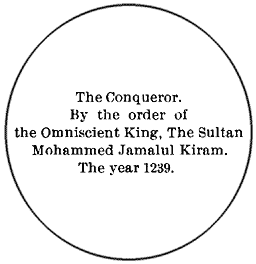
Text in circle: “The Conqueror. By the order of the Omniscient King, The Sultan Mohammed Jamalul Kiram. The year 1239.”

By the will of God the most High.

(Signed) The Sultan Jamaul Kiram.

[The End.]

Notes in this chapter

Note 1 · See below, p. 148.Note 2 · The eleventh month of the Mohammedan year.Note 3 · Sulu; the head, the chief.Note 4 · Arabic; the slave of the Merciful.Note 5 · Malay; sir or mister.Note 6 · Arabic; leader, caliph, high priest.Note 7 · A Sulu form of the Arabic “Caliph.”Note 8 · Malay-Sanskrit; minister of state.Note 9 · The central high region of Sumatra.Note 10 · Malay; officer of state. It literally means “rich man.”Note 11 · Sanskrit; king.Note 12 · Malay-Sanskrit; emperor or caliph. It is here used as a proper noun.Note 13 · A place in Lati, Sulu.Note 14 · Sulu; chicken, fowl.Note 15 · Sulu-Malay; slave.Note 16 · Sanskrit; wise.Note 17 · Arabic; understanding, mind.Note 18 · Malay-Sanskrit; subordinate officer of state.Note 19 · Arabic; lady, grandmother.Note 20 · Arabic; safe and sound.Note 21 · Malay; lady, woman.Note 22 · Arabic; righteous.Note 23 · A title of nobility.Note 24 · Arabic, Fatimah; the name of the Prophet’s daughter.Note 25 · Arabic; brilliant.Note 26 · Arabic; wife or husband.Note 27 · Arabic; beautiful.Note 28 · Arabic; hoping.Note 29 · Arabic; faithful.Note 30 · Arabic; religion.Note 31 · Arabic; trusted or trustworthy.Note 32 · Arabic; guide, leader.Note 33 · Sulu; fruit.Note 34 · Arabic; intelligent.Note 35 · Arabic; feminine of “salim” or safe and sound.Note 36 · Arabic; sleeping.Note 37 · Arabic; known.Note 38 · Arabic; noble, subordinate officer of state.Note 39 · Sanskrit; Iddha, kindled, lighted, or sunshine.Note 40 · Sanskrit; Indra, the god of the heavens, or most likely Indirā, name of Lakshmī, the wife of Vishnu.Note 41 · Sulu; light, sun.Note 42 · Arabic; wise.Note 43 · The name of Mohammed’s wife.Note 44 · Arabic; everlasting, eternal.Note 45 · Arabic; perfection.Note 46 · Arabic; scribe.Note 47 · Arabic; educated, taught.Note 48 · Arabic; virtuous.Note 49 · Arabic; pride, glory.Note 50 · Arabic; father.Note 51 · Arabic; firm, resolute, an attribute of God.Note 52 · Arabic; Mary.Note 53 · The Baklaya party should have been mentioned after the Tagimaha, but it was evidently left out by mistake. Tagimaha is a Sanskrit word whichNote 54 · Arabic; generous, noble.Note 55 · Arabic; served, master.Note 56 · Arabic; noble, applied to a descendant of Mohammed.Note 57 · Sulu, anchorage. The settlement lies 3 miles west of Jolo.Note 58 · It is used here as a name. As a title it is higher than raja and is equivalent to sultan or emperor.Note 59 · The Moro word for Zamboanga.Note 60 · Arabic; night, a common name.Note 61 · Arabic; power, superior authority, sultan.Note 62 · Arabic; glory.Note 63 · A corrupt form of the Arabic Ahmad.Note 64 · From the Arabic “Sheikh,” meaning chief.Note 65 · A place in Sumatra (?)Note 66 · Java.Note 67 · Arabic; master or noble, addressed to descendants of the prophet Mohammed.Note 68 · Town and state in southeastern Sumatra.Note 69 · Arabic; noble. This word is often pronounced by the Moros as “salip” or “sarip.”Note 70 · Arabic; height.Note 71 · Sanskrit; princess.Note 72 · Sanskrit; greater king, emperor.Note 73 · In Malay it indicates rank or office; in Sulu it is used only as a name.Note 74 · Malay; young.Note 75 · Arabic; defender.Note 76 · Arabic; honor, respect.Note 77 · Arabic; star, meteor, bright flame.Note 78 · Arabic; chosen (by God).Note 79 · Arabic; interceder.Note 80 · Arabic; victory.Note 81 · From the Arabic ʿazeem or great; not from ʿAlim, meaning learned.Note 82 · Arabic; exalter or defender.Note 83 · Arabic; Israel.Note 84 · Arabic; honor.Note 85 · Arabic; orator; the pandita who reads the oration, a part of the religions services held on Friday.Note 86 · See Ethnological Survey Publications, Vol. IV, pt. 1, p. 64.Note 87 · The servant of the giver.Note 88 · Jamiyun is Sanskrit and means brother or sister’s son; Kulisa is Indra’s thunderbolt.Note 89 · One of the names of the wife of Vishnu.Note 90 · Sulu; the sun.Note 91 · The Sulus believed that Alexander the Great came to Sulu and that their ancient rulers were descended from him.Note 92 · Sanskrit; the plant. Jamiyun Kulisa, Indira Suga, and Masha’ika are the names of the ancient gods of Sulu. Prior to Islam the Sulus worshipeNote 93 · Arabic; faithful.Note 94 · Chief.Note 95 · A gong used for signals and in worship.Note 96 · Western district of the Island of Sulu.Note 97 · The northern and central district of the Island of Sulu.Note 98 · The southern and central part of the Island of Sulu.Note 99 · The eastern part of the Island of Sulu.Note 100 · The town where the present Sultan of Sulu resides.Note 101 · The inhabitants of the region west of the town of Jolo.Note 102 · The inhabitants of the northern coast, east of Jolo.Note 103 · Arabic; generous.Note 104 · Arabic; master or served.Note 105 · Arabic; noble; a title applied to a descendant of Mohammed.Note 106 · Arabic; plural of walī, a man of God.Note 107 · Sulu; anchorage; the ancient capital of Sulu.Note 108 · A district in Sumatra.Note 109 · Arabic; beauty.Note 110 · Arabic; plural of karim, meaning generous.Note 111 · Arabic; orator; a high religious title, allied to Imam.Note 112 · Arabic; slave or servant.Note 113 · Arabic; the Giver, referring to God.Note 114 · Hadji Butu maintains that his ancestry goes back to Mantiri1 Asip, one of the ministers of Raja Baginda, the Sumatra prince who emigrated toNote 115 · The writing of this book was finished at 8 o’clock, Friday the 28th of Thul-Qaʿidat,2 1285 A. H.Note 116 · It belongs to Utu3 Abdur Rakman,4 the son of Abu Bakr. It was given to him by his uncle Tuan5 Imam6 Halipa7 Abdur Rakman. This is the genealNote 117 · This is the genealogy of Mantiri8 Asip, the hero and learned man of Menangkabaw.9 Mantiri Asip had the title of Orangkaya10 at the time he cNote 118 · Jawsul begot Na’ika and Rajiya.28 The former begot Orangkaya Sila. Rajiya bore Tuan Aminud29 Din.30 Santan bore Ma’mun.31 Ma’mun begot OrangNote 119 · Duwi bore Manduli and Immang. Manduli is the mother of Tuan Iman Anda and Na’ima.36 Immang bore Mali. Sitti bore Orangkayas Ugu, Garu, Abu BNote 120 · Masha’ika married the daughter of Raja Sipad the Younger, who was a descendant of Sipad the Older. His wife’s name was Idda39 Indira40 Suga.Note 121 · Tuan May begot Datu Tka, who was surnamed Dina, Lama and Timwan. Dina begot Abi50 Abdul Wakid51 and Maryam.52Note 122 · This chapter treats of the original inhabitants of the Island of Sulu. The first dwellers of the land of Sulu were the people of Maymbung, wNote 123 · Ten years later Raja Baginda58 came from Menangkabaw to Sambuwangan.59 From there he moved to Basilan and later to Sulu. When he arrived at Note 124 · There also came to Sulu from Bwayan,65 Sangilaya Bakti and Sangilaya Mansalah. The latter’s wife was Baliya’an Ñyaga.Note 125 · Five years after Raja Baginda’s arrival at Sulu the Raja of Jawa66 sent a messenger to Sulu with a present of wild elephants. The messenger’Note 126 · After that time there came Sayid67 Abu Bakr from Palembang68 to Bruney and from there to Sulu. When he arrived near the latter place he met Note 127 · After Abu Bakr, his son Kamalud Din succeeded to the sultanate. Alawad70 Din did not become sultan. Putri71 Sarip lived with her brother AlaNote 128 · Page 5 is a copy of a Sulu document issued by Sultan Jamalul-Kiram I in the year 1251 A. H., or about seventy-three years ago. It confers thNote 129 · Translation of page 1 of the original manuscript.—The first person who lived on the Island of Sulu is Jamiyun Kulisa.88 His wife was Indira8Note 130 · Translation of page 2 of the original manuscript.—In the days of the Timway94 Orangkaya Su’il the Sulus received from Manila four Bisayan caNote 131 · Translation of page 3 of the original manuscript.—The red-eyed man was stationed at Parang,96 and is the forefather of all the people of ParNote 132 · Translation of page 4 of the original manuscript.—The first inhabitants of the Island of Sulu were the people of Maymbung.100 They were follNote 133 · Translation of page 5 of the original manuscript.—Dated Wednesday, the tenth of Ramadan, in the year “D,” the first, which corresponds to th
Explore with AITake your curiosity a little further.

Reading settings