Chapter IV · SIGNS OF ANIMALS AND MONSTERS. (continued 2)
Reading edition
Visitors to the Isle of Wight will have noticed the word Bugle frequently inscribed under the picture of a Bull on the inn signboards there. Bugle is a provincial name in those parts for a wild bull. It is an old English word, and is used by Sir John Mandeville; “homes of grete oxen, or of bugles, or of kygn.” It was still current in the seventeenth century, for Randle Holme, 1688, classes the “Bugle, or Bubalus,” amongst “the savage beasts of the greater sort.” The horns of this animal, used as a musical instrument, gave a name to the Buglehorn. It may be remarked that the term bugle doubtless came, in old times, with other Gallicisms common to Sussex and Hampshire, from across the Channel, where the word bugle is still preserved in the verb beugler, the common French word for the lowing of cattle.
The Ox is rather uncommon; the Durham Ox and the Craven Ox, two famous breeds, are sometimes met with; then there is a Craven Ox Head, in George Street, York, and a Grey Ox at Brighouse, in the West Riding. The Ox and Compasses at Poulton Swindon, in Cumberland, is evidently a jocular imitation of the London sign of the Goat and Compasses.
The Cow is more common; its favourite colours being Red, Brown, White, Spotted, Spangled, &c. The Red Cow occurs as a sign near Holborn Conduit, on the seventeenth century trades tokens. It also gave a name to the alehouse in Anchor and Hope Lane, Wapping, in which Lord Chancellor Jeffries was taken prisoner, disguised as a sailor, and trying to escape to the Continent after the abdication of James II. Thinking himself safe in this neighbourhood, he was looking out of the window to while the time away, when he was recognised by a clerk who bore him a grudge, and at once betrayed him. An heraldic origin is not necessary for this colour of the cow.
“Cows (I mean that whole species of horned beasts) are more commonly black than Red in England. ’Tis for this reason that they have a greater value for Red Cow’s Milk than for Black Cow’s Milk. Whereas in France we esteem the Black Cow’s Milk, because Red Cows are more common with us.”[263]
Speaking of the Green Walk, St James’s Park, Tom Brown says: “There were a cluster of senators talking of state affairs, and the price of corn and cattle, and were disturbed with the noisy Milk folk crying: A can of Milk, Ladies; a can of Red Cow’s Milk, sirs?”[264] The preference for the Red Cow’s milk may, however, have a more remote origin, namely, from the ordinance of the law contained in Numbers xix. 2, where a red heifer is enjoined to be sacrificed as a purification for sin. Hence, Red Cow’s milk is particularly recommended in old prescriptions and panacea, as, for instance, in the following receipt of “a Cock water for a Consumption and Cough of the Lunges:”—
“Take a running cock and pull him alive, then kill him and cutt him in pieces and take out his intrailes and wipe him cleane, breake the bones, then put him into an ordinary still with a pottle of sack and a pottle of Red Cow’s Milk,” &c., &c.[265]
The Red Cow, in Bow Street, was the sign of a noted tavern, (afterwards called the Red Rose,) which stood at the corner of Rose Alley. It was when going home from this tavern that Dryden was cudgelled by bravoes, hired by Lord Rochester, for some remarks in Lord Mulgrave’s Essay on Satire, in the composition of which Dryden had assisted his lordship. The king offered £50, and a free pardon, but “Black Will with a cudgel,” to whom Lord Rochester had intrusted the task of thrashing the laureate, showed that there was such a thing as honour amongst rogues, and did not betray him for the king’s £50. In all probability, however, he received a larger sum from his lordship. In Dryden’s old age, Pope, then a boy, came here to look at the great man whose fame in after years he was to equal if not to eclipse. This tavern was the famous mart for libels and lampoons; one Julyan, a drunken dissipated “secretary to the Muses,” as he calls himself, was the chief manufacturer.
Near Marlborough, Wilts, there is an alehouse having the sign of the Red Cow, with the following rhyme:—
“The Red Cow Gives good Milk now.”
That under a Brown Cow at Oldham is still more sublime:—
“This Cow gives such Liquor, ’Twould puzzle a Viccar (sic.)”
The Heifer is to be met with sometimes in Yorkshire, but always with some local adjective, as the Craven Heifer; the Airesdale Heifer, the Durham Heifer, &c. The Pied Calf at Spalding seems to present a solitary instance of a calf on the signboard. Neither are sheep very common; the Ram was a noted carrier’s inn in the seventeenth century, in West Smithfield, and, indeed, continued as such until the recent destruction of this old cattle market. The crest of the cloth-workers was a mount vert, thereon a ram statant; so that this sign in that locality was very well chosen, being in honour of the cattle-dealers on ordinary occasions, and serving for the cloth-workers in the time of Bartholomew fair, for whose benefit the fair was founded. In 1668 there were two Ram’s Head inns in Fenchurch Street; one of them was a carriers’ inn for the Essex people. The Ram’s Skin, which occurs at Spalding in Lincolnshire, is another name for the Fleece. The Black Tup figures on a sign near Rochdale, perhaps in allusion to the black ram frail matrons used to bestride in the old custom of Free Bench, thus related in Jacob’s “Law Dictionary:”—
“In the manors of East and West-Enbourne in the Co. of Berks, and the manor of Torre in Devonshire, and other parts of the West of England, there is a custom, that when a Copyhold Tenant dies his widow shall have ‘Free Bench’ in all his customary lands ‘dum sola et casta fuerit,’ but if she commits incontinency she forfeits her estate. Yet nevertheless on her coming into the court of the manor, riding backwards on a black ram with his tail in her hand and saying the words following, the steward is bound by the custom to readmit her to her free bench; The words are these:—
Here I am Riding upon a Black Ram Like a w——e as I am; And for my crincum crancum I have lost my bincum bancum; And for my T——’s game Have done this worldly shame. Therefore pray, Mr Steward, let me have my land again.
This is a kind of penance among jocular tenures to purge the offence.”
Though the ram is rarely, and the sheep never seen on the signboard, the Lamb is not uncommon. In 1586, it was the sign of Abraham Veale, (agreeably to the punning practices of the time, one would have expected the Calf from him,) a bookseller in St Paul’s Churchyard, and in 1728 of Thomas Cox, also a bookseller, under the Royal Exchange in Cornhill. Doubtless, these signs had originally represented the Lamb with the flag of the Apocalypse. The sign was used by other trades: in 1673, it was the distinctive ornament of a confectioner at the lower end of Gracechurch Street;[266] and an instance of an alehouse is found in the following advertisement, which at the same time affords us a peep at the homely proceedings of the Admiralty in those days:—
“THIS is to give notice to the Officers and Company of His Majesty’s Frigate Boreas, who were on Board her at the taking the Ship Vrow Jacoba and Briggantyne Leon, that they will be paid their respective Shares of said Prizes, on Wednesday the Eight of April next, at the sign of the Lamb, in Abchurch Lane. Paying will begin at Eight o’clock of the forenoon of the said Day.”[267]
Think of that, ye clerks in Her Majesty’s offices, eight o’clock in the forenoon!
A few combinations also occur, as the Lamb and Breeches, the sign of Churches & Christie, leather-sellers and breeches-makers, on London Bridge, in the last century; this was a sign like that of the Hat and Beaver, in which the living animal, and the article manufactured from its skin, were juxtaposed. The Lamb and Crown was a sort of colonial or emigration office in Threadneedle Street, near the Southsea House in 1759.[268] At the present day there is a Lamb and Lark at Keynsham, Bath, and in Printing House Lane, Blackfriars. It is a typical representation of the proverb, “Go to bed with the Lamb and rise with the Lark.”
The Lamb and Hare figure together in Portsmouth Place, Lower Kennington Lane. The Lamb and Still is a combination intimating the sale of distilled waters. It was the sign of a house in Compton Street, in 1711, which had the honour to lodge Mr Fert, a dancing-master, and author of a work called “A Discourse or Explanation of the ground of Dancing.”[269]
If we except the heraldic Blue Boar, and the Sow and Pigs, we shall find no other pigs on the signboard but the Pig and Whistle,[270] the Little Pig at Amblecote, Stourbridge, and the Hog in the Pound in Oxford Street, jocularly called the gentleman in trouble. This latter was formerly a starting-point for coaches, and became notorious through the crime committed by its landlady, Catherine Hayes. Having formed an illicit connexion, she was induced by her paramour to murder her husband, after which she cut off his head, put it in a bag, and threw it in the Thames. It floated ashore, and was put on a pole in St Margaret’s Churchyard, Westminster, in order that it might be recognised; and by this primitive means the murderess was detected. The man was hanged, and Catherine burnt alive at Tyburn in 1726.
The Goat is not very common; there was a Goat Inn at Hammersmith, taken down in 1826, and rebuilt under the name of Suspension Bridge Inn; up to that time, the sign, and the woodwork from which it was suspended, used to extend across the street. The Goat in Boots, on the Fulham Road,[271] was in old times called simply “the Goat.” Besides these, there is a Black Goat in Lincoln, and a Grey Goat in Penrith and Carlisle, and a few others without addition of colour.
A walk through town on a fine Sunday morning will at once convince anybody of the good understanding that exists between the Englishmen and the canine species, “l’ami de l’homme” as Buffon calls the dog. From every lane and alley in the lower parts of the town sally forth men and youths in clean moleskins and corduroys, each invariably accompanied by some yelping cur, the least of whose faults is to be ugly. It is no wonder, then, that the Dog should be of frequent occurrence on the signboard. Pepys mentions a tavern of that name in Westminster, where, about the time of the Restoration, he used occasionally to show his merry face. In 1768, the author of the “Art of Living in London,” recommended the Dog in Holywell Street for a quiet good dinner:—
“Where disencumbered of all form or show, We to a moment might or sit or go; Eat what the palate recommends us hot, Yet not considered as a useless guest.”
PLATE IX.
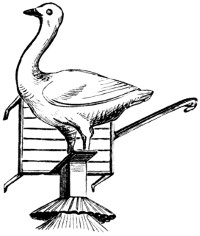
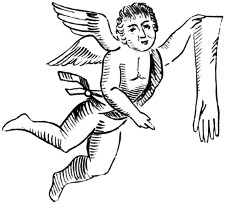
GOOSE AND GRIDIRON. (St Paul’s Churchyard, circa 1800.) ANGEL AND GLOVE. (Harleian Collection, 1710.)
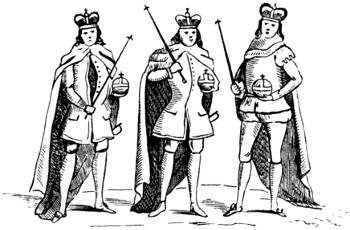
THREE KINGS. (Banks’s Collection, 1720.)
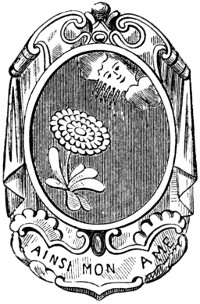
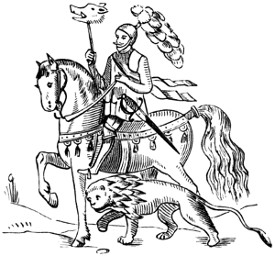
MARYGOLD. (Child’s Bank, Fleet Street, circa 1670.) GUY OF WARWICK. (Roxburghe Ballads, circa 1650.)
For some unknown reason, the Black Dog seems the greatest favourite; perhaps the English terrier is meant by it, a dog who “once had its day,” as the Scotch terrier appears to have it now. In the seventeenth century, there was a Black Dog Tavern near Newgate; a house of old standing, of which trades tokens are yet extant.
Mr Akerman, in his work on “Trades Tokens issued between 1648-1672,” makes a mistake in surmising that Luke Hutton’s “Black Dog of Newgate” had anything to do with this tavern. That poem is simply against “coney-catchers,” i.e., roguish detectives or informers of the Jonathan Wild stamp, and even worse. Such a one is impersonificated under the name of the Black Dog of Newgate, because the coney-catchers used to hunt people down threatening them with Newgate. This Black Dog may have derived its name from the canine spectre that still frightens the ignorant and fearful in our rural districts, just as the terrible Dun Cow, and the Lambton Worm were the terror of the people in old times. Near Lyme Regis, Dorset, there is an alehouse which has this black fiend in all his ancient ugliness painted over the door. Its adoption there arose from a legend that the spectral black dog used to haunt at nights the kitchen fire of a neighbouring farm-house, formerly a Royalist mansion, destroyed by Cromwell’s troops. The dog would sit opposite the farmer; but one night, a little extra liquor gave the man additional courage, and he struck at the dog, intending to rid himself of the horrid thing. Away, however, flew the dog and the farmer after him, from one room to another, until it sprang through the roof, and was seen no more that night. In mending the hole, a lot of money fell down, which, of course, was connected in some way or other with the dog’s strange visit. Near the house is a lane still called Dog Lane, which is now the favourite walk of the black dog, and to this genius loci the sign is dedicated.
There was another notorious Black Dog next door to the Devil Tavern, the shop of Abel Roper, who printed and distributed the majority of the pamphlets and ballads that paved the way for the Revolution of 1688. He was the original printer of the famous ballad of “Lillibulero.” Whatever pleased the public, whether good or bad, he was always ready to provide and send into the world; he was also the editor of the newspaper called the Postman. In the beginning of the reign of Charles II. he lived “at the Sun, over against St Dunstan’s Church, in Fleet Street.”[272]
Tokens are extant of the Pied Dog in Seething Lane, 1667, a sign still frequently to be seen at the present day.
We very rarely meet with the Blue Dog; but there is an example in Grantham, and the sign occurs in a few other places.
Sometimes a peculiar breed is chosen, as the Setter Dog at Redford, Notts; the Pointer at Peckfield, Milford Junction; the Beagle at Shute, Axminster, and the Merry Harriers, common in hunting counties. Equally common is the Greyhound, particularly in the North country, where coursing has long been a favourite sport. In the seventeenth century, it was the sign of a fashionable tavern in London, for in a sprightly ballad in the Roxburgh collection,[273] a young gallant is introduced who is going to forsake his evil courses and turn over a new leaf. He gives a last farewell to all his doxies:
“Farewell unto black patches, And farewell powder’d locks;”
and remembers all those delightfully wicked places he used to haunt formerly, and amongst them:
“Farewell unto the Greyhound, And farewell to the Bell, And farewell to my landlady, Whom I do love so well.”
This was probably the same Greyhound mentioned by Machyn, which seems to have been situated in Fleet Street, where the gaudily dressed Spanish ambassador took his stirrup-cup before leaving London. The same author mentions the sign elsewhere, apparently in Westminster; and the little picture of manners which accompanies it is rather curious:—
“The viij day of January (1557) dyd ryd in a care in Westmynster the wyff of the Grayhound, and the Abbot’s servand was wypyd [whipped] becawse that he toke her owt of the car, at the care h—e, [the back of the cart.]”
—another example that the course of true love never does run smooth, even though it runs upon wheels.
The White Greyhound was the sign of John Harrison, in St Paul’s Churchyard, a bookseller who published some of Shakespeare’s early works, as “The Rape of Lucrece,” “Venus and Adonis,” &c. White greyhounds, or rather silver greyhounds, were, until eighty years ago, the badges worn on the arm by king’s messengers.
The sign of the Black Greyhound is also of frequent occurrence, and at Grantham there is a Blue Greyhound. Indeed, although Lincoln was formerly famous for green, it seems also to have taken a great fancy to blue, for there we find the Blue Bull and the Blue Cow, the Blue Dog, the Blue Fox, (all in Colsterworth,) besides the Blue Pig, the Blue Ram, in Grantham, which town can also boast of the unique sign of the Blue Man.
The Talbot—old and now almost obsolete term for a large kind of hunting dog—has acquired a literary celebrity from having been substituted for the old sign of the Tabard Inn in Southwark, whence the pilgrims started on their merry journey to Canterbury. In 1606, we find the Talbot the sign of Thomas Man, bookseller in Paternoster Row, which, however, at that time, was not such a book market as now, being occupied by “eminent mercers, silkmen, and lacemen; and their shops were so resorted unto by the nobility and gentry in their coaches, that ofttimes the street was so stopped up, that there was no passage for foot passengers.”[274] So it continued until the fire; and it was only in the middle of the last century that the booksellers began to make their appearance in it.
A Talbot Inn in the Strand is mentioned in the following very quaint advertisement:—
“TO BE SOLD, a fine Grey Mare, full fifteen hands high, gone after the hounds many times, rising six years and no more; moves as well as most creatures upon earth, as good a road mare as any in 10 counties and 10 to that; trots at a confounded pace; is from the country, and her owner will sell her for nine guineas; if some folks had her she would fetch near three times the money. I have no acquaintance, and money I want, and a service in a shop to carry parcels or to be in a gentleman’s service. My father gave me the mare to get rid of me, and to try my fortune in London, and I am just come from Shropshire, and I can be recommended, as I suppose nobody takes servants without, and have a voucher for my mare. Enquire for me at the Talbot Inn near the New Church at the Strand.
“A. R.”[275]
At the foot of Burdley’s Hill, Gloucester, there is a Talbot Inn, which has a sign painted with two inscriptions; at the side where the road is level, it says:—
“Before you do this hill go up, Stop and drink a cheerful cup.”
On the side of the hill it says:
“You’re down the hill, all danger’s past, Stop and drink a cheerful glass.”
A publican at Odell has chosen the Mad Dog for a sign, evidently his beau ideal of a “jolly fellow,” one having a great horror for water; another at Pidley, Hunts, not to be behindhand with the Mad Dog, has put up the Mad Cat. We have as odd and apparently as unmeaning a sign in Tabernacle Walk, namely, the Barking Dogs.
All the combinations of the sign of the Dog point towards sports, as the Dog and Bear, which was very common in the seventeenth century, when bear-baiting was in fashion, and kings and queens countenanced it by their presence. The Dog and Duck refers to another barbarous pastime, when ducks were hunted in a pond by spaniels. The pleasure consisted in seeing the duck make her escape from the dog’s mouth by diving. It was much practised in the neighbourhood of London till the beginning of this century, when it went out of fashion, as most of the ponds were gradually built over. One of the most notorious Dog and Duck Taverns stood in St George’s Fields, where Bethlem Hospital now stands; it had a long room with tables and benches, and an organ[276] at the upper end. In its last days it was frequented only by thieves, prostitutes, and other low characters. After a long and wicked existence it was at length put down by the magistrates. In the seventeenth century it was famous for springs, but already in Garrick’s time its reputation was very equivocal:
“St George’s Fields, with taste and fashion struck, Display Arcadia at the Dog and Duck, And Drury Misses, here in tawdry pride, Are there “Pastoras” by the fountain side; To frowsy bowers they reel through midnight damps, With Fauns half drunk and Dryads breaking lamps.”[277]
In an unpublished paper from the MS. collection of William Hone, we have a mention of it:—
“It was a very small public-house till Hedger’s mother took it, who had been a barmaid to a tavern-keeper in London, who left this house to her at his death. Her son Hedger then was a postboy to a yard I believe at Epsom, and came to be master there. After making a good deal of money he left the house to his nephew, one Miles, (though it still went in Hedger’s name,) who was to allow him £1000 per annum out of the profits, and it was he that allowed the house to acquire so bad a character that the licence was taken away. I have this from one William Nelson who was servant to old Mrs Hedger, and remembers the house before he had it. He is now [1826] in the employ of the Lamb Street Water Works Company, and has been for thirty years. In particular, there never was any duck hunting since he knew the Gardens. Therefore, if ever, it must have been in a very early time indeed. Hedger, I am told, was the first person who sold the mineral water, (whence the St George’s Spa.) In 1787, when Hedger applied for a renewal of his licence, the magistrates of Surrey refused, and the Lord Mayor came into Southwark and held a court and granted the licence, in despite of the magistrates, which occasioned a great disturbance and litigation in the law courts.”
The old stone sign is still preserved, embedded in the brick wall of the garden of Bethlehem Hospital, visible from the road, and representing a dog squatted on his haunches, with a duck in his mouth, and the date 1617.
Another famous Dog and Duck inn formerly stood on the site of Hertford Street, in the now aristocratic precincts of May Fair. It was an old-fashioned wooden public-house, extensively patronised by the butchers and other rough characters during May Fair time. The pond in which the cruel sport took place was situated behind the house, and for the benefit of the spectators was boarded round to the height of the knee, to preserve the over-excited spectators from involuntary immersions. The pond was surrounded by a gravel walk shaded with willow trees.
The Dog and Badger, Kingswood, Gloucester, refers to the now obsolete sport of badger-baiting. More genial sports, however, are called to mind by the Dog and Gun, Dog and Partridge, Dog and Pheasant, all of which are very common.
“As I was going through a street of London, where I never had been till then, I felt a general clamp and faintness all over me, which I could not tell how to account for, till I chanced to cast my eyes upwards and found that I was passing under a signpost on which the picture of a cat was hung.” This little incident of the cat-hater, told in No. 538 of the Spectator, is a proof of the presence of cats on the signboard, where, indeed, they are still to be met with, but very rarely. There is a sign of the Cat at Egremont, in Cumberland, a Black Cat at St Leonard’s Gate, Lancaster, and a Red Cat at Birkenhead. There is also a sign of the Red Cat in the Hague, Holland, and “thereby hangs a tale.” It was put up by a certain Bertrand, a Frenchman, who had left his native country, having been mixed up in some conspiracy against Mazarin. Arrived at the Hague, he opened a cutler’s shop, and put up a double sign, representing on the one side a red cat, on the other a portrait of his Eminence Cardinal Mazarin in his red gown, and with his bristling moustache; underneath he wrote “aux deux méchantes bêtes” (the two obnoxious animals.) Holland, however, was at peace with France at that time, and so the Burgomaster, afraid of offending the French ambassador, requested Bertrand to alter his sign. Mazarin’s face was then painted out and another red cat put in its place. Gradually as the first sign was forgotten, the name became unmeaning, and was finally altered into the Red Cat, and in this shape it has come down to the present day, still the sign of a cutler, and a descendant of Bertrand.[278]
The Cat and Lion, which we meet with sometimes, as at Stockport, was probably at one time the Tiger and Lion. It is occasionally accompanied by the following elegant distich:—
“The lion is strong, the cat is vicious, My ale is strong, and so is my liquors.”
The Cat and Parrot was, in 1612, the sign of Thomas Pauer, a bookseller, dwelling near the Royal Exchange. At Santry, near Dublin, and in some other places, we meet with the Cat and Cage, which is represented by a cat trying to pull a bird out of a cage; but its origin may be found in the Cat in the Basket, a favourite sign of the booths on the Thames when that river was frozen over in 173940. The sign was a living one, a basket hanging outside the booth, with a cat in it. It was revived when the river was again frozen in 1789, and seems to have had many imitators, for on a print[279] representing a view of the river at Rotherithe during the frost, there is a booth with a merry company within, whose sign, inscribed the Original Cat in the Cage, represents poor Tabby in a basket. This sign of the Cat in the Basket, or in the Cage, doubtless originated from the cruel game, once practised by our ancestors, of shooting at a cat in a basket. Brand, in his “Popular Superstitions,” gives a quotation, from which it appears that a similar cruel sport was still practised at Kelso in 1789; but instead of shooting at the cat, it was placed in a barrel, the bottom of which had to be beaten out. The same game is still practised in Holland, and generally, if not always, on the ice.