Chapter II · HISTORIC AND COMMEMORATIVE SIGNS. (continued 2)
Reading edition
A ticket for one of his benefit representations, engraved by Hogarth, is still a morceau recherché amongst print collectors, as much as £12 having been paid for one. “Spiller’s Life and Jests” is the title of a little book published at that time.
Garrick’s Head was set up as a sign in his lifetime, and in 1768 it hung at the door of W. Griffiths, a bookseller of Catherine Street, Strand. It is still common in the neighbourhood of theatres. There is one in Leman Street, Whitechapel, not far from the place of his first successes, where, in 1742, he played at the theatre in Goodman’s Fields, and “the town ran horn-mad after him,” so that there were “a dozen dukes of a night at Goodman’s Fields sometimes.”[104]
Roxellana was, in the seventeenth century, the sign of Thomas Lacy, of Cateaton Street, (now Gresham Street,) City. It was the name of the principal female character in “The Siege of Rhodes,” and was originally the favourite part of the handsome Elizabeth Davenport, whose sham marriage to the Earl of Oxford, (who deceived her by disguising a trumpeter of his troop as a priest,) is told in De Grammont’s Memoirs. After she had found out the Earl’s deception, she continued under his protection, and is occasionally mentioned, (always under the name of Roxellana,) with a few words of encomium on her good looks by that entertaining gossip, Pepys.
Formerly there was a sign of Joey Grimaldi at a public-house nearly opposite Sadler’s Wells Theatre; not only had it the name, but addidit vultum verbis, in the shape of a clown with a goose under his arm, and a string of sausages issuing from his pocket. Joey’s name being less familiar to the public of the present day, the house is now called the Clown. This, we think, is the last instance of an actor being elevated to signboard honours.
Abel Drugger is one of the dramatis personæ in Ben Jonson’s comedy of the Alchymist, and from the character given him by his friend Captain Face, we get some curious information concerning the mysteries of the tobacco trade of that day:—
“This is my friend Abel, an honest fellow, He lets me have good tobacco, and he does not Sophisticate it with sack lees or oil, Nor washes it with muscadel and grains, Nor buries it in gravel underground, Wrapp’d up in greasy leather or p—— clouts, But keeps it in fine lily pots, that open’d Smell like conserve of roses, or French beans. He has his maple block, his silver tongs, Winchester pipes, and fire of juniper. A neat, spruce, honest fellow, and no goldsmith.”
This worthy was, in the end of the last century, the sign of Peter Cockburn, a tobacconist in Fenchurch Street, formerly shopman at the Sir Roger de Coverley, as he informs the public on his tobacco paper.[105] According to the custom of the times, and one which has yet lingered in old-fashioned neighbourhoods, this wrapper is adorned with some curious rhymes:—
“At Drugger’s Head, without a puff, You’ll ever find the best of snuff, Believe me, I’m not joking; Tobacco, too, of every kind, The very best you’ll always find, For chewing or for smoaking. Tho’ Abel, when the Humour’s in, At Drury Lane to make you grin, May sometimes take his station; At number Hundred-Forty-Six, In Fenchurch Street he now does fix His present Habitation. His best respects he therefore sends, And thus acquaints his generous Friends, From Limehouse up to Holborn, That his rare snuffs are sold by none, Except in Fenchurch Street alone, And there by Peter Cockburn.”
Falstaff, whom we have already mentioned when speaking of Shakespeare, and Paul Pry, are both very common. The last is even of more frequent occurrence than “honest Jack” himself.
Lower down in the scale of celebrities and public characters, we find the court-jester of Henry VIII., Old Will Somers, the sign of a public-house in Crispin Street, Spittalfields, at the present day. He also occurs on a token issued from Old Fish Street, in which he is represented very much the same as in his portrait by Holbein, viz., wearing a long gown, with hat on his head, and blowing a horn. Under an engraving of this picture are the following lines:—
“What though thou think’st me clad in strange attire, Knowe I am suted to my own deseire; And yet the characters described upon mee May shew thee that a king bestowed them upon mee. This horn I have betokens Sommers’ game, Which sportive tyme will bid thee reade my name, All with my nature well agreeing to As both the name, and tyme, and habit doe.”
Formerly there used to be in the town a wooden figure of Will with rams’ horns and a pair of large spectacles; and the story was told that he never would believe that his wife had presented him with the “bull’s feather” until he had seen it through his spectacles.
Two portraits of Sommers are preserved at Hampton Court, one in a picture after Holbein, representing Henry VII. with his queen, Elizabeth, and Henry VIII. with his queen, Jane Seymour. Will is on one side, his wife on the other. The other portrait is by Holbein, three-quarter life size, where he is represented looking through a closed window.[106] He also figures in Henry VIII.’s illuminated Psalter,[107] in which King Henry’s features are given to David, and those of Will Sommers to the fool who accompanies him.
Sommers was born at Eston Neston, Northamptonshire, where his father was a shepherd. His popularity arose from his frankness, which is thus eulogised by Ascham in his “Toxophilus:”—“They be not much unlike in this to Wyll Sommers, the kingis foole, which smiteth him that standeth alwayes before his face, be he never so worshipful a man, and never greatlye lokes for him which lurkes behinde another man’s backe that hurte him indeede.”
We next come to Broughton, the champion pugilist of England in the reign of George II. He kept a public-house in the Haymarket, opposite the present theatre; his sign was a portrait of himself, without a wig, in the costume of a bruiser. Underneath was the following line, from Æneid, v. 484:—
“Hic victor cæstus, artemque repono.”
Numerous public-houses already retail their good things under the auspices of the great Tom Sayers. One in Pimlico, Brighton, deserves especial mention, as it is reported to be the identical house in which the mighty champion made his entry on the stage of this world, for the noble purpose of dealing and receiving the blows of fistic fortune. But, as in the case of Homer’s birthplace, the honour is contested; almost every house in Pimlico lays claim to his nativity, and unless the great man writes his life and settles this mooted point, it is likely to give serious trouble to future historiographers.
Another athlete, Topham, “the strong man,” had also his quantum of signboards. “The public interest which his extraordinary exhibitions of strength had always excited did not die with him. His feats were delineated on many signs which were remaining up to 1800. One in particular, over a public-house near the Maypole, in East Smithfield, represented his first great feat of pulling against two dray horses.”[108]
Thomas Topham was born in London in 1710. His strength almost makes the feats of Homer’s heroes credible, for, besides pulling against two dray horses, in which he would have been successful if he had been properly placed, he lifted three hogsheads of water, weighing 1836 lbs, broke a rope two inches in circumference, lifted a stone roller, weighing 800 lbs., by a chain with his hands only, lifted with his teeth a table six feet long, with half a hundredweight fastened to the end of it, and held it a considerable time in a horizontal position, struck an iron poker, a yard long and three inches thick, against his bare left arm until it was bent into a right angle, placed a poker of the same dimensions against the back of his neck, and bent it until the ends met, and performed innumerable other remarkable feats.
In Daniel Lambert, whose portly figure acts as sign to a coffee-house on Ludgate Hill, and to a public-house in the High Street, St Martins, Stamford, Lincolnshire, we behold another wonder of the age. This man weighed no less than 52 stone 11 lb. (14 lbs. to the stone.) He was in his 40th year when he died, and the circumstances of his burial give a good idea of his enormous proportions. His coffin, in which there was great difficulty of placing him, was 6 ft. 4 in. long, 4 ft. 4 in. wide, and 2 ft. 4 in. deep. The immense size of his legs made it almost a square case. It consisted of 112 superficial feet of elm, and was built upon two axletrees and four clogwheels, and upon them his remains were rolled into the grave, a regular descent having been made by cutting the earth away for some distance slopingly down to the bottom. The window and part of the wall had to be taken down to allow his exit from the house in which he died. His demise took place on June 21, 1809.
Over the entrance to Bullhead Court, Newgate Street, there is a stone bas-relief, according to Horace Walpole once the sign of a house called The King’s Porter and the Dwarf, with the date 1660. The two persons represented are William Evans and Jeffrey Hudson. Evans is mentioned by Fuller.[109] Jeffrey Hudson, the dwarf, had a very chequered life. He was born in 1609 at Okeham in Rutlandshire, from a stalwart father, keeper of baiting-bulls to the Duke of Buckingham. Having been introduced at court by the Duchess, he entered the Queen’s service. On one occasion, at an entertainment given by Charles I. to his queen, he was served up in a cold pie; at another time at a court ball, he was drawn out of the pocket of Will Evans, the huge door porter, or keeper, at the palace. In 1630 he was sent to France to bring over a midwife for the queen, but on his return was taken prisoner by Flemish pirates, who robbed him of £2500 worth of presents received in France. Sir John Davenant wrote a comic poem on this occasion entitled “Jeffereïdos.” During the civil wars Jeffrey was a captain of horse in the royal army; he followed the queen to France, and there had a duel with a Mr Crofts (brother of Lord Crofts) whom he shot, for which misdemeanour he was expelled the court. Taken prisoner by pirates a second time, he was sold as a slave in Barbary. When he obtained his liberty he returned to London, but got into prison for participation in the Titus Oates plot, and died shortly after his release in 1682. Walter Scott has introduced him in his “Peveril of the Peak.”
Jeffrey is not the only dwarf who has figured on a signboard, for in the last century there was a Dwarf Tavern in Chelsea Fields, kept by John Coan, a Norfolk dwarf. It seems to have been a place of some attraction, since it was honoured by the repeated visits of an Indian king. “On Friday last the Cherokee king and his two chiefs, were so greatly pleased with the curiosities of the Dwarf’s Tavern in Chelsea Fields, that they were there again on Sunday at seven in the evening to drink tea, and will be there again in a few days.”—Daily Advertiser, July 12, 1762. Two years after we find the following advertisement:—“Yesterday died at the Dwarf Tavern in Chelsea Fields, Mr John Coan, the unparalleled Norfolk Dwarf.”—Daily Advertiser, March 17, 1764.
The name of Dirty Dick, which graces a public-house in Bishopsgate Without, was transferred to those spirit stores from the once famous Dirty Warehouse formerly in Leadenhall Street, a hardware shop kept in the end of the last century by Richard Bentley, alias Dirty Dick, in which premises, until about fifteen or twenty years ago, the signboard of the original shop was still to be seen in the window. Bentley was an eccentric character, the son of an opulent merchant, who kept his carriage and lived in great style. In his early life he was one of the beaux in Paris, was presented at the court of Louis XVI., and enjoyed the reputation of being the handsomest and best dressed Englishman at that time in the capital of France. On his return to London he became a new, though not a better, man. Brooms, mops, and brushes were rigorously proscribed from his shop; all order was abolished, jewellery and hardware were carelessly thrown together, covered by the same shroud of undisturbed dust. So they remained for more than forty years, when he relinquished business in 1804. The outside of his house was as dirty as the inside, to the great annoyance of his neighbours, who repeatedly offered Bentley to have it cleaned, painted, and repaired at their expense; but he would not hear of this, for his dirt had given him celebrity, and his house was known in the Levant, and the East and West Indies, by no other denomination than the “Dirty Warehouse in Leadenhall Street.” The appearance of his premises is thus described by a contemporary:—
“Who but has seen, (if he can see at all,) ‘Twixt Aldgate’s well-known pump and Leadenhall, A curious hardware shop, in generall full Of wares from Birmingham and Pontipool! Begrimed with dirt, behold its ample front, With thirty years’ collected filth upon’t; In festoon’d cobwebs pendant o’er the door, While boxes, bales, and trunks are strew’d around the floor. ....... Behold how whistling winds and driving rain Gain free admission at each broken pane, Safe when the dingy tenant keeps them out, With urn or tray, knife-case or dirty clout! Here snuffers, waiters, patent screws for corks, There castors, cardracks, cheesetrays, knives and forks; There empty cases piled in heaps on high, There packthread, papers, rope, in wild disorder lie.” &c.&c.&c.
The present Dirty Dick is a small public-house, or rather a tap of a wholesale wine and spirit business in Bishopsgate Street Without. It has all the appearance of one of those establishments that started up in the wake of the army at Varna and Balaclava, or at newly-discovered gold-diggings. A warehouse or barn without floorboards; a low ceiling, with cobweb festoons dangling from the black rafters; a pewter bar battered and dirty, floating with beer; numberless gas-pipes, tied anyhow along the struts and posts, to conduct the spirits from the barrels to the taps; sample phials and labelled bottles of wine and spirits on shelves,—everything covered with virgin dust and cobweb,—indeed, a place that would set the whole Dutch nation frantic.
Yet, though it has been observed that cleanliness of the body is conducive to cleanliness of the soul, and vice versa, the regulations of this dirty establishment, (hung up in a conspicuous place,) are more moral than those of the cleaner gin-palaces,—as, for instance:—“No man can be served twice.”[110] “No person to be served if in the least intoxicated.” “No improper language permitted.” “No smoking permitted;” whilst the last request, for fear of this charming place tempting customers to lounge about, says, “Our shop being small, difficulty occasionally arises in supplying the customers, who will greatly oblige by bearing in mind the good old maxim:—
‘When you are in a place of business, Transact your business And go about your business.’”
By a trades token we see that Old Parr’s Head was already in the seventeenth century the sign of a house in Chancery Lane. Circa 1825, a publican in Aldersgate put up the old patriarch, with the following medical advice:—
“Your head cool, Your feet warm, But a glass of good gin Would do you no harm.”
Thomas Parr was born in 1483, and dying November 15, 1635, at the age of 152, had lived in the reigns of ten several princes,—viz., Edward IV., Edward V., Richard III., Henry VII., Henry VIII., Edward VI., Queen Mary, Queen Elizabeth, James I., and Charles I. He was not the only one of the family who attained to a great age, for the London Evening Post, August 24, 1757, has the following note:—“Last week died at Kanne, in Shropshire, Robert Parr, aged 124. He was great-grandson of old Thomas Parr, who died in the reign of King Charles I., and lies buried in Westminster Abbey. What is very remarkable is, that the father of Robert was 109; the grandfather 113; and the great-grandfather, the said Thomas, is well known to have died at the age of 152.” Signs of old Parr are still remaining at Gravesend and at Rochester.
Thomas Hobson, (Hobson’s Choice,) the benevolent old carrier, is the sign of two public-houses in Cambridge,—the one called Old Hobson, the other Hobson’s House. His own inn in London was the Bull Inn in Bishopsgate Street, where he was represented in fresco, having a £100 bag under his arm, with the words, “The fruitful mother of an hundred more.” There is an engraving of him by John Payne, his contemporary, which also represents him holding a bag of money. Under it are these lines:—
“Laugh not to see so plaine a man in print; The shadow’s homely, yet there’s something in’t. Witness the Bagg he wears, (though seeming poore,) The fertile Mother of a thousand more. He was a thriving man, through lawful gain, And wealthy grew by warrantable faime. Men laugh at them that spend, not them that gather, Like thriving sonnes of such a thrifty father.”
The print also informs us that he died at the age of eighty-six, in the year 1630. Milton, who wrote two epitaphs upon him, says, that “he sickened in the time of his vacancy, being forbid to go to London by reason of the plague.”
Among this class of minor celebrities we may also place those who put up their own head for signs. Taylor, the water poet, (see Mourning Crown, pp. 49,) was one of the first. Next to him followed Pasqua Rosee; according to his handbill, “the first who made and publicly sold coffee-drink in England.” His establishment was “in St Michael’s Alley, in Cornhill, at the sign of his own head.” This handbill largely enters into the virtues of the “coffee-drink,” gives the natural history of the plant, prescribes how to make the drink, and advises that “it is to be drunk, fasting an hour before, and not eating an hour after, and to be taken as hot as possibly can be endured; the which will never fetch the skin off the mouth, or raise any blisters by reason of that heat.” The next enters upon a glowing description of all the evils cured by that drink, as fumes, headaches, defluxions of rhumes, dropsy, gout, scurvy, king’s-evil, spleen, hypochondriac, winds, stone, &c. This coffee-house was opened in 1652.
Lebeck’s Head was another instance of the owner setting up his own head as a sign; and though his name has not filled the trumpet of fame, yet had he many times bravely stood the fire, and filled the mouths of his contemporaries, for he kept an ordinary (about 1690) at the north-west corner of Half-moon Passage, (since called Bradford Street.) The sign seems to have found imitators at the time, and is even yet kept up by tradition. There is Lebeck’s Head in Shadwell, High Street; a Lebeck’s Inn and Lebeck’s Tavern in Bristol; and a Lebeck and Chaff-cutter at a village in Gloucestershire.
A still more famous house was the Pontack’s Head, formerly called the White Bear, in Christ Church Passage, (leading from Newgate Street to Christ Church.) This tavern having been destroyed by fire, Pontack, the son of a president of the parliament of Bordeaux, opened a new establishment on its site, and assuming his father’s portrait as its sign, called it the Pontack’s Head. It was the first fashionable eating-house in London, was opened soon after the Restoration, and continued in favour until about the year 1780, when it was pulled down to make room for the building of the vestry hall of Christ Church. De Foe describes it as “a constant ordinary for all comers at very reasonable prices, where you may bespeak a dinner from four or five shillings a head to a guinea, or what sum you please.”[111] In the beginning of the eighteenth century the dinners had become proverbially extravagant:—
“Now at Pontack’s we’ll take a bit, Shall quicken Nature’s appetite. Here, shew a room! what have you got? The waiter (cries) What have we not? All that the season can afford, Fresh, fat, and fine, upon my word A Guinea ordinary, sir.”
This Guinea ordinary was:—
“—— every way compleat, Adorn’d and beautifully dress’d. But what it was could not be guess’d.”
The waiter, however, gives the menu, which contains—Bird’s nest soup from China; a ragout of fatted snails; bantam pig, but one day old, stuffed with hard row and ambergris; French peas stewed in gravy, with cheese and garlick; an incomparable tart of frogs and forced meat; cod, with shrimp sauce; chickens en surprise, (they had not been two hours from the shell,) and similar dainties.[112] Pontack contributed much towards bringing the French wines in fashion, being proprietor of some of the Bordeaux vineyards which bore his name.
About the same time another tavern flourished, with its master’s head for sign; this was Caveac’s,[113] celebrated for wine; of him Amhurst sang:—
“Now sumptuously at Caveac’s dine, And drink the very best of wine.”
Though it cannot be said that Don Saltero put up his portrait for a sign, yet his coffee-house was named after him, and is still extant under the same denomination in Cheyne Walk, Chelsea. This house was opened in 1695 by a certain Salter, who had been servant to Sir Hans Sloane, and had accompanied him on his travels. Chelsea at that time was a village, full of the suburban residences of the aristocracy, and the pleasant situation of Salter’s house soon made it the resort of merry companions, on their way to or from friends’ villas, or Vauxhall, Jenny Whin’s, and other places of public resort in the neighbourhood. Vice-Admiral Mundy, on his return from the coast of Spain, amused with the pedantic dignity of Salter, christened him Don Saltero, and under that name the house has continued till this day.
From his connexion with the great Sir Hans Sloane, and the tradition of a descent from the Tradescants, Salter was of course in duty bound to have a museum of curiosities, which, by gifts from Sir Hans and certain aristocratic customers in the army and navy, soon became sufficiently interesting to constitute one of the London sights. It existed more than a century, and was at last sold by auction in the summer of 1798. From his catalogue[114] (headed with the words, “O Rare!”) we gather that the curiosities fully deserved that name, for amongst them we find: “a piece of St Catherine’s skin;” “a painted ribbon from Jerusalem, with which our Saviour was tied to the pillar when scourged, with a motto;”[115] “a very curious young mermaid-fish;” “manna from Canaan, it drops from the clouds twice a year, in May and June, one day in each month;” “a piece of nun’s skin;” “a necklace made of Job’s tears;” “the skeleton (sic) of a man’s finger;” “petrified rain;” “a petrified lamb, or a stone of that animal;” “a starved cat in the act of catching two mice, found between the walls of Westminster Abbey when repairing;” “Queen Elizabeth’s chambermaid’s hat,” &c.[116]
A most amusing paper in the Tatler, No. 34, gives a full-length portrait of Salter, who appears to have been an “original.” Music was his besetting sin, and with very little excuse for it. In that paper the museum, too, is taken to task. Richard Cromwell used to be a visitor to this house, where Pennant’s father, when a child, saw him, “a very neat old man, with a placid countenance.” Franklin also, when a printer’s apprentice, “one day made a party to go by water to Chelsea in order to see the college, and Don Saltero’s curiosities.”
There is a rather amusing advertisement of the Don’s in the Weekly Journal for June 23, 1723:—
“Sir,—Fifty years since to Chelsea great, From Rodnam on the Irish main, I stroll’d with maggots in my pate, Where much improved they still remain. Through various employs I’ve past, Toothdrawer, trimmer, and at last, I’m now a gimcrack whim-collector. Monsters of all sorts here are seen, Strange things in nature as they grew so; Some relicks of the Sheba queen, And fragments of the famed Bob Cruso; Knicknacks to dangle round the wall, Some in glass cases, some on shelf; But what’s the rarest sight of all, Your humble servant shows himself. On this my chiefest hope depends. Now if you will the cause espouse, In journals pray direct your friends To my Museum-Coffeehouse; And in requital for the timely favour I’ll gratis bleed, draw teeth, and be your shaver. Nay, that your pate may with my noddle tally, And you shine bright as I do—marry shall ye. Freely consult my revelation Molly; Nor shall one jealous thought create a huff, For she has taught me manners long enough. “Chelsea Knackatory. Don Saltero.”
At the end of his catalogue a list of the donors is added, most of whom, doubtless, also frequented his house. Amongst them the following names appear:—the Duke of Buccleuch, the Earl of Sutherland, Sir John Balchen, Sir Rob. Cotton, Bart., Sir John Cope, Bart., Sir Thomas de Veil, Sir Francis Drake, Lady Humphrey, Sir Thomas Littleton, Sir John Molesworth, the Hon. Capt. William Montague, Sir Yelverton Peyton, George Selwyn, the Hon. Mr Verney, Sir Francis Windham, &c., besides numbers of naval and military officers.
The Mother Redcap is a sign that occurs in various places, as in Upper Holloway, in the High Street, Camden Town, in Blackburn, Lancashire, in Edmund’s Lowland, Lincolnshire, &c.: whilst there is a Father Redcap at Camberwell Green, but he is merely a creature of the publican’s fancy. From the way in which Brathwaite mentions this sign in his “Whimsies of a new Cast of Characters,” 1631, it would seem to have been not uncommon at that time. “He [the painter] bestows his pencile on an aged piece of decayed canvas, in a sooty alehouse where Mother Redcap must be set out in her colours.” Who the original Mother Redcap was, is believed to be unknown, but not unlikely it is an impersonification of Skelton’s famous “Ellinor Rumming,” the alewife.
The Mother Redcap at Holloway is named by Drunken Barnaby in his travels. Formerly the following verses accompanied this sign:—
“Old Mother Redcap, according to her tale, Lived twenty and a hundred years by drinking this good ale; It was her meat, it was her drink, and medicine besides, And if she still had drank this ale, she never would have died.”
At one time the Mother Redcap, in Kentish Town, was kept by an old crone, from her amiable temper surnamed Mother Damnable.[117] This was probably the same person we find elsewhere alluded to under the name of Mother Huff, as in Baker’s “Comedy of Hampstead Heath,” 1706, a. ii. s. 1. “Arabella.—Well, this Hampstead’s a charming place, to dance all night at the Wells, and be treated at Mother Huff’s.”
PLATE VI.
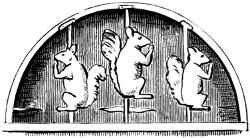

THREE SQUIRRELS. (Fleet Street, circa 1668.) HAND AND STAR. (1550.)
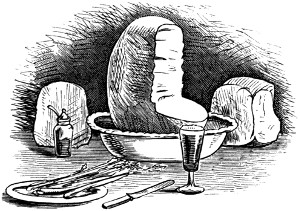
CHESHIRE CHEESE. (Modern sign, Aldermanbury, City.)
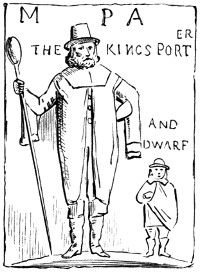
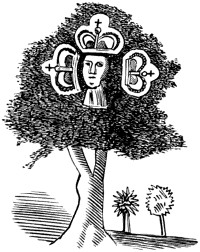
KING’S PORTER AND DWARF. (Newgate Street, circa 1668.) ROYAL OAK. (Roxburghe Ballads, 1660.)
Only a few more celebrities now remain to be disposed of; but they are of such a varied character, and so heterogeneous, that they can scarcely be ranged under any of the former divisions: thus we meet with the stern reformer, Melancthon’s Head, as the sign of an orthodox publican, in Park Street, Derby. Pretty Nell Gwynn occurs on several London public-houses: one in Chelsea, where she must have been well known, since her mother resided in that neighbourhood, and popular tradition allows Nell to have been one of the principal promoters of the erection of the famous hospital there. Another house, named after Charles II.’s favourite mistress, may be observed in Drury Lane, in which street she lived, and where Pepys, on May-day, 1667, saw her “standing at her lodgings door, in her smock sleeves and boddice,” and thought her “a mighty pretty creature.”
The Sir John Oldcastle was a tavern, in Coldbathfields, in the beginning of the last century; near this house, Bagford and a Mr Conyers, an antiquarian apothecary of Fleet Street, discovered the skeleton of an elephant in a gravel pit.[118] This house is also named in the following bill:—[119]
“All gentlemen, who are lovers of the ancient and noble exercise of archery, are hereby invited, by the stewards of the annual feast for the Clerkenwell Archers, to dine with them at Mrs Mary Barton’s, at the sign of Sir John Oldcastle, upon Friday, the 18th day of July 1707, at one of the clock, and to pay the bearer, Thomas Beaumont, Master of the Regiment of Archers, two shillings and sixpence, and to take a sealed ticket, that the certain number may be known, and provision made accordingly.
Nathaniel Axtell, Esq. Edward Bromwick, Gent. } Stewards.”
Opposite this house stood the Lord Cobham’s Head, as appears from the Daily Advertiser for August 9, 1742, which contains an advertisement puff of this place, praising its beer at 3d. a tankard, and mentioning the concert and illuminations. The correspondent concludes his letter by saying: “Note.—In seeing this great preparation, I thought it a duty incumbent upon me to inform my fellow-citizens and others, that they may distinguish this place from any pretended concerts, which are nothing but noise and nonsense, in particular, one that is rightly-styled the Hog-concert,” &c.
Both these houses were named after “the Good Lord Cobham,”—Sir John Oldcastle, who married the heiress of the Cobham family—the first author, as well as the first martyr of noble family in England. Being one of the Lollards, he was accused of rebellion, hanged in chains, and burned alive at St Giles in the Fields, in December 1417. Lord Cobham’s estates were close to the site of these two public-houses, which were supposed to comprise a part of the ancient mansion of that nobleman.
The Sir Paul Pindar public-house, in Bishopsgate Street Without, is all that remains of the splendid mansion of the rich merchant of that name, who had here a beautiful park, well stocked with game. The house continues almost in its original state, in the Cinque Cento style of ornament; the best part of it is the façade. In “Londiniana,” ii. p. 137, is an engraving of a lodge, standing in Half-Moon Alley, ornamented with figures, which tradition says was the keeper’s lodge of Sir Paul Pindar’s Park. Mulberry trees, and other park-like vestiges, were still within memory in 1829. In Pennant’s time it was already a public-house, having for a sign, “a head, called that of the original owner.” Sir Paul was a contemporary of Gresham, the founder of the Exchange. He travelled much, and by that means acquired many languages, which, at that time, was a sure way to advancement. James I. sent him as ambassador to the Sultan, from whom he obtained valuable concessions for the English trade throughout the Turkish dominions. After his return, he was appointed farmer of the customs, and frequently advanced money to King James, and afterwards to Charles I. In 1639 he was esteemed worth £236,000, exclusive of bad debts. He expended £19,000 in repairing St Paul’s Cathedral, and contributed large sums to various charities, yet, strange to say, died insolvent, Aug. 22, 1650, the year after his royal master had been beheaded. His executor, William Toomes, was so shocked at the hopeless state of Sir Paul’s affairs, that he committed suicide, and was buried with all the degrading ceremonies of a felo-de-se.
The Welch Head was the sign of a low public-house in Dyot Street, St Giles. In the last century there was a mendicants’ club held here, the origin of which dated as far back as 1660, at which time they used to hold their meetings at the Three Crowns in the Poultry. Saunders Welch was one of the justices of the peace for Westminster, and kept a regular office for the police of that district, in which he succeeded Fielding. He died Oct. 31, 1784, and lies buried in the church of St George’s, Bloomsbury. He was a very popular magistrate: a story is told that in 1766 he went unattended into Cranbourne Alley, to quell the riotous meetings of the journeymen shoemakers there, who had struck for an advance of wages. One of the crowd soon recognised him, when they at once mounted him on a beer barrel, and patiently listened to all that he had to say. He quieted the rioters, and prevailed upon the master shoemakers to grant an additional allowance to the workmen. This little incident, joined to his well-known benevolence, and skill in capturing malefactors, gave him that popularity which rewards by a signboard fame.
The Bedford Head, Covent Garden, represented the head of one of the Dukes of Bedford, ground landlords of that district. Pope twice alludes to this tavern, as a place where to obtain a delicate dinner. This house Mr Cunningham[120] suspects to have occupied the north-east corner of the Piazza, and there it appears in a view of old Covent Garden, about 1780, preserved in the “Crowle Pennant,” (vii. p. 25.) There was another Bedford Head in Southampton Street, which was kept by Wildman, the brother-in-law of Horne Tooke. A Liberal club used to meet at this house, of which Wilkes was a member, for several years. There is still a Bedford Head in Maiden Lane, hard by, at which the Reunion Literary Club is held.
Under the historical signs may be ranged a class of more modern signs, referring to local celebrities,—“mighty hunters before the Lord” probably—such as Captain Harmer, White Horse Plain, Yarmouth; Captain Ross on Clinker, at Natland, a village in Westmoreland; Captain Digby (the name of a vessel wrecked), at St Peter’s, Margate; Colonel Linskill, Charlotte Street, North Shields, &c.
The Don Cossack, so frequently seen, dates from the celebrity acquired by those troops in the extermination of the unfortunate half-starved and frozen soldiers, on their retreat from Moscow; though a more intimate acquaintance with the formidable Cossacks, during the Crimean campaign, considerably damaged their ancient reputation. The signs of the Druid, the Druid’s Head, the Druid and Oak, and the Royal Arch Druid, are more to be attributed to various kinds of masonic brotherhoods, than as a mark of respect paid to our aboriginal clergy. The Union originated with the union of Ireland with this kingdom; the Jubilee dates from the centenary of the revolution of 1688, held with considerable pomp and national rejoicing, in 1788. The Hero of Switzerland, Loughborough Road, Brixton, and in a few other places, refers to William Tell; and the Spanish Patriot, (Lambeth Lower Marsh and White Conduit Street,) dates from the excitement of our proposed intervention in the Spanish Succession question, in 1833. The Spanish Galleon, Church Street, Greenwich, simply owes its origin to the pictures of our naval victories in the Greenwich Hospital.
These, then, are some of the principal and most curious historic signs. From the perusal of this catalogue, we can draw one conclusion—namely, that only a few of what we have termed “historical signs,” outlive the century which gave them birth. If the term of their duration extends over this period, there is some chance that they will remain in popular favour for a long time. Thus, in the case of most heroes of the last century, few publicans certainly will know anything about the Marquis of Granby, Admiral Rodney, or the Duke of Cumberland, yet their names are almost as familiar as the Red Lion, or the Green Dragon, and have indeed become public-household words. Once that stage past, they have a last chance of continuing another century or two—namely, when those heroes are so completely forgotten, that the very mystery of their names becomes their recommendation; such as the Grave Morris, the Will Sommers, the Jack of Newbury, &c.