Chapter X · DIGNITIES, TRADES, AND PROFESSIONS.
Reading edition
Tools and utensils, as emblems of trade, were certainly placed outside houses at an early period, to inform the illiterate public of the particular trade or occupation carried on within. Centuries ago the practice, as a general rule, fell into disuse, although a few trades still adhere to it with laudable perseverance: thus a broom informs us where to find a sweep; a gilt arm wielding a hammer tells us where the gold-beater lives; and a last or gilt shoe where to order a pair of boots. Those houses of refreshment and general resort, which sought the custom of particular trades and professions, also very frequently adopted the tools and emblems of those trades as their distinguishing signs. At other houses, again, signs were set up as tributes of respect to certain dignities and functions. Amongst the latter, the King’s Head and Queen’s Head stand foremost, and none were more prominent types than Henry VIII. and Queen Elizabeth, even for more than two centuries after their decease. Only fifty or sixty years ago, there still remained a well-painted, half-length portrait of bluff Harry, as a sign of the King’s Head, before a public-house in Southwark. His personal appearance, doubtless, more than his character as a king, were at the bottom of this popular favour. He looked the personification of jollity and good cheer, and when the evil passions, expressed by his face, were lost under the clumsy brush of the sign-painter, there remained nothing but a merry, “beery-looking” Bacchus, eminently adapted for a public-house sign.
A very respectable folio might be filled with anecdotes connected with the various King’s Head inns and taverns up and down the country and in London—some connected with royalty, others with remarkable persons. Thus, for instance, when the Princess (afterwards Queen) Elizabeth came forth from her confinement in the Tower, November 17, 1558, she went into the church of All Hallows, Staining, the first church she found open, to return thanks for her deliverance from prison. As soon as this pious duty was performed, the princess and her attendants went to the King’s Head in Fenchurch Street to take some refreshment, and there her Royal Highness dined on pork and peas. A monument of this visit is still preserved at the above house in an engraving of the princess, from a picture by Hans Holbein, hung up in the coffee-room; and the dish from which she ate her dinner still remains, it is said, affixed to the kitchen dresser there. There is a tradition that the bells of All Hallows were rung on this occasion with such energy, that the queen presented the ringers with silken ropes.
A more painful association is connected with another King’s Head:—
“In a secluded part of the Oxfordshire hills, at a place called Collins End, situated between Hardwicke House and Goring Heath, is a neat little rustic inn, having for its sign a well-executed portrait of Charles I. There is a tradition that this unfortunate monarch, while residing as a prisoner at Caversham, rode one day, attended by an escort, into this part of the country, and hearing that there was a bowling-green at this inn, frequented by the neighbouring gentry, struck down to the house, and endeavoured to forget his sorrows for a while in a game at bowls. This circumstance is alluded to in the following lines, written beneath the signboard:—
“Stop, traveller, stop, in yonder peaceful glade, His favourite game the royal martyr play’d. Here, stripp’d of honours, children, freedom, rank, Drank from the bowl, and bowl’d for what he drank; Sought in a cheerful glass his cares to drown, And changed his guinea ere he lost his crown.”[444]
The sign, which seems to be a copy from Vandyke, though much faded from exposure to the weather, evidently displayed an amount of artistic skill not usually met with on the signboard; but the only information the people of the house could give was, that they believed it to have been painted in London. His son, Charles II., is also connected in an anecdote with a King’s Head Tavern, in the Poultry, for it is reported that he stopped at this inn on the day of his entry at the Restoration, at the request of the landlady, who happened just then to be in labour, and wished to salute his majesty. Mrs King, the lady so honoured, was aunt to William Bowyer, “the learned printer of the eighteenth century.” In Ben Jonson’s time there was a famous King’s Head Tavern in New Fish Street, “where roysters did range.” It is this tavern, probably, that is alluded to in the ballad of “The Ranting Wh——’s Resolution:”—
“I love a young Heir Whose fortune is fair, And frollick in Fish Street dinners, Who boldly does call, And in private paies all, These boyes are the noble beginners.”[445]
At the King’s Head, the corner of Chancery Lane, Cowley the poet was born in 1618; it was then a grocer’s shop kept by his father. Subsequently it became a famous tavern, of which tokens are extant. It was at this house that Titus Oates’s party met, and trumped up their infamous story against the Roman Catholics, trying to implicate the Duke of York in the murder of Sir Edmundbury Godfrey. In the reign of William III., it was a violent Whig club. The distinction adopted by the members was a green ribbon worn in the hat. When these ribbons were shown, it was a sign that mischief was on foot, and that there were secret meetings to be held. North gives an amusing and lively description of this club:—
“The house was double balconied in front, as may be yet seen, for the clubsters to issue forth, in fresco, with hats and no perruques, pipes in their mouths, merry faces and diluted throat for vocal encouragement of the canaglia below, at bonfires, on unusual and usual occasions.”
Here the Pope-burning manifestations were got up, the Earl of Shaftesbury being president. In opposition to this Green Ribbon Club, the Tories wore in their hat a scarlet ribbon, with the words, Rex et Haeredes. Ned Ward, with his usual humour, describes a breakfast given in 1706 by the master of this house to his customers, consisting of an ox of 415 lb., roasted whole, and at the same time embraces the opportunity of praising the landlord as “the honestest vintner in London, at whose house the best wine in England is to be drunk.” This was probably Ned’s way of settling an old score.
Another King’s Head is mentioned by Pepys, 26th March 16634:—
“Thence walked through the ducking-pond fields, but they are so altered since my father used to carry us to Islington, to the old man’s at the Kings-head, to eat cakes and ale (his name was Pitts,) that I did not know which was the ducking-pond, nor where I was.”
It was a very different “ducking” in which the landlady of the Queen’s Head ale-house was concerned, as shown by the following newspaper paragraph:—
“Last week, a woman that keeps the Queen’s Head ale-house at Kingston, in Surrey, was ordered by the Court to be ducked for scolding, and was accordingly placed in the chair and ducked in the river Thames, under Kingston Bridge, in the presence of 2000 or 3000 people.”—London Evening Post, Ap. 27, 1745.
Full particulars of such an operation are given by Misson:—
“They fasten an arm-chair to the end of two strong beams, twelve or fifteen feet long, and parallel to each other. The chair hangs upon a sort of axle, on which it plays freely, so as to remain in the horizontal position. The scold being well fastened in her chair, the two beams are then placed as near to the centre as possible, across a post on the water side, and being lifted up behind, the chair of course drops into the cold element. The ducking is repeated according to the degree of shrewdness possessed by the patient, and generally has the effect of cooling her immoderate heat, at least for a time.”
At the King’s Head, Strutton, near Ipswich, about ten years ago, there was the following inscription:—
“Good people, stop, and pray walk in, Here’s foreign brandy, rum, and gin, And, what is more, good purl and ale, Are both sold here by old Nat Dale.”
Old Nat had lived for a period of eighty years under the shadow of the King’s Head.
Combinations with the King’s Head are not very frequent. The King’s Head and Lamb, an ale-house in Upper Thames Street, is evidently a quartering of two signs. The Two Kings and Still, sign of Henry Francis in Newmarket, 1667,[446] representing a still between two kings crowned, holding their sceptres, may have originated from the distillers’ arms, the two wild men, serving as supporters, being refined into two kings, the garlands on their heads into crowns, and their clubs into sceptres.
That Queen Elizabeth was for more than two centuries the almost unvarying type of the Queen’s Head need not be wondered at when we consider her well-deserved popularity. A striking instance of the veneration and esteem in which she was held, even through all the tribulations and changes of the Commonwealth, is exhibited in the fact of the bells ringing on her birthday, as late as the reign of Charles II.:—
“The Earl of Dorset coming to court, one Queen Elisabeth’s birthday, the king [Charles II.] asked him what the bells rung for? which having answered, the king farther asked him, ‘how it came to pass that her holiday was still kept, whilst those of his father and grandfather were no more thought of than William the Conqueror’s?’ ‘Because,’ said the frank peer to the frank king, ‘she being a woman, chose men for her counsellors; and men, when they reign, usually chuse women.’”[447]
During the queen’s lifetime, however, the sign-painters had to mind how they represented “Queen Bess,” for Sir Walter Raleigh says that portraits of the queen “made by unskilful and common painters” were, by her own order, “knocked in pieces, and cast into the fire.”[448] A proclamation had been issued to that effect, in the year 1563, saying that:—
“Forasmuch as thrugh the natural desire that all sorts of subjects and people, both noble and mean, have to procure the portrait and picture of the Queen’s Majestie, great nomber of Paynters, and some Printers and Gravers have allredy, and doe daily, attempt to make in divers manners portraictures of hir Majestie, in paynting, graving, and pryntyng, wherein is evidently shewn, that hytherto none hath sufficiently expressed the naturall representation of hir Majesties person, favor, or grace, but for the most part have also erred therein, as thereof daily complaints are made amongst hir Majesties loving subjects, in so much, that for redress hereof hir Majestie hath lately bene so instantly and so importunately sued by the Lords of hir Consell, and others of hir nobility, in respect of the great disorder herein used, not only to be content that some special coning payntor might be permitted by access to hir Majestie to take the naturall representation of hir Majestie, whereof she hath been allwise of hir own right disposition very unwillyng, but also to prohibit all manner of other persons to draw, paynt, grave, or pourtrayit hir Majesties personage or visage for a time, until by some perfect patron and example the same may be by others followed.
“Therfor hir Majestie, being herein as it were overcome with the contynuall requests of so many of hir Nobility and Lords, whom she can not well deny, is pleased that for thir contentations, some coning persons, mete therefore, shall shortly make a pourtraict of hir person or visage, to be participated to others, for satisfaction of hir loving subjects; and furdermore commandeth all manner of persons in the mean tyme to forbear from payntyng, graving, printing, or making of any pourtraict of hir Majestie, untill some speciall person that shall be by hir allowed, shall have first fynished a pourtraicture thereof, after which finished, hir Majestie will be content that all other painters, printers, or gravers that shall be known men of understanding, and so thereto licensed by the hed officers of the plaices where they shall dwell, (as reason it is that every person should not without consideration attempt the same,) shall and maye at their pleasures follow the sayd patron or first portraicture. And for that hir Majestie perceiveth that a grete nomber of hir loving subjects are much greved and take grete offence with the errors and deformities allredy committed by sondry persons in this behalf, she straightly chargeth all her officers and ministers to see to the observation hereof, and, as soon as may be, to reform the errors allredy committed, and in the mean tyme to forbydd and prohibit the shewing and publication of such as are apparently deformed, until they may be reformed which are reformable.”[449]
That there were signboards, however, representing her Majesty’s “person, favour, and grace,” during her lifetime, is evident from the fact that an ancestor of Pennant, the London topographer, made his fortune as a goldsmith at the sign of the Queen’s Head, in Smithfield, during the reign of good Queen Bess.
The irascible Mr Boursault, whose bile was so often deranged by signboard irregularities, took also sycophantic exception at royal heads being represented in that way:
“Je souffre impatiemment que le portrait du Roy, celuy de la Reine, de Monseigneur et des autres Princes et Princesses, servent d’enseignes de boutiques; eux qui ne devroient faire l’ornement que des plus célèbres galeries et des plus illustres cabinets. Monsieur d’Argenson et Vous même, Monsieur le Commissaire, n’auriez-vous pas juste raison de vous facher de voir vôtre portrait servir d’enseigne à, la Maison d’un cabaretier, ou à la boutique d’un Fripier; et pourquoi donc ne vous fachez-vous pas de ce que celui du Roy y est?”[450]
Of celebrated Queen’s Heads we must begin with the highly respectable inn of that name, in which, before the reign of Queen Elizabeth, lived the canonists and professors of spiritual and ecclesiastical law. It was situated in Paternoster Row, where its name is still preserved in Queen’s Head Alley. From this place the lawyers removed to Doctors’ Commons.
Nearly as ancient a building was the old Queen’s Head, Lower Street, Islington, at the corner of Queen’s Head Lane, one of the most perfect specimens of ancient domestic architecture in the vicinity of London. It is said that it was built by Sir Walter Raleigh, after he had obtained “lycense for keeping of taverns and retayling of wynes throughout Englande,” and that it was called by him the Queen’s Head in compliment to his royal mistress. Essex is also said to have resided there, and to have been visited by the queen. The same tradition is current about the Lord Treasurer Burleigh. In the reign of George II. it was used as a playhouse, and bills are still extant of plays acted there at that period.
It was a strong wood and plaster building, three lofty stories high, projecting over each other, and forming bay windows supported by brackets and caryatides. Inside it was panelled with wainscot, and had stuccoed ceilings, adorned with dolphins, cherubims, and acorns, bordered by a wreath of flowers. The porch was supported by caryatides of oak, crowned with scroll-capitals.[451] This time-honoured structure was pulled down in October 1829, and nothing of it remains in the new building erected on its site but the name, the carved oak panels of the parlour, and a bust of Queen Elizabeth at the top front. A carved mantelpiece, (formerly in the parlour of the old house,) with the history of Dian and Actæon on it, (a favourite subject with the virgin queen,) was sold for more than £60 at the sale of the building materials, most of which were bought by antiquaries.
There used to be a large pewter tankard in this house, with an inscription engraved on it, which is much too highly spiced to be given here. It was signed John Cranch, and bore date 1796.
At the Queen’s Head, Duke Court, Bow Street, the English language was enriched with two new terms, though one of them seems to have been still-born. This tavern was once kept by a facetious individual of the name of Jupp. Two celebrated characters, Annesley Shay and Bob Todrington—the latter a sporting man—meeting late in the day at the above place, went to the bar and asked for half a quartern each, with a little cold water. In the course of the evening they drank twenty-four, when Shay said to the other, “Now we’ll go.” “Oh no,” replied his companion, “we’ll have another, and then go.” This did not satisfy the Hibernian, and they continued drinking on till three in the morning, when they both agreed to go; so that under the idea of going they made a long stay, and this was the origin of drinking goes; but another preferring to eke out the measure his own way, used to call for a quartern at a time, and these in the exercise of his humour he called stays.[452]
In the beginning of this century, when Marylebone consisted of “green fields, babbling brooks,” and pleasant suburban retreats, there was a small but picturesque house of public entertainment, yclept the Queen’s Head and Artichoke, situated “in a lane nearly opposite Portland Road, and about 500 yards from the road that leads from Paddington to Finsbury”—now Albany Street. Its attractions chiefly consisted in a long skittle and “bumble puppy” ground, shadowy bowers, and abundance of cream, tea, cakes, and other creature comforts. The only memorial now remaining of the original house is an engraving in the Gentleman’s Magazine, November 1819. The queen was Queen Elizabeth, and the house was reported to have been built by one of her gardeners, whence the strange combination on the sign.
Besides Crowns (see p. 101) other royal paraphernalia are occasionally used as signboard decorations. The Sceptre is not uncommon; the Sceptre and Heart was the sign of Samuel Grover, chirurgical instrument maker, on London Bridge, in the latter end of the seventeenth century. It is engraved on his shop-bill, and represents a circle surrounded by fruit and foliage, having two Cupids standing at the upper corner, and containing in the centre two palm branches enclosing a sceptre surmounted by a heart. Round the whole are suspended lancets, trepans, saws, &c. In all probability it is simply a quartering of two signs.
The Royal Hand and Globe was the loyal sign of a stationer at the corner of St Martin’s Lane, in 1682.[453] It doubtless refers to the royal hand holding the golden orb, surmounted by a cross. It is still the sign of an ale-house near the Soho Theatre. The same orb or globe seems to be alluded to in the sign of the Sword and Ball, on Holborn Bridge, in the seventeenth century. What stands in the way of this explanation, however, is that on the token of this house the sword is represented piercing the ball; but this may merely have been a fancy of the sign-painter, who did not understand its meaning. As for the Sword and Mace, the meaning is perfectly clear; it is the sign of a public-house in Coventry.
The Church is almost as abundantly represented as royalty. Even long after the Reformation the Pope’s Head was still very common. Nash’s “Anatomie of Absurdities” was printed by T. Charlwood for Thomas Hacket, and was “to be sold at his shop in Lumbard Street, vnder the signe of the Popes Heade, 1590.” Taylor, the Water poet, in his “Travels through London,” 1636, mentions four Pope’s Head taverns; but the most famous of all was the Pope’s Head tavern in Cornhill.
“I have read[454] of a countryman that, having lost his hood in Westminster Hall, found the same in Cornhill hanged out to be sold, which he challenged, but was forced to buy, or go without it, for their stall they said was their market. At that time also the wine drawers at the Pope’s Head tavern (standing without the door in the High Street,)[455] took the same man by the sleeve, and said, ’Sir, will you drink a pint of wine?’ Whereunto he answered, ‘A penny spend I may,’ and so drank his pint, for bread nothing did he pay, for that was allowed free.[456] This Pope’s Head tavern, with other houses adjoining, strongly built of stone, hath of old time been all in one, pertaining to some great estate, or rather to the king, as may be supposed both by the largeness thereof, and by the arms, to wit, three leopards passant gardant, which were the whole arms of England before the reign of Edward III., that quartered them with the arms of France three flower de lys. Some say this was King John’s house, which might be, for I find in a written copy of ‘Matthew Paris’s History’ that in the year 1232, Henry III. sent Hubert de Burgh, earl of Kent, to Cornehill in London, there to answer all matters objected against him: when he wisely acquitted himself. The Pope’s Head tavern hath a footway through from Cornhill into Lumbard Street.”—Stow’s Survey, p. 75.
In this tavern, in the fourth of Edward IV. (1464,) a trial of skill was held between Oliver Davy, goldsmith of London, and White Johnson, “Alicante Strangeour,” also of London,—the London goldsmiths being divided into native and “foren” workmen. These last, though they might be Englishmen, were so named merely as a distinction with respect to the work they produced, which consisted frequently in counterfeit articles and bad gold. The trial consisted in making, in four pieces of steel the size of a penny, a cat’s face in relief, and another cat’s face engraved, a naked man in relief, and another engraved, which work was to be performed in five weeks. Oliver Davy, the native goldsmith, won the wager, as White Johnson, the foreign workman, after six weeks could only produce the two “inward engraved” objects. The forfeit was a crown, and a dinner to the wardens, the umpires, and all those concerned in the wager. The works were kept in Goldsmith’s Hall, “to yat intent that they be redy iff any suche controursy herafter falls, to be shewede that suche traverse hathe be determyn’d aforetymes.”[457] In Pepys’s time this tavern, like many others of that period and later, had a painted room. “18 January 1668.—To the Pope’s Head, there to see the fine-painted room which Rogerson told me of, of his doing, but I do not like it at all, though it be good for such a publick room.” Here in 1718 Quin killed his brother actor Bowen. “On Thursday s’ennight at night, Mr Bowen and Mr Quin, two comedians, drinking at the Pope’s Head tavern in Cornhill, quarrelled, drew their swords, and fought, and the former was run into the guts; he languished till Sunday last, and then died. Bowen, before he expired, desired that Mr Quin might not be prosecuted, because what had happened to him was his own seeking.”[458] The jury brought in a verdict of manslaughter, and Quin for the offence was burned in the hand.[459] The quarrel was rather a foolish one, arising out of a wager which of the two was the honester man, which had been decided in favour of Quin; inde iræ. This tavern seems to have continued in existence till the latter part of the last century.
The emblem of another class of high dignitaries of the Roman Catholic Church, the Cardinal’s Hat or Cap, was at one time common in England. Bagford says: “You have not meney of them, they war set up by sume that had ben saruants to Tho. Wolsey.”[460] But we find the sign long before Wolsey’s time, for in 1459, Simon Eyre
“Gave the Tavern called the Cardinal’s Hat in Lumbard Street, with a tenement annexed on the East part of the tavern, and a mansion behind the East tenement, together with an alley from Lumbard Street to Cornhill, with the appurtenances, all which were by him new built, towards a brotherhood of our Lady in St Mary Woolnots.”—Stow, p. 77.
This tavern and another of the same name, also in Lombard Street, were still extant in the seventeenth century. It was also the sign of one of the Stairs on the Bankside, the name of which is still preserved to that locality in Cardinal Cap’s Alley.
“But at the naked stewes I understands howe that The sygne of the Cardinall’s hat That inne is now shit up.” Skelton’s Whye come ye not to Courte.
These houses, by proclamation of 37, Henry VIII., were “whited and painted with signes on the front for a token of the said houses;” they were under the jurisdiction of the Bishop of Winchester, whence Pennant makes some sly remarks upon the sign of the Cardinal’s Cap:—
“I will not give into scandal so far as to suppose that this house was peculiarly protected by any coeval member of the sacred college. Neither would I by any means insinuate that the Bishops of Winchester and Rochester, or the abbots of Waverley, or of St Augustine in Canterbury, or of Battel, or of Hyde, or the Prior of Lewis, had there their temporary residences for them or their trains, for the sake of these conveniences, in that period of cruel and unnatural restriction,” &c.[461]
The Bishop’s Head was, in 1663, the sign of J. Thompson, a bookseller and publisher in St Paul’s Churchyard. At this house, in 1708, was published Hatton’s “New View of London;” it was then in the occupation of Robert Knaplock.
More general, however, was the Mitre, which was the sign of several famous taverns in London in the seventeenth century. There was one in Great Wood Street, Cheapside, (called on the trades token of the house the Mitre and Rose,) mentioned by Pepys as “a house of the greatest note in London.”[462] The landlord of this house, named Proctor, died at Islington of the plague in 1665, in an insolvent state, though he had been “the greatest vintner for some time in London for great entertainments.” There was another Mitre near the west end of St Paul’s, the first music-house in London. The name of the master was Robert Herbert alias Forges. Like many brother-publicans, he was, besides being a lover of music, also a collector of natural curiosities, as appears by his
“Catalogue of many natural rarities, with great industrie, cost, and thirty years’ travel into foreign countries, collected by Robert Herbert, alias Forges, Gent., and sworn servant to his Majesty; to be seen at the place called the Musick house at the Mitre, near the West End of S. Paul’s Church, 1664.”
This collection, or at least a great part of it, was bought by Sir Hans Sloane. It is conjectured that the Mitre was situated in London House Yard, at the north-west end of St Paul’s, on the spot where, afterwards, stood the house known by the sign of the Goose and Gridiron. Ned Ward[463] describes the appearance of another music-house of the same name in Wapping, which he calls “the Paradise of Wapping,” though more probably it was in Shadwell, where there is still a Music House Court, which seems to point to some such origin. His description of this prototype of the Oxford and Alhambra music-halls is not a little amusing. The music, consisting of fiddles, hautboys, and a humdrum organ, he compares to the grunting of a hog added as a base to a concert of caterwauling cats in the height of their ecstacy. The music-room was richly decorated with paintings, (Hornfair was one of the pictures,) carvings, and gilding; the seats were like pews in a church, and the orchestra railed in like a chancel. The musicians occasionally went round to collect contributions, as they still do in the Cafés Chantants of the Champs Elysées, Paris. The other rooms in the house were “furnished for the entertainment of the best of companies,” all painted with humorous subjects. The kitchen, used at that period in many taverns as a sitting room by the customers, was railed in and ornamented in the same gaudy style as the rest of the houses; a quantity of canary birds were suspended on the walls. Underground was a tippling sanctuary painted with drunken women tormenting the devil, and other somewhat quaint subjects. The wine of the establishment was good. Here, then, we may imagine our great-great-grandfathers listening to the woeful fiddles scraping “Sillenger’s Round,” “John, come kiss me,” “Old Simon the King,” or other old tunes, until flesh and blood could stand it no longer, and a dance would be indulged in to the music of “Green Sleeves,” “Yellow Stockings,” or some other equally comic dance and tune; after which everybody went home, through the dirty dark streets, doubtless “highly pleased with the entertainment.”
Older than either of these was the Mitre in Cheap, which is mentioned in the vestry books of St Michael’s, Cheapside, before the year 1475.[464] In “Your Five Gallants,” a comedy by Middleton, about 1608, Goldstone prefers it to the Mermaid:—“The Mitre in my mind for neat attendance, diligent boys and—push, excels it [the Mermaid] far.” But the most famous of the inns with this name, was the Mitre in Mitre Court, Fleet Street, one of Doctor Johnson’s favourite haunts, “where he loved to sit up late,”[465] and where Goldsmith, and the other celebrities, and minor stars that moved about the great doctor, used to meet him. This house is named in the play of “Ram Alley, or Merry Tricks,” in 1611. It was one of those houses which, for more than two centuries, was the constant resort of all the wits about town; even the name of Shakespeare throws its halo around this place:—
“Mr Thorpe, the enterprising bookseller of Bedford Street,” says Mr J. P. Collier, “is in possession of a MS. full of songs and poems in the handwriting of a person of the name of Richard Jackson; all prior to the year 1631, and including many unpublished poems by a variety of celebrated poets. One of the most curious is a song of five-seven-lines stanzas thus headed: ’Shakespeare’s Rime which he made at the Mytre in Fleete Street.’ It begins—‘From the rich Lavinian shore,’ and some few of the lines were published by Playford, and set as a catch. Another shorter piece is called in the margin: ’Shakespeare’s Rime:’—
‘Give me a Cup of rich Canary Wine, Which was the Mitre’s (drink) and now is mine; Of which had Horace and Anacreon tasted Their lives as well as lines till now had lasted.’
I have little doubt that the lines are genuine, as well as many other songs.”
In this same tavern Boswell supped, for the first time, with his idol, and the description of the biographer’s delight on that grand occasion has a festive air about it that cannot fail to make a lively impression on his readers:—
“He agreed to meet me in the evening at the Mitre. I called on him, and we went thither at nine. We had a good supper, and port wine, of which he then sometimes drank a bottle. The orthodox high church sound of the Mitre,—the figure and manner of the celebrated Samuel Johnson—the extraordinary power and precision of his conversation and the pride from finding myself admitted as his companion, produced a variety of sensations and a pleasing elevation of mind beyond what I had ever experienced.”
There, also, that amusing scene with the young ladies from Staffordshire took place, which would make an excellent companion picture to Leslie’s “Uncle Toby and the Widow Wadman.”
“Two young women from Staffordshire visited him when I was present to consult him on the subject of Methodism, to which they were inclined. Come (said he) you pretty fools, dine with Maxwell and me at the Mitre, and we will talk over that subject, which they did; and after dinner, he took one of them on his knees and fondled them for half an hour together.”
Hogarth, too, was an occasional visitor at this tavern. A card is still extant, wherein he requested the company of Dr Arnold King to dine with him at the Mitre. The written part is contained within a circle, (representing a plate) to which a knife and fork are the supporters. In the centre is drawn a pie with a Mitre on the top of it, and the invitation—
Mr Hogarth’s compliments to Mr King, and desires the honour of his company to dinner, on Thursday next, to η. β. π. [Eta beta py.][466]
In this tavern the Society of Antiquaries used to meet, before apartments were obtained in Somerset House.
“The Society hitherto having no house of their own, meet every Thursday evening, about seven o’clock, at the Mitre Tavern in Fleet Street, where antiquities are produced and considered, draughts and impressions thereof taken, dissertations read, and minutes of the several transactions entered, and the whole economy under such admirable regulations, that probably in a short time they may apply for a royal power of incorporation.”[467]
In the bar of the Mitre Tavern in St James’ Market, which was kept by her aunt, (Mrs Voss, formerly the mistress of Sir Godfrey Kneller,) Captain Farquhar overheard Miss Nancy Oldfield read the play of “The Scornful Lady,” and was so struck with the proper emphasis and agreeable turn she gave to each character, that he swore the girl was cut out for the stage. Captain (afterwards Sir John) Vanbrugh, a friend of the family, recommended her to Rich, and shortly after she made her debut at Covent Garden, with an allowance of fifteen shillings a week.
Though a dozen other famous Mitre Taverns might be mentioned, these are sufficient to show how general a sign it was; the partiality of tavern-keepers for it is somewhat accounted for in the following stanza of the “Quack Vintners,” 1712:—
“May Smith, whose prosperous mitre is his sign, To shew the church no enemy to wine; Still draw such Christian liquor none may think, Tho’ e’er so pious, ’tis a sin to drink.”[468]
The Mitre also is found in a few combinations, as the Mitre and Dove, i.e., the Holy Ghost, in King Street, Westminster; the Mitre and Keys, in Leicester—evidently the Cross Keys, which are a charge in the arms of several bishoprics; and the Mitre and Rose, which, from trades tokens, appears to have been the sign of a tavern in the Strand, as well as in Wood Street, Cheapside.
That the friars were also honoured on the signboard appears from “Fryar Lane, on the south side of Thames Street, near Dowgate. It was formerly called Greenwich Lane, but of later years Fryar’s Lane, from the sign of a Fryar sometime there.”[469] Probably it was a Black Friar, or Dominican Monk, for that order, above all others, had the reputation of being great topers, and therefore were not out of place on a signboard. There is a prayer extant of the holy fathers, addressed to St Dominic:—
“Sanctus Dominicus sit nobis semper amicus Qui canimus nostro jugiter præconia rostro, De cordis venis, siccatis ante lagenis; Ergo tuas laudes si tu nos pangere gaudes, Tempore paschali, fac ne potu puteali Conveniat uti; quod si fit, undique muti Semper erunt patres qui, non curant nisi fratres.”[470]
And an old French couplet gives the following gradations of the potatory capacities of the different orders, in which the Franciscans only are said to beat the Dominicans:—
“Boire à la Capucine, C’est boire pauvrement; Boire à la Célestine, C’est boire largement; Boire à la Jacobine, C’est chopine à chopine; Mais boire en Cordelier, C’est vider le cellier.”[471]
Tokens are extant of a music-house, with the sign of the Black-friar, dated 1671. In Paris also, the Bacchic propensities of the Black-friars made a tavern-keeper of the seventeenth century choose St Dominic as the patron saint of his tavern. His principal customers, who formed a sort of club, were called Dominicans; a contemporary song thus gives the rule of this order:—
“Nous sommes dix, tous grands buveurs; Bons ivrognes et grands fumeurs, Qui ne cessant jamais de boire, Et de remuer la machoire, Méprisons d’amour les faveurs.”[472]
Nuns also figured on the signboard as the Three Nuns, which was constantly used by drapers; not exactly, as Tom Brown says, “very dismally painted to keep up young women’s antipathy to popery and” single blessedness, but because the holy sisterhoods were generally very expert in making lace embroidery, and other fancy work—as the handkerchiefs made by the nuns of Pau, and sold by our drapers, fully prove even at the present day. In the seventeenth century, the Three Nuns was the sign of a well-known coaching and carriers’ inn in Aldgate, which gave its name to Three Nuns’ Court close at hand; near this inn was the “dreadful gulf, for such it was rather than a pit,” in which, during the Plague of 1665, not less than 1114 bodies were buried in a fortnight, from the 6th to the 20th of September.[473] Not improbably this sign, after the Reformation, was occasionally metamorphosed into the Three Widows: Peter Treveris, a foreigner, erected a press and continued printing until 1552 at the Three Widows in Southwark; he printed several books for William Rastell, John Reynor, R. Copeland, and others in the city of London. It is still the sign of a cap and bonnet shop in Dublin. The Matrons, also, may have originally represented Nuns; this last hung, in the seventeenth century, at the door of John Bannister, crutch and bandage maker, near the hospital, (Christ’s Hospital School,) Newgate Street.[474]
PLATE XIII.
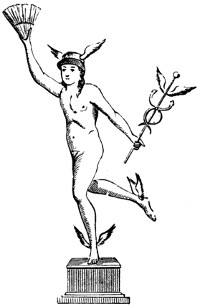
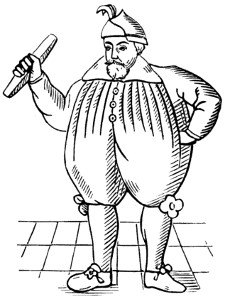
MERCURY AND FAN. (Banks’s Collection, 1810.) NOBODY. (From an old print, circa 1600.)
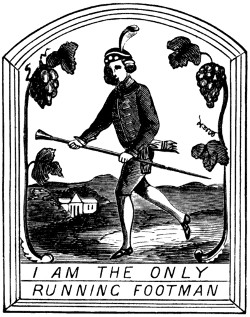
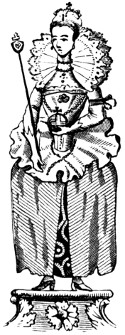
RUNNING FOOTMAN. (Charles Street, Berkeley Square, circa 1790.) QUEEN ELIZABETH. (Banks’s Collection.)
At the present day the Church is a very common ale-house sign, either on account of the esteem in which good living has been held by churchmen in all ages, “superbis pontificum potiore cœnis,” or, from the proximity of a church to the ale-house in question; thus, one inn in the town would be known as the “Market House,” whilst another might be known as the “Church Inn.” It has been said the name was given that topers might equivocate and say that they “frequently go to church.” Be this as it may, there is generally an ale-house close to every church, (in Knightsbridge the chapel of the Holy Trinity is jammed in between two public-houses,) whereby a good opportunity is offered to wash a dry sermon down. In Bristol, at the beginning of the present century, it was still worse—a Methodist meeting-room was immediately over a public-house, which gave rise to the following epigram:—
“There’s a spirit above and a spirit below, A spirit of joy and a spirit of woe— The spirit above is the spirit divine; But the spirit below is the spirit of wine.”
Other signs connected with the church are the Chapel Bell, at Suton, in Norfolk, and the Church Stile or Church Gates, which is very common. The origin of this last comes from an old custom of drinking ale on the parish account, on certain occasions, at the church stile. Pepys mentions this when he was at Walthamstow, April 14, 1661:—“After dinner we all went to the church stile, and there eat and drank.” To this a correspondent in the Gent. Mag. (Nov. 1852, p. 442) makes the following note:—“In an old book of accounts belonging to Warrington parish, the following minute occurs:—“Nov. 5, 1688. Paid for drink at the church steele, 13s.;” and in 1732, “It is ordered that hereafter no money be spent on ye 5th of November or any other State day on the parish account, either at the church stile or any other place.” Though certainly the parish now does not pay for any ale drunk at the church stile, the sign is evidently set up in remembrance of the good old time when such things were.
Belonging to the church was also the sign of the Three Brushes, or Holy Water Sprinklers, which was that of an old house near the White Lion prison, Southwark, in which there was a room with panelled wainscoting and ceiling ornamented with the royal arms of Queen Elizabeth. Probably it had been the court-room at the time the White Lion Inn was a prison. Amongst the Beaufoy trades tokens there is one of “Rob. Thornton, haberdasher, next the Three Brushes in Southwark, 1667.”
Innumerable signs were borrowed from the army and navy; thus, at the present day, every uniform in the service is represented near barracks or in other haunts of soldiers. The Recruiting Sergeant is generally the sign of the public-house, where that worthy spreads his nets. Cross Guns, Cross Lances, Cross Swords, and Cross Pistols, respectively, are meant to allure artillerymen, lancers, and various cavalry men. But above all the Standard, the Banner, or the Waving Flag—“the glorious rag that for a thousand years has stood the battle and the breeze,” is of common occurrence, not only in the neighbourhood of military quarters, but everywhere in towns and villages. At the Standard Tavern in the Strand, Edmund Curll the bookseller used to meet the mysterious Rev. Mr Smith, who sold him Pope’s correspondence.
“I am just going to the Lords to finish Pope,” writes Curll to this person. “I desire you to send me the sheets to perfect the first fifty books, and likewise the remaining three hundred books, and pray be at the Standard Tavern this evening and I will pay you £20 more.”
The Kettledrum is a sign at St George-in-the-East; the Drum and the Trumpet are both of frequent occurrence, and the last is of old standing. One of the characters in “The Ball,” a play by Shirley, 1633, thus commends the beer of the Trumpet:—
“Their strong beere is better than any I Ever drunke at the Trumpet.”—The Ball, Act v.
Possibly this was the Trumpet in Shire Lane, immortalised in the Tatler, and one of the favourite haunts of merry good-natured Dick Steele. Bishop Hoadley was once present at one of the meetings in this tavern, when Steele rather exposed himself in his efforts to please, a double duty devolving upon him, as well to celebrate the “glorious memory” of King William III., it being the 4th of November—as to drink up to conversation pitch his friend Addison, the phlegmatic constitution of whom was hardly warmed for society by the time Steele was no longer fit for it. One of the company, a red hot Whig, knelt down to drink the health with all honours. This rather disconcerted the bishop, which, Steele seeing, whispered to him—“Do laugh, my lord, pray laugh; it is humanity to laugh.” Shortly after Steele was put into a chair and sent home. Next morning he was much ashamed, and sent the Bishop this distich:—
“Virtue with so much ease on Bangor sits, All faults he pardons though he none commits.”
Some trades tokens are extant of houses with the sign of the Trumpet in King Street, Wapping, and in the Minories. At the same period there was a sign of the Trumpeter in Trump Alley, probably suggested by the name of the thoroughfare.
The Buckler is a very old sign, and occurs in “Cocke Lorell’s Bote:”—
“Here is Saunder Sadeler of Froge Street Corner, With Jelyan Joly at signe of the Bokeler.”
More general was the sign of the Sword and Buckler, which was frequently set up by haberdashers for the following reason:—
“And whereas, until about the twelve or thirteenth yeere of Queene Elisabeth, the auncient English fight of sword and buckler was only had in use, the bucklers then being only a foot broad, with a pike of four or five inches long; then they beganne to make them full half ell broad, with sharpe pikes 10 or 12 inches long, wherewith they meant either to breake the swordes of their enemies, if it hitte uppon the pike, or else sodainely to runne within them and stabbe, and thrust their buckler with the pike into the face, arme, and body of their adversary, but this continued not long;[475] every haberdasher then sold bucklers”.—Stow’s Chronicle.
The great prevalence of this sign originated in the so-called sword and buckler play, once so common in England. Misson, who visited this country in the beginning of the eighteenth century, says:—
“Within these few years you should often see a sort of gladiators marching through the streets, in their shirts to the waste, their sleeves tucked up, sword in hand, and preceeded by a drum to gather spectators. They give so much a head to see the fight, which was with cutting swords and a kind of buckler for defence. The edge of the sword was a little blunted, and the care of the prize fighters was not so much to avoid wounding one another, as to avoid doing it dangerously; nevertheless as they were obliged to fight till some blood was shed, without which nobody would give a farthing for the show, they were sometimes forced to play a little roughly. The fights are become very rare within these eight or ten years.”[476]
In the seventeenth century it was not a little rough play, which is evident from those matches at which Pepys was present, and which he describes at large. Jouvin, another Frenchman who visited England in 1672, gives a detailed account of these divertisements, which, at that period, at all events, were anything but play; and Maitland was right when he designated them as “a barbarous performance, by those whom necessity (occasioned by a scandalous laziness and indolence) induces to expose themselves to be horribly mangled for a little money, while the bloodily-minded spectators satiate themselves with human gore to the great reproach of religion.”
In the Spectator, No. 436, there is an amusing essay on those “Hockley-in-the-Hole Gladiators,” and in No. 449 a letter appears, in which the deceits of the champions are shown:—
“I overheard two masters of the science agreeing to quarrel on the next opportunity. This was to happen in the company of a set of the fraternity of the basket hilts who were to meet that evening. When this was settled, one asked the other: ‘Will you give cuts or receive?’ The other answered, ‘Receive.’ It was replied, ‘Are you a passionate man?’ ‘No, provided you cut no more, nor no deeper than we agree.’”
A few other instances of the Sword occur on signs, as the Sword and Cross, a sort of emblem of the Church militant, or perhaps an inversion of the Cross Swords: this was a sign “next door to the Savoy Gate in 1711.” The Swordblade, a coffee-house in Birchen Lane in 1718, and the Sword and Dagger, a combination of arms that evokes the phantom of many a desperate duel amongst the ruffling gallants of the reign of James I. This sign of ill omen was, in the seventeenth century, in St Catherine Lane, Tower, as appears from the traded tokens issued there.
The Dagger was once common in London—
“My lawyer’s clerk I lighted on last night In Holborn at the Dagger,”
says Captain Face, in Ben Jonson’s “Alchymist,” and various trades tokens testify the prevalence of the sign. Probably this arose from its being a charge in the city arms, which was supposed to represent the dagger Sir William Walworth used in slaying Wat Tyler. This at least was asserted in the inscription below the niche in which Sir William’s statue was erected in Fishmonger’s Hall:—
“Brave Walworth knyght Lord Mayor yt slew Rebellious Tyler in his alarmes— The king therefore did give in lieu The Dagger to the Cytyes armes.”
Stow says that this is erroneous, as, when in the 4 Richard II. a new seal was made for the city, “the armes of this city were not altered, but remayne as afore; to witte, argent, a playne cross gules a sword of Saint Paul in the first quarter and no dagger of William Walworth as is fabuled.”[477] The Dagger and Pie was in the seventeenth century the sign of a celebrated pie-shop in Cheapside, the Pie being added to the original sign; but from the trades tokens of this house we see that this was represented by a rebus of a dagger with a magpie on the point. Dagger-pies are frequently mentioned in the plays of that period; for instance, in Decker’s “Satyro-Mastrix:”—“I’ll not take thy word for a dagger-pie;” and in Prynne’s “Histrio-Mastrix,” “and please you, let them be dagger-pies.” The London apprentices appear to have been good customers to this house. Whenever, for example, old Hobson, the merry haberdasher, went abroad, “his prentices wold ether bee at the Taverne filling their heds with wine or at the Dagger in Cheapside cramming their bellies with minced pyes.”[478] And in Heywood’s comedy of “If you Know not me you Know Nobody,” the worthy citizen bitterly inveighs against the temptations held out to apprentices by the dainties of this house:—
“Ten pounds a morning! Here is the fruit Of Dagger-pies and Ale-house guzzling.”—Act i. sc. i., 1606.
A rather curious sign was that of the Red M and Dagger. The letter M was the initial of Mrs Milner’s name, who, at this sign in Pope’s Head Alley, “over against the Royal Exchange in Cornhill,” sold the “Grand Restorative,” which cured consumption, stone, dropsy, and all evils flesh is heir to. The sign occurs among the Bagford bills; there is a similar one amongst the Banks bills, the Pistol and C, the sign of John Crook, a razor-maker at the Great Turnstile, Holborn, circa 1787: the bill represents a renaissance scutcheon with a pistol, above it a C, and surgical instruments disseminated on the field.
Though we have the authority of Cicero that cedant arma togæ, yet booksellers, who flourish by the arts of peace, choose the Helmet for their sign. Humphrey Joy, a bookseller and printer in St Paul’s Churchyard in 1550, and another, celebrated in the reigns of Henry VIII., Edward VI., and Queen Mary, Rowland Hall by name, had both a Helmet for their sign. This Hall changed his sign more frequently than is generally the custom; thus, besides the Helmet, he is known to have traded at the signs of the Cradle, in Lombard Street; the Half Eagle and Key, in Gutter Lane; and the Three Arrows, in Golden Lane, near Cripplegate. There is still a stone carving of the helmet fixed in the front of a house in London Wall, with the date 1668 and the initials H. M. Ned Ward mentions the Helmet in Bishopsgate; he says at the battles without bloodshed of the Trainbands in Moorfields, the gallant warriors wish
“For beer from the Helmet in Bishopsgate. And why from the Helmet? Because that sign Makes the liquor as welcome t’ a soldier as wine.”
Trades tokens are extant of the Blue Helmet in Tower Street. From the same source we learn that there was, in the seventeenth century, a sign of the Plate, i.e., the Breastplate, in Upper Shadwell; and a Handgun in Shadwell. This weapon was a sort of musket of early times, fired in the hand without a rest; “gunners with handguns or half-hakes” are named by Stow in his enumeration of the troops marching in the city watch on St John’s night.
A few other old weapons remain to be mentioned, as the Arrow, once a great favourite when this weapon made the English name terrible whenever our troops took the field. In the last century there was a beer-house at Knockholt, in Kent, the sign an Arrow, with the following poetical effusion beneath:—
“Charles Collins liveth here, Sells rum, brandy, gin, and beer; I make this board a little wider, To let you know I sell good cyder.”
The Cross-bullets, a name puzzling at first sight, was a sign in Thames Street in the seventeenth century, representing two bar-shot crossed, which the trades token elucidates by the equally puzzling legend, “at the Crose bvlets;” this was an instrument of destruction formerly used in naval engagements, and for that reason set up in the neighbourhood of the shipping.
If we may believe a jocular article on a quack handbill in the Spectator, No. 444, there was a Cannon-ball in Drury Lane; for he mentions that—
“In Russell Court, over against the Canonball, at the Surgeons’ Arms, in Drury Lane, is lately come from his travels a surgeon who has practised surgery and physic both by sea and land these twenty-four years. He (by the blessing) cures the Yellow Jaundice, Green sickness, Scurvey, Dropsy, Surfeits, Long sea voyages, Campaigns, and women’s miscarriages, lyings in, etc., as some people that has been lamed these thirty years can testify; in short he cureth all diseases incident on man, women, or children.”
Undoubtedly this bill had been slightly touched up in passing through the hands of the Spectator, who, like the mythological king, “quodcunque tetigit inaurat,” for it is rather “too good to be true.”
The Halbert and Crown was, in 1791, the sign of Paul Savigne, a cutler in St Martin’s Churchyard; whilst the Spear in Hand is at the present day the sign of a public-house at Norwich, being undoubtedly a popular version of some family crest.
In Jews’ Row, or Royal Hospital Row, Chelsea, there is a sign which greatly mystifies the maimed old heroes of the Peninsula and Waterloo, and many others besides; this is the Snow-shoes. It is the sign of a house of old standing, and was set up during the excitement of the American war of independence, when snow-shoes formed part of the equipment of the troops sent out to fight the battles of King George against “Mr Washington and his rebels.”
One of the low public-houses that stood on the outskirts of London, towards Hyde Park Corner, at the end of the last century, was called the Triumphal Car. There were a great many other houses of the same description in that neighbourhood, viz., the Hercules Pillars, the Red Lion, the Swan, the Golden Lion, the Horse-shoe, the Running Horse, the Barleymow, the White Horse, and the Half-moon, which two last have given names to two streets in Piccadilly. The sign of the Triumphal Car was in all probability bestowed upon the house in honour of the soldiers who used to visit it.
“These public-houses, about the middle of last century, were much visited on Sundays, but those contiguous to Hyde Park were chiefly resorted to by soldiers, particularly on review days, when there were long wooden seats fixed in the street before the houses for the accommodation of six or seven barbers, who were employed on field days in powdering those youths who were not adroit enough to dress each other’s hair. Yet it was not unusual for twenty or thirty of the older soldiers to bestride a form in the open air, where each combed, soaped, powdered, and tied the hair of his comrade, and afterwards underwent the same operation himself.”[479]
The grenadiers of Frederick the Great managed those things still better, for twenty or thirty of them used to sit in a circle, each dressing, plaiting, and powdering the pigtail of the man before him, so that all hands were employed at the same time, and none was lost in waiting. There is still a Triumphant Chariot public-house in Pembroke Mews, Chelsea, a house of more than fifty years’ standing.
The Bombay Grab in High Street, Bow, belongs to military signs, as “Grab,” or “Crab,” is a slang expression for a foot soldier; perhaps the landlord at one time may have been in the Bombay army.
Objects relating to the navy, or rather to shipping, are still more common in this seafaring nation of ours than the attributes or emblems of any other trade or profession. Ned Ward describes Deptford in 1703 as every house being distinguished by either the sign of the Ship, the Anchor, the Three Mariners, Boatswain and Call, or something relating to the sea.
“For as I suppose [says he] if they should hang up any other, the salt-water novices would be as much puzzled to know what the figure represented as the Irishman was, when he called the Globe the Golden Cabbage, and the Unicorn the White Horse with a barber’s pole in his forehead.”[480]
There is scarcely a town in the kingdom that has not a Ship inn, tavern, or public-house. Tokens exist of “the Ship without Templebar, 1649,” probably the inn granted in 1571 to Sir Christopher Hatton, along with some lands in Yorkshire and Dorsetshire, and the wardship of a minor.[481] William Faithorne the engraver (ob. 1691) seems to have occupied the same house afterwards, for Walpole informs us that—
“Faithorne now set up in a new shop at the sign of the Ship, next to the Drake, opposite to the Palsgrave Head, without Temple Bar, where he not only followed his art, but sold Italian, Dutch, and English prints, and worked for booksellers.”[482]
This sign of the Ship, next to the Drake, seems to have constituted a sort of a pun or a rebus on Admiral Drake, as observed by Mr Akerman. Among the trades tokens there was “Will Jonson at ye Drake, Bell Yard, Temple Bar, 1667.” The Drake stood next to the Ship. It was doubtless a rebus, and alluded to the Admiral, who was very popular in the reign of Queen Elizabeth, the mint-mark of the martlet on her coins being termed by the vulgar a Drake. The situation of this sign near the Ship was appropriate enough. In the seventeenth century there was a sign of the Ship at Leeuwarden, in Friesland, (Netherlands,) with the following inscription:—
“Die in de ly, my vaart voorby Zal hebben een Ryxdaalder en ’t gelach vry.”[483]
At the Ship tavern in the Old Bailey, kept by Mr Thomas Amps, on Tuesday the 14th of February 1654, a plot against Cromwell was discovered. Carlyle[484] forcibly pictures the conspirators as eleven truculent, rather threadbare persons, sitting over small drink there on that Tuesday night, considering how the Protector might be assassinated. Poor broken Royalist men, payless old captains, and such like, with their steeple hats worn very brown, and jackboots slit, projecting there what they could not execute. The poor knaves were found guilty, but not worth hanging, and got off with being sent to the Tower for a while to ponder over their wickedness.
Names of famous men-of-war are often found on the signboard, in seaports; either in honour of some brilliant feat performed by them, or simply in compliment to the crew, in the hopes of obtaining their liberal patronage. Thus the Albion, the Saucy Ajax, the Circe, and Arethusa, with innumerable others, may be met with in the vicinity of Plymouth, Portsmouth, and other seaports. The naming of signboards in this way was an old custom; as two examples among the London trades tokens very sufficiently prove. Thus, for instance, The Speaker’s Frigate, the sign of a shop in Shadwell in the seventeenth century. The frigate had been named after Sir Richard Stainer, speaker in the House of Commons in the time of the Commonwealth, who had done good service under command of Admiral Blake, in some of the naval engagements with the Spaniards. In 1652, this ship was sent to “Argier in Turkey,” (Algiers,) under command of Captain Thorowgood, with the sum of £30,000 to redeem English captives from slavery. Upon this occasion the Puritan newspapers made the following punning prayer:—
“A prosperous gale attend his motion; and a Christian vote and blessing be present, in all their debates and consultations, for doubtless, ’tis a sacrifice pleasing both to God and man, and plainly denotes unto the people of England, that our magistrates had rather bring home exiles, than make more.”[485]
After the Restoration the name of this ship was changed into the Royal Charles, (which also occurs as a sign,) that ill-fated ship taken by the Dutch in 1667, when, under Admiral de Ruyter, they made their descent on Chatham and Sheerness, and burnt a part of our fleet. The Royal Charles was one of the ships they took away. Its stern is still kept as a trophy in Rotterdam.
Ships occur in various conditions, as the Full Ship, Hull; Ship in Dock, Dartmouth; and the Ship on Launch, in every ship-building locality. The Ship in Full Sail was the sign of the first shop of Murray the publisher, in Fleet Street—probably in opposition to Longman, who had the Ship at Anchor. The Ship in Distress is a touching appeal to the good-natured wayfarer to assist in keeping the pump going. At Brighton, there was such a sign in the last century, on which the poet had assisted the painter to invoke the sympathy of the thirsty public:—
“With sorrows I am compass’d round, Pray lend a hand, my ship’s aground.”
The Ship is to be met with in innumerable combinations: the Ship and Pilot Boat, Narrow Quay, Bristol; the Ship And Anchor is not uncommon, and in one place, at Chipping Norton, it is quaintly corrupted into the Sheep and Anchor;[486] the Ship and Whale, in compliment to the Greenland Fishery, occurs at South Shields, and the Ship and Notchblock is a sailor’s coffee-house in the Ratcliff Highway. All these explain themselves; most of the other combinations seem to result from the quartering of two signs, as the Ship and Bell, Horn Dean, Hants; the Ship and Fox, “next door but one to the Five Bells tavern, near the Maypole in the Strand,” in 1711; the Ship and Star on a trades token of Cornhill, may be the north star by which ancient mariners used to navigate; the Ship and Rainbow is common to many places; the Ship and Shovel, Tooley Street; said to be a deterioration of the Sir Cloudesley Shovel, but more likely alluding to the shovels used in taking out ballast, coal, corn, (when in bulk) and various other cargoes; the Ship and Plough, Hull; the Ship and Blue Coat Boy, Walworth Road, although susceptible of explanations, are doubtless only but quarterings. The Ship and Castle, though of common occurrence, seemed to puzzle the public already in the seventeenth century:—
“What resemblance the Ship and the Castle may bear To ships floating on clouds, or to castles in air, We know not; but this we are sure of, ’tis plain Their clarets are perfectly Leger-de-Main.” Search after Claret, 1691, canto I.
If not a combination of two signs, it may have some reference to our national defences. It was a sign in Cornhill as early as 1716, when, on November 9, the newspapers conveyed the following information to the metropolis:—
“We are informed that this day a fowl was roasted in a wonderful sun-kitchen on the top of the Ship and Castle tavern, Cornhill, in view of many gentlemen. The artist performer, who is a gentleman newly come from France, proposes to roast and boil meat, bake bread, prepare tea and coffee, and all kitchenwork done without common fire; some particular thing to be seen every day that the sun shines out brightly. ’Twas observable that when the fowl was dressed, it had the same taste and smell as if done by a common fire. The machine is composed of about a hundred small looking or convex-glasses.”
The scheme, seemingly, did not succeed in dethroning “old king coal,” for if we had to depend on the sun for our cookery, it is to be feared we would often have cold cheer.
Amongst all these ships, of course, Jack tar could not be forgot. The Ship Friends occur in Sunderland; the Three Mariners is an old sign, of which there are examples among the trades tokens, and which is still to be seen on two or three public-houses in London. There was formerly a tavern known by this sign in Vauxhall.
“On repairing it in 1752, in it was found a remarkably high-elbowed chair covered with purple cloth, and ornamented with gilt nails. An old fisherman told Mr Buckmaster that he had heard his grandfather say, that King Charles II. disguised, used on his water tours with his ladies to frequent the above tavern to play at chess, &c., and that the chair found, was the same as the king sat in. The chair was repaired and kept as a curiosity by the late John Dawson, Esq., but by neglect was, at the pulling down of his old dwelling at Vauxhall in 1777, destroyed. Mr Buckmaster sat in the chair many times, but his feet would not touch the ground. King Charles was very tall. No tavern of this name is known to exist now in Lambeth, but there is one of the sign of the Three Merry Boys,[487] probably a corruption of the above name.”[488]
In other places we meet with the Three Jolly Sailors; at Castleford there used to be one representing the jolly sailors “with a sheet in the wind,” and under it the following professional invitation:—
“Coil up your ropes and anchor here, Till better weather does appear.”
In North Street, Hull, there is a sign of Jack on a Cruise, not on board H.M. ship, but “out on” what the lands folk call “a spree;” the cruises, however, are generally confined to rather low latitudes. The Boatswain appears to have been a public-house in Wapping in the reign of Charles II., for Wycherly in the “Plain Dealer,” 1676, makes Jerry Blackaire say:—“I should soon be picking up all our own mortgaged apostle spoons, bowls, and beakers, out of most of the ale-houses betwixt Hercules Pillars and the Boatswain in Wapping.” The Boatswain’s Call is a public-house sign in Frederick Street, Portsea, whose invitation the sailors, no doubt, accept with much more pleasure than the boatswain’s call of “all hands on deck” on a frosty winter morning. It was the name of a patriotic sea song during one of the wars with France. Red, White, and Blue, and its synonyme, the Three Admirals, both occur in more than one instance in Liverpool.
The Anchor was, perhaps, set up rather as an emblem than as referring to its use in shipping. It is frequently represented in the catacombs, typifying the words of St Paul, who calls hope “the anchor of the soul, both sure and steadfast.” St Ambrose says, “it is this which keeps the Christian from being carried away by the storm of life.” Other early writers use it as a symbol of true faith, and one of them has this beautiful idea:—
“As an anchor cast into the sand will keep the ship in safety, even so hope, ever amidst poverty and tribulation, remains firm, and is sufficient to sustain the soul; though, in the eyes of the world, it may seem but a weak and frail support.”[489]
It was a favourite sign with the early printers, probably in imitation of Aldus.[490] Thus Thomas Vautrollier, a scholar and printer from Paris and Rouen, who came to England about the beginning of Queen Elizabeth’s reign, and established his printing-office in Blackfriars, had an anchor for his sign, with the motto, “Anchora Spei.” At West Bromwich there is an ale-house having the sign of the Anchor with the following inscription:—
“O sweet ale, how sweet art thou, Thy chearing streams new life impart, Esteemed by all extremely good, To quench our thirst and do us good.”
Sometimes a female figure in flowing garments is represented holding the anchor, in which case it is called the Hope and Anchor. The Blue Anchor was painted of that colour as a “difference” from other anchors; it is a common sign; it was the trade emblem of Henry Herringman, of the “New Exchange,” the principal London bookseller and publisher in the reign of King Charles II., the friend of Davenant, Dryden, and Cowley. The Blue Anchor and Ball was the sign of a mercer’s shop near the Conduit in Cheapside in 1707, the ball being the usual addition to intimate the sale of silks. Other distinctions are the Sheet Anchor, at Whitmore, in Staffordshire; the Foul Anchor, a sign of two public-houses at Wisbeach, implying, no doubt, that the lotus-eaters, who anchor in that harbour, get so entangled in the luxurious weeds of pleasure, that it becomes impossible for them to leave; the Raffled Anchor, Swan’s Quay, North Shields; and the Rope and Anchor, which is very common, the anchor being generally represented with a piece of cable twined round the stem.
A few combinations also occur: the Anchor and Can, at Ross, and at Putson, Hereford, which seems to allude to the Anchor as a measure; the Anchor and Shuttle, Luttendenfoot, Warley, Manchester, the shuttle being added in compliment to the weavers; the Anchor and Castle, a quartering of two signs in Tooley Street, &c.
Sometimes instead of the ship, some peculiar vessel is chosen, as, for instance, the Sloop, or the Leigh Hoy, a sort of smack, which occurs amongst the trades tokens as a sign near St Catherine’s Docks, and is still to be seen in Church Street, Mile End; the Coble, a sort of fishing-boat, common in Northumberland; the Tiltboat, Sommers Quay, Thames Street, in the XVIIth. century, and still at Billingsgate. This last was an open passenger boat for Greenwich, Woolwich, Gravesend, and other places down the river. It took twelve hours to perform the voyage to Gravesend, and much more if the wind was contrary, and the boat had not arrived before the tide turned. The tiltboats were superseded by steamers in 1815. The Dark House, Billingsgate, was their starting-place, and passengers would probably patronise the tavern with this name in the immediate neighbourhood, as they go now for a glass of ale and a sandwich to the Railway, or Steamboat Inn, during the quarter of an hour preceding departure.
The Fishing Smack was a public-house formerly standing near St Nicholas Church, Liverpool. The sign represented a man standing in a cart loaded with fish, and holding in his right hand what the artist intended to represent as a salmon. Underneath were the following lines:—
“This salmon has got a tail, It’s very like a whale; It’s a fish that’s very merry; They say it’s catch’d at Derry; It’s a fish that’s got a heart, It’s catch’d and put in Dugdale’s cart.”
This truly classic production of the Muse of the Mersey continued for several years to adorn the host’s door, until a change in the occupant of the house induced a corresponding change of the sign, and the following lines took the place of the preceding:—
“The cart and salmon has stray’d away, And left the fishing-boat to stay, When boisterous winds do drive you back, Come in and drink at the Fishing-Smack.”[491]
The Old Barge was a sign in Bucklersbury: “When Walbrooke did lye open, barges were rowed out of the Thames, or towed up so farre; and therefore the place has ever since been called the Old Barge, of such a sign hanging out over the gate thereof.”[492] The Old Barge, or the Old Boat, is still frequently seen as a sign on the banks of some of the canals through which boats and barges are towed.
The Boat, an isolated tavern in the open fields, at the back of the Foundling Hospital, was the head-quarters of the rioters and incendiaries, who, excited by the injudicious zeal of Lord George Gordon, set London in a blaze during the “No Popery” riots in 1780.
Next Boat by Paul’s, in Upper Thames Street, may be seen on the trades token of an ale-house, evidently kept by a waterman, who used to ply with his boat near St Paul’s. The token of this house represents a boat containing three men, over it the legend, “Next Boat.” “Next Oars” was the cry of the watermen waiting for a fare. Tom Brown in his walk round London, says, “I steered him down Blackfryars towards the Thames side till coming near the stairs, up started such a noisy multitude of grizly old Tritons, hollowing and hooting out Next Oars and scullers, &c. And with that I bawled out as loud as a speaking trumpet, ‘Next Oars,’ and away ran Captain Caron, and hollowed to his man Ben to bring the boat near.” “Next Boat,” was also the sign of a public-house of note adjoining Holland’s Leaguer in Blackfriars, where Holland Street is now.
The Law is very badly represented—the Judge’s Head seems to be the only sign in honour of this branch of the Commonwealth. It was the sign of Charles King, a bookseller in Westminster Hall in 1718,[493] and may be readily accounted for in that locality. It was also the first sign of Jacob Tonson, the well-known bookseller and secretary of the Kit-Kat Club, when he lived near Inner Temple gate, Fleet Street. In 1697 when he removed to Gray’s Inn gate, he adopted the Shakespeare’s Head, under which he became famous. After 1712, he took a shop in the Strand, opposite Catherine Street, but without altering his sign, and there he died in March 1736 possessed of a splendid fortune. This was that famous Tonson who published the works of the most celebrated authors and poets of the day. Dryden was one of them. Liberality in those days was a word not to be found in the dictionary of a publisher, as Dryden often experienced; in one of his ill tempers, when Tonson had been putting on the screw rather too much, the incensed poet began a satire upon him:—
“With leering look, bullfac’d, and freckled fair, With two left legs, with Judas-colour’d hair, And frowsy pores that taint the ambient air.”
These three lines he sent as a sample of his savoir faire to the publisher, with the gentle addition: “Tell the dog that he who wrote this can write more.” Tonson did not wish to see more, however, and Dryden obtained what he desired. About the year 1720, Jacob Tonson left the business to his nephew, Jacob Tonson, jun., son of his brother Richard, who, through the patronage of the Duke of Newcastle, became stationer, bookbinder, and printer to the Public Board, and this lucrative appointment was enjoyed by the Tonson family, or their assignees, till the month of January 1800.
Lot Goodal, Beadle of St Martin-in-the-Fields, in 1680, had, like other celebrities, taken his own goodly person for the sign of his house in Rupert Street, as appears from his advertisement, in which, like a true Dogberry, the public are informed that he had taken a silver watch with a studded case “in custody.” The Brown Bill was another constable’s sign:—
“Which is the constable’s house At the sign of the Brown Bill?” Blurt, Master Constable or the Spaniard’s Nightwalk. Tho. Middleton. 1602.
This brown bill was a kind of battle-axe, or hatchet affixed to a long staff, used by constables. The name was transferred from the weapon to the men who carried it:—
“Const. Come, my brown bills, we’ll roar, “Const. Bounce loud at the tavern door.”—Ibid.
They were also called Billmen:—
“To us billmen relate, Why you stagger so late, And how you came drunk so soon.” John Lilly’s Endymion. 1591.
Lawyers are only commemorated in the complimentary sign of the Good Lawyer,[494] and in the Rolls, a tavern kept by Ralph Massie, in Chancery Lane, in the reign of Charles II. In various parts of the house, and particularly in the great room up stairs, the coats of arms of the Carew family spoke of its former possessors. Further back still, we have it as a timber tenement belonging to the knights of St John of Jerusalem, by whom it was sold to Cardinal Wolsey, who for a time inhabited it, before he had reached the summit of his pride and fame. Behind this building was the house and garden of Sir Walter Raleigh. But all these remnants of bygone glory were swept away in 1760, when the house was rebuilt, and the name changed into the Crown and Rolls. The name of Rolls, it is needless to observe, was adopted from the neighbouring Rolls House, where the rolls and records of Chancery have been kept since the reign of Richard III.
The liberal arts are as badly represented on the signboard as the Bar. The Poet’s Head was a sign in St James’s Street in the seventeenth century; who the poet was it is impossible to say now; perhaps it was Dryden, since the trades tokens represent a head crowned with bays. The same sign had been used during the Commonwealth by Taylor the Water poet, but in his case the poet was Taylor himself, (see p. 48.) The Five Inkhorns, we gather from the trades tokens, was the sign of Walter Haddon, in Grub Street, a very appropriate trade emblem in that scribbling locality. There was also a house with this sign in Petticoat Lane, opposite which Strype’s mother lived; letters of his are extant addressed:—
These for his honoured Mother, Mrs Hester Stryp, widow dwelling in Petticoat Lane over against the five Inkhorns, without Bishopsgate in London.
Petticoat Lane in that time was the great manufacturing place for inkhorns. The Hand and Pen was a scrivener’s sign, which was adopted by Peter Bales, Queen Elizabeth’s celebrated penman. Hollinshed says[495] that
“He writ within the Compasse of a Penie in Latine, the Lord’s Prayer, the Creed, the Ten Commandements, a praise to God, a Prayer for the Queéne, his posie, his name, the daie of the month the yeare of our Lord, and the reigne of the Queéne. And on the seuenteenth of August next following, at Hampton Court, he presented the same to the Queenes maiestie in the head of a ring of gold, couered with a christall, and presented therewith an excellent spectacle, by him devised, for the easier reading thereof; wherewith her maiestie read all that was written therein with great admiration, and commended the same to the Lords of the Councill and the ambassadors, and did weare the same manie times vpon her finger.”
Bale was employed by Sir Francis Walsingham, and afterwards kept a writing school at the upper end of the Old Bailey. In 1595, when nearly fifty years old, he had a trial of skill with one Daniel Johnson, by which he was the winner of a golden pen, of a value of £20, which, in the pride of his victory, he set up as his sign. Upon this occasion, John Davis made the following epigram in his “Scourge of Folly:”—
“The Hand and Golden Pen, Clophonion Sets on his sign, to shew, O proud, poor soul, Both where he wonnes, and how the same he won, From writers fair, though he writ ever foul; But by that Hand, that Pen so borne has been, From Place to Place, that for the last half Yeare, It scarce a sen’night at a place is seen. That Hand so plies the Pen, though ne’er the neare, For when Men seek it, elsewhere it is sent, Or there shut up, as for the Plague or Rent, Without which stay, it never still could stand, Because the Pen is for a Running Hand.”[496]
The sign of the Hand and Pen was also used by the Fleet Street marriage-mongers, to denote “marriages performed without imposition.”
Music-shops always adhered to the primitive custom of using the instruments they sold as their signs; for instance, the Harp and Hautboy, the sign of John Walsh, “servant to his Majesty,” in Catherine Street in the Strand, in 1700.[497] Other music-shops had the French Horn and Violin; the Violin, Hautboy, and German Flute; the Hautboy and Two Flutes; all these instruments in the woodcut above the shopbill, which was a copy of the sign, are placed perpendicularly beside each other, without any attempt at grouping. The Hautboy was one of the most constant music-shop signs; it was formerly a favourite street instrument, and might be heard at the Christmas “waits,” and on occasions of popular rejoicing. Waits even are said to have derived their name from it, that, according to one authority, being the old English name of the hautboy.[498] This, however, we believe to be a mistake. The Waits were “watches”—guêts, who went round at certain hours of the night with music, to let it be known they were on the look-out, and make people feel secure.
Novello, the well-known music publisher, still adheres to the old tradition, and carries on business in the Poultry under the sign of the Golden Crotchet. Somewhat similar was the Sol La, or the Merry Song (le chant Gaillard) of Guyot or Guy Marchant, a bookseller and printer in Paris circa 1490. His colophon here represents the two notes sol la, surmounting two conjoined hands, in evident allusion to the words of the Pange Lingua “Sola Fides.” At the side are represented two merry cobblers, a class of mechanics, who, from time immemorial, have been noted above all others for merriment, and a habit of singing whilst at their work. It is a curious fact, that on the title-page of one of the books printed by Marchant, the “Epistola de Insulis de novo repertis,” his chant Gaillard is translated into “Campo Gaillardo,” which seems to lead to the inference that this work had been printed by some one who had heard of Marchant’s sign, but had never seen it, and merely adopted his name as being well known in the literary world,—a fraud frequently complained of by the old printers.
The French Horn was once a very common sign, and is still of frequent occurrence; thus, there is a French Horn and Rose in Wood Street, Cheapside; a French Horn and Half-moon at Wandsworth; and a French Horn and Queen’s Head in Smithfield. This last house was, for many years, kept by Peter Crawley, a noted member of the P. R., and there John Leech the artist, and a friend, used to study low life and boxiana under the tutelage of Black Sam. Finally, in the seventeenth century, there was a Horn and Three Tuns in Leadenhall Street. The trades tokens represent it as a French horn; but a drinking horn would certainly have been a more useful instrument in the company of three tuns. It was evidently a corruption of the Bottle-makers’ arms, which were argent on a chevron sable, three bugle-horns of the first between three leather-bottles of the second. These leather-bottles might easily be mistaken for tuns, and the bugle-horn be modernised into a musical instrument.
This frequency of the Horn rather jars with the unpleasant signification that instrument had in seventeenth century slang. Among the Roxburghe Ballads (ii. 138) there is one entitled “The Extravagant Youth, or an Emblem of Prodigality,” with a woodcut representing a youth jumping into the mouth of a large horn. On one side stands the father, seemingly in distress; on the other is a mad-house, with the sign of The Fool, two of the inmates looking out from behind the bars. The extravagant youth, after expatiating on his mad career, says:—
“But now all my glory is clearly decay’d, And into the horn myself have betray’d. ...... All comforts now from us are flown, My father in Bedlam makes his moan, And I in the counter a prisoner thrown, This Horn is a figure by which it is known.”
The Bugle Horn is fully as common; it occurs on a trades token of 1667 as the sign of a house in Aldersgate Street, and is still to be seen on many inns by the roadside, where the mail coach, in the good old coaching time, used to announce its arrival by a cheerful tune from the guard’s horn. Sometimes the Horn was used in a different sense. It was the sign and badge of the cattle doctor and village gelder, and came to be exhibited as such either from its use in drenching animals, or from the fact of such an instrument being blown by the doctor, to give notice to the villagers of his approach. At Messingham, Lincoln, the Horn Inn, a century ago, was kept by such a personage. Further on, at p. 369, this professional is mentioned in connexion with Tom of Bedlam.
The Harp, in the beginning of the eighteenth century, was the sign of a bird-fancier, “over against Somerset House in the Strand;”[499] and is still used as the sign of many public-houses, generally denoting an Irish origin. The Jew’s Harp (an instrument formerly called jeu trompe, Jew’s trump, i.e., toy trumpet) was in former times the sign of a house with bowery tea-gardens and thickly-foliated “snuggeries,” in what was once Marylebone Park, near the top of Portland Place, but removed on the laying out of Regent’s Park. Mr Onslow the Speaker used to go there in plain attire, and sitting in the chimney-corner, join in the humours of the customers, until, being recognised by the landlord one day, as he was riding in his golden coach to the House in state, he found, on going in the evening for his quiet pipe and glass, that his incognito was betrayed. This broke the charm, and like the fairies in the legend, he never more returned after that day. At the end of the last century there was another Jew’s Harp Tavern [and Tea-gardens] in Islington. It consisted of a large upper room, ascended by a staircase on the outside for the accommodation of the company on ball nights, and in this room large parties dined. Facing the south front of the premises was a large semicircular enclosure, with boxes for tea and ale drinkers, guarded by deal-board soldiers, between every box, painted in proper colours. In the centre of this opening were tables and seats placed for the smokers; a trap-ball ground was on the eastern side of the house, whilst the western side served for a tennis court; there were also public and private skittle-grounds. We find a clue to this rather odd sign in Ben Jonson’s play of the “Devil is an Ass,” Act i., scene 1, from which it appears that it was formerly a custom to keep a fool in a tavern, who, for the edification of the customers, used to play on a Jew’s harp, sitting on a joint-stool.
One of the signs originally used exclusively by apothecaries was the Mortar and Pestle, their well-known implements for pounding drugs. Among the celebrities who sold medicines under this emblem was the noted John Moore, “author of the celebrated Worm Powder,” to whom Pope addressed some stanzas beginning:—
“How much, egregious Moore, are we Deceived by shows and forms; Whate’er we think, whate’er we see, All human kind are worms.”
His shop was in St Lawrence Poultney Lane. Every week the newspapers contained advertisements proving, by the most wonderful cures, the efficacy of his powders.
In the sixteenth century a publican in Paris adopted the sign of the Pestle, on account of his living in the Rue de la Mortellerie, (Mortar Street.) His house was in high repute amongst the gallants of the period, which procured him a visit from Master Villon, who thus describes it:—
“S’en vint en une hotellerie, Rue de la Mortellerie. Ou pend l’enseigne du Pestel, A bon logis et bon hostel.”[500] Villon, Franches Repues.
The Apothecary leads us to the Barber, or rather Barber-Surgeon, and the Barber’s Pole, which dates from the time when barbers practised phlebotomy: the patient undergoing this operation had to grasp the pole in order to make the blood flow more freely. This use of the pole is illustrated in more than one illuminated MS. As the pole was of course liable to be stained with blood, it was painted red; when not in use, barbers were in the habit of suspending it outside the door with the white linen swathing-bands twisted round it; this, in latter times, gave rise to the pole being painted red and white, or black and white, or even with red, white, and blue lines winding round it. It was stated by Lord Thurlow in the House of Peers, July 17, 1797, when he opposed the Surgeon’s Incorporation Bill, that, “by a statute still in force, the barbers and surgeons were each to use a pole. The barbers were to have theirs blue and white striped, with no other appendage, but the surgeons [which were the same in other respects] were to have a gallipot and a red flag in addition, to denote the particular nature of their vocation.”
Besides the well-known brass soap-basins appended to the pole, the barbers in former times used to have other and more repulsive signs of their profession:—
“His pole with pewter[501] basons hung, Black, rotten teeth in order strung, Rang’d cups that in the window stood, Lined with red rags to look like blood, Did well his threefold trade explain, Who shaved, drew teeth, and breathed a vein.”
In Constantinople, where the barber still acts as surgeon and dentist, the teeth drawn by him are worked in ornamental patterns intermixed with blue beads, and hung as trophies in the window. Some of our London dentists even yet follow this disgusting custom, for in no less a thoroughfare than Sloane Street there is a certain chemist-dentist who exhibits in his window a whole bottleful of decayed teeth. Instead of cups “lined with red rags to look like blood,” the genuine article was formerly exhibited in the windows; but this was already prohibited at an early period, since the “Liber Albus” enjoins “that no barber be so bold or so daring as to put blood in their windows openly or in view of folks; but let them have it carried privily unto the Thames, under pain of paying two shillings unto the use of the Sheriffs.”
As “a little learning is dangerous,” the barber of the olden times generally contrived to make himself more or less ridiculous. Steele says:—“The particularity of this man [Don Saltero, see p. 95] put me into a deep thought whence it should proceed that of all the lower orders barbers should go further in hitting the ridiculous than any other set of men. Watermen brawl, cobblers sing: but why must a barber be for ever a politician, a musician, an anatomist, a poet, and a physician?” This love of music was at all times an idiosyncrasy of the knights of the brass basin. Morley, in his “Plain and Easie Introduction to Practicall Musicke,” says:—“It should seem you came lately from a barber’s shop, where you heard Gregory Walker or a Corranta plaide in the new proportions.” Henry Bold, in the beginning of the seventeenth century, speaks of ancient tunes “still sung to Barbers’ citterns”, viz., the “Lady’s Fall;” “John come kiss me now;” “Green Sleeves and Pudding Pies;” “The Punk’s Delight,” &c. And Tom Brown, in his “Amusements for the Meridian of London,” remarks:—
“In a Barber’s shop I saw a Beau so overladen with wig that there was no difference between his head and the wooden one that stood in the window. The fop it seems was newly come to his Estate, though not to the years of Discretion, and was singing the Song: ‘Happy the child whose father is gone to the Devil;’ and the Barber was all the while keeping time on his Cittern, for, you know, a Cittern and a Barber is as natural as milk to a calf, or the bears to be attended by a Bagpiper.”
The cittern is also mentioned by Ned Ward:—“I would sooner hear an old barber sing ‘Whittington’s Bells’ upon a cittern.”
But enough of their musical parts; as for their learning no examples are wanting: Partridge, the classical scholar, in Fielding’s “Tom Jones;” Vossius’ barber, who used to comb his hair in iambics;[502] and Smollett’s Hugh Strap, are excellent specimens. This last one was sketched from life; his real name was Hugh Hughson; he died in the parish of St Martin’s-in-the-Field, at the advanced age of eighty-five, having kept a barber-shop in that locality upwards of forty years. His shop was hung round with Latin quotations, and he would frequently point out to his customers the several scenes in “Roderick Random” pertaining to himself, which had their foundation, not in the Doctor’s inventive fancy, but in truth and reality. The meeting at the barber-shop in Newcastle, the subsequent mistake at the inn, their arrival together in London, and the assistance they experienced from Strap’s friends, were all facts. He is said to have left behind him an interleaved copy of “Roderick Random,” showing how far we are indebted to the creative fancy of Doctor Smollett, and to what extent the incidents recorded were founded upon fact.
Not many years ago there was a hairdresser in the Rue Racine, who, probably on account of his proximity to the universities of the Collège de France and the Sorbonne, had this inscription on his window: “κειρω τακιστα και σιναω,” “I shear quickly and am silent.” This classical hairdresser was evidently acquainted with the answers given by Anaxagoras to a barber who asked him, “How do you wish to have your beard shaved?” and who received the laconic answer, “without talking.” The shutters and windows of our Parisian worthy were covered with inscriptions in foreign languages, the number of which was only surpassed by the Bible shop in Brompton, during the time of the International Exhibition in 1862.
An eccentric barber opened a shop under the walls of the King’s Bench Prison; the windows being broken when he entered the house, he mended them with paper, on which appeared, “Shave for a penny,” with the usual invitation to customers; whilst on his door was scrawled the following rhymes:—
“Here lives Jemmie Wright, Shaves almost as well as any man in England, Almost—not quite.”
Foote, who delighted in anything eccentric, saw this inscription, and hoping to extract some wit from the author, whom he justly concluded to be an odd character, he pulled off his hat, and thrusting his head through a paper pane into the shop, called out, “Is Jimmy Wright at home?” The barber immediately forced his own head through another pane into the street, and replied: “No, sir, he has just popt out.”
Numerous more or less witty barbers’ inscriptions are recorded; one of the best is that attributed to Dean Swift, penned by him for a barber, who at the same time kept a public-house:—
“Rove not from pole to pole, but step in here, Where nought excels the shaving but the beer.”
A variation often met is:—
“Rove not from pole to pole, but here turn in, Where nought excels the shaving but the gin.”
Sir Walter Scott in his “Fortunes of Nigel,” vol ii., as a motto to chap. iv., gives the following version:—
“Rove not from pole to pole—the man lives here, Whose razor’s only equall’d by his beer; And where, in either sense, the Cockney-put, May, if he pleases, get confounded cut.”
The amalgamation of the two trades has led to some other rhymes and jokes. A barber-publican in Dudley has the following barbarous joke:—
“What do you think I’ll shave you for nothing and give you some drink?”
The point of this joke lies in the punctuation, which the illiterate shavers coming to the shop are sure to treat with supreme contempt; but a barber in Ratcliffe Highway, circa 1825, had the following bona fide invitation:—
“Hair cut with despatch, Shave well in a minute, And a glass in the bar—gain With a thimbleful in it.”*