Chapter XVI · MISCELLANEOUS SIGNS.
Reading edition
Signs which could not well be classed under any of the former divisions will find their place in this chapter, and hence a motley gathering may be expected. As in all inquiries it is proper to begin with the a. b. c., we shall do so here. The A. B. C. was the sign of Richard Fawkes, a bookseller, as the imprint of his works says:—
“In the suburbss of the famous Cytye of Lōdon, withoute Templebarre dwellynge in Durresme rentes [part of Durham House, where now the Adelphi stands] or else in Powles churche-yerde at the sygne of the A. B. C. The year of our Lorde MCCCCCXXX.”
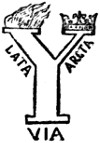
This, we must admit, was a very reasonable sign for a “man of letters.” Continental booksellers also employed it; amongst others, Jacob Pietersz Paetsy, of Amsterdam, in 1597; in the Hague such a sign gave its name to a street. About 1825 there was a public-house in Clare Market called the A. B. C., where the alphabet from A to Z was painted over the door. Even at the present day many public-houses are called the Letters; thus there are two in Shrewsbury, two in Carlisle, one in Oldham, and others in various places. Grand A is a public-house near East Dereham, Norfolk. Little A was the sign of a tobacconist in Leadenhall Street, circa 1780; his tobacco-papers, preserved among the Banks bills, were adorned with a portrait of “Sir Jeffrey Dunstan, or Old Wigs,” one of the mayors of Garrat, styled “Old Wigs” from his practice of buying those articles, by which he made an honourable living before ambition flamed his soul and he entered upon a political career. Grand B may be seen at Long Framlington, Morpeth; Q Inn at Staleybridge; and Q in the Corner in Sheffield. Rhyming alphabets and nursery rhymes present us with the first and last, but the second we confess is somewhat mysterious: the Crowned Q, (au Q Courronne,) which was an old sign in the Rue de la Ferronière, Paris, is easy enough to understand, and one of those broad Rabelaisian strokes of humour which the public delighted in a century or two ago; indeed the sign continued in its old quarters until 1828. The Y was formerly a mercer’s sign in France, and may have originated from the custom of tying ribbons up in festoons, when they would assume somewhat the shape of that letter. It was also the sign of Nicholas Duchemin, a bookseller in Paris, 1541-1576. He, however, took a Pythagorean view of this letter, and considered it, as the freemasons do, an emblem of the double path of life, the broad way leading to destruction, the narrow way unto life; hence the top of the left hand branch terminated in flames, the right hand in a crown. The idea was evidently borrowed from Matt. vii. 13, unless it be from Persius, who says—
“Et tibi quæ Samios deduxit litera ramos, Surgentem dextro monstravit limite callem.”
Z was formerly a grocer’s sign in this country, and was said to stand for Zinzibar, (ginger,) but this Z after all was perhaps only a corruption of the figure 4 which, we are informed, is or was a constant grocer’s sign in some parts of Scotland, as for instance in Stirling, implying that their provisions came from the four quarters of the world. Number IV is still the sign of an ale-house at 74 Hope Street, Salford, Manchester. Number Three is to be seen at Great Layton, near Blackpool. In 1633 it was the sign of a bookseller, Jean Brunet, in the Rue Neuve S. Louis, Paris. He says on the imprints of his books, au Trois de chiffres, in contradistinction to the Roman numerals, which at that time were not named chiffres but nombres; chiffres applied only to the Arab numerals. The latter were introduced by Pope Silvester II. (999-1003) who, having studied at Seville, acquired them from the Moors.
The Bell is one of the commonest signs in England, and was used as early as the fourteenth century, for Chaucer says that the “gentil hostelrie that heighte the Tabard,” was “faste by the Belle.” Most probably bells were set up as signs on account of our national fondness for bell-ringing, which procured for our island the name of the “ringing island,” and made Handel say, that the bell was our national musical instrument; and long may it be so! We confess to have derived infinitely more pleasurable feelings from hearing the melodious bells on a summer afternoon ringing through the clear air and sending their sweet sounds over corn-field and meadow, over brook and stream, than from any cavatina or cantata, sung by the dearest paid Italians in crowded operas, and at over-heated concerts. Paul Hentzner, a German traveller, who visited this country in the reign of Queen Elizabeth, says, “the English are vastly fond of noises that fill the air, such as firing of cannon, beating of drums, and ringing of bells; so that it is common for a number of them to go up into some belfry, and ring bells for hours together for the sake of exercise.” Aubrey makes a similar remark; and, for further reference, we may go to Sir Symonds D’Ewes, who writes in his “Memoirs,” that, in 1618, he was ringing the large bell of St John’s College, Cambridge, for exercise, when the great comet was in the heavens; the consequence was, that he got entangled in the ropes, and nearly fractured his skull, whereupon he wisely resolved not to ring so long as the mischievous comet was to be seen. Generally, for a merry peal, the different toned octave bells are rung in succession; then changes are introduced, which, by continually altering, the succession of the bells produces a most pleasing effect. A peal of bells usually consists of eight, hence the frequency of the Eight Bells; besides these, there are the Four Bells, the Five Bells, the Six Bells, the Ten Bells; the Eight Ringers, (Norwich and elsewhere,) the Old Ring o’ Bells, Wolverhampton, Birmingham, &c. Three Swans and Peal, Walsall, Staffordshire; the Nelson and Peal, also in Warwickshire, and many others mentioned in a previous chapter. In some old belfries, the rules and fines of the ringers are painted in rhymes on the walls; as for instance, in St John’s Church, Chester, (dated 1687,) in All Saints’ Church, Hastings, (dated 1756,) &c. One of the oldest Bell taverns in Middlesex stood in King Street, Westminster; it is named in the expenses of Sir John Howard, (Jockey of Norfolk,) in 1466. Pepys dined at this house, July 1, 1660, invited by purser Washington; but came away greatly disgusted, for, says he, “the rogue had no more manners than to invite me, and let me pay my club.” In November of the same year, he was there again, “to see the 7 flanders mares that my Lord has bought lately.” In Queen Anne’s reign, the October club, consisting of about one hundred and fifty county members of Parliament, all unmitigated Tories, used to meet at this tavern. The Bell, in Warwick Lane, Newgate Street, is another example of the old London coaching inns, still in its original condition, the galleries being propped up to prevent their falling down: everything about the place has a seventeenth century look,—the country carts, the chickens here in the very heart of the city, the inn kitchen with its old black clock, its settles and white benches, the very smell of the cookery going on seems more homely and old English than the hot greasy vapours emanating from the areas of modern taverns. Coming into this yard from the adjacent crowded streets, is like entering a latter-day Pompeii. It was at this inn that Archbishop Leighton, the honest, steady advocate of peace and forbearance, died in 1684.
“He often used to say that if he were to choose a place to die in, it should be an Inn; it looks like a pilgrim’s going home, to whom this world was all as an Inn, and who was weary of the noise and confusion in it. He added, that the officious tenderness and care of friends was an entanglement to a dying man; and that the unconcerned attendance of those that could be procured in such a place would give less disturbance. And he obtained what he desired.”[671]
At the Bell, in the Poultry, lived, in the reign of King William and Queen Anne, Nathaniel Crouch, the famous bookseller, who was the first to condense great and learned works into a small and popular form. He generally wrote under the name of “John Burton.” His “Historical Rarities in London and Westminster,” was one of the books Dr Johnson, in his old age, desired to read again in remembrance of the pleasure derived from their teaching in the days of his youth.
At Finedon, three miles from Wellingborough, there is an old inn, called the Bell, having for a sign the portrait of a female with the following lines beneath:—
“Queen Edith, lady once of Finedon, Where at the Bell good fare is dined on.”
The Bell Inn, kept by John Good, at Oxford, has:—
“My name, likewise my ale, is good, Walk in and taste my own home brew’d; For all that know John Good can tell, That, like my sign, it bears the Bell.”
There was a Golden Bell, in St Bride’s Lane, Fleet Street, in the reign of Queen Anne, next door to which lived Lydia Burcraft, a female hairdresser, who, as appears from her bill,[672] sold an infallible pomatum to make the hair grow long and curly. The Black Bell is mentioned by Stowe, p. 81:—
“Above this lane’s [Crooked Lane] end upon Fish Hill Street, is one great house, for the most part built of stone, which pertained some time to Edward the Black Prince, son to Edward III., who was in his lifetime lodged there. It is now altered to a common hostelry, having the Black Bell for a sign.”
The Monument now stands on the site of this house.
The Bell occurs in innumerable combinations, most of which seem to have no particular meaning, but simply to arise from the old custom of quartering signs. Among them, we may mention the Bell and Anchor, Hammersmith, which was much visited by the fashion in the beginning of the reign of George III. Representations of the place and its visitors may be seen in several of the caricatures of that period, published by Bowles and Carver, of St Paul’s Churchyard. It is still in existence, but its days of glory are past, for, instead of youth and beauty, and “names known to chivalry,” its customers now mostly consist of the Irish labourers who live in the lanes and back slums of North End. Further, we meet with the Bell and Lion, Crew, Cheshire; the Bell and Bullock, Netherem, Penrith, probably united on account of the alliteration; the Bell and Cuckoo, Erdington, near Birmingham; and the Bell and Candlestick, also in Birmingham.
The Bell and Crown is very common, and withal is a reasonable combination, for the bell has, from time immemorial, been rung to express the loyalty of the nation on royal entries, whether into the world or into a town, on occasion of royal marriages or deaths, at times of great victories and declarations of peace, and other loyal celebrations. Hence many bells are inscribed with the words, “Fear God, honour the King,” which, in the beginning of the eighteenth century, seems also to have been a common inscription on the sign of the Bell.[673] This sentiment was thus versified by a sign-painter, who evidently had more loyalty than poetical genius:—
“Let the King Live Long, Dong Ding, Ding Dong.”
PLATE XVIII.
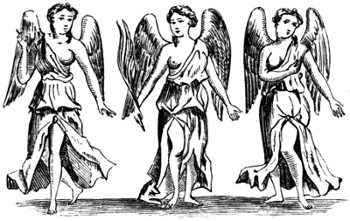
THREE ANGELS. (Banks’s Bills, 1770.)
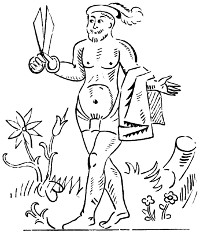
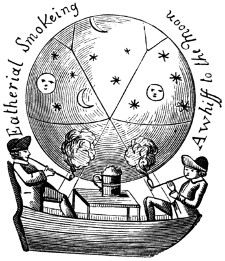
NAKED MAN. (From a print, 1542.) FIRE BALLOON. (Banks’s Collection, 1780.)
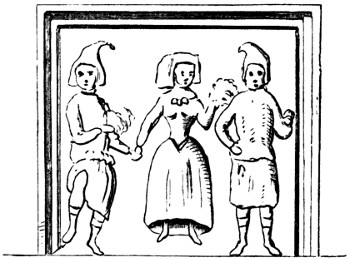
THREE MORRIS DANCERS. (Formerly in Old Change, Cheapside, circa 1668.)
Few signs have so often been wrongly explained as the Bell Savage, on Ludgate Hill. Stow, generally so accurate, says it received its name from one Isabella Savage, who had given the house to the company of cutlers. Where he gathered that information we do not know, but he was “burning,” as the children say, and was certainly much nearer the truth than the Spectator, who states that it was called after a French play of “la Belle Sauvage.” The “Antiquarian Repertory,” following Stow, asserts that the inn was once the property of the Lady Arabella Savage, familiarly called “Bell Savage,” which name was represented in a rebus by a wild man and a bell, and so it was always drawn on the panels of the coaches that used to run to and from it, until the railways changed our style of travelling. The true origin of the name is manifest from a document in the Clause Roll, 31 Henry VI.[674]
“D. Script, irrot. Frenssh.
Omnib; Xpi fidelib; ad quos p’sens Scriptum p’ven. Joh’nes Frenssh, filius primogenitus Joh’is Frenssh, Gentilman, quondam civis et aurifabri London’ salutem in Domino. Sciatis me dedisse, concessisse, et hoc p’senti scripto meo confirmasse, Johanne Frenssh, vidue, matri mee, totum teñ sive hospicium, cum suis p’ten’, vocat’ Savagesynne, alias vocat’ le Belle on the Hope, in parochia S’ce Brigide in Fletestreet, London’, h’end et tenend, totum p.’dc̃m ten’ sive hospicium, cum suis p’t’ in p’fat’ Johanne ad t’minū vite sue, absq’ impeticõe vasti. In cugis rei testimoniū, &c.”[675]
In the sixteenth century, the Belle Savage appears to have been a place of amusement. “Those who go to Paris garden, the Bel Savage, or theatre, to behold bear-baiting, interludes, or fence play, must not account of any pleasant spectacle unless they first pay one penny at the gate, another at the entry of the scaffold, and a third for quiet standing.”[676] One of the attractions about that period was Banks’s wonderful horse, Marocco, which here performed his tricks before a half-admiring, half-awe-stricken audience, many of whom doubtless considered the animal a witch, if not a devil. “To mine host of the Bel Sauage and all his honest guests,” was dedicated the satirical tract of “Marocco Extaticus,” in which this horse is introduced.[677] During the civil wars we find this inn mentioned as apparently a Royalist house: “Upon search at Bell Savage (by order of Parliament) great quantities of plate were found, intended for York, but stayed by order.”[678] A very odd accident happened in this inn during the terrific storm of November 26, 1703. A Mr Hempson, we are told, was blown in his sleep out of an upper room window, and knew nothing of the storm nor of his aerial voyage, till awaking, he found himself lying in his bed on Ludgate hill. No doubt the good wine of mine host must have had something to do with this miraculous flight.[679] Having been for centuries a coaching inn, its name spread to the provinces, and some inn-keepers copied its sign, whence we meet with La Belle Sauvage, Macclesfield, and in one or two other places.
Balls were extremely common in former times, frequently in combination with other objects; this arose from the custom of the silk mercers in hanging out a Golden Ball. Constantine the Great adopted a golden globe (termed Hesa) as the emblem of his imperial dignity, on which, after he embraced Christianity, he placed a cross, and with this addition it continues as one of the insignia of royalty at the present day. The early silk-mercers adopted this golden globe, or ball, as their sign, because in the middle ages, all silk was brought from the East, and more particularly from Byzantium and the imperial manufactories there, whence it was called serica Constantinopolitana, pannus imperialis, Basilica, de Basilicio, ρηγικον, &c. The Golden Ball continued as a silk-mercer’s sign until the end of the last century, when it gradually fell to the Berlin wool shops, and with them it continues at the present day.
Balls of various colours were invariably the signs of quacks and fortune-tellers in the eighteenth century; the Bagford Bills are full of Red, Blue, Black, White, and Green Balls, all signs of those gentry who profess to cure all the evils flesh is heir to. How they came to choose this sign is hard to say, for we can scarcely imagine that they were intended to represent magnified pills. Moorfields[680] was the head-quarters of this trade:—
“If in Moorfields a Lady stroles Among the Globes and Golden Balls, Where ere they hang she may be certain Of knowing what shall be her fortune. Her husband too, I dare to say, But that she better knows than they.” Compleat Vintner, London, 1720, p. 38.
The Golden Ball was the sign of J. Osborne, bookseller in Paternoster Row, circa 1740, who printed one of the earliest “London Directories;” also of Doctor Forman in Lambeth Marsh, who was deeply implicated in the murder of Sir Thomas Overbury in 1613. The Two Golden Balls at the upper end of Bow Street, Covent Garden, was a place famous for concerts, balls, and other amusements, in the end of the seventeenth and the beginning of the eighteenth century. Prince Eugene once attended a concert at this house. The Two White Balls, in Marylebone Street, was the sign of a school in 1712, where Latin, French, mathematics, &c., were taught; in the same house there also lived a clergyman who taught “to write well in three days.”[681]
The balls of the silk mercers and the quacks, suspended from an iron above the door, were generally added (in name at least) to the painted sign, when the house possessed one; as, for instance, the Ball and Cap, Hatton Garden, 1668; the Ball And Raven, Spitalfields, in the seventeenth century, (both on trades tokens;) the Red Ball and Acorn, Queen Street, Cheapside, “a [quack] gentlewoman, daughter of an eminent physician in 1722;”[682] the Plough and Ball, at Nuneaton; the Salmon and Ball, several in London; the Bible and Ball, a bookseller’s in Ave Maria Lane, 1761; the Heart and Ball, a silk-mercer’s in Little Britain, 1710; the Green Man and Ball, on a trades token of Charter House Lane, where the man is represented throwing a ball; and thus innumerable other combinations with the Ball might be mentioned.
The Three Blue Balls, generally a pawnbroker’s sign, was also in old times used for taverns and other houses, while pawnbrokers used at pleasure such signs as the Blackamoor’s Head, the Black Dog and Still, &c.[683] On 26th March 1668, Pepys tells us that, coming from the theatre in Lincoln’s Inn Fields, he and his party went to the Blue Balls tavern in the same locality, where they met some of their friends, including Mrs Knipp;
“And after much difficulty in getting of musick, we to dancing and then to a supper of French dishes, which yet did not please me, and then to dance and sing, and mighty merry we were till about eleven or twelve at night, with mighty great content in all my company, and I did, as I love to do, enjoy myself. My wife extraordinary fine to-day, in her flower tabby suit, bought a year and more ago, before my mother’s death put her into mourning, and so not worn till this day, and everybody in love with it, and, indeed, she is very fine and handsome in it. I having paid the reckoning, which came to almost £4, we parted.”
What a delightful flow of animal spirits that old Secretary of the Admiralty enjoyed! Alas, for the awful dignity of his modern successors!
There is still a public-house sign of the Blue Balls, at Newport, I.W.
The Ring and Ball, Fenchurch Street, 1700, seems suggested by the game of pall mall, recently revived under the name of croquet, in which a ball was struck by a mallet through an iron ring. This sign is mentioned in an advertisement of some valuable trinkets which had been lost:—
“A gold watch in a plain case, made by Thompson, with the hours of the day only; a gold chain, pear fashion, two lengths, with a gold watch-hook of Filegrin Indian work, and hung on it a diamond locket, large diamonds with hair in the middle and death at length on a tombstone; another diamond locket, less diamonds, with a cypher in hair; a red cornelian set in gold engraved with a head; a plain locket with A. K. in golden letters; a civet-box with a white stone, and engraved on it outwards a small head and a camel [cameo?] Whosoever stops them if offered to be pawned or valued, and gives notice to Mr Hankey at the Ring and Ball in Fenchurch Street, shall have 5 guineas for the whole, or proportionable for any part.”[684] A small inducement to honesty!
The Bat and Ball is a common sign for public-houses frequented by cricketers; also the Cricketers’ Arms, the Five Cricketers, and many others. The Wrestlers obtain their name from a sport formerly in great favour in this country, and still cultivated in some parts. At Yarmouth an inn of that name is more celebrated for the jeu d’esprit of the immortal Nelson than anything else. When the fleet was riding in the Yarmouth roads, the landlord, desirous of the patronage of the blue-jackets, requested permission to call his house the Nelson Arms. His lordship gave him full power to do so, but at the same time reminded him that his arms were only in the singular number.
“Odium quod certaminibus ortum ultra metum durat,”
says Velleius Paterculus, and the truth of the assertion is exemplified in the old national antipathy betwixt this country and our neighbours across the channel, whence the Antigallican (the name assumed by a London association in the middle of the last century) could not fail to be a favourite sign. At present this feeling exists to only a very small extent in the minds of our lower orders; but formerly a Frenchman could not pass through the streets of London with impunity. Stephen Perlin, a French ecclesiastic, who wrote in 1558 a description of England, Scotland, and Ireland, says:—
“The people of this country have a mortal hatred for the French as their ancient enemies, and in common call us France chenesve [French knave], France dogue, which is to say, French rascals and French dogs. They also call us or son.”
Grosley[685] devotes a whole chapter to this subject, and tells us that the French were ridiculed on the stage, and insulted and ill-treated in the streets. Even at the present day, when the penny romances are in want of a melodramatic villain, a Frenchman is sure to have the honour of personating him.
At the beginning of this century there was a tavern of this name in Shire Lane, Temple Bar, kept by Harry Lee, of sporting notoriety, and father of Alexander Lee, the first and “original tiger,” in which capacity he was produced by the notorious Lord Barrymore. This tavern was much frequented by his lordship and other gentlemen fond of low life, pugilism, and so-called sport. The nicknames of the brothers Barrymore will give a tolerably good idea of their amiable qualities; the eldest was called Hellgate; the second Cripplegate, (he was lame,) and the third Newgate, so styled, because, though an honourable and a reverend, he had been in almost every gaol in England except Newgate. This interesting family circle was completed by a sister, called Billingsgate, on account of the forcible and flowery language she made use of. The Antigallican is still in vogue, as there are three public-houses with that sign in London, besides some in the country, and an Antigallican Arms at New Charlton, Kent.
On the 29th of September 1783, the first balloon—or air-balloon as it was then called—was let off at Versailles, in the presence of Louis XVI. and the Royal Family. A sheep was the first aeronaut, and with this freight, in a cage, the balloon rose to a height of about 200 yards, floated over a part of Paris, and came down in the Carrefour Maréchal. The novelty was at once taken hold of by caricaturists, ballad-mongers, writers of comic articles, and also by the sign-painters. One of the first balloon-signs in London was that of the Balloon Fruit-shop, in Oxford Street, near Soho Square.[686] As those primitive balloons were, in the opinion of the vulgar, filled with smoke, the tobacconists considered them as within their province, and thus it became a favourite device with this class of shops. Several of their tobacco papers are preserved in the Banks collection. One has the following legend:—“The best Virginia under the Balloon.” Another, “Smoke the best balloon.” A third, “The best air-balloon tobacco,” &c. Some of these balloon-cuts will be found in our illustrations. One of them represents a balloon ascending, and two smokers standing beneath; one says, “I wish them a good voyage;” the other, “Smoak the balloon.” As a sign, the Balloon, or Air-balloon, is still not uncommon, and may be seen at Kingston, Hants, Birdlip, Gloucester, &c.
The Black Doll, hung at the doors of rag and marine store-dealers, probably originated in these shops buying old clothes and finery, which was sold to the buccaneers and coasting-traders, who exchanged them with the natives of Africa and America, for gold, ivory, furs, &c.; just as we see at the present day, Mr Abraham, or Mr Isaacs, constantly advertising in the Times for our “Left-off clothes for Australia and the Colonies.” The popular legend, however, has spread a halo of romance around the black doll. Once upon a time, an ancient dame came to a rag-shop in Norton Folgate, with a bundle of old clothes, which she desired to sell, but having no time to spare, she left them with the man to examine, promising to call for the money next day. The rag-merchant opened the bundle and found amongst the clothes a pair of diamond ear-rings, and a black doll. Anxious to restore the diamonds, (as may be imagined,) he expected the old woman to call day after day, but in vain; at last, thinking that she might have forgotten the house, he hung up the black doll at the door, but the old woman never came, and the doll hung until it rotted away, when it was replaced by a new one. The novelty of the object attracted many customers to the house, other ragmen imitated it, and so it finally became a sign, one which is now fast dying away, and being supplanted by coarse coloured prints, with absurd rhymes.
At the castles of the nobility the weary traveller formerly found food, shelter, and good “herborow;” the lower hall was always open to the adventurer, the tramp, the minstrel, and the pilgrim; the upper hall to the nobleman, the squire, the wealthy abbot, and the fair ladies. It was natural, then, that the Castle should at an early period have been adopted as a sign of “good entertainment for man and beast.” Such a sign became historical in the Wars of the Roses; for the Duke of Somerset, who had been warned to “shun castles,” was killed by Richard Plantagenet, at an ale-house, the sign of the Castle.
“For underneath an ale-house’ paltry sign, The Castle in Saint-Albans, Somerset Hath made the Wizard famous in his death.” 2 Henry VI., ac. v., sc. 2.
According to Hatton,[687] in 1708, the Castle Tavern in Fleet Street had the largest sign in London; next to it came the White Hart Inn, on the east side of the Borough, in Southwark.
In the reign of George I., the Castle, near Covent Garden, was a famous eating-house, kept by John Pierce, the Soyer of his day. Here the gallant feat was performed of a young blood taking one of the shoes from the foot of a noted toast, filling it with wine, and drinking her health, after which it was consigned to the cook, who prepared from it an excellent ragout, which was eaten with great relish by the lady’s admirers.
The Castle and Falcon (probably a combination of two signs, as there is a Falcon Court close by,) is the sign of an inn in Aldersgate, which house, or one on its site, in the reign of Queen Elizabeth, was occupied by John Day, the most considerable printer and publisher of his time. In after years the house became a famous coaching inn, and its reputation spread to all parts of England, whence we meet, at present, with Castles and Falcons in various towns, as at Birmingham, Chester, &c. Although we incline to the opinion that the sign arose from a combination, still it is worthy of remark, that the crest of Queen Catherine Parr was a crowned falcon, perched on a castle, and of course represented as large as the castle.
The Three Old Castles occurs at Mandeville, near Somerton; the Castle and Banner at Hunny Hill, Carisbrooke, originating in the banner floating from the castle turret, when the Lord of the Manor was residing there. Castles in the Air is to be seen at Lower Quay, Fareham; the origin seems to be an allusion to the ordinary sign swinging in mid-air—a piece of humour on the part of the landlord. The Castle and Wheelbarrow, at Rouse Lench, was, doubtless, another innkeeper’s notion of suggestive humour—but he was a dull wit.
Perhaps the most patriarchal of all signs is the Chequers, which may be seen even on houses in exhumed Pompeii. On that of Hercules, for instance, at the corner of the Strada Fullonica, they are painted lozenge-wise, red, white, and yellow, and on various other houses in that ancient city, similar decorations may still be observed. Originally it is said to have indicated that draughts and backgammon were played within. Brand, in his “Popular Antiquities,” ignorant of any existence of the sign in so remote a period as that mentioned, says that it represented the coat of arms of the Earls of Warenne and Surrey, who bore checqui or and azure, and in the reign of Edward IV., possessed the privilege of licensing ale-houses. A more plausible explanation, and one which is not set aside by the existence of the sign in Pompeii, is that given by Dr Lardner:—
“During the middle ages, it was usual for merchants, accountants, and judges, who arranged matters of revenue, to appear on a covered banc, so called from an old Saxon word, meaning a seat, (hence our Bank.) Before them was placed a flat surface, divided by parallel white lines, into perpendicular columns; these again divided transversely by lines crossing the former, so as to separate each column into squares. This table was called an Exchequer, from its resemblance to a chess-board, and the calculations were made by counters placed on its several divisions, (something after the manner of the Roman abacus.) A money-changer’s office was generally indicated by a sign of the chequered board suspended. This sign afterwards came to indicate an inn or house of entertainment, probably from the circumstance of the innkeeper also following the trade of money-changer—a coincidence still very common in seaport towns.”[688]
Chaucer’s Merry Pilgrims put up in Canterbury, at the sign of the “Checker of the Hope,” (i.e. the Chequers on the Hoop.)
“They took their in and loggit them at mydmorowe, I trowe, Atte cheker of the Hope that many a man doth knowe.” Ludgate’s Continuation of the Canterbury Tales.
This inn (says Mr Wright, in his edition of the above work) is still pointed out in Canterbury, at the corner of High Street and Mercery Lane, and is often mentioned in the Corporation Reports, under the title of the Chequer. It is situated in the immediate vicinity of the Cathedral, and was therefore appropriate for the reception of the pilgrims.
When the inn had another sign besides the Chequers, these last were invariably painted on the door-post; an example of this may still be seen at the Swiss Cottage, Chelsea. In or near Calcots Alley, Lambeth, was formerly situated an inn or house of entertainment called the Chequers. In the year 1454 a licence was granted to its landlord, John Calcot, to have an oratory in the house and a chaplain for the use of his family and guests, as long as his house should continue orderly and respectable, and adapted to the celebration of divine service.[689] The Black Chequers in Cowgate, Norwich, is so called on account of the chequers being black and white, whilst others are red and white, blue and white, or in such other contrast as may be fancied by the publican.
The Crooked Billet is a sign, for which we have not been able to discover any likely origin; it may have been originally a ragged staff, or a pastoral staff, or a baton cornu—the ancient name for a battle-axe.[690] It is also the name for a part of the tankard. Frequently the sign is represented by an untrimmed stick suspended above the door, as at Wold Newton, near Bridlington, where it is accompanied by the following poetical effusion on one side of the signboard:—
“When this comical stick grew in the wood, Our ale was fresh and very good; Step in and taste, O do make haste, For if you don’t ’twill surely waste.”
On the other side:—
“When you have viewed the other side, Come read this too before you ride, And now to end we’ll let it pass; Step in, kind friends, and take a glass.”
Though a very rustic sign, it was also used in towns; thus it occurs among the trades tokens of Montague Close, and was the sign of Andrew Sowle, a bookseller in Holloway Lane, Shoreditch, in 1683.
The Golden Head appears to have been a favourite with artists, probably a classic or modern bust gilded. It was the sign of Hogarth’s master and of himself.
“Hogarth made one essay in sculpture. He wanted a sign to distinguish his house in Leicester Fields; and thinking none more proper than the Golden Head, he out of a mass of cork made up several thicknesses compacted together, carved a bust of Van Dyke, which he gilt and placed over his door. It is long since decayed, and was succeeded by a head in plaister, which has also perished, and is succeeded by a head of Sir Isaac Newton.”—Nichols’s Anecdotes of Hogarth.
At this sign in 1735 Hogarth published the “Harlot’s Progress,” and several other engravings. Sir Robert Strange the engraver (1721-92) lived at the Golden Head, Henrietta Street, Covent Garden; and in 1762 the portrait of Cunneshote, one of the Cherokee chiefs, then on a visit to this country, was for sale at the Golden Head in Queen Square, Ormond Street; it was engraved after a painting by Francis Parsons. In 1700 it was the sign of a Monsieur Desert, “almost over against the King’s Bagnio in Long Acre, who sold guitars from 30 gs. to 30 sh. a piece.”[691] Thomas Carte the historian (1686 to 1754) lived at Mr Ker’s at the Golden Head, Newport Street, Long Acre. This sign also occurs in a most amusing advertisement:—
“An Exceeding Small Lap Spaniel.
ANY ONE THAT has (to dispose of) such a one, either dog or bitch, and of any colour or colours, that is very, very small, with a very short round snub nose, and good ears, if they will bring it to Mrs Smith, at a coachmaker’s over against the Golden Head in Great Queen Street, near Lincoln’s Inn Fields, they shall (if approved of) have a very good purchaser. And to prevent any further trouble, if it is not exceeding small, and has anything of a longish peaked nose, it will not at all do. And nevertheless after this advertisement is published no more, if any person should have a little creature that answers the character of the advertisement, if they will please but to remember the direction and bring it to Mrs Smith; the person is not so provided but that such a one will still at any time be hereafter purchased.”—Daily Advertiser, Nov. 1744.
The Two Heads was the sign of a dentist in Coventry Street in 1760. One head probably represented the mouth as possessing a fine set of teeth; the other doubtless showed how unfortunate is their absence. The advertisements of this man are gems in their way:—
“Ye Beauties, Beaux, ye Pleaders at the Bar, Wives, Husbands, lovers, every one beside, Wh’d have their heads deficient rectify’d, The Dentist famed who by just application Excels each other operator in the Nation, In Coventry’s known street, near Leicester Fields, At the Two Heads full satisfaction yields. Teeth artificial he fixes so secure, That as our own they usefully endure; Not merely outside show and ornament But ev’ry property of Teeth intent; To eat, as well as speak, and form support The falling cheeks and stumps from further hurt. Nor is he daunted when the whole is gone, But by an art-peculiar to him known, He’ll so supply you’ll think you’ve got your own. He scales, he cleans, he draws; in Pain gives Ease, Nor in each operation doth fail to please. Doth the foul scurvy fierce your Gums assault? In this he also rectifies the Fault By a fam’d Tincture. And his Powder nam’d A Dentifrice is also justly fam’d. Us’d as directed ’tis excellent to serve Both teeth and gums, cleanse, strengthen, and preserve; Foul mouth and stinking breath can ne’er be loved. But by his aid those evils are removed.” London Evening Post, July 1760.
Taylor the Water poet (1632) mentions two taverns with the sign of the Mouth, the one without Bishopsgate, the other within Aldersgate. Trades tokens of the first house are extant, representing a human head with a huge mouth wide open. An inventory is still extant of the stock in trade of this house in the year 1612,[692] which is not uninteresting. From it we gather that the wines drunk at that period in taverns were white wine, Vin de Grave, (a small white Burgundy wine,) Orleans wine, Malaga, sherry, sack, Malmsey, (Malvasia, a wine from the coast of Morea, sweet and white,) Alicante, (also sweet,) claret, &c. Beer seems to have been but little asked for by those that frequented this house; for whilst some of the wines were kept in such large quantities as seven hogsheads, there were only two dozen and eight bottles of ale. The names of the rooms in the house were “the Pomegranate,” “the Portcullis,” “Three Tuns,” “Cross Keys,” “Vine,” “King’s Head,” “Crown,” “Dolphin,” and “Bell,” all of them favourite tavern signs, and (as remarked on page 280) the usual names for tavern rooms. Among the utensils may be remarked fifteen silver bowls.
The Merry Mouth is still a sign at Fifield, Chipping Norton.
The Hand was the sign of a victualler near the Marshalsea in Southwark, in 1680. Hands occur in many combinations, owing to the custom of draughtsmen and sign-painters representing a hand issuing from the clouds to perform some action or hold some object; thus a hand holding a coffee-pot was a very general coffee-house sign. The “Hand” seems to have been a bad or evil sign:—
“I’ll go back to the country of the coffee-houses, [Fleet Street,] where being arrived I’m in a wood, there are so many of them I know not which to enter; stay, let me see, where the sign is painted with a woman’s hand in it, ’tis a bawdy house, where a man’s it has another qualification; but where it has a star in the sign ’tis calculated for every lewd purpose.”[693]
Though this is a sweeping denunciation, yet we find the Hand and Star occurring as the sign of a very respectable bookseller, Richard Tothill in Fleet Street, within Temple Bar, who in 1553 printed the “Dialogue of Comfort,” by Sir Thomas More. Not unlikely Tothill had adopted this sign from the watermarks in paper, for one of the most ancient of them is a hand, either in the position of giving benediction, or in that position called the upright hand, with a star above it. Messrs Butterworth, the law-publishers, who now occupy Tothill’s premises, possess all the leases and documents from the time of that old printer down to the present day.
Quacks, also, were very fond of a hand in their sign, pointing to an eye or an ear, to intimate that the great doctor cured the blind or the deaf. Thus, in the Harleian collection (5931) there is a handbill of S. Ketelby, sworn physician, who lived at the Hand and Ear, in Exeter Street near the Strand, and who professed to cure deafness, lameness, &c.
“He is capable now, not only of curing those incurable by others, but even those he could not cure himself six months ago! Note: He resolves all persons deaf from external causes, whether curable or not, in two minutes, in the dark as well as at noonday, which no other pretender can do,” &c.
The Hand and Face was the sign of another quack, who lived in Water Lane, Blackfriars, near Apothecaries’ Hall, in 1735.[694]
A few combinations of the hand refer to games, as the Hand and Ball, Barking, (trades token,) 1650, which seems to be derived from some of the innumerable games at ball in which our ancestors delighted, such as handball, tennis, balloon or windball, stoolball, hurling, football, stowball, pallmall, clubball, trapball, northen-spell, cricket, bowling, &c. The Hand and Tennis, Whitcombe Street, Haymarket, is so called from the adjoining Tennis Court, erected in 1678. The Old Hand and Tankard is a public-house sign at Wheatly, near Halifax. The Hand and Tench seems to point to a connexion with the followers of Isaac Walton; it was a mug-house in Seven Dials in 1717. The mugs in those days used to be suspended above the door, or on the sign-iron, not only in this, but in all the mug-houses, for the mug might be considered as much a badge of King George’s friends, as the white cockade was the badge of the Jacobites.
The Hand and Heart was, in 1711, the very appropriate sign of a marriage insurance office in East Harding Street, Shoe Lane.[695] Two right hands holding a heart was a very old symbol of concord. Aubrey gives quotations from Tacitus, by which he derives it from the Romans, and adds:—
“I have seen some rings made for sweethearts with a heart enamelled held between two hands. See an Epigrame of G. Buchanan, on two rings that were made by Q. Elisabeth’s appointment, which, being laid one upon the other, shewed the like figure. The heart was two diamonds, wch joyned, made the Heart. Q. Elisabeth kept one moietie, and sent ye other as a token of her constant friendship to Mary Q. of Scotts; but she cutt off her head for all that.”[696]
The Heart in Hand is still a common ale-house sign. A similar meaning is conveyed by the equally common Hand in Hand or Cross Hands; at Turnditch, Derby, this sign is called the Cross o’ the Hands, and a corruption of this again is the Cross in Hand, at Waldron, Sussex. The Hand in Hand was also one of the usual signs of the marriage-mongers in Fleet Street. Pennant says:—
“In walking along the streets in my youth, on the side next this prison, (the Fleet,) I have often been tempted by the question, ’Sir, will you be pleased to walk in and be married.’ Along this most lawless space was most frequently hung up the sign of a male and female hand conjoined, with ‘Marriages performed within’ written beneath. A dirty fellow invited you in; the parson was seen walking before his shop, a squalid, profligate figure, clad in a tattered plaid nightgown, with a fiery face, and ready to couple you for a dram of gin or a roll of tobacco.”
The two hands conjoined is also common in France—where it is called à la bonne Foi. In 1624 it was the sign of Pierre Billaine, bookseller and printer in the Rue St Jacques, Paris.
The Leg used formerly to be at the door of every hosier. It was also the sign of a tavern in King Street, Westminster, frequented by Pepys. Trades tokens are extant of the Leg and Star, kept by Richard Finch, in Aldersgate, in the seventeenth century. It may have represented a leg with the garter round it, and the star of that order; but more probably it was a combination of two signs.
The Old Man, Market Place, Westminster, was probably intended for Old Parr, who was celebrated in ballads as “The Olde, Olde, Very Olde Manne.” The token represents a bearded bust in profile, with a bare head. In the reign of James I. it was the name of a tavern in the Strand, otherwise called the Hercules Tavern, and in the eighteenth century there were two coffee-houses, the one called the Old Man’s, the other the Young Man’s Coffee-house.
The Fountain was a favourite sign with the Londoners before the Reformation, perhaps on account of its connexion with the martyrdom of St Paul, whose head, says the legend, on being struck off, rebounded three times, when a fountain gushed up at each spot where the sacred head had touched the ground. Hence there is a church near Rome, in the midst of the desolate Campagna, called San Paolo delle Tre Fontane, where altars are raised over each of those three fountains. There is also a fountain connected with the martyrdom of St Alban, the English protomartyr, and Saints’ Wells may be met with all over the kingdom.
During the Plague of 1665, the following advertisement used to figure constantly in the papers:—
“MONSIEUR Augier’s famous Remedies for stopping and preventing the plague having not only been recommended by several certificates from Lyons, Paris, Thoulouse, &c., but likewise experimented here by the special directions of the Lords of his Majesty’s most honourable Privy Council, and proved by Witnesses upon oath, and several Tryals, to be of singular virtue and effect, are to be had at Mr Drinkwater’s, at the Fountain, in Fleet Street, &c.”[697]
Mr Drinkwater had evidently intended a pun by selecting a fountain as his sign.
The Fountain Tavern in the Strand was famous as the meeting-place of the ultra-loyal party in 1685, who here talked over public affairs before the meeting of Parliament. Roger Lestrange, who had been recently knighted by the king, took a leading part in these consultations. But “the fate of things lies always in the dark;” in the reign of George II. this same house became a great resort for the Whigs, who sometimes used to meet here as many as two hundred at a time, making speeches and passing resolutions.
For this reason it was proposed that Master Jephson the landlord should write under his sign:—
“Hoc Fonte derivata libertas In Patriam, Populumq: fluxit.” “From this fam’d Fountain Freedom flow’d, For Britain’s and the People’s good.”
In this tavern, Law, subsequently famous as the Mississippi schemer, quarrelled with the magnificent and mysterious Beau Wilson; they left the house, adjourned to Bloomsbury Square, and fought a duel, in which the Beau was killed. The Kit Cat Club, in winter, used to meet at this house. This club was first established in an obscure house in Shire Lane; it consisted of thirty-nine distinguished noblemen or gentlemen, zealously attached to the Protestant succession of the house of Hanover. Among the members were the Dukes of Richmond, Devonshire, Marlborough, Somerset, Grafton, Newcastle, and Dorset, the Earls of Sunderland and Manchester, some lords, and Steele, Addison, Congreve, Garth, Vanbrugh, Manwaring, Stepney, Walpole, and Pulteney; Lord Mohun (implicated in the murder of Mountford the actor, and killed in a duel by the Duke of Hamilton) was also a member.
“The day Lord Mohun and the Earl of Berwick were entered of it, Jacob [Tonson, the secretary] said he saw they were just going to be ruined. When Lord Mohun broke down the gilded emblem on the top of his chair, Jacob complained to his friends, and said a man who would do that would cut a man’s throat.”[698]
Tonson, for fulfilling the duties of this honorary office, was presented with the portraits of all the members. After Jacob’s death, his brother Richard removed the pictures to his residence at Water Oakley, near Windsor. A list of them is to be found in Bray’s “History of Surrey,” vol. iii., p. 318. Forty-three of them have been engraved by Faber in mezzotint. The name of the club is said to have been derived from the first landlord, who was called Christopher Cat; he excelled in the making of mutton-pies, which were named after him Kit Cat, and were the standard dish of the club.
“Here did th’ assembly’s title first arise, And Kit Cat’s wits sprung first from Kit Cat’s pies.”
Next door to the Fountain Tavern lived Charles Lillie, the celebrated snuff-seller of the Spectators and Tatlers, but “he was burnt out when he began to have a reputation in his way.”—(Tatler, xcii.)
The Fountain and Bear is a sign named in the following quaint imprint:—
“A Present for Teeming Women, or Scripture Directions for Women with childe; how to prepare for the hour of Travel. Written first for the private use of a Gentlewoman of quality in the West, and now published for the common good by John Oliver, less than the least of saints. Sold by Mary Rothwell, at the Fountain and Bear, in Cheapside, 1663.”
The Sun and the Moon have been considered as signs of Pagan origin, typifying Apollo and Diana. Whether or no this conjecture be true, would be difficult to prove, but certain it is that they rank among the oldest and most common signs, not only in England but on the Continent. Early in the sixteenth century the French poet Desiré Arthus wrote in his “Loyaulté Consciencieuse des Taverniers:”—
“Sur les chemins des grands villes et champs, Ne trouverez de douze maisons l’une, Qui n’ait enseigne d’un soleil, d’une lune. Tous vendant vin, chascun à son quartier.”[699]
Like the Star, (see p. 501,) the Sun did not enjoy a good reputation. Henry Peacham thus cautions young men from the country:—
“Let a monyed man or gentleman especially beware in the city, ab istis calidis et callidis solis filiabus as Lipsius: these overhot and crafty daughters of the Sunne, your silken and gold laced harlots, everywhere (especially in the suburbs) to be found.”[700]
The reason of this sign having been especially adopted by that description of houses, we are unable to state, unless it be the one Tom D’Urfey gives in “Collin’s Walk through London,” where, speaking of a frail and fair one, he says:—
“And like the Sun, was understood To all mankind a common good.”
But as the sun shines alike over good and evil, so respectable as well as disreputable persons have used him for a sign; thus Wynkyn de Worde, in Fleet Street, and Anthony Kytson, another early printer, and the publisher of some works of Master John Skelton, poet laureate, carried on business under this device. Taylor the Water poet mentions three Sun taverns: being compelled one day on his “pennylesse pilgrimage,” to dine à la belle étoile, he says:—“I made virtue of necessity, and went to breakefast in the Sunne: I have fared better at three Sunnes many a time before now: in Aldersgate Street, Criplegate, and New Fish Street; but here is the oddss: at those Sunnes they will come vpon a man with a tauerne bill as sharp cutting as a taylor’s bill of items: a watchman’s bill or a watch hooke falls not halfe so heauy vpon a man.”[701] The Sun on Fish Street Hill is also named by Pepys:—
“Dec. 22, 1660.—Went to the Sun Tavern on Fish Street Hill, to a dinner of Captain Teddimans, where was my Lord Inchequin, (who seems to be a very fine person,) Sir W. Penn, Captain Cuttance, and Mr Laurence, (a fine gentleman now going to Algiers,) and other good company, where we had a very good dinner, good music, and a great deal of wine. I very merry—went to bed, my head aching all night.”
But the finest of all the Sun Taverns did not exist in Taylor’s time; it was built after the fire of 1666, behind the Exchange.
“Behind? I’ll ne’er believe it; you may as soon Persuade me that the sun stands behind noon.”
These are the opening lines of a ballad of 1672, entitled “The Glory of the Sun Tavern, behind the Exchange.”[702] From this ballad it is evident that the tavern was splendidly furnished, and offered comforts not generally to be met with at that time.
“There every chamber has an aquaeduct, As if the sun had fire for water truckt, Water as’t were exhal’d up to heavens sprouds, To cool your cups and glasses in the clouds.”
Pepys was a frequent visitor at this house, and, in fact, all the pleasure-seekers of that mad reign patronised it; the profligate Duke of Buckingham, in particular, was a constant customer. Simon Wadloe, the landlord, had made his fortune at the Devil in St Dunstan’s, whereupon he went to live in the country, and spent his money in a couple of years. He then “choused” Nick Colbourn out of the Sun, and Nick, who had amassed a handsome competence in the house, was easily persuaded to retire, and left it “to live like a prince in the country,” says Pepys. During the reign of Charles II., the house appears to have had an excellent custom, and was from morning till night full of the best company. The Sun Tavern, in Clare Street, was one of the haunts of the witty Joe Miller, and is often given as the locality of his jokes:—
“Joe Miller, sitting one day in the window of the Sun Tavern, Clare Street, a fish woman and her maid passing by, the woman cried: ‘Buy my soals, buy my maids!’ ‘Ah! you wicked old creature,’ cry’d honest Joe, ‘what, are you not content to sell your own soul, but you must sell your maid’s too?’”
A stereotype joke of the publican connected with the Sun is the motto, “the best liquor [generally beer] under the Sun,” which, of course, must be believed, for Solem quis dicere falsum audeat? Sometimes the sign is called the Sun in Splendour, as at Nottinghill, the “splendour” having reference simply to the golden beams or rays usually drawn by the painter. There is still a carved stone sign of the Sun, now gilt, dating from the seventeenth century, walled in the front of a house in the Poultry.
The Golden Sun was the sign of Ulrich Gering, in the Rue St Jacques, Paris, printer of the first Bible in France, in 1475. At the end of the volume the Bible thus addresses the reader:—
“Jam tribus undecimus lustris Francos Ludovicus Rexerat; Ulricus, Martinus, itemque Michael Orti Teutonia, hanc mihi composuere figuram Parisii arte sua; me correctam vigilanter Venalem in vico Jacobi Sol Aureus offert.”[703]
Their successor, Berthold Rumbold, on removing the business to another house in the same street, opposite the Rue Fromentel, kept the same sign, and there it continued as late as 1689, having constantly been in the hands of booksellers. Not improbably the first printers, both in England and abroad, adopted the sign of the Sun, as an emblem of the new era opened to the world by the invention of printing, which, when they reflected on their discovery, they saw would, at no distant period, spread an intellectual light over the world, as brilliant and as vivifying as that of the radiant sun.[704]
The sign of the Sun occurs in endless combinations, often capricious, without any other reason than a whim, and an alliteration, as the Sun and Sawyers; the Sun and Sword; the Sun and Sportsman; or quartered with other signs, as the Sun and Anchor; Dial; Falcon; Last; Horseshoe, &c. All these, and innumerable others of the same sort, occur among the London public-house signs of the present day. The Sun and Hare is a stone carved sign, walled up in the façade of a house in the High Street, Southwark. Were it not for the initials H. N. A., it might be taken for a rebus on the name Harrison; as it is, it may be a jocular corruption of the Sun and Hart, the badge of Richard II. (See p. 109.)
The Rising Sun is nearly as common as the sun in his meridian; perhaps on account of the favourable omen it presents for a man commencing business. In 1726 it was the sign of a noted tavern in Islington, where some merry doings went on occasionally:—
“ON Tuesday next, being Shrove Tuesday, will be a fine hog barbygu’d whole at the house of Peter Brett, at the Rising Sun, in Islington Road, with other diversions. It is the house where the ox was roasted whole at Christmas last.”—Mist’s Journal, February 9, 1726.
To barbecue a hog, was a West Indian term for roasting a whole pig, stuffed with spice, and basted with Madeira wine.
The Rising Sun and Seven Stars was the very appropriate sign, at which was printed a work on “Astrological Optics;” but better still, it was printed for R. Moon, whose shop was “in Paul’s Churchyarde, in the New Building, between the two North Doors. 1655.” An old jest-book says that an Irishman, seeing the sign of the Rising Sun was kept by A(nthony) Moon, accused the said Moon of having made a bull, for saying that the Sun was kept by the Moon.
One of the learned questions propounded by Hudibras to that cunning man, Sidrophel, the Rosicrucian, was:—
“Tell me but what’s the natural cause Why on a sign no painter draws The full moon ever, but the half.”—Hudibras, part iii., c. 3.
This might be true in Butler’s time, but is no longer so; at Leicester, for instance, there are two signs of the Full Moon, and it occurs in many other places. The Crescent, or Half-Moon, was the emblem of the temporal power, as the Sun was the distinction of the spiritual.
Ben Jonson once desiring a glass of sack, went to the Half-Moon Tavern, in Aldersgate Street, but found it closed, so he adjourned to the Sun Tavern, in Long Lane, and wrote this epigram:—
“Since the Half Moon is so unkind, To make me go about, The Sun my money now shall have, And the Moon shall go without.”
The Half-Moon, Upper Holloway, was famous in the last century for excellent cheesecakes, which were hawked about the streets of London, by a man on horseback, and formed one of the London cries. This circumstance is noticed in a poem in the Gentleman’s Magazine for 1743, entitled “A Journey to Nottingham.” In April 1747, the following advertisement appeared in the same magazine:—
“HALF-MOON Tavern, Cheapside, April 13. His Royal Highness the Duke of Cumberland having restored peace to Britain, by the ever memorable Battle of Culloden, fought on the 16th of April 1745, the choice spirits have agreed to celebrate that day annually by A Grand Jubilee in the Moon, of which the Stars are hereby acquainted and summoned to shine with their brightest Lustre by 6 o’clock on Thursday next in the Evening.”
The Crescent and Anchor is a sign at Norton-in-Hales, near Market Drayton; the Half-Moon and Seven Stars at Aston Clinton, near Tring; and the Sun, Moon, and Seven Stars at Blisworth, in Northampton. These Seven Stars have always been great favourites; they seem to be the same pleiad which is used as a Masonic emblem—a circle of six stars, with one in the centre; but to tell to ears profane, what this emblem means, would be disclosing the sacred arcana. The Seven Stars was the sign of Richard Moone, before he was so ambitious as to place the whole firmament on his sign: in 1653 he printed—
“The first addresses to his Excellence the Lord General, &c., by John Spittlehouse, a late Member of the Army, and a servant to the Saints of the Most High God, &c. London, printed by J. C., for himself and Richard Moon, at the Seven Stars, in Paul’s Churchyard, near the great North Door. 1653.”
As a change upon the Seven Stars, a publican at Counterslip, Bristol, has put up the Fourteen Stars.
We have seen (p. 492) that the sign of the Star was “calculated for every lewd purpose;” a great change certainly from mediæval times, when a star was the emblem of the Holy Virgin, who was thus styled Maris Stella (star of the sea)—the signification of the name Miriam in Hebrew—or Stella Jacobi, (star of Jacob,) Stella Matutina, (morning star,) Stella non erratica, (fixed star, unerring star,) &c.; a star being always painted either on her right shoulder, or on her veil, as may be readily observed in the works of the early Italian masters in our National Gallery. A star of sixteen rays is the crest of the Innholders’ Company. Oliver Cromwell used to meet some of his party at the Star in Coleman Street, as was deposed by one of the witnesses in the trial of Hugh Peters:—
“Gunter. My Lord, I was servant at the Star in Coleman Street, with one Hildesley. That house was a house where Oliver Cromwell and several of that party did use to meet in consultation.”
John Bunyan died in 1682 at the Star, on Snowhill, in the house of his friend, Mr Strudwick, a grocer.
The Pole Star is now a not uncommon sign. To make this device more intelligible, tavern-keepers ought to attach to it the motto it bore in the middle ages, when it was a symbol of the Church: “qui me non aspicit errat.” (He who does not look at me goes astray.) The Star and Crown was the sign of a haberdasher in Princes Street, Coventry Street, 1785, who, among other things, sold “dress and undress hoops.”
The signs of the zodiac appear occasionally to have been adopted by conjurors and astrologers. Ned Ward describes them as figuring, in his time, on the door of “a star-peeper,” in Prescot Street.[705]
The Two Twins, or Naked Boys, was the sign of a quack in Moorfields, “near the steps going out of the Lower Field into the Middle Field. There is a door above the steps, and another below the steps, with the Twins, and the name Langham on both doors;—keep the bill to prevent mistaking the house or being sent to a wrong place.”[706] To such lengthy explanations our ancestors were compelled to resort in the absence of numbers on their houses. Either this quack had adopted the Two Twins on account of his obstetrical pretensions, or he was an astrologer as well as a quack, for Moorfields was the head-quarters of
“Augurs and soothsayers, astrologers, Diviners, and interpreters of dreams.”
In the last case he might have chosen it as being the ascendant of the city of London, which “stands in a benign and temperate climate, in the latitude of 52° and longitude of 19° 15´,—having (as artists reckon) the celestial twins, the house of Mercury, patron of merchandise and ingenious arts, for her ascendant.”[707]
The Rainbow, in Fleet Street, opposite Chancery Lane, is the oldest coffee-house in London:—
“I find it recorded that one James Farr, a barber, who kept the coffee-house, which is now the Rainbow, by the Inner Temple gate, (one of the first in England,) was, in the year 1657, presented by the inquest of St Dunstan’s in the West, for making and selling a sort of liquor called Coffee, as a great nuisance and prejudice to the neighboorhood, &c., and who would have thought London would ever have had near three thousand such nuisances, and that coffee would have been (as now) so much drank by the best of quality and physicians.”[708]
The presentation here alluded to is still preserved among the records of St Sepulchre’s Church. It says:—
“We present James Farr, Barber, for making and selling a drink called coffee, whereby, in making the same, he annoyeth his neighboors by evill smells, and for keeping of fire the most part night and day, whereby his chimney and chamber has been set on fire, to the great danger and affreightment of his neighboors.”
This danger of fire was so much the greater, as a bookseller, Samuel Speedal, had his shop in the same house. In 1682, the Phœnix Fire Office, one of the first in this country, was established at this place.
The Thunder Storm is the sign of a public-house at Framwellgate Moor, Durham; and the Hailstone, at Knowle, Staffordshire; both these houses may have taken their names from a severe storm, which visited the neighbourhood at or about the time of their opening, just as the Haylift, at Wansforth, Northampton, is said to owe its origin to the fact of a man floating a long way down the river on a haycock, during an inundation, and landing near that place.
As for the Wild Sea, the sign of John Horton, over against Parson’s Brewhouse, Croydon,[709] in 1718, no more plausible explanation occurs to us than that John Horton might have been a sailor in his younger days.
The Hole-in-the-Wall is believed to have originated from the hole made in the wall of the debtors’ or other prison, through which the poor prisoners received the money, broken meat, or other donations of the charitably inclined. The old sign of the Hole-in-the-Wall (see our illustrations) shows such an opening in a square piece of brickwork. Generally, it is believed to refer to some snug corner, perhaps near the town walls; but at the old public-house in Chancery Lane the legend is as we have given it. Hard by, in Cursitor Street, prisoners for debt found a temporary lodging up to a very recent date. Trades tokens are extant of this house, which, about 1820, was kept by Jack Randall, alias Nonpareil, a famous member of the P.R.; on one occasion some verses were made containing the following lines:—
“Then blame me not, swells, kids, or lads of the fancy, For opening a lush crib in Chancery Lane, An appropriate spot ’tis, you doubtless all can see, Since heads I’ve oft placed there, and let out again.”
The poet, Thomas Moore, in the fast days when George IV. was king, and when pugilism and gin drinking were fashionable accomplishments, used to visit Mr Randall’s parlour. It was here that he picked up his materials for those rhyming satires on the politics and general topics of his time:—“Tom Crib’s Memorials to Congress, by one of the Fancy;” “Randall’s Diary of Proceedings at the House of Call for Genius;” “A Few Selections from Jack Randall’s Scrap Book, with Poems on the late Fight for the Championship.”
At the Hole-in-the-Wall in Chandos Street, Claude Duval the highwayman was taken prisoner; whilst the Hole-in-the-Wall in Baldwin’s Gardens was the citadel in which Tom Brown used to intrench himself from duns and bailiffs, with Henry Purcell the musician, as his companion in revelry and merriment. Tom Brown’s introductory verses, prefixed to Playford’s “Musical Companion,” 1698, are dated “from Mr Stewart’s at the Hole-in-the-Wall, in Baldwin’s Gardens.” Another Hole-in-the-Wall still exists in Kirby Street, Hatton Garden. It is a curious fact that the refreshment-room, or liquor-bar, attached to the House of Representatives at Washington, is known to most thirsty American politicians as The Hole-in-the-Wall.
Anciently, instead of being a painted board, the object of the sign was carved and hung within a hoop, hence (as we had occasion to remark on a former page) nearly all the ancient signs are called the “—— ON THE HOOP.” In the Clause Roll, 43 Edward III., we find the George on the Hoop; 26 Henry VI., the Hart on the Hoop; 30 Henry VI., the Swan, the Cock, and the Hen on the Hoop. Besides these we find mentioned the Crown on the Hoop, the Bunch of Grapes on the Hoop, the Mitre on the Hoop, the Angel on the Hoop, the Falcon on the Hoop, &c. In 1795, two of these signs were still extant, for a periodical of the time says:—“A sign of this nature is still preserved in Newport Street, and is a carved representation of a Bunch of Grapes within a Hoop. The Cock on the Hoop may be seen also in Holborn, painted on a board, to which, perhaps, it was transferred on the removal of the sign-posts.”[710] These hoops seem to have originated in the highly ornamented bush or crown, which latterly was made of hoops, covered with evergreens. In France, the Hoop (le Cerceau) was used as a sign. Jacques Androuet, a celebrated architect, and author of a work entitled “Les plus excellents Batiments de France,” lived at the sign of the Hoop, whence he adopted the surnames of Jacques Androuet du Cerceau. In 1570 he published a book on metal-work, containing several designs for ornamental iron frames and posts to suspend signboards from. That names in this country also were occasionally derived from signboards, has been stated in our introduction. Of this practice, Sir Peter Lely, the portrait painter, was an illustrious example. He belonged to a Dutch family named Van der Vaas. His grandfather was a perfumer, and lived at the sign of the Lily, (perhaps a vase of lilies, with a pun on his name.) When his son entered the English army he discarded his Dutch name, and from the paternal sign, adopted the more euphonious one of Lilly or Lely; and this name he and his children afterwards retained. The famous Rothschild family is another case in point. From the Red Shield (the roth schild) above the door of an honest old Hebrew, in the Juden-gasse, (or Jews’ Alley,) at Frankfort, has been derived the name of the richest family in the world.
The Hoop and Bunch of Grapes was the sign of a public-house, in St Albans Street, (now part of Waterloo Place,) kept at the beginning of the present century, by the famous Matthew Skeggs, who obtained his renown from playing, in the character of Signor Bumbasto, a concerto on a broomstick, at the Haymarket Theatre, adjoining. His portrait was painted by King, a friend of Hogarth, engraved by Houston, and published by Skeggs himself. The Hoop and Griffin was a coffee-house in Leadenhall Street, circa 1700;[711] and the Hoop and Toy is a public-house in Thurloe Place, Brompton. Here the original meaning of the hoop seems entirely lost, as its combination with the toy seems to allude to the hoop trundled by children.
The Toy at Hampton used to be a favourite resort with the Londoners till 1857, when it was pulled down to make room for private houses. Trades tokens of this house of the seventeenth century are extant. “In the survey of 1653 (in the Augmentation office) mention is made of a piece of pasture ground near the river, called the Toying place, the site, probably, of a well-known inn near the bridge now called the Toy.”[712]
Cardmakers usually took a card for their sign, as the Queen of Hearts and King’s Arms, which was the sign of a cardmaker in Jermyn Street in 1803.[713] One of the Bagford Bills has: “At the Old Knave of Clubs at the Bridgefoot, in Southwark, liveth Edward Butling, who maketh and selleth all sorts of hangings for rooms,” &c.[714] Possibly he sold also playing-cards. These knaves, however, seem at one time to have been a badge, for at the creation of seventeen knights of the Bath by Richard III., the Duke of Buckingham was “richely appareled, and his horse trapped in blue velvet embroudered with the knaves of cartes burnyng of golde, which trapper was borne by foteman from the grounde.”[715] The Queen of Trumps is a public-house sign at West Walton, near Wisbeach.
The Heart and Trumpet is a somewhat curious sign at Pentre-wern near Oswestry, perhaps a corruption of Hearts and Trumps. Other games have produced the sign of the Golden Quoit, in Whitehaven, and the Corner Pin, which is so common that it figures in a Seven Dials ballad, a parody on the Low-back Car:—
“When first I saw Miss Bailey, ‘Twas on a Saturday, At the Corner Pin she was drinking gin, And smoking a yard of clay,” &c.
All bowlers know that the corner pins are the most difficult to strike, and that from their fall with the rest depends whether the throw counts double or not.
Formerly the merriest day of the year in “Merry England” was certainly the first of May, but of its many festivities scarcely a trace is left except the dance of the sweeps and the sign of the Maypole. Stubbe, with puritanical horror, thus describes the Maypole:—
“They have twenty or fourtie yoke of oxen, every one having a sweet nosegay of flowers tyed on the tippe of his hornes, and these oxen draw home this Maie pole (this stinckyng Idoll rather) which is couered all ouer with flowers and hearbes bounde rounde aboute with stringes, from the toppe to the bottome, and sometyme painted with variable colours with two or three hundred men, women, and children following it with great devotion. And thus being reared up with handkerchiefs and flagges streaming on the toppe they strawe the ground aboute, binde green boughes aboute it, sett up sommer houses, Bowers, and Arbours hard by it. And then fall they to banquet and feast, to leape and daunce aboute it, as the Heathen people did at the dedication of their Idolles, whereof this is a perfect pattern, or rather the thing itself.”[716]
The same author also reports that it was customary for lads and lasses to go the night before May-day to the hills and woodlands to gather branches and flowers to deck the houses with on that day, and that they used to “spende all the night in pastymes” to the great detriment of female virtue; Featherstone, another sulky puritan, scandalised the fair sex by the assertion that “of tenne maydens which went to fetch May, nine of them came home with childe.”[717] The consequence of all this grumbling was that the Maypole was abolished in the godly times of the Commonwealth, and as a matter of course, revived at the Restoration—but its prestige was gone. At present it is only commemorated by hundreds of signboards. There is one on the outskirts of Hainault Forest, immortalised in “Barnaby Rudge,” which has all the regulations of the house laid down in rhyme; part of these have been quoted on p. 449. There is on the stable door:—
“Whosoever smokes tobacco here Shall forfeit sixpence to spend in beer. Your pipes lay by, when you come here, Or fire to me may prove severe.”
An old, and not uncommon sign, is the Wheel of Fortune, which may be seen at Alpington, Norwich, and in other places. This wheel is sometimes represented with four kings, one on each quadrant. In the middle ages it was a very common symbol, as well in England as on the continent, being frequently painted in churches; there is one still to be seen among the half obliterated frescoes of Catfield church in Norfolk. Other instances occur in the church of St Etienne, at Beauvais; in St Martin, at Basle; in San Zeno, at Verona; and in the beautiful pavement of the Duomo, at Sienna. Not only in those countries, but all over Europe, this device occurs as a sign. Peacham thus accounts for the wheel being chosen as the emblem of Fortune:—
“For like ourselves, the spoke that was on high Is to the bottom in a moment cast, As fast the lowest riseth by and by, All human things thus find a change at last.” Peacham’s Minerva Brittana, p. 76.
The Monster, at one period an inn of some resort in Willow Walk, Chelsea, now a starting-point for the Pimlico omnibuses, is perhaps a corruption of the Monastery. Robert de Heyle in 1368 leased the whole of the manor of Chelsea to the abbot and convent of Westminster for the term of his own life, for which they were to allow him a certain house within the convent for his residence, to pay him the sum of £20 per annum, to provide him every day two white loaves, two flagons of convent ale, and once a year a robe of esquire’s silk. At this period, or shortly after, the sign of the Monastery may have been set up, to be handed down from generation to generation, until the meaning and proper pronunciation were forgotten, and it became “the Monster.” In still older times, viz., during the Norman rule, Chelsea appears to have been one of the manors of Westminster, so that the connexion between the village of Chelsea and the monastery of Westminster had been of very old standing. This tavern, we believe, is the only one with such a sign. Ned Ward mentions a Green Monster tavern in Prescott Street, but that may have been one of Ned’s jokes on the very common Green Dragon. The tavern in question was a very unlucky house, and not less than three or four landlords had failed in it, which was not to be wondered at, for the street appears at that time to have been one of the soberest in London. According to Ned, one “would walk by forty or fifty houses and not an alehouse.”[718]
The Million Gardens, Strutton Ground, Westminster, was the singular name of the house where tickets might be obtained for a lottery of plate in 1718.[719] The name in reality refers to the “Melon Gardens,” which fruit was pronounced after the signboard orthography in the seventeenth and eighteenth centuries.
Pepys, on the 3d of August 1660, informs us that he dined at an ordinary called the Quaker, a somewhat unusual godfather for a sinful tavern. This house was situated in the Great Sanctuary, Westminster, and was only pulled down in the beginning of the present century to make way for a market-place, which in its turn has made room for a new sessions-house. Tull, the last landlord, opened a new public-house in Thieving Lane, and adorned the doorway of this house with twisted pillars decorated with vine-leaves, brought from the old Quaker tavern. J. T. Smith presents us with a view of this house in the additional plates to his “Antiquities of Westminster.”
The Pilgrim has been mentioned incidentally (on p. 434) as a sign at Coventry. There is another public-house of this name in Kew Lane. In 1833 a figure of a pilgrim was placed upon the roof of this house, which by concealed machinery moved to and fro like the Wandering Jew, doomed to wander up and down until the end of the world; it was, however, of contemptible workmanship, and very soon got out of order.
The Gipsy’s Tent occurs at Hagley, Stourbridge; the Gipsy Queen at Highbury and other places; and the Queen of the Gipsies was the sign of the so-called gipsy house near Norwood. The queen alluded to was Margaret Finch, who died at the great age of 109 years; Norwood was her residence during the last years of her life, and there she told fortunes to the credulous. She was buried October 24, 1760, in a deep square box, as from her constant habit of sitting with her chin resting on her knees, her muscles had become so contracted that she could not at last alter her position. This woman, when a girl of seventeen, may have been one of the dusky gang pretty Mrs Pepys and her companions went to consult, August 11, 1668, which her lord duly chronicled in the evening: “This afternoon my wife and Mercer and Deb went with Pelling to see the gypsies at Lambeth, and have their fortunes told, but what they did I did not enquire.” A granddaughter of Margaret Finch, also a so-styled queen, was living in an adjoining cottage in the year 1800.
The True Lover’s Knot is a sign at Uxbridge, the only example of it we have met with. In the North of England and in Scotland it is still the custom with betrothed lovers of the lower class to present each other with a curious kind of knot called “a true lover’s knot.” Brand says the word is not derived from true love, but from trulofa, Danish for fidem do. It was formerly a common present between lovers of all stations of life in England.
The Folly is not unusual; it is generally applied to a very ambitious, extravagantly furnished, or highly ornamented house; in such a sense it was already used in Queen Elizabeth’s reign:—
“Kirby Castle and Fisher’s Folly Spinola’s Pleasure and Megse’s Glory.”
One of the most notorious “Follies” was an edifice of timber divided into sundry rooms, with a platform and balustrade on the top, which in the reign of Charles II. floated in the Thames above London Bridge. At first it was very well frequented, and the beauty and fashion of the period (Pepys amongst them, April 13, 1668,) used to go there on summer evenings, partake of refreshments on the platform, and enjoy the breeze on the river (then guiltless of the modern sewers and filth.). On one occasion Queen Mary honoured it with a visit, accompanied by some of her courtiers. Gradually, however, it took to evil courses; loose and disorderly females were admitted, and unrestrained drinking and dancing soon gave it an unenviable notoriety. In this condition it was visited by Tom Brown, who describes it with his usual coarse vigour: “This whimsical piece of Architecture was designed as a musical Summer-house for the entertainment of quality where they might meet and ogle one another; but the Ladies of the Town finding it as convenient a rendez-vous, overstock’d the place with such an inundation of harlotry, that dashed the female quality out of countenance, and made them seek some more retired conveniency.” He next describes the company in very glowing colours, but found it such a confused scene of folly, madness, and debauchery, that he—no very bashful person—was compelled to return to his boat “without drinking!”[720] At length the place became so scandalous that it had to be closed; it went to decay, and at last was sold for firewood.
The sign of the Blue-Coat Boy, usually chosen by toy-shops, printsellers, and colourmen, was either in compliment to the scholars of King Edward VI.’s foundation, Christ’s Hospital,—commonly called “the Blue Coat School,” from the blue tunic of the lads, or was named after the Bridewell Boys, i.e., foundlings and deserted children, who wore a blue coat and trousers, with a white hat. Until the end of the last century they used to attend at all the fires with the Bridewell engine, but on the whole they were an unruly mischievous set. There was a Blue Coat coffee-house in Sweeting’s Alley, near the Exchange, in 1711.[721] At present it is generally called the Blue Boy, as at Old Swinford, Stourbridge; Minchinhampton, Gloucester, and in a few other places. In Islington there is still such a sign, and in Aldersgate Street, if we remember rightly, there is an ironmonger with such a decoration.
A very strange sign occurs amongst the Banks Bills. On a shop-bill dated 1698, is the following inscription: “At the signe of the Tare lives one Mr Grenier who makes all sorts of good rasors, lancets, sisers, very well, and all other sorts of instruments for chirugeons.” The engraving represents two angels holding a tear by a string, surrounded by a quantity of surgical instruments, after the true meat-axe type, and vicious-looking enough to “draw tears of molten brass from the eyes of Pluto himself.”
The Weary Traveller occurs at Sutton Road, Kidderminster; the Traveller’s Rest in a great many places, sometimes accompanied by the phrase Rest and be Thankful, which last advice serves as a sign to two public-houses at Whitehaven. Finally the Finish was the sign of a notorious night-house in Covent Garden, kept at the beginning of the present century by a Mrs Butler. Here, according to “Tom Crib’s Memorial to Congress,” the gentlemen of the road used to divide their spoil in the gray dawn of the morning, when it was time for the night-birds to fly to their roost. Crib (in reality Thomas Moore the poet, see p. 503) says that the congress is:—
“Some place that’s like the Finish, lads, Where all your high pedestrian pads That have been up and out all night, Running their rigs amongst the rattlers,[722] At morning meet, and, honour bright, Agree to share the blunt and tatlers.”
This house was originally named the Queen’s Head, but was nicknamed the Finish from its being the place where the fast men of the day generally “finished off.” Ned Shuter was at one time a drawer in this house, but, inspired by the neighbourhood of the theatres, he left the pots and bottles and took to the stage. Down to a recent date it was a gloomy disreputable coffee-house, kept by one Smith, and here, in interdicted hours, beer and spirits could be obtained when all the public-houses were closed. It was pulled down very recently. These last four signs have in a measure been the expression of the authors’ minds: who, weary of their long task, and fearful of having fatigued their readers, will now betake themselves to rest, and be thankful if they have given a few hours’ entertainment upon the subject of signboards. They now take their leave in the words of an old ballad:—
“Then faire fall all good tokens, And well fare a good heart, For by all signs and tokens ’Tis time for to depart.”