PART IV. From the Reformation to the present time. (continued 6)
Reading edition
Great complaints having for sometime been made of the sad state of fen-drainage in the parts above Lynn, much stir was made on that account about the year 1794, and a Cut from Eaubrink to Lynn-harbour was then proposed as a remedy for that growing evil. The expediency of the measure being agreed upon, an act of parliament was obtained in 1795 for its accomplishment. And though above fifteen years have since elapsed, during most of which time a heavy tax has been levied on the lands there, yet the projected cut, that was to produce such vast benefits, is not yet begun: nor is it at all certain, or even very probable at present, that it ever will, notwithstanding the vast sums that have been collected, and are still collecting for that purpose, from the respective land-owners. [976] The act of parliament that was obtained, if not already renewed, must, it seems, be so soon, because of this excessive procrastination. How many such renewals must hereafter be resorted to before the work will commence, it is impossible to say. The promoters of this measure appear to have engaged in it before they were sufficiently aware of the magnitude and arduousness of the undertaking. Their giving it up at last would therefore be no great wonder.
In 1794 serious apprehensions of a French invasion began to be pretty generally entertained in this kingdom; and in the summer of that year a new body of volunteers was formed at Lynn, under the command of alderman Edward Everard, junior. This was more numerous than that which was formed here some years before, and it continued embodied till the summer of 1802. The present writer being most of that time out of town, cannot say much from his own knowledge of the character of this corps, but he believes it was very fair, and no way discommendable, or discreditable to its worthy commandant: and this seems strongly corroborated by a paragraph which appeared in the Lynn Packet at the time when the corps was disbanded; [977] which also records the very day when that event took place.—Before we dismiss 1794, we may just hint that we had here then a violent thunderstorm, when a young girl was killed by the lightening. (See Norfolk Remembrancer, p. 29.)
The year 1796 is rendered very memorable here by the fatal disaster which happened then at the ferry in the mart time. On the 23rd of February, about 6 o’clock in the evening, many people, to the number of forty or more, got into the ferry-boat; and though the boat-men remonstrated with them, as being too many to be taken over at once, yet so anxious were they to get over without further delay that none of them could be persuaded to get out and wait for the return of the boat, it was a calm evening, but the tide was coming in very strong. The boat however proceeded safely till it had almost reached the opposite shore, when passing across some ropes belonging to a vessel lying there, it received a violent concussion which laid it pretty much on one side: at that moment the passengers, instead of keeping their places, rushed headlong to the lower side, and thereby overset the boat in an instant. Eleven of them lost their lives; among whom was a man and his wife and daughter; also two young persons on the point of marriage, who were afterwards found clasped in each others arms. It is rather wonderful that so many of them were saved; but it was said to be owing to several boats being then very near the spot, which came almost instantly to their assistance, and succeeded in picking up and saving most of them. Although the Lynn ferry be but an awkward kind of passage, yet this seems to have been the only very serious accident that has occurred there for a very great length of time. Our ferry-men in general are somewhat more civil and decent than their brethren in other parts, who have often been classed among the most rude and brutish of all our countrymen.
In 1797 a whale measuring 44 feet, (according to the Norfolk Remembrancer,) was caught in Lynn channel. In the course of the same year our farmers are said to have discovered cleansing seed-wheat by water only, (fresh water we suppose,) to be the best and most certain preservative against the smut or brand. If it be really so, many have been at a great deal of needless trouble and expense in preparing their seed-wheat. But such an imputation is by no means peculiar to our wheat growers. It is commonly the case in a progress of investigation and experiment. Many a highly and generally esteemed practice or usage, beside those that have obtained in the preparation of seed-corn, have been afterwards found far from deserving the high estimation they had acquired, and in which they had been long held. [979]
In the course of the year 1798, the fear of an invasion from France became very strong and general in this part of the kingdom; which occasioned our armed associations to be considerably multiplied. Among the new armed companies which sprung up, or were formed that year in this country, we read of the Holkham Yeomanry Cavalry, commanded by T. W. Coke Esq. and E. Rolfe Esq. The Freebridge Smithdon Yeomanry Cavalry, commanded by H. Styleman Esq. The Freebridge Lynn Yeomanry Cavalry, commanded by Joseph Taylor Esq. and the Swaffham ditto, commanded by J. Micklethwaite Esq. &c. &c. The very clergy discovered a readiness and strong desire to learn the use of arms, and one of them appears actually to have become commandant of one of these new raised corps; for among the military officers then enumerated the name of the revd. T. Lloyd appeared as captain of the North Walsham Volunteer company. This clerical ardour for taking up arms was said to be sometime after checked by episcopal authority, otherwise we might have had before now a very great number of reverend captains, and majors, and colonels. The Freebridge Lynn Yeomanry Cavalry remain still undisbanded under the orders of their original leader.—An Act passed this year for draining &c. the lands and fen grounds in Outwell, Stow Bardolph, Wimbotsham, and Downham; which it is to be hoped has answered much better than the Feltwell new drainage act, which we have already noticed.—On the 29th. of December this same year, at 11 P.M. the thermometer was said to be at 3 below 0: a degree of cold never before noticed in this island—if we may rely on the authority of the Norfolk Remembrancer.
The year 1799 was rendered somewhat remarkable here by an attempt to establish a Newspaper, under the name of the Lynn and Wisbech Packet; but it did not finally succeed, though persevered in for several years. Lynn seems not favourably situated for the success of such an undertaking, placed as it is in a corner of the country, and the adjacent parts well supplied with provincial papers of established repute and extensive circulation. It was therefore, perhaps, a rash and hopeless attempt, so that its relinquishment at last need not to excite any great surprise. The projector hoped, when he resolved to try this experiment, that it would prove a source of much gain, but he found in the end that what he gained by it was only a pretty heavy loss, which placed him in the list of unfortunate adventurers. [982]
But what rendered this year still more remarkable and memorable, both here and throughout the kingdom, was the origination, introduction, and operation of the income tax, which now took place and will not be soon forgotten. In former times this odious tax would have been very unwelcome in this country, and probably deemed intolerable by the whole nation. The people would have thought themselves degraded to the lowest degree, in being obliged to appear before certain of their own neighbours, in the character of commissioners, and there disclose upon oath the amount of their property and means of subsistence, in order to empower the tax-gatherers to take from them a tenth part of their yearly income, for the purpose of supporting and pursuing measures which many of them utterly disapproved. This vile impost was indeed doubly detestable, as it not only sunk the subjects below the rank of freemen, but also laid before them a strong incitement to falshood and perjury, and was, in all probability, the means of greatly increasing our national guilt and depravity. But these were considerations that weighed but little with the minister and his associates. An increasing revenue was with them of infinitely greater importance.—On the 2nd. of June this year, a pleasure boat going off from Heacham to a vessel lying in Lynn channel overset, and out of fourteen persons, who were on board, men women and children, twelve unfortunately perished.—This year also, from continued rains, the harvest was not got in, in some parts of Norfolk till the beginning of November; and in some parts of the kingdom some corn lay rotting in the fields at the beginning of December: a like instance had not occurred before for 40 or 50 years.
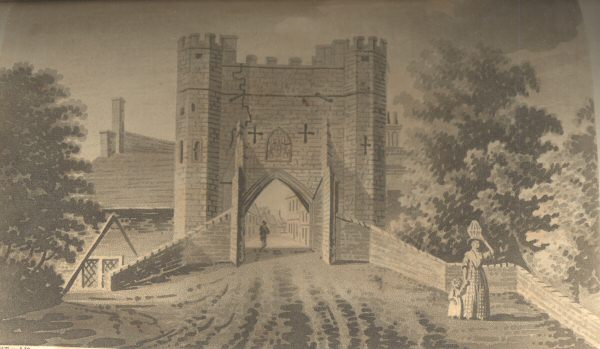
One of the most memorable of the Lynn occurrences in 1800, was the taking down the East-gates, which had stood many centuries, and made a somewhat venerable appearance. They had been for sometime a subject of complaint on account of the difficulty of entrance for highloaded waggons, by reason of the lowness of the arch. This act of dilapidation therefore was a case of necessity, and the removal of a nuisance, and it rendered that entrance into the town much pleasanter than before.—But an occurrence of this year which far more affected the public mind, in this town, as well as throughout the kingdom, was the regicide attempt of the maniac Hadfield on the evening of the 15th. of May, at Drury Lane theatre. The poor insane wretch fired a horse-pistol towards the king’s box just as his majesty entered it, but fortunately missed him, owing it seems to a person near him, with great presence of mind, raising his arm when in the act of firing, and so directing the contents of the pistol to the roof of the house. This shocking deed occasioned no small consternation in the house; but it soon subsided, and the play went on to the entire satisfaction and amusement of the whole company, the royal family not excepted.
The news of this horrid attempt upon the king’s life, and of his happy escape, deeply affected the minds of his Lynn subjects, from whom no less than two addresses were soon after presented to his majesty on the occasion; one from the mayor and corporation, and the other from the mayor and the inhabitants. [984] Both of them were penned in a language perfectly dutiful and loyal, which, without doubt, was expressed with the utmost truth and sincerity. The same may also be said of all the numerous addresses which then reached the throne, from all quarters; which proves the sovereign’s great popularity, and how high he stood in the estimation of his addressing subjects. His successor it is to be hoped will prove himself no less deserving of his people’s attachment.
Since the year 1800, and the commencement of the present century, nothing more remarkable is known to have occurred here than what has been produced by the operation of new taxes and new laws—especially our poor and paving laws. [985] These certainly have borne and are still bearing hard upon a large portion of the industrious inhabitants. Of these matters some notice has been taken already, and they will probably be further noticed when we come to give a view of the present state of the town. Such remarkable occurrences as the author may be able to recollect, or any one else may put him in mind of, as having been overlooked in the preceding pages, shall be carefully inserted in a Chronological Table at the end of the work.—Having now brought this history down to the present time, we shall here close this section.
Section X.
Biographical sketches of some of the most eminent or distinguished personages among the natives or inhabitants of Lynn, from the reformation to the present day—Watts—Arrowsmith—Goodwin—Horne—Phelpes—Falkner—Goddard.
In the list of persons of real note, or memorable distinction who appeared since the reformation among the natives or inhabitants of this town, the first place, in order of time, seems to belong to William Watts, said to have been a native of this borough, or its vicinity. The time of his birth is not recorded, but is supposed to have been about the close of the reign of Elizabeth. He probably received the rudiments of his education in the Grammar school of this town, which was from 1597 to 1608 under the care of Mr. John Man, afterwards minister of South Lynn, and from 1608 to 1612 or 13, under that of Mr. Henry Allston. He was afterwards sent to Caius College in Cambridge, where he appears to have made great proficiency, and to have finished his academical education. He then went and made some stay at Oxford; after which he travelled, as Anthony Wood says, into several countries, and became master of divers languages. In his travels he is supposed to have made his chief stay in Holland, where he became acquainted with the celebrated John Gerard Vossius, who entertained a very favourable and high opinion of him, and spoke of him as doctissimus et clarissimus Watsius, qui optime de historia meruit. At his return, after the accession of Charles I, he was made one of the king’s chaplains, and preferred successively to livings and dignities in the church. Being, as might be expected, a zealous royalist, and adhering firmly to the king’s cause, he was sequestered, plundered, and left without a shelter for his wife and children. He was carried by his courage and resentment into the field with prince Rupert, during the hardiest of his exploits; and died, in 1649, on board his fleet, in the harbour of Kinsale. He had an especial hand, says Wood, in Sir Henry Spelman’s Glossary; he edited Matthew Paris, and, exclusively of other treatises, he published, before the civil war of England began, several numbers of new books, in the English tongue, (more than forty,) containing the occurrences in the wars between the king of Sweden and the Germans. When he returned from his travels, Newspapers were very little known in this country. They had first appeared in the reign of Elizabeth, under the sage direction of Burleigh; but they were published only occasionally, and were all extraordinary gazettes. They appeared frequently about the time of the armada, and are supposed to have then answered very important purposes. Being no longer deemed necessary when that danger was past, they were discontinued. The public curiosity having been much gratified by these publications, the people would be no longer satisfied without a newspaper. It was therefore not long before publications of that kind began to make their appearance. They were at first occasional, and afterwards weekly. “Nathaniel Butter, at the Pyde-Bull, St. Augustin’s gate,” established a weekly newspaper, in August 1622, entitled “The certain news of the present week.” How long he continued his hebdomadal intelligences does not appear. He is said to have laid little before his readers, which could enlarge knowledge, or excite risibility; though his battles may have surprised and elevated, and his sieges may have alternately agitated the hopes and fears of his countrymen. He had, however, competitors and imitators. In February 1635–6 was first published a fresh paper of Weekly Newes. The foreign intelligence of May 22, was conveyed in number 13. This too was a small quarto of 14 pages; and it was printed in London, for Mercurius Britannicus; which proves sufficiently that that well known title had a more early origin than has been generally supposed. Similar papers were continued, though they assumed different names. Butter, who appears to have been the most active and enterprising newsmonger of his time, was influenced by his interest to tell—
“News, old news, and such news as you never heard of.”
He was thus induced to convert his Weekly News into half-yearly news, (two of which making a kind of annual register) which shews that he was a person of no common enterprize. In order to insure success to so novel an undertaking, an able compiler seemed absolutely necessary; and Butter very judiciously fixed upon Watts for that department. He accordingly complied with the projector’s proposal, and so became the precursor of Johnson, Burke, Kippis, Southey, and the rest of our distinguished literary characters, who have been since employed in similar departments. How long he continued thus employed we have not been able to discover; but it is probably it might be till near the commencement of the civil wars: and as he was likely to have distinguished himself, in the mean time, as a warm, and perhaps violent advocate for the measures of the court, it may in some measure account for the hardship and severity which he and his family afterwards experienced from the opposite party, by the hands of the sequestrators. Be that as it might, William Watts was certainly a person so distinguished in his day, as to deserve to have his name preserved among the most eminent characters that sprung up here during the period we are now reviewing.
2. John Arrowsmith M.A. Fellow of Catherine Hall, in Cambridge, afterwards D.D., Master of St. John’s College, and member of the Westminster Assembly of Divines. Where he was born we have not been able to learn; but he came to this town about Michaelmas 1630, being then chosen minister of St. Nicholas’ chapel, in which capacity he continued during the whole time of his residence here, which was fourteen years. The town allowed him a salary of 100l. a year, which must have been equal to 6 or 700l. of our money. He was also allowed a house to live in, or 5l. a year in lieu of it, which would pay a house-rent now of between 30 and 40l. a year. It appears that he was treated here, during the whole of his residence, with singular and universal respect; from which it may be inferred that he came well recommended, conducted himself with great prudence and propriety, and that his ministerial labours were highly acceptable. Yet Arrowsmith evidently belonged to the puritans, a party for which Lynn was never understood to entertain any particular predilection. How far his ministry contributed to prepare the town for the new order of things which took place in consequence of the siege, and with which the generality of the inhabitants appeared very compliable, we have not the means of ascertaining. But whatever might be the political tendency of his public labours here, their being highly acceptable to his hearers seems very clear and undeniable. For though he and the principal cotemporary minister of St. Margaret’s had several assistants, [990a] who performed the parts assigned to them on Sundays and week days with good acceptance, yet the present writer has in his hands sufficient documents [990b] to prove that he stood above them all in the public estimation. It is therefore presumed that we are fully warranted in placing him among the most eminent of the inhabitants of this town during the said period. The historian Neal speaks of him as a person “of unexceptionable character for learning and piety;” and further says, that “he was an accute disputant, and a judicious divine, as appears by his Tactica Sacra, a book of great reputation in those times.” He died before the restoration, and therefore his name does not appear in Calamy and Rastrick’s lists of ejected ministers.
Before we take our final leave of Dr. Arrowsmith, it may not be improper to apprize the reader of two persons whom the town successively fixed upon to occupy the vacant place of principal minister of St. Nicholas, immediately previous to their making choice of him. These, as appears to the present writer, were no other than the two Goodwins, Thomas and John, who became so famous and distinguished afterwards among the English nonconformists. In a document or record above alluded to, and extracted probably from the Hall-Books, the following passage occurs.—“1629, 12 June; Mr. Mayor and Mr. Tho. Gurlyn, aldn. travel to Cambridge to move Mr. Tho. Goodwin A.M. to come hither to (be) preacher in ys town, and Mr. M. A. CC elected sd. Mr. G. if he will accept thereof.” But he did not accept of their invitation, owing probably to his having been previously chosen lecturer of Trinity church in Cambridge, of which he afterwards became vicar. [993]
Having failed in their application to him, their next choice fell on John Goodwin, afterwards, if we are not mistaken, the noted minister of Coleman street, and the far-famed champion of arminianism and republicanism. He also was a Cambridge man, and had been Fellow of Queen’s College ever since 1617. He and Tho. Goodwin were both Norfolk men, and also near relations, if the present writer is not misinformed. But surely no two relations—not even Herbert Marsh and William Frend, could be more unlike one another. Thomas was a high supralapsarian Calvinist, and, of course, mortally hated Arminianism: John, on the other hand, was a decided Arminian, and one of its most redoubtable champions; and therefore held Calvinism in the utmost abhorrence. His firm and successful opposition to that system is said to have saved him at the restoration from utter ruin, in which his antimonarchical and republican productions would have inevitably involved him, when one or more of his books, together with some of Milton’s, were burnt by the common hangman:—a poor way, by the bye, to refute their contents, or arguments.
3. John Goodwin when invited to Lynn held the living of Rainham in the same county: yet he accepted that invitation, took up his residence here, and became the successor of Mr. Nic. Price, as chief minister of St. Nicholas’ chapel. But his settlement here was not long, scarcely exceeding one year; for he was chosen July 31. 1629—acceded to that choice on the 10th of the next month, and within a year, or very little more, from that period, he was, as the MS. says, inhibited for preaching here, [by the bishop we presume; but on what account does not appear;] and Dr. Arrowsmith was appointed to succeed him, at the michaelmas following, i.e. 1630, for further particulars concerning him, the reader is referred to the historians of the succeeding period, and to our general biographers. [994] With all his singularities and imperfections, he must have been in his day a very considerable and highly distinguished character.
4. John Horne—was another of our townsmen of former times, whose name deserves to be rescued from oblivion, and retained in the memory of the inhabitants. He was born at Long Sutton, Lincolnshire, in 1615; and educated at Trinity College in Cambridge, where he had Henry Hall B.D. for his tutor. He probably went into orders before 1640; and we are told that he preached first at Sutton St. James, in his native neighbourhood. It has been also supposed that he had afterwards a curacy at or near Bullingbrook, in the same county, and it seems somewhat probable that he married during his residence at that place. [995] Be that as it might, it is certain that his stay there was not very long, for he took up his residence at Lynn in 1646, [996] where he continued ever after to the day of his death, which was full thirty years. His coming hither was in consequence of having obtained the living or vicarage of Allhallows, or All-saints, in South Lynn, where he succeeded Mr. John Man, whom we noticed before, at p. 702 of this work, and who had resided here, first as usher, then master of the Grammar School, and afterwards as vicar of South Lynn, for the long space of between 50 and 60 years. [997a]
Having obtained the vicarage of South Lynn Allhallows, in 1646, Mr. H. continued in the faithful and diligent discharge of his duty there till 1662, when the act of uniformity, which took effect on Bartholomew day that year, [997b] rendered his situation there no longer tenable. He was then ejected from his vicarage of Allhallows in this town, as were also above 2000 worthy clergymen in different parts of the kingdom, to the great discouragement of integrity and piety, and the eternal disgrace of the rulers in church and state. A very respectable biographer and memorialist speaks of Mr. Horne as follows—“He was an Arminian in the point of redemption, and contended earnestly for the universality of it; but did not either believe or teach, that men may therefore live as they list, because Christ died for them; but taught that Christ therefore ‘died for all, that they which live should no longer live unto themselves, but unto him that died for them and rose again.’ 2 Cor. v. 14, 15. He was a man of most exemplary and primitive piety, and blameless conversation; very ready in the scriptures; excellently skilled in the oriental tongues, and very laborious in his private capacity after he was cast out of his living. He went constantly to church, and yet preached thrice at his own house every Lord’s day; first, in the morning before sermon; then after dinner, before church-time; and again in the evening. On the other days of the week, beside lecture-sermons, he constantly expounded the scriptures in order twice a day, to all that would come to hear him, as some always did. [998] He was a man of great charity, commonly emptying his pocket of what money he had in it amongst the poor, when he went into the town. He was of great compassion and tenderheartedness towards such as were in any affliction; a man of wonderfull meekness, patience, and dispassionateness; and was generally very much honoured and esteemed for his goodness, both in town and country.” We need no further proof of his being held here in high and general esteem, than that he was suffered to live in the town, and exercise his ministry, for the whole fourteen years he resided here after his ejection, and which was perhaps the very worst part of the persecuting and detestable reign of Charles II. Some old people used to say some years ago, that his lecturing or preaching place was in some obscure alley about Black-goose Street. However that was, Mr. Horne may justly be considered as the father of the Lynn Dissenters: nor need they be ashamed to own him as such. Beside his other labours, which were so very abundant, his labours as a writer were by no means inconsiderable. Mr. Palmer has preserved the titles of near thirty publications, of different sizes, of which he was the author; [999] which shews how active he was in employing his pen, as well as his tongue, in promoting what he deemed useful and profitable instruction. On the whole, it may be pretty safely concluded that such a union of laboriousness, conscientiousness, and piety, as appeared in the person of Mr. Horne, was scarce ever witnessed in any minister of this town, either before or since his time. His memory therefore ought to be very highly honoured. He died here on the 14th of December 1676, aged 61. His wife survived him near ten years. She died May 24. 1686, aged 73. What family they had we are unable to say. One Son, named Thomas, died about two years before the father, at the age of 28: and we are inclined to think there was another son, of both the father’s names, who long survived his parents, and that this son was no other than the afterwards famous master of the Lynn grammar school, who may be justly called the Dr. Busby of this town. That he exercised over his pupils so severe a discipline as that of the celebrated master of Westminster School, is what we will not take upon us to affirm—nor yet that he educated an equal number of eminent men; but in the assiduity with which he executed his charge there must have been a strong resemblance, and especially in the length of time he continued at the head of his seminary, for he held the mastership of the Lynn grammar school upwards of fifty years. He must therefore have been notable and eminent in his day among the inhabitants of this town. On which account, whether he was the son of the former John Horne, or not, he is entitled to some notice in the present list.
5. John Horne junr. A.M. (of the University of Cambridge, as it is supposed) was born in 1644. So that in case he was the son of the former, he must have been born about two years before his father settled in this town, which will very well agree with the former supposition, of his being previously married, while he resided at, or near Bullingbrook. After he left the university, the subject of the present article was for some time usher of the Grammar School at Norwich, whence he was invited to become master of that at Lynn. This was in 1678: whereupon he removed hither, and continued at the head of this school above 50 years; so that it may pretty safely be concluded that he educated a far greater number of pupils than any other master in this town. He died in 1732. aged 88, and was buried in St. Nicholas’ chapel, close to the grave of the other John Horne; which, together with his refraining from going into orders, may corroborate the opinion of his being the son of that worthy and memorable man. [1001a] However that was, he appears to have been a person of a very respectable character, who faithfully served his generation, and deserved well of his cotemporaries and of posterity; [1001b] which, it is to be feared, is more than can be said of all, or every one of his successors.
6. Charles Phelpes. In point of time he ought to have been placed before the last, being his senior, by near twenty years. But as the former was supposed to be the son of the preceding, it was thought proper to let his name immediately follow. The subject of this article, if not a relation, was yet an intimate friend of the elder Horne, and perhaps an occasional assistant to him in the ministry; but of this there is no clear proof. Nor is it at all certain that he afterwards ever officiated in the congregation as a public teacher. [1002a] All we know of him is, that he was a person eminently distinguished here in his day for his religious knowledge, his benevolence, and his piety, which he strove unweariedly to promote by his example, his conversation, and his writings. [1002b] In short, he was a blessing to the town, and one of that sort of men that may not improperly be called the “salt of the earth,” to whose benevolent and pious exertions we owe almost every thing truly good and valuable that is to be found amongst us. He was therefore clearly entitled to a place in this list, or biographical sketch. He died on 3rd of January 1711 in the 85th. year of his age, as we learn from his grave stone to St. Nicholas’ Church yard, over against the great South door, where it is said, and said truly no doubt, that he was “a person of exemplary piety and goodness.” We have heard that he was great uncle to the late vicar of South Lynn of the same name, who, though of inferior worth, was yet far from being one of the worst sort of clergymen.
7. Guybon Goddard. We hear of him first as Deputy Recorder of this borough, in 1645, under the memorable Miles Corbet, who had been chosen Recorder the preceding year. Goddard continued his deputy till 1650, or rather till the beginning of the ensuing year, when he succeeded to the recordership, as appears from the following passage in the Hall-books. “Jan. 31. 1650, 51; This day Mr. Mayor and aldermen have elected and chosen in the place of Miles Corbet, Esq. (called by the Parliament to the service of Ireland) Guybon Goddard Esq. Recorder, provided always, that he, accepting of the place, shall come and inhabit in this town, for the better assistance of the succeeding mayors with his advice and councell.” It may be supposed that he took up his residence here accordingly. However that might be, it seems he retained the place over after, and executed the duties, attached to it with much credit to himself, and to the satisfaction of the body corporate and the rest the community. He was doubtless very good lawyer, but more distinguished perhaps as an antiquary, to which pursuit he was much devoted, in which his acquirements we supposed to have been very considerable. His brother-in-law, Sir William Dugdale, and Parkin also, make honourable mention of his antiquarian attainments, [1003] and is such a case they must have been very competent judges. To archaiological objects in the adjacent and surrounding country he paid much attention, and still more to those that appertained to this town, his collection for a history of which is supposed to have been very complete, and excited for a long while very high expectation among his cotemporaries. But they were all sadly disappointed; for it was never suffered to see the light: and though the corporation, after his decease, endeavoured to procure it from his son, and offered for it what must have been at that time a handsome gratuity; yet it does not appear that they were able to obtain it. What became of it afterwards no one can tell: but it is most probable that it has long ago been irretrievably lost. Had it been preserved, and fallen into the present writer’s hands, it might (as was hinted at p. 821,) have rendered this work far more worthy than it now is of the public patronage. In Parkin’s History of Freebridge (p. 293,) the death of Goddard is placed in 1671, which we suspect to be a mistake for 1677, as the application to his son was made about the beginning of the next year; and it is not likely it would have been deferred for so long a time as seven years. However that was Guybon Goddard seems clearly entitled to have his name enrolled among the memorable men of Lynn.
8. William Falkner, D.D.—He came to this town in 1658, recommended by Dr. Arrowsmith and Dr. Tuckney, and was engaged as an assistant to Mr. Hoogan, who had succeeded Dr. A. as senior or principal minister of St. Nicholas’ Chapel. Falkner was then Fellow of Peter-house in Cambridge; so that there is no reason to suppose him the same as that William Falconer, M.A. of Aberdeen, whom, according to Granger, Wood in his Fasti mentions, under 1671, as incorporated into the University of Oxford, and one of the first exhibitioners at Baliol College. At the death or removal of Mr. Hoogan, F. appears to have succeeded him as chief minister, and in that situation he is supposed to have continued ever after; though, considering the prominent appearance he made among his brethren, it is not likely that he was left without other preferments. His residence here was about 24 years. He died April, 9. 1682: nor does it appear that he was then an old man; about 50, perhaps, or very little more. We have not been able to learn the character of his public ministry and pastoral labours, or how far he therein resembled Horne, or Arrowsmith. But, as a scholar and writer, he must have stood high among the Lynn clergy, and even among those of the whole diocese; for he was very learned, and his writings for the most part, were well calculated to render him famous among his brethren, and gain him the approbation and applause of the highest dignitaries of the church, and the chief functionaries of the state, or civil government. For passive obedience and non-resistance, and the whole tory system, then the darling doctrine of the clergy and the court, he was a warm and able advocate. Nor was he less so for the church of England, against the Romanists, on the one hand, and our protestant sectaries, on the other. How he would have stood, had he lived a few years longer, or till the eve of the revolution, it is impossible to say. But it is certain that many, who were to the full as torified as he in the reign of Charles, changed their minds and their tones greatly during that of his successor, so as to caress as friends and brethren, those very sectaries and schismatics, as they used to call them, whom they had before endeavoured with all their might to distress and crush. That Dr. F. would have done the same, had he lived so long, is more than we are warranted to affirm, through we would fain hope that such would have been the case.—Among the books of which he was the author were several pieces of divinity, which first perhaps appeared separately, but were in 1684, two years after his death, printed together in a quarto volume. As it has never fallen in our way, we can say nothing of its merits. But his principal publications seem to be the following; 1. Libertas Ecclesiastica, an english octavo volume, published in 1674, and spoken of, by Granger, as a book of merit. 2. A vindication of Liturgies, or set forms of prayer: printed in London in 1680. This was animadverted upon and answered by the memorable Dr. Collinges of Norwich, an eminent ejected Minister, first in a piece entitled, “A reasonable account of the judgment of nonconforming ministers, as to prescribed forms of prayer; with a supplement in Answer to Dr. Falkner of Liturgies;” and afterwards in another piece, entitled, “The vindication of Liturgies, lately published by Dr. Falkner, proved no vindication, &c.” 3. Christian Loyalty: or a discourse, wherein is asserted that just Royal Authority and Eminency which in this Church and Realm of England is yielded to the KING. Especially concerning supremacy in Causes Ecclesiastical. Together with the disclaiming of all Foreign Jurisdictions and the unlawfulness of Subjects TAKING ARMS against the King. This is a most notable production, and it seems not a little unaccountable that it did not immediately procure him a mitre. It is much in the way of Sir Robert Filmer, and the rest of our great Tory-writers, and scarcely inferior to the very best of them. It was printed in London in 1679, and again, it seems, in 1684, which shews that it was well approved of and sought for. Dr. Falkner dying, as was said, in 1682, was succeeded at St. Nicholas’ by a Mr. Killeingbeck, of whom we have heard nothing further.
Section XI.
Biographical Sketches continued—Littel—Pyle—Hepburn—Rastrick—Browne—Keene—&c.
9. Thomas Littel, D.D. He is supposed to have settled here, as one of our officiating clergy, pretty soon after the revolution; but whether as vicar and principal minister of the town, or as Lecturer, or in an inferior station as the Vicar’s curate, we cannot positively say. It is certain however that he soon succeeded as vicar or chief minister of the town, and continued in that situation for a great many years. Though a Doctor in Divinity, he is supposed not to have stood high among his brethren and contemporaries as a scholar, a preacher, or as a divine; but there were traits in his character that were of no unamiable cast, especially in regard to his attention to the edification of the common people. In more recent times he would probably have been deemed a methodistical clergyman, which is not mentioned here as dishonourable to his memory, but rather the contrary, as it is the opinion of the present writer, that if a reasonable portion of methodism were imbibed by the clergy, it would render their ministry more popular, and prove of material advantage to the lower orders of their auditors. In Dr. Littel’s time, a great many of his hearers, of the poorer classes, as it would seem, became desirous of improving themselves in religious knowledge; and the course that appeared to them most likely, or the best for attaining that object was to establish private meetings for free discussion, or serious conference. Whether they had been led to this from something of the kind that existed among their dissenting neighbours here, we are not able to say; but it is certain that such exercises are much more common among dissenters than among churchmen. However that was, it seems they were not disposed to put the plan in practice without consulting Dr. Littel, who was then vicar of St. Margaret’s and chief minister of the town: and it does not appear that he urged any material objection, or gave them any serious discouragement. But he was aware that it would not be safe or proper for him to countenance such a measure without the privity and permission of his diocesan. He accordingly applied to Dr. Moore, who then filled the see of Norwich, and who, in his answer, dated September 10. 1697, appeared no way hostile to the measure, provided it were properly conducted; though he said, however friendly he might be to the design, yet he did not find he had any power by law to constitute and authorize such assemblies. Nevertheless he consented to allow the experiment to be here tried, under certain regulations. This episcopal letter is on the whole a very curious document, and not dishonourable to his lordship’s memory; but it is too long for insertion here. He cautioned them to avoid all discussions about state affairs, and whatever might tend to give umbrage to government; and he advised them to meet in small rather than large companies: which advice was probably adhered to. However that was, the intended measure was soon put in practice. For six or seven years the meetings seem to have been kept in private houses, under certain general regulations. But in 1704 the plan was further matured, new rules of conference were drawn up, [1010] and the meetings afterwards were generally if not constantly kept in the Vestry of St. Margaret’s Church, till the death of Dr. Littel, which happened in 1732. The Society then languished and dwindled away, so that in the year 1744 it was reduced to six members, whose names were Colins Banister, James Cowell, Joshua Edwards senr. Adam Holditch, John Lee, and William Rayns: It appears to have been dissolved soon after, having existed about fifty years; and for a long time no memorial of it remained, except in some old papers which fell into the present writer’s hands accidentally. This Society had formed a library, a catalogue of which it also in this writer’s possession. What became of the books at last, does not appear. We know of nothing more creditable to the memory of Dr Littel, than the countenance he afforded to those serious people. It is supposed that his successor in the Vicarage of St. Margaret did not also succeed him as the patron of this Institution.
10. Thomas Pyle M.A. Of the birth-place and the early part of the life of the rev. T. Pyle, whose name is still mentioned with veneration by the few who remember him as a preacher, we have not been able to obtain any account. So rapid is the neglect or the forgetfulness of oral tradition! From his epitaph we learn indeed that he was born in 1674. About the year 1698, he was examined for ordination, at Norwich, by the celebrated and truly honest William Whiston, at that time chaplain to bishop Moore, who has stated in the interesting Memoirs of his Life, that Dr. Sydal and Mr. Pyle were the best scholars among the many candidates whom it was his office to examine. It is probable that he was ordained upon the title of one of the curacies of St Margaret’s parish, as he married, in 1701, a Mrs Mary Rolfe of an affluent and respectable family in Lynn, and in the same year he was appointed by the Corporation to be minister or preacher of St. Nicholas’ Chapel. He published some political Sermons in the years 1706, 1707. and especially in the year 1715. In these discourses he vindicated and enforced those principles to which we are indebted for the expulsion of the Stuarts, and for the elevation of the Brunswick family to the throne. About the same period he became generally known as the author of a very useful Paraphrase on the Historical Books of the Old Testament, and another on the Acts, the Epistles and the Revelation of the New Testament. Soon afterwards he enlisted himself as a writer in the Bangorian Controversy, and was a strenuous and able advocate of the civil and religious principles of Bp. Hoadly. He appears to have been on terms of particular friendship with some of the greatest and best men in the Church of England, such as Dr. Sam. Clarke, Mr. Jackson of Leicester, Dr. Sykes, Bp. Hoadly, Dr. Herring, afterwards abp. of Canterbury; and equally so with some eminent dissenting ministers, particularly Dr. Sam. Chandler and Mr. Rastrick of Lynn. Many years after his death his youngest son, the rev. Philip Pyle, published several volumes of his “Sermons on plain and practical Subjects.” His writings are characterised by a perspicuity and manly sense, rather than by any elevation of style, or by a graceful negligence; and yet in the delivery of his sermons, so impressive was his elocution, that both in the metropolis and in the country, he was one of the most admired preachers of his time. The flowing lines were sent to him on his Sermon preached at Lincoln’s Inn, May 4th. 1735, on Gen. III, 19.
What sounds are these! What energy divine, What master-strokes in every precept shine! While from thy lips the warm expression breaks, What heart but melteth as the preacher speaks! Thy voice is nature, and thy diction clear, It strikes like music on the listening ear. —“Vain foolish man to murmur at thy fate, The bounteous hand of heaven still leaves thee great; Still makes thee first of beings here below, Still gives thee more of happiness than woe. To lazy indolence this world may seem A barron wilderness; an idle dream; Thistles and brambles to the slothful eye, But roses to the hand of industry. ’Tis sordid avaries, with her sneaking train, Ambition, who torments herself in vain, Th’ unnumbered lusts that prey upon the mind, Fix the primeval curse on human kind. By their brow’s sweat their bread the labourers earn, But then no passions in their bosoms burn: Soon as the evening shade the day-light close, Unbroken slumbers crown their soft repose; And when the morning dawn salutes their eyes, Anteus-like, with double vigour rise. No stings of conscience! no remorse from sin! They feel the noblest paradise within; Content serene, that sunshine of the soul, With her warm beam invigorates the whole; Her blossom, health! her fruit, untainted joy! Nor pain nor death her relish can destroy; In unpolluted streams her pleasures flow, No weedy passions in her bosom grow.” —Thus faintly have I sketch’d thy glorious plan; Which fills, improves, adorns the inward man. Still urge thy generous task, to cleanse the mind, Till from the dregs of passion ’tis refin’d; To prune each vice, each folly of the age, Each wild excrescence of this earthly stage. Tho’ old in goodness, to the world resign’d, Still want thy heaven to give it to mankind. Religion’s friend! and virtue’s strongest guard! That heaven alone such merit can reward, Its joys approach no tongue but thine can tell; Doubt not to taste what thou describ’st so well.
With such talents, and with such connections, it cannot easily be accounted for, that Mr. Pyle should remain during so long a life in a situation of comparative obscurity. Sir Robert Walpole was the member for Lynn; and both the political and religious opinions of Mr. Pyle were calculated to recommend him to queen Caroline, who then impartially dispensed the dignities of the Church. Perhaps the spirit of the man was not thought sufficiently accommodating for an introduction to a court; or, like the late Dr. Ogden of Cambridge, from some deficiency of external polish, he might be deemed not producible. A passage in Abp. Herring’s Correspondence with Mr. Duncombe seems to be decisive on this point. “Tom Pyle is a learned and worthy, as well as a lively and entertaining man. To be sure his success has not been equal to his merit, which yet, perhaps, is in some measure owing to himself; for that very impetuosity of spirit, which, under proper government, renders him the agreeable creature he is, has, in some circumstances of life, got the better of him, and hurt his views.” [1015a] From whatever cause, with the exception of a Prebend of Salisbury, which he received from Bp. Hoadly, he was only in succession Lecturer and Minister of Lynn St. Margaret, and vicar of Lynn All-saints—all truly but a poor and paltry pittance for such a man, and from a church which had such immense abundance of good things to bestow; most of which too were actually bestowed on far unworthier objects.—The following Letters which passed between Mr. Pyle and Abp. Herring are highly characteristic and interesting.
“My Lord,
In the universal acclamation of joy for your Grace’s promotion to the Primacy of all England, may the feeble voice of an old man be heard, the short remainder of whose life, will pass off with a pleasure that nothing could have given, but seeing at the head of the Church, a Prelate so affectionately attached to the interests of Truth, Virtue, and Liberty.
I am, my Lord, your Grace’s most dutiful Servant. Tho: Pyle.”
“Dear Sir,
Your kind wishes for me give me spirit, and make my heart glad, for in good faith, I have been teazed and terrified with this exaltation; and thus much I will venture to say for myself, it sha’nt make me proud, it sha’nt make me covetous, it sha’nt make me ungrateful or unmindful of my Friends, but it frights me, and I fear has robbed me of the most precious thing in life, which is Liberty, but I will assert as much of it as I can, and not be for ever bound to the trammels of a long tail and ceremony, which my soul abhors.
I saw S—. Ch—r the other day. I really affect and honour the man, and wish with all my soul that the Church of England had him, for his spirit and learning are certainly of the first class; and I regard him the more because he resembles you and your manner. You talk of age and all that, but if I may judge from your letter, your eyes are good, your hand is steady, and I am sure your heart is warm for your friends, and those good things you mention, Truth, and Virtue, and Liberty, but that sort of warmth will certainly go to the grave with you and beyond it.
I am, Dear Sir, your affectionate Friend, Tho: Cantuar.” [1017]
Kensington. 17. Dec. 1747.
From the part which Mr. P. took in the Bangorian Controversy, and the terms of particular friendship on which he was known to live with Bp. Hoadly, we may be very sure that there subsisted between them a frequent correspondence. Copies of two of the letters that passed between them are now in the hands of the present writer. He has no reason to suppose that they ever have been published, or are likely to be so, unless they appear on this occasion. Thinking it highly probable that a sight of them cannot fail of gratifying many of his readers, he takes the liberty without further ceremony to introduce them in this place; not at all apprehensive that their contents will any way disparage the memory of either of the memorable personages by whom they were originally written,
“My Lord,
You may remember that when by your kind aid the affair of M—m was concluded in my Son’s favour, I presented my humble (and said it should be my last) petition to you, begging of you to be pleased to bestow on him a living that might consist with M—m, and that you were so good as to promise to give him any living you had not then engaged to dispose of otherways.—An incident has lately arisen of such a nature, as, I am sure will excuse my repeating the above-named request to your Lordship, with the utmost earnestness.—My Lord, Mrs. Bilk the D. of N—ch’s W. with her husband’s good liking, and out of the esteem she has long had for me and mine, and especially for my son Ph—. has been pleased to propose him as a H. for her niece, the only child of Mr. Arrowsmith: such a proposal from one who can and will make a considerable addition to the very good fortune that the young lady’s father can give her, is a great proof of her esteem for my son, who has been much with her from his childhood: and what she requires on my part is that I use my interest in your lordship, and mention her as joining with me to beg of you to confer a handsome living on my Son. This will crown all the instances of your beneficence towards me.—I want words to express the joy with which a happy success in this affair would carry me thro’ the small remainder of my life, and make me yield it up to its bounteous Author; or to describe the tearing anxiety that would accompany a disappointment from your refusing what I humbly ask.—Wherefore I beg of your lordship to make me feel the beginning of that satisfaction I have already in view by such a reply to this petition as may be pleasing to the excellent friends I am herein concerned with, and so highly obliged to, and to the heart of an old servant who has loved you all his life, and served you as well as he could (would to God it had been better) & will love you till death and beyond it. I am,
my Lord, yours &c. T. P.”
“Dear Sir,
6. Feb. 1752,
You cannot rejoice more sincerely at any good that falls on any part of your family than I do: tho’ you may feel it more paternally. In answer to what you propose, I first say that I was 75 years old on the 14th of last November. What may happen God only knows. But if it shd be both physically and morally in my power to serve your Son, you may depend upon it without the force of the strong expression you make use of. For my own inclination will in such case do it. And the regard I have for the D. of N—ch (and his lady, tho’ unknown, only by report) and for Mr. Arrowsmith, to whose faithful services and exemplary behaviour I was long ago a witness at Stretham, will not at all abate but increase the inclination. I cannot suppose that by what you say you can mean such a living as would make void M—lksham which your son told me was worth 250l. per ann. for that would be to [1020] . . . entirety a valuable living very hardly obtained; but one that would be an handsome addition to his income. And this must be one within the canonical distance. Nor do I suppose that the chapter of Salisbury will ever enter into measures for an exchange of Mlkshm &c. I wish you would tell me freely what you understand by an handsome living, assuring you of my sincere disposition to do any thing in my power agreeable to your own wishes. I have without doubt several good livings in my patronage. But you must remember that when you mentioned your request for your son Ph. first, I told you of engagements, and I now tell you that since that, I have not had one vacancy, as far as I can recollect, of a living in Wilts of about 130l. per annum. I think myself obliged to speak plainly, that nothing may be expected from me that I cannot pretend to perform. I have, and have had, for some years, two absolute engagements upon me for two of my best livings or such of a secondary sort as will be accepted of till better fall. And I am very sure, you are not the man that would say a single word to me towards the immorality of falshood or breach of promise. And I have the very same opinion of the goodness of heart of those worthy persons who have entered into this affair with you. As to actual vacancies, it is our duty not to wish for any by death. And they are very uncertain, and improbable to happen during the remainder of my life, tho’ my health is surprisingly better than it was in my younger days. With all these considerations of my age, and the precarious condition of all human affairs, if you will take my word, you will find me if alive, as sincere a Friend, as you yourself can wish to find.
Your affectionate &c. B. W. [1021]
Mr. Pyle, as was said before, obtained the lectureship, and became the preacher at St. Nicholas’ chapel, and one of the ministers of the town in 1701. In that situation he continued till 1732, when he succeeded Dr. Littel as vicar of St. Margaret’s. This situation he held till 1755, being no longer capable of discharging the duties annexed to it. He accordingly gave in his resignation, both to the Dean and Chapter of Norwich, and also to the Mayor and corporation of Lynn, early in the Summer of that year. How his resignation to the former was worded we know not, but his resignation to the latter, of which we have obtained a was expressed in the following words: and addressed to the elder Cary, then in the second year of his mayoralty.—
“Sir, A long decline of life, and absolute incapacity of attending on such a ministry as that of Lynn, calls upon me to resign it to some hands able in due manner to discharge it to the good-liking and satisfaction both of the Dean and Chapter of Norwich and of the mayor and corporation of Lynn. But I cannot nor ought to do this, without paying my just and most grateful acknowledgements to yourself, Sir, with the former magistrates, and the rest of the gentlemen of your Body, for the favours they have, for a long tract of time conferred upon me, and in particular for their tender and generous indulgence towards me in these last years of my age and infirmities. I request, Sir, you will please to make your hand the conveyor of this only return left in my power of thankfulness to them, accompanied with the sincerest wishes of every kind of good that can finish the welfare and prosperity of an ancient, generous, and loyal society; wishes from the heart of yours and theirs most affectionate humble Servant
Tho: Pyle.”
May 28th. 1755.
This Letter is supposed to have been dated from Swaffham, where, on account of its healthy situation, he resided the two last years of his life; and where, if we are not mistaken, he also died on the last day of the ensuing year. He was buried in the Church of Lynn All-Saints, where a latin epitaph honourable to their memories, is inscribed on the stone that covers the remains of him and his wife. She died the 14th of March 1748, aged 66: and he died the 31st. of December 1756, aged 82. This was 58 years after the commencement of his ministry. He was succeeded in his pastoral charge at Lynn by the late Charles Bagge D.D. whose ministerial as well as literary character must have been widely different from his; and yet it does not seem to have made any mighty difference as to the audience, who, it is presumed, went on much as before, praising the successor in terms very similar to those they had been wont to apply to his predecessor. Thus it often happens after the departure of eminent men, both in the church and in dissenting congregations.
11. Edmund Pyle D.D. was the eldest Son of the former, and a native of this town. In piety and inflexible integrity he is supposed to have been much inferior to his father; and the same was probably the case as to literary attainments, theological knowledge, critical skill, and ministerial talents: but he was certainly a man of no mean parts, as many of his letters that are still extant sufficiently evince. He was educated at Cambridge. When he went into orders, or where he officiated immediately after, does not appear; but in 1732, upon the death of Dr. Littel, and the appointment of his father to be his successor, he then succeeded to the vacant place, and became the lecturer, or assistant preacher and minister of this town; which situation he held till the year 1751, when he resigned in favour of the late Mr. Vann Eyre, and became chaplain to Bp. Hoadly, and a Prebendary of Winchester. After the Bp’s death, which happened in 1761, he is supposed to have resided during the remainder of his life at his prebendal house in that city, and to have died there in 1776. At Lynn he was deemed proud and unsociable, which character he, probably, might deserve, for we have sufficient evidence that even the gentry of this town, for the most part at least, stood so very low in his estimation as not to deserve his associating, or holding any communication with them but what was unavoidable: which to be sure was not altogether commendable, considering that he stood to those very people in the relation or character of one of their pastors. But it is certain that he could at times divest himself entirely of every appearance of superciliousness and reservedness, and behave towards those whom he esteemed in a very free, familiar, engaging and entertaining manner. Of this his letters still extant are a very good proof, [1024] and the same is corroborated by the testimony of some of his contemporaries who long survived him. His two brothers, Thomas and Philip, who were much younger than he and lived long after him, though not inferior to him in point of piety and moral worth, were yet thought to be much so in point of acumen, or quickness of intellect, and literature. They had also three sisters, all well spoken of, and that is supposed to have been all the family their father left.
12. George Hepburn (or Hepborne) M.D. He is supposed to have settled here about the commencement of the last century, as a physician; in which character he soon acquired high reputation, so as to be placed at the head of the profession in this part of the kingdom for near if not quite half a century. He was the favourite physician of Sir Robert Walpole the then prime minster of this country, with whom he spent much of his time at his princely seat at Houghton: and he was also employed in the same capacity by the principal nobility and gentry of this county. Very striking and diverting anecdotes are related of him during his long residence in these parts: but they are hardly proper to be inserted in the present memoir. He was certainly a very eminent and distinguished physician. His posthumous fame is not yet extinguished, as he is still remembered and mentioned, with the utmost respect whenever the conversation leads to the recollection of our eminent men of the last century. His reputation in the latter part of his life was become so very considerable that he was seldom to be found at home, being almost always attending one or other of the great families in the country. The town-practice consequently devolved upon the two other physicians, Browne and Lidderdale, both of whom were skilful and judicious practitioners. But as he lived to a very advanced age, it so happened that his eye sight gradually failed, and he became quite blind some years before he died. Having a large family to maintain, and being perhaps during his extensive practice not very economical, he would towards the close of life have been reduced to great difficulties, had it not been for two pensions which he then very seasonably obtained; one from George II, through the interest and friendship of Mr. Pelham, of 100l. a year; and the other from Dr. Maxwell, a rich relation of his own, of double that sum; which placed him above want, and rendered his situation tolerably easy and comfortable. In Walpole’s life time, and during his long premiership, while Hepburn was at the height of his fame, and in extensive practice, there might be no obvious or urgent season for befriending him and making provision for him in a similar way; otherwise it cannot well be supposed that that minister would have neglected it. But now the case was altered; the once celebrated and much sought physician was become old and blind, and no longer capable of following his profession, and gaining as theretofore the means of supporting himself and family. Something therefore was to be done for him, or he would sink into penury and want. It has been reported that though his practice was extensive, yet his fees were but moderate, considering the length and expence of his journeys, with the great attendance often required by his patients. So that his not dying wealthy was less owing to his improvidence and want of economy or frugality, than to the ungenerous and niggardly conduct of his patients or employers. Correspondent with this is said to have been the experience of others of our physicians since his time, particularly the late Dr. Hamilton, who never could boast of the great liberality or munificence of our opulent families, altho’ he was for some time our only physician. In short, this writer does not recollect having ever heard that any physician grew rich here by his practice, however extensive, unless it was Sir W. Browne, and it is generally understood and allowed that he really could do things which most other people could not. Dr. Hepburn died in 1759, at the very advanced age of ninety. He was a North Briton, as were also many, if not most of our eminent physicians. We have not been able to ascertain in what part of North Britain he drew his first breath, but rather suppose it to have been in East Lothian, and at, or near Haddington. [1030] Nor have we been able to discover at what university he was educated, but think it most probable it was that of Edinburgh, where so many eminent men of the same profession have been since educated. Dr. H. was twice married, first in 1693, to one of his own country-women, who died in 1707, aged 30. There were several children by this marriage. He afterwards married again, and his second wife was a Lynn woman. By her also he had some children, two of whom at least survived him. But they were remarkably and vastly inferior, in point of genius and capacity, or intellectual endowment, to those of the first marriage. His eldest daughter married a Mr. Young, and was the mother of the late Miss or Mrs. Dorothy Young, a lady of distinguished intellectual and literary talents. Another daughter became the wife of Dr. Lidderdale an eminent physician who settled here in the early part of George the second’s reign; and died here, in 1766, much regretted, as he is said to have stood high in the public estimation. The other daughter by the first wife lived single; but was a very extraordinary character, and stood unrivalled all her life time among the wits of this town. Her keen sayings, and stinging repartees are still fresh in the recollection of her surviving cotemporaries. Between her and her father’s daughters by his last wife there was a most striking and humiliating contrast: they being but little distant from idiocy.
13. William Browne M.D. afterwards Sir William Browne, Knight, F.R.S. and President of the Royal College of Physicians. Though he has been already noticed repeatedly in the course of this work, yet as he made so conspicuous a figure here in his day, and our materials relating to him not being yet exhausted, he seems justly entitled to a place among these biographical sketches. He was born about the beginning of the year 1692. The place of his birth we have not been able to discover, but think it to be at some distance from this town. We have understood that he was introduced here by the means and under the patronage of the Turner family, to which he became afterwards implacably hostile. His settlement here must have taken place at an early period of his life; for his name was enrolled among our free burgesses in February 1718; which must have been some time, perhaps two or three years, after he had first taken up his residence here. Yet he seems to have previously resided and graduated both at Cambridge and Oxford, for he denominated himself M.D. of both Universities. However that was, he appears to have soon got on fast in the way of his vocation, so as to obtain a large share of popularity and practice, especially among the middling and lower orders of the community, which he is said to have turned to very good account. And he is understood to have made much more of his patients, in the pecuniary way, than Hepburn was able to make of his among the higher orders. Having become the popular physician and favourite, or what we may call the man of the people, he grew quite regardless of the favour and good opinion of the gentry or higher classes. As to the gentlemen of the corporation, he held them very cheap, and treated them at times with the utmost disdain, looking upon them as his inferiors, and taking precedence of the very mayor himself, which gave no small umbrage, as was observed before, at page 900. This took place as early as the year 1723: and this hostility to the body corporate appears not to have undergone any abatement during the remainder of his residence here.—Before we proceed further we will beg leave here to subjoin the account given of him in the Encyclopedia Londinensis, the substance of which is as follows—
“Browne (Sir William,) an eminent physician, settled originally at Lynn, where he practised with great success and profit. Having acquired a competency by his profession, he removed to Queen Square, Ormond Street, London, where he resided till his death, which happened March 10, 1774, at the age of eighty two. By his will he left two prize medals to be annually contended for by the Cambridge poets. By his lady, who died July 25, 1763, in her 60th year, he had one daughter, mother to the present Sir Martin Browne Folkes, bart. Sir William Browne was a very facetious man, and the active part taken by him in the contest with the licentiates, in 1768, occasioned his being brought on the stage, in the farce of the Devil upon two Sticks. Upon Foote’s exact representation, of him, in this farce, with his identical wig and coat, tail figure, and glass, stiffly applied to his eye, he sent him a card, complimenting him in having so happily represented him; but, as he had forgot his muff, he had sent him his own. He used to frequent the annual ball at the ladies boarding school, Queen square, merely as a neighbour, a good natured man, and one fond of the company of sprightly young folkes. A dignitary of the church being there one day to see his daughter dance, and finding this upright figure stationed there, told him he believed he was Hermippus ridivivus, who lived anhelitu puellarum, ‘by the breath of girls.’ At the age of eighty on St. Luke’s-day, 1771, he went to Batson’s coffee-house, in a richly laced coat, embroidered waistcoat and band, and fringed white gloves, to shew himself to Mr. Crosby then lord Mayor. A gentleman present observing that he looked very well, he replied, “he had neither wife nor debts.” When he lived at Lynn, an extremely censorious pamphlet was written against him, which he nailed up against his house door, for the gratification of all who chose to inspect it. A great number of lively essays, both in prose and verse, the productions of his pen, were printed and circulated among his friends, Among those written during his stay in Lynn were, an Ode in imitation of Horace, ode 3, lib. iii, addressed to Sir R. Walpole, on his ceasing to be minister. The Pill Plot; to Dr. Ward, a quack of merry memory, then in the town; written Nov. 30. 1734. He also translated from the latin original, Dr. Gregory’s Elements of Catoptrics and Dioptrics, to which he added 1. a method for finding the foci of all Specula, as well as the Lenses universally, as also magnifying or lessening a given object by a given speculum, or lens, in any assigned proportion. 2. a Solution of those Problems which Dr. Gregory has left undemonstrated. 3. a particular account of Microscopes and Telescopes, from Mr. Huygens; which was published at Lynn. His other works are, 1. Opuscula varia utriusque Linguæ Medicinam, 4to 1765—2. a Farewell Oration, 1768, 4to—3. Fragmentum Isaaci Hawkins Browne completum, 1769, 4to—4. Appendix ad Opuscula; six odes, 1770, 4to—5. A proposal on our Coin, to remedy all present and prevent all future disorders 1774, 4to—6. A New years Gift, 1772—7. Corrections in verse, from the father of the College, 4to—8. Speech to the Royal Society, 1772—9. An Eulogy and address, 1773—10. a Latin version of Job, left unfinished, 4to.”
From the above sketch the reader will perceive that Sir William Browne was a person of no common cast, or ordinary genius. Men of his sort are not to be seen every day: and when they do appear they are sure to attract observation, and are apt to make a stir wherever they happen to fix their residence. Sir William was at the head of the party which opposed the ruling body here for most part of his long residence in this town: and he appears to have acted his part with no small skill and dexterity, and with considerable effect. When the squabble assumed any thing of a literary aspect, Dr. Pyle seems to have been his chief opponent. At other times he had the whole corporate body at him, and it must be said that he generally defended himself and repelled the attacks of the whole host of those philistines very stoutly and successfully. There is great reason to believe that the opposition which he and his friends so long maintained here, was often of real and not small service to the town. At the contested election in, 1747, he bore a very conspicuous part, as appears from Dr. Pyle’s Letter already quoted. The part he acted on that occasion is supposed to have laid the foundation of that intimacy between him and Mr. Folkes which issued in an alliance between the two families, by the marriage of that gentleman with Sir William’s only daughter and sole heiress. The issue of that marriage is our present Sir Martin; and Sir Martin’s Lady is the daughter of that same Sir John Turner, between whom and Sir William Browne there was such inveterate and sworn enmity. After the Church was rebuilt in 1747, great complaints were made of the unfair disposal of pews, &c. so as to exclude in a great measure the common people from the privilege of sitting within hearing of the minister. Sir William was one of those who set their faces against this grievance. How far he and his coadjutors succeeded in obtaining redress does not appear. But whether they succeeded or not, the part they then acted was proper and praise-worthy. Our worthy knight, no doubt, performed many other deeds that were equally commendable, and others, it seems, that were not so. Among the leading traits of his character have been reckoned undaunted assurance and consummate vanity. [1037] He died at his house in Queen Square, whence his grandson, Sir Martin, had his remains brought down to Hillington, and there buried in the family vault belonging to that gentleman’s ancestors. His Epitaph, or monumental inscription he had prepared long before he died, and had an elegant engraving of it set up conspicuously in one of his own apartments. It was in latin. This writer has seen a transcript of it long ago, but has not been able to get a sight of it lately. According to a rough draught of a translation of if, which he has now before him, he understands that the beginning of it would read as follows, in English.—
“Sacred to the memory of Sir William Browne, knight, President of the Royal College of Physicians, London, and F.R.S. one who much pursued study and business, and by God’s help surmounted the knowledge of Physic; and every night and day, as his strength would allow, cheerful to give health to mankind. Even that labour was pleasure to him. Alas! to be beheld thus doing no more! Yet asserting that he lived happily, well content, his time fulfilled; as a guest fill’d with life he departed, being a man who thought nothing belonging to mortals foreign from him. He died the — day of — in the year — aged —. He was born on the birth day of Cicero, the 3rd of January 1692—Country! O be perpetual! and free! Let my soul be with Christosophists, viz. with Newton, Boyle, Locke; far from mad-men, and from some sort of wisemen — — —” [1039]
14. Thomas Lidderdale M.D. He is said to have been an elegant and an accomplished scholar, as well as an excellent physician. The land of his nativity, as well as that of Dr. Hepburn, was North Britain; and it appears that he was related to some of the first families in that country: and such was the respectability of his character after he removed to England, that he attracted the notice and obtained the friendship of some of the first personages in this kingdom. He was born in 1709, and settled as a physician in this town about the year 1731, where he continued ever after to the day of his death, which happened in 1766. As to his descent, we learn that he was the “second son of David Lidderdale of St. Mary’s Isle, by Eleonora the eldest daughter of Sir James Dunbar of Mochrum, bart. by Isabella, 2nd. daughter and coheiress of Sir Thomas Nicholson of Carnock, bart. and Lady Margaret, eldest daughter of Alexander 2nd earl of Linlithgow and Lady Mary Dowglass, daughter of William, tenth earl of Angus or Dowglass.” This we have learnt from his Pedigree, which is now in the possession of a very respectable gentleman of this town, and which leads us back, by a long line of ancestry, through the Dunbars of Mochrum and Carnock, earls of Dunbar, of Murray, of March, heroes of the Holy War, earls and princes of Northumberland, kings of Scotland, &c. up even to the Saxon kings of England. So that in this view it could be no disparagement to any family in England, or out of it, to cultivate the acquaintance or friendship of Dr. Lidderdale. But it is certain that he derived far more real honour and dignity from his own personal worthiness, or respectability of character, than he could possibly do from his whole long catalogue of illustrious ancestors: and that, no doubt, was what raised him so high in the estimation of his numerous acquaintance in this country. Like other younger sons of respectable families, he appears not to have had much of this world’s goods bestowed on him by his father, beyond what was spent upon his education, which seems to have been excellent, from the high reputation he sustained as a scholar. The rudiments of learning he is supposed to have received at one of the grammar-schools of his native country; at one of whose universities he probably spent sometime afterwards; but he finished his education, if we are not mistaken, at the university of Rheims in France, where he received the degree of M.D. which was also conferred upon him afterwards by the university of St. Andrews. It is not very likely that he had begun to practise before he came to England; for he arrived in this town, and took up his residence here, as a physician, at the early age of twenty two. His introduction here he probably owed to his countryman, Dr. Hepburn, who was then advancing in years, and on the verge of his grand climacteric, though he lived near thirty years after. Our young physician soon attracted the notice and esteem of the enlightened and literary part of the public; and being patronized by Hepburn, he presently came into good practice; but like that of his patron, it seems to have been chiefly among those of the higher class. It appears, from one of his letters, that he was employed by the Townshend family from the very commencement of his practice; and of that family he is known to have retained the esteem and friendship to the very last. The Walpoles, Cokes, and Bedingfelds, the Hares, the Hostes, and most of the great families in these parts were numbered among his friends. With such high connections, it might be expected that he could not fail of being placed in easy, if not in affluent circumstances. It did not however so turn out. A sine cure office or place in the custom-house was all he obtained from the favour and affection, the interest and admiration of those honourable and noble personages, besides the fees of attendance in the way of his profession, which appear scarce ever to have corresponded with the length of his journeys, and the time he was often required to spend in attending upon his patients. But many beside him have found the smiles of the great very unproductive of solid advantages.—About seven years after he had fixed his residence here, he married Miss Susan Hepburn, the third daughter, if we are not mistaken, of his great friend and patron, Dr. Hepburn. He was then 29 years old, and the lady some few years older. They lived together about 28 years, when he left her a widow with one daughter, said to have been an extremely amiable and accomplished lady, whom the mother long survived; one dying in 1787, and the other in 1796, at the very advanced age of 92.—How much the doctor felt the unproductiveness of his practice, and the scantiness of his income, some years before he died, and how anxiously he wished to better his condition and be placed in easy circumstances, will appear from the two following Letters, one written to the right honourable Chas. Townshend, then secretary at war, and the other to general Townshend, afterwards Marquis Townshend. The first was dated at Lynn Oct. 10, 1762, and worded as follows,
“Sir,
Having been now upwards of thirty years a Norfolk Physician; where my practice has been attended with greater reputation than self-interest or money; it is no small mortification at last to find myself totally neglected and forgotten, among the many promotions and medical preferments which have been made for sometime, and are still daily making—Greenwich Hospital, or some Almshouse, I had reason to believe was intended for me, but that is gone with other things—I now, Dear Sir, beg leave to throw myself at your feet to dispose of me as you think properest and best, whether in a Physical or Civil capacity, I entirely submit to your determination and pleasure. Indeed I am almost worn out in the service of this county, and am no longer able to undergo the fatigue of winter journeys and slavery; neither is the practice of physic, or manner of residence in the country the same as when I had the honor of prescribing for your truly noble grand-father and his family at Rainham.—Your generous humanity, and known friendly disposition towards me, will I hope plead my excuse for the freedom of this Letter, and remind you of one who has long been, with the most cordial affection and fidelity, Dear Sir, Your most obedient and devoted humble Servant,
T. L.”
The other Letter was dated April 19th, 1763, and expressed thus,
“Dear General,
It gave me real concern that my health would not allow me to pay my personal respects at Cranmer, during your short stay in Norfolk—Indeed I have now too much reason to fear that my constitution and age will not permit me long to undergo the fatigue and slavery of business in the country, where I have hitherto practised with more reputation than profit; I therefore hope you’ll pardon my present solicitation for some appointment (through your interest and favour) that may render life less laborious to myself, and not useless to my family. Having upwards of thirty years disclaimed any application or pretensions but those of my connection, and long endeavoured to be serviceable in this county, I rely upon your friendship and favour to dispose of me as you shall think properest and best, without any particular attachment to the Profession of Physick, where so many, of a younger date and less service, have been put over my head.
I am, with the utmost regard,
Dear Sir, &c.
T. L.”
The former Letter was not the first the Dr. addressed to that correspondent on the same occasion. We have seen the copy of another, of a prior date, which he wrote to him to the same effect. But these applications or solicitations did not succeed. The Townshends did nothing for him or his family in his lifetime, whatever they did afterwards, though nothing could exceed their professions of respect and esteem for him. The place he got here in the customs was not obtained by their interest, but by that of Lord Orford and Sir John Turner: and he continued in vain to wish and hope for further preferment to his dying day. But however unproductive his practice had been, and much as he had felt on that account, his death was said to be generally and deeply regretted; as appears from the following paragraph in the public papers of that time, drawn up, it seems, by a celebrated character, who was one of his warm admirers—
“Lynn Regis Norfolk, April 18. 1766. On Friday the 11th. instant died here extremely lamented by the whole county, Doctor Thomas Lidderdale, a physician no less eminent for his skill and happy penetration, than for his wit, learning, and probity. His sudden sallies in conversation were so equally fortunate with his premeditation in prescribing, that his power over dulness, and disease, may be said to have been alike irresistable.”
Several Epitaphs, or monumental inscriptions, were also composed for him about the same time, some in latin and some in english, of which the following is one of the most remarkable.
“Sacred to the Memory Of Thomas Lidderdale, a most eminent Physician, in investigating the causes of diseases acutely sagacious, in his practice as remarkably successful. They to whom he restored health deservedly regret their loss, The sick will wish, but wish in vain, for a physician of equal abilities. He possessed a vein of polite wit, and inoffensive humour, ever flowing, ever new. His sentiments, conversation, and actions were all highly becoming a man of probity and a gentleman. His Friendship, his Advice, his best services were wanting to none. With such sentiments, heightened by such an amiably moral character, it is little to be wondered that his life should be dear, and his death afflicting to all. If polite literature is held in deserved estimation by men, If piety, and the duties of humanity are regarded by God, To his memory will be paid lasting honours on Earth, To himself will be given eternal rewards in Heaven. He died the 11th. of April 1766 Æt. 57.”
Dr. Lidderdale could, as we have seen, boast not only of the professed esteem and friendship of the great, but, as was before hinted, could claim kindred with some of them, particularly the Stair family, to which he is said to have been very nearly related. The following paragraph on the death of the great Lord Stair, being found among his papers, in his handwriting, was probably drawn up by him—
“Saturday May the 19th. 1747. This night died in the 78th year of his age, at his lodging in the Cannongate, the right honourable Field marshal Joan earl of Stair, one of the sixteen peers for Scotland, knight of the most ancient order of the Thistle, governor of Minorca, General of Marines, Colonel of the royal regiment of Scots Grey Dragoons, and one of his majesty’s most honourable Privy Council—A nobleman of the most rare abilities, being endowed with every virtue that could either accomplish the Statesman, or adorn the Warrior.—The Court of Versailles and States general will tell of his wisdom, and prudence, while the plains of Ramillies, Oudenard, Malplaquet, and Dettingen will continue lasting monuments of his bravery and conduct. Where shall we begin his Encomium? How equally qualified either for Camp or Court; how great without pride; now amiable without vanity; how just without rigour; how wise without arrogance, and bountiful without ostentation: supporting the highest dignities with decency, humanity, and moderation, only to be found among the truly great; being possessed of every talent which can render man great in himself, and beneficial to his friends and country.”
It is reported that Dr. Lidderdale had a genius for poetry, and would sometimes amuse himself in writing verses, and particularly epigrams, one of which is said to be the following—
“God and the Doctor men alike adore, Just on the Brink of Danger—not before: The Danger past, both are alike requited; God is forgotten and the Doctor slighted.”
The following Copy of verses by the revd. Joseph Sympson, to the memory of Miss Lidderdale, whose excellent character has been already noticed, will not it is hoped be deemed an improper conclusion to this article.
In vain Maria, we the healing Art Implor’d his balmy succours to impart: The healing Art, despairing of his power That well he knew diminish’d every hour, With mournful visage from thy couch withdrew, While hence to bliss thy gentle Spirit flew. And sure, meek Saint, the just decree of Heav’n To thee no Indian Paradise has giv’n; No verdant hill surrounded by the floods; No flow’ry valley in the depth of woods; Thou sought’st thy native place, the seats divine; The native place of ev’ry soul like thine! Had Angels on thy bosom fix’d their eyes They ne’er had seen a faulty thought arise: All there was guiltless as a Hermit’s dream, All mild as is the Sun’s departing beam: No wayward passions with malignant strife Disturb’d the peaceful current of thy life: The soft affections, loving and belov’d Alone its surface tremulously mov’d. To live as Virtue bids is fame most high; The second praise is virtuously to die; And both to thee are due—as on the bed Of tedious pain thou long reclin’d thy head, Calm resignation ever smoothed thy face, And unto sickness lent a languid grace; While Hope and Faith, fair sister Seraphs near, Still whisp’ring holy comfort in thine ear, With radiant finger pointed out the way That leads the good to everlasting day. Tho’ thou among the bright ethereal choir Again behold’st thy much regretted Sire, No perfect bliss thy tender heart can know, Reflecting pensive on thy Mother’s woe; For ah! thy piercing glance still sees her mourn In pious melancholy o’er thy urn, Yet let not this invade thy breast with care; For Hope and Faith, the same seraphic pair That brought to all thy sufferings sweet relief, Have stay’d below to mitigate her grief: Ev’n now they kindly check the rising sigh And close the opening sluices of her eye, Nor will they quit her till from sorrow free, She joins in Heav’n thy sainted Sire and thee.
We may here further observe, that among the friends and correspondents of Dr. Lidderdale are found the names of Dr. Heberden, Dr. R. Taylor, and Sir John Pringle. Between him and the latter however there was a kind of relationship, by the marriage of a sister of his to Sir John’s brother, the issue of which marriage was the late admiral Pringle. Sir John used to correspond with the family long after the death of Dr. Lidderdale, and so we presume did also the admiral, as miss Lidderdale and he were so nearly related. But we are not sure that that lady and her mother received many favours or much assistance from that quarter.
Some additional papers relating to Dr. Hepburn’s royal pension having fallen into the author’s hands since that article was printed off, he begs leave to take some notice of them here, by way of postscript or supplement to that same article.—It was there observed that the doctor had obtained a royal pension by the interest and friendship of Mr. Pelham. After the death of that minister a fresh application for the continuance of the pension became necessary, and this application was made to the succeeding minister, the Duke of Newcastle, and through him to the sovereign. The following is a copy of the Letter from the doctor on that occasion, dated May 14. 1754.—
“My Lord,
The grateful remembrance of my happy success in applying to Mr. Pelham 4 years ago for his Majesty’s Bounty, soon determined me to address your Grace for its continuance, in whose congenial generous breast I was sure to find the same benevolent disposition. But lest the prolixity of the Narrative, by which it was proper to inform your Grace of the present state of your petitioner, should possibly put a stop to the timely inspection of the whole, I have thrown that apart, to be considered whenever your Grace shall think proper. Meantime confiding entirely in your Grace’s favour, I beg the honour of being admitted, My Lord,
Your Grace’s most obedient and truly faithful humble Servant
G. H.”
The Narrative, above alluded to, was as follows—
“My sight has been declining for seven or eight years past. But in the year 1750 (the 80th. of my age) I became almost quite blind, as I have now for two years past been altogether so. Having lost most of my business with my sight, and as the distribution of my small fortune among six daughters whilst I could see had left me but a poor pittance to subsist on, I implored Mr. Pelham’s assistance for his majesty’s Bounty, which he was pleased with great alacrity to undertake: and with what zeal and address he performed it does not obscurely appear from what he was pleased to tell me at Holkham (where I had the honour to thank him Viva Voce) viz. That he never knew his majesty grant a favour with more cheerfullness than he did this.—The Earl of Leicester has annually done me the honour to receive this royal Bounty from Mr. Pelham’s own hand; two noble securities for one hundred pounds.”