PART IV. From the Reformation to the present time. (continued 3)
Reading edition
The burgesses or representatives sent by this town to the short parliament, which met in the spring of 1640, as well as those sent to the long parliament, which met the ensuing autumn or winter, were chosen from among its principal and responsible inhabitants; which seems to have been strictly proper and unexceptionable.—The representatives in the former or short parliament were Mr. Wm. Doughty and Mr. Tho. Gurlyn, the two senior aldermen; those in the latter, or long parliament, were Mr. John Percival and Mr. Tho. Toll; who were also chosen from among the aldermen. To each of those representatives their constituents allowed five shillings a day for their trouble, while they attended their duty in parliament. With this trifling allowance, while it was paid, the recipients appear to have been quite satisfied. But their constituents soon grew tired of it, and withheld it from them, which occasioned the interference of parliament, as appears by the following order.
“October 15. 1642—It is this day ordered by the Commons, now assembled in parliament, that the mayor, aldermen, and common counsell of the town of King’s Lynn, in the county of Norfolk, shall pay and allow, out of the town stock, as formerly, unto John Percevall [765a] and Tho. Toll, their burgesses for this present parliament, as large an allowance, per diem, as they have hitherto [765b] allowed any of their aldermen that have been burgesses in parliament for that towne, notwithstanding the freemen [765c] of that town had their voyces in the choice of the said John Percevall and Tho. Toll to be their burgesses in the present parliament. If the mayor of Lynn can shew any cause to the contrary wee shall be ready to hear him.”
The Corporation appear to have been pretty much at a loss how to act in this affair. No public notice appears to have been taken of it from the middle of October till the beginning of January. On the 2nd. of that month the Corporation had a meeting on the occasion, when the above order was taken under consideration. On the next day they met again, when it was resolved and ordered that the following Letter or address should be presented to the House of Commons, by way of answer.
“We the Mayor, Aldermen, and Comon Councel, whose names are hereunto subscribed, doe in all humbleness represent unto your grave wisdoms, That as heretofore no parliamentary wages have been paid before the parliament ended, [766] nor then out of the town stock, but by the Freemen and Inhabitants, saving that of late time, meerly of bounty not of dutye, the burgesses were diversely rewarded by the representative body, so in like humbleness we represent the now impossibility of performance of the said order, in respect wee have not at present (nor had at any time since notice of the said order) any Town-Stock at all, nor are likely to have any for many years to come, for that our revenues are not sufficient to defray the necessary charges wee annually disburse for the ordinary maintenance of the town, whereunto wee are tyed, besides the extraordinary expences which unavoidably do and will daily fall upon us for the safety of our town in especiall, and of the kingdom in generall, all which wee humbly refer to your high Justice and Honorable Consideration.”
As this address was a mere shuffle, it was not likely to impose upon parliament, or prove ultimately of any avail to the corporation. They affected however, to be still desirous of keeping fair with that body; and accordingly treated Cromwell and his company, when they visited the town, two or three months after, with marks of most respectful attention. [767] But that was probably a piece of downright finesse on their part, to gain time and bring the plot which they were forming, or their plan of future resistance to greater ripeness and a fairer chance of success. Even their withholding from their two members the usual allowance for their attendance in parliament may be naturally supposed to have resulted from the design of declaring for the king and against the parliament: and this design was put in execution the ensuing summer, which brought on the siege and other events already noticed.
The Corporation evaded the payment of the said daily allowance to their two members for a whole year or more: but it was not forgotten by the parliament, who sometime after the siege, appear to have put them again in mind of it. Accordingly we find that the following memorandum stands yet in the corporation-books—“Nov. 24. (1643,) ordered that five shillings per diem be paid to John Percevall and Tho. Toll, burgesses in this parliament, from the time they went to parliament to this day.” Thus the affair ended; and our representatives, it is presumed, continued to receive the like allowance afterwards, till the restoration. But it does not appear, or is at all likely to have been the case any longer, as to this town, though it might elsewhere. [768] At the period of which we are speaking, it was, probably, pretty general. Had it been universal, and so continued to this day, it would, no doubt, have been a very happy circumstance for these kingdoms. Our House of Commons, in that case, would have felt more for the country than it has generally done in these latter times: not to say that the people too had been then more careful in the choice of their representatives.
As to the two last elections, already glanced at, that for the short and that for the succeeding long parliament, they appear to have differed from each other in this, that the former was the act or deed of the corporation alone, and the latter that of the whole body of freemen, as is the case (at least nominally) at present. Succeeding elections seem to have exhibited similar diversity. In Cromwell’s first parliament, that of 1653, it does not appear that Lynn had any representatives. It is therefore likely that there was here then no previous election. In the second protectoral parliament, which met in 1654, this town was represented as usual; but how the election was conducted does not seem very clear, though it appears most probable that the freemen at large had no share in it, as may perhaps be concluded from the following memorandum in the town-books—
“1654 July 21. Ordered that 4l. 15s. expended by Mr. Mayor on the day of the election of the burgesses to serve in parliament for this corporation be paid by the chamberlain.”
That the election for the members sent to the 3rd protectoral parliament (that of 1656,) was managed by the corporation solely seems pretty evident from the following note in the town books—
“1656. August 18th. This day general John Desborow and major general Philip Skippon are chosen in this house to serve as burgesses for this borough in his Highness next parliament upon the 17th September next, according to a precept directed to Mr Mayor from the Sherife, and ordered that their charges be paid by this House.”
In the election of the members who represented Lynn in the protector Richard’s parliament the corporation appear to have exercised the same arbitrary power as before, of being sole electors. Several of the other freemen at the same time desired permission to poll, but were not allowed. At the election which took place in April 1660 the freemen again applied for permission to vote which, after some hesitation, was acceded to, and the members were then chosen by the general body of free burgesses. [769]
Thus we see how things formerly stood in this town, as to the state of political liberty, or the freedom of election. Former times appear not to have been very pure in those respects, any more than the present. In looking to our ancestors for much political rectitude or public virtue, we are often most sadly disappointed. It is now frequently made a subject of complaint or reflection, that our present members are chosen, in fact, by two or three individuals; but the same seems to have been almost always the case ever since the reformation, and revolution, as well as before. The freemen at large are indeed said to have a voice in the election of our members; but it is all a joke, while freedom of acting, or voting without constraint or control is totally out of the question. It is well known at what risk most of our pretended freemen would vote freely at our elections, and how much it has cost some of them before now for presuming so to do. All this however must be very wrong, if our constitution ought to be in practice what is it in theory.
Section III.
Maintenance of the clergy—state of the public morals and manners—mode and progress of reformation at Lynn, under the Common-wealth and Protectorate.
Of the Lynn clergy during this period Dr. Arrowsmith and Mr. Horn appear to have been by much the most eminent. The former we think was one of the ministers of St. Margaret’s parish. That his character, as a divine, stood very high, appears from his being appointed one of the Assembly of Divines, which was convened in 1643, and which appointment put an end probably to his residence here. He became afterwards Master of Peter-House in Cambridge. Mr. Horn must have settled here after the departure of Dr. Arrowsmith; not as his successor, however; for he was the minister of South Lynn, and held that situation till after the restoration, when we find him among those two thousand worthies, commonly called the “Ejected Ministers.” As minister of Alhallows or South Lynn, he laid his income at 80l. a year, a sum equal to 5 or 600l. at least, of our money. This comfortable situation and ample income he gave up, to preserve a good conscience; an instance and a proof of integrity which must endear his memory to all honest and good men.
The clergy of St. Margaret’s parish had probably as good an income as their brother of Alhallows, but the exact amount of theirs we have not the means of ascertaining. But in the town-books there is the following memorandum dated December 18. 1637 “Lionell Gatford minister to have 50l. yearly and a dwelling house, provided he agree not to meddle in the election of church wardens or parish clark.”—This 50l. was equal to 3 or 400 of our pounds, so that the liberality of the corporation to their minister at that period must have far exceeded what we understand it to be at present. As the said 50l. was over and above, or exclusive of the vicarial dues, and what we call surplice fees, the minister’s income must have been what may be called very decent and handsome at the period of which we are now treating.
After this town had been reduced under the dominion of the parliament it soon began to put on a religious and puritanical appearance. The publicans and those who frequented their houses were now obliged to be very particularly upon their guard, and at their peril to observe a decency of behaviour. Those who were guilty of tippling were fined, as were also the occupiers of the public houses where those offences were committed. Profane swearing was also punished in like manner, as well as loitering in the time of divine service on the Lord’s day. [774a] A strict attention to these matters began to be paid by the magistrates very shortly after the reduction of the town; and they appear to have pursued the same course pretty regularly thenceforward till the restoration. The town accordingly, soon assumed a decorous and respectable appearance. It was no longer disgraced as before by drunkenness, riot, or profane swearing. In fact, it was in a manner regenerated; and might with a good deal of propriety be denominated a christian town. The Lord’s Day was observed with remarkable decorum and solemnity; and on the Thursdays, in lecture time, the shops were kept shut up, to the end the people and their servants might the better attend the hearing the word of God. [774b] On the whole, this town appears to have been for the greatest part of this period as well governed as at any one time either before or afterwards.
The love of tippling appears to have been then in Lynn one of the greatest obstacles to the reformation of the people. The town was full of petty pot-houses, a great many of which were private and unlicensed. Even as late as 1657 we find no less than 40 or 50 of these private and unlawful places of resort heavily fined by the magistrates. This was, at the time, complained of, as a grievous oppression, and is so still represented in some of the existing MS. accounts of that period; which shews how unwilling the people were to forsake their immoralities, tho’ their rulers obliged them to do so outwardly. The restoration followed soon after, and we need not wonder that the profaneness and profligacy, then introduced and restored, proved highly acceptable and pleasing to the majority of the Lynn people, who now found themselves pretty well freed from most of the former troublesome checks upon immorality and licentiousness.
Of the persevering exertions of our magistrates, during this period, to check the prevailing propensity of the lower orders to tippling, profane swearing, and the like irregularities, many instances occur in our old records. Of several of those instances, in 1644, some notice has been taken already. Others are recorded as having occurred in 1645, [775] but a far greater number in the following year, (1646,) [776] which seems to indicate the uncommon zeal and vigilance of the then chief magistrate, or chief magistrates, for they seem to have occurred partly in the mayoralty of Edward Robinson, and partly (but chiefly) in that of Thomas Toll, one of the members for the town, who appears to have stood high here then in the public estimation.
In some of the succeeding years the attention of our magistrates appears to have been no less engaged in these corrective measures. 1651 was one of those years. Bartholemew Wormell was then mayor; at least for the first nine months of it; and he seems to have trod pretty much in the steps of his brother Toll. The offences that came under his cognisance seem to have exceeded in number rather than fallen short of those committed during the mayoralty of the latter. They were of various sorts; such as swearing, tippling, excessive drinking, keeping unlicensed alehouses, travelling on the Lord’s day, &c. By the distance between one and another of the years of remarkable delinquency and coercion, it would seem that the irregularities were checked for a time, but would afterwards break out afresh, with increasing force, like water pent up, or impeded in its course by a dam. At the distance of five or six years the vigorous interference of the magistrates appears always to have become necessary. 1645, 1651, and 1657, were the most remarkable years for the interposition of the municipal power to correct the existing abuses.
The last of those years (1657) was exceedingly remarkable for the number of petty pot-houses, or private drinking places then discovered in the town. They amounted seemingly to near fifty, for such a number of persons appear to have been then fined, “for selling beer without licence.” Vice seems to have then skulked into those places of private resort, and no longer cared to shew its face in public. Most of our misdoings appear to have been then confined to those petty and private pot-houses, and but one misdeed occurs within that year which would seem to have been committed elsewhere; and the same is recorded in these words—“Received of Mr. James Davey, which he levied upon an offender for prophaneing the Lord’s day, 10s.”—In short, one cannot help concluding that the town was then, in point of outward decency, much superior to what it is in the present day. We are not quite sure that there were then any common breweries here: and if there were, it is not probable that they were the property of magistrates.
Nor did the improvement which then took place in the town consist merely in the outward deportment or appearance of the inhabitants, but it seems to have also extended to the temper and disposition of a great many of them; as appears from the numerous acts of humanity and deeds of charity which are found to have been then promoted and performed here, beyond any preceding or subsequent period that we know of. The sufferings and distresses of their fellow creatures, far and near, at home and abroad, were then viewed, or listened to, at Lynn with sympathetic and commiserating attention, as is evinced by the numerous collections which then took place here for the relief of such sufferers and objects of distress and misery. The statement below in reference chiefly to the years 1653 and 1654, will give the reader some idea of the good character of our ancestors at the time of which we are treating. [779]—In short, we know not of any period when Lynn abounded more than it did then, in acts of charity and humanity, in works of mercy and fruits of righteousness; or when it made, on the whole, a more christian-like appearance: notwithstanding the immoral propensities of many of the inhabitants, and the adherence of not a few of the rest to superstitious or fanatical delusions.
Section IV.
Miscellaneous remarks, or a cursory view of divers other matters relating to this town, within, or about the same period.
Nothing, perhaps, exhibits more strikingly the wide difference between that time and the present, than the then defective state of postage, or letter-carriage, between this town and London. Had any one then foretold that we should ever have a mail-coach or mail-cart, or any other conveyance to bring letters from London, or carry them thither daily, it would have passed as an idle tale, no more credible or probable than bishop Wilkins’ notion or supposition of the probability of future intercourse between our world and the moon. The former fact, however, has been realized. But at the period of which we are speaking Letters used to arrive here from London or were conveyed thither from this town once a week, and that by a foot messenger.
Accordingly we have the following article, or memorandum in the corporation books, No. 8. under the year 1638, 9—“Feb. 11th. Richard Harrison and Richard Smith are chosen to be two foot posts for this town of Lynn to London interchangeably by turns every week, and to have 30s. each, from the town, per annum.” From the then mode of carrying on trade one may easily conceive that the intercourse between the two places was very small, and the letters conveyed to and fro very few, compared to what is the case at present. But the wages or salary of these postmen is not a little remarkable:—sixty shillings a year for going afoot every week to London! Neither the generosity nor even the justice of the town seems to shine here. Who would undertake such a service now for sixty guineas a year? Yet we are not sure that the shilling of that time was altogether as valuable as our guinea. It must however have been pretty nearly so: and within our own memory, even in this best of reigns, the guinea’s value has been reduced to seven shillings, if not lower. But on this subject we need not to enlarge.
In 1642 a measure was adopted, in the Hall, which must needs be creditable to the memory of its then members. The affair is thus expressed in the corporation books, under that year, or rather in the book of Extracts before mentioned—“October 9th. Ordered that the Charters shall be read by the town-clerk, in English, that those of this House may the better understand what they are sworn to maintain.” This seems very reasonable and very right, and indicates something like an earnest wish in the body corporate to avoid perjury, and to act conscientiously and honorably in their official capacities, or as municipal functionaries. How expedient it might be at this present time to have a motion made in the Hall to the same effect, or to have a similar measure adopted there, it is not for us to determine. But we cannot help suspecting that some, if not the majority of our present corporate body are to the full as ignorant of the contents of their charters, and of what they are sworn to maintain, as ever their predecessors were, who adapted the measure, or passed the order in question.
Our body corporate at the period of which we are treating, and long after, entertained very different ideas on some points from those of their successors of the present day: and that difference was not, perhaps, more remarkable on any point than on the course to be taken with such of their own members, or brethren, who ceased to be residents in the town, or became absentees. Formerly the non-residence of members was on no account allowed, or connived at. Aldermen, common-council-men, and even the recorder, as well as town-clerk and chamberlain, were required to be all residents: and whenever they ceased to be so, or happened to become absentees, they were always forthwith discharged, or cut off, as rotten and useless members. The necessity of this our corporation used formerly to insist upon, as what a due regard for the good government and prosperity of the town, as well as the very nature of their respective oaths and offices rendered indispensible. In short, it seemed to be their unanimous and invariable opinion that the nonresidence of any one of their fraternity was insufferable, and inconsistent with both honour and honesty, and of course with the character of a gentleman.
Their successors of the present time view the subject in another and a very different light. Our absentees are now very numerous, and seem to be daily on the increase. They consist already of several aldermen and common council men, with the recorder himself at their head—[783] all honourable men, no doubt: though we cannot help suspecting that their predecessors, of other times, would have bestowed upon them another and a somewhat more degrading appellation, and especially upon the rest of the brotherhood who quietly suffer their nonresidence, or allow them to retain their membership while they remain absentees. It is now a common complaint, that, owing to these absentees, the corporation business is much obstructed, so that it is often very difficult, and sometimes impossible to get what is called a Hall: yet no one, it seems, has the honesty, or the courage to move for the expulsion of those worse than useless members, as would always have been the case heretofore. This obvious symptom of declension and depravity in this corporation, may serve, perhaps, to illustrate what is said to be also actually the case on our great national theatre, or throughout the empire.
How these matters, or this case, stood formerly will appear from the following samples, out of the corporation books—“February 17th (1644, 5) This day it is agreed by order of this House, that Gregory Turnall, late one of the common-councell here, by reason of his absenting himself from the Hall (tho’ he hath often been required) be discharged our society.”—again—“1647, February. 14. This day it is agreed upon, that for that Mr. Richard Davy, late one of the common-councel of this House, is now gone to live at Yarmouth, therefore this House doe discharge him of the same place.” again—“March 16th. 1659. Nathaniel Atwood discharged from the office of a common-councell-man, having long absented himselfe, and being employed in the navy.”—again—“1661, October 25. Forasmuch as Mr. William Keeling, one of the aldermen of this burgh, hath a long time absented himselfe from this burgh, and from attending the service as alderman of this burgh, although he hath been thereto often requested, and is now at present absent out of the town, whereby the service of this burgh is very much impeded, to the great damage of the said burgh; it is thereupon this day ordered, that the said Wm. Keeling be discharged from being an alderman of this burgh.”—again—“November 28. 1673. This day Mr. Giles Alden (by reason of his being very much absent from this society, whereby the business of this corporation is much impeded and neglected) is by the mayor and aldermen discharged from being one of the common-councell of this burgh.”—again,—“September 29. 1728. Ordered that Robert Britiffe Esq. Recorder of this burgh, be discharged of his attendance as Recorder, for his neglect of duty and nonresidence.”—These extracts plainly shew what was the practice of our corporation formerly, in regard to such of their members as happened to become nonresidents or absentees, and how very different that practice was from that which prevails at present. The reader is now left to judge which is the most proper or reasonable, the former or the present practice.
At the period we are now reviewing, a roasted swan seems to have been in great request at our Lynn entertainments: hence we read under the date of Sept. 24. 1649—“Granted to John Bird, a lease for seven years of three ferry rights, at 10l. per annum, and a brace of swans well fatted to the mayor.” But the ferryman, probably, found it difficult sometimes to get, or to fatten those large birds; in which case the mayor might be expected to condescend to accept of an equivalent. Something like this accordingly occurs under the date of March 15. 1657, “Ordered that the chamberlain pay to the mayor for the time being 40s. on the 1st of January yearly, in liew of a brace of fatted Swanns usually delivered to the mayor by the person who hired the Ferry rights.”—The taste of our countrymen has undergone a great change since; and the Swan no longer appears upon our tables.
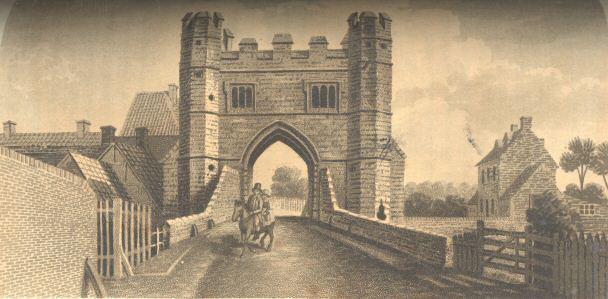
At the beginning of this period there were here no more than six corn-meters, but on the 14th. November 1653 they were increased to ten, which seems to indicate our trade, and particularly the corn trade, as well as the agriculture of the country to have been then in a state of progression.—The town seems also to have had then a greater intercourse with the country on its eastern than on its southern side; which we may infer from the following article in the corporation books, dated April 4. 1653: “Ordered that Henry Bloye, the Southgate porter, shall have the Tolls of that Gate at 1l. 5s. a year; and James Browne, the porter at the East-gate, shall pay for the Tolls of that Gate 1l. 15s. a year, during the pleasure of this House.”—The East gate is supposed still to retain a similar superiority.—It is somewhat remarkable that in those days the town-clerks of Lynn, as well as the recorders, were regular barristers: accordingly we find it noted in the corporation records, “December 6. 1652—This day Thomas Ulber Esq. councellor at Law is chosen Town-clerk, in the room of John Williamson Esq. councellor at Law, discharged.”—Our corporation must have been then well furnished with legal knowledge. In later times all our town-clerks were below the degree of barristers. [787]
On the 3rd of July 1657 the tolls of the East and South Gates, (as appears from the town-books,) were let for 15l. a year, which seems to shew that they were now much more productive than in 1653, when they were let for only 3l. a year. It is very natural to infer from this, that the trade of the town, or its intercourse with the country had much increased during those years.—On the 18th of July in the next year, (1658, as we learn from the same source) St. James’ church yard was ordered to be a burying place for the parish of St. Margaret’s, for one year, “there not being room in St. Margaret’s church-yard:”—but it seems rather unaccountable how making St. James’ church yard the parish burying-place for one year could materially alter the case as to the want of room in St. Margaret’s church-yard, or furnish more room there for burying at the end of that term than there was at the beginning of it. It might however be here suggested by way of query, if it would not have been quite as well, on a recent occasion, and far better in point of expense, to have made use again of St. James’ church yard (including the south side) instead of forming the new burying ground?—at least, till the times proved more favourable; which, it is to be hoped, will be the case in the next reign, if not sooner.
The period we are now reviewing, and the review of which we are now about to conclude, was perhaps the most remarkable of any in the history of this town, as well as that of England and of Britain. Nor does it seem to have been more remarkable for any thing than for the exertions then made to reform the morals and manners of the great mass of the people. But those exertions were generally too rough and violent, and therefore more calculated to make hypocrites than sincere converts, as must always be the case when such works are carried on by coercive means, rather than by rational persuasion, or upon right christian principles. Accordingly our reforming magistrates, by way of reclaiming their townsmen from their tippling propensities, and bringing them from drunkenness to sobriety, had recourse to fines and imprisonment, which as was before observed, fell sometimes very heavy upon the publicans, no less than six and thirty of whom were imprisoned in the course of one year, as we learn from one of our old MS. accounts. These measures excited a violent prejudice against our reformers, and against the reformation itself. Fining was called plundering, and imprisonment, passed for persecution and tyranny. But the restoration brought things back into the old channel, and relieved our publicans and tipplers from these hardships.
CHAP. V.
History of Lynn from the Restoration to the Revolution.
Between the period which we have been last reviewing and that which we are now entering upon there was confessedly a very wide and glaring dissimilarity: no two periods could well exhibit a more obvious and striking contrast. The spirit of puritanism predominated in the former, and that of libertinism, or, in other words, of licentiousness and profligacy in the latter. The rulers of the nation, in the former period, were men of sobriety and gravity, in the latter they were dissipated and dissolute. The former appeared to have for their aim the amendment or improvement of the national manners and morals, the latter the very reverse, for they were actually the promoters and patrons of all manner of depravity, of every thing that was vile, profligate, or flagitious. The two brothers, Charles and James, and their ministers, were certainly some of the vilest wretches that providence ever sent to punish and plague and curse a sinful nation.
As to Cromwell, it is pretty much the fashion to decry and vilify him, as a dissembling villain, a base hypocritical knave and usurper: but no one need to envy the discernment, penetration, or sagacity of those men who cannot perceive that his moral character was not below that of either the first or second Charles, and that his character as a statesman, and his talents for government, were infinitely superior to those of either of them, or of any of their kindred. No proof has ever been produced that he was a greater dissembler, or a more unprincipled wretch than those two princes; and it might perhaps without much difficulty be shewn, that, in comparison with either of them, he was really an honest, virtuous, great and good man.—As to what is deemed his greatest crime, that of compassing the king’s death, the great law of self-preservation will certainly plead much in extenuation of that act; for it is now very well known that Cromwell was previously in possession of good and absolute proof that it was the king’s intention to sacrifice him, in case he could bring the treaty then on foot between him and the parliament to a successful termination. The intercepted Letter to the queen convinced Oliver that he had no chance for his life, if the king reascended the throne. He therefore resolved to prevent that, and save his own life by sacrificing that of the king. [790] This was very natural, and few men would have done otherwise.
Section I.
Cursory remarks on the Restoration—its memorable effects—great joy manifested here on the occasion—several remarkable rejoicings at Lynn in the course of this period.
The Restoration was one of those revolutionary events which occur in the history of this country. It was effected, says one of our historians, “without any effusion of blood.” But what is more to be wondered at, is, that whereas so much blood had been spilt to compel Charles I. to come to terms with his people, towards which it is certain he at last made large concessions, Charles II. should be received without any conditions at all. Upon this bishop Burnet, in the History of his own times, observes, that Hale, afterwards lord chief justice, did move that a Committee might be appointed to look into the propositions that had been made, and the concessions that had been offered by the late king, and from thence digest such propositions as they should think fit to be sent over to the king. As such a motion was foreseen, Monk was instructed how to answer [or overrule] it. He accordingly told the House, that he had information of such numbers of incendiaries still in the kingdom, that if any delay was put to the sending for the king, he could not answer for the peace either of the nation or army: and as the king was to bring neither army nor treasure with him, either to fright or corrupt them, propositions might be as well offered to him when he should come over; so moved for sending commissioners immediately. This was echoed with such a shout all over the House, that Hale’s motion was no more insisted on. To the King’s coming without conditions, says the bishop, may well be imputed all the errors of his reign. [792a] To allow him so to return and ascend the throne was certainly a flagrant proof of the folly and pusillanimity of the convention parliament, and of the baseness of that spirit which then predominated among out ancestors.
Such a tide of extravagant joy overspread the nation upon the king’s arrival, as in the end very much hurt and debased the morals of the people, and introduced an almost universal dissoluteness of manners, which was encouraged and propagated by the ill example of the king and the court. From the enthusiasm and fanaticism, which prevailed in the former period, the nation fell now into the opposite extreme of licentiousness and immorality; one or the other of which extremes being always the consequence of men’s not governing themselves by reason. [792b] Thus the country had no great cause to congratulate itself on the blessed effects of the restoration of royalty, or the revival of the old order of things. No nation in Europe could be more depraved and licentious than the English in the reign of Charles the second.
Much pains were taken, before his majesty’s arrival, to represent his character in the most favourable and respectable light. Though the first born of profligacy and scoundrelism, he was reported, by his faithful and thorough-paced agents, as the very mirror of wisdom, of virtue, and of piety. These reports were not more industriously or artfully circulated than they were readily and generally believed, so that we need not wonder if the country in general looked upon the arrival of Charles as the commencement of the golden age, or of the reign of a heaven-born prince. Such seems to have been actually the case. The confidence the people had in the king, says Kimber, from the extraordinary good opinion they had been prepossessed with in his favour, and their transports of joy at being delivered from the late confusions and distractions, by means of his restoration, will account for the excessive complaisance that was shewn to the court at the beginning of this great event, so that the parliament could scarce deny the king any thing. To the ill use made of this confidence is to be imputed the opposition which the court met with afterwards.
Our ecclesiastical historian Neal, speaking of the restoration, says,
“Here was an end of those distracted times which our historians have loaded with all the infamy and reproach that the wit of man could invent. The puritan ministers have been decried, as ignorant mechanicks, canting preachers, enemies to learning, and no better than public robbers. The universities were said to be reduced to a meer Munster, and that if the Goths and Vandals, and even the Turks, had overrun the nation they could not have done more to introduce barbarism, disloyalty, and ignorance. Yet in these times, and by the men who then filled the university chairs, were educated the most learned divines and eloquent preachers, such as the Stillingfleets, Tillotsons, Bulls, Barrows, Whitbys, and others, who retained a high veneration for their learned tutors after they were ejected and displaced. The religious part of the common people have been stigmatized with the character of hypocrites, their looks, their dress and behaviour, have been represented in the most odious colours; and yet one may venture to challenge these declaimers to produce any period of time since the reformation, wherein there was less open profaneness and impiety, and more of the spirit as well as the appearance of religion. Perhaps there was too much rigour and preciseness in indifferent matters; but the lusts of men were laid under a visible restraint; and though the legal constitution was unhappily broken, and men were governed by false politicks, yet better laws were never made against vice, or more rigorously executed. The dress and conversation of people was sober and virtuous, and their manner of living remarkably frugal. There was hardly a single bankruptcy to be heard of in a year, and in such a case the bankrupt had a mark of infamy upon him that he could never wipe off. Drunkenness fornication, profane swearing, and every kind of debauchery, were justly deemed infamous, and universally discountenanced. The clergy were laborious to excess in preaching and praying, and catechising youth and visiting their parishes. The magistrates did their duty in suppressing all kinds of games, stage-plays, and abuses in publick-houses. There was not a play acted on any theatre in England for almost twenty years. The Lord’s day was observed with unusual reverence; and there were a set of as learned and pious youths training up in the university as had ever been known. So that if such a reformation of manners had been obtained under a legal administration they would have deserved the character of the best of times.”
“But when the legal constitution was restored, there returned with it a torrent of debauchery and wickedness. The times which followed the restoration were the reverse of those that preceded it; for the laws which had been enacted against vice for the last twenty years being declared null, and the magistrates changed, men set no bounds to their licentiousness. A proclamation indeed was published against those loose and riotous cavaliers, whose loyalty consisted in drinking health and railing at those who would not revel with them: but in reality the king was at the head of these disorders, being devoted to his pleasures, and having given himself up to an avowed course of lewdness; his bishops and chaplains said, that he usually came from his mistresses apartments to church, even on sacrament days.”
Yet he was, on earth, the supreme head of the church, and that church the best constituted in the world. It must need, surely, be well, extremely well constituted (and so must any body) not to be contaminated, disordered, or distracted with, or by such a head.
“Nothing was to be seen at court but feasting, hard drinking, revelling, and amorous intrigues, which engendered the most enormous vices. From court the contagion spread like wild fire among the people, in so much that men threw off the very profession of virtue and piety, under colour of drinking the king’s health: all kinds of old cavalier rioting and debauchery revived; the appearances of religion which remained with some, furnished matters of ridicule to libertines and scoffers. Some, who had been concerned in the former changes, thought they could not redeem their credit better than by deriding all religion, and telling or making stories to render their former party ridiculous. To appear serious, or make conscience either of words or actions, was the way to be accounted a schismatick, a fanatick, or a sectarian; though if there was any real religion during the course of this reign, it was chiefly among those people. They who did not applaud the new ceremonies were marked out for presbyterians, and every presbyterian was a rebel. The old clergy who had been sequestered for scandal, having taken possession of their livings, were intoxicated with their new felicity, and threw off all the restraints of their order.—Such was the general dissoluteness of manners that attended the deluge of joy which overflowed the nation upon his majesties restoration.” [796a]
As to Lynn, at and subsequently to the restoration, it appears to have largely shared the general joy and other effects produced by that memorable event. When we consider the extreme rigour of the former government or governors of this town, [796b] in attempting fines and imprisonment to restrain the tippling and other vicious and licentious propensities of the inhabitants, we cannot much wonder at the excessive joy which the restoration excited here, as it was very natural to expect that that event would effectually remove those severities, and introduce a more lax and indulgent system. How long the first transports of joy lasted we are not able exactly to ascertain; but that they were at their height on the first royal birth day, the 29th of May 1660, we may very reasonably presume. On that day the town was all festivity and triumph. Among the curiosities that graced that memorable carnival were 300 young maids, or lasses of the town, dressed all in white, and parading through the principal streets. [797] Whether this may, or may not be considered as an emblem of the predilection of the sex for Charles, or that of Charles for the sex, we will not take upon us to say. That it was a whimsical contrivance seems very evident; and that it was peculiar to this town appears more than probable, as we do not recollect having heard of any thing like it elsewhere on that day, or on that occasion.
This was certainly one of the most gladsome seasons that Lynn ever witnessed: but it was not the only season of that description that occurred here during the period now under review. There are others of the same kind that ought here not to pass unnoticed. One of these was in the spring of 1680, on account of the arrival of the duke of York from Scotland, and the discomfiture of the Whigs or petitioners, (or the king’s rejection of the petitions of the people for the assembling of parliament,) and, of course, the success and triumph of the Tories or court party, then called Abhorrers, as they professed to abhor such petitioning, and approve of the king’s governing without parliaments. On these interesting accounts there was much rejoicing at Lynn; and
“on the 30th of April that year, the following Address was read in the Hall, and signed the same day by every one of that House: and the mayor, (Giles Bridgeman) was desired to commend the same to the hands of the right honorable the Earl of Yarmouth (Lord Lieutenant of the County) to be presented by him to his Majesties.”
“To the King’s most excellent Majestie,
Dread Sir,—Wee your Majesties Dutifull and Loyall Subjects, the Mayor, Recorder, Aldermen, and Common-Councell of your Majesties ancient burgh of Lenn Regis, on behalf of ourselves and other the free Burgesses and principal inhabitants here doe in all humility prostrate ourselves at the feet of your most sacred Majestie, and in all duty acknowledge the infinite benefits wee of this burgh, with all other, the liedge people of this your Majesties Kingdom of England by your happy government and royall conduct next under God enjoye, and more particularly wee give your Majestie an oblation of our duty and thankfullness in your pious and resolute support and maintenance of the religion established by the Lawes of this kingdome in the Church of England in your couragious conserving the Regalities of your Crowne against insolent petitions, and protecting the lawfull liberties and freedoms of your subjects. And with our souls we bless Almighty God in the return of your royall brother, the Duke of Yorke, to your Majesties most Gracious presence, and doe cheerfully profess to maintaine and defend your Majesties most Royall person your Heirs and lawfull successors in your and their just rights,
May it please your Majestie
Your natural Liegemen.”
In this remarkable and curious Address to the Throne, what choice matter of joy, thankfulness, congratulation, and triumph is exhibited on the part of the Addressers! The King appeared resolved to govern despotically, or without a parliament. Many of his subjects had petitioned and prayed him to call or assemble a parliament. He had rejected those petitions and prayers with disdain. The Lynn Corporation address him on the occasion, congratulating, praising and extolling him to the skies for acting the despot and turning a deaf ear to the prayers and supplications of his aggrieved subjects. For such royal doings, and for the arrival and presence of the Duke of York at court, which presence had always been a curse to the nation, the corporation of Lynn congratulated their profligate sovereign, and offered to stand by him at all events. Moreover, they exhibit, all the while, a most sanctimonious appearance, and profess with all their souls to bless Almighty God for what was one of the greatest curses of their oppressed country.—So much for this royal and notable Address from Lynn. [800]
As to the accession of James to the throne, it appears to have been contemplated at Lynn with no small pleasure and satisfaction, and the day on which that memorable event was announced here to have been a day of uncommon rejoicing. We accordingly find the following note in the Town Books, “Febr. 10th. (1685) King James II. proclaimed with all due solemnities and signalls of Joy and Gladness.” Four days after was “ordered an Address to the King’s Majestie.” But having never seen a copy of this Address the present writer cannot give a particular account of its contents. He cannot however doubt but it was in the usual style of Lynn Addresses to that monarch.
Another season of extraordinary festivity and exultation at Lynn occurred in 1686. It was on no less interesting an occasion than the erecting of the statue of the sovereign in the Tuesday Market place. We accordingly read, in Mackerell’s “Chronological Account” of the town, of “great rejoicings here that year, at the setting up of the statue of king James II.” His majesty (as well as king John) seems to have been long the object of the admiration of the Lynn people. They admired him while Duke of York, and after his accession to the throne they never rested till they had set up his image or statue in the most public and conspicuous part of their town. Of this royal and memorable affair Mackerell has given the following information in another part of his work—
“An account of King James IId’s statue, and the Rejoicings at the setting up of the” [same.]
“On the 13th day of April 1686. which was the anniversary of their majesties coronation, the same was kept with all due solemnity; the mayor, aldermen, and the rest of the body, meeting in their formalities in the Guild-Hall, after Divine Service at the church, proceeded from thence attended with musick, to the great Market-place; in the middle whereof, by the Gentlemen and other Loyal Inhabitants of the corporation, was then erected the Effigies of his Sacred Majesty upon a Pedestal, with several carvings and embellishments, inclosed with a Pallisade of Iron, under inscribed,
Non Immemor Quantum Divinis Invictiss. Principis Jacobi II. Virtutibus debeat Hanc Regiæ Majestatis Effigiem Æternum Fidei et Obsequii Monumentum, Erexit S. P. Q. L. Anno Salutis 1686.
In English
“Not forgetting how much is due to the Divine Virtues of the Victorious King James the Second, the Senate and People of Lynn, as a lasting Monument of their Faith and Loyalty, have erected this Statue of his Royal Majesty, in the year of our Lord One Thousand Six Hundred and Eighty six.
“N.B. The King, Queen, and the rest of the Royal Family’s Healths were drank; and the Day was concluded with Ringing of Bells, Bonfires, all sorts of loud Musick, Fire works, discharging the Great Guns, with all other Demonstrations of Joy and Loyalty.” [803]
Such is Mackerell’s account of the extraordinary festivities and rejoicings at Lynn on this great and important occasion. It was, no doubt, worth recording, and it may still be worth preserving here, if it were only for this special reason, that it may help to give us just ideas of the general character of corporations, and of their proceedings. Here is a Statue erected to one of the vilest of human beings; and here are virtues, and even Divine Virtues! ascribed to one who was as devoid of every thing of that kind as the very devil: and here is an Inscription denominating the erection of the Statue a Lasting Monument of Faith and Loyalty; and yet this boasted faith and loyalty, and lasting Monument, lasted only about three or four years. The Statue was pulled down mutilated, decollated, disfigured, dismembered, and buried in dirt and rubbish, where it remains to this day.
There was here also a remarkable exhibition of joy and gratitude, as well as loyalty, in 1687, excited, it seems, by his majesty’s royal and memorable Declaration, and the consciousness of its being the duty of every member of the Church of England to defend and support him with their lives and fortunes.—The following Address to the Throne was accordingly agreed upon and ordered to be sealed with the common Seal, September 19. 1687.—
“Great Sir,—The known principles of the Church of England being such as oblige every member thereof with their Lives and Fortunes to defend and maintain your Majestie Your Royall Prerogative with all other rights belonging to your Majesties Imperiall Crown, makes us at this time humbly to begg your Majesty to receive this further attestation, not in the least doubting of the peaceable enjoyment of our religion under Your Majesties most sacred protection, returning our most hearty and humble thanks for Your Majesties late repeated Assurance thereof, expressed in Your Majesties late gracious Declaration.”
Such was the Address which was sent at that time from Lynn. But his sacred majesty soon found that the boasted principles of the Church of England were not sufficient to secure to him the attachment of his subjects and the quiet possessions of his throne, unless he relinquished those favourite projects of his which appeared hostile to that church. For the very next year a very alarming defection took place, and the majority of those of that communion became inimical to his government. Even the Life and fortune men forsook him, and beheld his downfal without concern or commiseration. So false did that description of his subjects prove to him, and so unavailing also in the end did he find even the great orthodox doctrine of passive obedience and nonresistance, which had been the favourite doctrine of the Church of England during the whole of his brother’s reign.
A few months after the last mentioned affair took place in January 1688, a fresh occasion of rejoicing was presented to the Lynn people. This was the annunication of the queen’s pregnancy; which proved not a little satisfactory and gratifying to our corporation, as appears from the following note in their books:
“January 26. Ordered and agreed that Sunday the 29th Instant being appointed by his Majestie a day of Thanksgiving for her Majesties being happily with child, the several members of this House doe attend Mr. Mayor (Robert Sparrow Esq.) in their formalitys at morning and evening service, to render thanksgiving to Almighty God for so signall a blessing, and after evening service to repair to the Custom House to drink the king’s health with a Bonefire.”
On the 2nd. of the following July, the Gentlemen and good people of Lynn were furnished with matter of still higher gratification, by the knowledge of her majesty’s safe delivery, and the birth of a prince [805] who would be likely to inherit his royal sire’s faith, piety, sapience, and sublime virtues. This important intelligence, as might be expected, was very joyfully received, and occasioned the immediate assembling of the corporation. In that assembly, or meeting, was proposed and voted an Address to his Majesty, of which the following is a copy:
“Great Sir—Wee Your Majesties Dutifull Subjects crave leave of Your Majesty and your Royall Consort that we join with Your Majestie in offering our most humble and hearty thanks to God Almighty in sending Your Majestie a Sonn and a Prince, and farther we begg of your Sacred Majestie to accept our Cordial thanks for your Majesties late favor to the body of this Corporation, [806] and also for your Princely condescension and affection by both your gracious Declarations, not only extending to the Church of England but to all other your peaceable and loyall Subjects, Assuring us by Your royall word you will stand by us, whereby we are not only obliged but resolved, when your Majestie shall think fitt to call a Parliament, wee will endeavour to elect such members as shall make your Majesty happie and Your Subjects easie, and shall pray for Your Majestie’s long and peaceable reigne over us. In witness whereof we have fixed our Town Seale the 2nd of July in the 4th year of your most gracious reign, Anno Domini 1688.”
In conclusion, it is presumed that we are fully warranted to affirm, that Lynn has never been more attached to any of our sovereigns than to King John and King James the second; and that even his present majesty, with all his shining virtues, is not more, if so much beloved here as those two monarchs were. It may perhaps be difficult to account for it, yet it seems unquestionably to be the fact, that of all the princes that ever swayed the British Sceptre, none ever shared more largely in the affection admiration, and veneration of the good people of this town than those three potentates. Nor have there been any other reigns under which our townsmen seemed more ready to congratulate themselves on the superior happiness they enjoyed, or the transcendent benefits and blessings they derived from the throne.
Section II.
Brief account of divers other remarkable circumstances relating to Lynn during this same period—decay of trade—increase of poor—Anmer coal, &c.
After Charles’ restoration, or accession to the throne, it was not to be expected that he should remain long unaddressed by this town. Accordingly we find that within the very first month of his actual reign, (June 16. 1660,) a congratulatory Address to him was voted and ordered in the Hall; and moreover, “that the Fee farm rents formerly paid from this town to the Crown, and lately purchased by the mayor and burgesses, amounting to 41l. 6s. 2d. be restored to his majestie.” Having never seen this Address, or any copy of it, we can give no particular account of its contents; but we need not to doubt but it teemed with servility, or was in no small degree of a fawning, crouching or cringing cast. As to the Feefarm rents which belonged to the Crown, but had been lately purchased by the Mayor and burgesses, and were now restored to his majesty, they appear to require no comment, or farther elucidation in this place. The restoring of them to his majesty was a matter not of choice but of necessity: and in purchasing them the Corporation evidently gained a loss; but to what amount we cannot say, having never learnt how much was paid for them.
A week after, (on the 23rd of the same month,) our Corporation agreed and ordered, that Oliver’s Charter confirming the priviledges [of the town] be cancelled. This also appears to have been a matter of absolute necessity; but whether so or not, that charter would be of no further use to the body corporate. Oliver’s day was now past, and whatever had sprung from him, if it did not actually disgrace the character of the holder or owner, yet was no longer held in any manner of estimation. That there is a copy now extant of this Charter of his we have not learnt.
Soon after the restoration this town began to suffer considerably from the decay of trade and consequent increase of the poor, which did not seem very well to accord with the excessive rejoicings that had then taken place. Within two years after that event those effects had made so alarming a progress, and the complaints of the sufferers had become so loud, that the body corporate found it necessary to take the affair into their immediate and most serious consideration, in order to check as much as possible the growing evil, and alleviate in some degree the sufferings of the poor inhabitants. The truth of this statement, and the mode of proceeding adopted then in the Hall in order to relieve or mitigate the distresses of the poor will appear by the following extract from the Corporation books.
“May 12. 1662. Forasmuch as the Poor of this Burgh thro’ great losses and decay of trade are grown very numerous, and the charge of them greater than can be well born by the inhabitants, and a great part of the coal trade carried on by Strangers and Foreigners, which bring their coals hither to sell in Ships and Vessells belonging to other Ports, who tho’ they reap a profit bear not the least part of the burthen, to the great discouragement of the Navigation belonging to this town and the impoverishing of the inhabitants thereof, It is thereupon [at the earnest request of the most considerable freemen Burgesses and Inhabitants of this town] this day ordered that every freeman or burgess of this burgh that shall from henceforth buy or cause to be bought of any stranger or foreign person not being free of this burgh any coals called Newcastle, Sunderland or Sea-water being lading or freight in any Ship or Vessell belonging to any such Stranger or outward Port whether the same be to sell again or for there (their) own expense shall pay for every chalder of coals so bought as aforesaid to the use of the mayor and burgesses of this burgh and their successors the sum of 12d. to be employed for and towards the necessary reliefe and maintenance of the poor of the said borough, the same to be levyed of every such freeman or burgess so buying the same as aforesaid by distress and sale of their Goods, or by such other ways and means as shall be thought most fitt and meete—And it is further ordered that no burgess or inhabitant of this burgh shall take any such coals out of any such strangers’ Ship or Vessel with intent to sell the same again untill the end of three working days next after the arrivall of such Strangers’ Ship within this Port, to the end the inhabitants of this town may be served with coales in that time for their own firing, according to severall former orders made to that purpose, and publication of this order to be made by the bellman.”
How long this law remained in force, or this impost continued to be paid does not appear; but it is not very likely that it ceased, or was discontinued till the arrival of better times, and the removal of those evils which led to its adoption. Fourpence a chalder, if we are not mistaken, is still charged on the coals brought by strangers, and applied in like manner to the relief of the poor. Why should it be no more, when thrice as much was charged so long ago? and a shilling then was worth a great deal more of our money. Surely the present pressure of the poor rates, which so large a proportion of the householders so severely feel, would justify the adoption of such a measure now, if it be allowable.
Towards the close of the year when the above transaction took place this town was visited by Lord Townshend, Sir John Tracy, Sir Edward Walpole, John Spelman and Roger Spelman Esqrs. as commissioners under a late act of parliament for the well-governing and regulating of Corporations. This act seems to have sprung from the narrow and arbitrary policy of the Stuart princes, who aimed at having corporations as much as possible under their direction and management, or subject to their immediate and absolute power and control. These commissioners were entertained here at the expense of the mayor and burgesses. They were, it seems, invested with large powers, so as to be authorized to displace any they happened to dislike of our municipal functionaries, and put others whom they thought better of in their room. In this town they expelled alderman Robert Thorogood and appointed one Lawrence Withers in his stead. A few weeks before “Mr. Fr. Rolfe was discharged from his office and place of Town-clerk, and Mr. Owen Barnes was elected in his room.”—This is said to have been done by the mayor and aldermen; but it is probable that the Commissioners were privy to it, and that it was a step taken in compliance with an intimation from them, for the time of their visit had been previously fixed. Those appear to have been the only changes which then took place in the Hall.
Under 1663 a circumstance has been recorded which casts some light on the ideas or sentiments which the Lynn people then entertained of their parliamentary representatives; and though they no longer allowed them daily wages, as formerly, yet they evidently considered the honest and diligent discharge of their trust or service as entitled to more than mere thanks. Had they on the other hand failed in the performance of their delegated functions, their constituents undoubtedly would have deemed that failure censurable.—The circumstance alluded to is explained in the following extract from the Hall books: “June 13. 1663, It is this day ordered that the Chamberlaine remitt to London 40l. to buy two pieces of Plate, of the value of 201. each, to be presented as a gratuity from this House to Sir Edward Walpole and Sir William Howell (Hovell) [812] burgesses in parliament for this burgh, for their faithfull services in behalf of this burgh.” What were those services in behalf of this burgh, which are here glanced at, and were deemed so meritorious, we are not told; but it is very clear that these representatives had acquitted themselves entirely to the satisfaction of their constituents. It is much to be wished that the same could be said of all our present national representatives.
Under the same year an occurrence is mentioned in one of our MSS, which leaves a foul stain on the memory of our ancestors of that period, and shews how much they were then the slaves of bigotry and intolerance. This was the persecution and imprisonment of several members of that pacific and respectable sect called Quakers, which seems to have been the only description of sectaries, except the Presbyterians, that had then attempted to introduce themselves into this town. But they were bitterly opposed here, as they were then also throughout the nation; and their sufferings were very great and grievous during almost the whole reign of Charles and James the second, to the lasting disgrace of a pretended christian and protestant government. It is to William and the Revolution that we owe, under providence, the adoption of a wiser policy and the enjoyment of better times.
In 1664 the high price of coals was severely felt here. That commodity advanced that year from 17s. a chalder to 30s. and upwards. This seems to have been owing to the late impost of 1s. a chalder laid by the Corporation on all coals brought by strangers, who consequently discontinued their visits. It seems rather probable that that impost or tax was now abolished, for we are told that the coal afterward, by reason of strangers’ resort, came again to the old price. It may therefore be concluded that the Lynn ships alone were not sufficient at that time to supply the town and all the inland country with that article. The same would probably be still the case, if this port was not frequented by any coal ships but such as belonged to the town. We are therefore, probably, much more indebted to strangers for our plentiful supplies of fuel than we are apt to imagine.
In 1665 Lynn was visited by that grievous scourge the Plague, which made great ravages here. “Wardsmen were appointed, one at the East and the other at the South-gate to keep out all Mackerell Carts from coming into the town:” the communication with the county was cut off; no Mart was kept that year, and the very markets were for sometime discontinued.—In the Summer of the very next year, 1666, which was a hundred and forty five years ago, a cart, (as is recorded in one of our manuscripts,) came hither from Anmer, loaded with coals, which were here sold by the mett or bushell. It seems therefore that there is coal somewhere about Anmer; but to what extent we cannot pretend to say. Nor does it appear what search or trial was there made for it, or why the attempt was given up. A good Coal-mine in that part of the country would, no doubt, be very desirable.
We know of no very remarkable event that occurred here afterward till 1670, when the town was honoured with a visit from the duke of Richmond and Lenox, of which the following notices are extracted from the Hall books—“July 23. It is this day ordered that his Grace the Duke of Richmond and Lenox upon his request shall have his Freedome of this Burgh gratis: and hereupon his Grace the said duke of Richmond and Lenox did this day come into this House and did take the Oathes of Aledgiance and of a Free Burgess; Mr. Thomas Greene and Mr. Benjamin Holly being his Suretyes.”—again—“July 28th. Ordered that the Chamberlain pay Mr. Mayor’s bill of Disbursements for the entertainment of the duke of Richmond and lord Townshend, 21l. 6s. 8d. and 13s. 4d. for his Cook, and for a hogshead of French Wine sent aboard the duke’s Vessell.”—Hence it appears that the duke came and departed by water. But the Sum of 22l. would go then much further than it would at present. It would go now but a very little way in entertaining brace of peers, with their retinue, and purchasing a hogshead of French wine.
Towards the latter part of this year the Corporation was presented with a plan or map of their town, as appears from the following note in the Hall-books—“October 14. 1670, This day alderman Edmund Abbott brought into this House a Topographical Draught of the town of King’s Lynn, which was given to the town by Sir Algernoon Payton; and Henry Bell Esq. mayor, is desired to peruse the said draught, to be mended and put into a Frame, for the use of the mayor and burgesses.” The same, we presume, was done accordingly; but we are not quite sure that this draught is still in existence: if it be, a sight of it might help towards forming a pretty just idea of the then state or lineaments of the place. The principal Streets and Lanes, however, must have been then much in the same situation as at present. In other respects the town must be now very widely different from what it was then.
In the same year we find Lynn to be in a great measure a manufacturing town, especially in the worstead line, and to have many hands employed in that branch; as appears from the following note in the Hall-books. “December 2. 1670, The worstead weavers petition to procure an Act of Parliament for the liberty of a Dyer and Callender to live in the town for the better [or the benefit of the] trade.” Those weavers must have been pretty numerous, and their trade hopeful and promising, to warrant or justify such an application. Still it must seem rather odd that they should think the obtaining of their object required the aid of an act of parliament. It does not appear, however, that an application was actually made to the legislature on this occasion.
Section III.
Account of the king’s intended visit to Lynn, in 1671, with divers other occurrences relating to this town, in that and some of the subsequent years.
The king, who used frequently to visit Newmarket, where he had it royal Lodge or Palace, purposed in the autumn of 1671 to make an excursion into Norfolk, and to visit Lynn in the course of his tour. This appears from the following Note from the Hall-books—“1671, August 11. Ordered that 100l. be paid into the Chamberlain’s hands for defraying disbursements on account of his Majesties entertainment, who Sir Robert Stewart writes intends to visit Lynn next month, in his progress.”—Great preparations were accordingly made by our Corporation for the reception and entertainment of their sovereign. But it so happened that our good townsmen were disappointed at last, for his majesty never came; so that the great expense they had been at, in preparing for his reception was, in a manner, all thrown away.
It is not said what it was that prevented his majesty’s coming, or frustrated his royal intention of visiting his Lynn subjects at that time. But it seems most probable that the very foul weather which happened in that month, and the terrible inundation which then overwhelmed the country about Lynn, were the principal, if not the sole causes of the relinquishment of his purpose. The tide rose so high on the 17th. of September, as we learn from one of our MSS. that the country about Lynn was all under water, “the haycocks swam about the fields to the first house in Gaywood, and several boats were rowed from the East Gate to that Village, many Ships were lost, Marshland was all overflowed, great numbers of sheep perished, and an immense loss sustained.” In short, it seems to have been here such another disastrous flood as that which lately devastated the Lincolnshire Coast. The roads must, in many places, have been broken up, so that the approaches to the town must have been rendered difficult, if not impracticable. On the whole, therefore, we cannot wonder that this royal visit was given up. As to the whole of the provisions and dainties that had been prepared for the intended august visitor, it does not appear how it was disposed of at last; but as to what had been procured from the Metropolis, its final disposal is plainly enough suggested by the following Note from the Hall books:—“November 10, 1671. Ordered that the mayor have the whole banquet lately sent from London, he paying tenn pounds.”—So much for this intended royal feast at Lynn.
In the same year, we find Lord Townshend tampering with the Corporation, with a view to the introduction of one of his friends to be chosen one of the Lynn representatives in parliament: hence we find it thus noted in the Hall books—“1671. August 7. Whereas Lord Townshend hath by his Letters to this House recommended Sir Francis North knight, his Majesties Sollicitor General, as a person of great worth and honor, and upon all occasions fitt to be usefull to this burgh in their most important concernments: It is therefore this day ordered, that the said Sir Francis North Knight, shall have his freedom of this Burgh gratis.” He soon after became, as had been previously projected, one of our parliamentary delegates.
Early in 1672 an order was issued from the Hall, which shews that the occupiers of houses in the Tuesday Market-place were not then allowed to let their shops during the Mart, unless they paid rent for the same to the mayor and burgesses. The following note in the Hall books will serve to elucidate this circumstance—“January 19. Whereas severall persons (who have usually lett their shops in the Tuesday market-place during the time of the Mart, and have therefor paid a rent for the same to the mayor and burgesses) have of late refused to pay the accustomed rent, it is this day ordered that the chamberlains doe demand the arrears, and in case of refusal to cause blinds or bootes to be built up against the Shops.” Such appears to have been the case formerly; but this claim, we apprehend, is no longer made. We have not learnt, however, how it came to be relinquished.
In July 1675 Mr. John Turner was admitted or chosen into the Hall, as common-council-man. Of him it is said that “he was chosen common-council-man, alderman, new-elect mayor, parliament-man, and captain of the trainbands, all in the course of two years.” From him sprung the family of that name which afterwards bore great sway in this town for a whole century. It is no disparagement to this family that it arose from a low origin; for where is that great family that has not so arisen? The noble, the royal, and the imperial not excepted. Many of whom are known to have sprung from and owed their rise to desperate Adventurers, captains of bands of robbers and ruffians, men, or rather demons, who defiled themselves with the foulest deeds, and made their way to power and greatness in defiance of all laws human and divine. To the founder of the Turner family no infamy has been imputed. Report has said that he was originally a waiter at an Inn at Cambridge, which cannot justly be considered as any disgrace to his descendants.
In 1676, according to one of the MSS. were first erected the new buildings, in Broad Street, designed for an Almshouse for twelve poor men, “at the cost and charge of one John Heathcote of Lynn.” Mackerell calls this person Helcote. Whatever his right name was, it is now almost forgotten, while that of Framingham is in everybody’s mouth: and yet the poor men owe, perhaps, as much to the memory of the former as they do to that of the latter, who has engrossed all the praise and credit of this charity. For had not this Helcote or Heathcote erected these buildings it is very doubtful if Framingham, rich as he was, had ever thought of endowing an almshouse. He was a man of low birth, [820] and became afterwards rich and ostentatious. The death of the founder gave him an opportunity to become the endower of this almshouse, and transmit his name to posterity, which he took care to ensure by having his Will publickly read, and a commemorative Sermon preached annually. Upon the whole, it is highly probable that vanity and ostentation had a larger share than charity, or pure benevolence, in the endowment of these Almshouses. That, however, cannot lessen the comfort or enjoyment of the poor men there admitted. The endowment does them as much good as if it had sprung from the worthiest motive, or most virtuous principle.
“On the 29th of August, 1677, Ben. Holly Esq. one of the aldermen, was fined 40l. for refusing to accept of the mayoralty, being thereunto chosen.” The reason of this refusal is not mentioned; but the alderman was not poorer, probably, at the end of the year than he would have been had he accepted the office.—About the close of the same year, (or early, in the next, as we reckon,) a step was here taken, the result of which the present writer has often wished to ascertain, but without success. The step or circumstance alluded to is thus expressed in the volume of extracts from the Hall books so often referred to in this work—“February 4th.” (1677, 8) “Ordered that a Letter be wrott to Th. Goddard, Son to Guybon Goddard Esq. late Recorder of this Burgh, to confer his Father’s labours about the antiquities and antient priviledges of this Corporation, and that he have a gratuity of 21l.” This shews that Mr. Guybon Goddard had collected materials for a history of Lynn: the same has been also affirmed by his brother-in-law, Sir William Dugdale, in some part of his works; so that the fact is beyond all doubt. But the question is, what became of those materials? If our Corporation obtained them, they seem to have been lost long ago. No one now in the Hall, it seems, not even the town-clerk himself, knows any thing about them. It is probable Mr. Th: Goddard did not choose to part with them. What became of them after his time, or whether they are now in existence or not, there is perhaps very little chance of discovering. Had they fallen in the present writer’s way, there can be no doubt, from the known character of Guybon Goddard, but he would have found them of considerable use in this undertaking.
In the autumn of 1678 a pretty strong antipathy to popery appears to have been prevalent in this town, and measures were adopted to secure the inhabitants from such dangers as might arise from that quarter. Accordingly we learn from the Hall books, that it was ordered on the 11th of November that year, to have “a watch kept every night to prevent dangers from Popish Recusants.” This seems to indicate that the Corporation and people of Lynn were now inclined to side with the patriots or Whigs against the Court; which appears somewhat corroborated by their resolving sometime after to elect two of their own townsmen, in preference to court candidates, to represent them in the ensuing parliament; as is evinced by the following document from the Hall books—“January 29th (1678, 9.) This day upon reading in this House a Letter from Robert Wright Esq. late one of the burgesses in parliament for this town, intimating his desire of being again elected here, it is ordered that thanks be returned for services received, and to acquaint him that this House taking notice of the generall averseness of this corporation to choose any other than an inhabitant of this town, and two of the Society having declared themselves to stand, this House cannot with any assurance incourage his coming down for that purpose. But that they doe and shall retain a true sense and opinion of his former performances.” The candidates they now returned were Messrs. Turner and Taylor, afterwards Sir John Turner and Sir Simon Taylor. How patriotically they discharged their respective duties we are unable to say.
On the 28th of the following April, 1679, an occurrence took place here which is well worth recording. It did so much credit to the moral feelings of one of the then members of the Hall, and does so little to those of certain members of it in more recent times, (namely, the absentees, or nonresidents above noticed,) that it ought by no means to be here passed over in silence. The person first alluded to was one of the aldermen, and he was also a physician. He perceived, upon serious reflection, that the duties attached to the office of an alderman were incompatible with those that belonged to the exercise of the medical profession; and as he was not disposed to relinquish the latter, he felt himself bound in conscience to withdraw from the Hall and resign his municipal function. This occurrence is thus noticed in the volume of Extracts from the Hall or Town Books—“April 18th. 1678, William Bassett having sent a Letter insinuating the inconsistence of his place in this House with his Profession of a Physician, and how that he is necessarily compelled to be criminal in the one whilst he endeavours to discharge his duty in the other, begs most heartily to be discharged,—[this House] doe consent that he be discharged, &c.”—This singular transaction gives us a very favourable idea of the character of this alderman, or doctor Bassett: it certainly deserves to be remembered; and it is now earnestly recommended to the serious consideration of the present members of the Hall, and especially the absentees, whose nonresidence must be more incompatible with their municipal duties than that gentleman’s medical profession was with his. If there be really any municipal factions or duties, that are any way useful or interesting to the community, attached to the appointment of common-council-man, or alderman of Lynn, the due discharge of them, without all doubt, must be utterly incompatible with the absence or nonresidence of such functionaries.—These hints, it is hoped will not fail to have their due weight with those individuals to whom they are applicable.
Section IV.
Danger incurred by the corporation on account of the issuing of farthings—third part of the duty levied on coals brought by strangers and landed in South Lynn, allowed to the South-Lynnians—difference and great lawsuit between them and the corporation about the Long-Bridge—the consequence, &c.
Towards the close of 1670 our corporation appeared in no small fear of danger from their gracious sovereign’s displeasure, on account of their having issued farthings, which was deemed an encroachment on the royal prerogative. They accordingly took measures forthwith towards appeasing the Monarch’s wrath and obtaining his forgiveness. This memorable affair is thus stated in the Town books,—“November 4th 1670, Forasmuch as Mr. Mayor, (Henry Bell Esq.) did this day present to this House two Letters, the one from Mr. Recorder, the other from Mr. Wright, for and about the danger the Town is lyable too, (to) for and concerning their putting out of Farthings, Mr. Mayor is desired to answer the said Letters and let them know this House doe desire that they would both effectually take care to use all means to prevent the Quo-ranto (Quo warranto) issuing out against the Town, and to petition his Majesties pardon, and to doe whatsoever else they shall judge necessary to prevent any trouble that may fall on the corporation for the putting out of these farthings which are out on the corporation account.”
The recorder therefore and the other gentleman, (who was also another great lawyer and one of the members for the town) appear to have exerted themselves faithfully and successfully on this occasion. We accordingly find that his sacred majesty’s pardon was actually obtained; but it seems to have taken up a long time, no less than two years, to effect this. It may be supposed to have cost a large sum of money, and we may presume that our corporation did not deem that money ill spent, though it might far exceed all the profits they had derived from their coinage. Both king and courtiers might deem it good policy to seem to be in great wrath for sometime, which would make the corporation the more ready to part with their cash. The successful termination of this business is thus noticed in the Town-books—“November 2nd. 1672, Ordered the Town Seal to be fixed to an instrument acknowledging his Majesties grace and favour in pardoning the Corporation for making of farthings.”
How many of these farthing coinages were undertaken by this corporation, it does not seem very easy to ascertain; nor are we able to discover when this measure was here first resorted to, or adopted. The present writer is in possession of several Lynn farthings, but they appear to have been all issued either in 1668, or in 1669. Whether or not any have been issued here before 1668 he is not able to say. He has seen farthings of other towns of a much earlier date, and has himself a Bristol farthing of 1652, which is the earliest of these town tokens he remembers to have met with. It is likely that Lynn was led into this coining adventure by the example of other places, and especially Norwich, which may be presumed to have been previously concerned in this business. [826] The same offence had been committed earlier, oftener, and later, by many, if not by most of its neighbours, so that it must be somewhat odd that the resentment of the court should appear so bitter towards this town, beyond what it seems to have been towards other offending places.—Norwich, Yarmouth, Diss, Thetford, Bury, Ipswich, Lowestoft, and other towns, all, if we are not mistaken, coined and issued farthings, and Wisbeach halfpence; yet we do not find that they were brought into any mighty trouble, or alarm, like Lynn, on that account. However this might be, these private coinages seem to have been discontinued every where soon after 1670, and never more resumed till within these last twenty or thirty years, when they became again very general, in consequence of the example of the Paris-mountain copper Company, in the Isle of Anglesey, who issued large penny pieces, which were for some years very common, and in extensive circulation. They have been latterly suppressed, with all the others to which they had given rise. Government seem resolved to prevent or discourage any thing of the kind being again attempted; for which we impute to them no blame, and sincerely wish we had no greater grievance to complain of.
Between the borough, or corporation of Lynn, and the parish of Allhallows, or Allsaints, alias South Lynn, there has been for ages, at times, no very good understanding. That parish has been too often treated like a younger brother, or a weaker neighbour, though we know not that it ever appears to have advanced any unreasonable claims. About the year 1672, some difference seems to have arisen between the two parties, about the participation or distribution of the benefit derived from the duty of 12d. in the chalder upon coals brought by strangers and delivered in South-Lynn parish. The borough, or great parish of St. Margaret, claimed the whole, as their exclusive right, but affected to condescend, at last, to allow a third part of the same to the South-Lynnians, as an act of generosity. The latter, by their agent, Tho. Hugins, consented to this, in consideration that their poor rates were moderate and easy, compared with those of Saint Margaret’s parish, which were said, even then, to be very heavy.
The South-Lynnians, however, as appears by their old Parish-book, considered that there was here some over-reaching, or foul play, on the part of the mayor and burgesses, and that their agent, Hugins, had been taken in on this occasion. So they really appear to have viewed this business. But the mayor and corporation viewed it differently; and the following is their representation of it, as given in the Hall-books—“October 17. 1672: Whereas there is due unto the mayor and burgesses, from Mr. Thomas Hugins and others of South Lynn, divers sums of money, arising upon the duty of coales bought by them of strangers, and whereas they have earnestly requested, forasmuch as the said duty doth arise for coales landed or sold within the said parish of South Lynn, that a third part of the said moneys may be allowed unto the said parish of South Lynn for the benefite of the same parish, to be employed by the paritioners according to the meaning of the order for that purpose, in regard of their present great charges. Thereupon this House doe think fitt to order that the same be allowed accordingly.” Thus we see that the corporation did not appear disposed to acknowledge that their South Lynn neighbours had any direct right to this allowance.
The mayor and corporation were very culpable, not only in granting their neighbours of South-Lynn, with such ill grace, a third part of the duty on coals delivered there by strangers, but also in refusing to accede to any such measure till now; which appears to have been really the case. To have been a little more neighbourly and accommodating would have been much more to their credit and their interest. But nothing better, perhaps, could be expected from them, as things then stood. Could they have foreseen the humiliating and mortifying condition, into which their illtreated neighbours would bring them in the course of a few months after, there is reason to believe they would have used them with a greater degree of gentleness and condescension. The fact is, they had been at bitter variance with them for several years, about the obligation of keeping up and repairing the Long Bridge, which they would fain throw entirely upon them. But that they were not able to effect, though they actually went to law with them for that very purpose. This memorable law-suit forms a prominent feature in the history of Lynn at that period: an account of it has been preserved in the old Parish-book of South Lynn, and is given as follows—
“South Lynn Allhallowes, March 25 1674.—At a Congregation met and assembled to take the report of Tho. Hugins concerning Long Bridge and other business treated about and considered of by him with the mayor and burgesses of Lynn Regis as followeth hereunder.”—
“Memorandum: That whereas the bridge commonly called Long Bridge, standing over Sandringham Ea, (alias White Friars Fleet,) is and hath been long time in great decay, and contest hath long time been between the mayor and burgesses of King’s Lynn, and the inhabitants of South Lynn, which of them should repair it: We the inhabitants of South Lynn taking it into consideration and not being very willing to contest with the said mayor and burgesses, if that by a way of treaty with them the difference might be composed, did, upon the 13th of April 1669. make our request to Samuel Barron Esq. Thomas Spencely gentleman, and Thomas Hugins, inhabitants of this parish, that they would treat with the mayor and burgesses concerning the premisses: what they, or any two of them did agree concerning the same we would condescend unto, as it is recorded in this book the said 13. April 1669.
“Now this daie one of the said Committee, named Thomas Hugins, (the other two being lately dead,) doth make report unto us, that notwithstanding they oft made request unto the mayor and burgesses to treat about the same, they commonly did refuse to meet, and the bridge being much in decay the country did indyte the mayor and burgesses and inhabitants of South Lynn at the country Quarter Sessions held in Lynn 16. January 1671. We traversed it against the mayor and burgesses, and then and there by verdict of the Jury the mayor and burgesses, were found guilty, and the court did set but a small fine upon them of 3l. expecting they would forthwith repair it. But they still continued refractory, and said they would try it at the assizes: Whereupon we prepared for tryal, and I Thomas Hugins did attend at the next assizes held at Thetford, 12. March 1671, 2; with five witnesses, and did retain three counsels, and was at the charge of two copies of the charter of K. Edward VI. and one of Q. Mary to the mayor and burgesses: and notwithstanding their former word, that they would try it there, and Henry Bell alderman, and Mr. Farrow their recorder, and Mr. Francis Rolph (Rolfe) their town-clark were there, they did then refuse to try it, nor did not but put us and themselves to further cost and charges; The Bridge being more and more in decay, the country did still complain, and in the month of July, 1672, the mayor and burgesses did appoint a committee to treat with us, and we did meet at the house of Mr Samuel Barron, but still they did wholly refuse to be at any cost or charge, notwithstanding we did offer them that if a rate were made for the repair thereof through the whole borough, of which we are part, that we of this parish would willingly have paid our proportion, which would have been a fourth part, if not more; and this they would not accept of neither: And then it was proposed to refer it to four men in the country, two for them and two for us; and when they had nominated two for them and accepted of by us, all the gentlemen in the country would not afford two for us that they would accept of; but they had always something or other to object against them: so jealous were they of the men, and indeed of their cause.
“So nothing [being] done, and the assizes at Thetford drawing towards, I Thomas Hugins, by request of the above-said Samuel Barron and Thomas Spencely, (they not being in health, nor in capacity to go abroad) did make address to Mr Seth Hawley, mayor, desiring him to use his interest that his committee would once again meet and treat with us, to see if it might not be determined between us. The said mayor did acquaint the Hall with it, and then they added Mr Farrow, their recorder, to the committee, but after that no meeting; for the mayor did once in place where I was present desire the said Mr Farrow, that he would meet and treat with us: he did peremptory reply to the mayor, he would not meet, and said to the mayor, it was but spending of 20l. at the assizes, and there would be an end of it; and so it fell out [as] to the end, tho’ not the end as he dreamt of: for at the assizes held at Thetford the 3, 4, 5, 6, and 7th. of March 1672 [832a] it was there tried, and the mayor and burgesses were found guilty; which trial was after this manner”—[832b]
“Messrs. Farrow and Rolfe, recorder and town-clerk, retained three counsels to plead for them. The South Lynnians, by their attorney, Jacob Wrag, retained also three counsels and a serjeant at Law. When they came to the indictment, it lay against the inhabitants of King’s Lynn and those of South Lynn. But lord Chief Justice Hale, [before whom this cause was tried,] understanding by our attorney and counsel, that it was the mayor and burgesses we complained of, and producing to my lord the true copies of the aforesaid charters, whereby it appeared that Edw. VI. had granted lands and tenements in King’s Lynn and South Lynn, amounting to the value of several 100l. a year, for the purpose of their maintaining of bridges, and jetties against floods, &c, Q. Mary’s charter also concurred with this; as did likewise the verdict of the jury in 1671, which was then also produced.