PART IV. From the Reformation to the present time. (continued 2)
Reading edition
At the accession of Elizabeth the pope was again discarded, and her majesty assumed the character of reformer and supreme head of the church. The protestant exiles now returned home, and resumed the arduous task of reforming their countrymen, though from what is known to have been the conduct of too many of them while abroad, it would seem that they ought first of all to have reformed themselves. They rapidly obtained preferment in the church, and many of them were promoted to the vacant sees, some of whom soon became most bitter persecutors of the poor puritans and other protestant sectaries:—so little good effect had their former sufferings upon them, and so far was their experience of the bitterness of persecution from disposing them to refrain from being themselves concerned in the same bloody and detestable work.
The effect of the new order of things was soon felt at Lynn, and the inhabitants were furnished with convincing proofs that the new was once more to supersede and triumph over the old religion. In the first year of this queen’s reign, “the rood lofts,” we are told, “and the images that were upon them, were taken down from all the churches in this town.” There surely could be no great harm in this. The harm, if there was any, must lie in its being done before the people had been convinced of the inutility and impropriety of setting up such images and retaining them in their churches. The work certainly should have succeeded and not preceded the people’s conviction of its reasonableness and propriety.
At the same time, or in the course of the same year 1559 “The steps,” as we further learn, “were taken from the altars in this town, and the ground, at the upper, or east ends of all the churches levelled with that in the other parts of them.”—All this seems to have been a courtly or royal mode of reforming: for it appears to have been done before the inhabitants were convinced of its necessity, or knew any thing about the meaning of it. It was done, no doubt, by royal authority; and that is reason enough for any thing, in the eyes of most courtiers and statesmen. It was, however, a preposterous mode of proceeding, as it was beginning the work at the wrong end, and treating the people as if they had not been rational beings, but were to be brought under discipline and made to obey their masters or managers just like all other cattle. But mankind have been treated pretty much in the same way in all ages.
The year following, (1560,) “several gentlemen came here,” (as it is said,) “by order of the privy council, to take the state of St. James’s church, but were opposed and resisted by the corporation.” Whether the object of those gentlemen, in taking the state of the said church was to have it repaired and refitted for a place of worship, or something else, we are not told. If the former the corporation was probably to blame in resisting them, as there seemed to be need enough for an additional place of worship, if it was thought desirable that the inhabitants should more generally attend at such places. Nor is it very easy to conceive how the corporation durst resist them, if they were indeed authorised by Letters from the privy council to do what they proposed. In short, the circumstance is involved in too much obscurity and uncertainly to allow our hazarding any decided opinion upon it.
The next year, (1561,) “many popish relics and mass books are said to have been burnt here, in the market place.” This, probably, was also premature; being done, in all likelihood, before the inhabitants were sufficiently enlightened and satisfied of the inutility or perniciousness of those books and relicks. The articles thus destroyed were seemingly such as had belonged to this town, and had been, till then, carefully preserved here. It is not very clear that the destruction of them could be of any material advantage to the cause of the reformation: it only serves to shew the spirit and complexion of Elizabeth’s reforming system.—About seven years after the date of this last transaction, another very similar to it occurred here: for we are told under 1568, “This year several vestments, popish relics, strings of beads, and crucifixes, were brought from Tilney to Lynn, and burnt in the open market.” This seems to indicate that Tilney was a very noted place for that kind of ware before the reformation: but it was now, as we may suppose, entirely deprived of them, so as to be reduced, in that respect, upon a level with the rest of its neighbours. This, however, would not have signified much, had the people been carefully instructed and rationalized. But that really appears have been exceedingly and shamefully neglected at Lynn and the parts adjacent for a very long period after the accession of Elizabeth, as we shall endeavour to shew in the following Section.
Section II.
Observations on the slow progress, or low state of protestantism, and of intellectual and moral improvement at Lynn during the period under consideration.
During no one part of the long century which we are now reviewing does it appear that this town had any great taste or desire for reformation. It was forced upon it at first, rather than sought for or desired; and it was submitted to out of pure loyalty, or profound deference to his majesty’s royal will and better judgment, as would, probably, have been the case had he appointed Mahomet, instead of the pope, or himself, to be the Head of the church. Be that as it might, it seems pretty evident that Lynn remained in a very dark and unimproved state from the era of the reformation till towards the middle of the seventeenth century, if not much longer. It bore indeed the name of a protestant town, but its faith, its morals, and its manners, appear not to have been at all superior, or more estimable than they were when it was a popish town, or remained under the papal jurisdiction. Thus it has often happened, that large communities as well as individuals have borne the honourable names of christians and protestants while they remained as far from the kingdom of heaven, or from the light and influence and spirit of the New Testament as the most superstitious romanists, or blindest heathens.
In the early part and near the commencement of this period, Baret, a native of this town, as was before mentioned, renouncing popery, embraced protestantism, and became a very laborious and famous preacher. But it was Norwich, and not Lynn that reaped the benefit of his labours; a pretty plain indication of the very low estimation in which eminent protestant preachers were then held among our ancestors. Had they highly appreciated the labours of such instructors, there can be little doubt but they would have invited and encouraged him to settle here: nor is it less probable that he would in that case have preferred his native town to any other place. But as there is not the least appearance of its being thought of getting him to settle here, it is very natural to conclude that Lynn was then no way zealous in the cause of reformation, and felt no kind of anxiety for introducing and establishing an able protestant ministry: and the same we presume continued to be the case for a very long season afterwards.
About the latter part of the reign of James I, or the beginning of that of his successor, the pious, learned, and memorable Samuel Fairclough became lecturer of this town: and he is the only protestant preacher that we know of among the Lynn clergy, during this long period, who set himself in good earnest, and with any prospect of success, about civilizing the town or reforming the inhabitants. But a host of enemies rose against him, which soon obliged him to desist and retire. The whole body of publicans and sinners, (and among the latter, without doubt, the manufacturers of strong beer, or the brewers, [699]) became decidedly hostile to him; for it was found that great numbers of those who formerly used to spend their Sundays at the alehouses, now discontinued that practice, and attended Fairclough’s ministry. This was very alarming to the votaries of the great goddess Diana, of Lynn. Like the Ephesian craftsmen, they perceived that their beloved craft, by which they got their wealth, was in imminent danger, and therefore it was high time to bestir themselves, and make such an outcry and uproar against this troublesome preacher as would oblige him to desist and decamp.
What greatly promoted and insured the attainment of their wishes was, that the diocesan, Dr. Harsnett, with his spiritual (or rather diabolical) court took the same side. The other clergy of the town were also supposed, out of envy, to do the same, underhand. The pretext for this spiritual interference was, that the preacher did not use the sign of the cross in the ceremony of christening; which, however disorderly some might deem it, had certainly nothing in it of moral turpitude. Had the whole ceremony been omitted, as well as that idle appendage, there would have been, perhaps, no mighty loss to any body, except to the preacher himself, who, in that case, it may be supposed, would have sustained some loss. In short, this preacher of righteousness was driven away by the violence and threatening aspect of the opposition that had been raised against him, and which to him and friends appeared irresistible. He removed to Clare in Suffolk, a more christianlike place, where, and in the adjacent parts, he long continued eminently useful, as well as greatly and deservedly respected. The Lynn people by expelling him prolonged the duration of their own blindness and barbarism.
Section III.
The fast of Lent rigidly enforced and strictly observed at Lynn to the very close of this period, a further proof of the dark and unreformed state of the town—additional observations.
That the observance of Lent was rigorously enforced and religiously regarded here as late as the reign of Charles I, admits of no manner of doubt. None, but those whose cases absolutely required it, were allowed here to taste of flesh meat during all that season. In such cases licences were applied for to the parish-minister, and obtained, provided the cases came well attested. But a strict charge was given not to exceed the bounds, or time, specified in the licence, without acquainting the minister, in order to have the licence renewed and continued. Of this we have sufficient evidence in the old parish-book of South Lynn, where, under the date of 1632, there is the following memorandum, in the hand writing of Mr. Man, who was then the minister of that parish.
“A Copy of a License for eating flesh in time of childbed, to the wife of goodman Sowell of South Lynn, blacksmyth, according to law, during the time of her sickness, granted the 14. of March 1633, and now eight dayes after, her sicknes still continuing, registered hereunder as followeth”—
“Forasmuch as the wife of goodman Sowell of South Lynn (being a member of the Borough of King’s Lynn) in the county of Norfolk, blacksmith, now lying in childbed, is by the testimony of the midwife and her said husband and others, testified to me to be very weak and sick; these are therefore, upon her and friends very earnest request, so far as in me is, and according to the statute in that behalf provided, for the better recovery of her former health and strength again, to signify that by me the minister of the said parish, she is licensed, the time of Lent notwithstanding, to eat flesh: Always provided that the said license continue no longer in force than only for the time of this her present sicknes: And if this her present sicknes shall continue above the space of eight days next after the date hereof, that then I be certified thereof further to perform and do therein as law requireth. In witness whereof the day and year above written I have hereunto sett my hand and seale
The duty of the Lynn Clergy must have been much greater then, especially during the time of Lent, than it is at present; for it may be supposed that these applications for licences were not few or unfrequent: and if they were obliged to do this work for nothing, it must have been still harder upon them. However that was, this practice seems to have continued till the civil wars broke out, or till the town was besieged and taken by the Earl of Manchester, when it was strongly garrisoned by the parliament, and made to undergo a civil as well as religious reformation. This appears to have been the greatest and most thorough reformation this town ever underwent, or experienced; at least, since the days of Henry VIII: for the long parliament, like his majesty, seldom did things by halves, but generally carried on with energy and effect whatever they took earnestly in hand.
It may very safely be concluded that the religious observance of Lent was discontinued at Lynn from the time referred to till the restoration, when it seems to have been again revived, both here and throughout the kingdom, among all true churchmen. For it appears to have been one of those choice and invaluable blessings which Charles II, (that most sacred, and most religious sovereign, as his bishops and clergy used to call him,) restored to us at his return from exile. Accordingly, we find, by the public prints and records of that period, that his majesty from the beginning of his reign, or first arrival, was attentive to this point. Among other plain indications of this is a striking passage in the Mercurius Publicus, of February 21, 1661, (a flaming weekly court paper of that time,) which is worded as follows.
“London Feb. 16.—We are commanded to give Notice of a malicious Slander against the good government of the city of London for observation of Lent according to law and his Majesties Proclamation: some malecontents suggesting that the company of Fishmongers have confessed they are not able to supply the market with fish sufficient for this occasion; (and therefore that the late proclamation will be recalled) which is so false and bottomles a fiction that the most vigilant Lord Maior hath assured the Lords of his Majesties Privy Council how the company of fishmongers do not only undertake to furnish the market with plenty and variety of good and wholesome fish, but to sell fish cheaper by twopence in a shilling; which is more than sufficient to stop the mouths of all that are averse to our good and wholesome laws (made upon so long experience, and so necessary for the common good and safety of this Island) which yet deprive none of the benefit of dispensation, whose condition really requires other dyet, such as are aged, or infants, women with child, sick persons, and such whose health and constitution is known to be prejudiced by continuall eating fish; for all whom the Law hath provided Licences and Dispensations to eat Flesh.” [704]
Here Charles appears in the character of a religious king, to which he, of all men living, had, perhaps, the least pretension. Yet his bishops and clergy unblushingly gave him that title, and would frequently mention him, even in their addresses to the Deity himself, under the same appellation, and under one still stronger—“Our most religious king!” So much for the bishops and clergy of those days. But it was in Scotland that his majesty’s religious and reforming character, at least in respect to the strict observance of Lent, was exhibited in the most striking light. This may be inferred from the following curious document in the above mentioned Court-newspaper of Feb. 26. 1662, which, though somewhat extraneous and out of place, the author hopes the reader will excuse his introducing it here, as he knew of no fitter place for its insertion.
“Edinburgh 12. Febr. 1662.—Forasmuch as the not keeping of Lent and Fish days, conform to several Acts of Parliament and late Act of Council of the sixth of February 1662, hath been occasioned by not exacting the penalties therein contained from the contraveeners, who, upon hopes of impunity, may still continue disobey the saids Acts, to the great prejudice of the kingdom: Therefore the Lords of his Majesties Privy Council have thought fit to cause intimat publickly at the Mercat Cross of Edinburgh, that none presume nor take upon hand to contraveen the saids Acts; with certification if they failize, the pains and penalties therein contained shall be exacted with all rigour: and that they will crave an account of all Magistrates and other Ministers of Justice, who are intrusted to procure obedience to the saids Acts, and give notice of the offendors within their respective bounds, as they will be answerable; and for that effect to cause, of new again, intimat the aforesaid Act; whereof the tenor follows—The Lords of His Majesties Privy Councill taking to their consideration the greatest advantage and profit will redound to all the Leiges of this kingdome, by keeping the time of Lent and the weekly Fish dayes, viz. Wednesday, Friday, and Saturday, and discharging of all persons to eat any flesh, during that time and upon the saids dayes; or to kill or sell in the Marcats any sort of Fleshes which are usually brought at other times, whereby the young brood and store will be preserved; so that hereafter the hazard of scarcity and dearth may be prevented, and the fishes, which by the mercy of God, abound in the salt and fresh waters of this kingdome, may be made use of for the food and entertainment of the Lieges, to the profit and encouragment of many poor families who live by fishing; the improvement whereof hath not been looked to these many years by gone, which hath been occasioned by the universal allowance of eating flesh and keeping of Mercats at all ordinary times without any restraint, against which many laudable Laws and Acts of Parliament have been made, prohibiting the eating flesh during the said time of Lent or upon the saids Fishdays, under the pains therein contained. Therefore, Ordains and Commands, that the time of Lent, for this year, and yearly hereafter, shall begin and be kept as before the year of God 1640, and that the saids weekly Fishdays be strictly observed in all time coming. And that no subject of whatsoever rank, quality or degree (except they have a special Licence) presume to eat any flesh during the said time of Lent, or upon the saids three weekly Fishdayes; and that no Butchers, Cooks, or Hostlers, kill, make ready or sell any flesh, either publickly in Mercats or privately in their own houses, during the said time or upon the saids dayes, under the penalties following, to be exacted with all rigour, viz. For the first fault 10l; for the second 20l; and for the third fault 40l; and so to be multiplied according to the oft contraveening of the said Act, to be exacted and payed, the one half to the king’s Majesty, and the other half to the delators. Likeas, for the surer exacting of the said pains, they give power and warrand to all Magistrates within Burghs, and all Sheriffs, Stewards, and Bailies within their several Jurisdictions, to enquire after the contraveeners and to pursue them before the Lords of Privy Council, or such others as shall be appointed or delegat for that effect. And ordains Heraulds, Macers, or Messengers at Arms, to make publication hereof at the Mercat Cross of Edinburgh, and other places needful, and that these presents be printed that none pretend ignorance.
Pet. Wedderburne Cl. Sti. Concillii.”
The above may serve as a sample of the manner in which that father of his people, king Charles II, managed, disciplined, and educated his Caledonian children. It was severe enough; but he sometimes far exceeded this specimen of his paternal attention; especially when he had some of the most obstreperous of those children of his hunted with bloodhounds, like wild beasts. This, as we learn from Laing’s excellent History of Scotland, was sometimes actually the case in that memorable reign. Having been naturally led to these digressions by the circumstance of the strict and religious observance of Lent in this town till near the middle of the 17th century, (which shews the small progress protestantism had made here down to that period,) we shall now resume the thread of our history.
Section IV.
Observations on other occurrences relating to Lynn during the period under consideration.
Lynn appears to have been several times visited, during this period, by the plague and other destructive diseases; and there is great reason to be thankful that it has not in more modern times experienced the like awful visitations. In 1540 the town is said to have been so severely afflicted with hot burning agues, (or intermittent fevers) and fluxes, that no Mart was kept here that year; which shews that the disorder must have raged to a terrible degree, and proved a most severe scourge to the town. The plague also was here three or four different times within this period. The last of them was in 1636, when it raged so violently and dreadfully that the markets were discontinued, and wooden houses or sheds were set up under the town-walk for the reception of the diseased, especially those of the poorer sort. It must have been a most awful season, and the present generation ought to rejoice in having escaped such calamities.—In 1598 also there was here a very great and destructive sickness: but it is not said of what sort or description it was: only we are told, that the mortality was so great, from March to July, that three hundred and twenty persons were buried in St. James’s Church Yard. To whatever cause it is to be ascribed, it seems to be a fact, that this town has been much healthier for the last 140 years than it was during the period of which we are now treating. There is a natural cause, no doubt, for that difference, though it may not be a very easy matter, perhaps, to discover it, or point it out.
It may be here further observed, that it was within this period the parish of All-Hallows, or All Saints, otherwise South Lynn, became a part or member of this Borough; being before a separate parish or hamlet, subject to the jurisdiction of the sheriff of the county. This union, or incorporation was first effected in 1546, by a Licence from the king, and afterwards fully confirmed by the Charter of Philip and Mary, in the fourth year of their reign. From that period it has ever been under the jurisdiction of the mayor, as an integral or indivisible part of the borough. Yet it has been long after, (if not down quite to our time,) treated by the corporation somewhat like a step-daughter, or as regular governments (as they are called,) are too apt to treat ceded or conquered places. Of this some remarkable instances have occurred at different times, and especially in the reign of Charles II, when the South Lynnians were very wrongfully involved in a most vexatious law-suit with the mayor and corporation, about the Long Bridge, which ended unfavourably to the latter, as has been also the case with our corporation law-suits, not unfrequently since that period. The above cause was tried at Thetford in 1672 before Sir Matthew Hale, who was exceedingly severe on the conduct of the mayor and corporation in that affair.
Many events are mentioned as having occurred at Lynn, during this period, of whose circumstances we are left very much in the dark: among them are the following—in 1562, Sir Nicholas Le Strange (according to one old MS.) “began a suit against Lynn for the House of Corpus Christi:” but we are not told either where that house stood, or what was the ground of that knight’s claim to it, or yet how the suit terminated.—In 1567 St. Margaret’s spire is said to have been shot down by a Dutch ship that then lay in the harbour, as were also several little crosses and ornaments on different parts of the church.” But we cannot learn how all this happened; whether designedly, or otherwise, or what was its result. In 1575 Henry Wodehouse, vice admiral of Norfolk is said to have arrested two Fly-Boats at Lynn, by process, which he delivered to the mayor, who refusing to serve them, brought great trouble on himself and several others.” This also is related so baldly, that it is impossible to form any adequate idea of the affair. Of much the same sort is what we read under 1587, “Sir Robert Southwell, being admiral of Norfolk, with several commissioners and justices, sat at Lynn and held a court of admiralty, at which sixteen pirates were condemned, and most of them executed at Gannock.” It is in vain we enquire into the particular case or circumstantial history of those pirates: all we can learn is that there were so many then tried and condemned here, and that Gannock was in the mean time the place of execution.
The following Lynn occurrences of this period are somewhat more luminous than the preceding ones. In 1576 queen Elizabeth visited Norwich; but it does not appear that her majesty deigned to honour Lynn with her royal presence. The corporation, however, went to meet her majesty. It is not said where, but we may suppose it to have been at Norwich, where her highness appears to have made some stay. At that interview, wherever it took place, our corporation presented their gracious sovereign with “a rich purse, finely wrought with pearl and gold, containing an hundred old angels of gold;” the whole valued at 200l. a sum equal, perhaps, to 2 or 3,000l. of our money. This, no doubt, was very handsome, and a proof of the sterling loyalty, as well as of the wealth and liberality of our corporation. What our virgin queen thought of this specimen of Lynn loyalty and homage, we are not told: but if the same had been done to her renowned grandfather, Henry VII, when he visited this town, we may be very sure that it would have proved highly acceptable and gratifying, as he is well known to have been a most ardent lover of money. His grand-daughter was in some things very different from him. Nor are we quite certain, though the gift was very handsome, that her majesty did not on this occasion laugh in her sleeve at the vanity and ostentation of the donors, who appear to have given her too much reason for so doing. She is also understood as not entertaining, in general, a very exalted opinion of the sagacity of her corporations, or the wisdom of the ruling and leading men of her cities and boroughs, who in her different excursions would sometimes sadly expose their folly, and excite in no small degree her contempt and derision. [712]
In, or about 1582, it is said, “that certain lusty young fellows began to set up ringing again, which for sometime had been disused; divers of the aldermen, meaning to silence them, occasioned a great disturbance, which turned to the mayor’s disadvantage, and was the cause of spending a great deal of money.” For aught we know, the mayor and aldermen might be very right on this occasion. Where there is a great deal of ringing it is certainly a very serious nuisance to the inhabitants, especially those who live near the steeples.—It is probable that those lusty young fellows belonged to some wealthy families, which enabled them to make so effectual a stand against the mayor and aldermen. Be that as it might, this circumstance may serve to shew what serious results may proceed from very frivolous causes, and how easily a parcel of idle fellows may sometimes disturb the tranquillity of a whole town, and bring every thing into the utmost confusion.
In 1587 the wife of one John Wanker and the widow Porker were both carted here for whoredom: and we further learn, that the sin of whoredom was deemed so detestable then, both at Lynn, and Norwich, that whoever were guilty of it were publickly exposed fastened to a cart and driven through the whole town.—This must be highly honourable to the moral character of both places at that period, and furnishes a favourable idea of the state of society here in the mean time. But alas! how very different must have been the character of Lynn then, from what it is at present, when it is said to abound with that sort of sinners more than any other place of its size, and when that vice seems no longer detested, or thought to have any moral pravity or turpitude attached to it: and as to the interference of magistrates, that seems to be entirely out of the question. After all, it seems to be a fact, that the unexampled burdens under which the people now lie, have contributed in no small degree to bring things to this sad pass.
The year 1558 was rendered remarkable in the annals of this town, by an order, as it is called, which was then made, “that on every first Monday in the Month there should be a meeting at a certain house, consisting of the Mayor, some of the aldermen and common Council-men, and the preachers, in order to settle peace and quietness between man and man, and to decide all manner of controversies: and it was called, The Feast of Reconciliation.”—This certainly looks well, and seems to reflect honour on the memory of the projector or projectors of it, as well as those who afterwards devoted their time for so useful and laudable a purpose. It is certainly much to be wished that every town and district was furnished with a similar institution; which, if properly conducted, would not fail to prove of very important benefit to the community. This therefore is here recorded as forming a favourable trait in the character of the magistrates and ministers of this town in the latter part of the reign of Elizabeth.—But, alas! those very people, at the same time, were persecuting, burning, and hanging, (and we may add, murdering) poor ignorant, friendless and harmless old creatures, under the name of witches!—Of this very dark shade, (which together with the preceding favourable trait exhibit so deplorable an inconsistency of character,) we shall take some further notice hereafter.
In the next reign, (that of James I,) the obtaining of a royal Charter, and the recovery of the alienated revenues and possessions belonging to the Gaywood hospital, (of the latter of which we have spoken already) seem to have constituted the principal and most memorable transactions that appertain to this history. Besides which scarce any thing occurred worthy of being here recorded, unless it be the erection or establishment (in 1617) of a Library in the Vestry of St. Nicholas’s Chapel: which appears to have been the first institution of the kind in this town since the dissolution of the convents. [715] So that for about eighty years, or ever since the reformation, the character of the town as a literary, or bookish place, must have been at a miserable low ebb. We need not wonder therefore at the extreme ignorance that seemed to have prevailed here in the mean time. This library is said to have been founded by the mayor, burgesses, &c. The library in St. Margaret’s Church is said not to have been founded till about fourteen years after. How extensively useful these bibliothecal collections proved we have not the means of ascertaining. At any rate, they were creditable to those by whom they were projected and promoted.
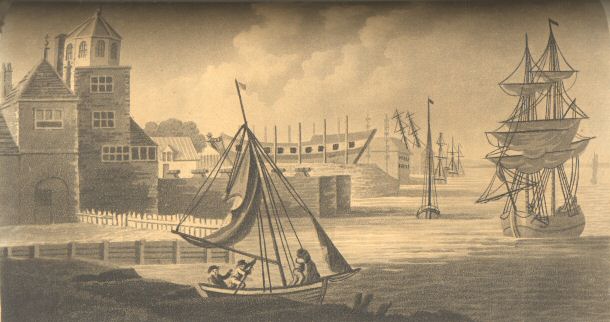
Upon the accession of Charles I, one of the first and most remarkable circumstances that appear to have occurred here was the erection of St. Anne’s Fort, on which were mounted, as we are told, “several great pieces of ordnance, sent from London and planted here for the defence of the town.” This some, perhaps, would be apt to construe as ominous of the subsequent troubles of that reign, of which this town appears to have had its full share: for having declared against the parliament, it was by their forces closely besieged and taken, and afterwards laid under contribution, and strongly garrisoned. As to the Fort, we cannot find that it proved of any material use to the town in that time of danger: nor does it appear to have been ever calculated for the defence and protection of the place, or for any other purpose but to please little or full-grown children, who are naturally fond of ribands and rattles. [717]
About the beginning of 1637, “an order came from the archbishop (Laud) to this town, that the ground at the east end of the churches should be raised; the communion table (or altar) placed at the upper end of the churches, under the east windows; and that they be decently railed in, and steps made to ascend thereto.”—This was evidently undoing what Elizabeth and her reformers had done at the beginning of her reign; for the ground at the upper or east end of the churches was then ordered, as we have seen, to be levelled with that in the other parts of them. That queen and her prelates were certainly quite high enough in their notions about these matters, and yet we see that they come not nearly up to Charles and Laud. Neither of these had any dislike to popery, provided they could be themselves at the head of it. Nor would it be a very easy matter to point out the time when the spirit of popery was more predominant, than it was in the church of England in the detestable reign of the first Charles, and under the vile administration and superintendence of archbishop Laud. The latter was a sworn and mortal enemy to both civil and religious liberty, as the whole tenor of his conduct shews. In short, he was no less superstitious, than intolerant, tyrannical, and cruel, as this order which he sent to Lynn, and many other parts of his conduct clearly evince: and he may be very safely said to have contributed largely to accelerate the ruin of the cause which he had espoused, and the downfal of the church of which he was unworthily the chief metropolitan.
Laud has been often represented as very learned: but it was paying learning but a poor compliment, as it appears to have done little, or rather nothing at all towards humanizing him, or softening his hard heart, and subduing the bigotry, intolerance, and unfeelingness, which were in him so preeminently conspicuous and predominant. Severities and terrors which most of the vulgar or unlearned protestant persecutors would have deemed sufficient, could not satisfy him: cropping or cutting off the ears, and slitting the noses of those who openly objected to his proceedings, were among his favourite forms of discipline, and what passed with him as justifiable and wholesome severities. His atrocities at last recoiled upon him with a vengeance, and he became the unpitied victim of his own system of terror and tyranny.
CHAP. III.
Account of reputed Witches, of this and subsequent periods, at Lynn and some other places—inexcusable severity of their sufferings—brutality of their persecutors—barbaric stupidity and infatuated credulity of the people and their rulers.
The existence of witches was formerly a part of the creed of the good people of Lynn, as well as of the rest of their countrymen. It was not a mere mental error, which would have made it, at least in a great measure, harmless, but it was a practical error of a most horrid nature, for it issued in the persecution and murder of not a few wretched, friendless, and innocent beings, who were no more in league with satan and the powers of darkness than their persecutors and judges, or even half so much. These legal murders were once very common in this country, even since the reformation: so that many hundreds, if not thousands of them have been perpetrated under the sanction of our protestant government, and in the sacred name of justice, and of our sovereign lord the king. This town, as was before observed, is among the places where this innocent blood has been spilt, and where the names of law, justice, and royalty, have been shamefully prostituted to justify those foul and murderous deeds. We shall now proceed to give a sketch of the part which our townsmen of other times appear to have taken in this detestable business.
Section I.
A sketch of the history of the prosecution and murder of divers poor harmless creatures, falsely denominated witches, at Lynn, in the sixteenth and seventeenth centuries.
Before the reformation, and since in popish countries, the cognizance of reputed witches, and suppression of what is called witchcraft, pertained to the inquisitors. Luiz de Paramo, a Spanish inquisitor, who wrote a most curious book in defence of the holy office, [720] declares that in the course of 150 years, (from 1485, if we are not mistaken) the inquisition had burnt 30,000 witches, which he evidently thought a most meritorious deed, for which the pious actors were entitled to the gratitude and veneration of posterity, and himself, who had been very active in the same way, to the praise of having deserved well of his country and of all Christendom.
After the reformation, the business, in these kingdoms, was taken up by such zealous protestants (conformists and nonconformists) whose spirit pretty much resembled that of the Spanish Inquisitors, and who appear to have been equally unchristianlike. Their zeal against what they called witchcraft was unbounded; and whenever they could fix that stigma upon any one, he could have little chance of escaping with his life. This country has therefore been highly infamous for the punishments inflicted, and the barbarities exercised upon those hapless beings whom our ignorant, superstitious, and savage ancestors used to brand with the odious names of witches and wizards. We might well be called to blush for those execrable deeds of our forefathers, if there were not others belonging to ourselves which no less loudly call for blushing.
Lancashire, it seems, has been noted for its reputed witches, and so has Warboys and other places in Huntingdonshire. Nor has this town been unproductive of persons who bore the same name, or had the hard fate of lying under the same imputation.—The first of these, that has fallen within the knowledge of the present writer, was Margaret Read, who is said to have been burnt here for witchcraft, in 1590.—Poor creature! She was certainly murdered! by the magistrates! by what was called the law of the land, and in the venerable and sacred name of justice! Such acts, however, have been but too common in all ages, in all countries, and even in what are called protestant states. England was then such a state, but that did not always secure the people from injustice and oppression, or prevent in all instances the rulers and magistrates from shedding innocent blood.
About eight years after, that is, in 1598, one Elizabeth Housegoe was executed here on the same account: but whether she was put to death by burning, or by hanging, does not appear. Whichever it was, it was a most horrid and detestable deed, and would lead one to shudder at the barbarous character of our ancestors, but for certain existing circumstances, which seem too clearly to indicate that we are not yet got so far beyond them in civilization and humanity as we are apt sometimes to conceive. Our boasted superiority in those respects over all modern nations, may also be suspected to be much less real than imaginary.
Mary Smith is the next name that occurs among this description of hapless sufferers at Lynn. She is said to have been burnt [723a] here, on the 12th. of January 1616, for witchcraft, which she was accused of having practised upon divers persons by means of a vocal contract with the devil. The poor creature, who no doubt was insane, acknowledged the truth of these foolish accusations; which acknowledgement, probably, formed the chief, if not the only proof of her guilt: and Alexander Roberts, styling himself preacher of God’s Word at King’s Linne, in the same year published a treatise on Witchcraft, in which the story of this Mary Smith, this pitiable victim of the stupid ignorance and savage superstition of our ancestors, is related. [723b]
While their hands were still red and poluted with the innocent blood of this poor defenceless woman, our magistrates went about establishing a Library in the town, which seems indeed to have been very much wanted among them: and we have already given them credit for that undertaking. But its inconsistency with the other part of their conduct is so manifest and glaring (especially if we join with it their laudable feast of reconciliation,) that one is apt to wonder that they should be capable of acting such different parts, or of being the performers of actions so totally dissimilar and heterogeneous. It must however be owned that the inconsistencies of the human character are sometimes very strange, unaccountable, and surprising.
After the last mentioned affair we hear no more of these horrid doings at Lynn till 1645, when Dorothy Lee, and Grace Wright, as Mackerel informs us, were hanged here for witchcraft. But we suspect that this is misdated, and that this bloody scene did not take place till the following year, (1646) as it appears, from the Town Records, that on the 11th. of May, that year, it was “ordered that alderman Thomas Rivett be requested to send for Mr. Hopkins, the Witch-discoverer, to come to Lynn, and his charges and recompense to be borne by the town.” We may presume that he did not hesitate to come, and that it was in consequence of his coming the prosecution and execution of those poor unhappy creatures took place. It must have been a sad time when such arch-villains as this Hopkins were caressed by the magistrates, and employed to assist them in the administration of justice!—Of him we shall hereafter give some further account.
Those two women were probably the last that were put to death here for witchcraft: but great numbers suffered afterwards for the same imaginary crime in other parts of the kingdom, to the great disgrace of both the makers and the administrators of our laws. Even till within these sixty or seventy years, if we are not mistaken, there have been instances among us of poor defenceless beings doomed to capital punishment for the same pretended offence: and though our legislators and rulers seem no longer to have any faith in the existence of witches, yet the common people in many places are as much in that belief as ever, and would be very glad, no doubt, to have the old sanguinary laws still put in execution. A melancholy instance of the present existence of such a superstitious belief among our country people occurred but about two years ago at Great Paxton in Huntingdonshire, of which we shall, perhaps, in another place take some further notice.
Section II.
Brief account of some of the principal witch-finders, or witch discoverers, as they were sometimes called, those pests of society, who were a disgrace to the country and to the age in which they lived.
It would appear perhaps incredible, that those infernal beings called witch-finders should ever have been tolerated and encouraged in any country calling itself christian and protestant, had we not seen characters no less detestable and diabolical countenanced, caressed, and patronised in such countries. The execrable reign of Charles II swarmed with Spies and informers, whose talents were employed to promote religious uniformity, and suppress liberty of conscience. Like the witch finders, they were countenanced by the magistrates, patronized by the gentry, and enriched by the wages of unrighteousness, and the ruin of innocent persons and families. Our own time has seen such wretches, and poor Ireland has been not a little prolific of them. Even among our financial or revenue agents some of the same family have made their appearance, which some are apt to consider as an evil and a grievance of no small magnitude. If our own time has abounded with such characters, and if they have been really countenanced and cherished by rulers and magistrates, we must not be too severe upon our ancestors for the course which they pursued in regard to those called witches and witch-finders: for we do not seem to have yet gone so far beyond them in wisdom and virtue as we are sometimes apt to think.
Among those called witch-finders, the first place seems due to Matthew Hopkins, of Maningtree, in Essex, who has been already mentioned, as invited here by the magistrates, to assist them in the discovery, or detection and conviction of witches, and the suppression of witchcraft. This man, as we are told, was witch-finder for the associated counties, (Essex, Suffolk, and Norfolk,) and hanged in one year no less than sixty reputed witches in his own county. The old, the ignorant, and the indigent; such as could neither plead their own cause nor hire an advocate; were the miserable victims of this wretch’s avarice and villany. He pretended to be a great critic in special marks; which were only moles, scorbutic spots, or warts, which frequently grew large and pendulous in old age, but were absurdly supposed to be teats to suckle imps. His ultimate method of proof was by tying together the thumbs and toes of the suspected person, about whose waist was fastened a cord, the ends of which were held, on the banks of a river, by two persons, in whose power it was to straighten or slacken it. Swimming, upon this experiment, was deemed a full proof of guilt; for which king James, (who is said to have recommended it, if he did not invent it,) assigned the following sage reason: “That as such persons have renounced their baptism by water, so the water refuses to receive them.” Sometimes those who were accused of diabolical practices were tied neck and heels and tossed into a pond. If they floated they were consequently guilty, and therefore taken out and burnt: if they were innocent they were only drowned. The experiment of swimming was at length tried upon Hopkins himself, in his own way, and he was in the event condemned, and, as it seems, executed as a wizard; [727] an end or retribution which he appears to have richly merited. But how far he was (if at all) convinced of that, at his exit, we are not informed. If we are not mistaken, there was also, about the same time, a noted witch-finder at Ipswich, who found pretty full employment, but as we have no account either of his mode of proceeding or exploits, or yet of his exit, we can say no more about him.
At the time when the belief and detestation of witchcraft were universal in this country there can be no doubt but the number of our pretended witch-finders was very considerable. It may be fairly supposed that there were more than one for every county, and even that they were no less numerous than our modern mountebanks and quack doctors. Some of them, however, would, in the natural course of things, outshine the rest, or far excel them in point of reputation or celebrity. Such a one was Hopkins, and such a one was that famous Scotchman, whose name we cannot at present make out, who found so much employment, in the way of his vile vocation, on this, as well as on the other side of the Tweed. Of him a curious account is given in a book entitled, England’s Grievance, &c. by Ralph Gardiner, Gent. of Chirton, in Northumberland. London: printed in 1655. Reprinted in 1796. Where we have the following information.
“In or about the year 1649 or 1650, the magistrates of Newcastle upon Tyne sent two of their sergeants, namely Thomas Shevel, and Cuthbert Nicholson, into Scotland, to agree with a Scotchman, who pretended knowledge to finde out witches by pricking them with pins, to come to Newcastle, where he should try such who should be brought to him, and have 20s. a-piece for all he could condemn (or convict) as witches, and free passage thither and back again: [i.e. have his expenses borne to and fro.] When the sergeants had brought this witch-finder on horseback to town, the magistrates sent their bellman through the town ringing his bell, and crying, all people that would bring in any complaint against any woman for a witch, they should be sent for and tryed by the person appointed. Thirty women were [accordingly] brought into the town-hall and stript, and then openly had pins thrust into their bodies, and most of them was (were) found guilty by him, and set aside.
“The said reputed witch-finder acquainted colonel Hobson that he knew women, whether they were witches or no, by their looks; and when he was searching a personable and good-like [or good looking] woman, the said colonel replied and said, Surely, this woman in none, and need not be tryed: but the scotchman said she was, for the town said she was, and therefore he would try her; and presently, in sight of all the people, laid her body naked to the waste, [waist] with her cloaths over her head; by which fright and shame all her blood contracted into one part of her body, and then he ran a pin into her thigh, and suddenly let her coats fall, and then demanded whither she had nothing of his in her body, but did not bleed? But she being amazed, replied little. Then he put his hands up her coats and pulled out the pin, setting her aside, as a guilty person and child of the devil, and fell to try others, whom he made guilty.”
“Colonel Hobson perceiving the alteration of the foresaid woman, by her blood settling in her right parts, caused her to be brought again, and her cloaths pulled up to her thigh, and required the scot to run the pin into the same place, and then it gushed out of blood, and the said scot cleared her, and said she was not a child of the devil. So soon as he had done, and received his wages, he went into Northumberland to try women there, where he got of some 3l. a-piece. But Henry Ogle Esq. a late member of parliament, laid hold on him, and required bond of him, to answer the sessions, but he got away for Scotland, and it was conceived, if he had staid, he would have made most of the women in the north witches, for money.”
The poor Newcastle women, whom this wretch had set aside and pronounced guilty, were put in prison till the assizes, when 14 of them, and one man, were condemned, and afterwards executed: all solemnly protesting their innocence. Their names are mentioned at page 115 of the said book. The truth of the above account is attested by three persons, whose names it is needless to insert here.—As to the infamous witch-finder himself, we are told that “he was afterwards taken up in Scotland, cast into prison, indicted, arraigned, and condemned for such like villanie exercised in Scotland: and on the gallows confessed he had been the death of above 220 women, in England and Scotland, for the gain of 20s. a-piece, and beseeched forgiveness, and was executed.”
The author of the work from which this account is extracted, indignantly inquires, “by what law the magistrates of Newcastle could send to another nation for a mercenary person to try women for witches? and set the bellman to cry for them to be brought in?—and give 20s. a piece to the former to condemn them?” These queries we know not how to answer, but by supposing that the whole was a lawless, as well as a most iniquitous, barbarous, and scandalous business. The magistrates of Newcastle certainly appear on this occasion a vile and infamous crew, whose memory ought to be held up to the horror of perpetual detestation. How much better the magistrates of Lynn would have appeared, had we so particular an account of their proceedings, when they sent for Hopkins, it is impossible now to say. Their conduct, to say the least of it, appears sufficiently dark and despicable.
While we feel and express a just indignation against the witchfinders, as well as against the spies and informers and such like miscreants, we ought not to forget how much the existence, sufferance, and employment of them reflect on the character of the rulers and magistrates of those days, and even of the nation, or public at large; for had these been sufficiently enlightened and humanized, those detestable wretches had never been encouraged and employed, or even endured in the country. How baleful and deplorable therefore must intellectual blindness or ignorance be in any community? how desirable, important, and necessary for all descriptions of men, is the true knowledge of their respective rights and duties! Had our magistrates and legislators always possessed that knowledge, and acted accordingly, our annals had never been disgraced, as they are, with the recital of so many acts of injustice and oppression, or with such shocking accounts of the torturing, burning, and hanging of so many reputed criminals, under the misapplied and odious names of witches, heretics, and blasphemers.
Section III.
Additional observations on Witchcraft, and on the absurd and superstitious notions entertained by our ancestors concerning witches, as well as their deep-rooted and deadly antipathy against all those whom they considered as such.
That the world abounded in former ages, and from the remotest periods, with jugglers and other sorts of artful impostors, who pretended to the knowledge of future events and other secrets, and so supported themselves and acquired great names by working upon the weakness, or imposing upon the credulity of mankind, is well known. Being of different sorts they went under different names, according to their respective pretensions, or peculiar, apparent, or professed modes of proceeding. Hence we speak of them under the various appellations of magicians, sorcerers, diviners, conjurers, witches and wizards, &c. each, or most of which denote a certain distinction of character or operation. [732] There were among them from the earliest times ventriloquists and consummate jugglers, well skilled in the arts of dexterity, or slight of hand tricks, and their operations served, (as real miracles did with the true prophets,) to gain credit to their declarations and pretensions. Thus their high and solemn professions, with the aid of gastriloquy, legerdemain or juggling, obtained credit in the world, so as to establish their character or fame, and perpetuate the delusion. Falshood assumed the name or place of truth, and fiction that of reality: and those who were thus taken in, or imposed upon, have always with difficulty been undeceived.
Formerly the names of magicians, sorcerers, witches, &c. were appropriated to those only who avowed or professed themselves to be such; but latterly, or in more recent times, they seem to have been chiefly, if not entirely appropriated to those who did not make such an avowal or profession, and who even disclaimed any such imputation or pretension. And, what is exceedingly remarkable, those who were uncommonly knowing, and those who were uncommonly ignorant became now equally the objects of suspicion, and were of course included under one or another of those appellations; as if extraordinary intelligence and extraordinary stupidity equally indicated an alliance or confederacy with the devil. Such men as Roger Bacon and Galileo, the most enlightened of their species, were more than suspected to be sorcerers, and multitudes of poor creatures, mostly old women, who were no way distinguished from the rest of the community, except by their extreme poverty, or extreme ignorance, have been treated in the most brutal manner, and in the end burnt or hanged, under the opprobrious name of witches—in the infamy of which conduct, as we have shewn, this town is deeply implicated.
Before the reformation there was, it seems, in this country a regular board of justice, for the constant apprehension and conviction of magicians, enchanters, sorcerers, witches, &c. and a warrant is said to be still extant for the seizing of one Thomas Northfield, professor of divinity, and sorcerer, with all his books and instruments. [734a] This double character, of conjurer and divine, exhibits the poor fellow in a queer kind of light, as a sort of amphibious animal. What he was as a divine, it is impossible now to ascertain. He might be eminent, or he might not. [734b] But his being also a sorcerer or conjurer, in the usual acceptations of those words, seems no way entitled to credit; so that his lying under that imputation, or his being so reputed, was merely the effect of the blind superstition which then prevailed, and which usually ascribed every appearance of superior genius or intelligence to a diabolical inspiration.
After the reformation, the rage against witches and sorcerers underwent no abatement. New laws were enacted against them, and reputed offenders were prosecuted with the utmost rigour. The most learned of our sovereigns, (Henry VIII. and James I.) not only strongly believed in the existence of such offenders, but likewise held them in the greatest abhorrence: Hence by statute 33 Henry VIII, c. 8. witchcraft and sorcery are made felony without benefit of clergy; and by statute 1 Jac. 1. c. 12. it is enacted, “that all persons invoking any evil spirit, or consulting, covenanting with, entertaining, employing, feeding, or rewarding any evil spirit; or taking up dead bodies from their graves to be used in any witchcraft, sorcery, charm, or enchantment; or killing, or otherwise hurting any person by such infernal arts; should be guilty of felony without benefit of clergy, and suffer death. And if any person should attempt by sorcery to discover hidden treasure, or to restore stolen goods, or to provoke unlawful love, or to hurt any man or beast, though the same were not effected, he or she should suffer imprisonment and pillory for the first offence, and death for the second.” These acts (judge Blackstone says) “continued in force till lately, to the terror of all ancient females in the kingdom: and many poor wretches were sacrificed to the prejudice of their neighbours and their own illusion; not a few having, by some means or other, confessed the fact at the gallows. But (he adds,) all executions for this dubious crime are now at an end. Accordingly it is with us enacted by statute 9 Geo. II. c. 5. that no prosecution shall be carried on against any person for conjuration, witchcraft, sorcery, or inchantment. [736a] But the misdemeanor of persons pretending to use witchcraft, tell fortunes, or discover stolen goods by skill in the occult sciences, is still deservedly punished with a year’s imprisonment, and standing four times in the pillory.” [736b]
Thus it appears that it was not till the last reign that the sanguinary laws against witchcraft &c. were repealed in this country; so that we had enjoyed the light of the reformation full 200 years before we discerned the injustice and bloodguiltiness of those laws, or even the folly and absurdity of believing that those poor, ignorant, defenceless women, whom we were pleased to call witches, had actually sold their souls and bodies to the devil, and had in exchange obtained from him the power of working miracles. For we always imputed to our witches a supernatural power, which we deemed one of their essential characteristics: and we firmly believed that they could fly, or ride in the air upon broomsticks, change themselves into the form of other animals, injure their neighbours in their persons or property, by their looks, their thoughts, or their wishes, &c. Now, if not only the public at large and the juries, but even the judges and legislators could believe all this, what wonder is it if some of the poor old women could do so too, as they are said to have sometimes made such a confession? Their confession, however, appears to have been often, if not always, the mere effect of terror and confusion. [737] Poor hapless creatures! without a friend in the world to take their part, or speak a word in their behalf; terrified also and confounded beyond measure by the presence of their judge and the awful apparatus of a court of Justice, they would confess any thing that might be urged upon them, and all without thought or reflection, or even knowing what they said.
It is not unworthy of observation that witches were formerly, even by our legislators, classed with heretics, and witchcraft went under the name of heresy, being deemed a species of that offence, and subjected to the same punishment, that of burning. It might quite as well have gone under the name of rebellion or high treason, or any other crime, for it has as much affinity with them, to the full, as it has with heresy. It is astonishing how often, or how commonly it is that human laws and governments are characterized by ignorance, absurdity, injustice, cruelty, folly and madness. So unfortunate in general has the world been in its rulers, that most of them have proved its greatest enemies, though often extolled to the skies, for every imaginable excellence, by the vile sycophants that surround them, and the vermin of every province and district who live and fatten on their oppressive and rapacious devices.
Section IV.
Summary view of the whole subject—account of proceedings against witches in this country till the repeal of the laws that chiefly affected them—hints on the present state of the nation in regard to this and its kindred delusions.
The proper idea of witchcraft, it is presumed, has been already very plainly suggested; but lest it should not seem sufficiently clear to our readers in general, it may be proper to attempt here a more explicit definition. We say therefore that witchcraft is a supernatural power which persons were supposed to obtain the possession of by entering into compact with the devil. It was believed that they had given themselves up to him body and soul; and that he engaged on his part that they should want for nothing, and that he would avenge them upon all their enemies:—also, that as soon as the bargain was concluded, the devil delivered up to the witch an imp, or familiar spirit, to be ready at a call and do whatever it was directed. By the assistance of this imp and the devil together, [that is, of both the young devil and the old one,] the witch, who was almost always an old woman, was enabled, as it was firmly believed, to do very marvellous feats—even to transport herself in the air, on a broomstick or a spit, to distant places to attend the assemblies or meetings of the witches; for, according to this belief, or way of thinking, the witches, (like some of our modern sects,) actually had their assemblies, associations, or general conferences, at which the devil himself always presided. It was also believed that they were enabled to transform themselves into various shapes, particularly to assume the forms of cats and hares, in which they most delighted; to inflict diseases on whomsoever they thought proper; and to punish their enemies in a variety of ways. [739] These ideas of witchery could not obtain belief among the heathens, as they had no knowledge of our devil.
Under popish darkness and delusion these views of witchcraft universally obtained in Europe till the 16th century, and the doctrine maintained its ground with tolerable firmness till after the middle of the seventeenth, and even till the former part of the eighteenth century, when it was obliged to give way to more rational views of things. Vast numbers of reputed witches were here, in protestant and evangelical England, convicted and condemned to be burnt every year; and a man who had the hardihood to deny the doctrine, or doubt of its truth, would be at once suspected of atheism, and perhaps run the risk of being burnt, if not for downright witchcraft, yet at least for advocating the cause, and being the agent of his Satanic majesty. [740]
Of the methods of discovering witches, one was to weigh the supposed criminal against the church bible, which, if she was guilty, would preponderate. Another method was by making her attempt to say the Lord’s Prayer; this no witch was able to repeat entirely, but would omit some part or other: all witches did not hesitate at the same place; some leaving out one part and some another.—It was also believed that witches always said their prayers backwards.—Teats, though which the imps suckled, were indubitable marks of a witch: these were always raw, and also insensible; and, if squeezed, sometimes yielded a drop of blood. A witch could not weep more than three tears, and that only out of the left eye. This want of tears was, by the witchfinders, and even by some judges, considered as a very substantial proof of guilt. Swimming a witch, as was before observed, was another kind of popular ordeal generally practised: for this she was stript naked, and cross bound, the right thumb to the left toe, and the left thumb to the right toe. Thus prepared, she was thrown into a pond or river, in which, if guilty, she could not sink; for having, as was said before, by her compact with the devil, renounced the benefit of the water of baptism, that element, in its turn, renounced her, and refused to receive her into its bosom.
The trial by stool, another method for the discovery of witches, was thus managed: having taken the suspected witch, she was placed in the middle of a room upon a stool or table, cross legged, or in some other uneasy posture; to which if she submitted not, she was bound with cords: there she was watched, and kept without food or sleep, for twenty four hours; for it was believed that they should within that time see her imp come and suck. A little hole was therefore made in the door for the imp to come in at: and lest he should come in a less discernible shape, they that watched were taught to be frequently sweeping the room, and, if they saw any spiders or flies, to kill them; if they could not kill them, then they might be sure they were imps.
If witches, under examination or torture, would not confess, all their apparel was changed, and every hair of their body shaven off with a sharp razor, lest they should secrete magical charms to prevent their confessing. Witches were believed to be most apt to confess on Fridays.—The two following expedients, or fiery ordeals, are also mentioned, as used to extort confession: the first, burning the thatch of the house of the suspected witch; the other, burning any animal supposed to be bewitched by her, as a hog or ox. These, it was held would force a witch to confess, [742] in spite of her teeth, or of the devil.—Our ancestors, strange as it may seem, persisted in the belief and practice, or observance of these horrid monstrosities till within the memory of some of the present generation. Nor had they perhaps relinquished or abandoned them quite so soon, but for the laudable exertions of such men as Locke and Addison, and their enlightened contemporaries.
Our kings, courtiers, and legislators were all believers in witchcraft, and hearty approvers of the existing laws against that reputed crime. One of the former, and deemed the wisest of that sacred order, and the Solomon of his day, (James I,) wrote a book in defence of that belief, and of subjecting witches to capital punishment; and when Reginald Scott, the first of our countrymen who ventured to dissent froth the popular creed and write on the other side of the question, published his book, his majesty ordered it to be burnt by the common hangman. The whole nation approved of the royal and magnanimous deed, and poor Scott passed for a notorious heretic.—It is not a little mortifying and humiliating to the dignity and pride of man, that the same stupid and absurd notions about witchcraft were among the articles of the creed of the great lord Bacon and his most enlightened contemporaries, as well as of their wise sovereign, and the whole body of the mobility or national rabblement. The poor witches, of course, had then almost terrible time of it; as much so, probably, to the full, as in the darkest days of popery.
Under Charles I, the Common-wealth, and succeeding reigns, the public opinion on this subject continued unchanged, and the judicial proceedings against witches went on as before. If they exceeded at any particular period, we presume it must have been under the Common-wealth, when the witch-finders appear to have been in full employment, and at the height of their prosperity. But we can hardly give credit to the account which Dr. Zachary Grey said he had seen, of between 3 and 4000 persons who suffered death, in the British dominions, for witchcraft, from the year 1640 to 1660. The spirit which then predominated and reigned, was certainly violent enough, and bore cruelly hard on the poor creatures who were accused of witchcraft: but such a number of victims in so short a space of time, is surely too excessive and extravagant to be credited. It is however greatly to be regretted that the leaders of that interesting period adhered in this particular to the creed of their ancestors, and were so stupidly in the dark as they appear to have been on this and some other subjects.
It does not appear, as far as the present writer has discovered, that any of the judges, till after the revolution, shewed the least inclination to discountenance the prosecution of reputed witches, or the prevailing and popular notions about witchcraft. Even Sir Matthew Hale went with the stream of public opinion, and was among those oracles of the law who passed, without hesitation, the sentence of death on those whom the verdict of a jury pronounced guilty of that reputed crime. Sir John Holt and Sir John Powel, to their immortal honour, appear to have been the first of our English judges who viewed this pretended offence with minds superior to vulgar prejudice. The conduct of the former, on a certain trial for that offence, is said to have been such as put an end to all similar prosecutions in that part of the country, and even throughout the kingdom. [744] But the law was not repealed or altered in his time.
As to the latter, (Judge Powel,) we hear of two different trials for this offence before him. At one of them, a witness gave evidence that the prisoner at the bar could fly: on which the judge asked the poor woman, if it really was so, and she answered in the affirmative; when the judge, with a promptitude of expression which evinced the superiority of his understanding, told her, so she might if she would; he knew of no law against it. How this trial ended we are not told; but we may be very sure that his lordship did all he could to get the prisoner acquitted. The other trial for witchcraft before him was that of Jane Wenham, at Hertford, March 4. 1712. The prisoner was charged with having bewitched several persons, and had the weakness, it seems, sometime before the trial, to confess herself guilty of the alleged crime: and though she afterwards accounted for this confession, as arising from terror, it appears to have had considerable influence on the minds of the jury, in spite of the endeavours of the humane judge to explain and invalidate the evidence brought against her. She was accordingly brought in guilty; but the judge reprieved her, and the queen soon after pardoned her.
One of the principal witnesses against the prisoner on this trial, as well as one of the principal writers in the controversy to which it gave rise, was Mr. Bragge, vicar of Hitchin. This gentlemen, in his evidence on the trial, declared, on “the faith of a clergyman,” that “he believed the prisoner to be a witch:” whereupon the judge told him, that, therefore, “on the Truth of a Judge, he took him to be no conjurer.” After she was pardoned, a gentleman in the country provided her an apartment over his stables, sent her victuals from his table, and suffered her to attend on his children: and we are informed that she was ever after looked upon by the family as an honest, good natured woman. [747a] Here we will venture to add that the conduct of the judge and the queen was as just and commendable as that of the prosecutors and the jury was vile and infamous.
In 1716, about four years after the above trial, came on at Huntingdon, for the same offence, before judge Wilmot, the trial of Mary Hicks and Elizabeth her daughter, nine years of age. They were, it seems, the wife and favourite child of a substantial farmer, who had them apprehended, and became himself, most unnaturally, the principal prosecutor. The child had practised some silly illusions on her father’s weakness, and the mother had had recourse to the antiquated folly of killing her neighbours in effigy. On this the suspicion of their being witches was founded. A confession on their part, not only corroborated that suspicion, but was taken as a full proof of their guilt: “and judge Wilmot suffered them to be hanged, upon that confession, four years (says Mr. Gough,) after his wiser brother, (judge Powel,) ventured his own life to save that of the old woman at Hertford.”
About twenty years after the date of this disgraceful and tragical trial, the 9th. of Geo. II, the old laws which made witchcraft a capital crime were happily repealed. How many more of such prosecutions or executions took place within those twenty years we are not able to say. [747b] But it does not appear that the inhabitants in general, or the lower orders of the community which constitute the bulk of the nation, have ever yet been fully satisfied with the repeal of those laws. Hence they have been often ready to take the business into their own hands and proceed in a summary and very savage way against those whom they have thought proper to deem or denominate witches. A shocking case of this kind occurred at Fring in Hertfordshire as lately as 1751, when one Ruth Osborn, a reputed witch, fell a victim to the stupid credulity and abominable prejudice of a frantic mob: and though several of the ringleaders in that bloody and brutal transaction were afterwards hanged, yet the blind and superstitious belief that produced it remained still in the country, and is, even now, in many, if not in most parts of the kingdom as strong as ever.
But little more than two years ago, as was observed before, one Ann Izzard, a poor, honest, industrious woman, of Great Paxton in Huntingdonshire, was very near meeting the same fate with the above Ruth Osborn. Two or three young women in the neighbourhood having fits, some people there gave out, that they were bewitched, and the suspicion fell upon Ann Izzard: a loaded cart sometime after, oversetting on its return from St. Neot’s market, while the same woman was in company, that accident was ascribed to her witchery. This confirmed and established the public opinion of her being actually a witch, and immediately set the whole parish in an uproar: “She has just overturned a loaded cart with as much ease as if it had been a spinning wheel,” was echoed from one end of it to the other. Men, women, and children raised their voices and exclaimed, “we have now sufficient proof of her guilt—this last act in open day speaks for itself—she is the person that does all the mischief; and if something is not done to put a stop to her baseness there will be no living in the place.”—Nor did this fit of phrensy terminate till they had made two attacks upon her, which, atrocious as they appeared to rational and enlightened people, where considered, by themselves as not only justifiable but highly meritorious. They were proceeding to still greater atrocities, which she escaped through the interposition of some of her more humane neighbours, who took her under their protection, and had the offenders prosecuted. [749]
But let us not suppose that it is only in Hertfordshire and Huntingdonshire that this stupid belief in the existence of witches still maintains its ground among us: there every reason to conclude, for all our boasted advancement in knowledge, that a large majority of our population is still subject to this stupidity, and strong in the faith of witchcraft. It is much to be wished we could here make an exception in favour of Norfolk, and particularly of Lynn. But it cannot be done. A great part of this county is known to be exceedingly dark and heathenish; and the vicinity of this town may be said to be much in the same predicament. Even of the town itself the majority of the population appear to be in a miserable low estate, in point of moral as well as religious cultivation. It is therefore not to be wondered at if a belief in such things as witchcraft and conjuration should be here still very common and prevalent.
The author presumes that there is no need to apologize for the length of these historical strictures on witchcraft; the belief of it being, even now, so general among us. As he deems it a vulgar error, or popular delusion of a most disgraceful character, and pernicious tendency, he wished to expose it with effect, which he thought he could not do more briefly. He has long observed, with regret, how tenaciously a large proportion of the population of this town and country still adhere to their old blind prejudices; and he would gladly contribute, as far as he can, towards weakening that adherence. The success, indeed, of all efforts in this way seems almost hopeless; our countrymen’s progress here, from darkness to light, having been hitherto so exceedingly slow and sluggish. A belief in the existence or reality of conjuration and witchcraft, and in the almost boundless power and dominion of a malignant being, called the devil, is yet, even now in the nineteenth century, among our deep-rooted delusions. That it is really so, might be exemplified and proved from many undeniable facts, as well as some very recent and striking occurrences. [751] But we will now dismiss the subject, and proceed to another division of the work, where new scenes will present themselves to our view.
CHAP. IV.
History of Lynn, from the meeting of the long parliament, and the commencement of the civil war, to the Restoration.
The long parliament, during the first years of its existence, exhibited, perhaps, a body of national representatives, the most respectable in point of talents and integrity, that this country could ever boast of, or has at any time produced. Between the patriotism of that assembly and the despotism of the court; there was certainly a most visible and striking contrast. The difference between these patriots and the government, arose from the oppressive proceedings of the latter, and their flagrant encroachments upon the rights and liberties of the people. The patriots heartily espoused the people’s cause; but as their oppressors would not listen to reason, or cease from their tyranny, and give security for their future good behaviour, an appeal was made to the sword, which produced the civil war, of which, together with its memorable effects or consequences, especially as they affected, or related to this town, we shall now proceed to lay before the reader a brief account, which will enable him to form some idea of the principal occurrences of that period.
Section I.
Hints relating to some occurrences here, anterior to the breaking out of the war—Lynn declares for the king—its previous conduct charged with duplicity—siege and surrender of the town—subsequent events.
Among the arbitrary measures of the government, which affected this town previously to the commencement of the war, was the levying of Ship-money. In 1634, the town is said to have been assessed towards a ship of 800 tons, with 260 men; but it does not appear what was the amount of the assessment. Two years after, however, (Nov. 6. 1637,) we learn, from the corporation books, that “the town was assessed 200l. for a ship of war.” This sum may be supposed nearly, if not quite equal to 2000l. of our money. We mean not to say that it was excessive or exorbitant: it was certainly arbitrary, and therefore illegal and objectionable. But by the heads of the town, if we may judge by their subsequent conduct, it was not deemed a serious grievance, or perhaps any grievance at all; for they declared for the court, and against the party which opposed those lawless exactions.
In the succeeding years, previously to the commencement of the war, the town appears to have been closely and carefully guarded, so that none were allowed to enter without permission: hence we find in 1639, the mayor appointing “two warders for the day time, one to stand at the South, and the other the East-Gate;” and the same to continue, “so long as he shall think fitting these dangerous times.” In 1640 and 1641, the town may be supposed guarded no less vigilantly; in the beginning of 1642, it was, it seems, further fortified, and furnished with seven pieces of brass cannon from London. In the early part of the same year, captain Sherwood of Norwich, at the head of a troop of dragoons, came close under St. Catherine’s Wall, by the East-Gate, and demanded admittance, but was denied, says Mackerel, “by the mayor and townsmen”—but we presume it must have been rather by the governor; who, at that time, if we are not mistaken, was Sir Hamon L’Estrange, the father of the afterwards famous Sir Roger.
The three gates were now furnished with draw-bridges, and the town, from its situation and the repairs bestowed on its fortifications, must have been pretty strong. The parliament also thought it a place of no small consequence, and therefore it was besieged and taken at an early stage of the war, by the earl of Manchester, one of their commanders, at the head of a very respectable and formidable force, well supplied with artillery. The town held out near three weeks; for the siege began on August 28. and the place surrendered on the 16th. of September. Of this memorable siege and surrender, the following account is extracted from Rushworth’s Historical Collections, vol. 5. p. 283, which it is hoped will not prove unacceptable to the reader.
“The town of Lynn Regis (says Rushworth,) advantageously situated on an arm of the sea, had for a long while fortified itself, on pretence of neutrality, and for their own defence; but afterwards shewed themselves wholly for the king: wherefore the earl of Manchester being made the parliament’s major-general, for the associated counties of Norfolk, Suffolk, &c. resolved to reduce it; and in order thereunto, seized the town of Old Lynn, and there planted ordnance, which much annoyed them in the other town. And two approaches were made, one by the causeway that leads to the South, and the other to the East-gate.” [Against the latter,] “The besieged made a brisk sally, and at once fired two houses in Gauwood, [Gaywood] intending to have destroyed the whole town, that the enemy might not have quarters there. But that party were beaten in, and the rest of the houses preserved. The besiegers summoned in pioneers, from all the neighbouring parts, and by degrees brought their approaches within half musket shot: and had begun from a battery on a hill, near to the end of the town, next the sea, and resolved upon storming the town, both by land and water, having provided many boats and ladders for that purpose. But then received a letter from the town, intimating their willingness to capitulate: and so a treaty was agreed on, to be had by eight persons of a side. Those for the earl of Manchester were, Sir John Pargrave, Col. Russel, Col. Walton, Mr. Philip Calthorpe, Mr. John Pickering, Mr. Gregory Gosset, Mr. John Spilman, and Mr. William Goodz. For the town Sir Hamon L’Estrange, Sir Richard Hovell, Mr. Clinch, Mr. Dereham, Mr. Pallet their recorder, Mr. Hudson the mayor elect, Mr. Leek, and Mr. Kirby: Between whom, after a long debate, it was agreed to this effect,—1. That the town, with the ordnance, arms, and ammunition be delivered to the earl, and he to enter the town.—2. That the gentlemen strangers in the town, shall have liberty to depart, with every man a horse, sword and pistols.—3. That the townsmen shall enjoy all rights and privileges appertaining to them, with free trading as far as may consist with law.—4. All prisoners on both sides to be set at liberty.—5. That the desires of the town touching certain of their ships taken by the parliament frigates, shall be represented by the earl, to the parliament and the earl of Warwick.—6. That neither the persons nor estates, of any inhabitants or strangers now resident in Lynn, shall be molested for any thing past, or done by them since the earl of Manchester’s coming into these parts.—7. That, for preventing of plundering, the town shall raise and pay ten shillings a man, to all private soldiers under the earl’s command, and a fortnight’s pay to the officers.—8. and lastly, That Sir Hamon L’Estrange, Sir Richard Hovell, Capt. Clinch, Mr. Recorder, Mr. Dereham, and Mr. Leek, remain as hostages, until the conditions be performed.”
“The same night, part of the Earl’s forces took possession of the town; and the next morning his lordship made his entry, and sent 500 men to Hull. Soon after be withdrew the rest of his forces into Lincolnshire, leaving Col. Walton governor of Lynn.”
Here it may be observed, that the forces that besieged and took Lynn, consisted solely of infantry: the cavalry attached to this army had remained in Lincolnshire, under the command of Cromwell, who was now beginning to distinguish himself as a soldier. But neither he nor his cavalry, were present at this siege, though some people have thought otherwise, for no better reason, seemingly, than the idle presumption that Cromwell must have been concerned in all the notable transactions of that memorable period.
Among the remarkable occurrences which took place here during this siege, the following has been found in a certain MS. account of the town—
“On Sunday the 3rd of September, in the afternoon, and in the middle of the sermon, came a shot of 18lb weight in at the window over the west door of St. Margaret’s church, and took the middle pillar a great part off, and broke it in many hundred pieces, dispersing them in all directions, all over the church. One piece of the stone, fell into a seat at the lower end of the church, where five men set, [sat,] and split the board before them, on which they laid their books; but no harm was done to them. The preacher, a reverend divine, named Mr. Hinson, left his sermon and came out of the church, and all the people departed in a most confused manner; [759a] some leaving their hatts, some their books, and some their scarves; but, praised be God, no further hurt was done to any person.” [759b]
Near three months after the surrender of Lynn, the following order of both houses was issued, bearing date December 9th 1643—
“Forasmuch as the Earl of Manchester, in his articles of agreement with the town of king’s Lynn, remitted the offence in reference to himself and his array while they lay before the town; but touched upon no private injuries done by the malignants to the well-affected: it is this day ordered by the Lords and Commons that such persons as did take any of the goods of the well-affected, by themselves or such as they appointed, or did any damage to their houses or mills, or any other ways, shall make restitution to all such well-affected persons as have been damnified, according to the greatness of their losses. And that Col. Walton, governor of King’s Lynn, Mr. Percival and Mr. Toll, members of the House of Commons, [for that town,] shall examine what damage hath been done to the well-affected, and appoint such as have done them injury to make them reparation accordingly: and if any of them shall refuse to make such reparation, that the said governor, Mr. Percival, and Mr. Toll, shall have power to sequester so much of the estates of such malignants as will make the reparation, and assign it to those that have been damnified.” [760a]
Hence it appears, that the town was then divided into two great political parties, the most powerful of which approving, and even admiring the corruptions and insanities of the Court: how far the case is similar or dissimilar at present, we need not say.
Sometime after the above order was issued by the two Houses, a party of royalists, at the head of which was young L’Estrange, afterwards the noted Sir Roger, formed a plan for surprising the town and recovering it for the king, who had granted him a commission, constituting him its governor, in case of success. But the design was betrayed by two of his confederates, though both bound by an oath of secrecy: which shews what trusty and choice hands they were. L’Estrange was consequently seized, tried by a court-martial, and condemned to die as a traitor. The sentence however was not executed. He remained in prison from 1644 till 1648, when he luckily escaped, and sometime after got out of the kingdom, where he remained, as was said before, [760b] till the autumn of 1653, when he succeeded in making his peace with the Protector: after which he lived in this country unmolested to the day of his death, when he was at a very advanced age.
About two years after L’Estrange’s adventure, we find the following notice taken of this town in a Public Paper, called “The Weekly Account,” of Wednesday May 6. 1646—It is an order of Parliament dated April 31. and thus worded—“Whereas the town of Lynn Regis hath suffered very much by the Lord Paulet, It is ordered that reparation should be made to the said town, according to their Petition, out of his estate.”—The Weekly account was a quarto news-paper, of one sheet, “containing certain special and remarkable passages from both Houses of Parliament, and collections of several Letters from the armies.”—We no where else meet with any account or intimation of damages sustained by Lynn from Lord Paulet: but the fact cannot be doubted. The town, it appears, had complained to Parliament, and petitioned on the occasion. Could that petition be found, it would, no doubt, cast some light upon this dark part of our history.
It is very certain that this town was no small sufferer during that revolutionary period, as appears from the Journal of the House of Commons in Rushworth’s Historical Collections, Vol. 7. p. 1217, where we find the following passage—“Saturday, August 5, 1648. The House was informed that the town of Lynn Regis did want much repair, being ruined by these times of war. The House ordered 2000 oaks for reparation thereof.” This conduct of the parliament, or then House of Commons looked well, as it indicated some regard for justice. We seldom, if ever, meet with similar instances in the conduct of the other, or opposite party. It is not very usual with crowned heads, or their minions, to think much of making reparation for injuries, much and devoutly as it is to be wished, that it always formed a prominent and essential part of their character.
For the remaining years, down to the restoration, this town appears to have remained tranquil, and pretty loyal to the constituted authorities, or new order of things. It seems also to have soon surmounted its former sufferings, [762a] and to have fast advanced in wealth and prosperity. We discover no particular symptoms of disaffection here within those years, unless it was about 1650, when there was an insurrection of the royalists in this county, and a major Saul, a worthy gentleman, as an old MS. says, was hanged here in the Tuesday market place, for being concerned, it seems, in that affair.
About the same time, or within the same year, one Dorothy Floyd, (or Lloyd,) also was hanged here, as the same old MS. says, for Witchcraft: which we now just mention, as we had overlooked it before, in our account of those who unhappily suffered at Lynn for that reputed or imaginary crime. [762b]
Section II.
Cromwell in much request at Lynn about the commencement of this period—the reason of it conjectured—his visit here, and that of Fairfax—character or quality of the then parliamentary representatives of the town—how chosen—paid by their constituents—demur on that score—payment enforced by parliament: &c.
The reputation and influence of Cromwell appear to have been very considerable in these parts before the breaking out of the war. In his native county of Huntingdon, and that of Cambridge, he was evidently well respected; and especially in the Isle and Fens and parts adjacent. In the direction and management of the drainage and other affairs of the Fens his interest appeared scarcely inferior to that of the earl of Bedford, if it did not sometimes exceed it. He appears to have been at the head of the opposition to that nobleman, to which party this town then belonged, as well as that of Cambridge, which Cromwell represented in parliament. The service which he had rendered to his party must have procured him their good opinion: and this, together with his general reputation, might be the reason of his being treated here with uncommon distinction.
In the spring of 1643, and but a few months before the Siege we find him invited here by the mayor and corporation; and the following order is still extant in their books—“March 20th. ordered a free entertainment at the town charge, by Thomas Gurling Esq. mayor, for Col. Cromwell and those gentlemen of his equipage, according to the invitation of Mr. Mayor, in answer to a Letter he received from Col. Cromwell.”—In the same books, a few weeks after, was inserted the following memorandum—“April 17. Mr. Mayor was allowed 5l. for his preparations for the entertainment of Col. Cromwell.” [764] This was at an early period of the war, before the town had ventured to declare for the king, and when they appeared desirous of keeping fair with the parliament, or being treated on the footing of neutrality. But whatever might be its policy, it was a very undignified conduct, as must always be the case where duplicity or hypocrisy forms the leading feature. The event shews that a different conduct would have answered better:—agreeable to the old adage or maxim, that “Honesty is the best Policy.”