WITH ROD AND LINE.
Reading edition
Blest silent groves, O, may you be, Forever, mirth’s best nursery! May pure contents Forever pitch their tents Upon these downs, these meads, these rocks, these mountains! And peace still slumber by these purling fountains, Which we may every year Meet, when we come a-fishing here. —Sir Henry Wotton.
TREAMS, from which the angler can soon fill his basket with trout, are not wanting in these mountains. It is the cold, pure waters, that spring from the perpetual fountains of the heights, that this royal fish inhabits. Show me a swift and amber-colored stream, babbling down the mountain slope under dense, luxurious forests, and, between laureled banks, issuing with rapids and cascades into a primitive valley, and I will insure that in it swims, in countless numbers, the prized fish of the angler. You or I may not be able to demonstrate this assertion; but the urchin with smiling face, yellow hair, torn shirt, suspenderless pantaloons, bare feet, and legs nude to his knees—this untaught boy, who lives in yonder homely hut amid the chestnut trees—will soon convince you of the truth of what I say, and besides, give you a few points, impossible to secure from piscatorial books, on how to catch the trout. I do not mean to say that the angler will meet with success at every point on one of these streams; for along its lower stretches, as the primeval character of the valley vanishes, as the water grows warmer under frequent floods of sunshine, and, losing its resinous color, flows with glassy surface between more open banks, the sport becomes less captivating, until only the chub and shiner rise to the fly.

The best trout-fishing, like the best hunting, is to be found in the wildest sections. The advance of civilization lessens the sport as rapidly as it thins the herds of deer along the wooded margins of the streams. Whether it be the disturbance of the waters by the line of active saw-mills, that with each year reaches deeper into the mountain solitudes, and the receding of the forests beneath the woodman’s axe; or the advent of the barefoot angler, that effects this change, makes no difference with my statement; for it is advancing civilization that brings them both.
But few persons are unfamiliar with the trout. What they have not learned from actual experience concerning its habits and appearance, has been obtained from books. The trout has been a standing theme for poets, and more has been written about it than any other fish. That honest and enthusiastic old angler, Isaak Walton, thus sums up, in a few words, his nature and habits:
“The trout is a fish highly valued in this and foreign nations. He may be justly said, as the old poet said of wine, and we English say of venison, to be a generous fish: a fish that is so like the buck, that he also has his seasons; for it is observed that he comes in and goes out of season with the stag and buck. Gesner says his name is of German offspring, and says he is a fish that feeds clean and purely, in the swiftest streams, and on the hardest gravel; and that he may justly contend with all fresh-water fish, as the mullet may with all sea-fish, for precedency and daintiness of taste, and that, being in right season, the most dainty palates have allowed precedency to him.”
The brook trout of the North Carolina mountains seldom exceeds a foot in length, and weighs from a few ounces to three-quarters of a pound. It is of a brown color on its back with darker brown, reticulated stripes. Its sides are of a lighter color and speckled with bright pink and golden, round dots, while its belly is silver white or light yellow. The dorsal fins are reddish; the first row of fins behind the gills and those on its belly are generally edged with white and black. This is its usual appearance, but trout caught in the same pool often vary in their colors. Different waters also change the shade of the body-coloring and strikingly vary the hue of the spots. In deep pools the trout is of a darker shade with deep red spots; while in the shallow ripples it runs to the other extreme, showing a silver belly and sides sprinkled with bright pink. It has no scales; nor does it require—like its scaleless brothers, the slimy cat-fish and bull-pout—hot water and a scraping knife to fit it for the table.
The mountaineer’s plan of frying it with its head on in butter and corn-meal is the best for the palate. The color of the trout when cooked is generally salmon-yellow, but frequently it is as white as the flesh of a bass. It would require a finely tempered palate to discover any difference between the two varieties. As you buy them of the native fish-boy, at the rate of a cent a piece, it takes a long string to make a respectable meal for a man with a mountain appetite. The quaint pronunciation of “mounting” for mountain might better be used, in this connection, to convey an exact but wider meaning. I have knowledge, from seeing the feat performed, of one man who, in a single meal, devoured twenty-seven of these fish, and that without apparent discomfiture. However, he probably picked out the smallest of the fry.
For fishing in the mountain brooks, the most important thing required is a pair of rubber boots. Those knee-high will suit the purpose; for, although in the wildest streams a man is compelled to wade almost all the time, he can avoid the deepest holes by springing from rock to rock. The kind used for marsh, duck hunting, which reach to the hips, would be too burdensome to wear for miles down an impetuous current. As far as rods are concerned, a slender birch cut from the bank of the stream will answer every purpose of a ringed and jointed rod; for reels with lines of fifty or more yards can not be used with any advantage. A silk or hair line, as long as the pole, is all the length required. If the sportsman, however, wishes to indulge in fishing for bass, salmon, or perch in the broad creeks or rivers, it would be well to have the angler’s complete outfit. In many sections he can take a turn at this sport in connection with what is considered the higher branch of the art. As for artificial flies, have a supply with you, and use the one nearest like the one in season; or, what is better, let the tow-head urchin give you a suggestion. It makes a great difference in the choice of your flies whether the stream is crystal in clearness, or is slightly discolored by a recent rain; and whether you have ventured out before breakfast, or the day is drawing to a close. It would be strange if at the latter hour a white or yellow fly, like those dropping on the surface of the stream, could not be used with pleasing returns.
The best fishing I ever saw done was by a mountaineer, one day in early June, who used a green-winged, yellow-bodied, artificial fly with a stick-bait worm strung on the hook. As we followed down the current, at every cast of his line he pulled a speckled trout from the water. The stick-bait is a small, white worm found in tiny bundles of water-soaked twigs along the edges of the stream. The twigs seem glued together, and when opened, reveal an occupant. In early spring, with a light sinker on your line, the common, red angle-worm on a featherless hook can be used with advantage.
A great deal has been written on how to catch trout, but these kindly suggestions are of about as much value as rules on how to swim without practice in the water. It requires a knack to catch trout; it is really an art; and no one can ever succeed in bringing into camp a long string of the speckled beauties, until after a novitiate of several days actual fishing,—or unless he meets and strikes a bargain with a small boy who has had a successful morning sport.
May is the paragon of months for the angler. Take it in the middle of the month, and if the tourist following and whipping some well-known trout stream, fails to catch fish, let him neither condemn the stream or the season, but with reason draw the conclusion that he is a bungler in the art of trout-fishing. The genial breezes and soft skies should draw every genuine lover of nature to the mountains. The deciduous forests of the valleys are again beautiful with their fresh foliage, destroying the contrast of the winter between their dun outlines and the green fronts of the higher pine groves, or the bodies of the giant hemlocks scattered in their midst. Winter’s traces, however, are not fully concealed; for there is still a line of bare woods between the green line slowly creeping up the slopes and the lower edges of the lofty, black balsam wildernesses. But every day, new sprouts of leaves appear, and soon the entire body of the wood-lands will have donned its summer mantle. The grass is of a bright green on the hill-sides; in the orchards, the apple trees are in full bloom; while the blossoms of the cherry are being scattered on the wings of breezes from the aromatic balsams. The valleys, on either side the narrow woods lining the banks of the streams, are dark green with sprouting fields of wheat and rye, or of lighter shade where the tender blades of the corn are springing.
In the forests which belt the streams, the bell-wood is white with blossoms, and every dog-wood white with flowers. “When the dog-wood is in bloom, then is the time to catch trout,” is a true, though trite, observation. At the same time the sassafras is yellow with buds, and the red maple, purple. A straggler along the wood-land path, between hedges of the budding kalmia, or ivy as the mountaineers term it, will be regaled with the delicious fragrance of the wild-plum and crab-apple whose white and pink blossomed trees are often entirely hidden by the clumps of alder or the close sides of the hedges. The wild grape also sheds an unequalled perfume. The path occasionally issues from the shrubbery, and pursues its way under the open trees, with the hurrying stream on one hand, and pleasing glades on the other. The woodland is vocal with the robin, red-bird and oriole, and the liquid murmur of the stream. The early violet still graces the sides of the path, and the crimson-tipped daisy is to be found in sunny spaces.
Let the evening come. At its approach, the keen-piped “bob-white” of the male quail grows less and less frequent in the fields, and after its call has entirely ceased, and the mountains grow gray, then finally resolve to black, formless masses, the cry of the whip-poor-will rings wild and peculiar out of the darkness above the meadows. If the night is free from rain, the forests and clearings will be ablaze with fire-flies. Millions of these insects spring into life with the dusk. Every yard of air is peopled with them; and for one who has never ventured into the country at night, their bright bodies flashing above the road, and under and amid the branches of the trees, would certainly fill him with profound astonishment.
As has been described in the geographical sketch, in this volume, Western North Carolina is a mountainous expanse, measuring about 200 miles in length by an average breadth of mountain plateau of 30 miles, yet in all this area there is not one lake. This seems a singular fact when contrasted with what is known of the waters of other mountain regions. There is no lack of water, however, in the Carolina mountains. It gushes up from thousands of springs in every valley, on every mountain slope and summit; but nowhere does it find a deep, wide basin in which to rest itself before hurrying to the sea. There are a few ponds in some of the valleys, but they are small, and are all artificial. Many are stocked with trout, from which the owners’ tables are easily supplied. One of these ponds is at Estes’ place near Blowing Rock. Trout are, at intervals, bagged in the brooks near by, and then freed in its waters. The tourist can be paddled in a boat over the clear surface, under which the standing trunks of the flooded trees are visible, and may be fortunate enough to pull out a few fish; but the fascination of killing the game in the mountain torrents is wholly lost.
Colonel Hampton, of Cashier’s valley, has a well stocked trout pond formed by the dammed up waters of Cashier creek. A screen fastened into the dam allows the escape of nothing but the water. The spawn is deposited high up the channels of the limpid streams, which empty into this pond. A fortune could be made in fish culture in the Carolina mountains. The valley of Jamestown, six miles east of Cashier’s valley, is admirably suited for an enterprise of this kind. A lake of six square miles could be formed here by damming, at a narrow gorge, a fork of Toxaway.
The headwaters of all the rivers may be whipped with success for trout. An exception to this general statement must be made of the slow-flowing Little Tennessee; the headwaters of its tributaries, however, teem with speckled habitants. Those streams most widely known as trout streams, while they, in fact, afford fine sport, are not to be compared with many loud-roaring little creeks, almost wholly unknown, even by the denizens of the vales into which they descend. Let the angler go to the loneliest solitudes, strike a stream as it issues from the balsams; and, following it to its mouth through miles of laurel tangle, he will cover himself with glory. It will be a well filled basket which he carries; therefore his wet clothes, his bruised body, tired legs, and depleted box of lines and flies left behind him on the branches of the trees, ought not to discourage him from trying it again.
For the angler of adventurous spirit and fond of the picturesque, that prong of the Toe river which flows between the Black mountains and the Blue Ridge, would be the stream for him to explore. With its North fork, this fork unites to form a wide and beautiful river, which flows along the line between Yancy and Mitchell counties, and empties into the Nolechucky. Its course is due north. Along its upper reaches, for mile after mile, not a clearing is to be seen; not a column of smoke curls upward through the trees, unless it be from the open fire before the temporary shelter of a benighted cattle-herder, or a party of bear-hunters; not an echo from the cliffs of dog or man; only the sombre, mossy woods, the rocks, crags and the stream beside the primitive path; the loud roar of rapids and cascades, or the low murmur of impetuous waters, sweeping under the rich drapery of the vines. One is not only outside the pale of civilized life, but is widely separated from visible connections with humanity. Let him shout with all the strength of his lungs, no one will hear him or the deep, sepulchral echo that comes up from the black-wooded defiles. A jay from out a wild cherry may answer him, or an eagle, circling high over-head, scream back as if in defiance to the intruder.
Here are the trout. Every few yards there are deep, clear pools, whose dark-lined basins make the surface of the waters perfect mirrors, strong and clear; so that the handsome man, for fear of the fate of Narcissus, would better avoid leaning over them. Such pools are the haunts of trout of largest size. They dwell in them as though protected by title-deeds; and old fishermen say that every trout clings to his favorite pool with singular tenacity. Natural death, the delusive hook, or larger fish that have been ousted from their own domains, are all the causes that can take the trout from his hereditary haunts. Here, in the still waters under a bridging log, or in some hole amid the exposed water-sunk roots of the rhododendron, lie the king trout, during the middle of the day, on the watch for stray worms, or silly gnats, and millers which flit above, then drop in the waters, with as much wisdom and facility as they hover around and burn up in the candle flame.
My presumption, in the following suggestions, is that the angler is able-bodied, not disinclined to walking, and of the male gender. Leave the railroad at Black Mountain station. From the station it is six miles to the foot of the Black mountains. The walking is good along the roads, if no rain is falling. One board nailed to a post on the bank of the Swannanoa, will inform you that in the direction you have come is “Black Mt. deepo 4 mi.” This will convince you that some one in the neighborhood believes in the phonetic system of spelling. The Swannanoa presents a few beautiful pictures along the roadside. The farm-houses, with great chimneys on the outside at both gable ends, will look queer to the Northerner; and to one who lives in a marshy, sandy, or prairie section of country, the old fences along some stretches of road, made wholly of boulders gathered from the fields, will excite interest. Many of them are overrun with vines, and in sections are as green as the hedge that lines the side of the rocky road nearest the stream. There are a number of foot-logs on the route, but it requires no skill to cross them, even if rude railings are not at their sides. It might be advisable to state that there is a house in the vicinity where pure whisky and apple-jack can be bought, for it is a wise thing to have a little liquor in one’s pocket, on a mountain excursion. It is an antidote for the bite of a rattle-snake; and simply to provide for such a dread emergency, should it be carried. There is a prevalent idea that whisky drank during a mountain climb is a help to a man. It is the worst thing a person can use at such a time. Water only should be drank; and, if that does not help the exhausted climber, it takes no wise head to advise an hour’s rest under a forest monarch beside the path.
Now, as there has been a casual mention made of rattle-snakes, a few words on that subject is suggested. There are few of them in the mountains, the numbers varying according to the condition of the country. From most sections they have disappeared, and it is only by singular mischance that the traveler stumbles across one. During four summers, in which the writer traversed all of the mountain section, he saw but one live rattle-snake, and only four dead ones. However, he heard many snake stories; but he knows of only two men who were bitten by the venomous reptiles. The mountaineers say that in one of the summer months the snakes undertake a pilgrimage, crossing the valleys from one peak to another. This report conflicts with the stories of their hereditary dens. Perhaps they return after the flight of the summer. From the same source, we learn that in August the snake is blind, and strikes without the customary warning whirr of his buttoned tail. Published natural histories are silent on this subject, and too close observation from nature is dangerous. Also, at night in summer, the rattle-snake forsakes the grass and rocks, and pursues its way along the beaten paths. There is nothing particularly startling in this latter statement, except to the trafficker in “moon-shine,” and the love-lorn mountain lad. Still, if one who is at all timid, desires or is required to take an evening walk, he can avoid all danger by taking to the grass himself.
There are well-known cures for snake-bite, applied externally, but this does not detract one particle from the fact of their efficacy. They consist in binding the opened body of the snake itself to the wound; or, if a live chicken can be caught, cutting that open in front and applying it to absorb the poison. All these means will fail, however, if a leading artery has been directly struck; otherwise, a man with strong constitution can struggle through.
Before you reach the mountain, engage the services of a guide to the summit of Mitchell’s Peak, and then down the east side to the Toe. Do not allow this senseless name to prejudice you against the stream. It is as beautiful as the name is barbarous. The original name, as given by the Indians, was Estatoe, pronounced with four syllables. Before you engage any one’s services determine on the price. If you intend to scale Mitchell’s Peak only, and then descend again to the valley of the Swannanoa, as the path is a plain one, you might as well go alone as pay $2.50 per day to the professional guide. That is their regular charge.
The climb up the Black mountains is arduous, and a half-day is required to complete it. Along the path is a wealth of timber that will one day entice into the forest depths something livelier than the perpendicular saw and its overshot wheel. After a five mile tramp, the second base of the Black is reached. Here, on an open, grassy tract, once stood the summer residence of William Patton, of Charleston, South Carolina. All that remains of it are the loose stones of its foundation, and a few mouldering timbers. Cattle, grazing in this common pasture, will ring their bells and low in notice of your arrival. Ravens croak from the balsams, and sail with wings expanded overhead. Close before the vision, appalling in its funereal coloring and immensity of height, rises the front of the Black mountain, the king of the Appalachians, arrayed in those forests which scorn to spring elsewhere but on the loftiest of ranges.
For the next five miles the bridle-path leads through woods similar to those described at length in the sketch on bear hunting. If thin puffs of cloud are scurrying through the trees and brushing against you, do not betray your ignorance by asking the guide where the smoke comes from. They have every appearance of smoke, and it is the most natural thing in the world for you to ask this question. On Mitchell’s Peak it is advisable to remain all night, and a shelving rock, a short distance down from the summit, will furnish excellent quarters after wood is brought for a great fire before it. Eat your cold snack, drink a cup of clear, hot coffee, and, rolling up in your blanket dream of trout fishing in the Toe. Most likely they will be waking dreams; for a high old fire blazing in your eyes, and a cold rock under you, are not conducive to slumber. Even in May your back will almost freeze while your front grows hot enough to crackle.
If no clouds wrap the pinnacle of Mitchell’s Peak, this, the highest mountain east of the Mississippi, will afford to the enthusiastic angler the grandest of prospects,
“When heaven’s wide arch Is glorious with the sun’s returning march.”
No two mornings will present the same panoply of cloud over the eastern mountainous horizon, the coloring will vary, the mists will cling in differing silver folds in the hollows of the hills, but changeless in its outlines will lie the soft purple mountain ocean.
Mitchell’s Peak rises to an elevation of 6,711 feet, and forms one of the spurs in the short, lofty backbone of a range termed, from the somber forests covering its upper slopes, the Black mountains. The range is about twenty miles in length. It is wholly in Yancy county, and trends due north toward the Iron mountains. A wide gap, filled with low mountains and the valleys of the Toe, stretches between its northern terminal point, Bowlen’s Pyramid, and the Smokies. On the summit of Mitchell’s Peak is the solitary grave of Professor Elisha Mitchell, piled round with stones, and at present bare of monument.
The descent to the Toe is a difficult journey down the east slope of the mountain. The exact distance in miles is unknown. You can guess at it as well as the guide, and most likely there will be no difference between his and your figures; for his will be stretched by exaggeration, and your’s by the tediousness of the descent. As soon as you reach the stream pay and dismiss him, and pursue your way, casting your flies where the water is most inviting. There is no reason why 100 trout should not grace the angler’s string by the time he has finished for the day, and, at some humble cabin far below, is snugly ensconsed for the night.
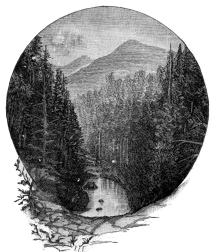
A GLIMPSE OF THE TOE.
There are many spots of rare, sylvan beauty in the region of the upper Toe; many spots of wild and melancholy magnificence,—dells that seem the natural haunts for satyrs and fawns, and where a modern Walter Scott might weave and locate some most fascinating fictions. The mountaineer is apparently devoid of superstition; and, as far as the writer could ascertain, no legends, like those of the Catskills, shed their hallowed light on any portion of the solitude. In lieu of a legend let him tell a ghost story.
One ghost has no known grave; the other’s lies beside the stream in an umbrageous dale high up in the mountains. The careless stranger passing down the mountain would not perceive it. It is a low mound scarcely rising above the level ground. Covering it are light-green mosses, as ancient apparently as the lichens which decorate the trunk of the two-hundred-year-old water birch standing in lieu of a headstone at one end of it. There are no rocks or stones to be seen, except on the opposite side of the tree where its roots are exposed. The stream is noisy; but it could not be otherwise in so rocky a channel, and so is excusable for disturbing the quiet of the grave. There are other trees shadowing the circle, but beside the monarch birch they sink into insignificance. In the grave was once placed the cold form of a white-haired old man; but half a century has passed since then, and what was flesh and bone has long ago resolved to natural dust.
This dust was Daniel Smith. He came from Tennessee, up the Nolechucky and the Toe to this dale. His widowed daughter and her baby boy were with him when he built a log cabin, and formed a clearing. On the same side of the creek, fifty steps from the grave, there is a space of several acres grown with trees of fewer years and lesser height than the surrounding pristine forest. In the center of this fresh wood, amid the brambles and briers, the straggler, by pulling them aside, will perceive a few crumbling stones piled in a heap like the ruin of a chimney. If there is a single timber concealed under the bushes, the foot will sink through it without resistance. It is the site of Smith’s cabin. A lofty locust with wide-spread branches springs, from where once was the hearth-stone. Where the babe crept on the puncheon floor, tree-sprouts, with thorns and thistles, are entangled. It is a desolate spot rendered doubly so by the knowledge, had from sight of the chimney stones, of what once was there; and by the black balsams which appear along the steep above it. It seems that Hood had seen it before he wrote the verse:
“For over all there hung a cloud of fear, A sense of mystery the spirit daunted, And said, as plain as whisper in the ear, The place is haunted!”
The old man showed no liking for outside associations, and scarcely ever appeared at the cabins of the settlers far below him. This disposition became more marked after the death of his daughter when the boy was about ten years old. He was a bright, blue-eyed, curly-haired, little fellow, and always went a-fishing with the old man, who was an ardent angler. Never was father more wrapped up in his child, than this venerable fisherman in his grandson. He was never seen without the boy; and the stray hunter coming down the trail, often saw their forms before him,—the silver-haired man with his fishing rod, and the merry, laughing boy with his hand clasping his grandsire’s. But Death came. During a heavy flood the boy was accidentally drowned, and his body was never recovered.
The old man was now thought to be crazy. He allowed no one to enter his cabin, and some said he fished from morning till night, in the insane hope of catching his boy, whom he imagined, was transformed to a trout. One who had watched him from his concealment in a thicket, said that every fish the old man caught, he examined carefully, as if searching for some peculiar mark, and mumbled to himself: “No, no, not Will this time. Strange where the boy is!”
One day Daniel Smith’s dog, cowed apparently by hunger, appeared at a Toe river cabin. The fierce nature of the animal was gone; he begged piteously with his eyes and voice, and then ate ferociously all that was given him. The settlers, suspecting the worst, went to Smith’s cabin; forced in the door, and found the occupant dead. They buried him under the water birch, where the mound marks the place. The same figures which attracted the attention of the stray hunter fifty years ago, are seen by the hunter and traveler to-day; but while they interested then, they frighten now; and no one, familiar with the story, passes through the dale without turning his head in dread and hurrying on. At night, when the moon bathes in golden light the dark forests, the straggler professes often to have seen before him, in plainly visible, but weird, out-lines, the stooped figure of the old angler and his blithe, bare-foot companion.
There is good fishing in Cane river, on the west slope of the Black mountains. If the angler prefers to try the latter stream, instead of the Toe, he can, at a point a short distance before reaching the summit of Mitchell’s Peak, turn to the left and follow down a plain trail, fishing as he descends, to “Big Tom” Wilson’s. From Wilson’s it is fifteen miles to Burnsville. It is a small, country village, amid sublime surroundings. From the high knoll, where stands the academy, a pleasant prospect can be obtained. In the morning, as it opens over the rolling peaks in the east; or, as the sun descends behind the receding lines of purple ranges, the scenes presented in their glory of cloud-coloring, their brilliant effect of light and shade, and the soft, poetic splendor of the mountains, are of beauty too divine, and of duration too transient, to be caught by the painter.
Thirty miles west of Asheville, fine sport can be had along the Pigeon. Leave the railroad at Pigeon River station. No teams can be procured here; so if you are disinclined to walking ten or twelve miles, continue your trip to Waynesville, and then drive to the desired point. It is an inviting walk up the river. The stream flows broad, deep, and clear, through rich valleys, affording fine farming land. The level fields are green with oats, corn and wheat; the farm houses are painted white, the yards neat in appearance, and everything in keeping with the fertility of the soil. The valley views are extremely picturesque; for you are amid some of the loftiest mountains of the system. The Balsams lie toward the south; and if you follow up the right fork, you will be exalted by the sight of these mountains looming along the horizon. The fishing is excellent, but the east prong is generally preferred.
Up the east prong, the wild beauty of stream and woods cannot be surpassed. There is such a richness about the foliage, such a purity in the waters, such an inspiration of atmosphere, that too long-continued companionship might be disastrous to your outside, worldly connections. Cold mountain rises on the west; Pisgah on the east. This latter peak is a famous height for the sight-seer. It is easily accessible, and from its summit the view is almost boundless. The broad valleys, watered by the Hominy and French Broad, stretch toward the eastern limit. The vales of the Pigeon lie on the west and north. All around, the skirts of the plateau are pinned by mountains loftier than the one beneath your feet. To the south and west the Balsams; to the north and northwest the Smokies; and on the other verges of the horizon, the Blue Ridge, Saluda, Swannanoa, Craggy, Black, Iron, and Newfound ranges. Your standpoint is one of the most symmetrical of peaks, and is always marked out by the observer on the streets of Asheville and Hendersonville.
There are agreeable people living on the Pigeon, and among them you will fare well, especially if you are an expert angler. Explore the wildest ramblings of the stream, and whip every pool from the white falls down to the valley known as the old Lenoir farm, where there is such a pleasant mingling of wild and rugged mountain scenery, with rich pastoral landscape, that one can never weary of viewing it.
A famous fishing ground is that section of the great Smokies watered by the Cataluche. Besides the trout-fishing, there is enough in this region to allure into it not only the angler, and hunter, but the painter and poet. It is wildly romantic in every feature. By the well-traveled road that leads from Waynesville to Knoxville, Tennessee, the tourist can reach it by a 22 mile drive from the former village. The country along Jonathan’s creek is as fine as that along the Pigeon. An air of prosperity pervades; and as one rattles on over the pebbled road, by the pink and white flowering hedges on one side, and the green fields on the other, the friendly salutations received by him from every man, woman, and child, will convince him that he is not in a land of strangers, and that, if any accident befall him, kind and willing hands will be ready to render assistance. Besides the farm dwellings and their out-buildings, noisy mills are situate along the stream; and in cleared spaces amid the woods, at intervals, can be seen country churches and log and frame school-houses. Leaving the valley, the road ascends Cove Creek mountain, whereon can be obtained a wide-sweeping view of nestling vales and receding mountain ranges. Now follows a long ride around mountain brows, until at length you draw rein before a small, unpainted, frame house, hanging between the highway and the abrupt edge of a deep valley, on whose steep side a road, like a great yellow snake, winds downward to the river. If it is at the close of a bright afternoon, the golden streaks of light, gleaming from the gaps and across the pine-capped tops of Mount Starling and its black, brother peaks of the Smokies, will set in indescribable splendor the mountains to the east; and darker will lie the shadows filling the cañon, within whose depths, 1,000 feet below you, glistens the waters of Cataluche.
In spite of the steepness of the cañon’s side, lofty woods cover it, and are as thickly planted along the descending road that, after leaving the main highway at the frame dwelling just mentioned, no glimpses can be had of the lower landscape. If the angler has not brought a jointed rod with him, before he has traveled far down this winding way, he can secure from the roadside an excellent pole in the shape of a long, lithe birch. There is a tumultuous ford of the river to cross just after reaching the narrow valley, and then the road leads up stream.
Our party of sixteen ladies and gentlemen, which, on a fishing excursion, visited the Cataluche river in the early part of June, 1879, put up at Mr. Palmer’s, the first farm house reached after passing the ford. At that time a high, pine picket fence enclosed the yard surrounding a roomy house, with large, open hall through its center, and a long, wide porch in the rear. In spite of our numbers, the farmer and his wife volunteered to accommodate us all, and did so in a satisfactory manner.
The river is no more than 100 yards from the house, and soon after our arrival that day two of us, with our rods, started for its banks. It was just before dusk, and white millers and gnats were fluttering above and dropping on the rapid water. The stream seemed perfectly alive with trout, coming up in sight with a splatter to secure these dainty morsels. The hour was propitious, and we improved it. Without moving from a line of smooth, deep-flowing pools, we secured a mess of forty trout before it became too dark to cast our lines. Even if you have no fishing tackle with you, it is interesting at evening to sit beside a stream and watch the trout secure his prey. A miller drops on the water, the swift current carries it for a few feet; then there is a splash and the insect has vanished. If you had looked sharp, you would have seen a wary trout dart through the water, rise to the surface, slap the miller with his tail to kill it, and almost with the same movement suck it into his mouth. For the very reason that the live fly floats down stream this ought to instruct the angler to let his artificial fly drift in the same manner; and then, as the quick jerk informs him that a trout has struck, pull the line up the current. You must be as quick in your movements as the fish is in his, or you will lose him.
After brushing through the weeds and briers and climbing a rambling, rail fence, we came out on the road beside one of our friends and a small boy, who appeared to be striking a bargain over a long string of trout. The boy “counted on” there being a hundred fish in the lot, and just at our arrival he had accepted seventy-five cents for them, and was making the transfer. We signified our perfect willingness to keep dark to the rest of the party on how he had secured them. The young angler was a bright-looking little fellow, with the clearest of complexions, ruddy cheeks and dark hair. He was barefooted and wore a straw hat, homespun pantaloons, jacket, and tattered shirt; and, as we stood with him in the road, he regaled us as follows:
“Did you catch all those trout yourself?” was asked.
“Yes, sir; an’ all ov ’em sence dinner. I heerd you’uns war comin’, an’ I knowed some o’ you all cud’nt ketch trouts by yourselfs, so I reckoned on arnin’ a little by fetchin’ in a string.”
“What did you catch them with?”
“This ’ere.”
He exhibited a hair line and a fly made of a crooked pin, wound with a small piece of red flannel and a black and white feather. “I hid the pole up yander,” he continued, pointing behind him.
“What, all with a pin hook?” exclaimed the purchaser of the trout.
“Law! yes. Why not? A pin hook’ll do ef you haint got enny other; but I’d like powerful well to hev one o’ them store hooks you’uns hev.”
We gave him one forthwith, and then asked: “When is the best time to fish, son?”
“When the signs air in the head; the signs in the awmanac, you know.”
“Oh, yes. When you haven’t fly hooks, what bait is the best?”
“Young hornets.”
“What baits do you use for young hornets?” was next asked, and rightly deemed a very important question under the circumstances.
“Rob a nest,” he answered, and continued: “Grasshoppers is good, too; so is stickbaits. I don’t keer much which I hev; they’re all good.”
“Well, you’re an expert, my son. Why, I believe he could catch trout without hook, line, or bait,” remarked the purchaser, with a laugh.
“In course, I could,” returned the boy in a matter-of-fact voice; “I don’t need no hooks or bait, I don’t.”
“Come, buddy; no fish stories now.”
“I’d use a snare. They’re fust-rate tricks whar the water is still an’ a little riley. You see I make a runnin’ noose in a long horse ha’r, or two or three ov ’em tied together on the end o’ a pole. I watch behind a log till I see a big trout, an then I drap the noose over his head, an’, with a quick jerk, snake him out. I’ve caught lots that a way.”
This method of fishing, as described by the boy, is often practiced. It is an outrage that nets are used in some of the trout streams. Hundreds of fish are frequently killed in a few hours by this unsportsman-like practice. In some counties (and it ought to be in all) it is a direct infringement of the law; and such practices should be exposed on every occasion, and punished to the full extent of the statute.
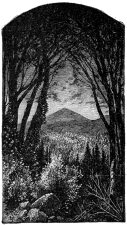
ON THE CATALUCHE.
Whip-poor-wills whistled their shrillest that June night, and the air was ablaze with millions of fire-flies. A grand scene was revealed when the round, yellow moon came creeping up from behind the ragged ridge that walls the eastern bank of Cataluche. The pines along the summit of the ridge, stood out like black skeletons. A light, almost as bright as day, flooded the shut-in valley, casting dark shadows on the stony ground under the giant forest trees, silvering their tall tops, and whitening the bare, mast-like pines, standing girdled in the fields of sprouting corn. The valley was resonant with the roar of the river. A refreshing evening breeze swept the porch of the old farm-house, carrying with it a sleepy influence which knocked the props out from under the drowsy eye-lids of our party, and caused one after another to steal away to bed.
The more enterprising and enthusiastic anglers were out and fishing before breakfast; but after that meal we all went. We pursued every bend of the romantic stream, catching trout at every cast of our flies. One day in particular is to be remembered. A soft, warm shower had fallen, and then cleared brightly by 9 o’clock. The best of breezes, one from the south, was blowing through the hemlocks. The current of the stream was slightly riled; thus everything being propitious for the sport. From one pool alone, ten gold and pink-spotted trout were taken that morning. It was a spot where a steep cliff, festooned with vines, lifted itself from the water on one side. On the other, was a wide curve of the bank, and along it grew azaleas and rhododendrons under the pines. The Rhine-wine colored waters lay dark in this picturesque basin; and from them were lifted trout after trout, beguiled by the treacherous fly. Between four and five hundred fish were brought in that evening.
There are many other streams in the Great Smoky mountains about equal in excellence to Cataluche. Among these are the Ocona Lufta, Forney, Hazel and Eagle creeks in Swain county. Soco is a natural trout stream; but, flowing as it does through the Cherokee reservation, its waters have been so whipped by the aboriginal fishermen that it can not be recommended to the angler. On its banks the angler, starting from Waynesville, will travel to reach the Ocona Lufta. The waters of the Ocona Lufta, even at its mouth in Tuckasege river, are of singular purity, and through some portions of its course, from racing over a moss-lined bed, appear clear emerald green. Above the Indian town the valley grows narrow, and prosperous farmers live along its banks. The forests are rich in cherry and walnut trees, and all necessary water power is afforded by the river. Joel Conner’s is a pleasant place to stop.
Forney creek empties into the Tuckasege at some distance below Charleston. The ride to its mouth will interest even the most practical of travelers. At times, the waters create a tumultuous uproar over a broken channel; then with startling silence they run smooth and swift for a hundred yards, and, making a bold sweep around a craggy mountain, disappear as though the earth had swallowed them. There are several islands in the stream; and at one place there is a twin pair lying close together in a channel wider than usual. Wild ducks will often be seen keeping their unwavering flight around the bends; and frequently from the water edge of a clump of alders, spice-wood and thunderberry bushes, a blue heron, with lank neck outstretched, will sail lazily out over the river. The mail man, mounted on a cadaverous horse, with leather mailbags upon his saddle, is apt to meet the tourist; but, differing from the general run of the natives, he travels on time and is loath to stop and talk. Not so with the man who, with a bushel of meal over his shoulders, is coming on foot from the nearest “corn-cracker.” At your halt for a few points in regard to your route, he will answer to the best of his ability; and then, if you feel so inclined, he will continue planted in the road and talk for an hour without once thinking of setting down his load. The fishing in Forney creek is excellent. It is in a rugged section, and at its mouth the scenery is wild enough to hold forth fine inducements. Hazel and Eagle creeks empty into the Little Tennessee in a still more lonely and less inhabited section, a number of miles below the mouth of the Tuckasege.
The Nantihala river is prolific in trout near its pure sources; and, along its lower reaches, is alive with other fish, among which the gamey black-bass is enough to allure the angler. A man may be an expert bass fisher, but a veritable failure at trouting. When one discovers this fact, with a sound pole, long line and reel, try the minnow and trolling-hook at the mouth of the Nantihala. In the Tuckasege his efforts may be rewarded with a salmon. A number of these royal fish were placed in this stream a few years since, and are now frequently landed. Nearly every creek that empties into the Tuckasege teems with trout. Among these are the north fork of Scott’s creek, Dark Ridge creek, and Caney Fork, all in Jackson county. A gentleman of undoubted veracity, who has whipped nearly every stream in the mountains, pronounces the Dark Ridge creek to be the best of any he ever cast a fly in. Its head-waters can be struck by turning from the State road about seven miles from Waynesville, and pursuing a left-hand, unfrequented road, into the wilderness. There are no farms along its banks. Great, silent forests, in which the locust and hickory attain enormous size, embosom it. Its edges are wild with tangled rhododendron and kalmia; its waters, small in volume, but cold and crystal.
Fourteen miles south of Webster, the county-seat of Jackson, is the most stupendous waterfall of the mountains. It is said that on certain evenings, when that dead quiet, prophetic of a storm, dwells in the valley, the dull roar of the falls can be heard eight miles down the river. It is on the Tuckasege, about 20 miles below its sources. There are three ways to reach it; two from above, on either bank, and one from below, on the west bank. The one way by the east bank is exceedingly arduous. To approach it from the west bank, the traveler journeys up the Cullowhe road from Webster. It is a delightful ride, over a picturesque highway, to where the river is struck at Watson’s. By dismounting there, you can follow, without difficulty, on foot down stream to the desired point. This latter approach is preferable to the one undertaken by our party. We left the highway about three miles below Watson’s. It is a rough walk of two miles to the waters, half a mile below the falls. There is no trail to follow, and it requires some activity to scale the rocks, jump the logs, and crawl through the thickets. Hard by the river, over a cliff 200 feet high, Rough-running brook pours its waters in rain and mist. If a certain guide’s story is to be believed, over this cliff, three deer, closely followed by an eager pack of hounds, once plunged unwittingly.
Along this part of the river the trout are thick and hungry enough to afford all the sport you wish; and, if there is a dark sky and dark water, it will be a gala-day. The scenery of the falls is as interesting as the fishing. On the left rises a gray, granite cliff, perfectly plumb with its base, 150 feet above the river. It is somewhat mantled with green vines and mosses, and a few shaggy cedars cling to its front. On the right, the cliff is less precipitous, and on it the forest and its undergrowth springs dense and rank. In front pours the water, a great sparkling cloud. For 60 or 70 feet down, it is a perpendicular, unbroken sheet; then a projecting ledge catches and breaks it into two columns, to fall through the last 25 feet of space. The frowning cliffs, primeval pines, gigantic boulders, and the vista of blue sky sighted through the cañon, form a picture of striking sublimity. If you do not object to getting wet from the mist and rain created by the cataract, you can stand on a great rock in the whirling pool and fish for trout and salmon, with success, for hours. The cliff on the right can be scaled by a boy or man, and the river ascended for a mile to Watson’s house on the road. However, before reaching the road, the upper falls are to be passed. Here the scene is different. For several hundred feet the waters pour over a bare mountain’s face, whose slant is several degrees from a perpendicular. At its base the stream widens out, for there are no cliffs to hem it in, and huge boulders being absent, a level, little lake lies buried in the forests. A fine point from which to view this fall is half way up the mountain on the opposite side of the river.
Fair fishing is still to be found in the Cullasaja. It can be reached from either Franklin or Highlands. In a beautiful valley, close by the bank of this stream, stands the homestead of a pioneer settler of the country, Silas McDowell. It is only a few years since he ended his pilgrimage. In his old age he took great delight in narrating his early experiences in the wilderness. The first trout fishing expedition undertaken by him in 1839, and told by him to the writer, will serve as an illustration of what the primitive angler had to encounter.
One bright morning, he, with two young companions, started up the Cullasaja. As a matter of course, they had excellent sport, and met with no adventure, until, in the ravines of Lamb mountain, a magnificent, antlered buck, startled by their sudden appearance, leaped up from behind a cliff and started up the stream. There was no outlet for him on either side, for the walls of the gorge are perpendicular. A short distance ahead, a cliff, over which the water tumbled, would stop his career. They had no guns with them, and, although the game was securely bagged, their only way to kill him was with stones. They pushed on pelting him with these. At length, maddened with the stoning, the old stag turned and rushed by them, breaking the narrator’s fishing rod as he passed. Just then he fell between two large boulders, and one of the young men, springing on the animal’s back, soon dispatched him with his knife. They sank the carcass in the cold, rushing water; fished until noon, catching several hundred trout, and then returned home to send two servants with a pack-horse after the game. The return of the servants was expected that evening, but it was not until the following afternoon that they appeared. They related that they had found the deer, but it was dark before they were ready to start. Thinking it was best to wait for the moon to rise, they placed the deer on a large, flat rock in mid stream, and then laid down beside it to sleep until that time. An unusual sound awoke them, and by the moonlight they saw an immense panther crossing the foot-log toward them. He had scented the fresh meat, and was about to investigate, but on the unexpected awakening of two human beings, he fled, as much startled as they were. The night was intensely cold, and finding it impossible to start, and also being afraid of wild animals along the lonely way, they remained on the rock until the sun had risen and warmed their numbed bodies. Thus they accounted for their long absence.
A few miles from Brevard, the headwaters of the French Broad, and farther south, on the Jackson county side, the streams hidden in the wilderness of the Hog-back and emptying into the Toxaway, and the head-waters of the Chatooga, can be recommended to the followers of Isaak Walton. The writer does not know from actual experience of any trout inhabiting the Linville waters, but there are sign-boards on the banks prohibiting fishing.
Close on the Mitchell and Watauga county boundary, is the Elk river, a famous trout stream. The best approach is from Tennessee, up the narrow-gauge railroad, through Carter county, to the Cranberry mines. From the old forge to Louis Banner’s, or Dugger’s, the distance is eight miles. The road winds upward along a clear, dark stream, rushing over light-colored rocks. Steep mountain sides, heavy with wild, brilliant forests, darken the highway with their shadows. In the morning and evening, the woods are filled with melodious birds. Logging camps are numerous in this neighborhood, the solitudes resounding with the crash of falling timbers and the songs, or more likely the oaths, of the lumbermen. Besides catching trout in the Elk, there is a good chance for killing deer along its margin, or in some of the vast hemlock forests in which the high valleys of the southwest corner of Watauga are embosomed. In Ashe county, the tributary creeks to the North fork of New river rise amid picturesque mountains, and teem with trout.
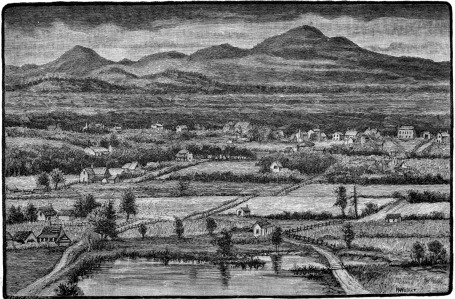
OCHLAWAHA VALLEY, FROM DUN CRAGIN.