HISTORICAL RÉSUMÉ.
Reading edition
There is much in the race we spring from affecting both the individual and the community. The physical and mental traits we derive from our ancestors, are not more marked and important in directing our destinies than are the prejudices, aspirations and traditions we drink in from childhood. No profound observers of human nature will ever estimate the conduct or capacities of a people without first looking at their genealogical table and noting the blood which flows in their veins.—[Senator Vance.
HIS observation is illustrated by the character of the settlements of both the Carolinas. Most of the first immigrants to the coast country of South Carolina were English capitalists, who purchased large plantations. The coast country of the north State drew its population from Virginia and from Barbadoes. The whole east line of settlement was English. Large plantations and numerous slaves were acquired, and the inhabitants after the second generation lived in comparative ease and luxury. Those of the south were particularly devoted to the cultivation of manners and mind, a degree of excellence being eventually attained, which has never been equalled elsewhere on the continent.

The emigrants to the plains beyond the line of terraces and hills were of entirely different stock, character, and situation in life. They belonged to that sturdy race, now so widely distributed over the whole country, which is known in history as Scotch-Irish. Their ancestors were of pure Scotch blood, but lived in the north of Ireland, whence they emigrated to America, landing at New York, Baltimore, and other northern ports. The first arrivals found home near the eastern base of the Alleghanies in Pennsylvania, but being annually joined by new immigrants of their own blood and fatherland, the best lands were soon filled to overflowing. The tide of immigration still continued, but an outlet was found toward the south, through which it swept along the entire base of the mountains into the inviting valleys of Carolina, and eventually crossed them into Georgia. There is to the present day marked homogeneity of character within this belt, from Pennsylvania to Virginia southward. Scattered families of other nationalities followed into the wilderness, but so largely did the Scotch-Irish prevail over all other races that the amalgamation of blood which followed brought about no perceptible change.
A long period elapsed from the time emigration from the north of Ireland began until the Pennsylvania and Virginia plains had been filled; and the Yadkin, in North Carolina, was reached near the middle of the last century. So strong was the opposition, natural and human, encountered at every point, that only dauntless courage and determined spirit was able to overcome it. A wilderness had to be reduced in the face of a cruel and cunning foe. Being poor, they purchased small farms, and the number of their slaves was never large. Unlike the plantation lords of the South State coast, they devoted themselves to rigorous labor, the number being few who had time to devote to the cultivation of manners, or to pleasure, and fewer still had the financial ability to educate their children.
Between 1750, the date of the first settlement on the upper Yadkin, and the Revolution, a period of 25 years, the best lands were occupied to the base of the Blue Ridge. Even that barrier was scaled, and the germs of civilized industry planted along the Holston before 1770.
A character of the times, typical of a class of early settlers, was the famous Daniel Boone, whose life is the inspiration and light of western annals. Being but a lad, when his father removed from Pennsylvania, and settled on the Yadkin in 1754, the wildness and beauty of his new home made him a recluse of nature. In early youth he became a hunter, a trapper, and fighter of Indians. When the country around him filled up, he left his home and plunged again into the depths of the wilderness beyond the mountains. After a period, crowded with blood-chilling adventures in Kentucky, he returned to his old home, but the growth of settlement had deprived it of its romance. He again crossed the Blue Ridge and pitched his camp in the Watauga plateau. There is a curious old church record in existence, which shows that he cursed “with profane oaths” a fellow Baptist for building a cabin within ten miles of his. His ideal of complete happiness was to be alone in a boundless wilderness. He once said: “I am richer than the man mentioned in Scripture who owned the cattle on a thousand hills. I own the wild beasts in more than a thousand valleys.” He expired at a deer stand, with rifle in hand, in the year 1818. It was of him that Byron wrote:
“Crime came not near him, she is not the child Of solitude. Health shrank not from him, for Her home is in the rarely trodden wild.”
The class of settlers of which Boone is mentioned as a type, is not large; but it was the class, to paraphrase a line of Scott, which dared to face the Indian in his den. They were hunters of wild animals and wild men. But there was a larger class, the equal in sturdiness of the former, and though less romantic in conduct, entitled to recognition by posterity. They were the men who cleared farms and built up houses and towns. In the valleys of the Yadkin and Catawba, is found a large percentage of population of German descent, which is the source of the German blood found in the western counties. Not far behind the Scotch-Irish pioneers, by the same route, came the astute hard-working ancestors of this class of citizens. Many were scattered through Virginia, and some drifted even beyond the line of the old North State. The least mixture of blood is found in the valley of the Catawba. It is a mongrel German, known in the North as “Pennsylvania Dutch.” The traveller from central Pennsylvania will frequently forget, while in the Catawba valley, that he is away from home. Governor Vance, whose long political career has familiarized him with all sections of the state, declares that in agriculture, as a general rule, they have excelled all other classes, especially in thrift economy and the art of preserving their lands from sterility. “To this day there is less of that desolation, known in the South as ‘old field,’ to be seen among the lands of their descendants, than amongst any others of our people.... A sturdier race of upright citizens is not to be found in this or any other state. Their steady progress in wealth and education, is one of their characteristics, and their enduring patience and unflinching patriotism, tested by many severe trials, proclaim them worthy of the great sires from whom they sprang.” Like their kin in Pennsylvania, and scattered over other states, west and south, “they are Lutheran in religion and Democratic in politics, and they are as steadfast as the hills in each.”
The Scotch and Germans of the upper plains and valleys, from which the trans-montane counties drew the bulk of their population, exist in the rural districts unmixed. There has been, until very recently, little immigration since the opening up of the great West soon after the Revolution, the growth of population being almost wholly a natural increase. It is further a fact, to the disadvantage of this community, as a similar condition of things is to all other old communities, that many of the most enterprising children of each generation leave their homes for fields of industry in new sections. Conservatism in the old community is an inevitable result. The western section of North Carolina is a conspicuous example. The same statesman, whom we have already quoted, a native there, has said:
“A very marked conservatism pervades all classes of North Carolinians. Attachment to old forms and institutions seems to be deeply implanted in them, as a part of their religion. They almost equal the conservatism of Sydney Smith’s man, who refused to look at the new moon, so great was his regard for the old. . . . North Carolina was, I believe, the last state in the Union to abolish property representation and suffrage in her legislature. The name of the lower branch, house of commons, was only changed in 1868. John Doe and Richard Roe died a violent death and departed our courts at the hands of the carpet-bag invasion the same year. This horde, also, with the most extraordinary perversion of its possible uses, unanimously deposed the whipping-post as a relic of barbarism, to which our people had clung as the great conservator of their goods and chattels.”
The present generation of Highlanders may be proud of the revolutionary record of their ancestors, though there were among them numerous tories, the proportion being one King George man to four revolutionists. Representatives from the west are found among the signers of the Mecklenburg declaration of independence in 1775, and by subsequent conduct they proved their enthusiasm in the cause of liberty. Their chief peril was to be apprehended from tory brigands and the Cherokees, incited to blood and cruelty by British agents. The danger was greatest in the summer of 1780, after Lord Cornwallis had made his victorious raid through the South. The liberty men were disheartened, and not a few went over to the tory militia, of which Colonel Patrick Moore appeared as the commander in North Carolina. He published both inducements and threats, as a means of increasing his forces, and was meeting with a degree of success dangerous to the patriot cause, when three companies of old Indian-fighters, under command of Colonels Shelby, McDowell, and Sevier, attacked him, with successful results. This was a small event in itself, but it encouraged the liberty party, and showed the British commander that there was a force in the scattered settlements of the mountain foot-hills which he had reason to fear.
Colonel Ferguson, with a nucleus of 100 regulars, had collected a band of 1,200 native Tories, from the foot of the mountains, in South Carolina. His progress northward was “marked with blood, and lighted up with conflagration.” For this reason he was selected to operate against the western settlements of North Carolina.
The mountain men made one dashing and successful onslaught on his advancing divisions, and then retired to the mountain fastnesses, for consultation and organization. Ferguson pursued as far as Rutherfordton (then Gilbert town), whence he dispatched a messenger to the patriots with the threat that if they did not lay down their arms he would burn their houses, lay waste their country, and hang their leaders.
This cruel threat aroused the settlers adjacent to the mountains, on both sides, and north, into Virginia. More men were willing to go to the field than it was prudent to have leave the settlements. Their fame as “center shots,” with the rifle, was well known to the British regulars, who feared to meet them; but the chivalric Ferguson was stimulated by this fact to greater watchfulness and exertion.
Ramsey draws this picture of the Revolutionary forces.
“The sparse settlements of the frontier had never before seen assembled a concourse of people so immense, and so evidently agitated by great excitement. The large mass of the assembly were volunteer riflemen, clad in the homespun of their wives and sisters, and wearing the hunting shirt of the back-woods soldiery, and not a few of them the moccasins of their own manufacture. A few of the officers were better dressed, but all in citizen’s clothing. The mien of Campbell was stern, authoritative, and dignified. Shelby was stern, taciturn, and determined; Sevier, vivacious, ardent, impulsive, and energetic; McDowell, moving about with the ease and dignity of a colonial magistrate, inspiring veneration for his virtues, and an indignant sympathy for the wrongs of himself and co-exiles. All were completely wrapt in the absorbing subject of the Revolutionary struggle, then approaching its acme, and threatening the homes and families of the mountaineers themselves. Never did mountain recess contain within it a loftier or more enlarged patriotism—never a cooler or more determined courage.”
Carrying their shot-pouches, powder-horns and blankets, they started from the Watauga, over Yellow mountain, to the head of the Catawba. Ferguson broke up his camp at Gilbert town (Rutherfordton), on the approach of the patriots. This was the most westward point he reached, in the execution of his threat to lay waste the country. The tories of his command quailed on the approach of so large a body of riflemen, and many of them deserted the royal standard. Ferguson dispatched for reinforcement, and took his position on King’s mountain, from which he declared “God Almighty could not drive him.”
After being in the saddle thirty hours, in a dashing rain the patriots, on the afternoon of October 7, 1780, arrived at the foot of the mountain. This, one of the most historic spots in the South, is located on the North Carolina border in Cleveland county. The area of its summit is about 500 yards by seventy.
The mountaineers approached the summit in divisions so as to make the attack from opposite sides simultaneously. The center reached the enemy first, and a furious and bloody fight was commenced. The royalists drove the attacking division down the mountain side, but were compelled to retreat by an onslaught from the end and opposite side. The battle became general all around, Ferguson’s forces being huddled in the center. The mountain men aimed coolly, and shot fatally, giving away before a fierce charge at one point, and charging with equal fierceness from another. The British commander, at length, gave up the idea of further resistance, but, determined not to surrender, made a desperate attempt to break through the lines. He fell in the charge with a mortal shot. A white flag asked for terms of capitulation; 225 royalists and 30 patriots lay dead upon the field; 700 prisoners were taken in custody; 1,500 stand of arms captured, and a great many horses and other booty which had been taken from the settlers, restored to the rightful owners. More than all, the frontier was freed from the ravages of a merciless foe.
The captured arms and booty was shouldered upon the prisoners and taken to a point in Rutherford county, where a court martial was held. Thirty of the tories were sentenced to death for desertion and other crimes they had committed, but only nine were executed. One of these was Colonel Mills, a distinguished leader. The remaining prisoners and captured arms were turned over to General Gates, commander of the Continental army in the South.
John Sevier, one of the leading spirits in the King’s mountain affair, and commander of the transmontane militia, was a brilliant, daring, dashing character; the idol and leader of bold frontiersmen, who nicknamed him “Nollichucky Jack.” The whole of Tennessee then belonged to North Carolina, but the settlers on the Holston were so far removed from the seat of government that, practically, they were without government. Sevier and his friends conceived the idea of organizing a new state, which, being in the nature of a measure for self-protection, was unquestioned west of the mountains as a just and proper proceeding, but by the home government denounced as an insurrection. The new state was named Franklin, in honor of the Philadelphia philosopher and patriot. For four years there was civil contention, which, in one instance, resulted in contact of arms and bloodshed. After this the parent state adopted a radical policy for the restraint of her premature liberty-seeking child. “Nollichucky Jack,” the governor of the insurrectionary state, was arrested for “high treason against the state of North Carolina,” and taken to Morganton for trial.
The prisoner’s chivalric character and gallant military services, on the one hand, and the extraordinary nature of the indictment on the other, gave the trial momentous interest. The village streets were crowded with old soldiers and settlers from far and near, eager to catch a glimpse of the court. There were others there with different purposes. The chivalry of the infant settlement of Tennessee; the men who had suffered with the trials of frontier life and savage warfare, who had fought under him to establish their country’s freedom, and who loved him as a brother, armed to the teeth, had followed the captive across the mountains, determined to “rescue him, or leave their bones.” Their plan was to rescue him by stratagem, but if that failed, to fire the town, and in the excitement of the conflagration make their escape.
On the day of trial, two of the “Franks,” as they were called, leaving their companions concealed near the town, and hiding reliable sidearms under their hunting shirts, rode up before the court-house, one of them on “Governor” Sevier’s fine race mare. He dismounted, and with the rein carelessly thrown over her neck, stood with the manner of an indifferent spectator. The companion having tied his horse, went into the court-room. Sevier’s attention, by a slight gesture, was directed to the man outside. During a pause in the trial, the bold “Frank” stepped into the bar, and with decided manner and tone, addressed the judge: “Are you done with that there man?” The scene was so unusual, the manner and tone of the speaker so firm and dramatic, that both officers and audience were thrown into confusion. The “Governor” sprang like a fox from his cage, one leap took him to the door, and two more on his racer’s back. The quick clash of hoofs gave notice of his escape. The silence of the bewildered court was broken by the exclamation of a waggish by-stander: “Yes, I’ll be damned if you haint done with him.”
Sevier was joined by his neighbors with a wild shout, and they bore him safely to his home. No attempt was made to re-arrest him. The State of Franklin died from various causes, and a few years later the new State of Tennessee honored “Nollichucky Jack” with the first governorship, and later, by an election to the United States Senate.
Recall a picture of the mountain soldier a century ago, during the heroic or military period: a tall, athletic form, hardy appearance, noiseless step, and keen pair of eyes—attired in an upper garment of blue home-spun, fringed at the bottom, and belted with wampum; deerskin leggins and buckskin moccasins, and armed with a large knife, tomahawk, and long rifle. This emblem of antiquity is now found only in museums.
Before the close of the Revolution there was a well-beaten road from the Catawba to the Watauga, the path of travel from Carolina to the incipient states west of the Alleghanies. South of this, except by hunters and Indian traders, the passes of the Blue Ridge had not been crossed. The fame of the luxuriant highland valleys was widespread, however, when an extinguishment of the Indian title opened them up to the settler.
It was a miscellaneous throng that filled the narrow roads leading from the head-waters of the eastward streams, in search of homes and lands in the cool upper plateau. Ahead, on horse-back, was a far-seeing man of middle age, a member of the legislature, whose industry had rewarded him with a small fortune, with which he would purchase a fertile tract of wild land, and hold it for an advance of price. Slowly moving along behind was a boat-shaped, great covered wagon, drawn by four oxen. It contained the family and household goods of a man whose earthly possessions amounted to but a few dollars besides. Then followed the foot emigrants of a still poorer class, badly clad, and scantily fed. The man and woman and larger children carried upon their backs, an axe, a few agricultural tools, a couple of cooking pots, and a light bundle of bed clothing. The man with the wagon would purchase a few hundred acres of valley land, erect a cabin, such as may yet be seen any where in the rural districts, make a clearing, and eventually become a prosperous citizen. The foot emigrant, without examining titles or running lines, built a hut where it suited him, deadened the trees on a few acres, which, cultivated with the hoe, yielded bread for his family. A flint-lock rifle, saved from the soldiering times, supplied meat and clothing. Neither the freehold settler nor the “squatter” was able to convert more than the hides of wild animals into money with which to make annual purchases of such supplies as could not be raised. The squatter had the advantage from a cash point of view over the land owner, for he had no taxes to pay, and more time to devote to the chase. Alive to this advantage he had no incentive to aspire to the ownership of property; an indifference to worldly condition characterized his simple life, an indifference which his children and his children’s children have inherited. It was different with the freeholder; he knew of the luxury of low country civilization; he had himself tasted the sweets of a substantial prosperity, and looked forward to their full enjoyment in his new home in the mountains. When times grew better he was able to purchase a few slaves, give his children an elementary education, and live in a comfortable house. From this class of the settler ancestry is descended the substantial element of the present generation of native mountaineers. They are famous business and professional men, who would be a credit to any community. They own nearly all the land, and inhabit the most inviting farms. Many of the wealthier land owners were not far behind the first settlers, and their posterity may be found in almost every county, some of them continuing to control large boundaries.
The nucleus of settlement was on the French Broad, at the mouth of the Swannanoa. It was there that the first white child was born, in the inter-montane plateau—James M. Smith. In the year 1795, a wagon passed from South Carolina, through Mill’s gap, down the French Broad, to the prosperous settlements in Tennessee. Scores of emigrants, intending to go on to the West, were charmed by broad stretches of valley between the mountains, and went no further. The Indians frequently showed hostile intentions, but the occasion for alarm was never great enough to deflect the tide of settlement. The best lands on the French Broad and Pigeon were occupied by freeholders, and the smoke of squatters’ cabins rose in almost every cove, before the Cherokee treaty of 1819 opened up the valleys beyond the Balsams, which were rapidly occupied by settlers mainly from the piedmont and trans-Blue Ridge regions. East Tennessee made slight contributions. The buying up of cove lands, by actual settlers, from speculators, or the state, began after the valleys were filled, and many small farms on mountain sides have been acquired by “undisturbed possession.”
The counties of Western North Carolina, in the year 1777, were all embraced in Burke, Wilkes, and Tryon. Ashe was carved off Wilkes, in 1799, and Alleghany off Ashe in 1859. Tryon, which bore the name of the most obnoxious of the colonial governors, was divided into Lincoln and Rutherford, in 1779, and the hated name obliterated. Cleveland was cut from both these counties in 1841. Caldwell was taken from Burke in 1842, and McDowell was erected out of territory from Burke and Rutherford; and Catawba from territory from Lincoln, in the same year. Easton was carved off Lincoln in 1846. Buncombe was erected in 1791, out of territory previously embraced, partly in Rutherford, but mainly in Burke. It is the parent stem of all the trans-Blue Ridge counties, excepting Ashe and Alleghany. The first branch was Haywood, in 1808, from which Macon was taken, in 1828, and Jackson in 1850. From territory of both these Swain was made in 1871. Cherokee was cut off Macon in 1839. From its territory Clay was formed in 1861, and Graham in 1872. Henderson was cut off Buncombe in 1838; Polk from Henderson and Rutherford in 1855; and Transylvania from Henderson and Jackson in 1861. Yancey was erected from Buncombe in 1833; Watauga from Yancey, Wilkes, Caldwell, and Ashe, in 1849. Madison was erected of territory from Buncombe in 1850; and Mitchell in 1861, from territory from Burke, McDowell, Caldwell, Watauga, and Yancey.
Two elements, in the settlement and population of the mountain country, have not been considered in the foregoing pages. The one is, happily, well nigh extinct, the other is the main hope of the future. In early times, criminals and refugees from justice made the fastnesses of the wilderness hiding places. Their stay, in most cases, was short, seclusion furnishing their profession a barren field for operation. A few, however, remained, either adopting the wild, free life of the chase, or preying upon the property of the community. The latter occupation has been entirely abandoned by their posterity. There was a time when it was unsafe to turn a good horse out to range on the grassy mountain tops, but that time is passed. There are communities in the mountains in which all the commands of the Decalogue are not punctiliously observed, but “Thou shalt not steal,” is seldom violated. Cattle and horses pasture on every range, stables are everywhere without locks, houses are left open, and highway robbery is remembered only as a tradition of the past.
By the element in the settlement referred to as the hope of the future, we mean those classes who have come for the purpose of engaging in business, and to establish summer homes, attracted by salubrity of climate and beauty of scenery. Representatives of the latter class have handsome estates at several places in the French Broad valley and along the Blue Ridge.
Immigration for business purposes is just starting. The mineral deposits and the lumber stores are bringing in good citizens from abroad. With abundant resources, both of material and power, there is a wide field here for manufacturers. The native population has not husbanded the capital needed to start the ball rolling. Although settled for 100 years, Western North Carolina is a new country in many respects, but the day of its rapid development is near at hand.
The great obstacle to development in the past has been the section’s isolated position, an obstacle now almost removed. The building of a turnpike from South Carolina to Tennessee was justly regarded a great public improvement when it was completed in 1827, but during the last half century horses have been too slow to carry on the world’s work. General Hayne, of South Carolina, was one of the first projectors of a railroad through the mountains. It was to run from Charleston to Cincinnati, a line which there is good reason for believing will be pushed to completion at no distant day. The original project was given chartered form in 1835.
The Western North Carolina road was also an early project, and is a part of the system of public improvements contemplated by the state government. A charter was granted in 1855. The state authorized the issue of bonds for three-fourths of the stock, the remaining one-fourth being subscribed by private individuals. R. C. Pearson was chosen president, and J. C. Turner engineer. It was the latter gentleman who first surveyed a route over the Blue Ridge via Swannanoa gap. The construction of this road reached to within five miles of Morganton, when the war opened and all operations were stopped. After the war, under the successive administrations as president of A. M. Powell, S. M. D. Tate, and Major J. W. Wilson, work was continued. The latter gentleman, combining the office of engineer with that of president, took the first locomotive around the coils and through the tunnels into the Swannanoa valley. The road was sold and passed under its present management, which is associated with the Richmond & Danville company, in the spring of 1880. It has been completed to its junction with the E. T. V. & G. R. R., and is being pushed over and through the massive transverse chains of the plateau to its western terminus. The scenery along its lines is spoken of at various places in the following pages. The Blue Ridge has been crossed by the Spartanburg & Asheville railroad, and there is good ground for hope that the Carolina Central will be extended from Shelby to Asheville at an early day. All these enterprises are necessarily expensive, and consequently show the confidence which capitalists place in the future of the region whose resources will be opened up.
On account of the secluded position of Western North Carolina, there is little to be said under the head of military reminiscences. The mountain men, in the War of 1812, shouldered their rifles and marched to distant climes, in defense of their country’s honor.
During the late struggle, this section escaped the desolation which the greater portion of the South suffered. Stoneman’s Federal cavalry made a raid, after the “surrender” of Lee into the trans-Blue Ridge country. He passed by Hendersonville and Asheville, whence a Confederate fort had been erected. Dividing into small squads, his men pillaged the country as they went west.
A dare-devil expedition was accomplished by the Federal raider Kirk, who, with his company of 325 East Tennesseeans, crossed the mountains, through Mitchell county into Burke, surprised a larger force of Confederates, and succeeded in capturing all their stores and taking the men prisoners of war.
The mountain men were divided in sentiment and action during the war. Most of the property holders joined the Confederate forces, while the poorer classes refused to volunteer, and, when conscripted into the service, deserted at the first opportunity. There were exceptions, of course, with respect to both classes—some of the larger freeholders being Union men, and some of the poor people in the coves being enthusiastically loyal to the state.
The Southern Alleghanies, though “the oldest in the world,” have not yet settled down to a state of absolute rest. Shocks and noises in several localities have frequently been felt and heard, much to the discomfort of inhabitants of the vicinity. There are reminiscences in the northern part of Haywood county of shocks as early as 1812, and from time to time ever since. The restless mountain is in a spur of the New Found range, near the head of Fine’s creek. General Clingman was the first to call public attention to it, which he did in an elaborate paper in 1848. There are cracks in the solid granite of which the ridge is composed, and towards its foot, chasms four feet wide, extending at places in all directions, like the radiating cracks made in a rock by a light blast of gunpowder. There are evidences of trees having been thrown violently down, and a trustworthy gentleman declares that a huge oak was split from root to top by the opening of a chasm under it. General Clingman says:
“I observed a large poplar tree which had been split through its center so as to leave one-half of it standing 30 or 40 feet high. The crack or opening under it was not an inch wide, but could be traced for hundreds of yards, making it evident that there had been an opening wide enough to split the tree, and that then the sides of the chasm had returned to their original position without having split so as to prevent the contact of broken rocks.”
A great mass of granite was broken into fragments, and after one of these shocks every loose stone and piece of wood was moved from its original place. These jars, accompanied with noise, used to occur at intervals of two or three years, but none have been felt for some time.
About the year 1829 occurred a violent earthquake, covering a limited area, in Cherokee county. One of the Valley River mountains was cleft open for several hundred yards, making a chasm which is still visible.
Silas McDowell, a careful observer, late of Macon county, stated, in a paper, that there was a violent shock on the divide between Ellijay and Cullasaja many years ago. A chasm opened in the north side of the mountain, accompanied with crashing sounds. Satoola mountain, bounding the Highlands plateau, it has been stated, has crevices from which smoke issues at intervals.
In Madison county there is a mountain which has been known to rumble and smoke. The warm springs are heated by volcanic action, probably by hot gas from the earth’s molten interior, seeking an outlet through crevices in the rocks and coming in contact with underground water currents.
The most famous of the restless mountains of North Carolina is “Shaking Bald.” The first shock, which occurred February 10, 1874, was followed in such quick succession by others, as to cause general alarm in the vicinity. This mountain for a time received national attention. Within six months more than 100 shocks were felt.
The general facts of these terrestrial disturbances have never been disputed, but concerning their cause, there has been widely diversified speculation. Is there an upheaval or subsidence of the mountains gradually going on? Are they the effect of explosions caused by the chemical action of minerals under the influence of electric currents; are they the effect of gases forced through fissures in the rocks from the center of the earth, seeking an outlet at the surface? These are questions on which scientists differ. Be the cause what it may, there is no occasion to fear the eruption of an active volcano.
The scientific exploration of the grand summit of the Alleghany system, was hinted at in the introduction, but on account of the great names associated with the subject it is worthy of fuller treatment. The extraordinary botanical resources of the mountains were first made known by one of the most distinguished botanists of his day, Andre Michaux, who made a tour of the valleys and some of the heights in 1787. In 1802 his son, an equally distinguished botanist, scaled the loftiest range. Both these naturalists reported having found trees and other specimens of alpine growth, that they had observed nowhere else south of Canada. This was the first hint that the Black mountains were the highest summits east of the Rockies. This judgment was based entirely upon the plant life of the region explored.
It was from entirely different data that John C. Calhoun arrived at the same opinion in 1825. David L. Swain, afterwards governor and president of the State University, was then a member of the legislature from Buncombe, his native county. Calhoun was Vice-President of the United States. Meeting each other in Raleigh, the latter made a playful allusion to their height, saying that in that respect they were like General Washington. “We can also,” said the Vice-President, “congratulate ourselves on another fact, that we live in the vicinity of the highest land east of the Rocky mountains.”
“The suggestion,” says Governor Swain, “took me entirely by surprise, and I inquired whether the fact had been ascertained? He replied that it had not been by measurement, but a very slight examination of the map would satisfy me it was so.”
Dr. Elisha Mitchell, of the State University, five years later, concurred in the opinion of Vice-President Calhoun, and announced to the Board of Public Improvements his intention to make a systematic geographical exploration. In the year 1835, with no other interest than that of contributing to scientific knowledge, he made the first barometrical measurements west of the Blue Ridge. With great labor and infinite patience he climbed the several peaks of the Blacks. In the language of a subsequent explorer: “At the time Dr. Mitchell gave his observations with regard to the height of the Black mountain it was more inaccessible than now, by reason of the progress of the settlements around its base, so that he was liable to be misled, thwarted by unforeseen obstacles, in his efforts to reach particular parts of the chain, and when he did attain some point at the top of the ridge, nature was too much exhausted to allow more than one observation as to the immediate locality.” Any one who has left the beaten path, and attempted to penetrate the tangled thickets of laurel on the slopes of the Black, will have some conception of the explorer’s difficulty.
Dr. Mitchell’s report was the first authoritative announcement of the superior altitude of the highest southern summit to Mt. Washington. This report gave rise to much controversy among geographers, but its correctness was soon universally yielded.
In 1844 Dr. Mitchell again visited the region, making observations in the interest of both geology and geography, and to confirm his former measurements. About this time Hon. Thomas L. Clingman, then a member of Congress, and a man of scientific tastes, began to make observations in different sections—the Balsams, Smokies, and Blacks. In the latter group he subsequently published that he had found a higher peak than the one measured by Professor Mitchell. In the controversy which followed, the fact of General Clingman having measured the highest point of ground was undisputed. The question was: Had Dr. Mitchell measured the same peak, or had he mistaken another for the highest, and ceased his investigations without going to the top of the true dome?
Admitting the possibility of having been mistaken, the Professor, in the summer vacation of 1857, embraced the first opportunity to review his measurements. Accompanied by his son, Charles Mitchell, he began at the railroad line to run a line of levels, that he might test the accuracy of his barometer. They reached the Mountain house, half way up the Black, at noon on Saturday, June 27th. Dismissing his son and assistant, the professor left, saying he intended to cross the range by the route he had gone in 1844, desiring to see the guide who at that time accompanied him. On Monday Charles Mitchell climbed to the place appointed to meet his father, but the day passed without his appearance. The next day passed. “He must have met with some accidental delay,” was the consolation. But another day’s absence dispelled this hope. On Thursday morning the alarm was spread. Messengers were sent across the range to the valleys below. He had not reached the place for which he had started. Friday evening the report of his disappearance reached Asheville. From every direction came men of all grades and avocations in life. Following them came their, wives and sisters, anxious to help in the search for the lost man’s body in that wilderness of more than 100,000 acres, whose funereal gloom conceals caverns and pitfalls into which the incautious traveler may disappear.
At least 500 men were engaged in the search, which began on Friday, within one day of a week after the professor was last seen. It was Tuesday before the trace of human footsteps was discovered. Thomas Wilson, who had acted as the professors’s guide, in 1844, in following the course they had then taken, distinguished a mark in the green turf, near the highest summit. Wilson declared it to be the summit they had both been on, and the professor had measured. The old hunter, followed by rugged mountaineers, hurried down a branch of Cane creek. The marks of the wanderer became plainer, as the ground became rougher. Down a splashing stream they followed for more than a mile, to a sheer waterfall of about forty feet. A broken laurel branch and torn moss told the story. Below in the circular pool fourteen feet deep, of crystal water, lay the body perfectly preserved.
The place has been thus described:
“The pure waters enveloped him in their winding sheet of crystal; the leaping cataract sang his requiem in that wondrous and eternal song, of which old ocean furnishes the grand, all comprehensive key. Cream and white flowers flaked the billowy thickets of the dark green laurel, and tall conical firs, delicately tapering spruces, interlocked their weeping branches, from shore to shore.”
Enveloping the body in a sheet, they carried it up the mountain to the summit, whence, at the request of the family, it was conveyed to Asheville for burial. A year later it was dis-interred, re-carried, and amid a large concourse of people, deposited on the very pinnacle of the Appalachians. There rests the “Christian hero’s dust.”
Since his death, Professor Mitchell’s claim to the credit of having measured the peak which bears his name is admitted. He measured a great many other pinnacles, but owing to the imperfection of his instruments and other causes, he was somewhat inaccurate. The credit of having made the first extensive survey and accurate measurements, is due Arnold Guyot, professor of physical geography in Princeton college. He was assisted in his long and unremunerated task, covering three summer vacations, by General Clingman, M. E. Grand-Pierre, and E. Sandoz. Their survey was begun in the Blacks in 1856. Professor Guyot’s report has been revised and completed by Dr. W. C. Kerr, the late state geologist of North Carolina.
To Dr. Curtis, of the University, the state is indebted for an exposition of its botanical resources. He embodied in his collection and several reports, the researches of Professors Gray and Carey, who, as early as 1841, traversed the highest ranges. Had Dr. Curtis’ labor been appreciated by the state government, North Carolina would have one of the best collections of botanical specimens in the country.
We have now briefly sketched the settlement and leading incidents in the progress of this highland country. The reader has no doubt reached the conclusion that the mountaineers must be a happy people, for “their annals are tiresome.” Should he visit the region, and stop in the homes scattered through the picturesque valleys, he will find the confirmation of that conclusion. If the inhabitants have little beyond the lavishments of nature to boast of, they have the compensating knowledge that they have little to be ashamed of. Their race and blood has furnished to the country three of its Presidents—Jackson, Polk, and Johnson; but greater than any of these, of the same kin, was that splendid specimen of statesmanship, John C. Calhoun, born in the sub-montane district of South Carolina. The same race has given to the gallery of frontier heroes, Daniel Boone, of the Yadkin, and David Crockett, of the Nollichucky. Old Buncombe itself has filled the governor’s chair with two incumbents, Swain and Vance; has given the State University a president, Swain; and to the United States Senate two of the most useful representatives the state has ever had—Clingman and Vance. Of such ancestry, and of such representatives of its capacity for development, any section might be proud. Of the attention its natural features has received from the outside world, it has scarcely less reason for pride and congratulation.
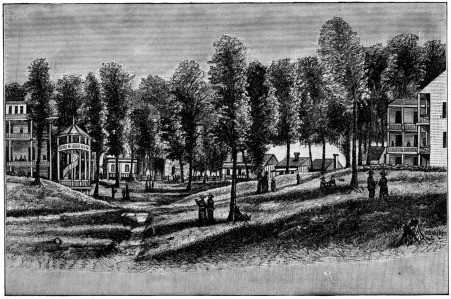
THE SPARKLING CATAWBA SPRINGS.