IN THE SADDLE.
Reading edition
And the steed it shall be shod All in silver, housed in azure, And the mane shall swim the wind; And the hoofs along the sod Shall flash onward and keep measure Till the shepherds look behind. —Elizabeth Barrett Browning.
HERE is something in a long ride on horseback that time cannot obliterate. At its recollection one feels again the motion of the horse, and can well imagine the bridle-reins in his fingers. With these sensations come the cool breath of morning, the smooth stretches of road through sunlight and shadow, the rough trail by wild, rushing waters, the vistas of rich meadows and fields, and the green and purple outlines of mountains. Such scenes become so impressed upon the memory that one might well question with Byron:

“Are not the mountains, waves, and skies a part Of me and of my soul, as I of them?”
This sketch is of a ride taken by the writer, through some of the most scenic sections of the mountains. Treating, as it does, of the country and people as they are, the tourist in quest for information, preparatory to a trip through the same region, need look no further than these pages.
In the interest of my pocket, I hired a sound young horse, at thirty-three and a third cents per day. He was my selection from several that could have been taken from the same class of people, at a schedule of prices ranging from twenty-five to fifty cents. If the tourist intends traveling for a month or more, the wisest plan is to buy a horse, and then sell at the finish. Money can be saved by this operation, unless being ignorant concerning horse flesh, he falls into the hands of an unscrupulous jockey.
It was in August, and clear bright skies for a season were predicted by the weather prophets, when, early one morning, I mounted my steed before an Asheville hotel. In the saddle-bags for myself was an extra suit of blue flannel, two pairs of socks, a rubber coat, comb, and brush; and for the horse two shoes and a paper of nails, to provide against losses which might occur twenty-five or more miles from where a horse-shoe could be procured. Country blacksmiths depend to a large extent upon their customers to furnish the materials for their work.
There is a road that winds from the center of Asheville, onward down hill and up, by pleasant door-yards, white-washed, stone-wall fences, and trimmed groves, to the bridge over the Swannanoa-river. Just beyond it, a wide road, turning sharp toward the left, is the route to Hickory Nut gap, and the comparatively level county of Rutherford beyond.
From this point the road runs through pleasant valleys, by mills, small streams, dwellings, and under forests, for eight miles, to the base of the mountains, whereon is the opening of the noted gap—the gateway to the picturesque region of Broad river. On the summit of the pass a limited view can be had of Buncombe county valley lands, dotted with cornfields, checkered with forests and mountain-bounded.
The road now begins to descend through beautiful sylvan scenes, combining all the gloom, luxuriance, wildness, and beauty of rocks, vines, pines, rhododendrons, crystal waters, dark ravines, and blue streaks of sky.
Where the Broad river crosses the road with a wide sweep, I drew rein before a frame dwelling, whose scanty farm lands gave no promise of yields which would afford enough extra money, by ten years’ savings, to be used in painting its dingy sides. Fastened to it was a porch with one end concealed by trailing vines, choked with dust. Before the weed-grown potato patch was a rickety, board fence, on the top of which was seated a man dressed in seedy, dusty, brown shirt, pantaloons, hat, and shoes.
Upon my inquiry whether dinner could be afforded here for horse and man, he slid lazily off his perch with the remark:
“Plenty oats an’ hay; no corn. Will ye lite?”
The man started with my horse for the stable, and I went toward the house. High steps reached up to the porch. On the latter stood a table, white with powdered plaster of Paris, and covered with dental instruments and teeth for false sets. Before it sat at work a middle-aged man.
“Pleasant day,” I said.
“Eh? What’s that?” wrinkling his narrow forehead.
“Fine weather,” I repeated.
“Can’t hear you,” shoving his chair a little nearer mine. He was evidently deaf.
“A pleasant day, this!” I thundered.
“Damn the weather! Where you from?”
“Asheville.”
“What’s your business?
“Seeing the country.”
“Seein’ the country?” Then with a cynical curl of his lip, “Poor business,” and he continued, whittling at his plaster cast.
I felt interested in the man. His cordial manners prompted me to fall on his neck, but I restrained myself. Then I took up the examination.
“You’re not a native. You have a foreign air about you, you have,” I shouted.
“You’re right.”
“Where do you hail from?”
“Been living with the Osage Indians for the last twelve years.”
I thought as much. He was all Indian, and I concluded to avoid him, but he did not intend to drop the subject so easily.
“Do you see that Osage relic?” pointing to an Indian blanket hanging on a hook against the wall. “That’s one of the things I brought back with me. I’m a man with a history. I can give you some points about a country that is a country.”
He again lapsed into silence. On the invitation to procure points, I determined to interview him.
“What were you doing among the Indians? Hunting?” I asked.
“No.”
“A trader?”
“No.”
“A dentist?”
“No.”
“What then?”
“None of your damn business!”
I felt disconcerted. Evidently, the man was a gentleman,—he objected to being interviewed. The tack looked like a bad one; clouds a little too electric for fine sailing. A thin-haired woman in a calico dress and rough shoes, with a care-worn expression on her pale face, was sitting at one end of the porch. She now spoke, in a voice inaudible to the unapproachable:
“Don’t pay any attention to him. He’s been drinkin’. Hit allers makes him ugly.”
“Who is he?” I whispered.
“My husband. We’ve been married a year; soon arter he cum from the West.”
And then she sighed and looked out across the rickety fence, the roaring waters of the Broad river, the brown mill and the few houses by it, and then at the stony-faced mountains beyond. I sighed in sympathy.
A bare-footed black girl stuck her head out of the door and announced that dinner was ready. Being tired and hungry, I was not backward in answering this notice, and moved into the dining-room. On my plate, after helping myself from everything on the table, were a chunk of fat pork, a piece of doughy, hot, wheat bread, and some boiled green beans. A tin cup of butter-milk was beside the mess to wash it down. Let me say right here that this was an exceptional meal! I have been on many tramps and rides through the Carolina mountains, but never had I met with such a reception and such fare. They were not backward in demanding half a dollar, the usual price asked by the mountaineer for supper, lodging and breakfast for man and his horse.
The man in brown, as he mended my saddle bags after dinner, filled my ears with a recital of the mysteries of Bat cave. He represented it as the wonder of the mountains. Its gloomy depths contained chambers of marvelous dimensions, while bats, the unholy habitants of darkness, stuck to the walls and flitted in its precincts. He volunteered as a guide, and as it lay on the way to Chimney Rock hotel, I mounted and rode along with him.
By the bouldered river, before the guide’s cabin, I tied my horse, and, by means of a foot-log, crossed to the opposite bank. It was a half-mile walk. We waded through the soft soil of several corn-fields, pitched almost perpendicular on the mountain side; climbed a number of rail fences; and after a steep ascent over tree-trunks and rocks, we arrived at the mouth of the cave. An air as cold as a winter lake breeze came from the darkness. It chilled us through and through. We went in without torches. There were rifts in the apex of the roof, high above, through which sunlight poured, dimly lighting up the whole interior. It failed most miserably to meet my expectations.
“Where are your bats, Dotson?” I asked.
“Hit’s cu’rous; I don’t see nary one.”
Dotson shaded his eyes, as he spoke, and peered down into a well-like hole, that broke away from our feet, and whose opposite wall, rock-piled in front, ascended straight upward till the sides closed.
“Nor do I,” I returned; “where are they?”
“Hit ’pears they aint ’ere. I ’low they been skeered out,” he drawled, rubbing his cheek.
That was all the satisfaction I obtained in regard to bats. A little curiosity is connected with the cave, from the fact that it is in granite rocks. At some convulsion of the mountain’s crust, the walls of granite were rent asunder, and then their tops, meeting again, left an opening between them. The air in it is cold and dry, for there is no water dripping in its interior. There is another smaller, but deeper, cave near the one just described. Torches are needed and one must crawl to enter it. The rocks around it are also granite.
I was on my horse again. The scenery for the next two miles is of a sublime description. The stone portals of a collossal gateway rise against the sky. The large mountain on the north is the Round Top. It presents a red cracked-stone front, and resembles the venerable ruins of a massive building, once swept by fire. Opposite to it is a line of Titanic stone cliffs—the front of Chimney Rock mountain. A luxuriant forest grows half way up its precipitous slope to the foot of the cliffs of bare rock, in height over 1,000 feet. A silver thread of water can be seen springing from the top-most edge, and falling down the bare face. It is the highest water-fall in the mountain system. The eastern end of the mountain projects its top forward, an abrupt headland. Its summit is covered with trees. From the glimpses caught of it along the shaded river, one might liken it to the bare forehead of some Cæsar, with laurel crown, overlooking the distant lands of Rutherford county.
Around the traveler, as he rides, are beautiful wood-land landscapes. A river, dammed with brown boulders, flows by the roadside. Where its channel narrows, it runs deep and smooth under the birches, oaks and pines; then at the shallows, among the rocks, it becomes a foaming torrent. The road is on a stone causeway, high above the crooked stream. Between the over-arching trees, glimpses of level road, yellow and dusty, can be seen at times. In the center of the valley, that widens out from the foot of the stone-fronted mountains, is a comfortable farm-house, enlarged for summer boarders, and kept by General G. W. Logan. It is the central point to view this scenic region of the mountains. It is reached by good roads from Rutherfordton, seventeen miles; Hendersonville, nineteen miles; Asheville, twenty-three miles; and Shelby, the terminus of the Carolina Central railroad, forty miles distant.
One mile from the hotel are the Pools. The stream is known as Pool creek. It seeks its level down a steep ravine, clothed principally with pines and oaks. Over three ledges of brown rock, whose edges still remain abrupt, the crystal waters of the stream plunge in quick succession, in as many thundering cascades. Where the cascades fall are basins, or pot-holes, formed perfectly round by the whirling of the waters. They are from ten to fifteen feet in diameter and of fabulous depth. The lower one is the largest, and has been sounded (as any one in the neighborhood, with straight face, will tell you) to the depth of 200 feet without striking bottom. Fifteen feet of the stock end of a giant pine projects out of it. The beauty and wildness of the spot could not be enhanced by a knowledge, even if true, that a depth of more than 200 feet of water lay in the lower pool.
On the edge of the ford of the river, our party halted to witness a sunset. It was an admirable point for observation. Before us spread a level, yellow field, forming the bottom of a beautiful, little valley. High mountains bound this vale on north and south, while directly in front of us, like companion sentinels, guarding the western gateway down which the sun was to march, stand Round Top and Chimney Rock mountains. Behind Chimney Rock, trending toward the west, arise in close succession, a number of mountains with distinct, broken summits,—a long palisade, fencing the gap in whose depths rushes the Broad river. In the center of the west, stands Bear Wallow mountain, the last visible knob of Hickory Nut gap. The sun was sinking behind the white cumuli that capped this mountain. Streamers of golden light, like the spokes of a celestial chariot, whose hub was the hidden sun, barred the western sky. The clouds shone with edges of beaten gold. Their centers, with every minute, changed to all hues imaginable. The fronts of the sentinel mountains were somber in the shadows, while the gap was radiant with the light pouring through it, and every pine on the top of the palisade stood black against the glowing sky.
It was dusk a few minutes after, but the roar of the river continued; the scents of summer filled the air; the trees bowed in luxuriant greenness over the road; the chirping of insects made musical the valley; the mountains rose gloomy and magnificent in the twilight.
The famous Bald mountain forms the north wall of the valley. Its sterile face is distinctly visible from the hotel porch. Caves similar to Bat cave are high on its front. In 1874, Bald mountain pushed itself into prominence by shaking its eastern end with an earthquake-like rumble, that rattled plates on pantry-shelves in the cabins of the valleys, shook windows to pieces in their sashes, and even startled the quiet inhabitants of Rutherfordton, 17 miles away. Since then rumblings have occasionally been heard, and some people say they have seen smoke rising in the atmosphere. There is an idea, wide-spread, that the mountain is an extinct volcano. As evidence of a crater, they point to a fissure about half a mile long, six feet wide in some places, and of unmeasured depth. This fissure, bordered with trees, extends across the eastern end of the peak. But the crater idea is effectually choked up by the fact that the crack is of recent appearance. The crack widens every year, and, as it widens, stones are dislodged from the mountain steeps. Their thundering falls from the heights may explain the rumbling, and their clouds of dust account for what appears to be smoke. The widening of the crack is possibly due to the gradual upheaval of the mountain.
The region of the gap is famous for sensational stories. In 1811, when known as Chimney Rock pass, a superstitious tale of a spectre cavalry fight, occurring here, was widely published in the newspapers of the day. The alleged witnesses of the spectacle were an old man and his wife living in the gap before Chimney Rock fall. So much interest was created in Rutherfordton by its recital, that a public meeting was held and a delegation, headed by Generals Miller and Walton, with a magistrate and clerk, visited the old couple and took their affidavits, to this effect: For several evenings, while shadows filled the pass and sunlight still lingered on the mountain summits, they had seen, from their doorway, two bodies of cavalry advance toward each other across the sky. They heard the charge sounded, and saw them meet in conflict, with flashing swords, groans, shouts of victory, and then disappear. Three more settlers testified as witnesses of the same vision. They were all believed trustworthy, but evidently deluded by some natural phenomenon. Giving credence to the tale, explanations were advanced, but none are satisfactory.
It is a half-day’s ride of unmarked interest from the bank of Broad river across the Bald mountains to the Catawba. The road is an old mail route to Marion, McDowell county. The air was hot and sultry in the middle of the day, when, after crossing the Bald mountains, I traveled over the foot-hills through woods of scrubby oaks and pines. The road was white, dry, and dusty. The branches of the impoverished trees, hanging with a melancholy droop, seemed panting with heat, and craving the presence of a breeze. Hawks circled overhead, and on a rail fence, visible at one break in the forest, a line of crows was roosting, with their glossy black plumage reflecting the sunlight. Their cawing heightened the effect of the scene. A ride alone through such scenery, and under such influences, tells upon one’s strength and spirits. After winding through a beautiful valley, and a moment later fording the Mill fork of Catawba river, I found myself in the little village of Old Fort. Its houses line a wide street, running parallel with the Western North Carolina railroad, and range along several short cross streets. A wooded hill rises back of it. During the Revolutionary war, and after, a fort with a strong stockade, enclosing a spring, stood on the bank of the stream. There were no battles fought here, but many depredations by Cherokees occurred, in which several people were killed in the vicinity. It is from this fort that the town takes its name.
About an hour before sunset, on that August day, I left Old Fort, by way of a well-traveled road, for Pleasant Gardens. There is many a level stretch for a gallop along this road, and I improved the opportunities afforded for a rapid push on my journey. Through the country I went, with the fields on my right, and the woods of the hills on my left; past large, pleasant-looking farm houses in the midst of ancestral orchards and wide-spreading farm lands. The streams are clear, but slow and smooth-flowing. The number of persimmon trees and hollies along the roadside mark a difference between the woods of this section and those of the higher counties.
It was after one of my easy gallops, that, bursting from a twilight wood, I beheld lying before me a valley scene of striking beauty. A broad and level tract of farming land, covered with meadows, corn and pea-fields, stretched away from the forested skirts of the hill-sides. From my point of observation not a house dotting the expanse could be seen, and not even the sound of running water (a marked feature of the higher valleys) disturbed the evening stillness. A cool pleasant breeze was stirring, but it scarcely rustled the leaves overhead. The dark outlines of Mackey’s mountains filled the foreground, making a broken horizon for the blue sky. On the right lay low hills. On the left the summits of a lofty line of peaks, behind which the sun was sinking, were crowned with clouds of flame, while the scattered cat-tails held all the tints and lustre of mother of pearl. That night I stopped in Pleasant Gardens, one of the richest and most beautiful valleys to be found in any land. It is miles in extent. John S. Brown was my hospitable and entertaining host. The large, frame house and surroundings vividly reminded me of my native state. Everything showed evidence of thrift and neatness, and withal a certain ancestral air, one that only appears with age, overhung the approach to, and portals of, the mansion. It was built a century ago, but many additions and repairs have been made since the original log-raising. Osage-orange hedges line the path to it under the cluster of noble trees. On the left as you approach, only a few feet from the house’s foundations, flows Buck creek with swift, clear waters: a trout stream in a day before civilization had cleared its banks.
Under a clouded sky I mounted my horse on the third morning of my journey, and set out from Pleasant Gardens. The fording of a stream is of so frequent occurrence in a trip through the Carolina mountains, that one is apt to have a confused recollection of any one river or creek that he crosses, although few are devoid of beauty or wildness. Those of the Catawba, as it flows through McDowell county, have lost the characteristics of the mountain ford. Boulders and out-cropping ledges of rock are absent; the rush and roar of crystal waters have given place to a smooth and less transparent flow, or noiseless, dimpled surface; the banks are of crumbling soil, and, instead of rhododendrons and pines, alders and willows fringe the waters’ edges.
The great valleys of the Catawba are covered principally with unfenced fields of corn. The road leads through rustling acres, where one’s horse, guided with slack rein by absent-minded rider, can, as he walks along, break a green ear of corn from the standing stalk, without stretching his neck over a fence. To prevent cattle from running at large through these thickly-planted lands, gates are swung across the roads at the division fence of each plantation, and from necessity, the traveler must open them to ride through; and then, from moral obligation, he must shut them behind him. The farm-houses are home-like in appearance. They denote prosperity, happiness and culture in the families inhabiting them. Many are of antique architecture, and set back on level lawns, under ornamental trees and flourishing orchards.
Toward the middle of the morning, the sharp outlines of the Linville mountains showed themselves in the east, and after an abrupt turn from the Bakersville road, I struck the North fork of the Catawba, and rode twelve miles along its picturesque course. Its waters have a peculiar, clear, green hue, and speak of speckled trout in their depths and shaded rapids. Without a guide, I could have followed up the North fork, under the shadows of Humpback mountain, and, by a trail, have crossed the ridge to the Linville falls; but by this route the wild scenery of the Linville cañon is lost. Bryson Magee was my guide to the Burke county road along the summit of Bynum’s bluff. Just after a slight shower, he overtook me as he was returning from a day’s work for a North Fork farmer. He had an open, tanned countenance, fringed by a brown beard, and capped by a head of long hair, hidden under the typical mountain hat—a black, slouch felt, with a hole for ventilation in the center of the crown and minus the band. An unbleached, linen shirt, crossed by “galluses” which held his homespun pantaloons in place, covered his body. He wore shoes and walked leisurely.
“Is there anyone on this road who can guide me up Bynum’s bluff?” I asked him, after returning his “howdy.”
“Why, some niggers live nigh hyar who could do hit, but they’re all at work two mile below.”
“Any one else I could get?”
“Not a soul, except—”
“Who?” I asked.
“Wal, stranger—I reckon you’s a furriner—I kin do hit, but I’m powerful tired: worked all day.”
When we arrived at his log cabin, he had definitely determined to go. It was then four o’clock, and clouds were driving thick and dark across the sky. We tied the saddle-bags to the saddle, and then began the ascent. Bryson led my horse; I walked on behind.
Before we had proceeded 100 yards, a light rain began falling. This did not deter us, for Bryson, like all the denizens of the coves, was callous to dampness, heat, and cold, and as for myself, a rubber coat came in play. The flinty ground was set with whortleberry bushes—a true indicator of sterility. These berries were ripe, and we gathered them, as we tramped along the trail, while the clouds grew heavier around us, and the rain swept in blinding sheets through the scrubby forest. There was no thunder to add variety to the storm, only the moan of the wind, and the sound of tree tops swaying in the gusts. The water poured in streams from my hat, and my legs, to the knees, were soaked from contact with wet bushes; but gradually it cleared over-head, and when we reached the main road, on the summit of the ridge, the clouds had parted, and through their rifts the sun, still an hour high, poured a burning glory over the dripping forests.
Looking southward in the direction the guide pointed, a mighty, rock-topped mountain, lifting itself into the sunlight above the fog, was visible. It appeared like a stone wall rising from the ocean. Squared off in sharp outlines, without trees or lesser visible vegetation on its level summit, it presents a striking contrast to the other peaks of the Alleghanies south. It is the Table Rock mountain, 3,918 feet in altitude. Hawk-bill, a peak named from its top being crowned with a tilted ledge of moss-mantled rock, resembling the beak of a hawk, stood before me as I turned toward the left. Its altitude is 4,090 feet. Both these peaks are accessible for climbers, and are much visited by tourists curious to examine the character of their rock formation.
“We jist hit it,” broke forth the guide, “a minute more an’ we wouldn’t seen ’em. See, the fog’s crawlin’ up, slow but shore.”
It was as he had said. The massed vapors in the low sunk vales were being driven upward, and a moment later they had enfolded Table Rock and Hawk-bill, and were creeping through the woods around us. I now handed him fifty cents, the price for a day’s common labor through that section, and, shaking hands, we separated. It was five miles to the nearest house, and lacked only one hour of sunset. Three miles had been passed over, when a sound, as of some distant waterfall, struck on my ears. It was a soft, steady, liquid murmur. Halting my horse, I sat in the saddle and listened, then dismounted, tied, and walking through the weeds a few steps, reached some broken rocks at the edge of a precipice. Clinging to a tree, I leaned over and looked below through perpendicular space over 1,000 feet. I shouted from the sensations created by the wonderful wildness of the scene.
At first sight down into a cañon, that seemed almost fathomless, I saw an inky, black band stretched through the depths, with surface streaked with silver. It was the Linville river, but distance rendered its waters motionless to the vision. A thin mist lent an indescribable weirdness to the scene, and seemed veiling some mighty mystery in its folds. “Wrapping the tall pines, dwindled as to shrubs in dizziness of distance,” it was being shaken from its foothold by varying breezes, broken into separate sheets of vapor, and pushed upward along the perpendicular walls. It curled and twisted weirdly through the tangled pines, filling black rents in the opposite mountain’s face, shielding a ragged, red cliff here and there, but at every movement mounting toward the cañon’s rim. Soon the profile faces on the upper cliffs jutted out in clear air; the brick-like fronts of rock, in pine settings across the chasm became plainly visible; the lower forests stood free; the dark river, sweeping in an acute angle, within stone drop below, tossed upward its eternal echo; the mists had clustered in thick clouds on the summit of an unknown peak, and then all grew dusky with the approach of night.
A scene is sublime, according to its power to awaken the sense of fear; the more startling, the more sublime. The view of Linville cañon from the Bynum’s Bluff road possesses, in the writer’s opinion, more of the elements of sublimity than any other landscape in North Carolina. The region of the Linville is one of scenery grandly wild and picturesque. The only region that approaches it in wildness and sublimity—being somewhat similar in the perpendicularity of its mountains and the clearness of its stream, but contrasting by the fertility of its soil and luxuriance of its forests—is the Nantihala River valley.
The Linville range is a spur of the Blue Ridge, separated from the latter by the North Fork valley. It trends south, and for a distance is the dividing line between Burke and McDowell. Its highest altitude is about 4,000 feet. Jonas’ Ridge runs parallel with it on the east, and between them, through a narrow gorge, over 1,000 feet deep, flows Linville river. The rocks of these mountains are sandstones and quartzites. The soil is scanty and sterile, and the forests scrubby. The falls are distant from Marion on the Western North Carolina railroad, about twenty-five miles, and reached as the writer has described. From Morgantown, on the same railroad, they can be reached by a day’s ride in conveyance over the highway on the summit of the mountains. Hickory is also a point from which to start, and one frequently taken by tourists.
That night I dried my clothes at T. C. Franklin’s fireside, one mile from the falls of the Linville. Around the crackling logs (this was in August) was a small party, such as is often collected at mountain wayside farm-houses. Steaming their clothes with me at the broad hearth, were two Philadelphia lawyers. A few days previous, closing their musty tomes, filing away their legal documents, and reconciling importunate clients with fair promises, they had locked their doors to silence, dust and cobwebs, and started southward. In Virginia they each bought a horse, and equipped like myself, they were doing the mountains. It was not only their first visit to Western North Carolina, but their first trial in that mode of traveling; and, like all innocents abroad, they had gathered some interesting matters from personal experience. While the good-wife rattled away at the plates on a table just cleared by us of everything in the shape of food, in spite of the steady patter of rain on the roof, warmed by the glowing fire, and growing enthusiastic over mutual praise of the mountain scenery, we drifted into the following conversation:
“That view from the Roan eclipses everything I have ever seen in the White, Green, Catskill and Virginia mountains; but I would not ascend it again for all the views from Maine to Florida, if I had the same experience to pass through,” said one, whose black hair, eyes, beard and dark complexion gave him a brigand appearance.
“No,” returned his pleasant, fair-faced companion, “You know the peril of your being abroad nights. Some one else, less timid, might actually shoot you.”
“Were you in danger of being shot?” I asked.
“Yes; shot for a highwayman,” answered he of the open countenance, and then he laughed.
“How so?”
“Oh! Hal’s joking about the shooting business. I was taken for a robber; that’s a fact; but what I mean by an unpleasant experience was our being lost on the Roan.”
“I intend to ascend the Roan. Is the way hard to find?” I spoke to the dark-visaged man.
“It is from the Tennessee side. We took that route, with explicit directions how to reach the hotel on the summit. It was only fifteen miles distant from our stopping-place, but it rained, and a dark morning gave us a late start. From Cranberry to the foot of the Roan we pursued a trail way, and a tangled pursuit it was. At the base of the mountain we wound ourselves up in a net-work of log roads that, cut by the lumbermen, branched out in every direction, crossing and recrossing each other in the great woods. Extricating ourselves from this, we climbed the mountain, arriving on the ridge about sunset. Just before gaining the ridge, we met a party of four tourists on foot, whom we saluted and left behind. A painted gate led us astray, and we followed the ridge leading to the Little Roan. We retraced our steps in the rain and darkness, and took shelter near the delusive gate in an empty but comfortable cabin, erected evidently for lost wayfarers. I went out after we had started a fire, and found the party of four men seated on a log in the rain at some distance from the cabin. I invited them to return with me, but they declined. I said nothing more, considering them non compos mentis.”
“A singular party. Did you discover any reason for their refusal?”
“Yes,” began the one addressed as Hal, “Mat’s face, dress, and figure frightened them; and, as they told the landlord in the morning, in spite of their being well armed, they preferred an all night’s roost in the rain to falling into the clutches of a highwayman.”
“Well, that’s so” said Mat, nodding his head and smiling; “However, we were lucky in finding the cabin before they did. Had they got there first, they would have barred the door against us, and, perhaps, warned us away with a few pistol shots.”
Our social ring was at this point broken up by a party who seemed too much preoccupied with themselves to join us, and so we separated for the night. The party in question consisted of two newly married couples. The knots had been tied in Morganton, a few days previous, and they were then on their bridal tour. They drove up in the rain, unharnessed and tied their horses under the dripping trees (for the stable was full), and came in upon us.
On the next morning, under a clear sky, I wound my way on foot under the limbs of kalmia and rhododendrons to the Linville falls. It is a wild approach. Over the hedges tower ancient hemlocks with mossed trunks. The blue-jay screamed through the forest, and around the boles of the trees and along the branches, squirrels, known as mountain boomers, chased each other, halting in their scampers to look down on the disturber of the solitude. Once, a brilliant-breasted pheasant, roused by my footsteps, from a bed of fern-crested rocks, sprung in air close before me, and with a startled whirr, sailed up a shaded ravine. A sportsman, with a shot-gun, could easily have winged the bird in its flight, thereby securing a valuable trophy for the taxidermist. The cock pheasant of the mountains has not a shabby feather on his body: They are found in many sections of the mountains, but not in great numbers. The hollow drum-like sound caused by beating their wings against their bodies, is in most instances their death tattoo. At its sound from the neighboring cove, the hunter takes down his rifle, creeps near the favorite log, and generally makes a dead shot.
An old mountaineer, famous as a narrator of bear and fish stories, was particularly fond of telling one relating to pheasant shooting. One autumn day, having already marked the forest locality from which the drum of a pheasant resounded every morning, he crept near with his rifle. The bird had just jumped in place and was drumming within his sight. He took deliberate aim and fired. On running to the log he discovered a red fox struggling in his death throes on the opposite side of the log, and in his mouth a dead pheasant. Reynard, as the mountaineer explained, marking the frequented log, had secreted himself close beside it, and, while the mountaineer was aiming, was preparing to seize the bird, and did so at the moment the trigger was pulled.
The heavy thunder of the falls swept through the forest, increasing as I advanced. The path diverged at one point, and, taking the right hand trail, by means of the roots of the laurel, I descended a cliff’s face in cool, dismal shade. At the bottom, I came out on a black ledge of rock, close to the river. A stupendous fall was before; stern walls of a rocky cañon, 100 feet high, around me, and a blue sky smiling above. I climbed a stair-way of moist rocks, and walked along the path on the cliff’s front to a point directly before the fall’s face. The great volume of the Linville river, formed from drainage for fifteen miles back to the water-shed of the Blue Ridge, here at the gap between Jonas’ Ridge and the Linville mountains, has cut asunder a massive wall, leaving high perpendicular cliffs towering over its surface, and then, with a tremendous leap, pours its current down through space, fifty feet, into the bottom of the cañon. It seems to burst from a dark cavern in the mountain’s center. A pool, sixty feet across, looking like the surface of a lake with dark waves white-capped, spreads in a circle at the base of the cliffs. After recovering from the dizziness of its plunge, the river, leaving the piny walls on either side, rushes along in view for a short distance, and then disappears around the corner of a green promontory.
If one, in retracing one’s steps, takes the left hand trail at the point of divergence, and follows it to the edge of the cliffs, a magnificent downward view will be obtained, both of the foot of the cataract, and above, where its waters race in serpentine course, increased in velocity by the plunges over smaller falls only a few yards up the gorge.
A wilder solitude, a more picturesque confusion of crags, waters, woods, and mountain heights, can scarcely be found. But even here, man once fitted for himself a dwelling-place; for plainly visible across the tops of the trees, was a little cabin on a small, sloping clearing. No smoke curled upward from its weather-worn roof; its doors had been torn away and chimney leveled. A few cows pastured before it.
After dinner I left Franklin’s to ride over a good road up the Linville river. The afternoon passed without any occurrences or scenes of marked interest, and the sun was slowly sinking toward a mountain-rimmed horizon when, making a last inquiry in regard to my route, I entered a wilderness, unbroken by human habitation for nearly five miles. It was a great, green-lined way. Linns, birches, and hemlocks met over-head, rendering dark the shadows. Under this forest, grow in richest luxuriance dark hedges of rhododendron, too dense for easy penetration, and reaching up to the lower branches of the trees. It was late in season for their flowers, still many of them were white and purple with bloom. So deep and luxuriant was the foliage of the forest and its undergrowth, and so cold the waters of the stream that crossed and recrossed or occupied the road-bed itself, that the air was chilly at the hour in which I rode, and must be so even at noon-day.
The shade continued to deepen, and the chilliness of the air increased; still, in spite of the apparent great distance I had covered, no house presented itself, and in only one place did the branches of the trees separate themselves sufficiently to see out. Then, far beyond, I saw the black summit of the Grandfather. That was all. The waters of the stream are of a rich, Rhine-wine color. At one point that day, I noticed, attached to a fence above the stream, a board bearing the words, “No fishing allowed on this land.” This is the only posted warning against angling that I have seen, or know of, in the mountains.
In that twilight hour the stream seemed to sing a doleful refrain over the smooth boulders and gnarled ivy roots. An owl hooted from its hidden perch in a mossed pine; and a scared rabbit, interrupted in its evening meal on an apple dropped by some lonely wayfarer, fled across the road, and disappeared in the gloom of the thickets. A more dismal woodland for a twilight ride could not well be imagined in the possibilities of nature. It would naturally be more dismal to the unfamiliar traveler, tired with a long day’s ride, and despairing of reaching a farm-house before the approach of a cloudy night.
Suddenly the forest on one side opened, and a clearing of dead, girdled trees, with brush fires blazing here and there among the white, standing trunks, lay before me. Further on was a meadow and a small house, from whose chimney a wreath of smoke was ascending straight to the zenith. Over the house and farm loomed the rock-crowned summit of the Peak of the Blue Ridge. An unshapely ledge cropped from the mountain’s top.
I was now on the summit of one of the gaps of the Blue Ridge, at an elevation of 4,100 feet. On one side down a gradual descent through the wilderness described, flow the waters of the Linville on the way to the Atlantic; on the other, close on the dividing line, wells up the spring forming the Watauga, whose waters mingle with the Mississippi. A short mile below this point, down the Watauga side, is Calloway’s, at the foot of the Grandfather, as the sign-board directly before the gate will tell the man who stops to read it. In the dusk, I dismounted here, tossed my horse’s bridle to a barefooted boy, and then lugged my saddle-bags to the porch before the unpainted front of a new addition on an old house. I was well received and seated.
Beside the road, before the house, was presented that evening a scene that merits description. It was the camp of a family who, having abandoned one home, was seeking another. An open fire blazed on the ground. Its light shone on a white covered, rickety wagon, at whose rear end were feeding, out of a box strapped there, a mule and a horse. The mule was all ears; the horse all ribs, backbone, and neck, plainly appearing through a drum-tight hide. Around the fire was a squalid group consisting of a man, woman, and four small boys. The man and boys were barefooted, and wore nothing but hats, breeches, and shirts. The woman had on a tattered gown, and had her pinched features concealed within a dark bonnet. At that moment they were drinking coffee in turns from a single tin cup, and eating corn bread. The pinched features, straggling hair, and sallow, almost beardless face of the man, made his a visage of stolid apathy. At intervals, a gust, sweeping down the narrow valley, would lay low the flames and whirl the smoke in a circle, enveloping the group, and awakening a loud coughing from the woman. My supper was not ready until after I had seen the last one of the family crawl after the others into the wagon for the night.
The next morning I went out to talk with them as they ate breakfast.
“Where are you from?” I asked.
“Tenesy,” answered the man, giving the accent on the first syllable, a pronunciation peculiar to the uneducated natives.
“How do you come to be here?”
“Movin’. Got ejected in Tenesy, an’ we’re now huntin’ a new place.”
“Where?”
“Dunno. We reckon on squattin’ somewhar in the Blue Ridge.”
“Will you buy or rent the property?”
“Buy?” answered he, with an expression of astonishment on his face; “What do you reckon I’d buy with, stranger? I ain’t got a copper, an’ thet mule, hoss, wagin, an’ hay an’ corn in hit, an’ them harnesses, could’nt be swapped fer much land, I reckon. All I’ve got? Yes, ’cept the ole woman an’ them boys. I’ll jist put up a cabin somewhars in the woods, plant a crap, an’ stick thar till they done driv me out.”
After this reply, he leaned forward and poured out another cup of coffee for himself and family, as I slowly turned and walked away. No more poverty-stricken families can be found than some of these occasionally seen moving through the mountains. This one had property in a team and wagon, but I have met them traveling on foot and carrying their sole possessions.
A family of the latter description I came across near the Ocona Lufta in Swain county. It was a warm May day, and the road was dry and dusty. I was on foot with a companion from the Richland valley. On descending a short hill to a small stream gliding out from under a clump of wayside willows, we met the party. There were eight of them, as destitute, ragged, forlorn, and withal as healthy a family as I ever saw. The father and husband was fully 70 years of age. His long gray hair, although unkempt; his wrinkled face, and mild blue eyes, had something in all to arouse reverence and pity in the most thoughtless of mankind. He was dressed in an unbleached muslin shirt, much the worse for wear; a pair of pantaloons so completely covered with patches that it would have taken an artisan tailor to distinguish the original ground-work; a pair of cloth suspenders, and a battered hat. He was bare-footed, and carried on his shoulders half a bushel of corn. The wife and mother was much younger. Her face was stolid enough to be utterly indifferent to their condition. She had on the least possible quantity of clothes to cover her form, and a calico bonnet on her head. Under her arm was a bundle of spring onions, probably gathered from some convenient yard near which they had encamped in true gypsy fashion. The eldest daughter, a grown woman, was no better attired than her Mother. She had in her possession a roll of tattered blankets. The five remaining, frowzy children, barefooted and ragged like their sire, had in their respective keepings, a coffee-pot, two or three gourds and an iron kettle. This was the whole family with a full inventory of their worldly possessions. They said that they were moving back to Tennessee; that they had been burnt out; that the head of the family could not earn more than 20 cents per day; that it was “split the Smoky mountings or bust.” We were under the impression that the 20 cents per day included the board for the family. We gave them some small change and tobacco and then separated.
The Grandfather mountain, in the extreme southern corner of Watauga county, is the highest point of the Blue Ridge. The elevation is 5,897 feet, and being 35 miles in an air-line distant from the loftier summits of the Black mountains, and fifteen miles from the Roan, over-topping as it does all the nearer peaks by an altitude of nearly 1,000 feet, it commands an almost limitless view of mountain country. It merits the name of Grandfather, for its rocks are of the Archæan age, and the oldest out-croppings on the globe. Two other reasons for its name are ascribed; one from the profile of a man’s face seen from the Watauga river; the other from the resemblance of the rhododendrons, when clad in ice and snow, to the white, flowing beard of a patriarch.
Differing from all the mountains of the South, dense labyrinths of rhododendrons and pines begin at its base. The traveler enters their shadows by the road-side, and for two and a half miles, the distance from Calloway’s to the summit, they are continually with him. Although the first two miles are often accomplished on horseback, it is too steep for easy riding. The path winds like the trail of a serpent, brushing by the bases of low, vine-draped cliffs, around yellow hemlocks, and disappearing in the rocky channel of a torrent, or into hedges of rhododendrons.
On the morning that I made the ascent, I was impressed with the noticeable absence of birds. Not a note from a feathered songster resounded through the forest. No life was visible or audible, except occasionally on the cliffs, quick-eyed lizards, of the color of the rocks, appeared and then disappeared in the mossed crevices of the stone.
One-half mile from the summit, under a tall, dark cliff whose cold face seems never to have been kissed by sunlight, bubbles a large spring. Its water is of a temperature less than eight degrees above the freezing point. This, as far as is known, is the coldest spring south of New York state. Here the steepest part of the ascent begins. At intervals old logs are piled across the narrow trail, and in places rocks have set themselves on edge. Grasses grow rankly with weeds and ferns. These, covered with the moisture of the clouds that had dropped with the night about the forehead of the Grandfather, and only lifted with daylight, wet the person pushing through them as thoroughly as if he had fallen in the torrent.
The summit of the mountain is a narrow, ragged ridge, covered with balsams. If these trees were cleared from the central pinnacle, a sweeping view toward every point of the compass could be obtained, without change of position. As it is, they obstruct the vision, and to see out on every side it is necessary to move to three points, all close together, known as the Watauga, Caldwell, and Burke views.
Let the reader imagine himself stationed at one of these views. Mantling the steep declivities are the wildernesses of black balsams. A cool breeze swings and beats their branches together. The sun rides in an atmosphere so clear that there seems no limit to vision. A precipice breaks away from your feet, but you do not notice where it ends; for at the attempted downward look, the mountains below, like the billows of a stormy ocean stilled in their rolling by some mighty hand, crowd upon the vision. They have all the colors of the ocean, wave beyond wave, surge beyond surge, till they blend in with the sky, or hide their most distant outlines in the cumuli bounding the horizon. You fancy hearing the sound of breakers, and look directly below as though seeking for the reason of no roar arising from the waves lying at the base of the headland. Then the dream of the sea vanishes. There lie the forests, dwarfed but real, dark green, covering the unsightly rocks and ending at brown clearings, in whose centers appear farm-houses, the almost invisible fences running wild over the hills, the yellow road revealed at intervals, and the silver threads of streams.
It was on a beautiful Sunday morning that I left Calloway’s and rode down the western slope of the Blue Ridge. A quiet, seemingly more hallowed than that of other days, was brooding over the valley through which, beside the Watauga, the road descended. The fields and meadows were vacant; and the mountaineers, observant of the Sabbath, were all within their homely dwellings, or assembled at the meeting-house of the neighborhood. This place of prayer is a plain, unpainted, frame building, enclosed by a rail fence, beside the road. Just before reaching it your horse must splash through a roaring, crystal ford of the Watauga. When I passed it that morning, services had already begun, and the sounds of a hymn, sung by all the congregation, in strong, melodious chorus, came wafted through the trees. A long line of saddled horses and mules were ranged along the fence, or tied to the rhododendron hedges on the opposite side of the road. The house seemed packed; for many of the men were standing bare-headed in the sunlight before the crowded door, and a number of young folks were gathered in groups about the yard, the latter more intent on their own conversation than on what was doing indoors. Some of them nodded to me as I passed. This manner of the mountaineers saluting every one, friend or stranger, is a pleasant one, and prevents, in the traveler, all feelings of loneliness arising from his being in a strange country.
At one point on the road, the further rocky end of the Grandfather mountain presents the distinct features of a face. You can see it looking out from its head-dress of firs, like a demi-god, holding eternal watch over the myriad mountains and valleys.
The vicinity of Blowing Rock is a summer resort. It is a lofty plateau of the Blue Ridge, covered with dense forests, level farms, and crossed by smooth highways. Good country accommodations are offered here for the tourist. From the edge of the mountain wall, which overhangs Caldwell county, two points—Blowing Rock and Fairview—afford admirable stands, for overlooking the piedmont country. The views are similar in character. From Fairview the valley of the John’s river, embosomed in green mountains, lies in the low foreground; while rolling back, spread ranges, picturesque in outline and purple coloring. In the morning or evening, when the sunlight is thrown aslant across them, bathing the fronting slopes in fire, and leaving, under the opposite brows, gloomy shadows, so long drawn out that many of the valleys are as dark as they are silent, the scene is such that one can never tire of viewing it, or ever lose the impressions that even one sight of it will awaken.
A ride of eight miles from the center of the plateau resort, will bring the traveler to Boone, the county seat of Watauga. Along the way several sweeping landscape prospects are afforded. In one of the dense woods I passed men engaged in clearing a laurel thicket. The soil where the laurel springs being generally rich, it requires, after its clearing, nothing but a slight plowing, and enough corn for planting, to have the
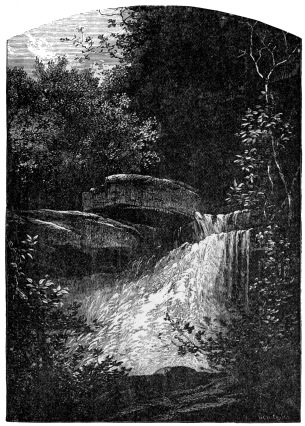
WATAUGA FALLS.
expanse, which, during the last season, was blooming with white and purple rhododendron flowers, transformed into a green and tasseled corn-field.
Boone, the most elevated county seat east of the Rocky mountains, is 3,222 feet above the sea. Its population numbers about 200, and lives along a street rising and falling with the hills. Due to the fact of no majestic mountains arising round it, there is, in its surroundings, less of the attractive features that distinguish the most of the mountain county seats. Near the stream which flows on one side of the town, Daniel Boone, the famous hunter, is said to have encamped while on a hunting tour. It is from this tradition of the camp that the village took its name.
An afternoon ride from Boone will land the traveler at Elk river. The scenery on the route is picturesque. In the valleys they were raking hay that August day. One valley in particular, by the Watauga, is of captivating loveliness. The mountains rise around it, as though placed there with no other purpose than to protect its jewel-like expanse from rough incursions of storm. It lay smooth and level under the warm sunlight. Nothing but grass and clover covered it—in some fields wholly standing, in others being laid low by the reapers. It is evidently a stock farm; for large droves of sleek, fat cattle were grazing in some of the meadows. A cheerful farm-house and large out-buildings stand on one side of the road. The noise of a spinning wheel, coming from the sunlight-flooded porch where a gray-haired matron was visible, blended with the sounds from the fields—the lowing of cattle, the noise of sharpening scythes, and laughter from rosy-cheeked girls and men, who, pausing in their work, looked for a moment at the travel-worn horse and rider. This valley I would love to live in.
As a county perfectly adapted for stock-raising, Watauga cannot be surpassed. One and three-quarters miles off the road you are now pursuing, is the Marianna falls of the Little Dutch creek. It is easily approached by the foot-traveler. After reaching the stream from above, by descending a winding, trail you come out on the flat rocks directly below and before the fall. It is eighty-five feet high and makes a perpendicular descent over mossed and lichened rocks.
Valle Crucis lie on the left of the way that winds under the trees along the base of one of its mountain limits. It is a valley containing probably 600 acres, and noted for its beauty. The name is taken from its imaginary resemblance to a cross. The length of the valley, running between the rounded parallel ranges, is compared to the upright piece of the cross, and the openings between these ranges on either side where green levels reach back, to the arms. From the best point of observation which I gained, it seemed a perfect square—a vivid green lake, fringed with the rich foliage of the forests which decked the slopes of the bordering mountains.
A little religious history is connected with this Valley of the Cross. On one spot in it there are still to be seen amid weeds and luxuriant grasses the scattered ruins of a building. They are all the remaining evidences of a mission school, founded many years since by the Episcopal Church of the state. It was under the particular supervision of Bishop Levi S. Ives; and it was here that, 30 years ago, he openly renounced loyalty to his church and went over to the Roman Catholic faith. With this singular apostacy, work at the mission school closed, and the building gradually assumed its present proportions.
Over lonely mountains the road now leads to Elk river. I rode for mile after mile that evening without seeing a cabin or farm-house. The scenery along the Elk has something decidedly romantic in its features. On one hand would be perched a moss-grown cottage on the mountain slope, with a few giant hemlocks, allowed to stand at the time of the general clearing, overshadowing it. Below, on the other hand, would lie fertile fields, watered by the noisy Elk, and enclosed on three sides by the dark and sober forests of the hemlock. The serenity of the evening was not disturbed by the farewell whistling of the quails; the rattling of the bells from the cows coming homeward across the pastures; the barking of a dog behind the barnyard fence, and the opening cry of the whip-poor-will.
The moon had turned from silver to gold; the stream under the spruces was sparkling where no shadows fell athwart its surface, and a cold, evening breeze, the usual companion of night over the mountains, was rustling the black foliage of the trees, when I dismounted at a hospitable farm-house on the Elk, where I had a wholesome supper; shared a bed with the farmer’s son, a graduate of the North Carolina University; had an early breakfast, and before sunrise, mounting my horse, I was on the way toward the foot of the Roan. An old forge, where the iron taken from the mountain near by was smelted, stands by the road. It was abandoned a few years since. The Cranberry mines are a mile off the main road. They are in Humpback mountain, Mitchell county, North Carolina, and included in a tract of 4,000 acres, owned by the Cranberry Iron & Coal Company of Philadelphia, of which A. Pardee is president. Mines have been worked in this mountain for the last half-century. They are now being operated on a large scale. The narrow-gauge railway, an off-shoot of the E. T:, V. & G. R. R., runs to the tunnel; and the raw ore is transferred by rail to furnaces in the North. The tunnel to the ore bank is run in on a level from the railroad, to a depth of 325 feet. Both steam and hand drills are being worked. The vein now struck appears inexhaustible. It was discovered half a mile above on the mountain side, and then the lower tunnel was projected in to it. The company’s saw-mill is in active operation near by. A town will soon be in existence here.
From the Tennessee side the ascent of the Roan is arduous, and if one has not taken precaution to secure explicit directions, he may be obliged to sleep out all night in the gloomy woods, in this regard being more unfortunate than the two travelers whom I met on the Linville. Profiting through their misfortune, I learned every crook of the way, and with only the steepness of the ascent to discomfit me, arrived at sunset on the summit of that majestic mountain. The scene below, in every direction, except where the Little Roan uplifts its gray dome, was one tumultuous mountain ocean, rolling with rough and smooth swells alternately toward the ragged horizon:
“And half the sky Was roofed with clouds of rich emblazonry, Dark purple at the zenith, which still grew Down the steep west into a wondrous hue, Brighter than burning gold, even to the rent, Where the swift sun yet paused in his descent Among the many-folded hills.”
One hundred and twelve feet below the extreme top of Roan mountain is situated Cloudland Hotel, over 6,200 feet above the sea, and the highest habitation east of the Rockies. There is enough novelty in the situation of a summer resort at so lofty an altitude to captivate the tourist, even were there no attractions of sky, climate, scenery, or the aspect of the mountain top itself. It is a beautiful, rounded meadow, where the rocks, which one would naturally expect to see exposed, are hidden under a soil clad with luxuriant grasses, mountain heather, and clumps of rhododendrons, and azaleas. Sombre forests of balsam stretch like natural fences around the edges of the treeless expanse, which, for over two miles, pursues the center ridge of the mountain. At one end of the Roan, naked granite cliffs descend into soundless gorges, and the sublimity of the view from the brow of the precipice is indescribable. The mountain brooks teem with speckled trout, and a series of beautiful cascades on one wild slope will attract the lover of nature. From June until October the air is balmy and bracing, the temperature ranging during the summer from 58° to 73°.
The regular route to Cloudland is over a turnpike from Johnson City, a station on the East Tennessee, Virginia, & Georgia railroad. A line of comfortable, covered stages make the trip of thirty-two miles every Monday, Wednesday, and Friday. For travelers coming from Eastern North Carolina and beyond, conveyances can be obtained at Marion, on the Western North Carolina railroad; distant 45 miles.
The slopes of this mountain are covered by vast tracts of cherry and other hard-wood trees. Its timbered wealth is incalculable. Saw-mills have lately sprung into place, and the bases and gentle uplands are now crossed with fresh roads and dotted with loggers’ camps. General Wilder, of Chattanooga, the owner of Cloudland Hotel and of most of the mountain, is the principal operator in this line.
As related by General J. W. Bowman, one of the first citizens of Mitchell county and descendant of a Revolutionary patriot, the summit of the Roan was the rendezvous for the mountain men of the Washington district and Watauga settlement, assembling for the march ending in the battle of King’s mountain.
In Yancey county, visible from the Roan, and forty-five miles from Asheville, is a peak known as Grier’s Bald, named in memory of David Grier, a hermit, who lived upon it for thirty-two years. From posthumous papers of Silas McDowell, we learn the following facts of the hermit’s singular history. A native of South Carolina, he came into the mountains in 1798, and made his home with Colonel David Vance, whose daughter he fell in love with. His suit was not encouraged; the young lady was married to another, and Grier, with mind evidently crazed, plunged into the wilderness. This was in 1802. On reaching the bald summit of the peak which bears his name, he determined to erect a permanent lodge in one of the coves. He built a log house and cleared a tract of nine acres, subsisting in the meantime by hunting and on a portion of the $250 paid him by Colonel Vance for his late services. He was twenty miles from a habitation. For years he lived undisturbed; then settlers began to encroach on his wild domains. In a quarrel about some of his real or imaginary landed rights, he killed a man named Holland Higgins. At the trial he was cleared on the ground of insanity, and returned home to meet his death at the hands of one of Holland’s friends. Grier was a man of strong mind and fair education. After killing Higgins, he published a pamphlet in justification of his act, and sold it on the streets. He left papers of interest, containing his life’s record and views of life in general, showing that he was a deist, and a believer in the right of every man to take the executive power of the law into his own hands.
While I was at the hotel a terrific thunder storm visited—not the summit of the Roan—but the valleys below it. It came after dark, and from the porch we looked out and down upon the world in which it raged. Every flash of lightning was a revelation of glory, disclosing a sea of clouds of immaculate whiteness—a boundless archipelago whose islands were the black peaks of the mountains. Not a valley could be seen; nothing but the snowy bosom of this cloud ocean, and the stately summits which had lifted themselves above its vapors. In the height of the storm, the lightning blazed in one incessant sheet, and the thunder came rolling up through the black awful edge of the balsams, producing somewhat similar sensations to those which fill the breast of a superstitious savage at the recurrence of an every-day storm above him.
When I descended the mountains on the following afternoon, the ravages of the storm were visible on several splintered oak trees, which lay prone across some of the wayside clearings and Big Rock creek was high and still roaring, with its excess of water.
At sight, of the rocky fords of this stream, the traveler would naturally form the opinion that it flows through wild, rugged scenery, in a country devoid of clearings. There is, however, fine farming land, cleared and occupied, along Big Rock creek. One portion of it, in particular, of soil rich and fertile, is settled by a prosperous and hard-working class of people, who, during the late war, sided with the North. It is now said that they will allow none, except white men, to stay, either permanently or as day laborers, in their community. The reason given is that they fought to liberate the negro from bondage, and, having thus helped him, they wish to be free from all contact with him. The same feeling prevails in other isolated localities through the mountains, one being on the Little Tennessee, in the region of its lower reaches, near the state line.
Bakersville, with a population of 500 people, is eight miles down from the summit of the Roan. It is situated on Cane creek. The town has been in existence only twenty-one years, is substantially built up, and growing rapidly. The mica interests are doing considerable to enrich it. An Indian town was once situated here, and to this day, although unused for 100 years, the old beaten trail of the red man, leading from Turkey Cove to the Nollichucky, is still visible, by the bank of the creek, under the bending grasses which grow along its edges, but still refuse to spring where the moccasin-footed aborigines, for probably centuries, wended back and forth from Tennessee.
Here, near the village, for one night’s encampment, in the course of their flight from Morganton, halted the “Franks” with “Nollichucky Jack,” their spirited and beloved leader. The details of his escape from trial are given in another chapter.
The 400 acres of valley, in which the town is situated, was a land grant of 1778, from North Carolina to William Sharpe and John McKnitt Alexander, clerk of the famous Mecklenburg convention. The old grant, with the surveyor’s plat of date September 30, 1770, and the great wax seal of the state attached, is among the archives of the county.
The Clarissa mica mine, in operation about three miles from the village, is a point of attraction for the tourist. At present work is going on more than 400 feet under ground, the passage down being through a dismal hole. If you attempt the descent, the daylight will be appreciated on your return.
The blocks of mica, after being blasted from the quartz and granite walls in which they lie embedded, are brought to the company’s shop in Bakersville. Here it is again sorted, the bent and otherwise worthless mica being thrown aside. That which appears merchantable is piled on the table before the workmen. Block by block it is taken and split into sheets, sufficiently thin to be cut by large iron shears. Specks or flaws in the mica are discovered by the workman holding each sheet, in turn, between his eyes and the light through a window, before him. The defects are remedied by again splitting the piece and taking off the thin defective layer. When entirely clear it is marked off in rectangular shapes, with patterns, and then cut by the shears. The sizes are assorted, and then wrapped and tied in pound packages. The value of mica ranges from half a dollar to three or four dollars per pound, the price depending upon the size.
The Sink-hole mines, near Bakersville, now abandoned, have some interesting facts connected with them. Years ago, a series of closely-connected, round, basin-like holes in the soil of a slope, creating some curiosity as to why and by whom they were formed, induced investigations. One was dug into, and in the center of its bottom, embedded in the rock, was discovered a vein of mica, which was followed until exhausted. The other holes were then worked in turn by the miners, several thousand dollars’ worth of mica being obtained. All efforts to strike the vein, beyond the line of the holes, proved unsuccessful. There was no mica discovered in the vicinity outside the sink-holes. In some of them curious stone tools were found, and the surface of the rock, around the mica blocks, in many instances, was chipped and worn, as though done by instruments in the hands of persons trying to extricate the mica. These ancient operations are attributed to the Mound Builders. In this connection, I had a conversation with Garret Ray, of Burnsville, containing the following:
When a boy, Mr. Ray had his attention attracted by a line of stone posts set, with about fifteen feet of space between each, on a mountain slope of his father’s farm. Years after, upon gaining possession of the property, he carried into execution a long-cherished idea of investigating the mystery of these posts. They marked a valuable mica vein, whose limits did not extend beyond them. There was no evidence that the located vein had ever been worked. By what surface indications or arts the mica was first discovered by the pre-historic practical miners, can only be answered by an oracle.
Many other traces have been discovered through the mountain country of a people who inhabited it before the advent of the Cherokees. Among the numerous mounds to be seen by the traveler in the broad valleys of the region, the one at Franklin undoubtedly takes precedence in shapeliness of outline. A few years since it was opened and a quantity of stone tools and ornaments taken from it. Eight miles southeast of Franklin, in the year 1820, soon after the transfer of that section by the Cherokees to the whites, a negro tenant of Silas McDowell, while at work plowing, discovered, fifteen inches under ground, a stratum of charcoal, and under this a burned clay slab, bearing on its lower side the imprint of the face and form of a man. Unfortunately, the slab, which was seven by four feet in dimensions, was broken into pieces, thus destroying a relic of untold value to the archæologist. The former inmate of this sepulchre was probably buried and then cremated by the race, according to its religious rites.
The Pigeon valley has been a great field for the relic hunter. Mr. Osborne, living about three miles south of the Pigeon River station, has, for a number of years, acted as an agent for a Richmond gentleman, in collecting the most curious of the ornaments and pieces of pottery turned up by the farmer’s plows. At least 2,000 of these relics have passed through his hands. Among a few which the writer saw at Mr. Osborne’s farm-house, was a group of men seated around a great bowl and smoking the pipe of peace. It consisted of one entire piece of soapstone, the figures being sculptured in correct proportions. They were raised about three inches above the ground part on which they were resting. Another was of two men struggling with a bear. Thousands of arrow and spear heads have been found in the valley. That the latter have no commercial value is evident from the fact that the long walks from the front fence to the house of the above mentioned farmer, are paved with them. Stone walls upon hill slopes have been unearthed in the vicinity. After this digression let us return to the journey.
The ride, by the nearest road from Bakersville to Burnsville, will lead the traveler for some distance along the banks of the Toe river. Deep, wide fords are to be crossed, and lonely forests ridden through. To the lover of nature, the solitude of some portions of the road will have in them nothing of a depressing nature. Burnsville is described in another chapter. From the latter village the road leads direct to Asheville. The dark outlines of the Black mountains are visible throughout a great part of the way. The road was in splendid condition when I traveled over it, and enabled me, with a sound horse, to arrive, in good shape, in the county seat of Buncombe, after an interesting horse-back journey of more than 300 miles.