Chapter VI · THE NATURAL AND ECONOMIC HISTORY OF THE HERRING. (continued 2)
Reading edition
The quantity cured in 1862 exceeds, by upwards of 50,000 barrels, that of any previous year’s fishing. The districts in which an increase of take was chiefly obtained were Buckie, Banff, Fraserburgh, and Peterhead on the east coast, and Stornoway and Inverary on the west. The total increase at these districts of the fishing of 1862 over that of 1861 being 184,023 barrels, and the increase of the whole of Scotland being 172,076 barrels, it would appear that, although there was a decided increase in these districts, the other fishing-places were scarcely up to the mark of the previous year. The fishing at Fraserburgh was remarkable as having yielded the highest average of any ever known in that district, being 226½ crans per boat. The season of 1862 was also remarkable for the decrease in the shoals of dogfish. This is shown from the entire and perfect condition of the herrings caught. In 1861, with a cure of 31,631 barrels at Fraserburgh, the broken fish were more than 4½ per cent; while in 1862, with a cure of 77,124 barrels, the broken were only a little over 2 per cent.
In 1863 there was an increase over 1862 in the districts of Lybster, Orkney, and Shetland, and the Isle of Man; but at Wick and some of the Moray Firth stations the fishing was almost the same; while it was greatly less at Eyemouth, Anstruther, Peterhead, Fraserburgh, Banff, Stornoway, and Inverary.
In 1862, at Wick, a fishing for herring with nets in the winter was tried for the first time, and was so far successful, herrings being caught having milt and roe, with the appearance that they might become full fish in three weeks or a month, and averaging 800 to the cran. This result goes far to prove that the herring is a fish of local habits, having no great range of emigration, and that it spawns twice in the course of the year. The winter fishing was repeated and extended in 1863. Trials were made for herring during the winter all along the south shores of the Moray Firth, and along the east coast as far as Montrose; and in some quarters this fishery was so extensively prosecuted as to lead to the fish being selected and branded for the Continental market.
The number of vessels fitted out in Scotland and the Isle of Man for the British herring-fishery 1862 was 281, employing 1149 men. The quantity of herrings cured in these vessels was 59,934 barrels, being an average of 213 barrels each vessel, generally made in two or three voyages. The number of boats in Scotland and the Isle of Man, whether decked or undecked, irrespective of the places to which they belong, employed in the herring-fishery of 1862, for one selected week in each district, was 9067, manned by 43,468 fishermen and boys, and employing 22,471 persons as coopers, gutters, packers, and labourers, making a total of persons employed 65,939. Of the total number of boats, 1122 fished at Wick, 960 at Loch Broom, 900 at Stornoway, 783 at Eyemouth, and 700 at Peterhead. The total number of boats employed in the shore-curing herring, and cod and ling fisheries in 1862 was 12,545, with an aggregate tonnage of 88,871, and valued at £272,960. The value of nets and lines belonging to these boats is estimated at £474,834. The boats are manned by 41,008 fishermen and boys, the curers and coopers employed amount to 2756, and the number of other persons employed is estimated at 50,098. In 1863 there was an increase of 47 boats, but a decrease of 150 fishermen and boys, while there was an increase of £34,369 in the estimated value of boats and nets.[10]
I have placed on the following page a complete journal of the daily catch of herrings at Wick for the season of 1862, in order to show the progress of the fishing.
Date. Boats out. Average crans. Total daily catch. General Average. Total catch for season. Quality. Weather.
July 3 20 2 40 0 40 Excellent Mild.
” 4 30 1 30 0 70 Do. Wet.
” 5 60 ½ 30 0 100 Do. Damp and mild.
” 8 50 ½ 25 0 125 Do. Mild.
” 9 70 0 10 0 135 Good Gentle breeze.
” 10 70 1½ 105 0 240 Do. Breezy.
” 11 120 2 60 ¼ 300 Do. Cold and breezy.
” 12 150 7 1,050 1¼ 1,350 Do. Fine.
” 15 180 1 180 1¼ 1,530 Mixed Mild.
” 16 170 1 170 1½ 1,700 Good Clear—strong tides.
” 17 150 1 150 1¾ 1,850 Do. Wet.
” 18 100 1 100 2 1,950 Do. Thick and wet.
” 19 50 1 50 2 2,000 Do. Rough.
” 22 300 3 900 3 2,900 Do. Mild.
” 23 600 2 1,200 4 4,100 Excellent Do.
” 24 700 1 700 4½ 4,800 Do. Changeable.
” 25 250 ½ 125 4½ 4,925 Do. Very rough.
” 26 700 1 700 5 5,625 Do. Mild.
” 29 950 0 150 5 5,775 Do. Mild and wet.
” 30 900 ½ 450 6 6,225 Do. Do.
” 31 950 1 950 6½ 7,175 Do. Rough.
Aug. 1 250 2 500 7 7,675 Do. Mild—heavy sea.
” 2 1000 2 2,000 8½ 9,675 Mixed Mild and wet.
” 5 150 1 150 9 9,825 Good Rough.
” 6 70 3 210 9 10,035 Spent Do.
” 7 1100 6 6,600 15 16,635 ⅓ spent Mild.
” 8 1100 4 4,400 19 21,035 ¼ spent Thick and rough.
” 9 700 6 4,200 23 25,235 Do. Do.
” 12 1120 3 3,360 26 28,595 Good Breezy.
” 13 1120 8 8,960 34 37,555 Excellent Thick, wet, and mild.
” 14 1120 4 4,480 38 42,035 Do. Do.
” 15 1100 11 12,210 48 54,245 Do. Do.
” 16 1000 8 8,000 56 62,245 ¼ spent Do.
” 19 1000 0 50 56 62,295 Excellent Strong gale.
” 20 800 ½ 400 56½ 62,695 Do. Gentle breeze—cold.
” 21 800 ¼ 200 57 62,895 Do. Do.
” 22 900 ½ 450 57 63,345 Do. Calm and clear.
” 23 800 ¼ 200 57½ 63,545 Do. Very wet and calm.
” 26 1120 2 2,240 59 65,785 ¼ spent Mild.
” 27 1120 5 5,600 64 71,385 ⅓ spent Breezy.
” 28 1120 1 1,120 65 72,505 Good Clear and mild.
” 29 1100 ¾ 800 65½ 73,305 Do. Do.
” 30 1000 ½ 500 66 73,805 Do. Do.
Sept. 2 1050 ½ 525 66½ 74,330 Excellent Breezy.
” 3 20 ½ 10 66½ 74,340 Do. Do.
” 4 20 ½ 10 66½ 74,350 Do. Do.
” 5 100 1 100 66½ 74,450 Do. Mild.
” 6 600 ¼ 150 67 74,600 Do. Do.
” 9 220 4 880 68 75,480 ¼ spent Do.
” 10 300 10 3,000 71 78,480 Good Do.
” 11 400 20 8,000 77 86,480 ⅓ spent Do.
” 12 400 10 4,000 81 90,480 ¼ spent Breezy.
” 13 3 4 12 81 90,492 Good Wind and rain.
” 16 200 ¾ 160 81 90,652 Do. Mild.
The quantity of netting now employed in the herring-fishery is enormous, and is increasing from year to year. It has been strongly represented by Mr. Cleghorn, and others who hold his views, that the herring-fishery is on the decline; that if the fish were as plentiful as in former years, the increased amount of netting would capture an increased number of herrings. It is certain that, with a growing population and an increasing facility of transport, we are able to use a far larger quantity of sea produce now than we could do fifty years ago, when we were in the pre-Stephenson age. If, with our present facilities for the transport of fish to inland towns, Great Britain had been a Catholic instead of a Protestant country, having the example of the French fisheries before us, I have no hesitation in saying that by this time our fisheries would have been completely exhausted—that is, supposing no remedial steps had been taken to guard against such a contingency. Were we compelled to observe Lent with Catholic rigidity, and had there been numerous fasts or fish-days, as there used to be in England before the Reformation, the demand, judging from our present ratio, would have been greater than the sea could have borne. Interested parties may sneer at these opinions; but, notwithstanding, I maintain that the pitcher is going too often to the well, and that some day soon it will come back empty.
I have always been slow to believe in the inexhaustibility of the shoals, and can easily imagine the overfishing, which some people pooh-pooh so glibly, to be quite possible, especially when supplemented by the cod and other cannibals so constantly at work, and so well described by the Lochfyne Commission; not that I believe it possible to pick up or kill every fish of a shoal; but, as I have already hinted, so many are taken, and the economy of the shoal so disturbed, that in all probability it may change its ground or amalgamate with some other herring colony. I shall be met here by the old argument, that “the fecundity of fish is so enormous as to prevent their extinction,” etc. etc. But the certainty of a fish yielding twenty thousand eggs is no surety for these being hatched, or if hatched, of their escaping the dangers of infancy, and reaching the market as table food. I watch the great shoals at Wick with much interest, and could wish to have been longer acquainted with them. How long time have the Wick shoals taken to grow to their present size?—what size were the shoals when the fish had leave to grow without molestation?—how large were the shoals when first discovered?—and how long have they been fished? are questions which I should like to have answered. As it is, I fear the great Wick fishery must come some day to an end. In the course of twenty-seven seasons as many as 1,275,027 barrels of herring have been caught off Wick (each barrel containing 700 fish); and in all probability as many more fish were killed by the nets, and never taken ashore. When the Wick fishery first began the fisherman could carry in a creel on his back the nets he required; now he requires a cart and a good strong horse! Leaving out one of the twenty-seven seasons (the first), and dividing the remaining twenty-six into two periods of thirteen each, we find the aggregate of the boats, the average crans to each, and the aggregate total for the
Boats. Average Crans. Total Crans.
1st thirteen years, 10,202 941 735,318
2d thirteen years, 13,522 519 539,719
During the first of these periods each boat carried about twenty-five nets, spun and worked in the county in a homely way; during the second period each had from thirty to thirty-five nets, machine-made, the twine being very even and fine, and far larger and deeper, a great many of them being of cotton, and far superior in their catching power to those of the first period; and yet, with 3320 additional boats carrying perhaps 200,000 more nets, larger, finer, and deeper than in the first period, we took 195,609 barrels fewer fish in the second than in the first thirteen years. During a late Wick fishing, a remarkable feature was the great disparity in the catch by individual boats. Although the average per boat over the whole fleet is set down as about eighty-three crans, yet half the boats do not average forty crans. As a rule, the boats that take the most fish are those with the longest, finest, and deepest drifts. In fact, the whole argument just amounts to this—that if the fish are as plentiful as ever, then double the quantity of netting ought to take double the quantity of herrings. During a late Wick season (1863), the entire fleet was only at sea twelve nights, and the average per night to each boat was only three crans. The Northern Ensign, a local journal, has over and over again asserted that the fish are as numerous as ever; but that, in consequence of the crowd of boats, there is not room to capture them. In answer to this I may note, that on six different evenings of the season, when the boats out ranged from two to six hundred, the take did not average half a cran per boat. It may be likewise stated that 604 boats, in the year 1820, with a greatly less amount of netting, took as many fish as have been taken this season (1863) although the boats fishing were 480 above the season of 1820. The average capture per boat in 1820, with the limited netting, was 148 crans, whilst the average for 1863 was only 85 crans! How is it possible to reconcile such great differences?
I conclude this part of the herring question by one other illustration. In 1862 the aggregate sailings—i.e. number of voyages—of the Wick boats for the season was 28,755, and the total catch 92,004 barrels; while this season (1863) the Wick boats have only taken 89,972 barrels in 32,630 voyages; and all over the country, so far as I know—and I have made extensive inquiries—the tale is the same, a failure in the herring-fishery. Perhaps the best plan is at once to exhaust the figures of the subject while we are discussing it. As to the Wick July fishing, the following figures are illustrative of two different periods of five years each:—
Year. Barrels. Year. Barrels.
1843 14,000 1859 2,500
1844 15,615 1860 12,850
1845 22,578 1861 5,821
1846 30,350 1862 7,173
1847 15,442 1863 8,517
97,985 36,861
The figures of the greatest month of the fishery—viz. August—are as follow:—
Year. Barrels. Year. Barrels.
1843 69,640 1859 80,853
1844 72,585 1860 86,120
1845 66,702 1861 73,580
1846 61,450 1862 65,321
1847 59,528 1863 46,000
329,905 351,874
It will be seen from these figures that, even in the great herring month of August, notwithstanding the large increase of boats and nets, a decreased quantity has been taken during the last two years. To understand this better, the boats in the first period were 4345, and in the second period 5489, and in this last period the boats had vastly increased their netting, as many as 55,775 more nets having been added. Now, it stands to reason that if the herrings were as numerous as ever in the second period, the take should have been, through the mere increase of boats, not counting the addition to the amount of netting, 417,916 barrels.
The September fishing has only been prosecuted of late years, for the very good reason that in former times all the herring required were caught in July and August; during the last two years great efforts have been made to institute a September fishery, and a great force was brought to bear on the races of herring then coming to maturity, with what result the following figures will show:—
Year. Barrels. Year. Barrels.
1843 4,100 1859 9,846
1844 2,000 1860 504
1845 2,880 1861 6,194
1846 900 1862 20,000
1847 9,100 1863 30,000
18,980 66,544
The September fishery at Wick will have its day like the July and August fisheries.
One more table will finish these statistics; it represents the averages of the Wick fishery for two periods—one for seven years, ending in 1824; the other for the seven years ending with the season of 1863:—
Years. Boats. Crans per Boat. Years. Boats. Crans per Boat.
1818 482 136 1857 1100 73
1819 609 133 1858 1061 80
1820 604 148 1859 1094 79
1821 595 123 1860 1080 92
1822 595 91 1861 1180 87
1823 555 123 1862 1122 82
1824 625 123½ 1863 1084 79
4065 877½ 7721 572
I shall not expend further argument on these figures, they speak too plainly to require illustration.
The state of the case as between the supply of fish and the extent of netting has been focused into the annexed diagram, which shows at a glance how the question stands.
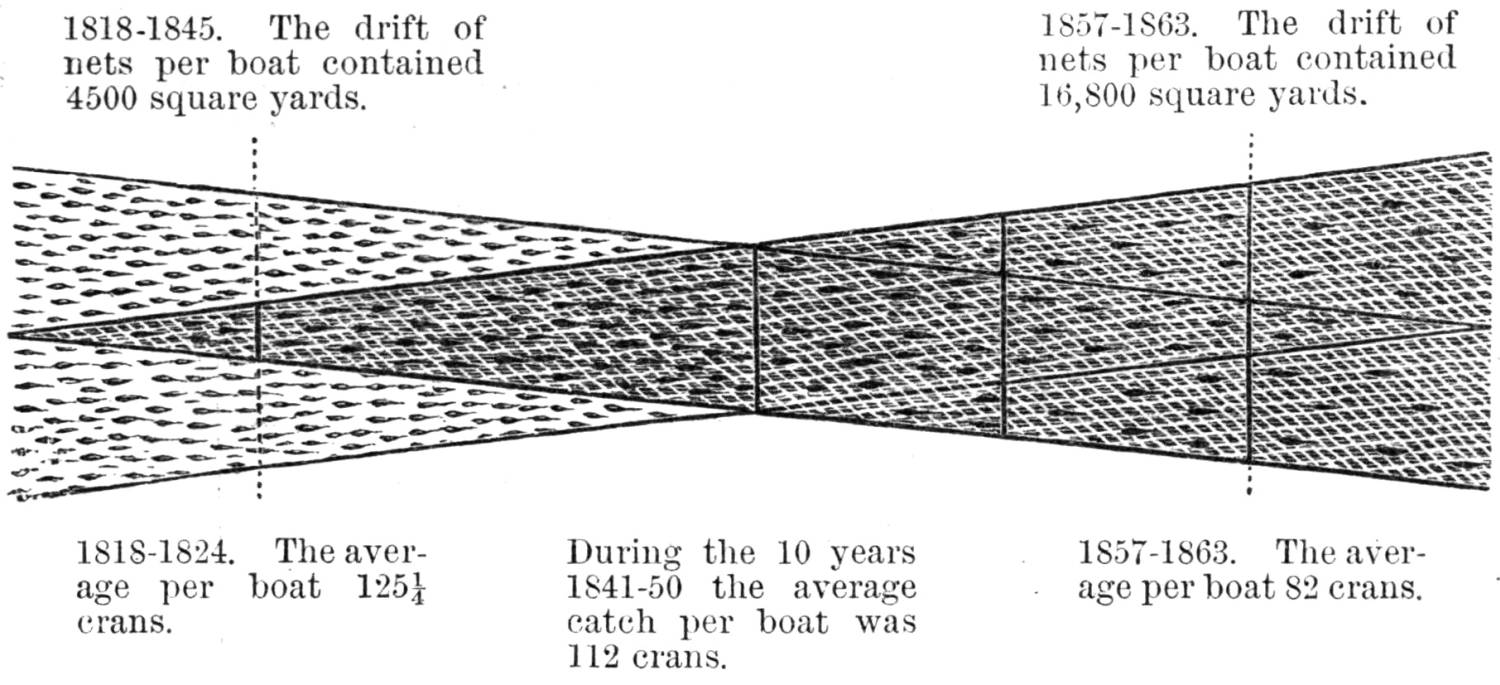
The text reads:
Top row.
1818-1845. The drift of nets per boat contained 4500 square yards. 1857-1863. The drift of nets per boat contained 16,800 square yards.
Bottom row.
1818-1824. The average per boat 125¼ crans. During the 10 years 1841-50 the average catch per boat was 112 crans. 1857-1863. The average per boat 82 crans.
Before concluding this chapter I wish to say a few words about a point of herring economy, which has been already alluded to in connection with the special commission appointed to inquire into the trawling system—viz. as to the natural enemies of the herring, the most ruthless of which are undoubtedly of the fish kind, and whose destructive power, some people assert, dwarfs into insignificance all that man can do against the fish:—“Consider,” say the commissioners, “the destruction of large herring by cod and ling alone. It is a very common thing to find a codfish with six or seven large herrings, of which not one has remained long enough to be digested, in his stomach. If, in order to be safe, we allow a codfish only two herrings per diem, and let him feed on herrings for only seven months in the year, then we have 420 herring as his allowance during that time; and fifty codfish will equal one fisherman in destructive power. But the quantity of cod and ling taken in 1861, and registered by the Fishery Board, was over 80,000 cwts. On an average thirty codfish go to one cwt. of dried fish. Hence, at least 2,400,000 will equal 48,000 fishermen. In other words, the cod and ling caught on the Scotch coasts in 1861, if they had been left in the water, would have caught as many herring as a number of fishermen equal to all those in Scotland, and six thousand more, in the same year; and as the cod and ling caught were certainly not one tithe part of those left behind, we may fairly estimate the destruction of herring by these voracious fish alone as at least ten times as great as that effected by all the fishermen put together.” As to only one of the numerous land enemies of the herring, the late Mr. Wilson, in his Tour round Scotland, calculated that the gannets or solan geese frequenting one island alone—St. Kilda—picked out of the water for their food 214 millions of herrings every summer! The shoals that can withstand these destructive agencies must indeed be vast, especially when taken in connection with the millions of herrings that are accidentally killed by the nets, and never brought ashore for food purposes. The work accomplished by these natural enemies of the herring, which has been going on during all time, does not however affect my argument, that by the concentration on one shoal of a thousand boats per annum, with an annually-increasing net-power, we both so weaken and frighten the shoal that it becomes in time unproductive. As the late Mr. Methuen said in one of his addresses: “We have been told that we are to have dominion over the fish of the sea, but dominion does not mean extermination.”
Although Scotland is the main seat of the herring-fishery, I should like to see statistics, similar to those collected in Scotland, taken at a few English ports for a period of years, in order that we might obtain additional data from which to arrive at a right conclusion as to the increase or decrease of the fishery for herring. It is possible to collect statistics of the cereal and root crops of the country; it was done for all Scotland during three seasons, and it was well and quickly accomplished. What can be done for the land may also, I think, be done for the sea. I believe the present Board for Scotland to be most useful in aiding the regulation of the fishery, and in collecting statistics of the catch; their functions, however, might be considerably extended, and elevated to a higher order of usefulness, especially as regards the various questions in connection with the natural history of the fish. The operations of the Board might likewise be extended for a few seasons to a dozen of the largest English fishing-ports, in order that we might obtain confirmation of what is so often rumoured, the falling off of our supplies of sea-food. There are various obvious abuses also in connection with the economy of our fisheries that ought to be remedied, and which an active Board could remedy and keep right; and a body of naturalists and economists might easily be kept up at a slight toll of say a guinea per boat.