Chapter III · FISH CULTURE. (continued 2)
Reading edition
The process of hatching was much more protracted than was anticipated; it was not till the 8th of June that the last of the eggs gave forth its little tenant. An account of the daily hatching was kept up till the time that 1000 of the eggs had arrived at maturity, but after that the hatching went on with such rapidity as to render it impossible to keep a correct record. Up to the 16th of June the trout had not been artificially fed, but for all that they looked healthy and grew fat. Mr. Ramsbottom computed that he had at least 3000 healthy salmon, rather a small percentage certainly to obtain out of the 30,000 eggs, but quite sufficient to solve the grand problem of whether or not it were possible to introduce the British salmon into Australian waters. The latest accounts tell us that the young parr are doing well, though they are not growing so fast as the trout.[4] The further progress of the experiment will be watched with great anxiety both at home and abroad. The Tasmanian Legislature have voted a further sum of £800 for the purpose of introducing another batch of ova; this sum will be augmented by £400 voted by the Victorian Acclimatisation Society; so that no means will be left untried to bring to a successful conclusion this great experiment—the ultimate result of which, I have no doubt, will be, that the salmon will become as valuable a fish in the waters of the great Australian Continent as it is in the waters of our own islands.
The naturalisation of fish, to which a brief reference has already been made, is a subject that is not very well understood; but so far as practical experience goes, I have seen nothing to prevent our breeding in England some of the most productive foreign kinds. Among the fishes of China, for instance, in addition to the golden carp—now quite common here, and bred in thousands in nearly every factory pond, and which is looked upon as simply an ornamental fish—there is the lo-in, or king of fish, which frequently measures seven feet in length, and weighs from fifty to two hundred pounds, the flesh being excellent; the lien-in-wang and the kan-in, almost as good, and even larger than the other. Then there is the li-in, the usual weight of which is about fifteen pounds, and is said to be of a much finer flavour than our European carp. There are many other choice fishes of exquisite flavour, which it is unnecessary to enumerate; but I have no doubt that, besides these natives of Chinese seas, there are numerous other fine fish that might be acclimatised in our rivers and firths. The seir fish of Ceylon may be named: it is a kind of scomberoid, and in shape and size is similar to the British salmon. We must not, however, build ourselves much on the acclimatisation of foreign fish, especially tropical fish, as—although fish can bear great extremes of temperature—it would be no easy matter to habituate them to our climate. Indeed some writers think it will be found impossible to habituate tropical fish, however valuable, to our cold waters, but the experiment is, I believe, being tried in France. The bass of Lake Wennern may also be mentioned as a suitable fish for British waters, as well as the ombre chevalier of the Lake of Geneva, a few of which latter are now, I believe, along with some other varieties, being tried in the river Thames. So great is the increasing interest of pisciculture becoming, that new ideas are being daily thrown out regarding it. A few months ago a writer in the Times suggested the introduction of a white fish from the Canadian lakes to our fresh waters:—“This fish (Coregonus albus), of the salmon family, is from three to four pounds weight, as delicious as a Dublin Bay haddock when fresh, and when barrelled considered a luxury in the Central and Southern States of America and the West Indies, bringing 50 per cent over the price of barrelled trout. Different from our fresh-water fish, it is a vegetarian, living on weeds and moss. It is a great article of food in the North-Western States of America and Canada, the exports of it being $464,479 in 1861 from the states on the lakes; but I have no return from Canada, which may be about one-half more, making a total of over $700,000, or £140,000 a year.”
The latest achievement in pisciculture has been the introduction to this part of Europe of “the Wels” (Silurus glanis), an interesting account of which lately appeared in the Field newspaper. Great expectations have been formed that this gigantic fish may be successfully reared in England. It is, I believe, the largest European fresh-water fish, commonly attaining a weight of from fifty to eighty pounds, and individuals have been found of the extraordinary size of four cwts.! Dr. Gunther, the eminent ichthyologist, remarks that this is the only foreign fish which it would be worth while to introduce into this country; and thinks that, in several of our lakes, particularly those in peat soil, it might be usefully placed.
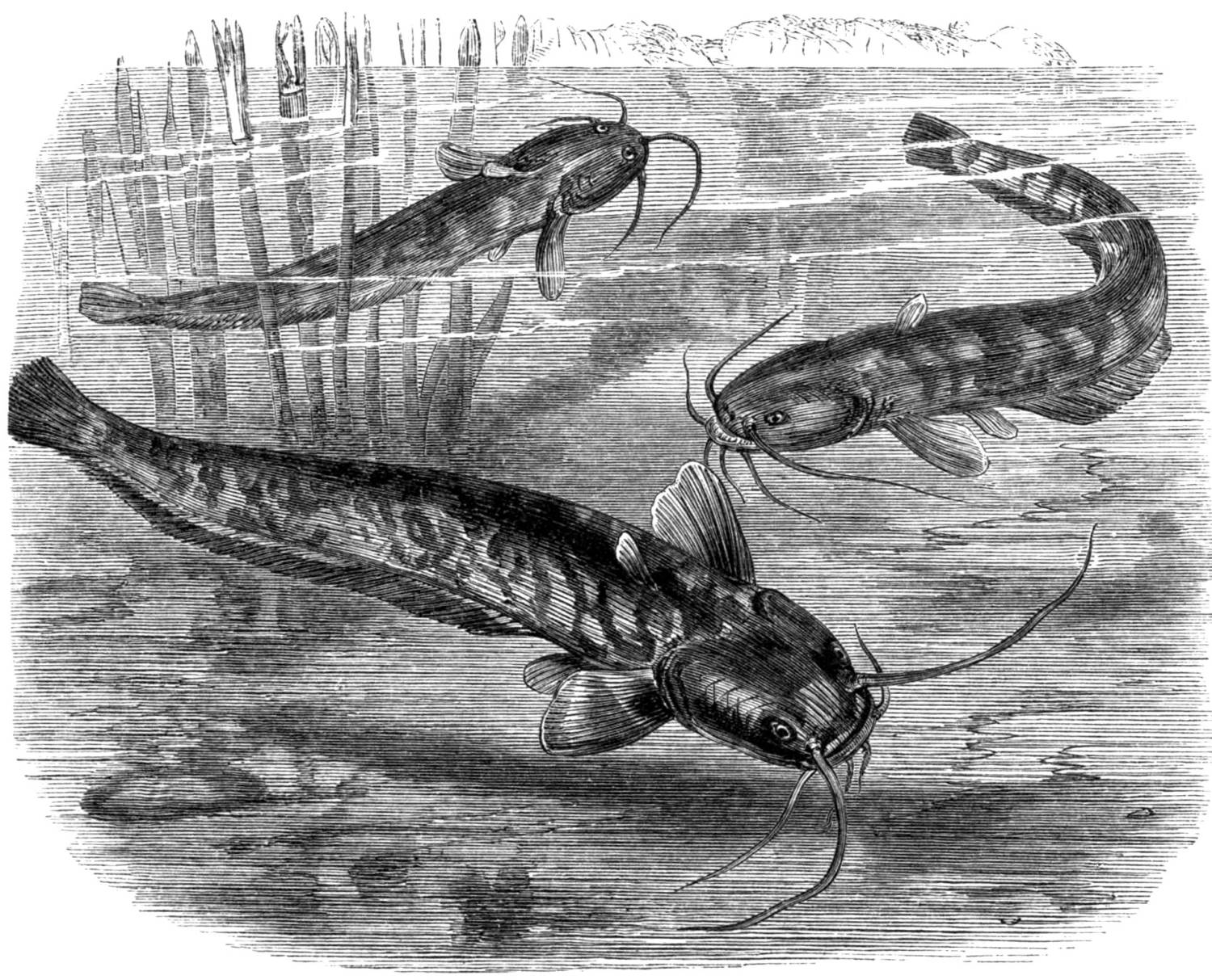
SILURUS GLANIS.
The following particulars regarding this new food fish have been printed by the Acclimatisation Society, to whom the greatest praise is due for its introduction:—Its appearance is not pleasant, the large flattened head having a capacious mouth, which is capable of seizing the largest kind of prey; so that if this fish be successfully propagated in our streams and lakes, the pike, the water-wolf of the British waters, will meet with more than its match. The habits of the Silurus glanis are said to be most ferocious, and its growth, provided there be a sufficient supply of food, very rapid. The body is less elongated than the eel, and there are, stretching from the head, long tapering barbels; the eyes are frog-like, and there are many other points of resemblance to the frog. The new fish is like the eel in its habits, being a wallowing fish, fond of burrowing in the mud, and hiding amongst the rotten roots of trees. There are dark charges made against some of the largest specimens of the Silurus glanis, in the stomachs of which it is reported that portions of human bodies have been found. However, this is probably an exaggeration. There can, however, be no doubt of the extraordinary appetite and fierceness of this fish. In the floods of the Danube the silurus finds plentiful prey in the multitude of frogs which pass into the river; but at other times, fish, small animals, worms, indeed anything which comes near, afford a supply of food; and there may be fear that, notwithstanding the valuable qualities of the silurus as a means of supply to our tables, it may more than balance its value in this way by the immense destruction of fish which is needed for its support. It is said that the silurus, when the prey is plentiful, will attain over fifty-six pounds in four years; and Englishmen who have tasted it report that in flavour it is superior to the salmon. Specimens of the wels have been brought alive from a distance of nearly two thousand miles to the station of the society at Twickenham by the exertions of Sir Stephen Lakeman and Mr. Lowe, a gentleman who takes a great interest in all questions of natural science. In all, fourteen of these young fish were brought from Kapochien, in Wallachia, where Sir Stephen Lakeman has an estate. The Argich river, which flows past there, abounds in these and other valuable fish, which are found more or less throughout central Europe and in Scandinavia. In the Danube and many of its tributaries the number is abundant; and in those wide waters the Silurus glanis is said to reach the enormous weight of three hundred pounds.