Chapter XI · THE CAMPAIGN OF PLATÆA.
Reading edition
H. viii. 131.
While these events were occurring in Middle Greece, Mardonius, in the far North, was preparing to move. It is said that before starting he despatched an envoy to make inquiries of the oracles of Northern Greece, at Lebadeia, Abæ, and Mount Ptoon, on what subject Herodotus is unable to say with certainty—on the circumstances of the time, he is inclined to think.
H. viii. 136.
A much more important envoy was despatched to Athens in the person of Alexander, the son of Amyntas, a member of the royal house of Macedonia, who was connected with the Persians by family ties, and with the Athenians by his having held for them the position of Proxenos, or consular agent, in his own country.
It may fairly be doubted whether Herodotus got the tale of Alexander’s mission from an Athenian or from a Macedonian source, or whether he combined information derived from both. H. viii. 136. The reference to the character of the Athenian people has, on the one hand, a strong Attic flavour about it, H. viii. 137 et seqq. while the knowledge of the Macedonian royal family displayed here and elsewhere in his work suggests that Herodotus acquired his information on the spot in the course of a visit to that country.177
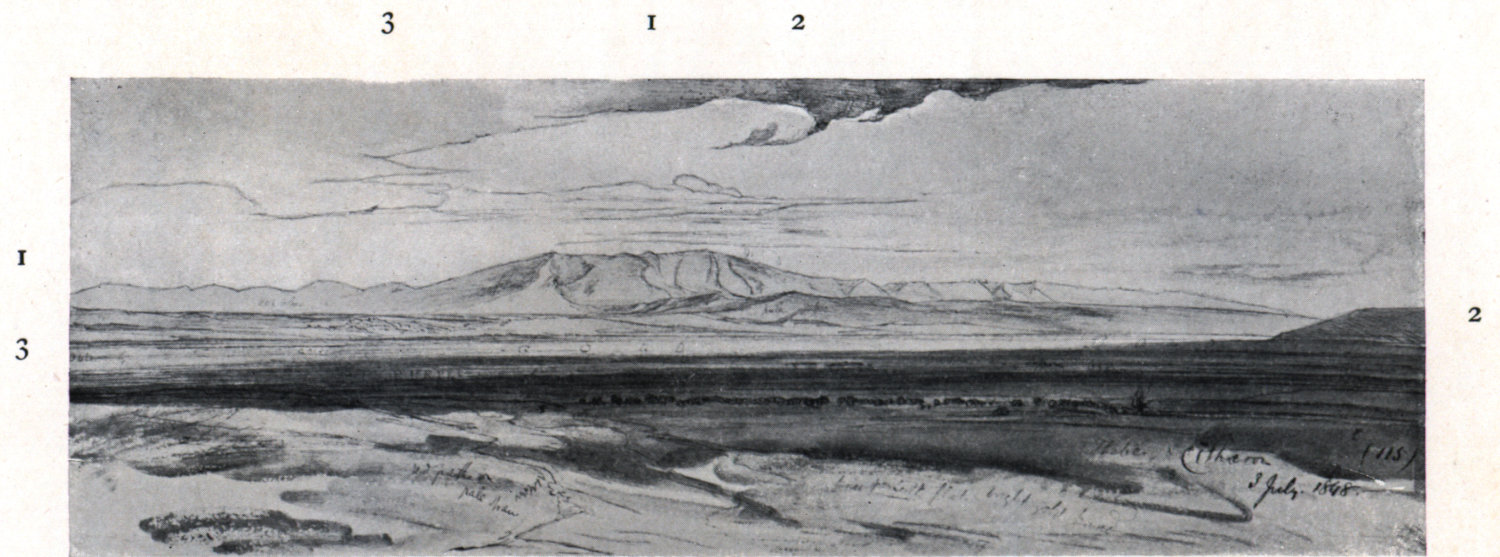
From Sketch by E. Lear.]
PLAIN OF THEBES AND MOUNT KITHAERON.
1. Kithæron (about 15 miles).
2. Ridge between Parasopia and Plain of Thebes.
3. Thebes.
[To face page 436.
This tale might, consequently, be derived from Macedonia. MARDONIUS AND ATHENS. This supposition is, however, rendered unlikely, owing to the excessively mistaken forecast which Alexander is described to have made of forthcoming events; and its Attic origin is the more probable. It is needless to say that that does not make for the veracity of a story whose evident intention is, like that of so many of the stories of this time, to bring into relief the self-denying patriotism of Athens. Yet, in spite of this, the story in itself is credible enough.
H. viii. 136.
Mardonius, so the tale runs, had made up his mind that if he could win over the Athenians to the Persian side he would thereby deprive the forces opposed to him of a people both numerous and brave, who were, moreover, mainly responsible for the disaster of the previous year. By this means he hoped to gain once more command of the sea, and expected to be infinitely superior to the enemy on land. This design, Herodotus thinks, was probably suggested to him by the oracles he had recently consulted.
The most remarkable reference, so far, is to the recovery of the command of the sea. No one could better estimate than Mardonius the full significance of the loss of that command. He must have known well that, unless it were recovered, he could at best obtain but a partial measure of success. Anything of the nature of a prolonged campaign to the southward of Bœotia would be, on the mere question of commissariat, impossible; and a brief campaign was not to be looked for. A foe which had been formidable with the courage of despair was likely to be more formidable when animated with the courage of a hope following despair. He had, no doubt, accumulated during the winter in Thessaly as large a commissariat as possible; but it is beyond conception that he could have greatly increased the necessarily limited supplies obtainable locally by transport along that route of four hundred miles whose use had only been contemplated a month or two before, and whose organization must necessarily have been of the most hurried description. He must win Athens over, or modify his plans.
To her accordingly was offered a free pardon for the past on the part of the Great King, the enjoyment of her existing lands, and any accession of territory she liked. Nor did Alexander the envoy fail to point out to the Athenians the contrast between such a prospect and their actual state as the people who had suffered most from the war.
H. viii. 141.
The news of Alexander’s visit to Athens, and of its object, created considerable alarm at Sparta. An embassy was despatched with all speed to counteract the possible ill-effects of his proposals. This embassy was actually present when Alexander spoke; for the latter had been kept waiting for several days before he had been allowed to bring his business before the assembly. The astute Athenians had made up their minds to use Alexander as a lever wherewith to move the sluggish Sparta to action. They do not seem to have had any intention whatever of taking Mardonius’ message into consideration. When Alexander had done speaking, the Spartan ambassadors addressed the assembly. They urged that it would be gross desertion on the part of the Athenians to renounce their share in a war which had been provoked by them, and by them alone. Turning to more material matters, they promised to alleviate the sufferings of the Athenians by undertaking the support of the non-effective part of the population.
The Athenian answer to Mardonius’ message was as firm as their determination: “So long as the sun runs his course in the heavens, we will never make terms with Xerxes.”
The answer to the Lacedæmonians as reported by Herodotus is, in sentiment and language alike, one of the finest passages in Greek prose.
“The fear of the Lacedæmonians lest we should make terms with the barbarians is, humanly speaking, very natural. And yet, knowing well, as you do, the spirit of Athens—that there is not in the wide world gold sufficient nor land so exceeding fair and good that we would accept it as the price of our own defection and of the enslavement of Hellas,—your fear, we think, does you but small credit. There are many powerful considerations which would forbid our so acting, even had we the will to do so. ATHENS AND SPARTA. First and foremost is the burning and destruction of the images and temples of the gods, which we, so far from making terms with the doers of these deeds, must of necessity avenge to the full. Secondly, there is that tie of blood and language which binds the Greek world together, our common share in our religious foundations and sacrifices, our community of manners—things which it would disgrace the Athenians to betray. Know this, if you did not before know it, that so long as a single Athenian survives, we will never make terms with Xerxes. We admire your kindly thought for us, in that, homeless as we are, you are willing to support our families. That kindness on your part is complete, but we will endure as we are, without burdening you.
“But now, these things being so, send forth your army with all speed, for we imagine that the invasion of our land by the barbarian will not be long deferred, so soon as he hears our message refusing compliance with his demands. Ere, then, he enters Attica, there is time for us to meet him in Bœotia.”
And so the Spartan ambassadors went home.
The Athenians evidently hoped that they would be able to save their land from the devastation of the previous year by persuading the allies to meet the enemy in Bœotia.
Their hopes were natural, but they were not destined to be fulfilled; and, if by Bœotia the Bœotian plain was meant, it was fortunate they remained unfulfilled.
On receipt of the answer from Athens Mardonius started on his march from Thessaly without delay. The feudal families of that region had thoroughly espoused the Persian cause, and their attitude, as well as that of the Bœotians, shows that the dominant section in the two great territories of the North had definitely made up their minds that, whatever the fate of the South might be, those regions were to become part of the Persian Empire. H. ix. 2. The Theban advice to Mardonius to remain in Bœotian territory and seek to conquer Greece by corrupting the leading men of its various states, shows that the medization of the ruling powers in Bœotia was not merely a passive attitude. One thing, however, Mardonius had made up his mind to do—to capture Athens a second time. Herodotus attributes the intention to mere vanity, but any one or all of three practical reasons made its acquisition of importance to him. Its recapture might induce Xerxes from his base on the Asian coast to attempt to regain the command of the sea. Its possession might bring pressure to bear on the Athenian authorities, and aid his design of detaching that people from the forces of resistance. Finally, in case he intended to advance on the Isthmus, the possession of the Acropolis would protect his left flank. He occupied Athens without striking a blow, the population having been removed, as in the previous year, to Salamis. Having occupied it, he reopened the negotiations which Alexander had attempted but a short time before. The result was the same. The spirit of the people was shown by their stoning to death Lykides, a member of the council, for merely proposing that the message should be communicated to the Assembly. Even his wife and children were murdered in a similar way by the Athenian women at Salamis.
H. ix. 6.
This second withdrawal to Salamis comes somewhat as a surprise in Herodotus’ narrative, for his account of the visit of the Spartan embassy to Athens at the time of Alexander’s presence there makes it appear that an understanding had been arrived at by which Athens might be spared a second invasion. The explanation comes later. “So long as the Athenians expected that an army would come from Peloponnese to help them, they remained in Attica.” But when the presence of the enemy in Bœotia was announced, and it became impossible to hope that help from the South could arrive in time, they retired to Salamis, as they had done the year before. They also despatched an embassy to Sparta to protest against the delay.
The strong appeal to patriotism made in their last communication to the Lacedæmonian embassy had failed to impress a people whose very institutions and training rendered them incapable of forming a real conception of the true spirit of a pan-Hellenic policy. Their stern discipline, moreover, was only too well calculated to render them mere tools of those set over them; and the delay in the present instance was probably due to the policy of an inner ring of the government at Sparta. The records of the time afford no certain clue to the motives lying behind that policy. ATHENIAN EMBASSY AT SPARTA. It is possible that it aimed at forcing the hand of the Athenians, and compelling them to take part in the defence of the Isthmus.
H. ix. 7.
Sparta having failed to listen to persuasion, Athens had recourse, as on previous occasions, to threats. The Spartans were told that if Athens found herself deserted, she would seek her salvation in her own way; it was more than hinted that Mardonius’ offer might become a question of practical politics. The Spartan excuse for delay was similar to that urged for the desertion of Thermopylæ, the celebration of a festival. The story of the reception of the ambassadors is one of the strangest in the strange history of this time. They bitterly reproached the Lacedæmonians with their conduct. They put the very worst construction on the Spartan policy, which had, they said, inflicted on patriotism an amount of suffering which it dare not have inflicted on uncertain fidelity. It is probable that the reproach was, in so far as the Spartan authorities were concerned, well deserved. From the language used by the Athenians it is evident that they believed that the Spartans had agreed to join in operations in Bœotia merely in order to keep Athens from medizing before the wall at the Isthmus was absolutely completed.178
That was the construction Athens put upon their conduct at this time; but it is probable that the more correct interpretation of their extraordinary policy is that by delaying they would be able to transfer the defence to the wall, and could, under any circumstances, rely on the devotion of Athens to the common cause.
Turning to the question of the future war policy, the Athenian ambassadors proposed that, as Bœotia had been lost, the enemy should be met in Attica; and they mentioned the Thriasian plain between Eleusis and Mount Ægaleos as admirably designed for a field of battle. [It must be remembered that this recommendation was made at a time when the Greeks were without experience of the effectiveness of the Persian cavalry on ground suited to its operations.]
The Ephors deferred their answer to the following day; from that to the next, and so on, until ten days had been wasted. They were waiting, says Herodotus, for the completion of the wall. They were, too, waiting, no doubt, until events in the North developed sufficiently to make it impossible for Athens to propose any other line of defence. This unsatisfactory state of things was brought to an end, so Herodotus says, by a warning addressed to the Ephors by Chileos, a Tegean, who had great influence in Sparta. He pointed out that if Athens joined the Persian, wall or no wall, the doors of the Peloponnese would be opened wide. Herodotus evidently supposed that until this moment such an idea had never occurred to the Spartan authorities, despite the experiences of Artemisium and Salamis in the previous year. In all probability, what really influenced these authorities was the fact that an able man, whose opinion they valued, was not so sure as they themselves were, that Athenian loyalty would endure much longer the severe test to which it was being put.
Their next act was a very strange one. Without saying a word to the ambassadors, they despatched under cover of night a force of five thousand Spartans, each of whom was accompanied by seven helots. There were, therefore, forty thousand in all. The number of light-armed helots is remarkable, certainly above the usual quota allotted to a force of five thousand heavy-armed.179
SECRET DESPATCH OF SPARTAN ARMY.
In constituting this force, the unusual number of light-armed in the army which it would have to meet would naturally be taken into consideration. The circumstances of population in the Spartan territories, moreover, were such that any unusual increase in the numbers employed on any expedition would be supplied by the increase in this branch of the service. The commander of this large force was Pausanias. Kleombrotos had been in command at the Isthmus in the previous year, but had died shortly after bringing back his army thence.180 It must have been prepared for departure for some time past No such force could start on short notice.181
The ambassadors, knowing nothing of this sudden march, and weary of the continual procrastination, were prepared to leave Sparta on the following morning. Before the deception was discovered the Athenian delegates actually stated that, in consequence of Sparta’s attitude, Athens would make terms with Persia, and, more than that, would accompany the Persians in their invasion. Truly the Spartan government policy had very nearly brought Greece to ruin.
The surprise of the indignant envoys may then be imagined when they were told in answer by the Ephors that they had every reason to believe that their army was, by that time, at Orestheion on its march against “the strangers,” as they called the barbarians. Orestheion was in the small plain of Asea, S.S.E. of the Arcadian plain, where one of the great roads from Sparta northward met the main road coming from Messenia to the Arcadian plain. The fact that they took this route is interesting, because it almost certainly indicates that they wished to avoid Argos, from which, as will be seen, a certain amount of trouble was to be expected.
Thus the truth came out; and the envoys started without delay in pursuit of this phantom army, accompanied by five thousand picked hoplites of the Periœki.
The truth about the attitude of Argos at this time is rendered uncertain by the fact that, after the war was over, the patriot Greeks regarded not merely those races which had medized, but also those who had not taken part with them, as having been enemies of their fatherland. That of itself would give rise to a number of traditions of doubtful credibility with respect to the attitude of such neutrals. Nevertheless, the attitude of Argos was highly suspicious, and there is no doubt that it was firmly believed in after-time that she had had traitorous relations with Persia.
H. ix. 12.
Herodotus asserts that the Argives sent a messenger about this time to Mardonius, who was in Athens, saying that they were unable to carry out the promise that they had made to him to stop the Spartan army on its march northwards. This tale is to a certain extent supported by the fact that the Spartans, instead of adopting the shorter route north by the Thyreatic plain and Argos, adopted the longer one indicated by the mention of Orestheion. Argos was, by its strategical position, ever a serious obstacle to Sparta’s communication with the north.
KITHÆRON AND PARNES.
Mardonius had, up to this time, refrained from damaging Athens and Attica, in the hope that the Athenians would change their minds, and accept his proposals; but, failing to persuade them to do so, and hearing of the advance of this army to the Isthmus, he set fire to Athens, and began to withdraw to Bœotia; “because,” says Herodotus, “Attica was not a country for cavalry, and if he were defeated in an engagement his only line of retreat was through strait places, so that a few men could stop him.” He determined, therefore, to retreat, and make Thebes his base of operations, as lying in a region eminently adapted to the use of cavalry. His evident fear was lest the Greek forces should work up through the Megarid and seize the difficult passes of the Kithæron-Parnes range in his rear.
As this range is of great importance in the campaign which was at this time about to open, it may be well to describe its nature, and to enumerate the passes by which it is pierced. It was regarded by the Greeks as an effective and important line of defence; and the difficulties which it presented to various armies which had occasion to traverse or to attempt to traverse it in the warfare of the fifth and fourth centuries before Christ, show that their estimate of its defensive possibilities was not a mistaken one. As its name implies, it is in reality composed of two short ranges, Kithæron on the west, and Parnes on the east. These are connected by an upland country known to the ancients by the name of Panakton, whose approaches on either side are, from a military point of view, of a very difficult character. The chain as a whole may be said to form a continuous barrier stretching from the head of the gulf of Corinth to the southern part of the Euripus. Both Kithæron and Parnes are sharply-edged, steep-sided ridges, whose highest points rise to a height of four thousand five hundred feet above sea-level, while the general elevation of each chain is about three thousand feet. Though not, as will be seen, of any great height, they offer comparatively few passages. There are six points at which the range may be traversed. Of these the western series, four in number, are of importance in reference to the battle of Platæa itself, while the two eastern passes afford alternative routes for an army retreating, like that of Mardonius, from Athens to Thebes.
At the extreme west of the range, where it sinks with sudden abruptness into the gulf of Corinth, it is turned rather than traversed by what is little better than a mountain track, which led from the Bœotian port of Kreusis to the Megarean town of Ægosthena. From Ægosthena a road led southwards to Pagæ, and so round the western bastions of Mount Geraneia to the Isthmus. It was also quite possible to reach Megara by a branch of this route.
Cf. Xen. Hell. v. 4; vi. 4.
The difficulties of this pass are such that it was rarely used for military purposes, and it seems to have played no part whatever in the operations of 479.
The second pass is that which the road from Platæa to Megara formerly traversed. It crosses Kithæron a little more than a mile eastward of Platæa, entering a deep valley which runs into the chain from the north, and ascending steeply from the head of the valley to the summit of a col in the ridge. Its character forbids the supposition that it can ever have been used for wheeled vehicles, and its importance must have been mainly due to the fact that it is the only one of this series of passes, with the exception of the track by Ægosthena, by which land communication between Northern Greece and the Peloponnese could be maintained without entering Attic territory. The road south of it, towards Megara, traverses the troublesome hill region of the Northern Megarid.182 The fact that Platæa practically commanded the northern end of this pass rendered the town one of the most important strategic positions in Greece, both in the fifth and in the fourth centuries. It will be hereafter seen that this pass must have played an important part in the operations of the Greek army at Platæa.
The third pass is one by which the road from Platæa to Athens crossed the range. It is little more than a mile to the east of that last mentioned. Remains of the road are visible on the north side, entering a somewhat broad valley running into the hills. It must have always been an easy pass, and the ancient wheel-ruts worn in the rock show that it was used by wheeled vehicles.183 PASSES BETWEEN ATTICA AND BŒOTIA. The road, after traversing it, turned east, and joined, near Eleutheræ, the road from Thebes to Eleusis by way of the pass of Dryoskephalæ. This pass also played an important part in the operations at Platæa.
The fourth pass was well known under its Attic name of Dryoskephalæ, and though not traversed by the direct road between Thebes and Athens, must have been largely used by those going from one place to the other, owing to the route by way of it being more easy than the direct road by Phyle. From the Bœotian side, near the site of the ancient Erythræ, the ascent is steep; it must have always been necessary to make it by a series of zigzags. The summit once reached, the descent is gradual, down a long stream-valley which abuts on a small plain of Attica beneath the fortress of Eleutheræ. As a pass, it was probably always more difficult than that on the Platæa-Athens road, but as the route from Thebes through it was more direct, it became the most used of the passes of Kithæron, and seems to have been the only one which had a special name in ancient times. The road through it was continued southward through a not very difficult country, as country goes in Greece, to the Thriasian plain and Eleusis, passing by or very near the fortress of Œne, whose importance must have been due to its position with reference to this road. Near Eleusis it joined the Sacred Way to Athens. Of the importance of this pass at the time of the battle of Platæa it is hardly necessary to speak.
The fifth of the series of passes is that on the direct road between Thebes and Athens. After ascending from the Bœotian plain to the plateau of Panakton, it traverses the upland pastures of that region, and enters a difficult country, where it was commanded by the important Attic fortress of Phyle. Thence it reaches the head of the Athenian plain. Mardonius might certainly have made use of this route for his retreat. He preferred, however, the more roundabout way through the sixth pass. It may have been, on the whole, an easier route. Furthermore, Mardonius, who seems to have been more apprehensive than he need at this moment have been that his retreat might be cut off, evidently thought that the route furthest from the Greek lines of advance would be safest.
The sixth pass leads from the plain of Athens into the lower basin of the Asopos. It was commanded near its summit by that fortress of Dekeleia which was destined to become so famous in the latter part of the Peloponnesian war. After passing Dekeleia, it was possible, instead of continuing along the road due north, to diverge to the left and follow a stream-valley to Tanagra. From Tanagra there must always have been a good, though not absolutely direct, road to Thebes, and also an easy passage up the Asopos valley.
H. ix. 14.
Herodotus, after describing Mardonius’ preparations for leaving Athens, says that when already on his way it was reported to him that a body of a thousand Lacedæmonians had been pushed forward to Megara. On hearing this, he wheeled about, and led his army as far as Megara, while his cavalry overran the whole of the Megarid. Herodotus’ intention in mentioning the incident is made sufficiently clear by the words which follow: H. ix. 14, ad fin. “This is the furthest point west in Europe which the Persian army reached.” Paus. i. 44, 4. It is to this expedition that a tradition mentioned by Pausanias must be referred—a tradition which preserved the record of the advance of the Medes to Pagæ.
There is no reason to doubt that the Persian raid into the Megarid is an historical fact, recorded by Herodotus and preserved in this chance tradition. It is not, however, at all likely that it was made by the whole Persian army, or that it was made at the time Herodotus mentions. His object in relating the story is plainly indicated, and in his desire to make his main point, he has probably not been over careful as to exactness in date.
If Mardonius wished, as is represented by the historian, to secure his safe passage to Bœotia, he would hardly have turned back with all his force. Had he done so, his natural line of withdrawal would have been by Dryoskephalæ. MARDONIS RETREATS TO BŒOTIA. The raid into Megara seems to have been a cavalry reconnaissance, whose object was to discover what the Greeks were doing at the Isthmus, and, moreover, it was probably made several days at least before the time indicated by Herodotus.
H. viii. 15.
The actual line of retreat Herodotus describes with some detail. He first went to Dekeleia, whence guides despatched by the Bœotarchs conducted him to Sphendale, and so to Tanagra. From thence he made his way up the Asopos valley to Skolos, where he formed a stockaded camp.184
It is impossible to arrive at any real comprehension of the history of this stage of the war without deducing from the action of Mardonius the nature of the designs, both political and strategical, which led him to adopt the course of action which he did.
It is evident, in the first place, that he had given up all idea of an attack on the fortifications of the Isthmus. It is also evident that he had recognized from the first that the only possibility offered him of an attack on that position was in the event of his winning over Athens to his side. If he could not do so, he would be liable to have his communications cut at any moment in the very difficult region of the Megarid. The negotiations with Athens had conspicuously failed. It would be absurd to suppose that he was not prepared for such an eventuality even before he started for Thessaly; he may be conceived even to have recognized that, after the events of the previous year, the probability of success in the negotiation was remote.185 If this be the case, it is to be concluded that he had some alternative design in his mind, which he intended to carry out in case the first miscarried. The very circumstances under which the history of the time was written forbade the possibility of the nature of that design becoming known to after-ages, and the only surviving indications of what he planned are afforded by what he did.
It is amply proved in the Greek historians that the disaster of the previous year had left the ruling powers of the north just as loyal to Persian interests as they had been before Salamis. If anything, their loyalty had increased. Their contingents were with Mardonius. They had practically staked their all on his success; and only his presence could save them from the severe retaliation which the patriotic Greeks might be expected to inflict on those who had joined the enemies of their country. If Mardonius’ strategy at this time be any indication of his policy, that policy aimed at the establishment of a new Persian frontier at the Kithæron-Parnes line, with Thessaly, Phocis, and Bœotia in a similar position to the vassal states of Thrace and Macedonia.
His strategical plan was well based. The Kithæron-Parnes line offered a much easier defence against an assailant from the south than against one from the north, because the continuous valleys of the Œroë and Asopos formed a natural highway running lengthwise along the chain, such a highway as was conspicuous by its absence on the southern side. By this highway an army could be moved rapidly from one point to the other, according to the locality of the pass through which the attack might be delivered. CHANGE IN GREEK PLAN OF CAMPAIGN. On the south no such facilities existed, and an army on the north which made a feint at one of the eastern passes, and so attracted an enemy to its defence, could move to one of the western passes, and get through it long before the defender could move from his original defensive position.186
Thus Mardonius was well placed. He had a fortified base at Thebes, in a rich country, and a country well adapted to his strength in cavalry; and he had a fortified camp on the strategic line of highway which the Asopos valley afforded.
It is little short of a calamity for the history of this time that Herodotus has omitted to account for the absolute change in the Greek plan of campaign which is indicated by the advance of the army from the Isthmus into Bœotia. It had manifestly been the intention of the Spartans up to the very last moment to await attack at the Isthmus; it may be certain that the other Peloponnesian States entertained this design still more emphatically. And yet, in spite of this, they follow the enemy to Bœotia, and shortly after their arrival there develop an offensive movement of a most unmistakable character. Athens must have been mainly responsible for this remarkable change; but what were the motives of Athens? It was too late to save Attica. The mischief there had been done. And yet these Greeks were persuaded to develop a policy whose boldness is in conspicuous contrast to the purely defensive attitude they had hitherto adopted in all their land operations, and to inaugurate the new policy in a region peculiarly favourable to that arm of the enemy’s force from which they had most to fear and against which they had nothing to match. It can only have been carried out under the impetus of some great and well-grounded alarm; and in view of the silence of the ancient historian, the only conclusion that it is possible to draw from the acts of either side is that the Greeks, through the Athenians, suspected the existence of a design to establish a new Persian frontier at Kithæron.
It was consequently necessary to take the offensive and the risk it involved, unless they were ready to submit to the existence of the Persian terror at their very doors. Whether its continued existence would have been possible without the regaining of the command of the sea is another question; but, considering the attitude of Bœotia and Thessaly, it would be unsafe to assert the impossibility. In any case, the Greeks regarded those possibilities from so near a perspective, that their field of vision must have been contracted to the one dangerous alternative.
H. ix. 19.
The Lacedæmonian army, which was last heard of at Orestheion in Arcadia, arrived at the Isthmus and encamped there. The patriotic States of Peloponnese, seeing the Spartans on the move, despatched their contingents thither also, or, rather, the complements of their contingents, since it must be concluded that the wall had not been without any defenders up to this time. From the Isthmus the whole army moved forward to Eleusis, where the Athenian land-army from Salamis joined it. The whole combined force then moved north along the road to Dryoskephalæ.187
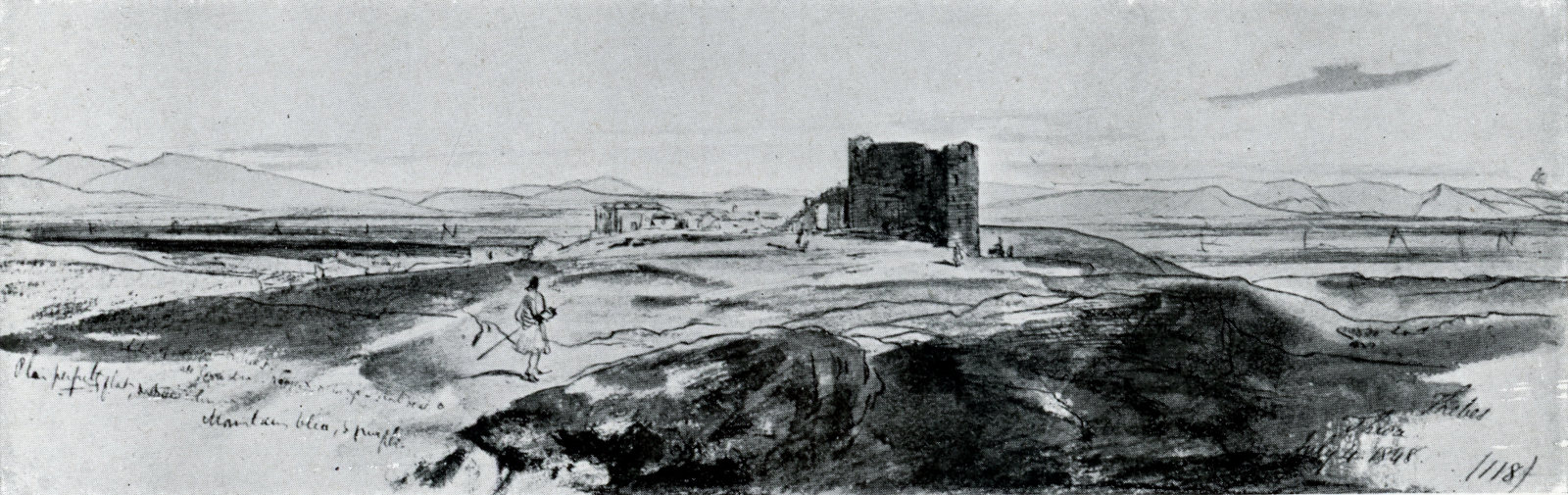
From Sketch by E. Lear.]
PLAIN OF KAPAIS, FROM THEBES.
[To face page 452.
Shortly after passing the summit of the pass the Greek army would arrive in full view of the Bœotian plain, which from that elevated place appears more flat than it really is. The comparative monotony of the scenery of the plain itself is disguised by distance; and that which strikes the eye most forcibly is the contrast between this huge extent of comparatively low level ground, and the magnificent frame of mountains which forms the horizon on every side. To the north-west, Helicon descends in a long and highly serrated slope, behind which the hump of Parnassus in the far distance towers to a great height. LIMITS OF THE FIELD OF OPERATIONS. The northern horizon is bounded by that southern extension of the Œta range which lies between Kopais and the North Euripus, though Kopais, or what was once Kopais, is out of sight behind a comparatively low ridge in the neighbourhood of Thebes. To the north-east, Mount Ptoon is visible; and over its lower ridge the great cliffs of Mount Mekistos, on the Eubœan side of the Euripus, are just discernible. Away to the east, though hidden from sight at the top of the pass by a high bastion of Kithæron, the truncated cone of Mount Dirphys in Mid-Eubœa is the most prominent object.
There are but few extensive views in Greece comparable with it, and perhaps only one which excels it, that from Thaumaki on the road from Lamia northward, when the great plain of Thessaly, with its fringing ranges, is spread out like a sea before the spectator.
From the pass the Greeks descended to a position which extended across the road by which they had come, at the point at which it debouched fully on the plain. Before describing this position in detail it may be well to give a brief general description of the ground on which the prolonged struggle took place.
Its limits may be clearly defined. To the south its boundary is the limit of cultivation, where the rocky foot of Kithæron begins to rise from the rounded ridges of the plain. Outside this line the ground was impracticable for cavalry operations, and, though both armies at different times traversed this ground, no fighting took place beyond the line, or even in its neighbourhood. On the north, the limits are equally well defined by the river Asopos, although again in this case the major part of the Persian army was, during nearly the whole of the operations, to the north of the stream. The only fighting, however, which can possibly have taken place beyond it occurred during the assault on the Persian camp after the battle. To the east the limit may be taken as the line of the Thebes-Athens road; while to the west an imaginary line running due north from the town of Platæa to the Asopos will well define its utmost extent in that direction. The area of this field is about fifteen square miles, the dimensions from north to south and from east to west being about three and a half and four miles respectively.
In respect to the lie of its surface it may be divided into two parts. The southern portion of it along the foot of Kithæron consists of ridges running south and north, divided from one another by stream-valleys,—spurs, in fact, of the great mountain, but of no great height.188 Of these the easternmost is much loftier than the others. On the westernmost is the site of the town of Platæa.
North of these ridges a distinctly marked line of depression extends across the field from east to west. It runs up the course of a brook,189 in a south-westerly direction, to the site of the modern Kriekouki. After reaching the bottom of that village it turns at right angles and goes north-west in a line parallel to, and immediately north of, the watershed between the basins of the Asopos and Œroë, reaching the flat alluvial plain north of Platæa, just west of the springs of Apotripi, the traditional Gargaphia.
This depression is of considerable importance in relation to the general scheme of the operations of the Greek army on the field:—
(a) Because it forms the dividing line between the first and intended third positions and the second position, that is to say, between the positions which were chiefly remarkable for their defensive character, and that position which was assumed with the manifest intention of taking a vigorous offensive.
(b) Because in it the Greek army, after marching from the first position, took up its order before occupying the second position.
(c) Because in it the two combats which ultimately decided the battle were fought.
The plain which has been mentioned in reference to the western extremity of this depression extends without any break from the north end of the site of the town of Platæa to the Asopos river. The plain is the only flat land in the whole battle-field.
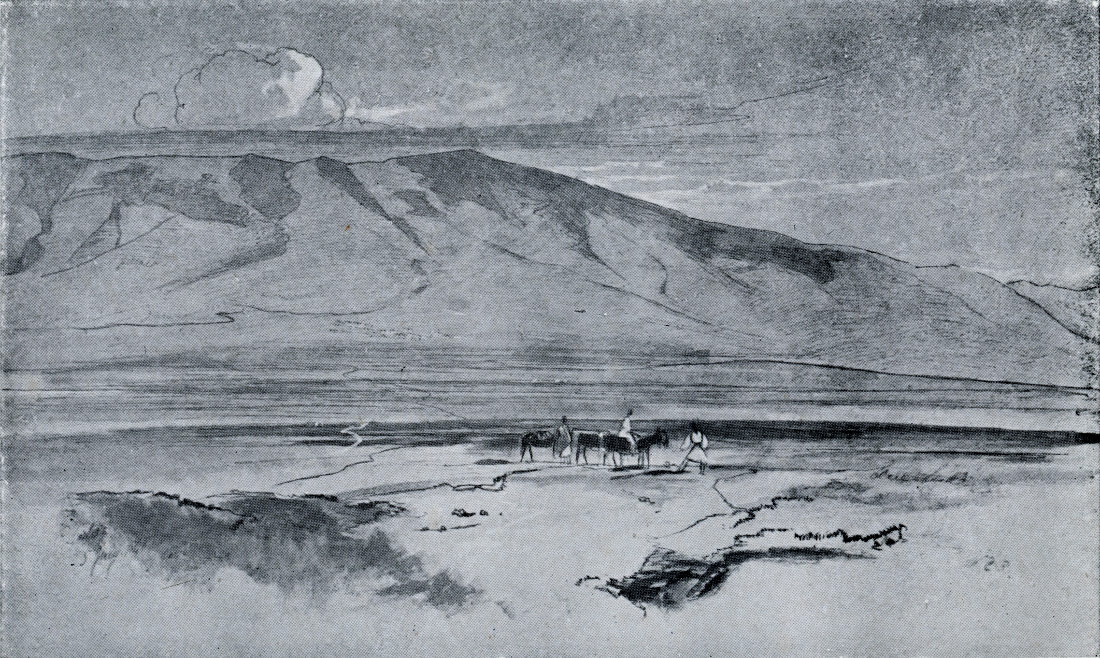
From Sketch by E. Lear.]
PLAIN OF PLATÆA AND KITHÆRON.
[To face page 454.
DESCRIPTION OF THE FIELD.
North of the depression rise three ridges or hills.190 These ridges are separated from one another by two deep stream-valleys.191 The slope of these ridges northward toward the Asopos is longer and more gradual than on the south.
In general appearance the plain of Bœotia at this part resembles the Wantage downs in such parts as the ploughland predominates over the pasture. The great grey wall of Kithæron to the south rises into the air, and dwarfs into insignificance the inequalities of the plain, rendering, moreover, all horizontal distances most deceptive to the eye.
It may be assumed with absolute confidence that the accidents of the terrain in this region of Greece are for all practical purposes identical with those which existed more than two thousand years ago. There is no evidence of great surface-changes such as are brought about in other parts of Greece by the torrents which sweep down in violence from the mountains. In Upper Parasopia such torrents do not exist. Their non-existence can hardly be ascribed to inferior rainfall, for the Bœotian climate is not more dry than that of other parts of Greece. The probable cause is the peculiarly porous nature of the soil, and, presumably, of the underlying rock, which absorbs a large amount of water which would in other parts of Greece escape along the surface.192
In the flat plain between Platæa and the Asopos river, the courses of the various streams which traverse it are without doubt liable to alterations, but the characteristics of the stream-beds as to width, depth, and so forth, are undoubtedly the same as they were in the past.
The passes which actually debouch upon the field are, as has been already mentioned, three in number. It is remarkable that in Herodotus’ account of the battle that of Dryoskephalæ is the only one mentioned. It is, however, quite clear from Herodotus that, while the Greeks were in the second position on the battle-field, the Dryoskephalæ pass, and also that on the Platæa-Athens road, were both held by the Persian cavalry, and the supplies of the army during the time must have come through the pass on the Platæa-Megara road.193
HERODOTUS’ ACCOUNT OF PLATÆA.
Before entering upon the actual description of the battle itself, it may be well to say one word about the general character of the account of it which Herodotus has given to the world. Its length and elaboration are greater than that devoted by the author to the description of any other single act or scene in the history of his time. The historian had evidently expended extraordinary trouble in its preparation, and had done his utmost to arrive at all the facts and to relate them with accuracy. Any failure in the latter respect is owing either to the nature of his source or sources of information, or to a misapprehension of military details due to his want of special knowledge and experience. But whatever these defects may be, his narrative is by far the best of the accounts which have survived until the present day, a fact which is capable of proof by reason of the extraordinary manner in which, in spite of certain obscurities, it harmonizes with the present state of the region wherein the incidents occurred. There can be no reasonable doubt that he visited the field, and that, where he gives topographical details, they are the result of autopsy. Some of the difficulties which arise with reference to his description are more probably due to want of knowledge on the part of the modern than on the part of the ancient historian. Some, again, are attributable to that natural difficulty, which must ever arise, when any one attempts to follow exactly the description, however clear, of a complicated piece of ground as seen by the eyes of another man; and this difficulty is not decreased when the language employed does not possess that wealth of technical vocabulary which is at the service of the writer of the present day. It is so easy to fail to realize these difficulties under which Herodotus wrote. Official records were probably non-existent: written records of any kind, if existent, were probably of the most meagre kind; and the historian must have been obliged to have recourse to the narratives of those who were actually present at the operations. It must have cost an infinite amount of trouble to collect the information, and to piece together the different narratives; and yet, despite the immense difficulty of dealing with evidence of this kind, Herodotus has left an account of the battle which is not merely of interest and value from the point of view of general history, but also in the narrower field of exclusively military history.
Platæa was no ordinary engagement. It was really a campaign of several weeks, conducted within an extraordinarily limited field of operations. During that brief time, and within that small area, the strength and weakness of East and West matched in battle against one another were exemplified in a most striking way. The lesson it taught was so tremendous, so wide in application, that men could not grasp it. Perhaps it was as well for the world that they did not.
H. ix. 19.
The Greeks having descended from the summit of the pass of Dryoskephalæ towards the Bœotian plain, discovered that the Persians were encamped upon the Asopos, and took up their position “on the foothills of Kithæron.”194 H. ix. 22. Herodotus refers later to this position as having been at Erythræ. The site of that small town has been somewhat in dispute; it appears to have been in the hollow on the north side of the mountain into which the road from Dryoskephalæ descends.195
FIRST POSITION OF THE GREEKS.
The position taken up by the Greeks is recognizable without difficulty at the present day. Their right was on the high bastion of Kithæron, east of Erythræ, stationed for the most part, in all probability, in the neighbourhood of the old fort which here overhangs the road. Their centre was on the low ground, à cheval of the Thebes road. Their left was probably on the slopes of the high ridge (ridge 1 in the map) to the east of the site of Kriekouki. The numbers present at this time are not known. All that is known is that, after considerable reinforcements had come in, from a hundred thousand to a hundred and ten thousand Greeks were in the field. It is not therefore possible to say what would be likely to be the length of the Greek front in this first position.
The strength of the position would be great. Their right and left wings would be unassailable by cavalry, and only assailable by infantry at a great disadvantage. Only on the flat ground in front of Erythræ would it be possible for the Persian cavalry to attack them, and this only along the right or east portion of the low ground, since the left or west portion of their centre would be protected by deep and precipitous stream-gullies which are there at this day, and must have existed in a similar form at the time of the battle. ATTACK BY PERSIAN CAVALRY. The comparatively advanced position of their centre in front of Erythræ, instead of on the difficult ground south of its site, was probably due to their being largely dependent on the wells of the little town for their supply of water.
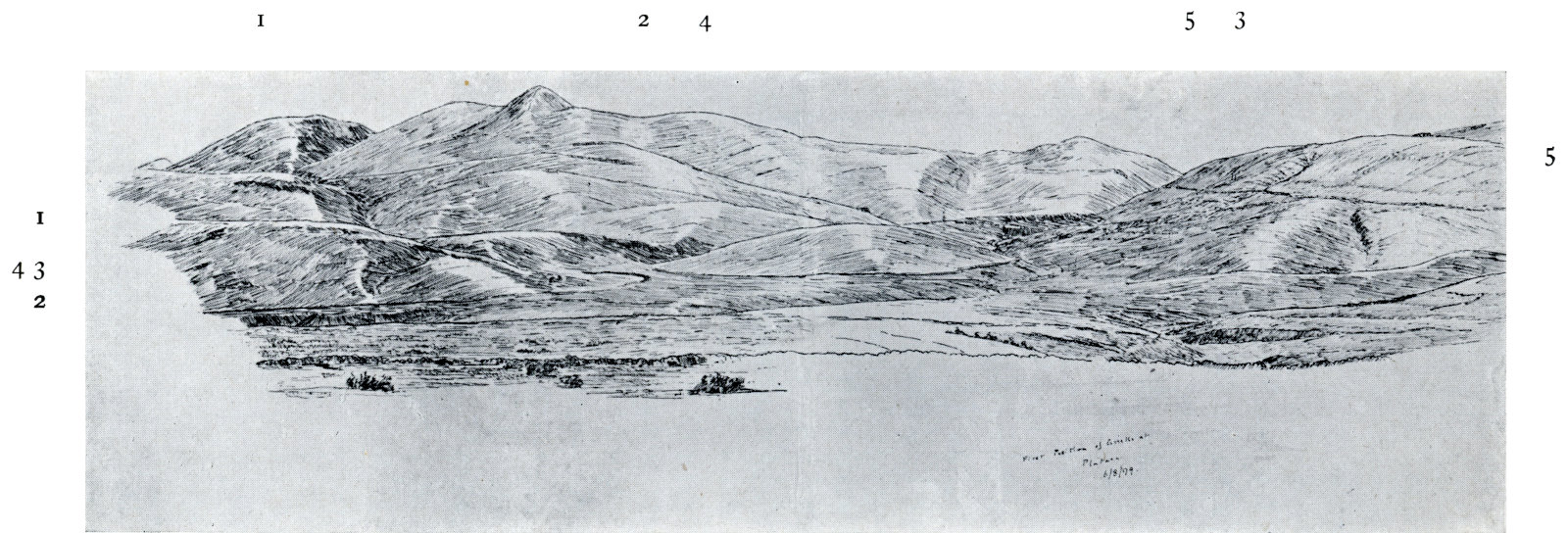
THE FIRST POSITION AT PLATÆA.
1. Greek right.
2. Greek centre.
3. Greek left.
4. Site of Erythræ.
5. Pass of Dryoskephalæ.
[To face page 460.
H. ix. 20.
Mardonius, seeing that the Greeks had taken up this position, and that they showed no disposition to come down into the plain, sent against them the whole of his cavalry, under the command of Masistios, a Persian of high reputation. On getting near the Greeks it did not attack in a body,—the deep stream courses opposite the Greek left centre would make that difficult,—but, owing evidently to the narrowness of the front assailable, attacked in squadrons, and did a great deal of damage. The Megareans were drawn up at the most assailable point, and were hard pressed by an assault which evidently aimed at cutting the Greek army in two, and seizing their direct line of retreat by way of the pass. The narrowness of the assailable front appears emphatically in Herodotus’ account of the message the Megareans despatched for assistance. They speak of themselves as being single-handed in the fight, and beg to be relieved from their position. They threaten even that, unless help be sent, they will be obliged to leave their post. Pausanias, who led the great Spartan contingent and commanded the whole army, had some difficulty in finding volunteers for the post of danger. Finally the Athenian picked troops, under the command of Olympiodoros, accompanied by a body of bowmen, undertook to occupy the critical position. Aristides, who commanded the Athenian contingent, would see clearly the pressing nature of the danger. H. ix. 22. The Persians continued their attack by squadrons until their leader, Masistios, had his horse wounded by an arrow. It reared and threw him, close, apparently, to the Greek line of battle; for the Athenians immediately rushed towards him. He was killed, and his horse was captured. The Persians had not noticed the fall of their commander, and it was not until they had retired and had come to a stand-still that the loss was discovered. With shouts of encouragement to one another, the horsemen turned upon the Greeks, eager to gain possession of their leader’s body. They came no longer in squadrons, but in what must have been one column of horse, many ranks in depth. The Athenians called on the rest of the army to aid them, but before the latter came up the attack fell. The Athenians, only three hundred in number, were pressed back from the place where Masistios lay; the fight was too unequal. But when the other Greeks came up the Persian horsemen retired and were obliged to leave the body in the hands of the enemy. After retreating a distance of two stades, they held a consultation, and decided that, having lost their general, the best thing they could do was to retire to the camp.
In this combat the Persian cavalry was evidently taught a severe lesson. They found out the mistake of attacking unshaken heavy infantry at close quarters, a fundamental error in tactics which they did not repeat again in the course of the battle. From this time forward the Persians used their cavalry to inflict damage on the immobile Greek force by assailing it with missiles from a distance, and by cutting its lines of communication. They had learnt their lesson: the Greeks had not.
It is evident that the latter drew a wholly mistaken conclusion from the results of the fight, H. ix. 25. and that their previous fear of the enemy’s cavalry gave place to an unwarranted confidence in their ability to face it on any ground. They were now prepared to carry out tactically that offensive movement which they had begun strategically by their advance into Bœotia. It would seem as if their original design had been to use the Dryoskephalæ-Thebes road as their line of advance, a design which was checked in part by the nervousness originally pervading the greater part of their army as to the result of a rencontre with the Persian cavalry, and still more by the fact that they could see that the fortified Persian camp was saddled, as it were, on their proposed line of advance. From Herodotus’ description it would appear as if that camp were on both sides of the Asopos river, and that the point at which the Thebes-Dryoskephalæ road crosses that river at the present day must have been well within its area.
MOVEMENT FROM THE FIRST POSITION.
It was, then, in consequence of their elation at the success which they had won over the Persian cavalry, and probably also in consequence of the decision of the Greek commanders to take the offensive along a line other than that of the direct route to Thebes, that the Greeks moved from the position which they had hitherto occupied. It was plain that in that position no decisive result could be obtained. The extreme importance of this movement makes it necessary that Herodotus’ description of it should be follow with the utmost care:—
H. ix. 25.
“After this they decided to go down towards Platæa. For the Platæan country seemed to them to be a much more suitable place for encampment than that about Erythræ. It was better supplied with water, and had other advantages. They determined therefore that they must move to that region and to the spring of Gargaphia, which is situated in it, and form a regular encampment. Taking up their arms, therefore, they went along the foot hills of Kithæron by Hysiæ to the Platæan country, and on arriving there they proceeded to take up their order by contingents near the spring of Gargaphia and the precinct of the hero Androkrates, along hills of no great height and level country.”
The Position of the Persian Camp.
Herodotus (ix. 15) describes the position of the camp as follows: Παρῆκε δὲ αὐτοῦ (Mardonius) τὸ στρατόπεδον ἀρξάμενον ἀπὸ Ἐρυθρέων παρὰ Ὑσίας, κατέτεινε δὲ ἐς τὴν Πλαταιίδα γῆν, παρὰ τὸν Ἀσωπὸν ποταμὸν τεταγμένον. Οὐ μέντοι τό γὲ τεῖχος τοσουτον ἐποιέετο, ἀλλ’ ὡς ἐπὶ δέκα σταδίους μάλιστά κῃ μέτωπον ἕκαστον.
Earlier in the same chapter he speaks of the Persian force as having arrived ἐς Σκῶλον, ἐν γῇ τῇ Θηβαίων.
I could not find any traces of the ruins of Skolos; Vide note on p. 449. but if the distance given in the passage of Pausanias (ix. 4, 3) already quoted is in any sense reliable, it lay four and a half miles east of the point where the Platæa-Thebes road crossed the Asopos; that is to say, about a mile and a half east of the Dryoskephalæ-Thebes road. Comparing this statement with Herodotus’ description of the position of the Persian army as stretching from Erythræ and Hysiæ, the conclusion which must be arrived at is that its encampment was on the low ground on either side of the Dryoskephalæ-Thebes road, and on the Asopos river.
The passage in Herodotus (ix. 31) πυθόμενοι τούς Ἓλληνας εἶναι ἐν Πλαταιῇσι, from the use of the word πυθόμενοι, would seem to indicate that the first phase of the second position of the Greeks was not in view of the Persian camp. If so, that camp was on the low ground, and did not extend southward to either of those heights called in the map the Long ridge and the Plateau.
At the risk of appearing to anticipate the evidence, it is necessary for the clear understanding of the somewhat complicated operations of this period of the battle, to state that the movement this indicated is not the complete movement to the second position, nor, consequently, is the position adopted the position finally taken up by the Greeks. That second position had three phases, of which this is the first.
It is possible to follow without difficulty this movement which Herodotus describes. It is evident that the Greek army first matched west along the south or upper part of the ridges196 which descend from Kithæron towards the plain. Their object was evidently to keep, in so far as possible, on the rocky hill slopes, where their march could not be imperilled or interrupted by cavalry attack. In this march they passed Hysiæ. The position of that small place is not, as has been already said, determinable with certainty; but it seems most probable that its site is to be looked for immediately above the village of Kriekouki, and, if so, it would lie almost on the line of march which Herodotus indicates.
The Site of Hysiæ.
Tradition gives the site of the modern Kriekouki as that of Hysiæ. Water being so important in this region, it is worthy of notice that, except in case of prolonged drought, Kriekouki is well supplied in this respect, which would render it likely that the site or its immediate neighbourhood would have been chosen for habitation in ancient times. As I have already indicated, I think Hysiæ stood just outside the area of the modern village, to the south of it, i.e. higher up the hillside. There is a mound there with a more or less circular enclosure at the top, quite close to the great bend of the loop-road above the Kriekouki. The enclosure may possibly mark the site of the foundations of an ancient φρούριον. Other remains I could not find. Hysiæ was at best but a little place, and, if it stood on that site, whatever remnants of it survived till modern times would inevitably be swept away for the building of the large village of Kriekouki, in whose walls, too, are stones which appear to have been taken from pre-existing buildings. This site accords with the little that is told us in ancient authors of the position of Hysiæ. It lies east of the line of road from Athens to Platæa, at a distance of something less than half a mile. To the traveller coming along the road from Eleutheræ it would therefore be, as Pausanias says (ix. 2, i), “a little to the right of the road.” It is also west of the site of Erythræ, as Herodotus (ix. 15) indicates Hysiæ to have been.
MOVEMENT TO THE SECOND POSITION.
After moving some distance westward along the foothills the Greek army must have turned in a north and north-westerly direction to reach the position which Herodotus describes. H. ix. 25. He mentions the spring of Gargaphia and the precinct of Androkrates197 as the two points defining the position, and indicates clearly what that position was, for the spring may be identified at the present day, and the precinct is referred to in Thucydides’ account of the escape of the two hundred and twelve from Platæa, in such a way that its site must lie somewhere within a comparatively small area of ground.
The Spring of Gargaphia.
The spring of Alopeki or Apotripi, at the head of the brook A 1, is pointed to by local tradition as the ancient Gargaphia. This spring does not give a very copious supply of water. I believe it does not always run dry in summer; but in August, 1899, after the long drought of that year, it was yielding no water whatever. The state of things in that month was such that the inhabitants of Kriekouki were absolutely dependent for water for themselves and their cattle on a group of springs lying east of Apotripi, distant from it about three-quarters of a mile, and forming the source of Stream A 4. These are the springs which Colonel Leake, rightly, as I firmly believe, identified with Gargaphia. The chief of these springs has, in modern times, been enclosed in a wall. What is quite certain is that one of these two groups is the Gargaphia.
Herodotus says (ix. 49) that the whole Greek army watered from the springs. As the battle took place in September, the greater yield of water from the eastern group of springs supports its identity as against Apotripi.
Herodotus also says (ix. 51) that the “Island” was ten stades from the spring.
Those who have visited the field since I was there in 1892 seem to be agreed that I was right in my identification of the “Island.”
The distance of the eastern springs from the “Island” is just about ten stade. Apotripi is about the same distance from it.
Herodotus says (ix. 52) that the spring was twenty stades from the Ἥραιον which, he says, is πρὸ τῆς πόλιος τῆς Πλαταιέων. The eastern springs are sixteen stades from the approximate position of that temple; Apotripi is but twelve stades off.
It will, I think, be seen that the evidence of Herodotus is in favour of the eastern springs.
The Precinct of the Hero Androkrates.
The evidence of Thucydides enables us to determine approximately the position of this Heroön. He says (iii. 24) that the two hundred and twelve who escaped made their way from Platæa
“along the road leading to Thebes, having on their right the hero-chapel of Androkrates ... and for six or seven stades the Platæans advanced along the Thebes road, and then, turning, went along the road leading to the mountain to Erythræ and Hysiæ.”
This can only mean that the Heroön was in the angle between the road to Thebes and the road to the mountains; and as these people only went about three-quarters of a mile along the Thebes road, it is evident that, if Thucydides be correct, the Heroön was to the right of the road and within three-quarters of a mile of Thebes. I have marked in the map the conjectural site of the building on the extremity of the last low ridge of the mountain before it sinks into the plain. There are at that point the remains of what has been an oblong building constructed of good squared blocks. I am almost certain that it is Hellenic work.
Mr. W. J. Woodhouse, in a recent number of the Journal of Hellenic Studies (Part I. 1898), dissents from my view as to the position of the Heroön of Androkrates.
His argument is as follows:—
(1) If the Heroön lay hard by the road, constituting a familiar landmark, Thucydides’ remark is pointless.
(2) There were two other roads from Platæa to Thebes, viz. those through Dryoskephalæ and the Pass on the Platæa-Athens road respectively.
(3) Plutarch places the Heroön near the ancient temple of Demeter.
Mr. Woodhouse accordingly suggests that the Heroön stood on the site of the church of St. John, on the Asopos ridge.
I would point out:—
(1) That Thucydides’ language [iii. 24] is not pointless, even if the Heroön be near “the road leading to Thebes,” inasmuch as he indicates a point near the road which the fugitives certainly passed before they turned to the right, and thus diminishes the comparative vagueness of the “six or seven stades” which follow. It does not seem unnatural that he should wish to make quite clear the fact that they passed the Heroön before they turned, i.e. that it lay within the angle through which they turned. I would also point out, that it is not the fact of the Heroön being on the right of the road, which Thucydides emphasizes, but it being on the right of the Platæans as they went along the road. The site of the church of St. John is eighteen stades from Platæa. Thucydides would hardly say that persons who only went “six or seven stades” along this road ever had that site upon their right hand.
(2) The alternative routes Mr. Woodhouse mentions are alternative routes from Platæa in much the same sense that the route by Bletchley is an alternative railway route from Oxford to London. “The road leading [from Platæa] to Thebes” could only mean the ordinary direct road. An author using that expression would not imagine that his meaning could be doubtful.
(3) Plutarch’s topography of Platæa is quite hopeless. It was evidently not a side of historical inquiry in which he took the slightest real interest
PRECINCT OF ANDROKRATES.
There can be little doubt that the Greek army on descending from the hillside of Kithæron proceeded to form in something resembling order of battle on the low ground near the bottom of the depression which extends across the field, or on the flattish ridge which forms the watershed between the Œroë and the Asopos. In this position their left would be near, but probably north of the hero-chapel of Androkrates; their right would be near the Gargaphia. The position of the centre and the right would, moreover, be “on hills of no great height;” that is to say, on the lower ends of the ridges which come down from Kithæron, while their left would be in the plain before Platæa, the “level country” of which Herodotus speaks. On this ground they would be completely hidden from the Persian camp by the intervening ridges to the north of them, which rise a hundred and twenty feet above the Gargaphia spring, and much more than that above the plain of Platæa.
This first phase or development of the second position of the Greeks was probably not of long duration. The nature of the ground provides an explanation of it. After completing this march from the first position, the Greeks seem to have been anxious to form their army in something like order of battle before ascending to the summit of the northern ridges (the Asopos ridge), for on arriving there they would be in full view of the enemy, and at no great distance from the Persian camp. In other words, they deployed their army out of sight of the enemy.
There seems to have been a certain amount of quarrelling between the various contingents as to the order to be taken in the line of battle. NUMBERS OF THE GREEK ARMY. Herodotus describes at some length such a dispute between the Tegeans and Athenians as to who should take position on the extreme left; but then he dearly loved that kind of traditional history which he represents the two disputants as having introduced into their arguments.
The matter was decided in favour of the Athenians. It is clear that the Greeks at this time had a high opinion of the fighting qualities of the people which had faced the Persians alone at Marathon.
H. ix. 28.
The Greek army was now larger in numbers than when it entered Bœotia. Reinforcements had been coming in day by day. The total given by Herodotus at this point in his narrative may be taken to represent the largest number present at any time on the field, though it must not, perhaps, be assumed that all these troops were actually with the army immediately after the first development of the second position had been completed.198
The total number amounts to more than a hundred and eight thousand men, of whom more than one-third were heavy-armed infantry. When it is remembered that with the exception of two thousand eight hundred, all the troops were drawn from the Peloponnese, Megara, and Attica, and that, besides these, large numbers of the men of military age were serving on board the fleet at this time, the strenuous nature of the effort which Greece put forth in this year can best be realized. There is one curious point about the list in Herodotus. Manifest as is his admiration for Aristides, it is in this passage only in his long account of Platæa that he mentions him as commander of the Athenian contingent.
After giving the numbers of the various contingents of the Greek army, Herodotus closes the account with a remark which, in view of his previous description of their position as being in the neighbourhood of the precinct of Androkrates and the spring of Gargaphia, is difficult to understand. He says, “These (troops) were drawn up in regular order upon the Asopos.” If by the Asopos is to be understood what is undoubtedly the main stream of that river, the army in the first development of the second position cannot have been even in its immediate neighbourhood, much less upon it. It cannot have been at any point less than a mile and a half distant. The probable explanation is that the name of Asopos was applied by the inhabitants of Platæa, in so far as the upper course of that stream is concerned, to the brook which has its rise in the springs of Apotripi.199
MOVEMENT OF THE PERSIANS.
H. ix. 31.
On receiving information of the movement of the Greeks, the Persians moved westward along the Asopos, keeping, as it would appear from subsequent events, to the north of the river. If Herodotus’ language is accurate in wording,200 it must be understood that this movement was made before the second position of the Greeks had entered upon its second phase; that is, while they were still out of sight of the Persian army behind the line of the northern ridges. Herodotus gives the Persian array in some detail. For all practical purposes of the story of the battle it is sufficient to know that the Persians proper were at this time on the left wing, opposite to the Lacedæmonians on the Greek right, and with a front overlapping that of the Tegeans. The other Asiatics formed the centre, opposite to the smaller Greek contingents, while the Bœotians and other medized Greeks on the Persian right were opposite to the Athenians, Platæans, and Megareans on the Greek left.
H. ix. 31.
Of the medized Greeks the Phocians were only represented by a fraction of their force. The remainder of that people had refused to medize, and from their strong refuge in Parnassus were evidently doing their best to interrupt the Persian line of communications, an operation for which their position was admirably adapted, as it was on the flank of the route from the north, at that point near Parapotamii and Chæronea where the available is peculiarly restricted.
The total number of the barbarian portion of the Persian army Herodotus gives at three hundred thousand. The numbers of the medized Greeks he does not know, but reckons to have been about fifty thousand. Probably there is an exaggeration in both estimates; but it cannot be very great in the first case. The numbers opposing the Greeks were certainly much superior to their own. The Thessalian element among the medized Greeks, whose numbers may have been very large, renders it impossible to make even a guess at the amount of truth in Herodotus’ estimate.
It is now necessary to consider what was the object of this movement of the Greeks to their second position. The main motive mentioned by Herodotus is the superiority of the water-supply at the new position. No one who has been in this part of Bœotia in the dry season would be inclined to under-estimate the importance of such a motive. But if the question of water had been the only motive, an equally good supply might have been obtained from the Vergutiani spring, and the wells or springs which must have supplied the contemporary town of Platæa. The position taken up in that case would have been beyond the reach of the Persian cavalry—it would, in fact, have been nearly identical with the proposed position at the “Island,” which became a prominent factor in the later developments of the battle.
If the motives given by Herodotus in his account of Platæa be examined, it will be seen that they are obviously those which would suggest themselves to one who had been present at the battle, but who had not been of sufficiently high military rank to be conversant with the designs of those in command. It was on some such man that Herodotus relied for his information; of actual official information he had little or none. He can only say where the army went, what positions it took up, and what were the incidents and issues of the combats which were fought. It is further plain that, as in the case of Thermopylæ, he supplemented this information by a personal examination of the ground.
THE OFFENSIVE.
It is, therefore, from the incidents of the battle that a judgment must be formed as to the nature of the design or designs which determined those incidents. In the present instance the three most remarkable factors in the situation were:—
(1) The Greeks had deliberately taken up a position far more advanced than they need have done, if guided by physical conditions alone.
(2) They had, after their march from their original position, deployed their army in order of battle before coming in sight of the enemy.
(3) Their new position was attained, not by a direct forward movement, but by a strong inclination to the left.
The first factor can only be interpreted in the sense that the Greeks intended to assume a vigorous offensive; the second indicates that the attack was to be of the nature of a surprise; the third that it aimed at an assault on the Persian flank.
In judging from the subsequent history of the battle, it seems probable that, had it been possible to carry out this programme in its entirety, the result would have been a great success. It must have led to close fighting; and in close fighting the Greek hoplite was infinitely superior to anything which the Persian could oppose to him. The failure of the plan—for it certainly did fail—was due to the fact that the Persians discovered the movement of the Greeks before the latter were ready to attack; and a surprise was impossible. Moreover, they took up a new position in which they could not be outflanked. This the Greeks must have discovered when they completed the second development of the second position.
This second development of the new position is indicated though not described in Herodotus’ narrative. Had the Greeks remained in the position stretching from the Gargaphia to the Heroön, the Asopos could not have played the part which it did in the subsequent fighting. H. ix. 31. The historian has described the movement of the Persians as having been to “the Asopos, which flows in this part,” that is to say, approximately opposite the new Greek position. The Asopos here must be the stream above and below the point where the brook joins it. But vide note, p. 470. H. ix. 30. The brook to which he has previously applied the name Asopos could not form the obstacle which is implied in the account of the fighting which occurred subsequently.201 It is evident what the nature of the movement of the Greek army must have been. The whole army, after deploying on the low ground, advanced up the slope of the Asopos ridge. The right must have been to the east of the site of the church of St. John. Westwards the line extended along the curve of the ridge, and the extreme left was probably on the low ground at the north end of the plain of Platæa, though the amount of the extension in this direction must necessarily be a matter of uncertainty. The sight of the Persian army drawn up on the far side of the Asopos, which must have met the eyes of the Greeks when they reached the summit of the ridge, would clearly demonstrate to them that the attempted surprise had failed. The position for the moment was, indeed, one of stalemate; H. ix. 33–37. and that this was recognized by both sides is shown by Herodotus’ tale of the sacrifices offered in both camps on the day subsequent to the attainment of the position. The conclusions drawn from them were favourable to the maintenance of the defensive, but unfavourable to the adoption of the offensive by crossing the Asopos. It may be suspected that the Greek commanders assisted in the interpretation of the omens. Mardonius also had a prophet in his employ, a Greek from Elis, whose previous treatment by the Spartans had been such as to guarantee his loyalty to any cause opposed to theirs. He also advised the maintenance of the defensive, and his advice accorded with that of a third prophet who accompanied the medized Greeks. Prophecy and tactics combined had brought matters to an impasse for the time being.
H. ix. 38, 39.
Eight days thus passed without, apparently, any active operations being undertaken by either side. The Greeks profited most by the delay. Reinforcements to their army kept coming in through the passes in their rear, and their numbers were considerably increased. EFFECTIVENESS OF PERSIAN CAVALRY. Mardonius’ attention was called to this fact by a Theban named Timegenides, who suggested that the Persian cavalry should be sent to assail the bands traversing the pass of Dryoskephalæ. The advice was taken, and on the very next night the cavalry was despatched. The fatal weakness of the new Greek position was now made apparent. On its right flank a wide space of practicable ground, traversed, moreover, by the Thebes-Dryoskephalæ road, had been left open, by which the Persian cavalry could without difficulty and without opposition reach the mouth not merely of the Dryoskephalæ pass, but also of that other pass on the Platæa-Athens road, the only two really effective lines of the Greek communications. The Greek army, by taking up so advanced a position, had ceased to cover those passes, and even the Platæa-Megara pass was but imperfectly protected.
The cavalry raid met with immediate and startling success. A Greek provision-train of five hundred pack animals, with their drivers and, presumably, their escort, was annihilated at the mouth of the Dryoskephalæ pass.
H. ix. 40.
During the two next days there was a good deal of skirmishing on the main line of the Asopos, but neither side crossed the stream, so that no decisive result was arrived at. This form of fighting was nevertheless distinctly disadvantageous to the Greeks, who suffered from the missiles of the Persian cavalry without being able to retaliate in any decisive fashion. The Asopos is not a large stream, and at this time of year would be easily traversable at any point. Its bed is sufficiently deep to render it a serious obstacle to the passage of cavalry, if the crossing were disputed, but an undisputed passage could be made without difficulty at almost any point of this part of its course.
H. ix. 41.
Mardonius was becoming impatient at the indecisive character of the operations. The two armies had now been for eleven days facing one another on either side of the Asopos. He had evidently made up his mind that this state of things could not continue, and that a movement of some kind must be made. Artabazos, who had commanded at the siege of Potidæa, advised withdrawal to Thebes, which was only six miles north of their position; it was strongly fortified, and, as the Persian base of operations, was, so he said, amply provided with supplies.202 H. ix. 41, ad fin. He pointed out that they were possessed of ample funds wherewith a campaign of bribery among the leading men of the Greek states might be instituted. The Thebans advocated the same line of action. They knew their countrymen; so apparently did Herodotus, as his language shows. Mardonius, however, would have none of such advice; he believed his army to be a better fighting machine than that of the Greeks; and it is impossible not to recognize the truth of his view as matters then stood.
A certain amount of light seems to be thrown on this reported discussion between the Persian commanders by an incident which Herodotus reports to have occurred on the night of the same day. Alexander the Macedonian, who has already appeared prominently in the history of this time as Mardonius’ representative in the recent negotiations with the Athenians, is said to have ridden up to the line of the Greek outposts and to have demanded speech with the commanders of the army.203 After reciting his attachment to the Greek cause, he made one startling revelation as to the state of things in the Persian army, which, if true, would go far to explain the subsequent course of events, and mould put a new complexion upon the advice which Artabazos is represented to have given. He said that he believed Mardonius intended to attack on the following day. If he deferred doing so, the Greeks were not to retire from their position, because the Persian supplies are running short. EVOLUTIONS. If this statement is true, it accounts for the pronounced offensive which Mardonius assumed from this time forward; and, if the enormous difficulties under which the Persians laboured as to their line of communications be taken into consideration, it is extremely probable that it was true. The action of the Phocian refugees away northward was sure to make itself felt in this department of the war.
This part of Herodotus’ narrative takes the form of a series of scenes in which the various prominent actors on either side are introduced upon the stage and use language suitable to the situation; but, though unreliable in form, it can hardly be doubted that these tales indicate in a more or less direct way the actual course of events. That tale among them which is least easy to understand or explain relates to what passed in the Greek camp after Alexander’s message had been reported to the generals.
Pausanias, as commander of the Spartans, is reported to have been alarmed at the prospect of an attack on the following day, and to have proposed to the Athenians that they should exchange places in the line with the Spartans, in order that they might then face the Persian contingent of whose fighting they had had experience at Marathon. The Athenians accepted the proposal willingly; they even said they had been on the point of making it themselves. The exchange was made; but the Bœotians, who noticed it, reported the matter to Mardonius, who made a corresponding change in his own line The Greeks, noticing this, returned to their original order.
As an account of what actually happened this can hardly be taken literally. It seems to refer to some evolution which either Herodotus or his informant did not understand, though what that evolution was it is impossible to say. The Athenian element in the story is evident.
H. ix. 48.
The tale which follows, that Mardonius sent a challenge to the Spartans to fight an equal number of his army, cannot be taken as serious history. Mardonius was well aware that until the Greek infantry were thoroughly shaken by his cavalry it would be unwise to assail them with the Persian foot-soldiers. His action which immediately followed shows this quite clearly. H. ix. 49. He intended,—it may be under the stress of necessity,—to take the offensive in some form. It was probably a case of victory or withdrawal. That being so, he despatched the whole of his numerous cavalry against the Greek army. Herodotus describes the attack in language which leaves no doubt as to the gravity of the situation which it created.
“When the cavalry rode up, they harassed the whole Greek army by hurling javelins and shooting arrows, being horsebowmen, who could not be brought to close combat. The spring of Gargaphia, too, from which the whole Greek army got water, they spoiled and filled up. Lacedæmonians alone were in position by the spring; it was at some distance from the various positions of the rest of the Greeks, while the Asopos was near them. Being driven back, however, from the Asopos, they resorted to the spring, for it was not possible for them to get water from the river, owing to the cavalry and bowmen.”204
This remarkable passage indicates with singular clearness what took place at this exceedingly critical moment of the battle. The Greek left was forced by the cavalry to retire from the Asopos, where they had on previous days been skirmishing with the enemy, and to take refuge on the Asopos ridge away from the flat ground.205 The second position of the Greeks attained, in other words, its third phase or development, in which the whole Greek army was confined to a position on the summit of the ridge.
On the extreme right matters were no less serious. CAVALRY ATTACK OF THE PERSIANS. The cavalry had got round the Greek flank to the Gargaphia spring, and after driving away what was probably a Lacedæmonian detachment on guard there, had rendered the spring unserviceable. The Greek army was consequently without water, and its retirement from the position could be at most a question of hours.
The situation of the Greek army was as critical as it well could be. Between them and the rough ground at the immediate foot of the mountain lay a band of country over which cavalry could ride; and they were cut off, not merely from their water supply, but also from the lines of communication afforded by the three passes. Cf. H. ix. 50. The convoys were blocked by the Persian cavalry, and were unable to reach the camp.
Cf. H. ix. 51, ad init. and 52, ad init.
This fierce attack seems to have lasted two days. On the morning of the second day a Council of War was held, and it was decided, if the attack were not renewed that day, to move to a position which Herodotus calls the “Island.” The attack was, however, renewed, and the movement had to be postponed.206
The passage in which Herodotus describes and explains the nature of the proposed movement is not merely of the greatest importance in the history of the battle, but is perhaps still more important as showing the pains which he took to get as accurate a knowledge as possible of the scenes of the greatest events which he describes. It is peculiarly noticeable in the case of Thermopylæ, and it is not less noticeable in this account of Platæa. It is impossible to conceive that he should have been able to write the description of the “Island,” unless he had actually seen the ground. His informant as to the incidents of the battle cannot be presumed to have described it to him, since no part of the Greek army ever attained the position, and he cannot therefore be supposed to have seen it.
“At a meeting of the Greek generals,” he says, “it was determined, should the Persians omit to renew the attack that day, to go to the Island. It is ten stades distant from the Asopos and from the spring of Gargaphia, at which they were at the time stationed, in front of the city of Platæa. This is how there comes to be an island on the mainland: the river, flowing from Kithæron divides high up the hill, and then flows down towards the plain, the streams being about three stades distant from one another, and then they join.... The name of the (combined) stream is Œroë.... To this position they determined to move, in order that they might have a plentiful water-supply, and the cavalry might not do them damage as when drawn up on their front. They determined to move in the second watch of the night,207 so that the Persians might not see them leaving their position, and their cavalry might not pursue them, and throw them into confusion. They determined, further, on arriving at the new position, which the Œroë, daughter of the Asopos, encloses in its course from Kithæron, to send the half of their army in the course of the night to Kithæron, in order that it might rescue the service corps which had gone for provisions; for it was blocked in Kithæron.”
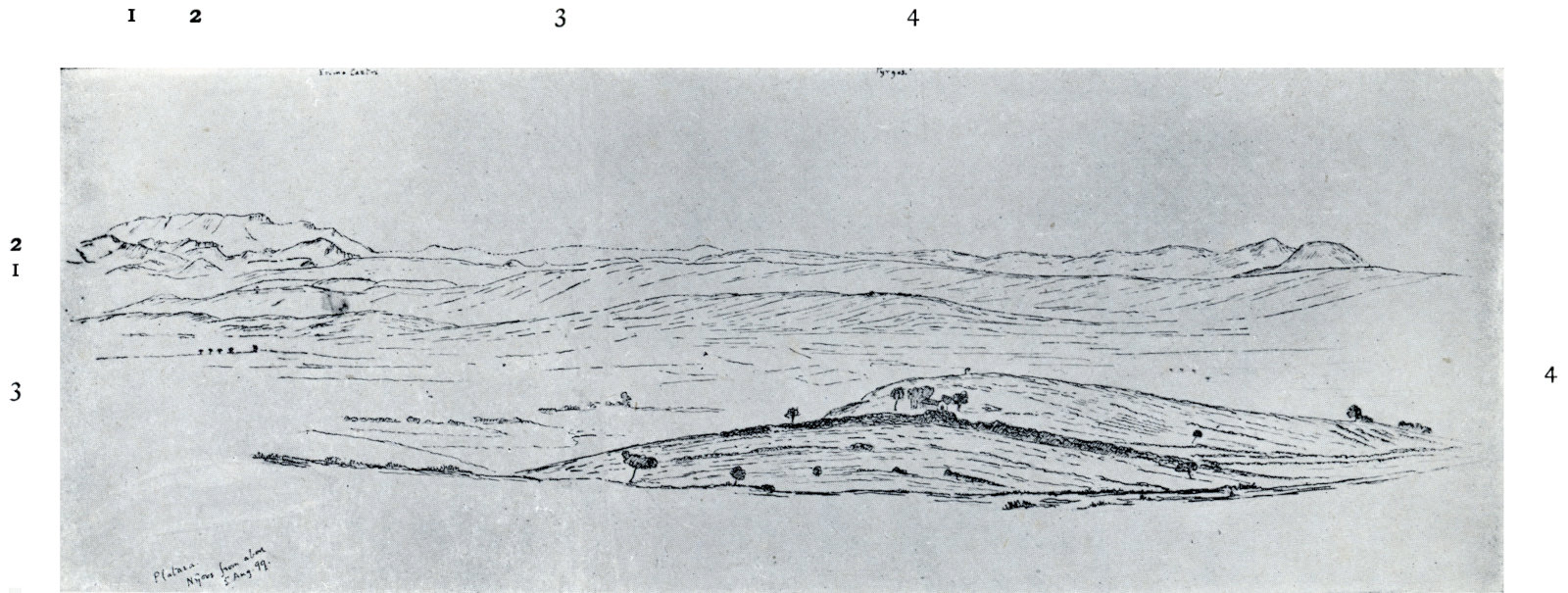
PLATÆA: “ISLAND,” FROM SIDE OF KITHÆRON.
1. Foot of Helicon.
2. Parnassos.
3. Plain of Platæa.
4. “Island.”
[To face page 480.
Note on the Position of the “Island.”
In order to understand this very important passage, it is necessary to examine the evidence, both documentary and topographical, as to the position of the νῆσος or Island. It will be well to tabulate the facts which Herodotus mentions with regard to it.
(1) It is ten stades from the Asopos.
(2) It is ten stades from the spring of Gargaphia.
(3) It is πρὸ τῆς τῶν Πλαταιέων πόλιος.
(4) The river divides ἄνωθεν ἐκ τοῦ Κιθαιρῶνος, and flows down into the plain.
(5) The streams are ὅσνπερ τρία στάδια distant from one another.
(6) The streams afterwards join one another.
(7) The name of the river is Œroë.
(8) There was a plentiful water supply at the νῆσος.
THE ISLAND.
(9) The cavalry could not annoy the Greeks there, ὥσπερ κατιθὺ ἐόντων.
Both Leake (“Northern Greece”) and Vischer (“Erinnerungen aus Griechenland”) identify a strip of flat ground, lying in the plain due north of the site of the town of Platæa between two of the stream-beds of the Œroë, as the “Island” of which Herodotus speaks.
This identification may be tested by the facts given by Herodotus:
(1) This piece of ground is ten stades from A 1, which, as I have said, is apparently the upper part of the Asopos of Herodotus. (It is thirteen or fourteen stades from the branch of the river which comes down from Leuktra.)
(2) It is considerably over ten stades, viz. fifteen or sixteen stades, from the spring which Leake identifies, rightly, as I think, with the Gargaphia.
(3) It is before or in full view of the city of Platæa.
(4) The words used by Herodotus do not seem to be those which he might have been expected to use in describing this piece of land. The streams divide at a point more than two miles above this.
(5) (6) (7) are adequately fulfilled by it.
It is when we come to (8) and (9), which are the very reasons stated by Herodotus for the movement to the “Island,” that the position indicated absolutely fails to accord with the conditions.
In respect to water supply it is conspicuously deficient; and of the three streams which cross the plain at this point one was absolutely dry at the time of my visit (Dec., 1892); and this one was that which would have formed the side of the “Island” towards the Persian army, viz. O 1.
The second contained water, but in a much less quantity than before it entered the plain. The third contained water also, but not in any quantity.
This was at a period of peculiarly heavy rains.
In September all of them would almost certainly be dry by the time they reached this part of the plain. O 1, being a pure drainage stream, would be, under ordinary circumstances, dry along its whole course at that time of year.
There would, under no conceivable circumstances, have been water enough in this conjectured νῆσος, at that time of year, to supply an army one-tenth the number of the Greek force. We cannot even assume exceptionally heavy rain (a most extraordinary circumstance in the month of September), for in that case the lands of the Asopos would have been impassable for cavalry, and even infantry would have been unable to cross them. I speak from personal experience. I wanted to get down to the river, in order to get points of survey upon it, since its course is not distinguishable with certainty, even from a furlong off; but after getting into plough, into which I sank above my knees, and after my Albanian servant had come down and nearly disappeared with my plane table, I gave it up. I could not reach it at that point; and that part of the Asopos had to remain marked in my map by a dotted line which, although it gives the course very nearly, does not pretend to the same accuracy as the rest of the map.
Condition (9) really contains two conditions.
(1) The Persian cavalry could not damage the Greeks so much in the former position, because—
(2) They would not attack them on the front
Applying (1) to this conjectured νῆσος, I have no hesitation in saying that the stream-beds which bound it afford no serious obstacles to cavalry for at least ninety out of every hundred yards of their course. A horse could cross them in most places without even easing from its gallop, and, apart from this, the effectiveness of the recent attacks of the Persian cavalry had been due to the fact that it had been fighting with missiles and not at close quarters, as Herodotus expressly says. The Greeks could not have faced them across a watercourse a yard or two broad, so as to be able to prevent their passing it, even had the passage been a work of some difficulty to a mounted man. If further argument on this point be necessary, I can only say that it is impossible to conceive how the generals of the Greeks, having found the Asopos an utterly insufficient protection, could have supposed that the army would be in safety behind these much slighter watercourses. Have the stream-beds altered in character? If any alteration has taken place, it can only have taken the form of the raising of the plain by earth brought down from the uplands, the result of which would be that the channels would be deeper now than at the time of the battle.
Condition (9, 2).—Had the Greek position been on this ground, the attack would certainly have been on the front.
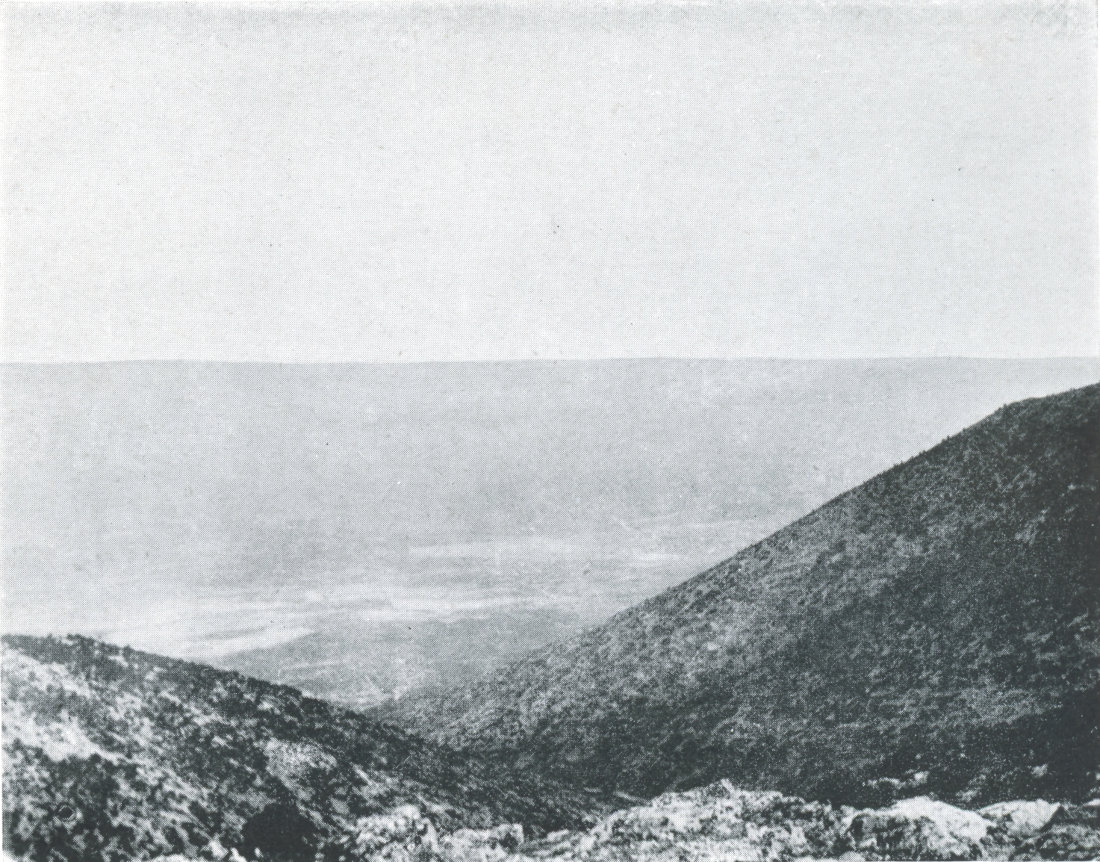
BŒOTIAN PLAIN, FROM PLATÆA-MEGARA PASS.
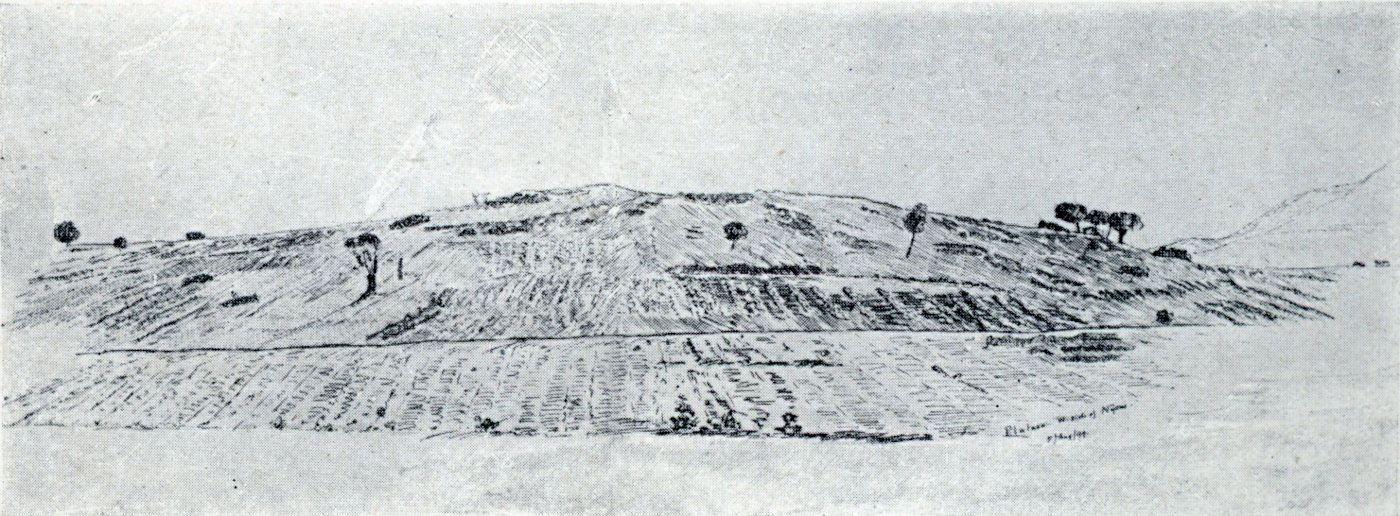
PLATÆA—WEST SIDE OF Νῆσος.
[To face page 482.
There is another point mentioned by Herodotus which is very difficult to reconcile with the location of the νῆσος in the position in which Leake and Vischer place it. “ISLAND” OF LEAKE AND VISCHER. He says (ix. 56) that when the Athenians and Lacedæmonians did actually begin their movement thither, οἱ μὲν (the Lacedæmonians) τῶν τε ὄχθων ἀντείχοντο καὶ τῆς ὑπωρέης του Κιθαιρῶνος, φοβεόμενοι τὴν ἵππον. Ἀθηναῖοι δὲ κάτω τραφ θέντες ἐς τὸ πεδίον, etc.
Since the Lacedæmonians, had they marched direct from the Asopos ridge to this νῆσος, would not have had to traverse a longer stretch of ἱππάσιμος χῶρος than if they had gone round by the ὑπωρέη (vide map), it is difficult to see why they should have adopted the infinitely more circuitous route.
I do not, however, wish to lay too much stress upon this argument, as I believe the real object of the course taken by the Spartans to have been the relief of the convoys blocked up in the pass on the Platæa-Athens road, a reason which may be deduced from Herodotus’ own words in describing the decision to move to the “Island” (ix. 51)—“They determined, on arriving at this place (the ‘Island’), to send off half the army towards Kithæron in the course of this night, to recover the attendants who had gone after the provisions, they being blocked up in Kithæron.”
It does not seem likely that, after the damage which they had suffered in the second position, they could have come to the decision to send off from the νῆσος of Leake and Vischer one half of the army to the pass. It would be obliged to march across a mile of ἱππάσιμος χῶρος between Platæa and Ridge 4, and to venture itself, at a distance of from two and a half to three miles from the remainder of the army.
The reason which mainly influenced both Leake and Vischer in thus determining the site of the νῆσος was no doubt the question of distance from the Asopos. They assumed that when Herodotus used that name he meant the stream coming from Leuktra and the west. It is almost beyond doubt that he does not mean this stream. The Asopos to him was the stream A 1 with the main stream below the junction of A 1; and it is extremely likely that what was the Asopos to him was also the Asopos to the Platæans. It is only necessary to stand on the site of Platæa and look northward over the plain in order to understand how this nomenclature would arise. The course of A 1 is traceable all along the west foot of the Asopos ridge; but the upper course of the main stream is undistinguishable unless the river be in flood.
As this piece of ground fails in such important particulars to harmonize with Herodotus’ account of the “Island,” it remains to be considered whether it is possible to apply his description to any other part of the field.
One fact is quite evident from Herodotus: the “Island” lay between the branches of the Œroë.
I think it is to be found high up in the interval between the branch streams, at the point indicated in the map, and that it consisted of Ridge 4, and possibly of Ridge 3 also. Any one who takes the higher track from Kriekouki to Kokla cannot fail to be struck by the peculiarity of the ground, should he happen to look down towards the plain at the point where the road passes close to the narrow strip of land which separates the sources of the streams O 1 and O 3. These sources, as will be seen from the map, are close together, and the ridge which separates them is quite low at the narrowest part. The stream O 3 (east branch) flows down towards the plain at first in a deep valley with a very steep slope towards the “Island,” which valley it leaves at the point where the streams which unite to form O 3 have their junction. From this point it flows beneath the “Island,” which rises steeply above it, whereas on the other side of the stream, i.e. on the west side, the ground slopes quite gradually up to the rounded back of the low-lying Ridge 5.