Chapter XI · THE CAMPAIGN OF PLATÆA. (continued 2)
Reading edition
The stream O 1 flows down to the plain in a deep depression.
It is true that at the present day these streams do not join immediately on reaching the plain; but to show how possible it is that their courses in the flat alluvial ground may have altered again and again, within certain limits, in the course of time, I may mention that when Colonel Leake visited this ground, the stream O 2 did not join O 3 at the point where it now joins it, but was a separate stream from it at the point where the Kokla-Thebes track passes the branches of the Œroë, i.e. more than a mile below their present junction.
There is another very striking point about this piece of ground, which is noticeable in its contouring in the map. Its insular character is, if I may so say, emphasized by a large hillock which rises on it close to O 3, and which is a most prominent object, especially when viewed from Platæa itself. This hillock may be identified by any one visiting the ground, owing to its having on the south slope of it a white building, the only building existing between Kriekouki and Kokla.
THE “ISLAND.”
It will be found on examination of the evidence that this locality corresponds most closely with the description of the “Island,” given by Herodotus, and furthermore that the incidents of the battle, as related by Herodotus, support in a remarkable degree the hypothesis that this is the island which he describes. It may be compared with the nine conditions deducible from Herodotus with the following result:—
(1) It is, like the “Island” of Leake and Vischer, ten stades from the stream A 1, the Asopos of Herodotus.
(2) It is, unlike their “Island,” ten stades from the Gargaphia spring.
(3) It may be peculiarly well described as being πρὸ τῆς τῶν Πλαταιέων πόλιος. (a) Because, the site of Platæa city has a slope this way, in fact, “verges” towards the east, as well as towards the north. (b) Because, looking at it from the site of Platæa across the low Ridge 5, it [especially the hillock] stands out in a remarkable way.
(4) The division of the streams ἄνωθεν ἐκ τοῦ Κιθαιρῶνος, whether it be taken as that between O 1 and O 3, or between O 1 and O 2, is peculiarly striking in either case, the head waters of the streams nearly touching.
(5) O 3 and O 2 are three stades from one another. O 3 and O 1 are nearly four stades.
(6) The streams do join now, but may well have joined at a point higher up their course at the time at which the battle was fought.
(7) The streams are the head waters of the Œroë.
(8) The water-supply of O 3 is derived, as will be seen, from seven streams. On these streams are two large springs, one of which is called by Leake the spring of Vergutiani, Paus ix. 2, 3. and is apparently the πηγή of Pausanias. Beside these two springs there are numerous smaller ones, and O 3 as it passes beneath the hillock on the “Island,” is quite a large stream; but, like the other streams which flow to the plain, its volume goes on decreasing the further it gets into the flat country.
(9a) Reference to the map will show how well the condition is fulfilled by the ground. The position would be unassailable by cavalry on south and west. On the west, the slope of the “Island” is very steep indeed; on the east of the valley of the stream O 1 is deep. It would seem, too, from the large accumulation of rocks and stones which have been removed from the cultivated land at this part, as if this Eastern slope of the “Island” was till recent times of the same nature as the rocky hillside of Kithæron.
If, however, O 2 be taken as the boundary of the “Island,” then there would be this rocky ground on the far side of it The valley of O 2 is not, however, so deep as that of O 1.
The only point, then, at which this ground would be assailable by cavalry would be at the north end or bottom of the slope. This brings me to the second part of Condition 9.
(9a) The last fact mentioned explains Herodotus’ words, ὥσπερ κατιθὺ ἐόντων.
Such, then, are the reasons, taken from Herodotus, which induce me to take what may appear to be, and is, I confess, a very decided view as to the position of the ground called the “Island.”
I think, too, that there are other considerations of a strategic character which support this view.
A brief examination of the map will show that it would have been difficult for the Greek generals to have chosen a spot in the whole neighbourhood of Platæa which would have rendered their position in case of disaster a more hopeless one than it would have been had they withdrawn to the “Island” of Leake and Vischer. The possibility of disaster must have been very present to their minds at the time at which the decision was made to move to the “Island.”
Herodotus’ description of the state of the army under the continued attacks of the Persian cavalry is brief but graphic. Its position was, beyond doubt, exceedingly serious. But what would have been its position had disaster overtaken it on that tongue of land in the plain of Platæa? It would in the first place have been surrounded by the Persian cavalry, since the ground between it and Platæa, a considerable stretch of land, is all ιππάσιμος χῶρος, and to all intents and purposes absolutely flat. Supposing even that it did try to cut its way out, it would have been obliged either to retreat to the west towards the Corinthian Gulf, or to make its way to one of the passes. In either case the result must have been the practical, if not actual, ruin of the Greek army.
MOVEMENT TO THE “ISLAND.”
The way to the Corinthian Gulf, however, would be outside all calculation, since—
(1) There was no fleet in the gulf which could possibly have transported even a small fraction of the force across it
(2) The only path across Kithæron west of Platæa must, from Xenophon’s description (Xen. Hell. v. 4; and vi. 4), have been an exceedingly difficult one. It is, moreover, some nine or ten miles distant from Platæa. It cannot, in fact, have ever entered into the calculations of the Greek generals.
As regards the three passes which lead on to the field, can we, if we bear in mind the condition of the Greek army at the time of the movement, suppose for a moment that the Greek generals would move to a position farther away from the passes than they were before the movement began? Surely their natural course would be to retire to the higher ground, where they would be in comparative safety from the Persian cavalry, and where, in the position I have indicated, they would be exactly between the passes on the Platæa-Megara and Platæa-Athens roads respectively, and where, too, they would be in easy communication with both by way of the rocky part of the Kithæron slope.
The last piece of evidence bearing on this point is afforded by the remarkable tale of Amompharetos, the Spartan officer who refused to move from the second position with the rest of the Lacedæmonian force. The reason which prompted (H. ix. 53) him in his refusal is stated by Herodotus to have been the disgrace of retreating before the enemy.
The feeling is hardly comprehensible if the movement was to be to the “Island” in the plain; it is comprehensible if it was to be towards Kithæron, since he might well suspect that the real design of Pausanias was to retreat through the mountain into Attica.
At the time at which this resolution was taken the Greeks were for the moment a beaten army. What might have happened had the proposed movement ever become an actual fact cannot of course be said, but it is extremely probable that a leakage through the passes would have commenced, by which its numbers would have been so rapidly reduced that an absolute withdrawal from Bœotia would have shortly become necessary. Had that been the case, Northern Greece must have been lost. It would have been very difficult after what had happened to keep together so composite a force in an advanced but purely defensive position. As far as the Greek generals were concerned, their design, doubtless, was to remain on the defensive in Bœotia, now that their offensive strategy had not met with success, and to starve the enemy out of the country. Alexander of Macedon had reported to them the approaching failure of the Persian supplies.
They had failed in attempting to take the offensive in a country which was peculiarly adapted for the operations of cavalry. They had been led by the success they had achieved in the first position into the mistake of remaining in a position which could only be justified by an active offensive, not recognizing that their success on that occasion had been due to the wrong use which Mardonius or Masistios had made of their numerous cavalry. The passes formed, as it were, their immediate base; and they had not recognized that by leaving an interval between themselves and that base they exposed their line of communications to the attacks of an arm against whose mobility they had nothing to match, and had rendered themselves assailable from all sides by a mode of assault which made it impossible for them to retaliate in adequate fashion. It was their first experience of the possibilities of cavalry action on a large scale; and it is noticeable that in the many subsequent years of warfare with Persia in that century they never again willingly exposed themselves to the possibility of such a reverse as they had suffered in the second position at Platæa.
The curious piece of land, with its curious name of the “Island,” which was fixed upon by the Greek commanders as the goal of the proposed movement, is easily recognizable at the present day, owing to the accuracy with which Herodotus describes it. It is one of those ridges which extend northwards into the plain from the foot of the rocky slope of Kithæron; but it is remarkable among them for two peculiarities. LAST HOURS ON THE ASOPOS RIDGE. The streams which bound it on either side have their sources on the mountain slope above it within but a few yards of one another, so that it may be said to be all but surrounded by water; and the ordinarily rounded back of these northward stretching ridges is varied in this case by a steep and very noticeable natural mound which rises upon it. It is nearly two miles due south of the ridge which formed the Greek second position, and about one mile due east of the town of Platæa. As a position it offered the distinct advantage of being within touch of the Platæa-Athens and Platæa-Megara passes, and of affording the army comparative immunity from cavalry attack.
The Greek commanders were disappointed in their hope or expectation that the cavalry attack would not be renewed on that day, on the morning of which the Council of War was held. The Persians had plain evidence of the effectiveness of the method they were employing; and for the whole of a second day the Greeks had to support a series of assaults without being able to inflict any proportionate damage on the foe. Those who have been in the plains of Bœotia during the heat of the late summer and early autumn will best appreciate the terrible hardships which the army suffered. For at least forty hours it must have been wholly cut off from water, and for a considerable part of that time must have been undergoing severe exertion and supporting severe losses under a burning sun upon that dusty, rolling plain. It is evident indeed that the Persian cavalry withdrew during the night; but they had, before doing so, rendered the Gargaphia spring unusable. The longed-for darkness came at last, and at the appointed hour the movement began. It began, indeed,—but it ended vary differently from what had been intended. With the exception of the Spartans and Athenians, the Greek army, without waiting for further orders, started off in haste at the time appointed, —but not to the “Island,” so says Herodotus. They never even thought of so doing, but were glad to take refuge just outside the town of Platæa, around the temple of Hera.208
It is quite plain that Herodotus believed that the centre of the Greek army fled in something resembling a panic, and neither obeyed, nor intended to obey, orders. When the story is examined it is found to contain several features which are very difficult to reconcile with the colouring which Herodotus has given to it. If these Greeks intended to fly, why did they not make directly for the Platæa-Megara pass, which must have been open? Why did they go to Platæa?
Having gone thither, why did they not seize upon the town?
It has been suggested that in going thither they were carrying out orders, and that the position at the Heræon was part of the position of which the “Island” was another part. The nature of the ground between the two positions, and their distance apart, does not render this very probable.
The probability is that, like so many stories of incidents in Greek history, this particular one has suffered from the exaggeration of some of its true details, and the loss of others.
It is not strange that the events of the last two days’ fighting on the Asopos ridge should have created disposition to panic throughout the Greek army. Doubtless such a disposition did exist, and showed itself in the hurried departure of a large portion of the army. But even Herodotus does not say that the departure was premature. So far, the tale may give a true representation of the facts of the case. RETIREMENT OF GREEK CENTRE. What in all probability took place was that the retiring force started without taking due precautions to ascertain the exact line of retreat, or to provide itself with guides who could lead it amid the darkness of the night to the position which had been appointed as the rendezvous of the army. If that were so, a mistake was not merely possible, but almost inevitable. In that country of rise and fall which lies between Kithæron and the Asopos, one slope resembles another, and one stream is similar in character to its neighbours, so that there is a conspicuous absence of those landmarks which may serve as a guide to one who traverses it by night.
It is not difficult to imagine their position when they found themselves at the Heræon. They must have arrived there in the night, and may have thought it well to wait until dawn disclosed the true position of the rallying point of the Greek army. From the Heræon the “Island” would be full in sight, when the advance of daylight had rendered the surrounding country visible. But the dawn can have brought but little comfort to them. It is more easy to realize the scene that met their eyes than the intensity of this anxiety which that scene aroused. Away to the east the “Island”—empty, unoccupied. To the north-east the Persian army pouring in streams over the ridge which they had evacuated during the night, and from the hollow beneath that ridge two clouds of dust arising, sole indication of the terrible struggle which was going on beyond the intervening ridges. This is not merely a picture of the imagination and no more. It is what these men must have seen from their position at Platæa; for the narrative of Herodotus indicates with sufficient clearness the time and the locality of the battles which were fought on that fatal morning by the right and left wings of the Greek army.
It would be unjustifiable to pass a decisive judgment on the conduct of those Greeks. The extent of their cowardice is not indeed calculable. The tradition which Herodotus followed tended manifestly to depict the whole attitude of the Peloponnesian Greeks, both on this and other occasions in the war, in the most unfavourable light. There can be little doubt that the tradition was Athenian in origin.
It is not, however, necessary to assume that in this or any other particular instance the truth was distorted in order to cloke Athenian failings. The animosities of that later time at which Herodotus wrote his history are quite sufficient to account for the discoloration of facts, and in this particular instance there does not appear to be any valid reason for supposing that the Athenians had anything to conceal.
Much had happened during the night of which the Greek centre was wholly unaware.
Pausanias on the right wing, on seeing that the troops in the centre had begun the movement of retirement, gave orders to the Spartans to do the same. He supposed that the other Greeks would, according to orders, withdraw to the “Island;” and, as has been seen, it is probable that the latter had every intention of so doing.
A question now arises which is of very great importance with regard to the history of the battle. Was it the intention of Pausanias that his Spartans on the right wing should likewise withdraw direct to the “Island,” or did he intend to carry out some other operation before joining the rest of the army in that position? Herodotus, whose attention is at this point in his narrative distracted by the not unimportant tale of Amompharetos, makes no direct statement on the subject, but he furnishes sufficient indirect evidence to render it almost certain that the march of the Spartans neither was, nor was intended to be, directed straight to the “Island,” but aimed first at the accomplishment of a design which was at the moment of the utmost importance to the army. It is further noticeable that the indirect evidence of Herodotus is peculiarly supported by the light which is thrown upon the further incidents of the battle by the topography of the field.
In describing the resolution to move to the “Island,” Herodotus, it will be remembered, says that it was the intention of the Greek commanders to send half the army to relieve the provision trains which were blocked in the passes; and the other evidence shows that the Spartans’ movement from the second position had this immediate object in view.209
OBSTINACY OF AMOMPHARETOS.
When, therefore, Pausanias saw the Greek centre was starting for the “Island,” he gave orders to his division of forty thousand Spartans and helots to move also, intending to march towards the pass on the Platæa-Athens road, and, possibly, towards Dryoskephalæ pass also. For the moment, however, his plan was completely upset by the obstinacy and insubordination of one of his captains, Amompharetos, who, so Herodotus says, commanded the Pitanate division of the Lacedæmonian force.210 The refusal to obey was evidently based on the supposition that the withdrawal from the position was nothing less than a preliminary to a retreat.211 Orders and expostulations proving alike unavailing, persuasion was tried, but with no better effect. The whole night seems to have been wasted in the dispute, for it was not until day was dawning that Pausanias moved away, reluctant to leave the regiment to its fate, but hoping that when Amompharetos found himself alone he would make up his mind to follow. The Tegeans accompanied the Spartans in their movement.
That movement is described in some detail by Herodotus. While the Athenians, who had been suspiciously waiting for the Spartans to move, turned down towards the plain, the latter kept to the hills, and made for the slopes of Kithæron, from fear of the Persian cavalry.212 Amompharetos, on seeing that the rest of the Spartan army was leaving him in good earnest, started slowly after it, which movement being perceived by Pausanias, he stopped the main body in order to wait for him. He had by that time advanced ten stades, or a little more than a mile, from his previous position, and he waited at a place which is described as having been near the river Moloeis, in what was called the Argiopian country, where was a temple of Eleusinian Demeter.
The Temple of Eleusinian Demeter, etc.
Herodotus, in the words recently quoted, gives the following facts:—
(1) That Pausanias, with the main body of the Spartans, advanced ten stades, and then waited for Amompharetos and his regiment.
(2) That he waited at the river Moloeis, in what is called the Argiopian country.
(3) That there is a temple of Eleusinian Demeter in that part.
To which may be added from an earlier chapter:—
(4) Pausanias, after failing to persuade Amompharetos, starts at dawn: his movements Herodotus describes as having been as follows:—
H. ix. 56.
“He gave the signal and led away the whole of the rest of his force through the hills; the Tegeans also followed him.... For the Lacedæmonians intended to keep to the hilly ground and the foot-slopes of Kithæron, because they feared the cavalry.”
TEMPLE OF ELEUSIAN DEMETER.
Circumstances (1) and (2) may be taken together.
This is the first mention of the river Moloeis.
Nothing is known of the position of the Argiopian country; but it may be surmised that it had some more or less striking characteristic which caused it to be called by a special name.
Any identification of these two geographical features must be a matter of extreme uncertainty.
After my stay at Kriekouki in 1892–1893, I was disposed to identify the brook A 5 with the river Moloeis. I am inclined, after revisiting the country in August, 1899, to think that the brook A 6 is more probably the stream mentioned by Herodotus. It is the largest of the streams which traverse the field, save, of course, the Asopos itself, and Leake, in his map, assigns to it the name of the main stream. Though the Spartan army after advancing ten stades from the Asopos ridge would not be actually on this brook, yet, even granting to the measurement given a greater accuracy than perhaps it can claim, the position attained might be described as περὶ ποταμὸν Μολόεντα.
The matter, however, is so uncertain, that it is impossible to insist on either of these two identifications against the other.
The name Argiopian has been supposed to mean “white rock,” and, adopting this interpretation, one visitor to the region has discovered that there is a patch of white rock on the side of Kithæron which is a prominent object from the plain. As we were in August, 1899, encamped in the plain near the head of brook A 5, I had ample opportunity for observing the north slope of Kithæron. No such patch was then visible on the dull grey-green rock slopes of the mountain. As to the interpretation of the name I am, I confess, sceptical. The interpretation of place-names in Greece, as elsewhere, is a most dangerous though fascinating pastime; and it is but too often the case that the most obvious interpretation is the most incorrect. All, I think, that can be safely assumed in the present instance is that the Argiopian country was a stretch of land marked off in some way from its surroundings, and I venture to think that either the Long Ridge or the Plateau has sufficient peculiarities, quâ ground, to render it possible that either of them might in ancient times have been known by a distinctive local name.
The temple of Eleusinian Demeter is a more important landmark in the history of the battle.
I venture to think that the ruins of the church of St. Demetrion are probably on or near the site of that temple, and that the τέμενος of the temple was on the flat top of that mound of the Long Ridge. The reasons which may be adduced for this identification are as follows:—
(a) The Christians, in cases in which they adopted an ancient temple, or the site of an ancient temple, for a church, were apt, in dedicating the new sanctuary, to make a pious pun on the dedication of the pre-existing pagan shrine. This kind of nomenclature has been peculiarly common in Greece.
(b) It is true that Pausanias mentions several temples of Eleusinian Demeter as having existed in this immediate neighbourhood, no one of which can be supposed to have stood in this position.
But it is also clear that the temple mentioned by Herodotus is not any one of these mentioned by Pausanias.
Cf. Paus. ix. 4, 2, at Platæa; ix. 4, 3, at Skolos; ix. 9, 1, Grove of Demeter at Potniæ on the road from Thebes to Platæa, ten stades from Thebes, i.e. about sixty stades from Platæa.
The omission of Pausanias to mention the one to which I refer may possibly be accounted for by the fact that it lay, if I am right, not near the great road from Athens to Thebes, viâ Dryoskephalæ, but near the alternative and probably much less frequented route between the two towns by way of the Platæa-Athens pass.
(c) Pausanias (ix. 2, 6) says: “The trophy of the battle of Platæa which the Greeks set up stood about fifteen stades from the city.”
It would be in accordance with Greek custom that this trophy should be set up in that part of the field where the decisive engagement took place. If, as I take it, it was fought just south of the hill on which the ruined church of St Demetrion stands, a trophy placed on or near that site would be almost exactly two miles from the town of Platæa, or a little more than seventeen stades.
(d) This hypothesis as to the site of the temple receives peculiar confirmation, as I shall show, from the account given by Herodotus of the subsequent incidents of the battle, but it will, I think, be best to take the order of the incidents as given by Herodotus.
In Plutarch’s life of Aristides (xi.) is a topographical detail which would present considerable difficulty, were it not accompanied by other details which show the absolute valuelessness of Plutarch as an authority on the topographical question. He is speaking of the time at which a move from the first position was contemplated: “Near Hysiæ Kithæron is a quite ancient temple called (the shrine) of Eleusinian Demeter and Kore.” He says further on that the rocky slope of Kithæron meets the plain near the temple, and then adds that the Heroön of Androkrates was there also, surrounded by a thick grove of trees.
Pausanias mentions (ix. 2, 1) a temple of Apollo among the ruins of Hysiæ, but says not a word of any temple of Eleusinian Demeter being found there.
But the reference to the position of the Heroön of Androkrates shows that either Plutarch has made a great error, or that his language is hopelessly inexact.
If latter be assumed to be the case, the temple of Demeter to which I have referred might, I think, be described as being near what I take to be the site of Hysiæ. It might even, owing to the height of Kithæron, be described as underneath that mountain. As to the position of the temple being near the edge of the ύπωρέη, it may be pointed out that the site of the modern Kriekouki is a part of the rocky mountain-side which projects far into the plain, but stops far short of the church of St. Demetrion.
But even the utmost looseness of language will hardly account for the assertion that the Heroön of Androkrates was near this temple, still less that it was near the site of Hysiæ.
The explanation of the difficulty is, I take it, that Plutarch was a biographer and not an historian; and consequently he may not have thought, nay, he evidently did not think it necessary to deal intimately with the topography of the battle. There is very little topographical detail given by him, though as a Bœotian he had most probably traversed one or more of the roads which cross the field. He makes no mention of the νῆσος, either directly or indirectly:—a most strange omission if he insisted at all on topographical detail.
There is in the passage above referred to a clause which is in direct conflict with Herodotus’ narrative. Plutarch speaks of τὰς ὑπωρείας ... ἄφιππα ποιούσας τὰ καταλήγοντα καὶ συγκυροῦντα τοῦ πεδίου πρὸς τὸ ἱερόν, whereas Herodotus describes a cavalry attack as having taken place upon this ground. Furthermore,—and this is a most important point if Herodotus’ account of the fighting be correct,—the temple of Demeter certainly lay on the Persian line of retreat after they had been defeated by the Spartans; that is to say, it was almost certainly between the place where the final action took place or began and the Persian camp.
Again, I think that the words of Herodotus, in describing the first phase of the second position of the Greeks as “near the Spring of Gargaphia and the τέμενος of Androkrates the Hero, through hills of no great height and level country,” can only mean that the τέμενος was on the left of the Greek line; for the ἀπέδος χῶρος can only be the plain between Platæa and the Asopos which comes from Leuktra, and this position for the τέμενος accords with the details given by Thucydides. How, then, the τέμενος be described as near the temple of Demeter, if the latter was near Hysiæ?
On the question of the value of Plutarch’s evidence relative to the battle, I agree with Colonel Leake:—
“It is scarcely worth while to advert to the particulars in which the other ancient authors who have related this great event differ from Herodotus; Diodorus and Plutarch lived so long afterwards that they cannot have much weight against the testimony of the contemporary historian. The former does not, however, deviate from it in any important point, and the contradictions of the latter are undeserving of much respect, as being those of a Bœotian angry with Herodotus for having spoken freely of the disgraceful conduct of his countrymen, and thinking no mode of exculpation so effectual as that of throwing general discredit on the historian’s accuracy.” (“Travels in Northern Greece,” vol. ii. p. 353.)
The movement of the Spartans was directed towards the pass on the Platæa-Athens road. It was evidently their object to avoid as much as possible the unimpeded ground of the plain on which the Persian cavalry could act, and with this intent they seem to have diverged slightly from the direct route to the pass in order to gain the northern end of that rocky bastion of Kithæron whereon the modern Kriekouki stands, a point at which the rocky mountain foot projects for some distance into the plain. SPARTANS LEAVE THE SECOND POSITION. They would thus take a direction S.S.E. from their position on the Asopos ridge, and must have passed the now useless Gargaphia spring on their way. After proceeding thus for ten stades, or about a mile and a furlong, they waited for Amompharetos and his company, whose reluctant movement from the late position they would be able to see from the moment that it began. It must therefore have been near the head waters of the two streams which run northwards on either side of the Long Ridge that this delay took place; and either the easternmost of these streams or the larger brook which skirts the site of Kriekouki on the west would seem to be the river Moloeis of which Herodotus speaks. Looking northward from that position, the highest point of the Long Ridge would rise in front of them in the form of a flat-topped table-land, bounded on either flank by the steep-sided stream valleys,213 with the temple of Eleusinian Demeter, of which Herodotus speaks, upon its summit. The flat table-land itself formed doubtless that sacred precinct of the goddess of which Herodotus has something more to tell. Somewhere in the neighbourhood was the Argiopian country of which the historian speaks, all trace of whose name and identity has long vanished into the past. Possibly the plateau to the east of the Long Ridge bore that name in ancient times.
It was in the position which they had thus attained that they were fated to fight the decisive engagement by which the long-drawn struggle was won. They never reached that rocky projection where Kriekouki now stands.214
H. ix. 57.
“Those with Amompharetos joined them, and the whole of the barbarian cavalry assailed them,” says Herodotus, in one significant sentence.
In the gathering light of the dawn the Persians beyond the Asopos had noticed that the ridges which the Greeks had occupied for more than a fortnight past were vacant, and had sent forward their cavalry to overtake the retreating enemy. Amompharetos seems to have just managed to reach the main body before the attack fell; but the reunited force had no time to move before the cavalry was upon it. The ground on which it stood at the time was as unfavourable as it well could be. The bottom of the ridge lying west of Kriekouki sinks into the depression in a long gentle slope, affording a terrain admirably suited to the operations of the Persian cavalry; and it was on this ground that the Spartans were obliged to make their stand. The object of the cavalry attack was evidently to prevent the Greeks from attaining, before the Persian infantry should have time to come up, the strong position which the rocky slopes of Kithæron would afford. Mardonius made the fatal mistake of supposing that the Greeks were a broken as well as a beaten army,215 and his sole anxiety seems to have been to render the victory complete. Had he been able to appreciate the real circumstances of the case, had he been content to abide by the tactics he had employed on the previous days, the whole history of the battle might have been changed.
H. ix. 59.
Having despatched his cavalry in pursuit of the Greeks, Mardonius lost no time in hurrying forward his infantry across the Asopos on the track of the retreating foe.216 It is interesting to notice that it was against the Lacedæmonians and Tegeans alone that his efforts were directed, the line of retreat of the Athenians on the right wing of the Greeks being hidden from him by the hills.217
It was with the Persian infantry that Mardonius led the way; but the rest of the army followed with much speed and little order, eager to take part in the rout of the enemy with whom they had been so long face to face. They must have ascended the long gradual slope of the theatre which is formed by the curve of the Asopos ridge on its north front, and, arrived at its summit, they would see on the low ground southward the large mass of the Lacedæmonian contingent engaged by their cavalry.
BEGINNING THE GREAT FIGHT.
Pausanias had no illusions as to the serious nature of the cavalry attack, but sent an urgent message to the Athenians, who were at this time making straight for the Island, to come to his help with all speed.218 The message is recorded, after the manner of Herodotus, in what purport to be the words actually used. Without unduly insisting upon the letter, its spirit is remarkable. The Spartans are represented as having placed the worst construction upon the conduct of the Greek centre in withdrawing from the position on the Asopos ridge before they had done so themselves. And yet it will be remembered that Herodotus expressly says that these “runaways” did not leave that position until the hour which had been originally fixed for that movement. But here these allies are represented as cowards and traitors to their friends. The whole question of the conduct of the Greek centre at this stage of the battle is an exceedingly difficult one; the only thing which seems to be clear is that those Greeks who bore the burden and heat of this day of decisive battle rightly or wrongly regarded them as having yielded to a panic of fear. The condemnation was probably unjust; but it is not possible to demonstrate conclusively that it was so.
H. ix. 61.
The Athenian help never reached the Spartans, and so they were left to fight the battle alone. It was no small combat. Over fifty thousand Greeks on the one side were face to face with what must have been numerically a still more formidable force—a force which may have been indeed several times their own in number. The Persian cavalry adhered to the tactics which had been so effective on the previous days, avoiding close fighting, and making the assault with arrows and missile weapons from behind a barrier of shields. Many of the Lacedæmonians fell, and many more were wounded in this unequal combat, in which they must have been able to inflict but little damage on their mobile opponents. The sacrifices were unfavourable; and so the Greeks did not take the offensive. Pausanias must have been wholly in agreement with the sacrifices, knowing well, it may be apprehended, that his only chance of salvation lay in offering a firm front to the attack, and in preventing the assailant horse from finding its way through the line of Greek shields. The Persian infantry was, of course, by this time aiding the assault, and it must indeed have been their shields which were set up to form the extemporized stockade. This went on for a long time. Pausanias was probably waiting till the press of the enemy became sufficiently great to deprive their front ranks of that mobility from which the Greek hoplite had most to fear. When this state of things supervened he let his men loose upon the foe, after offering up a prayer to Hera, which that goddess answered by rendering the sacrifices favourable. It is probable that the attention which the Greek commander paid to sacrificial omens was due rather to their effect on the minds and courage of the common soldiers than to any undue trust which he placed in them as indications of the tactical policy to be pursued.
H. ix. 62.
The Tegeans were the first to attack the mass of barbarians opposed to them, and after an interval the Lacedæmonians did the same. They first had to break through the barricade of shields; then the battle became a fierce hand-to-hand struggle. Herodotus bears testimony to the fact that the Persians were no whit inferior in courage, but being without heavy defensive armour, they were no match for the most experienced and best drilled infantry in Greece. Cf. ix. 62, ad fin. They evidently made fierce efforts to break through the iron-clad line of the enemy, charging singly and in groups. But it was all of no avail; not even the most desperate courage could compensate for the immense disparity of weapons, and the men who had “made the tour of Asia on foot,” and had fought and conquered the numerous peoples of the East, found themselves utterly unable to cope with an army drawn from one small corner of the Western Continent. Mardonius had made a terrible miscalculation when he launched his comparatively light-armed infantry against the Greek hoplites. He paid for his mistake with his own life. H. ix. 63. Surrounded by a picked FLIGHT OF THE PERSIANS. body of Persians, he was himself in the midst of the mêlée, and was naturally marked out by the Greeks for attack. At last he fell, but not until the assailants had paid dearly for their success.
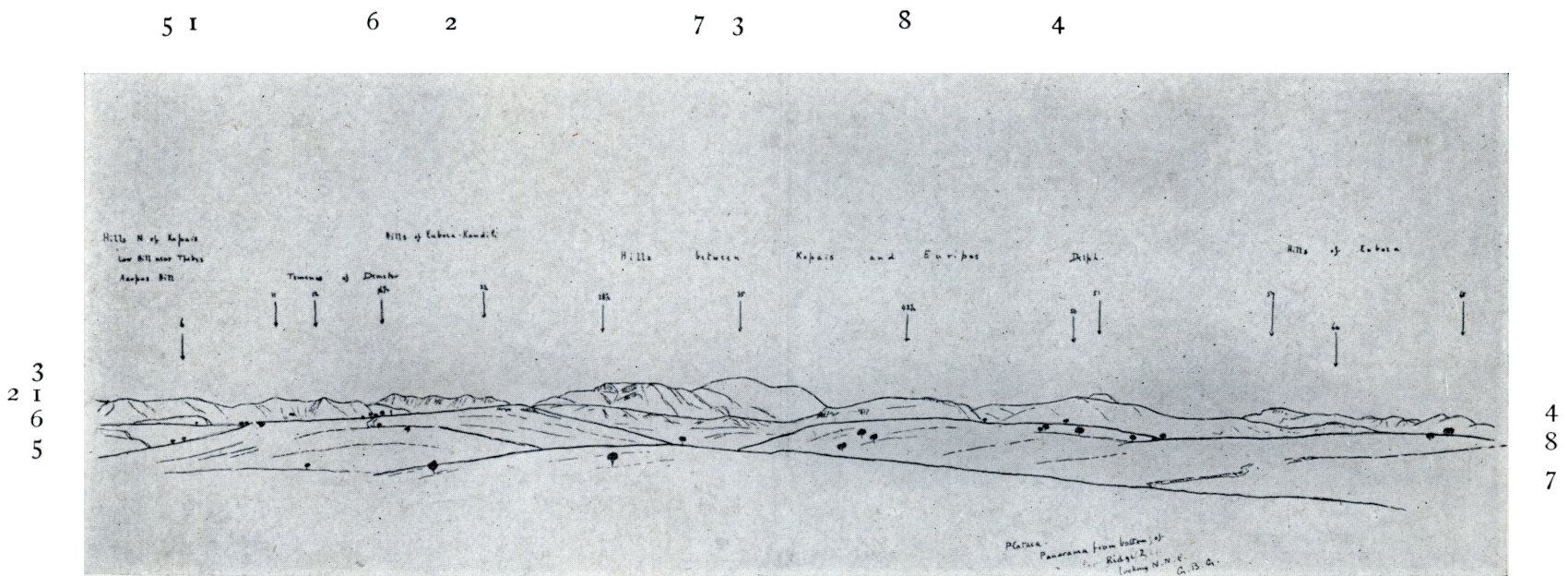
PLATÆA: PANORAMA FROM SCENE OF LAST FIGHT.
1. Hills North of Kopais.
2. Mount Kandili (Mekistos) in Eubœa.
3. Hills between Kopais and Euripus.
4. Mount Dirphys in Eubœa.
5. Valley of Stream A 4.
6. Temenos of Demeter.
7. Valley of Stream A 5.
8. The Plateau.
[To face page 502.
It is not difficult at the present day to follow the course of this struggle.219 After their commander’s fall the Persians gave way, and were pushed down the gradual slope towards the stream valleys which ran on either side of the precinct of Demeter,220 affording them direct lines of retreat to their camp. The stream of fugitives would divide where the rise of the ground towards the precinct begins, and would naturally take the easier and quicker routes afforded by these valleys. H. ix. 65. They fled in disorder to their camp and stockade. Herodotus notes with pious emphasis the fact that, though the fight had raged near the temple, none of the sacrilegious destroyers of her temple at Eleusis fell within the consecrated ground about this shrine of Demeter. On more materialistic grounds it would be extremely unlikely that men flying for their lives in panic flight should ascend the hill whereon the sanctuary and its precinct stood, when easier avenues of retreat were ready for them on either side of it.221
Such were the fortunes of what had been the Greek right wing. It is now necessary to follow the movements of the Athenians who had been stationed on the left of the second position.
It is clear that the two days’ cavalry attack had driven back the Greek left from the Asopos; and, in the final phase of its tenure of the second position, the army must have been massed on the summit of the Asopos ridge; so that the left would be at no great distance from the right.
H. ix. 54.
The Lacedæmonian delay in starting upon the movement of retirement seems to have aroused suspicion in the minds of the Athenians, if Herodotus’ narrative is to be believed. He does not mention any specific cause for the distrust in the present instance, other than the delay caused by the obstinacy of Amompharetos, attributing it rather to general grounds: “They knew the Lacedæmonians had a way of intending one thing and saying another.” The conduct of the Athenians is not consistent with the tale of suspicion; and the tale itself probably does something less than justice to the Athenian motives for remaining at their post of danger. It is noticeable that when they do move they take a wholly different line to the Spartans, showing that they did not suspect them of any intention of deserting the army, and consequently the only conceivable motive they can have had in waiting must have been the desire that the withdrawal should be covered, if necessary, by a sufficient number of the Greek army. As, however, the Spartans started just before daylight, and the Persians did not immediately discover the movement, the Athenians evidently thought that there would be no danger in carrying out the original design; so, while their allies made their way towards the passes, they took the easiest route to the Island.
They apparently started on their movement about the same time as the Lacedæmonians. Their course can be traced with fair certainty. From their position on the Asopos ridge north of the ruins of the church of St John, they did not take the direct line for the Island, which would have led them past the site of that modern sanctuary, but descended to the western slope of the ridge to the Platæan plain.222
On reaching it they would pass up the course of that stream which Herodotus identifies with the upper Asopos,223 and would be marching in a straight line for the Island. ATHENIANS AND MEDIZED GREEKS. The route adopted was indeed but little longer than the direct route, and would be easier, as it lay along the level plain. H ix. 60. It must have been at some point in the course of this march that the message from Pausanias reached them, announcing the attack of the Persian cavalry, and urgently entreating them to come to his assistance, or at any rate to send their bowmen to his help. H. ix. 61. On receiving this the Athenians diverged from the line of march, and started towards the place where the Spartans were being sore pressed by the cavalry. Shortly after this change of direction had taken place they were attacked by the medized Greeks who were with the Persian force, and were thus prevented from assisting the Spartans. The circumstance that this fight seems to have been out of sight of that part of the Greek army which was at Platæa, renders it probable that the Athenians had turned from the plain along the line of the modern track which leads from Leuktra to Dryoskephalæ, and that the medized Greeks, coming up over the Asopos ridge in the neighbourhood of the church of St. John, overtook them in the hollow near the springs of Apotripi, where a fierce engagement took place. H. ix. 67. Although the rest of the medized Greeks voluntarily played the coward on this occasion, the Bœotians showed that they had not espoused the Persian cause to no purpose, and for a long time maintained an obstinate struggle, losing three hundred of their best and bravest in the battle. In the end they had to give way, and fled in disorder to Thebes.
H. ix. 68.
The whole Persian army was now in full flight, save the cavalry, which made a brave and, for the time being, a successful effort to cover the retreat, though it could not prevent the pursuing Greeks from inflicting severe losses upon the fugitives.
H. ix. 69.
It was at this time, says Herodotus, that the Greeks at Platæa first heard that a battle had taken place, and that Pausanias and his men had won the day. They must have spent an anxious morning on that rocky slope near the Heræon, not venturing to move, because uncertain what they ought to do, and knowing nothing of their friends save that they were not at the Island, where, according to arrangement, they should have been. They may perhaps have seen the Athenians moving along the foot of the Asopos ridge shortly after dawn, and the Persian army as, a little later, it streamed across that ridge, must have been plainly visible; but from the moment when the Athenians disappeared into the hollow near the springs of Apotripi, until they received this message, all they can have seen or heard must have been the clouds of dust rising from two points in the depression beneath the northern ridges, and the confused and distant noise of an engagement. They seem to have played an inglorious, if not a cowardly, part in sitting still while these things were going on; but if it be borne in mind that the little they did see of the movements of their friends and of the enemy on the fatal morning was wholly inexplicable by the orders they themselves had received, or by anything that had happened within their knowledge, their inaction may seem natural. Herodotus is not inclined to put the best construction on the conduct of those who were drawn largely from those Greek states which had advocated what seemed to him the cowardly blunder of confining the defence to the Isthmus.
The receipt of the message, therefore, put them for the first time in possession of certain information as to what had happened since they had parted from their allies on the Asopos ridge on the preceding night. The news, such as it was, was good; and they started immediately with a view to take part in the victory. The details which Herodotus gives of their movements afford conspicuous proof of his remarkable excellence as a topographer, though they also illustrate his limitations as a military historian.
The Greeks at Platæa divided into two bodies; and from the description which the historian gives of the lines of advance which they adopted there can be little doubt that, though he does not mention the fact, they marched respectively on the two places where fighting was going on. H. ix. 69. The advance was hurried and disorderly. The one body was composed of the Corinthians and those with them—the right centre. THE GREEK CENTRE. It took a line along the rocky slope of Kithæron and through the hills, along the upper way leading straight to the temple of Demeter. Its course was evidently along the rocky slope at the south end of the ridge224 which intervenes between Platæa and the Island, over the head waters of the streams which form the Island,225 and then over the open and unimpeded ridges towards the temple.226 This division of the Greek centre seems to have reached the Lacedæmonians in safety, and may even have taken part in the last stages of the struggle near the temple. The other division, composed of Megareans, Phliasians, and the rest of the Greek left centre, was not so fortunate. H. ix. 69. They took “the most level way through the plain.” Herodotus is evidently under the impression that they also were making for the temple of Eleusinian Demeter; but the course they took, which must have been along the base of the ridge between Platæa and the Island,227 together with the fact that they came across the Bœotian cavalry at a time at which it cannot have been covering the retreat of the medized Greeks,—at a time, that is to say, at which they were still engaged with the Athenians,—suggests that they aimed at giving assistance to their friends in that part of the field, and that the Bœotian cavalry sought, not in vain, to prevent them from so doing. The conjecture is further supported by Herodotus’ statement that they were “near the enemy” when the Theban horse caught sight of them; and that cavalry must presumably have been engaged at the time in battle with the Athenians. Their disorderly and hurried advance cost them dear. The Thebans cut them to pieces, killing six hundred of them, and driving the rest in headlong rout towards Kithæron.
This was the only disaster which befell any section of the Greek army on that eventful day. No doubt the Athenians and Lacedæmonians suffered severely—more severely than the Greeks ever admitted; but in any case they paid but a cheap price for their great victory.
H. ix. 63.
Herodotus is fully aware that it was to the superiority of their weapons that the Greeks owed their success. “The main cause of the Persian defeat was the fact that their equipment was devoid of defensive armour. They sought, exposed as they were, to compete with heavy armed infantry.”
The enthusiasm with which he hails the victory is rare with him. Salamis left him comparatively cold; but of Platæa he says that there “Pausanias the son of Kleombrotos the son of Anaxandrides gained the most glorious victory on record.”228
The historian was right in thus attributing to Pausanias and his Lacedæmonians the chief credit of the victory. The decisive conflict was fought beneath the shadow of the temple of Eleusinian Demeter.
The two defeated bodies of the enemy fled in different directions. The Persians retreated to their camp, where, thanks to the bravery of their cavalry in covering their rout, they had time to man the stockaded portion of it before the Greeks came up. The beaten Bœotians, on the other hand, fled straight to Thebes, probably striking the Platæa-Thebes road shortly after recrossing the Asopos.
H. ix. 66.
One division of the Persians, a body of forty thousand men, under the command of Artabazos, neither took part in the final struggle nor took refuge in the stockaded camp. With singular foresight, their commander was strongly opposed to the attack on the apparently retreating Greeks, apprehending that it could only end in disaster. He only brought up his men in time to meet the stream of fugitives from the battle, and then turned right about and departed without further ado for Phocis.
LOSSES IN THE BATTLE.
In the course of the pursuit the Lacedæmonians, as would be expected from their position in the field, arrived first at the stockaded camp; but, with that noteable incapacity in the attack on fortified places which is one of the most striking and least comprehensible features in Greek military history, they failed to make any impression on it, until the Athenians, who possessed more skill in this respect, came up. A successful assault was made, the Tegeans being the first to enter the stockade. Then ensued a massacre, in which it is reported that thirty thousand men perished. H. ix. 82, ad init. Plunder, too, of great value fell into the hands of the victors, for Xerxes, in his precipitate flight to the Hellespont, had left behind him much of the extraordinary paraphernalia which he, like other Oriental monarchs of other ages, thought necessary to bring with him on campaign.
H. ix. 70.
It is doubtless the case that the numbers of those who perished on the Persian side were very large, though much exaggerated in later tradition. On the Greek side the losses, as given by Herodotus, were ninety-one Lacedæmonians, seventeen Tegeans, and fifty-two Athenians. It is evident that this statement refers only to those who fell in the fighting of the last day of the battle; but, even so, it may be suspected that there is a considerable understatement. It is, indeed, the case that, throughout the history of the fifth and fourth centuries, the losses of Greek armies in victorious combats against Orientals are singularly small; but it is hardly credible that on the present occasion, when the Persian infantry and cavalry fought with all the confidence of success, that the large mass of their opponents, the majority of whom were light-armed, lost but ninety-one men in a somewhat protracted engagement; still less is it credible that the Athenian loss was so small when matched against an enemy armed like themselves.
Of the Greeks that took part in the fight, Herodotus considers that the Lacedæmonians distinguished themselves most, and after them the Athenians and Tegeans.
Any one who realizes the difficulties which must have faced the historian of the fifth century when seeking to discover the truth with respect to the incidents of a battle which had been fought years before he began even to collect his materials, must admire the success which Herodotus has attained in his description. At the same time, that description is of such a nature, and is so manifest in its limitations, that a careful reader can distinguish without difficulty the kind of sources from which it is drawn. There is hardly any trace whatever of any official record lying behind it; it does not even seem as if the historian drew his information with regard to any one of its incidents from any one who was acquainted with the design of those in command. The account, as it stands, seems to be mainly built upon a foundation of evidence furnished by some intelligent observer or observers present at the fight in some subordinate position. This fact would account for the entire absence of any mention of any plan, strategic or tactical, on the part of the Greek generals. Two motives continually brought forward for the movements of the Greek force are the want of water and the damage wrought by the Persian cavalry; and these are the very motives which would present themselves to the mind of a Greek soldier to whom the plans governing the battle were unknown. It is fortunate that sufficient details of a reliable character have been preserved to make it possible to see the general nature of the design entertained by those in command in what was certainly the greatest and most interesting of the Hellenic battles of the fifth century. But, while the major part of Herodotus’ narrative rests on the basis of information thus supplied, there are undoubtedly parts of it which are drawn from traditional sources. He seems to have interwoven into the main story incidents drawn both from Athenian and from Spartan, or possibly Pan-Hellenic traditions; for instance, the tale of the shifting of the positions of the Athenians and Spartans in the Greek line of battle, and possibly the tale of Amompharetos, together with passages here and there which show a bias in favour of some particular element in the Greek army. But, judged even by modern standard, there is but little to find fault with in the account, in so far as its fairness is concerned. The only section of it which shows signs of personal feeling on the part of the narrator himself, is that relating to the conduct of the Greek centre after the withdrawal from the second position. SURVEY OF THE BATTLE. In that case it may be suspected that what has appeared to him the reprehensible and selfish policy of the Peloponnesian states in the previous period of the war, has coloured his view of the conduct of their contingents on this particular occasion. His failure to appreciate the strategy and larger tactics is in accordance with what is found elsewhere in his history; and though it renders his narrative difficult to unravel, it makes the demonstrable accuracy of the tale which he does tell all the more remarkable.
A battle so great and so important must necessarily excite the imagination of any student of history. It is hardly an exaggeration to say that much of the environment of our daily life at the present day owes its existence to the issue of that struggle in the hollow beneath the temple of Eleusinian Demeter. Had the great battle turned out differently, as it so very nearly did, the whole history of the fifth century might have been altered. Surely it was one of the strangest battles ever fought; it was indeed more of the nature of a campaign within an extremely circumscribed area. The operations were spread over a period of certainly not less than three weeks, reckoning from the arrival in Bœotia up to the time of the capture of Thebes; and it is possible even to argue from Herodotus’ narrative that they covered a period of four weeks. But the most remarkable point with regard to them is not perhaps their protracted nature, but the extraordinary variations of success and failure which attended the operations of either side. It was eminently a battle in which the ultimate success was due, not to the excellence of the dispositions made by the victor, but to the mistakes made by the vanquished. Theoretically those mistakes were hardly greater than those which the victor made: practically they were fatal.
The Greeks arrived in Bœotia and took up their position with a general intention of striking at the Persian and his base of operations along the Dryoskephalæ-Thebes road. Finding this blocked by the Persian position, they were probably somewhat at a loss as to what course to pursue next. Opinions were, doubtless, divided as to the significance of that factor of unknown but suspected value in the Persian camp, the cavalry, for, owing to its absence at Marathon, the European Greeks had had no opportunity of testing its effectiveness. Mardonius was not slow in providing them with an experiment in his desire to win what would have been a striking success by piercing the Greek centre, and seizing the pass in its immediate rear, he made the mistake of using his cavalry against unbroken heavy infantry in a position which offered exceedingly restricted opportunities for such an attack, with the inevitable result that his men were beaten back with considerable loss. There can be little question that the Greek commanders misread the results of that experiment, and mistakenly assumed that what had occurred on the low ground in front of Erythræ gave satisfactory assurance of the capacity of the Greek army to face the enemy’s cavalry in the plain. It did not, apparently, occur to them that it was one thing to face that cavalry in a position where the attack could only be on their front, and, moreover, on but a small extent of that front, and quite another thing to meet it on the open plain, where its extreme mobility, compared with their own immobility, would render it able to assail front, flank, and rear at the same time.
Their immediate object of attack was Thebes. It is little short of absurd to suppose that a people such as the Greeks reversed without cause the whole system on which they had hitherto conducted the war, and entered Bœotia with a witless lack of design.
Their plan was to force the Persian to retire from Northern Greece, and from Bœotia first of all, and so to get rid of the danger which manifestly threatened them, the establishment of a new frontier of the great Empire within their own borders. If the enemy’s tenure of Thebes could be rendered impossible, he must retire northward; and against Thebes therefore their operations were directly aimed. The fatal weakness of their plan was their lack of cavalry; but it was the very form of weakness whose significance, from their lack of experience in that arm, they were least capable of gauging.
In spite of this, their design in moving to the second position might have been effective, had they been able to execute it before the Persians received information of what they were doing. STRATEGY AND TACTICS AT PLATÆA. A flank attack suddenly delivered by the whole Greek army could hardly have failed to lead to decisive results. With such an end in view, they moved along the side of Kithæron, and then, advancing into the plain, deployed the army in that depression which was hidden from the Persian camp by the northern ridges,229 so as to be able to advance in battle array directly upon the Persian right flank. But on reaching the summit of the Asopos ridge, they found that their movement had been discovered by the enemy, and that he had also moved in such a way as to make a flank attack and a surprise alike impossible. The position was, for the time being, stalemate; and remained so for at least a week, neither side venturing on a direct frontal attack. But the situation began to develop rapidly so soon as Mardonius launched his cavalry against the short Greek line of communication with the passes. The position became desperate when he began to use his horsemen in the effective way in which that excellent Asiatic light cavalry could be used, to harass the Greek infantry by a form of attack which they were wholly unable to meet in adequate fashion.
The Greek force was obliged to retire from the Asopos ridge. Mardonius, if he had only known it, had won the battle, in the sense that he had rendered impossible all further offensive operations on the part of the enemy in the plains of Bœotia. He was too eager to convert the defeat into a rout, when, on seeing that the Greeks had evacuated their position during the night, he launched the whole of his infantry against them. The mistake was fatal, irremediable. The rout of his infantry was such that no effort on the part of his cavalry could restore the battle; all that it could do was to cover the retreat as far as the stockaded ramp. Marengo is perhaps the only other great battle in history which presents so startling a reversal of fortune. Platæa was lost and won. Truly the Persian was the rock on which he himself made shipwreck.
With the capture of the stockaded camp the battle ended. Two Greek contingents arrived on the scene after the fighting was over, the Mantineans and Eleians. The incident is chiefly remarkable as showing how extraordinarily difficult it was to instil into the population of the Peloponnese the necessity of prompt united action against the common foe. Their delay does not seem to have been due to cowardice, but to an absolute failure to appreciate the necessities of warfare waged beyond their own borders, with an enemy who was prepared to keep the field for an indefinite length of time. Their disappointment in not sharing in the victory was no doubt genuine enough,—the Mantineans are even reported to have offered to pursue the retreating army of Artabazos as far as Thessaly,—but it is significant for the trustworthiness of Greek official records that the Eleians, probably owing to their close and friendly relations to Sparta at this time, got their name engraved on the official lists both at Olympia and at Delphi of those who had taken part in the battle.
H. ix. 77.
Many tales told by Herodotus of individual exploits display all the traces of the embellishment of later tradition. One of them, however, is notable. It may be true, or it may be an invention, for an Æginetan plays the part of villain in the plot; but it shows in any case the incorruptible character of a not unimportant side of Greek civilization. An Æginetan of rank, named Lampon, is represented as having advised Pausanias to requite on the dead body of Mardonius the outrages which the barbarians had inflicted on the corpse of Leonidas after his death at Thermopylæ. Pausanias’ striking answer lays down the law that, even under circumstances of the greatest provocation, Hellenic civilization should never imitate the barbarism of the foreigner. It was, perhaps, owing to the very vagueness of their ideas as to the afterworld, and to the prevalence of the old Homeric view that in any case the future life could be at best but a shadow of the present, that they regarded the mortality of the body with most touching sympathy. To a people who lived, enjoyed, and appreciated every moment of their vivid life amid the light and colour of the East, the dead body, whether of Greek or Barbarian, was the material presentment of the loss of all they valued most.
AFTER THE BATTLE.
The spoil which the Greeks collected from the Persian camp seemed to them of enormous value; and Pausanias took special precautions for its collection, employing the helots alone for this purpose. If Herodotus is to be believed, these precautions were not entirely successful; for the Æginetans persuaded the helots to sell them many of the valuables for a mere nothing, and by that means acquired considerable wealth. The tale, however, must be read in the light of after-history, when the long-standing enmity between Athens and Ægina reached its culminating point.
A tithe of the plunder was dedicated to Delphi, offerings being also made at Olympia and the Isthmus. It belongs to the romance of history that, amid the wholesale and irreparable destruction of the monuments of the great ages of Greece, the most remarkable of the memorials of the battle survives at the present day. Near the great altar at Delphi was set up a golden tripod upon a lofty stand of three entwined snakes, on which was engraved the names of the Greek states which had sent contingents to Platæa. This most interesting and most important monument of antiquity still in part remains. The snake pillar was removed by Constantine to Constantinople. Amid all the vicissitudes in the subsequent history of the great city it has survived. It still stands in a mutilated form, the heads of the snakes having been broken off, exposed, alas! to the weather in front of the great Mosque of Sultan Achmet.
The burial of those who had died in the battle was next carried out. The body of Mardonius had vanished—how, no one could say; but Herodotus thinks that some Greeks had been paid to give it sepulture, and he knows that many subsequently claimed and received money from the son of Mardonius for having so done. The Greek dead were placed in graves, according to their nationality, Paus. ix. 2, 5. and centuries later Pausanias saw those graves by the side of the Platæa-Megara road, just before it entered the town of Platæa. There are numerous rock-hewn tombs remaining at the present day in the same locality; and it would seem as if a cemetery had in later times been established on the ground in which the heroes of the battle were buried. Among the Spartan dead was Amompharetos, whose obstinacy had been so largely instrumental in bringing about the victory. Some of the Greeks, says Herodotus, who had no dead to bury, owing to the inglorious part they had played, raised tombs there “for the sake of posterity.” The unfortunate Æginetans, of whom the historian in this part of his history has no good word to say, are reported to have caused such a tomb to be raised at Platæa ten years after the event.230
The Greeks spent ten days over the distribution of the spoil and the disposal of the dead. Before leaving Bœotia they determined to settle the long account standing against the Thebans and the Bœotians generally. They can hardly be blamed for the bitter feeling which the policy of that people had aroused in their breasts. The treason of Bœotia to the national cause had indeed been beyond forgiveness. From the very outset its attitude had been doubtful and suspicious, even before the time when the desertion of Thermopylæ afforded it some excuse for an unpatriotic policy. It is very difficult to form any certain idea of the motives which prompted the Bœotians to medize at all in the first instance, and to medize so energetically in the end. It is probable, however, that from the very beginning the oligarchs in the various cities, adopting the policy of the feudal lords in Thessaly, thought that they could best secure the permanence of their own selfish interests by submission to Persia; and that subsequently the determination of the other Greeks to make no attempt to defend the land north of Geraneia caused the mass of the population to side with a policy which afforded them some possibility of saving their rich lands from wholesale ruin. The decision once taken, they displayed at least the merit of thoroughness. PUNISHMENT OF THE THEBANS. Their medism was by no means passive. They had staked all on the Persian success, and could expect far less mercy from the Greek patriots than, as a fact, they actually received. That being so, they remained faithful to their new allies after Salamis, and showed no disposition to revolt during that winter of 480–479, while Mardonius was far away north in Thessaly. It may be that they were acquainted with that alternative design of conquest whose conjectured existence can alone account for the strategy of Greek and Persian alike previous to the battle of Platæa. They had so thoroughly identified themselves with the invaders, that the success of the Greek in the war might be expected to prove far more dangerous to them than that of the Persian. Moreover, public opinion in Bœotia was that of the few rather than that of the many; and the few evidently conceived that their interests in the present and future alike were intimately bound up in the success of Persia, whose Government had shown in its treatment of the Ionians that it was sufficiently civilized to appreciate the advisability of ruling Greeks by means of Greeks.
The patriots seem to have recognized that the responsibility for the treason of Bœotia rested not so much with the whole population as with its leaders; H. ix. 86. for they aimed not at a wide measure of revenge, but at the punishment of those prominent men who had led the people astray. They marched on Thebes, and demanded the surrender of the medizing party, and especially of the prime instigators, Timegenides and Attaginos. The town was blockaded, but still the Thebans refused to give up the men; so the wall was attacked and the lands in the neighbourhood laid waste. On the ninth day of the siege Timegenides proposed that, in order to save the country, the assailants, if they wanted money, should be bought off; or, if they persisted in their demand for the surrender of himself and his fellow culprits, they should give themselves up, and take their chance of a trial. His hope was, evidently, that bribery would do its work. The Thebans gave up all save Attaginos, who escaped. It is a strange commentary on Greek character that Pausanias did not entrust the prisoners to the judgment of a pan-Hellenic court, fearing, as Herodotus plainly hints, that bribery might secure their acquittal, but took them away to Corinth, where he had them executed. It is, perhaps, a still stranger commentary on Greek character that a Greek historian should have dared to insert such a suspicion into an account of what was in many respects the crowning incident in the national history.
Of the fate of the defeated Persians Herodotus says nothing. They probably streamed back to Asia in a miserable and ever diminishing train. H. ix. 89. Even Artabazos, who made good his escape, thought it necessary to conceal from the Thessalians what had happened in Bœotia, and himself suffered severe losses in a retreat which must have been a counterpart on a smaller scale of that of Xerxes the year before. He did not venture along the coast route, but took an inland course, and finally reached Asia across the Bosphorus by way of Byzantion.
Appendix Note 1.—The Account of the Battle given by Diodorus.
It is, perhaps, impossible to say from what authorities other than Herodotus Diodorus drew his account of the battle. We have had reason to see that, despite his carelessness as to chronological details, he sometimes displays the merit of having followed valuable authorities whose original work is not now extant. This is noticeably the case in his account of Salamis. His narrative of Platæa seems to rest mainly on the history of Herodotus, together with elaborations either of his own or taken from his main authority, Ephoros. One great omission, and his looseness in the treatment of his facts, make it impossible to accept his evidence, where it differs from Herodotus’ version, as being of historical importance. I do not therefore propose to do more than tabulate the main points of resemblance and difference in the two accounts.
(1) He, like Herodotus, says that the first position of the Greeks was near Erythræ (D. xi. 29).
(2) He represents the Persian force as having been at Thebes when the news of the Greek advance into Bœotia reached Mardonius. Herodotus does not say this; but he does, of course, give an account of a banquet at Thebes somewhere about this time, at which the principal Persians were present (D. xi. 30).
ACCOUNTS OF DIODORUS AND PLUTARCH.
(3) His account of the first cavalry attack of the Persians differs from that of Herodotus in certain details. He seems to represent the Athenians as having been the first to be attacked; but he also represents them as subsequently extricating the Megareans from their dangerous position.
(4) He mentions, more emphatically perhaps than Herodotus, the feeling of elation and confidence among the Greeks at the defeat of the Persian horse and the death of Masistios, whom, however, he does not name.
(5) He mentions the movement to the second position, his description of which corresponds very well with what I think must, from the description of Herodotus, have been the locality of the second phase of that position.
(6) The rest of his narrative appears to be a version of Herodotus’ account of the last great fight which took place in the course of the movement to the “Island.” Consequently there is a large gap in his narrative (D. xi. 30, 31).
Generally speaking, he represents the Greeks as having taken the offensive in a more emphatic way than we should suppose did we take the account of Herodotus without reading between the lines of it.
Appendix Note 2.—The Account of the Battle given in Plutarch’s “Aristides.”
The account of the operations of the army as a whole, in so far as it is given, follows closely the account of the same events given by Herodotus, and is, apparently, largely taken from his narrative. It is noteworthy, however, that all that Herodotus says relating to the “Island” is omitted, and a doubt is expressed as to the accuracy of his statement with regard to the part which the Greek centre played on the decisive day of the struggle. The reasons given for this doubt would, however, seem to indicate that Plutarch had not fully estimated the significance of this part of Herodotus’ story. That Plutarch did not rely wholly on Herodotus in writing the account of the operations of the army is shown by his reference to Kleidemos for an unimportant and not very probable detail (Plut. Arist. 19). Still, his narrative, in so far as it relates to the events mentioned by Herodotus, coincides very closely with the account of the latter.
Appendix Note 3.—Note on Platæa.
In the American Journal of Archæology, 1890, p. 460, Mr. Irving Hunt, who spent some time at Platæa as one of the members of the American School of Archæology engaged in superintending excavations on the site of the ruins of the town, has written an account of the battlefield. A slight map of the field is added at the end of the volume; it is, however, on a very small scale, and does not mark any natural features at all save the streams.
Mr. Hunt seems to accept most of the identifications previously made by Leake; and as these have been already discussed, there is no reason to refer to them again here. The point, however, in his paper with which I wish to deal at length is his determination of the site of the temple of Eleusinian Demeter.
He places it “on high ground south-east of Platæa, where are the foundations of a large Byzantine church, six minutes’ walk east of the spring of Vergutiani.” Over the ground to which Mr. Hunt refers, six minutes’ walk could be at most five or six hundred yards. He says that it is probable that the trophy erected by the Greeks was near the temple of Eleusinian Demeter. This was, no doubt, the case. He then quotes Pausanias (ix. 2, 6), who states that this trophy was fifteen stades from Platæa, ἀπωτέρω τῆς πόλεως, the comparative of distance being used, as elsewhere in Pausanias, in a positive sense. Mr. Hunt says that the ναός of which he speaks is at that distance from the ruins of the city.
The Vergutiani spring is about 2100 yards from Platæa, therefore this ναός is about thirteen stades from the city, a discrepancy of distance which does not render the position impossible.
But when we come to compare the situation of this ναός with the details in Herodotus, which enable us to fix approximately the position of the temple of Eleusinian Demeter, some very serious difficulties arise.
(1) Pausanias had only moved ten stades from the second position when he waited for Amompharetos in the neighbourhood of the temple. This site is 4000 yards, i.e. twenty stades, from what is clearly defined as the second position.
(2) This ναός is on the rocky ὑπωρέη. TOPOGRAPHICAL CRITICISM. Also, from Herodotus’ account, the temple of Eleusinian Demeter must have been between the Spartans and the Persian camp. If this, then, coincides with its site, the Spartans, who must have been south of it, were on ground on which cavalry could not act, and Herodotus’ account of the cavalry attack becomes incomprehensible.
(3) A battle in this position must have been within sight of the Greek centre at the Heræon. Herodotus’ views as to the conduct of the Greek centre are not such as to render it probable that he would have implied that the battle took place out of sight of them when in that position, unless such had actually been the case.
(4) The topographical detail of Plutarch, to which Mr. Hunt refers, is manifestly unreliable, as has been shown in a previous note.