Chapter IX · SALAMIS.
Reading edition
Thermopylæ taken, and Artemisium deserted, the way southwards, both by land and sea, was now open to the invading force. No doubt the general plan of future operations was discussed in the Persian council of war. It may be that, owing to the presence of the Spartan Demaratos, some faint echo of the discussion reached Greek ears. It may be, too, that Herodotus’ story of the interview of Demaratos and Achæmenes with Xerxes after the capture of Thermopylæ contains some hint of the general lines which it followed. According to his tale, the main question was whether a part of the fleet should create a diversion against Sparta in South Peloponnese, or whether such a division of the naval forces might be undesirable. Achæmenes was strongly in favour of keeping the fleet together and crushing the Greeks by mere weight of numbers; and Xerxes decided in favour of this plan. It is needless to say that the story cannot be taken au pied de la lettre. In its main lines it may be true; in one of its details it contains what is almost certainly an anachronism. That the desperate defence of the pass may have suggested to some members of the council of war the advisability of taking measures to distract the attention of Sparta from the general defence is extremely likely. Herodotus puts the suggestion in the mouth of Demaratos, who is also represented as proposing a way in which his plan could be carried out—by the occupation of Kythera, a large island off the mouth of the Laconian gulf. ROUTE FROM THERMOPYLÆ. “Chilon,” he said, “who was the wisest man among us, asserted that it would be better for Sparta were the island not above water but below it, because he always expected that something of the kind which I am describing to you would come from it, not with special reference to your expedition, but because he dreaded all invasions alike.” Demaratos then proposed to the king that he should make this island the base of operations against the Lacedæmonian territory.
So runs the tale in Herodotus.
The mention of Kythera in this connection, taken in conjunction with the evidence which this part of the history affords of its having been composed during the early years of the Peloponnesian war, suggests that Herodotus has probably attributed to Demaratos in 480 a strategical proposal which was much discussed in Athens at the time at which he wrote, T. iv. 53, ff. and which was actually carried out a few years later when Nikias in 424 occupied this island.
The reliable part of Herodotus’ story is probably confined to the raising of the question whether or not some diversion against Sparta should be attempted. Into this account Herodotus has inserted a detail borrowed from a similar strategic question of his own day.
The way in which the advance by sea should be conducted being settled, it was necessary to decide upon the line or lines of advance by land. From Thermopylæ to the Attic border the Greek military highway is defined with singular clearness by the nature of the country. Œta forms the first barrier to be passed. The question of the utility of the Asopos ravine has been already discussed. For the purposes of a large army it is impracticable. Infantry could only pass through it in single file; and even a slight accident, or a slight rise in the stream, would block it. For a lightly equipped column with numbers not so large as to make it impossible for it to live on the country in its passage of the Dorian and Phocian plains, it would be a practicable route under circumstances such as existed at the time. Little opposition was to be expected; and it would be merely the question of a day or two before a junction could be effected with the main army, which would reach Parapotamii where the Phocian plain ends and the Bœotian begins, by the great route by way of Hyampolis. Besides the Asopos ravine there were three other routes from Thermopylæ southwards. The first of these led out of the pass up a steep ascent of one hour, and crossed the range of Œta, by way of the modern Boudenitza, to the ancient Elatæa. It is a mere mountain path, a way which an army without a heavy baggage train might adopt in an emergency, or by which a force defeated at Thermopylæ might secure its retreat. The second left the coast road near Thronion and passed up the valley of the Boagrios river, at the head of which it crossed the mountain ridge, and descended to Elatæa. It was certainly of importance in later times, though not fitted for the passage of a heavy baggage train, and difficult for cavalry. Hence, probably, there is no trace of its having been used by the Persian army on this occasion. The route by Atalanta and Hyampolis is admirably adapted for the advance of a large force. It presents but few difficulties to cavalry or baggage-train, and affords but few facilities to the defence. In this very part of his history Herodotus, in his excursus on the pre-existing relations between the Thessalians and Phocians, gives an example which shows pretty clearly that it was the route by which incursions of the Thessalian cavalry had to be feared. In an undated, but presumably recent war between the two peoples, H. viii. 28. the Phocians had inflicted a severe defeat on the raiding cavalry in the pass near Hyampolis. They had dug a trench across it, filled it with large pottery, and covered it with earth. Into this the Thessalian horsemen had fallen, and had incurred signal disaster.
The three minor routes join this major route at Parapotamii. There is, however, a loop of the main road, which, starting from Hyampolis, passes over a ridge to Orchomenos and joins the main road again outside the mountain gate at Parapotamii.
ROUTE THROUGH BŒOTIA.
Near this point in Mid Bœotia the invader from the north is faced by a barrier of a composite character, which, though not homogeneous, is one of the most effective in the whole of Greece. From the west the spurs of Helicon came down to the marshy expanse of Lake Kopais, a hundred square miles of shallow reed-covered mere, when the winter rains had raised it to its full height. From Kopais to the Euripus extended a narrow mountainous region, never rising to any great height, but exceedingly rough and broken, and affording no way of passage through it better than a mere track.
The consequence of this natural formation of the country was that an invader from the north was confined in his advance to the narrow breadth of land between Helicon and Kopais. So this mere ribbon of country became the great battle-ground of Greece, and on it the fate of the land was again and again decided at Chæronea, Koronea, and elsewhere. This part of the great northern route may be said to end at Thebes, which town, like Larisa and Lamia, was not merely a point where important roads converged, but also a point which must be passed in the passage from the North. To it came the great road which has just been described, and also a hardly less important road, which ran from Chalkis on the Eastern sea, and was continued through it to Kreusis on the Corinthian Gulf. Thebes was thus one of the great strategic positions in Greece.
Xerxes’ main object after taking Thermopylæ was to strike at Attica. Two minor objects had to be attained by the way; the punishment of the Phocians, and the plunder of Delphi.
The Phocians were the only people in the north, so Herodotus says, who did not medize. The Bœotians, wavering if not disloyal before, doubtless medized en masse after Thermopylæ had shown them the insincerity of the Council at the Isthmus with regard to the defence of the north. It is difficult to account for the Phocian attitude. H. viii. 30. Herodotus says they were simply actuated by the desire to take the opposite side to the Thessalians. It is possible that they dared not trust to the mercy of the Persian, seeing they had taken part in the defence of Thermopylæ. Besides, their own deadly foes were in the enemy’s camp. Whatever their motive was, H. viii. 30, ad fin. they took the moral ground of refusing to be traitors to their fatherland, and rejected the offer of the Thessalians to save them at a price.
The first step in the march south which Herodotus describes is the invasion of Phocis. H. viii. 31. A body of troops, under the guidance of the Thessalians, made their way into Doris, that dreary little upland plain at the head of the Kephissos basin. The route taken must have been by the Asopos defile. Doris was left unharmed. It had medized; and, besides, the Thessalians intervened on its behalf. Its poverty may have had something to do with its salvation on this occasion.148
From Doris the invaders passed into Phocis. There is no natural boundary between the two plains; and the records of the history of this region, dim though they are, point to a frequent shifting of the frontier. The Phocians had one retreat to which they could always resort; and, before the invasion was on them, they took to the heights of Parnassus, whose great humped mass rises more than seven thousand five hundred feet above the plain. It was evidently the accustomed refuge of the race. They had adopted the same plan at the time of the undated Thessalian attack on their country.
H. viii. 32.
The actual place of refuge on this occasion was Tithorea, not apparently at this time the city which it became later, but a strong natural position, which could be easily defended. PERSIAN RAID ON DELPHI. Many of them, however, had made their way to Amphissa, at the head of the Krissæan plain, not far from Delphi, passing thither, doubtless, through Dorian territory by way of the direct pass through the mountains from Kytinion to Amphissa, which is the southern continuation of the Thermopylæ-Delphi route by way of the Asopos ravine.
The destruction which the Persians wrought in Phocis was complete in so far as the plain was concerned. Its cities were plundered and destroyed; and the great oracular shrine at Abæ, close to Hyampolis, was robbed of its treasures and burnt to the ground.
At Parapotamii the plunderers from the plain would meet with the main force, which must have come round by the Atalanta route, to which the destruction of Abæ and Hyampolis may presumably be attributed.149 It was from this point that a flying column was sent to attack Delphi, while the mass of the army held on its way through Bœotia. The route followed in the march to Delphi must have been the celebrated “divided way” (σχίστη ὁδός), made famous in the myth of Œdipus, H. viii. 35. for Herodotus mentions that they passed by Daulis and left Parnassus on their right. The object of this expedition was to seize the immensely valuable offerings at the great shrine, and especially those of Crœsus, the Lydian king.
The element of the supernatural plays so large a part in the tale of the adventures of this band of plunderers, that it is impossible to say with certainty what really happened. Some catastrophe overtook them in the immediate neighbourhood of Delphi itself; and the very remarkable physical characteristics of the neighbourhood of the town, together with the story in Herodotus divested of its supernatural element, render it possible to hazard a conjecture as to what was the actual nature of this catastrophe.
Delphi stood on a mere shelf of rock where the south slope of Parnassus sinks into a narrow cleft-like valley more than three thousand feet deep. On the north a perpendicular cliff of several hundred feet in height overhangs the site, and continues both east of it towards Amphissa until it meets the valley which comes south from that town; and also westward, towards the modern Aráchova, some two hours distant. South of the town the ground falls with great steepness towards the bottom of the Pleistos valley, two thousand five hundred feet below.
H. viii. 36.
On the news of the approach of the Persians some of the inhabitants of Delphi fled to Amphissa, in whose strong acropolis, commanding the direct road from Kytinion and the north, some of the Phocian refugees had shut themselves. Others, however, had taken refuge in the Corycian cave and on the summit of the cliffs above the town; and it is to these latter that the quasi-supernatural disaster which overtook the Persians must be attributed. The latter, coming from the direction of Aráchova, arrived at the temple of Pronaia Athene, which lay outside and west of the sacred precinct, beyond the ravine down which the stream from the Castalian spring makes its way. Cf. H. viii. 39. At this point the road would pass under the cliffs, and doubtless the refugees on their summit rained a shower of rocks on the advancing Persian band, who fled in disorder. Nothing is said about the number of the band, but, as it was on a mere plundering raid, it was probably not large.150
The war had now reached its most critical stage.
On the return of the fleet from Artemisium, the Athenians discovered the desertion which had led to the disaster at Thermopylæ.
H. viii. 40.
“They intended to call a council to consider the situation, since their expectation had been falsified; for they supposed that they would find the Peloponnesians in full force in Bœotia awaiting the barbarians. STRATEGIC SITUATION. They found nothing of the kind; nay, they heard that they were fortifying the Isthmus to the Peloponnese, making its salvation and defence their one great object, and letting the rest of Greece take its chance.”
They had evidently supposed that some large force was on its way to Thermopylæ at the time when the disaster took place, and had expected to find, at any rate, an army in Bœotia. What they actually discovered was that the Peloponnesians were fortifying the Isthmus, and were concentrating the defence on that point. The Peloponnesian party had at last shown its hand. Thermopylæ had been a mere pretence, an attempt to purchase the aid of the Athenian fleet, and, possibly, of the Northern States, at the cheapest rate possible,—at a much cheaper rate, indeed, than the price which had been actually paid. The idea of the Peloponnesians at this time evidently was that the Athenians might be led to suppose that, as the defence of so strong a position as Thermopylæ had been unsuccessful, no other position north of the Isthmus could possibly be regarded as tenable.
That which the Athenian commanders did recognize was that, as in their absence at Artemisium no sort of attempt had been made to provide for the defence of either the passage by Lake Kopais or of the Kithæron-Parnes line of mountains, the military situation must be, perforce, accepted, and their efforts must be concentrated on inducing the allies to take a sound view of the necessities of the naval position. In its main outlines it was plain to the dullest intelligence. The defence of the Isthmus was as much, if not more, dependent on the fleet than that of Thermopylæ. If the Persians could once land troops in Argolis, the position at the Isthmus was fatally turned. The saving factor in the situation was that the fleet was just as necessary an adjunct for the Peloponnesian as for the Northern policy. But when it became a question how the fleet should act as an aid to the defence of the Isthmus, the decision was by no means so clear. The fighting on the last day at Artemisium had shown the danger of meeting a greatly superior force on open water, where the smaller fleet could be outflanked; and the coast in the immediate neighbourhood of the Isthmus itself afforded no position which, if taken up, would guarantee the Greek fleet from attack on either flank. That was evidently the ruling consideration which decided the Greeks, on the recommendation of Themistocles, to take up their station in Salamis strait But even after that position was taken up, Themistocles must have been painfully conscious that, if the Persians chose to ignore the Greek fleet at Salamis, and to sail straight to the Isthmus, the situation would be dangerous to the last degree.
It must be recognized that in this great war the darkness before the dawn of Greek victory was intense. The strategy which led the Greek fleet to take its station at Salamis was the strategy of despair. It was adopted because there was no alternative. The only possibility of success depended upon the Persians being induced to attack the fleet in its chosen position; and this accounts for the manifest anxiety which Themistocles showed to do everything, to run even the risk of a charge of the grossest treachery, in order to bring about an engagement in the strait. One thing favoured his design. The Persians had shown at Artemisium that they intended, if they could, not merely to defeat, but to capture the whole Greek fleet Salamis strait, consisting of two narrow channels by which the broad bay of Eleusis communicates with the Saronic gulf, would seem to them a position adapted by nature to the carrying out of this purpose; and it must have been with a view to encourage them in this idea that Themistocles left the western channel unguarded. He was playing a desperate game, under circumstances which were, however, sufficiently desperate to justify it. The dazzling brilliancy of the success attained by it has blinded posterity to the enormous risk which it entailed.
Herodotus does not enlarge on the feelings of the Athenians when they discovered what had been going on during their absence at Artemisium. REMOVAL OF THE POPULATION OF ATTICA. They must have felt bitterly that they had been the victims of a base desertion, and they probably expressed their feelings; but nothing in the whole course of the war is more honourable to them than the practical spirit and energy with which they faced the situation. It was indeed before Salamis rather than at Salamis that Athens saved Greece. “When they learnt what had happened,” says Herodotus, “they requested the fleet to touch at Salamis.” They appear to have already made up their minds what to do. It is probable that their previous experience of the selfish policy of the Peloponnesians had prepared them for the possibility of a position such as that in which they found themselves. The half-fulfilment of the first oracle delivered to them at Delphi was to be accomplished. The population of Attica was to be removed en masse to refuges beyond the reach of the Persian army; and it is not unlikely that under certain eventualities the Athenian authorities were prepared to carry out to the full the desperate advice which Delphi had given them. H. viii. 41. The proclamation of removal was issued, and the people of Attica fled to various places on the shores of the Saronic gulf, some to Ægina, some to Salamis, but the majority to Trœzen. The Athenians knew well that they could expect no mercy from the Persian. Marathon had been an unpardonable act of lèse mejesté, for which they would have in any case to pay dearly, and with the very life-blood of their people, if they, as well as the land, fell into the enemy’s power.
It is noticeable that in choosing their places of refuge they were careful not to give any hostages to the Peloponnesians. Trœzen was the base of naval operations. Ægina and Salamis were islands. All three were therefore within reach of their own powerful fleet, and out of reach of the Peloponnesian army at the Isthmus.
The news that the fleet from Artemisium had put in at Salamis brought thither the rest of the Greek fleet, which seems to have been gathering for some time previously at the port of Pogon151 in Trœzen, near the east end of the Argolic peninsula. The numbers now available were considerably larger than those which had fought at Artemisium.152
It seems to be implied by Herodotus’ language, as well as by the fact that their addition would raise the numbers of the Athenian fleet to two hundred, that the fifty-three Attic vessels were not part of the original fleet at Artemisium. If this be so, the net increase in the number of triremes at Salamis is forty-two. THE GREEK FLEET AT SALAMIS. Some of the original contingents, notably those of the Æginetans and Lacedæmonians, were increased; and several small contingents were added which had not been present at Artemisium. The almost absolute apathy of the Western States and of Magna Græcia is most marked. Corcyra is unrepresented.153 The great Kroton sends but one ship. Had Salamis turned out differently, they might have had bitter cause to regret their lack of patriotism. It is, however, possible that Magna Græcia, and even the towns of the extreme north-west of Greece, had their attention distracted at this time by the immanence of the life-and-death struggle between Gelo and the Carthaginians in Sicily.
It is also noticeable that Herodotus makes one of his customary mistakes in addition, putting the number of the fleet, exclusive of pentekonters, at three hundred and seventy-eight; whereas, according to his own list, it should be three hundred and sixty-six.154
As at Artemisium, Eurybiades commanded the fleet. The Athenians, according to Herodotus, supplied the best ships.
Though the fleet had assembled at Salamis, it was by no means certain that it would remain there. The gathering had been designed to cover and assist the withdrawal of the population of Attica. It was quite certain that there would be a large party in favour of withdrawal to the Isthmus, and the risks, which have already been pointed out, attendant upon the occupation of the strait were so palpable, that they could hardly fail to afford a strong argument in favour of the Peloponnesian policy.
After the fleet had collected, a Council of War was held. It soon appeared that the majority were in favour of retiring to some point off the Isthmus. They argued that there, in case of defeat, they could withdraw to land held by their own troops, whereas a disaster at Salamis would mean that they would be blockaded on that not very fruitful island.
Before the decision was taken, an Athenian messenger arrived announcing that the Persian was already committing devastation in Attica.
Of Xerxes’ passage from Panopeus, near Parapotamii, to Attica, little is told by Herodotus. H. viii. 50. He must have taken the great route to Thebes, whence, after burning Thespiæ and Platæa, he probably made his way into Attica by the Dryoskephalæ and other passes.
H. viii. 51.
There is a curious and somewhat self-contradictory tale in Herodotus about what occurred in Athens itself at this time. He says that the Persians “came upon the city deserted, but found a few of the Athenians in the temple, both the temple stewards and (certain) poor men, who, having fortified the Acropolis with planks, and wooden (breastworks), tried to defend themselves against the assailants. The reason they had not departed to Salamis was that they had not the means to do so; and, furthermore, because they thought that they had discovered the meaning of the oracular response which the Pythian gave them, namely, that the wooden wall should never be taken, and that this and not the ships was to be their salvation.” The historian then proceeds to give what purports to be a description of a siege of this fortification. The Persians took up their position on Areopagus, and confined their attack in the first place to the discharge of fire-bearing arrows against the wooden wall. The besieged replied by rolling down boulder stones upon the assailants, and “for a long time” Xerxes was at a loss how to force an entrance. Finally a party scaled one of the cliffs at an unexpected point, and the Acropolis was taken, and all its defenders massacred.
THE SIEGE OF THE ACROPOLIS.
Such is, in brief, the extraordinary tale.
But the strangest part of the whole story is the account of the impression created in the fleet by the news of the capture.
H. viii. 56.
“The Greeks at Salamis, on hearing what had happened to the Athenian Acropolis, fell into such a state of panic, that some of the commanders did not even wait for the settlement of the question under discussion, but rushed to the ships, and set sail with intent to take to flight. By those who remained it was decided to fight in front of the Isthmus.”
The inconsistency between the description of the garrison and its defensive works, and the alarm created by the capture of the fortification, is so glaring as to be irreconcileable, and modern historians have naturally been led to form conjectures as to what really took place. It has been suggested that the tale is merely a reminiscence of the fact that some stragglers who had remained in the Acropolis were slaughtered by the Persians after their occupation of the city, an incident exaggerated in subsequent tradition. This, if true, would bring into still higher relief the absurdity of the panic in the fleet at Salamis.
A much more probable theory155 is that Herodotus, so far from overstating what took place, has considerably understated it, and that a real defence was attempted, and a serious disaster sustained. This does, at any rate, account for two important points in the narrative, (1) that the defence was successful “for a considerable time;” (2) that the panic caused was so great.
The evidence, other than that of Herodotus, as to what took place at this time, affords, unfortunately, but little help to the elucidation of the mystery. Diodorus, though in his account of the actual battle of Salamis he makes use of information which is certainly not drawn from Herodotus, has in this particular instance transcribed Herodotus’ description almost word for word.
The question is, Was a garrison of any kind left in the Acropolis?
H. viii. 41.
Herodotus has already given the words of the proclamation for the desertion of Attica: “The Athenians shall dispose their children and households in any place of safety they can.” Arist. Athen Polit. 23. Aristotle says that the Areopagus assisted the citizens with a vote of eight drachmas apiece. Plut. Them. 10. Plutarch speaks of a psephism proposed by Themistocles to the effect that (1) the city should be left to the care of Athene; (2) all able-bodied persons should embark on board the fleet; (3) the rest of the population should save itself where it could.
Against this cf. Thuc. i. 73.
It has been suggested that Plutarch is here guilty of an historical error, (1) because Herodotus says nothing about embarkation on board the triremes; (2) because this embarkation is incredible, since the triremes had their complements already, and an addition to their crews would have been an embarrassment. H. viii. 95. It is concluded therefore that the land army did not as a whole embark. Some hoplites were posted at Salamis; but there is reason, so it is urged, to suspect that part of the army was left at Athens.
It is plain that, on the evidence available, any conjecture must involve its maker in certain difficulties. In the present instance one important objection immediately arises:—no adequate motive can be urged for the suppression of the truth, if this conjecture represents it. Had such a disaster overtaken a considerable Athenian force, would not Herodotus, who is anxious to bring into prominence the sufferings and self-sacrifice of the Athenians in this war, have seized upon so noteworthy an example in point? Again, what conceivable object was to be gained under the circumstances by garrisoning the Acropolis? Furthermore, taking the history of the war as related, is it in the slightest degree likely that the Persians could, even by surprise, have taken such a position when defended by any considerable number of Greek hoplites? It is improbable to the last degree.
But the rejection of this theory does not lead to any positive results in the elucidation of the story. Herodotus has manifestly exaggerated or understated some detail of it.
THEMISTOCLES.
His expression that the siege lasted “a considerable time” is not perhaps to be taken as being more precise than such expressions are in ordinary language. It may have been that some enthusiasts or belated citizens did conceive the idea that they could defend themselves, and possibly their property, in that remarkable stronghold until the danger was overpast, and that, considering the resources at their disposal, they did hold out for “a considerable time.” It may be that “the considerable time” was inserted by the historian to emphasize the hopelessness of the struggle against fate, as represented by the oracle. “It was fated,” he says, “in accordance with the oracle, that the whole of continental Attica should fall into the hands of the Persian.”
But how is the panic in the fleet at Salamis to be accounted for? The tale at Artemisium may suggest a solution. Herodotus shows himself very eager to bring into prominence the difficulty which Athens had in keeping the courage of the other Greeks to its sticking point; and this description of the panic and the consequent determination to withdraw to the Isthmus is identical in species with the frequent references in the Artemisium story to withdrawals or intended withdrawals either to Chalkis or to Mid Greece. Doubtless these stories do rest on a very solid basis of fact, though in themselves exaggerated. The Peloponnesians seem to have displayed an almost feverish anxiety to remove the defence to the Isthmus.
The near approach of the crisis in the war brings into peculiar prominence the man who was destined to play the greatest part in it. It cannot be accounted otherwise than strange that a historian so fair-minded as Herodotus should up to this point in his narrative have minimized the share which this remarkable man must have taken in determining the course of the Greek operations previous to Salamis. And yet, even from his account of the war, it is evident that Themistocles had been most prominent in whatever part of the Greek strategy had been due to Athenian initiative. He had commanded the contingent sent to Thessaly; he had commanded the Athenian fleet at Artemisium. In both cases the adoption of a line of defence so far north of Peloponnesus must have been due to Athenian influence; and it may be regarded as certain that Themistocles was mainly, if not entirely, responsible for the direction in which that influence made itself felt. In Thessaly there had indeed been a passive failure, and Artemisium had not been a success. It is clear, however, that in the latter case the Athenians did not attribute the lack of success to Themistocles, otherwise they could not have been expected to place themselves so entirely in his hands as they did at the time of Salamis. Probably the true significance of Thermopylæ was already surmised, if not understood, at Athens, soon after the fleet returned from Artemisium.
Herodotus seems never to have succeeded in getting the character of Themistocles into its true perspective. It is possible that the tales told in after-time of his financial trickeries prejudiced the honest old historian against him. Throughout his history he shows himself an admirer of moral rather than intellectual greatness; and this disposition on his part would inevitably tend to obscure his appreciation of the great qualities of one whom tradition represented to him as guilty of a most serious form of moral weakness. Whence he drew the tradition he followed is another question. It may be that during his sojourn in Athens he was associated with the political heirs of the party opposed to Themistocles, and, if so, it may be certain that he would hear little to Themistocles’ credit, and much that was false to his discredit Still the tradition as to this peculiarly bad characteristic of the man was very prevalent; and it is hardly conceivable that the unanimity of the testimony of after-time was founded on no sounder basis than inimical party tradition. It is, then, possible that there was a real groundwork of truth in the accusations which Herodotus brings against Themistocles, though the undue emphasis which the historian lays on this side of the man’s character renders it also probable that, if true, the accusations are not unexaggerated.
At the same time, the complete assumption of this truth is difficult, in view of the silence of Thucydides on the matter. THUCYDIDES’ ACCOUNT OF THEMISTOCLES. It is plain that he considered the charges sufficiently groundless to be ignored, and this in spite of the fact that the course of his history forced him to recount the least savoury portion of the great man’s career. Nor can it be assumed that the historian’s judgment was warped by party considerations. Such obliquities as are discernible in the biographical details in his history are clearly traceable to personal rather than party enmities. It is manifest that he had an intense admiration for Themistocles’ intellectual capacity; and it was fortunate for after-times that the second great historian of the fifth century was led by circumstances to draw the picture of the character of perhaps the most able man which the century produced—a picture which, in the hands of the first historian, had never got beyond the stage of mere preliminary sketches, not artistically connected, never completed, and never perhaps intended to be so. It is really the written judgment of Thucydides which has enabled posterity to understand the influence of Themistocles at this most critical period of Greek history, when the land was faced by circumstances of a magnitude far outstripping the narrow bounds of Greek experience. When the knowledge of experience cannot compass the situation, the intuition of genius is the only possible means by which the situation may be successfully met. And, if Thucydides is to be believed, it was this special and most rare quality which Themistocles possessed in such a remarkable degree.
T. i. 138.
“Themistocles was a man who displayed genius in the most unmistakable way, and in this respect calls for admiration in a special and unparalleled manner. For by his native intellectual power, unaided by study or by the teaching of experience, he was capable of giving the ablest opinion in emergencies only admitting of the briefest consideration, and was skilled in forming a judgment upon coming events even to the most distant future. Whatever came within the range of his practice, he could explain; and he did not fail to form an adequate judgment on that which lay beyond his experience. He possessed a peculiar power of foresight into the good and evil of the uncertain future. Speaking generally, by the very power of his genius, in spite of the slightness of his application, he was unsurpassed in devising intuitively what was required in an emergency.”
Note on Translation of T. i. 138, 3, καὶ οὔτε προμαθών ἐς αὐτὴν οὐδὲν οὐτ ἐπιμαθών.
The translation I have adopted follows in its main lines that of Croiset in his edition of Thucydides, to which attention is called in M. Hauvette’s work on Herodotus. “Le génie naturel de Thémistocle ne devait rien ni à l’étude préalable ni à cette autre sorte d’étude qui sort de l’expérience, et surtout de l’expérience malheureuse.”
Such is Thucydides’ description of the man, delivered more than sixty years after Salamis, when his cool judgment, unaffected by political controversy, which had in the interval wholly changed its ground, could sift without passion and without prejudice the evidence that he found in existence in his own time. Themistocles may have been dishonest; but Thucydides does not seem to have been satisfied that he was so; and, that being the case, the modern world may well have some doubts upon the subject.
Apart from the charges of dishonesty, Herodotus shows a tendency to discount the merit of Themistocles in proposing the design which led to the great victory. A previous example of the same tendency has been noticed in the reference which the historian makes to the proposal to allot the surplus from the mines at Laurion to the construction of a fleet. It is there implied that Themistocles did not act with the foresight with which he was credited; that the proposal had reference to the war with Ægina, and not to any foreseen invasion from the side of Persia. It is easy now to see that Herodotus’ allegation is most certainly mistaken. The Persian design of revenging Marathon, conceived before the death of Darius in 485, cannot have been a secret; and the mere size of the fleet proposed renders it extremely unlikely that Athens would have assented to the expense it involved, merely for the purposes of an attack on a state which could only place one-fifth of the number of ships in commission.
The allegation of Herodotus in the present instance is equally unconvincing.
THE TALE OF MNESIPHILOS.
He describes the panic, as he asserts it to have been, caused by the fall of Athens, and the consequent decision to withdraw the fleet to the Isthmus, and implies that Themistocles was a consenting party to the withdrawal. H. viii. 57. “On Themistocles coming on board his ship, Mnesiphilos, an Athenian, asked him what had been decided by the council.” On learning from him that it had been decided to put out to the Isthmus and fight for the Peloponnese, he prophesied that the whole force would break up, and Greece come to ruin. He also advised Themistocles to do all he could to dissuade Eurybiades from a design so disastrous. The animus of the story is shown by the assertion that Themistocles went on board the commander’s vessel, and used these arguments as his own. Of this Mnesiphilos more is told in Plutarch. Plut. Them. He represents him to have been the political tutor of Themistocles, and says that some people attributed to Mnesiphilos much for which Themistocles got credit with the general public. It may be surmised that the people who took this view were not unconnected with the various other stories current in later times to Themistocles’ discredit. The story in Herodotus is in itself not free from improbability, and is inconsistent with what the author’s own account of the battle shows to have been the reason for fighting in the strait, namely, the desire to engage the numerically superior fleet in a channel where its greater numbers would be of but little avail. The last fight at Artemisium had probably taught the Greeks a lesson to whose significance they could not shut their eyes; at any rate, in the then state of feeling, it must have been a very powerful and compelling motive which induced the Peloponnesian contingents to abide at Salamis. The tale of Mnesiphilos supplies none such. The argument as to the break-up of the defence is palpably weak. There would be infinitely more fear of a dissolution of the naval force in case Salamis were chosen as the scene of battle, than if it were determined to fight in the immediate neighbourhood of the Isthmus, the very determination for which the Peloponnesian party had been intriguing ever since the war began.
This tale of Mnesiphilos is so suspicious that it cannot be regarded as reliable history. Herodotus seems himself to have been aware that it would convey an impression of improbability when read beside the other tale of the motive which Themistocles urged for fighting in the strait; for he attempts to reconcile the truth of the two stories.
In his private interview with Eurybiades, Themistocles, so he says, adopted as his own the argument suggested by Mnesiphilos, and with its aid so far persuaded that much vexed but apparently honest patriot of the inadvisability of the decision to which the Council of War had recently come, that he consented to call another meeting to reconsider the subject. This was the famous meeting at which the fate of Greece was decided; and it may be regarded as certain that, as is invariably the case with the crises of great historical tragedies, later tradition did not allow the incidents of the situation to lose dramatic force in the telling. Though the dramatic element is not absent from Herodotus’ version, it gives a strong impression of being in the main a true account of what took place. The historian seems to have exercised a powerful self-control over himself in writing the account of what he knew well to have been the most critical moment in the history of his race; and he has, in consequence, succeeded in making his description of this gathering of the Greek commanders one of the most striking pictures in his history.
H. viii. 59.
“And when they had assembled, before Eurybiades put the question about which he had called the generals together, Themistocles spoke long and earnestly. As he was speaking the Corinthian commander, Adeimantos, the son of Okytos, said: ‘At the games, Themistocles, those who start too soon are scourged.’ But he, justifying his action, answered, ‘Yes, and those left at the post do not win the prize.’ On this occasion his retort to the Corinthian was mild in character; but to Eurybiades he did not use his previous arguments, to the effect that the fleet, if it left Salamis, would disperse; for in the presence of the allies it did not become him to accuse any one. COUNCIL OF WAR AT SALAMIS. He relied on a different argument, and spoke as follows: ‘The salvation of Greece is in your hands if you be persuaded by me to remain and give battle in this place, and do not yield to those here present who urge you to remove the fleet to the Isthmus. Hear now and judge between the two plans. If you engage off the Isthmus you will fight in the open sea, and it is highly inexpedient for us to put out thither, because our ships are heavier and fewer in number; and, again, you will lose Salamis, Megara, and Ægina, even if we are successful in other respects. For the Persians’ land army will accompany their fleet, and so you will be responsible for bringing them to the Peloponnese, and will place the whole of Greece in peril. But if you do as I say, you will find the following great advantages in my plan. In the first place, by engaging in the strait with few ships against many, we shall win a great victory, if the war takes the course that may be expected; for it is in our favour to fight in the narrow seas, just as it is in their favour to fight in the open. Again Salamis, in which we have deposited our wives and children, will not fall into the hands of the enemy. And there is this further advantage in the plan, and one by which you set most store. Whether you remain here, or whether you fight at the Isthmus, you will be just as much fighting on behalf of the Peloponnese; and you will not, if you are wise, attract the enemy towards the Peloponnese. If matters turn out as I expect, and we win a naval battle, the barbarians will never reach the Isthmus, nor advance further than Attica, but will retire in disorder: and we shall be the gainers by the salvation of Megara, Ægina, and Salamis, at which, according to an oracle, we should defeat the foe. When men form reasonable plans they usually succeed; but if they form unreasonable ones, the god refuses to fall in with human fancies.’ When Themistocles had made this speech, the Corinthian Adeimantos again attacked him, bidding him hold his peace, as he had no fatherland, and protesting against Eurybiades putting the vote for one who had no state to represent; for he urged that Themistocles should show of what state he was envoy, before he gave his vote with the rest. The point of this reproach was that Athens had been captured and was in the hands of the foe. On this occasion Themistocles spoke both long and bitterly against him and the Corinthians, and demonstrated that the Athenians had a State and country more powerful than that of Corinth, so long as two hundred ships were manned by them; for none of the Greeks could resist their attack.
“After this declaration he appealed to Eurybiades, speaking more earnestly (than before). ‘If you,’ he said, ‘remain here and play the man, all will be well; but if not, you will bring about the overthrow of Hellas. For the decision of the war lies with the fleet. Therefore be persuaded by me.
“‘But if you do not do this, we will take our families and go as we are to Siris in Italy, which is our land of old, and the oracles say is fated to be colonized by us. You, when bereft of such allies as we have been, will remember my words.’
“After this speech of Themistocles Eurybiades changed his mind. My own view is that he did so, fearing lest the Athenians should desert them if he took the fleet to the Isthmus; for if the Athenians departed, the remainder of the fleet was incapable of facing the enemy. He decided therefore to remain, and give battle there.”
There are very noteworthy points about this remarkable narrative. Despite his prejudice against Themistocles, Herodotus makes it quite clear that he, and he alone, was responsible for the fleet remaining at Salamis. Though the language of the story does not make it quite clear, the remarks of Themistocles which provoked the first retort of Adeimantos, seem to have been of the nature of individual exhortation to the various commanders before the formal meeting opened. Apparently, the first step in the regular Council of War was a statement made by the president of the question to be discussed.
Herodotus is at special pains to mention that the argument suggested by Mnesphilos was, of set purpose, not employed upon the present occasion.
It may be observed that if that argument had any applicability at all, it could only be to the Æginetans and Megareans, whose lands would be exposed to the Persian in case the decision to retire to the Isthmus were persisted in. They had just as much, if not more, cause than the Athenians had to wish the fleet to remain at Salamis, therefore the reason given for the omission of the argument, namely, that Themistocles did not wish to accuse any one, is highly improbable. Had there been any soundness in it, had it, indeed, ever been used, the Æginetans and Megareans would have recked little of being charged with a desire to defend their own homes, if the charge had supplied an argument for the carrying out of a policy which was a matter of life and death to them.
CORINTH AND ATHENS.
The almost vindictive opposition of the Corinthian admiral to Themistocles is not the least remarkable feature in the tale. It will be remembered that something of a like kind had occurred at Artemisium. When Themistocles, at the request of the Eubœans, advocated the retention of the fleet at Artemisium, it was not merely with Eurybiades, but also with the Corinthian admiral, that he had to deal.
It has been suggested that these tales, which were calculated in after-time to cast discredit on the behaviour of the Corinthians at this crisis, were invented at the period, later in the century, when Corinth was in the forefront of hostility to Athens. It is, however, very possible that the seeds of that hostility had been already sown, and were bearing fruit in 480. The evidence obtainable from the remains of this period which have been discovered in Sicily and in Magna Græcia, make it clear that in the latter part of the sixth and early years of the fifth century, of the great trading cities of Greece proper, Corinth and Athens divided between them the lion’s share of the trade with the West; There had, no doubt, been a rivalry between the two; but up to a certain point it had been of a peaceful character, neither party being strong enough to establish a supremacy over the other. Still, in the twenty years preceding the war, the changes in the coinage system of Sicily seem to indicate that Athens had been for some time gaining ground. That there was, however, no rupture in the peaceful, or even friendly, relations between the two towns is shown by the fact that Corinth actually aided Athens in one of her wars with Ægina by the loan of ships.
It is calculated that this loan of ships was made about the year 498.156 Corinth, the Venice of Greece, was a trading state pure and simple; and trade questions must have had a preponderating influence on her policy. It would seem, then, that at the beginning of the fifth century she regarded Ægina as a more formidable trade rival than Athens. One cause for this suggests itself. The naval power of Ægina was at the beginning of the century superior to that of Athens, as the loan of vessels shows; and a trade rival is a much more serious competitor if backed by naval power than if working on the lines of purely peaceful competition. The next twenty years, however, brought about a complete change in the relative circumstances of the three states. Ægina had suffered severely in a war with Athens, which took place in the decade intervening between Marathon and Salamis. The naval power of Athens had, on the other hand, enormously increased from the moment when, in or about 484 the Athenians began to adopt the advice of Themistocles, and to devote the proceeds of the mines of Laurion to the building of a fleet, the like of which Greece had never seen at the command of any single one of her States. This is the probable cause of the original growth of that enmity between Corinth and Athens which was to bear fruit later in the century; and this may account for the attitude of Corinth at the time of the Great War.
Themistocles’ first speech consists of an argument; his second of a threat; but, as Herodotus points out, the second was delivered under the influence of the anger he felt at the injustice of the taunt which Adeimantos had hurled against himself and his countrymen. Never was anger more justifiable. The necessity for the removal of the population had been brought about by the fact that the Peloponnesian land forces at the Isthmus had made no preparation whatever to defend Attica during the time at which the fleet was at Artemisium.
One part of the argument is very striking, because it is, perhaps, the only passage in Herodotus which gives an indication of what must have been of necessity the case,—the dependence of the Persian army on the fleet Themistocles points out to the Greeks that, if they keep the Persian fleet at Salamis, the Persian army can never reach the Isthmus, or even invade the Megarid. More he does not say on this point, because he evidently assumed that his hearers would understand him. If the situation be considered, the only interpretation which they could pit upon his words was that the difficulty of commissariat would, under those circumstances, be an insuperable obstacle to the Persian advance. ORIGINAL AUTHORITIES. Their army, after crossing Kithæron, had left the rich lands of Greece, the plains of Bœotia and Thessaly, behind it. It might, indeed, have reached the Isthmus; but the maintenance of it even for a brief period in a region which could afford but little sustenance, and which was peculiarly inaccessible by land from the North, owing to the interposition of the great and difficult ridge of Geraneia, would become an impossibility.157
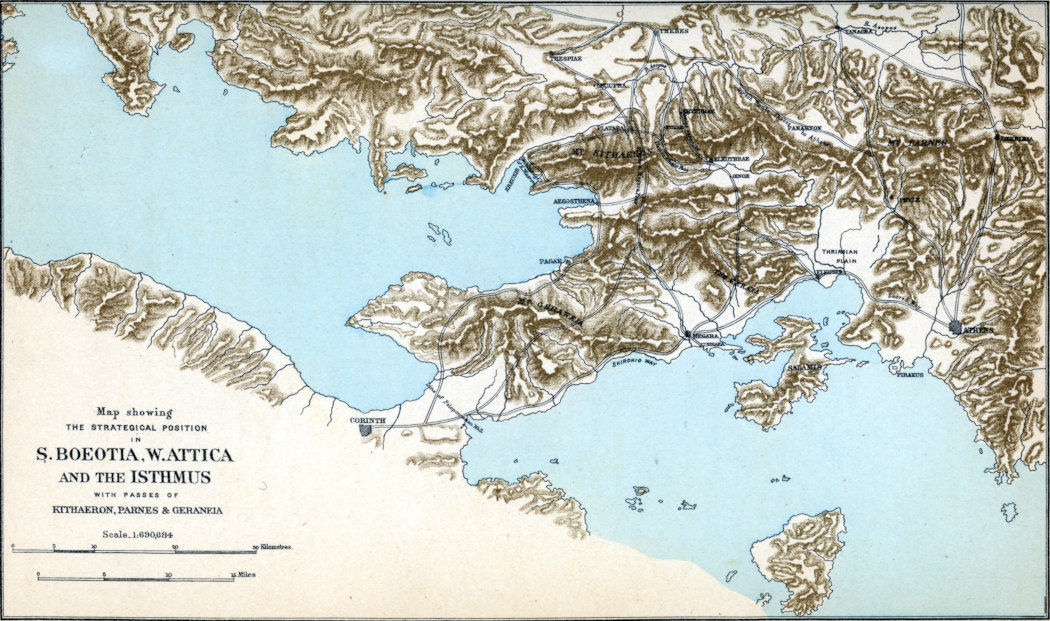
Map showing THE STRATEGICAL POSITION IN S. BOEOTIA, W. ATTICA AND THE ISTHMUS WITH PASSES OF KITHAERON, PARNES & GERANEIA
London: John Murray, Albemarle Street. Stanford’s Geographical Estabt. London.
Note on the Authorities for the Account of Salamis.
It is impossible to enter upon the description of the battle of Salamis without giving some short explanation of the views on the subject which the author has thought fit to adopt, since they differ fundamentally from those which are put forward in the best-known modern histories of Greece. The historians of the last generation do not seem to have recognized that the details of the battle as given by Herodotus present any difficulty of a serious character. His account was accepted as correct, against all other extant evidence on the subject, which was treated as either worthless or of inferior authority.
Apart from chance references in other writers, which are either mere commonplaces or historically valueless, the evidence available is supplied by four authors,—Æschylus, Herodotus, Diodorus, and Plutarch. Those who adopt Herodotus’ views regard the evidence of the other three authors as being, for various reasons, unreliable.
In the case of Æschylus, the obvious objection is that he was a poet, and that all the evidence he gives is contained in the “Persæ.” It cannot, of course, be denied that this objection would, from the historical point of view, be a very strong one, were Æschylus merely giving a poetical account of a most dramatic scene, the description of which he derived from others. But when it is remembered that the poet was actually present as a combatant on board the Greek fleet, it is manifest that his narrative, though cast in the poetical form, cannot be ignored by the historian. One element in it, at any rate, must be reckoned with: the stated facts of the author’s personal observation. These are, indeed, few in number, but it so happens that they are of very great importance; nor are they of a character such as might suggest that they had been modified in any way for dramatic purposes.
The evidence of Diodorus is ignored by modern authorities simply on the ground that that author is so notoriously unreliable. That such is the case, no one who knows his work would care to deny; but it is a fallacy to treat the whole of his work as unsound, and to say, as has been said by one eminent authority, that whenever the evidence of Herodotus and Diodorus respectively differs on any particular point, that of Herodotus is to be unhesitatingly preferred.
In the present case, Plutarch may, for the most part, be ignored. His evidence is secondhand of the secondhand; and most details given by him which are not found in any one of the three first-mentioned authorities are either unimportant, highly suspicious, or demonstrably wrong.
The rejection of Herodotus’ account of the tactics pursued by the two fleets rests on two grounds:—
(1) The evidence of the eye-witness Æschylus, which is quite irreconcileable with Herodotus’ description.
(2) Objections of a most important character which must suggest themselves to the mind of any one who has seen the strait, and might well be suggested to any one who possesses a reliable map of it.
In so far as I am aware, Professor Goodwin, in an article on “Salamis” in the Journal of the Archæological Institute of America, 1882–83, was the first to point out the serious difficulties involved, not, as he thought, in Herodotus’ account, but rather in the interpretation which later historians had put upon it.
As the main basis of his argument he enunciated the necessity of taking the evidence of Æschylus into serious consideration; he laid it down, indeed, that that evidence, in so far as it was plainly drawn from personal observation, must be regarded as superior in authority to any evidence on the same point contained in other extant descriptions of the fight. INTERPRETATION OF EVIDENCE. I venture to think that, in so doing, Professor Goodwin rendered a most important service to the study of a great chapter in Ancient History.
He further argued that the discrepancies between Æschylus and Herodotus are apparent and not real, and are due to a mistaken interpretation of Herodotus’ narrative.
It will be seen that I do not agree with the second part of Professor Goodwin’s proposition. My belief is that the modern historians have correctly interpreted Herodotus’ account; and that, so far as his evidence is concerned, the mistake is in the evidence, and not in the interpretation of it.
Though the detail must be reserved for discussion when the incidents of the fight come to be examined in detail, it may be convenient for the understanding of the problem involved, to give a brief sketch of the line of argument which will be followed.
It is generally agreed—in fact, the evidence is unanimous on this point—that the Persians drew up their fleet in some way so as to block the eastern end of the Salamis strait; though the way in which they did this is disputed. But the main points in dispute are:—
(1) As to the locality of the part of the other end of the strait which they blocked so as to prevent the Greek fleet from escaping, viz. whether it was the narrow portion of the eastern strait at the point where it enters the bay of Eleusis, or whether it was the strait between Salamis island and the Megarid coast.
(2) As to the position of the Persian fleet, especially at daybreak, on the morning of the battle.
The scheme of the battle given in nearly all the modern histories of Greece, represents the Persian fleet as drawn up on the morning of the battle along the Attic coast, from the narrows at the entrance of the bay of Eleusis almost to the mouth of Piræus harbour, while the Greek fleet is opposite, extending from a point some way north of the island of St. George almost to the end of Kynosura (vide Grote, etc.).
I notice that this scheme has been adhered to in various histories of Greece which are either new or have been re-edited since Professor Goodwin’s article was published.
The objections to it which Professor Goodwin urged seem to me so strong that I am surprised that the scheme is still adhered to by great authorities on Greek history. The reason for this adherence I have not seen stated in print I can only suppose that those who retain the old view reject wholly the version of Diodorus, where it differs from that of Herodotus, and would hold that the latter is not contradicted in any essential respect by the, for historical purposes, imperfect account of Æschylus. Professor Goodwin lays down the canon that on any detail which Æschylus does mention, he is the authority to be followed, because he was an eye-witness. He further seeks to reconcile Herodotus’ account with that of Æschylus, with the result that he reproduces a history of the battle which is in nearly all essential respects that of Diodorus.
The thesis which I propose to put forward is that we have in the tale of Salamis one of the rare cases in which Diodorus has either obtained better information than Herodotus or made better use of his information.
The arguments against the old scheme, of which the most convincing have been already stated by Professor Goodwin, are:—
Since the passage between Attica and Psyttaleia is one thousand three hundred yards wide;
And that between Ægaleos and Salamis one thousand five hundred yards;
And between Ægaleos and St George Island one thousand two hundred yards; i.e. the whole channel is very narrow;
(a) How could the Persian movement of cutting off be accomplished so secretly that the Greeks got no wind of it? (H. viii. 78; Plut Them. 12; Arist. 8.)
How could the Persians have slipped along the other side of the narrow strait in the night unperceived?
(b) Can we believe that the Greek fleet was allowed to form quietly in line of battle at the other side of this narrow strait, in the very face of the Persian fleet only a few hundred yards distant?
Surely the Persian fleet, being eager to capture the Greek fleet, would have seized the ships while the crews were preparing to embark.
(c) Æschylus, an eye-witness, testifies that it was only after the Greeks had rowed forward from their position that they were fairly seen by the Persians (Æsch Pers. 400).
(d) Æschylus, Pers. 443–466; H. viii. 76, 95; Plut. Aris. 9, concur in the statement that Xerxes landed a body of Persians on Psyttaleia, because he thought that it would be a central point of the sea-fight.
Such are Professor Goodwin’s objections to the old scheme.
NATURE OF ERROR IN HERODOTUS.
To the last I would add that Herodotus expressly describes the measures taken with regard to Psyttaleia as being synchronous with those for blocking the straits (viii. 76).
Of these objections:—
(a) is strong, as being Herodotus’ own evidence; and it is on Herodotus that the old scheme must rely. The passages quoted from Plutarch are, however, manifestly from the Herodotean source.
Objections (b), (c), (d) seem to me unanswerable. As I read the narrative, the old scheme of Grote and others cannot stand in face of them.
In so far as my experience goes, I think that it may be demonstrated that Herodotus’ mistakes, in his military history generally, arise almost wholly from—
(1) Misreading of sources.
(2) Use of defective or mistaken sources; not from the invention of imaginary facts.
His painful conscientiousness seems to be genuine, not fictitious. But, eminently unmilitary himself, he was peculiarly liable to misunderstand the information at his disposal with regard to military matters; and this, as it seems to me, is exactly what has happened with regard to his account of Salamis, and in the following way:—
It is, of course, a commonplace of criticism to say that Herodotus gives us no account of the general movements or manœuvres of the two fleets on the actual day of the battle, save that he mentions that the Æginetan vessels fell on the Phœnician ships which the Athenians put to flight. What I may call the enunciation of my proposition is this:—
This failure of information in this part of his narrative is due to the fact that he had already, in the previous part of it, used up his information on this point.
He antedated a movement made on the night preceding the battle to the previous afternoon, and further antedated the movements in the battle itself to the night preceding the battle.
It is curious and noticeable that, when this correction is made in Herodotus’ dating, and in the mistaken accounts of movements which the chronological error entailed, there is so close a resemblance between the narratives of Herodotus and Diodorus that they may be suspected of having been derived from sources which, if not absolutely identical, were close in similarity.
The fleet of Xerxes was now at Phaleron, in the bay lying east of the peninsula on which stood the town of Piræus. After spending three days at Histiæa, subsequent to the departure of the army from Thermopylæ, it had taken three days more to reach Phaleron. It is probable, therefore, that it arrived there shortly before the army reached Attic territory. Herodotus is of opinion that, despite the losses at the Sepiad strand, at Thermopylæ, at Artemisium, and in the Hollows of Eubœa, the net strength of the land and sea forces was, owing to the accession of reinforcements, not less than before these losses were incurred. For the numbers of the land forces he makes out something resembling a case. It is probable that the addition of the full contingents of Dorians and Locrians, and of all the Bœotians, except the Platæans and Thespians, largely, if not entirely, compensated for the losses suffered at Thermopylæ, great as they had been. But that the naval contingents of Karystos, Andros, Tenos, and the other islands, can have in any sensible measure compensated for the losses suffered at Sepias, Artemisium, and the Hollows of Eubœa, is plainly absurd. Herodotus has evidently, in his desire to magnify the force opposed to the Greeks at Salamis, forgotten the enormity of the losses he represents the Persians to have suffered in the two storms.
H. viii. 67–69.
It is difficult to say how much truth there is in the account given of the Persian Council of War held before Salamis. It could hardly be treated as serious history, were it not that Artemisia, a countrywoman of Herodotus, is represented as having been present on the occasion, and as having taken a prominent part in the discussion. She alone advised against the attack; but her reported speech is so noticeably marked by knowledge after the event, that much of the matter of it cannot be regarded as genuine. At the same time, it is plain that Herodotus did obtain from her, either directly or indirectly, details, whether true or false, both of what happened at this meeting, and of many personal incidents in the coming battle; and despite the exultation with which he chronicles the Greek victory, he is evidently anxious to record the wisdom of the queen of his native city.
DESCRIPTION OF THE STRAIT.
The theatre of the impending operations was the channel between Salamis island and the mainland of Attica, or, rather, that eastern part of it which stretches from the harbour of Piræus to the sharp bend which the strait makes beyond Salamis town. After rounding the promontory of Piræus, a fleet entering the strait would sail nearly due north. The island of Psyttaleia lies across the entrance, and being of considerable size (nearly three-quarters of a mile in length), greatly detracts from the width of the channel, dividing it into two, the western arm, between the elongated rocky promontory of Kynosura and the island, being exactly half a mile wide, the eastern, between the island and the mainland of Attica, being slightly more than three-quarters of a mile in width. After passing Psyttaleia the channel turns west at right angles, and now runs between Kynosura and Mount Ægaleos, with a width of about two thousand yards, contracting opposite the site of the ancient town of Salamis to a width of about thirteen hundred and fifty yards. The strait then once more turns at right angles, and goes due north to the bay of Eleusis, the fairway being blocked by the island of St. George, where it is only twelve hundred yards in width on the side towards Attica. Just before entering the bay of Eleusis it once more contracts to the width of slightly more than fourteen hundred yards. Taking a line down the centre of the channel, the distance from Psyttaleia to the narrows of old Salamis is two miles and a half, and from the latter point to the narrows at the entrance of the bay of Eleusis about a mile and three-quarters. The scenery in the strait is beautiful. Looking from the mainland of Attica north of Piræus harbour along the arm of the channel which goes westward, the deep blue of the water is contrasted with the brilliant yellows, reds, and browns of the somewhat fantastically shaped hills of Salamis; while on the right the pine woods of Ægaleos add a mingled dark and brilliant light green to the colouring of the picture. Behind the hills of Salamis the grey hump of Geraneia upon the Isthmus rises high into the air.
From Ægaleos, the view southward towards Psyttaleia is somewhat different in character. The island, which rises to a considerable height out of the water, occupies the central part of the middle distance. The easternmost of the two channels is seen at its full width. Piræus is in sight, and away behind it the somewhat featureless shore of South Attica stretches into an apparent infinity towards Sunium. The channel to the west of the island appears greatly contracted, because Kynosura, with its serrated back, almost overlaps the west end of Psyttaleia. Behind Kynosura rise the hills of South Salamis; and in the far background the hills of Ægina are in sight. Such is the scene of the great battle, as it shows itself in the present day.
H. viii. 63.
The effect of Themistocles’ speech at the Council of War was to persuade Eurybiades of the absolute necessity of remaining at Salamis. Herodotus believes, [probably rightly,] that the threatened defection of the Athenian fleet was what decided him to change the determination to which the previous Council of War had come; and, if Herodotus’ language is to be taken as it stands, the decision was his own. There is no mention of any further voting on the question. This decision seems to have been taken on the day but one preceding the battle.
The position on the evening of that day was that the Persian fleet was at Phaleron, while the Greek fleet lay at Salamis.
From the historical point of view, the critical point in the various parallel accounts of the battle is the description of the events of the next day, the eve of the great fight.
H. viii. 64.
At sunrise an earthquake occurred which was felt both by land and sea. The Greeks determined, in consequence of it, to summon the sacred heroes, the Æacidæ, to their aid, and despatched a ship to Ægina to fetch their images, which were deposited in that island. Other ominous events, less credible than the earthquake, are reported to have taken place at this time.
H. viii. 70.
It is to this day that Herodotus ascribes the first movement of the Persian fleet from Phaleron towards the mouth of the strait. He says that it put out towards Salamis, but that the day was too far spent for it to attempt to engage the Greek fleet before nightfall. THE MESSAGE OF THEMISTOCLES. It must be concluded, therefore, that he attributes this movement to the late afternoon. It seems highly probable that the very serious difficulties which are raised by the later part of his narrative of the movements preceding the battle are originally due to his mistiming of this movement. Cf. H. viii. 75. He represents it as having been made before Xerxes received Themistocles’ message to the effect that the Greeks intended to fly, and, therefore, as not being in any way causally connected with that message. On this point his evidence is in conflict with that of Æschylus and Diodorus.
Æsch. Pers. 357, ff.
Æschylus’ account is, in brief, as follows: A message came to Xerxes from the Greek fleet, and told him that the Greeks would, during the night, disperse and seek safety in flight. Xerxes, failing to discern the crafty nature of the message, ordered his captains, when night came, to range the fleet in three lines, and “to guard the exits and the roaring firths.” Furthermore, ships were ordered to make the circuit of the “Island of Ajax,” so as to cut off the Greek retreat.
Æschylus evidently attributes the Persian movement to the receipt of this message. But the most important point in his narrative is that he attributes this first Persian movement to the night preceding the battle, and not to the afternoon of the previous day. Had it taken place on the afternoon of that day, as Herodotus alleges, those on board the Greek fleet must have known of it. The movement of the whole Persian fleet to the mouth of the strait could not have remained a secret to the Greeks at Salamis, less than three miles from its entrance.
To return to the message: Æschylus describes Xerxes as giving his orders immediately on receipt of it, but bidding his officers wait till nightfall. This raises a certain amount of probability that the receipt of the message is to be dated to the late afternoon. H. viii. 75, 76. Furthermore, this very time of the despatch of the message is indicated in Herodotus’ account.
The circumstances under which it was sent are as follows: Eurybiades’ decision had been taken on the previous day. It seems, as has been already pointed out, as if the decision had been his own. If so, it is not surprising that there should have been a considerable amount of dissatisfaction existent among those commanders of contingents whose opinions he had ignored.158 H. viii. 74. They were anxious for the safety of the Isthmus, and not without reason; H. viii. 70. for Herodotus states that a few hours after this time, during the ensuing night, the Persian army started on its march thither.
Another Council of War assembled. It was no longer proposed that the whole fleet should sail away to the Isthmus; that proposition, in view of the attitude taken up by the Athenians, could have had no real effect if carried, and the decision of the council was apparently that the Athenian, Megarean, and Æginetan contingents should remain at Salamis, while the remainder of the fleet went to the Isthmus. This, had it ever been carried out, could not have failed to be absolutely disastrous to the Greek cause; nothing, under the circumstances, could have been more fatal than the division of the Greek fleet at this crisis of affairs. Though no such decision is mentioned by Æschylus or Diodorus, there is every probability that the story is founded upon fact. Diodorus’ evidence as to the extreme state of panic which prevailed in the fleet at this moment is just as emphatic as that of Herodotus.
There can be little doubt that the design of the Peloponnesians was to transfer themselves from the sea to the land defence. H. viii. 71. For months past they had been fortifying the Isthmus, and by this time they had brought their defensive works practically to a state of completion, for they had employed large numbers of workers, and the toil had been continuous, day and night. They had also taken measures to render impassable the Skironid way, that most difficult coast road, which ran along a mere shelf of the precipices of Geraneia above the Saronic gulf. Why, instead of walling the Isthmus, they did not, after blocking the Skironid way, provide for the defence of the two other very difficult passes by which alone Geraneia could be traversed, it is impossible to say. THE PELOPONNESIANS. It may be that their own notorious incompetence in attacking artificial fortifications led them to over-estimate the effectiveness of this form of defence.
Diodorus mentions that the wall ran from Lechæum to Cenchrea, and that it was forty stades, or between four and a half and five miles, in length. That such a work would require a very large number of men for its effective defence in those days of short-range missiles and close fighting is evident. Still, the numbers requisite might have been supplied, had all the Peloponnesian states furnished contingents, and had not part of the available forces of those who did come forward been engaged on board the fleet. Argos and Achaia were unrepresented; and if so low a number as one hundred and fifty be taken as the average crew of each of the triremes furnished by the Peloponnesians, more than thirteen thousand of their men were, for the time being, not available at the Isthmus. It is highly probable the predominant feeling among the Peloponnesian members of the fleet at Salamis was one of extreme anxiety as to whether the force available with Kleombrotos at the wall was sufficient to defend works so extensive.
Of the three main authorities for the incidents of this time, it is Herodotus who gives the message of Themistocles in its fullest form. His account is that, on finding the majority in the last Council of War against him, Themistocles went quietly away and despatched a message to Xerxes.159 Sikinnos was the name of the messenger, so he says—a slave of Themistocles, and tutor to his son.160 Æschylus merely says that he was a Greek, and Diodorus does not mention his name or quality.
It is interesting to note the terms of the message. It represents the sender as being desirous for the success of the Persians. It then proceeds to give two reasons why the king should attack immediately: (1) because otherwise the Greek fleet would disperse; (2) because, in case of the Persian attack, a section of the fleet whose views coincided with those of the sender would attack the other. Diod xi. 17. Diodorus gives a brief account of the matter, and only mentions the first of the two reasons.
The terms of the message must not be taken to indicate the motives of the sender, other than his desire to induce the Persian to attack without delay.
A very little consideration will show that the reasons urged in it are not necessarily, either in whole or in part, identical with those private motives which led to its being sent. Still, no Greek who knew his countrymen at that time could have much doubt that the Persian authorities would be kept fairly well informed of the main currents of feeling in the Greek fleet. They must, for example, have been perfectly well aware of the dissensions with regard to the place at which the invasion should be resisted; and this knowledge alone would render Xerxes and his advisers liable to credit the plausible but exaggerated statement with reference to the length to which those dissensions had gone. It is purely an accident that the first reason stated in the message conveyed little more than the truth. Two dangers threatened the strategy which had kept the fleet at Salamis: (1) the secession of the Peloponnesian contingent; (2) the advance of the Persian fleet, or even of a part of it, to the Isthmus, without risking an engagement in the narrows. There is absolutely no reason why it should not have gone there as a whole. The Greek fleet could not have remained at Salamis had it done so, and would have been forced to fight at a comparative disadvantage in the open. The ultimate result might not have been different; but it would have been infinitely more uncertain. Both strategical dangers were avoided, if only the Persians could be persuaded to fight; and the long-headed Athenian had wit enough to hold out to Xerxes the two inducements which would have most weight with him,—the prospect of the capture of the Greek fleet, and the desirability of striking while the dissension in it was at its height.
PERSIAN MOVEMENT TO THE STRAIT.
Xerxes fell into the trap laid for him, and modified his plans accordingly. For the successful accomplishment of the new Persian design three conditions were necessary:—the action must be prompt; it must be secret; the blocking of the eastern and western channels of Salamis strait must be carried out simultaneously. Even were there not more conclusive reasons for rejecting the time of the movement of the Persian fleet to the eastern strait as given by Herodotus, the fact that it would have conspicuously failed to fulfil the two most important of these evident conditions would render the accuracy of his statement a matter for serious consideration.
But this does not afford any reason for rejecting Herodotus’ evidence as to the nature of the movement. His description of it clearly identifies it with part of the movement which Æschylus and Diodorus attribute to the night preceding the battle. The identity is further confirmed by the fact that in all three historians no previous movement on the part of the Persian fleet at Phaleron is mentioned. H. viii. 70. Herodotus says that the Persian fleet, on being ordered to put out from Phaleron, sailed towards Salamis, and quietly took up its order in its various divisions.
Æsch Pers. 366, ff.
Æschylus says that Xerxes’ orders were that the fleet should put out after nightfall, and that “the close array of ships should be drawn up in three ranks to guard the exits of the straits and the roaring firths,” while others should circumnavigate the “Island of Ajax,” so as to close that line of retreat to the Greek fleet.
Diodorus is practically in agreement with Æschylus in so far as the latter goes. Diod xi. 17. The king, he says, placed credence in the message which he had received, and hastened to prevent the naval forces of the Greeks from getting near the land army. He therefore immediately despatched the Egyptian contingent, ordering it to block the passage between Salamis and the Megarid.161 Cf. Plut. Them. 12. The rest of the ships he sent towards Salamis, ordering them to attack the enemy, and decide the struggle by a naval battle.
It is clear, then, that neither Æschylus nor Diodorus has any mention of a movement of the Persian fleet from Phaleron until after the receipt of Themistocles’ message; and Æschylus expressly states that the movement to the east end of the strait was made after the fall of night. Plut. Them. 12. As has been already pointed out, if it had been made during the daytime, the Greeks on board the fleet, among whom was Æschylus, could not have failed to know of it.
Plutarch, though unreliable as an independent witness, is in agreement with Æschylus and Diodorus as to the Persian movement being subsequent to the receipt of Themistocles’ message.
In connection with the blocking of the eastern strait an important measure was taken. H. viii. 76. Persian troops were landed on the island of Psyttaleia. Herodotus describes this as being subsequent to the receipt of Themistocles’ message. Æsch. Pers. 452. Both he and Æschylus say that the measure was taken in order that the troops there might save such Persians and destroy such Greeks as were driven on to it in the stress of the battle.
For some reason, then, the Persian commanders supposed that the island would play a prominent part in the battle as designed by them. It is impossible that they could have held any supposition of the kind, had their plan of attack been such as is described in Herodotus, for in that case the battle must have taken place several miles away up the strait.
Note on the Movement of the Persian Fleet on the Night before the Battle, as described by Herodotus.
Before taking the historian’s account into consideration, it is necessary to realize, in so far as possible, the exact nature of the difficulties in which, as a historian, he was involved by his mistiming of the Persian movement from Phaleron. He had failed to connect the movement to the east end of the strait with Themistocles’ message. Despite this, he seems to be aware that the Persians did make a movement in the night in consequence of the receipt of that message, and that part of that movement consisted in closing the western channel,—at some point or other near Salamis, he is led to think. He is also aware that this movement during the night, including the blocking of the western strait, was made after, and in consequence of, the receipt of Themistocles’ message. He had already, without knowing it, exhausted his sources of information with regard to the major part of this night-advance. What those sources of information were, it is impossible to say. The probability is that, in the form in which he used them in composing this chapter of his history, they were of a written kind,—possibly notes he had himself made on the subject of the battle, taken years before from the verbal description of one who was present at it.
Turning to his notes to seek for details of this night-movement, he would, under the circumstances, suppose, naturally enough, that the movements indicated in them as succeeding the movement he had already described, were those made by the Persian fleet in the night. Two pieces of evidence support this conjecture:—
(1) In spite of the confusion of his description, arising from the misapplication of his information, it is possible to identify the movements which he attributes to the fleet during the night with the movements of the fleet in the actual battle, in so far as they are indicated from other sources.
(2) The complete absence in his account of the actual battle of any details of the general movements of the fleets is accounted for, if, as is suggested, he had misapplied the information which he possessed on this point,—if he had, in fact, used it up beforehand.
His description of this night-movement is given in the following words
“When midnight arrived, the west wing put out and made a turning movement towards Salamis; and those about Keos and Kynosura put out in order, and occupied the whole strait as far as Munychia with their ships. The object of these movements was to rob the Greeks of the possibility of retreat, so that vengeance might be taken upon them when cut off in Salamis for the battles fought near Artemisium.”
H. viii. 76.
He then recurs to the occupation of Psyttaleia.
“Persians were disembarked on the island called Psyttaleia, in order that, when the battle took place, as the damaged vessels and their crews would be for the most part carried in that direction (for the island lay in the line of the approaching sea-fight), they might save their friends and destroy their foes.
“These measures they carried out quietly, so that the enemy might not get wind of them.”
Any attempt to apply this description to the movement made on the night preceding the battle renders the passage absolutely incomprehensible. No useful end can be gained by discussing the difficulties at length. It will be sufficient to point them out, in order to make their insoluble character quite clear.
(1) What does Herodotus mean by the “west wing” of the Persian fleet? He distinguishes it from the ships about Keos and Kynosura. Where were their positions? Keos is not identifiable. Some suppose it to be an alternative name for Kynosura. But of the identity of the latter there can be no doubt. It is certainly the long narrow “dog’s tail” of a peninsula to the west of Psyttaleia, jutting out from the island of Salamis. There is an exactly similar peninsula at Marathon, which was called by the same name. This being so, the ships about Kynosura could only be the west wing of the fleet! How, then, does the distinction arise in Herodotus?
(2) This “west wing” put out towards Salamis with intent, according to Herodotus’ language in the next sentence, to prevent the Greeks from escaping by the western strait. If so, they must have occupied the narrows either at or just north of the island of St. George.
How did they get there unknown to the Greek fleet of over three hundred vessels on the other side of the narrow strait, which, as has been pointed out, contracts to a width of about three-quarters of a mile opposite to old Salamis town? Could such a movement on the part of a large body of ships have escaped their notice, even under the highly improbable supposition that they had taken no precaution whatever to prevent surprise? THE NIGHT BEFORE THE BATTLE. Is it conceivable that the commanders who had at the time of Artemisium sent scouting vessels up the Thessalian coast, and inaugurated a signalling system which extended probably from Skiathos to South Eubœa, would have allowed the fleet to lie at Salamis without placing sentinel vessels to observe the straits in their immediate neighbourhood?
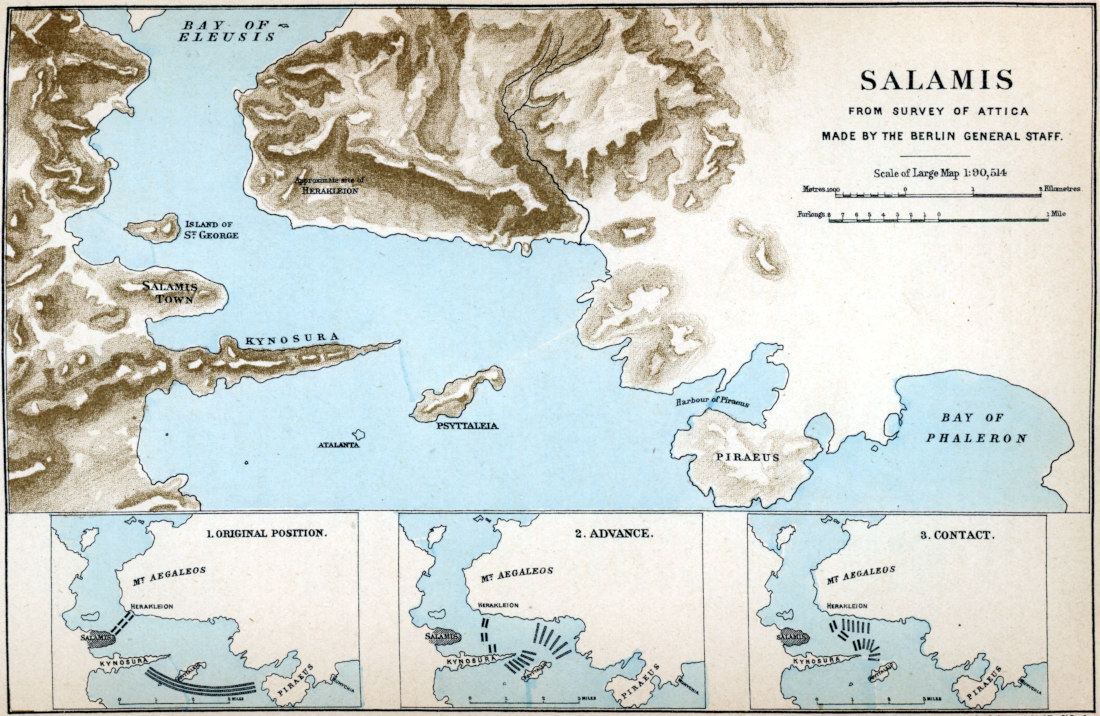
SALAMIS FROM THE SURVEY OF ATTICA MADE BY THE BERLIN GENERAL STAFF.
London: John Murray, Albemarle Street. Stanford’s Geographical Estabt. London.
(3) What did Herodotus suppose to be the position of the rest of the fleet which held “all the strait as far as Munychia”?
Attempts have been made to argue that his language with regard to the movement of ships “about Keos and Kynosura” refers to a blocking of the strait at about the line of which Psyttaleia was the centre. The object of this argument is, manifestly, to bring Herodotus into agreement with Æschylus and Diodorus.
But can this interpretation of his description be maintained, when it is remembered that Herodotus has already described a movement as having taken place the previous afternoon with a view to blocking the strait at that point? Again, Herodotus mentions Munychia as one end of the line of ships, and evidently implies that at the other end it came in contact with the ships which had been sent πρὸς τὴν Σαλαμῖνα to block the western exit at the narrows before the bay of Eleusis. In other words, it seems impossible to doubt that the interpretation which Grote and others have put upon his description of the position taken up by the Persian fleet on the night before the battle is perfectly correct. It stretched in a long line (κατεῖχόν πάντα τὸν πορθμὸν), from the bend of the strait at the end of Mount Ægaleos, along the shore of Attica to Munychia. This interpretation is furthermore overwhelmingly supported by his language in chapter 85, when he says:—
“Opposite to the Athenians were the Phœnicians, for these occupied the wing on the side of Eleusis and the west. Over against the Lacedæmonians were the Ionians. These occupied the wing towards the east and the Piræus.”
The acceptance of this plan of the battle involves several difficulties which are of a very serious character. If such was the position of the Persian fleet,—
(1) How can Xerxes have supposed, as both Herodotus and Æschylus assert he did, that the island of Psyttaleia would play a prominent part in the battle?
(2) How can a movement on such a scale have been carried out during the night, unknown to the Greek fleet on the opposite side of the narrow strait? Any one who has been to Salamis can only give one answer to this question.
(3) What possible protection on either flank would the narrow seaway have afforded to the Greek fleet when advancing to meet the Persians in this position? It must have been outflanked.
How, then, did it come to pass that in after-time the success at Salamis was ascribed to Themistocles’ strategy, and this not merely in the tradition of the battle, but by the commanders who actually fought there? The success of that strategy was absolutely dependent on the narrowness of the possible front of the fighting line.
(4) If such were the position of the two fleets when the fatal morning dawned, they must have been in full view of one another, at a distance of a few hundred yards, across the narrow strait.
Æsch. Pers. 400.
If so, how is it that the evidence of the eye-witness Æschylus is utterly at variance with such a supposition?
It is really only possible to come to one conclusion on the subject. As a description of the movement made in the night by the Persian fleet, this passage in Herodotus is wholly mistaken. He has almost certainly used in his description notes of the movements of the fleet made in the actual battle, for the very good reason that he had previously used his notes of the night-movement in describing a movement which he supposed to have taken place on the previous afternoon. Either he did not possess or he overlooked any note which he had made on the blocking of the western strait; and in order to describe what he knew to have taken place, as his reference to the arrival of Aristides shows, he stretched what was probably only a note on the advance of the Persian right wing in the battle, such as actually took place, as is known from other evidence, into an advance of that wing so far as the narrows by the island of St. George.
It is now possible to hazard a conjecture as to what he means by the “west wing” in his description of the movement. It is probable that when he used this term he had in his mind the position of the fleet as he supposed it to be, not when the movement started, but when the movement was complete; and it is noticeable that in chapter 85 he expressly speaks of the wing which would be the eastern wing in the original position, as the western wing.
THE MORNING OF THE BATTLE.
Occasion will be taken in discussing the details of the actual battle to point out how nearly Herodotus’ description of the movement during the night, when this exaggerated advance of the Persian right wing has been eliminated, coincides with such evidence as is extant elsewhere on the movements in the actual battle.
The movement of the Persian fleet seems not to have been completed until shortly before dawn on the day of the battle. Its position at that time appears to have been: (1) the main body was drawn up in a line across the eastern strait, blocking the channels on either side of Psyttaleia; while that island, between or in front of the bodies of ships at either side, was occupied by Persian troops;162 (2) the western channel between Salamis island and the Megarid was occupied by the two hundred vessels of the Egyptian squadron. The fairway in this channel is quite narrow, as the depth of water on either side of it is not sufficient to admit of the passage of even the shallow-draught trireme. The Egyptian squadron would therefore be sufficiently numerous to block it effectively, though the distance of this part of the strait from the scene of the battle must have precluded all idea of the ships posted there taking part in the actual fight. The Persians thought, no doubt, that by sheer weight of numbers they would be able to force the enemy’s fleet into the bay of Eleusis, and so into the clutches of the blockading squadron.
H. will 78.
During the earlier part of the night, the Greek commanders, unaware of the Persian movement, continued to dispute on the question of the policy to be pursued. Themistocles must have known by that time that his message had had its effect; but, until the western passage was blocked, there was always the possibility of his plan turning out a failure. It may well be that he fomented this “wrangle,” as Herodotus calls it, in order to gain time. There is a partial conflict of evidence between Herodotus and Diodorus as to the means by which the news of the encircling movement was conveyed to the Greek camp. Diod. xi. 17. Diodorus says that a messenger sent by the Ionian Greeks announced the fact. Herodotus, on the other hand, says that the celebrated Aristides, who now for the first time appears on the stage of his history, arrived from Ægina with the news. The tale is a somewhat dramatic one, for the appreciation of which it is necessary to gather together the fragmentary evidence which is available as to the last few preceding years in the life of this famous Athenian statesman.
Herodotus’ introduction of him is brief, and certainly inadequate for a true comprehension of his actual position at this critical time. He speaks of his character in terms of the highest praise: “After inquiring into the character of this man, I am disposed to think that he was the best and most righteous man in Athens,”—a judgment which the unanimous verdict of his own and after-time confirmed. But of his previous career he says but little: he had been ostracized by the people, and he was an enemy of Themistocles. There is no mention of this ostracism having been withdrawn.