LOUISE S. McGEHEE SCHOOL 2343 Prytania Street
Reading edition
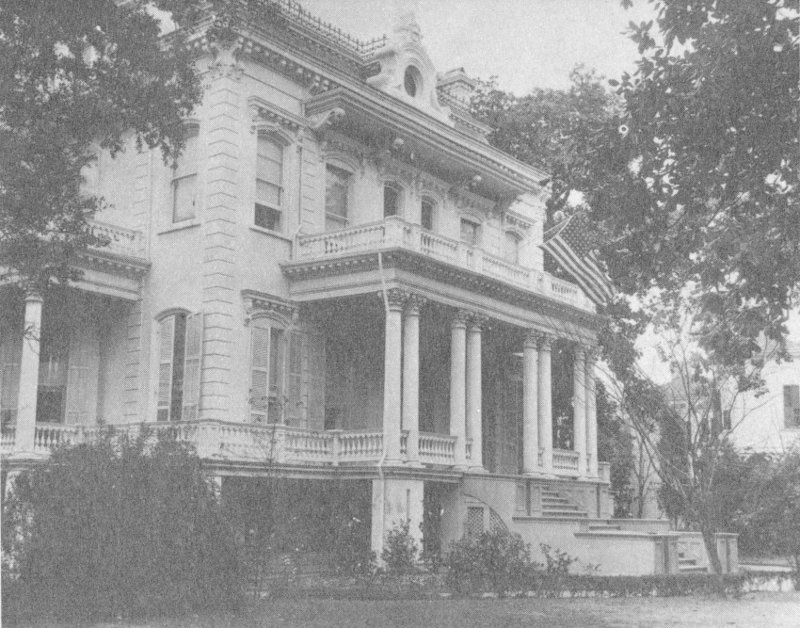
The Main Building
Formerly one of the most lavish private homes in the Garden District, this mansion now serves as the main building of the Louise S. McGehee School, for almost half a century one of the outstanding private schools for girls in the South. Amid architectural surroundings which bespeak a bygone age of leisure, work and study now prevail as the students pursue their exacting college preparatory curriculum.
Designed in the splendid free Renaissance style by James Freret, the mansion was constructed in 1872 for Bradish Johnson, a young man of wealth and discrimination whose family fortune was based on sugar plantations. Its erection marked the second great period of affluence for the Garden District. According to tradition it was built at a cost of one hundred thousand dollars and its furnishings were as lavish as the house itself. Always beautifully maintained by the Johnsons and the Walter Denègre family, its later owners, the architectural features of the building have been carefully preserved by the school corporation. Of undiminished loveliness are the fluted Corinthian columns, lofty ceilings and elaborate moldings embellished with classical motifs. An outstanding feature of the building is the winding staircase which rises at the rear of the marble-floored entrance hall. This stairway of unsurpassed beauty has been frequently honored as a masterpiece of design and craftsmanship.
A curious fact about the building is that neither a marriage, a birth, nor a death has ever taken place within its walls. However, since its acquisition by McGehee school in 1929 it has been the scene of many scholastic triumphs. The school features an honor system and 28 student self government, the first high school in the city to establish this type of government. Nearly all of the school’s graduates have gone to college and most of the alumnae are active in civic affairs.
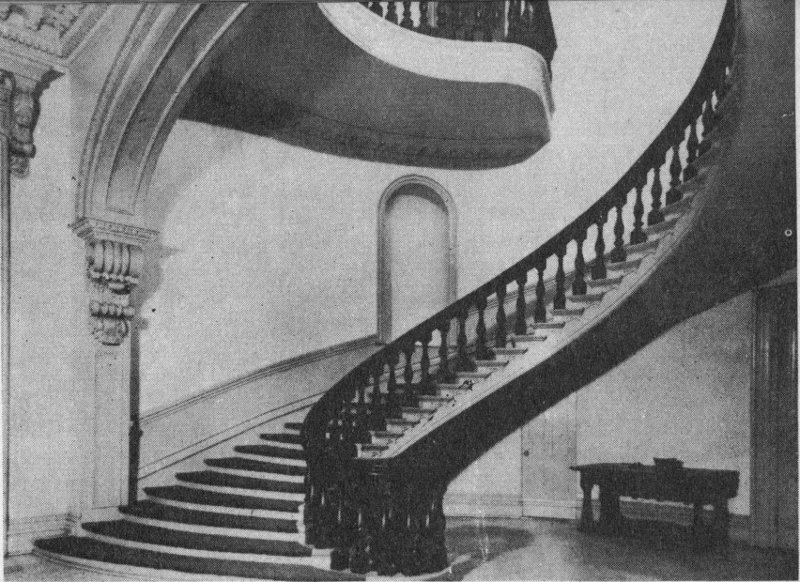
Magnificent spiral staircase in marble-floored central hall of former Bradish Johnson mansion has mahogany railing, stained glass skylight. Johnson fortune was based on large sugar plantations. City house was showplace.
A stroll around the grounds on the First Street side gives a good view of the former servants’ wing, which extends to the rear, looking today much as it did when the house was new. The beautiful grounds are particularly lovely in the spring when myriads of azaleas are in bloom as well as the large wisteria vine which drapes the arch of the front gate. Aged and majestic are the many magnolia trees, the largest of which some years ago was declared by E. H. Sargent, then curator of the Arnold Arboretum, to be the most magnificent specimen of magnolia grandiflora in the United States.
Provision for fine private education for girls has long been a tradition in the Garden District. By a strange coincidence, three of the earlier schools were within the immediate neighborhood of what is now McGehee School, and one of these was on the very spot.
In 1853 the Reverend William Duncan, later a professor of Greek and Latin at the University of Louisiana, opened the Young Ladies’ Seminary on the corner of Jackson and Prytania Streets. The seminary offered what was for that time quite an impressive curriculum in languages, arts and physical sciences.
Little is known today about the Carnatz Institute, a “fashionable academy for young ladies”, which in the 1860’s occupied a substantial brick cottage on the present site of McGehee School. This corner of First and Prytania streets had been one of the first settled in this part of Lafayette. Here Charles Conrad, one of a prominent family of lawyers, had his cottage. Nearby were the houses of Alfred T. and Frank Conrad, also barristers. Sometime later General W. R. Miles was said to have owned the Conrad house which subsequently became the Carnatz Institute. In addition to day students this school attracted 29 boarding students from Mississippi, Alabama and Texas. The Institute was advertised as having a “healthy and secluded location with spacious rooms and shaded grounds.” It is not known whether the academy moved or was disbanded when Bradish Johnson bought the property and removed the old house to make way for his new mansion.
Of more recent vintage was the school of Mrs. Francis D. Blake which was located in a large gray house, now demolished, on the downtown lake corner of Prytania and Philip Streets. Mrs. Blake, a daughter of the famous Bishop Leonidas Polk, was assisted in running the school by her sister, Mrs. Lucia Chapman. This school of Sally Polk Blake is of more than passing interest because in the last years of the school the English teacher was the youthful Miss Louise Schaumburg McGehee. When the doors of Mrs. Blake’s were closed, parents of undergraduates asked Miss McGehee if she would undertake to run a school for their daughters.
In 1912 Miss McGehee began her school in a small cottage on Louisiana Avenue near St. Charles. The following year the school moved to more commodious quarters at 1439 Louisiana Avenue. Assuming corporate status in 1929, the school purchased the Johnson-Denègre house and moved to its present location. The carriage house of this mansion was converted into a gymnasium and the stable into a cafeteria.
A program of growth and expansion was undertaken in 1953-54 with the construction of a new building containing elementary classrooms and an assembly room. By 1960 McGehee School had acquired adjoining properties which complete the school’s ownership of the entire Prytania Street frontage on the lake side of the 2300 block. Plans begun in that year call for the construction of a lower elementary building, new cafeteria and gymnasium and a studio-laboratory wing to the upper school building. This project will be financed by a drive for capital funds, launched in 1961.
During its history, McGehee’s has seen changes not only in its physical plant but also in its organizational structure. In 1937 the school was re-incorporated as a non-profit institution, which status it has today.
30