BRYAN BELL HOUSE 1331 Third Street
Reading edition
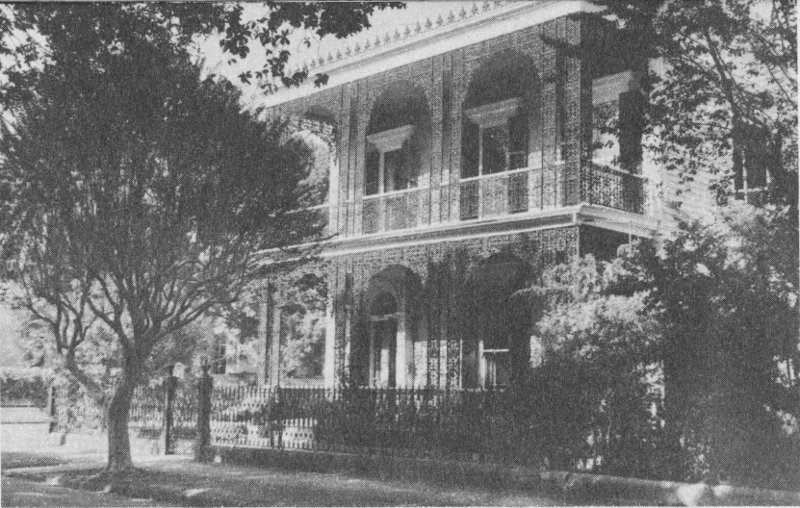
Iron lace, delicate but dramatic, casting lovely shadows across the façade of the Bell house, has made this a favorite “shot” for photographers, both amateur and professional. These cast iron galleries, often called the finest in the city, make the house eye-catching, but locally it is also famous for its associations with the New Orleans family of the French painter Edgar Degas.
In 1850 Michel Musson, a prominent cotton merchant and postmaster of New Orleans from 1849 to 1853, purchased the site and is said to have commissioned James Gallier, Sr., to design his dwelling. Construction was soon completed on this interpretation in wood of a formal Italian villa, as its style has been defined by Samuel Wilson, Jr., local architectural historian. Certainly in those days the designation would have been more appropriate than now, the famous ironwork having been added in 1884. The original Gallier plan had two bay windows on the front, similar to one on the garden side of the house, with canopies such as are on the Coliseum Street side protecting the upper windows. The bracketed overhang of the roof on both sides is Italianate in feeling.
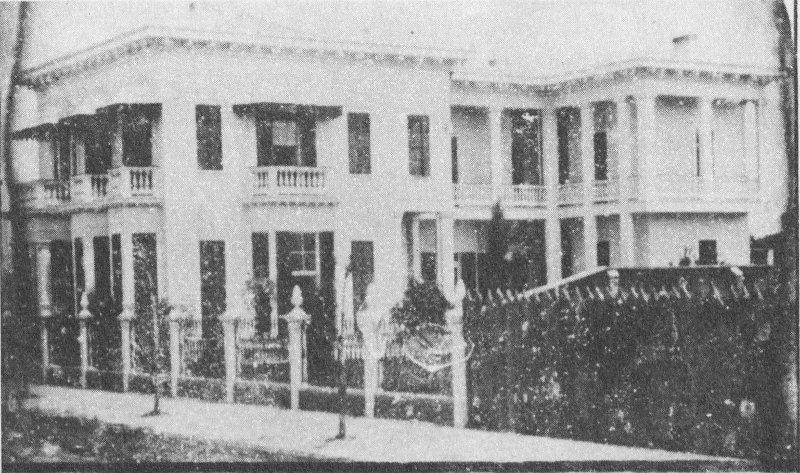
Rare daguerreotype shows Bell house before grillwork was added. Mansion had Italian villa influence, bay windows, shaped canopies.
41
In 1869 the house was sold to James Buckner, who in turn sold it in 1884 to Charles M. Whitney. In addition to altering the front of the house, Whitney also added the Victorian stables which are still preserved complete with brass name plates on the former stalls of his favorite horses, Momus, Comus and Twenty-one. The last was named for a favorite riverboat gambling game. At the rear of the property is a garçonnière (literally “house of the boys”) which is original, as is the ornamental iron fence.
The house is now the property of Mr. and Mrs. Bryan Bell who have furnished it with an excellent collection of antiques and paintings.
As a visitor enters the house, he is at once captivated by the graceful curved stairs, typical of Gallier’s work. This is of the unsupported or free-hanging type. Throughout the house, woodwork of door and window frames is of the famous neo-classic design, popularly called the “keyhole design”, which owes its inspiration to the vogue for Egyptian styles which followed Napoleon’s campaigns in that country. The lovely living room cornices are of plaster, set out from the wall at a slight angle with an openwork design which gives them the local name of “double transparencies”. The wide board floors are heart of pine, sun-cured instead of kiln-dried which gave great durability to the wood.
Lovers of the unusual are always fascinated by the handcarved teakwood mantel in the living room. Added by the Whitneys, it has a secret compartment on either side.
An unusual feature of the house is the huge dining room, which, despite its twin mantels, was always a single room. The large Musson family and the many friends they entertained dictated a dining room of tremendous proportions. The identical bronze chandeliers were originally for gas but later were wired for electricity. Mrs. Whitney, however, not fully trusting the new-fangled electricity, prudently had only half the arms wired. The rest she kept for gas “just in case”.
The spacious side garden of the Bell home uses many typical Southern materials bordering a wide sweep of green lawn. The towering palm is a species of date palm tree. On the trellises by the house are Carolina jasmine (Gelsemium sempervirens) vines. At the corner of the house is a large golden dewdrop (Duranta repens), a showy shrub which has bright yellow berries and racemes of small lilac flowers, frequently at the same time. Near this spot is a Lady Banksia rose (Rosa Banksiae), for many years a New Orleans springtime favorite. In summer the famous “Whitney pink” oleanders are especially striking. This variety was propagated by Mrs. Whitney’s gardener and is now one of the most popular in the Crescent City.
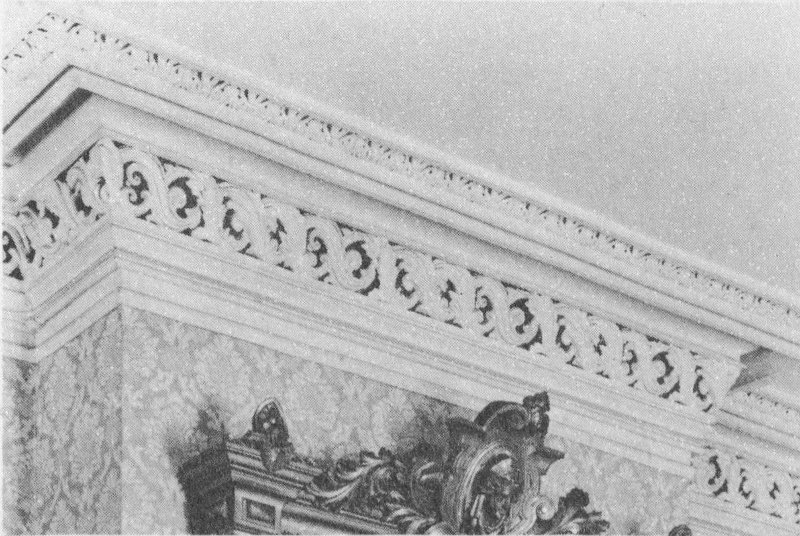
Molded plaster cornices are set out from wall in style locally called “double transparency”.
This type of work is typical of that done by European artisans who decorated many great Garden District homes.
42