PAUL CARUS (continued 5)
Reading edition
Then they addressed the Blessed One and said: "Will the Blessed One do us the honor of taking his meal, together with the brethren, at our palace to-morrow?"14
"O Licchavi," said the Blessed One, "I have promised to dine to-morrow with Ambapālī, the courtesan."15
Then the Licchavi, expressing their approval of the words of the Blessed One, arose from their seats and bowed down before the Blessed One, and, keeping him on their right hand as they passed him, they departed thence; but when they came home, they cast up their hands, saying: "A worldly woman has outdone us; we have been left behind by a frivolous girl!"16
And at the end of the night Ambapālī, the courtesan, made ready in her mansion sweet rice and cakes, and on the next day announced through a messenger the time to the Blessed One, saying, "The hour, Lord, has come, and the meal is ready!"17
And the Blessed One robed himself early in the morning, took his bowl, and went with the brethren to the place where Ambapālī's dwelling-house was; and when they had come there they seated themselves on the seats prepared for them. And Ambapālī, the courtesan, set the sweet rice and cakes before the order, with the Buddha at their head, and waited upon them till they refused to take more.18
And when the Blessed One had finished his meal, the courtesan had a low stool brought, and sat down at his side, and addressed the Blessed One, and said: "Lord, I present this mansion to the order of bhikkhus, of which the Buddha is the chief."19
And the Blessed One accepted the gift; and after instructing, arousing, and gladdening her with religious edification, he rose from his seat and departed thence.20
XCIII.
THE BUDDHA'S FAREWELL ADDRESS.
When the Blessed One had remained as long as he wished at Ambapālī's grove, he went to Beluva, near Vesālī. There the Blessed One addressed the brethren, and said: "O mendicants, take up your abode for the rainy season round about Vesālī, each one according to the place where his friends and near companions may five. I shall enter upon the rainy season here at Beluva."1
When the Blessed One had thus entered upon the rainy season there fell upon him a dire sickness, and sharp pains came upon him even unto death. But the Blessed One, mindful and self-possessed, bore his ailments without complaint.2
Then this thought occurred to the Blessed One, "It would not be right for me to pass away from life without addressing the disciples, without taking leave of the order. Let me now, by a strong effort of the will, subdue this sickness, and keep my hold on life till the allotted time have come."3
And the Blessed One, by a strong effort of the will subdued the sickness, and kept his hold on life till the time he fixed upon should come. And the sickness abated.4
Thus the Blessed One began to recover; and when he had quite got rid of the sickness, he went out from the monastery, and sat down on a seat spread out in the open air. And the venerable Ānanda, accompanied by many other disciples, approached where the Blessed One was, saluted him, and taking a seat respectfully on one side, said: "I have beheld, Lord, how the Blessed One was in health, and I have beheld how the Blessed One had to suffer. And though at the sight of the sickness of the Blessed One my body became weak as a creeper, and the horizon became dim to me, and my faculties were no longer clear, yet notwithstanding I took some little comfort from the thought that the Blessed One would not pass away from existence until at least he had left instructions as touching the order."5
And the Blessed One addressed Ānanda in behalf of the order, saying:6
"What, then, Ānanda, does the order expect of me? I have preached the truth without making any distinction between exoteric and esoteric doctrine; for in respect of the truth, Ānanda, the Tathāgata has no such thing as the closed fist of a teacher, who keeps some things back.7
"Surely, Ānanda, should there be any one who harbors the thought, 'It is I who will lead the brotherhood,' or, 'The order is dependent upon me,' he should lay down instructions in any matter concerning the order. Now the Tathāgata, Ānanda, thinks not that it is he who should lead the brotherhood, or that the order is dependent upon him.8
"Why, then, should the Tathāgata leave instructions in any matter concerning the order?9
"I am now grown old, O Ānanda, and full of years; my journey is drawing to its close, I have reached the sum of my days, I am turning eighty years of age.10
"Just as a worn-out cart can not be made to move along without much difficulty, so the body of the Tathāgata can only be kept going with much additional care.11
"It is only, Ānanda, when the Tathāgata, ceasing to attend to any outward thing, becomes plunged in that devout meditation of heart which is concerned with no bodily object, it is only then that the body of the Tathāgata is at ease.12
"Therefore, O Ānanda, be ye lamps unto yourselves. Rely on yourselves, and do not rely on external help.13
"Hold fast to the truth as a lamp. Seek salvation alone in the truth. Look not for assistance to any one besides yourselves.14
"And how, Ānanda, can a brother be a lamp unto himself, rely on himself only and not on any external help, holding fast to the truth as his lamp and seeking salvation in the truth alone, looking not for assistance to any one besides himself?15
"Herein, O Ānanda, let a brother, as he dwells in the body, so regard the body that he, being strenuous, thoughtful, and mindful, may, whilst in the world, overcome the grief which arises from the body's cravings.16
"While subject to sensations let him continue so to regard the sensations that he, being strenuous, thoughtful, and mindful, may, whilst in the world, overcome the grief which arises from the sensations.17
"And so, also, when he thinks or reasons, or feels, let him so regard his thoughts that being strenuous, thoughtful, and mindful he may, whilst in the world, overcome the grief which arises from the craving due to ideas, or to reasoning, or to feeling.18
"Those who, either now or after I am dead, shall be lamps unto themselves, relying upon themselves only and not relying upon any external help, but holding fast to the truth as their lamp, and seeking their salvation in the truth alone, and shall not look for assistance to any one besides themselves, it is they, Ānanda, among my bhikkhus, who shall reach the very topmost height! But they must be anxious to learn."19
XCIV.
THE BUDDHA ANNOUNCES HIS DEATH.
Said the Tathāgata to Ānanda: "In former years, Ānanda, Māra, the Evil One, approached the holy Buddha three times to tempt him.1
"And now, Ānanda, Māra, the Evil One, came again today to the place where I was, and, standing beside me, addressed me in the same words as he did when I was resting under the shepherd's Nigrodha tree on the bank of the Nerañjarā river: 'Be greeted, thou Holy One. Thou hast attained the highest bliss and it is time for thee to enter into the final Nirvāna.'2
"And when Māra had thus spoken, Ānanda, I answered him and said: 'Make thyself happy, O wicked one; the final extinction of the Tathāgata shall take place before long.'"3
And the venerable Ānanda addressed the Blessed One and said: "Vouchsafe, Lord, to remain with us, O Blessed One! for the good and the happiness of the great multitudes, out of pity for the world, for the good and the gain of mankind!"4
Said the Blessed One: "Enough now, Ānanda, beseech not the Tathāgata!"5
And again, a second time, the venerable Ānanda besought the Blessed One in the same words. And he received from the Blessed One the same reply. 6
And again, the third time, the venerable Ānanda besought the Blessed One to live longer; and the Blessed One said: "Hast thou faith, Ānanda?"7
Said Ānanda: "I have, my Lord!"8
And the Blessed One, seeing the quivering eyelids of Ānanda, read the deep grief in the heart of his beloved disciple, and he asked again: "Hast thou, indeed, faith, Ānanda?"9
And Ānanda said: "I have faith, my Lord."10
Than the Blessed One continued: "If thou hast faith, Ānanda, in the wisdom of the Tathāgata, why, then, Ānanda, dost thou trouble the Tathāgata even until the third time? Have I not formerly declared to you that it is in the very nature of all compound things that they must be dissolved again. We must separate ourselves from all things near and dear to us, and must leave them. How then, Ānanda, can it be possible for me to remain, since everything that is born, or brought into being, and organized, contains within itself the inherent necessity of dissolution? How, then, can it be possible that this body of mine should not be dissolved? No such condition can exist! And this mortal existence, O Ānanda, has been relinquished, cast away, renounced, rejected, and abandoned by the Tathāgata."11
And the Blessed One said to Ānanda: "Go now, Ānanda, and assemble in the Service Hall such of the brethren as reside in the neighborhood of Vesālī."12
Then the Blessed One proceeded to the Service Hall, and sat down there on the mat spread out for him. And when he was seated, the Blessed One addressed the brethren, and said:13
"O brethren, ye to whom the truth has been made known, having thoroughly made yourselves masters of it, practise it, meditate upon it, and spread it abroad, in order that pure religion may last long and be perpetuated, in order that it may continue for the good and happiness of the great multitudes, out of pity for the world, and to the good and gain of all living beings!14
"Star-gazing and astrology, forecasting lucky or unfortunate events by signs, prognosticating good or evil, all these are things forbidden.15
"He who lets his heart go loose without restraint shall not attain Nirvāna; therefore, must we hold the heart in check, and retire from worldly excitements and seek tranquillity of mind.16
"Eat your food to satisfy your hunger, and drink to satisfy you thirst. Satisfy the necessities of life like the butterfly that sips the flower, without destroying its fragrance or its texture.17
"It is through not understanding and grasping the four truths, O brethren, that we have gone astray so long, and wandered in this weary path of transmigrations, both you and I, until we have found the truth.18
"Practise the earnest meditations I have taught you. Continue in the great struggle against sin. Walk steadily in the roads of saintship. Be strong in moral powers. Let the organs of your spiritual sense be quick. When the seven kinds of wisdom enlighten your mind, you will find the noble, eightfold path that leads to Nirvāna.19
"Behold, O brethren, the final extinction of the Tathāgata will take place before long. I now exhort you, saying: 'All component things must grow old and be dissolved again. Seek ye for that which is permanent, and work out your salvation with diligence.'"20
XCV.
CHUNDA, THE SMITH.
And the Blessed One went to Pāvā.1
When Chunda, the worker in metals, heard that the Blessed One had come to Pāvā and was staying in his mango grove, he came to the Buddha and respectfully invited him and the brethren to take their meal at his house. And Chunda prepared rice-cakes and a dish of dried boar's meat.2
When the Blessed One had eaten the food prepared by Chunda, the worker in metals, there fell upon him a dire sickness, and sharp pain came upon him even unto death. But the Blessed One, mindful and self-possessed, bore it without complaint.3
And the Blessed One addressed the venerable Ānanda, and said: "Come, Ānanda, let us go on to Kusinārā."4
On his way the Blessed One grew tired, and he went aside from the road to rest at the foot of a tree, and said: "Fold the robe, I pray thee, Ānanda, and spread it out for me. I am weary, Ānanda, and must rest awhile!"5
"Be it so, Lord!" said the venerable Ānanda; and he spread out the robe folded fourfold.6
The Blessed One seated himself, and when he was seated he addressed the venerable Ānanda, and said: "Fetch me some water, I pray thee, Ānanda. I am thirsty, Ānanda, and would drink."7
When he had thus spoken, the venerable Ānanda said to the Blessed One: "But just now, Lord, five hundred carts have gone across the brook and have stirred the water; but a river, O Lord, is not far off. Its water is clear and pleasant, cool and transparent, and it is easy to get down to it. There the Blessed One may both drink water and cool his limbs."8
A second time the Blessed One addressed the venerable Ānanda, saying: "Fetch me some water, I pray thee Ānanda, I am thirsty, Ānanda, and would drink."9
And a second time the venerable Ānanda said: "Let us go to the river."10
Then the third time the Blessed One addressed the venerable Ānanda, and said: "Fetch me some water, I pray thee, Ānanda, I am thirsty, Ānanda, and would drink."11
"Be it so, Lord!" said the venerable Ānanda in assent to the Blessed One; and, taking a bowl, he went down to the streamlet. And lo! the streamlet, which, stirred up by wheels, had become muddy, when the venerable Ānanda came up to it, flowed clear and bright and free from all turbidity. And he thought: "How wonderful, how marvelous is the great might and power of the Tathāgata!"12
Ānanda brought the water in the bowl to the Lord, saying: "Let the Blessed One take the bowl. Let the Happy One drink the water. Let the Teacher of men and gods quench his thirst."13
Then the Blessed One drank of the water.14
Now, at that time a man of low caste, named Pukkusa, a young Malla, a disciple of Alāra Kālāma, was passing along the high road from Kusinārā to Pāvā.15
And Pukkusa, the young Malla, saw the Blessed One seated at the foot of a tree. On seeing him, he went up to the place where the Blessed One was, and when he had come there, he saluted the Blessed One and took his seat respectfully on one side. Then the Blessed One instructed, edified, and gladdened Pukkusa, the young Malla, with religious discourse.16
Aroused and gladdened by the words of the Blessed One, Pukkusa, the young Malla, addressed a certain man who happened to pass by, and said: "Fetch me, I pray thee, my good man, two robes of cloth of gold, burnished and ready for wear."17
"Be it so, sir!" said that man in assent to Pukkusa, the young Malla; and he brought two robes of cloth of gold, burnished and ready for wear.18
And the Malla Pukkusa presented the two robes of cloth of gold, burnished and ready for wear, to the Blessed One, saying: "Lord, these two robes of burnished cloth of gold are ready for wear. May the Blessed One show me favor and accept them at my hands!"19
The Blessed One said: "Pukkusa, robe me in one, and Ānanda in the other."20
And the Tathāgata's body appeared shining like a flame, and he was beautiful above all expression.21
And the venerable Ānanda said to the Blessed One: "How wonderful a thing is it, Lord, and how marvellous, that the color of the skin of the Blessed One should be so clear, so exceedingly bright! When I placed this robe of burnished cloth of gold on the body of the Blessed One, lo! it seemed as if it had lost its splendor!"22
The Blessed One said: "There are two occasions on which a Tathāgata's appearance becomes clear and exceeding bright. In the night, Ānanda, in which a Tathāgata attains to the supreme and perfect insight, and in the night in which he passes finally away in that utter passing away which leaves nothing whatever of his earthly existence to remain."23
And the Blessed One addressed the venerable Ānanda, and said: "Now it may happen, Ānanda, that some one should stir up remorse in Chunda, the smith, by saying: 'It is evil to thee, Chunda, and loss to thee, that the Tathāgata died, having eaten his last meal from thy provision.' Any such remorse, Ānanda, in Chunda, the smith, should be checked by saying: 'It is good to thee, Chunda, and gain to thee, that the Tathāgata died, having eaten his last meal from thy provision. From the very mouth of the Blessed One, O Chunda, have I heard, from his own mouth have I received this saying, "These two offerings of food are of equal fruit and of much greater profit than any other: the offerings of food which a Tathāgata accepts when he has attained perfect enlightenment and when he passes away by the utter passing away in which nothing whatever of his earthly existence remains behind—these two offerings of food are of equal fruit and of equal profit, and of much greater fruit and much greater profit than any other. There has been laid up by Chunda, the smith, a karma redounding to length of life, redounding to good birth, redounding to good fortune, redounding to good fame, redounding to the inheritance of heaven and of great power." In this way, Ānanda, should be checked any remorse in Chunda, the smith."24
Then the Blessed One, perceiving that death was near, uttered these words: "He who gives away shall have real gain. He who subdues himself shall be free, he shall cease to be a slave of passions. The righteous man casts off evil; and by rooting out lust, bitterness, and illusion, do we reach Nirvāna."25
XCVI.
METTEYYA.
The Blessed One proceeded with a great company of the brethren to the sāla grove of the Mallas, the Upavattana of Kusinārā on the further side of the river Hiraññavatī, and when he had arrived he addressed the venerable Ānanda, and said: "Make ready for me, I pray you, Ānanda, the couch with its head to the north, between the twin sāla trees. I am weary, Ānanda, and wish to be down."1
"Be it so, Lord!" said the venerable Ānanda, and he spread a couch with its head to the north, between the twin sāla trees. And the Blessed One laid himself down, and he was mindful and self-possessed.2
Now, at that time the twin sāla trees were full of bloom with flowers out of season; and heavenly songs came wafted from the skies, out of reverence for the successor of the Buddhas of old. And Ānanda was filled with wonder that the Blessed One was thus honored. But the Blessed One said: "Not by such events, Ānanda, is the Tathāgata rightly honored, held sacred, or revered. But the brother or the sister, the devout man or the devout woman, who continually fulfils all the greater and the lesser duties, walking according to the precepts, it is they who rightly honor, hold sacred, and revere the Tathāgata with the worthiest homage. Therefore, O Ānanda, be ye "constant in the fulfilment of the greater and of the lesser duties, and walk according to the precepts; thus, Ānanda, will ye honor the Master."3
Then the venerable Ānanda went into the vihāra, and stood leaning against the doorpost, weeping at the thought: "Alas! I remain still but a learner, one who has yet to work out his own perfection. And the Master is about to pass away from me—he who is so kind!"4
Now, the Blessed One called the brethren, and said: "Where, O brethren, is Ānanda?"5
And one of the brethren went and called Ānanda. And Ānanda came and said to the Blessed One: "Deep darkness reigned for want of wisdom; the world of sentient creatures was groping for want of light; then the Tathāgata lit up the lamp of wisdom, and now it will be extinguished again, ere he has brought it out."6
And the Blessed One said to the venerable Ānanda, as he sat there by his side:7
"Enough, Ānanda! Let not thy self be troubled; do not weep! Have I not already, on former occasions, told you that it is in the very nature of all things most near and dear unto us that we must separate from them and leave them?8
"The foolish man conceives the idea of 'self,' the wise man sees there is no ground on which to build the idea of 'self,' thus he has a right conception of the world and well concludes that all compounds amassed by sorrow will be dissolved again, but the truth will remain.9
"Why should I preserve this body of flesh, when the body of the excellent law will endure? I am resolved; having accomplished my purpose and attended to the work set me, I look for rest!10
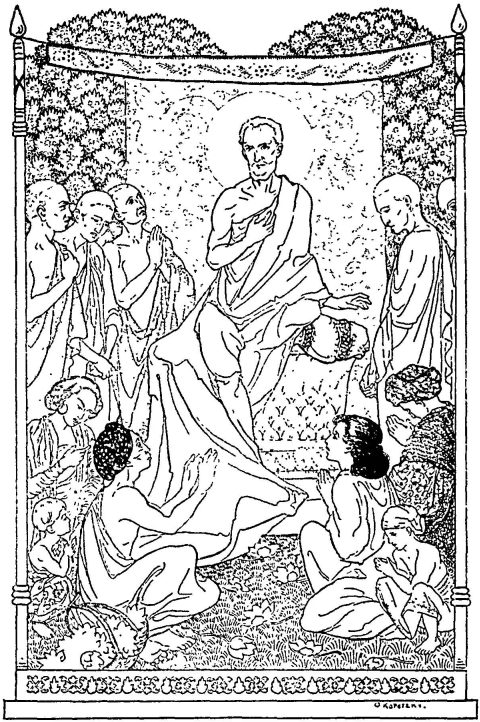
"For a long time, Ānanda, thou hast been very near to me by thoughts and acts of such love as never varies and is beyond all measure. Thou hast done well, Ānanda! Be earnest in effort and thou too shalt soon be free from the great evils, from sensuality, from selfishness, from delusion, and from ignorance!"11
And Ānanda, suppressing his tears, said to the Blessed One: "Who shall teach us when thou art gone?"12
And the Blessed One replied: "I am not the first Buddha who came upon earth, nor shall I be the last. In due time another Buddha will arise in the world, a Holy One, a supremely enlightened One, endowed with wisdom in conduct, auspicious, knowing the universe, an incomparable leader of men, a master of angels and mortals. He will reveal to you the same eternal truths which I have taught you. He will preach his religion, glorious in its origin, glorious at the climax, and glorious at the goal, in the spirit and in the letter. He will proclaim a religious life, wholly perfect and pure; such as I now proclaim."13
Ānanda said: "How shall we know him?"14
The Blessed One said: "He will be known as Metteyya, which means 'he whose name is kindness.'"15
XCVII.
THE BUDDHA'S FINAL ENTERING INTO NIRVĀNA.
Then the Mallas, with their young men and maidens and their wives, being grieved, and sad, and afflicted at heart, went to the Upavattana, the sāla grove of the Mallas, and wanted to see the Blessed One, in order to partake of the bliss that devolves upon those who are in the presence of the Holy One.1
And the Blessed One addressed them and said:2
"Seeking the way, ye must exert yourselves and strive with diligence. It is not enough to have seen me! Walk as I have commanded you; free yourselves from the tangled net of sorrow. Walk in the path with steadfast aim.3
"A sick man may be cured by the healing power of medicine and will be rid of all his ailments without beholding the physician.4
"He who does not do what I command sees me in vain. This brings no profit. Whilst he who lives far off from where I am and yet walks righteously is ever near me.5
"A man may dwell beside me, and yet, being disobedient, be far away from me. Yet he who obeys the Dharma will always enjoy the bliss of the Tathāgata's presence."6
Then the mendicant Subhadda went to the sāla grove of the Mallas and said to the venerable Ānanda: "I have heard from fellow mendicants of mine, who were deep stricken in years and teachers of great experience: 'Sometimes and full seldom to Tathāgatas appear in the world, the holy Buddhas.' Now it is said that to-day in the last watch of the night, the final passing away of the samana Gotama will take place. My mind is full of uncertainty, yet have I faith in the samana Gotama and trust he will be able so to present the truth that I may become rid of my doubts. O that I might be allowed to see the samana Gotama!"7
When he had thus spoken the venerable Ānanda said to the mendicant Subhadda: "Enough! friend Subhadda. Trouble not the Tathāgata. The Blessed One is weary."8
Now the Blessed One overheard this conversation of the venerable Ānanda with the mendicant Subhadda. And the Blessed One called the venerable Ānanda, and said: "Ānanda! Do not keep out Subhadda. Subhadda may be allowed to see the Tathāgata. Whatever Subhadda will ask of me, he will ask from a desire for knowledge, and not to annoy me, and whatever I may say in answer to his questions, that he will quickly understand." 10
Then the venerable Ānanda said to Subhadda the mendicant: "Step in, friend Subhadda; for the Blessed One gives thee leave."11
When the Blessed One had instructed Subhadda, and aroused and gladdened him with words of wisdom and comfort, Subhadda said to the Blessed One:12
"Glorious Lord, glorious Lord! Most excellent are the words of thy mouth, most excellent! They set up that which has been overturned, they reveal that which has been hidden. They point out the right road to the wanderer who has gone astray. They bring a lamp into the darkness so that those who have eyes to see can see. Thus, Lord, the truth has been made known to me by the Blessed One and I take my refuge in the Blessed One, in the Truth, and in the Order. May the Blessed One accept me as a disciple and true believer, from this day forth as long as life endures."13
And Subhadda, the mendicant, said to the venerable Ānanda: "Great is thy gain, friend Ānanda, great is thy good fortune, that for so many years thou hast been sprinkled with the sprinkling of discipleship in this brotherhood at the hands of the Master himself!"14
Now the Blessed One addressed the venerable Ānanda, and said: "It may be, Ānanda, that in some of you the thought may arise, 'The word of the Master is ended, we have no teacher more!' But it is not thus, Ānanda, that you should regard it. It is true that no more shall I receive a body, for all future sorrow has now forever passed away. But though this body will be dissolved, the Tathāgata remains. The truth and the rules of the order which I have set forth and laid down for you all, let them, after I am gone, be a teacher unto you. When I am gone, Ānanda, let the order, if it should so wish, abolish all the lesser and minor precepts."15
Then the Blessed One addressed the brethren, and said: "There may be some doubt or misgiving in the mind of a brother as to the Buddha, or the truth, or the path. Do not have to reproach yourselves afterwards with the thought, 'We did not inquire of the Blessed One when we were face to face with him.' Therefore inquire now, O brethren, inquire freely."16
And the brethren remained silent.17
Then the venerable Ānanda said to the Blessed One: "Verily, I believe that in this whole assembly of the brethren there is not one brother who has any doubt or misgiving as to the Buddha, or the truth, or the path!"18
Said the Blessed One: "It is out of the fullness of faith that thou hast spoken, Ānanda! But, Ānanda, the Tathāgata knows for certain that in this whole assembly of the brethren there is not one brother who has any doubt or misgiving as to the Buddha, or the truth, or the path! For even the most backward, Ānanda, of all these brethren has become converted, and is assured of final salvation."19
Then the Blessed One addressed the brethren and said: "If ye now know the Dharma, the cause of all suffering, and the path of salvation, O disciples, will ye then say: 'We respect the Master, and out of reverence for the Master do we thus speak?'"20
The brethren replied: "That we shall not, O Lord."21
And the Holy One continued:22
"Of those beings who live in ignorance, shut up and confined, as it were, in an egg, I have first broken the eggshell of ignorance and alone in the universe obtained the most exalted, universal Buddhahood. Thus, O disciples, I am the eldest, the noblest of beings.23
"But what ye speak, O disciples, is it not even that which ye have yourselves known, yourselves seen, yourselves realised?"24
Ānanda and the brethren said: "It is, O Lord."25
Once more the Blessed One began to speak: "Behold now, brethren," said he, "I exhort you, saying, 'Decay is inherent in all component things, but the truth will remain forever!' Work out your salvation with diligence!" This was the last word of the Tathāgata. Then the Tathāgata fell into a deep meditation, and having passed through the four jhānas, entered Nirvāna.26
When the Blessed One entered Nirvāna there arose, at his passing out of existence, a mighty earthquake, terrible and awe-inspiring: and the thunders of heaven burst forth, and of those of the brethren who were not yet free from passions some stretched out their arms and wept, and some fell headlong on the ground, in anguish at the thought: "Too soon has the Blessed One died! Too soon has the Happy One passed away from existence! Too soon has the Light of the world gone out!"27
Then the venerable Anuruddha exhorted the brethren and said: "Enough, my brethren! Weep not, neither lament! Has not the Blessed One formerly declared this to us, that it is in the very nature of all things near and dear unto us, that we must separate from them and leave them, since everything that is born, brought into being, and organized, contains within itself the inherent necessity of dissolution? How then can it be possible that the body of the Tathāgata should not be dissolved? No such condition can exist! Those who are free from passion will bear the loss, calm and self-possessed, mindful of the truth he has taught us."28
And the venerable Anuruddha and the venerable Ānanda spent the rest of the night in religious discourse.29
Then the venerable Anuruddha said to the venerable Ānanda: "Go now, brother Ānanda, and inform the Mallas of Kusinārā saying, 'The Blessed One has passed away: do, then, whatsoever seemeth to you fit!'"30
And when the Mallas had heard this saying they were grieved, and sad, and afflicted at heart. 31
Then the Mallas of Kusinārā gave orders to their attendants, saying, "Gather together perfumes and garlands, and all the music in Kusinārā!" And the Mallas of Kusinārā took the perfumes and garlands, and all the musical instruments, and five hundred garments, and went to the sāla grove where the body of the Blessed One lay. There they passed the day in paying honor and reverence to the remains of the Blessed One, with hymns, and music, and with garlands and perfumes, and in making canopies of their garments, and preparing decorative wreaths to hang thereon. And they burned the remains of the Blessed One as they would do to the body of a king of kings.32
When the funeral pyre was lit, the sun and moon withdrew their shining, the peaceful streams on every side were torrent-swollen, the earth quaked, and the sturdy forests shook like aspen leaves, whilst flowers and leaves fell untimely to the ground, like scattered rain, so that all Kusinārā became strewn knee-deep with mandāra flowers raining down from heaven.33
When the burning ceremonies were over, Devaputta said to the multitudes that were assembled round the pyre:34
"Behold, O brethren, the earthly remains of the Blessed One have been dissolved, but the truth which he has taught us lives in our minds and cleanses us from all error.35
"Let us, then, go out into the world, as compassionate and merciful as our great master, and preach to all living beings the four noble truths and the eightfold path of righteousness, so that all mankind may attain to a final salvation, taking refuge in the Buddha, the Dharma, and the Sangha."36
And when the Blessed One had entered into Nirvāna, and the Mallas had burned the body with such ceremonies as would indicate that he was the great king of kings, ambassadors came from all the empires that at the time had embraced his doctrine, to claim a share of the relics; and the relics were divided into eight parts and eight dāgobas were erected for their preservation. One dāgoba was erected by the Mallas and seven others by the seven kings of those countries, whose people had taken refuge in the Buddha.37
CONCLUSION.
XCVIII.
THE THREE PERSONALITIES OF THE BUDDHA.
When the Blessed One had passed away into Nirvāna, the disciples came together and consulted what to do in order to keep the Dharma pure and uncorrupted by heresies.1
And Upāli rose, saying:2
"Our great Master used to say to the brethren: 'O bhikkhus! after my final entrance into Nirvāna you must reverence and obey the law. Regard the law as your master. The law is like unto a light that shines in the darkness, pointing out the way; it is also like unto a precious jewel to gain which you must shun no trouble, and be ready to bring any sacrifice, even, should it be needed, your own fives. Obey the Dharma which I have revealed to you; follow it carefully and regard it in no way different from myself.'3
"Such were the words of the Blessed One.4
"The law, accordingly, which the Buddha has left us as a precious inheritance has now become the visible body of the Tathāgata. Let us, therefore, revere it and keep it sacred. For what is the use of erecting dāgobas for relics, if we neglect the spirit of the Master's teachings?"5
And Anuruddha arose and said:6
"Let us bear in mind, O brethren, that Gotama Siddhattha has revealed the truth to us. He was the Holy One and the Perfect One and the Blessed One, because the eternal truth had taken abode in him.7
"The Tathāgata taught us that the truth existed before he was born into this world, and will exist after he has entered into the bliss of Nirvāna.8
"The Tathāgata said:9
"'The truth is omnipresent and eternal, endowed with excellencies innumerable, above all human nature, and ineffable in its holiness.'10
"Now, let us bear in mind that not this or that law which is revealed to us in the Dharma is the Buddha, but the entire truth, the truth which is eternal, omnipresent, immutable, and most excellent.11
"Many regulations of the Sangha are temporary; they were prescribed because they suited the occasion and were needed for some transient emergency. The truth, however, is not temporary.12
"The truth is not arbitrary nor a matter of opinion, but can be investigated, and he who earnestly searches for the truth will find it.13
"The truth is hidden to the blind, but he who has the mental eye sees the truth. The truth is Buddha's essence, and the truth will remain the ultimate standard by which we can discern false and true doctrines. 14
"Let us, then, revere the truth; let us inquire into the truth and state it, and let us obey the truth. For the truth is Buddha our Master, our Teacher, our Lord."15
And Kassapa rose and said:16
"Truly thou hast spoken well, O brother Anuruddha. Neither is there any conflict of opinion on the meaning of our religion. For the Blessed One possesses three personalities, and every one of them is of equal importance to us.17
"There is the Dharma Kāya. There is the Nirmāna Kāya. There is the Sambhoga Kāya.18
"Buddha is the all-excellent truth, eternal, omnipresent, and immutable. This is the Sambhoga Kāya which is in a state of perfect bliss.19
"Buddha is the all-loving teacher assuming the shape of the beings whom he teaches. This is the Nirmāna Kāya, his apparitional body.20
"Buddha is the all-blessed dispensation of religion. He is the spirit of the Sangha and the meaning of the commands which he has left us in his sacred word, the Dharma. This is the Dharma Kāya, the body of the most excellent law.21
"If Buddha had not appeared to us as Gotama Sakyamuni, how could we have the sacred traditions of his doctrine? And if the generations to come did not have the sacred traditions preserved in the Sangha, how could they know anything of the great Sakyamuni? And neither we nor others would know anything about the most excellent truth which is eternal, omnipresent, and immutable.22
"Let us then keep sacred and revere the traditions; let us keep sacred the memory of Gotama Sakyamuni, so that people may find the truth; for he whose spiritual eye is open will discover it, and it is the same to every one who possesses the comprehension of a Buddha to recognize it and to expound it." 23
Then the brethren decided to convene a synod in Rājagaha in order to lay down the pure doctrines of the Blessed One, to collect and collate the sacred writings, and to establish a canon which should serve as a source of instruction for future generations.24
XCIX.
THE PURPOSE OF BEING.
Eternal verities dominate the formation of worlds and constitute the cosmic order of natural laws. But when, through the conflicting motion of masses, the universe was illumined with blazing fire, there was no eye to see the light, no ear to listen to reason's teachings, no mind to perceive the significance of being; and in the immeasurable spaces of existence no place was found where the truth could abide in all its glory.1
In the due course of evolution sentiency appeared and sense-perception arose. There was a new realm of being, the realm of soul-life, full of yearning, with powerful passions and of unconquerable energy. And the world split in twain: there were pleasures and pains, self and notself, friends and foes, hatred and love. The truth vibrated through the world of sentiency, but in all its infinite potentialities no place could be found where the truth could abide in all its glory.2
And reason came forth in the struggle for life. Reason began to guide the instinct of self, and reason took the sceptre of the creation and overcame the strength of the brutes and the power of the elements. Yet reason seemed to add new fuel to the flame of hatred, increasing the turmoil of conflicting passions; and brothers slew their brothers for the sake of satisfying the lust of a fleeting moment. And the truth repaired to the domains of reason, but in all its recesses no place was found where the truth could abide in all its glory.3
Now reason, as the helpmate of self, implicated all living beings more and more in the meshes of lust, hatred, and envy, and from lust, hatred, and envy the evils of wrongdoing originated. Men broke down under the burdens of life, until the saviour appeared, the great Buddha, the Holy Teacher of men and gods.4
And the Buddha taught men the right use of sentiency, and the right application of reason; and he taught men to see things as they are, without illusions, and they learned to act according to truth. He taught righteousness and thus changed rational creatures into humane beings, just, kind-hearted, and faithful. And now at last a place was found where the truth might abide in all its glory, and this place is the heart of mankind.5
Buddha, O Blessed One, O Holy One, O Perfect One, thou hast revealed the truth, and the truth has appeared upon earth and the kingdom of truth has been founded.6
There is not room for truth in space, infinite though it be.7
There is not room for truth in sentiency, neither in its pleasures nor in its pains; sentiency is the first footstep of truth, but there is not room in it for the truth, though sentiency may beam with the blazing glow of beauty and life.8
Neither is there any room for truth in rationality. Rationality is a two-edged sword and serves the purpose of love equally as well as the purpose of hatred. Rationality is the platform on which the truth standeth. No truth is attainable without reason. Nevertheless, in mere rationality there is no room for truth, though it be the instrument that masters the things of the world. 9
The throne of truth is righteousness; and love and justice and good-will are its ornaments.10
Righteousness is the place in which truth dwells, and here in the hearts of mankind aspiring after the realization of righteousness, there is ample space for a rich and ever richer revelation of the truth.12
This is the Gospel of the Blessed One. This is the revelation of the Enlightened One. This is the bequest of the Holy One.13
Those who accept the truth and have faith in the truth, take refuge in the Buddha, the Dharma, and the Sangha.14
Receive us, O Buddha, as thy disciples from this day hence, so long as our life lasts.15
Comfort, O holy Teacher, compassionate and all-loving, the afflicted and the sorrow-laden, illumine those who go astray, and let us all gain more and more in comprehension and in holiness.16
The truth is the end and aim of all existence, and the worlds originate so that the truth may come and dwell therein.17
Those who fail to aspire for the truth have missed the purpose of life.18
Blessed is he who rests in the truth, for all things will pass away, but the truth abideth forever.19
The world is built for the truth, but false combinations of thought misrepresent the true state of things and bring forth errors.20
Errors can be fashioned as it pleases those who cherish them; therefore they are pleasant to look upon, but they are unstable and contain the seeds of dissolution.21
Truth cannot be fashioned. Truth is one and the same; it is immutable.22
Truth is above the power of death; it is omnipresent, eternal, and most glorious. 23
Illusions, errors, and lies are the daughters of Māra, and great power is given unto them to seduce the minds of men and lead them astray upon the path of evil.24
The nature of delusions, errors, and lies is death; and wrong-doing is the way to perdition.25
Delusions, errors, and lies are like huge, gaudy vessels, the rafters of which are rotten and wormeaten, and those who embark in them are fated to be shipwrecked.26
There are many who say: "Come error, be thou my guide," and when they are caught in the meshes of selfishness, lust, and evil desires, misery is begot.27
Yet does all life yearn for the truth and the truth only can cure our diseases and give peace to our unrest.28
Truth is the essence of life, for truth endureth beyond the death of the body. Truth is eternal and will still remain even though heaven and earth shall pass away.29
There are not different truths in the world, for truth is one and the same at all times and in every place.30
Truth teaches us the noble eightfold path of righteousness, and it is a straight path easily found by the truth-loving. Happy are those who walk in it.31
C.
THE PRAISE OF ALL THE BUDDHAS.
All the Buddhas are wonderful and glorious. There is not their equal upon earth. They reveal to us the path of life. And we hail their appearance with pious reverence.1 All the Buddhas teach the same truth. They point out the path to those who go astray. The Truth is our hope and comfort. We gratefully accept its illimitable light.2 Ah the Buddhas are one in essence, Which is omnipresent in all modes of being, Sanctifying the bonds that tie all souls together, And we rest in its bliss as our final refuge.3


TABLE OF REFERENCE.
[list of abbr. in this table follows here]
THE GOSPEL OF BUDDHA CHAPTER AND VERSE (Gospel): I-III Sources: EA Parallelisms: — Gospel: Descent from heaven omitted Sources: LV; rGya, iii-iv Parallelisms: Klopstock's Messias Gesang I Gospel: IV Sources: Fo, vv. 1-147 Parallelisms: — Gospel: IV, 6 Sources: BSt, p. 64 Parallelisms: Mark vii, 32, 37; Matth. xi, 5 Gospel: IV, 9 Sources: Fo, vv. 22-24 Parallelisms: Matth. ii, 1 Gospel: IV, 12 Sources: Fo, vv. 39-40 Parallelisms: Luke ii, 36 Gospel: IV, 17 Sources: RB 150; RHB 52 Parallelisms: Pseudo Matth. 23 Gospel: IV, 27 Sources: Fo, v. 147 Parallelisms: Luke ii, 52 Gospel: Omitted Sources: RHB, pp. 103-108 Parallelisms: Matth. ii, 16 Gospel: V Sources: HM, p. 156; RB, p. 83; rGya, xii Parallelisms: — Sources: Fo, vv. 152-156 Parallelisms: Luke ii, 46-47 Gospel: V, 9 Sources: Fo, v. 164 Parallelisms: Matth. iii, 16 Gospel: VI Sources: Fo, vv. 191-322 Parallelisms: — Gospel: VI, 19-20 Sources: BSt, pp. 79-80; RB, p. 23 Parallelisms: Luke xi, 27-28 Gospel: VII Sources: Fo, vv. 335-417 Parallelisms: — Gospel: VII, 7 Sources: BSt, p. 5-6 Parallelisms: — Gospel: VII, 18-19 Sources: BSt, p. 18 Parallelisms: Matt. xxiv, 35; Luke xxi, 33; Luke xvi, 17 Gospel: VII, 23-24 Sources: BSt, p. 84 Parallelisms: Luke iv, 5-8 [see also Matth. iv, 1-7 and Mark i, 13] Gospel: VIII Sources: Fo, vv. 778-918 Parallelisms: — Gospel: VIII, 15 Sources: DP, v. 178 Parallelisms: — Gospel: IX Sources: Fo, vv. 919-1035; Cf. "Arāda and Udraka" in Rhys Davids's Dialogue Parallelisms: Compare the results of modern psychology Gospel: IX, 6 Sources: MV. 1, 6, Secs. 36-38 [SB, xiii, p. 100] Parallelisms: — Gospel: IX, 14 Sources: QKM, pp. 83-86 Parallelisms: Evolution theory Gospel: IX, 15 Sources: QKM,p. 133 Parallelisms: — Gospel: IX, 16 Sources: QKM, p. 111 Parallelisms: — Gospel: X Sources: Fo, vv. 1000-1023 Parallelisms: — Gospel: X, 4, 5 Sources: SN, vv. 425, 439; SN, v. 445 Parallelisms: Luke iv, 2-4; John iii, 46 Gospel: X, 11 Sources: Fo, vv. 1024; Fo, vv. 1222-1224 Parallelisms: Luke vii, 19; Matth ii, 3 Gospel: XI [See LXXXIX, 1-6] Sources: Fo, vv. 1026-1110 Parallelisms: Luke iv, 2; Matth. iv, 1-7; Mark i, 13 Gospel: XII Sources: Fo, vv. 1111-1199 Parallelisms: — Gospel: XII, 8 Sources: QKM, p. 79; SDP, vii [SB, xxi, p. 172] Parallelisms: — Gospel: XII, 11-15 Sources: SDP, iii [SB, xxi, p. 90]; MV, i, 6 Secs. 19-28; Cf. OldG, pp. 227-228, OldE, p. 211; RhDB, pp. 106-107 Parallelisms: — Gospel: XII, 16 Sources: BSt, pp. 103-104; Cf. DP, pp. 153-154; Db, p. 12 Parallelisms: — Gospel: XII, 20 Sources: rGya, 355 Parallelisms: Matth. v, 3-11 Gospel: XIII Sources: MV, i, 4 Parallelisms: — Gospel: XIV Sources: MV, i, 5 Parallelisms: — Gospel: XIV, 2 Sources: MV, i, 3, Sec. 4 Parallelisms: — Gospel: XIV, 14 Sources: MPN, iii, 44, 45; Cf. W, p. 87 Parallelisms: — Gospel: XV Sources: Fo, vv. 1200-1217; MV, i, 6, Secs. 1-9 Parallelisms: — Gospel: XVI Sources: Fo, vv. 1217-1279; MV, i, 6, Secs. 10-47 Parallelisms: — Gospel: XVI, 5 Sources: SN, v. 248 Parallelisms: — Gospel: XVI, 6 Sources: RhDB p. 131 Parallelisms: — Gospel: XVI, 7 Sources: SN, v. 241 Parallelisms: Matth. xv, 10 Gospel: XVII Sources: MV, i, 6, Sec. 10-47 Parallelisms: — Gospel: XVII, 10-12 Sources: Saniyuttaka Nikāya, vol. iii, fol. sā, quoted by OldG, p. 364; OldE, p. 339 Parallelisms: — Gospel: XVII, 13-18 Sources: MV, i, 11 Parallelisms: — Sources: Fo, vv. 1297-1300 Parallelisms: Luke ix, 1-6; Luke x, 1-24 Gospel: XVII, 15 Sources: QKM, p. 264 Parallelisms: Matth. v, 16 Sources: QKM, p. 266 Parallelisms: Matth. vii, 6 Gospel: XVIII Sources: MV, 1, 7; 8, 9; Fo, vv. 1280-1296 Parallelisms: John iii, 2 Gospel: XVIII, 8 Sources: Fo, vv. 1289-1290 Parallelisms: — Gospel: XVIII, 10 Sources: Fo, v. 1292 Parallelisms: — Gospel: XIX Sources: Fo, vv. 1300-1334; MV, 1, 20-21 Parallelisms: — Gospel: XX Sources: Fo, vv. 1335-1379; MV, 1, 22 Parallelisms: — Gospel: XX, 19-20 Sources: SN, v. 148; Metta Sutta. [An often quoted sentence. RhDB, p. 109, Hardy, "Legends and Theories of the Buddhas," p. 212] Parallelisms: — Gospel: XX, 23 Sources: RhDB, p. 62 Parallelisms: — Gospel: XX, 28 Sources: Fo, v. 1733 Parallelisms: — Gospel: XXI Sources: Fo, vv. 1380-1381; MV, 1, 22, Secs. 15-18 Parallelisms: Matth. xxi, 1-11; Mark. xi, 1-10; Luke xix, 28-38; John xii, 12-15 Gospel: XXII Sources: Fo, vv. 1382-1433; MV 1, 23-24; W, p. 89 Parallelisms: — Gospel: XXII, 3-5 Sources: MV, 1, 23, Secs. 13-14 Parallelisms: — Matth. xxi, 9; Mark xi, 9; John xii, 13 Gospel: XXIII, 10-20 Sources: EA Parallelisms: — Gospel: XXIV Sources: Fo, vv. 1496-1521 Parallelisms: — Gospel: XXV, 4 Sources: Fo, vv. 1516-1517 Parallelisms: Acts xx, 35 Gospel: XXV Sources: Fo, vv. 1522-1533, 1611-1671 Parallelisms: — Gospel: XXVI, 1-7 Sources: AN, iii, 134. Parallelisms: Compare the results of modern psychology Gospel: XXVI, 8-13 Sources: US, p. 112; W, p. xiv Parallelisms: — Gospel: XXVII Sources: Fo, vv. 1534-1610; HM, p. 204 Parallelisms: — Gospel: XXVIII Sources: HM, p. 203 et seqq.; BSt, pp. 125-126 Parallelisms: — Gospel: XXIX Sources: MV, i, 54; HM, 208-209 Parallelisms: — Gospel: XXX Sources: MV, viii, 23-36 [SB, xvii, pp. 193-194] Parallelisms: — Gospel: XXXI Sources: Fo vv. 1672-1673 Parallelisms: — Gospel: XXXII Sources: HM, pp. 353-354 Parallelisms: — Gospel: XXXII, 4-6 Sources: W, pp. 443-444 Parallelisms: — Gospel: XXXIII Sources: S42S; Fo, vv. 1757-1766; Bf, p. 153 Parallelisms: Matth. v, 28 Gospel: XXXIII, 9-11 Sources: Fo vv. 1762-1763 Parallelisms: Eph. vi, 13-17 Sources: Fo, vv. 1763 Parallelisms: Mark ix, 47; Matth. v, 29; Matth. xviii, 9 Gospel: XXXIV Sources: MV, viii, 15. [SB, xvii, pp. 219-225.] Parallelisms: — Gospel: XXXIV, 24 [Last part of the verse.] Sources: Bgt, p. 211 Parallelisms: Luke viii, 2; Matth. xiii, 24-27 Gospel: XXXV Sources: MV, ii Parallelisms: — Gospel: XXXVI Sources: MV, x, 1, 2, Sec. 1-2; Sec. 20; C, vol iii, p. 139 Parallelisms: — Gospel: XXXVII Sources: MV, x, 5-6, 2 Sec. 3-20 Parallelisms: — Gospel: XXXVIII Sources: MV, v, 4 Parallelisms: — Gospel: XXXVIII, 3 Sources: BSt, p. 311 Parallelisms: — Gospel: XXXVIII, 5 Sources: MV, v, 4, 2 [SB, xvii, p. 18] Parallelisms: Matth. v, 46-47 Gospel: XXXIX Sources: Fo, vv. 1713-1734; HM, pp. 337-340 Parallelisms: — Gospel: XXXIX, 4 Sources: BSt, p. 200 Parallelisms: — Gospel: XXXIX, 7 Sources: DP, v. 227; SB, x, p. 58 (cf. ChD, p. 122) Parallelisms: Matth. xi, 16, 19 Gospel: XL Sources: V, xviii, xx; W, pp. 184-186 Parallelisms: — Gospel: XLI Sources: MV, vi, 29 [SB, xvii, pp. 104-105.] Parallelisms: — Gospel: XLI, 12-13 Sources: Metta Sutta; SN v. 148. [Cf. RhDB, p. 109] Parallelisms: — Gospel: XLII Sources: RB, pp. 68-69. [Cf. RhDB, p. 71 and OldG, 376-378.] Parallelisms: Mark iii, 14; Luke ix, 2 Sources: Bgt, 212 Parallelisms: Matth. xiii, 3 et seq.; Mark iv, 3-20 Gospel: XLIV Sources: TPN, p. 129 Parallelisms: — Gospel: XLV Sources: TPN, pp. 22-23 and p. 25 Parallelisms: — Gospel: XLVI Sources: S42S, 4 Parallelisms: — Gospel: XLVII Sources: SDP, x, xiii, xxvii Parallelisms: — Gospel: XLVII, 23 Sources: SDP, xxiv, 22. [SB, xxi, p. 416.] Parallelisms: — Gospel: XLVIII Sources: DP in SB, x Parallelisms: — Gospel: XLVIII, 36-37 Sources: DP, v. 5 Parallelisms: Matth. v, 44 Gospel: XLVIII, 46 Sources: SN, vv. 784-785, 885-888, 834 [SB, x, 149, 159, 169.] Parallelisms: Matth. xi, 29-30 Gospel: XLVIII, 47 Sources: DP, v. 275 Parallelisms: II Cor. vii, 7 Gospel: XLVIII, 55 Sources: DP, v. 387 Parallelisms: — Gospel: XLIX Sources: SB, xi, pp. 157-203 Parallelisms: — Gospel: XLIX, 17 Sources: SB, xi, pp. 173-174 Parallelisms: Matth. xv, 14 Gospel: L Sources: SSP, pp. 297-320 [Cf. RhDB, 143.] Parallelisms: — Gospel: LI, 1-14; LI, 31-75 Sources: MV, vi, 31. [SB, xvii, pp. 108-113.] Parallelisms: — Gospel: LI, 15-30 Sources: EA [cf. QKM, pp. 254-257] Parallelisms: — Gospel: LII Sources: EA [cf. CBS, p. 15 and also MV, v] Parallelisms: — Gospel: LIII Sources: Compiled from HM, pp. 280 et seq.; Fo, v. 1682, 1683; W, p. 219; and QKM, pass. Parallelisms: — Gospel: LIII, 18-23a Sources: QKM, p. 120 Parallelisms: — Gospel: LIII, 23b Sources: QKM, p. 148 Parallelisms: John iii, 8 Gospel: LIII, 26-27 Sources: QKM, p. 67 Parallelisms: — Gospel: LIII, 29-32 Sources: QKM, pp. 73-74 Parallelisms: — Gospel: LIII, 47-59 Sources: QKM, pp. 63, 83-86 Parallelisms: — Gospel: LIII, 53 Sources: US and W, motto Parallelisms: — Gospel: LIV, 1-2 Sources: Fo, vv. 1208, 1228 Parallelisms: Matth. v, 3-11 Gospel: LIV, 3 Sources: Brahmajāla Sutta, quoted by RhDB, p. 99 Parallelisms: John xvi, 16; Matth. xxiv, 23 Gospel: LIV, 4 Sources: Gospel: QKM, p. 114 Parallelisms: — Gospel: LIV, 5 Sources: Fo, v. 1231 Parallelisms: — Gospel: LIV, 6-8 Sources: rGya, p. 372 Parallelisms: Matth. xi, 28 Gospel: LIV, 9 Sources: S42S, 16 Parallelisms: — Gospel: LIV, 10 Sources: QKM, p. 110 Parallelisms: John xiv, 6; John xviii, 37 Gospel: LV Sources: SDP, v Parallelisms: — Gospel: LVI Sources: Mahā Rāhula Sutta Parallelisms: — Gospel: LVII Sources: S42S Parallelisms: — Gospel: LVIII Sources: Buddhist Catena Parallelisms: — Gospel: LIX Sources: SN, pp. 58-62; p, 25; p. 147; p. 54; MV, i, 3, Sec. 4 [cf. OldE, p. 118]; Nidhikanda Sutta, quoted by RhDB, p. 127 Parallelisms: Matth. vi, 20 Gospel: LX, 7-8 Sources: RhDB, p. 156 Parallelisms: — Gospel: LX, 12 Sources: Beal, Buddhism of China, chap, xii Parallelisms: — Gospel: LX, 18-23 Sources: RhDB, p. 170 Parallelisms: — Gospel: LX, 27-28 Sources: EH Parallelisms: — Gospel: LX, 29 Sources: QKM, p. 127 Parallelisms: — Gospel: LX, 31 Sources: RhDB, pp. 175-176 Parallelisms: — Gospel: LX, 33 Sources: RhDB,p. 173 Parallelisms: — Gospel: LXI Sources: MPN, 111, 22. [SB, xx, p. 48-49.] Parallelisms: — Gospel: LXI, 3-5 Sources: Chullavaggaxx, 1-4. [SB, xx, 301-305] Parallelisms: Matth. v, 13 Gospel: LXI, 6-9 Sources: Sutra Dsauglun [cf. R. Seydel "Das Ev. v. Jesu in s. Verb. z. Buddha-Sage" pp. 184-185] Parallelisms: Matth. v, 1-2 Gospel: LXII Sources: EA Parallelisms: — Gospel: LXIII Sources: See OC, xvii, pp. 353-354 Parallelisms: — Gospel: LXIII, 7-9 Sources: Ug, vii, 14 seq. Parallelisms: Matth. xxv, 14 et seq. Gospel: LXIV Sources: DP, v Parallelisms: — Gospel: LXV Sources: SDP, iv Parallelisms: Luke xv, 11 et seq. Gospel: LXVI Sources: BSt, pp. 211, 299. [See PT, 11, 58.] Parallelisms: — Gospel: LXVII Sources: BSt, pp. 315 et seq. Parallelisms: — Gospel: LXVIII Sources: ChD, pp. 88-89 Parallelisms: — Gospel: LXVIII, 6 Sources: ChD Parallelisms: Mark xii, 42-44 Gospel: LXIX Sources: ChD, p. 46 Parallelisms: The Story of Diogenes and his Lantern Gospel: LXX Sources: ChD, p. 134 Parallelisms: — Gospel: LXXI Sources: Bgp, pp. 107 et seq. Parallelisms: — Gospel: LXXII Sources: ChD, p. 77 Parallelisms: Luke xii, 20 Gospel: LXXIII Sources: BSt, p. 147 Parallelisms: — Gospel: LXXIII, 15 Sources: BSt Parallelisms: Exodus xvii, 6 Gospel: LXXIV Sources: SN, pp. 11-15 Parallelisms: Matth. xiii, 3 et seq.; Mark iv, 14 Gospel: LXXV Sources: SN, pp. 20 et seq. Parallelisms: — Gospel: LXXVI Sources: Bf, p. 205. Parallelisms: John v, 5 et seq. Gospel: LXXVII Sources: HM, pp. 317-319 Parallelisms: — Gospel: LXXVIII, LXXIX Sources: Jātaka Tales Parallelisms: — Gospel: LXXX Sources: Bf, pp. 146 et seq. Parallelisms: — Gospel: LXXXI Sources: Fu-Pen-Hing-tsi-King, tr. by S. Beal Parallelisms: — Gospel: LXXXI, 7-10 Sources: EA Parallelisms: John ii, 1 et seq. Gospel: LXXXII Sources: MV, i, 14 Parallelisms: — Gospel: LXXXIII Sources: ChD, p. 130 et seq. Parallelisms: — Gospel: LXXXIII, 5 Sources: BP, p. 16 Parallelisms: — Gospel: LXXXIII, 5, 6, 9 Sources: ChD and SS Parallelisms: Matth. xxii, 30 Gospel: LXXXIV, 1-14 Sources: BP, pp. 98 et seqq. Parallelisms: Greek versions quoted by Jacob H. Thiessen, LKG. Gospel: LXXXIV, 15-28 Sources: SB, x, p. 106 Parallelisms: — Gospel: LXXXV Sources: ChD, pp. 50-51 Parallelisms: Matth. v. 25, 29 Gospel: LXXXV, 6 Sources: ChD, cf OC No. 470 Parallelisms: Rom. iii, 28 Gospel: LXXXVI Sources: ChD, pp. 94-98 Parallelisms: — Gospel: LXXXVII Sources: C, ii p. 262 Parallelisms: — Gospel: LXXXVIII Sources: MPN, i [SB, xi, p. 1 et seqq.] Parallelisms: — Gospel: LXXXIX Sources: MPN, i, 19, 22; MV, vi, 28 Parallelisms: — Gospel: XC Sources: MPN, i, 16 Parallelisms: — Gospel: XCI Sources: MPN, ii, 9 Parallelisms: — Gospel: XCI, 6 Sources: MPN Parallelisms: 1 Cor. 15, 55 Gospel: XCII Sources: MPN, 11, 12-24; Fo, vv. 1749-1753, 1768-1782 Parallelisms: — Gospel: XCIII Sources: MPN, ii, 27-35 Parallelisms: — Gospel: XCIV, 1 Sources: BSt,p. 84 Parallelisms: See Matth. iv, 1 and Mark i, 13 Gospel: XCIV, 2-13 Sources: MPN, iii, 46-63 Parallelisms: — Gospel: XCV Sources: MPN, iv, 14-57 Parallelisms: — Gospel: XCV, 6 Sources: MPN, iv, 25 Parallelisms: John xix, 28 Gospel: XCV, 14-22 Sources: MPN, iv, 47-52 Parallelisms: Matth. xxvii, 2; Mark ix, 2 Gospel: XCVI Sources: MPN, v, 1-14, concerning Metteyya see EH s.v. RhDB, pp. 180, 200; OldG, p. 153, etc. Parallelisms: John xiv, 26 Gospel: XCVII Sources: MPN, v, 52-69, and vi; Fo, vv. 2303-2310 Parallelisms: — Gospel: XCVII, 19-20; XCVII, 23-24 Sources: Mahātanhāsamkhaya-Sutta, Majjhima Nikāya, vol. 1, p. 263, quoted by OldG, p. 349, E, p. 325. Parallelisms: — Gospel: XCVII, 22 Sources: Suttavibbanga, Parājika 1, pp. 1, 4 quoted by OldG, p. 349, E, p. 325 Parallelisms: 1 Cor. xv, 20 Gospel: XCVIII Sources: EA, embodying later traditions, see EH and almost any other work on Buddhism. Parallelisms: The Christian Trinity dogma Gospel: XCIX Sources: EA Parallelisms: — Gospel: C Sources: EA, in imitation of a formula at present in use among Northern Buddhists Parallelisms: —
ABBREVIATIONS IN THE TABLE OF REFERENCE.
AN.—Añguttara Nikāya in Warren's Buddhism in Translations.
Bf.—Burnouf, Introduction à l'histoire du Bouddhisme Indien, Paris 1844.
Bgt.—The Life or Legend of Gautama, by the R. Rev. P. Bigandet.
BL.—Buddhist Literature in China by Samuel Beal.
Bf.—Buddhaghosha's Parables. Translated by T. Rogers, London, 1870.
BSt.—Buddhist Birth Stories or Jātaka Tales. Translated by Rhys Davids.
C.—The Jātaka edited by Prof. E.B. Cowell, Cambridge.
CBS.—A Catena of Buddhist Scriptures from the Chinese by Samuel Beal. London, 1871.
ChD.—[Chinese Dhammapada.] Texts from the Buddhist Canon, commonly known as Dhammapada. Translated by S. Beal, London and Boston, 1878.
Dh.—The Dharma, or The Religion of Enlightenment by Paul Carus. 5th ed. Chicago, 1907.
DP.—The Dhammapada. Translated from Pāli by F. Max Müller, Vol. X, Part I, of the Sacred Books of the East. Oxford, 1881.
EA.—Explanatory Addition.
EH.—Handbook of Chinese Buddhism, by Ernest J. Eitel. London, 1888.
Fo.—The Fo-Sho-Hing-Tsan-King. A Life of Buddha by Asvaghosha, translated from Sanskrit into Chinese by Dharmarakhsha, A.D. 420, and from Chinese into English by Samuel Beal. Vol. XIX of the Sacred Books of the East. Oxford, 1883.
G.—Reden Gotamo's by Karl Eugen Neumann.
HF.—Hymns of the Faith (Dhammapada) transl. by Albert J. Edmunds.
HM.—A Manual of Buddhism, by R. Spence Hardy.
LKG.—Die Legende von Kisāgotamī, by Jakob H. Thiessen. Breslau, 1880.
LV.—Lalita Vistara, translated into German by Dr. S. Lefmann. Berlin, 1874.
MPN.—The Mahāparinibbāna Suttanta. The Book of the Great Decease. Vol. XI of the Sacred Books of the East. Oxford 1881.
MP.—The Mahāvagga. I-IV in Vol. XIII; V-X in Vol. XVII of the Sacred Books of the East. Oxford, 1881-1882.
MY.—Outlines of the Mahāyāna as Taught by Buddha, by S. Kuroda. Tokyo, Japan, 1893.
OC.—The Open Court, a monthly magazine, published by the Open Court Publishing Company, Chicago.
OldG.—German Edition, Buddha, sein Leben, seine Lehre und seine Gemeinde, by H. Oldenberg. Second Edition. Berlin, 1890.
OldE.—English translation, Buddha, His Life, His Doctrine, and His Order by H. Oldenberg. London, 1882.
PT.—Pantschatantra, translated into German by Theodor Benfey. Two vols. Leipsic, 1859.
QKM.—The Questions of King Milinda, translated from Pāli by T.W. Rhys Davids, Vol. XXXV of the Sacred Books of the East. Oxford, 1890.
RB.-The Life of the Buddha from Thibetan Works, transl. by W.W. Rockhill. London, 1884.
rGya.—rGya Tchee Roll Pa, Histoire du Bouddha Sakya Mouni, by Foucaux. Paris, 1868.
RHB.—The Romantic History of Buddha from the Chinese Sanskrit, by S. Beal. London, 1875.
RhDB.—Buddhism, by T.W. Rhys Davids, in the Series of Non-Christian Religious Systems. London, 1890.
S42S.—Sutra of Forty-two Sections. Kyoto, Japan.
SB.-Sacred Books of the East.
SN.—Sutta Nipāta, translated from the Pāli by V. Fausböll. Part II, Vol. X of the Sacred Books of the East. Oxford, 1881.
SS.—A Brief Account of Shin-Shiu by R. Akamatsu. Kyoto, Japan, 1893.
SSP.—Sept Suttas Pālis by M.P. Grimblot. Paris, 1876.
TPN.—Buddhistische Anthologie. Texte aus dem Pāli-Kanon. By Dr. Karl Eugen Neumann. Leyden, 1892.
Ug.—Uttarādhyayana, translated by H. Jacobi. Vol. XLV of the Sacred Books of the East.
US.—The Udāna by Major General D.M. Strong.
V.—Visuddhi-Magga in Warren's Buddhism in Translations.
W.—Buddhism in Translations by Henry Clarke Warren.
The original Pāli texts are published in the Journal of the Pāli Text Society, London, Henry Frowde.

GLOSSARY OF NAMES AND TERMS.
[In the text of the present booklet all unnecessary terms have been avoided. Whenever a good English equivalent could be found, the foreign expression has been dropped. Nevertheless, the introduction not only of many foreign-sounding names, but also of some of the original terms, was unavoidable.
Now we have to state that the Eastern people, at least those of Hindu culture during the golden age of Buddhism in India, adopted the habit of translating not only terms but also names. A German whose name is Schmied is not called Smith in English, but Buddhists, when translating from Pāli into Sanskrit, change Siddhattha into Siddhartha. The reason of this strange custom lies in the fact that Buddhists originally employed the popular speech and did not adopt the use of Sanskrit until about five hundred years after Buddha. Since the most important names and terms, such as Nirvāna, Karma and Dharma, have become familiar to us in their Sanskrit form, while their Pali equivalents, Nibbāna, Kamma and Dhamma, are little used, it appeared advisable to prefer for some terms the Sanskrit forms, but there are instances in which the Pāli, for some reason or other, has been preferred by English authors [e. g. Krishā Gautamī is always called Kisāgotamī], we present here in the Glossary both the Sanskrit and the Pāli forms.
Names which have been Anglicised, such as "Brahmā, Brahman, Benares, Jain, and karma," have been preserved in their accepted form. If we adopt the rule of transferring Sanskrit and Pali words in their stem-form, as we do in most cases (e.g. Nirvāna, ātman), we ought to call Brahmā "Brahman," and karma "karman." But us us est tyrannus. In a popular book it is not wise to swim against the stream.
Following the common English usage of saying "Christ," not "the Christ," we say in the title "Buddha," not "the Buddha."]
Abni'ññā, p., Abhi'jññā, skt., supernatural talent. There are six abhijññās which Buddha acquired when attaining perfect enlightenment:—(i) the celestial eye, or an intuitive insight of the nature of any object in any universe; (2) the celestial ear, or the ability to understand any sound produced in any universe; (3) the power of assuming any shape or form; (4) knowledge of all forms of pre-existence of one's self and others; (5) intuitive knowledge of the minds of all beings; and (6) knowledge of the finality of the stream of life.—175, 176.
Acira'vatī, p. and skt., a river.—96.
Agni, p. and skt., a god of the Brahmans, the god of fire.—49.
Ajatasa'ttu, p., Ajatasa'tru, skt., the son of king Bimbisāra and his successor to the throne of Magadha.—110-112, 219.
Alā'ra, p., Ārā'da, skt., a prominent Brahman philosopher. His full name is Ālāra Kālāma.—29, 239.
Ambapā'lī, the courtesan, called "Lady Amra" in Fo-Sho-Hing-Tsan-King. It is difficult for us to form a proper conception of the social position of courtesans at Buddha's time in India. This much is sure, that they were not common prostitutes, but ladies of wealth, possessing great influence. Their education was similar to the hetairs in Greece, where Aspasia played so prominent a part. Their rank must sometimes have been like that of Madame Pompadour in France at the court of Louis XIV. They rose to prominence, not by birth, but by beauty, education, refinement, and other purely personal accomplishments, and many of them were installed by royal favor. The first paragraphs of Khandhaka VIII of the Mahāvagga [S. B., Vol. XVII, pp. 171-172] gives a fair idea of the important role of courtesans in those days. They were not necessarily venal daughters of lust, but, often women of distinction and repute, worldly, but not disrespectable.—227, 228, 231, 232.
Amitā'bha, p. and skt., endowed with boundless light, from amita, infinite, immeasurable, and ābbā, ray of light, splendor, the bliss of enlightenment. It is a term of later Buddhism and has been personified as Amitābha Buddha, or Amita. The invocation of the all-saving name of Amitābha Buddha is a favorite tenet of the Lotus or Pure Land sect, so popular in China and Japan. Their poetical conception of a paradise in the West is referred to in Chapter LX. Southern Buddhism knows nothing of a personified Amitābha, and the Chinese travellers Fa-hien and Hiuen-tsang do not mention it. The oldest allusion to Amita is found in the Amitāyus Sūtra, translated A.D. 148-170. [See Eitel, Handbook, pp. 7-9.]—172, 173, 174, 175.
Āna'nda, p. and skt., Buddha's cousin and his favorite disciple. The Buddhistic St. John (Johannes).—86, 87, 90, 92, 93, 120, 177, 190, 191, 196, 197, 219, 220, 225, 226, 233, 234, 235, 236, 238, 239, 240, 241, 245, 246, 247, 248, 249.
Anāthapi'ndika, p. and skt., (also called Anāthapi'ndada in skt.) literally "One who gives alms (pinda) to the unprotected or needy (anātha)." Eitel's etymology "one who gives without keeping (anātha) a mouthful (pinda) for himself" is not tenable. A wealthy lay devotee famous for his liberality and donor of the Jetavana vihāra.—72, 75, 76, 77, 81, 168.
Annabhā'ra, p. and skt., literally "he who brings food"; name of Sumana's slave.—189, 190.
Aññā'ta, p., Âjñā'ta, skt., literally "knowing", a cognomen of Kondañña, the first disciple of Buddha.—56.
Anuru'ddha, a prominent disciple of Buddha, known as the great master of Buddhist metaphysics. He was a cousin of Buddha, being the second son of Amritodana, a brother of Suddhodana.—86, 249, 253, 254.
A'rahat, p., Ar'hant, skt., a saint. (See also Saint in Index.)—97.
Arati, dislike, hatred. The opposite of rati. The name of one of Māra's daughters, q. v.—36.
A'sita, p. and skt., a prophet.—9, 10.
A'ssaji, p., Aśvajit, skt., one of Buddha's disciples by whose dignified demeanor Sāriputta is converted.—70.
Ā'tman, skt., Atta, p., breath as the principle of life, the soul, self, the ego. To some of the old Brahman schools the ātman constitutes a metaphysical being in man, which is the thinker of his thoughts, the perceiver of his sensations, and the doer of his doings. Buddha denies the existence of an ātman in this sense.—29, 30, 32, 33, 154, 158.
Balā'ni, or pañca-balāni, p. and skt., (the singular is bala, power), the five moral powers (also called panca-indriyani), which are: Faith, energy, memory or recollection, meditation or contemplation, and wisdom or intuition.
Beluva, a village near Vesālī.—232.
Benares, the well-known city in India; Anglicised form of Vārānasī, skt., and Bārānasī, p. (See Kāsī.)—47, 48, 49, 58, 61, 104-106, 215.
Bha'gavat, p., Bha'gavant, skt., the man of merit, worshipful, the Blessed One. A title of honor given to Buddha.—21, 170, 195.
Bha'llika, p. and skt., a merchant.—42.
Bhāradvā'ja, p. and skt., name of a Brahman.—139, 141, 194.
Bhā'vanā, p. and skt., meditation. There are five principal meditations: metta-bhavana, on love; karunā-bhāvanā, on pity; mudita-bhavana, on joy; asubha-bhāvanā, on impurity; and upekhā-bhāvanā, on serenity. [See Rhys Davids's Buddhism, pp. 170-171.]—174, 175.
Bhi'kkhu, p., bhi'kshu, skt., mendicant, monk, friar; the five bhikkhus, 34, 35, 47, 49, 55, 56, 88, 90, 91, 93, 94, 95, 96, 97, 98, 99, 100, 101, 102, 103, 108, 120, 170, 171, 172, 177, 183, 209, 234; bhikkhus doffed their robes, 95; bhikkhus rebuked, 109; bhikkhus prospered, 221; the sick bhikkhu, 213.
Bhi'kkhunī, p., bhi'kshunī, skt., nun.—93, 95, 96.
Bimbisā'ra, p. and skt., the king of Magadha; often honored with the cognomen "Sai'nya," skt., or "Se'niya," i.e. "the warlike or military."—25, 26, 65, 69, 90, 98, 110, 111, 219.
Bo'dhi, p. and skt., knowledge, wisdom, enlightenment.—151.
Bodhi-a'nga or Bojjha'nga, or Sa'tta Bojjha'nga, meditation on the seven kinds of wisdom, which are:—energy, recollection, contemplation, investigation of scripture, joy, repose, and serenity.—97.
Bodhisa'tta, p., Bodhisa'ttva, skt., he whose essence (sattva) is becoming enlightenment (bodhi). The term denotes (1) one who is about to become a Buddha, but has not as yet attained Nirvāna; (2) a class of saints who have only once more to be born again to enter into Nirvāna; (3) in later Buddhism any preacher or religious teacher.—9, 21, 25, 86, 118, 192, 194, 214-216; appearance of, 25; Bodhisattas, 130.
Bodhi-tree, the tree at Buddha-Gaya, species ficus religiosa.—36.
Bra'hmā, Anglicised form of skt. stem-form Brahman (nom. s. Brahmā). The chief God of Brahmanism, the world-soul. See also Sahampati.—43, 44, 45, 87, 141; Brahmā, a union with, 139; Brahmā, face to face, 140; Brahmā's mind, 141.
Brahmada'tta, p. and skt., (etym. given by Brahmā) name of a mythical king of Kâshî, skt., or Kāsī, p.—104-108, 192, 199, 200, 215.
Bra'hman, the priestly caste of the Indians. Anglicised form of Brahmana (p. and skt.). Priests were selected from the Brahman caste, but Brahmans were not necessarily priests; they were farmers, merchants, and often high officials in the service of kings. Brahmans, the two—139.
Buddha, p. and skt., the Awakened One, the Enlightened One—. Buddha is also called Sakyamuni (the Sakya sage), Sakyasimha (the Sakya Lion), Sugata (the Happy One), Satthar, nom. Satthâ, p.; Shāstar, skt., (the Teacher), Jina (the Conqueror), Bhagavat (the Blessed One), Lokanātha (the Lord of the World), Sarvajña (the Omniscient One), Dharmarāja (the King of Truth), Tathāgata, etc. [See Rh. Davids's B. p. 28.] B., faith in the, 226; B., I am not the first, 245; B. not Gotama, 160; B., refuge in the, 42, 60, 61, 68, 71, 150, 160, 168, 202, 206, 211, 247, 257; B. remains, Gotama is gone, 247; B. replies to the deva, 168; B., the sower, 194; B., the teacher, 177; B., the three personalities of, 252; B., the truth, 2, 161, 254; B., truly thou art, 45, 150; B. will arise, another, 245; B.'s birth, 8; B.'s death, 249; B.'s farewell address, 249; consolidation of B.'s religion, 89; Buddhas, the praise of all the, 258; Buddhas, the religion of all the, 68; Buddhas, the words of immutable, 20, 22.
Cha'nna, p. and skt., prince Siddhattha's driver.—15, 25. Chu'nda, p. and skt., the smith of Pāvā.—237, 240, 241.
Dāgo'ba, modernised form of skt. Dhātu-ga'rbha, "relic shrine," (also called Stūpa in Northern Buddhism) a mausoleum, tower containing relics, a kenotaph.—250, 253.
Dā'namatī, and skt., name of a village. The word means "having a mind to give."—152.
De'va, p. and skt., any celestial spirit, a god especially of intermediate rank, angel.—Deva, questions of the, 168; Buddha replies to the deva, 168; Devas, 29, 55, 69, 92.
Devada'tta (etym. god-given) brother of Yasodharā and Buddha's brother-in-law. He tried to found a sect of his own with severer rules than those prescribed by Buddha. He is described undoubtedly with great injustice in the Buddhist canon and treated as a traitor. [About his sect see Rh. Davids's B. p. 181-182.]—86, 88, 110-112, 214.
Devapu'tta, p., Devapu'tra, skt., (etym. Son of a God) one of Buddha's disciples.—250.
Dhammapa'da, p., Dharmapa'da, skt.—131.
Dha'rma, skt., Dha'mma, p., originally the natural condition of things or beings, the law of their existence, truth, then religious truth, the law, the ethical code of righteousness, the whole body of religious doctrines as a system, religion.—40, 41, 42, 44, 57, 61, 64, 68, 71, 74, 84, 98-101, 138, 145, 146, 147, 150, 160, 168, 170, 171, 178, 179, 214, 246, 248, 250, 252, 253; let a man take pleasure in the dharma, 171; the goodness of the dharma, 134.
Dharmakā'ya, skt., the body of the law.—254.
Dharmarā'ja, skt., Dhammarā'ja, p., the king of truth.—21, 78, 130.
Dīghā'vu, Dīrghā'yu, skt., the etymology of the word is "livelong." Name of a mythical prince, son of king Dīghīti.—104-108.
Dīghī'ti, p., Dīrghe'ti, skt., literally "suffer-long," Name of a mythical king, father of prince Dīghā'vu.—104-108.
Ganges, the well known river of India.—14, 21, 224.
Gava'mpati, p., Gavā'mpati, skt., literally "lord of cows," a friend of Yasa.—61.
Ga'yā Kassapa, brother of the great Kassapa of Uruvelā.—64.
Go'tama, p., Gau'tama, skt., Buddha's family name.—7, 48, 49, 62, 65, 71, 140, 141, 142, 144, 145, 151, 160, 195; Gotama denies the existence of the soul, 151; Gotama is gone, Buddha remains, 247; Buddha not Gotama, 160; Gotama the samana, 146; Gotama Siddhattha, 110, 165, 253.
Gotamī, name of any woman belonging to the Gotama family. Kisā Gotamī, 16, 209, 210, 211.
Hinayā'na, skt., the small vehicle, viz., of salvation. A name invented by Northern Buddhists, in contradistinction to Mahāyāna, to designate the spirit of Southern Buddhism. The term is not used among Southern Buddhists.—Pp. ix-x.
Hira'ññavatī, p., Hiran'yavatī, skt., a river.—241.
I'ddhi, p., Ri'ddhi, skt., defined by Eitel as "the dominion of spirit over matter." It is the adjusting power to one's purpose and the adaptation to conditions. In popular belief it implies exemption from the law of gravitation and the power of assuming any shape at will. (See Iddhipāda.)
Iddhipā'da, p., Riddhipā'da, skt., the mode of attaining the power of mind over matter, four steps being needed: (1) the will to acquire it, (2) the necessary exertion, (3) the indispensable preparation of the heart, and (4) a diligent investigation of the truth.—177.
Indra, one of the principal Brahman gods.—141, 198.
Indriyā'ni or panc'-indriyāni, the five organs of the spiritual sense. (See Balāni.)
I'si, p., Ri'shi, skt., a prophet or seer, an inspired poet, a hermit having acquired wisdom in saintly retirement, a recluse or anchorite.
Iś'vara, skt., I'ssara, (lit. independent existence) Lord, Creator, personal God, a title given to Shiva and other great deities. In Buddhistic scriptures as well as in Brahman the skt. Is'vara (not the p. Issara) means always a transcendent or extramundane God, a personal God, a deity distinct from, and independent of nature, who is supposed to have created the world out of nothing.—72, 73.
Jain, modernised form of skt. Jaina; an adherent of the Jain-sect which reveres Vardhamāna (Nātaputta) as Buddha. (See Jainism.)—48.
Jainism, a sect, founded by Vardhamāna, older than Buddhism and still extant in India. It is in many respects similar to Buddhism. Buddha's main objection to the Jains was the habit of their ascetics of going naked. The Jains lay great stress upon ascetic exercises and self-mortification which the Buddhists declare to be injurious.
Ja'mbu, p. and skt., a tree.—19, 35.
Jambū'nada, p., Jāmbū'nada, skt., a town of unknown site. (Also the name of a mountain and of a lake.)—202.
Ja'tila, p., "wearing matted hair." The Jatilas were Brahman ascetics. Buddha converted a tribe of them, and Kassapa, their chief, became one of his most prominent disciples.—62, 63, 64, 65.
Je'ta, the heir apparent to the kingdom of Sāvatthī.—76.
Je'tavana, a vihāra.—76, 77, 81, 168, 191, 195, 208, 215.
Jhā'na, p., Dhyā'na, skt., intuition, beatic vision, ecstasy, rapture, the result of samādhi. Buddha did not recommend trances as means of religious devotion, urging that deliverance can be obtained only by the recognition of the four noble truths and walking on the noble eightfold path, but he did not disturb those who took delight in ecstasies and beatific visions. Buddha's interpretation of the Dhyāna is not losing consciousness but a self-possessed and purposive eradication of egotism. There are four Dhyānas, the first being a state of joy and gladness born of seclusion full of investigation and reflexion; the second one, born of deep tranquillity without reflexion or investigation, the third one brings the destruction of passion, while the fourth one consists in pure equanimity, making an end of sorrow. [See Rhys Davids's B. pp. 175-176.] In the Fo-Sho-hing-tsang-king, the Dhyāna is mentioned twice only: first, III, 12, vv. 960-978, where Ārāda sets forth the doctrine of the four Dhyānas which is not approved of by Buddha, and secondly, at Buddha's death; when his mind is said to have passed through all the Dhyānas.—176, 249.
Ji'na, p. and skt., the Conqueror, an honorary title of Buddha. The Jains use the term with preference as an appellative of Vardhamāna whom they revere as their Buddha.—48.
Jī'vaka, p. and skt., physician to king Bimbisāra. According to tradition he was the son of king Bimbisāra and the courtesan Salavatī. We read in Mahāvagga VIII that after his birth he was exposed but saved; then he became a most famous physician and cured Buddha of a troublesome disease contracted by wearing cast off rags. He was an ardent disciple of Buddha and prevailed upon him to allow the Bhikkhus to wear lay robes.—89, 90, 91.
Jo'tikkha, p., name of a householder, son of Subhadda.—119.
Kālā'ma, p. and skt., (see Alāra).
Ka'nthaka, prince Siddhattha's horse.—25.
Kapilava'tthu, p., Kapilava'stu, skt., the capital of the Sakyas, the birthplace of Buddha.—7, 13, 77, 82, 86, 87.
Ka'rma, anglicised form of skt. stem-form ka'rman (nom. s. karma), the p. of which is ka'mmam. Action, work, the law of action, retribution, results of deeds previously done and the destiny resulting therefrom. Eitel defines karma as "that moral kernel [of any being] which alone survives death and continues in transmigration." Karma is a well-defined and scientifically exact term. Professor Huxley says, "In the theory of evolution, the tendency of a germ to develop according to a certain specific type, e.g., of the kidney bean seed to grow into a plant having all the characters of Phaseolus vulgaris is its 'karma.' It is 'the last inheritor and the last result' of all the conditions that have affected a line of ancestry which goes back for many millions of years to the time when life first appeared on earth." We read in the Anguttara Nikāya, Pancaka Nipāta: "My action (karma) is my possession, my action is my inheritance, my action is the womb which bears me, my action is the race to which I am akin [as the kidney-bean to its species], my action is my refuge." [See the article "Karma and Nirvāna" in Buddhism and Its Christian Critics, p. 131 ff.]— 29, 31, 32, 33, 86, 110, 115, 117, 118, 157, 172, 223, 225, 240.
Kā'sī, p., Ka's'i, skt., the old and holy name of Benares.—104 et seq., 192.
Ka'ssapa, p., Kā's'yapa, skt. (the etymology "He who swallowed fire," is now rejected), a name of three brothers, chiefs of the Jatilas, called after their residences, Uruvelā, Nadī, and Gayā. The name Kassapa applies mainly to Kāssapa of Uruvelā, one of the great pillars of the Buddhistic brotherhood, who took at once, after his conversion, a most prominent rank among Buddha's disciples. [Kassapa of Uruvelā is frequently identified with Mahā-Kassapa, the same who was president of the council at Rājagaha, but H. Dharmapala states, on the authority of the Anguttara Nikāya, that the two were altogether different persons.]—62-65, 119, 120, 163, 164, 254.
Kha'ndha, p., Ska'ndha, skt., elements; attributes of being, which are form, sensation, perception, discrimination, and consciousness.—30.
Kile'sa, p., Kle'śa, skt., error.
Ki'sā Go'tamī, p., Kri'sha Gau'tamī, skt., the slim or thin Gotamī. Name (i) of a cousin of Buddha, mentioned in Chap. VI, p. 16, (2) of the heroine in the parable of the mustard seed.—209, 210, 211.
Ko'lī, a little kingdom in the neighborhood of Kapilavatthu, the home of Yasodharā.—13.
Kond'añña, p., Kaundi'nya, skt., name of Buddha's first disciple, afterwards called Ājñā'ta Kaundi'nya in skt. and Aññā'ta Konda'ñña in p.—55, 56.
Ko'sala, p. and skt., name of a country.—75, 76, 77, 94, 104, 105, 139.
Kosa'mbī, p., Kausā'mbī, skt., a city.—100, 103, 187.
Kusinā'rā, p., Kusina'gara, skt., a town.—238, 239, 241, 249, 250.
Kūtada'nta, p. and skt., a Brahman chief in the village Dānamatī, also called Khānumat; is mentioned in Sp. Hardy's M.B., p. 289 and in S.B.E., Vol. XIX., p. 242 [Fo, v. 1682].—152-160. Cf. Rhys Davids's Dialogues, pp. 173-179.
Li'cchavi, p. and skt., the name of a princely family.—228, 231.
Lu'mbinī, skt., a grove named after a princess, its owner.—8.
Ma'gadha, p. and skt., name of a country.—65, 68, 70, 71, 90, 98, 111, 219, 223, 224.
Ma'gga, Mā'rga, skt., path; especially used in the Pāli phrase "Ariyo atthangiko maggo," the noble eightfold path, which consists of: right views, high aims, right speech, upright conduct, a harmless livelihood, perseverance in well-doing, intellectual activity, and earnest thought. [See S.B.E, Vol. XI, pp. 63 and 147.]
Mahārā'ja, the great king.—78.
Mahāse'tu, the great bridge. A name invented by the author of the present book to designate the importance of Christianity compared to the Hīnayāna and Mahāyāna of Buddhism.—ix, x.
Mahāyā'na, the great vehicle, viz., of salvation. Name of the Northern conception of Buddhism, comparing religion to a great ship in which men can cross the stream of Samsāra to reach the shore of Nirvāna.—ix, x.
Ma'lla, p. and skt., name of a tribe.—239, 241, 245, 246, 249, 250, 251.
Manasā'kata, p., Manasā'krita, skt., a village in Kosala.—139, 140, 142.
Mandā'ra, p. and skt., a flower of great beauty.—9.
Mā'ra, p. and skt., the Evil One, the tempter, the destroyer, the god of lust, sin, and death.—5, 9, 25, 34, 36, 39, 42, 43, 44, 79, 116, 117, 130, 131, 133, 171, 173, 205, 235.
Māra's daughters are always three in number but their names are variously given as Tanhā, Arati, Rati (Dh. 164), and Tanhā, Arati, Ragā (Ab. 44 etc.).—36, 258.
Mā'tali, p. and skt., name of a demon in the retinue of Yama.—198.
Māta'nga, p. and skt., literally, of low birth; the Matanga caste comprises mongrels of the lowest with higher castes.—196, 197.
Mā'thura, and skt., name of a place.—200.
Mā'yā, p. and skt., Buddha's mother. (See Māyā-devī.) The term "veil of Māyā," viz., the illusion of self, popularly known through Schopenhauer, does not refer to Buddha's mother, but to the Vedantic conception of māyā. The word means "charm, magic enhancement."—7, 91. The similarity of sound in the names Māyā and Maria is curious.
Māyā-de'vī, also called Mahā-Māyā, or simply Māyā, p. and skt., the wife of Suddhodana and mother of Buddha. She died in childbed, and Buddha ascends to heaven to preach to her the good law and the gospel of salvation.—7, 91.
Mette'yya, Maitre'ya, skt., etymology, "full of kindness"; the name of the Buddha to come.—241, 245.
Moggallā'na, p., Maudgalyā'yana, skt., one of the most prominent disciples of Buddha, a friend of Sāriputta.—70, 71, 85.
Mu'ni, skt. and p., a thinker, a sage; especially a religious thinker. Sakyamu'ni, the sage of the Sakyas, is Buddha.—26, 62, 103, 170, 171, 172.
Nadī'-Ka'ssapa, p., Nadī-Kā's'yapa, skt., brother of the great Kassapa of Uruvelā.—64.
Nā'dika, p. and skt., name of a village.—225.
Nā'ga, p. and skt., literally serpent. The serpent being regarded as a superior being, the word denotes a special kind of spiritual beings; a sage, a man of spiritual insight; any superior personality. Nāga kings, 9.
Nalagiri, name of an elephant.—111.
Nāla'ndā, p. and skt., a village near Rājagaha.—221, 223.
Nanda, p., Siddhattha's halfbrother, son of Pajāpatī.—86, 88.
Na'ndā, daughter of a chief of shepherds, also called Sujātā.—35.
Nātapu'tta, Jain Prakrit, Jñātapu'tra, skt., the son of Jñāta. Patronym of Vardhamāna, the founder of Jainism.—145, 146.
Nerañjarā, Naira'ñjanā, skt., name of a river identified by some with the Nilajan, by others with the Phalgu.—35, 43, 235.
Nidā'na, p. and skt., cause. The twelve nidānas, forming the chain of causation which brings about the misery in the world. [See Oldenberg, Buddha, Engl. tr., pp 224-252].—40.
Nigga'ntha, p., Nirgra'ntha, skt., literally "liberated from bonds"; a name adopted by the adherents of the Jaina sect.—145, 146; Nigganthas, give also to the, 150.
Nigro'dha, p., Nyagro'dha, skt., a tree, ficus indica well known for its air roots.—43, 235.
Nirmā'na Kā'ya, skt., the body of transformation.—254.
Nirvā'na, skt., Nibbā'na, p., extinction, viz., the extinction of self; according to the Hīnayāna it is defined as "extinction of illusion," according to the Mayāyāna as "attainment of truth." Nirvāna means, according to the latter, enlightenment, the state of mind in which upādāna, kilesa, and tanhā are extinct, the happy condition of enlightenment, peace of mind, bliss, the glory of righteousness in this life and beyond, the eternal rest of Buddha after death. Buddha himself has refused to decide the problem whether or not Nirvāna is a final extinction of personality. When questioned, he indicated by his silence that the solution is not one of those subjects a knowledge of which is indispensable for salvation.—2, 4, 6, 16, 20, 41, 43, 44, 48, 50, 51, 55, 64, 65, 67, 70, 71, 74, 76, 81, 83, 91, 97, 118, 122, 123, 130, 143, 153, 154, 160, 164, 170, 171, 188, 195, 235, 236, 237, 245, 249, 250, 252, 253; where is Nirvāna? 154; Nirvāna not a locality, 154; the city of Nirvāna, 130; the harvest, Nirvāna, 195; the one aim, Nirvāna, 164; Samsāra and Nirvāna, 2, 6, 225.
Okkā'ka, p., Ikshvā'ku, skt., the name of a mythological family from which the chiefs of the Sakyas claim descent.—7.
Pabba'jjā, p., pravra'jyā, skt., the act of leaving the world for receiving admittance to the Order. The first step of the Buddhist ordination. (See Upasa'mpadā.)
Pajā'patī, p., Prajā'patī or Mahā-Prajā'patī, skt., the sister of Māyā-devī, second wife of Suddhodana, aunt and fostermother of Buddha. She is also called by her husband's family name Gotamī (feminine form of Gotama).—10, 13, 86, 92, 93, 103.
Pajjo'ta, p., Pradyo'ta, skt., name of a king of Ujjenī.—90, 91.
(Pakati, p.) Pra'kriti, skt., name of a girl of low caste.—196, 197.
Pāramitā', p. and skt., perfection, or virtue. The six pāramitās are: almsgiving, morality, patience, zeal or energy, meditation, and wisdom.
Paribbā'jaka, p., Parivrā'jaka, skt., a sect belonging to the Tīrthika school.—98.
Pase'nadi, p., (Prase'najit, skt., also called Pasenit) king of Kosala, residing at Sāvatthī.—75, 77.
Pātalipu'tra, skt., Pātalipu'tta, p., also called Pātaligāma, a city on the Ganges north of Rājagaha and belonging to the kingdom of Magadha, the frontier station against the Vriji (Vajji), the present Patna. Buddha is reported to have predicted the future greatness of the place, which is an important passage for determining the time in which the account of Buddha's sojourn in Pātaliputra was written. It is still uncertain, however, when Patna became the important centre which it is now. It was the capital of the country when Megasthenes, the ambassador of Seleucus Nicator, at the end of the third century B.C., visited India. He gave in his book a detailed description of the city.—223, 224; Pātaliputra, three dangers hang over, 224.
Pātimo'kkha, p., Pratimo'ksha, skt., (usually spelt Prātimoksha in Buddhistic Sanskrit,) literally "disburdenment." It is the Buddhist confession. Rhys Davids says "that it almost certainly dates from the fifth century B.C. Since that time—during a period that is of nearly two thousand and three hundred years—it has been regularly repeated, twice in each month, in formal meetings of the stricter members of the Order. It occupies, therefore, a unique position in the literary history of the world; and no rules for moral conduct have been for so long a time as these in constant practical use, except only those laid down in the Old Testament and in the works of Confucius" (p. 163).—98, 99.
Pā'vā, p. and skt., a village where Buddha took his last meal.—237, 239.
Pokkharasā'ti, p., Paushkarasā'ti, skt., a Brahman philosopher.—139.
Pubbārā'ma, p., Pūrvārā'ma, skt., the Eastern garden.—94.
Pu'kkusa, p., Pu'kkasha or Pu'kkasa, skt., name of a low caste.—239.
Puññ'aji, p., Pu'nyajit, skt., a friend of Yasa.—61.
Ragā, pleasure, desire or lust; a synonym of rati. The name of one of Māra's daughters, q. v.—36.
Rāhula, p. and skt., the son of Buddha, was admitted to the fraternity while still a boy. Buddha gave him a lesson in truthfulness [see Chapter LVI]. He is always named among the prominent disciples of Buddha and is revered as the patron saint of novices.—14, 85, 86, 87, 88, 165, 166, 167.
Rainy season (see Vassa).—58, 232.
Rā'jā, p. and skt., nominative form of the stem rājan, a king (in composition rāja).
Rājaga'ha, p., Rājagri'ha, skt., the capital of Magadha and residence of king Bimbisāra.—26, 65, 69, 71, 72, 80, 91, 98, 110, 119, 144, 219, 220, 255.
Ra'tana, p., ra'tna, skt., "jewel."
Rati, love, liking; a synonym of ragā. The name of one of Māra's daughters, q. v.—36.
Saha'mpati, occurs only in the phrase "Brahmā Sahampati," a name frequently used in Buddhist scriptures the meaning of which is obscure. Burnouf renders it Seigneur des êtres patients; Eitel, Lord of the inhabitable parts of all universes; H. Kern [in S.B., XXI, p. 5] maintains that it is synonymous with Sikhin, which is a common term for Agni.
Sa'kka, p., Śa'kra, skt., Lord; a cognomen of Indra.—69.
Sa'kya, Śākya, skt., the name of a royal race in the northern frontiers of Magadha.—7, 14, 26.
Sakyamuni, p., Śakyamuni, skt., the Sākya sage; a cognomen of Buddha.—27, 28, 33, 34, 36, 62, 63, 64, 65, 71, 83, 120, 121, 142, 144, 178, 196, 198, 210, 254.
Sā'la, p., Śā'la, skt., a tree, vatica robusta; sāla-grove, 241, 245; sāla-trees, 241.
Samā'dhi, p. and skt., trance, abstraction, self-control. Rhys Davids says (B. p. 177): "Buddhism has not been able to escape from the natural results of the wonder with which abnormal nervous states have always been regarded during the infancy of science.... But it must be added, to its credit, that the most ancient Buddhism despises dreams and visions; and that the doctrine of Samādhi is of small practical importance compared with the doctrine of the noble eightfold Path." Eitel says (Handbook, p. 140): "The term Samādhi is sometimes used ethically, when it designates moral self-deliverance from passion and vice."
Sa'mana, p., Śrā'mana, skt., an ascetic; one who lives under the vow, 26, 36, 42, 59, 70, 87, 93, 119, 152, 165, 188, 189, 194, 195, 207, 223; the Samana Gotama, 151, the vision of a samana, 20.
Sambho'ga-Kā'ya, skt., the body of Bliss.—254.
Sammappadhā'na, p., Samyakpradhā'na, skt., right effort, exertion, struggle. There are four great efforts to overcome sin, which are: (1) Mastery over the passions so as to prevent bad qualities from rising; (2) suppression of sinful thoughts to put away bad qualities which have arisen; (3) meditation on the seven kinds of wisdom (Bojjhañga) in order to produce goodness not previously existing, and (4) fixed attention or the exertion of preventing the mind from wandering, so as to increase the goodness which exists. [See the Mahāpadhāna-Sutta in the Dīgha-Nikāya. Compare B.B. St., p. 89, and Rh. Davids's Buddhism, pp. 172-173.]
Samsā'ra, p. and skt., the ocean of birth and death, transiency, worldliness, the restlessness of a worldly life, the agitation of selfishness, the vanity fair of life.—2, 5, 172, 225.
Sa'ngha, p. and skt., the brotherhood of Buddha's disciples, the Buddhist church. An assembly of at least four has the power to hear confession, to grant absolution, to admit persons to the priesthood, etc. The sangha forms the third constituent of the Tiratana or three jewels in which refuge is taken (the S. B. of the E. spell Sawgha).—56, 61, 64, 68, 69, 71, 86, 92, 95, 96, 98, 99, 100, 102, 103, 104, 108, 145, 150, 168, 178, 250, 253, 254; sangha maybe expected to prosper, 221.
Sa'ñjaya, p. and skt., a wandering ascetic and chief of that sect to which Sāriputta and Moggallāna belonged before their conversion.—70.
Sankhā'ra, p., Samskā'ra, skt., confection, conformation, disposition. It is the formative element in the karma as it has taken shape in bodily existence.—155, 157, 158.
Sāripu'tta, p., Sāripu'tra, skt., one of the principal disciples of Buddha; the Buddhistic St. Peter.—70, 71, 76, 77, 85, 87, 103, 112, 120, 212, 213, 222; Sāriputta's faith, 213, 221.
Sā'vaka, p., Srā'vaka, skt., he who has heard the voice (viz. of Buddha), a pupil, a beginner. The name is used to designate (1) all personal disciples of Buddha, the foremost among whom are called Mahā-sāvakas, and (2) an elementary degree of saintship. A sāvaka is he who is superficial yet in practice and comprehension, being compared to a hare crossing the stream of Samsāra by swimming on the surface. [See Eitel Handbook, p. 157.]—172, 173, 174.
Sati-patthā'na, p., Smrityupasthā'na, skt., meditation; explained as "fixing the attention." The four objects of earnest meditation are: (1) the impurity of the body, (2) the evils arising from sensation, (3) ideas or the impermanence of existence, and (4) reason and character, or the permanency of the dharma. (Rh. D.B., p. 172.) The term is different from "bhāvanā," although translated by the same English word. (S.B. of the E. XI, p. 62.—211).
Sāva'tthi, p., Srāva'sti, skt., capital of Northern Kosala. It has been identified by General Cunningham with the ruins of Sāhet-Māhet in Oudh and was situated on the river Rapri, northwest of Magadha.—75, 77, 81, 94, 96, 97, 103, 188, 195, 212, 215.
Se'niya, p., Sai'nya, skt., military, warlike, an honorary title given to Bimbisāra the king of Magadha.—65, 69, 90, 98.
Siddha'ttha, p., Siddhā'rtha, skt., Buddha's proper name. Etymology, "He who has reached his goal."—10-26, 48, 82-86, 88, 110, 165.
Sigā'la, p., Srigā'la, skt., literally, "jackal"; name of a Brahman converted by Buddha.—144, 145.
Si'mha, skt., Sī'ha, p., literally, "lion." Name of a general, an adherent of the Niggantha sect, converted by Buddha, 145-151; Simha, a soldier, 147; Simha's question concerning annihilation, 146.
So'ma, p. and skt., derived from the root su, to press in a winepress; not as, according to Eitel, Chinese scholars propose from "exhilarate (su) and mind (mana)." Name of a plant and of its juice, which is intoxicating and is used at Brahmanical festivals; the Soma drink is identified with the moon and personified as a deity.—141.
Subā'hu, p. and skt., a friend of Yasa.—61.
Subha'dda, p., Subha'dra, skt., name of a samana. Subha'dda, Buddha's last convert, must not be confounded with another man of the same name who caused dissension soon after Buddha's death.—119, 246, 247.
Suddho'dana, p., Śuddho'dana, skt., Buddha's father. The word means "possessing pure rice." Buddhists always represent him as a king, but Oldenberg declares that this does not appear in the oldest records, and speaks of him as "a great and wealthy land-owner." (See his Buddha, English version, pp. 99 and 416-417).—7, 8, 13, 14, 25, 82, 83, 85, 91.
Su'mana, p. and skt., name of a householder.—189, 190.
Suprabuddha, father of Devadatta.—110.
Su'tta, p., Sū'tra, skt., literally" thread," any essay, or guide of a religious character.
Tanhā, p., Tr'ishna, skt., thirst; the word denotes generally all intense desire, cleaving and clinging with passion. The name of one of Māra's daughters, q.v.—36, 138.
Tapu'ssa, p. and skt., a merchant.—42.
Tāru'kkha, p., Tāru'kshya, skt., name of a Brahman philosopher.—139.
Tathā'gata, p. and skt., generally explained as "the Perfect One." The highest attribute of Buddha, 21, 32, 34, 44, 49, 50, 55, 58, 59, 63, 65, 68, 69, 71, 73, 74, 80, 82, 85, 86, 87, 90, 92, 93, 95, 96, 111, 121, 124, 127, 128, 129, 130, 138, 142, 143, 144, 147, 148, 150, 151, 152, 154, 156, 157, 158, 163, 164, 165, 171, 172, 174, 175, 176, 177, 181, 188, 195, 197, 198, 199, 201, 202, 213, 214, 217, 225, 233, 234, 235, 236, 237, 239, 240, 242, 246, 247, 248, 249, 253; robe of the Tathāgata, 127; soldiers of the Tathāgata, 130; the law the body of the Tathāgata, 253; Tathāgatas are only preachers, 131.
Tiratana, p., Trira'tna, skt., the three jewels or the holy trinity of the Buddha, the Dharma, and the Sangha, a doctrine peculiar to Northern Buddhism. (See Trikāya.)
Ti'tthiya, p., Tī'rthika, skt., a religious school of India in Buddha's time.—98.
Trikā'ya, the three bodies or personalities of Buddha, the Dharmakāya, the Sambhoga-kāya, and the Nirmāna-kāya.—254.