PAUL CARUS (continued 2)
Reading edition
And the Buddha said: "Come, O bhikkhus! Well taught is the doctrine. Lead a holy life for the extinction of suffering." 8
Then Kondañña and the other bhikkhus uttered three times these solemn vows: 9
"To the Buddha will I look in faith: He, the Perfect One, is holy and supreme. The Buddha conveys to us instruction, wisdom, and salvation; he is the Blessed One, who knows the law of being; he is the Lord of the world, who yoketh men like oxen, the Teacher of gods and men, the Exalted Buddha. Therefore, to the Buddha will I look in faith. 10
"To the doctrine will I look in faith: well-preached is the doctrine by the Exalted One. The doctrine has been revealed so as to become visible; the doctrine is above time and space. The doctrine is not based upon hearsay, it means 'Come and see'; the doctrine leads to welfare; the doctrine is recognized by the wise in their own hearts. Therefore to the doctrine will I look in faith. 11
"To the community will I look in faith; the community of the Buddha's disciples instructs us how to lead a life of righteousness; the community of the Buddha's disciples teaches us how to exercise honesty and justice; the community of the Buddha's disciples shows us how to practise the truth. They form a brotherhood in kindness and charity, and their saints are worthy of reverence. The community of the Buddha's disciples is founded as a holy brotherhood in which men bind themselves together to teach the behests of rectitude and to do good. Therefore, to the community will I look in faith." 12
And the gospel of the Blessed One increased from day to day, and many people came to hear him and to accept the ordination to lead thenceforth a holy life for the sake of the extinction of suffering. 13
And the Blessed One seeing that it was impossible to attend to all who wanted to hear the truth and receive the ordination, sent out from the number of his disciples such as were to preach the Dharma and said unto them: 14
"The Dharma and the Vinaya proclaimed by the Tathāgata shine forth when they are displayed, and not when they are concealed. But let not this doctrine, so full of truth and so excellent, fall into the hands of those unworthy of it, where it would be despised and contemned, treated shamefully, ridiculed and censured. 15
"I now grant you, O bhikkhus, this permission. Confer henceforth in the different countries the ordination upon those who are eager to receive it, when you find them worthy. 16
"Go ye now, O bhikkhus, for the benefit of the many, for the welfare of mankind, out of compassion for the world. Preach the doctrine which is glorious in the beginning, glorious in the middle, and glorious in the end, in the spirit as well as in the letter. There are beings whose eyes are scarcely covered with dust, but if the doctrine is not preached to them they cannot attain salvation. Proclaim to them a life of holiness. They will understand the doctrine and accept it." 17
And it became an established custom that the bhikkhus went out preaching while the weather was good, but in the rainy season they came together again and joined their master, to listen to the exhortations of the Tathāgata. 18
XVIII.
YASA, THE YOUTH OF BENARES.
At that time there was in Benares a noble youth, Yasa by name, the son of a wealthy merchant. Troubled in his mind about the sorrows of the world, he secretly rose up in the night and stole away to the Blessed One. 1
The Blessed One saw Yasa, the noble youth, coming from afar. And Yasa approached and exclaimed: "Alas, what distress! What tribulations!" 2
The Blessed One said to Yasa: "Here is no distress; here are no tribulations. Come to me and I will teach you the truth, and the truth will dispel your sorrows." 3
And when Yasa, the noble youth, heard that there were neither distress, nor tribulations, nor sorrows, his heart was comforted. He went into the place where the Blessed One was, and sat down near him. 4
Then the Blessed One preached about charity and morality. He explained the vanity of the thought "I am"; the dangers of desire, and the necessity of avoiding the evils of life in order to walk on the path of deliverance. 5
Instead of disgust with the world, Yasa felt the cooling stream of holy wisdom, and, having obtained the pure and spotless eye of truth, he looked at his person, richly adorned with pearls and precious stones, and his heart was filled with shame. 6
The Tathāgata, knowing his inward thoughts, said: 7
"Though a person be ornamented with jewels, the heart may have conquered the senses. The outward form does not constitute religion or affect the mind. Thus the body of a samana may wear an ascetic's garb while his mind is immersed in worldliness. 8
"A man that dwells in lonely woods and yet covets worldly vanities, is a worldling, while the man in worldly garments may let his heart soar high to heavenly thoughts. 9
"There is no distinction between the layman and the hermit, if but both have banished the thought of self." 10
Seeing that Yasa was ready to enter upon the path, the Blessed One said to him: "Follow me!" And Yasa joined the brotherhood, and having put on a bhikkhu's robe, received the ordination. 11
While the Blessed One and Yasa were discussing the doctrine, Yasa's father passed by in search of his son; and in passing he asked the Blessed One: "Pray, Lord, hast thou seen Yasa, my son?" 12
And the Buddha said to Yasa's father: "Come in, sir, thou wilt find thy son"; and Yasa's father became full of joy and he entered. He sat down near his son, but his eyes were holden and he knew him not; and the Lord began to preach. And Yasa's father, understanding the doctrine of the Blessed One, said: 13
"Glorious is the truth, O Lord! The Buddha, the Holy One, our Master, sets up what has been overturned; he reveals what has been hidden; he points out the way to the wanderer who has gone astray; he lights a lamp in the darkness so that all who have eyes to see can discern the things that surround them. I take refuge in the Buddha, our Lord: I take refuge in the doctrine revealed by him: I take refuge in the brotherhood which he has founded. May the Blessed One receive me from this day forth while my life lasts as a lay disciple who has taken refuge in him." 14
Yasa's father was the first lay-member who became the first lay disciple of the Buddha by pronouncing the threefold formula of refuge. 15
When the wealthy merchant had taken refuge in the Buddha, his eyes were opened and he saw his son sitting at his side in a bhikkhu's robe. "My son, Yasa," he said, "thy mother is absorbed in lamentation and grief. Return home and restore thy mother to life." 16
Then Yasa looked at the Blessed One, and the Blessed One said: "Should Yasa return to the world and enjoy the pleasures of a worldly life as he did before?" 17
And Yasa's father replied: "If Yasa, my son, finds it a gain to stay with thee, let him stay. He has become delivered from the bondage of worldliness." 18
When the Blessed One had cheered their hearts with words of truth and righteousness, Yasa's father said: "May the Blessed One, O Lord, consent to take his meal with me together with Yasa as his attendant?" 19
The Blessed One, having donned his robes, took his alms-bowl and went with Yasa to the house of the rich merchant. When they had arrived there, the mother and also the former wife of Yasa saluted the Blessed One and sat down near him. 20
Then the Blessed One preached, and the women having understood his doctrine, exclaimed: "Glorious is the truth, O Lord! We take refuge in the Buddha, our Lord. We take refuge in the doctrine revealed by him. We take refuge in the brotherhood which has been founded by him. May the Blessed One receive us from this day forth while our life lasts as lay disciples who have taken refuge in him." 21
The mother and the wife of Yasa, the noble youth of Benares, were the first women who became lay disciples and took their refuge in the Buddha. 22
Now there were four friends of Yasa belonging to the wealthy families of Benares. Their names were Vimala, Subāhu, Puññaji, and Gavampati. 23
When Yasa's friends heard that Yasa had cut off his hair and put on bhikkhu robes to give up the world and go forth into homelessness, they thought: "Surely that cannot be a common doctrine, that must be a noble renunciation of the world, if Yasa, whom we know to be good and wise, has shaved his hair and put on bhikkhu robes to give up the world and go forth into homelessness." 24
And they went to Yasa, and Yasa addressed the Blessed One, saying: "May the Blessed One administer exhortation and instruction to these four friends of mine." And the Blessed One preached to them, and Yasa's friends accepted the doctrine and took refuge in the Buddha, the Dharma, and the Sangha. 25

XIX.
KASSAPA.
At that time there lived in Uruvelā the Jatilas, Brahman hermits with matted hair, worshipping the fire and keeping a fire-dragon; and Kassapa was their chief. 1
Kassapa was renowned throughout all India, and his name was honored as one of the wisest men on earth and an authority on religion. 2
And the Blessed One went to Kassapa of Uruvelā, the Jatila, and said: "Let me stay a night in the room where you keep your sacred fire." 3
Kassapa, seeing the Blessed One in his majesty and beauty, thought to himself: "This is a great muni and a noble teacher. Should he stay over night in the room where the sacred fire is kept, the serpent will bite him and he will die." And he said: "I do not object to your staying over-night in the room where the sacred fire is kept, but the serpent lives there; he will kill you and I should be sorry to see you perish." 4
But the Buddha insisted and Kassapa admitted him to the room where the sacred fire was kept. 5
And the Blessed One sat down with his body erect, surrounding himself with watchfulness. 6
In the night the dragon came to the Buddha, belching forth in rage his fiery poison, and filling the air with burning vapor, but could do him no harm, and the fire consumed itself while the World-honored One remained composed. And the venomous fiend became very wroth so that he died in his anger. 7
When Kassapa saw the light shining forth from the room he said: "Alas, what misery! Truly, the countenance of Gotama the great Sakyamuni is beautiful, but the serpent will destroy him." 8
In the morning the Blessed One showed the dead body of the fiend to Kassapa, saying: "His fire has been conquered by my fire." 9
And Kassapa thought to himself. "Sakyamuni is a great samana and possesses high powers, but he is not holy like me." 10
There was in those days a festival, and Kassapa thought: "The people will come hither from all parts of the country and will see the great Sakyamuni. When he speaks to them, they will believe in him and abandon me." And he grew envious. 11
When the day of the festival arrived, the Blessed One retired and did not come to Kassapa. And Kassapa went to the Buddha on the next morning and said: "Why did the great Sakyamuni not come?" 12
The Tathāgata replied: "Didst thou not think, O Kassapa, that it would be better if I stayed away from the festival?" 13
And Kassapa was astonished and thought: "Great is Sakyamuni; he can read my most secret thoughts, but he is not holy like me." 14
And the Blessed One addressed Kassapa and said: "Thou seest the truth, but acceptest it not because of the envy that dwells in thy heart. Is envy holiness? Envy is the last remnant of self that has remained in thy mind. Thou art not holy, Kassapa; thou hast not yet entered the path." 15
And Kassapa gave up his resistance. His envy disappeared, and, bowing down before the Blessed One, he said: "Lord, our Master, let me receive the ordination from tin. Blessed One." 16
And the Blessed One said: "Thou, Kassapa, art chief of the Jatilas. Go, then, first and inform them of thine intention, and let them do as thou thinkest fit." 17
Then Kassapa went to the Jatilas and said: "I am anxious to lead a religious life under the direction of the great Sakyamuni, who is the Enlightened One, the Buddha. Do as ye think best." 18
And the Jatilas replied: "We have conceived a profound affection for the great Sakyamuni, and if thou wilt join his brotherhood, we will do likewise." 19
The Jatilas of Uruvelā now flung their paraphernalia of fire-worship into the river and went to the Blessed One. 20
Nadi Kassapa and Gayā Kassapa, brothers of the great Uruvelā Kassapa, powerful men and chieftains among the people, were dwelling below on the stream, and when they saw the instruments used in fire-worship floating in the river, they said: "Something has happened to our brother." And they came with their folk to Uruvelā. Hearing what had happened, they, too, went to the Buddha. 21
The Blessed One, seeing that the Jatilas of Nadi and Gayā, who had practised severe austerities and worshipped fire, were now come to him, preached a sermon on fire, and said: 22
"Everything, O Jatilas, is burning. The eye is burning, all the senses are burning, thoughts are burning. They are burning with the fire of lust. There is anger, there is ignorance, there is hatred, and as long as the fire finds inflammable things upon which it can feed, so long will it burn, and there will be birth and death, decay, grief, lamentation, suffering, despair, and sorrow. Considering this, a disciple of the Dharma will see the four noble truths and walk in the eightfold path of holiness. He will become wary of his eye, wary of all his senses, wary of his thoughts. He will divest himself of passion and become free. He will be delivered from selfishness and attain the blessed state of Nirvāna." 23
And the Jatilas rejoiced and took refuge in the Buddha, the Dharma, and the Sangha. 24
XX.
THE SERMON AT RĀJAGAHA.
And the Blessed One having dwelt some time in Uruvelā went forth to Rājagaha, accompanied by a great number of bhikkhus, many of whom had been Jatilas before; and the great Kassapa, chief of the Jatilas and formerly a fireworshipper, went with him. 1
When the Magadha king, Seniya Bimbisāra, heard of the arrival of Gotama Sakyamuni, of whom the people said, "He is the Holy One, the blessed Buddha, guiding men as a driver curbs bullocks, the teacher of high and low," he went out surrounded with his counsellors and generals and came to the grove where the Blessed One was. 2
There they saw the Blessed One in the company of Kassapa, the great religious teacher of the Jatilas, and they were astonished and thought: "Has the great Sakyamuni placed himself under the spiritual direction of Kassapa, or has Kassapa become a disciple of Gotama?" 3
And the Tathāgata, reading the thoughts of the people, said to Kassapa: "What knowledge hast thou gained, O Kassapa, and what has induced thee to renounce the sacred fire and give up thine austere penances?" 4
Kassapa said: "The profit I derived from adoring the fire was continuance in the wheel of individuality with all its sorrows and vanities. This service I have cast away, and instead of continuing penances and sacrifices I have gone in quest of the highest Nirvāna. Since I have seen the light of truth, I have abandoned worshipping the fire." 5
The Buddha, perceiving that the whole assembly was ready as a vessel to receive the doctrine, spoke thus to Bimbisāra the king: 6
"He who knows the nature of self and understands how the senses act, finds no room for selfishness, and thus he will attain peace unending. The world holds the thought of self, and from this arises false apprehension. 7
"Some say that the self endures after death, some say it perishes. Both are wrong and their error is most grievous. 8
"For if they say the self is perishable, the fruit they strive for will perish too, and at some time there will be no hereafter. Good and evil would be indifferent. This salvation from selfishness is without merit. 9
"When some, on the other hand, say the self will not perish, then in the midst of all life and death there is but one identity unborn and undying. If such is their self, then it is perfect and cannot be perfected by deeds. The lasting, imperishable self could never be changed. The self would be lord and master, and there would be no use in perfecting the perfect; moral aims and salvation would be unnecessary. 10
"But now we see the marks of joy and sorrow. Where is any constancy? If there is no permanent self that does our deeds, then there is no self; there is no actor behind our actions, no perceiver behind our perception, no lord behind our deeds. 11
"Now attend and listen: The senses meet the object and from their contact sensation is born. Thence results recollection. Thus, as the sun's power through a burning-glass causes fire to appear, so through the cognizance born of sense and object, the mind originates and with it the ego, the thought of self, whom some Brahman teachers call the lord. The shoot springs from the seed; the seed is not the shoot; both are not one and the same, but successive phases in a continuous growth. Such is the birth of animated life. 12
"Ye that are slaves of the self and toil in its service from morn until night, ye that live in constant fear of birth, old age, sickness, and death, receive the good tidings that your cruel master exists not. 13
"Self is an error, an illusion, a dream. Open your eyes and awaken. See things as they are and ye will be comforted. 14
"He who is awake will no longer be afraid of nightmares. He who has recognized the nature of the rope that seemed to be a serpent will cease to tremble. 15
"He who has found there is no self will let go all the lusts and desires of egotism. 16
"The cleaving to things, covetousness, and sensuality inherited from former existences, are the causes of the misery and vanity in the world. 17
"Surrender the grasping disposition of selfishness, and you will attain to that calm state of mind which conveys perfect peace, goodness, and wisdom." 18
And the Buddha breathed forth this solemn utterance: 19
"Do not deceive, do not despise Each other, anywhere. Do not be angry, nor should ye Secret resentment bear; For as a mother risks her life And watches o'er her child, So boundless be your love to all, So tender, kind and mild.20 "Yea, cherish good-will right and left, All round, early and late, And without hindrance, without stint, From envy free and hate, While standing, walking, sitting down, Whate'er you have in mind, The rule of life that's always best Is to be loving-kind.21
"Gifts are great, the founding of vihāras is meritorious, meditations and religious exercises pacify the heart, comprehension of the truth leads to Nirvāna, but greater than all is lovingkindness. As the light of the moon is sixteen times stronger than the light of all the stars, so lovingkindness is sixteen times more efficacious in liberating the heart than all other religious accomplishments taken together. 22
"This state of heart is the best in the world. Let a man remain steadfast in it while he is awake, whether he is standing, walking, sitting, or lying down." 23
When the Enlightened One had finished his sermon, the Magadha king said to the Blessed One: 24
"In former days, Lord, when I was a prince, I cherished five wishes. I wished: O, that I might be inaugurated as a king. This was my first wish, and it has been fulfilled. Further, I wished: Might the Holy Buddha, the Perfect One, appear on earth while I rule and might he come to my kingdom. This was my second wish and it is fulfilled now. Further I wished: Might I pay my respects to him. This was my third wish and it is fulfilled now. The fourth wish was: Might the Blessed One preach the doctrine to me, and this is fulfilled now. The greatest wish, however, was the fifth wish: Might I understand the doctrine of the Blessed One. And this wish is fulfilled too. 25
"Glorious Lord! Most glorious is the truth preached by the Tathāgata! Our Lord, the Buddha, sets up what has been overturned; he reveals what has been hidden; he points out the way to the wanderer who has gone astray; he lights a lamp in the darkness so that those who have eyes to see may see. 26
"I take my refuge in the Buddha. I take my refuge in the Dharma. I take my refuge in the Sangha." 27
The Tathāgata, by the exercise of his virtue and by wisdom, showed his unlimited spiritual power. He subdued and harmonized all minds. He made them see and accept the truth, and throughout the kingdom the seeds of virtue were sown. 28
XXI.
THE KING'S GIFT.
The king, having taken his refuge in the Buddha, invited the Tathāgata to his palace, saying: "Will the Blessed One consent to take his meal with me to-morrow together with the fraternity of bhikkhus?" 1
The next morning Seniya Bimbisāra, the king, announced to the Blessed One that it was time for taking food: "Thou art my most welcome guest, O Lord of the world, come; the meal is prepared." 2
And the Blessed One having donned his robes, took his alms-bowl and, together with a great number of bhikkhus, entered the city of Rājagaha. 3
Sakka, the king of the Devas, assuming the appearance of a young Brahman, walked in front, and said: 4
"He who teaches self-control with those who have learned self-control; the redeemer with those whom he has redeemed; the Blessed One with those to whom he has given peace, is entering Rājagaha! Hail to the Buddha, our Lord! Honor to his name and blessings to all who take refuge in him." And Sakka intoned this stanza: 5
"So blest is an age in which Buddhas arise, So blest is the truth's proclamation. So blest is the Sangha, concordant and wise, So blest a devout congregation!6 "And if by all the truth were known, More seeds of kindness would be sown, And richer crops of good deeds grown."7
When the Blessed One had finished his meal, and had cleansed his bowl and his hands, the king sat down near him and thought: 8
"Where may I find a place for the Blessed One to live in, not too far from the town and not too near, suitable for going and coming, easily accessible to all people who want to see him, a place that is by day not too crowded and by night not exposed to noise, wholesome and well fitted for a retired life? There is my pleasure-garden, the bamboo grove Veluvana, fulfilling all these conditions. I shall offer it to the brotherhood whose head is the Buddha." 9
The king dedicated his garden to the brotherhood, saying: "May the Blessed One accept my gift." 10
Then the Blessed One, having silently shown his consent and having gladdened and edified the Magadha king by religious discourse, rose from his seat and went away. 11
XXII.
SĀRIPUTTA AND MOGGALLĀNA.
At that time Sāriputta and Moggallāna, two Brahmans and chiefs of the followers of Sañjaya, led a religious life. They had promised each other: "He who first attains Nirvāna shall tell the other one." 1
Sāriputta seeing the venerable Assaji begging for alms, modestly keeping his eyes to the ground and dignified in deportment,[1] exclaimed: "Truly this samana has entered the right path; I will ask him in whose name he has retired from the world and what doctrine he professes." Being addressed by Sāriputta, Assaji replied: "I am a follower of the Buddha, the Blessed One, but being a novice I can tell you the substance only of the doctrine." 2
Said Sāriputta: "Tell me, venerable monk, it is the substance I want." And Assaji recited the stanza: 3
"The Buddha did the cause unfold Of all the things that spring from causes. And further the great sage has told How finally all passion pauses."4
Having heard this stanza, Sāriputta obtained the pure and spotless eye of truth and said: "Now I see clearly, whatsoever is subject to origination is also subject to cessation. If this be the doctrine I have reached the state to enter Nirvāna which heretofore has remained hidden from me." 5
Sāriputta went to Moggallāna and told him, and both said: "We will go to the Blessed One, that he, the Blessed One, may be our teacher." 6
When the Buddha saw Sāriputta and Moggallāna coming from afar, he said to his disciples, "These two monks are highly auspicious." 7
When the two friends had taken refuge in the Buddha, the Dharma and the Sangha, the Holy One said to his other disciples: "Sāriputta, like the first-born son of a world-ruling monarch, is well able to assist the king as his chief follower to set the wheel of the law rolling." 8
And the people were annoyed. Seeing that many distinguished young men of the kingdom of Magadha led a religious life under the direction of the Blessed One, they became angry and murmured: "Gotama Sakyamuni induces fathers to leave their wives and causes families to become extinct." 9
When they saw the bhikkhus, they reviled them, saying: "The great Sakyamuni has come to Rājagaha subduing the minds of men. Who will be the next to be led astray by him?" 10
The bhikkhus told it to the Blessed One, and the Blessed One said: "This murmuring, O bhikkhus, will not last long. It will last seven days. If they revile you, O bhikkhus, answer them with these words: 11
"'It is by preaching the truth that Tathāgatas lead men. Who will murmur at the wise? Who will blame the virtuous? Who will condemn self-control, righteousness, and kindness?'" 12
And the Blessed One proclaimed this verse:
"Commit no wrong but good deeds do And let thy heart be pure. All Buddhas teach this doctrine true Which will for aye endure."13
XXIII.
ANĀTHAPINDIKA.
At this time there was Anāthapindika, a man of unmeasured wealth, visiting Rājagaha. Being of a charitable disposition, he was called "the supporter of orphans and the friend of the poor." 1
Hearing that the Buddha had come into the world and was stopping in the bamboo grove near the city, he set out in the very night to meet the Blessed One. 2
And the Blessed One saw at once the sterling quality of Anāthapindika's heart and greeted him with words of religious comfort. And they sat down together, and Anāthapindika listened to the sweetness of the truth preached by the Blessed One. And the Buddha said: 3
"The restless, busy nature of the world, this, I declare, is at the root of pain. Attain that composure of mind which is resting in the peace of immortality. Self is but a heap of composite qualities, and its world is empty like a fantasy. 4
"Who is it that shapes our lives? Is it Iśvara, a personal creator? If Iśvara be the maker, all living things should have silently to submit to their maker's power. They would be like vessels formed by the potter's hand; and if it were so, how would it be possible to practise virtue? If the world had been made by Iśvara there should be no such thing as sorrow, or calamity, or evil; for both pure and impure deeds muse come from him. If not, there would be another cause beside him, and he would not be self-existent. Thus, thou seest, the thought of Iśvara is overthrown. 5
"Again, it is said that the Absolute has created us. But that which is absolute cannot be a cause. All things around us come from a cause as the plant comes from the seed; but how can the Absolute be the cause of all things alike? If it pervades them, then, certainly, it does not make them. 6
"Again, it is said that Self is the maker. But if self is the maker, why did it not make things pleasing? The causes of sorrow and joy are real and objective. How can they have been made by self? 7
"Again, if we adopt the argument that there is no maker, our fate is such as it is, and there is no causation, what use would there be in shaping our lives and adjusting means to an end? 8
"Therefore, we argue that all things that exist are not without cause. However, neither Iśvara, nor the absolute, nor the self, nor causeless chance, is the maker, but our deeds produce results both good and evil according to the law of causation. 9
"Let us, then, abandon the heresy of worshipping Iśvara and of praying to him; let us no longer lose ourselves in vain speculations of profitless subtleties; let us surrender self and all selfishness, and as all things are fixed by causation, let us practise good so that good may result from our actions." 10
And Anāthapindika said: "I see that thou art the Buddha, the Blessed One, the Tathāgata, and I wish to open to thee my whole mind. Having listened to my words advise me what I shall do. 11
"My life is full of work, and having acquired great wealth, I am surrounded with cares. Yet I enjoy my work, and apply myself to it with all diligence. Many people are in my employ and depend upon the success of my enterprises. 12
"Now, I have heard thy disciples praise the bliss of the hermit and denounce the unrest of the world. 'The Holy One,' they say, 'has given up his kingdom and his inheritance, and has found the path of righteousness, thus setting an example to all the world how to attain Nirvāna.' 13
"My heart yearns to do what is right and to be a blessing unto my fellows. Let me then ask thee, Must I give up my wealth, my home, and my business enterprises, and, like thyself, go into homelessness in order to attain the bliss of a religious life?" 14
And the Buddha replied: "The bliss of a religious life is attainable by every one who walks in the noble eightfold path. He that cleaves to wealth had better cast it away than allow his heart to be poisoned by it; but he who does not cleave to wealth, and possessing riches, uses them rightly, will be a blessing unto his fellows. 15
"It is not life and wealth and power that enslave men, but the cleaving to life and wealth and power. 16
"The bhikkhu who retires from the world in order to lead a life of leisure will have no gain, for a life of indolence is an abomination, and lack of energy is to be despised. 17
"The Dharma of the Tathāgata does not require a man to go into homelessness or to resign the world, unless he feels called upon to do so; but the Dharma of the Tathāgata requires every man to free himself from the illusion of self, to cleanse his heart, to give up his thirst for pleasure and lead a life of righteousness. 18
"And whatever men do, whether they remain in the world as artisans, merchants, and officers of the king, or retire from the world and devote themselves to a life of religious meditation, let them put their whole heart into their task; let them be diligent and energetic, and, if they are like the lotus, which, although it grows in the water, yet remains untouched by the water, if they struggle in life without cherishing envy or hatred, if they live in the world not a life of self but a life of truth, then surely joy, peace, and bliss will dwell in their minds." 19
XXIV.
THE SERMON ON CHARITY.
Anāthapindika rejoiced at the words of the Blessed One and said: "I dwell at Sāvatthi, the capital of Kosala, a land rich in produce and enjoying peace. Pasenadi is the king of the country, and his name is renowned among our own people and our neighbors. Now I wish to found there a vihāra which shall be a place of religious devotion for your brotherhood, and I pray you kindly to accept it." 1
The Buddha saw into the heart of the supporter of orphans; and knowing that unselfish charity was the moving cause of his offer, in acceptance of the gift, the Blessed One said: 2
"The charitable man is loved by all; his friendship is prized highly; in death his heart is at rest and full of joy, for he suffers not from repentance; he receives the opening flower of his reward and the fruit that ripens from it. 3
"Hard it is to understand: By giving away our food, we get more strength, by bestowing clothing on others, we gain more beauty; by donating abodes of purity and truth, we acquire great treasures. 4
"There is a proper time and a proper m ode in charity just as the vigorous warrior goes to battle, so is the man; who is able to give. He is like an able warrior, a champion strong and wise in action. 5
"Loving and compassionate he gives with reverence and banishes all hatred, envy, and anger. 6
"The charitable man has found the path of salvation. He is like the man who plants a sapling, securing thereby the shade, the flowers, and the fruit in future years. Even so is the result of charity, even so is the joy of him who helps those that are in need of assistance; even so is the great Nirvāna. 7
"We reach the immortal path only by continuous acts of kindliness and we perfect our souls by compassion and charity." 8
Anāthapindika invited Sāriputta to accompany him on his return to Kosala and help him in selecting a pleasant site for the vihāra. 9
XXV.
JETAVANA.
Anāthapindika, the friend of the destitute and the supporter of orphans, having returned home, saw the garden of the heir-apparent, Jeta, with its green groves and limpid rivulets, and thought: "This is the place which will be most suitable as a vihāra for the brotherhood of the Blessed One." And he went to the prince and asked leave to buy the ground. 1
The prince was not inclined to sell the garden, for he valued it highly. He at first refused but said at last, "If thou canst cover it with gold, then, and for no other price, shalt thou have it." 2
Anāthapindika rejoiced and began to spread his gold; but Jeta said: "Spare thyself the trouble, for I will not sell." But Anāthapindika insisted. Thus they contended until they resorted to the magistrate. 3
Meanwhile the people began to talk of the unwonted proceeding, and the prince, hearing more of the details and knowing that Anāthapindika was not only very wealthy but also straightforward and sincere, inquired into his plans. On hearing the name of the Buddha, the prince became anxious to share in the foundation and he accepted only one-half of the gold, saying: "Yours is the land, but mine are the trees. I will give the trees as my share of this offering to the Buddha." 4
Then Anāthapindika took the land and Jeta the trees, and they placed them in trust of Sāriputta for the Buddha. 5
After the foundations were laid, they began to build the hall which rose loftily in due proportions according to the directions which the Buddha had suggested; and it was beautifully decorated with appropriate carvings. 6
This vihāra was called Jetavana, and the friend of the orphans invited the Lord to come to Sāvatthi and receive the donation. And the Blessed One left Kapilavatthu and came to Sāvatthi. 7
While the Blessed One was entering Jetavana, Anāthapindika scattered flowers and burned incense, and as a sign of the gift he poured water from a golden dragon decanter, saying, "This Jetavana vihāra I give for the use of the brotherhood throughout the world." 8
The Blessed One received the gift and replied: "May all evil influences be overcome; may the offering promote the kingdom of righteousness and be a permanent blessing to mankind in general, to the land of Kosala, and especially also to the giver."9
Then the king Pasenadi, hearing that the Lord had come, went in his royal equipage to the Jetavana vihāra and saluted the Blessed One with clasped hands, saying: 10
"Blessed is my unworthy and obscure kingdom that it has met with so great a fortune. For how can calamities and dangers befall it in the presence of the Lord of the world, the Dharmarāja, the King of Truth. 11
"Now that I have seen thy sacred countenance, let me partake of the refreshing waters of thy teachings. 12
"Worldly profit is fleeting and perishable, but religious profit is eternal and inexhaustible. A worldly man, though a king, is full of trouble, but even a common man who is holy has peace of mind." 13
Knowing the tendency of the king's heart, weighed down by avarice and love of pleasure, the Buddha seized the opportunity and said: 14
"Even those who, by their evil karma, have been born in low degree, when they see a virtuous man, feel reverence for him. How much more must an independent king, on account of merits acquired in previous existences, when meeting a Buddha, conceive reverence for him. 15
"And now as I briefly expound the law, let the Mahārāja listen and weigh my words, and hold fast that which I deliver! 16
"Our good or evil deeds follow us continually like shadows. 17
"That which is most needed is a loving heart! 18
"Regard thy people as men do an only son. Do not oppress them, do not destroy them; keep in due check every member of thy body, forsake unrighteous doctrine and walk in the straight path. Exalt not thyself by trampling down others, but comfort and befriend the suffering. 19
"Neither ponder on kingly dignity, nor listen to the smooth words of flatterers. 20
"There is no profit in vexing oneself by austerities, but meditate on the Buddha and weigh his righteous law. 21
"We are encompassed on all sides by the rocks of birth, old age, disease, and death, and only by considering and practising the true law can we escape from this sorrow-piled mountain. 22
"What profit, then, in practising iniquity? 23
"All who are wise spurn the pleasures of the body. They loathe lust and seek to promote their spiritual existence. 24
"When a tree is burning with fierce flames, how can the birds congregate therein? Truth cannot dwell where passion lives. He who does not know this, though he be a learned man and be praised by others as a sage, is beclouded with ignorance. 25
"To him who has this knowledge true wisdom dawns, and he will beware of hankering after pleasure. To acquire this state of mind, wisdom is the one thing needful. To neglect wisdom will lead to failure in life. 26
"The teachings of all religions should center here, for without wisdom there is no reason. 27
"This truth is not for the hermit alone; it concerns every human being, priest and layman alike. There is no distinction between the monk who has taken the vows, and the man of the world living with his family. There are hermits who fall into perdition, and there are humble householders who mount to the rank of rishis. 28
"Hankering after pleasure is a danger common to all; it carries away the world. He who is involved in its eddies finds no escape. But wisdom is the handy boat, reflection is the rudder. The slogan of religion calls you to overcome the assaults of Māra, the enemy. 29
"Since it is impossible to escape the result of our deeds, let us practise good works. 30
"Let us guard our thoughts that we do no evil, for as we sow so shall we reap. 31
"There are ways from light into darkness and from darkness into light. There are ways, also, from the gloom into deeper darkness, and from the dawn into brighter light. The wise man will use the light he has to receive more fight. He will constantly advance in the knowledge of truth.32
"Exhibit true superiority by virtuous conduct and the exercise of reason; meditate deeply on the vanity of earthly things, and understand the fickleness of life. 33
"Elevate the mind, and seek sincere faith with firm purpose; transgress not the rules of kingly conduct, and let your happiness depend, not upon external things, but upon your own mind. Thus you will lay up a good name for distant ages and will secure the favor of the Tathāgata." 34
The king listened with reverence and remembered all the words of the Buddha in his heart. 35
XXVI.
THE THREE CHARACTERISTICS AND THE UNCREATE.
When the Buddha was staying at the Veluvana, the bamboo grove at Rājagaha, he addressed the brethren thus: 1
"Whether Buddhas arise, O priests, or whether Buddhas do not arise, it remains a fact and the fixed and necessary constitution of being that all conformations are transitory. This fact a Buddha discovers and masters, and when he has discovered and mastered it, he announces, teaches, publishes, proclaims, discloses, minutely explains and makes it clear that all conformations are transitory. 2
"Whether Buddhas arise, O priests, or whether Buddhas do not arise, it remains a fact and a fixed and necessary constitution of being, that all conformations are suffering. This fact a Buddha discovers and masters, and when he has discovered and mastered it, he announces, publishes, proclaims, discloses, minutely explains and makes it clear that all conformations are suffering. 3
"Whether Buddhas arise, O priests, or whether Buddhas do not arise, it remains a fact and a fixed and necessary constitution of being, that all conformations are lacking a self. This fact a Buddha discovers and masters, and when he has discovered and mastered it, he announces, teaches, publishes, proclaims, discloses, minutely explains and makes it clear that all conformations are lacking a self." 4
And on another occasion the Blessed One dwelt at Sāvatthi in the Jetavana, the garden of Anāthapindika. 5
At that time the Blessed One edified, aroused, quickened and gladdened the monks with a religious discourse on the subject of Nirvāna. And these monks grasping the meaning, thinking it out, and accepting with their hearts the whole doctrine, listened attentively. But there was one brother who had some doubt left in his heart. He arose and clasping his hands made the request: "May I be permitted to ask a question?" When permission was granted he spoke as follows: 6
"The Buddha teaches that all conformations are transient, that all conformations are subject to sorrow, that all conformations are lacking a self. How then can there be Nirvāna, a state of eternal bliss?" 7
And the Blessed One, in this connection, on that occasion, breathed forth this solemn utterance: 8
"There is, O monks, a state where there is neither earth, nor water, nor heat, nor air; neither infinity of space nor infinity of consciousness, nor nothingness, nor perception nor non-perception; neither this world nor that world, neither sun nor moon. It is the uncreate. 9
"That, O monks, I term neither coming nor going nor standing; neither death nor birth. It is without stability, without change; it is the eternal which never originates and never passes away. There is the end of sorrow. 10
"It is hard to realize the essential, the truth is not easily perceived; desire is mastered by him who knows, and to him who sees aright all things are naught. 11
"There is, O monks, an unborn, unoriginated, uncreated, unformed. Were there not, O monks, this unborn, unoriginated, uncreated, unformed, there would be no escape from the world of the born, originated, created, formed. 12
"Since, O monks, there is an unborn, unoriginated, uncreated, and unformed, therefore is there an escape from the born, originated, created, formed." 13
XXVII.
THE BUDDHA'S FATHER.
The Buddha's name became famous over all India and Suddhodana, his father, sent word to him saying: "I am growing old and wish to see my son before I die. Others have had the benefit of his doctrine, but not his father nor his relatives." 1
And the messenger said: "O world-honored Tathāgata, thy father looks for thy coming as the lily longs for the rising of the sun." 2
The Blessed One consented to the request of his father and set out on his journey to Kapilavatthu. Soon the tidings spread in the native country of the Buddha: "Prince Siddhattha, who wandered forth from home into homelessness to obtain enlightenment, having attained his purpose, is coming back." 3
Suddhodana went out with his relatives and ministers to meet the prince. When the king saw Siddhattha, his son, from afar, he was struck with his beauty and dignity, and he rejoiced in his heart, but his mouth found no words to utter. 4
This, indeed, was his son; these were the features of Siddhattha. How near was the great samana to his heart, and yet what a distance lay between them! That noble muni was no longer Siddhattha, his son; he was the Buddha, the Blessed One, the Holy One, Lord of truth, and teacher of mankind. 5
Suddhodana the king, considering the religious dignity of his son, descended from his chariot and after saluting his son said: "It is now seven years since I have seen thee. How I have longed for this moment!" 6
Then the Sakyamuni took a seat opposite his father, and the king gazed eagerly at his son. He longed to call him by his name, but he dared not. "Siddhattha," he exclaimed silently in his heart, "Siddhattha, come back to thine aged father and be his son again!" But seeing the determination of his son, he suppressed his sentiments, and desolation overcame him. 7
Thus the king sat face to face with his son, rejoicing in his sadness and sad in his rejoicing. Well might he be proud of his son, but his pride broke down at the idea that his great son would never be his heir. 8
"I would offer thee my kingdom," said the king, "but if I did, thou wouldst account it but as ashes." 9
And the Buddha said: "I know that the king's heart is full of love and that for his son's sake he feels deep grief. But let the ties of love that bind him to the son whom he lost embrace with equal kindness all his fellow-beings, and he will receive in his place a greater one than Siddhattha; he will receive the Buddha, the teacher of truth, the preacher of righteousness, and the peace of Nirvāna will enter into his heart." 10
Suddhodana trembled with joy when he heard the melodious words of his son, the Buddha, and clasping his hands, exclaimed with tears in his eyes: "Wonderful is this change! The overwhelming sorrow has passed away. At first my sorrowing heart was heavy, but now I reap the fruit of thy great renunciation. It was right that, moved by thy mighty sympathy, thou shouldst reject the pleasures of royal power and achieve thy noble purpose in religious devotion. Now that thou hast found the path, thou canst preach the law of immortality to all the world that yearns for deliverance." 11
The king returned to the palace, while the Buddha remained in the grove before the city. 12
XXVIII.
YASODHARĀ.
On the next morning the Buddha took his bowl and set out to beg his food. 1
And the news spread abroad: "Prince Siddhattha is going from house to house to receive alms in the city where he used to ride in a chariot attended by bis retinue. His robe is like a red clod, and he holds in his hand an earthen bowl." 2
On hearing the strange rumor, the king went forth in great haste and when he met his son he exclaimed: "Why dost thou thus disgrace me? Knowest thou not that I can easily supply thee and thy bhikkhus with food?" 3
And the Buddha replied: "It is the custom of my race." 4
But the king said: "How can this be? Thou art descended from kings, and not one of them ever begged for food." 5
"O great king," rejoined the Buddha, "thou and thy race may claim descent from kings; my descent is from the Buddhas of old. They, begging their food, lived on alms." 6
The king made no reply, and the Blessed One continued: "It is customary, O king, when one has found a hidden treasure, for him to make an offering of the most precious jewel to his father. Suffer me, therefore, to open this treasure of mine which is the Dharma, and accept from me this gem:" 7
And the Blessed One recited the following stanza:
"Rise from dreams and loiter not Open to truth thy mind. Practise righteousness and thou Eternal bliss shalt find."8
Then the king conducted the prince into the palace, and the ministers and all the members of the royal family greeted him with great reverence, but Yasodharā, the mother of Rāhula, did not make her appearance. The king sent for Yasodharā, but she replied: "Surely, if I am deserving of any regard, Siddhattha will come and see me." 9
The Blessed One, having greeted all his relatives and friends, asked: "Where is Yasodharā?" And on being informed that she had refused to come, he rose straightway and went to her apartments. 10
"I am free," the Blessed One said to his disciples, Sāriputta and Moggallāna, whom he had bidden to accompany him to the princess's chamber; "the princess, however, is not as yet free. Not having seen me for a long time, she is exceedingly sorrowful. Unless her grief be allowed its course her heart will cleave. Should she touch the Tathāgata, the Holy One, ye must not prevent her." 11
Yasodharā sat in her room, dressed in mean garments, and her hair cut. When Prince Siddhattha entered, she was, from the abundance of her affection, like an overflowing vessel, unable to contain her love. 12
Forgetting that the man whom she loved was the Buddha, the Lord of the world, the preacher of truth, she held him by his feet and wept bitterly. 13
Remembering, however, that Suddhodana was present, she felt ashamed, and rising, seated herself reverently at a little distance. 14
The king apologized for the princess, saying: "This arises from her deep affection, and is more than a temporary emotion. During the seven years that she has lost her husband, when she heard that Siddhattha had shaved his head, she did likewise; when she heard that he had left off the use of perfumes and ornaments, she also refused their use. Like her husband she had eaten at appointed times from an earthen bowl only. Like him she had renounced high beds with splendid coverings, and when other princes asked her in marriage, she replied that she was still his. Therefore, grant her forgiveness." 15
And the Blessed One spoke kindly to Yasodharā, telling of her great merits inherited from former lives. She had indeed been again and again of great assistance to him. Her purity, her gentleness, her devotion had been invaluable to the Bodhisatta when he aspired to attain enlightenment, the highest aim of mankind. And so holy had she been that she desired to become the wife of a Buddha. This, then, is her karma, and it is the result of great merits. Her grief has been unspeakable, but the consciousness of the glory that surrounds her spiritual inheritance increased by her noble attitude during her life, will be a balm that will miraculously transform all sorrows into heavenly joy.16
XXIX.
RĀHULA.
Many people in Kapilavatthu believed in the Tathāgata and took refuge in his doctrine, among them Nanda, Siddhattha's halfbrother, the son of Pajāpatī; Devadatta, his cousin and brother-in-law; Upāli the barber; and Anuruddha the philosopher. Some years later Ānanda, another cousin of the Blessed One, also joined the Sangha. 1
Ānanda was a man after the heart of the Blessed One; he was his most beloved disciple, profound in comprehension and gentle in spirit. And Ānanda remained always near the Blessed Master of truth, until death parted them 2
On the seventh day after the Buddha's arrival in Kapilavatthu, Yasodharā dressed Rāhula, now seven years old, in all the splendor of a prince and said to him: 3
"This holy man, whose appearance is so glorious that he looks like the great Brahmā, is thy father. He possesses four great mines of wealth which I have not yet seen. Go to him and entreat him to put thee in possession of them, for the son ought to inherit the property of his father." 4
Rāhula replied: "I know of no father but the king. Who is my father?" 5
The princess took the boy in her arms and from the window she pointed out to him the Buddha, who happened to be near the palace, partaking of food. 6
Rāhula then went to the Buddha, and looking up into his face said without fear and with much affection: "My father!" 7
And standing near by him, he added: "O samana, even thy shadow is a place of bliss!" 8
When the Tathāgata had finished his repast, he gave blessings and went away from the palace, but Rāhula followed and asked his father for his inheritance. 9
No one prevented the boy, nor did the Blessed One himself. 10
Then the Blessed One turned to Sāriputta, saying: "My son asks for his inheritance. I cannot give him perishable treasures that will bring cares and sorrows, but I can give him the inheritance of a holy life, which is a treasure that will not perish." 11
Addressing Rāhula with earnestness, the Blessed One said: "Gold and silver and jewels are not in my possession. But if thou art willing to receive spiritual treasures, and art strong enough to carry them and to keep them, I shall give thee the four truths which will teach thee the eightfold path of righteousness. Dost thou desire to be admitted to the brotherhood of those who devote their life to the culture of the heart seeking for the highest bliss attainable?" 12
And Rāhula replied with firmness: "I do. I want to join the brotherhood of the Buddha." 13
When the king heard that Rāhula had joined the brotherhood of bhikkhus he was grieved. He had lost Siddhattha and Nanda, his sons, and Devadatta, his nephew. But now that his grandson had been taken from him, he went to the Blessed One and spoke to him. And the Blessed One promised that from that time forward he would not ordain any minor without the consent of his parents or guardians. 14
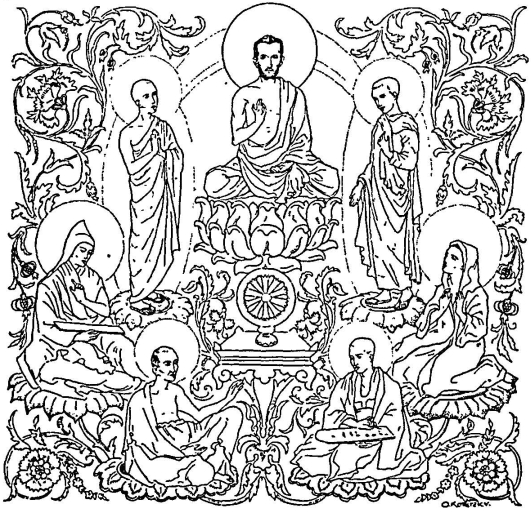
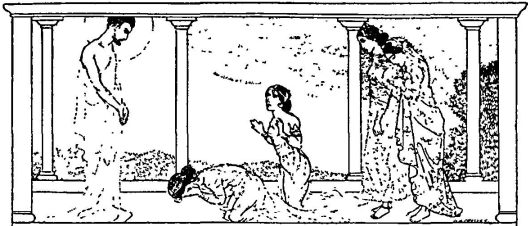
CONSOLIDATION OF THE BUDDHA'S RELIGION.
XXX.
JĪVAKA, THE PHYSICIAN.
Long before the Blessed One had attained enlightenment, self-mortification had been the custom among those who earnestly sought for salvation. Deliverance of the soul from all the necessities of life and finally from the body itself, they regarded as the aim of religion. Thus, they avoided everything that might be a luxury in food, shelter, and clothing, and lived like the beasts in the woods. Some went naked, while others wore the rags cast away upon cemeteries or dungheaps. 1
When the Blessed One retired from the world, he recognized at once the error of the naked ascetics, and, considering the indecency of their habit, clad himself in cast-off rags. 2
Having attained enlightenment and rejected all unnecessary self-mortifications, the Blessed One and his bhikkhus continued for a long time to wear the cast-off rags of cemeteries and dung-heaps. 3
Then it happened that the bhikkhus were visited with diseases of all kinds, and the Blessed One permitted and explicitly ordered the use of medicines, and among them he even enjoined, whenever needed, the use of unguents.4
One of the brethren suffered from a sore on his foot, and the Blessed One enjoined the bhikkhus to wear foot-coverings. 5
Now it happened that a disease befell the body of the Blessed One himself, and Ānanda went to Jīvaka, physician to Bimbisāra, the king. 6
And Jīvaka, a faithful believer in the Holy One, ministered unto the Blessed One with medicines and baths until the body of the Blessed One was completely restored. 7
At that time, Pajjota, king of Ujjenī, was suffering from jaundice, and Jīvaka, the physician to king Bimbisāra, was consulted. When king Pajjota had been restored to health, he sent to Jīvaka a suit of the most excellent cloth. And Jīvaka said to himself: "This suit is made of the best cloth, and nobody is worthy to receive it but the Blessed One, the perfect and holy Buddha, or the Magadha king, Senija Bimbisāra." 8
Then Jīvaka took that suit and went to the place where the Blessed One was; having approached him, and having respectfully saluted the Blessed One, he sat down near him and said: "Lord, I have a boon to ask of the Blessed One." 9
The Buddha replied: "The Tathāgatas, Jīvaka, do not grant boons before they know what they are."10
Jīvaka said: "Lord, it is a proper and unobjectionable request." 11
"Speak, Jīvaka," said the Blessed One. 12
"Lord of the world, the Blessed One wears only robes made of rags taken from a dung-heap or a cemetery, and so also does the brotherhood of bhikkhus. Now, Lord, this suit has been sent to me by King Pajjota, which is the best and most excellent, and the finest and the most precious, and the noblest that can be found. Lord of the world, may the Blessed One accept from me this suit, and may he allow the brotherhood of bhikkhus to wear lay robes." 13
The Blessed One accepted the suit, and after having delivered a religious discourse, he addressed the bhikkhus thus: 14
"Henceforth ye shall be at liberty to wear either cast-off rags or lay robes. Whether ye are pleased with the one or with the other, I will approve of it." 15
When the people at Rājagaha heard, "The Blessed One has allowed the bhikkhus to wear lay robes," those who were willing to bestow gifts became glad. And in one day many thousands of robes were presented at Rājagaha to the bhikkhus. 16
XXXI.
THE BUDDHA'S PARENTS ATTAIN NIRVĀNA.
When Suddhodana had grown old, he fell sick and sent for his son to come and see him once more before he died; and the Blessed One came and stayed at the sick-bed, and Suddhodana, having attained perfect enlightenment, died in the arms of the Blessed One. 1
And it is said that the Blessed One, for the sake of preaching to his mother Māyā-devī, ascended to heaven and dwelt with the devas. Having concluded his pious mission, he returned to the earth and went about again, converting those who listened to his teachings. 2
XXXII.
WOMEN ADMITTED TO THE SANGHA.
Yasodharā had three times requested of the Buddha that she might be admitted to the Sangha, but her wish had not been granted. Now Pajāpatī, the foster-mother of the Blessed One, in the company of Yasodharā, and many other women, went to the Tathāgata entreating him earnestly to let them take the vows and be ordained as disciples. 1
And the Blessed One, foreseeing the danger that lurked in admitting women to the Sangha, protested that while the good religion ought surely to last a thousand years it would, when women joined it, likely decay after five hundred years; but observing the zeal of Pajāpatī and Yasodharā for leading a religious life he could no longer resist and assented to have them admitted as his disciples. 2
Then the venerable Ānanda addressed the Blessed One thus: 3
"Are women competent, Venerable Lord, if they retire from household life to the homeless state, under the doctrine and discipline announced by the Tathāgata, to attain to the fruit of conversion, to attain to a release from a wearisome repetition of rebirths, to attain to saintship?" 4
And the Blessed One declared: "Women are competent, Ānanda, if they retire from household life to the homeless state, under the doctrine and discipline announced by the Tathāgata, to attain to the fruit of conversion, to attain to a release from a wearisome repetition of rebirths, to attain to saintship.5
"Consider, Ānanda, how great a benefactress Pajāpatī has been. She is the sister of the mother of the Blessed One, and as foster-mother and nurse, reared the Blessed One after the death of his mother. So, Ānanda, women may retire from household life to the homeless state, under the doctrine and discipline announced by the Tathāgata." 6
Pajāpatī was the first woman to become a disciple of the Buddha and to receive the ordination as a bhikkhunī. 7
XXXIII.
THE BHIKKHUS' CONDUCT TOWARD WOMEN.
The bhikkhus came to the Blessed One and asked him: 1
"O Tathāgata, our Lord and Master, what conduct toward women dost thou prescribe to the samanas who have left the world?" 2
And the Blessed One said: 3
"Guard against looking on a woman. 4
"If ye see a woman, let it be as though ye saw her not, and have no conversation with her. 5
"If, after all, ye must speak with her, let it be with a pure heart, and think to yourself, 'I as a samana will live in this sinful world as the spotless leaf of the lotus, unsoiled by the mud in which it grows.' 6
"If the woman be old, regard her as your mother, if young, as your sister, if very young, as your child. 7
"The samana who looks on a woman as a woman, or touches her as a woman, has broken his vow and is no longer a disciple of the Tathāgata. 8
"The power of lust is great with men, and is to be feared withal; take then the bow of earnest perseverance, and the sharp arrow-points of wisdom. 9
"Cover your heads with the helmet of right thought, and fight with fixed resolve against the five desires. 10
"Lust beclouds a man's heart, when it is confused with woman's beauty, and the mind is dazed. 11
"Better far with red-hot irons bore out both your eyes, than encourage in yourself sensual thoughts, or look upon a woman's form with lustful desires. 12
"Better fall into the fierce tiger's mouth, or under the sharp knife of the executioner, than dwell with a woman and excite in yourself lustful thoughts. 13
"A woman of the world is anxious to exhibit her form and shape, whether walking, standing, sitting, or sleeping. Even when represented as a picture, she desires to captivate with the charms of her beauty, and thus to rob men of their steadfast heart. 14
"How then ought ye to guard yourselves? 15
"By regarding her tears and her smiles as enemies, her stooping form, her hanging arms, and her disentangled hair as toils designed to entrap man's heart. 16
"Therefore, I say, restrain the heart, give it no unbridled license." 17
XXXIV.
VISĀKHĀ.
Visākhā, a wealthy woman in Sāvatthi who had many children and grandchildren, had given to the order the Pubbārāma or Eastern Garden, and was the first in Northern Kosala to become a matron of the lay sisters. 1
When the Blessed One stayed at Sāvatthi, Visākhā went up to the place where the Blessed One was, and tendered him an invitation to take his meal at her house, which the Blessed One accepted. 2
And a heavy rain fell during the night and the next morning; and the bhikkhus doffed their robes to keep them dry and let the rain fall upon their bodies. 3
When on the next day the Blessed One had finished his meal, she took her seat at his side and spoke thus: "Eight are the boons, Lord, which I beg of the Blessed One." 4
Said the Blessed One: "The Tathāgatas, O Visākhā, grant no boons until they know what they are." 5
Visākhā replied: "Befitting, Lord, and unobjectionable are the boons I ask." 6
Having received permission to make known her requests, Visākhā said: "I desire, Lord, through all my life long to bestow robes for the rainy season on the Sangha, and food for incoming bhikkhus, and food for outgoing bhikkhus, and food for the sick, and food for those who wait upon the sick, and medicine for the sick, and a constant supply of rice-milk for the Sangha, and bathing robes for the bhikkhunīs, the sisters." 7
Said the Buddha: "But what circumstance is it, O Visākhā, that thou hast in view in asking these eight boons of the Tathāgata?" 8
And Visākhā replied: 9
"I gave command, Lord, to my maid-servant, saying, 'Go, and announce to the brotherhood that the meal is ready.' And the maid went, but when she came to the vihāra, she observed that the bhikkhus had doffed their robes while it was raining, and she thought: 'These are not bhikkhus, but naked ascetics letting the rain fall on them.' So she returned to me and reported accordingly, and I had to send her a second time. Impure, Lord, is nakedness, and revolting. It was this circumstance, Lord, that I had in view in desiring to provide the Sangha my life long with special garments for use in the rainy season. 10
"As to my second wish, Lord, an incoming bhikkhu, not being able to take the direct roads, and not knowing the places where food can be procured, comes on his way tired out by seeking for alms. It was this circumstance, Lord, that I had in view in desiring to provide the Sangha my life long with food for incoming bhikkhus. 11
"Thirdly, Lord, an outgoing bhikkhu, while seeking about for alms, may be left behind, or may arrive too late at the place whither he desires to go, and will set out on the road in weariness. 12
"Fourthly, Lord, if a sick bhikkhu does not obtain suitable food, his sickness may increase upon him, and he may die. 13
"Fifthly, Lord, a bhikkhu who is waiting upon the sick will lose his opportunity of going out to seek food for himself. 14
"Sixthly, Lord, if a sick bhikkhu does not obtain suitable medicines, his sickness may increase upon him, and he may die. 15
"Seventhly, Lord, I have heard that the Blessed One has praised rice-milk, because it gives readiness of mind, dispels hunger and thirst; it is wholesome for the healthy as nourishment, and for the sick as a medicine. Therefore I desire to provide the Sangha my life long with a constant supply of rice-milk. 16
"Finally, Lord, the bhikkhunīs are in the habit of bathing in the river Achiravatī with the courtesans, at the same landing-place, and naked. And the courtesans, Lord, ridicule the bhikkhunīs, saying, 'What is the good, ladies, of your maintaining chastity when you are young? When you are old, maintain chastity then; thus will you obtain both worldly pleasure and religious consolation.' Impure, Lord, is nakedness for a woman, disgusting, and revolting. 17
"These are the circumstances, Lord, that I had in view." 18
The Blessed One said: "But what was the advantage you had in view for yourself, O Visākhā, in asking the eight boons of the Tathāgatha?" 19
Visākhā replied: 20
"Bhikkhus who have spent the rainy seasons in various places will come, Lord, to Sāvatthi to visit the Blessed One. And on coming to the Blessed One they will ask, saying: 'Such and such a bhikkhu, Lord, has died. What, now, is his destiny?' Then will the Blessed One explain that he has attained the fruits of conversion; that he has attained arahatship or has entered Nirvāna, as the case may be. 21
"And I, going up to them, will ask, 'Was that brother, Sirs, one of those who had formerly been at Sāvatthi?' If they reply to me, 'He has formerly been at Sāvatthi,' then shall I arrive at the conclusion, 'For a certainty did that brother enjoy either the robes for the rainy season, or the food for the incoming bhikkhus, or the food for the outgoing bhikkhus, or the food for the sick, or the food for those that wait upon the sick, or the medicine for the sick, or the constant supply of rice-milk.' 22
"Then will gladness spring up within me; thus gladdened, joy will come to me; and so rejoicing all my mind will be at peace. Being thus at peace I shall experience a blissful feeling of content; and in that bliss my heart will be at rest. That will be to me an exercise of my moral sense, an exercise of my moral powers, an exercise of the seven kinds of wisdom! This, Lord, was the advantage I had in view for myself in asking those eight boons of the Blessed One." 23
The Blessed One said: "It is well, it is well, Visākhā. Thou hast done well in asking these eight boons of the Tathāgata with such advantages in view. Charity bestowed upon those who are worthy of it is like good seed sown on a good soil that yields an abundance of fruits. But alms given to those who are yet under the tyrannical yoke of the passions are like seed deposited in a bad soil. The passions of the receiver of the alms choke, as it were, the growth of merits." 24
And the Blessed One gave thanks to Visākhā in these verses: 25
"O noble woman of an upright life, Disciple of the Blessed One, thou givest Unstintedly in purity of heart.26 "Thou spreadest joy, assuagest pain, And verily thy gift will be a blessing As well to many others as to thee."27
XXXV.
THE UPOSATHA AND PĀTIMOKKHA.
When Seniya Bimbisāra, the king of Magadha, was advanced in years, he retired from the world and led a religious life. He observed that there were Brahmanical sects in Rājagaha keeping sacred certain days, and the people went to their meeting-houses and listened to their sermons. 1
Concerning the need of keeping regular days for retirement from worldly labors and religious instruction, the king went to the Blessed One and said: "The Parivrājaka, who belong to the Titthiya school, prosper and gain adherents because they keep the eighth day and also the fourteenth or fifteenth day of each half-month. Would it not be advisable for the reverend brethren of the Sangha also to assemble on days duly appointed for that purpose?" 2
And the Blessed One commanded the bhikkhus to assemble on the eighth day and also on the fourteenth or fifteenth day of each half-month, and to devote these days to religious exercises. 3
A bhikkhu duly appointed should address the congregation and expound the Dharma. He should exhort the people to walk in the eightfold path of righteousness; he should comfort them in the vicissitudes of life and gladden them with the bliss of the fruit of good deeds. Thus the brethren should keep the Uposatha. 4
Now the bhikkhus, in obedience to the rule laid down by the Blessed One, assembled in the vihāra on the day appointed, and the people went to hear the Dharma, but they were greatly disappointed, for the bhikkhus remained silent and delivered no discourse. 5
When the Blessed One heard of it, he ordered the bhikkhus to recite the Pātimokkha, which is a ceremony of disburdening the conscience; and he commanded them to make confession of their trespasses so as to receive the absolution of the order. 6
A fault, if there be one, should be confessed by the bhikkhu who remembers it and desires to be cleansed. For a fault, when confessed, shall be light on him. 7
And the Blessed One said: "The Pātimokkha must be recited in this way: 8
"Let a competent and venerable bhikkhu make the following proclamation to the Sangha: 'May the Sangha hear me! To-day is Uposatha, the eighth, or the fourteenth or fifteenth day of the half-month. If the Sangha is ready, let the Sangha hold the Uposatha service and recite the Pātimokkha. I will recite the Pātimokkha.' 9
"And the bhikkhus shall reply: 'We hear it well and we concentrate well our minds on it, all of us.' 10
"Then the officiating bhikkhu shall continue: 'Let him who has committed an offence, confess it; if there be no offence, let all remain silent; from your being silent I shall understand that the reverend brethren are free from offences. 11
'As a single person who has been asked a question answers it, so also, if before an assembly like this a question is solemnly proclaimed three times, an answer is expected: if a bhikkhu, after a threefold proclamation, does not confess an existing offence which he remembers, he commits an intentional falsehood. 12
'Now, reverend brethren, an intentional falsehood has been declared an impediment by the Blessed One. Therefore, if an offence has been committed by a bhikkhu who remembers it and desires to become pure, the offence should be confessed by the bhikkhu, and when it has been confessed, it is treated duly.'" 13
XXXVI.
THE SCHISM.
While the Blessed One dwelt at Kosambī, a certain bhikkhu was accused of having committed an offence, and, as he refused to acknowledge it, the brotherhood pronounced against him the sentence of expulsion. 1
Now, that bhikkhu was erudite. He knew the Dharma, had studied the rules of the order, and was wise, learned, intelligent, modest, conscientious, and ready to submit himself to discipline. And he went to his companions and friends among the bhikkhus, saying: "This is no offence, friends; this is no reason for a sentence of expulsion. I am not guilty. The verdict is unconstitutional and invalid. Therefore I consider myself still as a member of the order. May the venerable brethren assist me in maintaining my right." 2
Those who sided with the expelled brother went to the bhikkhus who had pronounced the sentence, saying: "This is no offence"; while the bhikkhus who had pronounced the sentence replied: "This is an offence." 3
Thus altercations and quarrels arose, and the Sangha was divided into two parties, reviling and slandering each other. 4
And all these happenings were reported to the Blessed One. 5
Then the Blessed One went to the place where the bhikkhus were who had pronounced the sentence of expulsion, and said to them: "Do not think, O bhikkhus, that you are to pronounce expulsion against a bhikkhu, whatever be the facts of the case, simply by saying: 'It occurs to us that it is so, and therefore we are pleased to proceed thus against our brother.' Let those bhikkhus who frivolously pronounce a sentence against a brother who knows the Dharma and the rules of the order, who is learned, wise, intelligent, modest, conscientious, and ready to submit himself to discipline, stand in awe of causing divisions. They must not pronounce a sentence of expulsion against a brother merely because he refuses to see his offence." 6
Then the Blessed One rose and went to the brethren who sided with the expelled brother and said to them: "Do not think, O bhikkhus, that if you have given offence you need not atone for it, thinking: 'We are without offence.' When a bhikkhu has committed an offence, which he considers no offence while the brotherhood consider him guilty, he should think: 'These brethren know the Dharma and the rules of the order; they are learned, wise, intelligent, modest, conscientious, and ready to submit themselves to discipline; it is impossible that they should on my account act with selfishness or in malice or in delusion or in fear.' Let him stand in awe of causing divisions, and rather acknowledge his offence on the authority of his brethren." 7
Both parties continued to keep Uposatha and perform official acts independently of one another; and when their doings were related to the Blessed One, he ruled that the keeping of Uposatha and the performance of official acts were lawful, unobjectionable, and valid for both parties. For he said: "The bhikkhus who side with the expelled brother form a different communion from those who pronounced the sentence. There are venerable brethren in both parties. As they do not agree, let them keep Uposatha and perform official acts separately." 8
And the Blessed One reprimanded the quarrelsome bhikkhus saying to them: 9
"Loud is the voice which worldlings make; but how can they be blamed when divisions arise also in the Sangha? Hatred is not appeased in those who think: 'He has reviled me, he has wronged me, he has injured me.' 10
"For not by hatred is hatred appeased. Hatred is appeased by not-hatred. This is an eternal law. 11
"There are some who do not know the need of self-restraint; if they are quarrelsome we may excuse their behavior. But those who know better, should learn to live in concord. 12
"If a man finds a wise friend who lives righteously and is constant in his character, he may live with him, overcoming all dangers, happy and mindful. 13
"But if he finds not a friend who lives righteously and is constant in his character, let him rather walk alone, like a king who leaves his empire and the cares of government behind him to lead a life of retirement like a lonely elephant in the forest. 14
"With fools there is no companionship. Rather than to live with men who are selfish, vain, quarrelsome, and obstinate let a man walk alone." 15
And the Blessed One thought to himself: "It is no easy task to instruct these headstrong and infatuate fools." And he rose from his seat and went away. 16

XXXVII.
THE RE-ESTABLISHMENT OF CONCORD.
Whilst the dispute between the parties was not yet settled, the Blessed One left Kosambī, and wandering from place to place he came at last to Sāvatthi. 1
And in the absence of the Blessed One the quarrels grew worse, so that the Jay devotees of Kosambī became annoyed and they said: "These quarrelsome monks are a great nuisance and will bring upon us misfortunes. Worried by their altercations the Blessed One is gone, and has selected another abode for his residence. Let us, therefore, neither salute the bhikkhus nor support them. They are not worthy of wearing yellow robes, and must either propitiate the Blessed One, or return to the world." 2
And the bhikkhus of Kosambī, when no longer honored and no longer supported by the lay devotees, began to repent and said: "Let us go to the Blessed One and let him settle the question of our disagreement." 3
And both parties went to Savatthi to the Blessed One. And the venerable Sāriputta, having heard of their arrival, addressed the Blessed One and said: "These contentious, disputatious, and quarrelsome bhikkhus of Kosambī, the authors of dissensions, have come to Sāvatthi. How am I to behave, O Lord, toward those bhikkhus." 4
"Do not reprove them, Sāriputta," said the Blessed One, "for harsh words do not serve as a remedy and are pleasant to no one. Assign separate dwelling-places to each party and treat them with impartial justice. Listen with patience to both parties. He alone who weighs both sides is called a muni. When both parties have presented their case, let the Sangha come to an agreement and declare the re-establishment of concord." 5
And Pājapatī, the matron, asked the Blessed One for advice, and the Blessed One said: "Let both parties enjoy the gifts of lay members, be they robes or food, as they may need, and let no one receive any noticeable preference over any other." 6
And the venerable Upāli, having approached the Blessed One, asked concerning the re-establishment of peace in the Sangha: "Would it be right, O Lord," said he, "that the Sangha, to avoid further disputations, should declare the restoration of concord without inquiring into the matter of the quarrel?" 7
And the Blessed One said: 8
"If the Sangha declares the re-establishment of concord without having inquired into the matter, the declaration is neither right nor lawful. 9
"There are two ways of re-establishing concord; one is in the letter, and the other one is in the spirit and in the letter. 10
"If the Sangha declares the re-establishment of concord without having inquired into the matter, the peace is concluded in the letter only. But if the Sangha, having inquired into the matter and having gone to the bottom of it, decides to declare the re-establishment of concord, the peace is concluded in the spirit and also in the letter. 11
"The concord re-established in the spirit and in the letter is alone right and lawful." 12
And the Blessed One addressed the bhikkhus and told them the story of Prince Dīghāvu, the Long-lived. He said: 13
"In former times, there lived at Benares a powerful king whose name was Brahmadatta of Kāsi; and he went to war against Dīghīti, the Long-suffering, a king of Kosala, for he thought, 'The kingdom of Kosala is small and Dīghīti will not be able to resist my armies.' 14
"And Dīghīti, seeing that resistance was impossible against the great host of the king of Kāsi, fled, leaving his little kingdom in the hands of Brahmadatta; and having wandered from place to place, he came at last to Benares, and lived there with his consort in a potter's dwelling outside the town. 15
"And the queen bore him a son and they called him Dīghāvu. 16
"When Dīghāvu had grown up, the king thought to himself: 'King Brahmadatta has done us great harm, and he is fearing our revenge; he will seek to kill us. Should he find us he will slay all three of us.' And he sent his son away, and Dīghāvu having received a good education from his father, applied himself diligently to learn all arts, becoming very skilful and wise. 17
"At that time the barber of king Dīghīti dwelt at Benares, and he saw the king, his former master, and, being of an avaricious nature, betrayed him to King Brahmadatta. 18
"When Brahmadatta, the king of Kāsi, heard that the fugitive king of Kosala and his queen, unknown and in disguise, were living a quiet life in a potter's dwelling, he ordered them to be bound and executed; and the sheriff to whom the order was given seized king Dīghīti and led him to the place of execution. 19
"While the captive king was being led through the streets of Benares he saw his son who had returned to visit his parents, and, careful not to betray the presence of his son, yet anxious to communicate to him his last advice, he cried: 'O Dīghāvu, my son! Be not far-sighted, be not near-sighted, for not by hatred is hatred appeased; hatred is appeased by not-hatred only.' 20
"The king and queen of Kosala were executed, but Dīghāvu their son bought strong wine and made the guards drunk. When the night arrived he laid the bodies of his parents upon a funeral pyre and burned them with all honors and religious rites. 21
"When king Brahmadatta heard of it, he became afraid, for he thought, 'Dīghāvu, the son of king Dīghīti, is a wise youth and he will take revenge for the death of his parents. If he espies a favorable opportunity, he will assassinate me.' 22
"Young Dīghāvu went to the forest and wept to his heart's content. Then he wiped his tears and returned to Benares. Hearing that assistants were wanted in the royal elephants' stable, he offered his services and was engaged by the master of the elephants. 23
"And it happened that the king heard a sweet voice ringing through the night and singing to the lute a beautiful song that gladdened his heart. And having inquired among his attendants who the singer might be, was told that the master of the elephants had in his service a young man of great accomplishments, and beloved by all his comrades. They said, 'He is wont to sing to the lute, and he must have been the singer that gladdened the heart of the king.' 24
"And the king summoned the young man before him and, being much pleased with Dīghāvu, gave him employment in the royal castle. Observing how wisely the youth acted, how modest he was and yet punctilious in the performance of his work, the king very soon gave him a position of trust. 25
"Now it came to pass that the king went hunting and became separated from his retinue, young Dīghāvu alone remaining with him. And the king worn out from the hunt laid his head in the lap of young Dīghāvu and slept. 26
"And Dīghāvu thought: 'People will forgive great wrongs which they have suffered, but they will never be at ease about the wrongs which they themselves have done. They will persecute their victims to the bitter end. This king Brahmadatta has done us great injury, he robbed us of our kingdom and slew my father and my mother. He is now in my power.' Thinking thus he unsheathed his sword. 27
"Then Dīghāvu thought of the last words of his father. 'Be not far-sighted, be not near-sighted. For not by hatred is hatred appeased. Hatred is appeased by not-hatred alone.' Thinking thus, he put his sword back into the sheath. 28
"The king became restless in his sleep and he awoke, and when the youth asked, 'Why art thou frightened, O king?' he replied: 'My sleep is always restless because I often dream that young Dīghāvu is coming upon me with his sword. While I lay here with my head in thy lap I dreamed the dreadful dream again; and I awoke full of terror and alarm.' 29
"Then the youth, laying his left hand upon the defenceless king's head and with his right hand drawing his sword, said: 'I am Dīghāvu, the son of king Dīghīti, whom thou hast robbed of his kingdom and slain together with his queen, my mother. I know that men overcome the hatred entertained for wrongs which they have suffered much more easily than for the wrongs which they have done, and so I cannot expect that thou wilt take pity on me; but now a chance for revenge has come to me.' 30
"The king seeing that he was at the mercy of young Dīghāvu raised his hands and said: 'Grant me my life, my dear Dīghāvu, grant me my life. I shall be forever grateful to thee.' 31
"And Dīghāvu said without bitterness or ill-will: 'How can I grant thee thy life, O king, since my life is endangered by thee. I do not mean to take thy life. It is thou, O king, who must grant me my life.' 32
"And the king said: 'Well, my dear Dīghāvu, then grant me my life, and I will grant thee thine.' 33
"Thus, king Brahmadatta of Kāsi and young Dīghāvu granted each other's life and took each other's hand and swore an oath not to do any harm to each other. 34
"And king Brahmadatta of Kāsi said to young Dīghāvu: 'Why did thy father say to thee in the hour of his death: "Be not far-sighted, be not near-sighted, for hatred is not appeased by hatred. Hatred is appeased by not-hatred alone,"—what did thy father mean by that?' 35
"The youth replied: 'When my father, O king, in the hour of his death said: "Be not far-sighted," he meant, Let not thy hatred go far. And when my father said, "Be not near-sighted," he meant, Be not hasty to fall out with thy friends. And when he said, "For not by hatred is hatred appeased; hatred is appeased by not-hatred," he meant this: Thou hast killed my father and mother, O king, and if I should deprive thee of thy life, then thy partisans in turn would take away my life; my partisans again would deprive thine of their lives. Thus by hatred, hatred would not be appeased. But now, O king, thou hast granted me my life, and I have granted thee thine; thus by not-hatred hatred has been appeased.' 36
"Then king Brahmadatta of Kāsi thought: 'How wise is young Dīghāvu that he understands in its full extent the meaning of what his father spoke concisely.' And the king gave him back his father's kingdom and gave him his daughter in marriage." 37
Having finished the story, the Blessed One said: "Brethren, ye are my lawful sons in the faith, begotten by the words of my mouth. Children ought not to trample under foot the counsel given them by their father; do ye henceforth follow my admonitions." 38
Then the bhikkhus met in conference; they discussed their differences in mutual good will, and the concord of the Sangha was re-established. 39
XXXVIII.
THE BHIKKHUS REBUKED.
And it happened that the Blessed One walked up and down in the open air unshod. 1
When the elders saw that the Blessed One walked unshod, they put away their shoes and did likewise. But the novices did not heed the example of their elders and kept their feet covered. 2
Some of the brethren noticed the irreverent behavior of the novices and told the Blessed One; and the Blessed One rebuked the novices and said: "If the brethren, even now, while I am yet living, show so little respect and courtesy to one another, what will they do when I have passed away?" 3
And the Blessed One was filled with anxiety for the welfare of the truth; and he continued: 4
"Even the laymen, O bhikkhus, who move in the world, pursuing some handicraft that they may procure them a living, will be respectful, affectionate, and hospitable to their teachers. Do ye, therefore, O bhikkhus, so let your light shine forth, that ye, having left the world and devoted your entire life to religion and to religious discipline, may observe the rules of decency, be respectful, affectionate, and hospitable to your teachers and superiors, or those who rank as your teachers and superiors. Your demeanor, O bhikkhus, does not conduce to the conversion of the unconverted and to the increase of the number of the faithful. It serves, O bhikkhus, to repel the unconverted and to estrange them. I exhort you to be more considerate in the future, more thoughtful and more respectful" 5
XXXIX.
DEVADATTA.
When Devadatta, the son of Suprabuddha and a brother of Yasodharā, became a disciple, he cherished the hope of attaining the same distinctions and honors as Gotama Siddhattha. Being disappointed in his ambitions, he conceived in his heart a jealous hatred, and, attempting to excel the Perfect One in virtue, he found fault with his regulations and reproved them as too lenient. 1
Devadatta went to Rājagaha and gained the ear of Ajātasattu, the son of King Bimbisāra. And Ajātasattu built a new vihāra for Devadatta, and founded a sect whose disciples were pledged to severe rules and self-mortification. 2
Soon afterwards the Blessed One himself came to Rājagaha and stayed at the Veluvana vihāra. 3
Devadatta called on the Blessed One, requesting him to sanction his rules of greater stringency, by which a greater holiness might be procured. "The body," he said, "consists of its thirty-two parts and has no divine attributes. It is conceived in sin and born in corruption. Its attributes are liability to pain and dissolution, for it is impermanent. It is the receptacle of karma which is the curse of our former existences; it is the dwelling-place of sin and diseases and its organs constantly discharge disgusting secretions. Its end is death and its goal the charnel house. Such being the condition of the body it behooves us to treat it as a carcass full of abomination and to clothe it in such rags only as have been gathered in cemeteries or upon dung-hills." 4
The Blessed One said: "Truly, the body is full of impurity and its end is the charnel house, for it is impermanent and destined to be dissolved into its elements. But being the receptacle of karma, it lies in our power to make it a vessel of truth and not of evil. It is not good to indulge in the pleasures of the body, but neither is it good to neglect our bodily needs and to heap filth upon impurities. The lamp that is not cleansed and not filled with oil will be extinguished, and a body that is unkempt, unwashed, and weakened by penance will not be a fit receptacle for the light of truth. Attend to your body and its needs as you would treat a wound which you care for without loving it. Severe rules will not lead the disciples on the middle path which I have taught. Certainly, no one can be prevented from keeping more stringent rules, if he sees fit to do so, but they should not be imposed upon any one, for they are unnecessary." 5
Thus the Tathāgata refused Devadatta's proposal; and Devadatta left the Buddha and went into the vihāra speaking evil of the Lord's path of salvation as too lenient and altogether insufficient. 6
When the Blessed One heard of Devadatta's intrigues, he said: "Among men there is no one who is not blamed. People blame him who sits silent and him who speaks, they also blame the man who preaches the middle path." 7
Devadatta instigated Ajātasattu to plot against his father Bimbisāra, the king, so that the prince would no longer be subject to him; Bimbisāra was imprisoned by his son in a tower where he died leaving the kingdom of Magadha to his son Ajātasattu. 8
The new king listened to the evil advice of Devadatta, and he gave orders to take the life of the Tathāgata. However, the murderers sent out to kill the Lord could not perform their wicked deed, and became converted as soon as they saw him and listened to his preaching. The rock hurled down from a precipice upon the great Master split in twain, and the two pieces passed by on either side without doing any harm. Nalagiri, the wild elephant let loose to destroy the Lord, became gentle in his presence; and Ajātasattu, suffering greatly from the pangs of his conscience, went to the Blessed One and sought peace in his distress. 9