PAUL CARUS (continued 4)
Reading edition
The Buddha said:4
"Let the bhikkhu subdue his passion for human and celestial pleasures, then, having conquered existence, he will command the Dharma. Such a one will wander rightly in the world.5
"He whose lusts have been destroyed, who is free from pride, who has overcome all the ways of passion, is subdued, perfectly happy, and of a firm mind. Such a one will wander rightly in the world.6
"Faithful is he who is possessed of knowledge, seeing the way that leads to Nirvāna; he who is not a partisan; he who is pure and virtuous, and has removed the veil from his eyes. Such a one will wander rightly in the world."7
Said the bhikkhus: "Certainly, O Bhagavat, it is so: whichever bhikkhu lives in this way, subdued and having overcome all bonds, such a one will wander rightly in the world."8
The Blessed One said:99
"Whatever is to be done by him who aspires to attain the tranquillity of Nirvāna let him be able and upright, conscientious and gentle, and not proud.10
"Let a man's pleasure be the Dharma, let him delight in the Dharma, let him stand fast in the Dharma, let him know how to inquire into the Dharma, let him not raise any dispute that pollutes the Dharma, and let him spend his time in pondering on the well-spoken truths of the Dharma.11
"A treasure that is laid up in a deep pit profits nothing and may easily be lost. The real treasure that is laid up through charity and piety, temperance, self-control, or deeds of merit, is hid secure and cannot pass away. It is never gained by despoiling or wronging others, and no thief can steal it. A man, when he dies, must leave the fleeting wealth of the world, but this treasure of virtuous acts he takes with him. Let the wise do good deeds; they are a treasure that can never be lost."12
And the bhikkhus praised the wisdom of the Tathāgata:13
"Thou hast passed beyond pain; thou art holy, O Enlightened One, we consider thee one that has destroyed his passions. Thou art glorious, thoughtful, and of great understanding. O thou who puttest an end to pain, thou hast carried us across our doubt.14
"Because thou sawst our longing and carriedst us across our doubt, adoration be to thee, O muni, who hast attained the highest good in the ways of wisdom.15
"The doubt we had before, thou hast cleared away, O thou clearly-seeing one; surely thou art a great thinker, perfectly enlightened, there is no obstacle for thee.16
"And all thy troubles are scattered and cut off; thou art calm, subdued, firm, truthful.17
"Adoration be to thee, O noble sage, adoration be to thee, O thou best of beings; in the world of men and gods there is none equal to thee. 18
"Thou art the Buddha, thou art the Master, thou art the muni that conquers Māra; after having cut off desire thou hast crossed over and carriest this generation to the other shore."19
LX.
AMITĀBHA.
One of the disciples came to the Blessed One with a trembling heart and his mind full of doubt. And he asked the Blessed One: "O Buddha, our Lord and Master, why do we give up the pleasures of the world, if thou forbiddest us to work miracles and to attain the supernatural? Is not Amitābha, the infinite light of revelation, the source of innumerable miracles?"1
And the Blessed One, seeing the anxiety of a truth-seeking mind, said: "O sāvaka, thou art a novice among the novices, and thou art swimming on the surface of samsāra. How long will it take thee to grasp the truth? Thou hast not understood the words of the Tathāgata. The law of karma is irrefragable, and supplications have no effect, for they are empty words."2
Said the disciple: "So sayest thou there are no miraculous and wonderful things?"3
And the Blessed One replied:4
"Is it not a wonderful thing, mysterious and miraculous to the worldling, that a man who commits wrong can become a saint, that he who attains to true enlightenment will find the path of truth and abandon the evil ways of selfishness?5
"The bhikkhu who renounces the transient pleasures of the world for the eternal bliss of holiness, performs the only miracle that can truly be called a miracle. 6
"A holy man changes the curses of karma into blessings. The desire to perform miracles arises either from covetousness or from vanity.7
"That mendicant does right who does not think: 'People should salute me'; who, though despised by the world, yet cherishes no ill-will towards it.8
"That mendicant does right to whom omens, meteors, dreams, and signs are things abolished; he is free from all their evils.9
"Amitābha, the unbounded light, is the source of wisdom, of virtue, of Buddhahood. The deeds of sorcerers and miracle-mongers are frauds, but what is more wondrous, more mysterious, more miraculous than Amitābha?"10
"But, Master," continued the sāvaka, "is the promise of the happy region vain talk and a myth?"11
"What is this promise?" asked the Buddha; and the disciple replied:12
"There is in the west a paradise called the Pure Land, exquisitely adorned with gold and silver and precious gems. There are pure waters with golden sands, surrounded by pleasant walks and covered with large lotus flowers. Joyous music is heard, and flowers rain down three times a day. There are singing birds whose harmonious notes proclaim the praises of religion, and in the minds of those who listen to their sweet sounds, remembrance arises of the Buddha, the law, and the brotherhood. No evil birth is possible there, and even the name of hell is unknown. He who fervently and with a pious mind repeats the words 'Amitābha Buddha' will be transported to the happy region of this pure land, and when death draws nigh, the Buddha, with a company of saintly followers, will stand before him, and there will be perfect tranquillity."13
"In truth," said the Buddha, "there is such a happy paradise. But the country is spiritual and it is accessible only to those that are spiritual. Thou sayest it lies in the west. This means, look for it where he who enlightens the world resides. The sun sinks down and leaves us in utter darkness, the shades of night steal over us, and Māra, the evil one, buries our bodies in the grave. Sunset is nevertheless no extinction, and where we imagine we see extinction, there is boundless light and inexhaustible life."14
"I understand," said the sāvaka, "that the story of the Western Paradise is not literally true."15
"Thy description of paradise," the Buddha continued, "is beautiful; yet it is insufficient and does little justice to the glory of the pure land. The worldly can speak of it in a worldly way only; they use worldly similes and worldly words. But the pure land in which the pure live is more beautiful than thou canst say or imagine.16
"However, the repetition of the name Amitābha Buddha is meritorious only if thou speak it with such a devout attitude of mind as will cleanse thy heart and attune thy will to do works of righteousness. He only can reach the happy land whose soul is filled with the infinite light of truth. He only can live and breathe in the spiritual atmosphere of the Western Paradise who has attained enlightenment.17
"Verily I say unto thee, the Tathāgata lives in the pure land of eternal bliss even now while he is still in the body; and the Tathāgata preaches the law of religion unto thee and unto the whole world, so that thou and thy brethren may attain the same peace and the same happiness."18
Said the disciple: "Teach me, O Lord, the meditations to which I must devote myself in order to let my mind enter into the paradise of the pure land."19
Buddha said: "There are five meditations.20
"The first meditation is the meditation of love in which thou must so adjust thy heart that thou longest for the weal and welfare of all beings, including the happiness of thine enemies. 21
"The second meditation is the meditation of pity, in which thou thinkest of all beings in distress, vividly representing in thine imagination their sorrows and anxieties so as to arouse a deep compassion for them in thy soul.22
"The third meditation is the meditation of joy in which thou thinkest of the prosperity of others and rejoicest with their rejoicings.23
"The fourth meditation is the meditation on impurity, in which thou considerest the evil consequences of corruption, the effects of wrongs and evils. How trivial is often the pleasure of the moment and how fatal are its consequences!24
"The fifth meditation is the meditation on serenity, in which thou risest above love and hate, tyranny and thraldom, wealth and want, and regardest thine own fate with impartial calmness and perfect tranquillity.25
"A true follower of the Tathāgata founds not his trust upon austerities or rituals but giving up the idea of self relies with his whole heart upon Amitābha, which is the unbounded light of truth."26
The Blessed One after having explained his doctrine of Amitābha, the immeasurable light which makes him who receives it a Buddha, looked into the heart of his disciple and saw still some doubts and anxieties. And the Blessed One said: "Ask me, my son, the questions which weigh upon thy soul."27
And the disciple said: "Can a humble monk, by sanctifying himself, acquire the talents of supernatural wisdom called Abhiññas and the supernatural powers called Iddhi? Show me the Iddhi-pāda, the path to the highest wisdom? Open to me the Jhānas which are the means of acquiring samādhi, the fixity of mind which enraptures the soul."28
And the Blessed One said: "Which are the Abhiññas?"29
The disciple replied: "There are six Abhiññas: (1) The celestial eye; (2) the celestial ear; (3) the body at will or the power of transformation; (4) the knowledge of the destiny of former dwellings, so as to know former states of existence; (5) the faculty of reading the thoughts of others; and (6) the knowledge of comprehending the finality of the stream of life."30
And the Blessed One replied: "These are wondrous things; but verily, every man can attain them. Consider the abilities of thine own mind; thou wert born about two hundred leagues from here and canst thou not in thy thought, in an instant travel to thy native place and remember the details of thy father's home? Seest thou not with thy mind's eye the roots of the tree which is shaken by the wind without being overthrown? Does not the collector of herbs see in his mental vision, whenever he pleases, any plant with its roots, its stem, its fruits, leaves, and even the uses to which it can be applied? Cannot the man who understands languages recall to his mind any word whenever he pleases, knowing its exact meaning and import? How much more does the Tathāgata understand the nature of things; he looks into the hearts of men and reads their thoughts. He knows the evolution of beings and foresees their ends."31
Said the disciple: "Then the Tathāgata teaches that man can attain through the Jhānas the bliss of Abhiñña."32
And the Blessed One asked in reply: "Which are the Jhānas through which man reaches Abhiñña?"33
The disciple replied: "There are four Jhānas. The first Jhāna is seclusion in which one must free his mind from sensuality; the second Jhāna is a tranquillity of mind full of joy and gladness; the third Jhāna is a taking delight in things spiritual; the fourth Jhāna is a state of perfect purity and peace in which the mind is above all gladness and grief."34
"Good, my son," enjoined the Blessed One. "Be sober and abandon wrong practices which serve only to stultify the mind."35
Said the disciple: "Forbear with me, O Blessed One, for I have faith without understanding and I am seeking the truth. O Blessed One, O Tathāgata, my Lord and Master, teach me the Iddhipāda."36
The Blessed One said: "There are four means by which Iddhi is acquired; (1) Prevent bad qualities from arising. (2) Put away bad qualities which have arisen. (3) Produce goodness that does not yet exist. (4) Increase goodness which already exists.—Search with sincerity, and persevere in the search. In the end thou wilt find the truth."37
LXI.
THE TEACHER UNKNOWN.
And the Blessed One said to Ānanda:1
"There are various kinds of assemblies, O Ānanda; assemblies of nobles, of Brahmans, of householders, of bhikkhus, and of other beings. When I used to enter an assembly, I always became, before I seated myself, in color like unto the color of my audience, and in voice like unto their voice. I spoke to them in their language and then with religious discourse, I instructed, quickened, and gladdened them.2
"My doctrine is like the ocean, having the same eight wonderful qualities.3
"Both the ocean and my doctrine become gradually deeper. Both preserve their identity under all changes. Both cast out dead bodies upon the dry land. As the great rivers, when falling into the main, lose their names and are thenceforth reckoned as the great ocean, so all the castes, having renounced their lineage and entered the Sangha, become brethren and are reckoned the sons of Sakyamuni. The ocean is the goal of all streams and of the rain from the clouds, yet is it never overflowing and never emptied: so the Dharma is embraced by many millions of people, yet it neither increases nor decreases. As the great ocean has only one taste, the taste of salt, so my doctrine has only one flavor, the flavor of emancipation. Both the ocean and the Dharma are full of gems and pearls and jewels, and both afford a dwelling-place for mighty beings.4
"These are the eight wonderful qualities in which my doctrine resembles the ocean.5
"My doctrine is pure and it makes no discrimination between noble and ignoble, rich and poor.6
"My doctrine is like unto water which cleanses all without distinction.7
"My doctrine is like unto fire which consumes all things that exist between heaven and earth, great and small.8
"My doctrine is like unto the heavens, for there is room in it, ample room for the reception of all, for men and women, boys and girls, the powerful and the lowly.9
"But when I spoke, they knew me not and would say, 'Who may this be who thus speaks, a man or a god?' Then having instructed, quickened, and gladdened them with religious discourse, I would vanish away. But they knew me not, even when I vanished away."10

PARABLES AND STORIES.
LXII.
PARABLES.
And the Blessed One thought: "I have taught the truth which is excellent in the beginning, excellent in the middle, and excellent in the end; it is glorious in its spirit and glorious in its letter. But simple as it is, the people cannot understand it. I must speak to them in their own language. I must adapt my thoughts to their thoughts. They are like unto children, and love to hear tales. Therefore, I will tell them stories to explain the glory of the Dharma. If they cannot grasp the truth in the abstract arguments by which I have reached it, they may nevertheless come to understand it, if it is illustrated in parables."1
LXIII.
THE WIDOW'S TWO MITES AND THE PARABLE OF THE THREE MERCHANTS.
There was once a lone widow who was very destitute, and having gone to the mountain she beheld hermits holding a religious assembly. Then the woman was filled with joy, and uttering praises, said, "It is well, holy priests! but while others give precious things such as the ocean caves produce, I have nothing to offer." Having spoken thus and having searched herself in vain for something to give, she recollected that some time before she had found in a dungheap two coppers, so taking these she offered them forthwith as a gift to the priesthood in charity.1
The superior of the priests, a saint who could read the hearts of men, disregarding the rich gifts of others and beholding the deep faith dwelling in the heart of this poor widow, and wishing the priesthood to esteem rightly her religious merit, burst forth with full voice in a canto. He raised his right hand and said, "Reverend priests attend!" and then he proceeded:2
"The coppers of this poor widow To all purpose are more worth Than all the treasures of the oceans And the wealth of the broad earth.3 "As an act of pure devotion She has done a pious deed; She has attained salvation, Being free from selfish greed."4
The woman was mightily strengthened in her mind by this thought, and said, "It is even as the Teacher says: what I have done is as much as if a rich man were to give up all his wealth."5
And the Teacher said: "Doing good deeds is like hoarding up treasures," and he expounded this truth in a parable:6
"Three merchants set out on their travels, each with his capital; one of them gained much, the second returned with his capital, and the third one came home after having lost his capital. What is true in common life applies also to religion.7
"The capital is the state a man has reached, the gain is heaven; the loss of his capital means that a man will be born in a lower state, as a denizen of hell or as an animal. These are the courses that are open to the sinner.8
"He who brings back his capital, is like unto one who is born again as a man. Those who through the exercise of various virtues become pious householders will be born again as men, for all beings will reap the fruit of their actions. But he who increases his capital is like unto one who practises eminent virtues. The virtuous, excellent man attains in heaven to the glorious state of the gods."9
LXIV.
THE MAN BORN BLIND.
There was a man born blind, and he said: "I do not believe in the world of light and appearance. There are no colors, bright or sombre. There is no sun, no moon, no stars. No one has witnessed these things."1
His friends remonstrated with him, but he clung to his opinion: "What you say that you see," he objected, "are illusions. If colors existed I should be able to touch them. They have no substance and are not real. Everything real has weight, but I feel no weight where you see colors."2
In those days there was a physician who was called to see the blind man. He mixed four simples, and when he applied them to the cataract of the blind man the gray film melted, and his eyes acquired the faculty of sight.3
The Tathāgata is the physician, the cataract is the illusion of the thought "I am," and the four simples are the four noble truths.4
LXV.
THE LOST SON.
There was a householder's son who went away into a distant country, and while the father accumulated immeasurable riches, the son became miserably poor. And the son while searching for food and clothing happened to come to the country in which his father lived. And the father saw him in his wretchedness, for he was ragged and brutalized by poverty, and ordered some of his servants to call him.1
When the son saw the place to which he was conducted, he thought, "I must have evoked the suspicion of a powerful man, and he will throw me into prison." Full of apprehension he made his escape before he had seen his father.2
Then the father sent messengers out after his son, who was caught and brought back in spite of his cries and lamentations. Thereupon the father ordered his servants to deal tenderly with his son, and he appointed a laborer of his son's rank and education to employ the lad as a helpmate on the estate. And the son was pleased with his new situation.3
From the window of his palace the father watched the boy, and when he saw that he was honest and industrious, he promoted him higher and higher.4
After some time, he summoned his son and called together all his servants, and made the secret known to them. Then the poor man was exceedingly glad and he was full of joy at meeting his father.5
Little by little must the minds of men be trained for higher truths.6
LXVI.
THE GIDDY FISH.
There was a bhikkhu who had great difficulty in keeping his senses and passions under control; so, resolving to leave the Order, he came to the Blessed One to ask him for a release from the vows. And the Blessed One said to the bhikkhu:1
"Take heed, my son, lest thou fall a prey to the passions of thy misguided heart. For I see that in former existences, thou hast suffered much from the evil consequences of lust, and unless thou learnest to conquer thy sensual desire, thou wilt in this life be ruined through thy folly.2
"Listen to a story of another existence of thine, as a fish. 3
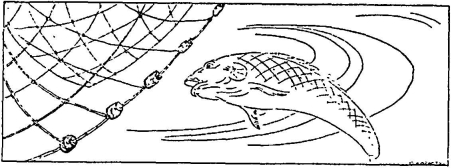
"The fish could be seen swimming lustily in the river, playing with his mate. She, moving in front, suddenly perceived the meshes of a net, and slipping around escaped the danger; but he, blinded by love, shot eagerly after her and fell straight into the mouth of the net. The fisherman pulled the net up, and the fish, who complained bitterly of his sad fate, saying, 'this indeed is the bitter fruit of my folly,' would surely have died if the Bodhisatta had not chanced to come by, and, understanding the language of the fish, took pity on him. He bought the poor creature and said to him: 'My good fish, had I not caught sight of thee this day, thou wouldst have lost thy life. I shall save thee, but henceforth avoid the evil of lust.' With these words he threw the fish into the water4
"Make the best of the time of grace that is offered to thee in thy present existence, and fear the dart of passion which, if thou guard not thy senses, will lead thee to destruction." 5
LXVII
THE CRUEL CRANE OUTWITTED.
A tailor who used to make robes for the brotherhood was wont to cheat his customers, and thus prided himself on being smarter than other men. But once, on entering upon an important business transaction with a stranger, he found his master in fraudulent practices, and suffered a heavy loss.1
And the Blessed One said: "This is not an isolated incident in the greedy tailor's fate; in other incarnations he suffered similar losses, and by trying to dupe others ultimately ruined himself.2
"This same greedy character lived many generations ago as a crane near a pond, and when the dry season set in he said to the fishes with a bland voice: 'Are you not anxious for your future welfare? There is at present very little water and still less food in this pond. What will you do should the whole pond become dry, in this drought?'3
'Yes, indeed' said the fishes, 'what should we do?'4
"Replied the crane: 'I know a fine, large lake, which never becomes dry. Would you not like me to carry you there in my beak?' When the fishes began to distrust the honesty of the crane, he proposed to have one of them sent over to the lake to see it; and a big carp at last decided to take the risk for the sake of the others, and the crane carried him to a beautiful lake and brought him back in safety. Then all doubt vanished, and the fishes gained confidence in the crane, and now the crane took them one by one out of the pond and devoured them on a big varana-tree.5
"There was also a lobster in the pond, and when it listed the crane to eat him too, he said: 'I have taken all the fishes away and put them in a fine, large lake. Come along. I shall take thee, too!'6
'But how wilt thou hold me to carry me along?' asked the lobster.7
'I shall take hold of thee with my beak,' said the crane.8
'Thou wilt let me fall if thou carry me like that. I will not go with thee!' replied the lobster.9
'Thou needst not fear,' rejoined the crane; 'I shall hold thee quite tight all the way.'10
"Then said the lobster to himself: 'If this crane once gets hold of a fish, he will certainly never let him go in a lake! Now if he should really put me into the lake it would be splendid; but if he does not, then I will cut his throat and kill him!' So he said to the crane: 'Look here, friend, thou wilt not be able to hold me tight enough; but we lobsters have a famous grip. If thou wilt let me catch hold of thee round the neck with my claws, I shall be glad to go with thee.'11
"The crane did not see that the lobster was trying to outwit him, and agreed. So the lobster caught hold of his neck with his claws as securely as with a pair of blacksmith's pincers, and called out: 'Ready, ready, go!'12
"The crane took him and showed him the lake, and then turned off toward the varana-tree. 'My dear uncle!' cried the lobster, 'The lake lies that way, but thou art taking me this other way.'13
"Answered the crane: 'Thinkest thou so? Am I thy dear uncle? Thou meanest me to understand, I suppose, that I am thy slave, who has to lift thee up and carry thee about with him, where thou pleasest! Now cast thine eye upon that heap of fish-bones at the root of yonder varana-tree. Just as I have eaten those fish, every one of them, just so will I devour thee also!'14
'Ah! those fishes got eaten through their own stupidity,' answered the lobster, 'but I am not going to let thee kill me. On the contrary, it is thou that I am going to destroy. For thou, in thy folly, hast not seen that I have outwitted thee. If we die, we both die together; for I will cut off this head of thine and cast it to the ground!' So saying, he gave the crane's neck a pinch with his claws as with a vise.15
"Then gasping, and with tears trickling from his eyes, and trembling with the fear of death, the crane besought the lobster, saying: 'O, my Lord! Indeed I did not intend to eat thee. Grant me my life!'16
'Very well! fly down and put me into the lake,' replied the lobster.17
"And the crane turned round and stepped down into the lake, to place the lobster on the mud at its edge. Then the lobster cut the crane's neck through as clean as one would cut a lotus-stalk with a hunting-knife, and then entered the water!"18
When the Teacher had finished this discourse, he added: "Not now only was this man outwitted in this way, but in other existences, too, by his own intrigues."19
LXVIII.
FOUR KINDS OF MERIT.
There was a rich man who used to invite all the Brahmans of the neighborhood to his house, and, giving them rich gifts, offered great sacrifices to the gods.1
And the Blessed One said: "If a man each month repeat a thousand sacrifices and give offerings without ceasing, he is not equal to him who but for one moment fixes his mind upon righteousness."2
The world-honored Buddha continued: "There are four kinds of offering: first, when the gifts are large and the merit small; secondly, when the gifts are small and the merit small; thirdly, when the gifts are small and the merit large; and fourthly, when the gifts are large and the merit is also large.3
"The first is the case of the deluded man who takes away life for the purpose of sacrificing to the gods, accompanied by carousing and feasting. Here the gifts are great, but the merit is small indeed.4
"The gifts are small and the merit is also small, when from covetousness and an evil heart a man keeps to himself a part of that which he intends to offer.5
"The merit is great, however, while the gift is small, when a man makes his offering from love and with a desire to grow in wisdom and in kindness.6
"Lastly, the gift is large and the merit is large, when a wealthy man, in an unselfish spirit and with the wisdom of a Buddha, gives donations and founds institutions for the best of mankind to enlighten the minds of his fellow-men and to administer unto their needs."7
LXIX.
THE LIGHT OF THE WORLD.
There was a certain Brahman in Kosambī, a wrangler and well versed in the Vedas. As he found no one whom he regarded his equal in debate he used to carry a lighted torch in his hand, and when asked for the reason of his strange conduct, he replied: "The world is so dark that I carry this torch to light it up, as far as I can."1
A samana sitting in the market-place heard these words and said: "My friend, if thine eyes are blind to the sight of the omnipresent light of the day, do not call the world dark. Thy torch adds nothing to the glory of the sun and thy intention to illumine the minds of others is as futile as it is arrogant." 2
Whereupon the Brahman asked: "Where is the sun of which thou speakest?" And the samana replied: "The wisdom of the Tathāgata is the sun of the mind. His radiancy is glorious by day and night, and he whose faith is strong will not lack light on the path to Nirvāna where he will inherit bliss everlasting."3
LXX.
LUXURIOUS LIVING.
While the Buddha was preaching his doctrine for the conversion of the world in the neighborhood of Savatthi, a man of great wealth who suffered from many ailmemts came to him with clasped hands and said: "World-honored Buddha, pardon me for my want of respect in not saluting thee as I ought, but I suffer greatly from obesity, excessive drowsiness, and other complaints, so that I cannot move without pain."1
The Tathāgata, seeing the luxuries with which the man was surrounded asked him: "Hast thou a desire to know the cause of thy ailments?" And when the wealthy man expressed his willingness to learn, the Blessed One said: "There are five things which produce the condition of which thou complainest: opulent dinners, love of sleep, hankering after pleasure, thoughtlessness, and lack of occupation. Exercise self-control at thy meals, and take upon thyself some duties that will exercise thy abilities and make thee useful to thy fellow-men. In following this advice thou wilt prolong thy life."2
The rich man remembered the words of the Buddha and after some time having recovered his lightness of body and youthful buoyancy returned to the Worldhonored One and, coming afoot without horses and attendants, said to him: "Master, thou hast cured my bodily ailments; I come now to seek enlightenment of my mind."3
And the Blessed One said: "The worldling nourishes his body, but the wise man nourishes his mind. He who indulges in the satisfaction of his appetites works his own destruction; but he who walks in the path will have both the salvation from evil and a prolongation of life."4
LXXI.
THE COMMUNICATION OF BLISS.
Annabhāra, the slave of Sumana, having just cut the grass on the meadow, saw a samana with his bowl begging for food. Throwing down his bundle of grass he ran into the house and returned with the rice that had been provided for his own food.1
The samana ate the rice and gladdened him with words of religious comfort.1
The daughter of Sumana having observed the scene from a window called out: "Good! Annabhāra, good! Very good!"3
Sumana hearing these words inquired what she meant, and on being informed about Annabhāra's devotion and the words of comfort he had received from the samana, went to his slave and offered him money to divide the bliss of his offering.4
"My lord," said Annabhāra, "let me first ask the venerable man." And approaching the samana, he said: "My master has asked me to share with him the bliss of the offering I made thee of my allowance of rice. Is it right that I should divide it with him?"5
The samana replied in a parable. He said: "In a village of one hundred houses a single light was burning. Then a neighbor came with his lamp and lit it; and in this same way the light was communicated from house to house and the brightness in the village was increased. Thus the light of religion may be diffused without stinting him who communicates it. Let the bliss of thy offering also be diffused. Divide it."6
Annabhāra returned to his master's house and said to him: "I present thee, my lord, with a share of the bliss of my offering. Deign to accept it."7
Sumana accepted it and offered his slave a sum of money, but Annabhāra replied: "Not so, my lord; if I accept thy money it would appear as if I sold thee my share. Bliss cannot be sold; I beg thou wilt accept it as a gift."8
The master replied: "Brother Annabhāra, from this day forth thou shalt be free. Live with me as my friend and accept this present as a token of my respect."9
LXXII.
THE LISTLESS FOOL.
There was a rich Brahman, well advanced in years, who, unmindful of the impermanence of earthly things and anticipating a long life, had built himself a large house.1
The Buddha wondered why a man so near to death had built a mansion with so many apartments, and he sent Ānanda to the rich Brahman to preach to him the four noble truths and the eightfold path of salvation.2
The Brahman showed Ānanda his house and explained to him the purpose of its numerous chambers, but to the instruction of the Buddha's teachings he gave no heed.3
Ānanda said: "It is the habit of fools to say, 'I have children and wealth.' He who says so is not even master of himself; how can he claim possession of children, riches, and servants? Many are the anxieties of the worldly, but they know nothing of the changes of the future."4
Scarcely had Ānanda left, when the old man was stricken with apoplexy and fell dead. The Buddha said, for the instruction of those who were ready to learn: "A fool, though he live in the company of the wise, understands nothing of the true doctrine, as a spoon tastes not the flavor of the soup. He thinks of himself only, and unmindful of the advice of good counsellors is unable to deliver himself."5
LXXIII.
RESCUE IN THE DESERT.
There was a disciple of the Blessed One, full of energy and zeal for the truth, who, living under a vow to complete a meditation in solitude, flagged in a moment of weakness. He said to himself: "The Teacher said there are several kinds of men; I must belong to the lowest class and fear that in this birth there will be neither path nor fruit for me. What is the use of a forest life if I cannot by my constant endeavor attain the insight of meditation to which I have devoted myself?" And he left the solitude and returned to the Jetavana.1
When the brethren saw him they said to him: "Thou hast done wrong, O brother, after taking a vow, to give up the attempt of carrying it out;" and they took him to the Master.2
When the Blessed One saw them he said: "I see, O mendicants, that you have brought this brother here against his will. What has he done?"3
"Lord, this brother, having taken the vows of so sanctifying a faith, has abandoned the endeavor to accomplish the aim of a member of the order, and has come back to us."4
Then the Teacher said to him: "Is it true that thou hast given up trying?"5
"It is true, O Blessed One!" was the reply.6
The Master said: "This present life of thine is a time of grace. If thou fail now to reach the happy state thou wilt have to suffer remorse in future existences. How is it, brother, that thou hast proved so irresolute? Why, in former states of existence thou wert full of determination. By thy energy alone the men and bullocks of five hundred wagons obtained water in the sandy desert, and were saved. How is it that thou now givest up?"7
By these few words that brother was re-established in his resolution. But the others besought the Blessed One, saying: "Lord! Tell us how this was."8
"Listen, then, O mendicants!" said the Blessed One; and having thus excited their attention, he made manifest a thing concealed by change of birth.9
Once upon a time, when Brahmadatta was reigning in Kāsi, the Bodhisatta was born in a merchant's family; and when he grew up, he went about trafficking with five hundred carts.10
One day he arrived at a sandy desert many leagues across. The sand in that desert was so fine that when taken in the closed fist it could not be kept in the hand. After the sun had risen it became as hot as a mass of burning embers, so that no man could walk on it. Those, therefore, who had to travel over it took wood, and water, and oil, and rice in their carts, and traveled during the night. And at daybreak they formed an encampment and spread an awning over it, and, taking their meals early, they passed the day lying in the shade. At sunset they supped, and when the ground had become cool they yoked their oxen and went on. The traveling was like a voyage over the sea: a desert-pilot had to be chosen, and he brought the caravan safe to the other side by his knowledge of the stars.11
Thus the merchant of our story traversed the desert. And when he had passed over fifty-nine leagues he thought, "Now, in one more night we shall get out of the sand," and after supper he directed the wagons to be yoked, and so set out. The pilot had cushions arranged on the foremost cart and lay down, looking at the stars and directing the men where to drive. But worn out by want of rest during the long march, he fell asleep, and did not perceive that the oxen had turned round and taken the same road by which they had come.12
The oxen went on the whole night through. Towards dawn the pilot woke up, and, observing the stars, called out: "Stop the wagons, stop the wagons!" The day broke just as they stopped and were drawing up the carts in a line. Then the men cried out: "Why this is the very encampment we left yesterday! We have but little wood left and our water is all gone! We are lost!" And unyoking the oxen and spreading the canopy over their heads, they lay down in despondency, each one under his wagon. But the Bodhisatta said to himself, "If I lose heart, all these will perish," and walked about while the morning was yet cool. On seeing a tuft of kusa-grass, he thought: "This could have grown only by soaking up some water which must be beneath it."13
And he made them bring a spade and dig in that spot. And they dug sixty cubits deep. And when they had got thus far, the spade of the diggers struck on a rock; and as soon as it struck, they all gave up in despair. But the Bodhisatta thought, "There must be water under that rock," and descending into the well he got upon the stone, and stooping down applied his ear to it and tested the sound of it. He heard the sound of water gurgling beneath, and when he got out he called his page. "My lad, if thou givest up now, we shall all be lost. Do not lose heart. Take this iron hammer, and go down into the pit, and give the rock a good blow."14
The lad obeyed, and though they all stood by in despair, he went down full of determination and struck at the stone. The rock split in two and fell below, so that it no longer blocked the stream, and water rose till its depth from the bottom to the brim of the well was equal to the height of a palm-tree. And they all drank of the water, and bathed in it. Then they cooked rice and ate it, and fed their oxen with it. And when the sun set, they put a flag in the well, and went to the place appointed. There they sold their merchandise at a good profit and returned to their home, and when they died they passed away according to their deeds. And the Bodhisatta gave gifts and did other virtuous acts, and he also passed away according to his deeds.15
After the Teacher had told the story he formed the connection by saying in conclusion, "The caravanleader was the Bodhisatta, the future Buddha; the page who at that time despaired not, but broke the stone, and gave water to the multitude, was this brother without perseverance; and the other men were attendants on the Buddha."16
LXXIV.
THE SOWER.
Bhāradvāja, a wealthy Brahman farmer, was celebrating his harvest-thanksgiving when the Blessed One came with his alms-bowl, begging for food.1
Some of the people paid him reverence, but the Brahman was angry and said: "O samana, it would be more fitting for thee to go to work than to beg. I plough and sow, and having ploughed and sown, I eat. If thou didst likewise, thou, too, wouldst have something to eat."2
The Tathāgata answered him and said: "O Brahman, I, too, plough and sow, and having ploughed and sown, I eat."3
"Dost thou profess to be a husbandman?" replied the Brahman. "Where, then, are thy bullocks? Where is the seed and the plough?"4
The Blessed One said: "Faith is the seed I sow: good works are the rain that fertilizes it; wisdom and modesty are the plough; my mind is the guiding-rein; I lay hold of the handle of the law; earnestness is the goad I use, and exertion is my draught-ox. This ploughing is ploughed to destroy the weeds of illusion. The harvest it yields is the immortal fruit of Nirvāna, and thus all sorrow ends."5
Then the Brahman poured rice-milk into a golden bowl and offered it to the Blessed One, saying: "Let the Teacher of mankind partake of the rice-milk, for the venerable Gotama ploughs a ploughing that bears the fruit of immortality."6
LXXV.
THE OUTCAST.
When Bhagavat dwelt at Sāvatthi in the Jetavana, he went out with his alms-bowl to beg for food and approached the house of a Brahman priest while the fire of an offering was blazing upon the altar. And the priest said: "Stay there, O shaveling; stay there, O wretched samana; thou art an outcast."1
The Blessed One replied: "Who is an outcast?2
"An outcast is the man who is angry and bears hatred; the man who is wicked and hypocritical, he who embraces error and is full of deceit.3
"Whosoever is a provoker and is avaricious, has evil desires, is envious, wicked, shameless, and without fear to commit wrong, let him be known as an outcast.4
"Not by birth does one become an outcast, not by birth does one become a Brahman; by deeds one becomes an outcast, by deeds one becomes a Brahman."5
LXXVI.
THE WOMAN AT THE WELL.
Ānanda, the favorite disciple of the Buddha, having been sent by the Lord on a mission, passed by a well near a village, and seeing Pakati, a girl of the Mātanga caste, he asked her for water to drink.1
Pakati said: "O Brahman, I am too humble and mean to give thee water to drink, do not ask any service of me lest thy holiness be contaminated, for I am of low caste."2
And Ānanda replied: "I ask not for caste but for water;" and the Mātanga girl's heart leaped joyfully and she gave Ānanda to drink.3
Ānanda thanked her and went away; but she followed him at a distance.4
Having heard that Ānanda was a disciple of Gotama Sakyamuni, the girl repaired to the Blessed One and cried: "O Lord help me, and let me live in the place where Ānanda thy disciple dwells, so that I may see him and minister unto him, for I love Ānanda."5
And the Blessed One understood the emotions of her heart and he said: "Pakati, thy heart is full of love, but thou understandest not thine own sentiments. It is not Ānanda that thou lovest, but his kindness. Accept, then, the kindness thou hast seen him practise unto thee, and in the humility of thy station practise it unto others.6
"Verily there is great merit in the generosity of a king when he is land to a slave; but there is a greater merit in the slave when he ignores the wrongs which he suffers and cherishes kindness and good-will to all mankind. He will cease to hate his oppressors, and even when powerless to resist their usurpation will with compassion pity their arrogance and supercilious demeanor.7
"Blessed art thou, Pakati, for though thou art a Mātanga thou wilt be a model for noblemen and noblewomen. Thou art of low caste, but Brahmans may learn a lesson from thee. Swerve not from the path of justice and righteousness and thou wilt outshine the royal glory of: queens on the throne."8
LXXVII.
THE PEACEMAKER.
It is reported that two kingdoms were on the verge of war for the possession of a certain embankment which was disputed by them.1
And the Buddha seeing the kings and their armies ready to fight, requested them to tell him the cause of their quarrels. Having heard the complaints on both sides, he said:2
"I understand that the embankment has value for some of your people; has it any intrinsic value aside from its service to your men?"3
"It has no intrinsic value whatever," was the reply. The Tathāgata continued: "Now when you go to battle is it not sure that many of your men will be slain and that you yourselves, O kings, are liable to lose your lives?4
And they said: "Verily, it is sure that many will be slain and our own lives be jeopardized."5
"The blood of men, however," said Buddha, "has it less intrinsic value than a mound of earth?"6
"No," the kings said, "the lives of men and above all the lives of kings, are priceless."7
Then the Tathāgata concluded: "Are you going to stake that which is priceless against that which has no intrinsic value whatever?"8
The wrath of the two monarchs abated, and they came to a peaceable agreement.9
LXXVIII.
THE HUNGRY DOG.
There was a great king who oppressed his people and was hated by his subjects; yet when the Tathāgata came into his kingdom, the king desired much to see him. So he went to the place where the Blessed One stayed and asked: "O Sakyamuni, canst thou teach a lesson to the king that will divert his mind and benefit him at the same time?"1
And the Blessed One said: "I shall tell thee the parable of the hungry dog:2
"There was a wicked tyrant; and the god Indra, assuming the shape of a hunter, came down upon earth with the demon Mātali, the latter appearing as a dog of enormous size. Hunter and dog entered the palace, and the dog howled so wofully that the royal buildings shook by the sound to their very foundations. The tyrant had the awe-inspiring hunter brought before his throne and inquired after the cause of the terrible bark. The hunter said, "The dog is hungry," whereupon the frightened king ordered food for him. All the food prepared at the royal banquet disappeared rapidly in the dog's jaws, and still he howled with portentous significance. More food was sent for, and all the royal store-houses were emptied, but in vain. Then the tyrant grew desperate and asked: 'Will nothing satisfy the cravings of that woful beast?' 'Nothing,' replied the hunter, 'nothing except perhaps the flesh of all his enemies.' 'And who are his enemies?' anxiously asked the tyrant. The hunter replied: 'The dog will howl as long as there are people hungry in the kingdom, and his enemies are those who practise injustice and oppress the poor.' The oppressor of the people, remembering his evil deeds, was seized with remorse, and for the first time in his life he began to listen to the teachings of righteousness."3
Having ended his story, the Blessed One addressed the king, who had turned pale, and said to him:4
"The Tathāgata can quicken the spiritual ears of the powerful, and when thou, great king, hearest the dog bark, think of the teachings of the Buddha, and thou mayst still learn to pacify the monster."5
LXXIX.
THE DESPOT.
King Brahmadatta happened to see a beautiful woman, the wife of a Brahman merchant, and, conceiving a passion for her ordered a precious jewel secretly to be dropped into the merchant's carriage. The jewel was missed, searched for, and found. The merchant was arrested on the charge of stealing, and the king pretended to listen with great attention to the defence, and with seeming regret ordered the merchant to be executed, while his wife was consigned to the royal harem.1
Brahmadatta attended the execution in person, for such sights were wont to give him pleasure, but when the doomed man looked with deep compassion at his infamous judge, a flash of the Buddha's wisdom lit up the king's passion-beclouded mind; and while the executioner raised the sword for the fatal stroke, Brahmadatta felt the effect in his own mind, and he imagined he saw himself on the block. "Hold, executioner!" shouted Brahmadatta, "it is the king whom thou slayest!" But it was too late! The executioner had done the bloody deed.2
The king fell back in a swoon, and when he awoke a change had come over him. He had ceased to be the cruel despot and henceforth led a life of holiness and rectitude. The people said that the character of the Brahman had been impressed into his mind.3
O ye who commit murders and robberies! The veil of self-delusion covers your eyes. If ye could see things as they are, not as they appear, ye would no longer inflict injuries and pain on your own selves. Ye see not that ye will have to atone for your evil deeds, for what ye sow that will ye reap.4
LXXX.
VĀSAVADATTĀ.
There was a courtesan in Mathurā named Vāsavadattā. She happened to see Upagutta, one of Buddha's disciples, a tall and beautiful youth, and fell desperately in love with him. Vāsavadattā sent an invitation to the young man, but he replied: "The time has not yet arrived when Upagutta will visit Vāsavadattā."1
The courtesan was astonished at the reply, and she sent again for him, saying: "Vāsavadattā desires love, not gold, from Upagutta." But Upagutta made the same enigmatic reply and did not come.2
A few months later Vāsavadattā had a love-intrigue with the chief of the artisans, and at that time a wealthy merchant came to Mathurā, who fell in love with Vāsavadattā. Seeing his wealth, and fearing the jealousy of her other lover, she contrived the death of the chief of the artisans, and concealed his body under a dunghill. 3
When the chief of the artisans had disappeared, his relatives and friends searched for him and found his body. Vāsavadattā, however, was tried by a judge, and condemned to have her ears and nose, her hands and feet cut off, and flung into a graveyard.4
Vāsavadattā had been a passionate girl, but kind to her servants, and one of her maids followed her, and out of love for her former mistress ministered unto her in her agonies, and chased away the crows.5
Now the time had arrived when Upagutta decided to visit Vāsavadattā.6
When he came, the poor woman ordered her maid to collect and hide under a cloth her severed limbs; and he greeted her kindly, but she said with petulance: "Once this body was fragrant like the lotus, and I offered thee my love. In those days I was covered with pearls and fine muslin. Now I am mangled by the executioner and covered with filth and blood."7
"Sister," said the young man, "it is not for my pleasure that I approach thee. It is to restore to thee a nobler beauty than the charms which thou hast lost.8
"I have seen with mine eyes the Tathāgata walking upon earth and teaching men his wonderful doctrine. But thou wouldst not have listened to the words of righteousness while surrounded with temptations, while under the spell of passion and yearning for worldly pleasures. Thou wouldst nor have listened to the teachings of the Tathāgata, for thy heart was wayward, and thou didst set thy trust on the sham of thy transient charms.9
"The charms of a lovely form are treacherous, and quickly lead into temptations, which have proved too strong for thee. But there is a beauty which will not fade, and if thou wilt but listen to the doctrine of our Lord, the Buddha, thou wilt find that peace which thou wouldst have found in the restless world of sinful pleasures."10
Vāsavadattā became calm and a spiritual happiness soothed the tortures of her bodily pain; for where there is much suffering there is also great bliss.11
Having taken refuge in the Buddha, the Dharma, and the Sangha, she died in pious submission to the punishment of her crime.12
LXXXI.
THE MARRIAGE-FEAST IN JAMBŪNADA.
There was a man in Jambūnada who was to be married the next day, and he thought, "Would that the Buddha, the Blessed One, might be present at the wedding."1
And the Blessed One passed by his house and met him, and when he read the silent wish in the heart of the bridegroom, he consented to enter.2
When the Holy One appeared with the retinue of his many bhikkhus, the host whose means were limited received them as best he could, saying: "Eat, my Lord, and all thy congregation, according to your desire."3
While the holy men ate, the meats and drinks remained undiminished, and the host thought to himself: "How wondrous is this! I should have had plenty for all my relatives and friends. Would that I had invited them all."4
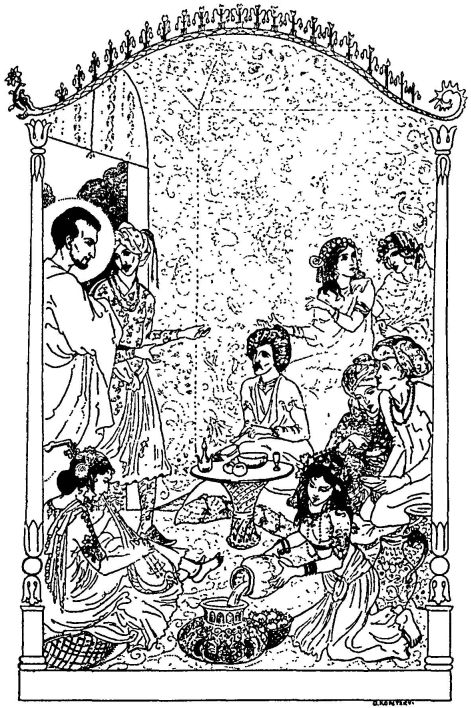
When this thought was in the host's mind, all his relatives and friends entered the house; and although the hall in the house was small there was room in it for all of them. They sat down at the table and ate, and there was more than enough for all of them.5
The Blessed One was pleased to see so many guests full of good cheer and he quickened them and gladdened them with words of truth, proclaiming the bliss of righteousness:6
"The greatest happiness which a mortal man can imagine is the bond of marriage that ties together two loving hearts. But there is a greater happiness still: it is the embrace of truth. Death will separate husband and wife, but death will never affect him who has espoused the truth.7
"Therefore be married unto the truth and live with the truth in holy wedlock. The husband who loves his wife and desires for a union that shall be everlasting must be faithful to her so as to be like truth itself, and she will rely upon him and revere him and minister unto him. And the wife who loves her husband and desires a union that shall be everlasting must be faithful to him so as to be like truth itself; and he will place his trust in her, he will provide for her. Verily, I say unto you, their children will become like unto their parents and will bear witness to their happiness.8
"Let no man be single, let every one be wedded in holy love to the truth. And when Māra, the destroyer, comes to separate the visible forms of your being, you will continue to live in the truth, and you will partake of the life everlasting, for the truth is immortal."9
There was no one among the guests but was strengthened in his spiritual life, and recognized the sweetness of a life of righteousness; and they took refuge in Buddha, the Dharma, and the Sangha.10
LXXXII.
A PARTY IN SEARCH OF A THIEF.
Having sent out his disciples, the Blessed One himself wandered from place to place until he reached Uruvelā.1
On his way he sat down in a grove to rest, and it happened that in that same grove there was a party of thirty friends who were enjoying themselves with their wives; and while they were sporting, some of their goods were stolen.2
Then the whole party went in search of the thief and, meeting the Blessed One sitting under a tree, saluted him and said: "Pray, Lord, didst thou see the thief pass by with our goods?"3
And the Blessed One said: "Which is better for you, that you go in search for the thief or for yourselves?" And the youths cried: "In search for ourselves!"4
"Well, then," said the Blessed One, "sit down and I will preach the truth to you."5
And the whole party sat down and they listened eagerly to the words of the Blessed One. Having grasped the truth, they praised the doctrine and took refuge in the Buddha.6
LXXXIII.
IN THE REALM OF YAMARĀJA.
There was a Brahman, a religious man and fond in his affections but without deep wisdom. He had a son of great promise, who, when seven years old, was struck with a fatal disease and died. The unfortunate father was unable to control himself; he threw himself upon the corpse and lay there as one dead.1
The relatives came and buried the dead child and when the father came to himself, he was so immoderate in his grief that he behaved like an insane person. He no longer gave way to tears but wandered about asking for the residence of Yamarāja, the king of death, humbly to beg of him that his child might be allowed to return to life.2
Having arrived at a great Brahman temple the sad father went through certain religious rites and fell asleep. While wandering on in his dream he came to a deep mountain pass where he met a number of samanas who had acquired supreme wisdom. "Kind sirs," he said, "can you not tell me where the residence of Yamarāja is?" And they asked him, "Good friend, why wouldst thou know?" Whereupon he told them his sad story and explained his intentions. Pitying his self-delusion, the samanas said: "No mortal man can reach the place where Yama reigns, but some four hundred miles westward lies a great city in which many good spirits live; every eighth day of the month Yama visits the place, and there mayst thou see him who is the King of Death and ask him for a boon."3
The Brahman rejoicing at the news went to the city and found it as the samanas had told him. He was admitted to the dread presence of Yama, the King of Death, who, on hearing his request, said: "Thy son now lives in the eastern garden where he is disporting himself; go there and ask him to follow thee."4
Said the happy father: "How does it happen that my son, without having performed one good work, is now living in paradise?" Yamarāja replied: "He has obtained celestial happiness not for performing good deeds, but because he died in faith and in love to the Lord and Master, the most glorious Buddha. The Buddha says: 'The heart of love and faith spreads as it were a beneficent shade from the world of men to the world of gods.' This glorious utterance is like the stamp of a king's seal upon a royal edict."5
The happy father hastened to the place and saw his beloved child playing with other children, all transfigured by the peace of the blissful existence of a heavenly life. He ran up to his boy and cried with tears running down his cheeks: "My son, my son, dost thou not remember me, thy father who watched over thee with loving care and tended thee in thy sickness? Return home with me to the land of the living." But the boy, while struggling to go back to his playmates, upbraided him for using such strange expressions as father and son. "In my present state," he said, "I know no such words, for I am free from delusion."6
On this, the Brahman departed, and when he woke from his dream he bethought himself of the Blessed Master of mankind, the great Buddha, and resolved to go to him, lay bare his grief, and seek consolation.7
Having arrived at the Jetavana, the Brahman told his story and how his boy had refused to recognize him and to go home with him.8
And the World-honored One said: "Truly thou art deluded. When man dies the body is dissolved into its elements, but the spirit is not entombed. It leads a higher mode of life in which all the relative terms of father, son, wife, mother, are at an end, just as a guest who leaves his lodging has done with it, as though it were a thing of the past. Men concern themselves most about that which passes away; but the end of life quickly comes as a burning torrent sweeping away the transient in a moment. They are like a blind man set to look after a burning lamp. A wise man, understanding the transiency of worldly relations, destroys the cause of grief, and escapes from the seething whirlpool of sorrow. Religious wisdom lifts a man above the pleasures and pains of the world and gives him peace everlasting."9
The Brahman asked the permission of the Blessed One to enter the community of his bhikkhus, so as to acquire that heavenly wisdom which alone can give comfort to an afflicted heart.10
LXXXIV.
THE MUSTARD SEED.
There was a rich man who found his gold suddenly transformed into ashes; and he took to his bed and refused all food. A friend, hearing of his sickness, visited the rich man and learned the cause of his grief. And the friend said: "Thou didst not make good use of thy wealth. When thou didst hoard it up it was not better than ashes. Now heed my advice. Spread mats in the bazaar; pile up these ashes, and pretend to trade with them."1
The rich man did as his friend had told him, and when his neighbors asked him, "Why sellest thou ashes?" he said: "I offer my goods for sale."2
After some time a young girl, named Kisā Gotamī, an orphan and very poor, passed by, and seeing the rich man in the bazaar, said: "My lord, why pilest thou thus up gold and silver for sale."3
And the rich man said: "Wilt thou please hand me that gold and silver?" And Kisā Gotamī took up a handful of ashes, and lo! they changed back into gold.4
Considering that Kisā Gotamī had the mental eye of spiritual knowledge and saw the real worth of things, the rich man gave her in marriage to his son, and he said: "With many, gold is no better than ashes, but with Kisā Gotamī ashes become pure gold."5
And Kisā Gotamī had an only son, and he died. In her grief she carried the dead child to all her neighbors, asking them for medicine, and the people said: "She has lost her senses. The boy is dead."6
At length Kisā Gotamī met a man who replied to her request: "I cannot give thee medicine for thy child, but I know a physician who can."7
And the girl said: "Pray tell me, sir; who is it?" And the man replied: "Go to Sakyamuni, the Buddha."8
Kisā Gotamī repaired to the Buddha and cried: "Lord and Master, give me the medicine that will cure my boy."9
The Buddha answered: "I want a handful of mustard-seed." And when the girl in her joy promised to procure it, the Buddha added: "The mustard-seed must be taken from a house where no one has lost a child, husband, parent, or friend."10
Poor Kisā Gotamī now went from house to house, and the people pitied her and said: "Here is mustard-seed; take it!" But when she asked, "Did a son or daughter, a father or mother, die in your family?" They answered her: "Alas! the living are few, but the dead are many. Do not remind us of our deepest grief." And there was no house but some beloved one had died in it.11
Kisā Gotamī became weary and hopeless, and sat down at the wayside, watching the lights of the city, as they flickered up and were extinguished again. At last the darkness of the night reigned everywhere. And she considered the fate of men, that their lives flicker up and are extinguished. And she thought to herself: "How selfish am I in my grief! Death is common to all; yet in this valley of desolation there is a path that leads him to immortality who has surrendered all selfishness."12
Putting away the selfishness of her affection for her child, Kisā Gotamī had the dead body buried in the forest. Returning to the Buddha, she took refuge in him and found comfort in the Dharma, which is a balm that will soothe all the pains of our troubled hearts.13
The Buddha said:14
"The life of mortals in this world is troubled and brief and combined with pain. For there is not any means by which those that have been born can avoid dying; after reaching old age there is death; of such a nature are living beings.15
"As ripe fruits are early in danger of falling, so mortals when born are always in danger of death.16
"As all earthen vessels made by the potter end in being broken, so is the life of mortals.17
"Both young and adult, both those who are fools and those who are wise, all fall into the power of death; all are subject to death.18
"Of those who, overcome by death, depart from life, a father cannot save his son, nor kinsmen their relations.19
"Mark! while relatives are looking on and lamenting deeply, one by one mortals are carried off, like an ox that is led to the slaughter.20
"So the world is afflicted with death and decay, therefore the wise do not grieve, knowing the terms of the world.21
"In whatever manner people think a thing will come to pass, it is often different when it happens, and great is the disappointment; see, such are the terms of the world.22
"Not from weeping nor from grieving will any one obtain peace of mind; on the contrary, his pain will be the greater and his body will suffer. He will make himself sick and pale, yet the dead are not saved by his lamentation.23
"People pass away, and their fate after death will be according to their deeds.24
"If a man live a hundred years, or even more, he will at last be separated from the company of his relatives, and leave the life of this world.25
"He who seeks peace should draw out the arrow of lamentation, and complaint, and grief.26
"He who has drawn out the arrow and has become composed will obtain peace of mind; he who has overcome all sorrow will become free from sorrow, and be blessed."27
LXXXV.
FOLLOWING THE MASTER OVER THE STREAM.
South of Sāvatthi is a great river, on the banks of which lay a hamlet of five hundred houses. Thinking of the salvation of the people, the World-honored One resolved to go to the village and preach the doctrine. Having come to the riverside he sat down beneath a tree, and the villagers seeing the glory of his appearance approached him with reverence; but when he began to preach, they believed him not.1
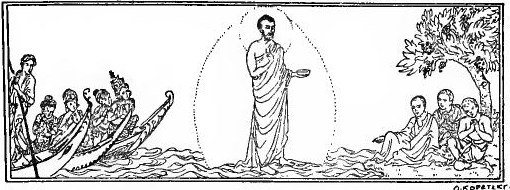
When the world-honored Buddha had left Sāvatthi Sāriputta felt a desire to see the Lord and to hear him preach. Coming to the river where the water was deep and the current strong, he said to himself: "This stream shall not prevent me. I shall go and see the Blessed One," and he stepped upon the water which was as firm under his feet as a slab of granite.2
When he arrived at a place in the middle of the stream where the waves were high, Sāriputta's heart gave way, and he began to sink. But rousing his faith and renewing his mental effort, he proceeded as before and reached the other bank.3
The people of the village were astonished to see Sāriputta, and they asked how he could cross the stream where there was nether a bridge nor a ferry.4
And Sāriputta replied: "I lived in ignorance until I heard the voice of the Buddha. As I was anxious to hear the doctrine of salvation, I crossed the river and I walked over its troubled waters because I had faith. Faith, nothing else, enabled me to do so, and now I am here in the bliss of the Master's presency."5
The World-honored One added: "Sāriputta, thou hast spoken well. Faith like thine alone can save the world from the yawning gulf of migration and enable men to walk dryshod to the other shore."6
And the Blessed One urged to the villagers the necessity of ever advancing in the conquest of sorrow and of casting off all shackles so as to cross the river of worldliness and attain deliverance from death.7
Hearing the words of the Tathāgata, the villagers were filled with joy and believing in the doctrines of the Blessed One embraced the five rules and took refuge in his name.8
LXXXVI.
THE SICK BHIKKHU.
An old bhikkhu of a surly disposition was afflicted with a loathsome disease the sight and smell of which was so nauseating that no one would come near him or help him in his distress. And it happened that the World-honored One came to the vihāra in which the unfortunate man lay; hearing of the case he ordered warm water to be prepared and went to the sick-room to administer unto the sores of the patient with his own hand, saying to his disciples:1
"The Tathāgata has come into the world to befriend the poor, to succor the unprotected, to nourish those in bodily affliction, both the followers of the Dharma and unbelievers, to give sight to the blind and enlighten the minds of the deluded, to stand up for the rights of orphans as well as the aged, and in so doing to set an example to others. This is the consummation of his work, and thus he attains the great goal of life as the rivers that lose themselves in the ocean."2
The World-honored One administered unto the sick bhikkhu daily so long as he stayed in that place. And the governor of the city came to the Buddha to do him reverence, and having heard of the service which the Lord did in the vihāra asked the Blessed One about the previous existence of the sick monk, and the Buddha said:3
"In days gone by there was a wicked king who used to extort from his subjects all he could get; and he ordered one of his officers to lay the lash on a man of eminence. The officer little thinking of the pain he inflicted upon others, obeyed; but when the victim of the king's wrath begged for mercy, he felt compassion and laid the whip lightly upon him. Now the king was reborn as Devadatta, who was abandoned by all his followers, because they were no longer willing to stand his severity and he died miserable and full of penitence. The officer is the sick bhikkhu, who having often given offence to his brethren in the vihāra was left without assistance in his distress. The eminent man, however, who was unjustly beaten and begged for mercy was the Bodhisatta; he has been reborn as the Tathāgata. It is now the lot of the Tathāgata to help the wretched officer as he had mercy on him."4
And the World-honored One repeated these lines: "He who inflicts pain on the gentle, or falsely accuses the innocent, will inherit one of the ten great calamities. But he who has learned to suffer with patience will be purified and will be the chosen instrument for the alleviation of suffering."5
The diseased bhikkhu on hearing these words turned to the Buddha, confessed his ill-natured temper and repented, and with a heart cleansed from error did reverence unto the Lord.6
LXXXVII.
THE PATIENT ELEPHANT.
While the Blessed One was residing in the Jetavana, there was a householder living in Sāvatthi known to all his neighbors as patient and kind, but his relatives were wicked and contrived a plot to rob him. One day they came to the householder and often worrying him with all kinds of threats took away a goodly portion of his property. He did not go to court, nor did he complain, but tolerated with great forbearance the wrongs he suffered.1
The neighbors wondered and began to talk about it, and rumors of the affair reached the ears of the brethren in Jetavana. While the brethren discussed the occurrence in the assembly hall, the Blessed One entered and asked "What was the topic of your conversation?" And they told him.2
Said the Blessed One: "The time will come when the wicked relatives will find their punishment. O brethren, this is not the first time that this occurrence took place; it has happened before", and he told them a world-old tale.3
Once upon a time, when Brahmadatta was king of Benares, the Bodhisatta was born in the Himālaya region as an elephant. He grew up strong and big, and ranged the hills and mountains, the peaks and caves of the tortuous woods in the valleys. Once as he went he saw a pleasant tree, and took his food, standing under it.4
Then some impertinent monkeys came down out of the tree, and jumping on the elephant's back, insulted and tormented him greatly; they took hold of his tusks, pulled his tail and disported themselves, thereby causing him much annoyance. The Bodhisatta, being full of patience, kindliness and mercy, took no notice at all of their misconduct which the monkeys repeated again and again.5
One day the spirit that lived in the tree, standing upon the tree-trunk, addressed the elephant saying, "My lord elephant, why dost thou put up with the impudence of these bad monkeys?" And he asked the question in a couplet as follows:6
"Why dost thou patiently endure each freak These mischievous and selfish monkeys wreak?"7
The Bodhisatta, on hearing this, replied, "If, Tree-sprite, I cannot endure these monkeys' ill treatment without abusing their birth, lineage and persons, how can I walk in the eightfold noble path? But these monkeys will do the same to others thinking them to be like me. If they do it to any rogue elephant, he will punish them indeed, and I shall be delivered both from their annoyance and the guilt of having done harm to others."8
Saying this he repeated another stanza:9
"If they will treat another one like me, He will destroy them; and I shall be free."10
A few days after, the Bodhisatta went elsewhither, and another elephant, a savage beast, came and stood in his place. The wicked monkeys thinking him to be like the old one, climbed upon bis back and did as before. The rogue elephant seized the monkeys with his trunk, threw them upon the ground, gored them with his tusk and trampled them to mincemeat under his feet.11
When the Master had ended this teaching, he declared the truths, and identified the births, saying: "At that time the mischievous monkeys were the wicked relatives of the good man, the rogue elephant was the one who will punish them, but the virtuous noble elephant was the Tathāgata himself in a former incarnation."12
After this discourse one of the brethren rose and asked leave to propose a question and when permission was granted he said: "I have heard the doctrine that wrong should be met with wrong and the evil doer should be checked by being made to suffer, for if this were not done evil would increase and good would disappear. What shall we do?"13
Said the Blessed One: "Nay, I will tell you: Ye who have left the world and have adopted this glorious faith of putting aside selfishness, ye shall not do evil for evil nor return hate for hate. Nor do ye think that ye can destroy wrong by retaliating evil for evil and thus increasing wrong. Leave the wicked to their fate and their evil deeds will sooner or later in one way or another bring on their own punishment." And the Tathāgata repeated these stanzas:14
"Who harmeth him that doth no harm And striketh him that striketh not, Shall gravest punishment incur The which his wickedness begot,—15 "Some of the greatest ills in life Either a loathsome dread disease, Or dread old age, or loss of mind, Or wretched pain without surcease,16 "Or conflagration, loss of wealth; Or of his nearest kin he shall See some one die that's dear to him, And then he'll be reborn in hell."17

THE LAST DAYS.
LXXXVIII.
THE CONDITIONS OF WELFARE.
When the Blessed One was residing on the mount called Vulture's Peak, near Rājagaha, Ajātasattu the king of Magadha, who reigned in the place of Bimbisāra, planned an attack on the Vajjīs, and he said to Vassakāra, his prime minister: "I will root out the Vajjīs, mighty though they be. I will destroy the Vajjīs; I will bring them to utter ruin! Come now, O Brahman, and go to the Blessed One; inquire in my name for his health, and tell him my purpose. Bear carefully in mind what the Blessed One may say, and repeat it to me, for the Buddhas speak nothing untrue."1
When Vassakāra, the prime minister, had greeted the Blessed One and delivered his message, the venerable Ānanda stood behind the Blessed One and fanned him, and the Blessed One said to him: "Hast thou heard, Ānanda, that the Vajjis hold full and frequent public assemblies?"2
"Lord, so I have heard," replied he.3
"So long, Ānanda," said the Blessed One, "as the Vajjis hold these full and frequent public assemblies, they may be expected not to decline, but to prosper. So long as they meet together in concord, so long as they honor their elders, so long as they respect womanhood, so long as they remain religious, performing all proper rites, so long as they extend the rightful protection, defence and support to the holy ones, the Vajjis may be expected not to decline, but to prosper."4
Then the Blessed One addressed Vassakāra and said: "When I stayed, O Brahman, at Vesālī, I taught the Vajjis these conditions of welfare, that so long as they should remain well instructed, so long as they will continue in the right path, so long as they live up to the precepts of righteousness, we could expect them not to decline, but to prosper."5
As soon as the king's messenger had gone, the Blessed One had the brethren, that were in the neighborhood of Rājagaha, assembled in the service-hall, and addressed them, saying:6
"I will teach you, O bhikkhus, the conditions of the welfare of a community. Listen well, and I will speak.7
"So lone, O bhikkhus, as the brethren hold full and frequent assemblies, meeting in concord, rising in concord, and attending in concord to the affairs of the Sangha; so long as they, O bhikkhus, do not abrogate that which experience has proved to be good, and introduce nothing except such things as have been carefully tested; so long as their elders practise justice; so long as the brethren esteem, revere, and support their elders, and hearken unto their words; so long as the brethren are not under the influence of craving, but delight in the blessings of religion, so that good and holy men shall come to them and dwell among them in quiet; so long as the brethren shall not be addicted to sloth and idleness; so long as the brethren shall exercise themselves in the sevenfold higher wisdom of mental activity, search after truth, energy, joy, modesty, self-control, earnest contemplation, and equanimity of mind,—so long the Sangha may be expected not to decline, but to prosper.8
"Therefore, O bhikkhus, be full of faith, modest in heart, afraid of sin, anxious to learn, strong in energy, active in mind, and full of wisdom."9
LXXXIX.
SĀRIPUTTA'S FAITH.
The Blessed One proceeded with a great company of the brethren to Nālandā; and there he stayed in a mango grove.1
Now the venerable Sāriputta came to the place where the Blessed One was, and having saluted him, took his seat respectfully at his side, and said: "Lord! such faith have I in the Blessed One, that methinks there never has been, nor will there be, nor is there now any other, who is greater or wiser than the Blessed One, that is to say, as regards the higher wisdom."2
Replied the Blessed One: "Grand and bold are the words of thy mouth, Sāriputta: verily, thou hast burst forth into a song of ecstasy! Surely then thou hast known all the Blessed Ones who in the long ages of the past have been holy Buddhas?"3
"Not so, O Lord!" said Sāriputta.4
And the Lord continued: "Then thou hast perceived all the Blessed Ones who in the long ages of the future shall be holy Buddhas?"5
"Not so, O Lord!"6
"But at least then, O Sāriputta, thou knowest me as the holy Buddha now alive, and hast penetrated my mind."7
"Not even that, O Lord!"8
"Thou seest then, Sāriputta, that thou knowest not the hearts of the holy Buddhas of the past nor the hearts of those of the future. Why, therefore, are thy words so grand and bold? Why burstest thou forth into such a song of ecstasy?"9
"O Lord! I have not the knowledge of the hearts of all the Buddhas that have been and are to come, and now are. I only know the lineage of the faith. Just as a king, Lord, might have a border city, strong in its foundations, strong in its ramparts and with one gate only; and the king might have a watchman there, clever, expert, and wise, to stop all strangers and admit only friends. And on going over the approaches all about the city, he might not be able so to observe all the joints and crevices in the ramparts of that city as to know where such a small creature as a cat could get out. That might well be. Yet all living beings of larger size that entered or left the city, would have to pass through that gate. Thus only is it, Lord, that I know the lineage of the faith. I know that the holy Buddhas of the past, putting away all lust, ill-will, sloth, pride, and doubt, knowing all those mental faults which make men weak, training their minds in the four kinds of mental activity, thoroughly exercising themselves in the sevenfold higher wisdom, received the full fruition of Enlightenment. And I know that the holy Buddhas of the times to come will do the same. And I know that the Blessed One, the holy Buddha of to-day, has done so now."10
"Great is thy faith, O Sāriputta," replied the Blessed One, "but take heed that it be well grounded."11
XC.
PĀTALIPUTTA.
When the Blessed One had stayed as long as convenient at Nālandā, he went to Pātaliputta, the frontier town of Magadha; and when the disciples at Pātaliputta heard of his arrival, they invited him to their village rest-house. And the Blessed One robed himself, took his bowl and went with the brethren to the rest-house. There he washed his feet, entered the hall, and seated himself against the center pillar, with his face towards the east. The brethren, also, having washed their feet, entered the hall, and took their seats round the Blessed One, against the western wall, facing the east. And the lay devotees of Pātaliputta, having also washed their feet, entered the hall, and took their seats opposite the Blessed One, against the eastern wall, facing towards the west.1
Then the Blessed One addressed the lay-disciples of Pātaliputta, and he said:2
"Fivefold, O householders, is the loss of the wrong-doer through his want of rectitude. In the first place, the wrong-doer, devoid of rectitude, falls into great poverty through sloth; in the next place, his evil repute gets noised abroad; thirdly, whatever society he enters, whether of Brahmans, nobles, heads of houses, or samanas, he enters shyly and confusedly; fourthly, he is full of anxiety when he dies; and lastly, on the dissolution of the body after death, his mind remains in an unhappy state. Wherever his karma continues, there will be suffering and woe. This, O householders, is the fivefold loss of the evil-doer!3
"Fivefold, O householders, is the gain of the well-doer through his practice of rectitude. In the first place the well-doer, strong in rectitude, acquires property through his industry; in the next place, good reports of him are spread abroad; thirdly, whatever society he enters, whether of nobles, Brahmans, heads of houses, or members of the order, he enters with confidence and self-possession; fourthly, he dies without anxiety; and, lastly, on the dissolution of the body after death, his mind remains in a happy state. Wherever his karma continues, there will be heavenly bliss and peace. This, O householders, is the fivefold gain of the well-doer."4
When the Blessed One had taught the disciples, and incited them, and roused them, and gladdened them far into the night with religious edification, he dismissed them, saying, "The night is far spent, O householders. It is time for you to do what ye deem most fit."5
"Be it so, Lord!" answered the disciples of Pātaliputta, and rising from their seats, they bowed to the Blessed One, and keeping him on their right hand as they passed him, they departed thence.6
While the Blessed One stayed at Pātaliputta, the king of Magadha sent a messenger to the governor of Pātaliputta to raise fortifications for the security of the town.7
And the Blessed One seeing the laborers at work predicted the future greatness of the place, saying: "The men who build the fortress act as if they had consulted higher powers. For this city of Pātaliputta will be a dwelling-place of busy men and a center for the exchange of all kinds of goods. But three dangers hang over Pātaliputta, that of fire, that of water, that of dissension."8
When the governor heard of the prophecy of Pātaliputta's future, he greatly rejoiced and named the city-gate through which the Buddha had gone towards the river Ganges, "The Gotama Gate."9
Meanwhile the people living on the banks of the Ganges arrived in great numbers to pay reverence to the Lord of the world; and many persons asked him to do them the honor to cross over in their boats. But the Blessed One considering the number of the boats and their beauty did not want to show any partiality, and by accepting the invitation of one to offend all the others. He therefore crossed the river without any boat, signifying thereby that the rafts of asceticism and the gaudy gondolas of religious ceremonies were not staunch enough to weather the storms of Samsāra, while the Tathāgata can walk dry-shod over the ocean of worldliness.10
And as the city gate was called after the name of the Tathāgata so the people called this passage of the river "Gotama Ford."11
XCI.
THE MIRROR OF TRUTH.
The Blessed One proceeded to the village Nādikā with a great company of brethren and there he stayed at the Brick Hall. And the venerable Ānanda went to the Blessed One and mentioning to him the names of the brethren and sisters that had died, anxiously inquired about their fate after death, whether they had been reborn in animals or in hell, or as ghosts, or in any place of woe.1
And the Blessed One replied to Ānanda and said:2
"Those who have died after the complete destruction of the three bonds of lust, of covetousness and of the egotistical cleaving to existence, need not fear the state after death. They will not be reborn in a state of suffering; their minds will not continue as a karma of evil deeds or sin, but are assured of final salvation.3
"When they die, nothing will remain of them but their good thoughts, their righteous acts, and the bliss that proceeds from truth and righteousness. As rivers must at last reach the distant main, so their minds will be reborn in higher states of existence and continue to be pressing on to their ultimate goal which is the ocean of truth, the eternal peace of Nirvāna.4
"Men are anxious about death and their fate after death; but consider, it is not at all strange, Ānanda, that a human being should die. However, that thou shouldst inquire about them, and having heard the truth still be anxious about the dead, this is wearisome to the Blessed One. I will, therefore, teach thee the mirror of truth and let the faithful disciple repeat it:5
"'Hell is destroyed for me, and rebirth as an animal, or a ghost, or in any place of woe. I am converted; I am no longer liable to be reborn in a state of suffering, and am assured of final salvation.' 6
"What, then, Ānanda, is this mirror of truth? It is the consciousness that the elect disciple is in this world possessed of faith in the Buddha, believing the Blessed One to be the Holy One, the Fully-Enlightened One, wise, upright, happy, world-knowing, supreme, the Bridler of men's wayward hearts, the Teacher of gods and men, the blessed Buddha. 7
"It is further the consciousness that the disciple is possessed of faith in the truth, believing the truth to have been proclaimed by the Blessed One, for the benefit of the world, passing not away, welcoming all, leading to salvation, to which8
"And, finally, it is the consciousness that the disciple is possessed of faith in the order, believing in the efficacy of a union among those men and women who are anxious to walk in the noble eightfold path; believing this church of the Buddha, of the righteous, the upright, the just, the law-abiding, to be worthy of honor, of hospitality, of gifts, and of reverence; to be the supreme sowing-ground of merit for the world; to be possessed of the virtues beloved by the good, virtues unbroken, intact, unspotted, unblemished, virtues which make men truly free, virtues which are praised by the wise, are untarnished by the desire of selfish aims, either now or in a future life, or by the belief in the efficacy of outward acts, and are conducive to high and holy thought.9
"This is the mirror of truth which teaches the straightest way to enlightenment which is the common goal of all living creatures. He who possesses the mirror of truth is free from fear; he will find comfort in the tribulations of life, and his life will be a blessing to all his fellow-creatures."10
XCII.
AMBAPĀLĪ.
Then the Blessed One proceeded with a great number of brethren to Vesālī, and he stayed at the grove of the courtesan Ambapālī. And he said to the brethren: "Let a brother, O bhikkhus, be mindful and thoughtful. Let a brother, whilst in the world, overcome the grief which arises from bodily craving, from the lust of sensations, and from the errors of wrong reasoning. Whatever you do, act always in full presence of mind. Be thoughtful in eating and drinking, in walking or standing, in sleeping or waking, while talking or being silent."1
When the courtesan Ambapālī heard that the Blessed One was staying in her mango grove, she was exceedingly glad and went in a carriage as far as the ground was passable for carriages. There she alighted and thence proceeding to the place where the Blessed One was, she took her seat respectfully at his feet on one side. As a prudent woman goes forth to perform her religious duties, so she appeared in a simple dress without any ornaments, yet beautiful to look upon.2
And the Blessed One thought to himself: "This woman moves in worldly circles and is a favorite of kings and princes; yet is her heart calm and composed. Young in years, rich, surrounded by pleasures, she is thoughtful and steadfast. This, indeed, is rare in the world. Women, as a rule, are scant in wisdom and deeply immersed in vanity; but she, although living in luxury, has acquired the wisdom of a master, taking delight in piety, and able to receive the truth in its completeness."3
When she was seated, the Blessed One instructed, aroused, and gladdened her with religious discourse.4
As she listened to the law, her face brightened with delight. Then she rose and said to the Blessed One: "Will the Blessed One do me the honor of taking his meal, together with the brethren, at my house to-morrow?" And the Blessed One gave, by silence, his consent.5
Now, the Licchavi, a wealthy family of princely rank, hearing that the Blessed One had arrived at Vesālī and was staying at Ambapālī's grove, mounted their magnificent carriages, and proceeded with their retinue to the place where the Blessed One was. And the Licchavi were gorgeously dressed in bright colors and decorated with costly jewels.6
And Ambapālī drove up against the young Licchavi, axle to axle, wheel to wheel, and yoke to yoke, and the Licchavi said to Ambapālī, the courtesan: "How is it, Ambapālī, that you drive up against us thus?"7
"My lords," said she, "I have just invited the Blessed One and his brethren for their to-morrow's meal."8
And the princes replied: "Ambapālī! give up this meal to us for a hundred thousand."9
"My lords, were you to offer all Vesālī with its subject territory, I would not give up so great an honor!"10
Then the Licchavi went on to Ambapālī's grove.11
When the Blessed One saw the Licchavi approaching in the distance, he addressed the brethren, and said: "O brethren, let those of the brethren who have never seen the gods gaze upon this company of the Licchavi, for they are dressed gorgeously, like immortals."12
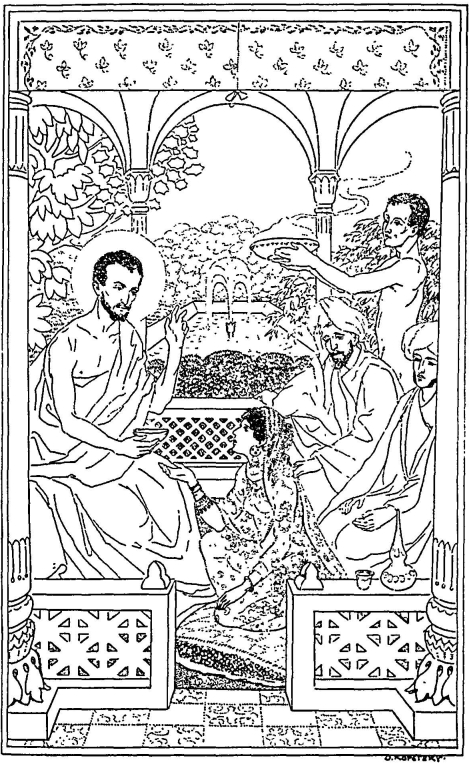
And when they had driven as far as the ground was passable for carriages, the Licchavi alighted and went on foot to the place where the Blessed One was, taking their seats respectfully by his side. And when they were thus seated, the Blessed One instructed, aroused, and gladdened them with religious discourse.13