XXVI “SAMUEL! SAMUEL!”
Reading edition
NE time, in the hill country, among the mountains of Ephraim, there lived a farmer named Elkanah. He and Hannah his wife were comfortably rich. They had fields of wheat and vineyards of grapes, and flocks and herds, and plenty of hay in the barn; but in one way they were poor,—they had no children. Sometimes Hannah cried because the house was so empty and still, and there were no voices of children in it. Sometimes she was so sad and lonely that she could not eat, and though her husband tried to comfort her, and said, “Hannah, am I not better to you than ten sons?” still she was full of grief. For children are the best gift which God gives to man, and all the cornfields and vineyards and sheep and oxen in the world are not to be compared with them.

One day, Hannah went in to town, to Shiloh; and as she passed the church she stopped and knelt down on the steps and prayed with all her heart that God would give her a son. And Eli, the minister, was sitting on a bench by the church door. Eli was an old man, and his two sons, Hophni and Phinehas, who had become ministers in his place, were not only bad ministers, but bad men, so that many people had stopped going to church. In those days, when people went to church, they carried sheep with them, or other animals, to offer to God. This they did that they might show God that they truly loved Him: they gave Him the best they had. But when they came with their sacrifices, and the meat was in the pot cooking over the church fire, Hophni and Phinehas would send their servants, each with a great three-pronged fork in his hand, and they would thrust their forks into the pot, and whatever they brought up they would carry away to their masters. “Give us meat,” they said, “for the priests.” And if anybody objected, the servants answered, “If you will not give it, we will take it from you by force.” Thus Hophni and Phinehas had plenty to eat, and grew rich, and became more wicked day by day, but the number of persons who came to church grew less and less. So when Eli saw Hannah praying at the church steps he was surprised. Nobody had been to church to pray for a long time. He could not believe, at first, that she was really praying; her lips moved, but she made no sound. And because he was old and his eyes were bad so that he could not see well, he thought that she was some drunken person.
THE LAD SHALL BELONG TO THE LORD

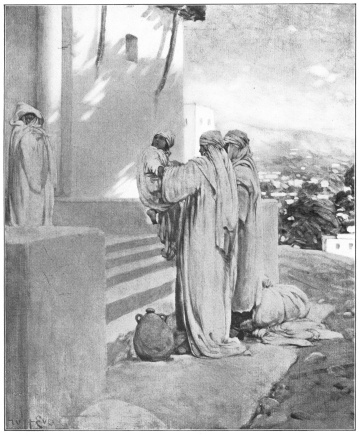
“Come, come,” he said at last, “how long wilt thou be drunken?” But she said, “Sir, I am not drunken. I am praying my prayers.” And she told him what she was praying for. And Eli said, “My daughter, go in peace. May the God of Israel grant thy request.”
And the God of Israel did grant her request. God sent a little son to Hannah and Elkanah, and they named him Samuel. And when the child was two years old, they went one day to the church in Shiloh, and there was Eli sitting by the door. And they said, “Sir, do you remember the woman who was here praying for a son? Here she is, and here is her son with her. And we have promised that the lad shall belong to the Lord. Take him now and bring him up to be a minister of the church.” And they went away, leaving the child behind them. And Eli took care of the little boy, and because his own sons had turned out so badly, he took the greater pains with Samuel, and taught him to be obedient and honest and to tell the truth. And every year his mother came to see him and brought him a little coat which she had made with her own hands.
At last, one night when Eli was so old that he could hardly see, and Samuel had grown to be a sturdy lad, they were both asleep in the same room. There was a great box in the room called the Ark, and in it were the two tables of stone on which the Ten Commandments were written, and over it hung a lamp which was kept burning every night.
And Samuel heard a voice calling his name, “Samuel!” and he answered, “Here am I,” and ran to see what Eli wanted. But Eli said, “I did not call, my son; lie down again.”
So Samuel went and lay down, and again there was a voice, “Samuel! Samuel!” And again Samuel ran to Eli, saying, “Here am I,” and Eli said, “I did not call.” And this happened a third time.
Then Eli perceived that the Lord had called the child. Therefore Eli said to Samuel, “Go lie down, and if you hear the voice again, say, ‘Speak, Lord, for thy servant heareth.’ ” And pretty soon he heard the voice again, “Samuel! Samuel!” and he said, “Speak, Lord, for thy servant heareth.”
Then the Lord spoke and said, “Behold, I will do a thing in Israel at which both the ears of every one that heareth it shall tingle. I will punish Eli and his sons for all the evil that is done, for they have behaved themselves wickedly and he did not stop them.” Then there was silence, and by and by the lamp burned out, and the sun rose and it was light, and Samuel got up and opened the doors and let the morning breeze blow in. And Eli said, “Samuel, what did the Lord say?” And Samuel did not like to tell, but Eli urged him, and he told. And Eli said, “It is the Lord, let him do what seemeth him good.”