XVII THE BATTLE OF THE GREAT PLAIN
Reading edition
IGHT across the Promised Land, between the river and the sea, lay a great plain. Mountains stood about it on every side, and through the midst of it ran a winding river, called the Kishon. Some of the tribes of Israel had settled among the hills on the north; others had settled among the hills on the south. But the plain itself was held by the enemy. They had a king named Jabin, and a general named Sisera, and nine hundred chariots of iron. And for twenty years, they mightily oppressed the Children of Israel. They were so strong and cruel that the Children of Israel did not dare to show themselves, but went along the by-paths, or through the woods, keeping out of sight. And none of them had either shield or spear.
Now there was a woman in the land who was braver than any of the men, and her name was Deborah. She was not only brave, but wise, so that people used to come to her from all directions to ask her questions, and she told them what to do. Thus she sat every day under a palm tree, listening to the people and answering them. Many who came told Deborah how poor and miserable they were, and how King Jabin’s men, the Canaanites, troubled them, and stole all that they had, and were very bad to them. So Deborah knew how the land was filled with suffering.
At last, one day, she sent for a man named Barak. “Barak,” she said, as he came under the palm tree, “you know how the Canaanites are treating our people, day by day, and year by year, and how since Joshua died we have no leader. We must stop it. You must take the lead. God has spoken in my soul, and has told me that you are the man, and that this is the time. Go now, and get an army.”
But Barak said, “Deborah, we are all afraid, and we have no shields or spears, nothing but sticks out of the woods, and Sisera has nine hundred chariots of iron. Am I to do this thing alone, or will you go with me? If you will go with me, I will go: but if you will not go with me, I will not go.”
And Deborah answered, “I will surely go with you, but it will be a woman and not a man who shall have the honor of the victory.”
So Barak sent messengers to all the tribes who lived among the hills by the Great Plain. Some of the tribes said that they would not come, some said that they would think about it; but Issachar and Zebulun and Naphtali sent soldiers, until Barak and Deborah had ten thousand men. In the meantime, Sisera gathered his great army, thousands upon thousands of footmen, and thousands upon thousands of prancing horses, and nine hundred chariots of iron. And Barak and his soldiers were on the side of Mount Tabor, and Sisera and his soldiers were in the Great Plain. And there came a storm out of the north, as if the clouds were an army in the sky pouring water out of great buckets. And Deborah cried, “Up, Barak; for this is the day in which the Lord hath delivered Sisera into thine hand.” And Barak rose up and his men with him, and down they charged over the side of the mountain. And the Great Plain was filled with mud by the beating of the rain, so that the wheels of the chariots sank like the wheels of Pharaoh’s chariots in the Red Sea. And the Kishon overflowed its banks. And the army of Sisera fled east and west, and the army of Barak followed them.
Now Sisera, when he saw that he was defeated and that his chariot was stuck fast in the mud, leaped down in great haste and ran for his life. And as he ran he came to a tent away off among the hills, where a man lived whose name was Heber and his wife’s name was Jael. Heber had no
JAEL TAKES THE TENT PIN

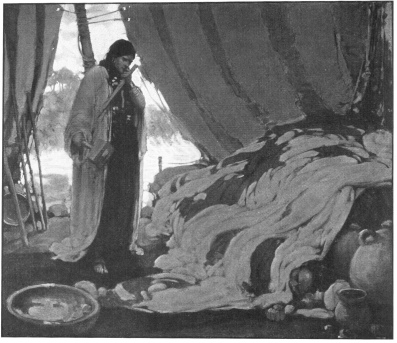
part in the battle of the day. He lived by himself, and was neither on the side of Barak nor on the side of Sisera. While the others were fighting he was in the distant pastures tending his sheep, and his wife was at home alone. So Sisera came breathless and weary with running, and Barak was following him far behind. And Jael came out to meet Sisera, and she asked him to come in and hide. “Turn in, my lord,” she said, “turn in to me: fear not.” So he went in. And he said, “Give me, I pray thee, a little water to drink; for I am thirsty.” And she opened a bottle and gave him milk to drink. And he lay down in the tent, and she covered him with a mantle, so that he was hid. And he said, “If anybody comes to the tent, and asks, ‘Is there any man here?’ you must say, ‘No.’ ” Then he went to sleep, for he was very tired.
Then Jael took one of the big wooden pins which held the ropes of the tent, and in her other hand a workman’s mallet, and when Sisera was sound asleep she went to him softly, and drove the pin straight through his head. And Barak and his men came running by in pursuit of Sisera: and Jael came to the tent door, and said, “Come here, and I will show you the man whom you are seeking.” And Barak came in, and there was Sisera dead. This, you understand, was a long, long time ago, when people did not know so much as we know now about the difference between right and wrong: and it was in the midst of war, when very dreadful things are done. Anyhow, Sisera was dead, and the Children of Israel were delivered from the Canaanites.