IX THE BURNING BUSH
Reading edition
OSEPH and his brothers had many sons and daughters, and they in their turn had many sons and daughters; and even after they were grown up they were all called the Children of Israel; for Israel, you remember, was the new name of their father Jacob.
And years passed, and years passed, and Pharaoh died, and another Pharaoh reigned in his stead. And the Egyptians forgot how Joseph had saved their fathers from starving in the seven years of famine. And they made the Children of Israel their slaves, and sent them into their fields to work, and set taskmasters over them with whips. And the new Pharaoh said to his princes, “The Children of Israel are more and mightier than we. We must keep them from increasing.” So they made a law that all the boy babies of the Children of Israel should be put to death as soon as they were born.
Now there was a man and his wife who had two children, a girl of eight or ten, named Miriam, and a boy of three, named Aaron. And just at the time of this law, there came a little new boy baby. And his mother hid him, so that the Egyptians should not take him away and kill him. But it is very hard to hide a baby. So after three months his mother made a basket of bulrushes, and put pitch on the inside to keep the water out, and laid the baby in the basket, and set the basket in the river, near the bank among the reeds. And she told little Miriam to stay near, and see what would happen. So Miriam hid herself in the bushes and watched and waited, and by and by who should come down to the water but the princess herself, the daughter of Pharaoh. And the princess saw the basket and sent her maid to fetch it. And when she opened it, there was the baby. And the baby began to cry.
And the princess said, “This is one of the babies of the Children of Israel.” And she was very sorry.
Then Miriam came and said, “Princess, if you want a good nurse to take care of the baby for you, I think I can find one.”
And the princess said, “Go, find her, and bring her to me.”
So Miriam went and brought the baby’s mother. And the princess said, “Take this child and nurse it for me, and I will pay you.”
So the mother nursed her baby in peace, and when he became a big boy, she took him to the king’s palace, and he lived there with the princess as if he had been a prince himself. And his name was Moses.
So years passed, and the boy became a man. The princess had sent him to school, and he had learned all that the best teachers could tell him. He was very wise. But he never forgot that he was one of the Children of Israel. When he saw his people working in the fields, and the task-masters urging them with whips, he was sad and troubled. One day, as he passed by, and saw an Egyptian beating one of the Children of Israel, he could restrain himself no longer. He saved the man and killed the Egyptian. Then he found that the thing was known, and that Pharaoh had discovered that he was really on the side of the Children of Israel. And he had to run away to save his life.
Now the land which was next to Egypt was called Arabia, and to Arabia went Moses, and there he found a well. And flocks of sheep were feeding by it, some of them tended by men and some by women. But the men were very unkind to the women and kept them from drawing water for their sheep. And as Moses sat by the well, there came seven sisters with a flock of sheep, and the shepherds would not let them get any water. But Moses stood up and drove away the shepherds, and drew water for the seven sisters, and watered their flocks himself.
So the sisters went home to their father, and he said, “How is it that you are come so soon to-day?” They said, “An Egyptian beat the shepherds, and watered our sheep.”
Their father said, “Where is the man? Why did you not bring him home to dinner?”
So they found Moses, and brought him home, and when they knew that he had no place in which to stay, they asked him to live with them. And pretty soon he married one of the seven sisters.
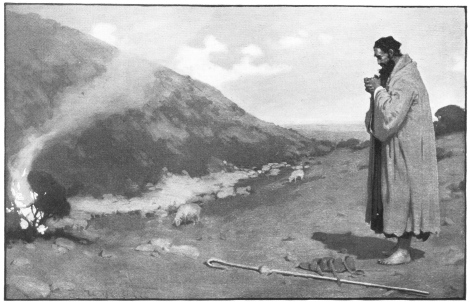
One day, as Moses kept the flock of his father-in-law, and led them here and there for pasture, he came to a high mountain, and at the foot of the mountain he saw a fire. There was a bush burning, and yet, as he watched it, the bush was not burnt. And he said to himself, “I will turn aside and see this great sight, why the bush is not burnt.” And as he came near, he heard a voice; and the voice said, “Moses, Moses!”
And he answered, “Here I am.”
And the voice said, “I am the God of Abraham and of Isaac and of Jacob. I have seen the sorrows of my people, the Children of Israel, how the Egyptians make them work, and whip them. Come now, return to Egypt, and tell
MOSES BY THE BURNING BUSH

Pharaoh to let my people go that they may meet me here at this mountain.”
But Moses said, “Pharaoh will not hear me.”
And God said, “I will make Pharaoh hear you.”
Then Moses said, “I am no speaker.”
And God answered, “Look, who is that coming?” And Moses looked, and there was his brother Aaron. And he ran to meet him and kissed him. And God said, “Aaron shall go with you and speak for you.”
So Moses went back to his father-in-law and told him what had happened at the burning bush. And the next day, Moses and Aaron started for Egypt. There they found the Children of Israel working very hard, and the taskmasters beating them with whips to make them work harder. And Moses and Aaron said to the people, “God spoke to us in Arabia, and sent us to tell you to meet him there beside a mountain. He has seen your affliction and has promised to help you.” And the people were very glad.