Plate 159.
Reading edition
CYRTANTHUS Galpini. Transvaal.
Amaryllidaceae. Tribe Amarylleae. Cyrtanthus, Ait.; Benth. et Hook. f. Gen. Plant. vol. iii. p. 729.
Cyrtanthus Galpinii, Baker in Kew Bull. 1892, p. 83; Fl. Cap. vol. vi. p. 227.
We have pleasure in figuring for the first time this charming little Cyrtanthus from the Barberton District of the Transvaal. According to Mr. G. J. Hofmeyr, B.Sc., of the Forest Department, who collected the flowers, the plants are found growing in long grass at Kaapse Hoop. The plant is subsocial, and forms conspicuous pink patches in the veld. Mr. Hofmeyr informs us that the flowers at Barberton are scarlet, and not alizams pink (R. C. S), as in the Kaapse Hoop plants.
The species was first collected by Mr. E. E. Galpin, F.L.S., amongst rocks on Berea Ridge, near Barberton, in 1889. He describes the flowers as scarlet, dusted with gold. It flowers during the months of July and August.
C. Galpini falls into the same section of the genus as C. helictus, which we figured on Plate 99.
Our plate was partly prepared from Galpin’s specimens (Galpin 409) and partly from living flowers collected by Mr. Hofmeyr.
Description:—Bulb ovoid, 2·5 to 3 mm. in diameter. Leaves appearing before the flowers, up to 8 cm. long, 2 mm. broad above, narrowing to a filiform portion below, with a single rib, glabrous. Peduncle 10 to 19 cm. long, 3 mm. in diameter, terete, very gradually narrowing upwards. Bracts 2·5 to 3 cm. long, scarious, linear, acuminate. Flowers solitary, more rarely 2-nate. Perianth-tube with a narrow-cylindric lower portion 1·5 cm. long, broadening out into a funnel-shaped portion 2 cm. long and 1·3 cm. in diameter at the throat; lobes 2 cm. long, 7 to 9 mm. broad, oblong, bluntly apiculate, with a very small tuft of glandular hairs on the apex of three of them. Stamens all arising from the base of the widened portion of the perianth-tube; filaments of unequal lengths and attached to the perianth-tube for different distances, giving the stamens the appearance of being in two rows; anthers oblong, versatile. Ovary 5 mm. long, ellipsoid; style 3-8 cm. long, filiform; stigmas 3 mm. long, recurved, papillose on the upper side.
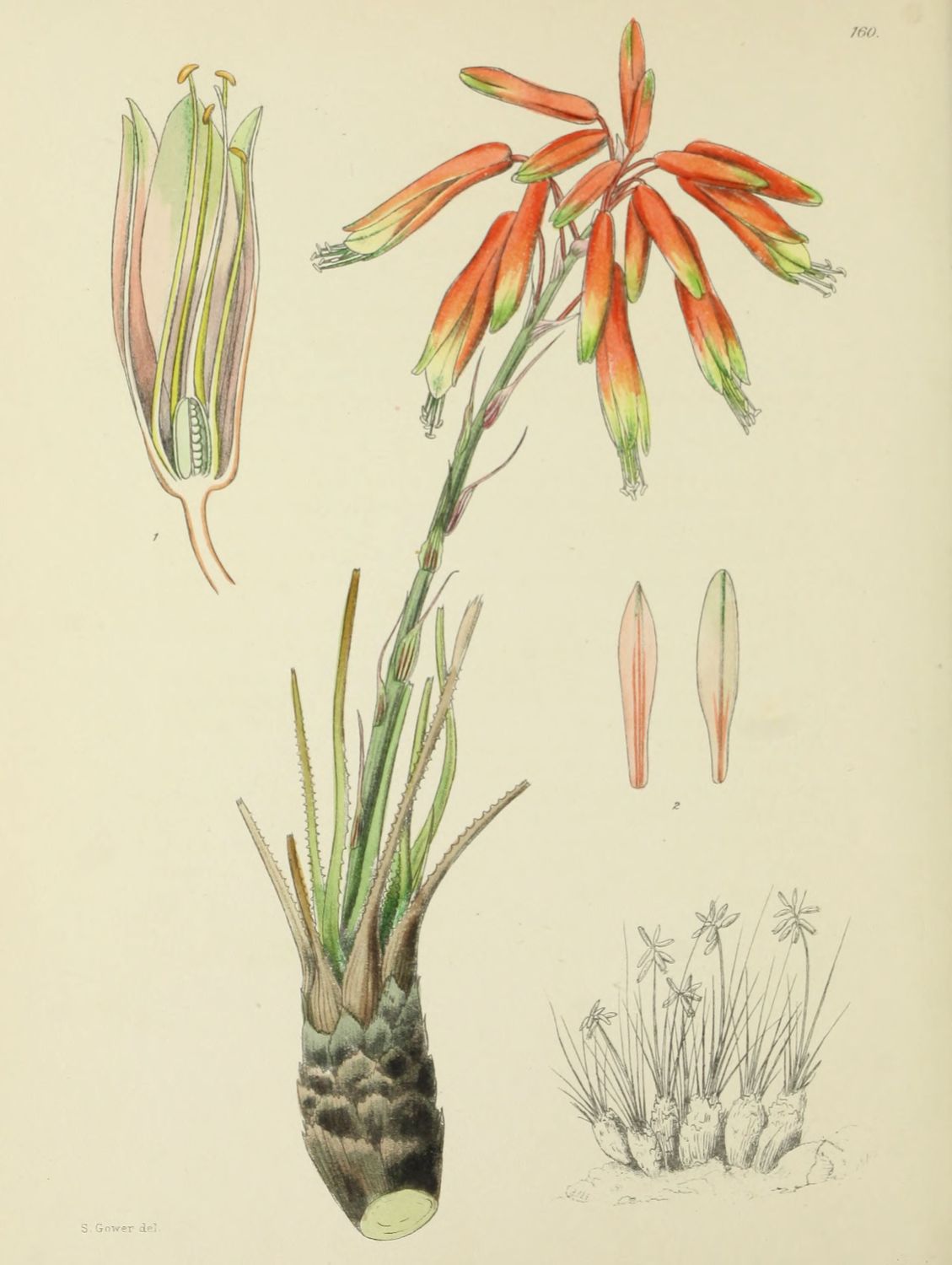
Plate 159.—Fig. 1, median longitudinal section of a flower; Fig. 2, portion of a perianth lobe showing apiculus and tuft of glandular hairs. Fig. 3, ovary.
F.P.S.A., 1924.