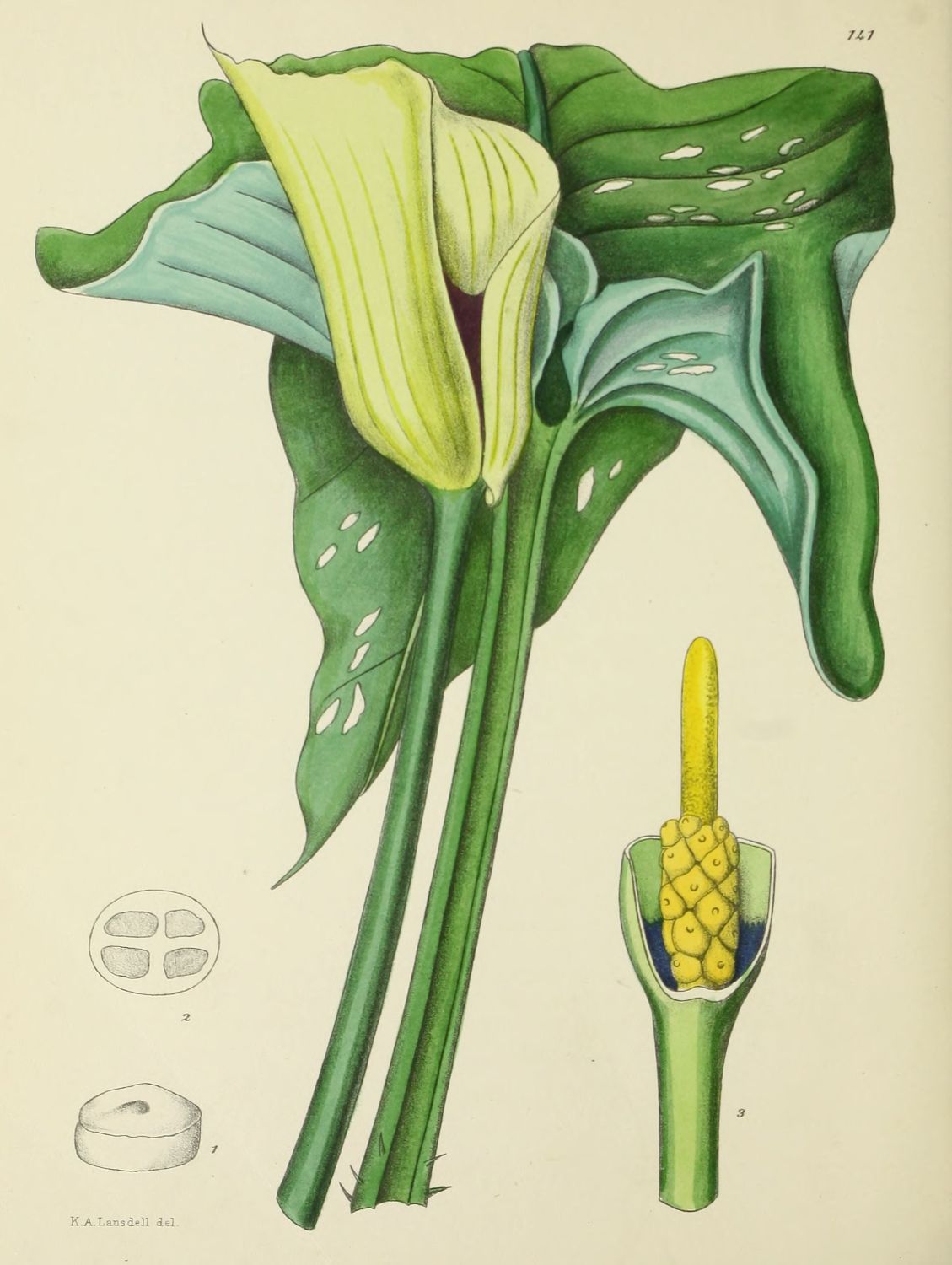
Plate 140.
Reading edition
CEROPEGIA AMPLIATA. Cape Province, Natal.
Asclepiadaceae. Tribe Ceropegieae. Ceropegia, Linn.; Benth. et Hook. f. Gen. Plant. vol. ii. p. 779.
Ceropegia ampliata, E. Mey. Comm. 194; Fl. Cap. vol. iv. sect. i. p. 817.
The species of Ceropegia, figured here for the first time, belongs to the same group in the genus as C. Meyeri (Plate 30), which is characterised by the tips of the petals being connate and forming a cage-like top to the flower. Ceropegia ampliata is one of the five South African species collected by Drège, all of which were described by E. Meyer.
The plant is a twiner or scrambler, devoid of leaves at the flowering period. The flowers are pale green with a purple band within the corolla-tube, which is visible through the wall of the tube. It is not such a striking plant as some of the species we have previously figured, but the purple band on a background of green gives the individual flower a very pleasing effect.
Our Plate was prepared from a living plant lent by Mr. W. Haygarth to the late Dr. J. Medley Wood.
Description:—Stem succulent, twining or scrambling, leafless at the time of flowering, glabrous. Leaves only seen at the young tips of the stems, soon deciduous, minute, 2 to 2·5 mm. long, lanceolate, acute, glabrous. Flowers 2 to 4 together at the nodes, successively developed; pedicels 0·6 to 1·3 cm. long, glabrous. Sepals 2 to 3 mm. long, lanceolate, acuminate, glabrous. Corolla-tube in dried specimens 2·5 to 5 cm. long, 0·8 to 1·2 cm. in diameter, cylindric and slightly or not at all inflated at the base, but on the living plant, according to a drawing, 5 cm. long, globosely and somewhat lobulate-inflated and about 2·5 cm. in diameter at the base, cylindric and 1·3 cm. in diameter above, not dilated at the apex, pale green, with a narrow purple transverse band at the top of the inflation inside, glabrous outside, covered inside with long simple hairs, longer and more matted at the purple band and above than in the lower part; lobes 0·8 to 1·2 cm. long, 5 to 6 mm. broad at the base, lanceolate from a deltoid base, acute, erectly connivent and connate at the tips, replicate or with reflexed margins, glabrous on both sides and not ciliate, green, spotted with darker green, becoming olive-brown when dried, probably with a velvety sheen on the inner surface; outer corona cup-shaped, equally 10-toothed; teeth about 1 mm. long, narrowly deltoid, acute, hairy on the inner surface; inner corona-lobes 4 to 5 mm. long, very slenderly filiform, connivent-erect, dorsally-connected by vertical plates to the outer corona at the base. (Flora Capensis.)
Plate 140.—Fig. 1, corolla laid open; Fig. 2, outer and inner corona, showing the pollinia; Fig. 3, pollinia.
F.P.S.A., 1924.