Front matter
Reading edition
BY
ETHEL TURNER,
AUTHOR OF "SEVEN LITTLE AUSTRALIANS," "THE STORY OF A BABY," ETC
"Ah that spring should vanish with the Rose! That youth's sweet-scented manuscript should close!" THE RUBÁIYAT OF OMAR KHAYYÁM.
"To youth the greatest reverence is due." JUVENAL.
WITH ILLUSTRATIONS BY A. J. JOHNSON.
LONDON: WARD, LOCK & CO., LIMITED, WARWICK HOUSE, SALISBURY SQUARE, E.C. NEW YORK AND MELBOURNE.
TO CHARLES COPE, MY STEPFATHER AND FRIEND
E. S. T., LINDFIELD, SYDNEY.
CONTENTS.
CHAP.
PICKING UP THREADS
SCHOOL TROUBLES
A PASSAGE-AT-ARMS
A SUMMER'S DAY
BETWEEN A DREAM AND A DREAM
TO-MORROW
A LITTLE MAID-ERRANT
ONE PARTICULAR EVENING
THAT MISCHIEVOUS CUPID
NEEDLES AND PINS
A DAY IN SYDNEY
THREE COURSES ONE SHILLING
PARNASSUS AND PUDDINGS
MUSHROOMS
THE GOVERNMENT OF MEG
MORE MUTINY
A DINNER PARTY
"HOW GOOD YOU OUGHT TO BE!"
HEADACHE AND HEARTACHE
MY LITTLE ONE DAUGHTER
THE SEVENTH DAY
AMARANTH OR ASPHODEL
LITTLE FAITHFUL MEG
"IN THE MIDNIGHT, IN THE SILENCE OF THE SLEEP-TIME"
HERE ENDETH
Contents tailpiece
THE FAMILY AT MISRULE.
CHAPTER I.
PICKING UP THREADS.
"Should auld acquaintance be forgot?"
There was discord at Misrule.
Nell, in some mysterious way, had let down a muslin frock of last season till it reached her ankles.
And Meg was doing her best to put her foot down upon it.
In a metaphorical sense, of course. Meg Woolcot at twenty-one was far too lady-like to resort to a personal struggle with her young sister.
But her eyes were distressed.
"You can't say I don't look nice," Nell said. "Why, even Martha said, 'La, Miss Nell!' and held her head on one side with a pleased look for two minutes."
"But you're such a child, Nellie," objected Meg. "you look like playing at being grown up."
"Fifteen's very old, I think," said Miss Nell, walking up and down just for the simple pleasure of hearing the frou-frou of muslin frills near her shoes.
"Ah well, I do think I look nice with my hair done up, and you can't have it up with short frocks."
"Then the moral is easy of deduction," said Meg drily.
"Oh, bother morals!" was Nell's easy answer.
She tripped down the verandah steps with a glance or two over her shoulder at the set of the back of her dress, and she crossed the lawn to the crazy-looking summer-house.
"Oh dear!" sighed Meg.
She leaned her face on her hands, and stared sadly after the crisp, retreating frills and the shimmer of golden hair "done up." This was one of the days when Meg's desires to be a model eldest sister were in the ascendency, hence the very feminine exclamation.
She had not altered very much in all these live long years—a little taller perhaps, a little more womanly, but the eyes still had their child-like, straightforward look, and the powdering of freckles was there yet, albeit fainter in colouring.
She still made resolutions—and broke them. She still wrote verses—and burnt them. To-day she was darning socks, Pip's and Bunty's. That was because she had just made a fresh resolve to do her duty in her state of life.
At other times she left them all to the fag end of the week, and great was the cobbling thereof to satisfy the demands of "Clean socks, Meg, and look sharp."
Besides darning, Meg had promised to take care of the children for the afternoon, as Esther had gone out.
Who were the children? you will ask, thinking five years has taken that title away from several of our young Australians.
The General is six now, and answers to the name of Peter on the occasions that Pip does not call him Jumbo, and Bunty, Billy. Nell, who is inclining to elegant manners, ventures occasionally in company to address him as Rupert; but he generally winks or says "Beg pardon?" in a vacant kind of way.
Baby also has become "Poppet," and handed down her name of long standing to a rightful claimant who disjointed the General's nose nearly three years ago and made our number up to seven again.
Just a wee, chubby morsel of a girl it is, with sunshiny eyes and sunshiny hair and a ceaseless supply of sunshiny smiles.
Even her tears are sunshiny; they are so short-lived that the smiles shine through and make them things of beauty.
The boys generally call her "The Scrap," though she is as big as most three-year-olds. She was christened Esther.
And Poppet is still a child,—to be nine is scarcely to have reached years of discretion.
She has lost her chubbiness, and developed abnormally long, thin legs and arms, a surprising capacity for mischief, and the tenderest little heart in the world.
So Meg's hands were fairly well filled for the afternoon, to keep these three young ones in check, darn the socks, and superintend kitchen arrangements, which meant Martha Tomlinson and the cook.
She had not bargained for the tussle with Nell too.
That young person was at a difficult age just now: too old—in her own eyes, at any rate—to romp with Bunty and Poppet; too young to take a place beside Meg and pay visits with Esther,—she hung between, and had just compromised matters by letting down her frocks, as years ago Meg had done in the privacy of her bedroom.
Her early promise of good looks was more than fulfilled, and in this long, pale blue muslin, and "picture" hat, cornflower-trimmed, she looked a fresh enough young beauty to be queen of a season. The golden hair had deepened, and was twisted up in the careful, careless way fashion dictated. The complexion was wonderfully pure and bright for Australia, and the eyes were just as dewy and soft and sweetly lashed as ever.
But not yet sixteen! Was ever such an impossible age for grown-up rights? Just because she was tall and gracefully built was no reason why she should consider herself fit to be "out," Meg contended—especially, she added, with a touch of sisterly sarcasm, as she had a weakness for spelling "believe" and "receive" in unorthodox ways, and was still floundering wretchedly through her first French author—Le Chien du Capitaine.
Poppet's legs dashed across the gravel path under the window; Peter's copper-toed boots in hot pursuit shone for a second and vanished.
"Where's Baby, I wonder?" Meg said to herself.
The child had been playing with a chair a little time back, dragging it up and down the verandah and bumping it about noisily; now all was silent. She went to the foot of the stairs, one of Bunty's socks more "holey" than righteous drawn over her hand.
"What you doing, Essie?" she called.
"Nosing, Mig," said a little sweet voice from a bedroom,—"nosing at all."
"Now, Essie!"—Meg's voice took a stern note,— "tell me what you are doing!"
"Nosing," said the little voice; "I'se velly dood."
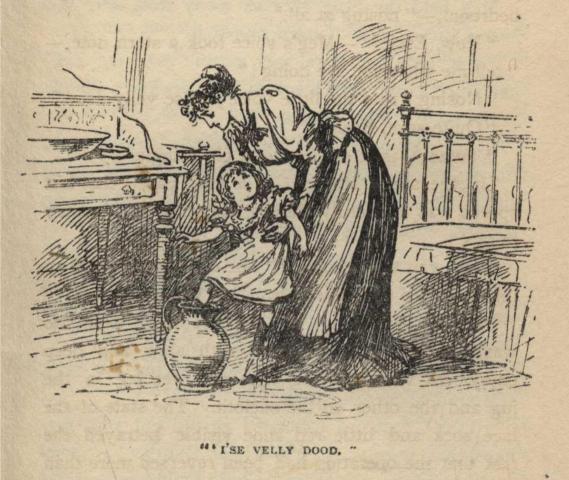
"'I'SE VELLY DOOD.'"
"Quite sure, Essie?"
"Twite; I isn't dettin' wet a bit, Miggie."
Up the stairs Meg ran at a swift pace; that last speech was eminently Baby's, and betokened many things.
"Oh, you wicked child!" she cried, and drove an unsummoned smile away from her mouth corners.
The big water-jug was on the floor near the washstand, and small Essie with slow and deep enjoyment was standing with one wee leg in the jug and the other on the oilcloth. The state of the lace sock and little red shoe visible betrayed the fact that the operation had been reversed more than once.
This was an odd little characteristic of Essie's, and no amount of scolding and even shaking could break her of it. Innumerable times she had been found at this work of iniquity, dipping one leg after the other in any water-jugs she found on the floor. And did Martha, in washing floors, leave her bucket of dirty water one moment unguarded, Essie would creep up and pop in one little leg while she stood her ground with the other.
Meg dried her, scolding hard all the time. "All your shoes are spoiled, Baby, you naughty girl; what am I to do to you?"
"Velly solly," said Baby cheerfully.
She squeezed a tear out of her smiling eyes when Meg bade her look at the ruin of her pretty red shoes.
"And you told me a story, Essie; you said you were good, and were not getting wet."
Meg held the little offender away from her, and looked upon her with stern reproach.
"But on'y my legs was dettin' wet—not me," explained Essie, with a sob in her voice and a dimple at the corner of her mouth.
There was nothing of course to be done but put the water-jug into its basin, and carry the small sinner downstairs in dry socks and ankle-strap slippers that showed signs of having been wet through at some time or other.
Bunty was lying on his back on the dining-room couch, which Meg had left strewn with footwear waiting to be paired and rolled up.
"Oh, John!" she said vexedly, seeing her work scattered about the floor.
"John" took no notice. I should tell you, perhaps, that, since starting to school, Bunty's baptismal name had been called into requisition by authorities who objected to nicknames, and his family fell into the way of using it occasionally too.
He was a big, awkward lad, tall for his thirteen years, and very loosely built. Nell used to say complainingly that he always looked as if he needed tightening up. His clothes never fitted him, or seemed part of him, like other boys' clothes. His coats generally looked big and baggy, while his trousers had a way of creeping up his ankles and showing a piece of loose sock.
In the matter of collars he was hopeless. He had a daily allowance of one clean one, but, even if you met him quite early in the morning, there would be nothing but a limp, crooked piece of linen of doubtful hue visible. He had the face of a boy at war with the world. His eyes were sullen, brooding—his mouth obstinate. Every one knew he was the black sheep. He knew it himself, and resented it in silence.
Poppet understood him a little—no one else. He was at perpetual enmity with his father, who had no patience with him at all. Esther excused him by saying he was at the hobbledehoy stage, and would grow up all right; but she was always too busy to help him to grow. Meg's hands were full with Pip; and Nell, after a try or two to win his confidence, had pronounced him a larrikin, undeserving of sisters at all.
So Poppet undertook him. She was a faithful little soul, and in some strange way just fitted into him, despite his awkward angles.
Sometimes he would tell her things, and go to a great deal of trouble to do something she particularly wanted; but then again he would bully her unmercifully, and make her life not worth living.
"Why don't you play cricket, or do something, John?" Meg said, snipping off an end of cotton very energetically. "I hate to see a great boy like you sprawling on a sofa doing nothing."
"Do you?" said John.
"What made you so late home from school? It's nearly teatime. I hope it wasn't detention again."
"It was," said John.
"Oh, Bunty, that means Saturday taken again, doesn't it?"
"It does." John rolled over, and lay on his other side, his eyes shut.
"Bunty, why don't you try?" Meg said; "you are always in scrapes for something. Pip never got in half so many, and yet he wasn't a model boy. Will you promise me to try next week?"
There was a grunt from the sofa cushion that might be interpreted at will as negative or affirmative.
Nell came into the room, her hat swung over her arm.
"Get up, John," she said; "what a horrid boy you are! Look at your great muddy boots on the sofa! Meg, I don't know how you could sit there and see him. Why, if we sat down, we'd get our dresses all spoiled."
"Good job too," said John, not moving a hand.
Nellie regarded him with frankest disgust. "What a collar!" she said, a world of emphasis on the "what." "I declare the street newsboys and match-sellers look more gentlemanly than you do."
The tea-bell rang upstairs; John sat up instantly.
"I hope you saved me more pudding to-day, Meg," he said. "I never saw such a stingy bit as you kept yesterday."
Nell's scarlet lips formed themselves into something very like "pig" as she turned on her heel to leave the room. Then she said "Clumsy wretch!" with startling suddenness. John had set his "great muddy boot" down on one of her pretty flounces, and a sound of sundering stitches smote the air.
"Beg pardon," said John, with a fiendish light of triumph in his eyes. Then he went upstairs two steps at a time to discuss his warmed-up dinner while the others had tea.
CHAPTER II.
SCHOOL TROUBLES.
"A heart at leisure from itself
To soothe and sympathise."
Poppet and Peter were discussing many things in general, and the mystery of life in particular. They were sitting crouched up together in an old tank that had been cast out in the first paddock because it leaked. It was after tea, and Poppet had a little dead chicken in her hand that she had picked up in the garden.
"Ith got wheelth inthide it, and when they thop ith deaded," Peter was saying,—"thust like my thteam engine, thath what tith."
"I think being alive is very funny," Poppet said, looking earnestly at the little lifeless body. "All those chickies was eggs, and then sud'nly they begin running about and enjoying themselves, and then sud'nly they tumble down dead, and even the doctor can't make them run again."
"Yeth," said Peter, his eyes very thoughtful as he tried to grasp great things. "Prapth you might tumble down like that, Poppet; all your wheelth might thtop."
"Or yours," urged Poppet. Death was in her hand. She did not like to feel that ever her active little body could lie like this fluffy, silent one, and so made the likelihood more general.
"Yeth," said Peter; "and oneth, Poppet, I nearly wath deaded, and Judy thaved me."
"You don't remember," Poppet said, in a voice of great scorn. "You was only a little, tiny baby, just beginning to walk, Peter. But I was there, and remember everything."
"You wath athleep, Poppet," Peter objected,—Poppet's air of superiority irritated him. "Meg told me about it when I had the meathleth, and the thaid that you wath athleep, tho there!"
"At any rate, Peter, I think you are old enough to stop lisping," Poppet said severely, finding herself worsted. "You are six now, and only babies of ten months lisp. I never lisped at all."
Peter went red in the face.
"I don't lithp; you're a thtory-teller, Poppet Woolcot!" he said, drawing in his tongue with a great effort at straight pronunciation.
Poppet jeered unkindly, then she caught sight of Bunty strolling aimlessly about the garden, and she squeezed herself out of the tank and stood upright.
"Don't go," said Peter. "Leth play Zoo, Poppet, and you can be the lion thith time, and I'll feed you!"
But not even this inducement had any effect.
"I want to talk to Bunty," the little girl said, looking across with a half-troubled light in her eyes to where Bunty's old cap was visible. "I can play with you when he's at school. You can go and have a game with Baby."
She went away, leaving him disconsolate, and crushed herself through a broken paling into the garden.
She would like to have gone up to Bunty and slipped her arm through his and asked him what had made him so exceptionally glum and silent these last few days.
But she knew him better than that. She was very wise for her nine years.
She fell to weeding her garden with great industry while he was walking on the path near it. Then when he rambled farther away, she hovered about here and there, now plucking a flower, now giving chase to a great praying mantis. She was within a few feet of him all the time.
"What are you buzznaccing about like this for?" he said at last irritably, when her short holland frock appeared at every path he turned down. He threw himself down on the grass, and pulled his cap over his eyes.
"Flibberty-Gibbet had a tic in his head this morning," said the little girl, sitting down beside him Turk fashion.
"Well, I don't care," Bunty said, with almost a groan.
A look of anger crept up into the little sister's, earnest eyes.
"I 'spect it's that old Burnham again," she said wrathfully. "What's he been doing this time?"
Bunty groaned again.
"Was it your Greek?" she said, edging nearer. "Howid stuff! As if you could be espected to get it right always!"
There was another smothered sound from beneath the cap.
"Was it that nasty algebra?" said the little, encouraging voice. It was so tender and anxious and loving that the boy uncovered his eyes a little.
"I'm in the beastliest row, Poppet," he said.
Poppet's little, fair face was ashine with sympathy.
"I'd like to hammer that Mr. Burnham," she said. "How did it happen, Bunty?"
Bunty sat up and sighed. After all, it would be a relief to tell some one; and who better than the faithful Poppet?
"Well, you know Bully Hawkins?" he said.
"Oh yes," said the little girl; and she did, excellently—by hearsay.
"Well, on Monday he was on the cricket pitch practising, and Tom Jackson was bowling him—he'd made him. And when I went down—I was crossing it to go up to Bruce—he jumped on me, and said I was to backstop. I said I wasn't going to—why should I go after his blooming balls?—and he said he'd punch my head if I didn't. And I said, 'Yes, you do,' and walked on to Bruce. We were going to play marbles. And he came after me, and hit me over the head and boxed my ears and twisted my arms."
"Bully!" said Poppet, with gleaming eyes. "What did you do, Bunty? did you knock him down? I hope you made his nose bleed,—I'd—I'd have flattened him!"
Bunty gave her a look of scorn.
"He's sixteen, and the size of a prize-fighter!" he said. "I'd have been half killed. No; Mr. Burnham was just a little way off, and I let out a yell to him, and he came up and I told of him."
"Bunty!" said Poppet. The word came out like the report of a pistol, and her red lips shut again very tightly to prevent any more following.
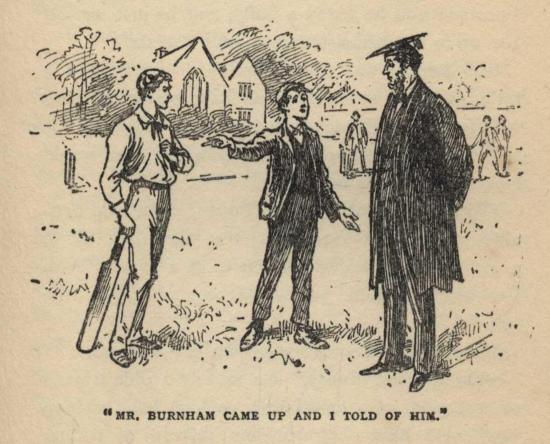
"MR. BURNHAM CAME UP AND I TOLD OF HIM."
This touch of cowardice, this failure to grasp simple honour in Bunty's character, was a perpetual grief and amazement to her little fearless soul. But he would brook no advice nor reproach from her, as she knew full well, and that is why her lips had closed with a snap after that one word.
But he had seen the look of horror in her eyes.
"D'ye think I'm going to be pummelled just as that brute likes?" he demanded angrily. "He's always bullying the fellows in our form, and it'll do him good to get a taste of what he gives us. Mr. Burnham said he hated a bully, and he just walked him up to the schoolroom and gave him six."
Still Poppet was silent; her face was flushed a little, and she was pulling up long pieces of grass with feverish diligence. In her quick little way she saw it all, and felt acutely just how the boys would look upon Bunty's behaviour.
"What an idiot you are, Poppet!" he said irritably, as she did not speak; "as though a bit of a girl like you knows what it is at a boys' school. I'm sorry I told you—I—I won't tell you the rest."
Poppet choked something down in her throat.
"Do tell me, Bunty," she said; "I didn't mean to be howid. Go on—I only couldn't help wishing you could have foughted him instead of telling, because—well, I espect he'll be worse to you than ever now, and the other fellows too."
"That's it," Bunty said, with a groan. "Oh, but that's not half of it yet, Poppet. I almost wish I was dead."
Something like a tear forced itself beneath his eyelids and trickled down his cheeks. Poppet's. heart expanded and grew pitiful again instantly His face was close to her knee, and wore so miserable an expression that in a sudden little burst of love she put down her lips and kissed him half-a-dozen times.
He sat up instantly and looked ashamed.
"How often am I to tell you I hate mugging?" he said gruffly. "If you go on like this, I won't tell you."
"I beg your pardon," Poppet said very humbly; "really, I won't again, Bunty. Do go on."
"Well, after that, I went round the side of the school—you know that path, near the master's windows. Well, I'd nothing much to do, and the bell hadn't gone, and I was just chucking my cricket ball up and down; there was a tree, and I tried to make it go up in a straight line just as high, and the next minute I heard a crash, and it had gone through Mr. Hollington's window."
"Good gracious!" Poppet said, with widening eyes; then she gave a little joyful jump. "I've got thirteen shillings, Bunty, from the pound Mr. Hassal gave me; I'll give it to you to get it mended with. Oh, it won't be such a very bad row; you can 'splain it all to Mr. Hollington."
"That's not all," Bunty said. "Thirteen shillings! You might as well say ha'pennies. I stood there for a bit and no one came, and at last I went in and looked about, and what do you think?—no one had heard!"
"Oh!" breathed Poppet. She scented the old trouble again.
"But you see it was such an awful crash. I knew it was more than the window. And every one was out in the playground,—even Mr. Burnham had just gone out again for something, and Mr. Hollington had gone home early. So I first went quietly upstairs, and no one was about, so I went into his room to get the ball, because my name was on it. And there were two glass cases on top of one another under the window with eggs and specimens and things in, and they were all smashed."
Poppet drew a long breath that ended in a whistle. She was wishing she had not bought that set of gardening tools that cost six shillings, and that shillingsworth of burnt almonds—perhaps a sovereign——
"It wasn't school-time," Bunty was whispering now, "and no one had seen—not a soul, Poppet. Poppet, it was an accident; why should I go and tell of myself? Why, I might have been expelled; and think what the governor would say. So——"
"Yes," said Poppet steadily, "go on, Bunty."
He had paused, and was digging up the earth with his broken pocket-knife. "So—go on."
"So, when we were all in afternoon school, Mr. Burnham came in and asked who did it."
"Yes, Bunty—dear." A red colour had crept up into the little girl's cheeks, her eyes were full of painful anxiety. "You said you had, Bunty—didn't you, Bunty dear? Oh, Bunty, of course you said you had."
"No, I didn't," burst out her brother. "How could I after that, you idiot you? What is the good telling you things? Why I didn't know what would have happened. When he asked us separately I just said 'No' in a hurry, and then I couldn't say 'Yes' after, could I?"
Again Poppet was silent, again there was the look of amaze and grief in her wide, clear eyes. Bunty pulled his old cap over his face again—he hated himself, and most of all he hated to meet the honest, sorrowful eyes of his little sister.
"Couldn't you tell now, Bunty?" she said softly. "Go to-night—I'll come with you to the gate—oh, do, Bunty dear. Mr. Burnham is not vewy howid perhaps, and canings don't hurt vewy much—let's go to-night, and by to-morrow it'll all be over."
"It's no good." A sob came from under the cap. "Oh, Poppet, it'll be awful to-morrow! Oh, Poppet! Some one had seen, after all. Just as I left school Hawkins came up to me. He hadn't been there when Burnham asked us, and didn't hear anything till after school, and he said he saw me coming out of Hollington's room, and creeping down the passage with a cricket ball in my hand, and he went in to report it to Burnham just as I came home, to pay me out for getting him a swishing."
Poppet was crying, though she hardly knew it. Such a terrible scrape, and such a lie at the back of it—what could be the end of it?
"Oh, Bunty!" she said, and put her face right down in the long grass. The earth and the tears got mixed, and smirched the clearness of her skin—there was a wet, black smudge all down her poor little nose.
"Poppet!" cried Meg's voice, preceding her down the path in the dusk. "Are you really sitting on the grass again when I've told you so often how wet the dew makes it? John, how can you let her, when you know how she coughs! Go to bed at once, Poppet, it's after eight; and you haven't touched your home-lessons, John—really it's one person's work to look after you—and where is that coat with the buttons off?"
"On my bed," "John" said sulkily.
"I wish you'd hang it up—what's the use of pegs? Poppet, go in when I tell you—don't be naughty. Now, John, go and start your lessons. You'd better do them in your bedroom, you make such a litter downstairs."
Meg turned to go back, Poppet's reluctant hand held fast.
"Can't I stay five minutes, please, Meg?" the little girl said, looking up beseechingly.
Even in the fading light Meg saw the sweet brimming eyes and quivering little lips.
"John!" she said angrily, "you've been bullying the poor little thing again; I simply won't have it—I shall speak to father."
"Oh, shut up!" said John; and he moved away wearily up to the house.
CHAPTER III.
A PASSAGE AT ARMS.
"Oh the day when thou goest a-wooing,
Philip, my king."
Meg was a little "put out," as it is popularly called, this evening,—she was not generally so short with the young ones. The good fit had worn away during the endless process of darning, and she had jumped up at last, stuffed all the work into the gaping stocking-bag, and said to herself that eldest sisters were mistaken and wrongful institutions.
But that did not give Baby Essie her tea, nor yet put her lively little ladyship to bed; and since Esther was out, there was no one else to undertake it.
And when that was done Pip came in and asked her in his off-hand manner to "just put a stitch in that football blazer."
The stitch meant a hundred or two, for it was slit from top to bottom.
And then Esther came home—a quieter Esther, an Esther of less brilliant colouring than you used to know, for there are not many "fast colours" beneath Australian skies—and with her the Captain, grown more short-tempered with the lapse of years, and an income that did not grow with his family. And again it was "Meg."
The seltzogene was empty. The Captain asked some one to tell him what was the use of having a grown-up daughter—he could not answer the question himself.
The lamb was a shade too much cooked, and the Golden Pudding a shade too little. He wanted to know whether Meg considered it below her to superintend domestic matters. In his young days girls, etc., etc. She went from the dinner-table at the end of the meal with hot cheeks.
"I never chose to be eldest—I was made so; and I don't see I should be scapegoat for everything!" she said, sitting down on the arm of the lounge on which lay six feet of the superior sex in the shape of Pip.
There was a wrathful look in her blue eyes, and she had ruffled her fair hair back in a way she always did in moments of annoyance.
"Why don't you make that conceited little chit help?" Pip said between puffs at his cigar.
"Nellie!" ejaculated Meg in surprise.
"Yes, Nellie," said Pip. He looked across to where she was making a picture beautiful to the most critical eye in a hammock a yard or two distant. "Is her only mission in life going to be looking pretty?"
"Oh," Meg said, "she's too young, of course, Pip. Why, she's only fifteen, though she is so tall! Oh, of course it can't be helped—only it's annoying. But what have you got your best trousers on for, Pip, again, and that blue tie? You had them last night and the night before!"
Pip's handsome face coloured slowly.
"You've got a fair amount of cheek of your own, Meg," he said, collecting the cigar ash in a little heap very carefully, and then blowing it away with equal industry. "I wonder when you'll learn to mind your own business. I should imagine I'm old enough to choose my own clothes."
"Only she's a horrid, vulgar girl, that's all," Meg said slowly, and colouring on her own account. "Pip, I don't know how you can, really I don't—a common little dressmaker. Oh yes, we know all about it; Peter saw you last night, and Poppet the night before."
"Peter be—Poppet be—— What the deuce do you mean spying after me?" stormed Pip, sitting upright and looking wrathfully at his sister. "If I choose to take a walk with a pretty girl, is it any concern of yours?"
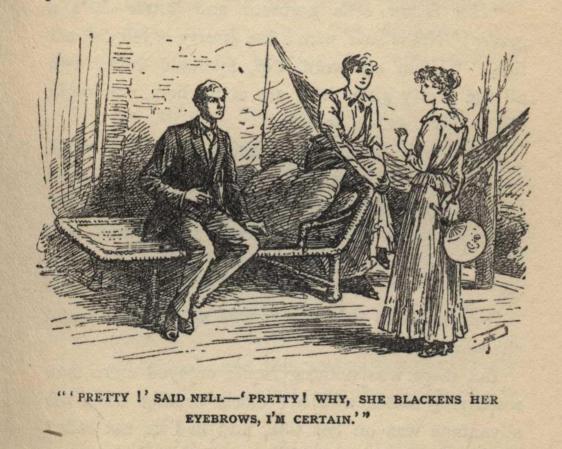
"'PRETTY!' SAID NELL—'PRETTY! WHY, SHE BLACKENS HER EYEBROWS, I'M CERTAIN.'"
"Pretty!" said Nell, who had come up at his raised voice,—"pretty! Why, she blackens her eyebrows, I'm certain; and you should have seen her hat last Sunday—a green bird, some blue, lumpy plush, and a bunch of pink chiffon."
"Upon my word," said Pip,—he was white with anger, and his eyes blazed,—"upon my word, I've got two nice sisters. Trust a girl for running down another pretty one. You're jealous, that's what it is, because you know you can't hold a candle to her."
"Her father sells kerosene and butter—he's a grocer!" Nellie said, with a fine swerve of her delicate lips. "Upon my word, Pip, I should think, with all the pretty girls there are about here, you might fall in love with a lady."
"She is a lady," Pip contended hotly. "She works with her needle, perhaps—she's not been brought up in selfish idleness like you girls—but her manners are a long sight better than yours, and she'd blush to say small-minded things like you do."
It occurred to Meg that it was small-minded, and she said no more.
But there was nothing Nellie enjoyed more than a sparring match with her eldest brother when the advantage was on her side, and had he not called her a conceited chit?
"There's one thing—you'd get your groceries at a reduction," she said meditatively. "I think their sardines are only 5-½*d.* a tin; they'd let you have them for 5*d.* perhaps, considering all you've spent in chocolates and eight-button gloves. Meg, I did think that packet of lovely gloves in his bedroom was for his dear little sisters, until——"
"Until you forfeited them by your abominable behaviour!" Philip cried jesuitically.
But Nellie gave him a pitying glance. "Until I saw the size was too utterly impossible for the hands of ladies,—o-o-h, Pip, don't, you hurt me—ah-h-h, you're bruising my arm—stop it, Pip!"
Pip was twisting her soft, muslin-covered arms back in the torturous way boys learn at school, and in a minute she was compelled to call for mercy.
"Down on your knees!" he cried, forcing her down into that humble position. "Now, apologise for all the caddish things you've said about Miss Jones; begin at once,—now, one, two, three—say, 'I apologise.'"
"Never!" screamed Nell, struggling desperately; "I'll die first,—o-o-h, ah-h-h, oh—'I—I—I apologise'—you donkey!"
"More than that,—'I should be glad to be half as beautiful and good and lady-like.'"
"'B-beautiful and good and l-l-lady-like," repeated Nell, with a gasp and a cry between each word. "Oh, Meg, make him stop!"
"'I only said those caddish things because I was jealous of her superiority'—hurry up, now!" A scientific turn accompanied his sentence.
"'C-caddish things because I was jealous—superiority,'—oh, Pip! Meg! somebody, quick—he's half killing me!" Tears of pain and mortification had started to her eyes.
"Let her go, Pip," Meg said; "you really hurt." She pulled at his arm, and he released his victim, who fell in a heap on the floor, and said he was "a h-h-horrid w-wretch, and she w-wished she had no brothers."
Pip picked up his hat and settled his pale blue tie, which had become somewhat disarranged.
"Good-night; I hope you'll learn and inwardly digest your lesson, my child," he said, going out upon the gravel.
But Nellie sprang to her feet, and called after him all down the path till he reached the gate, "Candles, sardines, needles and pins, size nine gloves! ask her what she blacks her eyebrows with!"
Meg was looking troubled. She was sitting on the lounge he had quitted, and her fair brows were knitted beneath the soft, straying hair.
"Nell dear, it is vulgar," she said, "and it is small. I don't know where the distinction of ladies comes in if we say things like that. Perhaps the little dressmaker really wouldn't."
"But we are ladies," Miss Elinor said, her small head in the air,—"nothing can alter that. Our father is a gentleman, our mother was a lady—we are ladies."
"Not if we act like servant girls," Meg said quietly. "If you found a bit of glass under all the conditions you'd expect to find a diamond, and yet it didn't shine like a diamond, then it wouldn't be a diamond, would it?"
"Now don't get elder-sistery and moralous," said Nell; albeit she was a trifle ashamed, for she prided herself certainly upon being a little lady to her boot toes. "Meg, I thought of doing up that white crepon Esther gave me into a kind of evening dress, just for little evenings, you know, at the Baileys or Courtneys, or anywhere, or when we have people here. Would you make the body as a blouse with big frills over the shoulders, or with a yoke and gathered into the waist? The blouse way would be easier, for there's no lining, you know."
"Oh, the blouse, I think," Meg said, half abstractedly. "Do you know if Poppet has gone to bed, Nell? I don't think I saw her come in, and her cough was bad last night."
"I don't know. Meg, I'll give you half-a-crown for that silver belt of yours; I've got a little money left in my allowance yet, and you never wear it. Half-a-crown would buy you a new book, or one of those burnt straw sailor-hats, and the belt would look lovely with the white dress." The younger girl looked persuasively at the elder.
"But I gave seven-and-sixpence for it," Meg objected, "and it's nearly new."
"But you never wear it—what's the good of a thing you don't wear?" contended Nellie, who had set her heart upon it. "If you think it's too little, say two shillings and that light blue blouse of mine that you like."
Meg put the blouse on mentally.
"Well, I like myself in pale blue," she said; "yes, I'll do that—only I hope it's not torn or anything. Oh! and Nell, I think you might go and see if Poppet is in the garden; I've done ever so much to-day, and you've only been reading."
But Nellie was comfortably in the hammock again among the cushions.
"Oh, Poppet never does anything I tell her," she said; "you'd better get her yourself—all the children mind you more than me, you have so much more patience, Megsie."
So it was Meg who had disturbed the important tête-à-tête between Bunty and his little sister; Meg who had separated them abruptly, almost unkindly, at a crisis of great moment; and Meg who had seen the little girl actually into bed, and administered a dose of eucalyptus against the cough.
But it was also Meg who went down in the drawing-room presently, and played Mendelssohn's tender, exquisite Love Song, and a rippling, laughing little bit of Grieg, and a Sonata of Beethoven's, to a father half asleep on the sofa and a young man very wide awake on a neighbouring chair.
And it was Poppet who made hay, and crept along the passage in her little nightgown to the room where Bunty was sitting with his head on his arms and misery in his eyes.
And it was Poppet who, after torrents of abuse and vituperation from the unhappy lad, succeeded in extracting a promise that he should own up everything bravely in the morning, and not shirk his punishment whatever it was.
CHAPTER IV.
A SUMMER'S DAY.
"Happy in this, she is not yet so old
But she may learn; happier than this,
She is not bred so dull but she can learn."
The next day was exceedingly hot, one of those moist, breathless days that make February the most unpleasant month in the year to Sydney folks.
Every one in the house felt utterly limp and cross and miserable, and daily duties were performed in as slipshod and languid a manner as possible. The cook had made a great pan of quince jam, and brought it into the breakfast-room on a tray for Esther to tie down. And Esther was sitting in the rocking-chair trying to make up her mind to do it, and wondering whether it would be easier to use string or paste. Small Esther was making a terrible noise. She owned dolls and bricks, little tea-services, and baby furniture—all the toys that well-regulated little girls are supposed to love; she generally tired of them, however, after a few minutes' play.
At present she had made a tram of six heavy leather chairs, with the armchair for "motor," and her little sweet face was scarlet and wet with the exertion of dragging them into place.
In addition to this she had taken the fire-irons out of the fender, and was rowing, or in some way propelling the train forward—to her own satisfaction, at any rate—by brandishing the tongs wildly about while she stood in the motor and shouted and cried, "Gee up!"
"Essie," big Esther said at last, "you must be quiet. Poor mamma's head aches. Where's your doll? That's not a pretty game."
"All bwoked," said Essie; "gee up, old twain." Bang, bang, clatter, clatter.
"Essie, put those things away at once." Esther noticed the poker for the first time. "You naughty girl, you are scratching the chairs dreadfully."
"But I can't make ze twain puff-puff wifout," objected the engine-driver, "an' we has to go to Bwisbane; det up wif you." She leaned over the tall back of her locomotive, and made vigorous hits at the legs of it.
So vigorous indeed that the chair went over with a crash, precipitating Essie and the poker and tongs and shovel in four different directions.
"Oh dear," said Esther, and sighed before she attempted to go to the rescue. Essie was always tumbling from somewhere or other and never got much hurt, and really it was terribly hot.
"Oo-oo-oh!" said a very small voice. It quavered for a minute. If the anxiously examined little fat knees had been scratched, it would have broken into a despairing yell, but they were whole, and the motor had misbehaved itself.
"Beast!" she said, picking herself up in a great hurry,—"howid old pig!" Then she seized the poker and beat the prostrate chair with all her small, angered strength.
"Essie," big Esther said languidly—she had found with thankfulness she need not move from the chair,—"Essie, I shall whip you, if you use naughty words like that."
"But I was zust dettin' to Bwisbane—so it is a pig," Essie maintained. Then she climbed up again, and the journey proceeded.
In the nursery Meg was supposed to be giving lessons to Peter and Poppet, and superintending the more advanced studies of Nellie; for the last nursery governess had left suddenly, and the Captain had professed himself unable to afford another until the next quarter.
Meg used to provide herself with a book during these daily struggles, to be indulged in at times when her supervision was not required. It had been an "improving" book for the last month, for she had lately been finding out how wofully ignorant she was when she talked to the young man who had listened to her playing last night. To-day it was Browning, because he had looked horrified to find she never read any of his poems, on the plea that he was acknowledged to be difficult to understand.
It was a pity she chose "Filippo Baldinucci on the Privilege of Burial" for her first essay, especially as it was such a hot day; but she had determined to read, dauntlessly, the first poem the book opened at.
"Do this sum, Poppet," she said, setting a multiplication with eight figures in each line—"dear, what a greasy slate; and Peter, if you drop any blots on your copy, you will have to write it again this afternoon."
Peter was sucking a little lump of ice he had stolen out of the ice-chest. Poppet asked him for a bit to clean her slate with, but he considered this such waste of precious material that he swallowed it in a hurry and choked. Poppet asked if she might go and wet her sponge; but Meg said no, it always took a quarter of an hour to do that simple act, if she escaped from the room. So Peter offered to breathe on it for her.
"Both of us will," said Poppet,—"you on the top half, and me on the bottom."
Meg was taking a cursory glance at "Filippo," and groaning mentally; she did not hear the arrangement for the slate-cleaning until the heads bumped violently and the two began to quarrel.
"You licked it with your tongue," Poppet said.
"I never—I wath only breathing with my lipth on it," declared Peter.
"I saw the end of your tongue hanging out," Poppet maintained.
"You're a thtory-teller, Poppet." Peter's face began to get red. "I wath only breathing, tho there."
"Peter, go and sit at the other end of the table. Poppet, if you put out your tongue at Peter again, I shall make you stand in the corner." Meg put a pen in the Browning to keep it open, and went over to Nell at the window to see how "Le Chien du Capitaine" was progressing.
"Oh, Nell!" she said.
The French dictionary lay face downwards on the broad window-sill; "Le Chien" was face upward on Nell's knee, but on the top of it was "Not Wisely, but too Well."
"Oh!" said Nell, with a gasp, her eyes misty, her cheeks flushed,—"oh, it's no use scolding, Meg,—I absolutely must finish this; I'm just where Kate is—Oh, Meg, you are horrid!"
For Meg had taken forcible possession of the dark green book, and had picked up the dictionary.
"You know you are not to read in the morning," she said; "and I don't think you ought to read a love story like this till you're eighteen at least. Really, Nellie, it's no use me pretending to overlook you; you've done one page of 'The Dog' in three mornings. I'll have to tell father I must give up the pretence of teaching."
"Here, give it to me," Nellie said, sighing wistfully; "it ought to be called 'The Pig,' I think, it's so detestable. Put 'Not Wisely' on the table, Miggie, so I can see the title and get occasional refreshment."
Then Meg returned to the "Privilege of Burial." Her first thought, when she had read the piece through, was that Browning was not a true poet, however great a man he might be; and her second that Allan Courtney must be exceedingly clever to be able to enjoy such reading; her third was sorrow at the poor brains she felt she must possess not to be able to enjoy it too.
She tried another at random—"Popularity." It was rather better she decided, though she had no very clear idea of the meaning; and oh! that terrible last verse,—was it an enigma, or could clever people see the sense instantly?—
"Hobbs hints blue—straight he turtle eats:
Nobbs prints blue—claret crowns his cup
Nokes outdares Stokes in azure feats,—
Both gorge. Who fished the murex up?
What porridge had John Keats?"
The deep sigh that accompanied the third vain reading of it, disturbed Peter in his occupation of putting flies in the ink, fishing them out, and letting them crawl over to Poppet.
Poppet at her side of the table was similarly occupied, only she had captured a March-fly, and it made beautifully clear tracks right across to Peter.
"Is your sum finished, Poppet?" Meg said abstractedly, pondering even as she spoke, what Keats, who was a god to her, had to do with porridge.
Poppet put her hand over the March-fly and confessed it was not quite.
"How many rows have you done?"
The answer came in a whisper, "Not quite one."
"I shall keep you in to do it then after four," Meg said in her sternest voice; "and, Peter, look at your copy."
In the excitement of getting the half-drowned flies safely across Peter had made a landing-place of his copy-book, and great was the inkiness of it.
"Oh, bleth it!" he said ruefully.
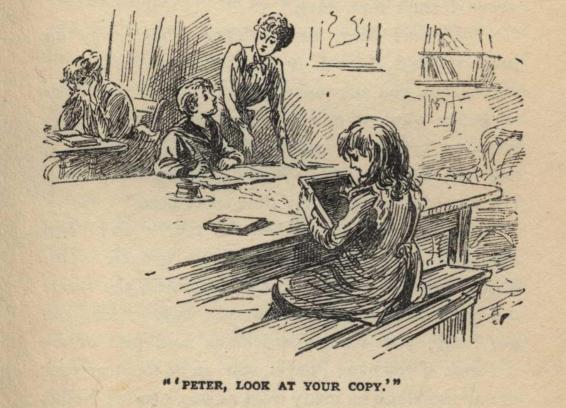
"'PETER, LOOK AT YOUR COPY.'"
Poppet's head was within an inch of her slate. She was working now at a startling pace, and counting on her fingers in a loud whisper. What would Bunty say if he came home, and she was not there to ask how he had got on, and sympathise with the red marks that were sure to be on his hands?
Nellie had translated five lines, and was occupied in a vain search for the dictionary meaning of pourra.
"I believe it's 'pour,' and 'ra' is a misprint that's got tacked on," she said, "or else this beautiful dictionary has left it out, there are ever so many words I can't find, Meg."
"Oh," said Meg, her patience flying away on sudden wings, "what is the use of anything? I won't teach you any more, any of you. Peter wrote far better a month ago than he does now; Poppet's taken an hour to do a row of multiplication by six, and you are looking in the dictionary for pourra. It's simply wasting all my time to sit here."
The problem, "who fished the murex up?" had not improved my eldest heroine's temper. Her cheeks were pink, and her eyes sparkled, she threw out her hands in a little dramatic way. "You can go, Peter, you can go and make mud pies of the universe, if you like; Poppet, you can go too, tear your dress, and climb as many trees as you please; Nellie, you can sit in front of the looking-glass the rest of the day and read every novel in the house,—why should I care? I won't teach any more."
She flung herself down on the old horse-hair sofa, opened her Browning, and turned her face to the wall.
And they all went, not at first, but presently and by degrees.
"The thaid we could," whispered Peter.
"Did she mean it?" Poppet said doubtfully.
"Of courth," said Peter; "I'm going, at any rate. The thaid I wath to; I'm not going to dithobey her," and he slipped out on tip-toe. Poppet worked to the end of the line by seven, then she remembered she had forgotten to "carry" all the way, and she grew afraid that Peter would get to the birds' eggs she was putting in compartments for Bunty.
So she also, after a glance or two at her sister's back hair, slipped off her chair and stole softly away.
And Nellie drew "Not Wisely" to her own end of the table with the aid of a long ruler; then she followed the example of her iniquitous juniors and departed noiselessly.
It was nearly an hour before Meg turned round again. She had lost herself in some wonderful poems now,—"The Flight of the Duchess," "By the Fireside," and some of the shorter love pieces; she began to see possibilities of beauty and enjoyment, and felt glad with a great gladness that she was able to appreciate them even in a slight degree.
Then the silence struck her. Surely if Poppet were doing her sum, her pencil would be squeaking; and surely if Peter were engaged as he should be on his copy, he would be breathing laboriously and giving occasional little impatient grunts to testify to each fresh blot.
She looked round, and saw the deserted room.
"Took me at my word!" she said aloud. "They might have known I didn't mean it, young scamps,—Nellie too."
Then she smiled indulgently. The exquisite tenderness and the strength of the love pieces had softened and braced her at the same time.
"They're very young," she said, as she went out after them, "and—really it's very hot."
This was all in the morning. At night there was another breeze.
Bunty did not eat his pudding. That of itself was phenomenal, for it was brown with sultanas and had citron peel at wide intervals; generally he managed three servings, and, even then, said they might have made it in a bigger basin. But to-night he said "No pudding" in a sullen voice, and kicked the legs of his chair monotonously with his boot heels.
"You might have the common politeness to say thank you, I think," said Nellie, who was officiating at nursery tea in Meg's absence. "What a boor you are getting, John."
"Oh, go and hang yourself," he returned. He pushed his chair back from the table, and went out of the room with lowering brows.
Poppet slipped down from her chair.
"Sit down instantly, Poppet; do you think I'm going to allow you to behave like this?" Nellie cried. "If John has no more manners than a larrikin, you are not to follow his example. Sit down, I tell you, Poppet; do you hear me?"
"Can't you see how white he is?" said the little girl, her lips trembling. "Nellie, I can't stay—no, I don't want pudding." She darted across the room and down the passage after him.
The boys' bedrooms opened on to a long landing with a high staircase window at the end that looked straight out to the river and the great stretch of gum trees on the Crown lands.
Bunty was standing staring out, his hands thrust in his pockets; the setting sun was on the stained window-panes, and his face looked ghastly in the red light.
"Was it very bad?" said the little, tender voice at his elbow.
He turned round, and looked at his young sister for a minute in silence.
"Look here, Poppet," he said, and his voice sounded strange and strangled; "I know I tell lies and do mean things—I can't help it sometimes, I think I was made so; but I haven't done this new thing they say I have—Poppet, I swear I haven't."
"I know you haven't," the loving voice said; "what is it, Bunty?"
He gave her a fleeting, grateful glance. "I can't tell you, old girl—you'll know soon enough,—every one thinks I have; it's no good me saying anything nothing's any good in the world." He leaned his forehead on the cold window-pane and choked something down in his throat. "To-morrow, Poppet, they'll say all sorts of things about me; but don't you believe them, old girl—will you?—whatever they say, Poppet—promise me."
"I pwomise you, Bunty, faithf'lly," the little girl said, an almost solemn light in her eyes. She could never remember Bunty quite like this before. There was a despairing note in his voice, and really the red sunset light made his face look dreadful.
"Give us a kiss, Poppet," he whispered, and put his face down on her little, rough, curly head.
The child burst into tears of excitement and fright—everything seemed so strange and unreal. Bunty had never asked her for a kiss before in his life. She clung to him sobbing, with her small, thin arms around his neck and her cheek against his. Both his arms were round her, he had lifted her up to him right off the ground, and his cheeks were almost as wet as hers.
There was a step, and he set her down again and turned away.
"Where are you going?" she asked half fearfully.
"To bed," he said gruffly. "My head aches. Good-night."
CHAPTER V.
BETWEEN A DREAM AND A DREAM.
"It isn't the thing you do, dear,
It's the thing you leave undone,
Which gives you a bit of heartache
At the setting of the sun—
The loving touch of the hand, dear,
The gentle and winsome tone,
That you had no time nor thought for,
With troubles enough of your own."
Such a troubled night poor little Poppet had. Twice she woke up with a stifled scream, and lay awake afterwards hot and trembling in the dark. The third time she slept, she dreamed Bunty had thrown a stone at the schoolmaster's house, which was all built of glass; she heard the crashing and splintering of it as it came down in a heap, forms, blackboards, boys, and masters, all flying in different directions. Then a great voice that sounded like thunder asked if John Woolcot had done this, and all the world seemed listening for the answer. And Bunty was standing near a great red window, with a frightened look on his face, and he said, "No, I never." Then there was a loud shouting and hissing, and a dozen hands caught hold of the boy and hurried him away.
"What are they going to do with him?" some one asked of a giant who was sitting peeling a cricket-ball as if it were an orange. And the giant, who had Bully Hawkins' face, laughed, and said, "They're putting him in the guillotine; listen to that snap—his head has just fallen off; I'm going to have it for a ball because he wouldn't scout!"
The snap that woke the poor dreaming child was the banging of the bedroom door.
Nell had just come in, gone to the glass, given her hair a few pats and light touches, and hurriedly slipped on her best bronze shoes,—it was nine o'clock, and some late visitors had come—men with gold buttons.
"Oh-h-h!" said the little sobbing figure, sitting up in bed. "Oh-h-h—oh-h—oh, Nellie!"
"Don't be silly, Poppet; go to sleep at once,"—the elder sister gave her a hasty pat. "Lie down, and don't be naughty; you've been eating apples again late, I expect, and it's made you dream,—there, I must go."
The child clung to her.
"Bunty!" she said,—"is he dead? did they take his head?—oh, Bunty!"
"You silly little thing, don't I tell you you've been dreaming!" Nellie laid her down impatiently and tucked the clothes round her. "There, go to sleep; I have to go down, there are visitors. I'll leave the candle if you like."
Poppet put her head under the clothes and sobbed hysterically; the little, narrow bed with its spring mattress was shaking.
"Oh!" said Nellie,—"oh dear, this is tiresome! Poppet, do you want anything? Would you like a drink?—oh, I'm in such a hurry,—what is it, Poppet? What's the use of being silly, now? When a dream's gone, it's gone. Stop crying at once, or I shall be very angry, and go and leave you in the dark!"
The bed shook even more violently.
"M-M-Meg!" was the word that came with a choking sound from under the counterpane,—"oh, M-M-Meg!"
"All right, I'll send her if you'll be good,—not for a minute or two, because she's talking to some gentlemen, but as soon as I can whisper to her. Here, drink this water before I go, and stop sobbing. You're too big a girl to go on like this, Poppet."
Nellie's voice had a stern note in it,—she thought kindness would make her cry more, and there really was not time to argue with her.
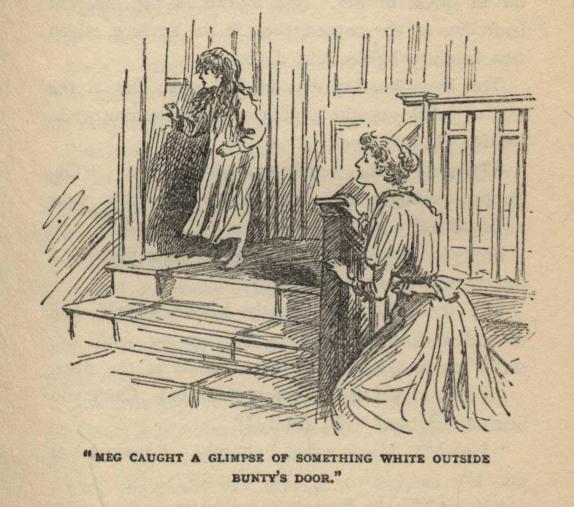
"MEG CAUGHT A GLIMPSE OF SOMETHING WHITE OUTSIDE BUNTY'S DOOR."
Five, six, seven minutes slipped away after she had gone; then Meg came running lightly upstairs and into the room the child shared with Nellie.
"She's too excitable—I'll have to make her go to bed earlier," she thought, as she crossed over to the tossed bed. "Nightmare—poor little mite!"
But there was only a pillow and a tossed heap of clothes—the bed was empty!
"She's gone down for more light and company. How unkind of Nellie!" she said aloud, starting off in quest of her. She looked in the different bedrooms as she passed, then in the nursery, which was brightly lighted but deserted.
The boys' landing was in darkness; but at the end of it she caught a glimpse of something white outside Bunty's door.
"Poppet!" she cried, hurrying down. "Oh, Poppet, nothing on your feet, and only your nightgown!"
She picked her up in her arms, nine years old though she was.
But the child was nearly beside herself, and struggled back to the ground, beating with her small hands against the lower panels of the door.
"Bunty!" she said, "Bunty! Bunty! Can't you hear me, Bunty? Oh, Bunty!"
"John!" Meg called sharply, "answer at once!"
"What?" said Bunty's voice in its gruffest tone. "For goodness' sake leave me alone! What on earth do you want? Don't be an idiot, Poppet."
The very gruffness and crossness of the reply reassured the child—it was so unmistakably Buntyish. Her sobs grew less and less wild—she even permitted Meg to lift her up in her arms again.
"Good-night, Bunty," she said in a small voice with a pitiful hiccough at the end.
"Oh, good-night," he said.
And then Meg carried her off.
Such a tender, gentle, soothing Meg she was, even though some one was waiting impatiently in the drawing-room and the evening was almost over.
She took the child into her own room, and put her into her own bed with the pink rosebud hangings and pale pink mosquito nets that Poppet had always thought the prettiest things in the world.
And she bathed her face with lavender-water, and sprinkled the same refreshing stuff on the white, frilled pillows, and talked to her in a pleasant, matter-of-fact way that dispelled the horrors of the night entirely.
The little girl told her dream. She longed to pour all Bunty's troubles into this dear, big sister's ear! But that of course was forbidden.
One thing she did venture to say, as she lay cuddled up with her face luxuriously against Meg's soft breast.
"Dear Megsie, couldn't you be sweet and dear to Bunty too? Poor Bunty, everybody gets on to him."
"My pet, he won't let people be nice to him," said Meg in a troubled way.
"I don't mean kiss him or anything," the little girl said; "only don't call him 'John'—it's such an ugly name; and don't keep saying 'Don't!'; and don't let Nellie keep telling him he's dirty and clumsy,—please, dearest Megsie!"
Meg kissed her silently.
What a wise little child it was! What a dear little child! And oh, what a poor little child, for it had never in its life known a mother!
Her thoughts leapt back across the years to that dear, fading memory of her mother. She saw the bedroom, with the bright lights that seemed strangely painful in such a place.
"I want to see them all, John, please," the voice from the pillows had said when the Captain moved away to turn the gas down; "it can't hurt me now."
And they had gathered up close to the white pillows that gleamed with the loose, bright hair—all the little, frightened children,—herself, hardly thirteen; Pip in a sailor suit and his eyes red; little dear Judy with wild, bright eyes and trembling lips; Nellie with a headless doll clasped in her arms; Bunty in a holland pinafore stained with jam.
Nobody heeded the tiny baby that lay just in the hollow of mother's arm,—what was a baby, even one almost new to them all, when mother was dying?
But the next day, when all was over, and every one was tired of crying and feeling the world had stopped for them for ever, the strange nurse brought in the little lonely baby and gave it to Meg to nurse, because she was the eldest.
"You'll have to be its mother now, little miss," she said, as she laid it in all its long, many clothes in Meg's frightened arms.
Its mother!
The scene came vividly before Meg's eyes to-night, as she sat with the poor child close in her arms.
She bent her head in an agony of shame and sorrow.
How she had failed! how she had neglected, scolded, grown impatient with, laughed at, her little trust! Loved her, of course; but life was such a confusing, busy, quarrelling, pleasure-seeking kind of thing at Misrule, and she had forgotten so often, and been so taken up with her own affairs, that she had not had time to "be a mother" to her little sister.
"Oh, Poppet!" she said, in a voice full of passionate regret; and Poppet slipped her dear, thin little arms around her neck and clung closer, as if she almost knew what the trouble was.
But presently the child fell asleep, and Meg stayed there, motionless, on the bed edge, looking down at the small, flushed cheeks, where the black lashes lay still heavy and wet.
There was a strange look of Judy about the little face to-night, and altogether it made Meg forget the visitors downstairs, Alan, Nell's impatience, everything but the little dead mother and the knowledge that her place was not well filled. She thought of Bunty, sullen, hard, untruthful, and growing more so every day—Bunty, whose nature no one but Poppet had a key to, and even hers would not always turn.
If the little mother had lived, he would have been very different. Poor lad! perhaps he was unhappy too—he had been even more gloomy and silent than usual these last few days; she would go to him now, and try to get into his confidence by degrees.
She slipped Poppet's little warm hand out of her own and put it softly on the pillow.
"Well, this is too bad of you," said Nellie, putting her head into the door. "You've no regard for appearances, really, Meg. It's an hour since you left the room, and I've been making excuses for you all the time. Why don't you come down? There's only Esther and me to entertain them all, and Alan Courtney's been looking at the photograph album for half an hour, and not spoken a word. You are too bad. Sitting here with Poppet all this time—she's asleep too. Talk about spoiling the children!"
Meg got up, her eyelashes wet, her face very sweet in its new gravity.
"I sha'n't come down again," she said in a low tone. "Tell them Poppet was not well, and I had to stay with her; indeed, I cannot come, Nellie."
Nellie glanced at her impatiently; she did not understand the strange, moved look on her sister's face—it had been unclouded and laughing an hour ago; how could she guess she had been holding hands with the dead all this little while?
Besides, her conscience reproached her about poor little Poppet, and it made her feel irritable.
"I never saw any one like you for moods, Meg," she said crossly. "A minute ago you were laughing and talking to Alan Courtney, and now you're looking like a funeral hearse; and I think it's very rude not to come down and say good-night. They asked me to sing the 'Venetian Boat Song' too, and you know I can't play my own accompaniment."
"Dear Nell, another night," Meg whispered; "and hush, you will disturb Poppet. Go down again yourself now, or Esther will be vexed. Wish them good-night for me; I have to speak to Jo—Bunty."
Nellie's face still looked vexed. She had practised her somewhat difficult song, and was ambitious to sing it since they all pressed her so.
"I can see Alan thinks it strange of you vanishing like that," she said grumblingly. "He told me to be sure to make you come down again."
Then Meg blushed—a beautiful, warm, tender blush that crept right up to the little straying curls on her forehead. They had been talking about books, she and Alan, before she came upstairs; and in a sudden fit of petulance with herself she had said she was "a stupid, ignorant thing, and would not talk to him about books again, because she knew he was laughing at her for knowing so little."
And oh! what was it his eyes had said when they flashed that one quick, eager look into hers? what was it that softly breathed "Meg" had meant?
Nellie had whispered in her ear the next second, "Poppet's crying herself nearly into a fit for you; can you go to her for a minute?"
It seemed almost a week ago now since she had gone. In some indefinable way she seemed to have grown older in that one hour, to have got away from all these things that had engrossed her before.
"Come on; why shouldn't you?" Nell said persuasively, quick to take advantage of that sudden blush.
Just a moment Meg hesitated,—it would be very sweet to go down to the room again and lose this heavy-heartedness in "the delight of happy laughter, the delight of low replies."
But poor, misunderstood Bunty whom they all "got on to"—her neglected duty! Had she any right to be enjoying herself just now, any right to chase away these new feelings?
She turned away with a sudden lifting of head.
"No, I am not coming; say good-night for me."
"Stay away then," said Nellie in exasperation. So Meg went down the landing once more to the boys' end.
"Bunty," she said, knocking softly, "I want to come in; may I?"
There was an impatient grunt inside.
"What on earth do you want? Can't you give a fellow a bit of peace? What are you after now? Yes, I've put my dirty socks in the linen basket."
"It isn't that, Bunty; I only want to talk to you for a little." Meg's voice was very even and patient.
But "Blow being talked to!" was Bunty's grateful and polite reply. He was weary of sisterly "talkings."
"I'm not going to lecture you or anything like that, Bunty. I wish you'd open the door. What have you fastened yourself in for?" Meg beat a little tattoo on the wood and rattled the handle.
"What a nuisance you are, Meg; why on earth can't you go away and let a fellow be quiet? I'm not going to open the door, so there." His voice sounded from the bed across the room; he had not even attempted to come near the door.
"Oh, very well," said Meg, seeing it was useless, to-night, at least, with that barrier of pine between them.
"Good-night, old fellow. I don't see why you should be so grumpy with me."
"I'll talk to him to-morrow," she said, as she went downstairs with a free heart to the drawing-room again.
But, alas! to-morrow, and to-morrow, and to-morrow!
CHAPTER VI
TO-MORROW.
"What's done we partly may compute,
But know not what's resisted."
They did not find it out till nearly nine o'clock.
Bunty was frequently late for his breakfast, so no one remarked upon his absence this particular morning. Only Meg kept his coffee hot, and sent his chop back to the kitchen to be put in the oven—an unusual piece of consideration, for she used to say he deserved everything to be cold and greasy if he got up so late.
But Nellie, who was cutting the sandwiches as usual for his school lunch, cried out for him. "I can't find John's lunch serviette anywhere," she said, putting in a generous supply of fat beef. "I ask him every day to leave it out of his bag. What a tiresome boy he is! I won't give him another one this morning; he had one yesterday."
"Poppet, go and tell John he'll be late for school," Meg said. "Tell him it's a quarter to nine—he won't have time to eat his breakfast." Poppet departed, her own bright merry self again; the events of last night had vanished from her with her dreams.
But she came back with a half-startled face. "He's not there, Meg; his hat's gone too, and his school-bag. I 'spect he got something in the pantry and went early; perhaps there is something on at school; and—and—I think he must have made his bed himself, because—it—it's made."
She looked half pitifully, half eagerly at Meg, as if asking for a denial of her horrible suspicions. "Come and look," she said.
Meg got up and followed her; Nellie laid down the breadknife and went too,—it was beyond credence that Bunty should be up early and make his own bed. Peter and Essie brought up the rear, of course.
"It—it's very strange," Meg said, her face quite pale as she looked round the room. The bed had evidently not been slept in, for no boy could have made it look as neat as it did; it was just as Martha had left it yesterday morning. There was a suit missing—not his best one, but the one he wore alternate weeks at school—a couple of shirts too, and some socks and collars. Nellie darted to his little red post-office money-box; it had been prised open—he had lost the key long since—and was empty.
"He had two and fourpenth ha'penny in it," said Peter, "cauth I athked him one day."
"He's run away," said Nellie. "Oh, the bad, wicked boy!"
"Hush," said Meg. She feared for the effect the blow would have on Poppet, and caught the child's hand and drew her to her side.
"Run away!" repeated Poppet.
Every vestige of colour had dropped out of her face; it wore a strained, unchildlike look, and her eyes were heavy.
Meg drew her closer still and stroked her hair.
"Perhaps it's a mistake, dear. Oh, he's only gone to school, or camping, or something, and didn't tell us; there's no need to trouble," she said. But she felt terribly uneasy.
Poppet did not look up. She was thinking of the red-stained window and the kiss last night—thinking of the school troubles, and the boy's strange behaviour, and hints at worse.
There was a loud, angry voice calling from the nursery, and every one trooped back in amaze. What was the Captain doing in their own special room at breakfast-time?
Esther was there, too, with horrified eyes, and Pip with a look of fierce disgust on his face.
How red their father's face was! how his moustache bristled! Peter shrank close up behind Meg, and wondered if it was about yesterday's lessons.
"Father," Meg said, white to the lips, "what is the matter? Esther, can't you speak? Oh, Pip, what is it?"
"Matter!" shouted her father; "I'm disgraced—we're all disgraced. Where is he? Heavens! I'll cut the skin off his back! Peter, get my horsewhip; he's no son of mine! I'll turn him off—I'll have him locked up. Where is he? where is the young thief? Only let me get hold of him. Bring him here at once, Pip. Where's that horsewhip, Peter?"
"He's run away, we think," Nellie said in a trembling voice; and there was a great silence for two minutes, broken only by a very deep breath from Poppet. Then Meg's voice was heard.
"What has he done?" she said, "because—because—oh, indeed, I believe we have all been misunderstanding the poor boy."
"Misunderstanding!" echoed her father, with almost a snort of anger. "Read that, miss, and don't talk nonsense!"
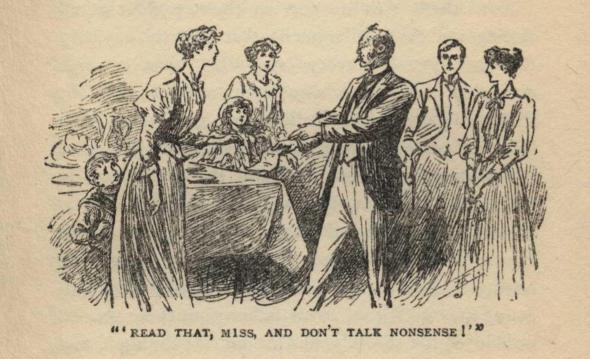
"'READ THAT, MISS, AND DON'T TALK NONSENSE!'"
He passed her a letter that had just been brought him, and Meg read it and grew pale; Nellie read it and crimsoned; Poppet picked it up in her little shaking hands and looked piteously from one to the other,—that black, thick writing—oh, what was it all about?
Meg told her afterwards, for it was no use trying to put the child off, and indeed it seemed she knew more than they did.
The letter was from the head master. It stated everything that Bunty had confessed to Poppet about the broken window and glass cases, about the lie he had told when taxed with it. But then the terrible part came. On the desk five sovereigns were lying in a little heap when the master was called out of the room; it was one of the boys' fees, and the master was in the act of entering the amount in the book when he was sent for. He was detained a quarter of an hour, and when he returned the window and the glass cases were broken, and the money had gone!
Now there was no one on the top floor at all during the time, it seemed—that was the mystery that had puzzled every one. But then it came out that Hawkins, who was waiting in Mr. Burnham's own room for his caning, had seen John Woolcot come creeping down the stairs just after the crash, with a white face and the cricket-ball in his hand. Woolcot, too, when he found his lie of no avail, had confessed to the smashing, but denied having taken the money. The head master regretted having to perform such a painful duty as communicating the intelligence to his father; but there seemed no doubt that the boy had committed the theft, and under the circumstances perhaps it would be wiser if he were removed from the school.
No wonder the Captain raved and stormed! no wonder Esther and the elder girls looked pale and horrified, and Pip disgusted beyond words! He was guilty—there was no doubt of it in their minds. The fact of his running away was sufficient proof of it; and they all remembered his strange behaviour yesterday. It was in vain poor little Poppet protested again and again and again that "he didn't do it—oh, indeed he didn't do it. Yes, he had broken the glass; and yes, he had told a lie; but oh, indeed he had not stolen."
"How do you know, miss?" her father said sharply; "what proof have you that he didn't?"
"He told me he didn't," said the poor little mite. "Oh, he said he didn't,—oh, why won't you believe it? Meg, I tell you he said he didn't."
But even Meg could not believe, so lightly was Bunty's word held amongst them.
For the first day the Captain was too angry even to attempt to find traces of his son. He declared he would never own him again, never have him inside his doors.
But afterwards, of course, he saw this was impossible, and he put the matter in the hands of the police, gave them a full description of the lad's personal appearance, and offered a reward for finding him.
To the head master of the school he sent a curt note stating the boy had run away, so he could make no inquiries, and enclosing a cheque for five pounds to make up for what was lost. Of course the cheque was a tacit acknowledgment of his guilt.
A week slipped away without any clue being found. Then a detective brought news.
A boy answering to the written description had gone on board a vessel to San Francisco as cabin boy the very day in question. There seemed no doubt as to his identity. The Captain said it was the best thing that could have happened. It was a rough ship, and the boy would have exceedingly hard work and discipline—it might be the making of him. He sent a cable to reach the captain in America, when the boat arrived, to ask him to see the lad was brought safely back in the same capacity.
And then everything at Misrule resumed its ordinary course. Bunty was safe, though they could not hear of him or see him for four or five months; it was no use being unsettled any longer.
But Poppet made a small discovery one day. She found her little money-box empty under her own bed, with a bit of dirty paper stuck in the slit. "I'll pay you back," it said in Bunty's straggling hand; "you said you'd lend me the thirteen shillings. I have to go, Poppet; it's no good stopping here—no one believes you. Don't forget what you promised. You can have my tortoise for your own. It's in the old bucket under the house. Don't forget to feed it; it likes bits of meat as well as bread. I'd like to say good-bye, but you always cry and make a fuss, and I have to go. You're the only one worth anything anywhere. Oh, and don't forget to change its water often,—well water has more insects in than tap."
"Don't forget what you promised," repeated Nell, as she read the almost undecipherable epistle in her turn. "What did you promise, Poppet?"
"That I would believe him," the little girl said, with a sweet, steadfast look in her eyes.
CHAPTER VII.
A LITTLE MAID-ERRANT.
"There's nothing on earth half so holy
As the innocent heart of a child."
It was in the midst of morning lessons soon after at the Beltham Grammar School that an odd thing happened.
It was very hot; not a breath of wind came in at the open doors and windows—nothing but the blazing sunlight that lay in hot patches on the floor, and slowly baked blackboards and slates and desks. It was a very long room, this "Great Hall," as they called it; half-a-dozen classes were at work in it, with as many masters; and at the end, on a little, raised platform, sat Mr. Burnham in front of his desk. He was looking through the Euclid exercises of the fourth form, and his brow kept criss-crossing with lines of annoyance at any noise,—the hot, slumbrous air was quite enough to bear, without the occasional down-crashing of a pile of slates or the upsetting of a form.
Then came the loud note of the locust—the whir-r-r, and pen-inimitable sound of its wings, inside the room, not out. Who had dared to bring one of the prohibited creatures into school, after the endless penalties that had been imposed for the offence? Mr. Burnham scored a red line through one of the exercises and stood up in his place, a heavy frown on his face.
And at the same moment a very small shadow fell just inside the entrance door at the far end of the room, and a very small knock sounded there. Nobody said "Come in," though a hundred and fifty pairs of eyes went in the direction with the swiftness natural to gratitude for any break in the monotony of morning school. Then there stepped over the threshold a little, slight girl,—a little girl with a very short, holland frock, a great sun-hat, and no gloves; a little girl with a white, small face, great frightened eyes shining strangely, and soft lips very tightly closed. Up the long, long room she went, both little hands held tightly together in front of her. No one could tell from the way she walked how her poor little knees were shaking and her poor little heart was beating.
For a minute Mr. Burnham's frown did not disappear—not till he noticed how white her face was; he told himself he had never seen a child's face so white in all his life.
"What is it, little girl?" he said, and really thought he made his voice quite gentle and encouraging, though to Poppet it sounded terrible.
"I——" she said—"you——" Something rose in her throat that would not be strangled away, her face grew even whiter, and her lips, white too, twitched a little, but the words would not come.
He took her hand, the little trembling, shut, brown hand, and held it between his own.
"There is nothing to be afraid of, my child; tell me what it is you want"; he drew her closer to the desk, and sat down. He seemed less formidable in that position than towering above her—his eyes looked strangely kind; could it really be the terrible Mr. Burnham she had heard so much about? The hand he held fluttered a minute, then her lips moved again:
"Bunty didn't do it," she said in a whisper.
"Eh? what?" he said, mystified.
"He didn't do it—Bunty didn't do it—oh, indeed."
"But who is Bunty? and who are you, my little maid?" Mr. Burnham said, with a smile that lit up his thoughtful eyes.
"He's my brother," she said in a voice that had gained a little strength.
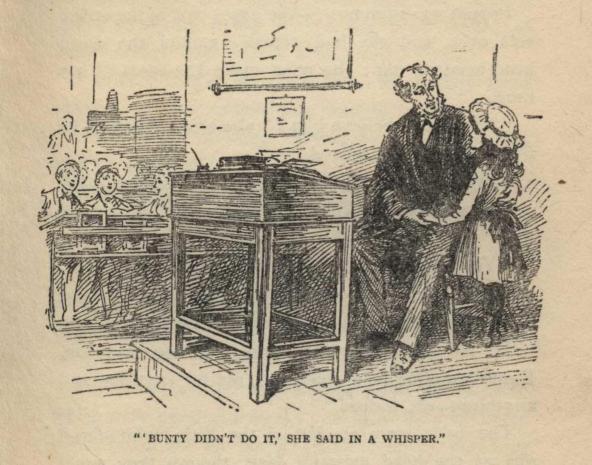
"'BUNTY DIDN'T DO IT,' SHE SAID IN A WHISPER."
Then it struck her Bunty was not so called at school.
"His name's John Woolcot," she added, with downcast eyes; "I'm Poppet."
Then Mr. Burnham remembered everything, and his eyes grew stern as he thought of the boy there had been so much trouble with; but they softened as they fell again on the little, white, eager face.
"And his little sister is taking up his cudgels; thankless work, I'm afraid—eh?" he said quizzically.
Poppet was calm now,—the worst part of the ordeal was over, and she had actually gained the dread head master's ear; she must make the most of her time.
"Won't you believe him?" she said; "indeed he didn't do it—oh, indeed."
"What?" he asked,—"break the window—tell a lie—anything? Why, my little child, he owned to it."
"Yes," said Poppet, "he bwoke the glass, I know; and yes, he did tell one story." Her face fell after the last sentence, and a little red crept into her cheek. "But he didn't take the money—oh no, no!—oh, Bunty wouldn't be a thief—oh, not for anything and anything—oh, indeed."
The boys were staring at the little, white-faced girl at the head master's desk, though they could not hear what was being said.
"Would you like to come and talk to me privately?" Mr. Burnham said.
And "Oh-h-h!" was Poppet's only answer; but the gratitude in her eyes was so intense, he guessed a little what the ordeal had been to her.
Away down the long room she went again, only this time her hand was being held in a firm, kindly grasp.
"Oh!" she said again, when near the door a great, slouching fellow with a big head moved to help another boy with a blackboard.
"What?" said Mr. Burnham, when they were outside; he had noticed her intense interest.
"Was that Bull-dog Hawkins—the fellow that told?" she said.
He smiled somewhat; Hawkins was not a favourite of his, and the fitting name sounded odd on the little girl's lips.
"His name is Hawkins," he said; "and yes, he gave the information; but that has nothing to do with it, my child. Now, tell me what it is you have to say."
He had taken her into a little room the walls of which were lined with books; he drew up a chair for himself, and one for her, but she preferred standing against his knee.
Almost she convinced him, so great was the belief in her shining eyes, so utterly unshaken her trust. She told him everything, and he listened patiently and attentively even to the smallest detail, asking a question here and there, but for the most part letting her tell her story in her own way.
When she told of the kiss by the staircase window, she broke down a little; but he slipped his arm round her waist, and she shed her tears on his coat sleeve,—how Bunty would have stared! She showed the dirty scrap of paper, and he read it thoughtfully.
"If only he had never told a lie before," he said, "then perhaps——"
Oh, if only she could have flung back her head and said, "He has never told a lie in his life, sir; never—never!"
Shame at not being able to do so made the dear, curly head droop a little, and two more tears forced their way from under her eyelids and fell sadly down her cheek.
"I'm sure he never will again!" she said, with sorrowful hopefulness. "But, oh, sir, he couldn't be a thief! Oh, how could he?"
"Well, I don't see how he could be altogether bad with such a little sister," he said slowly. "What sort of a boy is he at home? Is he good to you?"
"Oh yes," said Poppet,—"oh yes, indeed!"
And it is a fact that not a single act that disproved this came to the little girl's mind. She remembered nothing but the times he had been good to her.
"Twice I was sent to bed without tea, and he bwought me all his pudding in some newspaper," she said eagerly; "and when I had difeeria, and they wouldn't let him in, he used to climb up the creeper when no one was in the room and smile at me through the window. An' another time I was ill he sat on the mat outside the door all night; Meg found him in the morning asleep with his head on the oilcloth. An' when it was my birthday—I was nine—and he had no money, so he sold his guinea-pigs to one of the fellows—and he liked them better than anything he'd got—and he went and bought me a doll's pwambulator, 'cause Peter smashed mine with filling it with stones. Oh, and lots and lots and lots of things! He was vewy good to me—oh, indeed!"
Such a flushed, little, eager face it was now—such a fluent little tongue that told of Bunty's goodness! The child's beautiful trust, affection, and courage had quite touched the head master's heart.
He took a bunch of keys from his pocket.
"You are a dear, brave, little girl, Poppet," he said. "By the way, haven't you a prettier name than that?"
"Oh, it's Winifred, of course, really," said Poppet.
"Something in a name," he said, half to himself. Then aloud:
"Well, Winifred, then, just because you have believed in your brother and done this for him, I am going to reward you in the way I know will gladden you most."
He unlocked a tin box on the table, and counted out five sovereigns, while the surprise in Poppet's eyes deepened every minute.
"Have you a purse?" he asked.
"No," she said in a very low tone. It made her feel fit to cry to think he should give her money, even such a large, beautiful amount, for doing this.
"Because I want you to give this to Captain Woolcot," he continued, "and tell him I have had reason to doubt whether John was guilty, and until I am perfectly sure it is not fair to the lad to take it."
How Poppet's eyes shone, albeit the tears were not dry! how her lips smiled and quivered! and how the glad, warm colour rushed all over her little, sweet face! Not a word of thanks she said, and he would not have had it; only she clung very tightly to his arm for a minute, and hid her face. When he saw it, he felt he had had more than thanks.
And that was not all he did. He took her back with him to the schoolroom, and walked up to the raised platform, and held her hand all the time.
"Boys," he said, in his clear, far-carrying voice, "I have reason to believe that John Woolcot is not guilty of the theft that you have all heard of. I wish you all to give him the benefit of the doubt, since he is not here to clear himself. For my part, I believe him innocent."
How the boys cheered! It was not that Bunty was a special favourite, though he had his own friends; but they felt it was expected of them, and it was another break in the monotony to be able to do so. Besides, they felt a vague pity and admiration for the little girl standing there, with such a smiling, tear-wet face.
After that Mr. Burnham took her all the way home to Misrule himself. Meg and Nellie went into the drawing-room to see him, and Poppet slipped away. He told them what the child had done, praised her high courage and simple faith. "If," he said, as he took his leave an hour later,—"if all my boys had such sisters as little Poppet is, my school would be a better place, and later, the world."
CHAPTER VIII.
ONE PARTICULAR EVENING.
"O world, as God has made it! All is beauty,
And knowing this is love, and love is duty."
It was Peter who first noticed Meg's face one particular evening. He and Poppet were doing, or making a pretence of doing, preparation for the next day, and Nellie was reading a novel in the only armchair the nursery held.
Meg came in at nine o'clock—nearly an hour past the usual time to send the little ones to bed. "Thust look at Meg'th fathe!" Peter said, and rounded his eyes at her. Of course every one looked instantly.
It was like a blush rose. A delicate, exquisite flush had crept over it, her eyes were soft and dewy, her lips unsteady.
"Peter dear, come to bed; now, Poppet," she said; and even in her voice there was a new note.
Nellie laid down her book and looked at her sister in surprise. She had only just discovered she was beautiful. Hitherto it had seemed to be tacitly allowed that she herself had monopolised the good looks of the family; so to discover this sudden beauty in Meg rather amazed her.
She looked to see if it had anything to do with her dress; no, she had worn it scores of times before. It was a muslin, pale blue, rather old-fashioned in make, for the body fitted plainly with the exception of a slight gathering at the neck. The skirt was very long, and ended in a crossway frill at the hem,—how graceful it made her look! In her waistband she had stuck some cornflowers vividly blue.
And her hair! Nellie devoted a surprisingly long time daily to the erection of an elaborate coiffeur on her own beautiful head; but surely Meg's had a grace of its own, from its very simplicity. It was drawn back loosely that it might wave and curl as it pleased, and then was twisted into a shining knot halfway down her head.
And that exquisite pink in her cheeks!
"Oh, Meg!" Nellie said, half guessing, half shy.
"Dear Peter—oh, Poppet, do come!" Meg entreated. The pink had deepened, her eyes had grown distressful. Both children rose and followed her without a word; they had the native delicacy that every unspoiled child possesses.
But Nellie had lost interest in her book,—what was a fictitious tale of love, when she might hear of one in real life within these very walls?
She went downstairs and into the drawing-room. "Who's in the study, Esther? I can hear voices," she said sharply.
Esther was reading, lying on the sofa, her dark, beautiful head against the yellow, frilled cushions. She turned a leaf before she replied.
"Oh, only father and Alan Courtney," she said, with a studiously matter-of-fact air.
"I thought so!" Nell exclaimed, with a deep breath; then she sat down at the foot of the sofa and looked at Esther.
"Well?" Esther said, feeling the gaze before she reached the end of the next page; then she smiled.
"Is he really asking father?" Nell asked breathlessly.
"I'm not at the keyhole," Esther replied.
"And I wish I was," Nell said with fervour.
Then they looked at each other again, and again Esther smiled. "How pretty she looked to-night!" she said meditatively.
"Very, very," Nell answered eagerly; "why, I couldn't help staring at her."
"I'm very fond of Alan myself; he's a thoroughly good fellow. I think they are excellently suited," the young stepmother said.
Nellie was silent a minute. "I wish he looked older," she said; "thirty is the proper age for a man, I think. And I'd rather he had a long, fair moustache; his eyes are not bad; but I wish he wouldn't rumple his hair up straight when he gets excited."
Esther smiled indulgently at Nellie's idea of a hero.
"As long as he makes her happy," she said, "I'll forgive him for being clean-shaved. Why are you looking at me like that, Nell?"
"I was thinking how very pretty you are yet, Esther," was the girl's answer, spoken thoughtfully. Esther's beauty did strike her on occasion, and to-night, with the dark, bright face and rich, crinkly hair in relief against the cushions, it was especially noticeable.
"Yet," repeated Esther, "I'm not very old, Nell, am I? Twenty-five is not very old." Her eyes looked wistfully at the very young lovely face of her second step-daughter.
"Oh no, dear—oh no, Esther," said Nell, quick to notice the wistfulness; "why, of course it is very young; only—oh, Essie!"
"What?" said Esther in surprise.
"How could you marry father?" She crept up closer, and put her shining head down beside the dark one. "Of course I don't want to hurt your feelings, but really he is so very middle-aged and ordinary; were you really in love, Essie?"
But Esther was spared the embarrassing answer by the entrance of the Captain and Alan.
You all saw Alan last five years ago, when he used to go on the river boat every morning to his lectures at the university. His face is even more earnest and grave than before; life is a serious business to this young doctor, and the only relaxations he allows himself are football and Meg.
His eyes are grey, deeply set; his patients and Meg think them beautiful. His dark hair has a wave in it, and is on end, for of course he has been somewhat excited.
The Captain does not look unamiable.
Alan has only just begun to practise, certainly; but then he has three hundred a year of his own, and his prospects are spoken of as brilliant. Still, he has the air of having grudgingly conferred a favour, and he goes out to smoke his cigar and think it over.