Front matter (continued 2)
Reading edition
"All well?" ask Esther's arched eyebrows. And "All is well" Alan answers with a grave, pleasant smile.
"Dear boy, I am so glad," she says. There is a moisture in her dark eyes as she gives him her hand, for Meg is very dear to her.
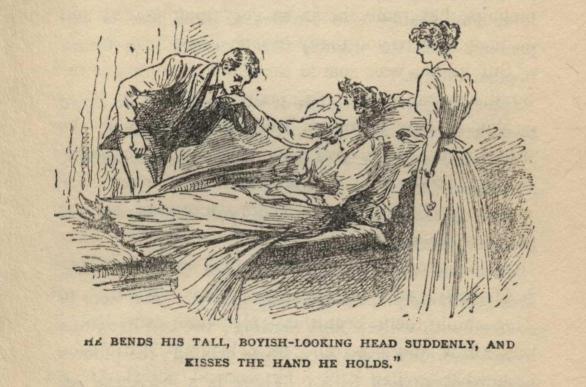
"HE BENDS HIS TALL, BOYISH-LOOKING HEAD SUDDENLY, AND KISSES THE HAND HE HOLDS."
He looks at her in silence for a minute; then he bends his tall, boyish-looking head suddenly, and kisses the hand he holds.
"I am glad too," Nellie whispers, with something like a sob in her throat; she too holds out her hand.
"Dear little Nell!" he says; and such a happy light is in the eyes that look down at her that she quite forgives his lack of good looks. "Dear little Nell!"
He does not kiss her hand—it is too little and childish, he considers; but he stoops and takes a first brotherly kiss from the soft cheek nearest to him, and though she blushes a little, she is impressed with the dignity that attaches to a future brother-in-law.
Then he goes. Meg has refused to be visible again to-night to him, and Nellie flies up the staircase.
"Dear Meg," she pleads at the door—it is locked, and doesn't open for a minute.
But the tone turns the key, and the sisters are in each other's arms.
Just the room you might expect Meg to have. It is fresh, simple, and daintily pretty. The floor is covered with white China matting; the bed hangings have loose pink roses on a white ground; the pillows have hem-stitched frills. There is a bookcase on one wall, in which the poets preponderate; the dressing-table is strewn with the pretty odds and ends girls delight in; there is a writing-table that looks as if it is used often; and in the window stands a deep wicker chair with rose-pink cushions double frilled.
On the walls there are some water-colours of Meg's own, pretty in colouring, but shaky as to perspective. Two lines she has illuminated herself,—
"Lord, help us this and every day
To live more nearly as we pray."
The gold letters are a little uneven, perhaps; but she wears them in her heart besides, so it does not matter. There is an engraving in an oak and gold frame—"Songs of Love"; Meg loves the exquisite face of the singer, and the back of the sweet little child. There is a long photo-frame with a balcony rail: here is Essie all dimpled with her sauciest smile; Poppet and Peter's heads close together like two little bright-eyed birds; Nell, a little self-conscious with the camera so close; Esther looking absurdly girlish; Pip in his cap and gown when they were delightfully new. Bunty always refused to put on an engaging smile and submit himself to the photographer, so he is not represented.
And over the mantelpiece, in an ivory frame, is an old, fading likeness of a little thin girl with a bright face and mischievous eyes, and rough, curly hair—Judy at ten.
It had taken all the time you have been looking at the room for the girls to kiss each other and say little half-laughing, half-crying words. Then Nellie forced Meg into the wicker chair, and knelt down herself, with her arms round her sister's waist.
"You darling," she said. "Oh, Meg, how glad I am! Dear, dear Meg, I do hope you'll be happy—impossibly happy."
It was the first connected sentence either of them had spoken.
"I couldn't be happier," was Meg's whisper.
"But always, always, dear—even when your hair is white, and there are wrinkles here and here and here." She touched the smooth cheeks and brow with tender fingers.
There was a little silence fraught with love, the two bright heads leaning together; then Meg spoke, shyly, hesitatingly:
"Alan—Nell dear—you do—like him?"
"Oh, he's well enough—oh yes, I'm very fond of Alan," said Nell. "Of course I don't consider him half good enough, though, for you."
"Oh, Nellie!" Meg looked quite distressed. "Why, it is the other way, of course. He is so clever—oh! you don't know how clever; and I am such a stupid thing."
"Very stupid," assented Nellie; but her smile differed.
"And he is always thinking of plans to do good to the lower classes. Nell, you cannot think how miserable some of them are; though they don't half realise it, they get so dulled and weary. Oh, Nellie dear, I do think he is the very best man in the world." The young, sweet face was half hidden behind the deep cushion frill.
"Well, you are the very best woman," Nell said very tenderly, and meant it indeed.
Pretty giddy little butterfly, that she was just now, she often paused in her flights to wish she could grow just as sweet and good and true and unselfish as Meg without any trouble.
"The very best woman," she repeated; but Meg's soft hand closed her lips and stayed there.
"If you knew how I'm always failing," she said, with a deep sigh.
"But the trying is everything," Nell said.
Then there were more tender words and wishes, and Nellie went to bed, stealing on tip-toe down the passage, for time had flown on noiseless wings and the household was asleep. And Meg took down the ivory frame, and put her lips to the laughing child-face.
"Oh, Judy," she said, "I wish you knew. Dear little Judy, I wonder if you know?"
CHAPTER IX.
THAT MISCHIEVOUS CUPID.
"For boys say, Love me or I die."
University examinations are not things to be postponed with polite little notes like inconvenient balls or picnics. And, given the early days of December, and a young man who steadfastly refused to acknowledge this fact, what use was it even to trouble to scan the lists?
Of course Philip was plucked.
In October he had brought down his father's wrath upon him by failing to get through in a class examination; and any one who had had experience of the Captain's would have thought that would have been quite enough to make him take a good place at the end of his second year.
But, as I said, his name was conspicuous by its absence.
"Oh, Philip!" Nell said, an accent of reproach on the first syllable; "and even that stupid Burton boy is through."
"Oh, Pip!" said Meg. "What will father say?"
It was the day the lists were out at the university, and Philip had just communicated the agreeable intelligence to his sisters in the midst of his third pipe after dinner.
And the strange part was, he did not seem to care twopence—the orthodox measure of indifference.
He lolled back on the lounge, and made fantastic figures with the smoke from his pipe; he did not even seem to hear what the girls were saying.
And when he came out of his father's study, after a mauvais quart d'heure of unusual elasticity, there was not a trace of repentance on his face, nothing but obstinacy in his eyes, and lips all pursed up for a careless whistle when the distance from the room should be respectable enough.
But later on in the evening Meg caught a glimpse of his face when he thought he was quite unobserved, and its restless, unhappy look gave her a curious feeling of surprise and anxiety.
She remembered all at once that she had quite forgotten of late to take an interest in this eldest brother of hers.
The "time o' day" that it was just now in her life made it excusable, perhaps. She had a latchkey to a little heaven of her own, where she might retreat whenever earth grew troublous or commonplace; sometimes she stayed there too long and grew forgetful. And though she had taken Poppet as her special charge, and formed endless resolutions as to her future treatment of poor, prodigal Bunty, she had let Pip slip away.
He was from home so much was the excuse she made to herself now—at lectures most of the day, and no one knew where in the evening; how could she be all she should to him? She had kept a sisterly eye on his clothes, darned all manner of sweet little dreams into the heels and toes of his socks, and even embroidered him a 'varsity cap so that he should not be jealous of the one she had worked for Alan.
But there she had stopped, and it struck her suddenly to-night that this big, tall fellow with the manly shoulders and boyish, unhappy face was almost as a stranger to her.
Where had all his fun, his schoolboy teasings, his high spirits and absurdities, gone to? Surely it was only yesterday he used to pull their hair and slaughter their dolls and come for three servings of pudding!
She gazed at him with great earnestness as he sat motionless at the table, looking, not at the book before him, but straight opposite at the wall where Poppet had spilt the ink; and it came to her with a strange pang of pain that Pip, dear old madcap, merry Pip, was a man.
All the young light had gone from his eyes; they were graver, sterner than the boy's eyes, and yet full of a troubled unrest. Then his mouth was firmer, and it was not only the soft, dark line of an incipient moustache that made it seem so; the careless laughter lines around it no longer showed, his very lips seemed to have grown straighter.
But even as Meg watched, all her heart in her eyes, those same lips unclosed, and a half tremulous curve of pain appeared at each corner and made them look very boyish again. He put up his hand and pushed his crisp hair away from his forehead with a weary gesture. She could look no longer.
She went up to the table and slipped an arm round his shoulder.
"Dear old fellow," she said; "oh, I am so sorry about the exam."
"The exam.!" he repeated. "Oh, you needn't bother, old girl; I don't care. What's an exam. fifty years hence?"
His lips were under his own control again.
The girl's arm went from his shoulder to his neck. "Dear Pip, I wish you'd tell me things sometimes; don't shunt me altogether because I'm only your sister. Pip, couldn't you tell me? I know you're in trouble; couldn't I help a bit? Dear old fellow, there's nothing I wouldn't do." Such an earnest, loving voice it was.
But he freed his neck, and put her away almost roughly.
"Help me!" he said bitterly; "you're the last in the world who would. Yes, I'm in trouble, perhaps; but it's a trouble you girls and Esther would do your best to increase."
Meg's eyes filled, but she would not be repulsed. "Try me," she said. "Is it gambling, Pip? Are you in need of money? Is it debts? Have you done anything you daren't tell father?" She put her arm round his shoulder again; but he stood up hastily and pushed her aside.
"It's nothing you can help, Meg. No, it's none of those things. As to telling you, I'd sooner cut my tongue out! There, I didn't mean to hurt you," for Meg's lips had trembled; "but oh, it would be impossible for you to understand. Why, you'd be the first to be against me." He went over to the door, and picked up his straw hat from the side-table on the way.
Meg followed him. "Sha'n't you ever tell me?" she said. "Not to-night, perhaps, as you don't want to, but another time Pip; indeed, you shouldn't be disappointed in me. Just promise you'll tell me another time."
"You'll know before the month's out," he said, and laughed half wildly as he closed the door behind him.
As a matter of fact, a trivial accident happened, and she knew before the next day was out.
They were having afternoon tea down near the river, and it being Sunday afternoon and pleasantly cool, the Captain had strolled down with Esther, and was seated on the grass leisurely examining some letters that had come by the Saturday afternoon's post and been laid aside. There was a bill amongst them that he had had no part in making, a tailor's bill, with what seemed to him superfluous blazers, flannels, and such things, down. On ordinary occasions he would only have grumbled moderately and as a matter of duty, for Pip was not particularly extravagant. But to-day, with his son's recent failure fresh in his mind, he felt he could be explosive with perfect justice. So he despatched Peter up to the house to request Pip's immediate presence. Pip was on the point of going out, and came with a half-aggrieved, half-aggressive look on his face.
But before there was time for even the preliminaries of warfare, Essie created a diversion by tumbling out of the moored boat in which she and Poppet were sitting into the deep, clear water of the river.
Pip's coat was off before any one had even time to scream, he flung it into Meg's lap right over the teacups, and was swimming out to the little dark bobbing head in less time than it takes to write it.
Nellie and Poppet had screamed, a strange, strangled cry had broken from Esther's lips, and the Captain had put his arm round her and said, "Don't be foolish, she's quite safe," in a sharp voice; but his face was white under its bronze,—this little saucy-faced baby daughter of his had crept closer to his heart than any of his other children.
Of course she was quite safe. Here was Pip scrambling up the bank again, and holding her up in his arms, a little dripping figure in a white frock and pinafore, one foot quite bare, the other with only the sock on.
Such gurgling little sobs of fright and relief she gave, such leaps and shudders of joy and terror, as they carried her up to the house wrapped in her father's coat.
But now she was safe and unhurt Meg did not follow the rest of the family into the bedroom with her. Instead she went into her own, and sank down on the ottoman at the bed foot, white to the lips and trembling like an old, old woman,—not on Essie's account, the danger had been so short-lived, but in that breathless moment something terrible had come to her knowledge.
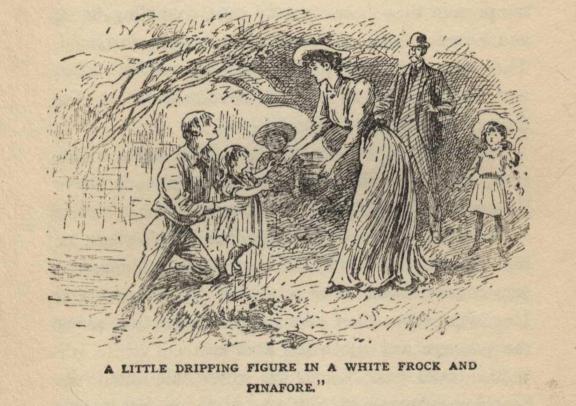
"A LITTLE DRIPPING FIGURE IN A WHITE FROCK AND PINAFORE."
I told you Pip had thrown his coat to her over the tea-things; it had fallen on her lap with a jerk, and the contents of one pocket had been precipitated on to the tray.
A tobacco pouch, a fountain pen, and a pipe she had replaced hastily. A letter had fallen face upwards—even in the confusion she had seen it was addressed to "Miss Mabelle Jones," in her brother's bold writing.
But the thing that had taken all the colour and life from her face, she had not put back in the pocket at all, when Pip had taken the coat. She held it at the present time in her tightly shut, trembling hand, and every minute the horror in her eyes deepened. Then she said, "Pip!" in a low, wailing voice, and opened her hand and looked again at the thing.
The tissue paper was still there, and on its whiteness, shining bravely up into the wild eyes above it, lay a little gold wedding-ring.
There was a step outside her door—Pip's step; he had been to his room to change to dry things, and was coming back. For a minute he stopped, and Meg went paler than ever; then he went on, along the passage and down the staircase.
She could hear him in the lower hall,—could he be going out again? She started to her feet as the door banged, and went hastily over to the window. No; he had his old tennis cap on, and was going very slowly across the grass towards the river, his eyes searching the ground. He had evidently missed it already, and surmised it had fallen from the pocket, either as he carried his coat to the house or when he flung it to Meg. She gave him just time to get down to the water, and then, with the small, terrible thing tightly held in her hand, she went almost blindly down the stairs and over the grass after him.
He was kneeling down just beside the tea-things, groping about in the long grass.
"Have you lost anything?" Meg asked, in a voice that seemed to have no connection with herself, so faint and far away it sounded.
"Er—only the stem of my pipe," Pip said, a dull flush on his forehead.
He overturned a cup, spilt the milk into the biscuit barrel, and said something under his breath.
"Is this what you have lost, Pip?"
Meg's voice came in almost a whisper, with a note of great yearning in it,—oh, if only he would laugh, and give a ridiculously simple explanation of it all! She hardly dared to look at his face for fear of what she should find there; her hand, outstretched to him with the gold circle on its palm, trembled like a leaf.
The scarlet leaped up into his face as if he had been a girl; his very brow and neck and ears were deeply dyed. He snatched the ring from the little soft palm, and held it in his own closed hand; his eyes were like coals on fire.
But Meg faced him quietly; all her courage gathered in her hands now the need had come.
"You were going to marry the little dressmaker, Philip," she said.
He told her a lie, two or three lies; then he abused her violently for her interference and prying; then, kneeling as he was, he put both his arms round her waist and prayed her, if she had any love for him, not to try to ruin the happiness of his life.
Oh the young, wild, passionate face, the imploring words! It almost broke Meg's heart to see him. Such a boy again,—oh, surely not a man now,—not twenty yet, and so headstrong. She felt years and years older than he—felt almost as if she were his mother, and he a child begging to play with the fire.
Strange wisdom came to her. She neither railed nor mocked, reproached nor wept. "And after you are married, what then, Pip?" she said, her voice quite even. "Fifty pounds a year won't go very far; and I suppose father will stop even that."
He flung back his head with its crisp waves and curls, the light came into his eyes.
"I can work," he said, and smiled proudly.
Meg looked merely thoughtful.
"Of course you can," she said; "but of course you will get a bare nothing at first. And, Pip, excuse me saying it, aren't you rather selfish? You might be able to rough it; but wouldn't it be very hard on her? Dear Pip, haven't you too much pride to ask any woman in the world to be your wife, and not have a penny to offer her or a house to take her to?"
This was a new view of the case to Pip. It had certainly not occurred to him it was hard on her; all the sacrifice had seemed on his side, and he had rejoiced to make it.
"She doesn't mind; she knows I'd have to begin from the beginning," he said, half sulkily.
"But wouldn't she rather wait? There is every chance of a bright future before you, as you know, Pip, with all the influence father has. Pip, I am sure she would rather wait and come to you when you are able to take her proudly before every one, than marry you now and make you sink into a fifth-rate clerk for the rest of your life."
She held her head on one side argumentatively; the colour was beginning to creep back into her cheeks.
As for Pip, he was both surprised and sobered at her moderation. She had not said a word against the girl he loved, she had not been contemptuous; she was only laying before him, clearly and rationally, what he had seen and refused to see himself.
The conversation spread itself out over hours; dusk was beginning to fall before they turned to go in again. It would take half this book to narrate everything that was said, but in the end the victory was to Meg.
When it came to the crisis she had been very firm.
Unless he would promise her, before God and before heaven, before their dead mother and all he held holy, not to marry the girl secretly, she should immediately inform his father, who, until he was of age, could make the thing impossible.
If, on the other hand, he would go back to his old life and work with all his will, as it was only right and just he should do, and if at the end of two years he was just as much in love with her as ever, and if there was nothing against her but her lowly position, then she, Meg, would withdraw her opposition, and even do all she could to help him forward. She felt safe.
"Think how much better you will know each other by then," she said cheerfully, as they walked back to the house, both feeling they had been near a volcano's edge. "Why, how long have you known her, Pip?"
And his answer was the least bit shamefaced.
"Three months—nearly four, at least."
He had the unpleasant feeling of having been conquered; but deep in his secret heart there was relief; that it had been taken out of his hands. He had known he was making shipwreck of his life, known he was bringing bitter trouble upon his family by this hot haste; but Mabel (with two l's and an e) had been so insistent about an immediate marriage, and he so deeply in love and fearful of losing her, that he had felt the world was well lost.
And what Meg said was very true. It would be more manly of him to work first, and take a wife when he had something to keep her on.
His Spanish castles raised themselves rapidly against the early evening sky. He would work for two or three years as never man worked yet, and marry "Mabelle" at the end of that time; then he would take her to England that she might grow a little more educated and polished (oh, Pip, Pip!), and then bring her back and present her proudly to Esther and his father and sisters.
His face looked quite young and bright again by the time they reached the front door.
"You're a well-meaning little thing, Meg," he said, and kissed her patronisingly; it was not in nature that he should feel quite proper gratitude.
Meg drew a series of long breaths of relief as she took off her hat upstairs and smoothed her hair for tea.
"Oh, who would have brothers?" she asked her image in the glass; but it only looked back at her and smiled mournfully.
CHAPTER X.
NEEDLES AND PINS.
"Something attempted, something done."
Snip, snip. Bits of silesia and common red cashmere worked their way to the edge of the table, and from there dropped to the floor where there was a glorious litter. Buzz, buzz, bang against the window-panes went the body and wings of a great "meat" fly. Whirr, whirr, the sewing-machine fled frantically over the silesia in the places where the scissors had gone snip, snip. From the trees across the road came the maddening sound of many locusts; the great fly on the hot window-glass was half killing itself in the effort to outdo them in noise.
"What ever was she?" sighed Miss Mabelle Jones.
She got up from the machine with a length of grey webbing in her hand, and looked absently about for a few minutes. She had written the measurement of a customer's waist on the back of a card of buttons, she remembered; but the question was, where were the buttons?
"If only he had money of his own now," she said aloud, which had no apparent connection with waist measurements, but showed that dressmakers' thoughts occasionally run on other things besides gatherings, crossway flounces, and boned bodices. Then she found the card in the leaves of the Young Ladies' Journal; and the comment, "Thirty-five inches, fat old thing," had a connection.
She held the webbing against the tape measure, and cut it off at thirty-five with quite a vicious little snip.
"Stuck up things," she muttered. "I wouldn't be seen in the plain, common dresses they wear for anything—no style at all. Why, Miss Woolcot's at church on Sunday was just fourpence-ha'penny print, and nothing else."
Then she gasped, and put down the underskirt she was making in a great hurry. Just outside the window stood Miss Woolcot herself, looking half-hesitatingly at the fly-spotted card that said "Miss Mabelle Jones, Costumiere and Modiste." The next minute the knocker sounded.
The father of Miss Mabelle Jones, as mentioned before, earned an honest livelihood by vending tea and sugar, wax candles, and such—not to speak of sardines. There were great white letters on his window that asked, for the benefit of humanity, "Who brought down Sydney prices?" and vivid red ones that answered boldly and with generous flourishes, "Why, Thomas Jones of course, the People's Friend. One pound of fine white sugar given away with every pound of tea."
The shop was at the corner. The little side-door and window had been given to Miss Jones when she had set up for herself and lengthened her baptismal name by two letters.
Good Mrs. Jones was cutting up carrots for haricot mutton in the back kitchen, when her daughter burst in upon her.
"Go and let that young lady in; say I'll be down presently—say I'm engaged for a bit," she said, pulling off as she spoke the housewifely apron that protected the front of her mother's dress.
But "Bless us, girl" was Mrs. Jones's rather aggrieved reply; "you always see folks in that dress, and you always let 'em in yourself. This 'arryco won't be fit for pa if I go and leave it."
"It isn't ordinary folks—it's a real swell; it's—it's his sister, the eldest one," said Miss Jones, in great agitation. "There, she's knocked again; oh, for goodness' sake be quick, ma! The room's all in a mess too."
Mrs. Jones with a sigh set aside her toothsome "'arryco" and proceeded to the door.
"Can I see Miss Jones?" asked the pale young lady on the doorstep.
And "She'll be down presently; she's cleanin' herself," answered Mrs. Jones, leading the way into Mabelle's room, and moving a heap of work off a chair.
"Sit down, miss, and I'll go and 'urry her up. You can be lookin' at the fashun plates; they're the latest styles in London"; and she kindly put a heap of coloured supplements, depicting ladies' fearfully and wonderfully arrayed, at Meg's elbow.
It was more than a quarter of an hour before Miss Jones made her appearance, and oh, what a change was there!
She wore a "costume" of bright terra-cotta poplin, with insertion bands of black lace over pink ribbon at intervals up the skirt and round the body.
The sleeves were enormous—gigot shape; there were numberless gold and silver bangles at her wrists, several brooches at her neck, and a gold-headed pin was stuck through her hair. She had white canvas shoes with tan bands.
That she was pretty there was no doubt. She had a bright complexion, scarlet lips, and large heavily lashed brown eyes, very soft and beautiful; her hair, which was much frizzed, was black and silky.
"I regret that circumstances over which I had no control compelled me to keep you waiting so long; but I was engaged with some one who was in a great hurry," she said, which sounded very well, for she had composed it while she curled her hair.
Only she accented the second half of "circumstances," and deprived her poor little last word of its rightful "h."
"I have plenty of time," Meg said. "It does not matter at all." Then she paused, and in the little space of clock-ticking Miss Jones examined her.
Meg's dress was one of the despised prints—a tiny blue spot on a white ground, very clean and fresh. There was a band of blue belting at her waist, and one on her sailor-hat. Her shoes were very neat, black with shining toe-caps; her gloves fitted without a crease, and were beyond reproach.
No jewellery at all, as Miss Jones noted, but a little gold-bar brooch fastening her spotless collar. A lady every inch, though the dress was home-made and had cost under five shillings.
In a vague, slow way Miss Jones felt the difference and was dissatisfied. She almost wished she had not put on her best dress, as it was only early morning.
"You want to see me; is it about a dress?" she asked; for Meg had half unconsciously picked up one of the magazines and opened it at "The Latest in Skirts."
"No," said Meg. "It is about my brother Philip I have come." She put the paper down; and Miss Jones, somewhat overawed by the quiet dignity of her manner, had small idea of the way her heart was beating.
"By an accident it came to my knowledge that you and my brother were thinking of an immediate marriage," Meg said; "and I came to have a quiet talk to you, Miss Jones, because I felt sure you could not know quite all the unhappiness such a course would bring."
Miss Jones's fine eyelashes were lying on her cheek; her face glowed a little with sudden colour. Pip had not been to see her the night before, as Meg knew; he had had an engagement that she took care he should not break, and now this early morning visit anticipated him.
"He told you?" she asked in a low tone.
"Yes, when I had found out everything," Meg answered. Then she leaned a little more towards the pretty dressmaker.
"Miss Jones, he is such a boy, poor Philip. Since you love him so much, how can you bear to spoil his future?"
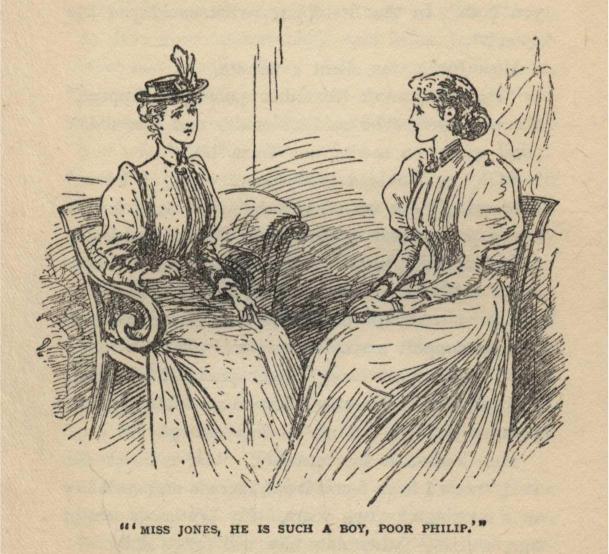
"'MISS JONES, HE IS SUCH A BOY, POOR PHILIP.'"
Miss Jones lifted her eyes and bridled a little.
"Of course, I knew you wouldn't think me good enough," she said.
"But," said Meg simply, "how could I think so? I do not know you. What I mean is, marriage with any one till he is older would be ruin to him. Surely you must see the unhappiness it would bring upon you both. In the first place, what could you live upon?"
Miss Jones was silent a minute.
"He could work like other people, I suppose," she answered; "he said he could, and I wouldn't mind going on sewing too for a bit."
"Oh, he would be willing to work, I know," Meg said; "but what could he do? It is harder in the present state of things for sons of gentlemen to find anything to do than labouring men. And he is not half educated yet. Now, in a few years he will be, I trust, in very different circumstances, and able to support a wife in comfort."
"I don't mind being rather poor," Miss Jones replied; "and I'm not going to give him up just because you don't think me fine enough for you."
Meg looked at her steadily. "Of course," she said, "now I have found it out, there is no possibility of a marriage for two years. My brother is not of age, and my father naturally will forbid it."
Then she softened again, for the girl's eyes had an unhappy look in them. "I expect I seem severe to you, Miss Jones; but, indeed, all I am thinking of is my brother's happiness. If I thought it would truly be for his good, I would not say a word. And you—you love him too—won't you show your love by not standing in his light?"
"You seem to think it's as easy to give him up as drop your 'andkerchief," said Miss Jones, in a voice that shook a little. "If you'd a young man, how d'you think you'd feel if any one came to you and said as you couldn't make him happy because you wasn't as fine as him?"
"If I had a lover," Meg said softly, "I would not bring unhappiness upon him for all the world. If I had a lover, and thought my love could only do him harm, I would never see him again."
"Oh-h-h," said Miss Jones,—"oh-h dear!"
Some tears gathered on her black lashes, and slipped slowly down her cheeks. They were clear tears too, and the lashes had not changed colour. Meg remembered Nellie's accusation and blushed.
"W-what is it you want me to do?" the young dressmaker said. "Oh-h, you are cruel."
Meg felt she was, but kept telling herself she must save Pip. Still, the girl's tears and large, beautiful eyes touched her tender heart. She put out her hand impulsively and took the one with needle-marked fingers; she held it in hers while she talked to her gently and wisely and firmly. She spoke of Pip's extreme youth, of his penniless condition, his dependence on the Captain. "My father is a hard man, and a poor man. I don't think he would ever forgive or recognise my brother again as long as he lived," she said. "Then again, Philip has been used to comfort and certain luxuries all his life—to mixing in good society. He would be miserable, and make you miserable too, to go to such utterly changed conditions. Not one unequal marriage in fifty is happy—it is almost impossible they should be; and think how young he is."
"I 'adn't quite made up my mind," Miss Jones said, feeling she needed some justification. "Yes, I know he'd got the ring—he bought it as soon as I said yes; and at first I thought as it would be nice to be married straight off, but often when he wasn't here I used to think as I wouldn't after all."
"That was very wise of you," said Meg fervently, "very good of you. Oh, I knew I should only have to represent things to you a little for you to see how unwise it would be."
Miss Jones looked a little gratified, though still somewhat mournful. She felt very much like one of the heroines in her favourite Bow Bells or Family Novelettes, sacrificing herself in this noble manner for the good of her lover. But secretly, like Pip, she too felt a trifle relieved.
All her life she had been used to poverty. Things had been a little more "genteel" with them since she had been earning money of her own; but still there was the never-ending struggle of trying to make sixpence buy a shillingsworth. And, from all accounts, it would only be intensified by marriage with this handsome youth she had been so taken with lately. She thought of a certain faithful ironmonger whose heart had been half broken lately by her coldness to him. He was spoken of already as a "solid" man—a shilling need only do its legitimate work if she yielded to his entreaties and married him. Perhaps, after all, it was unwise for a girl in her position to think of a "gentleman born"; and yet Pip's way of speaking, his nice linen cuffs and gold links, his well-cut serge suits, had been a great happiness to her.
"Well?" said Meg softly, breaking in at length upon her train of thought.
"Oh, I s'pose I'll give him up," she answered, somewhat ungraciously.
"How good you are!" Meg said.
"Of course it's 'ard and all that; but I don't want to make him un'appy and his family set against him—I'd rather sacrifice myself." Miss Jones cast down her lashes and looked heroic. "I suppose, though, I'll have a fine piece of work with him when he comes."
Meg had no doubt of it.
"But you will be very firm, won't you?" she said anxiously. "Remember, you have promised me to leave him quite free—to refuse to be even engaged for at least two years."
"Oh, I'll manage him, someway; but I quite expect he will want to shoot either himself or me," was the dressmaker's answer, spoken with a certain melancholy enjoyment.
Then Meg shook hands with her warmly, affectionately even—she felt she almost loved her—and took her departure.
"But Pip will never forgive me," she said to herself, as she walked home again. "Oh, never, never, never!"
CHAPTER XI.
A DAY IN SYDNEY.
"To Mr. O'Malley in foreign parts."
Once a month Martha Tomlinson had a day's holiday. She generally chose Wednesdays, because, she used to say, if there was any luck flying about in a week, that was the day on which it fell to earth. She certainly had illustrations for her theory that Poppet at least used to think were wonderful. For instance, one Wednesday she had picked up a sixpence with a horseshoe on the side the Queen's head is generally seen—the omen had struck her as almost good enough to be married on. Another time the young man she "went walking with" had been within an ace of buying a pee-wit hat that was cheap certainly, but was moth-eaten in a place or two. If, now, she had gone on Thursday, it would have been too late to prevent it, and Tuesday it would have been too soon. It was a clear case of luck, there was no doubt.
One time, indeed, she had been tempted to take a Thursday instead, as the weather looked threatening on the Wednesday; but after a little deliberation, she thought it would be better to keep to her rule. And on the Thursday she had almost gone there was a collision between the river boat and one going to Balmain,—no one hurt certainly, but then, as she very truly remarked, there might have been. There had never been a collision in the memory of any of the family, for she questioned each and all, on a Wednesday.
The man in corduroy trousers still came to see her, and they still only talked of their marriage as the "far-off divine event" of their lives; in all probability they would be talking of it just the same ten years hence. They were not like the usual happy-go-lucky, improvident Australians of their class, who married first, and wondered where the bread and meat were coming from second.
Malcolm was a Scotchman, and was saving up to buy a house of his own—he did not believe in lining landlords' pockets with his earnings. It would, with the strip of land he wanted, be four hundred odd pounds, and he had already saved £75. Martha had £15 in the bank, but then hers would have to go in furniture and clothing. Pip calculated that Malcolm would be seventy-two, and Martha a gay young thing of sixty-nine, by the time the house was built and furnished; but Martha was more hopeful, and did not leave such a margin for the "strikes" Malcolm seemed to revel in.
Now this particular Wednesday, Martha had asked, as a great favour, that Poppet might go with her to town. The little girl was her favourite among all the children, and her warm heart quite ached to see the child moping as she had done since Bunty's disappearance. Every day, while the nursery tea-things were being washed up, Poppet used to stand beside her, with big mournful eyes, wondering "if just this minute Bunty was climbing a mast; if he was very tired of salt meat and weevily biscuits; if his feet got very cold swilling the decks down; if—if—if——"
Martha's brother had been a sailor, so Martha knew more about life on board ship than any one else in the house; hence her great attraction.
Esther, after a consultation with Meg, gave permission; the child was fretting herself thin and pale, and any change did her good.
Of course when Poppet was dressed and standing on the verandah, engaged in the vexatious task of pulling her gloves over her little brown hands, Peter wanted to come too.
"You're a thneak, Poppet, going and having pleathure, and me thtuck here doing nothing," he said. "I'm coming too."
"In that dirty old suit, and mud on the end of your nose?" said Poppet, with the virtuous tone a spotless white frock, whole stockings, and clean boots made justifiable.
"Of courth I can wath my noth, and the thuit ithn't dirty if you bruth it." He took out a crumpled ball of handkerchief, dipped one corner in the goldfish bowl inside the hall door, and polished his small nose with great energy. "There, ith it off?"
Martha came out, resplendent in a green cashmere made in the very latest style, a green hat with pink ostrich feathers, and a green parasol.
Peter looked impressed, and said nothing more about accompanying them; Poppet was nobody, of course, even though her new boots had twelve buttons against his own six; but even his young soul felt the impossibility of a sailor suit no longer new being seen within a yard of that magnificent new costume of Martha's.
He contented himself with looking after them enviously as they went down the drive, and kicking the verandah post with his small strong boots.
"Tthuck up thingth!" he muttered, turning away to look for means of amusement. "I'll thutht pay that Poppet out."
Martha had ideas of her own as to the proper way a holiday should be spent, and had determined Poppet should have a day she would long remember. One thing only Poppet asked for, and that was that they should walk about Circular Quay for a little time and look at the great ships, and especially any that were bound for America.
In her pocket the little girl had a blotted note she had written some days ago. On the envelope, in very bad, unsteady writing, there was this strange address:—
"TO BUNTY IN AMERICA.
"On the ship Isabela plese will the capten give this to Bunty."
There was a pencil mark through Bunty, and John Woolcot was written in brackets.
Inside the envelope was much paper and many smudges made by the tears that fell all the time the pen went slowly along the lines.
"Oh Bunty do come home, Bunty dere there is nothing to be fritened of. Mr. Barnham doesn't beleeve you took it and the boys chered you like anything and Meg is going to be nice always the tortus is very well and I give it beefstake every day I can get any you would be serprised to see what it can eat. Oh Bunty do be quick home oh you mite have told me you were going Bunty I'd have come with you or anything do you have to go up the masts. I'm so fritened you'll fall overbord I've put 10 pense in here so you can buy things when you're on shore I wish I had more Martha says the biskits are full of weevuls. Dere Bunty oh do come home quick quick oh Bunty if only you'll come I'll always do things for you and never grumbil whatever it is I know I used to be horid and grumbling before but just you see do you have to swil the deks with no boots. Martha says so. Oh dere Bunty DO come home. I've beleeved you all the time Bunty dere of corse.
"Your loving sister,
"POPPET.
"P.S.—Be sure to come quick."
For a long time the little girl could think of no possible way of getting this letter to her brother. Meg had said the post-office would be no use, for in all probability the boat bearing it would pass in mid ocean the one bringing Bunty back.
But it had struck Poppet lately that if only she could give it to the captain of some other boat going to America, he would know just where the boat was and be able to send it on.
That was the hope that was making her eyes grow full of light as the river boat got nearer and nearer to Sydney, and hundreds of tall masts and interlacing yards stood against the blue of the sky or the brown-grey of the great warehouses.
How beautiful the harbour looked to-day! There was a cool breeze blowing, and it ruffled the waters into a million little broken waves that leaped and danced in the clear morning sunshine.
Up near the Quay there was all the picturesque untidiness and bustle of busy shipping; but out farther the sun and the waves and the drifting clouds had it their own way, and made a hundred shifting pictures. Sometimes a white sail glittered in the sun, then a brown one would make a spot of warm colour. The great boats to Manly left long majestic trails of white foam behind them, and little skiffs got into the wash and rocked joyously.
On the North Shore the many buildings showed white and clean in the sunlight; farther to the left the houses were fewer, and beautiful gardens stretched down to the water's edge. Still farther away, across the white-tipped waves, were shores with backgrounds of thickly-growing gums; and higher, the soft blue line of hills.
Poppet's very heart was in her eyes as the boat stopped at the Erskine Street Wharf and the gangway was put down. She pinched Martha's arm gently and whispered to her not to forget.
Martha spoke to a sailor who was sitting smoking on an inverted cask.
She "supposed the boats to America went from the Quay, didn't they now?—or was it from Wooloomooloo?"
But he "supposed there were boats and boats to America. There was sich as the Mariposa, which carried swells and was a fine boat; and sich as the Jenny Lind, which took oil and was not a fine boat!"
"Do you know the Isabella?" said Poppet's little eager voice.
"Captain Brown?—well, I reckon I do, little miss," he said, and chewed a bit of tobacco thoughtfully. "Bloomin' old tub! I was on her five year."
Poppet nearly fell upon him,—she could not wait while he said all he knew about it in his slow roundabout way.
"Is he a cruel man? don't they have vegetables to eat? do the little boys have to go up the masts? are there weevils in the biscuits? oh! and won't he let them have their boots on when they swill the decks?"
But it turned out that the Isabella he was on was a schooner plying between Melbourne and the South Sea Islands. He rather fancied there was a brig of the same name that went to San Francisco or Boston, or "one of those places."
Poppet's face had fallen again.
"Do you know of any boats that go to America?" she said in a forlorn tone. "Oh, do please try and think if you know of any."
Martha explained rapidly, sotto voce: "The young lady's brother had run away, and was on that boat; she was fretting her little heart out to get a letter to him; couldn't he pacify her some way? she herself knew it was impossible."
The sailor looked kindly at the little sweet face under its broad-brimmed hat.
"I have a mate on the Jenny Lind, little miss,—how'd it be if I gave him the letter? He's a good-hearted chap, and would try his best; he'd be sure to know where the Isabella is, and could easy send it."
"That would be best, Miss Poppet dear," said Martha; "give it to this nice kind man and he'll send it."
"Is he going to America soon? Do you think he would see the Isabella?" the little sad voice said.
And the sailor's answer was certainly very reassuring: the Jenny Lind sailed in two days, and was sure to meet the Isabella, in which case the letter would be delivered into Bunty's hands.
Poppet handed over her letter with a sigh of relief; she had hardly dared to hope a boat would leave so soon.
Martha thanked the man, opened her green parasol, and walked on. Poppet lingered half a minute.
"If you should happen to meet him anywhere," she said hurriedly,—"you might, you know, as you're a sailor too: he's a tallish little boy, with brown eyes, and his hair's rather rough,—you won't forget, will you?"
"Not I," he said warmly, shaking the small hand she held out,—"a tallish little boy with brown eyes,—oh! I'd easy know him."
Then she caught up Martha, who was beckoning impatiently, and felt a load was off her mind.
Such a morning they had! They went to the waxworks in George Street first, and saw bush-rangers, an aboriginal murderer, and other pleasing characters, with life-like eyelashes and surprisingly beautiful complexions. Then they climbed all the way to the top of the Town Hall—Martha knew the caretaker—and had the pleasure of seeing the city in miniature far below. The Cathedral being next door came in for a turn, but seemed rather flat after the waxworks. After that they went through the five arcades systematically, flattening their noses at each interesting window, and telling each other what they would buy if they had the money.
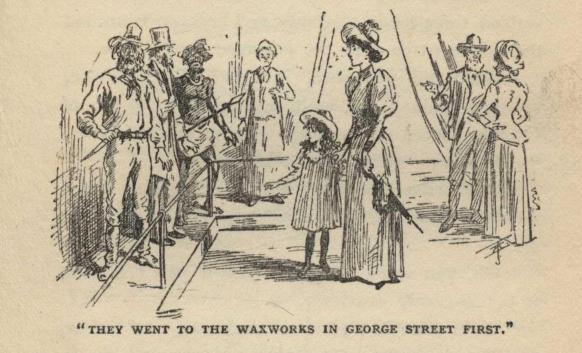
"THEY WENT TO THE WAXWORKS IN GEORGE STREET FIRST."
It was twelve o'clock when they had finished with the Strand, and they were to meet Malcolm, who was going to take them somewhere to lunch, at half-past one.
"There's just time for the Botanicking Gardens," said Martha, wiping her heated face and setting her splendid hat straight at one of the narrow slits of mirror in the arcade.
So away they posted, up King Street, down Macquarie Street, and away down the broad, beautiful, shady walk in the Domain.
There was not time to "do" the Gardens thoroughly, so they only walked rapidly up some of the paths, paused for a moment to look at the blue harbour beyond the low sea wall, and then walked three times solemnly and backwards around the wishing-tree near the entrance gates.
"What did you wish, Martha?" Poppet said, as they walked up again towards the statue of Captain Cook, where they were to meet Malcolm. "I hope you wished about Bunty."
But Martha had been selfish enough to desire fervently that Malcolm should never go on strike again.
"Oh, you never get your wish if you tell what it is," she said evasively.
"Don't you?" said Poppet anxiously. "Oh dear, and I was nearly telling mine. You can't guess in the slightest, Martha, can you? You have no idea, have you, Martha?"
"Not the slightest," said Martha of the warm heart,—"not the least little bit, Miss Poppet."
"And you always get your wish, Martha?"
"Oh, of course."
Years after, Poppet's faith in that wonderful wishing-tree was unshaken.
CHAPTER XII.
THREE COURSES, ONE SHILLING.
"Yesterday's errors let yesterday cover;
Yesterday's wounds which smarted and bled
Are healed with the healing which night has shed."
Poppet had been for lunch with Esther or Meg to the Fresh Food and Ice Company, Quong Tart's, and such places on various occasions. But the restaurant to which Malcolm and Martha took her was quite a new experience. She did not know the name of the street it was in, but it was not very far from the Quay, and there was a rather mixed, if interesting, assembly of diners. Not that it was a particularly low-class place; it had a very good name for the excellency of its food and its moderate prices, and its patrons comprised poor clerks who minded fashion less than a good dinner,—tradesmen, sailors, and occasional wharf labourers. Martha had asked Malcolm whether, as she had Poppet with her, they had better go to some place higher up town. Malcolm, who dined there regularly, seemed to see no reason why he should change his custom for a little slip of a girl under ten.
As for Poppet, it was all one with her where she went, and while Martha and Malcolm were studying the bill of fare, she fell to watching some sailors at an adjoining table with the deepest interest.
"Now, Miss Poppet," said Martha, "what will you have? Me and Malcolm have fixed on sucking pig, sweet potatoes and baked pumpkin, but I think you'd better have something plainer; there's roast mutton, or corned beef, or beefsteak pie."
"Why," said Poppet, "we have those things at home. No, I'll have sucking pig too, please, Martha; I like tasting new things."
"Did you ever!" remarked Martha, looking troubled; "it might make you ill, Miss Poppet dear. Have corned beef like a good little girl."
But Poppet could be firm on occasion. She did not dine at a restaurant every day, and when she did she had no intention of confining herself to ordinary things.
"Sucking pig for two," said Malcolm to the waiter, and paused for Poppet's order.
"For three," said Poppet, softly but firmly. While he had gone to execute the order, she occupied herself with considering what pudding she would have. There were five or six down on the list: plum duff, apple pie and custard, treacle rolypoly, stewed pears, and macaroni and cheese. She was wavering between macaroni and plum duff, when the waiter returned with the three great steaming plates of sucking pig and vegetables.
Malcolm and Martha were soon busily occupied, both considering it would be sheer wilful waste, after paying a shilling each, to leave an atom on their plates; but Poppet found a very little satisfying, and fell to watching the sailors again.
She heard them give their orders—five of them, each a different meat and different vegetables; she wondered how the waiter could keep it all in his head, and watched quite anxiously when he returned with the tray to see if he made any mistake.
Just behind the screen where they filled the trays somebody stood handing plate after plate to the one busy waiter. Presently, as the place filled more and more she heard him say he must have some one to help at once, a number of people were waiting.
A boy in a long white apron stepped out from the screen, a tray with three corned beefs, two sucking pigs, and a roast mutton in his hand.
"Miss Poppet, dear, do eat up your potato," said Martha, pausing with a knifeload midway between her plate and mouth. But Poppet's face was deadly pale, and in her eyes was a look of strange wildness.
"She's ill," said Martha; "I knew she oughtn't to have it." She looked at Malcolm in a helpless way for a second, and then pushed back her chair to go round to the child.
But Poppet flung up her arms, and with a wild, piercing shriek darted from her place and flew across the room.
There was a crash of crockery, one of those slow, piece-after-piece crashes, when you wonder if there can be anything left to be broken, angry words from the waiter and manager, confusion and laughter on the part of the diners, blankest amazement on the faces of Martha and Malcolm, and in the midst a small girl in a white frock and big hat clinging frantically to "a tallish little boy with brown eyes and dark, rough hair,"—a shabby, white-faced boy in a waiter's apron.
"Oh-h-h-h!" she sobbed, "oh-h-h! oh-h-h-h! Bunty!" She laughed and sobbed and laughed again.
This extraordinary scene went on for two or three minutes; then the manager recovered his wits and began to storm, and Martha, still wearing an expression of stupefaction, made her way to the group.
Malcolm, after an expressive shoulder shrug, returned to his sucking pig, which he was enjoying immensely.
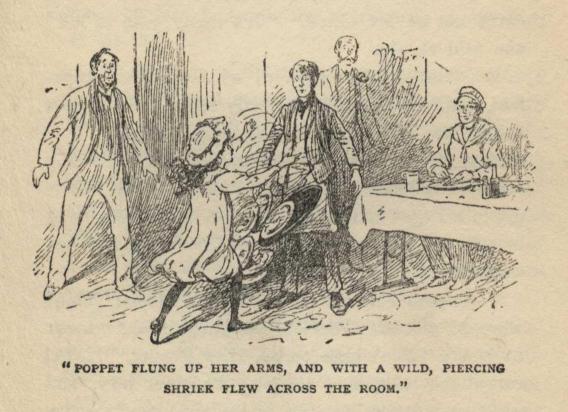
"POPPET FLUNG UP HER ARMS, AND WITH A WILD, PIERCING SHRIEK FLEW ACROSS THE ROOM."
"There's nothing them kids could do as 'ud surprise me," he said, as he took a fresh supply of mustard and settled down again.
He had known the family for seven years, so the remark was not unjustifiable. Martha had withdrawn to a back room with the manager. She explained that his young waiter was the son of a gentleman; she gave him Captain Woolcot's address that he might be reimbursed for the breakages.
"But 'owever he got 'ere, so help me, I can't imagine," she said. "Why, he's in America." She put out her hand to touch the lad and feel if he were real flesh and blood, the evidence of her senses could not be accredited. "It's really you, is it?" she said slowly.
But Bunty did not answer; he seemed half stupefied, and was standing perfectly still, while Poppet sobbed and asked questions and clung to him.
Such a tall, gaunt boy he had grown. His face was thin and sharp, there was a look of silent suffering in his eyes and round his lips, his clothes hung loosely on him, and were threadbare to the last degree.
"Get your hat and come with us, Master John," she said, a touch of her old sharpness in her manner to him. "Don't take on so, Miss Poppet. Hush! every one is looking at you; be quiet now, an we'll go to the Gardens, or somewhere where we can talk, and then we'll go home."
"I can't go home," Bunty said faintly.
He wondered if those five terrible months behind him were a dream; or if little trembling Poppet, who was holding him so tightly, was a vision his disordered imagination had called up.
"Oh, I can't go home, of course," he said, and pushed his thick hair back in a tired kind of way. "Hush, Poppet; go home with Martha like a good girl, and, on no account, say you've seen me. Promise me——"
He did not wait for an answer, however, but made fresh confusion by fainting dead away on the floor at Martha's feet.
The manager of the restaurant felt himself a very ill-used man that such things should happen at his busiest time; but he was not inhuman, and the boy's deathly face and the little girl's exceeding distress touched him. Besides, Malcolm was his most regular customer; it would be unwise to offend him. So he helped to lift the boy into an inner room, gave Martha brandy and water, and recommended burnt feathers.
"I'll go and send a tellygrum for the Captain," Malcolm said, picking up his hat. He too felt ill-used, for there were some choice morsels still on his plate, and there was no knowing when he would get his pudding.
But Poppet caught his coat sleeve.
"Not father, on any account," she said. "Esther, or Meg, or even Pip—but oh, not father!"
"No, you'd better not fetch the Captain," Martha said. "Oh no, he wouldn't do at all. Better telegraph for Miss Meg—she's got a head on her. The missus is ill with a headache, so it's no good fetching her—yes, send for Miss Meg."
It was between half-past one and two when all this happened; at five Bunty was half-sitting, half-lying on the old, springless sofa in the nursery. Poppet had squeezed herself on the half-inch of space he had left, and was gazing at him, a look of great content and unspeakable love on her little face; and Meg on the low rocking-chair beside them was holding a hand of each.
The others had been turned out. Bunty lay with his face to the wall and his lips shut in a dogged kind of way when they had all crowded round asking questions; and at last Meg, seeing he was totally unfit for any excitement or distress, persuaded them to leave him to Poppet and herself till he was stronger.
And when the room was quiet, and Meg rocking softly to and fro, and Poppet occasionally rubbing her smooth little cheek against his old coat, he told them everything of his own accord.
He had not been to America at all, he had never even heard of a boat called the Isabella; it must have been some other boy the police had heard of, and a chance resemblance that made them connect the two.
He had been in or near Sydney all the time, living he hardly knew how. The first month he had done odd jobs, fetched and carried for a grocer in Botany. Then he had managed to get a place on a rough farm in the Lane Cove district, where he was paid four shillings a week and given board and lodging—of a kind. But there had been a long spell of rainy weather and rough westerly winds, and he had been in wet things sometimes from morning to night.
"And it gave me fever—rheumatic—pretty badly," he said; "so they shipped me down to the hospital here in Sydney."
Poppet buried her nose in the sofa cushion, and Meg gave an exclamation of horror.
"And you didn't tell the people who you were, and send for us?" she said, wondering if this could be the same boy who, when he was small, required the sympathies of the house if he scratched his knees.
"How could I?" was Bunty's low reply, "when you didn't know about that!"
Meg held his hand closer.
"Didn't the people at the hospital ask who you were?" she said.
"I told them I hadn't any home, and my name was John Thomson," he answered. "Of course they thought I was nothing but a farm boy. Well, I was there a long time—about two months, I think; it seemed like years."
Meg's face was pale, and her eyes full of hot tears.
She pictured the poor lad lying in that hospital bed week after week, strange faces all around him, strange hands ministering to him,—weak, racked with pain, and yet with almost incredible strength of mind persevering in his determination not to let his family know anything.
"How could you help sending for us?" she said, in a low tone.
He moved his head a little restlessly.
"I knew you were all sick of me, and ashamed of me. I know I'm not like the rest of you, and I kept saying I'd get well and work hard and do something to make you respect me before I came back."
Respect him! In Poppet's eyes Nelson was less of a hero, Gordon had infinitely less claim to glory.
"Two or three times I nearly told the nurse," he continued, half-shamefacedly; "the pain was pretty bad, I couldn't go to sleep for it, and I thought I'd like Poppet to come,"—he gave her hand a rough squeeze,—"but then I used to stuff the blanket in my mouth and bite it, and it kept me from telling her. I used to have to shut my eyes so I shouldn't see her coming to my end of the ward; I used to get so frightened I'd say it without meaning to."
"And then," said Meg—the narration was almost too painful—"what did you do then—when you got better?"
The rest of the story he hurried over; it made him shudder a little to think of it all, now he was lying in this dear old room with two faces full of love close to him.
He had not been strong enough for any regular work after he came from the hospital. He had twelve shillings of his wages left, and this kept him for a fortnight, with the help of what he received for an odd job or two. The last week had been the worst of all. On Saturday he had elevenpence only left; he lived on it that day, Sunday, and Monday, sleeping in the Domain at night. On Tuesday he had in the course of his wanderings come to Malcolm's favourite restaurant, and lingered around it, trying to feed his poor hungry body with the appetising smells that issued from the door. At last he could bear it no longer; he went in and asked if they wanted a boy to wash up or wait, offering to do so in return for food and a bed at night. They had been very pushed for help, for one of the waiters had fallen ill, and they told him he could try it for a day or two. All Tuesday he worked hard there, washing up, peeling potatoes, running errands; the meals seemed more than ample repayment to him in his half-starved state.
On Wednesday the absent waiter had sent word to say he would be at his duties the following day. Just as Bunty was lading his tray to carry it round he dropped a couple of tumblers,—he had broken two or three things the previous day,—and the manager in annoyance told him he could stay the rest of the day but need not come back to-morrow. Sick at heart at the thought of the streets again, the poor boy had picked up his tray and gone out into the big room with it.
And the next minute there came that wild, glad shriek, and Poppet had flung herself upon him half mad with joy.
Just as the tale ended Nellie burst into the room. She went straight over to the sofa and fell down on her knees beside it.
"Oh, how can you ever forgive us, Bunty!" she said, tears brimming over in her eyes. "Oh, Bunty, I shall never forgive myself, never!"
Esther had followed, her face' shining with gladness. "Mr. Burnham is here," she said, "and——"
"Bunty never did it, 'twath Bully Hawkinth!" burst out Peter, pushing Nellie aside, and actually trying to kiss his injured brother in his excitement.
Bunty rose to his feet, pale, trembling.
"What is it, Esther?" he said. "Nellie—tell me!"
"Only it was young Hawkins after all who took the money," said Esther, in tones that trembled with gladness for the news, and grief for the poor boy's unmerited sufferings. "He broke his collar bone at football yesterday, and he thought at first he was going to die; he confessed it to his mother, and made her send word to school. Mr. Burnham has come straight here with the news, and says he can never forgive himself for all you have suffered over it."
"Oh, Bunty! how hateful we were not to believe you," said Nellie, wiping her eyes; "we don't deserve for you to speak to us."
But Bunty put his poor rough head down on the cushions again, and great hard sobs broke from him, sobs that he was bitterly ashamed of, but that he had absolutely no strength to restrain.
No one would ever know quite how wretched this thing had made him. However warm the welcome home had been, there would always have been that cloud.
The relief was almost too much for him in his weak state.
At night, when Meg was tucking Poppet up in bed, the little girl sat up suddenly.
"Meg, that is the most wonderfullest tree in the world," she said in a low, almost reverential tone.
Meg asked her to explain, and she told how she and Martha had walked backwards three times, around the "wishing-tree" in the Botanical Gardens.
Meg stooped down and kissed the dear little face; how she envied Poppet to-day! she was the only one who had had faith all the time.
"What did you wish?" she asked, though she knew without telling.
"That Bunty might be found this vewy day, and that they might find out about the money."
"But I think I know a little girl who has said that in her prayers every day for five months," whispered Meg. "Which do you think answered, God or the tree?"
The little girl was quiet for a minute, then she knelt up on her pillow and drooped her sweet, grave face with its closed eyelids over her two small hands.
When she cuddled down among the clothes again, she drew Meg's bright head down to her.
"I was thanking Him," she said.
CHAPTER XIII.
PARNASSUS AND PUDDINGS.
"When for the first time Nature says plain 'No
To some 'Yes' in you, and walks over you
In gorgeous sweeps of scorn."
Pip had not spoken to Meg for over three weeks. There had been one fiery outbreak consequent upon Miss Jones' dismissal of him. When he learnt Meg had been to her he had accused his sister of treachery, of trying to ruin his happiness; he had been willing, he said, to put off the question of marriage for a year or two, but no power on earth would have made him promise to give Mabelle up.
And she had given him up! Put him aside as if he had been a schoolboy, or a worn-out glove! And with astonishing firmness. He had even seen her already walking out with a man who sold saucepans and kettles and fire-grates in the one business street of the suburb.
No wonder his cup of bitterness seemed running over; no wonder he felt Meg had sinned beyond forgiveness in thus interfering.
His last examination had not, it was found, been hopelessly bad, and he had been granted a "post mortem." But even then he did not attempt to work. He used certainly, to stay in his bedroom, where his table stood with its wild confusion of books and papers, but he would sit hour after hour staring moodily in front of him, with never a glance at the Todhunter or Berkeley that so urgently required his attention. Or he would read poetry, lying full length on his bed,—Keats, Shelley, and Byron, tales of blighted passion and hopeless grief, till his eyes would ache with the tears his young manhood forbade to fall, tears of huge self-pity and misery.
Surely since the creation there had been no one quite so wretched, so utterly bereft of all that made life worth living! How grey and monotonous stretched out the future before him! The probable length of his life made him aghast. The sheer uselessness of living, the hollow mockery of the sunshine and laughter and birds' songs, and the intolerable length of hours and days, seemed each day to strike him with fresh force.
After a certain time his mood induced poetic outpourings. He thought himself just as wretched,—even more so, indeed; but the mere fact that his feelings were able to relieve themselves in this way showed the first keenness was passing.
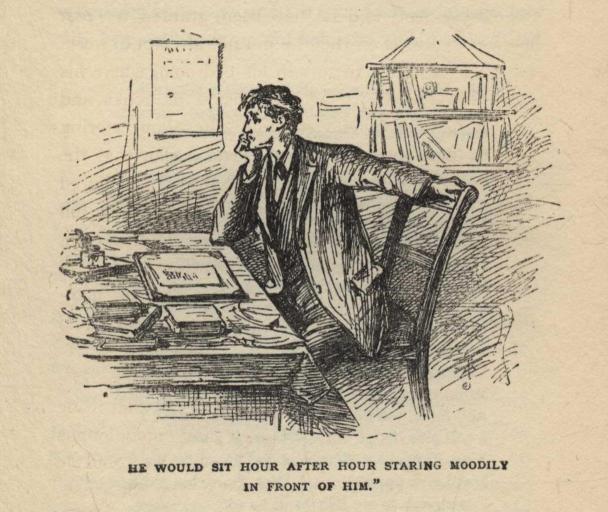
"HE WOULD SIT HOUR AFTER HOUR STARING MOODILY IN FRONT OF HIM."
Sheet after sheet of University paper was covered with wild, impassioned addresses in the shape of sonnets and odes, or, when the pen was too full for studied forms, of eloquent blank verse.
For instance, the following poem struck him as exceptionally fine. He composed it at midnight, after eating his heart out in misery all the day. It was written in his blackest writing, as might be expected, and upon a sheet of grey note paper,—the University buff had suddenly offended his sense of fitness.
"Oh, what is life when all its joys are fled!
I am in love with Death's long dreamful ease.
Over my head I hear th' unwelcome tread
Of future years; my aching eye still sees
New suns arise and set, and seasons wane.
I would take arms against this sea of pain,
I would embrace Earth's sea and sink to rest,
For ever lulled upon her soothing breast!
I would fling off this gift of Life, as you,
O bitter Love, flung me aside, your you!
O Love, O Love, O bitter, beauteous Love,
Heartless and cold, but still my one fair dove!
What is this life that some find strangely fair,
When but to think brings sorrow and despair?
What is this life when love, your love, lies dead,
And mine, too much alive, slays me instead?
I will give up, go down,—there is a sea,
A winding sheet, kept cool and green for me.
I will give up, go down! Yet, Love, but smile,
But stretch to me that hand so soft and white,
That seemed my own, that sad, sweet little while,
And all grows day, for ever dead the night."
He was not at all sure when he read it the eighth or ninth time that the mantle of the "Sun-treader" had not fallen upon him, that Helicon's drying fount would not spring up afresh at his bidding.
Other men in love, he knew, had made verses, but they were of the mawkish, sentimental kind his more fastidious taste rejected, the kind that generally began something like—
"Oh, Star of Beauty, all the night
Thou shinest in the sky;
For thee the dark doth grow quite bright—
Oh, hear my plaintive sigh!"
His, he felt, were strong with the strength born of fathomless misery, and sweet with the bitter-sweet of undying and spurned love.
One day he met Mabelle; she was walking to church with her fat, honest old mother, who preferred a man of saucepans with money far before one of irreproachable shirt cuffs and empty pockets.
She smiled at him from her brown, beautifully lashed eyes, a kind of for-goodness-sake-try-to-make- the-best-of-it-and-don't-look-so-tragic smile, but he interpreted it as a sign of softening. When he got home he sent her the poem,—if anything in the wide world could touch her beautiful, stony heart he thought that would.
He entrusted it to the common post, and waited with an undisciplined heart for the answer.
It came on a Monday morning. Poppet took it from the postman and carried it up to him, but she was too busy with a scheme of Bunty's to notice how white he turned, and how his hand trembled.
It was painfully short and to the point:—
"What's the use of writing poetery to me when all's up and done with? I showed it to Ma and Pa and some one else, and they thort it very fine; but said you oughtent to write it as some one else writes poetery for me now. I think it's very nice of course and I'll keep it this time but don't send any more.
"Your friend only and nothing more,
"Miss JONES (not Mabelle).
"P.S.—I suppose I may as well tell you as I'm engaged to be married to Mr. Wilkes."
That was Pip's death-blow, and, if a paradox may be allowed, from that minute he began to live again.
The thought that his cherished poem had been submitted to the critical gaze of a man who sold frying pans and wrote "poetery" himself, stung him to madness. He sat down and attacked his hydrostatics with savage frenzy to prevent himself doing anything desperate.
He even played in a football match the next week, a thing he had not done for a long time; and he took food less under protest.
But Meg he could not forgive; his manner to her, if compelled to speak, was cold and contemptuous; when possible he totally ignored her presence.
The girl found such conduct very hard indeed to bear from her favourite brother, especially as it was only her keen anxiety for his welfare that had made her act as she had done; she bore it in silence, however, and without reproaching him. Some day, she knew, he would thank her from his heart, and for the present she must content herself to lie under the ban of his displeasure.
To solace herself she took to making puddings, learning the technicalities of meat cooking, and concocting queer-smelling bottles of stuff she labelled mushroom ketchup, tomato sauce, and Australian chutnee in her neatest hand.
Esther smiled a little when first these operations began. Meg had hitherto expressed the frankest dislike for culinary engagements.
Nellie laughed openly.
"Her 'prentice hand she tried on us,
And then she cooked for Alan, oh!"
she said one day, shaking her head as she eyed a surprisingly queer-looking conglomeration Meg called amber pudding.
"Many thanks, but no, Meg dearest; I think I will finish with honest bread and cheese!"
"Esther?" said Meg, pausing with uplifted tablespoon, and taking no notice of Nell's sarcasm beyond blushing finely. "You'll try a little, won't you? I'm sure it's very nice."
But even Esther looked dubious; the frothed icing on top had an elegant appearance certainly, but underneath was a mass of strange colour and consistency.
"Dear Meg," she said, "I am like the French lady, you know,—I eat only my acquaintances. Nellie, pass me the cheese."
But this sort of thing did not damp Meg's spirits, not at least for more than a day or two.
Perhaps the next three or four puddings would be long-established favourites that no one could take exception to, but after that there would appear one or two of French title and unknown quantities. Now and again indeed they turned out brilliant successes, that every one praised and longed for more of; but most often, it must be confessed, they were failures, very trying to the tempers and digestions of all who ventured on a helping.
"It was well to be Alan," Nellie said, "with nine innocent people submitting themselves daily to the dangers of poisoning or lifelong indigestion, just that in future he might escape and have his palate continually pleased."
"If I can't practise on my own family," demanded Meg, smiling however, "how am I to get experience? All of you have excellent digestions, so it will not do you any real harm."
And she persevered with so much determination that they only groaned inwardly when a "confection à la Marguerite," as Nellie called it, took the place of old favourites, such as plum puddings, apple pies, roly-polys and Queens. Every one accepted their portion in meekness, and really tried to say encouraging things, especially if her face was hot and anxious.
Bunty was just beginning to find his place in the family again. But he was a changed boy. No one could doubt that those five hard months had had the most beneficial effect on his character, although they had made him so white and hollow-cheeked. He was stronger morally, more self-reliant. The rough usage he had received seemed to have quite dissipated his cowardice, and with it the inclination to falsehood. He was almost pitifully careful not to make the slightest untrue statement about anything; and now the barriers of reserve between himself and Meg were broken down, she was able to help him more, and put herself more in his place.
Poppet was as much as ever his faithful little companion; there was absolutely nothing the child would not have done for this dear, recovered brother. She even consulted Meg as to the practicability of learning Latin, just that she might look up his words for him every evening in the dictionary.
But as three-syllabled words in her own language made her pucker up her poor little brows, and as English grammar still had power to draw weary, dispirited tears, Meg advised a short postponement.
CHAPTER XIV.
MUSHROOMS.
"In what will all this ostentation end?"
A new house had been built lately not very far from Misrule, a grand, showy-looking place, or red brick, in the Elizabethan style, which the suburbs of Sydney are just beginning to affect largely.
The grounds were laid out by a landscape gardener, and there were velvet lawns, carpet beds, and terraces reaching down to the river, where at Misrule there was only a wilderness of a garden with broken palings, and a couple of sloping paddocks where long rank grass and poppies flourished. Then the carriage drive,—such a grand, smooth, red sweep, serpentining up to the great porch. The Misrule drive was hardly red at all; the gravel had mostly vanished, the dead leaves were generally of Vallambrosian thickness, and weeds raised cheerful heads at intervals. The name of the people who had built the new house was Browne,—Fitzroy-Browne, with a hyphen and an e.
Mr. Fitzroy-Browne was a railway contractor, and had builded himself an ample fortune out of a Government that not yet had need to cheese-pare.
There were three or four Misses Fitzroy-Browne, that fashionable boarding-schools, dressmakers, and several seasons had done their best for. There was a Mr. Fitzroy-Browne junior, who waxed his moustache, wore clothes of chessboard device, and kept racehorses. And there was Mamma Fitzroy-Browne, who was fat and good-natured, and said "Bless yer 'art" with a cheeriness refreshing in these days of ceremony, and then pulled herself up short and looked unhappy.
Poor Mamma Browne! who sometimes thought wistfully of the long-dead days when Papa had been only an honest navvy, and her little girls and boy too small to snub and suppress her, and order her about.
Mamma Browne, who had liked her little old "best" room, with its big round table, holding the Bible, three gilt-edged books, and some wax grapes under a glass shade, far better than her grand new drawing-room, that was like a furniture show-place, all mirrors and cabinets, and green and gold.
How many Mamma Brownes there are in Australia! It is quite pitiful. Good dear creatures, with their bones too set to adapt themselves to the change the golden days have brought; poor simple-minded things, who, having consistently left "h" out of their language for forty or fifty years, cannot remember it now till an embarrassed cough or a blush and sneer from a Miss Hyphen Browne makes their old hearts ache for shame of themselves.
Dear housewives, who wasted not their husbands' substance in the old days, and now bring down vials of contempt from the daughters for anxious watchfulness over reckless servants! Sociable old bodies, to whom a cup of tea in the kitchen with a gossiping friend had been happiness, but "At Homes," thronged with stylish people whose speech fairly bristled with h's and g's, bewildering misery.
Comfortable women who have weaknesses for violet, crimson, and bright brown, with large bonnets heavily trimmed, and are sternly arrayed in fashionable no colours, and for bonnets forced to wear a bit of jet, a flyaway bow and strings, that they say piteously feels as if they had no head covering at all.
I should like to build a Home for them, these dear, fat, snubbed orphans of society that is altogether too fine for them—I said fat, because if you notice it is always the fat ones who get into trouble: the thin ones can shape themselves into place better,—to build a Home full of small cosy rooms, with centre tables, and chairs, not artistically arranged but set straight against the walls, with vases (pronounced vorses) in pairs everywhere, waxen fruit and flowers under glass, and china animals that never were on sea or land. There should always be a tea-pot, warmly cosied, cups big enough to hold more than one mouthful and not sufficiently precious to make one uncomfortable, plates of cake, cut, not in finikin finger strips, but in good hearty wedges.
These to be in readiness for all the dear old vulgar friends who had not got to fortune yet and loved to "drop in."
And if I had a uniform at all for my orphans it should be of a good warm purple, with plenty of fringe and plush and buttons; and the standard weight of the bonnets should be thirteen ounces.
All this because of Mrs. Fitzroy-Browne!
Captain Woolcot had told Esther she need not call when the new people came to the district: he said he "hated mushroom growths, especially when they were so pretentiously gilt-edged,"—which was rather a mixed metaphor, by the way but no one could tell him so.
For some time therefore all the young Woolcots saw of the "mushrooms" was on Sundays, when a pew that had belonged to two sweet old maids—grey-clad always, sisters and lovers, never apart even in their recent deaths—blossomed out into a gay dressmaker's showroom, from which all the congregation could during sermon time take useful notes for the renovation of their wardrobes.
Nellie's hats were good signs of the times. The boys chaffed and scorned her unmercifully, but the poor child had such a weakness for having things "in fashion" that for her very life, when the Misses Fitzroy-Browne's trimmings were all severely at the back of their hats, she could not leave hers at the front. Or if their frills crept up into the middle of their skirts and had an insertion heading, how could she be strong-minded enough to let hers remain on the hem with only a gathering thread at the top?
Poor Nellie! she had a great, secret hankering for the flesh-pots of Egypt. The love of pretty things amounted to a passion with her, and the shabby carpets, scratched furniture, and ill-kept grounds of Misrule were a source of real trouble to her.
Privately, she took a great interest in the rich Brownes, and envied them not a little. Their grand house and beautiful grounds, their army of trained servants, their splendid carriages and horses, and their heaps of dresses and jewellery seemed to the half-grown girl the most desirable things on earth.
But if you had put it to the test whether she would change Esther's beautiful, quiet grace of manner for Mrs. Browne's nervous fussiness; her soldierly, upright father for little, mean-looking Mr. Browne; handsome, careless Pip, who looked like a king in his flannels and old cricket cap, for Mr. Theodore Fitzroy-Browne of the careful toilets and bold eyes; or sweet, gracious Meg, who always said the right thing at the right time, for one of the over-dressed, gushing Miss Brownes, I think—even with all the money thrown in—she would have clung to Misrule.
For their part, the Brownes took a great interest in the Woolcot family, and felt themselves much aggrieved that, with all their shabbiness, they had been too "stuck-up" to call upon them.
They would have liked Pip for their "At Homes" and dances; and the young, grave-faced doctor, who was always turning in at the Misrule gate; Meg, who looked "such a lady"; and Nellie, whose beautiful face would be so great an attraction to—at any rate—the masculine portion of their guests.
When, after some five or six months, no cards from Captain, Mrs., and Miss Woolcot had been deposited at the shrine of their wealth, they began to make overtures themselves.
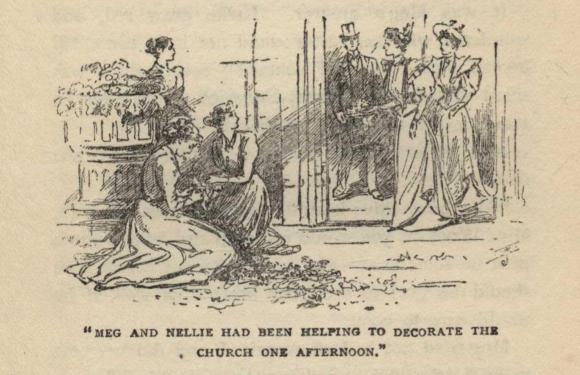
"MEG AND NELLIE HAD BEEN HELPING TO DECORATE THE CHURCH ONE AFTERNOON."
Meg and Nellie had been helping to decorate the church one afternoon,—it was Easter-time,—when two of the Misses Browne came in, followed by a man in livery, bearing a great basket of exquisite white roses, and kosmea. Mrs. Macintosh, the clergyman's wife, introduced the girls to each other, since they were so close, and they hammered their fingers and exchanged civilities together for the next hour.
Miss Browne at the end of that time wanted to know if they were not passionately fond of tennis.
"Oh yes—very," said Nellie. "We love it!"
"Of course you have a court?"
"Only a chip one the boys made; but it does very well."
It was Meg's answer. Nellie grew red, and wondered why her sister could not have contented herself with "Yes, of course!" seeing there was small chance the Fitzroy-Brownes would ever be asked inside the gates of Misrule.
Miss Browne was silent a minute, then she said,—
"We have three beautiful grass courts. I wish, Miss Woolcot, you would come up and have a game with us sometimes—and your sister, of course; we should be glad to see your brother as well, if he would care to come."
Meg tried not to look surprised, and did her best to find "the right word for the right place."
"Thank you very much," she said; "but our afternoons are very much filled, I am afraid we should not be able to."
"Then come in the morning," urged Miss Browne. "We always practise in the morning—it fills the time, for, of course, there is nothing else for us to do."
"I am always busy in the morning, and my brother is at lectures," Meg said; "thank you all the same."
"Well, your sister," said Miss Browne. "Won't you come, Miss Nellie? You can't be busy as well."
Nell looked at Meg as much as to say, "Why can't we?" but Meg was somewhat annoyed at the persistency.
"I am very sorry, but Nellie still studies in the morning," she said, just a little stiffly; "she is not old enough to be emancipated yet."
"Well, I think it's very mean of you, you know," was Miss Browne's answer; but she had not taken offence, for Meg's tone had been pleasant. "Still, if ever you can find time, we shall be delighted to see you; we are always at home on Tuesdays and Fridays, evenings as well as afternoons; or if you just sent me a little note to say you were coming I would stay in."
Again Meg thanked her politely, if not warmly, and managed not to commit herself to a promise. She moved away, however, from the danger of it as soon as she could, and helped Mrs. Macintosh to decorate the chancel with kosmea and asparagus grass.
But the Misses Browne kept the not unwilling Nellie close to them, chattering to her, flattering her adroitly, altogether treating her as if she were quite grown up, instead of not yet sixteen.
She was much easier to get on with than Meg, although she was a little shy. They found out from her, by dint of much questioning, that the young man with earnest eyes was Dr. Alan Courtney, and that—"yes, he was engaged to Meg." They learnt that Pip was in his second year, and went out a great deal; also that he played tennis splendidly, and had won the singles tournament at the University, but that he liked football much better. That the thin boy with brown, rough hair was John, and the little bright-faced girl who wore big hats and always sat next to him was Winifred. How Poppet would have smiled to hear her baptismal name! That Pete—Rupert and Essie were the "second family," and that the tall, beautiful girl they at first had thought was the eldest Miss Woolcot was the step-mother. Meg intimated to Nellie it was glove-putting-on time, and tried to draw her away, but Mrs. Courtney came up at the moment and engaged her attention.
"I wish you could have come to tennis," the eldest Miss Browne said, "or to our evenings; we have such awfully jolly ones."
Nellie admitted, half hesitatingly, that she should like to "very much indeed."
"It's a shame for a pretty girl like you to stay at home," Miss Isabel said. "It isn't fair to the poor men, my dear."
Nellie blushed exquisitely, and both the Misses Browne thought she was the sweetest-looking girl they had ever seen.
"I'm not out yet, of course," she said shyly. "I suppose I shall go to places when I'm as old as Meg."
But they seemed to think that was a very old-fashioned notion. When they were fifteen, and even younger, they said, they had gone to parties and no end of things.
"I don't suppose you could just run up to us one day next week by yourself, and have a game with us?" insinuated Miss Browne, who would fain show the glories of Trafalgar House to this young girl, who was trying, unsuccessfully, to hide her well-worn gloves from their gaze.
Nellie was "afraid not," but the "not" was very dubious; she was wondering if she could not manage it in some way, and when Meg, released from Mrs. Courtney, came down the church for her, the first seeds of the intimacy had been sown.
CHAPTER XV.
THE GOVERNMENT OF MEG.
"Alas! how easily things go wrong."
A week later, cards, very thick, gilt-edged, and perfumed, arrived at Misrule, requesting the pleasure of the company of Mr. Philip and the Misses Woolcot's company at an "At Home" at Trafalgar House.
Pip said it was "fair cheek." Meg raised her eyebrows, but Nellie longed ardently to accept, and almost wept when a formal answer pleading regret and a prior engagement was sent in return.
A fortnight passed, and more cards arrived.
MR. AND MRS. FITZROY-BROWNE. The Misses Woolcot, FRIDAY EVENING. Dancing. R.S.V.P.
Meg left out the "prior engagement" this time in her reply, and merely "regretted the Misses Woolcot could not have the pleasure, etc."
But the girls gushed over Nellie just as much whenever they met her. She used to go occasionally to the Parsonage to play mild tennis with Mr. Macintosh's delicate son, who had been ordered the exercise. The Misses Browne also went there at times; they considered that to visit there on equal terms was a hall mark of gentility, and persevered therefore, even though they yawned afterwards all through the drive home.
They always drove wherever they were going, they seemed to think foot exercise below them. It was even said that when they went to return a call of the Macarthys who lived two doors off, they went in their great open carriage, with high-stepping horses, coachman, and footman complete. So, also, whenever they went to the little homely Parsonage on the hill top, the imposing equipage took them there, the footman stood in petrified state while they alighted, and afterwards handed the two racquets out with as much ceremony as if he was assisting in some public function.
Innate good taste sometimes whispered to Nellie that these things ought not to be so, but she generally chose to be conveniently blind.
How could she find fault with them when they petted her and flattered her till her silly little head was swimming? when they pressed gifts upon her,—a gold bangle that one of them wore and she had admired, a brooch with a tiny chrysophrase heart, even a parasol composed of billowy chiffon. She had the good sense certainly to refuse the presents, though she looked at them with longing eyes, but none the less she admired and envied girls who had it in their power to make the offers.
"Your people seem determined not to come to our house," Miss Isabel said one day on the Parsonage tennis ground.
"They—they have so many engagements," said Nellie, with hesitating mendacity and a blush of distress. What would they say if they knew the contempt the cards met with at Misrule?
Miss Browne spoke of the great ballroom at Trafalgar House, of illuminated grounds, of the throngs of guests; to Nellie, who had not yet been allowed more harmful dissipation than tea-parties, picnics, and children's romps, it sounded entrancing. "Yes, I should love to come," she said wistfully, as they once again regretted she should not give the world an opportunity to see her beauty.