Front matter (continued 3)
Reading edition
The child naturally was flattered that two grown-up young ladies should take so much notice of her, and tell her so frequently of her good looks; it seemed strange, even to her, that with all their money and friends they should trouble to make much of a girl of her age who never wore anything more expensive than muslin, crepon or serge, and always trimmed her own hats.
The reason was that the Misses Browne, though they had really taken a genuine liking to the shy, beautiful-faced child, had a great respect for the name of Woolcot, the high esteem in which the family was held, peccadilloes notwithstanding, and envied greatly their unquestioned entry into the society that, strive as they would, opened not its doors for them. And they thought, if they could once get on to a friendly footing at Misrule, other people in the neighbourhood who had looked coldly on them hitherto would immediately hold out hands of friendship, and come to their doors with the magic bits of pasteboard they so desired.
The best means to this end they considered would be to dazzle the eyes of the family with the luxury and unstinted wealth at Trafalgar House.
But Nellie was the only one they could get hold of, so they fed her young vanity without stint, and tried to lure her up to the great red mansion.
"Yes, I should love to come," she had said on this occasion. They were standing on the Parsonage court after a sett, Nell in a pink cambric blouse and well-worn serge skirt, the Misses Browne in elaborate costumes of Liberty silk with crossed tennis racquets worked all round the skirts.
"Well, come," they said,—"don't wait for the others; we want you,—why can't you come even if they won't?"
"Oh," said Nell, who had not dreamed of independent action, "how could I if Esther and Meg don't?"
Miss Browne gave a little laughing sneer.
"What a good little girl it is! Does it always ask permission for everything, and do exactly as it's told? Why, when we were your age we never dreamt even of consulting our parents where we went, and they never dreamt of interfering. Why, it's a very old-fashioned notion to be in bondage like that to your parents."
Nell flushed half-shamefacedly.
She began to believe that she really gave in too much to her elders, that she ought to have more freedom, and be more independent, now she was nearly "grown up."
"Perhaps I will come some day," she said a little uncertainly.
"Just show them a few times that you are not a child, to be dictated to as they wish," advised Miss Isabel; "after that it will be quite easy. Why, I'd just like to hear ma or pa say we shouldn't go here or mustn't go there, shouldn't you, Beatrice?"
Beatrice's laugh of utter scorn was sufficient answer. "Why, it's just the other way," she said: "we tell ma what to do."
"Some day" Nellie had said, but had not imagined how soon the day would be offered to her.
General Blaxland, the head of the forces in New South Wales, had decided to send a certain Lieutenant Holloway and Captain Birsted to India, with a view to gaining information from the forces there about several reforms he wished to introduce into the colony.
Just at the last Lieutenant Holloway fell ill, and the General had asked our Captain whether he could manage to tear himself away from the bosom of his family for the time required, or whether they must send one of the younger lieutenants. The Captain had asked for a day to think it over, hastened home to Misrule, and told Esther if she would go with him he would accept, for it would be a delightful holiday for both.
Esther was charmed with the idea. India had always seemed a kind of beautiful enchanted country to her, where Arabian Night kind of entertainments went on from morning to night. She begged for small Essie's company, but the Captain would not hear of such a tie. So as they would only be away four months Esther at length consented, and delivered her baby into Meg's care with numberless injunctions.
There was one week of wild confusion at Misrule. The children had holidays from lessons; dressmaking and millinery seemed going on all over the house; trunks, cabin boxes, and portmanteaux stood gaping open in Esther's room, and the Captain had a fit of intense irritability all the time.
Monday, the day the Orotava started, came at last, and Meg awoke from the confused dream she had been in all the week to find herself on the Quay waving a wet handkerchief to a boat almost out of sight, and only refraining from more tears by a hastily got up argument between Peter and Essie.
"Ze tissed me last," said Essie, trying to derive tearful superiority from the fact.
"The waved to me latht, tho there!" Peter said.
"Ze never!" said Essie.
"The did!" cried Peter.
Meg thought it time to put away her handkerchief and interpose herself between the two "grass orphans," or the quarrel would end in Essie slapping Peter, and Peter growing red and pushing her down on the ground.
Every one was looking a little grave and upset. It is impossible to see a great ship bearing our dear ones move slowly away toward the wide, terrible ocean without quickened heart-beatings, and serious if not misty eyes, even if they are only going for a very little time, and accidents are unheard-of things with such splendid ships.
Meg proposed an adjournment.
"Let's go and have tea and cakes or ice-creams at Quong Tart's" she said.
"Who'll pay?" asked Bunty the practical.
Meg waited a moment; she half hoped Pip would come with them, his own merry self again, and offer to "go halves," but he made no movement.
"I might take it out of the housekeeping money just this once," she said. "Seven of us,—that would be three-and-six; only, Peter, you mustn't ask for ice-cream too if you have a custard roll or anything; every one can only have one thing, or it makes it too expensive."
Pip moved away.
"Won't you come, Pip?" she said half beseechingly, and catching his coat sleeve.
But he gave her a cold look.
"No, thanks," he said, and walked off.
So only six of them went to drown their grief in tea and ice-cream.
There had been talk of asking Mrs. Hassal to come down and look after Misrule and its inmates for the four months; but then, what would have become of Yarrahappini?
Meg begged her father to have no one. Surely, she said, for that short time she was capable of being head of the house. The cook was a married woman, and would give an air of steadiness to the place; Martha was thoroughly reliable; and Pat had the virtue of doing as he was told. There would be herself and Pip in authority, with Nellie as aide-de-camp; Bunty was a changed character; and as to Poppet, Peter, and Essie, any one with a little tact could manage them.
So it was decided at last, and Meg picked up the reins of government with a pleasurable feeling of responsibility and no misgivings whatever.
Pip felt he had done his duty for the time when he spoke a word in season to Peter and threatened "hidings" innumerable if he waxed obstreperous.
But the aide-de-camp was tried and proved wanting,—all the trouble that followed came through her.
Meg, who desired everything to go on smoothly and pleasantly, made a point of consulting Nellie in many things, and treating her as an equal in age. As it happened, it was the worst policy she could adopt just then, for it strengthened the younger girl's growing ideas of independence.
A little firmness—a mother's firmness—and the enforcement of unquestioned authority at this juncture would have saved her from many a subsequent heartache. But alas! there was no mother, and Meg's rule was certainly not despotic, though it was firm in its way, and answered excellently with the young ones.
"Where are you going, Nell?" she said one afternoon, going up into the bedroom, and finding her young sister in the midst of as elaborate a toilet as her simple clothes would allow.
"Up to Trafalgar House for tennis, that's all!" Nell replied, in a tone whose studied nonchalance was somewhat overdone.
Meg fairly gasped. Was she going to have open rebellion among her subjects as soon as this?
"You are going to do nothing of the kind, I hope," she said, with considerable warmth in her tone. "What are you thinking of? Of course you can't accept hospitality from people we refuse to visit!"
"Oh, that's all nonsense!" Nellie replied, fluffing a strand of hair backward with the comb and pinning it up into a roll. "I consider Esther and you were very rude and unneighbourly not to call on them, and it's no reason I should be impolite as well!"
"But you can't do such an impossible thing!" Meg cried. "Don't be such a child, Nellie. Go to the Parsonage, or the Courtneys, or anywhere if you want a game; but, for goodness' sake, keep away from that horrid place!"
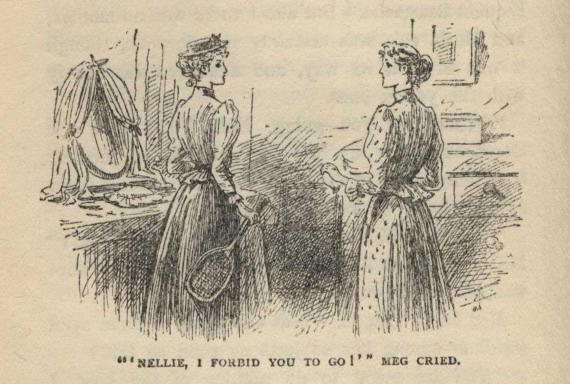
"'NELLIE, I FORBID YOU TO GO!' MEG CRIED."
Nellie proceeded quietly with her dressing, the resolute light in her eyes not a whit diminished. She buttoned her blue tennis blouse, brushed some specks of dust off her skirt, and put a piece of clean belting in her silver waist-clasp.
"I can't believe you're in earnest," Meg began again; "why, you must remember father expressly said we were not to go!"
"He did not tell me; he only said Esther needn't call,—that's not forbidding me!" Nell said calmly.
She put on her sailor hat, stuck the pins through with great care, and made a few little deft dabs at her fluffy side hair. Then she put on her very best gloves and picked up her racquet.
"Nellie, I forbid you to go!" Meg cried, finding neither reasoning nor asking would answer. "Remember, I have been left here in charge of you all, and I absolutely forbid you to go near those Brownes!"
"Pooh!" said Nellie, "I'm nearly as old as you—I'm too big to be forbidden. Give your orders to Peter and Poppet—I'm going!"
And she went.
CHAPTER XVI.
MORE MUTINY.
"Gently scan your brother man.
Still gentlier sister woman,
An' if they gang a trifle wrang
To step aside is human."
That was the first battle; another followed quickly on its heels; and then there came a long and sorrowful peace.
Meg had been exceedingly angry about it—and with justice. She marvelled, not only at Nellie's rebellion, but that she should care to mix with such "impossible" people, as she called them.
"It isn't as if they were merely homely and uneducated," she said; "but their vulgarity and pretentiousness are enough to make any one sick!"
However, as Nellie was very quiet—docile even—after the one outbreak, and as it was not possible to keep up an unfriendly spirit for ever, she thought she had better overlook it as a first and last offence; more especially as she remembered her own mad infatuation for Aldith MacCarthy, when she had been even older than Nell was now.
But she warned her with much resolution in her tone.
"You only leave me one course, Nellie," she said. "I have been left in charge, and if you won't obey orders—I'm sure I try to give as few as possible—I shall be compelled to write to Mr. Hassal and ask him either to send you to school till father comes back or else to let some one come here whose authority you will respect."
Then she softened, and put her arms round her sister.
"Don't make it so hard for me, Nell," she said, almost with tears in her eyes; "there's nothing in moderation I'd try to stop you, but you really must see I can't let you grow intimate with these people."
But Nellie had not responded with her usual sisterly hug and kiss. She wriggled away from the encircling arms and gave a little impatient toss of her head.
"What a fuss you make about things, Meg!" she said pettishly. "I do wish you'd leave me alone! I'm not a child, and I'm not going to be ordered about like one."
Then came the next war.
Cards for a dinner-party arrived from the "unsnubbable" Brownes—Bunty's adjective.
"Put them in the fire," Pip said. "No answer is the best for such people."
If there had been some pretty faces among the feminine portion of the Browne household Pip would not have been so scornful of the overtures, but the girls were each and all undeniably plain. For the days that intervened between the arrival of the cards and the date of the dinner-party Meg was exceedingly busy.
She had a dressmaker in the house making winter frocks for Poppet and Essie; that took up much of her time. Besides this, two great cases of quinces and apples had been sent to them from Yarrahappini, and, with Martha's help, she was converting them into jam and jelly.
Bunty also had been unwell, and from school a day or two, and Peter had one of his perverse fits upon him. She had not had time to give the Fitzroy-Brownes as much as a passing thought; and as the new daily governess made no complaint about Nellie's morning studies she concluded all was going on well.
Judge therefore her immeasurable amaze when, going up to the bedroom on the date of the dinner-party, and just after nursery tea was over, she discovered Nellie again in the act of making a "toilette." She had the white crepon dress on; it nearly touched the ground in front, and trailed a little behind. There was soft lace in the neck and sleeves of it, and on her bosom a cluster of the exquisite pink roses that climbed all over the tool-shed. She had white suede gloves and black pretty shoes, both new, as the gap in her small allowance testified.
Excitement had lent a brilliant colour to her cheeks; her eyes, with their thick, curled lashes, were like stars. For one second Meg paused, struck with the wondrous, exceeding beauty of her young sister; the next she realised what she was dressed for.
"Where are you going?" she said, merely as a matter of form—of course she knew.
"I'm going to the Fitzroy-Brownes at Trafalgar House for a small dinner-party,—seven to ten, carriages at half-past," Nellie said, with elaborate attention to detail. "Is there anything else you would like to know?"
Meg went a little white.
"You don't move from this house, Nellie!" she said, and her lips set themselves firmly. "You can take off that dress as soon as you like!"
Nellie twisted a long lace scarf round her beautiful shining head.
"It's no use making a bother," she said; "I've made up my mind to go, and I'm going!"
"I refused the invitation," Meg said, catching at a straw.
"But I accepted," was Nellie's answer. "I met Isabel yesterday and promised."
For ten long minutes did Meg argue, reason, coax, and appeal to Nellie's better judgment: the fear of Isabel's sneers, together with the thought of the cost of her shoes and gloves, were of more avail. The girl was quietly obdurate; Meg found she was not even listening to her.
"They are sending a brougham down to pick me up at the Bentleys," she said, when Meg was almost exhausted; "I shall miss them if I wait any longer." She moved to the door.
But a flame of righteous anger sprang up in Meg's eyes. She hastened down the corridor to Pip's room, and laid the case in a few words before him.
Offended as he was with his sister, he could not refuse to uphold her in a matter like this—especially as he had such a vast contempt for the "mushrooms."
He caught Nellie on the staircase.
"Don't be such a little idiot!" he said. "Go and take that frippery off at once!"
"Go and mind your own business, Philip Woolcot!" retorted Nellie.
"Well, of all little donkeys!" he said. "Do you actually mean to say, Meg, she was going off on her own hook, without you or me or any one?"
"I certainly do think she's losing her senses!" Meg said in exasperation.
Philip surveyed her in silence for a minute—her exquisite, childish, unformed beauty even appealed to his coldly fraternal eyes. He smiled almost benignly.
"Be a good little chicken," he said; "wait three or four years, and you shall revel in this sort of thing till you find it's all vanity."
Three or four years! Nellie's eyes flashed defiance at them both.
"I'm going," she said, in a low, very determined voice. She brushed past Meg and went down five stairs.
But "Are you, my lady?" quoth Pip. He jumped the steps, caught her, and held her fast.
She struggled violently—anger and excitement lent her unnatural strength—and she freed herself at length, and fled in wild, mad haste down the stairs and to the front door. Once in the brougham, which was only a little way off, and she knew she could bid defiance to all the Megs and Pips in the world!
But Pip's blood was up. He had no intention of letting a little chit like Nellie get the upper hand of him, even if there were no real object at stake. As it was, the thought of his pretty, innocent little sister in the company of the "off crowd" of men he had seen young Fitzroy-Browne take home, and the loud women with whom he felt instinctively the girls consorted, made him shudder.
"Are you going to stay at home quietly?" he said, fire in his dark eyes as he caught her by the arms just as she was pulling the door handle back.
"No, I'm not!" she said stormily.
For answer he picked her right up in his arms as if she had been Poppet.
"Where shall I put her, Meg? I'm going to lock her up," he called breathlessly; she was not fragilely light.
Meg was a little startled at such a summary proceeding; then she decided rapidly it was the only thing to be done at the juncture.
"Here!" she cried, "in her own bedroom." She flung open the door, and he strode down the passage with his struggling burden in its dainty dress and sweet, crushed roses.
They left her the light. There was a shelf of books to occupy her if so she liked, also her work-basket, with a fleecy cloud she was crocheting; she would be able to fill the time. But they locked the door very carefully, and took the key downstairs with them.
"You must have been exceedingly careless, Meg, to let her get to know them," Pip said, with masculine inclination to locate blame.
Meg told of the introduction and subsequent meetings—how it seemed impossible to get the people to accept the frequent if delicately-conveyed hints that their acquaintance was not desired. She kept the tennis episode to herself, for she feared it would only make him more harsh and overbearing to Nellie, and do no good.
When they were separating some time later she looked wistfully up at him.
"Dear Pip, aren't you ever going to forgive me?" she said; "can't you see I only did it for your good? Do let us kiss and be friends again."
He looked at her very coldly and sternly; the old bitter curve showed at his mouth.
"No," he said, "I shall never forgive you while I live, Meg." Then he turned and went out of the room.
Meg went upstairs, tired, dispirited. Tears smarted in her eyes from her rebuff. Nellie, she knew, was thinking hard thoughts of her; Alan had not written to-day, for some reason or other; and all the world seemed wrong. She went into her room and sat down, with a sob and some splashing tears, in the dark by the window.
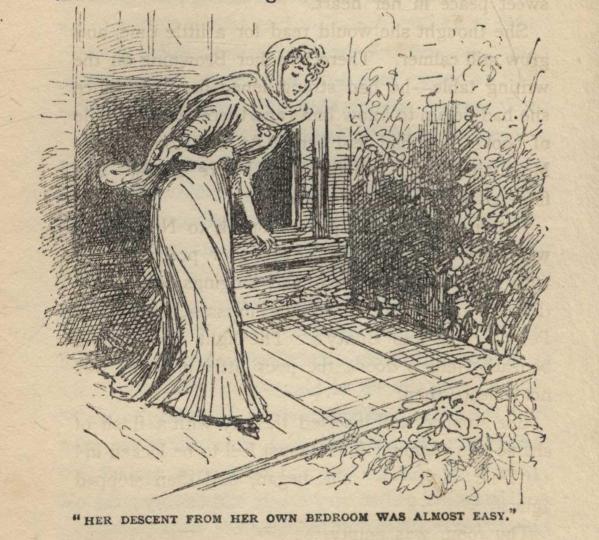
"HER DESCENT FROM HER OWN BEDROOM WAS ALMOST EASY."
Such a great calm sky of pale, sweet stars; such a hushed, faint breath in the tall gum trees; such a low, soothing lapping of little river waves!
In an hour she was very strong again; her eyes were dry and calm and brave; there was a great, sweet peace in her heart.
She thought she would read for a little time, and grow still calmer. There was her Browning on the writing table—he had strengthened her often since she had begun to know him; and there were a couple of books Alan had lent her: "At the Roots of the Mountains," and something of Pierre Loti's. She fingered them a moment.
But first she would go and speak to Nellie, who would be calmer too by now,—poor pretty Nellie, with her childish defiance and longings for "other things." She went down the passage, softly, by Peter's room and Bunty's. The light was shining beneath Nellie's door; the poor little prisoner was not asleep, then.
She stopped and inserted the key with a flush of shame: how ignominious it must feel to be locked in!
"Dear Nell——" she began, and then stopped aghast.
The room was empty.
CHAPTER XVII.
A DINNER PARTY.
"Oh, would I were dead now,
Or up in my bed now,
To cover my head now
And have a good cry!"
Trafalgar House, if you please. Time, about eight o'clock. Dramatis personæ some fifteen brilliantly-dressed ladies, and as many gentlemen in regulation evening attire.
A great long table, magnificently set, and ablaze with tiny electric lamps cunningly hidden among foliage and splendid flowers. At one end Mrs. Fitzroy-Browne in rich black satin, a truly astonishing cap, and twice as many glittering rings as she had fingers.
Mrs. Fitzroy-Browne, with a large fixed smile that only her fork or spoon ever disturbed—Mrs. Fitzroy-Browne, with one anxious eye on the waiting servants, one half frightened on her son and daughters, and only the large smile for the guests.
At the head Mr. Fitzroy-Browne, a small, neat man, with little eyes and a half-apologetic, half-assertive manner, as if he were begging your pardon for the great wealth that made you mere nobodies, and at the same time hugging himself mightily.
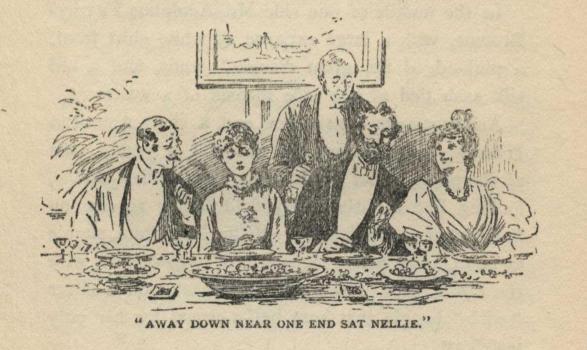
"AWAY DOWN NEAR ONE END SAT NELLIE."
At intervals down the sides the Misses Fitzroy-Browne, in decolleté dresses of latest style.
Sandwiched with them and other females with large bare arms and rough, fashionally-coiffeured hair, net-covered, men of various sorts and conditions,—self-made men like their host, who came to approve the show money could make; a few of better position, who enjoyed the wines and good dinner and despised the vulgarity of the givers; a good-looking adventurer or two of higher society, remittance men, who, having almost outrun the constable, as a last resource came heiress-hunting.
In the middle of one side Mr. Adolphus Fitzroy-Browne, with a large expanse of white shirt front, a pink-edged tie, great diamond studs, and a red silk sash tied at one side instead of a waistcoat.
And away down near one end, a stout American Hebrew, dinner intent, on one side, a young man of the puppy order on the other, sat Nellie,—Nellie, looking like a little lonely field flower sprung up in a bed of gaudy dahlias,—Nellie, in a white, simple dress of home make, high-necked, long-sleeved, with the dying pink roses at her breast, and a silver "wish" bangle that cost half-a-crown for her only jewellery.
Poor little Nell! Never perhaps in all her fifteen years had she been so immeasurably miserable and uncomfortable.
In the drawing-room the women had stared her up and down in scorn, and rustled about in voluminous silken and velvet skirts; the thought of her own plain, high-necked dress made her cheeks burn. The Misses Browne had been too busy with entertaining to do more than give her a nod and a word or two as they introduced several of the men to her.
"Daughter of Captain John Woolcot," she overheard one of them whisper once,—"poor, but of very good family, related to a title; great friend of dear Isabel's; pretty little thing, yes; quite a charity to show her some life."
Nellie had blushed hotly, and shrunk back into a corner. Oh, if only there had been a door near and she could have slipped out and flown through the night back to dear, despised Misrule. If only the floor would open and mercifully swallow her out of sight! If only there was a window near, through which she could make her exit from Trafalgar House for ever! But alas! the drawing-room was upstairs here, and there were no convenient tanks and thickly-wooded creepers such as had made her descent from her own bedroom almost easy. There was a little patch of green on her skirt, and a pin held together a ripped flounce, but, certainly, no one in that gay assemblage suspected her of leaving her own home by any more unusual mode of exit than the front door. It was even worse when a move was made towards the dining-room, and she was assigned to a youth in a chokingly high collar, a youth who said ya-as and haw, and left out his r's and g's because he had been told it was "as done in London."
She was in a hot state of nervous distress even when no one was speaking to her; it was increased tenfold when she found this man evidently expected her to talk and be talked to all the time.
He asked her whose dancing she liked best, Sylvia Grey's or Marion Hood's.
"—I don't know either of them," she answered, wondering distressfully if she ought to use her silver knife and fork or an ordinary fork only for the paté-de-something that the footman had just given her.
"Haw," said the youth, "at the theatre,—don't-cher-know,—haw—haw, very good."
Nellie's cheeks burned. He looked at her with impertinent admiration.
"Like to see a garl blush myself, don't-cher-know," he drawled, "shows they're young. Lord! what wouldn't the old ones give to do it—our friend Miss Isabel, for instance?"
Nell's pink deepened to scarlet under the cool audacity of his stare. This was the first experience of the kind she had had in her life; all the men she had hitherto met on equal terms had been gentlemen unmistakably.
But she did not speak; her long eyelashes lay almost tremblingly on her cheek, and she took a mouthful or two of the paté; she had decided to use the fork, and then crimsoned afresh to see most of the others employing knife as well. The pastry broke up into little flaky pieces; in vain her one implement chased them round her plate, she could only get a crumb to stay on the prongs each time.
"Haw—what lovely long lashes you've got, Miss—haw—Woolcot, wasn't it? I suppose that's why you keep persistin' in lookin' down, isn't it now?" said the voice at her elbow.
She looked up in desperation, her cheeks aflame again.
"Haw, that's better," he said; "now I can see your eyes. I couldn't when you kept them so cruelly hidden, don't cher see."
Then the Hebrew neighbour claimed her attention.
"Grand finisht dot vash at Randwick, Sat'day," he said. The servants were bringing him fresh supplies, so he could spare time for a minute to speak to the pretty little girl beside him.
"Yes," assented Nellie in a hurry. She had not caught what he said, but thought it would be easier to assent than tell him so.
"And vich horse vos it you vos backing?" he pursued.
Then she had to explain she had not heard what he said; and afterwards, that she had never been to the races in her life.
The Hebrew had no other conversation at command just then, so he returned to his fresh plateful, and left her to her other neighbours, who smiled openly, but made no movement to help her when a servant brought champagne, and she was perplexed to know whether she ought to offer one of the many glasses beside her or remain passive. She had never thought it possible for a meal to last the interminably long time this one did.
The others seemed to be enjoying themselves exceedingly. There was loud talking and laughing on both sides, wine was flowing freely, and there was an exhaustless supply of good things to eat.
Nellie wondered miserably if Meg had found her out, as she dipped her finger tips into the Venetian glass finger bowl. There was a tiny William Alan Richardson rosebud floating there; Meg had had a cluster stuck in her waistband when she had been entreating her to give up this dinner. Dear, dear Meg! and to think she had vexed and worried and grieved her like this, just for the sake of these horrible people and their thrice horrible dinner-party!
Her eyes ached with tears, there was a lump in her throat, a tightness at her heart; the young man at her elbow was talking, but she neither heard his words nor turned her head. Then he laughed out, and the Hebrew gentleman touched her arm. All the ladies had risen and were on their way to the door; she only was sitting still, her gloves yet off, her young, unhappy face downcast. A wave of colour rushed into her cheeks, and as she jumped up hurriedly, every one was looking at her, half amusedly, half admiringly. Isabel at the door waited for her, a little vexed.
"What were you dreaming of?" she said. "Why, you haven't even got your gloves on."
"Dear Miss Isabel," Nellie said, entreaty almost tearful in her voice, "do let me go home now. Indeed I must,—oh do, do, do!"
But "What nonsense, child!" Isabel answered, and bore her along with the others into the brilliantly lighted drawing-room.
Here it was not quite so bad. Nell saw a chair half hidden behind a window-curtain, and felt she had indeed come into a haven of peace when she gained it. No one disturbed her for a time; some of the girls yawned openly, and kept their speech for the arrival of the gentlemen; one or two frankly closed their eyes to show the small appreciation they had for their own sex; the others discussed the men, their moustaches, money, eyes, figures, in a way that made the one violet in the room want to shrivel up or turn rosy for the shame of her girlhood.
They all ignored Mamma Browne, who had a spacious velvet sofa all to herself; she would have liked to knit or do something with her fingers, but the girls had told her it wasn't "good form," so she only twisted them in and out of each other, and wondered if the people would go at eleven or twelve, and whether they had noticed that only three servants waited instead of the five they always had for the parties.
Then she noticed the little lonely figure in white by the great window. There was a droop about the little sweet mouth and a misty look in the sweet eyes that quite touched her kind old heart. She got up and waddled slowly across the floor. "Come and sit on the sofy with me, dearie," she said; and all Nellie's heart went out to her.
The sofa was in a deep window at the end of the room, quite away from the loud-voiced, finely-dressed girls who so overpowered her.
"Oh, do let me stay with you all the time, please!" she said, as she nestled down close to the motherly, capacious-looking old lady. "Oh, it is much nicer here—may I?"
"Why, of course," said Mrs. Browne; "why, I'll be glad to 'ave you; you ain't been enjoyin' yourself, I'm thinkin'?"
"Oh," said Nellie, who was a polite little soul, even in distress, "oh, it has been very nice, I'm sure, only I don't go to dinner parties yet, and so I am a little shy, I suppose."
"Well, I ain't enjoyed it," said Mrs. Browne, with a sigh; "they worrit my life out, these parties, and unsettle the servints, and make all the house rumpled up, and then no one says thank you or likes you a bit better for it all."
She felt she might ease her poor old heart a little to this young girl, whose dress was not fine enough to make her haughty, and whose face was sweetly sympathetic.
"Oh, I'm sure every one has enjoyed it very much, and thinks it is very kind of you to give such a nice party," Nellie said, touched by the tired quaver in the speaker's voice.
"Me!" the old lady replied, with a touch of bitterness. "I'm only their mother, I don't give it, bless your soul!—all the good mothers is nowadays, is to mind the servints and take blame when things go wrong. Me! All I 'ave to do is to order dinner and stay up till every one's gone."
She rocked herself to and fro unhappily; her state of bondage was beginning to tell upon her.
"Ha' you got a mother?" she asked, turning sharply on her young guest.
And Nellie's reply was very low and sad: "She died nine years ago."
The poor child was in the mood to-night to long inexpressibly for the soft arms and breast of a mother. There was silence for a few minutes.
"Ah!" said Mrs. Browne, and her voice also was very low, and a little unsteady with tears, "she was fortunit, mothers had oughter die when their childers is little and loves them. When childers is growed up mothers is only in the way."
Nellie stretched out her young hand and stroked the poor old fat one that was tremblingly smoothing imaginary creases out of the sofa seat. "Why, I would give all the world if my mother were alive," she said, with eager hurrying lips, "and Meg and Pip would,—all of us, dear Mrs. Browne. I think it is just when we are grown up we love mothers best, and want them most."
"Not me," was the slow, sad answer, accompanied by a furtively wiped tear. "Not mothers as ain't been learned grammar proper when they was young. Them's the kind of mothers as had oughter die afore their boys and girls are growed up."
Then the gentlemen came in, and there was a louder buzz of talk, a new settlement of chairs, and presently some excessively noisy music.
"I'm just goin' to get something for my 'ed, it aches so bad," Mrs. Browne whispered to Nellie after a time; "they won't notice if I slip out when Miss 'Udson goes to the pianee."
Nellie lifted eager eyes. "Let me come with you,—oh, please!" she said impulsively, and the next minute the two were stealing out of the nearest door together.
In the dimly-lighted bedroom the old lady gave way altogether, and sobbed for a long time in a heartbroken way, much to Nellie's distress.
"Oh, I wish I was dead, I do—I wish I was dead!" she said, with a little rocking movement to ease the sorrow of her poor old heart. She mopped at her eyes occasionally with her lace-trimmed handkerchief; in olden days she would have put her apron over her head and shed her tears behind its screen; but even that solace was denied her now.
Nell found eau-de-Cologne on the dressing-table, and insisted on bathing her head with it, and then fanning slowly with a palm leaf till the poor thing's agitation calmed and the burning head was a little cooler.
"I think I've let things worrit me too much to-day," was her faltering excuse when, half an hour later, she awoke to the fact that Nellie was still fanning her; "but no one knows what my poor 'ed 'as been lately. Marthy the parlour-maid was sick last night, poor thing, and I sat with her till near two; and James the other footman begged me to let 'im go off—they said 'is little girl was bad with scarlet-fever. I 'ad to let 'im, of course, and you could see 'ow vexed Pa was when we was short-'anded at table. It worrited me awful."
There was a rustle of silken skirts along the corridor, and a patter of high-heeled shoes. Isabel had suddenly missed her young guest, whose eyes she had so wanted to dazzle; it struck her with infinite vexation that it was more than probable she was with her mother, despising her hugely for her ungrammatical language and many banalities.
"Well, really!" she said, sweeping into the bedroom, and looking vexedly at the two on the sofa.
Mrs. Browne struggled instantly to her feet.
"I'm just comin', my dear,—comin' this minute," she said, in a voice whose nervousness struck Nellie as strangely pathetic. "I thought the folk wouldn't be missin' me just for a bit."
"Oh, I never expect you to do things like other hostesses," her daughter answered rudely. Then she turned to Nellie.
"I don't know what you want to run away like this for; I shall begin to think you're not enjoying yourself. Come, we're going into the ballroom to have a dance or two: can you do the cotillon?"
She swept her away to the lights and music again, to fresh vexation of spirit that self-forgetfulness for a time had made less keen.
In the midst of a waltz with her odious dinner companion Nell caught sight of her so-called hostess, who had followed her daughter back to the room.
She was sitting, poor fat old creature, on a stiff chair near the wall, blinking patiently at the dancers, the large set smile on her face again, and a headache pucker on her forehead.
To Nellie the one bright spot in that dreadful evening was the thought of her touching, surprised gratitude at the trifling service she had done her.
"I just wish you was my little girl!" was her wistful speech at parting, when twelve o'clock put an end to the revels,—"oh, 'ow I wish you was my little girl!"
CHAPTER XVIII.
"HOW GOOD YOU OUGHT TO BE!"
"Greater than anger
Is love, and subdueth."
The silence of midnight hung over all the house—there was darkness in all the rooms save one. Outside, the rain was falling, but without noise; sometimes the wind blew it against the window-panes in little gusts like the light spray of waves, but for the most part it fell in straight, silent sheets upon the soaking garden and paddocks. Now and again the same fitful wind stirred a Japanese sun-blind at the end of the side verandah. It had a broken pulley, and was hauled up slant-wise; when the wind stirred, it moaned and creaked like a live creature.
Meg was sitting on the drawing-room hearthrug, her head in her hands, her fair hair rumpled back from her forehead, her eyes, intensely thoughtful, fixed on the ashes in the grate. Early in the evening a fire had been lighted; for, although it was only May, it had been a chilly day. The fire had gone out, however, and Meg had not noticed this, though she had been staring hard at it most of the time.
Only one gas-jet was alight, and it was turned low—the room had almost an eerie look in the faint light. A great vase of pampas grass and bulrushes loomed tall and ghostly from the corner near the piano; and a wet, dull moon—when the drifting clouds permitted—looked in at a little side window where the blind was not drawn.
Every one in the house was asleep but Meg.
She was sitting up for Nellie.
Pip had gone out before she had found the bird was flown from the cage in which he had locked her. There was a smoking concert at one of the Colleges, and he had left word that he should not be back that night at all—the last boat left so ridiculously early that one of the men had offered him a bed.
So Meg kept her lonely watch with cold feet and low spirits.
She was wondering if it was not very selfish of her to think of being married. Alan had given her a year, under protest,—at the end of that time he would assuredly claim her. No one was less conceited than our sweet, pale Margaret, but she could not help seeing that things would be much worse at Misrule when her place knew her no more. There was little, eager Poppet with her excitable nature and wonderful capacity for feeling everything,—who would listen patiently to all her funny little plans and thoughts, or take an interest in her keen childish troubles and joys? Poor, reclaimed Bunty, whose sullen reserve and brooding fits of depression she was just beginning to understand and sympathise with—if the old days of "John" and carping blame began again, his character would be ruined.
And Pip, who had just left his glad boyhood paths and was stepping so carelessly into the strange, sorrowful ones of manhood, where there were precipices and pitfalls at every turn,—how she longed to be at his elbow again, giving him the right kind of help! He had spurned her away just now, she knew; but soon, she felt certain, she could slip back to him as if nothing had happened, and keep him from worse things, perhaps.
But not if she made fresh ties for herself.
She told some of her fears, half falteringly, to Alan.
"I think you must give me longer," she said.
But he only laughed at her. Men never understand these things.
"I didn't think you were conceited, Meg," he said; "why, Nellie will make a model eldest sister, by-and-by, of course. And I have far more need of you than these children have. And I'm not going to take you to New Zealand or the Islands; we shall live somewhere in Sydney, and you will still be able to keep your eye on Bunty's collar,—that's the greatest grievance, isn't it?"
Meg was trying to imagine beautiful, spoilt Nell as a model eldest sister this evening as she sat on the hearthrug. Why, not one of the young ones would have acted so wrongfully, so utterly foolishly as she had done about these Brownes; the girl had no "balance" naturally, and her great beauty already seemed likely to prove as much of a snare as beauty is popularly supposed to be. She was not even decently educated; the daily governess they had had so long had been a person of weak will, and Nellie in especial had learned or refused to learn much as she pleased. True, she could play and sing fairly well, and write a ladylike hand; but her French was hopeless, her slate pencil had not travelled beyond discount and the rule of three, and her acquaintance with the great lights of English literature was so restricted that, though she knew Shakespeare wrote "Romeo and Juliet," and "Paradise Lost" was composed by one John Milton, nearly all the other names she met conveyed nothing more to her mind than that they were "men at the end of the history book."
Meg's lips grew severe as the night wore on. In truth she did not know what to do in this crisis, she felt so young and powerless. If Nellie insisted on going to Trafalgar House every night of her life, how could she prevent it? She told herself her sister knew this, and was taking advantage of their father's absence in an exceedingly unworthy way.
Through the rain came the half-deadened sound of wheels along the road. Meg stood up, cramped and cold, sick at heart. How she did dread and detest "scenes," and she knew there must be one!
The gate clicked, but no wheels came up the drive. Meg pulled herself together and went out to the front door with a little shiver. She knew exactly how it would all be: Nell would be flushed and beautiful and defiant; she would brush past her and go upstairs in her pretty, white trailing gown, her head very high. She would most probably say "Mind your own business" or "Hold your tongue," for both these phrases were in Miss Nellie's vocabulary of anger. And then she would lock her bedroom door and go to sleep, rebellious as ever.
Her cold hand pulled back the heavy fastening of the door when light footsteps fell on the verandah. She stood there in silence. But oh! such a little woebegone, dripping wet figure was there, with no wrap on at all, and only a bit of soaking lace on her head!
"Oh, Meg!" she said, and sprang into her sister's arms with a hysterical sob of relief. "Oh, Meg, Meg, Meg! oh, my darling old Meg!"
What could Meg do?
Be angry when the wilful, beautiful creature was sobbing so pitifully?
Shake her aside and speak coldly when she was clinging to her with such a passion of love and relief? She kissed the face, wet with rain and tears.
"Come and get your wet things off, dear," she said; "you should have driven up to the door, the drive's so long."
"I was afraid it would wake every one," was Nellie's answer, broken in three places.
Even when Meg had taken off, with her own hands, the poor spoiled white dress, and wet white gloves, and little muddy shoes; when she had made up a crackling fire of wood in the bedroom open fireplace, and brought her own cosy red dressing-gown and a white shawl for array, Nellie still wept heartbrokenly.
She was overwrought with the excitement of her escape, the evening, and her return. And now Meg's tenderness and utter absence of reproach broke her down altogether.
She put her head on the arm of the easy chair, and all her body shook with sobs.
Meg only stroked the wealth of beautiful hair she had let down to dry; she felt it better not to speak at all.
By-and-by she slipped out of the room and stole down to the kitchen. When she returned, Nellie was a little calmer, and even gave a wet look of interest at the tray she carried. There was a little old saucepan on it, a tin of café-au-lait, two cups, sugar in a saucer, the end of a loaf of bread, and some pineapple jam.
"I couldn't find the butter," she said, half apologetically, as she set down her load on the bed edge.
"Oh, I don't deserve it!" wept Nellie, meaning less the butter than Meg's kindness.
They had to use the water out of the wash-stand bottle, and in the absence of spoons had to stir their cups with the bone ends of their toothbrushes, but the meal gave them both new life and spirits. Meg toasted the bread on the end of her knife and spread a piece thickly with the toothsome jam. She proffered it to Nell with burnt cheeks and a gay little laugh.
"Oh, Meg, you are the best girl on earth!" the girl said, flinging her arms impetuously around her sister's neck. "I'm not fit to black your boots! there's nobody just like you, Meg, in all the world. Oh, Meg darling, why can't you make me more like you?"
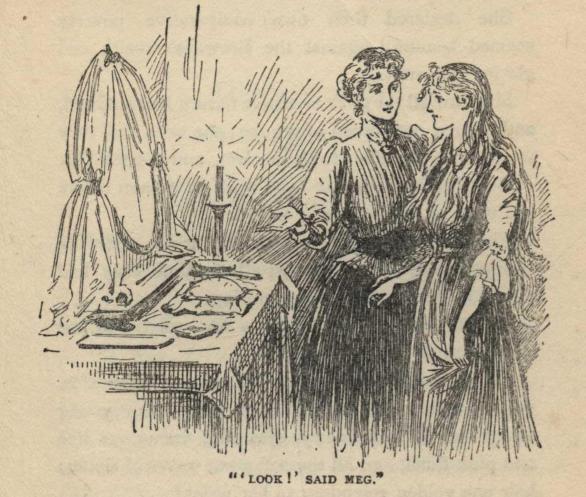
"'LOOK!' SAID MEG."
Meg only kissed her for answer, kissed her with a sweet, moved look on her face. And then Nellie told everything: how she had dropped from the window on to the tanks and scrambled down from there with the help of the creeper, how she had been in time for the brougham they had sent, how utterly miserable she had been all the evening.
She declared their own comparative poverty seemed beautiful against the Brownes' wealth and glaring vulgarity.
Meg saw all the girl's sensitive nature had suffered, and uttered not a word of rebuke; she even said they would keep the affair to themselves, and not tell Pip.
But she dropped one little word in season before she went to her own room to bed.
The dressing-gown suited the girl's exquisite young beauty marvellously; all the time they had talked Meg could not help admiring.
When they got up she drew her quietly to the long glass of the dressing-table.
Oh the wonderful picture it showed! the rich, warm colouring of the graceful gown, the young sweet face with its dewy eyes and tremulous lips and pink flush, and all the soft great waves of riotous hair one golden splendour to her waist!
"Look!" said Meg.
The girl looked at her image shyly, almost shamedly, but with a certain little glad quickening at her heart.
"Oh, Nellie! how good you ought to be!" whispered the elder girl, and kissed her and slipped away.
CHAPTER XIX.
HEADACHE AND HEARTACHE.
"Look where the healing waters run,
And strive and strain to be good again."
Poor little Nell,—it was almost pitiful to see how good she tried to be after her escapade. There was absolutely nothing she would not have done for Meg. She begged to be allowed to help in the housekeeping, offered to take the darning of Bunty's socks and Peter's terrible stockings as her own particular work, and sternly refrained from looking in her glass when it was not necessary for the straight set of her collar or respectable appearance of her hair.
She consulted Meg as to the best study she could take up—she said she felt ashamed to be so dreadfully ignorant.
"Why, I haven't read anything better than Jessie Fothergill and Rhoda Broughton this year," she said, in a tone of stern surprise at herself.
Meg suggested the "Essays of Elia," "The Professor at the Breakfast Table," "Sesame and Lilies," Lives of various poets.
"You can go then gradually to something deeper," she said. "I'm afraid you might be discouraged if you started on anything more solid just yet."
But Nellie's zeal was too tremendous for half measures.
During the morning of the day after the dinner party, Meg had occasion to go into the nursery for something or other during Miss Monson's hours, and with difficulty restrained a smile.
Nellie always studied—or pretended to—at a rickety-legged draught-table in the window. Her working materials hitherto had consisted of a chased silver pen that looked too elegant to write with, an ornamental inkstand with violet and red ink, a box of chocolates, a novel in brown paper covers, "Le Chien," highly dilapidated, and "Samson Agonistes," which she was supposed to be studying in detail.
This morning all was changed. There was black ink in the bottles, the silver pen was invisible, and a plain penny red one occupied its place on the stag's head. No trace of chocolates, no covered fiction at all. Instead, a pile of books selected from the study simply because they were the most solid looking and driest on the shelves. The choice had occupied Nellie for almost an hour; if any she took down had spaced matter, light-looking conversations, or broken-up paragraphs she instantly replaced them. She had finally selected and carried to the nursery, to Miss Monson's incredulous surprise, the following six: "Sartor Resartus," "The Wealth of Nations," "Marcus Aurelius," "Mazzini's Essays," the "Rise and Fall of the Roman Empire," and Johnson's "Rasselas."
When Meg came in she was struggling with Carlyle, fingers at ears to keep him quite apart from the object lesson on Ants which Miss Monson was delivering to Poppet and Peter. In the afternoon she practised for two consecutive hours, not waltzes and scraps from the "Mikado" and "Gondoliers" and "Paul Jones" as usual, but Plaidy's technical studies and Czerny's Velocity Exercises and a fugue from Bach.
At night she took out a quantity of red wool that she found in a box, and began to crochet a petticoat for an old woman who lived in a tumble-down bark hut near the river, and had the reputation of being mother of two bushrangers who had been shot, sister to a famous murderer, and daughter of one of the early Botany Bay convicts.
But of course such an abnormal state of goodness could not be expected to continue uninterruptedly, at any rate in its early days. In less than a fortnight the silver pen made its reappearance, and violet ink crept back into one of the bottles. The crochet needle was slipped out of the sixth row of the petticoat and made to work fleecy white wool up into that pretty style of head wrap known as a "fascinator."
"Oh, I didn't do anything so very dreadful, after all," she said to herself, with the blunted memory of ten days. "Dear old Meg is always a little inclined to make mountains out of molehills."
At first there had been a little real fright mixed with the thought of the dinner-party. Five days after it was over, she was in at the chemist's spending eighteenpence of her allowance on a sweet little bottle of scent for Meg.
And one of the grooms from Trafalgar House came in with a prescription.
"The old lady's pretty bad," he said, in answer to a question of the chemist that Nell had not caught, "and two more of the maids are down."
Nellie lingered a few minutes, counted her change several times, examined the nail and tooth-brushes displayed in a glass case, and read an advertisement setting forth the merits of somebody's pills.
The man said he would call back for the medicine in half an hour, and departed. Then she went back to the counter.
"Is it Mrs. Fitzroy-Browne who is ill?" she asked, remembering with a pang the poor old woman's wistful "I just wish you was my little girl!"
"Yes, she's down with scarlet-fever—several of the servants too," he said, and went to the gas to melt some sealing-wax.
The girl went home with a grave face. Apart from regret at the old lady's illness, there was the fear that she herself might have caught it. She went straight to her room and examined her tongue anxiously at the glass; then she held one wrist gravely with a finger and thumb, and asked herself if she felt feverish.
But the pulse was calm, the tongue healthily red,—she laughed at herself.
"I never felt better in my life," she said aloud. After some deliberation she decided she would not tell Meg. "She'd only worry, and prepare herself for my immediate funeral," she thought. "I should be all over red spots by now if I had got it."
So that is how it happened, when ten days had gone and she still felt exuberantly well, that the silver pen returned and the fascinator was commenced. One could not wear sackcloth for ever.
She even borrowed "Comin' thro' the Rye" and "Joan" from a girl-friend; and "Rasselas" and "Sartor Resartus" slipped down behind the table and were forgotten.
But she had intended all the time to consult Alan. He had been away for almost a fortnight in Victoria, or she would have asked him before.
The afternoon he returned, and as soon as she could get him away from Meg, she asked him if he would come down into the garden with her, as she wanted to ask him something very particularly.
The young doctor laughed, and put himself very much at her service.
"I hope it's not about the style of hats in Melbourne," he said in mock alarm, as they went down the path; "for I culpably forgot to notice. If it's only sleeves, now, I can tell you—they're up to the ears, and a yard and a half wide."
"It's about the state of my health," she said sententiously,—"I wish to consult you professionally, Dr. Courtney!"
He put on a sympathetic look.
"The heart, I suppose?" he said.
But Nell stopped short in the summer-house.
"Don't be stupid!" she said. "Look here, Alan, have I, or have I not, got scarlet-fever?"
He could not help laughing. It seemed so absurd for a fine girl—the picture of health—to ask such a question.
"Your skin is cool—your pulse normal—your tongue fit for a health advertisement. If you have got it you're managing to conceal it very well," he said. "You might give me the recipe for my other patients."
"I was talking to some one who had scarlet-fever just after," Nell returned,—"that's all."
There was no fun in Alan's face now.
"When?" he said sharply.
"Oh, nearly a fortnight ago!"
"You've not got it, then," he said. "Did you change your things after?—take every precaution? How did it happen?"
She told him everything, blushing hotly at the surprise in his face when he heard she had been to Trafalgar House.
He looked exceedingly serious over it.
"There's no knowing what may be the end of it," he said, a frown of anxiety on his brow. "How could you do such a thing, Nellie? You might have known Meg's judgment would be good."
"But you say I haven't got it," the girl answered, resenting the elder-brotherly tone of reproof, "so there's no need for any more fuss."
"How do I know you did not bring it home with you and give it to one of the others?" he said shortly.
Nell looked aghast.
"Why, I couldn't do that, could I?" she said, with startled eyes. "I never dreamt any one but I could have got it."
"You ought not to have been allowed with the others," he said. "However, as things are, I daresay no harm has been done. No one has been complaining of headache or sore throat, have they?"
Nellie thought hard for a minute or two. She reviewed each member of the family rapidly in succession, and tried to remember if any one's appetite had failed at any meal lately, that was always the great test of health at Misrule.
"No," she said at last. Then she caught her breath.
"Essie had a headache this morning," she faltered. "Oh, but she fell down and bumped her head, so that accounts, and she ate four jam tarts yesterday when no one was in the room; that's the cause of hers, Alan, isn't it?—oh, you can see it is."
"I'll look at her," he said. "Does Meg know anything about all this?"
"I didn't like to worry her," Nellie answered, and followed him up the path like a criminal found out in blackest iniquity. She had never dreamed she was endangering the others. Poppet met them on the second path.
"Afternoon tea's ready, and Meg says aren't you two ever coming in. No, I don't want any, there's only gingerbread."
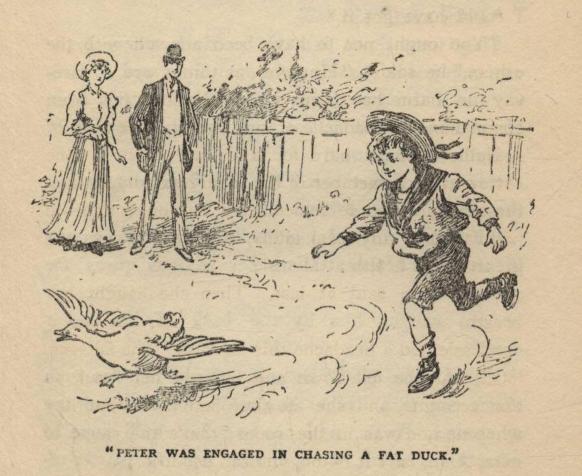
"PETER WAS ENGAGED IN CHASING A FAT DUCK."
Alan felt her pulse, and asked to see her tongue.
"There's something alarming in a little girl who doesn't like gingerbread," he said; but there was a professional look in his eye.
"She never eats gingerbread," Nell exclaimed, almost indignant with him for having fears when the child looked so rosy.
"Poppet's all right," he said in a low tone, as they went on; and Nellie could have cried in her relief.
"Peter next," she said.
They went down into the paddock, where Peter was engaged in chasing a fat duck from end to end, without a thought in his mind of being cruel to it. He was hot, certainly, but that was the exertion of running and shouting.
"Is your throat sore?" Nellie burst out, before they fairly reached him.
"I thould think I can thout if I like," he said in an injured tone, taking her anxious query for sarcasm.
Alan caught him by the back of his sailor coat.
"Mad, quite mad," he said—"only lunatics rush about like this. Hold him while we find out the symptoms, Nellie, and see whether we'll have to extract his teeth, or put his legs in plaster-of-Paris."
"He's all right too, I think," he said, when the released boy sprang away again after the duck, that was panting in a corner with one anxious eye on its enemy.
"Bunty's beautifully well," Nell said eagerly, as they went up to the house again. "You should just see him eat, Alan. And Pip is splendid, so is Meg, as you can see."
Meg was standing on the front verandah, a troubled look in her eyes.
"Oh, there you are!" she said.
"Here we are," said Nellie. She drooped her eyes guiltily. "Is the tea cold?"
But Meg did not answer her.
"I wish you'd come and look at Essie, Alan," she said. "She's been eating pastry, and it's upset her, poor little thing. I don't like her looks."
"Does her head ache?" Nellie asked with dry lips.
"She says her head aches, her throat aches, and her legs ache,—everything aches," was Meg's answer. "Esther always gives her aconite if she's out of sorts, Alan. I gave her five drops this morning: was that right?"
"Quite," he said; "I'll go up and look at her now."
He went up the stairs behind Meg, a very grave look in his eyes.
And Nellie followed with a face as colourless as the great white roses she had stuck in her belt so lightheartedly half an hour ago.
CHAPTER XX.
MY LITTLE ONE DAUGHTER.
"Misery,—oh! Misery,
This world is all too wide for thee!"
The very next day came a letter from India.
"Oh, this beautiful, beautiful country!" wrote Esther. "Oh, the colouring, the life in everything I I cannot tell you how new, painfully new, Australia seems compared with it. Imagine a little perky, pretty cottage beside a grand old castle, whose walls bear the mark of centuries. India is the castle. Or a nice, clean, healthy child in pinafores, very fond of play, and more than a little inclined to be spoilt, beside an old, old seer with a grand head grown white with wisdom, and wide eyes dim with staring at eternity. Australia is the nice clean child.
"It is the age of the place that sobers me. I feel I ought to go about on tiptoe and speak in a whisper half the time. We are at Ajmere just now: from the window here I can see a white temple on the peak of wild mountains. It is called Taraghur, or the abode of the stars, and the Mohammedans make pilgrimages to it. Yesterday we rode (I wear a white linen habit and a helmet, girls) to Pookur, twelve miles away. It is a spot considered sacred by the Hindoos; indeed, it is one of the most sacred places in India. There is a lake lying in a basin among the hills, with its banks studded with buildings, old temples, and gardens, and in the centre a ruined fane I am afraid to say how many hundreds and hundreds of years old.
"To-morrow we go to Musseerabad, where the garrison is that your father has to take notes about; then on to Oodeypore; after that I am not certain of the programme, only—don't all exclaim at once, or I shall hear even at this distance—we cannot possibly be back in the time we said. Your father has written for two months' extension, and really, though of course I want to see you all, and ache sometimes for a sight of my baby's little dear dirty face, I shouldn't like to come without seeing more. Fancy if we had to come back without visiting the Taj Mahal! My only anxiety is that any one should be ill; but then, again, I don't see why any one should be so inconsiderate,—you've all managed to keep in splendid health for years; just keep a clean bill till I get back, and then you shall all take it in turns if you like. Dear Meg, keep Essie's hands from picking and stealing. I dreamt the other night she ate a cocoanut and went in a fit. And Peter, my precious son, don't climb the pine tree till mum comes back—if you must break your dear little collar bone at least give me the satisfaction of seeing it done. Of course there is no earthly reason why any of you should be ill, but I worry a little at times; I suppose it is because of the difficulty in getting letters. We never know where we are going next, so they can't send on the mails from Bombay to us till we write for them. I will send you, by the next mail, an address to write to: we have not decided yet whether we are going to Hyderabad, Madras, or Calcutta. We are picking up presents for you all,—the loveliest chessmen for Pip, a wonderful cabinet of Bhoondee carving for Meg, moonstones from Ceylon for Nell,—something for every one. Such a box we shall have.
"Good-bye, my chickies all; take care of yourselves, and have as good a time as you can. If you should be just a little extravagant with the housekeeping money, Meg, I won't scold you much; you can let Bennett's bill run if you like, and have a little garden party or jollification. Every one kiss my little one daughter for me.
"Your loving old mother,
"ESTHER."
It was only the last part they heeded. What were descriptions of old temples to them with that little tossing head on the pillow?
"Oh, Esther,—poor, poor Esther!" Meg said, with the first sob in her throat since Alan had pronounced it to be the fever—"oh, if she knew!" But she was mercifully spared that knowledge. They held a grave consultation together, Meg, Nell, Pipi and the family doctor, while Alan stayed at the bedside. It really seemed useless to send for the travellers to come home. If it was only a slight attack the child would be quite well again by the time they returned; if—there was a catching of breaths—if even the very worst should happen, still they could not be home in time, and oh! what agony of mind they would have during the long voyage. It was even no use sending a cable until they received Esther's next letter, for they had no address.
The doctor decided the matter.
"Don't send," he said; "please God we'll have the little woman up and well in no time. I will send in a trained nurse, she shall have every care possible. Mrs. Woolcot could not do anything further if she were here herself. Now about the other little folks."
It had been decided at once to send the others away from fear of infection. Pip had even suggested packing them off by the early morning train to Yarrahappini.
But the doctor shook his head. There was the chance that they had the germs in their systems even now; it was neither fair to send them into other families, nor yet wise to allow them to go far from home nursing.
There was a furnished cottage about half a mile up the road: he advised that Poppet, Peter, and Bunty should be removed there until all danger of infection was over.
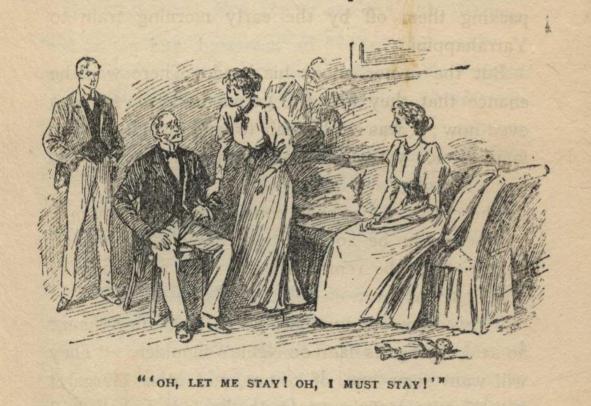
"This young lady might go to look after them," he said, laying his hand on Nellie's shoulder. "They will want some one, of course, and Miss Margaret will be quite sufficient to help the lady I shall send in."
Nellie lifted great beseeching eyes, rimmed with the shadows of a sleepless night.
"Oh, let me stay! oh, I must stay,—it would kill me to have to go!" she said, with a great sob.
"Of course you will have to go, Nellie," Pip said hastily; "don't make extra trouble by being tiresome,—surely you have done enough."
"Oh, hush!" said Meg.
Pip knew now how the infection had been brought, and could not find any excuse for his sister.
"'OH, LET ME STAY! OH, I MUST STAY!'"
But Meg saw the wince of pain that his words caused the poor girl, and knew a little what an agony of remorse she was suffering.
"She'll be out of the danger, too," Pip added, a little ashamed of himself when he saw the beautiful, miserable eyes.
Out of the danger! And the girl was in such a frenzy of repentance and grief, she would gladly have laid down her life just to see Essie go flying down the drive in a losing race with Flibbertigibbet.
She caught the doctor's arm.
"I would watch night and day—I would do anything in the world, anything—oh! let me stay," she said.
"Poor little girl!" he answered, and patted her bright head; he had learnt something of the heart apart from its physiological formation during his long practice. "Poor little girl! standing still is very hard work, isn't it? But all soldiers can't fight at the same time, you know.
"'Yours not to reason why,
Yours but to do or die.
That's not for sword-soldiers only, little girl."
Poor Nellie! no punishment on earth could have been harder for her. To die—that would be quite easy, pleasant even; but to remain passive—oh! it needed greater courage than hers.
To go away, to leave the house, and not even venture past the gates again for weeks, not to see the little sweet sister upon whom her wilfulness alone had brought this suffering, not even to have the relief of spending her strength in nursing! To go away, and eat and sleep and pass the time doing ordinary things, and trying to keep Bunty, and Poppet, and Peter comfortable and happy!
No one would ever know quite what it cost the girl, but it had to be done.
"Mayn't I just see her for one minute, Meg?" she said, her courage failing her at the last minute.
It almost made Meg cry to see the utter despair and misery on her face, and to have to refuse her.
"Alan shall tell you every day how she is. Dear Nell, you know I dare not let you go into the room."
Then she went away to take up her post with the nurse. And Nellie, with that unutterable ache at her heart, had to go and collect the clothes they would all need, the books, playthings,—everything.
She and Poppet, with Bunty's help, were to do the work of the cottage between them. At first, Meg had thought of letting Martha go with them, but afterwards it occurred to her it might be better to let Nellie cook, wash up, and see to everything, just to keep her time occupied.
Bunty was to go to school daily, but Miss Monson relinquished her duties for a time. She had two little sisters and a baby brother at home; no one could say that Peter or Poppet would not sicken personally, and she dare not run the risk. "But Nellie can easily manage the little ones," she said, "and even keep up her own studies; she will have plenty of time."
The little sick child was put into Esther's room, and a bed made up on the sofa for Meg or the nurse. The window looked straight to the gate, and could be seen through a gap in the acacias. They arranged a code of signals to be waved by Meg through it three times a day. She kept a walking-stick of the Captain's just near the window, and with it a white towel, an old red dressing-gown of Poppet's, and a black wool shawl belonging to Martha. The black signal meant "Better,"—not for worlds would they have used the black for "Worse"; the white meant "No change"; the red, "Not so well."
And when that was settled, and every other little matter, and the dogcart filled and sent off with the luggage, then the four sorrowful little figures walked slowly down the drive, waved with wet eyes to Meg at the window, and disappeared round the bend in the road.
And Misrule, strangely quiet for days and days, saw only the silent-footed nurse in her grey dress and cap, and poor Meg with her young shoulders weighed down with the responsibility; the two doctors, Alan and the old one, on occasion, and the maids. Nobody shouted in the nursery or quarrelled and laughed along the passages; no little girls ran lightly down the stairs; no boys tramped up with muddy boots. No ringing voices floated from the grounds through the open windows; no flying figures and yelping dogs went down the drive.
Meg's face grew grave and old-looking those long, slow, silent days when there was so little to be done and so much to fight for. She lost her old trick of dimpling when she smiled—she almost lost the trick of smiling at all. Always there was a picture before her eyes,—Esther coming towards her, radiant with the happiness of home-coming, Esther with outstretched arms and bright eyes with no shadow of suspicion in them.
Always the picture was speaking—
"Meg, where is Essie?—what have you done with my baby, Meg?"
CHAPTER XXI.
THE SEVENTH DAY.
"When the heart is sick,
And all the wheels of Being slow."
Seven leaden days had come and gone. To-night they said the little child would die or live. But the second would need almost a miracle.
All day the red signal had drooped out of a front upstairs window of Misrule. Five times had the children from the cottage trailed with sick hearts up the long red road to the house, and each time had that sorrowful signal been there.
Meg's heart had bled as she floated it out in the morning; only that they had her faithful promise they should not be deceived, she could not have borne to put it there. "Not so well," they had agreed it should mean, but her heart said "Dying" as she fastened it, and she knew the little anxious-eyed group at the gate would read it so.
Such a tiny darling it was, such a wee frail body for the fierce fever to feed upon. How could it stretch out its little listless hands and grasp strongly at that strange thing Life that was slipping so fast away? And ah, God! that those standing by so wild with grief might not put out their eager hands and seize it for her!
After the fifth sad journey the children dragged to the cottage again and cried themselves sick. Poppet began. The minute they got inside the little front room she dropped down in a heap on the oilcloth and sobbed in a wild hysterical way that shook her poor little body all over. Peter fell down beside her and cried in the bitter, astonished, whole-souled fashion of very small children. And Bunty put his rough head down on the table with both his arms round it. Nellie walked past them all into her tiny bedroom, and only God saw her despairing grief. They had had tea before they went the last time, and the early winter darkness had fallen already, though it was only seven o'clock.
Alan had promised to come in at nine and give them the latest report, but how could any of them see the end of that interval with such wet eyes? Time seemed to have ceased for them altogether just now.
After a time, however, Peter sat up straight and looked around; childish tears, thank Heaven, dry quickly. There was one of his little tin soldiers on the hearthrug, and he picked it up gratefully and held it in his small warm hand. Near the fender two of the horsemen with red caps were lying; he would like to have reached them as well, only Poppet's chest was on his other arm, and he could not bear to disturb her.
Five more minutes ticked away by the funny old clock on the mantelpiece. It pointed to a quarter to eight, and had just struck eleven; they all knew by that it was about twenty minutes past seven.
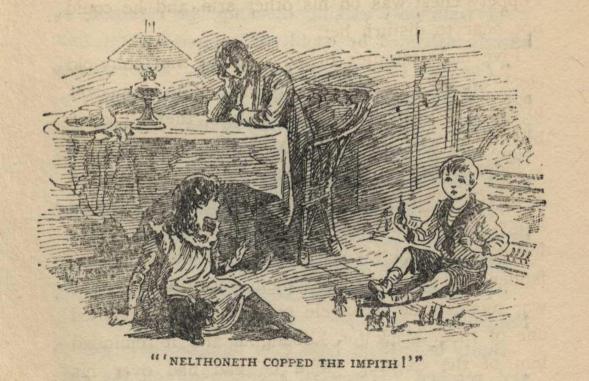
Peter sighed, and very, very softly withdrew his small cramped arm; he waited a minute or two longer, and then crawled over to the horsemen. He felt a chastened joy to find all the boxful in the fender just as he had left them yesterday after the war against the Matabele tribes. He had painted one of them black for Lobengula, and it reminded him of the exciting game he had had over his capture. He wondered, poor little tear-weary boy, would Essie mind very much if he had a little, only a little, game very quietly on the floor now; the oilcloth had beautiful yellow squares, all ready for the different detachments.
Poppet's head was turned the other way; he fancied she was asleep, she lay so still; Bunty at the table had stopped breathing loudly; perhaps he was asleep too; and Nellie was in her room.
"'NELTHONETH COPPED THE IMPITH!'"
He marshalled the little figures up in rows, army against army; the brass toy cannon he gave to the English, but to make up, he put a few more men on the side of the Matabeles. He always felt secretly sorry for them, and often gave Lobengula loopholes of escape that he did not permit to Nelson, Gordon, and Marlborough, who, with small-boy enthusiasm, he had placed in command of his British forces.
The clock struck six, indicated eight, and meant half-past seven. Then the stillness of the little lamp-lit room was suddenly broken.
"Nelthonth copped the Impith! hurrah—hip, hip, hur——"
Poppet sat up speechless. Poor little sinful Peter lowered his head at her accusing eyes and whimpered softly.
"You cwuel boy!" she said
"I wath only picking them up," he returned, so bitterly ashamed he could not be quite truthful.
"I've been cwying hard all the time," was Poppet's sorrowfully superior answer; she was feeling disappointed with herself at being so near her own last tear, and it made her more severe with him. "I don't b'leeve you care a bit."
"I'm thorrier than you, tho there!" he retorted tearfully.
"Why, you've hardly cwied at all!"
"I have, I cried for hourth,—you're a thtory, Poppet."
Bunty bade them hold their tongues. He got up and reached "Hereward the Wake" off the side table to try to occupy his thoughts with; he was half through "Tom Floremall's School Days," and it lay open on the same table, but he felt it would have been unfeeling to read anything so light.
The example, however, encouraged the children. Poppet put out her hand and caught the black kitten that had tapped her shoulder temptingly once or twice; she cuddled down on the hearthrug with it, after giving Peter a kiss of forgiveness.
And Peter, utterly relieved, banged Marlborough and Lobengula together in such fierce single combat that it is wonderful neither of them was decapitated.
The door handle turned and Nellie came in again, Nellie with a sheet-white face, heavy wet lashes, and swollen eyes.
"I'm going up again," she said.
"Tho 'm I," said Peter, springing to his feet.
"An' me," Poppet cried.
"Come on," said Bunty, picking up his hat.
But Nellie shook her head.
"You know your cold's bad again, Poppet; and, Peter dear, it's after your bedtime,—you must stay," she said. "Oh, Bunty, do stop with them."
"I'm sure——" Bunty answered, with contradictory accent.
Nellie caught a sob.
"I shall die if I don't go this minute," she said passionately.
She moved to the door, but Bunty had gone before her.
"We can't leave them,—oh, Bunty, if only you'd stay!" She held his coat sleeve and tried to force him back.
"I want to hear as much as you do," he said, with all his old gruffness; "here, let go."
"I tell you I shall go mad—mad—if I don't go!" the girl said wildly. He saw the burning look in her eyes, the pain at her lips, and fell back suddenly, awkwardly.
"All right, go on," he said.
Then his just wakening brotherly-protection ideas occurred to him.
"I say, you can't go," he said; "don't be a silly. You're only a girl, and it's dark,—let me go, Nell; I'll run all the way, and come straight back and tell you."
"I must go," she repeated hoarsely. "Make them go to bed; give Poppet her medicine; don't leave the matches near Peter."
She slipped off his detaining hand, and the next minute was flying up the road through the cold white moonlight; a small dark figure with desperate eyes, and the wretchedest little heart in the world.
CHAPTER XXII.
AMARANTH OR ASPHODEL?
"Falling with my weight of cares
Upon the great world's altar stairs,
That slope through darkness up to God."
All the way she never stopped once,—it was nearly a mile. Her heart was in her throat, her breath coming in great choking pants; her knees were trembling as she stumbled up against the old Misrule gate, and clung to it blind and giddy for a moment.
There was a step on the footpath—it stopped at the gate. Some one came and peered at her and uttered a cry of surprise.
"Why, Nellie!"
"How—is—she?"
She gasped the words, swayed, and recovered herself.
"I'm just going in again," Alan said. He slipped his arm round her and steadied her—"I told you not to come again, Nellie."
"'OH, LET ME COME!' SHE IMPLORED."
"I couldn't help it."
He saw she couldn't, and did not scold her.
"But what am I to do with you?" he said in dismay.
He was anxious to get in, and now here was this poor, trembling, wild-eyed girl on his hands.
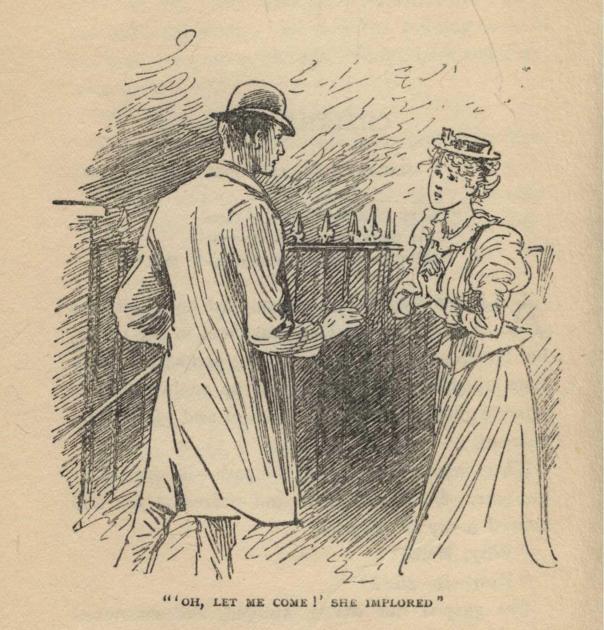
"Oh, let me come!" she implored. There was a sob rising in her throat.
Then he did scold her a little. Surely she was not going to trouble them on this terrible night? Meg was all courage, and quite calm, and so relieved to know the children were being well looked after,—she must not fail them all now at the crisis.
The sob was strangled instantly.
"I'll stay," she said,—"only—oh, Alan, come out and tell me soon!"
He promised he would. He drew her just within the gate and wrapped his overcoat round her, for she was jacketless, of course.
"I trust you not to come past the hedge," he said. "See, stand here, and I can find you easily. There now, dear, I must go."
"A minute—is she in—real danger, Alan? Is she going to die?"
Oh the wide, beseeching eyes, full of moonlight and misery!
He had never told a lie in his life,—never even charged one to his medical conscience; but his arm clasped her more strongly, more tenderly.
"She is in danger," he said quietly. "We are afraid she cannot live; but there is always hope, and the next hour will decide."
She pushed him forward.
"Go!" she said, "go!" and he kissed her forehead and went.
She paced up and down by the low pittosporum hedge that divided the garden from the shrubbery next the fence, and she held her hands so tightly together, that she felt the pain as far as her elbows.
It was full moon to-night.
She remembered when it had been new,—a little, friendly, pretty crescent. They had sat out on the verandah—four or five of them—watching it rise, and Alan had said it
"Was like a little feather
Fluttering far down the gulf."
But Pip said he thought that man saw things straighter who found "the curled moon more like a bitten biscuit thrown out of a top-story window in a high wind." Meg culled from "Endymion." "The beautiful thing," she said,
"'Only stooped to tie
Her silver sandals, ere deliciously
She bowed into the heavens her timid head."
And Bunty said, "What rot!"
How happy and light-hearted they had been then! Oh the strange and sad and oh the glad things that happen in this world between the crescent moon and the full!
Such a white cold moon it was, so far away, so wondrously large and calm. It suggested the immeasurable vastness of the universe, the infinitesimal smallness of herself. Her heart sickened and died within her,—what use was it for her to pray and weep and beat her hands to such a far-off sky? What madness to suppose the great high awful God beyond it would put forth His saving hand just because one small insignificant creature down on earth prayed to Him! Such a faultful creature too; all her life through she could not remember one really good thing she had done, nothing but wrong-doings, littlenesses, and selfishness came to her mind. She looked away from the sky and scornful moon, she went to and fro with her eyes on the white ground.
"Of course it's no use," she muttered, and held her hands together more tightly.
A buggy stopped at the gate. The old doctor got out; he told the coachman not to drive in, but to wait there.
Two people passing up the road saw him, and crossed over.
"How's the little girl?" they said.
And "Very bad, poor baby," was his answer. "I ought to have been here before, but have been at a deathbed."
"Whose?" they asked, in the lowered tones death claims.
"Mrs. Fitzroy-Browne," he said, and hurried away up to the house.
Nellie went back to the low hedge. From there she could just see the palely-lighted window upstairs, and the large shadows on the blind. She saw Meg move across to the corner where the bed stood, then the nurse's cap was outlined, Alan's head and shoulders, the doctor's.
More and more icy grew the hand at her heart, whiter and whiter shone the moon, longer and longer every minute took to pass. A sudden gust of wind blew over the pampas clumps full into her face, and the air was still again. Perhaps with that very wind Essie had left them.
She fell on her knees with wide, outstretched arms, and dropped her face on the low hedge. The twigs and leaves scratched and pricked her, the ground made her knees ache, the night air was freezing her; but that was happiness. The sky she dare not look at; but she was compelled to pray again, just to say God, God, God! and shiver and writhe and bite her lips. There was no help for her on earth, and she must shriek to God even though He heard not.
Suddenly the moonlight faded, the garden, the silent house, the pale lights.
She was at the top of a hill, and at the foot was the reddest sunset the world had ever seen. She was a little child again, flying from the bark hut and awful gathering shadows to the fence that skirted the road along which help would come. She was a child flinging herself on the ground, face downward, and crying, "Make her better, God!—God, make her better,—oh, can't you make her better!"
But Judy had died. He had not listened to her then, He would not listen now.
She lifted a face of agony and looked at the sky again. It had grown softer, a grey more tender, and deepened with blue; the moon hung lower, a yellow warmth had crept into it.
Her tears gushed out again, and poured in hot streams down her face.
"Dear God!" she whispered,—"oh, my dear, great God, I will be so good—only let her live, just let her live—such a little thing, God, such a little baby thing,—oh, you wouldn't take her from us, my great God—I will give you all my life, God! I will be good always, I will go to church always, and do everything you want me to, only don't take her away, God! Please, Jesus, ask Him,—dear, sweet Jesus, don't let Him take her; oh, my sweet, kind Christ, let her stay here!"
Her face fell into the hedge once more, and her lips babbled the wild, pitiful, bargaining prayer that only One could understand.
It seemed hours that she knelt there, praying, sobbing, and shivering, before Alan came as he had promised.
She heard his step coming down the path, and she struggled to her feet and forced herself forward.
But he was going past her,—had he forgotten her?
No, she knew; the child was dead, and he could not tell her.
He had passed the hedge and was going on to the gate; she stumbled along after him, but he did not seem to hear her.
"Alan!" she said, as he pulled the chain aside to go out. Her voice sounded hollow and far away.
He stopped, but did not look at her.
"I—know," she said.
He nodded.
"Dead—dead—dead!" she said.
But he spoke then.
"Essie is better," he said; "she will live now."
She caught at the palings; all the world was moving about her, the sky, the ground beneath her feet.
"Better," she told herself—"better, better—can't you hear?"
Then she noticed Alan's face. It was deathly white, his lips were trembling and twitching, his eyes were wild.
"What?" she whispered.
"Meg has got it," he said with a great sob in his voice; and he brushed past her and went away.
CHAPTER XXIII.
LITTLE FAITHFUL MEG.
"And shadow, and silence, and sadness
Were hanging over all."
Pip had a time of unhappiness almost as great as that Nellie had gone through.
He was playing chess at the Courtneys to keep from thinking, when Alan came in with the news that Meg had the fever.
All the colour dropped from his brown, handsome face; he started up in his place, the queen he had just captured still in his hand; he went out of the room and out of the house without a word. Andrew caught him up when he had gone some hundred yards up the road.
"Here's your hat, old fellow," he said, and Pip took it without thanks and walked on.
Little faithful Meg, whose worst fault had been loving him too well to let him spoil his life! And he had shaken her aside time after time when she had tried to end the quarrel—he had told her he would never forgive her!
And now, perhaps, he would never have the chance.
He pulled back the gate at Misrule with fingers as nerveless as the veriest girl; he turned to go up to the house the short way, by the pittosporum hedge. There was a little dark heap of something on the wet grass in front of him; he touched it with his foot, and then bent down in horror.
It was his second little sister, sobbing as if her heart would break; she was face downwards, her arms spread out, her whole body convulsed.
So stunned and shaken with his grief had Alan been, he had utterly forgotten, when he left the poor child, that she was not at her proper place for the night; he had gone straight home to see if there had been a call for him, then off to a serious case of typhoid in Fivedock, for doctors cannot sit down and give themselves up to their grief, however great the cause.
Pip tried to raise the girl, but she stiffened herself and resisted him; when she had flung herself down she had prayed passionately that she might die, and here was some one come to disturb her.
But surely it could not be careless Pip who held her so tenderly, when at last he did manage to lift her,—Pip who stroked her hair, and rubbed his cheek against hers, and let her finish her bitter weeping on his shoulder.
When he felt how cold and damp she was, he stirred.
"You must come home, old girl," he said.
"Here," she said—"I must stay here! I shall nurse her, but she'll die—oh! I know she'll die."
Pip groaned: he knew it himself, he would not give himself the slightest hope; and the bitterness was as of death itself.
But he saw Nellie was totally unfit to go into an infected house that night.
"To-morrow," he said; "come down to the cottage now; there's the nurse there, and the servants; you'll be ill yourself next."
"I want to be—oh, why can't I die?" she wailed. "It's all me, every bit of this, and God won't let me die."
Oh the young miserable face, so white and wet in the moonlight! A great lump came into Pip's throat, and in his heart a sudden knowledge of the dearness of his sisters.
"Oh, you poor little thing!" he said.
He put her on the old seat under the mulberry tree near, and went away.
When he came back he was leading one of the horses by the bridle over the grass.
"What are you going to do?" she asked miserably.
And "Ride you home," was his answer.
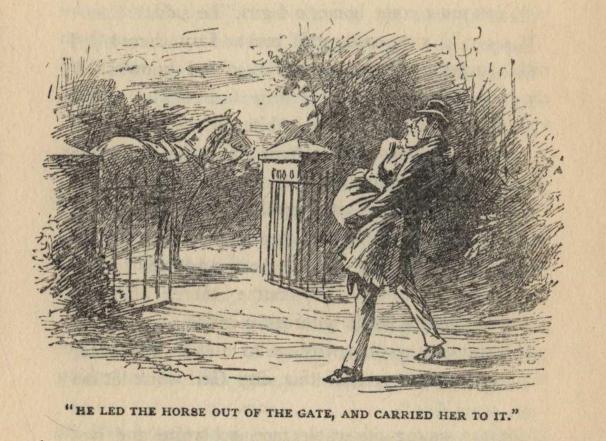
"HE LED THE HORSE OUT OF THE GATE, AND CARRIED HER TO IT."
He led the horse out of the gate, carried her to it, and put her just on the saddle; then he got up himself behind, and held her with one hand and the reins with the other.
That is how they reached the cottage.
The children were in bed, and poor Bunty, weary of waiting, had fallen asleep sitting bolt upright in a chair.
Pip woke him, gently enough.
"Make up the fire," he said.
The boy fell to the task with all his heart, so dreadful was his sister's face. The clatter woke Poppet; she slipped out of bed and came in to them in her little nightgown, her eyes heavy with sleep and the struggle between forgetfulness and remembrance.
"Baby!" she said. Then her eyes flew open, and the colour died out of her little flushed cheeks. What made Nellie look so terrible?
"Better, much better—getting well," was Pip's hasty answer. He did not want another ill on his hands.
The child gasped with relief.
"Go and get something on," said Pip; "and bring Nell a big shawl or rug, and put something on your feet."
She came back with a great blanket for Nellie—she had pinned her little flannel petticoat round her own shoulders, and stuck her feet into goloshes.
Bunty made coffee—a great jugful. The grounds were floating on the top, certainly, but it was very hot. Pip made the girl drink two full cups and eat a big piece of bread and butter—he heard she had had neither dinner nor tea.
Then she crept close to him again. What a dear big brother he was, and how much less terrible things looked here in the firelight, with his arm round her, than when she lay prone on the wet grass under the white, far moon.
They dare not tell Poppet to-night, her eyes were far too bright, her cheeks too flushed. So Bunty, at a whisper from Nell, picked her up and carried her off to bed again.
"I'll stop with you till you go to sleep," he said, feeling her chest heave.
"I b'leeve they're 'ceiving me," said the poor little child. "I heard Nell whisper to you! Oh, Bunty, tell me!—oh, Baby, Baby!"
He reassured her eagerly. The crisis was quite past; the doctor said she could not help getting better now. Why, they would be playing with her again now in no time!