Front matter (continued 4)
Reading edition
She cried a little from the relief, and then dropped off to sleep, holding tightly to his gentle, roughened hand.
In the sitting-room Pip was comforting Nellie as tenderly and pitifully as if he had been a woman and she a poor, little, hurt child. They had never known each other before—these two—and both were touched and surprised at the beauty of the new knowledge.
He agreed that she must go to Misrule and help to nurse, but thought they would wire up to Yarrahappini and ask Mrs. Hassal to come down to the cottage instead of getting any one strange. Nellie thought it an excellent suggestion, and made him draft a telegram immediately, so that it might be sent first thing in the morning.
When he thought she was calm again, and fit to be left he saw her into her own bedroom, and made her promise to go direct to bed and try her best to sleep, since so much depended on her now.
Such a poor, scratched, swollen face it was lifted to him for a good-night kiss, so different from the brilliant, beautiful, rebellious one that had defied him on the night of that trouble-causing dinner party.
He took the front door key with him, and went out, riding slowly back to Misrule, though he had no business there, as he knew. He put his father's horse back into the stable, and learnt from the man, who had just gone to bed, that Martha was with Essie and the nurse with Meg.
Then he went round into the garden, and to the side of the house where Meg's bedroom was.
There was a white, flat paling fence separating that part of the garden from the paddocks; he sat down on it and watched the light on her white blind with a despairing expression in his eyes.
He would have given all the world for a kiss from her, a smile of forgiveness; his love for Mabelle lay, a cold thing, almost dead, in his breast; he felt he could never breathe on it and warm it to life again.
To him, as to Nellie, this great white awful night brought back to memory the red red sunset and purple black shadows of the evening Judy had died. Like Nellie, he too fell on his knees, and prayed as he had only prayed that one other time in his life. And, like Nellie too, he prayed despairingly and without faith because that other prayer had not been answered. It was midnight when he had ridden back; he stopped there in the white, hushed garden till the moon began to fade out of the sky and a pale flush of rose crept up from the river. He was stiff and cold from his long watch; on the ill-kept strip of grass beneath the lighted window he had worn a path with his pacings, and his heart was heavier than ever.
When five o'clock came he still lingered; he was watching for the first opening door. To wait for her smile and forgiveness till she was better—to wait—to miss it for ever, perhaps—was more than he could bear to contemplate. He wrote her a little eager loving note on the back of an envelope from his pocket; his sister, his dear, sweet old Meg, would she ever forgive him?
He thought he would give it to Martha the minute there was a stir of life within the house, and he went softly round the verandah to the side door; it was always opened first, he knew. He stood there more than half an hour, listening for a footstep on the stairs, for the creak of a door or the sound of a voice.
On the weather-worn wall near there were a number of marks and names and dates; it was the measuring wall of the family. It carried his thoughts back a long, long time. It was nearly seven long years since the first marks were made: the little one, only a couple of feet off the ground, was marked "The General,"—Pip remembered Esther had to hold him there, for it was before he could walk. Then all the small steps above it—Baby, and Bunty, and Nell—such a little Nell; Judy, with a crossing out at her name and a mark lower down—he remembered finding out after he had measured her first, that she had tacked a bit of wood on to each heel of her shoes; then himself, and Meg topping them all.
The last marks were recent; they had measured merrily just before Esther went away, to see if any one could possibly grow in such a short time. He himself was at the top now, ten inches past Meg, and Nellie and Bunty were nearly up to Meg. How nearly the new little mark that meant Essie had never risen any higher! And Judy, dear, dear little Judy, so quick growing, so eager-eyed—her mark was no longer among them.
It forced itself upon Pip that perhaps never again would he put the flat book on Meg's bright head and crush down, ere he measured her, the fluffy hair that gave her an unlawful inch.
He turned on his heel from the wall; the mark seemed on his heart.
Some one opened a verandah door some distance away and stepped out into the garden. It was the nurse, heavy-eyed, pale-cheeked, come out for a breath of the quickening morning. She did not see the unhappy boy standing there, but went down the path towards the sun-touched river, and left the door open behind her.
Pip slipped in, on uncontrollable impulse. He stole through the quiet hall and up the staircase; he went softly down the upstairs passage—and Meg's door was open.
She was quite alone, lying among the pillows, with her bright hair loose, her cheeks a little flushed, but her eyes open and quite natural. The next second he was in the room kneeling by the bedside, and kissing the little hot hand on the counterpane.
"Just say you forgive me, Meg darling—darling!" he implored, the tears rolling down his cheeks.
She sat up in distress.
"Oh, go away!" she cried. "Oh, Pip, how mad of you—dear Pip, you'll catch it!"
But he would not loose her hand.
"Will you?" he said.
She moved to put her arm round his neck, then remembered and shrank back.
"Why, there is nothing," she said; "it was you to forgive me—if you do I am more than glad; now do go, old fellow."
"Lie down," he said, standing up again; it had only just struck him he might be doing her harm.
"There, lie so,—keep still, for heaven's sake. I only came to tell you you're the best sister on earth, and I've been a brute to you. Meg, I'll promise you faithfully never to think of Mabelle again—oh, good God! I haven't made you worse, have I?" For Meg put her hand up to her head with a sudden movement.
"Not an atom," she said, "the cloth was wetting my neck, that's all.—you've made me better indeed with that promise; now go, Pip dearest, this minute, and change everything—promise me; think of the children; get a suit out of your room and have a bath."
The nurse's step was on the stairs; he kissed her hand again and fled.
Afterwards he felt he had done a selfish thing, and made himself miserable over it. Perhaps he had excited and worried her, perhaps it would make her worse; and suppose he gave the infection to Peter or Poppet!
He took his evening clothes, they were the only ones left in his room, and he went down to the river with a slow and heavy step.
Then he undressed and swam about for nearly twenty minutes, so determined was he not to carry home a microbe. He even struck out into the middle, and braved any sharks that might be yet unbreakfasted. Then he made his toilet again, swallow-tail and all, carefully washed the clothes he had taken off, and laid them on the grass to dry.
A man he knew, coming down to the water with his towels over his shoulder, met him on the way to the cottage and stared amazedly.
"You're fairly late home, old chap," he said; "where in the world have you been?"
Pip only shook his head and pushed on. He was far too unhappy to stay and explain.
CHAPTER XXIV.
"IN THE MIDNIGHT, IN THE SILENCE OF THE SLEEP TIME."
"Have I not trodden a weary road
Saint, my Saint?
And where, at last, shall be my abode,
Oh, my Saint?"
But Meg only had it very lightly, or those two poor human hearts could not have borne their misery. She was not half so ill as Essie had been; she was not delirious at all, and she never went near to the great wide sea whose cold waves had washed up to the little baby feet.
When she woke after a troubled sleep in the afternoon, there was Nellie standing by the bedside looking at her, with all her heart in her eyes.
"What about the children?" she said with instant anxiety. "You oughtn't to be here."
But Nell stooped and kissed her.
"It's just where I ought to be," she said, "and Esther's mother will be here this evening, to look after the children,—don't worry."
Meg turned over restfully; how good it was to feel there would be a sister near always instead of the strange hands and face of a nurse! What a relief, now the strain was over, to be able to give up and be taken care of instead of taking care!
In the morning, when she woke, her first question again, after hearing Essie was improving fast, was what about the children?
Mrs. Hassal had come, Nell said; Mr. Gillet had brought her, and they were both at the cottage. Mr. Gillet was much distressed to hear she was ill, and had sent kindest regards and hopes for a speedy recovery.
For a moment the long-unheard name brought no connection with it to Meg; then she saw the burnt grass paddocks, the dingy sheep, the homestead and clustering cottages of Yarrahappini.
She called to mind his little room as she had seen it when she went for the keys of the storeroom. She was surprised to still remember, after all these years, her astonishment at finding the keeper of the stores with the room of a gentleman.
She could remember the rows of books, the medallion of Shelley, the pictures, the little breakfast table—even the silver chased vase with the passion flowers in it.
She wondered if he had kept the blue ribbon she had given him; even now her cheeks coloured above their fever to think how intolerant she had been in those days. But perhaps she was just as bad now, or had other faults still worse; she tossed unhappily and thought upon all the mistakes she was for ever making. Then Nellie's cool fingers touched her forehead and replaced a wet, lavender-sweet handkerchief, and she dropped off into an uneasy slumber.
She thought they were binding her head round and round with ribbon, pale blue with creases in it; it held her down to the bed so that she could not move; and there in the dancing river little Essie was struggling, the grey look of death on her small sweet face.
Then that torture shifted, and it was Pip who was struggling, and he could not put out his arms to swim because he had a monstrous gold wedding-ring binding them to his body. And Peter was at the top of the forbidden tree, and Poppet shrieking to him to come down. And Bunty was in the hospital with scarlet fever, and they could not give him medicine because he would not tell his name.
For several days troubles of this kind lasted, with short unrefreshing waking intervals when her mouth was parched, her throat swollen, and her head throbbing.
On the sixth morning she opened her eyes about eleven o'clock. Nellie was mixing lemon drink at a small table, and Alan was standing by the bedside, Alan with a face grown quite haggard, and a look in his eyes that had never quite left them since she fell ill.
"Am I getting better or worse?" she said, for his look made her suddenly fearful for herself.
But he brightened instantly, for, in truth, the anxiety was almost over, only he could not shake it off at once.
"Much better," he said. "Do you know you have been asleep since nine last night?"
"How many hours is that?" she asked, with smiling languor; "my brain's asleep yet, I can't count." But neither could he. His lip trembled suddenly, and he put his face down on hers.
She slipped her thin hands round his neck.
"Poor old fellow!" she said, "dear old fellow! I'm going to get better immediately now."
"Try to go to sleep again," he whispered, putting a kiss on each eyelid to keep them shut. "Please, my little, pale daisy."
The eyelashes lay quite still, but the lips smiled up to him. Then, before she knew it, she was asleep again, her breathing regular, her skin cool. And when she woke she was far on the road to recovery. But down in the cottage, while Essie and Meg were struggling slowly up the beautiful tiring hill of convalescence, a terrible tragedy had happened.
In the middle of one night, Poppet, sleeping in a little made-up bed in the room with Mrs. Hassal, woke up hot and choking. One side of the room was in a sheet of fire; the curled, leaping tongues of flame came nearer every instant.
She sprang out of bed shrieking wildly, and pulled and shook poor little Mrs. Hassal, who, half suffocated with the smoke, lay motionless.
Pip slept at the Courtneys now, since the cottage was so taxed for room, Bunty and Peter across the passage, and Mr. Gillet had a camp bed in the sitting-room. No one had wakened till the little girl's wild shrieks rang through the house; the smoke had stupefied them all.
Then there was a terrible scene of confusion. The door of the bedroom was in a blaze—all the wall adjacent; the flames were licking at the long French window, and the curtains already burning.
Mr. Gillet went back one second for his thick coat, which he had not put on at first; then, shielding his face with his arm, he sprang into the room through the window, calling to Bunty to stand outside.
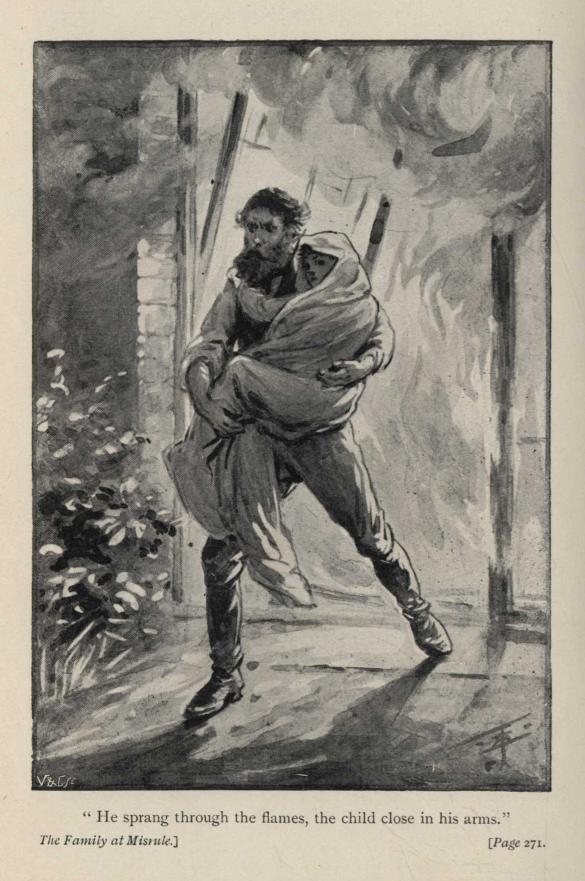
"He sprang through the flames, the child close in his arms." The Family at Misrule. Page 271.
Poppet, mad with terror, was still pulling at Mrs. Hassal, and the mosquito nets of the bed had just caught.
He pushed the child aside, and bade her go into the one safe corner. Then he enveloped Mrs. Hassal in the blanket, carried her across the room, and hastily put her through the window to Bunty.
Then he went back for the little girl,—Meg's little sister.
He took off his coat to wrap her in, as the other bedclothes had caught, but as he did so Bunty threw back the big blanket, and he used it instead.
The flames at the window were growing worse, but he sprang through them, the child close in his arms. When they took the blanket off her not a hair of her head was hurt.
One breathless second they looked at the burning room together from the safe vantage ground of the grass plot at the side.
Then Mr. Gillet started forward again.
"I've left my coat," he said.
Mrs. Hassal held his arm. "As if that matters," she answered indignantly.
"But there's something I rather prize in it," he said; "there's no danger,—see, I'll have the blanket this time."
He flung it round his head and shoulders, and went through the window again.
"Catch!" he cried, and threw the rough serge coat far out to them.
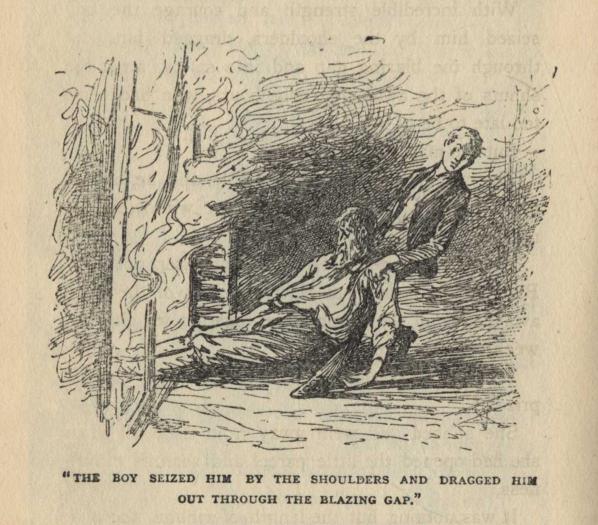
"THE BOY SEIZED HIM BY THE SHOULDERS AND DRAGGED HIM OUT THROUGH THE BLAZING GAP."
They saw him in the burning window putting his arms up to dive out. But even as he did so there was a crash and fall—a great burning rafter had dropped from the ceiling.
Bunty was the hero now. He put his coat over his head and dashed into the room.
Mr. Gillet had fallen just inside, the blanket still around him.
With incredible strength and courage the boy seized him by the shoulders, dragged him out through the blazing gap and into safety, amid the shouts of the awakened neighbours, who had come too late to be of use.
But the man was dead.
The rafter had struck his temple, and he had no more days of life to ruin, no more with which to redeem past ruin.
They did not tell Meg until long after, not until Blue Mountain air had blown the last of the fever away, and all the seven were together for the last week before coming home.
Then they gave her the something he had "rather prized."
She sobbed and went away from them all when she had opened the little parcel and seen its pitifulness.
It was nothing but the length of ribbon, the blue faded, and still creased as it had tied her hair.
On the paper wrapping it he had written, "My soft-eyed girl St. Cecily."
CHAPTER XXV.
HERE ENDETH.
"God's in His heaven,
All's right with the world."
Such a day! The spring of the year in the sky, and on the river, and on the land. September at its happiest, fresh and young, and gladdening as a maiden stepping with shining eyes and light feet into a world that she knows she is going to brighten.
Blue in the sky, blue deeper and sun-flecked in the river, a glory of roses in the garden, a yellow splendour of wattles in the bush.
Tea was spread on the lawn, not under a tree, but out in the sunshine that no one could get enough of. Even the cakes had a light-hearted look; and as for the shining kettle on the lamp, it was absolutely bubbling with good spirits. They were all there,—the seven and Mrs. Hassal, all mentally on tiptoe, physically in comfortable attitudes, sitting or lying round the cloth.
The Captain and Esther were expected every minute.
Peter wanted to begin on the little cakes that had such a fascinating bit of peel on the top of each.
"Leth go halveth in one, Nell," he said; "we ought to tathte them firtht,—prapth you forgot the thugar."
But Nellie assured him they were sweetness itself, and removed the plate into the middle of the cloth, where they could not lead his fingers into temptation.
She consoled him with two lumps of sugar, and he gave Poppet one and bet her he could suck his for a longer time than she could without it breaking.
Alan was hammering at a tipsy-looking erection of posts halfway down the drive, that said "Welcome" in pink and white roses, and threatened to fall and engulf any one passing underneath. Bunty had made it, Alan was only trying to ensure the safety of Esther's head.
Near the door was another arch; it was very low—both the Captain and Esther would have to go under it doubled up: it was done in ferns and red geraniums and blue flag lilies and yellow "bunny rabbits," and it said "Wellcome."
This was the architecture of Peter and Poppet; the choice of flowers and handing up had been Essie's work.
The kettle boiled over. Meg took the opinions of the company as to whether she should make the tea or wait. The travellers were coming overland from Brisbane, and the man had already gone to the station with the dogcart. It always made the Captain irritable to be met by half his family on a station, so they were all assembled at home instead. Nellie counselled waiting, tea brewed too long was "horrid."
Pip said no one would know what they were drinking, so it did not matter.
Swift wheels on the road, a shriek from Peter and Poppet, and the question was decided. Meg filled up the teapot and cosied it, then snatched Essie up in her arms and went down the path. Oh, thank God, thank God she had her to take!
Esther leapt out before the horse fairly stopped, just as impetuously young as ever. She devoured Essie, lifted big Peter right up in her arms, laughed and cried over the others.
No one said anything the pen could catch for the next ten minutes; every one spoke at once and laughed at once; every one asked questions and no one waited for answers.
It was the Captain of course who first made a whole speech. "We've been travelling for hours,—haven't you any tea for Esther, Meg?"
Then they all trooped up under the arches to the white cloth, flower-strewn, and Flibbertigibbet had improved the shining time by drinking the milk.
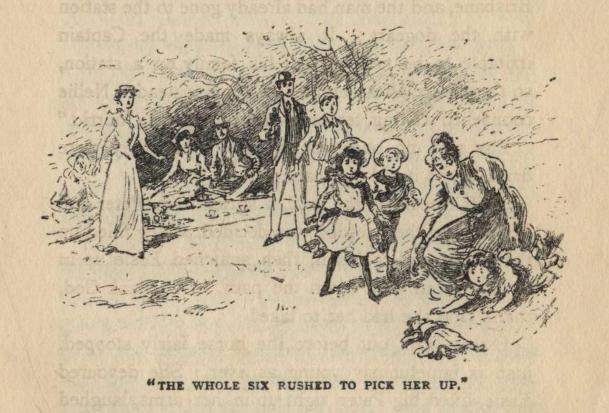
"THE WHOLE SIX RUSHED TO PICK HER UP."
Martha came down with more, her very forehead sharing in the great smile that widened all her features.
She shook the Captain's hand and Esther's; then small Essie ran before her, and she pulled up her apron to catch a sudden sob and went away.
Little Mrs. Hassal picked up the child,—just her own little girl Esther over again. She gave her a lump of sugar and squeezed her tenderly for nothing in particular. Then Nellie crept round and took her to find the prettiest cake of all, and Pip rode her round and round on his shoulders and kissed her again and again when she happened to stand near him.
And once, when running back from the house with her grand new doll for inspection, her eager little feet tripped and she fell on the path, the whole six started up and rushed to pick her up. Esther told herself she had left her darling in loving enough hands, she need not have worried so.
"But she seems a little thinner to me, Meg," she said; "I don't know if it is my fancy."
Then they all grew silent, and each one waited for the other to tell.
It was Nellie who spoke at last, and told the story, and Esther's tears fell and she clasped her baby close to her breast and thanked God who had been so good to her. And the Captain put out his hand and drew his eldest daughter closer to him, and said he did not think Alan could have her now.
It is only four o'clock, and the spring glad sunshine is still over everything; the feast is at its height, and all faces untroubled again. Let us leave them here.
Esther is leaning against her husband, her bright face full of content and happiness; once or twice her eyes have gone skywards, and the light in them has deepened. Essie is in her arms, saucy and dimpled: she knows she is the undisputed queen of that gathering, and is taking advantage of her power by giving all manner of sweet little commands.
Peter is still engaged on the cakes; he is only eating the tops of them where the peel nestles, but no one has noticed. He has just informed Esther of the progress he has made in her absence.
"I tharcely drop any blotht now," he said; "I've gone into theven times, I'm learning peninthulath, and I've thtopped lithping."
As no one disputes any of his statements, and as no one smiles openly, he is quite happy in his present occupation. Poppet seems to have grown; she is thinner than ever,—arms and legs, as Bunty says, and nothing else worth mentioning. He forgets the heart; it is just the same dear loving tender little one, with room for all the world, and one warm, special corner for himself.
Bunty's collar this afternoon is a sign of the times; it is perfectly white and almost unrumpled; the whole of it is visible, and his jacket does not fit extraordinarily badly. His mouth is firm, but hardly strikes one as obstinate now, and the brooding light that used to be in his eyes shows very seldom. Pip says if some day the boy becomes a great hero it will not surprise any one in the family at all, despite those early days he is so bitterly ashamed of.
This is quite a different Nellie from the one who went over this same lawn in her first long dress. More beautiful if possible: the shining hair and dewy, long-lashed eyes, the clear colouring, and slim, straight figure are just the same, but there is a deeper look in the young eyes, a sweeter, graver expression about the young mouth. She will be that gladdening thing, an exceedingly beautiful woman; she will be more, a good woman and a noble.
Meg,—well, Meg is Meg.
A little thin and pale-looking from the fever, a little quieter, and, if possible, even more sweet, more womanly and lovable than ever. Alan is at one side of her, her family at the other; so far they possess her equally, and perhaps the standing between is the happiest time of her life.
Pip is stretched on the ground, six feet of splendid young manhood; his laugh is good to hear, his cheeks have the tint of health, he measures a surprising number of inches round the chest. Surely it is reasonable to suppose his blighted affections have not done him irreparable mischief! Peter lets a light in on the subject. He has finished the cakes, and is at liberty again to pour out all the events of note that have happened during Esther's absence.
He has informed her that "the catht had four kittenth, that his betht thuith grown too thmall for his legth, that the butcher thent the chopth and thteak too late for breakfatht, and Meg got another one named Thmitherth, and that a thtorm of hail had thmathed the thtudy window."
Then his eye fell upon his eldest brother, and his young catholic mind found an item of news concerning him.
"An' Mith Joneth ith married to the man at the thauthpan thop; me and Poppet peeped in at the church, and the looked thplendid. And Pip wath awful mad, but he'th gone on Mith Thybil Moore now."
And as Miss Sybil Moore was the exceedingly pretty daughter of new delightful neighbours, and as Mr. Philip coloured somewhat warmly and inverted the young scamp in great haste, there seemed a probability of pleasant truth in the statement. Especially as Meg smiled contentedly.
Esther spoke of Indian scarfs and shawls and gauzes the boxes held.
"They will do beautifully for charades and theatricals," she said.
"Or playing at being grown up," said Poppet.
The Captain leaned back against a tree. "There is not much playing about it," he said. "I must be getting an old man; how fast you are all growing up."
"What's dwowing up?" asked Essie.
"I used to think it was just long dresses and done-up hair," sighed Nellie; "or a stick and a moustache."
"And not doing as you're told," supplemented Poppet.
"An' eating thingth and not getting thick." It was Peter's amendment.
Meg only smiled.
But there was a faint curve of sadness as well as the smile on her young lips—and one was for sweet, buried childhood, and one for the broadening days.
THE END
UNWIN BROTHERS, THE GRESHAM PRESS, WOKING AND LONDON.
* * * * * * * *
Works by Ethel Turner
(MRS. H. E. CURLEWIS).
The Story of a Baby.
Illustrated by FRANCES EWAN and others.
Seven Little Australians.
With Twenty-six Illustrations by A. J. JOHNSON.
The Family at Misrule.
A Sequel to the above.
With Twenty-nine Illustrations by A. J. JOHNSON.
Three Little Maids.
Illustrated by A. J. JOHNSON.
The Camp at Wandinong.
Illustrated by FRANCES EWAN and others.
Miss Bobbie.
Illustrated by HAROLD COPPING.
The Little Larrikin.
Illustrated by A. J. JOHNSON.
* * * * *
The "Tip-Cat" Series
(BY THE AUTHOR OF 'LADDIE')
Tip-Cat.
By the Author of 'Laddie.'
A very pathetic story of hardships and sacrifice, telling how the tenderness and generosity of one may make life smooth and happy for others.
Dear.
By the Author of 'Laddie.'
The love-story of the daughter of a simple-hearted country clergyman. The way she is deprived of her lover, and duped into marrying the squire's son, and the final attainment of her heart's desire, are told with great charm and pathos.
Pen.
By the Author of 'Laddie.'
A story of the neglect of two motherless children. The sketches of character and touching love passages are exceedingly well told.
My Honey.
By the Author of 'Laddie.'
"It is always a pleasure to meet with a book by the authoress of 'Tip-Cat.' The story is full of charming character drawing."—Graphic.
Rob.
By the Author of 'Laddie.'
"Interestingly written, and will be read with equal pleasure by members of either sex."—Westminster Gazette.
Lil.
By the Author of 'Laddie.'
"A volume of interesting reading that should attract all young people."—Sunday School Recorder.
Our Little Ann.
By the Author of 'Laddie.'
The story of a girl who from the time she left the country for town led a chequered life. The various episodes are cleverly connected, and the descriptive portions well told.
Laddie, etc.
By the Author of 'Tip-Cat.'
"It is possible that 'kiddie' may become a classic."—Chambers' Journal.
The Captain of Five.
By MARY H. DEBENHAM.
"Every human being over seven and under seventy will agree in pronouncing it delightful."—Daily Chronicle.
Hollyberry Janet.
By MAGGIE SYMINGTON ("Aunt Maggie").
"An excellent addition to a charming series."—Academy.
The Pattypats.
By H. ESCOTT-INMAN.
"One of the most delightfully droll story-books that it is possible to conceive of. Brimful of quaint and wonderful notions, and teeming with mirth and 'go.'"—The Teachers' Aid.
* * * * *
The Youths' Library.
1 From Log Cabin to White House, By W. M. Thayer
2 Robinson Crusoe, By Daniel Defoe
3 Bunyan's Pilgrim's Progress
4 Grimm's Fairy Stories
5 Grimm's Fairy Tales
6 Swiss Family Robinson
7 Andersen's Popular Tales
8 Andersen's Stories
9 Boys' Own Sea Stories
10 Two Years before the Mast, By R. H. Dana
11 Scottish Chiefs, By Jane Porter
12 Ivanhoe, By Sir Walter Scott
13 Romance of Navigation, By Henry Frith
14 Prisoners of the Sea, By F. M. Kingsley
15 Westward Ho!, By Charles Kingsley
16 Arabian Nights Entertainments
17 Black Man's Ghost, By J. C. Hutcheson
18 Frank Allreddy's Fortune, By Franklin Fox
20 Two Years Ago, By Charles Kingsley
21 The Last of the Barons, By Bulwer Lytton
22 Harold, By Bulwer Lytton
23 The Holy War, By John Bunyan
24 The Heroes, By Charles Kingsley
25 The Beachcombers, By Gilbert Bishop
WARD, LOCK & CO., LIMITED.