LA FONTAINE. (continued 5)
Walter Thornbury translation
FABLE CLXVI.
THE FALCON AND THE CAPON.
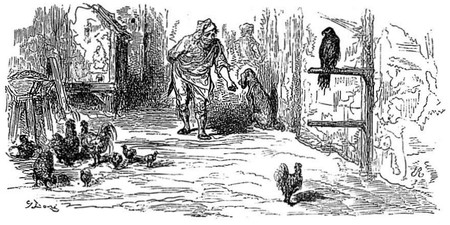
A treacherous voice will sometimes call; Hear it, but trust it not at all. Not meaningless the thing I tell, But like the clog of Jean Nivelle. A citizen of Mons, by trade, A Capon, one day, was dismayed, Being summoned, very suddenly, Before his master's Lares; he Disliked that tribunal, the spit (It was a fowl of ready wit). Yet all the folks, their scheme to hide, "Coop, coop, coop, coop," so softly cried. "Your servant; your gross bait is vain; You won't catch me, I say again." All this a Falcon saw, perplexed: What had the silly creature vexed? Instinct, experience, or no, Fowls have no faith in us, I know; And this one, caught with endless trouble, To-morrow in a pot would bubble, Or in a stately dish repose— Small honour, as the Capon knows. The Falcon the poor creature blamed; "I am astonished! I'm ashamed! You scum! you canaille! how you act! You're half an idiot, that's a fact. I come back to my master's fist, And hunt for him whate'er he list. Why, see, he's at the window, there; You're deaf; he's calling, I declare." "I know too well," the Fowl replied, Not caring for the Falcon's pride: "What does he want to say to me? The cook has got his knife, I see. Would you attend to such a bait? Now, let me fly, or I'm too late; So, cease to mock. Nay, now, good master, That wheedling voice portends disaster! Had you seen at the friendly hearth As many Falcons of good birth As I've seen Capons put to roast, You'd not reproach me with vain boast."
FABLE CLXVII.
THE TWO PIGEONS.
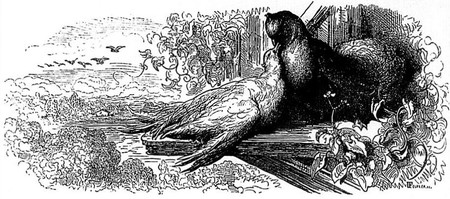
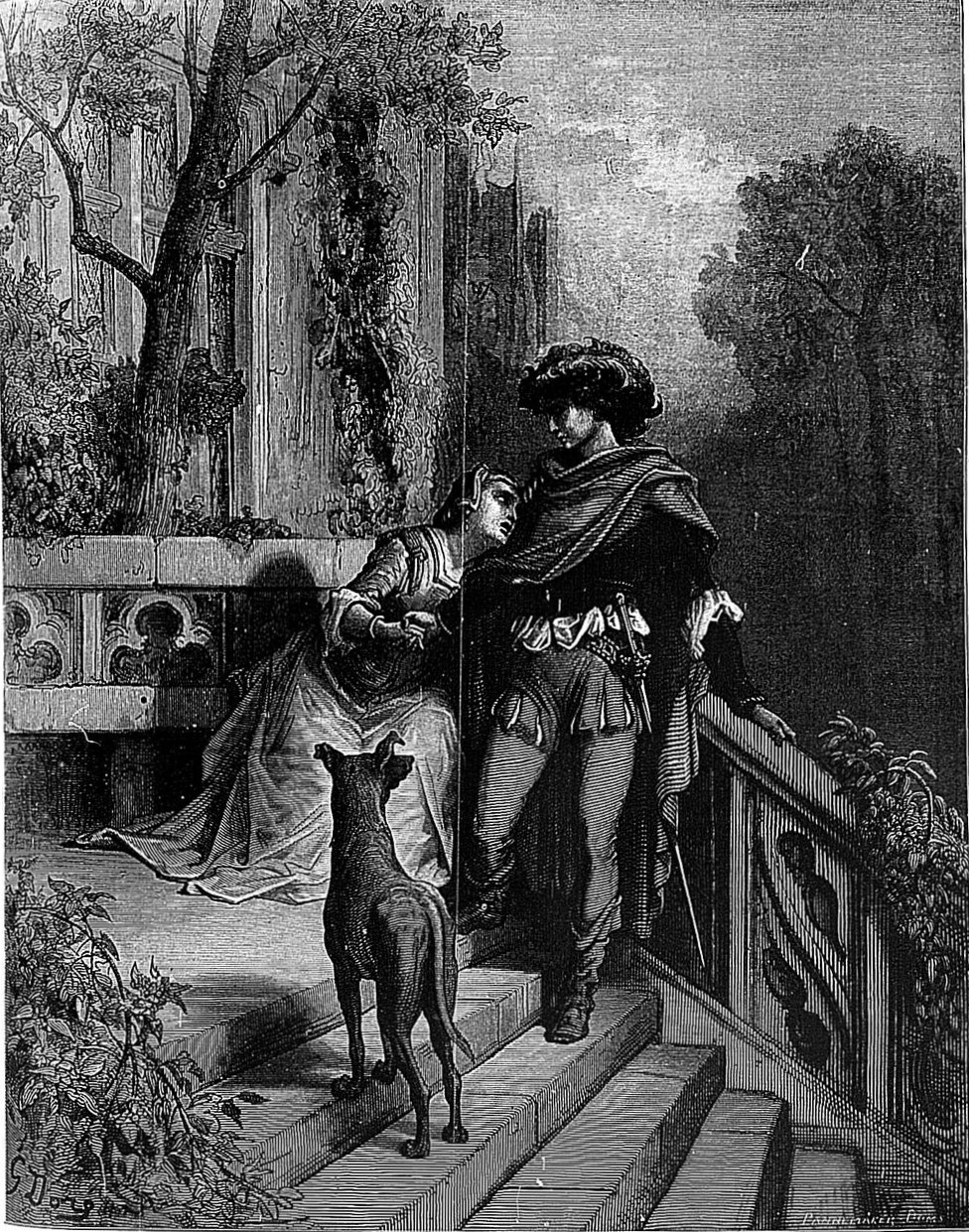
Two Pigeons once, as brother [brother], With true affection loved each other; But one of them, foolishly, tired of home, Resolved to distant lands to roam. Then the other one said, with piteous tear, "What! brother, and would you then leave me here? Of all the ills that on earth we share, Absence from loved ones is bitterest woe! And if to your heart this feeling's strange, Let the dangers of travel your purpose change, And, oh, at least for the spring-tide wait! I heard a crow, on a neighbouring tree,
THE TWO PIGEONS.
Just now, predicting an awful fate For some wretched bird; and I foresee Falcons and snares awaiting thee. What more can you want than what you've got— A friend, a good dwelling, and wholesome cot?" The other, by these pleadings shaken, Almost had his whim forsaken; But still, by restless ardour swayed, Soon, in soothing tones, he said— "Weep not, brother, I'll not stay But for three short days away; And then, quite satisfied, returning, Impart to you my travelled learning. Who stays at home has nought to say; But I will have such things to tell,— 'Twas there I went,'—'It thus befel,'— That you will think that you have been In every action, every scene." Thus having said, he bade adieu, And forth on eager pinion flew; But ere a dozen miles were past, The skies with clouds grew overcast; All drenched with rain, the Pigeon sought A tree, whose shelter was but nought; And when, at length, the rain was o'er, His draggled wings could scarcely soar. Soon after this, a field espying, Whereon some grains of corn were lying, He saw another Pigeon there, And straight resolved to have his share. So down he flies, and finds, too late, The treacherous corn is only there To tempt poor birds to hapless fate. As the net was torn and old, however, With beak, and claw, and fluttering wing, And by despairs supreme endeavour, He quickly broke string after string; And, with the loss of half his plumes, Joyous, his flight once more resumes. But cruel fate had yet in store A sadder evil than before; For, as our Pigeon slowly flew, And bits of net behind him drew, Like felon, just from prison 'scaped, A hawk his course towards him shaped. And now the Pigeon's life were ended, But that, just then, with wings extended, An eagle on the hawk descended. Leaving the thieves to fight it out, With beak and talon, helter-skelter, The Pigeon 'neath a wall takes shelter; And now believes, without a doubt, That for the present time released, The series of his woes has ceased. But, lo! a cruel boy of ten (That age knows not compassion's name), Whirling his sling, with deadly aim, Half kills the hapless bird, who then, With splintered wing, half dead, and lame, His zeal for travel deeply cursing, Goes home to seek his brother's nursing. By hook or by crook he hobbled along, And arrived at home without further wrong. Then, united once more, and safe from blows, The brothers forgot their recent woes. Oh, lover, happy lovers! never separate, I say, But by the nearest rivulet your wandering footsteps stay. Let each unto the other be a world that's ever fair, Ever varied in its aspects, ever young and debonair. Let each be dear to each, and as nothing count the rest. I myself have sometimes been by a lover's ardour blest, And then I'd not have changed for any palace here below, Or for all that in the heavens in lustrous splendour glow, The woods, and lanes, and fields, which were lightened by the eyes, Which were gladdened by the feet of that shepherdess so fair,— So sweet, and good, and young, to whom, bound by Cupid's ties,— Fast bound, I thought, for ever, I first breathed my oaths in air. Alas! shall such sweet moments be never more for me? Shall my restless soul no more on earth such tender objects see? Oh, if I dared to venture on the lover's path again, Should I still find sweet contentment in Cupid's broad domain? Or is my heart grown torpid?—are my aspirations vain?
FABLE CLXVIII.
EDUCATION.
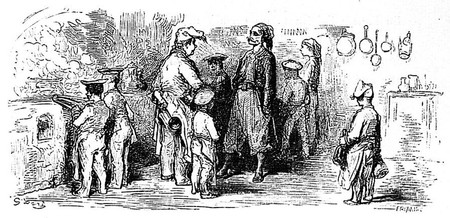
Cæsar and Laridon, his brother, Both suckled by the same dear mother, Sprang from an ancient royal race; Right hardy in the toiling chase. Two masters shared the noble brood; And one the kitchen, one the wood Made his home. Yet still the same, They both kept their former name. Place and custom altered them In their nature, not in limb. The one dog purchased by the cook, Laridon for title took. His brother to renown soon soars, Slays by dozens stags and boars. Soon as Cæsar he was known, And as wonderful was shown. But for Laridon none cared, Or his children—how they fared. So the Turnspits spread through France— Vulgar dogs, that toil or dance: Timid creatures, as one sees Cæsar's true antipodes. Time, neglect, and luckless fate Make a race degenerate; Wise men's sons turn simpletons; Cæsars become Laridons.
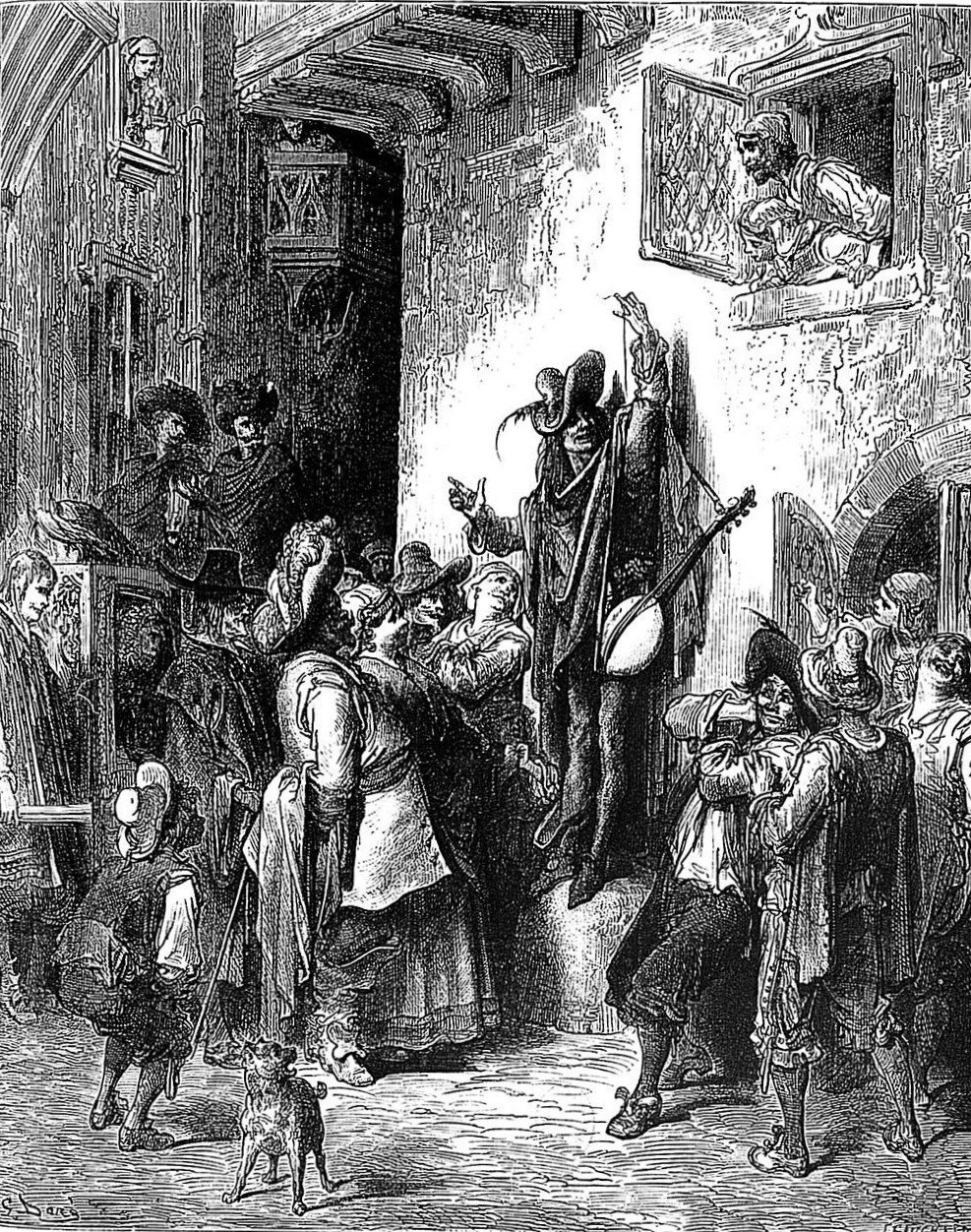
THE MADMAN WHO SOLD WISDOM.
FABLE CLXIX.
THE MADMAN WHO SOLD WISDOM.
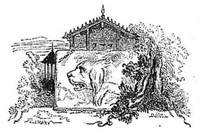
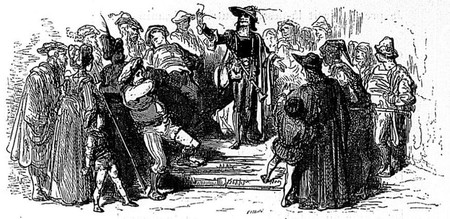
Never get in a Madman's reach: Ye wise men, listen to my speech. It's my advice—or right or wrong— To flee from such crazed folk headlong; In courts you often see them stalk, The prince smiles at them in his walk; To rogue and fool, and the buffoon, They serve for jokes from morn to noon.— A Madman once, in market-place, Said he sold Wisdom. The dolts race To buy the treasure. What fun is his, Watching the silly people's phizzes, When for their money they obtain A blow that gives their red ears pain, And forty yards of common thread. Some were indignant; they, instead Of pity, only mockery got. The best way was to bear one's lot, And walk off laughing; or else go Home, and not talk about the blow. To ask the meaning of all this Was to secure a wise man's hiss; There is no reason in such folks. 'Tis chance begets such crazy jokes, And yet the thread it was mysterious. One of the dupes who took it serious Went to consult a sage he knew, Who replied thus at the first view:— "These hieroglyphics I can see; People of sense infallibly Between themselves and madmen place At least some fathoms of this lace; Or else they will a buffet gain, And never much redress obtain. You are not gulled; a crazy fool Has sold you wisdom from his school."
FABLE CLXX.
THE CAT AND THE RAT.
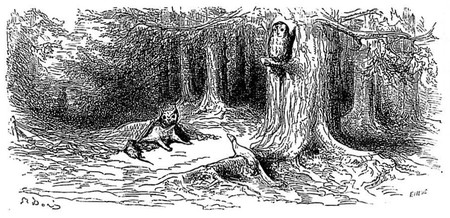
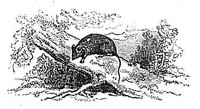
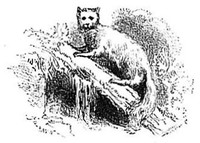
Four animals, of natures various, Living lives the most precarious, Together dwelt, and yet apart, Close to, and e'en within the heart Of a most ancient pine. The one was Master Cat, who claws; Another, Master Rat, who gnaws; The Weasel third, with waist so fine, And of a very ancient line. The fourth was sapient Master Owl, Whose midnight hoot disturbs the ghoul. One night, a man about their tree A snare disposed with secresy; And Master Cat, at early dawn, From couch with hope of plunder drawn, Scarce half awake, fell plump within The cruelly-invented gin. Such caterwauling then arose, That Master Gnaw-cheese hurried round To see, in fetters safely bound, The deadliest of his special foes. Then Master Purrer softly cried, "Sir Rat, your true benevolence Is known in all the country wide; So pray, for pity, take me hence From this atrocious, strangling snare In which I've fallen, unaware; 'Tis strange, but true, that you alone, Of all the Rats I've ever known, Have won my heart, and, thank the skies! I've loved you more than both my eyes. [']Twas just as I was on my way, As all devout ones should, to pray, At early dawn, that I was pent Within this cursed instrument. My life is in your hands, my friend; Pray, with your tooth these, shackles rend." But curtly then replied the Rat, "Pray, say what I should gain by that?" "My friendship true, for evermore," The Cat replied. "These talons grim Shall be your guard; the Owl no more Should watch your nest; the Weasel slim Shall never make of you his meat." "Not such a fool," replied the Rat, "Am I as to release a Cat!" And forthwith sought his snug retreat; But near the narrow hole he sought The Weasel watched, perhaps meaning nought. Still further upward climbed the Rat, To where the great Owl grimly sat; At last, by dangers menaced round, Sir Gnaw-cheese once more seeks the ground, And, working hard with practised grinder, Relieves poor Puss from cords that bind her. The task is just completed, When the ruthless man appears, And, overwhelmed with equal fears, The new allies by different paths retreated. Soon after this adventure The Cat beheld, one sunny day, Snug in a place from cats secure, His friend the Rat, and said, "I pray, Come, let's embrace, we are friends again. It gives me, on my word, true pain To think that one to whom I owe My life should deem me still his foe!" "And do you think," replied the Rat, "That I am ignorant of a Cat? I know within your bosom lies The germ of all hypocrisies." To trust to friendships that rogues feign Is leaning on a straw, 'tis plain.
FABLE CLXXI.
DEMOCRITUS AND THE ABDERANIANS.
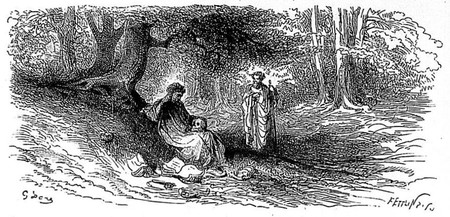
How I the base and vulgar hate: Profane, unjust, and obstinate! So ever prone, with lip and eye, To turn the truth to calumny! The master of great Epicurus Suffered from this rabble once; Which shows e'en learning can't secure us From the malice of the dunce. By all the people of his town Was cried, "Democritus is mad!" But in his own land, well 'tis known, No prophet credit ever had. The truth within a nutshell lies: His friends were fools,—and he was wise. The error spread to such extent, That, at length, a deputation, With letters from Abdera's nation, To famed Hippocrates was sent, With humble, earnest hope that he For madness might find remedy. "Our fellow-townsman," weeping said The deputation, "lost his head Through too much reading. Would that he Had only read as much as we! To know how truly he insane is, He says, for instance, nought more plain is, Than that this earth is only one Of million others round the sun; And all these shining worlds are full Of people, wise as well as dull. And, not content with dreaming thus, With theories strange he puzzles us; Asserting that his brain consists Of some queer kind of airy mists. And, more than this, he says, that though He measures stars from earth below, What he himself is he don't know! Long since, in friendly conversation, He was the wit of all the nation; But now alone he'll talk and mumble: So, great physician, if you can, Pray come and cure this poor old man." Hippocrates, by all this jumble, Was not deceived, but still he went;— And here we see how accident Can bring such meetings 'tween ourselves As scarce could managed be by elves. Hippocrates arrived, to find That he whom all men called a fool Was sage, and wise, and calm, and cool,— Still searching for the innate mind In heart and brain of beast and man. Retired beneath a leafy grove, Through which a murmuring brooklet ran, The sage, with patient ardour, strove The labyrinths of a skull to scan. Beside him lay full many a scroll By ancients written; and his soul Was wrapt in learned thought so wholly, That scarce he saw his friend advance: Their greeting was but just a glance;— For sages right well know the folly Of idle compliment and word. So, throwing off all forms absurd, They spoke, in language large and free, Of man, his soul and destiny; And then discussed the secret springs Which move all bad or holy things. But 'tis not meet that I rehearse Such weighty words in humble verse. From this short story we may see How much at fault the mob may be; And this being so, pray tell me why Some venture to proclaim aloud That in the clamour of the crowd We hear the voice of Deity?
THE OYSTER AND ITS CLAIMANTS.
FABLE CLXXII.
THE OYSTER AND ITS CLAIMANTS.
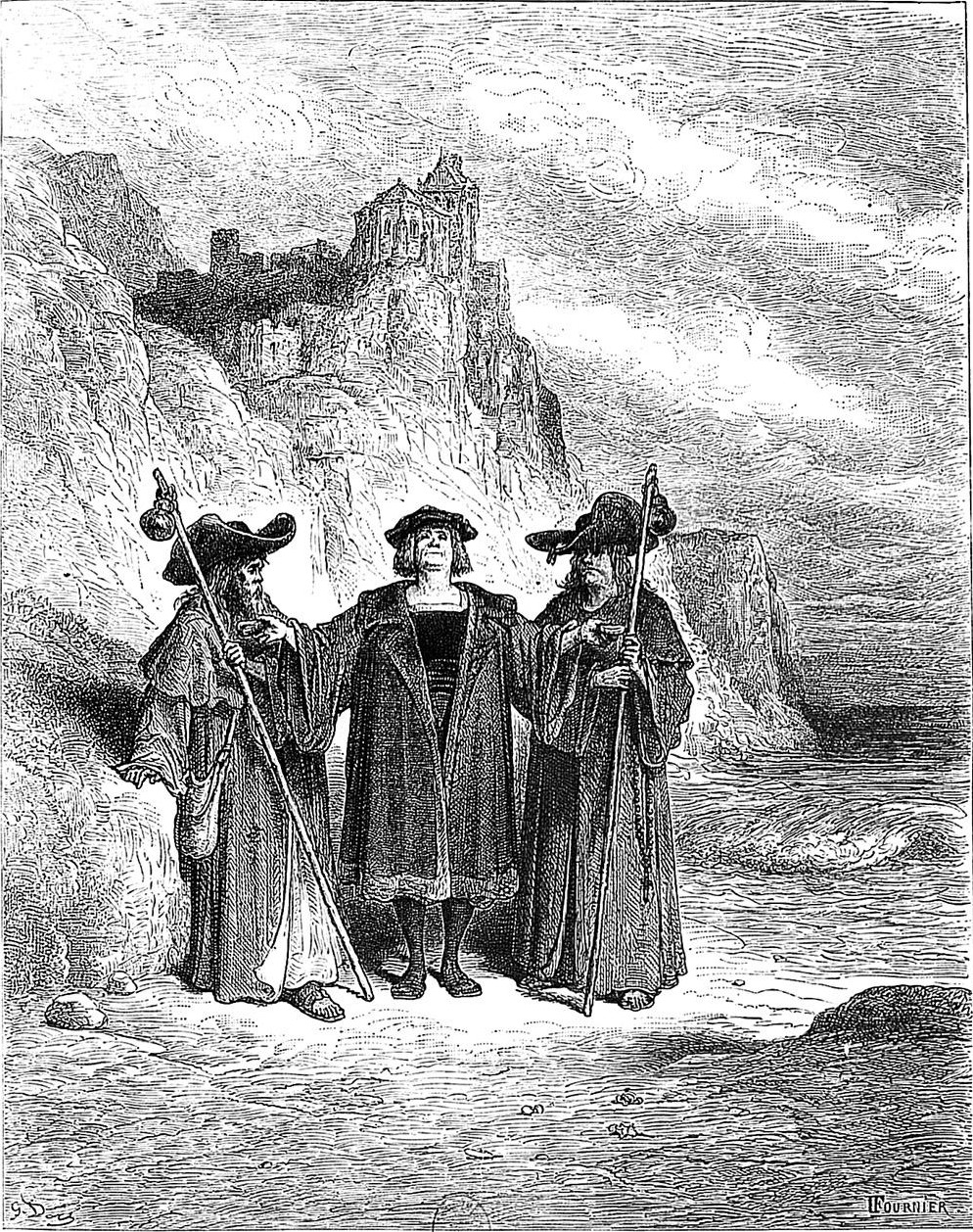
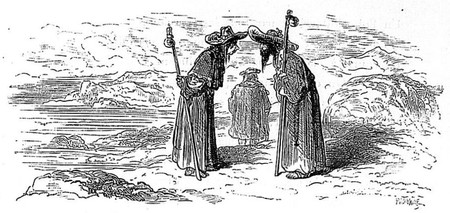
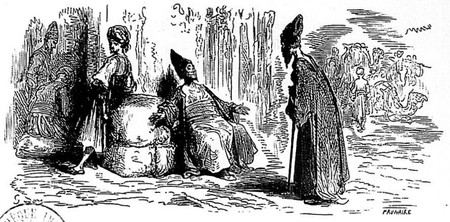
Two travellers discovered on the beach An Oyster, carried thither by the sea. 'Twas eyed with equal greediness by each; Then came the question whose was it to be. One, stooping down to pounce upon the prize, Was thrust away before his hand could snatch it. "Not quite so quickly," his companion cries; "If you've a claim here, I've a claim to match it; The first that saw it has the better right To its possession; come, you can't deny it." "Well," said his friend, "my orbs are pretty bright, And I, upon my life, was first to spy it." "You? Not at all; or, if you did perceive it, I smelt it long before it was in view; But here's a lawyer coming—let us leave it To him to arbitrate between the two." The lawyer listens with a stolid face, Arrives at his decision in a minute; And, as the shortest way to end the case, Opens the shell and cats the fish within it. The rivals look upon him with dismay:— "This Court," says he, "awards you each a shell; You've neither of you any costs to pay, And so be happy. Go in peace. Farewell!" How often, when causes to trial are brought, Does the lawyer get pelf and the client get naught! The former will pocket his fees with a sneer, While the latter sneaks off with a flea in his ear.
FABLE CLXXIII.
THE FRAUDULENT TRUSTEE.
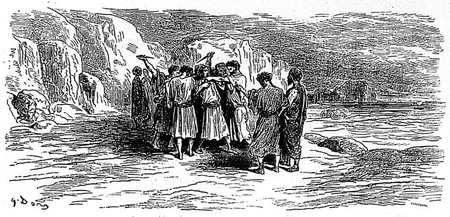
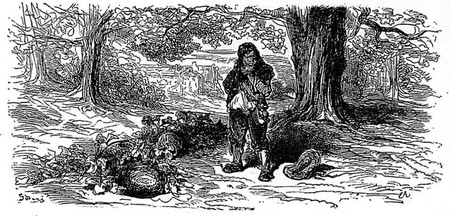
Animals I've sung in verse, Memory's daughters aiding; Perhaps I should have done far worse, In other heroes trading. In my book the dogs sit down With wolves in conversation; And beasts dressed up in vest and gown, All sorts, of every nation, Reflect each kind of folly duly, My verse interprets them so truly. Fools there are, and wise there are, But my heroes I can't flatter; For 'tis certain that, by far, The former ones exceed the latter. Swindlers I have painted often— Brutes whom kindness cannot soften; Tyrants, flatterers, and the crew Who take your gifts, then bite at you. In my pages you'll find many Examples of the utter zany; But chiefly have I had to do With those who say what is not true. The ancient wise man cried aloud, "All men are liars!" Had he stated This fact but of the wretched crowd, E'en then I should have hesitated; But that we mortals, great and small, Both good and bad, are liars all, I should deny at once, of course, Did I not know the maxim's source. But he who lies as Æsop lies, Or, to go a little higher, As old Homer, is no liar; For the charming dreams we prize, With which they have enriched the world, Are brightest truths in fiction furled. The works of such should live for ever; And he who lies like them lies never. But he who should attempt to lie As a Fraudulent Trustee did, A liar is, most certainly, And should suffer for't as he did. The story tells us That, proposing To journey into foreign lands, A merchant, in the Persian trade— In friends all confidence reposing— Agreement with a neighbour made, To leave some iron in his hands. "My metal?" said he, coming back. "Your metal! 'tis all gone, alack! A rat has eaten up the lot! I've scolded all my slaves, God wot! But, in spite of all control, A granary floor will have a hole." The merchant opened well his eyes, And never hinted aught of lies; But soon he stole his neighbour's child, And then he asked the rogue to dine. To which the other answered, wild With anguish, "Sir, I must decline— I loved a child—I have but one— I have! What say I? I have none, For he is stolen!" Then replies The Merchant, "With my own two eyes, On yester eve, at close of day, I saw your offspring borne away, With many a struggle, many a howl, To an old ruin, by an owl." "An owl," the father cried, "convey To such a height so big a prey! My son could kill a dozen such; For my belief this is too much!" "I do not that deny," replies His friend, "yet saw it with these eyes; And wherefore should you think it strange That in a land where rats can steal A ton of iron from a grange, An owl should seize a boy of ten, Fly with him to his lofty den. And of him make a hearty meal?" The Fraudulent Trustee perceived Which way the artful story tended, Gave back the goods, the man received His child, and so the matter ended. Between two Travellers, on their road, Dispute arose, in a strange mode:— The one a story-teller, such As oft are met with, who can't touch On any great or trivial topic, Without the use—that is, abuse— Of lenses microscopic. With them all objects are gigantic, Small ponds grow huge as the Atlantic. The present instance said he "knew A cabbage once that grew so tall, It topped a lofty garden wall." "I'm sure," replied his friend, "'tis true, For I myself a pot have met, Within which no large church could get." The first one such a pot derided: "Softly, my friend," rejoined the second; "You quite without your host have reckoned; To boil your cabbage was my pot provided!" The man of the monstrous pot was a wag, The man of the iron adroit; And if ever you meet with a man who'll brag, Never attempt to stint him a doit, But match his long bow with your strong bow.
FABLE CLXXIV.
JUPITER AND THE TRAVELLER.
The gods our perils would make wealthy, If we our vows remembered, when once made. But, dangers passed, and we, all safe and healthy, Forget the promises on altars laid; We only think of what we owe to men. Jove, says the atheist, is a creditor Who never sends out bailiffs; if so, then What is the thunder meant as warning for? A Passenger, in tempest tossed and rolled, To Jupiter a hundred oxen offered. He hadn't one; had he been only bold, A hundred elephants he would have proffered: They'd cost him not a single farthing more. Suddenly mounted unto great Jove's nose The scent of beef bones burnt upon the shore. "Accept my promised vow," the rascal crows; "'Tis ox you smell: the smoke is all for thee: Now we are quits." Jove smiled a bitter smile; But, some days after, sent a dream, to be The recompense of that man's wicked guile. The dream informed him where a treasure lay: The man ran to it, like a moth to flame. Some robbers seized him. Having nought to pay, He promised them at once, if they but came Where he'd a hundred talents of good gold. The place, far off, pleased not the wary thieves; And one man said, "My comrade, I am told You mock us; and he dies, whoe'er deceives. Go and take Pluto, for an offering, Your hundred talents: they will please the king."
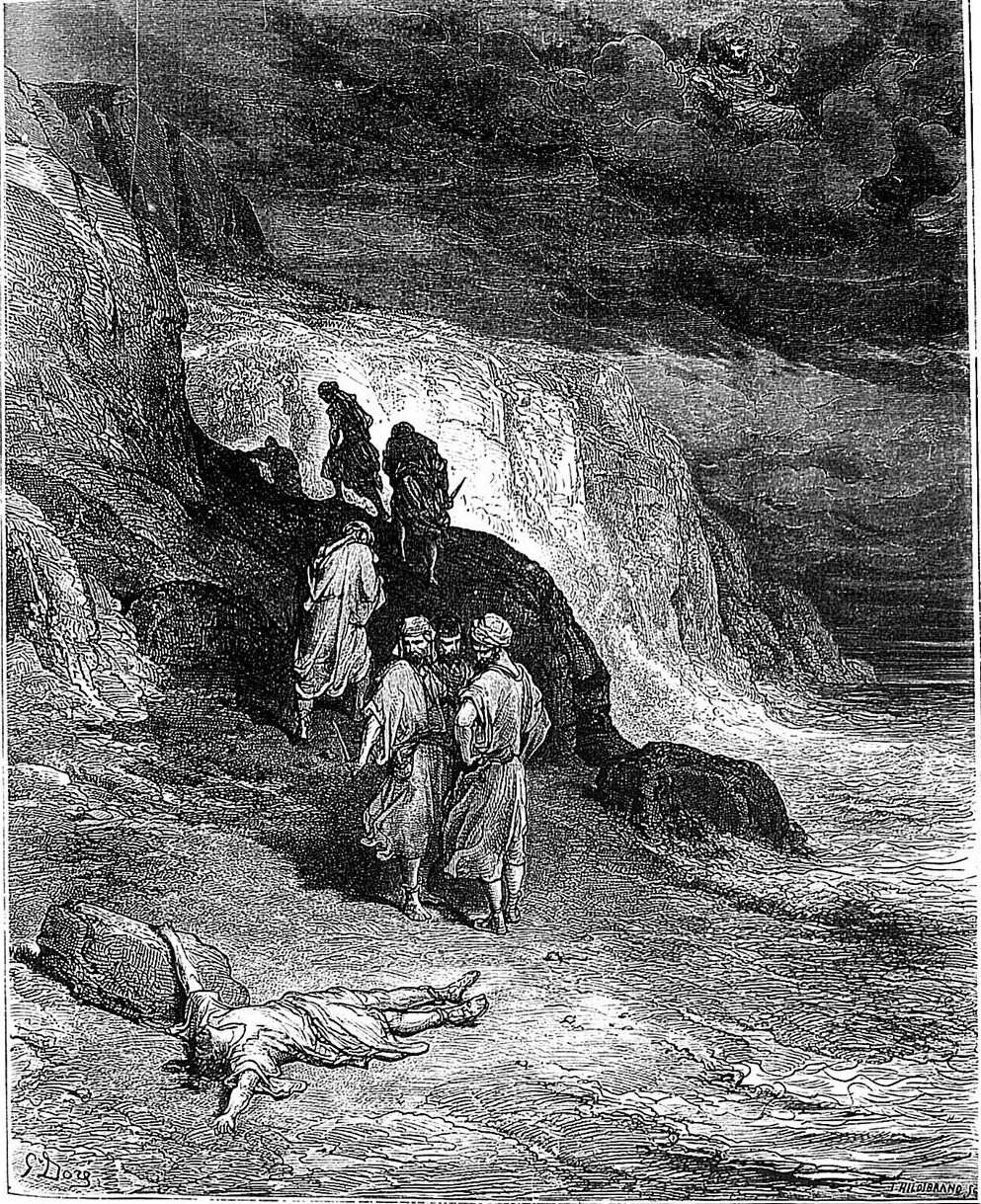
JUPITER AND THE TRAVELLER.
FABLE CLXXV.
THE APE AND THE LEOPARD.
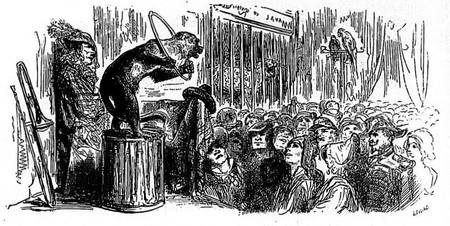
An Ape and a Leopard one day repair— Money to gain—to a country fair, And setting up separate booths they vie, Each with each, in the arts of cajolery. "Come, see me," cries Leopard, "come, gentlemen come, The price of admission's a very small sum; To the great in all places my fame is well known, And should death overtake me, the king on his throne Would be glad of a robe from my skin; For 'tis mottled and wattled, And stained and ingrained With spots and with lines, lines and spots thick and thin, That truly, though modest, I can but declare, 'Tis by far the most wonderful thing in the fair." This bounce attained its end, and so The gulls came hurrying to the show; But, the sight seen, and the cash spent, They went away in discontent. Meanwhile the Ape cries—"Come, and see The sum of versatility! Yon Leopard boasts, through thick and thin, A splendid show of outside skin; But many varied gifts I have (For which your kind applause I crave) All safely lodged my brain within. Your servant I, Monsieur Guffaw, The noble Bertrand's son-in-law, Chief monkey to his Holiness The Pope. I now have come express, In three huge ships, to have with you The honour of an interview: For speaking is my special forte, And I can dance, and hoops jump through, And other kinds of tumbling do, And magic feats perform of every sort; And for six blancos? no, I say, a sou; But if with the performance you Are discontented, at the door To each his money we'll restore." And right was the Ape: For the colour and shape Of fine clothes can but please for awhile, Whilst the charms of a brain That is witty, remain, And for ever can soothe and beguile. Ah! there's many a one, Lord and gentleman's son, Who holds high estate here below, Who to Leopards akin Has nought but fine skin As the sum of his merits to show.
FABLE CLXXVI.
THE ACORN AND THE GOURD.
All that Jove does is wise and good, I need not travel far abroad To make this maxim understood, But take example from a Gourd. Observing once a pumpkin, Of bulk so huge on stem so small, "What meant he," cried a bumpkin, "Great Jove, I mean, who made us all, By such an act capricious? If my advice were asked by Heaven, To yonder oaks the gourds were given, And 'twould have been judicious; For sure it is good taste to suit To monstrous trees a monstrous fruit. And truly, Tony, had but he Whom the priests talk of asked of me Advice on here and there a point, Things would not be so out of joint. For why, to take this plain example, Should not the Acorn here be hung— For it this tiny stem is ample— Whilst on the oak the pumpkin swung? The more I view this sad abortion Of all the laws of true proportion, The more I'm sure the Lord of Thunder Has made a very serious blunder." Teased by this matter, Tony cries, "One soon grows weary when one's wise;" Then dozing 'neath an oak he lies. Now, as he slept, an Acorn fell Straight on his nose, and made it swell. At once awake, he seeks to trace With eager hand what hurt his face, And in his beard the Acorn caught, Discovers what the pain had wrought. And now, by injured nose induced, Our friend takes up a different tone— "I bleed, I bleed!" he makes his moan, "And all is by this thing produced: But, oh! if from the tree, instead, A full-grown Gourd had struck my head! Ah! Jove, most wise, has made decree That Acorns only deck the tree, And now I quite the reason see." Thus in a better frame of mind Homeward went our honest hind.
FABLE CLXXVII.
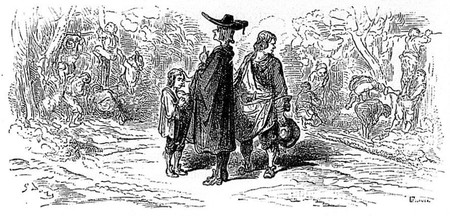
THE SCHOOL-BOY, THE PEDANT, AND THE NURSERY GARDENER.
A certain Boy, half-spoiled at school— Your Pedants spoil lads, as a rule; Ten times a fool, ten times a rogue They'd made this mischievous young dog.— A neighbour's flowers and fruits he stole: A man who struggled, heart and soul, To raise Pomona's choicest treasure: In what was bad he had no pleasure. Each season did its tribute bring, And Flora's gifts were his in spring. One day he saw upon a tree The boy climb up, and recklessly Spoil half the buds, the promise dear Of future plenty for the year;— He even broke the boughs. At last The Gardener to the school ran fast. The Master came, with all his train Of lads. "Of what does he complain?" The orchard's full of dreadful boys, Worse than the first, in tricks and noise. The Pedant, though he meant not to, Made the first evil double grow. The Pedant was so eloquent About the sin and ill intent; It was a lesson not forgot By the whole school, an ill-taught lot; He often cites the Mantuan bard; At rhetoric toils hot and hard. So long his speech, the wicked race Had time enough to spoil the place. I hate your misplaced eloquence, Endless, ill-timed, and without sense; And no fool I detest so bad As an ill-taught and thievish lad, Except his Master; yet the best Of these is a bad neighbour, 'tis confessed.
FABLE CLXXVIII.
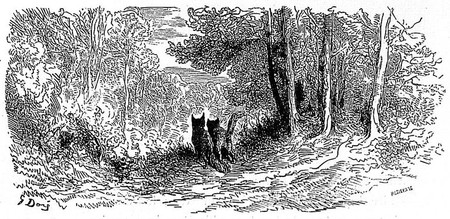
THE CAT AND THE FOX.
The Fox and Cat, two saints indeed, To make a pilgrimage agreed: Two artful hypocrites they were,— Soft-footed, sly, and smooth, and fair. Full many a fowl, and many a cheese, Made up for loss of time and ease. The road was long, and weary too: To shorten it, to talk they flew. For argument drives sleep away, And helps a journey on, they say. The Fox to the Cat says, "My friend,
THE CAT AND THE FOX.
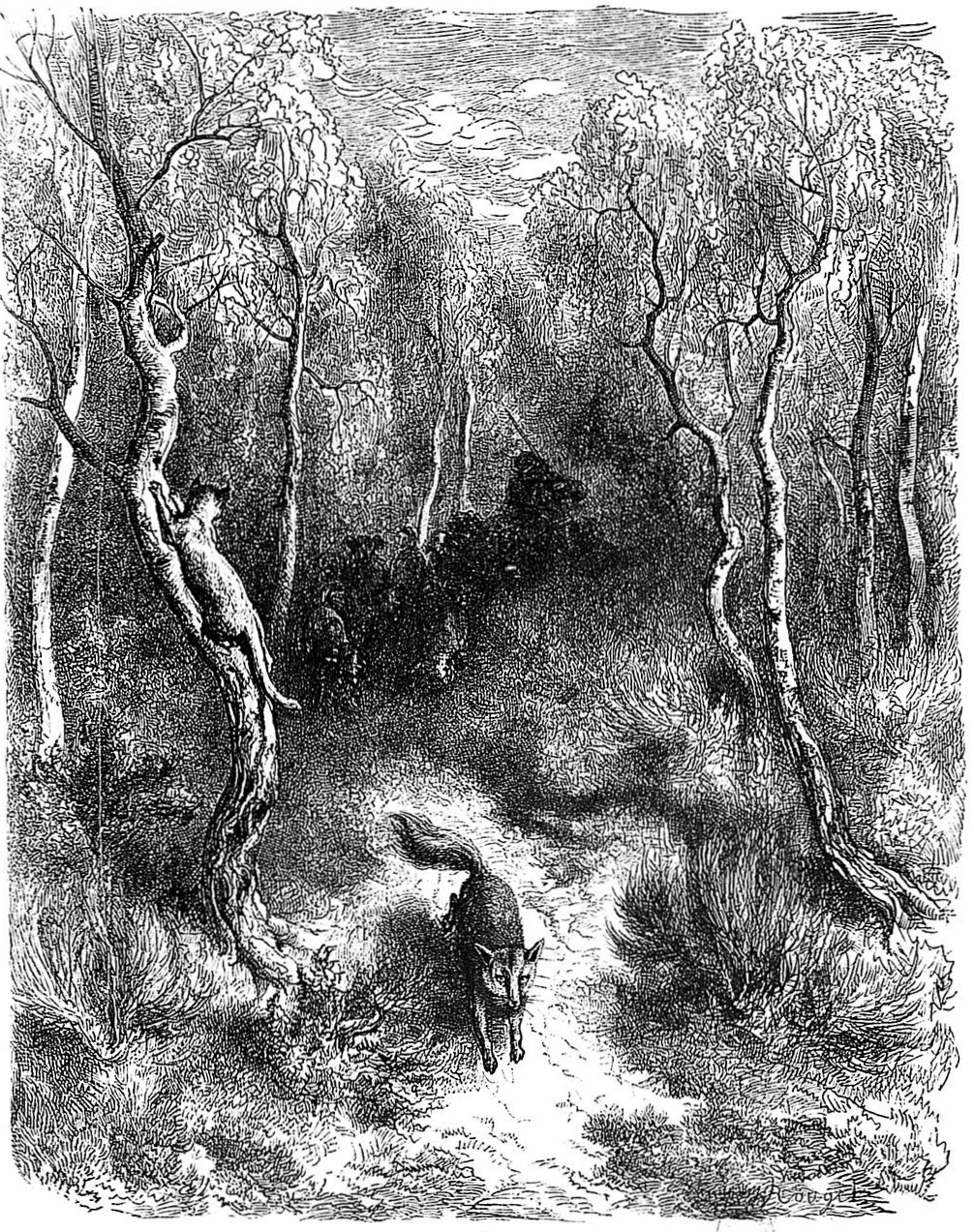
To be so clever you pretend; Say what am I? I've in this sack A hundred tricks." "Well, on my back," The other, very timid, said, "I've only one, I'm quite afraid; But that, I hold, is worth a dozen, My enemies to cheat and cozen." Then the dispute began anew, With "So say I!" and "I tell you!" Till, suddenly, some hounds in sight Silenced them soon, as it well might. The Cat cries, "Search your bag, my friend, Or you are lost, you may depend: Choose out your choicest stratagem!" Puss climbed a tree, and baffled them. The Fox a hundred burrows sought: Turned, dodged, and doubled, as he thought, To put the terriers at fault, And shun their rough and rude assault. In every place he tried for shelter, But begged it vainly; helter skelter, The hounds were on the treacherous scent, That still betrayed, where'er he went. At last, as from a hole he started, Two swift dogs on poor Reynard darted; Then came up all the yelping crew, And at his throat at once they flew. Too many schemes spoil everything, We lose our time in settling. Have only one, as wise man should: But let that one be sound and good.
FABLE CLXXIX.
THE SCULPTOR AND THE STATUE OF JUPITER.
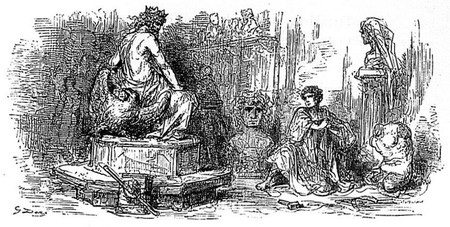
A Block of marble shone so white, A Sculptor bought it, and, that night, Said, "Now, my chisel, let's decree: God, tank, or table, shall it be? "We 'll have a god—the dream I clasp; His hand a thunderbolt shall grasp. Tremble, ye monarchs, ere it's hurled! Behold the master of the world!" So well the patient workman wrought In stone the vision of his thought, The people cried at last, "Beseech The gods to grant it power of speech!" Some even dared the crowd to tell That, when the chisel's last blow fell, The Sculptor was the first with dread To turn away his trembling head. The ancient poet's not to blame, For weak man's terror, fear, and shame The gods invented in each age, Abhorring human hate and rage. The sculptor was a child; confess, His mind, like children's in distress, Tormented by this ceaseless sorrow, His doll might angry be to-morrow. The heart obeys its guide, the mind: And from this source there flows, we find, This Pagan error, which we see Widen to all infinity. We all embrace some favourite dream, And follow it down flood and stream. Pygmalion was in love, 'tis said, With Venus that himself had made. Each turns his dream into a truth, And tries to fancy it all sooth. Ice to the facts before his face, But burning falsehood to embrace.
FABLE CLXXX.
THE MOUSE METAMORPHOSED INTO A GIRL.
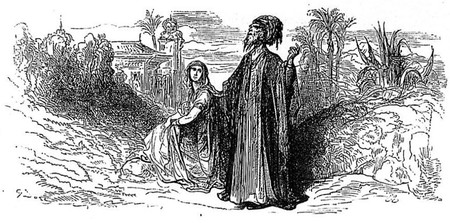
A Mouse from the beak of an owl fell down, A Brahmin lifted it up, half dead: Tenderly nursed it, and tamed it, and fed. I could not have done such an act, I own; But every land has its own conceit: With a Mouse I'd rather not sit at meat. But Brahmins regard a flea as a friend, For they think that the soul of a king may descend To some beast, or insect, or dog, or mite,— Pythagoras taught them this law erudite. Thus believing, the Brahmin a sorcerer prayed That the Mouse might resume some more elegant dress. The wise man consented, and, truth to confess, Performed his task well, for the Mouse became Maid,— Ah! a Maid of fifteen—such an elegant creature, Of a form so genteel, of such exquisite feature, That if Paris had met her, that amorous boy Would have risked, to possess her, full many a Troy. Surprised at the sight of a being so fair, The Brahmin said, "Darling, you've but to declare Whom you'll have for a husband, for none will refuse Such a beautiful bride;—you have only to choose." Then the Maiden replied, "I confess that I long For a husband that's valiant, and noble, and strong." Then the Brahmin knelt down, and addressing the Sun, Cried, "Noblest of living things, you are the one!" But the Lord of the Daylight replied, "'Tis not true That I am so strong; for the Cloud you see yonder, Piled high with the rain, and the hail, and the thunder, Could hide me at once, if he chose, from your view." To the Cloud, then, appealing, the Brahmin declared That with him, Lord of Storms, his child's fate should be shared. "No, No!" said the dark Cloud; "it never can be, For at each breath of wind I am driven to flee. If you'd have for a son-in-law somebody strong, Your Maid to the North Wind should fairly belong." Disgusted with constant refusals like these, The Brahmin appealed to the wild, roving Breeze; And the Breeze was quite willing to wed the fair Maid, But a Mountain Top huge his love's pilgrimage stayed. The ball, at this game of "a lover to find," Now passed to the Hill, but he quickly declined; "For," said he, "with the Rat I'm not friends, and, I know, If I took the fair Maid, he would gnaw at me so." At the mention of Rat, the fair Maiden, with glee, Cried, "'Tis Rat, and Rat only, my husband shall be!" See a Girl for a Rat now Apollo forsaking! It was one of those strokes which Love glories in making. And, 'twixt you and me, such strange instances are, 'Mongst girls that we know of, more frequent than rare. With men and with beasts it is ever the same: They still show the trace of the place whence they came; And this fable may aid us to prove it; but yet, On a nearer inspection, some sophistry's met In its traits; for, to trust to this fanciful story, Any spouse were more good than the Sun in his glory. But, what! shall I say that a giant is less Than a flea, because fleas can a giant distress? The Rat, if this rule must be strictly obeyed, Of his wife to the Cat would a present have made: And the Cat to the Dog, and the Dog to the Bear; Till, at length, by a sort of a high-winding stair, The story had brought us where first 'twas begun, And the beautiful Maid would have married the Sun. But let us return to the Metempsychosis The truth of which, firstly, this fable supposes. It seems to me plain that the fable itself The system decidedly puts on the shelf. According to Brahmin law, animals all That inhabit the earth, be they mighty or small,— Be they men, mice, or wolves, or e'en creatures more coarse,— Their souls have derived from one general source; And vary, in physical actions, just so As the form of their organs may force them to do. And if this be the case, then, how came it that one Of so fine-formed a frame did not wed with the Sun? Whereas, as we know, to a Rat she devoted The charms on which many a king would have doated. All things considered, I'll declare That girl and mouse souls different are. We must our destiny fulfil, As ordered by the sovereign will. Appeal to magic,—it is all in vain; The soul, once born, will still the same remain.
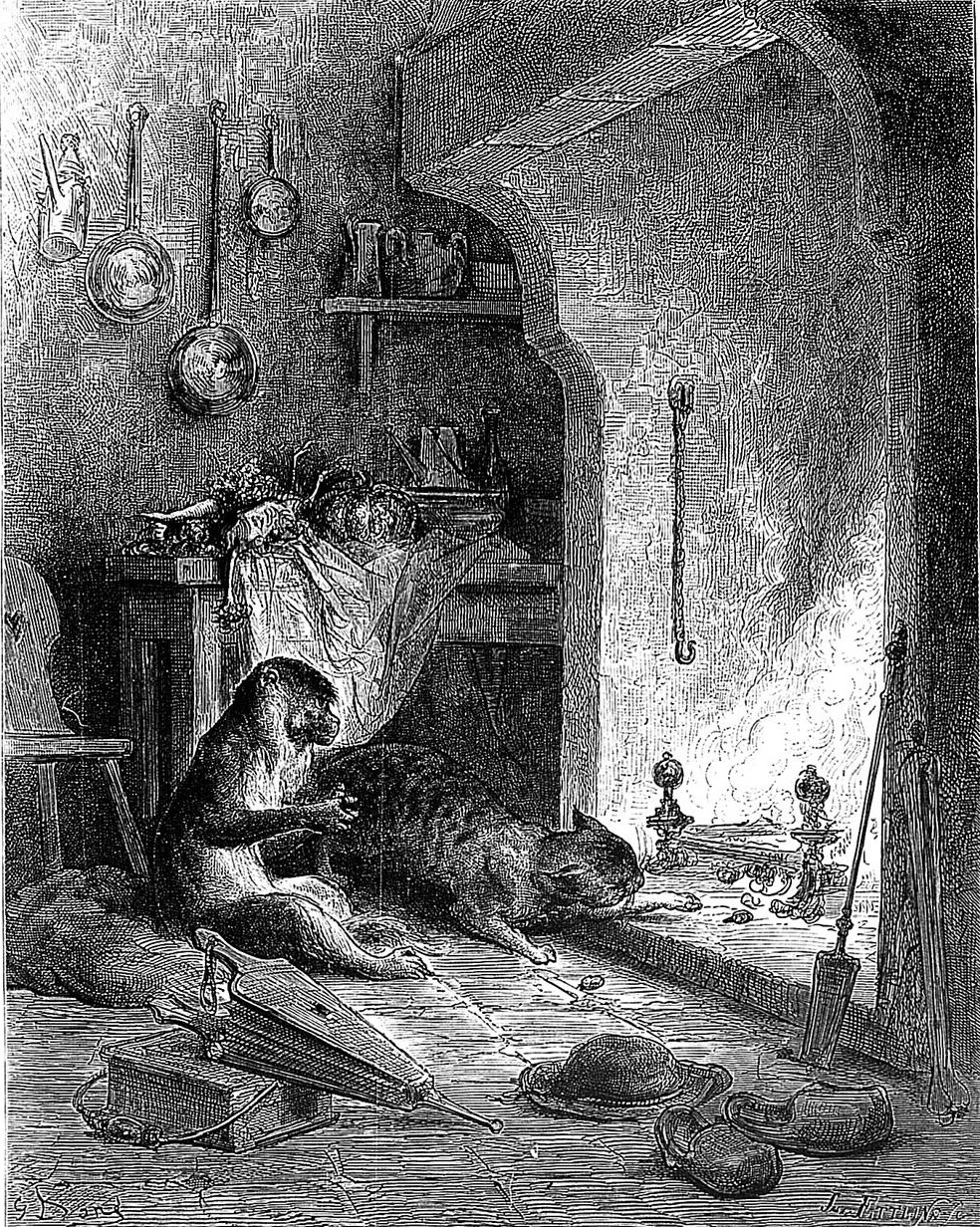
THE MONKEY AND THE CAT.
FABLE CLXXXI.
THE MONKEY AND THE CAT.
Bertrand and Raton—a Monkey and Cat— Were messmates in mischief, with roguery fat; There was nothing they feared, there was nothing they spared, And whatever they plundered they usually shared. If anything close by was stealable, they Would never go foraging out of their way. Bertrand stole everything Raton to please, And Raton cared less for the mice than the cheese. One day at the fire, when all clear was the coast, The pair were both spying some chesnuts at roast: To steal a good meal is its pleasure to double; Besides, it would bring the cook's man into trouble. Says Bertrand to Raton, "My brother, you see, Fate's given a moment of glory to thee; Get those chesnuts, and quickly, my brave one, I pray, The gods have vouchsafed us a dinner to-day." And so to snatch chesnuts poor Raton agreed, And at once set to work on the dangerous deed. With gingerly touch he the cinders withdrew, And snatched the hot prizes, first one, and then two. He has pilfered quite half, but has not eaten one; The eating his comrade, Bertrand, has done. A scullion comes—there's adieu to the theft— And Raton is empty and querulous left. Your nobles are much in a similar case, Who as flatterers dangerous service embrace; And to gratify kings, fingers often will burn, Then homeward, though wiser, still poorer return.
FABLE CLXXXII.
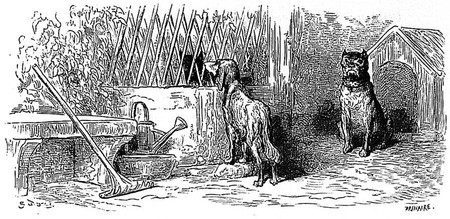
THE WOLF AND THE STARVED DOG.
Once on a time, a little Carp to man Preached all in vain; they put him in the pan. And I repeat, 'tis foolish to let slip The glass that's full, and half way to the lip, In hopes of better wine. The fish was wrong; The fisherman was right, his reason strong. One speaks out boldly when a life's to save; It needs some eloquence King Death to waive; But still I hold I'm right, and don't demur, If from my former text I do not stir. A Wolf, less wise than our good fisherman, Meeting a Dog outside the village, ran To bear him off. The poor Dog pleaded hard That he was thin, and not worth his regard. "My lord, I shall not please you, that is pat; Wait till the marriage, I shall then grow fat And quite myself—when master's daughter's wed." The Wolf believed all that the terrier said. The day expired; he came with faith to see If good had come from this festivity. To Wolf without the Dog spoke through the gate: "Friend, I am coming, if you'll only wait; The porter of our lodge is coming, too, We'll soon be ready, sir, to wait on you." The porter was a mastiff, you must know, Ready to crunch up wolves, and at one blow. The caller paused: "Your servant I remain," He said, and ran and sought the wood again; Swift, but not clever: the remark was made, "This Wolf was not a master of his trade."

FABLE CLXXXIII.
THE WAX CANDLE.
From heaven the Bees came down, they say, And on Hymettus' top, one day, Settled, and from sweet Zephyr's flowers Stole all the treasures and strange powers; And when th' ambrosia from each field, Long in their store-rooms close concealed, Was, to speak simple French, all taken, And the mere empty comb forsaken, Many Wax Tapers, from it made, Were sold by those to whom that trade Belongs. One of these Candles, long and thick, Seeing clay hardened into brick By fire, made to endure for aye, Like an Empedocles, to die, Resolved to perish in the flame. A foolish martyr, seeking fame, He leaped in headlong. Reasoning vain: Small wisdom in his empty brain. No human being's like another: One cannot argue from one's brother. Empedocles burnt up like paper; Yet wasn't madder than this Taper.
FABLE CLXXXIV.
"NOT TOO MUCH."
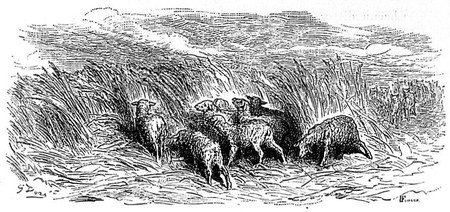
I Find in no one race or nation Of men what I call moderation; Both animals and plants do err In this respect, I must aver. Nature's great Master wished that we Should guard the golden mean, you see; But do we?—No; and once more, No! Whether to good or ill we go. The corn that Ceres from her hand Spreads lavish o'er the fertile land, Too richly grows, and drains the ground, Luxuriant, and without a bound; So that from rank and crowded grain All nourishment the deep roots drain; The trees spread likewise heedlessly To check the corn. God graciously Gives us the sheep to check ill growth; Amid the corn they, nothing loath, Plunge headlong, and so, ruthless, spoil The slow result of peasants' toil. Then Heaven sends the wolf to thin The sheep—they gobble kith and kin— If they spare one 'tis not their fault, They're but too ready to assault; Then man the speedy punishment Unto the cruel wolves is sent. Next man—far worst of all abuses— The power Divine he rashly uses. Man, of all animals yet known, Is more disposed to this, I own; Little or great, unto excess We carry all things, I confess; No soul that lives but errs, I see, In this respect continually, The good text, "Not too much," is met Often, but never practised yet.
FABLE CLXXXV.
THE TWO RATS, THE FOX, AND THE EGG.
TO MADAME DE LA SABLIÈRE.
Iris, it were easy, quite, Verses in your praise to write, Were't not that, scornful, you refuse The plaintive homage of my muse, In that unlike your sisters fair, Who any weight of praise can bear: Most women doat on flattery's lies, Nor are they, on this point, unwise; For, if it be a crime, 'tis one That gods and monarchs fail to shun. That nectar which, the poets say, Is quaffed by him who holds the sway O'er thunders, and which kings on earth Get drunk on, from their earliest birth, Is flattery, Iris, flattery—such As you 'll not even deign to touch. No, Iris! you have rich resources In genuine wit, and wise discourses,— Sometimes half earnest, sometimes gay; The world believes it not, they say: Let the poor world think what it may. In conversation, I maintain That truth and jokes are equal gain. Pure science well may be the stay Of friendly converse; but the ray Of mirth should, ever and anon, Electric, light friends' union. Discourse, when rightly comprehended, Is with a thousand graces blended, And much resembles gardens sweet, Where Flora's various beauties meet; And where the bees search every bloom, And from each bush bring honey home. Allowing this to be so, let Some theories in my tales be met: Theories philosophic, new, Engaging, subtle; have not you Heard speak of them? Their holders say That animals are mere machines, And move but by mechanic means; That, move or gambol as they may, They move but blindly, have no soul, No feeling heart, no self-control; But are like watches, which, set going, Work on, without their object knowing. If we should open one of these, What is't the eye within them sees? A score of tiny wheels we find; The first is moved, then, close behind, A second follows, then a third, And so on, till the hour is heard. To hark to these philosophers, The heart is such; some object stirs A certain nerve, and straight, again, A fellow-nerve endures the strain; And so on, till the sense it reaches, And some deep vital lesson teaches. "But how's it done?" These theorists cry, 'Tis done by pure necessity; That neither will nor even passion Assist in it, in any fashion. That, moved by some inherent force, The beast is sent to run the course Of love and grief, joy, pain, and hate, Or any other varied state. A watch may be a watch, and go, Compelled by springs; but 'tis not so With us;—and here 'twere wise to ask Descartes to aid us in our task,— Descartes, who, in the times of eld, Had for a deity been held; And who, between mere men and spirits, Holds such a place, by special merits, As 'twixt man and oyster has That patient animal, the ass. He reasons thus, and boldly says, "Of all the animals that dwell On this round world, I know, full well, My brain alone has reason's rays." Now, Iris, you will recollect, 'Twas taught us by that older science, On which we used to have reliance, That when beasts think, they don't reflect. Descartes goes farther, and maintains That beasts are quite devoid of brains. This you believe with ease, and so Can I, until to woods I go, Just when, perchance, some motley crew, With dogs and horns, a stag pursue. In vain it doubles, and confounds. With many a devious turn, the hounds. At length this ancient stag of ten, Discovering all its efforts vain, And almost wholly worn and spent, Drives by main force, from covert near, Athwart the dogs, some younger deer, To tempt them off, by fresher scent. What reasoning here the beast displays! Its backward tracks on beaten ways, Its numerous schemes its scent to smother, And skill, at length, to thrust another
THE TWO RATS, THE FOX, AND THE EGG.
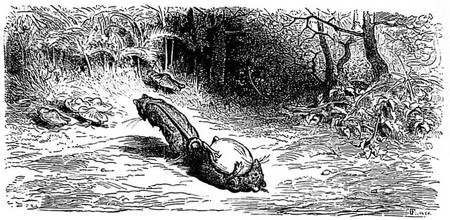
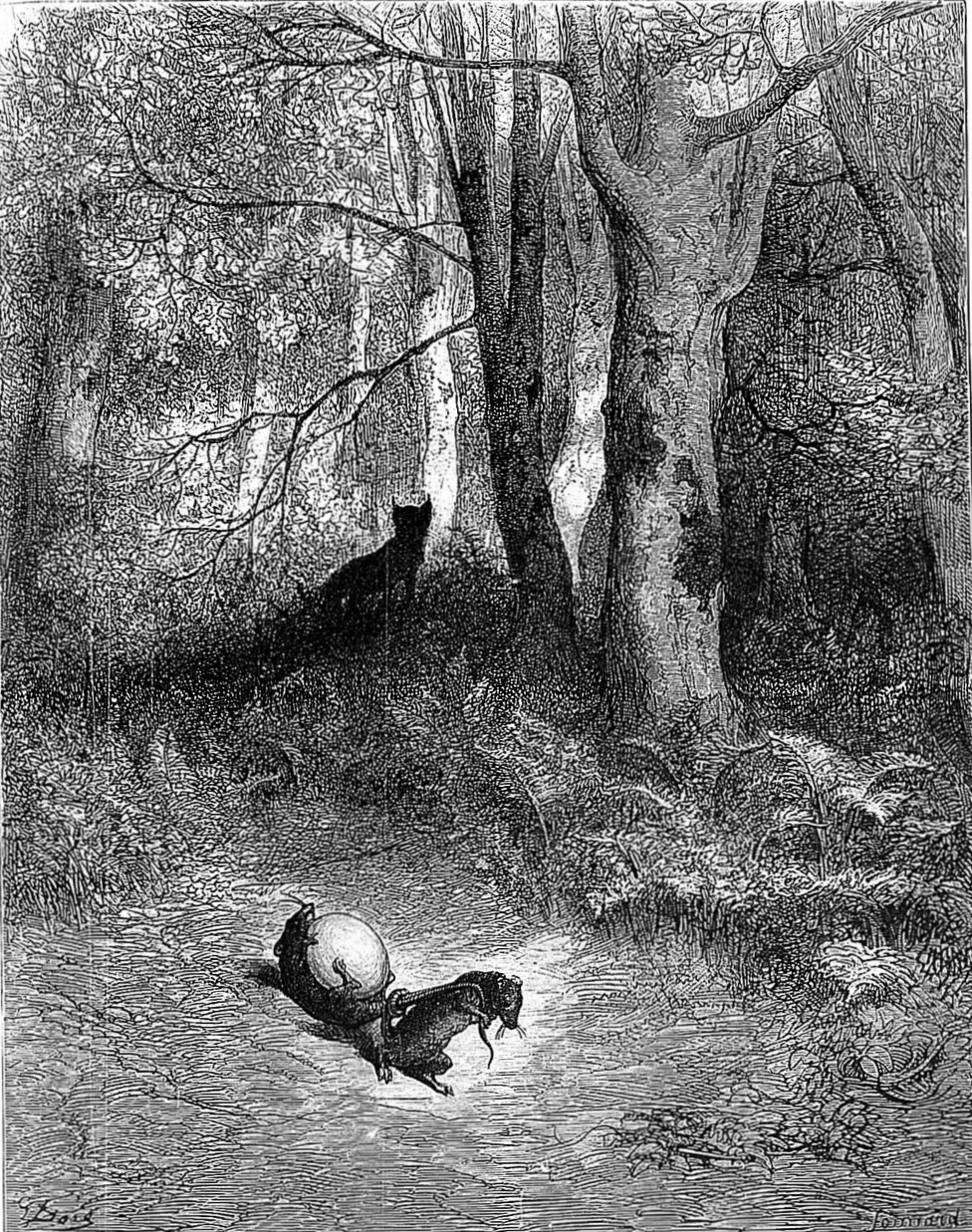
On danger almost at its feet, For some great party chief were meet; And worthy of some better fate Than death from dogs insatiate. 'Tis thus the red-legged partridge, sprung By pointer, strives to save her young, As yet unfledged. With piteous cries, And lagging wing, she feigns to rise, Runs on, then halts, then hurries on again, And dog and hunter tempts across the plain; But when her nest is far enough behind, She laughs at both, and skims along the wind. 'Tis said that beings have been found, In distant lands, in northern climes, Who still in ignorance profound Are steeped, as in primeval times. But only of the men I speak, For there four-footed creatures break The force of streams by dams and ridges, And join opposing banks by bridges: Beams morticed well with beams, their toil Resists the stream's attempt to spoil; Each labourer with the other vies, And old ones guide young energies; Chief engineers the whole survey, And point out aught that goes astray. Pluto's well-ordered state could never Have vied with these amphibians clever. In snows they build their houses high, And pass o'er pools on bridges dry: Such is their prudence, art, and skill; Whilst men like us around them, still, If they, perchance, should have the whim A distant shore to reach, must swim. Now, spite of all, this evidence Convinces me of beavers' sense. But still, my point to make more clear, I will a story here relate, Which but lately met my ear From lips of one who rules in state: A king, I mean, and one whose glory Soars high on wings of victory— The Polish prince, whose name alone Spreads terror round the Turkish throne. That kings can lie not is well known: He says, then, that his frontiers wide Are edged by wilds where beasts reside, Who warfare wage inveterate, And to their sons transmit their hate. "These beasts are fox-like," says the king, And to their wars such arts they bring, That neither this nor any age Has seen men with like skill engage. All pickets, sentinels, and spies, With ambuscades and treacheries, That she who from Styx's entrails came, And unto heroes gives their fame, Invented has, for man's perdition, These beasts employ, with erudition. To sing their battles we should have Homer restored us, from the grave; And, oh! that he who Epicurus Rivals once more could re-assure us That, whatever beasts may do, Is to mechanic means but due; That all their minds corporeal are; That building houses, making war, They are but agents, weak and blind, Of some mere watchspring in the mind. The object which their sense attacks, Returning, fills its former tracks, And straightway, in their bestial pates, The image seen before creates, Without that thought, or sense, or soul Have o'er the thing the least control. But men a different station fill, And, scorning instinct, use their will. I speak, I walk, and feel within Something to God-like power akin. Distinct from all my flesh and bone, It lives a life that's all its own, Yet o'er my flesh it rules alone. But how can soul be understood By what is merely flesh and blood? There lies the point. The tool by hand is guided; Who guides the hand has not yet been decided. Ah! what is that strange power which wings The planets on their heavenly way? Doth each some angel lord obey? And are my spirit's secret springs Moved and controlled the selfsame way? My soul obeys some influence; I know not what it is, nor whence. That secret must for ever lie Hid by God's awful majesty. Descartes knew just as much as I: In other things he may supplant All men; he's here as ignorant. But, Iris, this, at least, I know,— That no such lofty souls endow The beasts of whom I've made example:— Of soul, man only is the temple. Yet must we to the beasts accord Some sense the plant-world can't afford; And even plants have humble lives. But let me add one story still; And let me know how much your skill Of moral from its facts derives. Two Rats, seeking something to eat, found an Egg: For such folks, to have something to eat is sufficient; And seldom or never you'll find that they beg Of the gods turtle soup, or a French cook proficient. Full of appetite, nimbly they sat down to eat, And soon from the shell would have drawn out the meat, When a Fox in the distance appeared, to molest them, And a question arose, which most greatly distress'd them,— No other, as you may suppose, but the way The Egg from Sir Reynard's keen snout to convey. To drag it behind them, or roll it on floor, To pack it behind them, or shove it before, Were the plans tried in turn, but were all tried in vain. When at length the old mother of arts[1] made it plain That, if one on his back held the Egg in his paw, The other from danger could readily draw. The plan was successful, in spite of some jolting; And we leave the two sages their pleasant meal bolting. Who shall, after this, declare That beasts devoid of reason are? For my part, I'll to beasts allow The sense that dwells in childhood's brow. Reason, from childhood's earliest years, In all its acts and ways appears; And so it seems to me quite plain That without soul there may be brain. I give to beasts a sort of mind, Compared to ours, a league behind. Some matter I would subtilise, Some matter hard to analyse, Some atoms essence, light's extract; Fire, subtlest of all things; in fact, The flames that out of wood arise Enable us to form some thought Of what the soul is. Silver lies Involved in lead. Beasts' brains are wrought So that they think and judge;—no more. They judge imperfectly. 'Tis sure No ape could ever argue. Then Above all beasts I'll place us men; For to us men a double treasure Belongs—that sense which, in some measure, To all things living here below, The wise and foolish, high and low, Is common; and that holier spirit Which men, with seraphim, inherit. And, oh! this loftier soul can fly Through all the wondrous realms of sky: On smallest point can lie at ease; And though commenced shall never cease. Things strange, but true. In infancy This soul must dim and feeble be; But ripening years its frame develop, And then it bursts the gross envelope Which still in fetters always binds, In men and beasts, the lower minds.
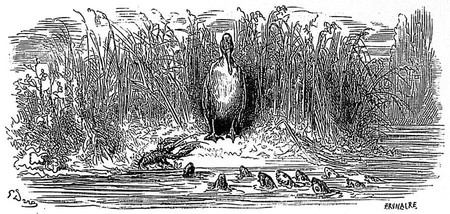
FABLE CLXXXVI.
THE CORMORANT AND THE FISHES.
Through all the country far and wide, In pools and rivers incessantly diving, A Cormorant greedy his table supplied, On their finny inhabitants so daintily thriving. But at length there came a day When his strength gave way, And the Cormorant, having to fish for himself, Unskilled to use nets which we mortals employ, The fish for our own selfish use to decoy, Began soon to starve; with no crumb on the shelf, What could he do now?—Necessity, mother, Who teaches us more than we learn when at school, Advised the poor bird to go down to a pool, And addressing a Cray-fish, to say to him—"Brother, Go tell your friends a tale of coming sorrow: Your master drains this pool a week to-morrow!" The Cray-fish hurried off without delay, And soon the pool was quivering with dismay: Much trouble, much debate. At length was sent A deputation to the Cormorant. "Most lordly web-foot! are you sure th' event Will be as you have stated? If so, grant Your kind advice in this our present need!" The sly bird answered—"Change your home with speed." "But how do that?" "Oh! that shall be my care; For one by one I'll take you to my home, A most impenetrable, secret lair, Where never foe of finny tribe has come; A deep, wide pool, of nature's best, In which your race may safely rest." The fish believed this friendly speech, And soon were borne, each after each, Down to a little shallow, cribbed, confined, In which the greedy bird could choose them to his mind.
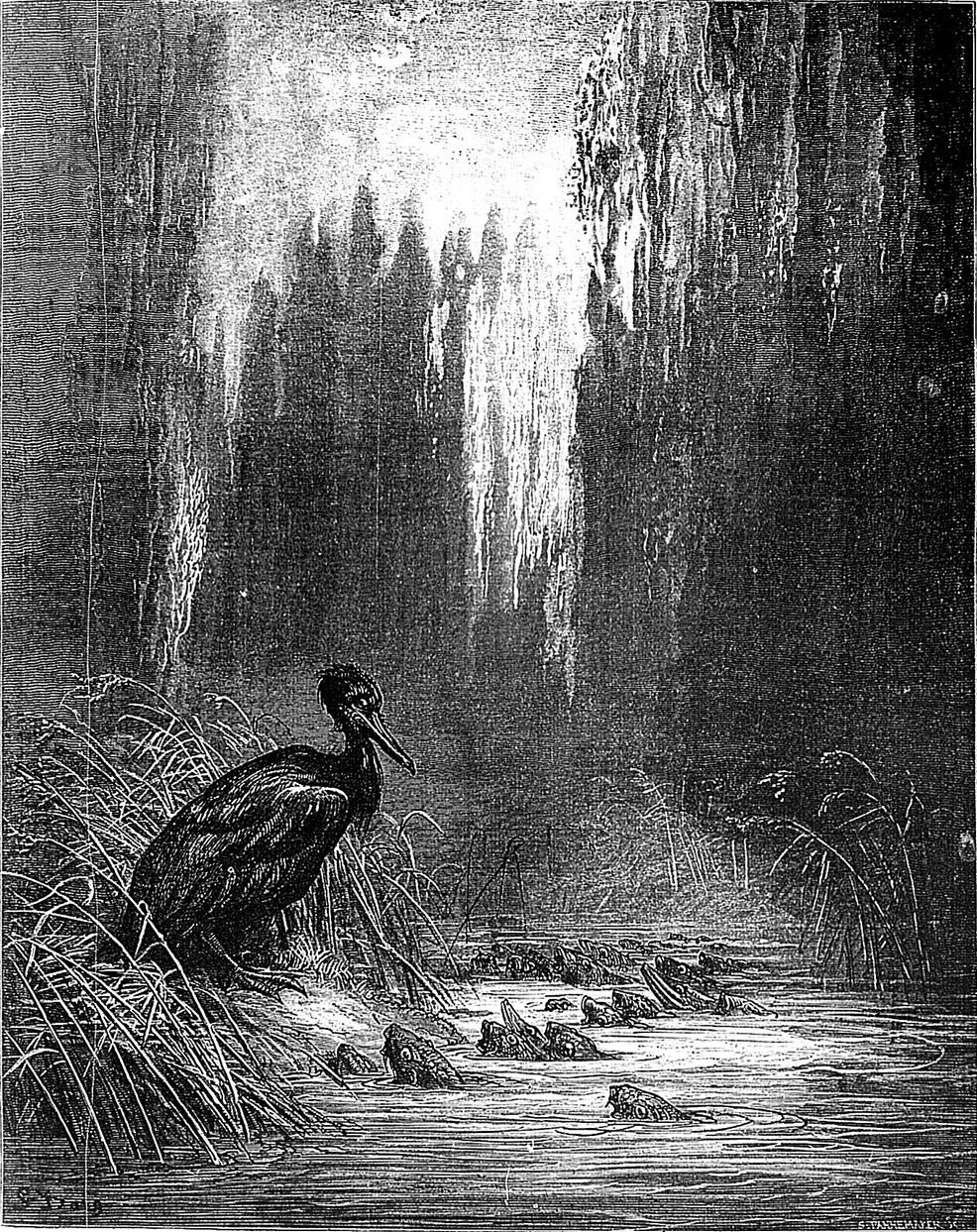
THE CORMORANT AND THE FISHES.
And there they learnt, although too late, To trust no bills insatiate. But, after all, it don't much matter— A Cormorant's throat or human platter— Whether a wolf or man digest me, Doesn't seem really to molest me; And whether one's eaten to-day or to-morrow Should scarcely be any occasion for sorrow.
FABLE CLXXXVII.
THE HUSBAND, THE WIFE, AND THE ROBBER.
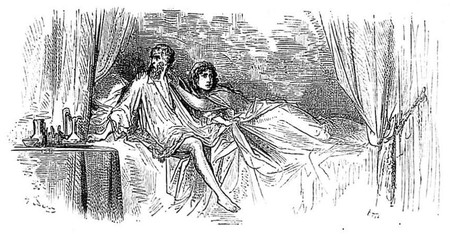
A Husband, loving very tenderly— Most tenderly—his wife, was treated ill By her;—her coldness caused him misery. No look, no glance, no, not a friendly word,— Not e'en a smile, such as she gave her bird,— But cold looks, frowns, and peevish answers, still. He did not Venus nor yet Hymen curse, Nor blame his destiny and cruel lot, Yet daily grew the evil worse and worse: Although he loved her every hour the more. It is so now, and has been so of yore. In fact, he was a Husband, was he not? One night, as he lay moaning in his sleep, A Robber entered; and, struck dumb with fear, The fretful Wife, too frightened e'en to weep, Sprang to her Husband's arms, and, sheltered there, Defied all sorrow, trouble, danger near, As her heart softened, and burst forth the tear. "Friend Robber," said the Husband, "but for thee I had not known this boundless happiness. Take all I have,—I give thee liberty; Take house and all, to prove my gratitude." Thieves with much modesty are not endued; The Robber took sufficient, I confess. From this I argue that fear is so strong, It conquers hatred, and love, too, sometimes. Yet love has triumphed over passion's throng: Witness the lover, who his house burnt down, So he might win Hope's brightest laurel crown, By rescuing her, the lady he'd loved long, And so secure her heart. I like the story: It strikes my fancy very pleasantly; It is so Spanish in its tone. I glory In love, so chivalrous and mettlesome, And hold it grand (so will all times to come). 'Twas not by any means insanity.
FABLE CLXXXVIII.
THE SHEPHERD AND THE KING.
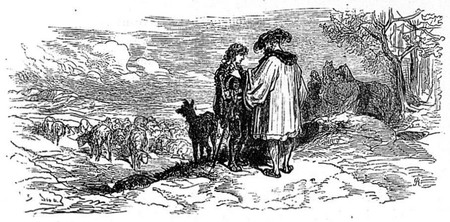
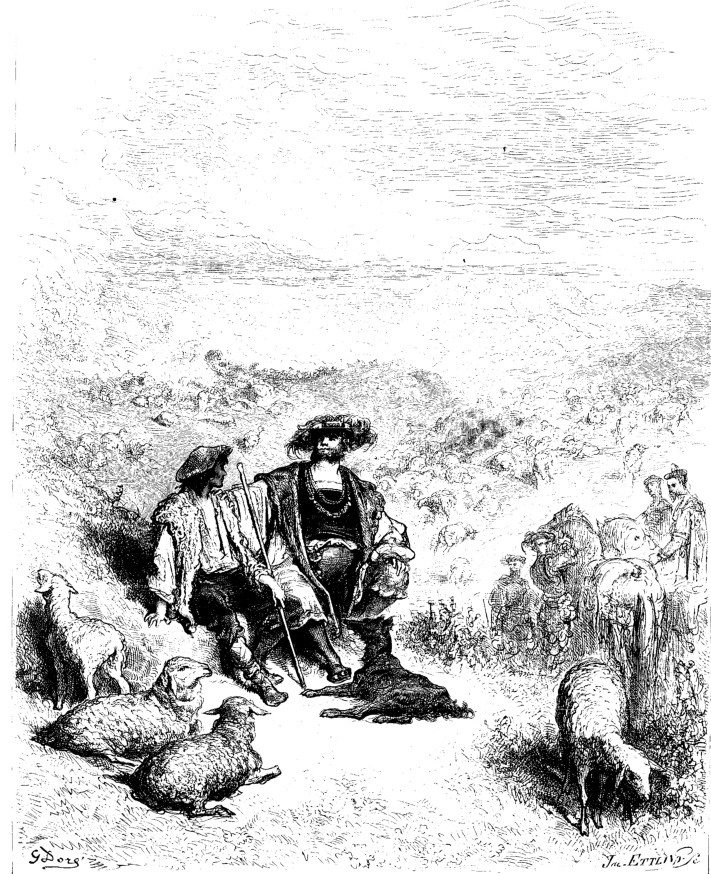
Our lives are spoiled by demons twain; Turn in, turn out; by each, in season; By each with reckless force is slain That which we mortals call our reason. And if you ask their name and state, I'll name god Love, the potentate, For one; and for the other, I'll name Ambition, Love's half-brother, Who, not seldom, Love defeats, And reigns within his choicest seats, All this I soon could prove; but now That which I wish to tell is how A Shepherd by a King was sent for, And what this royal deed was meant for. The tale belongs to distant ages, And not to those which fill these pages. A numerous flock that filled the plain, And brought the owner heaps of gain, Through Shepherd's care and industry, Once met a sapient's Monarch's eye. Pleased with such skill and thrift, he said, "Good Shepherd, to rule men thou'rt bred; Leave now thy sheep. Come, follow me; Accept my widest satrapy. And so our Shepherd, who before Had scarce had friend but hermit poor, And very seldom had in view Aught but his sheep and wolf or two, Was with a viceroy's sceptre graced; Nor was he by this change misplaced, For Nature had endowed his mind With funds of great good sense; And how to govern human kind He amply learned from thence.
THE SHEPHERD AND THE KING.
Ere many days had passed away, His former friend, the hermit, Came running quickly, crying—-"Say, 'Tis dream-work, or as truth affirm it, That you are now beloved of kings, And deal yourself in regal things. Oh, kings mistrust; their favour goes Life snow on water; thousand woes Fall ever on the luckless wight Who basks a time in kingly might. You know not to what precipice You haste. Come back; take my advice." The other smiled; on which the man Of sacred life, continuing, said— "Alas! already I can scan How far astray your wits have fled; Your foolish conduct calls to mind The story of the traveller blind, Who sees a snake benumbed with cold; The creature frosts so numb and nip, He lies like some old leathern whip; His own just lost, the man takes hold, And waves the reptile in his joy, When one who passes by that way Cries—'Heavens! throw that snake away, Or quickly 'twill your life destroy.' 'No snake; but a good whip,' replied the other. 'No whip; but snake,' replied the stranger; 'And, pray, should I thus make a pother Unless I saw your woful danger? And will you really keep that thing, With fangs so sharp, and deadly sting?' 'Of course, I shall; my whip was lost, And this will save another's cost. You speak from envy—sir, good-bye.' The snake, now brandished wide and high, Grew warm and warmer gradually, And, stinging, caused the fool to die. But, as for you, my satrap friend, You hasten to a bitterer end." "What! worse than death?" the satrap cried. "Ah! worse than death," the sage replied. And, in due time, the hermit's word Was proved with truth in due accord; For all the pests that haunt a Court, By hint and wink, and false report, Soon made the satrap's virtuous skill Seem to his royal master ill. Cabals arose on every side; Defeated suitors loudly cried, "With what belonged to us he built that palace wide." The Monarch fain would see this wealth, And thither stole one day by stealth, But nought within it met his eyes Save modest mediocrities, And praises of the joys that lie In loneliness and poverty. "His wealth, then," cried the pests, "consists In diamonds, pearls, and amethysts; In yonder chest with locks his hoard, The ransom of a king, is stored!" The Monarch, with his own white hands, Undoes the locks and clumsy bands, Throws back the wooden lid—and mute Each base calumnious courtier stands; For in that oaken chest is nought But cap and jacket, roughly wrought, A simple cloak, a shepherd's flute. "Ah! much-loved treasures;" then exclaims The Shepherd; "you are dear, indeed, For never did you rouse the greed Or malice of my fellow-men, And you your master now reclaims; Let's leave this palace, ne'er again To enter, save in airy vision. Monarch! pardon this decision; When I mounted Fortune's height, A fate untimely met my sight; But who, alas! is quite so wise, As not sometimes to wish to rise?"
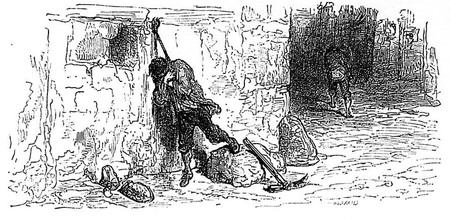
FABLE CLXXXIX.
THE TWO MEN AND THE TREASURE.
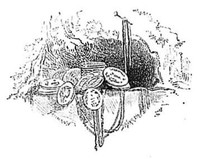
A Man of cash and credit shorn (The Devil only in his purse), Resolved to hang himself one morn, Since death by hunger might be worse: A king of death which pleases not Those curious in their final taste. A rope and nail he quickly got, And fixed them to a wall in haste. The wall was weak and very old, With the man's weight it crumbling fell; When out there came a stream of gold, The Treasure that he loved so well. He did not stay to count, but ran; Pale Penury no more he feared. When in the miser came—poor man! To find his wealth had disappeared. "Gold gone! This cord's my only wealth!" He cried; "now I have lost all hope:" And so straightway he hanged himself. How changed the fortunes of that rope! The miser saves his wealth for those Who may be prudent, may be thieves; Into the grave perhaps it goes: Who knows the changes Fortune weaves? For Lady Fortune mocks outright At human nature's dying pangs; And if by you or me made tight The rope, she laughs that some one hangs!
FABLE CXC.
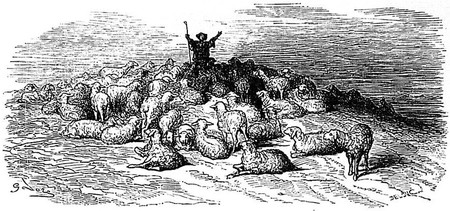
THE SHEPHERD AND HIS FLOCK.
"Alas! I see another one Of my poor foolish flock is gone! The wolf, relentless, day by day, Makes still another sheep his prey. In vain I count them, oft and oft— Ten times a hundred; they're so soft, That they have let my Bob be torn By wolfish jaws. Ah! me, forlorn! My darling Bob would follow me, In town or in the country, up and down, O'er all the world, with tread for tread, If I but showed a bit of bread. A furlong off my step he knew, And to my piping time kept true. Alas! poor Bobby!" When, at last, This funeral discourse had past, And Robin's fame was duly sounded, The Shepherd, by his flock surrounded, Addressed them all, ram, lamb, and sheep, And said, that if they'd only keep United, never wolf would dare Their woolly-coated throats to tear. The flock declared, with solemn bleat, They all their master's views would meet, Form ever one united band, And chase Sir Wolf from out the land. Delighted at their brave reply, Guillot regaled them sumptuously. But, sad to say, before the night, There happened a disaster new. A horrid wolf appeared in sight, And off the timid creatures flew. In truth 'twas a mere shadow, but The ant's a wolf in Lilliput. Bad soldiers you in vain address; Heroic aims they all profess; But let the slightest danger show, In spite of generals, off they go.
FABLE CXCI.
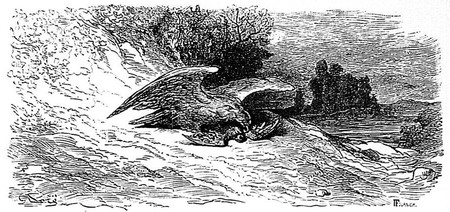
THE KITE AND THE NIGHTINGALE.
A Daring thief, a Kite by name, Spread dire alarm o'er hill and dale. E'en little children cried, "For shame!" When he pounced on a Nightingale. The bird of Spring for life prayed well— "I'm fit for songs, and not for eating; Oh, hear my notes, and I will tell My tale of Tyreus, still repeating." "Tyreus! is that good food?" then said The Kite. "No, no;" was the reply; "He was a mighty king, who made His love to me, with vow and sigh. "His cruel love was strong: too strong! 'Twas mad—'twas criminal: now, sire, Let me transport you with my song; A song so sweet you must admire." Not having eaten all the day, The Kite had other views of things. Thus—"What's the use of music, pray? I, too, can talk of mighty kings. "When you take kings—or kings take you— Sing to them and their pretty dears; I'm hungry, and know what to do— An empty stomach has no ears."
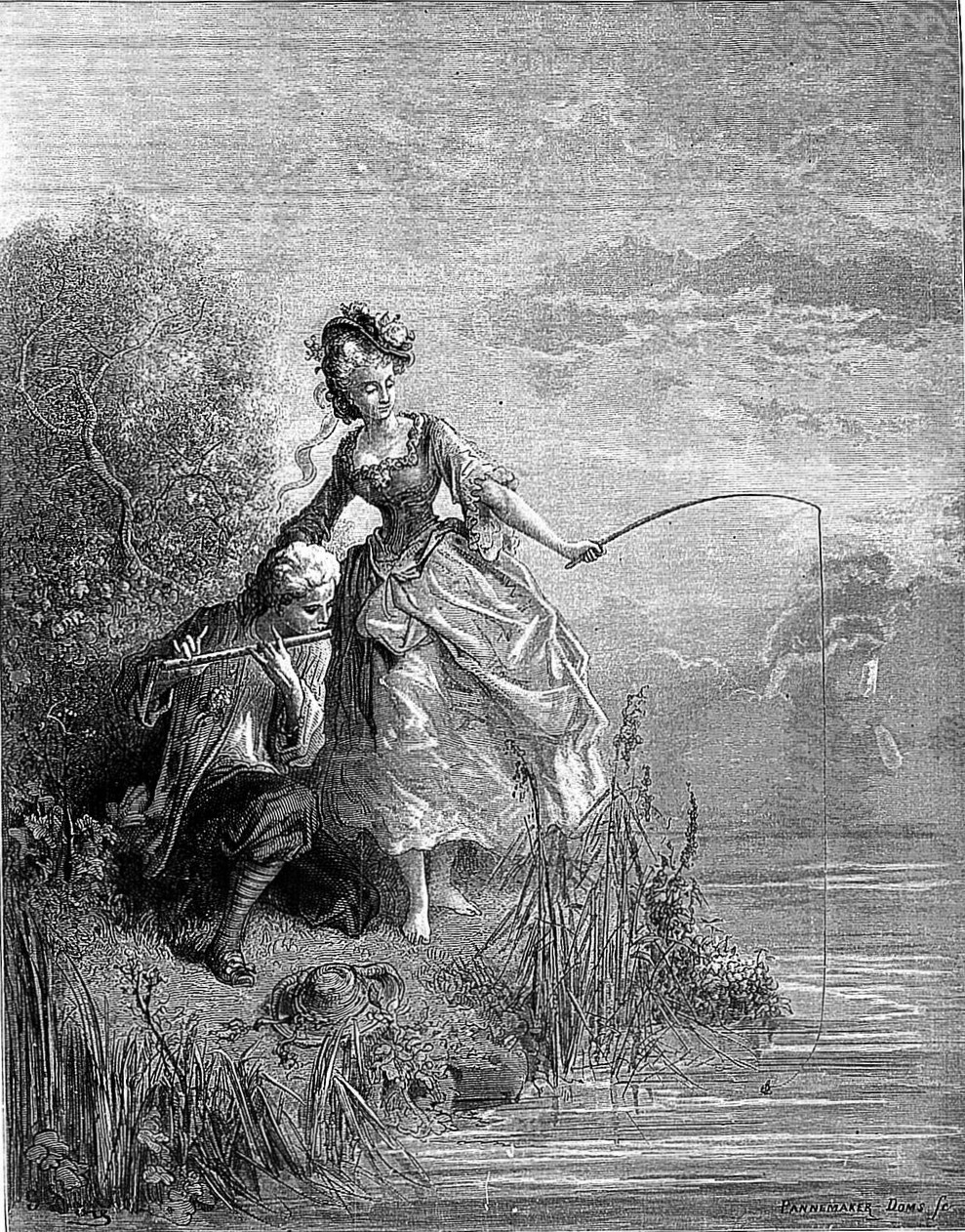
THE FISH AND THE SHEPHERD WHO PLAYED ON THE CLARIONET.
FABLE CXCII.
THE FISH AND THE SHEPHERD WHO PLAYED ON THE CLARIONET.
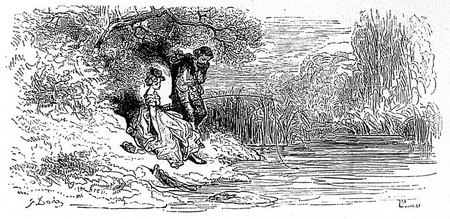
Tircis, for his loved Annette Playing on the Clarionet, Poured forth strains of music, such As the very dead might touch:— Played and sang beside a stream Which through the meadows flowed like some delicious dream. Meanwhile, Annette, demure and pretty, With rod and line, on fishes bent, Stood, listening unto Tircis' ditty, Which failed to lure them from their element. Still Tircis sang, "Come, come, ye fishes, come: Come from the cool depths of your watery home; Forsake your naiad, and see one more fair: Surrender all your lives to Annette's care! She is gentle, she is kind; In her keeping you will find Your lives more safe than down below. Safe in a crystal pool, no want you'll know. And should you in her keeping die, Your fate I'd suffer willingly." Now this song was well sung, and the instrument's strains Were deliciously sweet, but, in spite of his pains, The fishes avoided the charmer's keen hook. Then Tircis lost patience, and hastily took A net called a trammel, and, sweeping the stream, Placed at Annette's disposal trout, greyling, and bream. Oh, shepherds of men, and not of sheep; Kings, who think you can safely keep Your subjects in order by rule of right, Attend to my counsel, and spread out your nets, Before the time comes for forlorn regrets, And let them cringe, under the rule of might.
FABLE CXCIII.
THE MAN AND THE SNAKE.
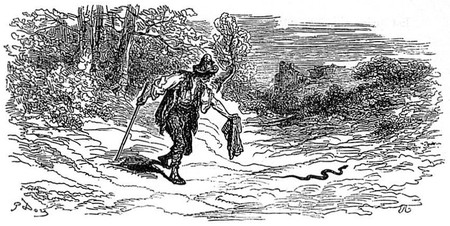
A Man once saw a Snake, and said, "Thou wretched thing, I'll strike thee dead— 'Tis for the general good!" And straight the wicked thing (By wicked be it understood, I mean not Man, but wretch with sting; For some my meaning might mistake), Well, this base and atrocious Snake Was placed in sack, And doomed, alack! To death without the aid of jury! But yet the Man, despite his fury, To show that he with justice acted, His reasons in these words compacted:— "Oh, symbol of all that is base, 'Twere a crime to spare one of thy race; For mercy to those that are bad Can from foolish ones only be had; And no more shall thy sting or thy teeth, Oh, thou villanous Snake, find their sheath!" The Serpent, thus addressed, His counter views expressed, And briefly made reply:— "O Man! if all must die Who graceless are, there's none Who would not be undone. Yourself shall be the judge; I'll take From you excuse for me, the Snake. My life is in your hands, I know, But ponder ere you strike the blow, And see now what you justice call Is based on vices great and small. Your pleasure and convenience You'll satisfy at my expense; But, pray, think not that I am rude, If, dying, I this statement make— That Man, and not the Snake, The symbol is of all ingratitude." These words the angry Man surprise, He starts aside, and then replies— "Your words are nonsense, and to me Belongs of right your fate's decree; But, nathless, let us have resort Unto some independent court." The Snake assented; and a Cow That stood hard by, appealed to, said— "The case is plain; I can't see how The thing should puzzle any head: The Snake is right, I'll frankly say; For yonder Man, for many a day, With milk and curd I've amply fed, And long ere this his child were dead, If my rich food his pining son Had rescued not from Acheron. And now that I am old and dry, He leaves me, wanting grass, to die; Sure, had a Serpent been my master, It could have been no worse disaster." Thus saying, with an awkward bow, Walked off, or rather limped, the Cow. The Man, aghast at this decree, Exclaimed, "O Snake! it cannot be; The Cow is doting. Let us place Before this Ox our mutual case." The Snake assents, and heavily The Ox walks up, and by-and-by, Still ruminating, makes reply To this effect—"That, after years Of painful toil and weariness, That Ceres' wealth Man might possess (And here the Ox burst into tears), His sole reward had been the goad, When panting with some weighty load; And, what was worse, his owner thought He—Ox—was honoured, being bought By cruel butcher, to be flayed, And as a prize beast then displayed!" The Man declared the Ox a liar, And said, "Yon Oak-tree shall be trier." The tree, appealed to, made a case Redounding unto Man's disgrace; Told how he sheltered Man from rain, Told how he garnished hill and plain, Told how he gave Man flowers and fruits, And how that, when Man's will it suits, He cuts him down and burns his roots! The Man, convinced against his will, Resolved to have his vengeance still; So took the Serpent, bag and all, And banged it up against the wall, Until the wretched Serpent died, And human wrath was satisfied. It is ever thus with the rich and great, Truth and reason they always hate; They think that all things here below Solely for their convenience grow; And if any this simple truth denies, They call him a sulky growler of lies; And this being so, when you wish to teach The truth to such people, keep out of their reach.
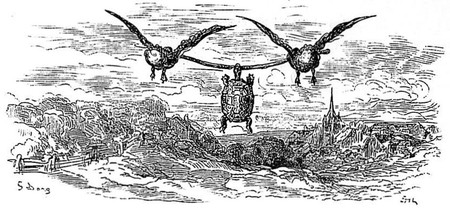
FABLE CXCIV.
THE TORTOISE AND THE TWO DUCKS.
A Tortoise once, with an empty head, Grown sick of her safe but monotonous home, Resolved on some distant shore to tread;— It is ever the cripple that loves to roam. Two Ducks, to whom our friend repaired To gossip o'er her bold intent, Their full approval straight declared; And, pointing to the firmament, Said, "By that road—'tis broad and ample— We'll seek Columbia's mighty range, See peoples, laws, and manners strange; Ulysses shall be our example." (Ulysses would have been astounded At being with this scheme confounded.) The Tortoise liking much this plan, Straightway the friendly Ducks began To see how one for flight unfitted Might through the realms of air be flitted. At length within her jaws they fitted A trusty stick, and seizing each an end, With many a warning cry—"Hold fast! hold fast!" Bore up to heaven their adventurous friend. The people wondered as the cortège passed, And truly it was droll to see A Tortoise and her house in the Ducks' company. "A miracle!" the wondering mob surprises: "Behold, on clouds the great Queen Tortoise rises!" "A queen!" the Tortoise answered; "yes, forsooth; Make no mistake—I am—in honest truth." Alas! why did she speak? She was a chattering dunce: For as her jaws unclose, the stick slips out at once, And down amidst the gaping crowds she sank, A wretched victim to her claims to rank. Self-pride, a love of idle speaking, And wish to be for ever seeking A power that Nature ne'er intended, Are follies close allied, and from one stock descended.
THE TWO ADVENTURERS AND THE TALISMAN.
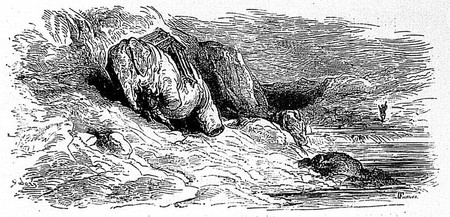
FABLE CXCV.
THE TWO ADVENTURERS AND THE TALISMAN.
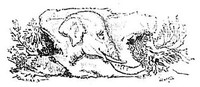
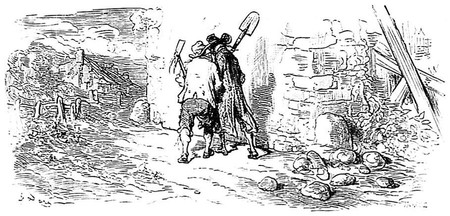
I have never heard or read In annals true or fabled story, That paths of pleasure ever led Mortal heroes unto glory; And in proof of this one sees The labours twelve of Hercules. However, once, by Talisman Induced, a knight conceived the plan Of mounting horse and couching lance, And seeking lands of fair romance, Accompanied by one he knew. After a time there came in view A post upon the public way, On which was writ—"A moment stay, Adventurous knight. If you would see That which no knight has seen before, Venture across yon torrent's roar, And from the root of yonder tree Yon elephant's huge head of stone Raise up, and, without resting, bear To yonder mountain's crest, which proudly stands alone." Now of these knights one was of those Who shudder at your swashing blows. "The torrent's deep and broad," he cried; "And if we reach the other side? Why climb unto a mountain's crest, With a stone elephant opprest? 'Tis true the artist may have wrought His work on such a scale, a man Might bear it for a yard, then rest; But tell me not that mortal can Bear it to yonder mountain's top, Not daring once for breath to stay. Perhaps this mystic head is naught But such as one might bear away; And if the latter be the truth, Success were honour small, in sooth. The whole thing is so plain a trick, I'll leave it. Come, my friend, be quick." This wise man having passed along, The other crossed his breast, and made A dash across the torrent strong, And found beneath the tree the beast's head laid. He raised it, and, with breathless stride, He bore it to the mountain's brow, And there, upon a terrace wide, Gazed on a city fair that stretched below. "Umph!" cried the elephant, and then Forth swarmed a host of armed men. All other errant knights but this Would now have shown some cowardice; But he, so far from turning back, Couched lance in rest, and spurred to the attack. But what the hero's great surprise, When all the crowd, with joyful cries, Proclaimed him monarch, in the place Of one just dead! With modest grace The knight declared he was not fit A crown to wear, and then took it. Sixtus the Pope once said so, too; (And is it, then, so bad a thing To be a pope, or be a king?) But Sixtus said what was not true. Blind fortune to blind courage is a friend; And often he will gain his end Who rashly acts; whilst he who tarries, By prudence quite deceived, miscarries.
FABLE CXCVI.
THE MISER AND HIS FRIEND.
A Miser once who'd got much money, Was puzzled how to hide that honey; For ignorance and love of gain Being ever sisters twain, Had left him at a total loss Where to secrete his golden dross; And why the Miser was so hot to find A place of safety for his hoarded pelf, Was simply the great fear that filled his mind, That some day he should spend and rob himself: Yes, rob himself by gathering pleasure From the usage of his treasure. Poor Miser! how I pity your mistake! Wealth is not wealth unless we use it, And when we do not we abuse it. Why keep money till the sense Of pleasure dies in impotence? To gather gold alone is wretched slaving; To have to watch it makes it not worth having. However this may be, our Miser might Have found some trusty banker for his gold; But it seemed better, to his purblind sight, To give it to the depths of earth to hold. So with a comrade's aid It soon beneath the turf was laid; But when a little time was past, Our Miser going to re-visit His buried treasure, found a huge deficit. At first despair oppressed him; but at last He hurried to his comrade, and he said— "To-morrow I shall want your help again; Some bags of gold still in my house remain, And they had better with the rest be laid." The comrade immediately hurried away, And returned all the gold he had taken, Intending to grasp the whole lot the next day; But in this he was somewhat mistaken; For the Miser grown wise by the loss of his store, Resolved 'neath the earth to conceal it no more, But to use and enjoy it; and thus the poor thief, By being too clever, came headlong to grief. In my belief there is no ill in Playing the rascal to a villain.
FABLE CXCVII.
THE WOLF AND THE PEASANTS.
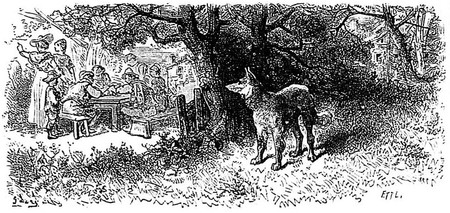
A Conscientious Wolf one day (If conscientious Wolves there be), Lamenting he was beast of prey, Though such but by necessity, Exclaimed—"I'm dreaded far and near, To all a thing of hate and fear; Dogs, hunters, and peasants combine to pursue me, And weary out Jove with their prayers to undo me: In England long since a price paid for my head, Has caused the whole race to be utterly dead. I'm an object of wrath to each ignorant squire, Who orders his people to hunt me and kill; And if a child cries, all that mothers require Is to mention my name to make it be still. And why this universal spite, In all the country round, Which never leaves the Wolf at rest? Because, perchance, by hunger prest, To satisfy my appetite, I've eaten scurvy sheep, or ass, or mangy hound. Ah! well, henceforth I'll eat no living thing, But feed on herbs, and water from the spring; Or starve and die—a cruel, cruel fate— Sooner than be a thing of universal hate." Saying these words, a pleasant savour drew Our wolf's attention to some shepherds near, Feasting on what his wolfish instinct knew Had once been lambkin, to some mother dear. "Ah, ah!" he exclaimed, "this is strange, by my troth; I'm reproaching myself for each lamb that I've slain, Whilst the shepherds and sheep-dogs themselves are not loth To regale on roast lamb is abundantly plain; And shall I, then, a Wolf, feed on nothing but grass? No, not if I know it! The day shall not pass Till a lambkin has gone down my cavernous jaws, Without waiting for any of cookery's laws. A lamb, did I say? I should just think so, rather; Aye, the mother that bore him, and also his father." Well, the Wolf was right; for as long as we feed On animals' flesh, it is surely unjust That we should endeavour to make them recede To the primitive food of a root or a crust. And beasts of prey, we should always remember, Know not the use of spit or ember. Shepherds, shepherds! trust to me; The Wolf a hermit ne'er can be. And sure the Wolf is only wrong When he is weak and you are strong.
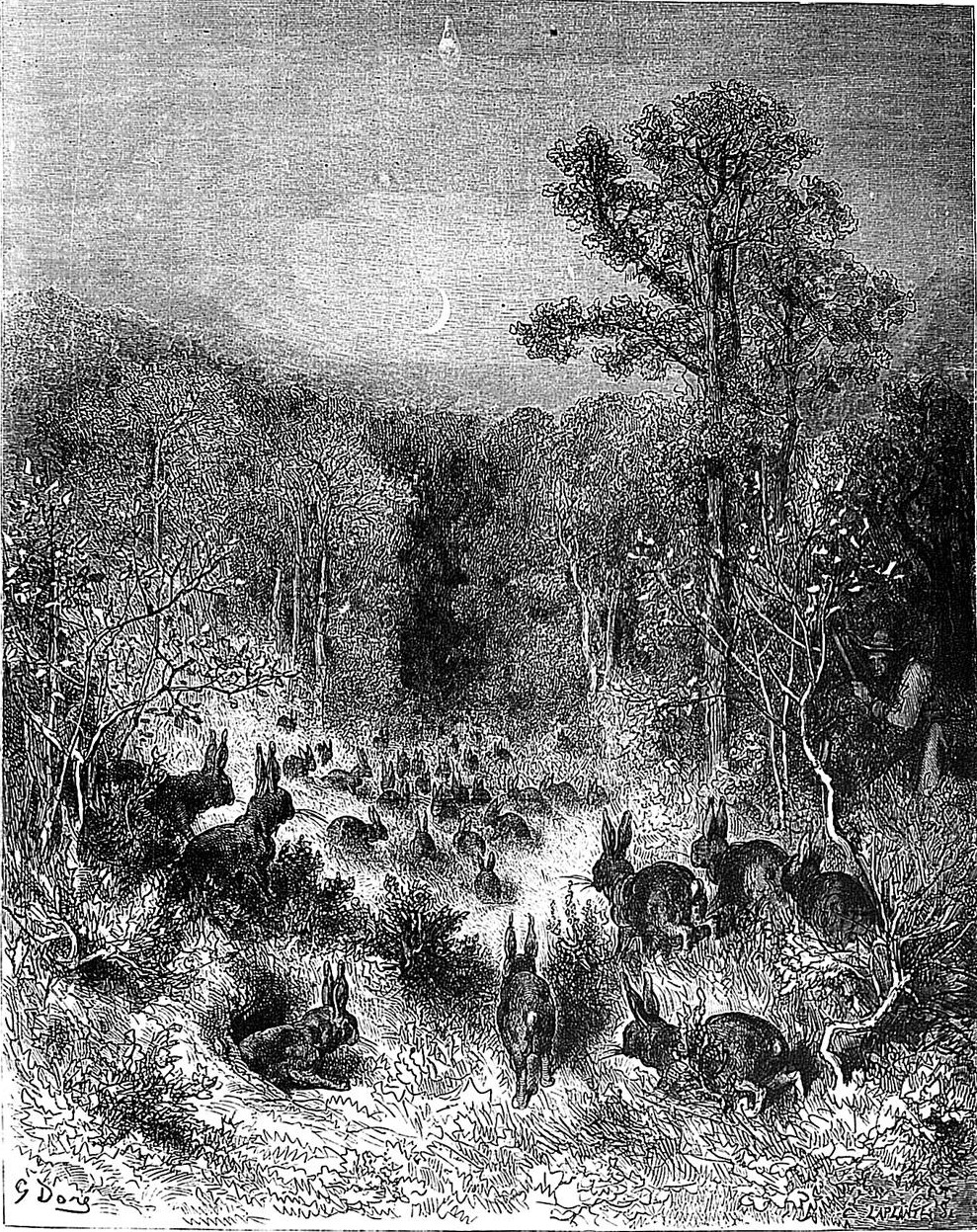
THE RABBITS.
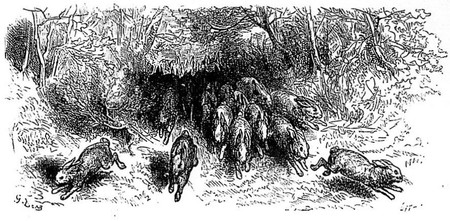
FABLE CXCVIII.
THE RABBITS.
TO THE DUKE DE ROCHEFOUCAULD.
I Have often said, on seeing How men like animals seem to act, That the lord of the earth, a poor frail being, Is not much better, in fact, Than the beasts whom he rules; and that Nature Has given to each living creature A sense of morality's force, That its origin owes to the one same source. At that witching hour when day In the brown of the eve melts away, Or at that when the long-brooding night Has just lifted its pinions for flight, I climb up some tree, at the edge of a wood, And there, like a Jove, so wise and so good, I startle with fear Some young Rabbits gambolling near. Then the nation of Rabbits, Which, in tune with its habits, With eyes and ears both open wide, Played and browsed on the woodland side, Perfuming its banquets with odours of thyme, With a hurry and scurry, Tails turned in a hurry, Seeks its earth-sheltered burrows (thieves flying from crime.) But five minutes, or so, Have not vanished, when, lo! More gay than before, On the fragrant green floor, A rollicking band, The Rabbits are there, again, under my hand! Ah! do we not in this perceive A picture of the race of men Who, shipwrecked once, will still again The safety of the harbour leave, Risking fresh shipwreck from the selfsame wind? True Rabbits! They, to fortune blind, Entrust their wealth, and all their store! And of this truth take one example more. When stranger dogs pass through some place Where they do not of wont reside, The native dogs at once give chase, With hungry jaws, all opening wide (Fearing that the intruders may Snatch the true owner's food away), And never weary till th' intruders Are safely driven from their borders. Just so with those whom gracious fates Have made the governors of states; And those whom many artful plans Have made much-favoured courtesans; And merchants; men of any kind; In all you'll find this jealous mind. Each one, in his several place, To the intruder grants no grace. Your fine coquettes and authors are Precisely of this character. Woe to the unknown writer who Dares publish something bright and new! Poets forgive you any crime, If you'll not rival them in rhyme. A thousand instances of this I might recite; but well I wish That works should never be too long. Moreover, you should always show You think your readers wise, you know; So now I'll close this song. Ah! you, to whom I owe so much; Whose greatness, and whose modesty Are in exact equality; Who cannot bear that men should touch With praiseful tongues your well-earned fame, Who still will blush with needless shame: You, who scarcely have allowed That I should make my verses proud, And from critics and from time Protect my insufficient rhyme, By heading them with one of those Great names which make our nation's pride, Our France, whose annals long disclose More famous names than all the world beside; Oh, let me tell the universe That you gave me this subject for my verse.
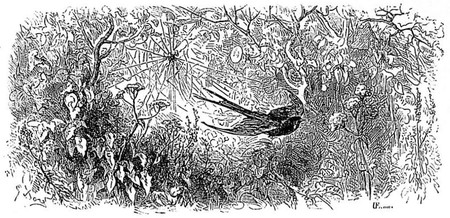
FABLE CXCIX.
THE SWALLOW AND THE SPIDER.
"O Jupiter! who from thy regal brow Drew forth Minerva, my old enemy, List to the prayer of a poor Spider now; Listen, I pray to thee. Progne here and there, all day, and everywhere, Ever skimming, flitting, fifty times a day, Passes by me sitting in my trimly woven lair; Passes by me impudent, and bears away my prey: Yes, swallows up the flies that are crowding to my net, Which with skilful patience 'tween the laurel boughs I've set." Thus the Spider, who of yore so artistically wove, But now reduced in rank to the state of humble spinner, Regarding every fly as hers of right for dinner, Complained in noisy accents unto all-deciding Jove. But in spite of this harangue, Still Philomel's swift sister sprang Past the luckless Spider's door, Ever with her main and might, And with pitiless delight, Bearing to her brood incessantly the food, Which the clamorous little gluttons demanded more and more. But sad it is to tell! still worse was yet to come, For the Swallow, skimming, flitting, Spied the Spider sadly sitting, And snatched her hanging helpless from her once well-ordered home. In this world here below, it is Jupiter's plan Two tables to spread for two different classes; At the one feasts the skilful, strong, vigilant man, At t'other starve feeble and ignorant masses.
FABLE CC.
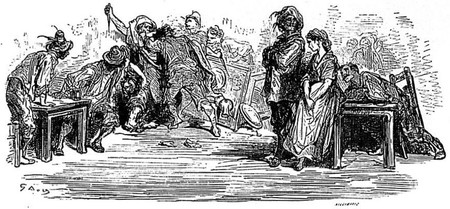
THE PARTRIDGE AND THE FOWLS.
Once to a red-legged Partridge it befell Amongst a lot of fighting Cocks to dwell. Now, as the latter are a gallant race, Fighting with pleasure for a dame's embrace, The Partridge hoped that she would treated be, By these brave birds, with hospitality. But soon, alas! her hopes were cross'd, For oft, by angry passions toss'd, Her fiery hosts, with spur and beak, Would tear her plumage, brown and sleek. At first, this grieved the Partridge much; But when, as soon she did, she saw her foes Inflicting on each other equal woes, She ceased to blame them; "For," said she, "they're such As Jupiter has made them; and we know That he has planted many various creatures here below: The Partridge, mild; the Game-cock, rude and wild. If I could be as I would be, I'd pass my life in gentle company. But what avails these vain regrets? The master here takes Partridges in nets, And forces them to live with Fowls. We owe To man, and not to Nature, all our woe."
FABLE CCI.
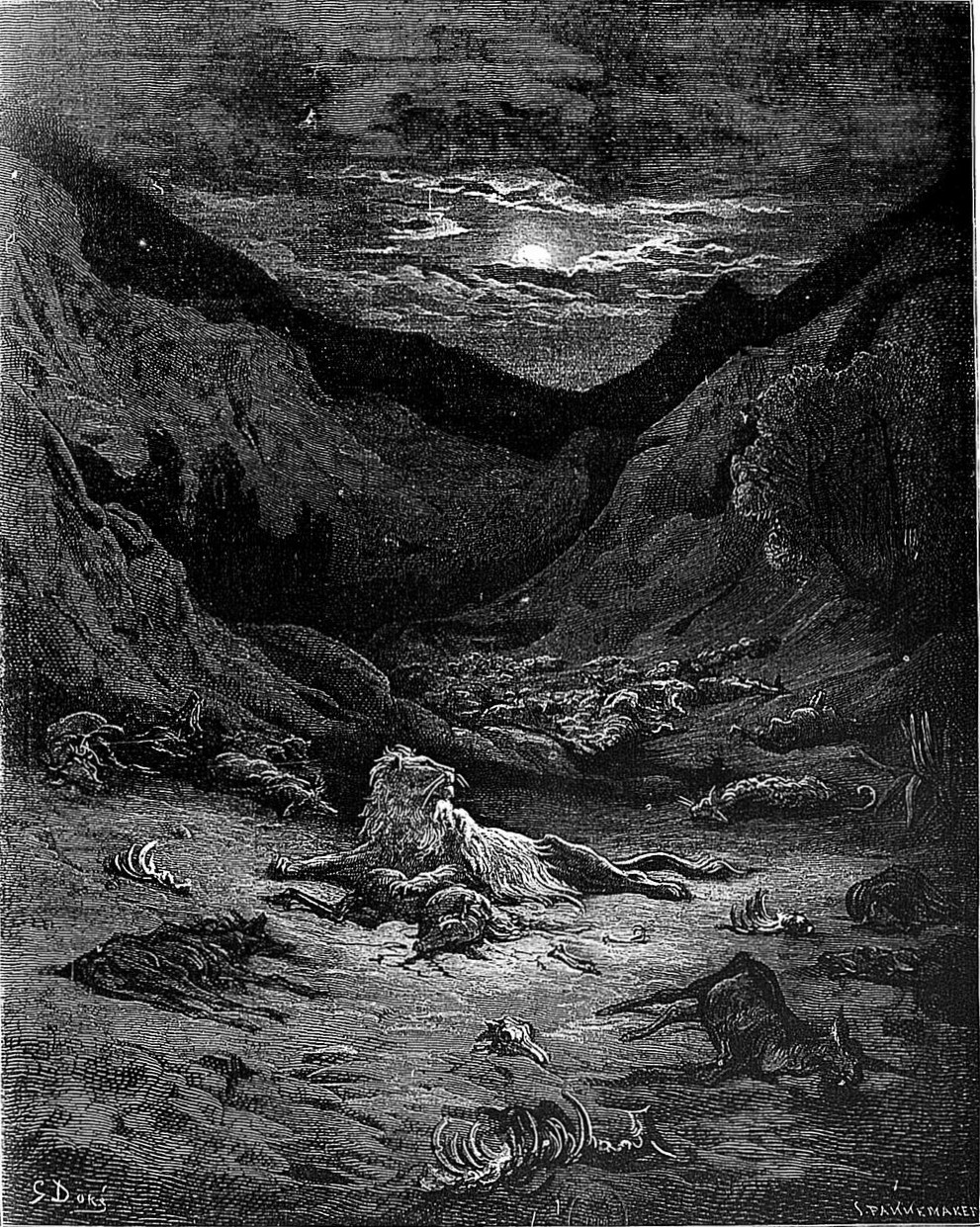
THE LION.
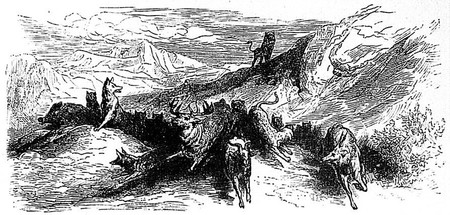
Through spoil and plunder, wealthy grown, A Leopard once claimed as his own, In meadows broad, and forests deep, Full many a steer, and stag, and sheep. At length, upon some luckless morn, Not far away, a Lion born, Received, as usual is with great ones, The compliments well known as state ones. But this once done, King Leopard said To Mr. Fox, his vizier keen,
THE LION.
"I know you suffer from the spleen, Because this Lion-whelp is bred. But why be fearful, since his father Is in deaths keeping? Pity, rather, This orphan child, disconsolate, For he will have a lucky fate, If he, instead of seeking strife, Can but contrive to save his life." The Fox replied, "For orphans such My pity is not over much. In fact, two things alone remain,— His friendship by some means to gain, Or else to kill him, ere he grows Too strong for all the world t' oppose. His horoscope I've duly cast, And find that he will ever be To us the bitterest enemy, But to allies he will cling fast. So, now, decide: become his friend, Or straightway of him make an end." But argued thus the Fox in vain: The Leopard slept, with all his train, Until the Lion's whelp, full grown, Spread havoc, and made all his own. Then Mr. Fox, with careworn brow, Appealed to, said, "'Tis useless, now, To think of meeting force by force: Suppose to friends you had recourse, They would but eat up all your store, And Master Lion does no more. But, sire, remember that the Lion Has got three friends he can rely on, Who ask for neither pay nor food,— Strength, Vigilance, and Fortitude. So, send him now a sheep or two; If that won't answer, lambs a few; And if he's not content with that, A heifer add, both large and fat; For by this means, perchance, you may Save something from this beast of prey." Thus spoke the Fox; but to his master Th' advice seemed ill; and thence disaster Spread over all the country round; For still, combine as might the states, Republics, cities, potentates, They still the Lion master found. If you would now the moral know, Just to this brief advice attend:— If you have let a Lion grow, Take care that he becomes your friend.
FABLE CCII.
THE DOG WHOSE EARS WERE CUT.
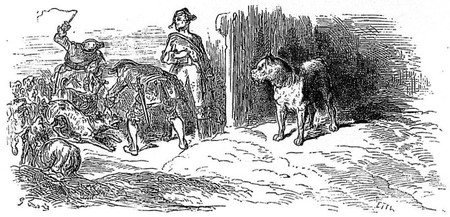
"What have I done, I should like to know, That my master should make me a public show? Amongst other dogs I can never now go! Oh, kings of animals, human race! Tyrants, authors of my disgrace! I wish some demon would treat you the same!" Thus a young Dog reflected, mad with pain, As they cropped his long ears, but his cries were in vain, And he thought himself lost; but he found, one fine day. That his loss was a gain, for, by nature endowed With a combative spirit, in many a fray He saw that to cropping his long ears he owed Avoidance of many a subject for tears,— Rough dogs, when they fight, bite their enemies' ears: For hostile mastiffs his were best of all. 'Tis easy to defend one opening in a wall; Armed with a collar, and with ears but small, Our young Dog meets his foes, fights, and defeats them all.
FABLE CCIII.
THE TWO PARROTS, THE MONARCH, AND HIS SON.
A Parrot and his child, 'tis said, On royal dishes daily fed, Having the affections won Of a monarch and his son. An equal age made either pair Affection for each other bear. The fathers gravely loved each other; And their chicks, though wild and young, At school or play, together clung, As fondest brother unto brother. That a parroquet thus by the son of a king Should be loved, need we say, was a wonderful thing. Now the fates had endowed this young heir to the throne With a love for all creatures that he called his own; And a Sparrow, by arts which caused prudes to despise her, Had contrived how to make this great Monarch's son prize her. And so it chanced, alack! one day. That the rivals twain, at play, Fell into a desperate rage; And the youthful Parrot, stung By some taunt the Sparrow flung, Attacked, and sent her dying to her cage. And then the Prince, with equal fury seized, The slayer snatched, and in a death-grip squeezed. Soon to the Parrot-father's ears The tidings came, and then the air Was tortured by his wild despair; But nought availed, or moans or tears, For his child was lying still— Inanimate, with voiceless bill. Then from his woe the bird awoke, And, with a cruel, double stroke, Tore out the wretched Prince's eyes. This done, unto a pine he flies, And on its topmost branch he knows What joy from satiate vengeance flows. Runs, then, the King to him, and cries, "Come down, my friend, our tears are vain; In love let's bury woe and hate. This wretchedness, 'tis very plain, Comes from my son; or, rather, Fate Had long since writ her stern decree, Your son should die, and mine not see, And that we parents twain should live disconsolate." On this the father bird replied— "Too great a wrong us twain divide; Nor can I think he'll smother hate, Who heathenishly speaks of Fate. But whether it be Providence Or Fate that rules our lives, I'm sure That I will never move from hence Till tempted by some wood secure. I know that in a kingly breast Vengeance for a time may rest; But kings are also like the gods, And, soon or late, you feel their rods. I can scarcely trust you far, Though sincere you think you are; But you are losing time below, For with my will I'll never go. And trust me, hate, like love, is best By absence lullabied to rest."
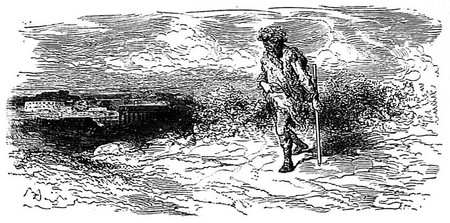
FABLE CCIV.
THE PEASANT OF THE DANUBE.
To judge by appearances only is wrong, The maxim is true, if not very new, And by means of a mouse I have taught it in song; But to prove it at present I'll change my note, And with Æsop and Socrates, also, I'll quote A boor whom Marcus Aurelius drew, And left us a portrait both faithful and true. The first are old friends; but the other, unknown, Is sufficiently well in this miniature shown. His chin was clothed with a mighty beard, And all his body so thickly furred, That much he resembled a grizzly bear— One that had never known mother's care;
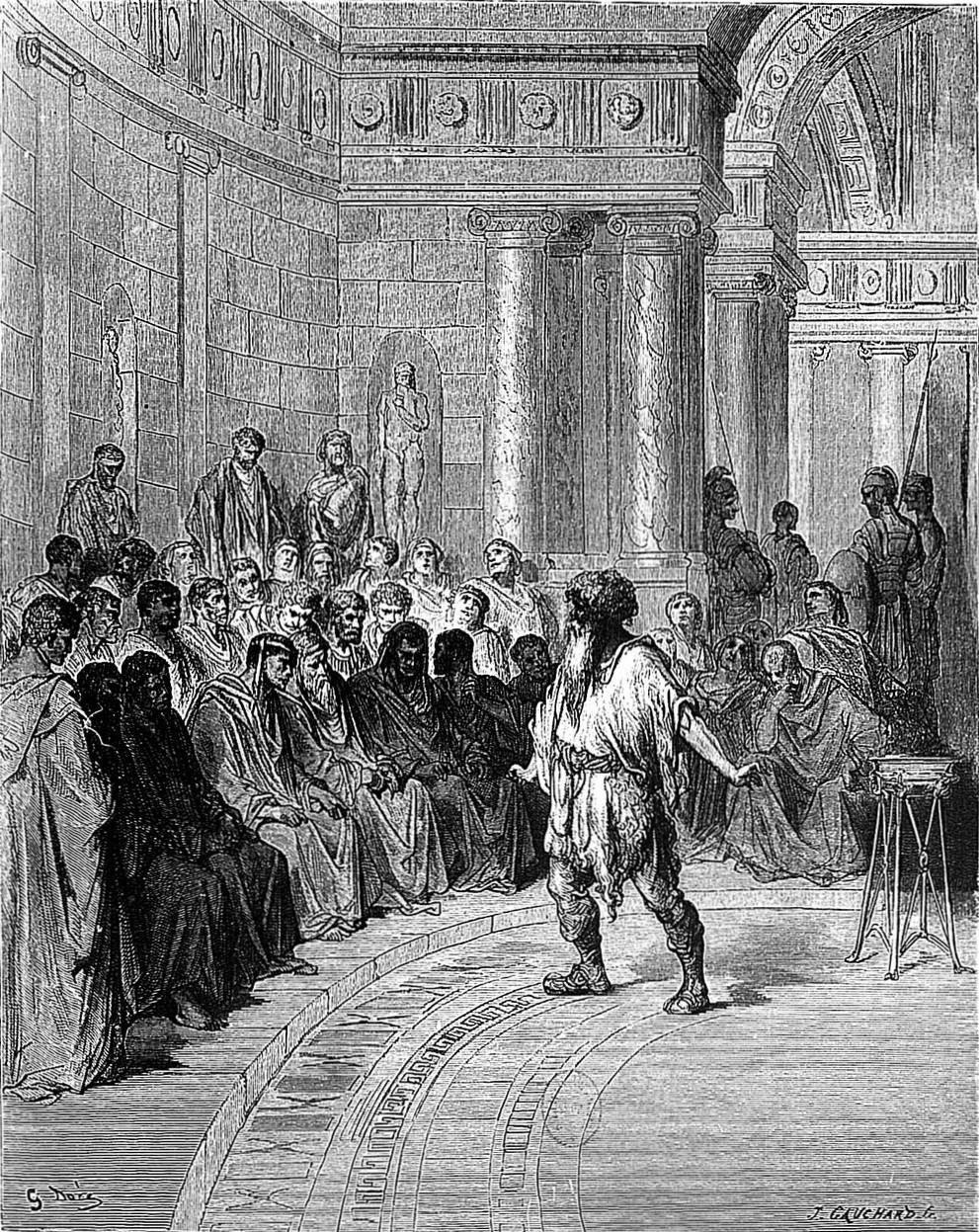
THE PEASANT OF THE DANUBE.
'Neath eyebrows shaggy, two piercing eyes Glared in a way more fierce than wise; Whilst ill-shaped lips and a crooked nose, The sum of his facial beauties close. A girdle of goat-skin formed his dress, With small shells studded for comeliness. This sturdy youth, at a time when Rome Spoiled many a race of its native home, Was sent as a sort of deputation, By Danubian towns, to the Roman nation. Arriving after toilsome travels, The rustic thus his tale unravels: "O Romans! and you, reverend sires, Who sit to list to my desires, First, let me pray the gods, that they May teach me what I ought to say, And so direct my ignorant tongue, That it may utter nothing wrong! Without their intervention must Be all things evil, all unjust. Unless through them we plead our cause, 'Tis sure we violate their laws. In witness of this truth perceive How Roman avarice makes us grieve; For 'tis not by its arms that Rome Has robbed us both of peace and home; 'Tis we ourselves, ill ways pursuing, Have worked at length our own undoing. Then, Romans, fear that Heaven, in time, To you may send the wage of crime, And justice, in our vengeful hands Placing its destructive brands, Hurl swift o'er you the endless waves Of war, and make you fettered slaves! Why, why should we be slaves to you? What is't that you can better do Than the poor tribes you scourge with war? Why trouble lives that tranquil are? Before you came we fed in peace Our flocks and reaped our fields' increase. What to the Germans have you taught? Courageous they and quick of thought, Had avarice been their only aim, They might have played a different game, And now have held the world in chains; But, ah! believe me, they would not Have scourged your race with needless pains, Had victory been now their lot. The cruelties by your prefects wrought Can scarce be ever borne in thought; Us e'en your Roman altars scare, For your gods eyes are everywhere. The gods, alas! 'Tis thanks to you That nought but horror meets their view, That they themselves are scoffed and jeered at, And all but avarice is sneered at. Of all the cruel men you sent To rule our towns, not one's content. They seize our lands, they make us toil, And e'en our little huts they spoil. Oh, call them back. Our boors refuse To till the fields for others' use. We quit our homes, and to the mountains fly, No tender wife now bears us company; With wolves and bears we pass our lives away, For who would children rear for Rome to slay? And, oh! the terrors of your prefects bring One added horror; for a hateful thing, Unknown before, has now spread far and wide Throughout our native land—Infanticide! Call back your men, or else the German race From day to day in vice will grow apace. But why should I come here to make appeal? The self-same vices spoil your commonweal: At Rome, as on the Danube's banks, the way To gain a scrap of justice is to pay. I know my words are rude, and only wait Humbly to suffer candour's usual fate." The half wild peasant paused, and all, Astonished that such words could fall From lips uncouth, and that such sense, Large-heartedness, and eloquence, Could dwell within a savage man, Proclaimed him a Patrician. The Danube's prefects were recalled, And others in their place installed. And more than this, the Senate made A copy of the Peasant's speech, All future orators to teach How to tell truth, convince, persuade. But sad to tell, not long at Rome Had eloquence like this its home.
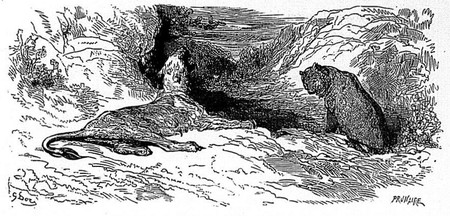
FABLE CCV.
THE LIONESS AND SHE-BEAR.
A Mother Lion had lost her young: A hunter had stolen her cub away; And from the dawn, when the gay birds sung, All through the shadeless hours of day, She filled the forest with huge dismay; Nor did the night, with its silent charms, Still the voice of this childless mother's alarms. At length a She-Bear rose, and said, "Do you ever think of the children dead, By your paws and jaws so cruelly slain? Yet their mothers silent still remain; And why not you?" The beast replied, "My child is lost, perhaps has died; And nothing for me now is left But a life of hope bereft." "And what condemns you to this wretched fate?" "Fate!" echoed then the beast disconsolate. From since the time the world a world became, All living things have thought or said the same. You wretched mortals, who bewail That over you Fate's darkest cloud is thrown, Just think of Hecuba's sad tale, Then thank the gods that it is not your own.
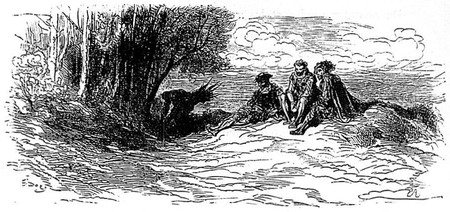
FABLE CCVI.
THE MERCHANT, THE NOBLEMAN, THE SHEPHERD, AND THE KING'S SON.
A Merchant, Shepherd, Lord, and a King's Son, Adventuring to a distant land, By waves and shipwrecks utterly undone, Found themselves beggars on a foreign strand. It matters not to tell at large What chance had joined them in an equal fate; But, one day, sitting on a fountain's marge, They counsel took, disconsolate. The Prince confessed, with many a bitter sigh, The ills that fall on those who sit on high. The Shepherd thought it best to throw All thoughts of former ills afar;— "Laments," he said, "no medicines are; So let us use the arts we know, And work, and earn the means to take us back to Rome." But what is this? Can prudent language come From Shepherd's mouth? and is it not, then, true That they alone are wise whose blood is blue? Surely sheep and shepherd are, As far as thought goes, on a par? However, wrecked on shores American, Without a choice, the three approved this plan. The Merchant cried that they should keep a school; Himself arithmetic would teach by rule, For monthly pay. "And I," the Prince exclaimed, "Will teach how proper laws for states are framed." The Noble said, "And I intend to try For pupils in the art of Heraldry."— As though such wretched stuff could have A home beyond the Atlantic wave! Then cried the Shepherd, "Worth all praise Are your intentions; but, remark, the week Has many days. Now, where a meal to seek I am somewhat in the dark. Your prospects of success are good, But I am pining, now, for food; Tell me therefore, comrades, pray, Whence comes to-morrow's meal, and whence the meal to-day? You seem in your resources rich; But food to day's a subject which So presses, that I really must Decline to put in you my trust." This said, the Shepherd in a neighbouring wood Collected fagots, which he sold for food, And shared it kindly with his clever friends, Before their talents had attained their ends, Or, by long fasting, they were forced to go And air their talents in the world below. From this adventure we, I think, may learn That for life's daily needs much learning is not wanted; But that to every man the power to earn Food by his labour has been freely granted.
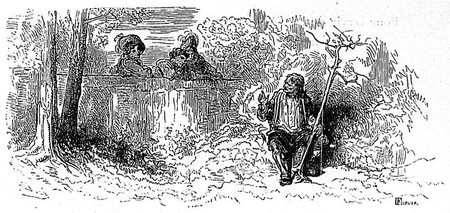
FABLE CCVII.
THE OLD MAN AND THE THREE YOUNG MEN.
An Old Man, planting a tree, was met By three joyous youths of the village near, Who cried, "It is dotage a tree to set At your years, sir, for it will not bear, Unless you reach Methuselah's age: To build a tomb were much more sage; But why, in any case, burden your days With care for other people's enjoyment? 'Tis for you to repent of your evil ways: To care for the future is our employment!" Then the aged man replies—