LA FONTAINE. (continued 4)
Walter Thornbury translation
FABLE CXV.
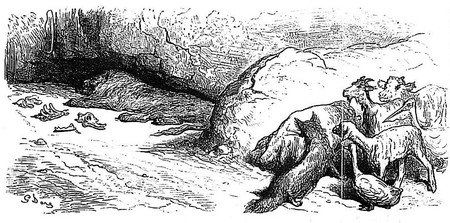
THE SICK LION AND THE FOX.
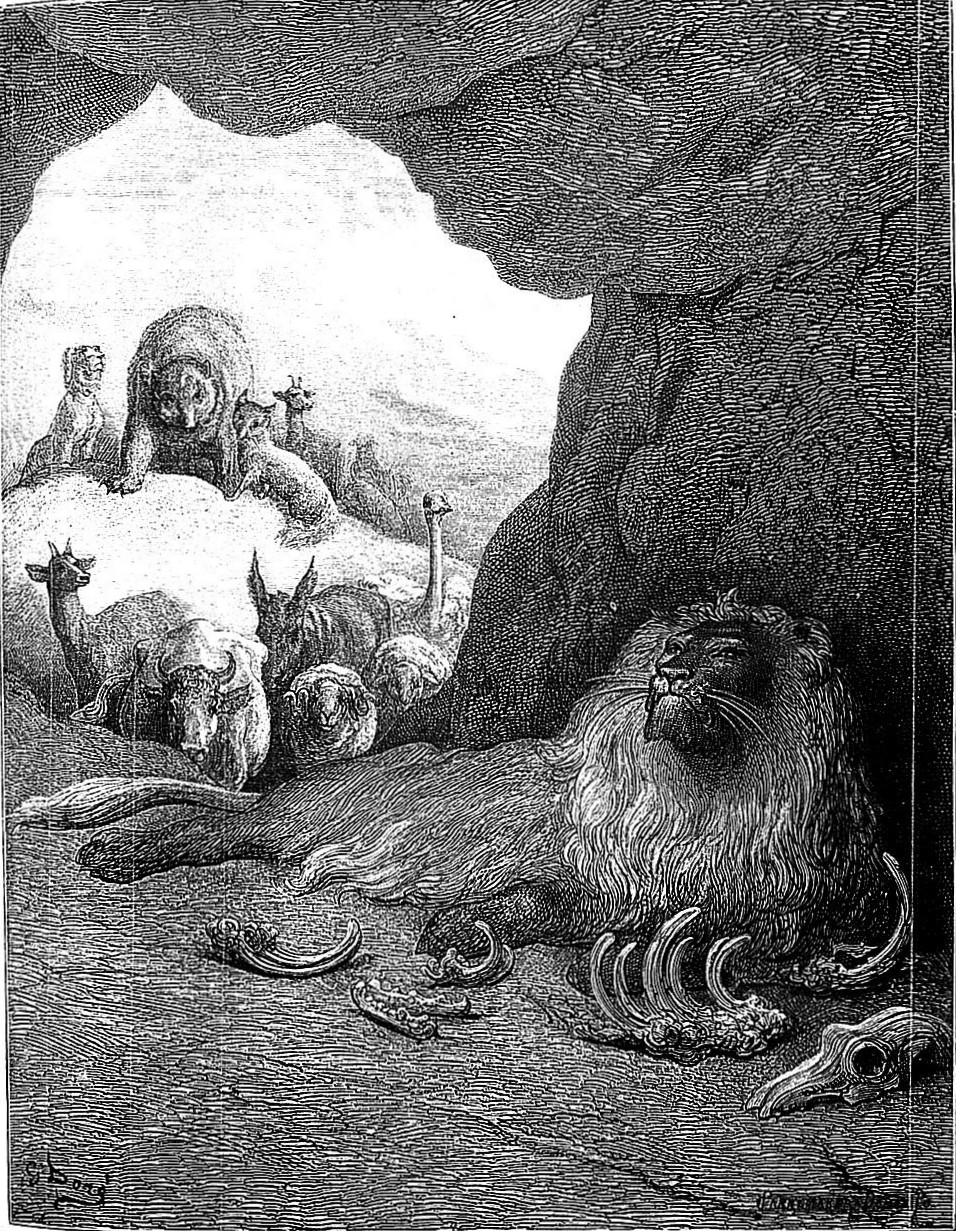
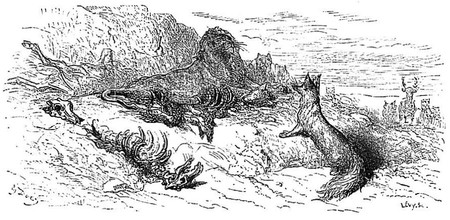
The King of Beasts was sick to death, And, almost with his latest breath, Made known to all his vassals he Needed their deepest sympathy. As in his cave he lay, he stated, For friendly visitors he waited. With every guarantee insured, The deputies went, quite secured; Upon the Lion's passport writ, In fair round hand, each word of it— A promise good, in eyes of law,
THE SICK LION AND THE FOX.
Whether against tooth or claw. The Prince's will to execute Goes every class of beast and brute. The Foxes only kept at home; One gave the reason he'd not come: "The footprints of the courtiers, see, Are all one way, that's plain to me: But none point homeward. It is just If I feel somewhat of distrust. Our sick King's courtiers may dispense With passports, for they're full of sense. Granted, no doubt; and yet I crave They'll show me how to leave the cave.— I clearly see they enter. Well! But how they leave it who can tell?"
FABLE CXVI.
THE ASS AND HIS MASTERS.
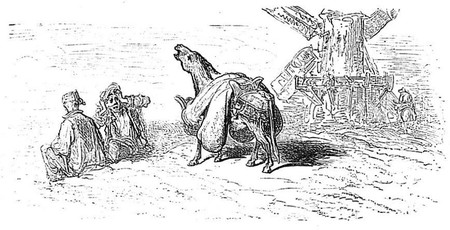
A Gardener's Donkey once complained to Fate Of having to rise earlier than the sun. "The cocks," he said, "are certainly not late; But I have got to rise ere they've begun. And all for what?—to carry herbs to sell: A pretty cause to break one's morning sleep!" Fate, touched by this appeal, determined well To give the beast to other hands to keep: The Gardener to a Tanner yields him next. The weight of hides, and their distressing fume, Soon shock our friend; he is far worse perplexed: His mind again begins to lower and gloom. "I much regret," he said, "my first good man, For when he turned his head I always got A bite of cabbage;—that was just my plan: It cost me not a single sous, or jot; But here no, no rewards but kick and cuff."— His fortune shifts; a Charcoal-dealer's stall Receives him. Still complaints, and quantum suff. "What! not content yet," Fate cries, "after all? This Ass is worse than half a hundred kings. Does he, forsooth, think he's the only one That's not content? Have I no other things To fill my mind but this poor simpleton?" And Fate was right. No man is satisfied: Our fortune never fits our wayward minds; The present seems the worst we've ever tried; We weary Heaven with outcries of all kinds. And yet, if Jupiter gave each his will, We should torment his ear with wishes still.
FABLE CXVII.
THE SUN AND THE FROGS.
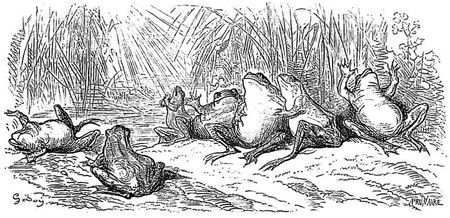
A Monarch's wedding gave his people up, The whole day long, to dances and the cup; But Æsop found their doings in bad taste, And thought their joy decidedly misplaced. "The Sun," said he, "once thought about a wife, And fancied he could shine in married life; But instantly there came petitions loud From all the Frogs on earth—a noisy crowd. 'Suppose,' they said, 'the Queen should be prolific, Our situation will become terrific. A single sun is quite enough to bear; The little ones will drive us to despair. Parched as we are, in sultry summer weather, The extra heat will roast us altogether. Let us entreat your mercy on our race; The river Styx is not a pleasant place!'" Considering that Frogs are very small, I think the argument not bad at all.
FABLE CXVIII.
THE CARTER STUCK IN THE MUD.
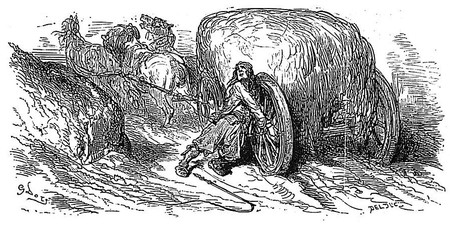
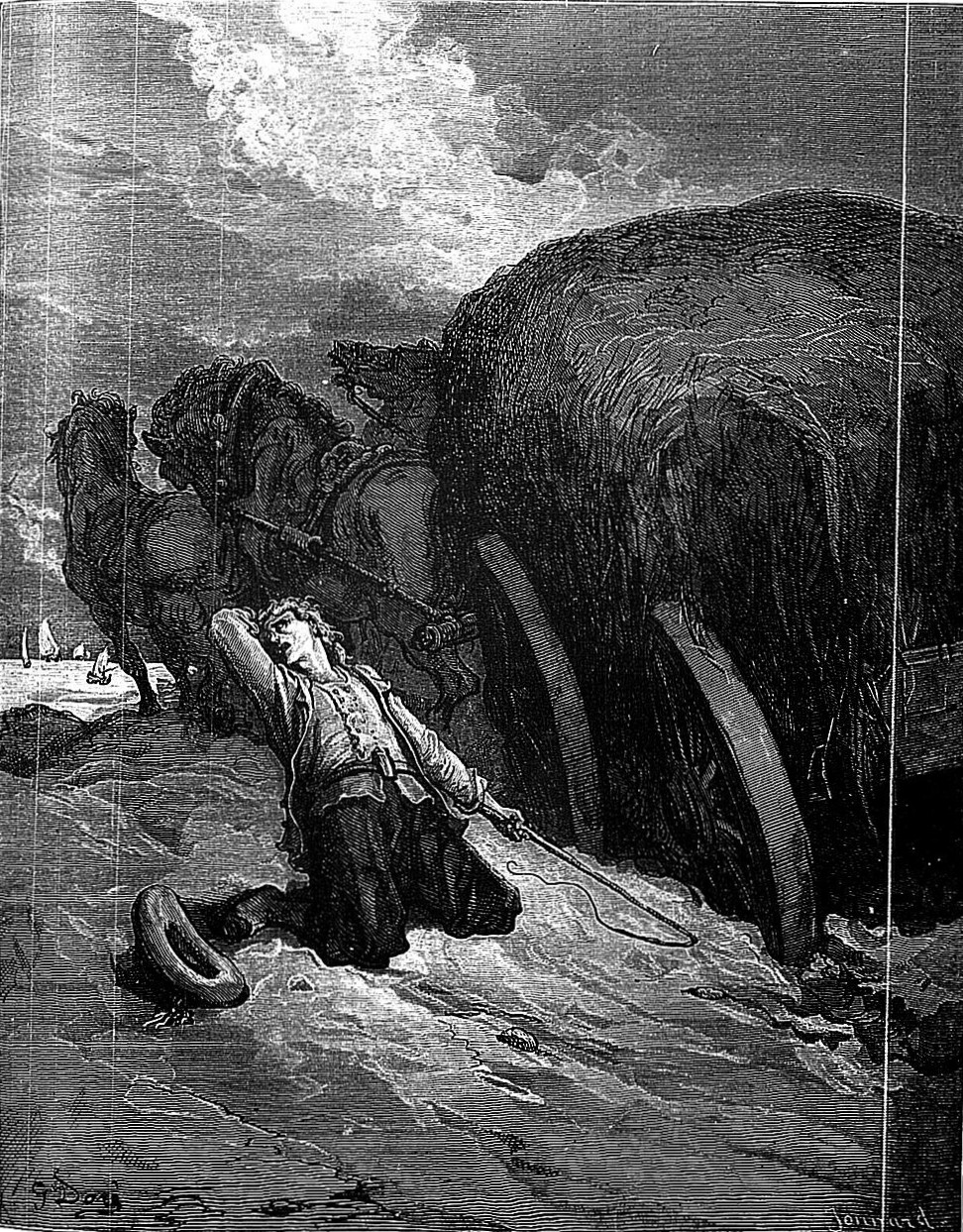
A Phaeton, who drove a load of hay, Found himself in the mud stuck hard and fast: Poor man! from all assistance far away. (In Lower Brittany he had been cast, Near Quimper-Corentin, and all may know 'Tis there that Destiny sends folks she hates. God keep us from such journey here below!) But to return. The Carter, in the mire, Rages and swears, and foams and execrates— His eyes wild rolling, and his face on fire; Curses the holes, the horses, every stone,
THE CARTER STUCK IN THE MUD.
The cart, and then himself. The god he prays, Whose mighty labours through the world are known: "O Hercules! send present aid," he says; "If thy broad back once bore this mighty sphere, Thy arm can drag me out." His prayer he ends. Then came a voice from out a cloud quite near: "To those who strive themselves he succour lends. Work, and find out where the obstruction lies; Remove this bird-lime mud you curse so hot; Clear axle-tree and wheel—be quick and wise; Take up the pick, and break that flint—why not? Fill up that yawning rut. Now, is it done?" "Yes," said the man; and then the voice replied, "Now I can help you; take your whip, my son." "I've got it. Hallo! here; what's this?" he cried; "My cart goes nicely—praise to Hercules." And then the voices—"You see how readily Your horses got clear out of jeopardy." To those who help themselves the gods send help and ease.
FABLE CXIX.
THE DOG AND THE SHADOW.
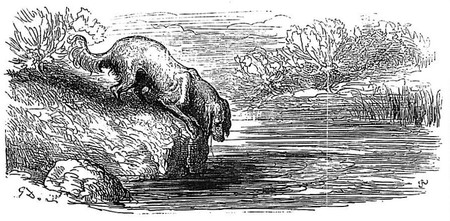
We all deceive ourselves, and so we fall; We all run after shadows, in our way: So many madmen, one can't count them all; Send them to Æsop's Dog,—I beg and pray. The Dog, who saw the shadow of the meat He carried, dark upon the liquid tide, Dropping his prey, snapped at the counterfeit: The river rose, and washed him from the side. True, with much danger, he regained the shore, But neither meat nor shadow saw he more.
FABLE CXX.
THE BIRD-CATCHER, THE HAWK, AND THE SKYLARK.
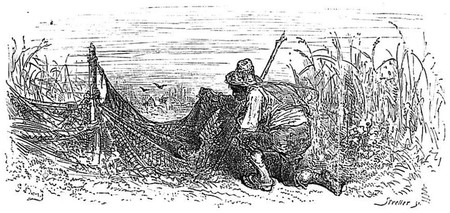
Injustice, and false people's wilful crimes, Serve others as excuses, oftentimes, For fresh injustice. Nature's law's planned so; If you wish to be spared, then give no blow. A Countryman, with glittering looking-glass, Was catching birds. The brilliant phantom lured A Lark; when, suddenly, it came to pass A Sparrow Hawk, of its sweet prey assured, Dropped from the cloud, and struck swift to the ground The gentlest bird that sings; though near the tomb, She had escaped the trap; yet now she found Beneath that cruel beak at last her doom. Whilst stripping her, eager and all intent, The Hawk itself beneath the net was caught. "Fowler," he cried, "no harm I ever meant: I never did thee ill, nor ever sought To do." The man replied, "This helpless thing Had done no more to thee;—no murmuring!"
FABLE CXXI.
THE HORSE AND THE ASS.
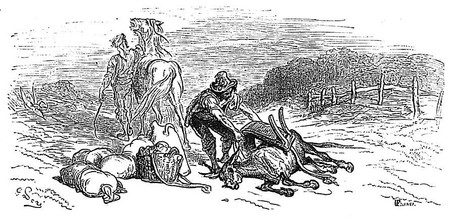
In this world every one must help his brother. If your poor neighbour dies, his weary load On you, perhaps, may fall, and on no other. An Ass and Horse were travelling on the road: The last had but the harness on his back. The first, borne down unto the very ground, Besought the Horse to help him, or, alack! He'd never reach the town. In duty bound, Apologies he made for this request: "To you," he said, "the load will be mere sport." The Horse refused, and snorted at the jest. Just as he sneered, the Donkey died. In short, He soon perceived he had not acted right, And had his friend ill treated; for that night They made him drag the cart through thick and thin, And in the cart his injured comrade's skin.
FABLE CXXII.
THE CHARLATAN.
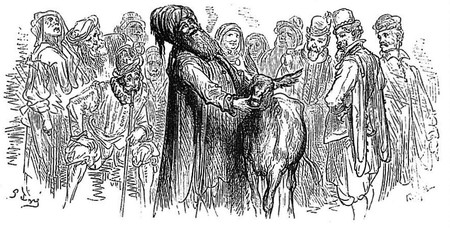
Of Charlatans the world has never lack: This science of professors has no want. Only the other day one made his vaunt He could cheat Acheron; in white and black Another boasted o'er the town that, lo! He was another Cicero. One of these fellows claimed a mastery Of eloquence; swore he could make an ass, "A peasant, rustic, booby, d'ye see?— Yes, gentlemen, a dolt of basest class— Eloquent. Bring me an ass," he cried, "The veriest ass, and I will teach him so, He shall the cassock wear with proper pride." The Prince resolved the truth of this to know. "I have," he to the rhetorician one day said, "A fine ass from Arcadia in my stable; Make him an orator, if you are able." "Sire, you do what you will." The man they made Accept a sum, for twenty years to teach The ass the proper use of speech; And if he failed, he in the market-place, With halter round his neck, was to be hung; Upon his back his rhetoric books all strung, And asses' ears above his frightened face. One of the courtiers said that he would go And see him at the gibbet; he'd such grace And presence, he'd become the hangman's show; There, above all, his art would come in well: A long-extended speech—with pathos, too— Would fit the great occasion, so it fell In the one form of those grand Ciceros Vulgarly known as thieves. "Yes, that is true," The other said; "but ere I try, The king, the ass, and you will die."
FABLE CXXIII.
THE YOUNG WIDOW.
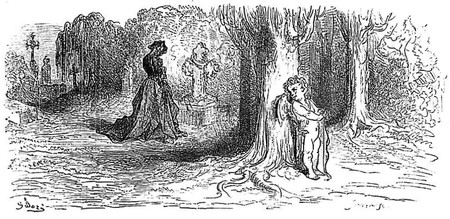
A Husband isn't lost without a sigh; We give a groan, then are consoled again; Swift on Time's wings we see our sorrow fly; Fleet Time brings sunshine's pleasure after rain. The widow of a year, the widow of a day, Are very different, I say: One finds it almost hard to trust one's eyes, Or the same face to recognise. One flies the world, the other plans her wiles; In true or untrue sighs the one pours forth her heart,
THE YOUNG WIDOW.
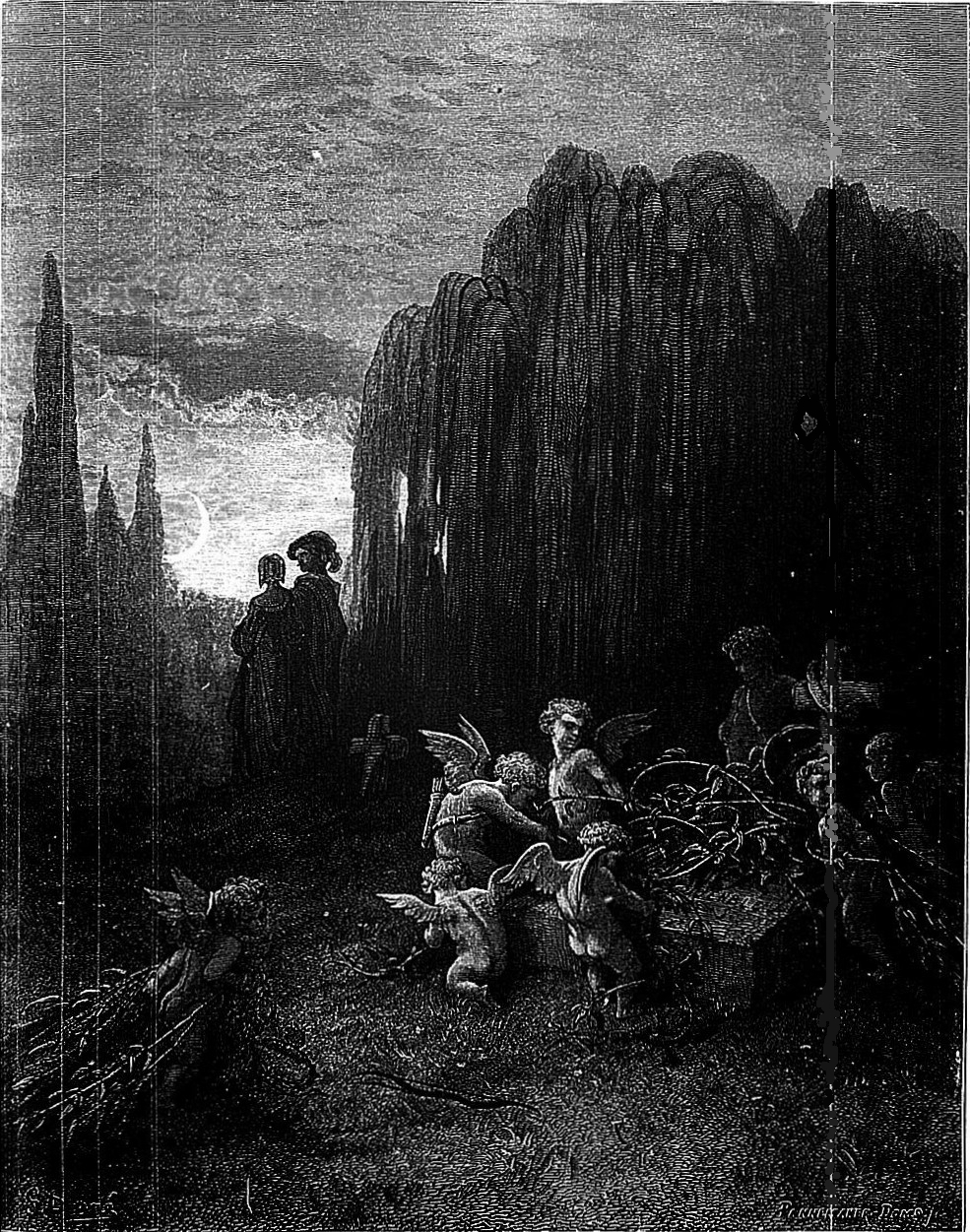
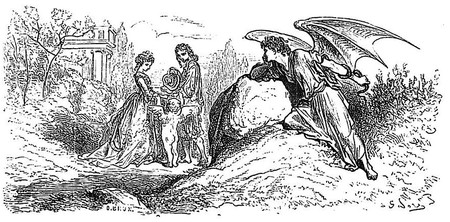
Yet the same note they sing, or tears or smiles— "Quite inconsolable," they say; but, for my part, I don't heed that. This fable shows the truth: Yet why say fiction?—it is sooth. The husband of a beauty, young and gay, Unto another world was call'd away. "My soul, wait for me!" was the Widow's moan. The husband waited not, but went alone. The Widow had a father—prudent man! He let her tears flow; 'twas the wisest plan. Then to console, "My child," he said, "this way Of weeping will soon wash your charms away. There still live men: think no more of the dead; I do not say at once I would be wed; But after a short time you'll see, I know, A husband young and handsome that I'll show, By no means like the sorry one you mourn." "A cloister is my husband—ah! forlorn." The father let these foolish groans go by; A month pass'd—every moment tear or sigh. Another month, and ribbons load her table; She changed her dress, and cast away her sable. The flock of Cupids to the dovecot back Came flying, now unscared by scarecrow black. Smiles, sports, and dances follow in their train, She bathes in youth's bright fountain once again. No more the father fears the dear deceased; But, as his silence not one whit decreased, The angry widow cries impatiently, "Where's the young husband that you promised me?"
FABLE CXXIV.
DISCORD.
Discord, who had the gods entangled About an apple—how they wrangled!— Was driven from the skies at last, And to that animal came fast That they call Man; her brother, too, "Whether or no," who long'd to view Our ball of earth. Her father came— Old "Thine and Mine"—the very same. She did much honour to our sphere By longing so much to be here; She cared not for the other race Who watch us from aerial space— We were gross folk, not tamed the least, Who married without law or priest— Discord no business had at all: The proper places where to call Scandal has orders to find out; She, a right busy, active scout, Falls quick to quarrel and debates, And always Peace anticipates: Blows up a spark into a blaze, Not to burn out for many days. Scandal, at length, complain'd she found No refuge certain above ground, And often lost her precious time: She must have shelter in this clime— A point from whence she could send forth Discord, west, east, or south, or north. There were no nunneries then, you see: That made it difficult, may be. The inn of Wedlock was assign'd At last, and suited Scandal's mind.
FABLE CXXV.
THE ANIMALS SICK OF THE PLAGUE.
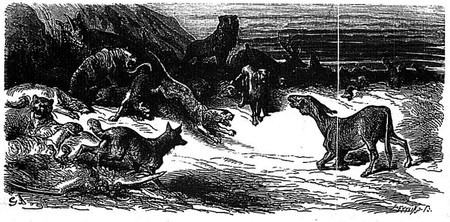
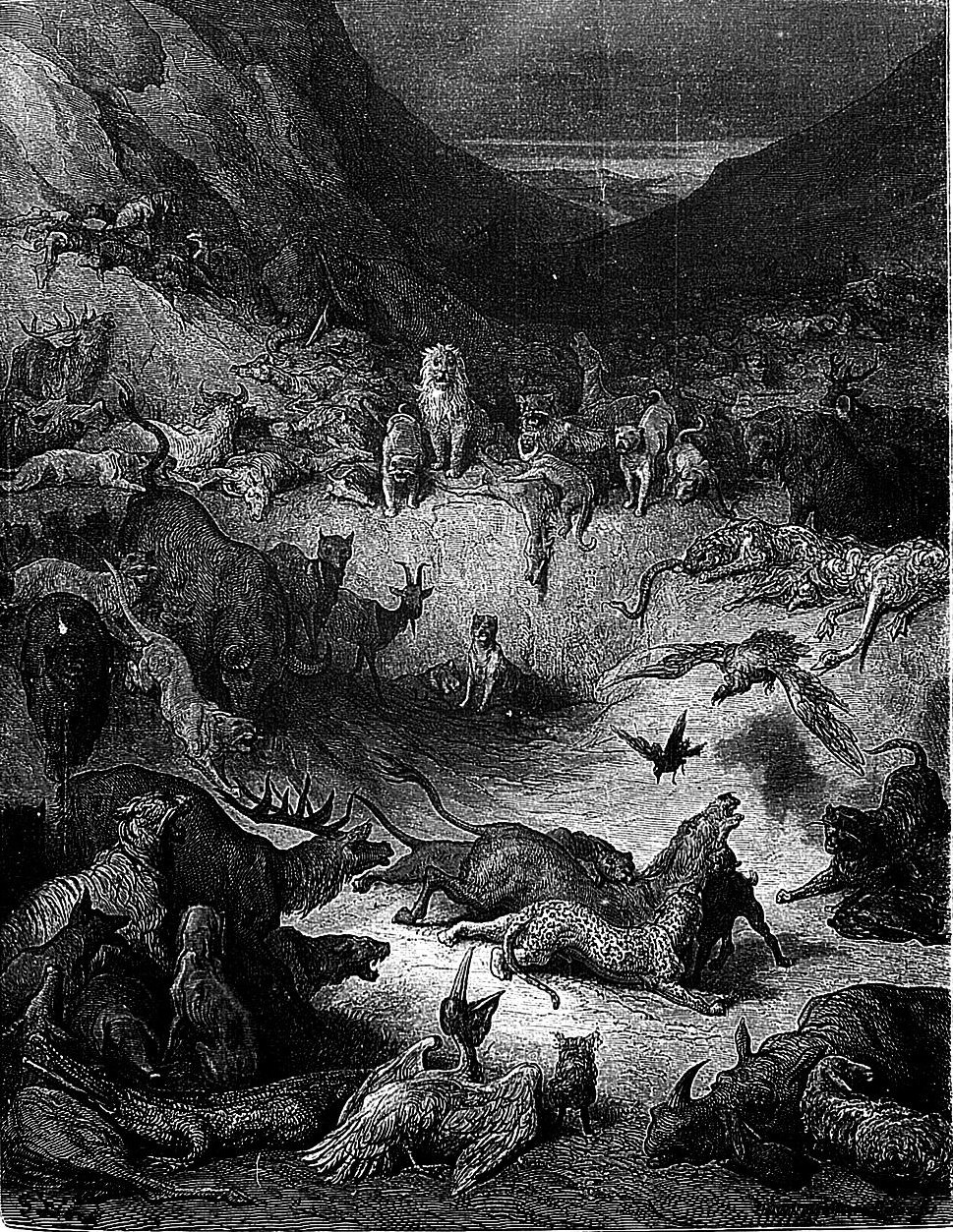
A Malady that Heaven sent On earth, for our sin's punishment— The Plague (if I must call it right), Fit to fill Hades in a night— Upon the animals made war; Not all die, but all stricken are. They scarcely care to seek for food, For they are dying, and their brood. The Wolves and Foxes crouching keep, Nor care to watch for timorous Sheep. Even the very Turtle-doves Forget their little harmless loves. The Lion, calling counsel, spoke— "Dear friends, upon our luckless crown Heaven misfortune has sent down, For some great sin. Let, then, the worst Of all our race be taken first, And sacrificed to Heaven's ire; So healing Mercury, through the fire, May come and free us from this curse, That's daily growing worse and worse. History tells us, in such cases For patriotism there a place is. No self-deception;—plain and flat Search each his conscience, mind you that. I've eaten several sheep, I own. What harm had they done me?—why, none. Sometimes—to be quite fair and true— I've eaten up the shepherd too. I will devote myself; but, first, Let's hear if any has done worst. Each must accuse himself, as I Have done; for justice would let die The guiltiest one." The Fox replied— "You are too good to thus decide.
THE ANIMAL SICK OF THE PLAGUE.
Your Majesty's kind scruples show Too much of delicacy. No What! eating sheep—the paltry—base, Is that a sin? You did the race, In munching them, an honour—yes, I'm free, your highness, to confess. And as for shepherds, they earn all The evils that upon them fall: Being of those who claim a sway (Fantastic claim!) o'er us, they say." Thus spoke the Fox the flatterer's text. The Tiger and the Bear came next, With claims that no one thought perplexed. In fact, more quarrelsome they were, The fewer grew the cavillers there. Even the humblest proved a saint: None made a slanderous complaint. The Ass came in his turn, and said, "For one thing I myself upbraid. Once, in a rank green abbey field, Sharp hunger made me basely yield. The opportunity was there; The grass was rich; the day was fair. Some demon tempted me: I fell, And cleared my bare tongue's length, pell-mell." Scarce had he spoken ere they rose In arms, nor waited for the close. A Wolf, half lawyer, made a speech, And proved this creature wrong'd them each And all, and they must sacrifice This scurvy wretch, who to his eyes Was steep'd in every wickedness. Doom'd to the rope, without redress, "Hang him at once! What! go and eat An Abbot's grass, however sweet! Abominable crime!" they cry; "Death only clears the infamy." If you are powerful, wrong or right, The court will change your black to white.
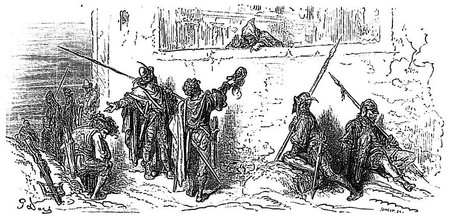
FABLE CXXVI.
THE RAT WHO RETIRED FROM THE WORLD.
There is a legend of the Levantine, That once a certain Rat, weary of strife, Retired into a Dutch cheese, calm, serene, Far from the bustle and the cares of life. In solitude extreme, dim stretching far and wide, The hermit dwelt in all tranquillity, And worked so well with feet and teeth inside, Shelter and food were his in certainty. What need of more? Soon he grew fat with pride; God showers his blessings upon those who pay Their vows to him in faith. There came, one day, A pious deputy, from Ratdom sent, To beg some trilling alms, because their town— Ratopolis—was leaguered with intent Most deadly; they, without a crown, Had been obliged to fly,—so indigent Was the assailed republic. Little ask The scared ambassadors—the succour sure, In a few days: the loan was no hard task. "My friend," the hermit cried. "I can endure No more the things of this world. What have I, A poor recluse, to give you, but a prayer? I yield you patiently unto His care." And then he shut the door, quite tranquilly. Who do I mean, then, by this selfish Rat? A monk?—no, sir; a dervish is more fat. A monk, where'er in this world he may be, Is always full, you know, of charity.
FABLE CXXVII.
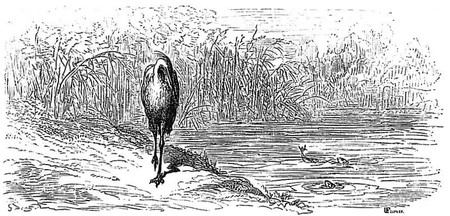
THE HERON.
One day, on his stilt legs, walked, here and there, A Heron, with long neck and searching beak; Along a river side he came to seek. The water was transparent, the day fair, Gossip, the Carp, was gambolling in the stream: The Pike, her neighbour, was in spirits, too. The Heron had no trouble, it would seem, But to approach the bank, and snap the two; But he resolved for better appetite To calmly wait:—he had his stated hours: He lived by rule. At last, there came in sight Some Tench, that exercised their finny powers. They pleased him not, and so he waited still, Scornful, like rat of whom good Horace wrote. "What! eat a tench?—I, who can take my fill, Munch such poor trash?"—he'll sing another note. The tench refused, a gudgeon next came by: "A pretty dish for such as me, forsooth! The gods forgive me if I eat such fry: I'll never open beak for that:"—and yet, in truth, He opened for far less. The fish no more Returned. Then Hunger came;—thus ends my tale. He who'd rejected dishes half a score, Was forced, at last, to snap a paltry snail. Do not be too exacting. The cleverer people are The sooner pleased, by far. We all may lose by trying for too much;— I have known such. Hold nothing in contempt, and the less so, If you are needing help, for know In that trap many fall, not only birds, Like Herons, to whom now I gave some words. Listen, my fellow-men,—another fable: Some lessons can be found amid your lords.
FABLE CXXVIII.
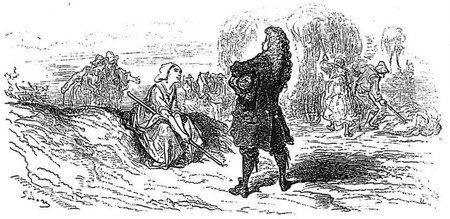
THE MAN BADLY MARRIED.
Oh, that the good and beautiful were wedded! From early morrow I will seek the pair; But since they are divorced, the addle-headed Alone would track them long through sea or air. Few beauteous bodies shelter beauteous souls; So don't be angry if I cease pursuit. Marriages many I have seen. The goals To which men strive my fancies seldom suit. The full four-fourths of men rush reckless on, And brave the deadliest risks;—four-fourths repent. I'll produce one who, being woe-begone, Found no resource but sending where he'd sent Before his hopeless wife, jealous and miserly, Peevish and fretful;—nothing was done right. They went to bed too soon—rose tardily; The white was black, the black was staring white; The servants groaned, the master swore outright. "Monsieur is always busy;—he, of course, Will think of nothing—squanders everything." So much of this, in fact. Monsieur, par force, Weary of all this squabble, and the sting, Sends her back to the country and her friends,— Phillis, who drives the turkeys, and the men Who watch the pigs, and very soon she mends. Grown calmer, he writes for her kindly then:— "Well, how did time pass? was it pleasant there? How did you like the country innocence?" "It's bearable," she said; "the only care That vexed me was to see the vile pretence Of industry. Why, those base, lazy patches Let the herds starve;—not one of them has sense To do their proper work, except by snatches." "Come, madam," cried the husband in a rage, "If you're so peevish that folk out all day Weary of you, and long to see the stage That bears you from them anywhere away, What must the servants feel who, every hour, Are chased about by your outrageous tongue! And what the husband, who is in your power By night and day? Adieu! May I be hung If I again recall you from the farm; Or if I do, may I atone the sin By having Pluto's gloomy realms within Two wives like you, a shrew for either arm."
FABLE CXXIX.
THE MAIDEN.
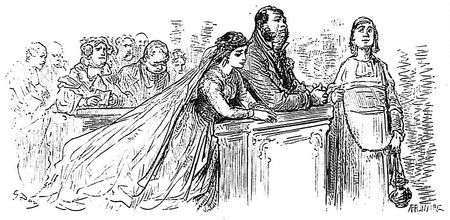
A certain Maiden, somewhat proud, A husband sought from out the crowd Of suitors. Handsome he's to be, and bold, Agreeable, young, and neither cold Nor jealous. Wealth she wished, and birth, Talent; in fact, all things on earth. Who could expect to have them all? Fortune was kind and helped to call Lovers of rank and eminence. She thought them mean and wanting sense— "What! I accept such people? Pish!
THE MAIDEN.
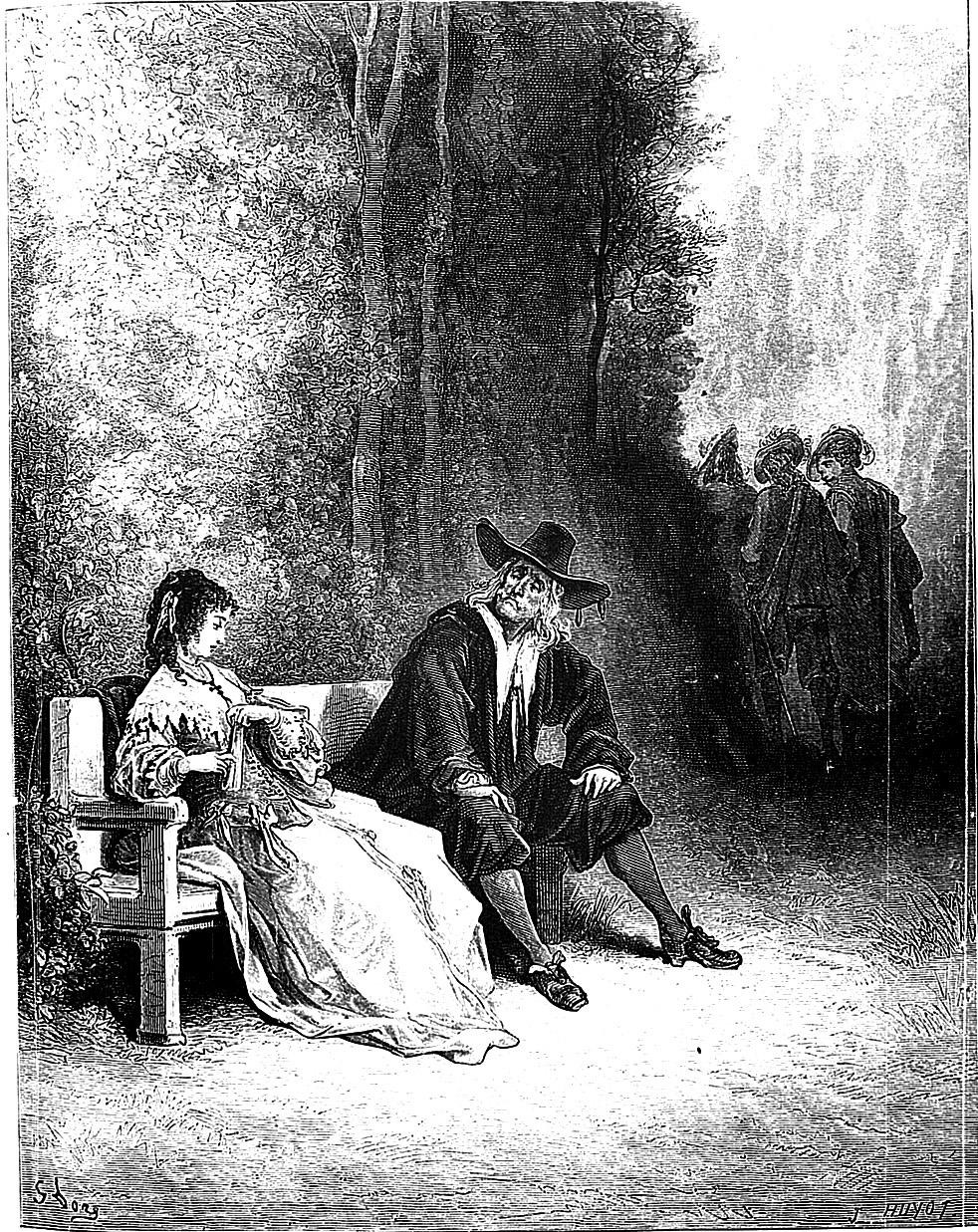
You're doting, if that is your wish. Look at the paltry creatures. See, Mark how they grin, and ogle me." One's vulgar; he who dares propose Has, goodness gracious! such a nose; This is too short, and that too tall, Something distinctly wrong in all. Affected girls are hard to please, Though lovers sue them on their knees. After the best were spurned, there came The humbler people of less name. She mocked them, too, unmercifully— "To greet such men is good of me; Perhaps they think my chance is poor, Even to venture near my door; But, Heaven be thanked, I pass my life, Although alone, quite free from strife." The Belle was with herself content; But age came soon, the lovers went. A year or two passed restlessly; Then comes chagrin, and by-and-by She feels that every hurrying day Chases first smiles, then love away. Soon wrinkles make her almost faint, And try a thousand sorts of paint; But all in vain, when past one's prime, To shun that mighty robber, Time: A ruined house you can replace, But not the ruins of a face. Her pride abates—her mirror cries, "A husband get if you are wise;" Her heart, too, echoes what is said— E'en prudes are willing to be wed. A curious choice, at last, she made, And not a grand one, I'm afraid; Her choice was what most men called foolish: A clumsy boor, ill-shaped and mulish.
FABLE CXXX.
THE WISHES.
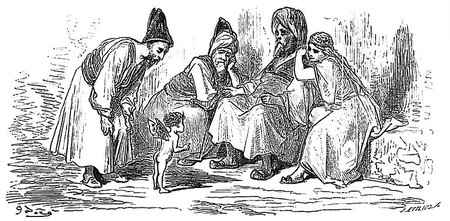
In the Mogul's dominions far away, Certain small spirits there are often found, Who sweep the house and dig the garden ground, And guard your equipage by night and day: If you but touch their work, you spoil the whole. One of these spirits near the Ganges, then, Toiled at the garden of a citizen; And with a silent skill worked heart and soul. He loved his master and his mistress, too, The garden most. The Zephyrs (Heaven knows), Friends of the genii, as the story goes, Perhaps assisted him, whate'er he'd do. He toiled unceasingly to show his zeal, Loaded his host with gifts, a brimming store, Boundless of pleasure; indeed, wished no more To leave those friends for whom he thus could feel. Fickle such spirits are, yet true was he; His brother genii, joining in a plot, The chief of their republic quickly got, From some caprice or jealous policy, To order him to go to Norway straight. To guard a hut covered with changeless snows, From India straight to Lapland. Ere he goes The Spirit with his master holds debate: "They make me leave you, yet I know not why; For some forgotten fault, and I obey; But be the time a month, or but a day, I'll grant you now Three Wishes ere I fly— Three, and no more. It is not hard, I know, For man to wish—how easy, we all see." They wished Abundance, and then presently Abundance came; fast from her full hands flow The golden streams, barns brim with piles of wheat; The cellars with rich casks are almost burst: How to arrange the stores—that is the worst; What ceaseless care! what toil of hands and feet! Thieves plot against them, nobles will still borrow; The Prince heaps taxes: hapless is their fate; Their sorrow, too much fortune, luck too great. They say, "Take from us wealth, let's wake to-morrow Poor as before. Happy the indigent; Poverty's better than such wealth," their cry: "Treasures, begone, take wings at once, and fly; Of that so foolish wish we both repent. Come, Moderation, mother of Repose, Friend of good sense, O Moderation, come!" She comes once more unto her former home; The door behind her joyfully they close. Two wishes gone, and not so luckily, Their lot was that of those who dream away Life in vain sighings, stealing, day by day, Time better spent in honest industry. The Spirit smiled at them; ere taking flight, While yet his wings were spread, the one wish more They asked; and this time Wisdom—that's a store That never can embarrass, day or night.
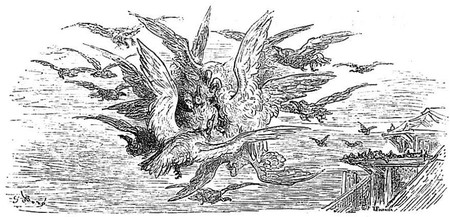
FABLE CXXXI.
THE VULTURES AND THE PIGEONS.
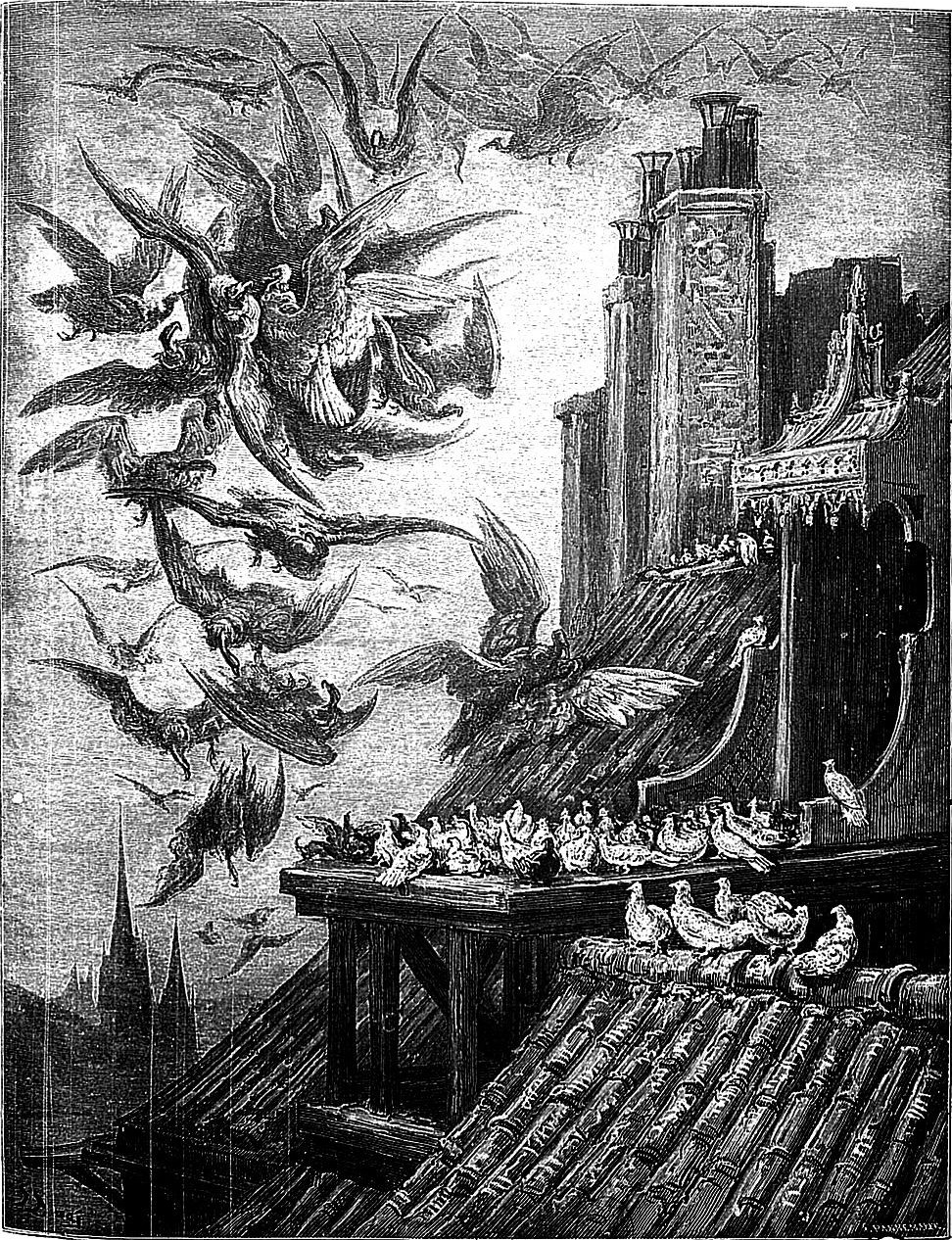
Mars one day set the sky on fire: A quarrel roused the wild birds' ire— Not those sweet subjects of the spring, Who in the branches play and sing; Not those whom Venus to her car Harnesses; but the Vulture race, With crooked beak and villain face. 'Twas for a dog deceased—that's all. The blood in torrents 'gins to fall; I only tell the sober truth, They fought it out with nail and tooth.
THE VULTURES AND THE PIGEONS.
I should want breath for the detail, If I told how with tooth and nail They battled. Many chiefs fell dead, Many a dauntless hero bled; Prometheus on his mountain sighed, And hoped Jove nearly satisfied. 'Twas pleasure to observe their pains— 'Twas sad to see the corpse-strewn plains. Valour, address, and stratagem, By turns were tried by all of them; By folks so brave no means were lost To fill each spare place on the coast Of Styx. Each varied element Ghosts to the distant realm had sent. This fury roused, at last, deep pity, Within the pigeons' quiet city; They—of the neck of changing hue, The heart so tender and so true— Resolved, as well became their nation, To end the war by mediation. Ambassadors they chose and sent, Who worked with such a good intent, The Vultures cried, "A truce," at last, And wars red horrors from them cast. Alas! the Pigeons paid for it; Their heart was better than their wit; The cursed race upon them fell, And made a carnage terrible; Dispeopled every farm and town, And struck the unwise people down. In this, then, always be decided: Keep wicked people still divided; The safety of the world depends On that—sow war among their friends; Contract no peace with such, I say, But this is merely by the way.
FABLE CXXXII
THE COURT OF THE LION.
His Majesty Leo, in order to find The extent of his varied and ample dominions, Had summoned his vassals of every kind, Of all colours and shapes, and of divers opinions. A circular, signed by His Majesty's hand. Was the means of conveying the King's invitation— He promised festivities regally grand (With an evident eye to self-glorification). His palace was open, of course, to the throng; What a place!—a mere slaughter-house, putting it plainly, Where visitors met with an odour so strong, That they strove to protect their olfactories vainly. The Bear in disgust put a paw to his nose; He had scarcely the time to repent his grimaces; For Leo at once in a fury arose, And consigned the poor brute to the Styx, to make faces. The Monkey, true courtier, approved of the deed— Said the palace was fit for a king's habitation, And thought neither amber nor musk could exceed The rich odour that gave him such gratification. His fulsome behaviour had little success; He was treated the same as the previous aspirant (His Leonine Majesty, let us confess, Was Caligula-like, and a bit of a tyrant). The Fox trotted up, very servile and sly; Said the monarch, "No shuffling, but answer me frankly; Beware how you venture to give your reply: Do you notice that anything smells rather rankly?" But Reynard was more than a match for his king, And replied that his cold being rather a bad one, He could not at present distinguish a thing By its odour, or even assert that it had one. There's a hint for plain-speakers and flatterers here— You should ne'er be too servile nor over-sincere; And to answer sometimes in a round-about way, Is a dozen times better than plain yea or nay.
FABLE CXXXIII.
THE MILK-MAID AND THE MILK-PAIL.
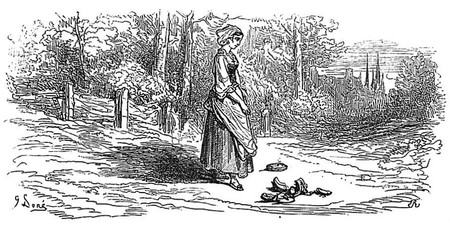
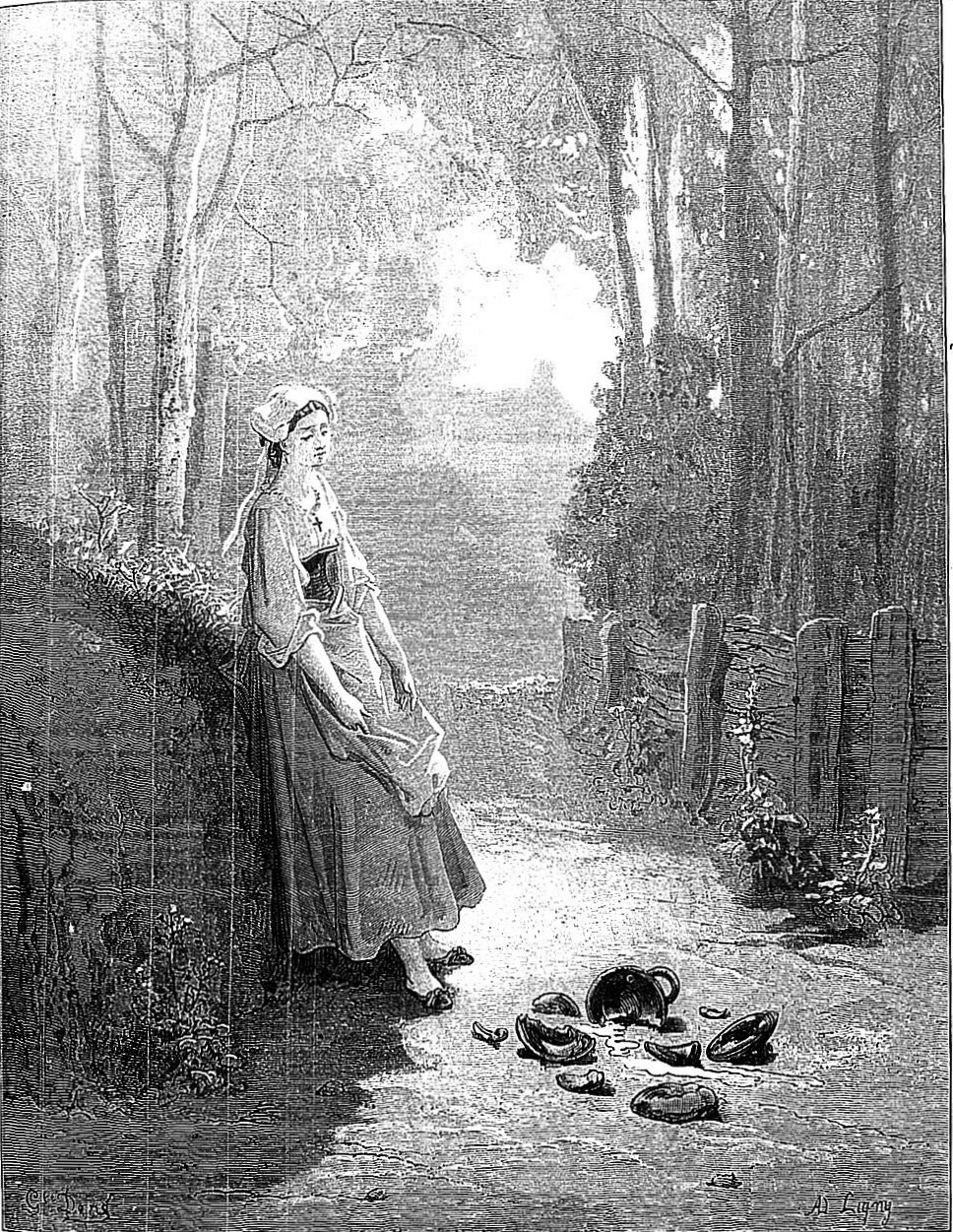
Perette, her Milk-pail balanced on her head, Tripped gaily and without hindrance down the road, So slim and trim, and gay she nimbly sped. For more agility, with such a load, She'd donned her shortest kirtle and light shoes. And as she went she counted up her gains— Her future gains—with her twice one, twice twos. How long division racked her little brains! "First buy a hundred eggs, then triple broods; With care like mine the money soon will grow;
THE MILK-MAID AND THE MILK-PAIL.
No fox so clever in our neighbour's woods But must leave me enough, as well I know, To buy a pig, 'twill fatten very soon; I buy him large, and for a good round sum I sell him, mark you that some afternoon; A cow and calf into our stable come; Who'll prevent that? that's what I mean to say. I see the calf skipping among the herd." Then Perette skipped for joy. Alack-a-day! Down came the milk, I give you my sworn word: Adieu cow, calf, pig, chicken, all the rest. She left with tearful eye her fortune lost, And ran to tell her husband, dreading lest He'd beat her, when in anger tempest tossed. The neighbours, doubling up with laughter, Called her the Milk-pail ever after. Who has not raised his tower in Spain, And in a cloud-land longed to reign? Picrocolles, Pyrrhus have so done, Sages or fools, just like this one. All dream by turns; the dream is sweet; The world lies prostrate at our feet: Our souls yield blindly to the vision, Ours beauty, honour, fields Elysian. 'Tis I alone the bravest smite, The dethroned Sophy owns my might; They choose me king, in crowds I'm led; Gold crowns come raining on my head. A fly soon wakes me up once more, And I am Big John, as before.
FABLE CXXXIV.
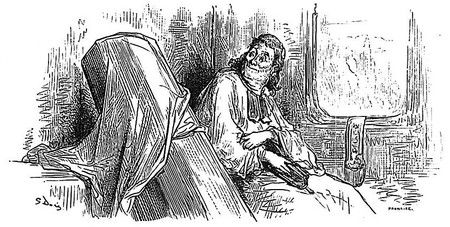
THE CURATE AND THE CORPSE.
A Dead man, on his mournful way. To his last lodging went one day. A Curé, bustling gaily, came In due form, to inter the same. Deceased was in a coach, with care Packed snugly from the sun and air; Clad in a robe, alas! ye proud, Summer or winter, called a shroud; To change it no one is allowed. The pastor sat the dead beside, Reciting, without grief or pride, Lessons, responses, and those done, The funeral psalms; yes, every one. Good Mr. Dead-man, let them chant, The salary is all they want. The Curé Chouart shut the eyes Of his dead man, lest he surprise The priest who snatched from him a prize. His looks they seemed to say, "My friend, From you I'll have, before I end, This much in silver, that in wax," And many another little tax; That soon would bring our good divine A small cask of the choicest wine; His pretty niece a new silk gown, And Paquette something from the town. Just as his pleasant thoughts took flight, There came a crash... Curé, good night! The leaden coffin strikes his head. Parishioner, lapped up in lead, Politely you went first, you see, Now comes the priest for company. Such is our life, as in this tale: See Curé Chouart counting on his fee, Like the poor girl with the milk-pail.
FABLE CXXXV.
THE MAN WHO RUNS AFTER FORTUNE, AND THE MAN WHO WAITS FOR HER.
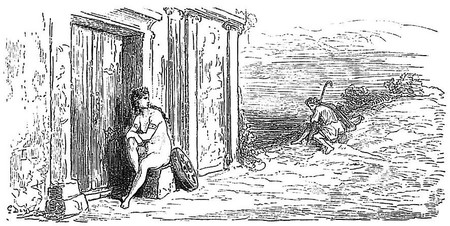
Is there a man beneath the sun, Who does not after Fortune run? I would I were in some snug place, And high enough to watch the race Of the long, scuffling, struggling train That hunt Dame Fortune all in vain. The phantom flies from land to land, They follow with an outstretched hand. Now they have almost caught her. No; She's vanished like the April bow. Poor creatures! Pity them, I do: Fools deserve pity—the whole crew, By no means rage—"You see, we hope; That cabbage-planter made a Pope. Are we not quite as good?" they cry. "Twenty times better," my reply. "But what avails your mighty mind, When Fortune is so densely blind? Besides, what use the Papacy? It is not worth the price, may be." Rest, rest; a treasure that's so great 'Twas once for gods reserved by Fate; How rarely fickle Fortune sends Such gifts unto her trusting friends. Seek not the goddess, stay at home; Then like her sex she's sure to come. Two friends there lived in the same place, Who were by no means in bad case. One sighed for Fortune night and day: "Let's quit our sojourn here, I pray," He to the other said, "You know, Prophets in their own country go Unhonoured; let us seek elsewhere." "Seek!" said the other; "I'll stay here. I wish no better land or sky: Content yourself, and I will try To sleep the time out patiently." The friend—ambitious, greedy soul!— Set out to reach the wished-for goal; And on the morrow sought a place Where Fortune ought to show her face, And frequently—the Court, I mean; So there he halts, to view the scene; Still seeking early, seeking late, The hours propitious to Fate; But yet, though seeking everywhere, He only found regret and care. "It's of no use," at last he cried; "Queen Fortune elsewhere must abide; And yet I see her, o'er and o'er, Enter by this and that man's door: And how, then, is it I can never Meet her, though I seek her ever?" These sort of people, I'm afraid, Ambition find a losing trade. Adieu, my lords; my lords, adieu; Follow the shadow ruling you. Fortune at Surat temples boasts; Let's seek those distant Indian coasts, Ye souls of bronze who e'er essayed This voyage; nay, diamond arms arrayed The man who first crossed the abyss. Many a time our friend, I wis, Thought of his village and his farm, Fearing incessantly some harm From pirates, tempests, rocks and sands, All friends of death. In many lands Man seeks his foeman, round and round, Who soon enough at home is found. In Tartary they tell the man That Fortune's busy at Japan: Then off he hurries, ne'er downcast. Seas weary of the man at last, And all the profit that he gains Is this one lesson for his pains: Japan, no more than Tartary, Brought good to him or wealthy fee. At last he settles it was shame To leave his home, and takes the blame. Then he returns: the well-loved place Makes tears of joy run down his face. "Happy," he cries, "the man at ease, Who lives at home himself to please; Ruling his passions, by report Knowing alone of sea or Court, Or Fortune, of thy empire, Jade, Which has by turns to all displayed Titles and wealth, that lead us on From rising to the setting sun; And yet thy promises astray Still lead us to our dying day. Henceforth I will not budge again, And shall do better, I see plain." While he thus schemed, resolved, and planned, And against Fortune clenched his hand, He found her in the open air At his friend's door, and sleeping there.
FABLE CXXXVI.
THE TWO FOWLS.
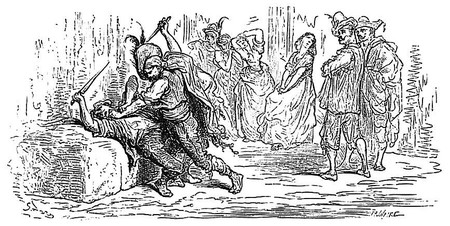
Two Barn-door Fowls in peace spent all their life, Until, at last, love, love lit up the strife: War's flames burst out. O Love! that ruined Troy, 'Twas thou who, by fierce quarrel, banished joy, And stained with blood and crime the Xanthus' tide! Long, long the combat raged 'tween wrath and pride, Until the rumour spread the whole town through, And all the crested people ran to view. Many a well-plumed Helen was the prize Of him who conquered; but the vanquished flies— Skulks to the darkest and most hidden place,
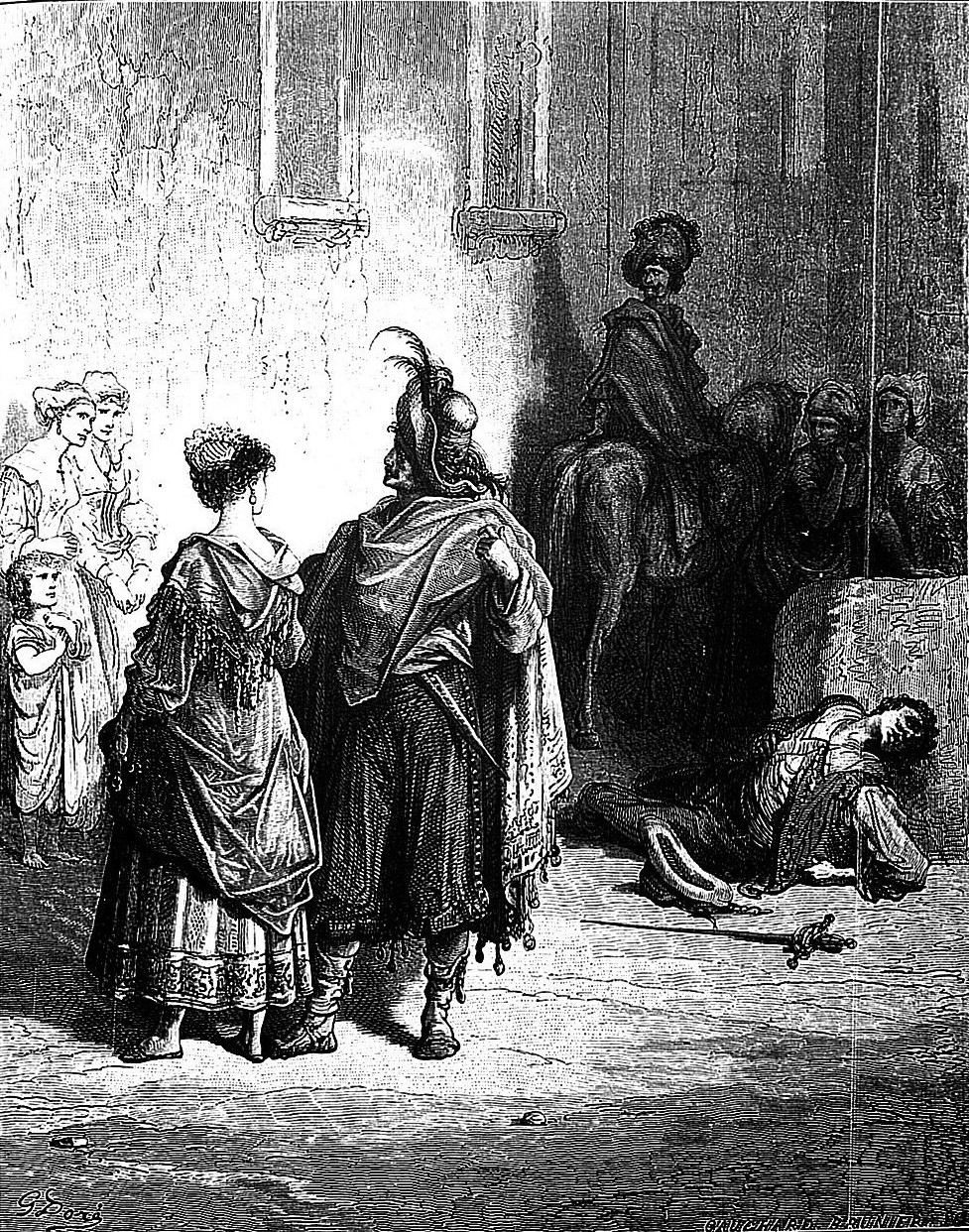
THE TWO FOWLS.
And mourns his love with a dejected face. His rival, proud of recent victory, Exulting crows, and claims the sovereignty. The conquered rival, big with rage, dilates, Sharpens his beak, and Fortune invocates, Clapping his wings, while, maddened by defeat, The other skulks and plans a safe retreat. The victor on the roof is perched, to crow; A vulture sees the bragger far below. Adieu! love, pride, and glory, all are vain Beneath the vulture's beak;—so ends that reign. The rival soon returns to make his court To the fair dame, and victory to report, As he had half-a-dozen other wives, to say the least, You'll guess the chattering at his wedding feast. Fortune always rejoices in such blows: Insolent conquerors, beware of those. Still mistrust Fate, and dread security, Even the evening after victory.

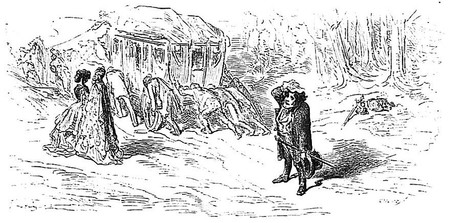
FABLE CXXXVII.
THE COACH AND THE FLY.
Up a long dusty hill, deep sunk in sand, Six sturdy horses drew a Coach. The band Of passengers were pushing hard behind: Women, old men, and monks, all of one mind. Weary and spent they were, and faint with heat; Straight on their heads the sunbeams fiercely beat. In the hot air, just then, came buzzing by, Thinking to rouse the team, a paltry Fly. Stings one, and then another; views the scene: Believing that this ponderous machine Is by his efforts moved, the pole bestrides; And now upon the coachman's nose he rides. Soon as the wheels begin again to grind The upward road, and folks to push behind, He claims the glory; bustles here and there, Fussy and fast, with all the toil and care With which a general hurries up his men, To charge the broken enemy again, And victory secure. The Fly, perplexed With all the work, confessed that she was vexed No one was helping, in that time of need. The monk his foolish breviary would read: He chose a pretty time! a woman sang: Let her and all her foolish songs go hang! Dame Fly went buzzing restless in their ears, And with such mockery their journey cheers. After much toil, the Coach moves on at last: "Now let us breathe; the worst of it is past," The Fly exclaimed; "it is quite smooth, you know; Come, my good nags, now pay me what you owe." So, certain people give themselves great airs, And meddlers mix themselves with one's affairs; Try to be useful, worry more and more, Until, at last, you show the fools the door.

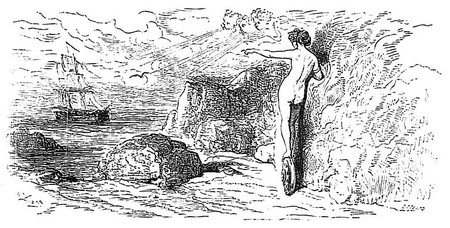
FABLE CXXXVIII.
THE INGRATITUDE AND INJUSTICE OF MEN TOWARDS FORTUNE.
A merchant, trading o'er the seas, Became enriched by every trip. No gulf nor rock destroyed his ease; He lost no goods, from any ship. To others came misfortunes sad, For Fate and Neptune had their will. Fortune for him safe harbours had; His servants served with zeal and skill. He sold tobacco, sugar, spices, Silks, porcelains, or what you please; Made boundless wealth (this phrase suffices), And "lived to clutch the golden keys." 'Twas luxury that gave him millions: In gold men almost talked to him. Dogs, horses, carriages, postillions, To give this man seemed Fortune's whim. A Friend asked how came all this splendour: "I know the 'nick of time,'" he said, "When to be borrower and lender: My care and talent all this made." His profit seemed so very sweet, He risked once more his handsome gains; But, this time, baffled was his fleet: Imprudent, he paid all the pains. One rotten ship sank 'neath a storm, And one to watchful pirates fell; A third, indeed, made port in form, But nothing wanted had to sell. Fortune gives but one chance, we know: All was reversed,—his servants thieves. Fate came upon him with one blow, And made the mark that seldom leaves. The Friend perceived his painful case. "Fortune, alas!" the merchant cries. "Be happy," says his Friend, "and face The world, and be a little wise." "To counsel you is to give health: I know that all mankind impute To Industry their peace and wealth, To Fortune all that does not suit." Thus, if each time we errors make, That bring us up with sudden halt, Nothing's more common than to take Our own for Fate or Fortune's fault. Our good we always make by force, The evil fetters us so strong; For we are always right, of course, And Destiny is always wrong.
AN ANIMAL IN THE MOON.
FABLE CXXXIX.
AN ANIMAL IN THE MOON.
Some sages argue that all men are dupes, And that their senses lead the fools in troops; Other philosophers reverse this quite, And prove that man is nearly always right. Philosophy says true, senses mislead, If we judge only by them without heed; But if we mark the distance and reflect On atmosphere and what it will effect, The senses cheat none of us; Nature's wise: I'll give an instance. With my naked eyes I see the sun; how large is it, think you? Three feet at farthest? It appears so, true! But could I see it from a nearer sky, 'Twould seem of our vast universe the eye: The distance shows its magnitude, you see; My hand discovers angles easily. Fools think the earth is flat; it's round, I know; Some think it motionless, it moves so slow. Thus, in a word, my eyes have wisdom got, The illusions of the senses cheat me not. My soul, beneath appearances, sees deep; My eye's too quick, a watch on it I keep; My ear, not slow to carry sounds, betrays; When water seems to bend a stick ten ways, My reason helps me out, and if my sight Lies always, yet it never cheats me quite: If I would trust my senses, very soon They'd tell me of the woman in the moon. What is there really?—No, mistrust your eyes, For what you see are inequalities. The surface of the moon has many regions, Here spread the plains, there mountains rise in legions.
AN ANIMAL IN THE MOON (2).
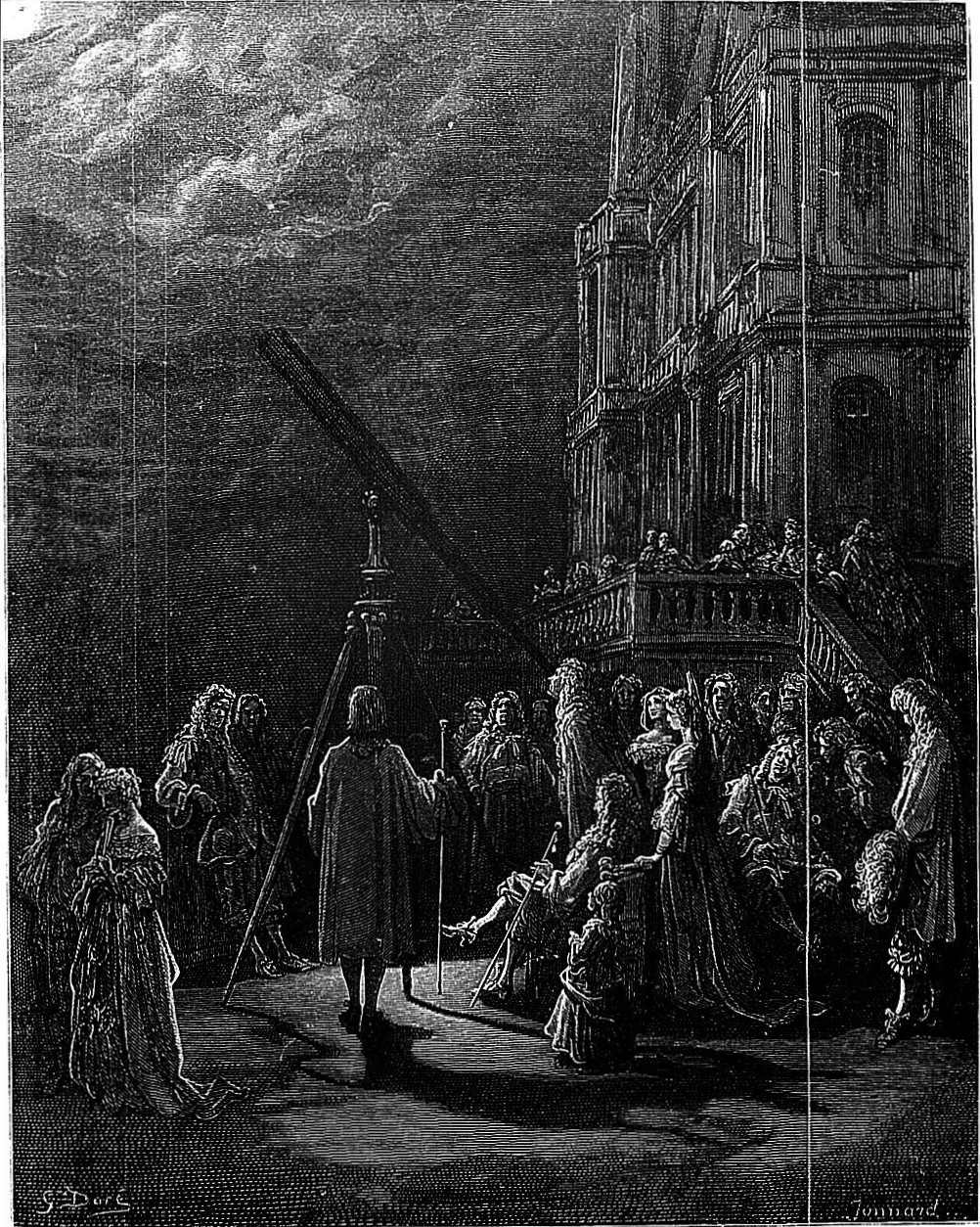
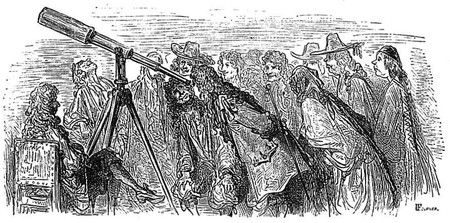
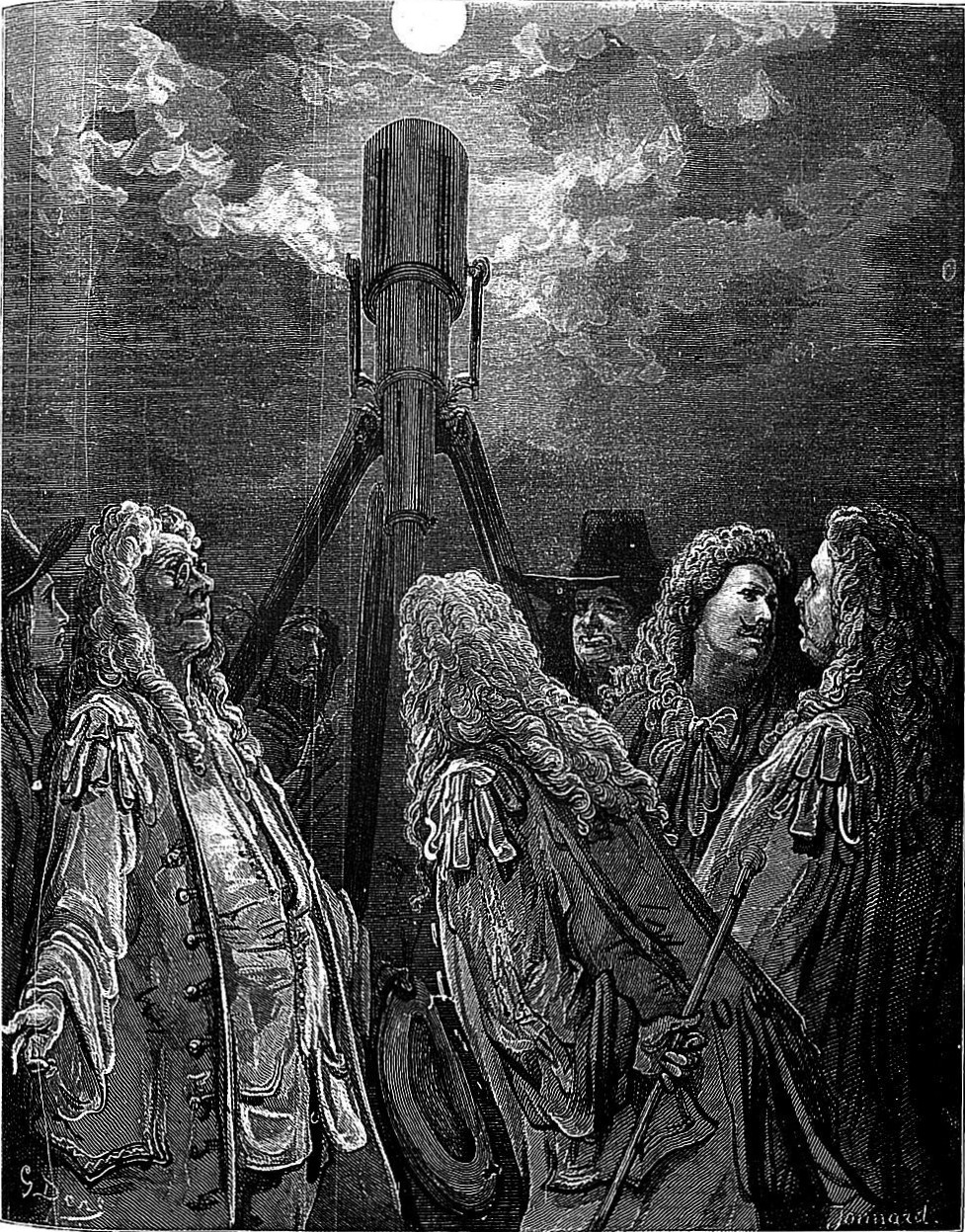
In light and shade strange figures you can trace—- An elephant, an ox, a human face. Not long ago, in England men perplexed, Saw, in a telescope, what savants vexed, A monster in this planet's mirror fair; Wild cries of horror filled the midnight air. Some change was pending—some mysterious change, Predicting wars, or a misfortune strange. The monarch came, he favoured learned men; The wondrous monster showed itself again: It was a mouse between the glasses shut— The source of war—the nibbler of a nut. The people laughed—oh, nation blessed with ease, When will the French have time for toils like these? Mars brings us glory's harvests; still the foe Shrinks down before us, dreading every blow; 'Tis we who seek them, sure that victory, Slave to our Louis, follows ceaselessly His flag; his laurels render us renowned: Yet memory has not left this mortal round. We wish for peace—for peace alone we sigh; Charles tastes the joys of rest: he would in war Display his valour, and his flag bear far, To reach the tranquil joy that now he shares. Would he could end our quarrels and our cares! What incense would be his, what endless fame! Did not Augustus win a glorious name, Equal to Cæsar's in its majesty, And worthy of like reverence, may be? Oh, happy people, when will Peace come down, To dower our nation with her olive-crown?
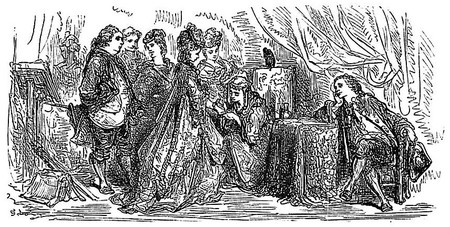
FABLE CXL.
THE FORTUNE-TELLER.
Opinion is the child of Chance, And this Opinion forms our taste. Against all people I advance These words. I find the world all haste— Infatuation; justice gone; A torrent towards a goal unseen. We only know things will be done In their own way, as they have been. In Paris lived a Sorceress, Who told the people of their fate. All sought her:—men; girls loverless; A husband whom his wife thought late In dying; many a jealous woman. Ill-natured mothers, by the score, Came—for they all were simply human— To hear what Fortune had in store. Her tricks of trade were hardihood, Some terms of art, a neat address. Sometimes a prophecy proved good, And then they thought her nothing less Than Delphi's Pythoness of yore: Though ignorance itself was she; And made her wretched garret floor Highway for gullibility. Grown rich, she took a house, and bought A place of profit for her lord. The witch's garret soon was sought By a young girl, who never soared To witchery, save by eyes and voice. But yet they all came, as of old— The lucky, who in wealth rejoice, And poor—to have their fortunes told.
The regulation had been made For this poor place, by her who late Had been its tenant; and the shade Sybillic hovered o'er its state. In vain the maiden said, "You mock. Read Fate!—I scarcely know my letters!" But though such words, of course, might shock, They never could convince "her betters." "Predict—divine;—here's gold in pay, More than the learned get together." What wonder if the maid gave way, Despite herself, such gold to gather? For fortune-telling seemed the place All tumble-down, and weird, and broken: A broomstick, for the witches' chase, And many another mystic token; The witches' sabbath; all suggested The change of body, and of face; And so in Fate fools still invested. But what of her who made the place? She seeks the golden prize to gain, In gorgeous state, like any parrot; But people jeer and pass. In vain; They all go rushing to the garret. 'Tis custom governs everything. I've often seen, in courts of law, Some stupid barrister, who'll bring Briefs such as clever men ne'er saw. All a mistake: his eyes may glisten; They'll take him for some other man: One unto whom the world will listen. Explain me this, now, if you can.
FABLE CXLI.
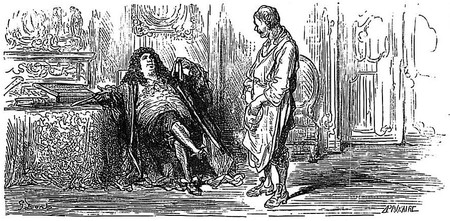
THE COBBLER AND THE BANKER.
A Cobbler, who would sing from dawn to dark (A very merry soul to hear and see, As satisfied as all the Seven Wise Men could be), Had for a neighbour, not a paltry clerk, But a great Banker, who could roll in gold: A Crœsus, singing little, sleeping less; Who, if by chance he had the happiness, Just towards morning, to drop off, I'm told, Was by the Cobbler's merry singing woke. Loud he complain'd that Heaven did not keep For sale, in market-places, soothing sleep. He sent, then, for the Cobbler ('twas no joke):— "What, Gregory, do you earn in the half-year?" "Half-year, sir!" said the Cobbler, very gaily; "I do not reckon so. I struggle daily For the day's bread, and only hunger fear." "Well, what a day?—what is your profit, man?" "Now more, now less;—the worst thing is those fêtes. Why, without them—and hang their constant dates!— The living would be tidy—drat the plan! Monsieur the Curé always a fresh saint Stuffs in his sermon every other week." The Banker laughed to hear the fellow speak, And utter with such naïveté his complaint. "I wish," he said, "to mount you on a throne; Here are a hundred crowns, knave—keep them all, They'll serve you well, whatever ill befall." The Cobbler thought he saw before him thrown All money in the earth that had been found. Home went he to conceal it in a vault, Safe from discovery and thieves' assault. There, too, he buried joy,—deep under ground; No singing now: he'd lost his voice from fear.
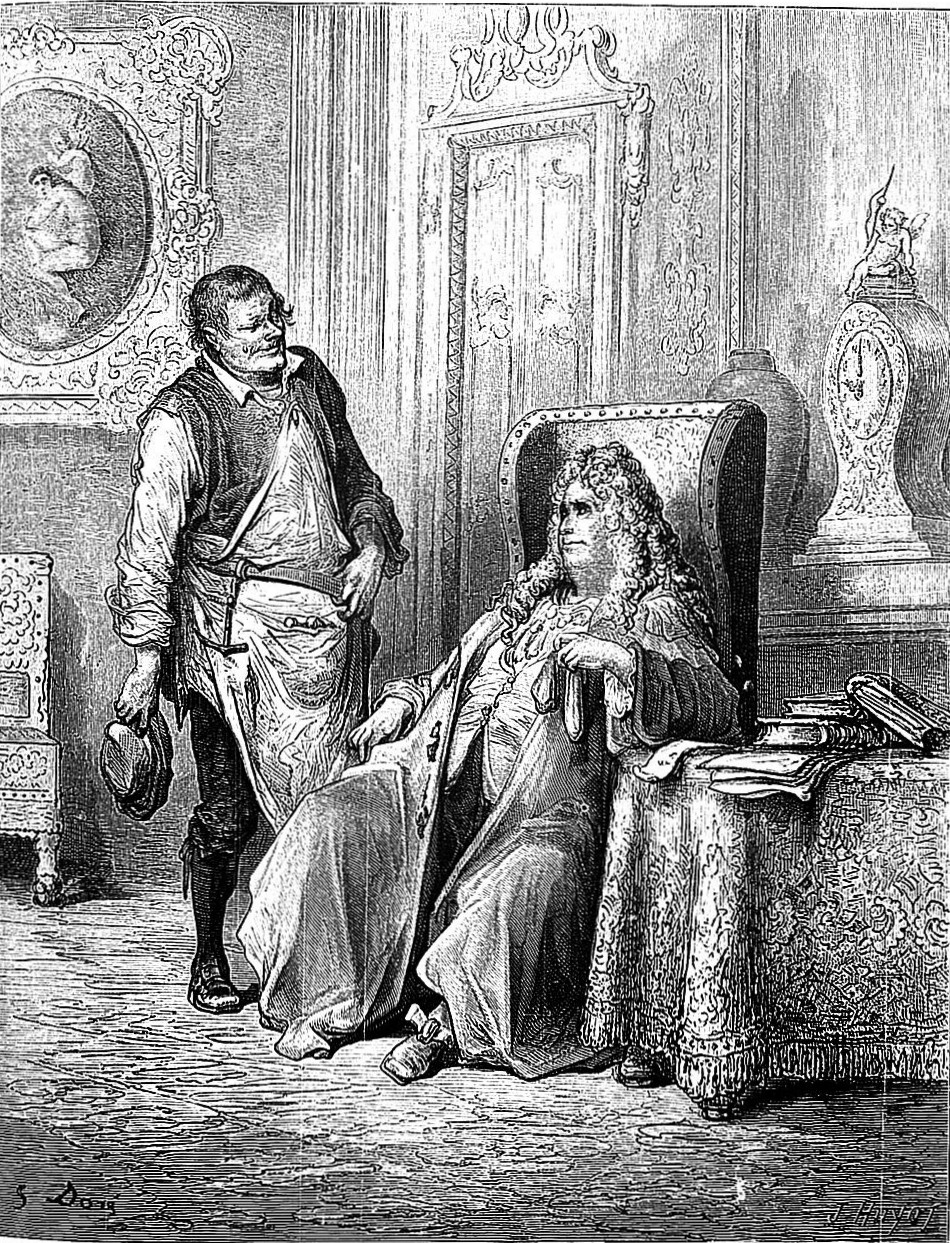
THE COBBLER AND THE BANKER.
His guests were cares, suspicions, vain alarms; All day he watch'd,—at night still dreading harms: If but a cat stirr'd, robbers he could hear. At last the poor fool to his neighbour ran; He had not woke him lately, I'm afraid: "Return my songs and tranquil sleep," he said, "And take your hundred crowns, my generous man."
FABLE CXLII.
THE CAT, THE WEASEL, AND THE LITTLE RABBIT.
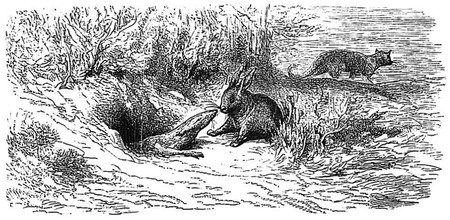
A little Rabbit's charming nook A Weasel seized upon one morn; His household gods with him he took, Jane Rabbit's mansion to adorn. At break of day departed Jane, To munch amongst the thyme and roses, Returning, at her window-pane— "Why, there the wicked Weasel's nose is!" "Oh, gracious goodness! what is here? Turned out of my paternal hall! From this you quickly disappear, Or I'll give all the rats a call." The Weasel simply said the Earth Always belonged to the first comer; All other claims were little worth: A sufferance tenant a misnomer. A little kingdom he had found: "Now, tell me, what more right have you To these domains, this patch of ground, Than Tom or Dick, than Nan or Sue?" "Usage and custom of the law," The Rabbit said, "give me the place: On sire's and grandsire's claims I stand— I, who here represent their race." "A law most wise! can't be more wise!" Said cunning Weasel. "What of that? Our claims to settle, I devise A reference to our friend the Cat." It was a Cat of solemn mien— A very hermit of a Cat:— A saint, upon whose face was seen Precept and practice, law, and—fat. The Rabbit here agreed, and then They sought the pious Pussy's home. "Approach—I'm deaf, he said; and when They came, they told him why they'd come. "Approach, fear not, for calm is law; For law no one here ever lacks;" And, stretching on each side a claw, He broke both litigants' weak backs. This story calls unto my mind The sad result which often springs From squabbles of a larger kind, Which small grand-dukes refer to kings.
FABLE CXLIII.
THE LION, THE WOLF, AND THE FOX.
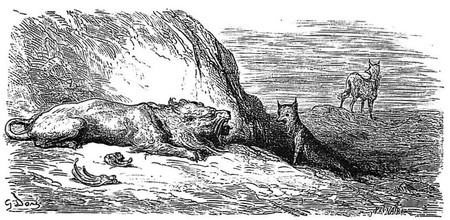
A Lion, sickly, weak, and full of years, Desired a remedy against old age (Impossible's a word no monarch hears Without directly flying in a rage). He sent for doctors—men of draughts and pills; From far and near, obedient to the call, Came makers-up of recipes and pills: The Fox alone declined to come at all. At court the Wolf malignantly referred To Reynard's absence, whereupon the King— Whose anger was aroused at what he heard—- Decided on a rather cruel thing. He sent a force to smoke sly Reynard out, And bring him, willy nilly. When he came, The Fox could scarcely entertain a doubt As to whose tongue had put him thus to shame. "I greatly fear, your Majesty," said he, "You think me rude; you wrong me, if you do: For I was on a pilgrimage, you see, And went to offer up my vows for you. I scarcely need inform you I have met Expert physicians whilst I was away, And hope to cure you of your sickness yet, Which comes from coldness of the blood, they say You must, sire, skin a Wolf, and wrap the skin About you close, to get the body warmed; And when the heat has kindled up within The fires of life again, the cure's performed. Our friend, I'm sure, will take immense delight In lending you his coat; so, take it, sire." The Lion supped upon the Wolf that night, And made the skin a part of his attire.
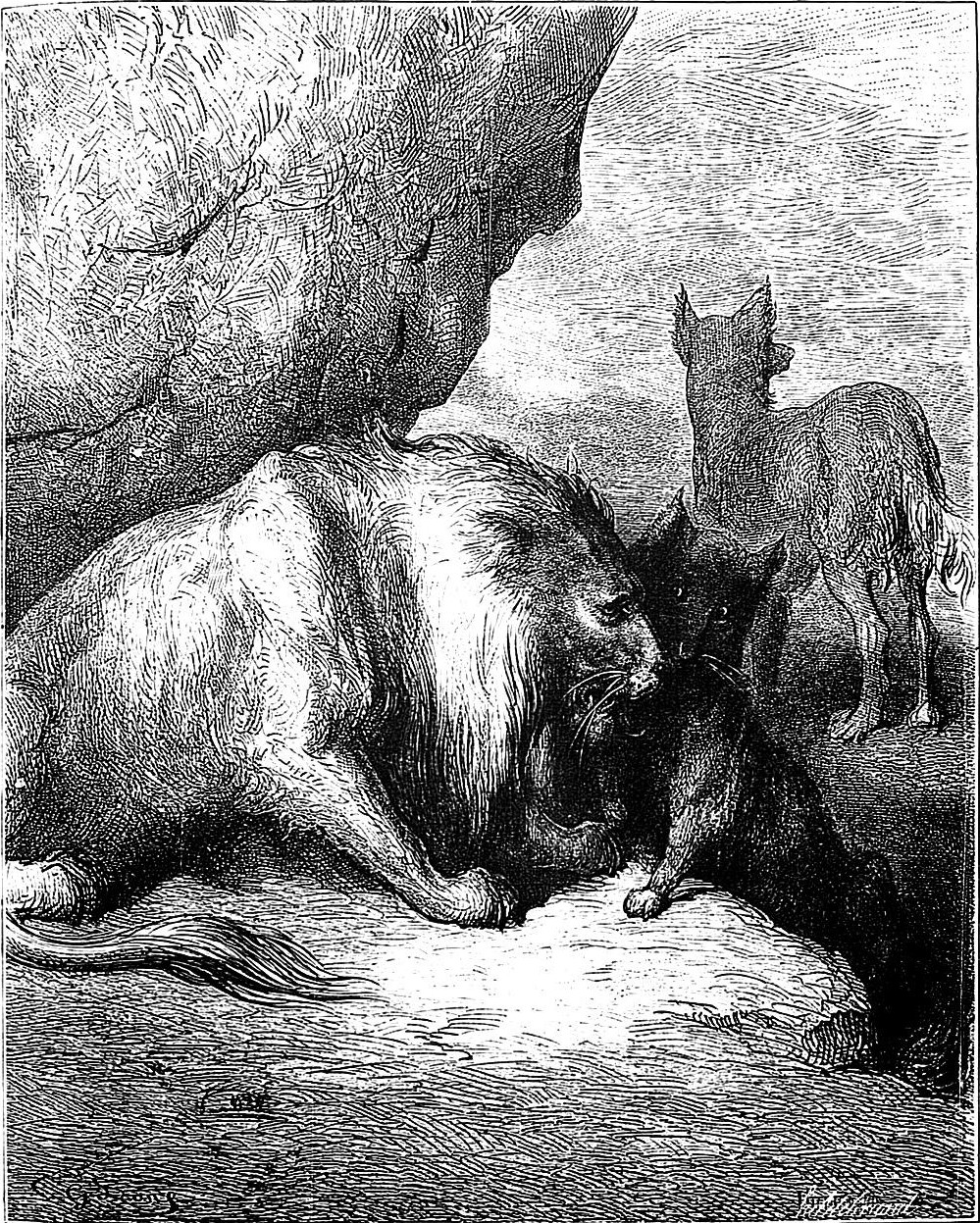
THE LION, THE WOLF, AND THE FOX.
Courtiers, discretion is your safest plan: Malice is sure to find its source again; And, while you do yourself what good you can, Reflect that slandering others is in vain.
FABLE CXLIV.
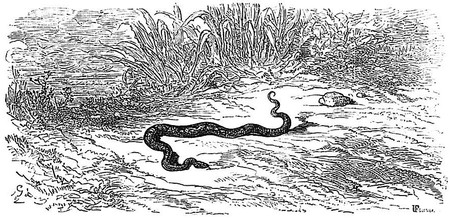
THE HEAD AND THE TAIL OF THE SERPENT.
The Snake has two parts, it is said, Hostile to man—his tail and head; And both, as all of us must know, Are well known to the Fates below. Once on a time a feud arose For the precedence—almost blows. "I always walked before the Tail," So said the Head, without avail. The Tail replied, "I travel o'er Furlongs and leagues—ay, score on score— Just as I please. Then, is it right I should be always in this plight? Jove! I am sister, and not slave: Equality is all I crave. Both of the selfsame blood, I claim Our treatment, then, should be the same. As well as her I poison bear, Powerful and prompt, for men to fear. And this is all I wish to ask; Command it—'tis a simple task: Let me but in my turn go first; For her 'twill be no whit the worst. I sure can guide, as well as she; No subject for complaint shall be." Heaven was cruel in consenting: Such favours lead but to repenting. Jove should be deaf to such wild prayers: He was not then; so first she fares; She, who in brightest day saw not, No more than shut up in a pot, Struck against rocks, and many a tree— 'Gainst passers-by, continually; Until she led them both, you see, Straight into Styx. Unhappy all Those wretched states who, like her, fall.
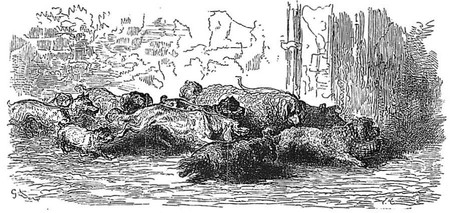
FABLE CXLV.
THE DOG WHICH CARRIED ROUND HIS NECK HIS MASTER'S DINNER.
Few eyes are against beauty proof; Few hands from gold can keep aloof; Few people guard a treasure well, Or of strict faithfulness can tell. A certain Dog, true, brave, and stout, Carried his master's dinner out. This self-denial pressed him hard, When he had dainty food to guard: Yet long he kept it safe and sound. Well, we are tempted oft, 'tis found, By good things near us! Strange, we learn From dogs, and yet we hopeless turn From men when temperance is in view! One day this Dog, so staunch and true, A mastiff met, who wished to seize The dinner. Not so, if you please. The Dog put down the food, to fight A mighty combat. Left and right Came other dogs,—mere thieves and foes, Who cared not for the hardest blows. Our Dog, who dreaded every stranger, And saw the food was much in danger, Wanted his share. "Come, gentlemen, This rabbit does for me; now, then, You take the rest!" so he leaped on it, And then the others fell upon it. He snapped the best, and then they flew And shared the plunder,—the whole crew. So, sometimes, when they yield a town, And soldiers burghers trample down, Sheriffs and provosts are the worst To rob and pillage, being first:
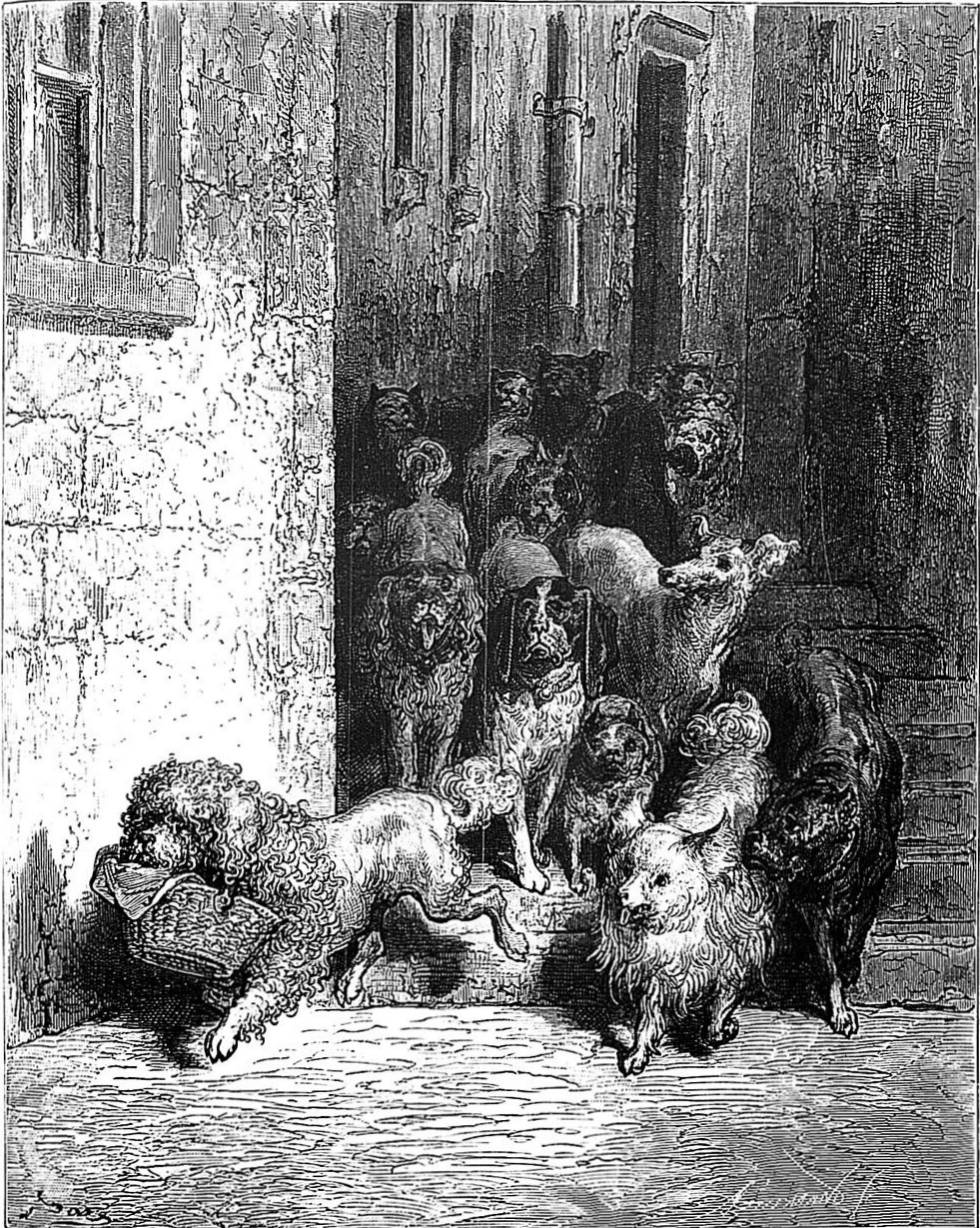
THE DOG AND HIS MASTER'S DINNER.
Pleasant to see them pistoles seize, Filling their purses at their ease! And if, by chance, to one more cool Some scruples come, they call him fool: Then he repents him of the blunder, And is the first to lead the plunder.
FABLE CXLVI.
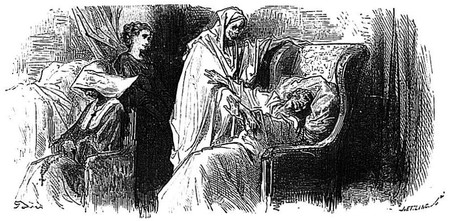
DEATH AND THE DYING MAN.
Death never yet surprised the sage, Who's always ready for the stage; Knowing each hour that comes may be His passage to eternity. Death's rule embraces every day: Each moment is beneath his sway. We all pay tribute to that lord; We all bow down beneath his sword. The instant the king's child has birth— And looks forth on this desert earth—- That instant Death may it surprise, And close its scarcely-opened eyes. Beauty, youth, virtue, every day, Death steals so ruthlessly away. One day the world will be his prey: This knowledge is most largely shared; For no event we're less prepared. A dying man, a century old, Complained to Death, that he was told Too suddenly, before his will Was made; he'd duties to fulfil; "Now, is it just," this was his cry, "To call me, unprepared, to die? No; wait a moment, pray, sir, do; My wife would wish to join me, too. For still one nephew I'd provide: And I have causes to decide. I must enlarge my house, you know. Don't be so pressing, pray, sir, go." "Old man," said Death, "for once be wise; My visit can be no surprise. What! I impatient? In the throng Of Paris who has lived so long? Find me in all France even ten; I should have warned you, you say then? And so your will you would have made, Your grandson settled; basement laid. What! not a warning, when your feet Can scarcely move, and fast retreat Your memory makes, when half your mind And wit is left a league behind? When nearly all fails?—no more hearing— No taste—all fading, as I'm fearing. The star of day shines now in vain For you: why sigh to view again The pleasures out of reach? Just see Your comrades drop continually, Dead, dying: is no warning there? I put it to you, is this fair? Come, come, old man; what! wrangling still? No matter, you must leave your will; The great republic cares not, sir, For one or no executor." And Death was right: old men, at least, Should die as people leave a feast, Thanking the host—their luggage trim: Death will not stay to please their whim. You murmur, dotard! look and sigh, To see the young, that daily die; Walk to the grave or run, a name To win of everlasting fame: Death glorious may be, yet how sure, And sometimes cruel to endure. In vain I preach; with foolish zeal, Those most akin to death but feel The more regret in quitting life, And creep reluctant from the strife.
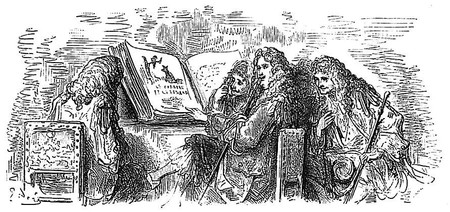
FABLE CXLVII.
THE POWER OF FABLES.
TO M. DE BARILLON.
How can a great ambassador descend To simple tales a patient ear to lend? How could I trifling verses to you bring, Or dare with transient playfulness to sing? For if, sometimes, I vainly tried to soar, Would you not only deem me rash once more? You have more weighty matters to debate Than of a Weasel and a Rabbit's fate. Read me, or read me not; but, oh, debar All Europe banding against us in war. Lest from a thousand places there arise Fresh enemies our legions to surprise. England already wearies of her rest, And views our king's alliance as a jest. Is it not time that Louis sought repose? What Hercules but wearies of his blows At the huge Hydra?—will it show its might, And press again the lately ended fight, By thrusting forth another head to meet, At his strong sinewy arm, a fresh defeat? If your mind, pliant, eloquent, and strong, Could soften hearts, and but avert this wrong, I'd sacrifice a hundred sheep to you— A pretty thing for a poor bard to do. Have then, at least, the kindness graciously This pinch of incense to receive from me. Accept my ardent vows, and what I write: The subject suits you that I here indite. I'll not repeat the praises Envy owns Are due to you, who need not fear her groans. In Athens' city, fickle, vain, of old, An Orator, who dangers manifold Saw crowding on his country, one day went Up in the tribune, with the wise intent, With his skill'd tongue, and his despotic art, Towards a republic to force every heart. He spoke with fervour 'bout the common weal; They would not listen: they were hard as steel. The Orator, to rouse them, had recourse To metaphors of greater fire and force, To sting the basest. He awoke the dead. He, Zeus-like, flamed and thunder'd o'er each head: The wind bore all away,—yes, every word. The many-headed monster had not heard: They ran to see the rabble children play, Or two boys fighting made them turn away. What did the speaker do?—he tried once more: "Ceres," he said, "once made, we hear, a tour. An Eel and Swallow follow'd her: A river gave them some demur. The Eel it swam: the Swallow flew, Now what I tell you's really true." And as he utter'd this, the crowd "And Ceres, what did she?" cried loud. "Just what she did:—then pious rage Stirr'd him to execrate the age. What children's tales absorb your mind, Careless of all the woes behind! Thou only careless Grecian state, What Philip does you should debate." At this reproach the mob grew still, And listen'd with a better will: Such silence a mere fable won! We're like the Greeks, all said and done. And I myself, who preach so well, If any one to me would tell "Le Peau d'Ane," I should, with delight, Listen for half the livelong night. The world is old, as I have heard, And I believe it, on my word; Yet still, though old, I'm reconciled To entertain it like a child.
FABLE CXLVIII.
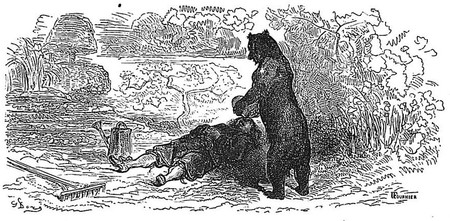
THE BEAR AND THE AMATEUR OF GARDENING.
A certain Mountain Bruin once, they say, Was wont within a lonely wood to stray,— A new Bellerophon secluded there, His mind had gone, and left his brain-pan bare. Reason on lonely people sheds no ray; It's good to speak—better to silent stay: Both in excess are bad. No animal Was ever seen, or was within a call. Bear though he was, he wearied of this life, And longed for the world's joy and the world's strife: Then "Melancholy marked him for her own." Not far from him an old man lived alone:
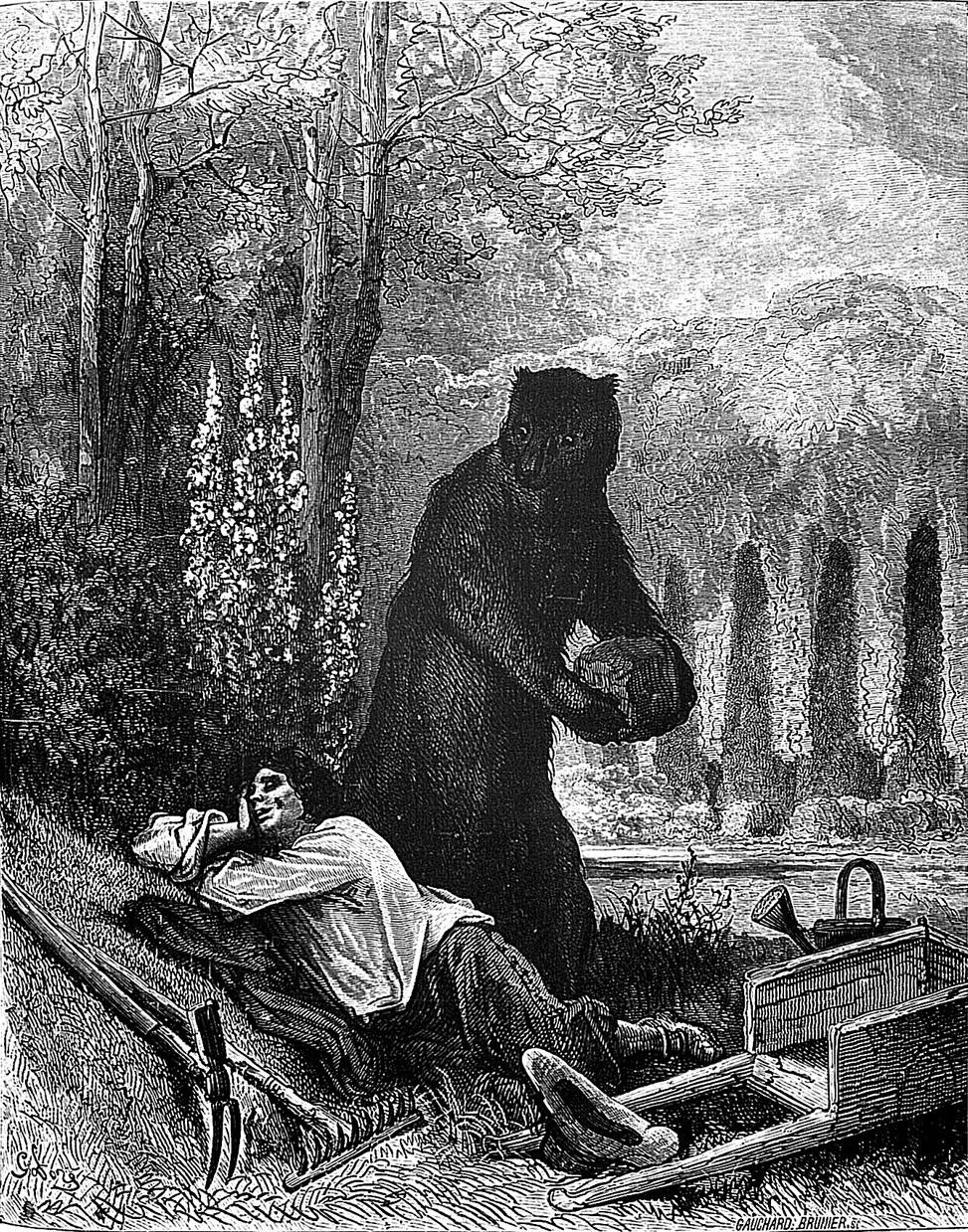
THE BEAR AND THE AMATEUR OF GARDENING.
Dull as the Bear, he loved his garden well; Was priest of Flora and Pomona; still, Though the employment's pleasant, a kind friend Is needful, its full charms to it to lend: Gardens talk little, save in my small book. Weary at last of their mere smiling look, And those his dumb companions, one fine day, Our man set forth upon his lonely way, To seek a friend. The Bear, with the same thought, Had left his mountain, satisfied with nought. By chance most strange the two adventurers meet At the same turning. He's afraid to greet The Bear; but fly he can't. What can he do? Well, like a Gascon, he gets neatly through: Conceals his fright. The bear is not well bred; Still growls, "Come, see me!" but the other said, "Here is my cottage; pray come in, my lord; Do me the honour at my frugal board To lunch al fresco. I have milk and fruit, That will, perhaps, your worship's pleasure suit For once, though not your ordinary fare; I offer all I have." With friendly air They're chums already before reaching home; Still better friends when there they've fairly come. In my opinion it's a golden rule: Better be lonely than be with a fool. The Bear, who did not speak two words a day, Left the drudge there to work and toil away. Bruin went hunting, and brought in the game, Or flapped the blow-flies, when the blow-flies came; And kept from off his sleeping partner's face Of winged parasites the teasing race. One day a buzzer o'er the sleeping man Poised, and then settled on his nose,—their plan. The Bear was crazy: all his chase was vain; "I'll catch you, thief!" he cried: it came again. 'Twas said, 'twas done; the flapper seized a stone, And launched it bravely—bravely it was thrown. He crushed the fly, but smashed the poor man's skull— A sturdy thrower, but a reasoner dull. Nothing's so dangerous as a foolish friend; Worse than a real wise foe, you may depend.
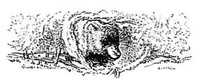
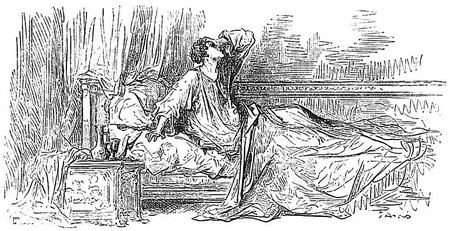
FABLE CXLIX.
THE MAN AND THE FLEA.
People pray to and weary the gods, now and then, About trifles unworthy to interest men; Thinking Providence cruel unless it contrives To design to their likings the whole of their lives. Why believe that Olympus should study us more Than it studied the Greeks and the Trojans of yore? A gaby was bit on the shoulder, one night, By a Flea, which took refuge instanter in flight. "O Hercules, Hercules, prithee come down, And exterminate Fleas!" cried the suppliant clown. "O Jupiter, strike with your lightning the beasts, And avenge me on them and their horrible feasts!" To punish a Flea, 'twould be rather a wonder If gods went to work with their clubs and their thunder.
FABLE CL.
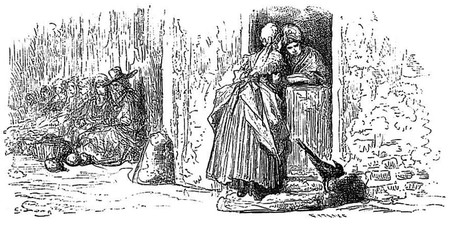
THE WOMAN AND THE SECRET.
A secret is a dreadful weighty thing: Few women carry secrets very far; And this remark doth to my memory bring Some men, too, born beneath the female star. To try his wife, a husband one night cried, "Ye gods, I perish! spare me, spare, I pray: For, lo! I have just laid an egg." "An egg?" she sighed. "Here it is—newly laid: but do not say A single word, or they will call me 'hen.' Be silent, darling." Then, in full belief, She swore by all the gods to keep all men Quite in the dark, so she assured her chief. But with the shadows pass those words of hers. Foolish and indiscreet, at earliest dawn, She seeks her neighbour, and she thus avers: "My gossip, such a thing took place last night! You must say nothing, or I shall be beat. My husband laid an egg, yes, large and white. And big as any four; but don't repeat, In Heaven's name, nor mention anywhere This strange occurrence." "Now, I see you mock," The other said. "What! mention the affair! You know me not. Go, I am like a rock!" The hen's wife hastened homeward presently; The other spreads the tale in twenty places. The one big egg she quickly turns to three; Nor was this all: to many startled faces Another chatterer makes the number four. Whispering is no more needful—all is known. Before the day was over there had flown A rumour that the man had forty score Of chickens of his own all cackling round his door.
TIRCIS AND AMARANTH.
FABLE CLI.
TIRCIS AND AMARANTH.
FOR MADEMOISELLE DE SILLERY.
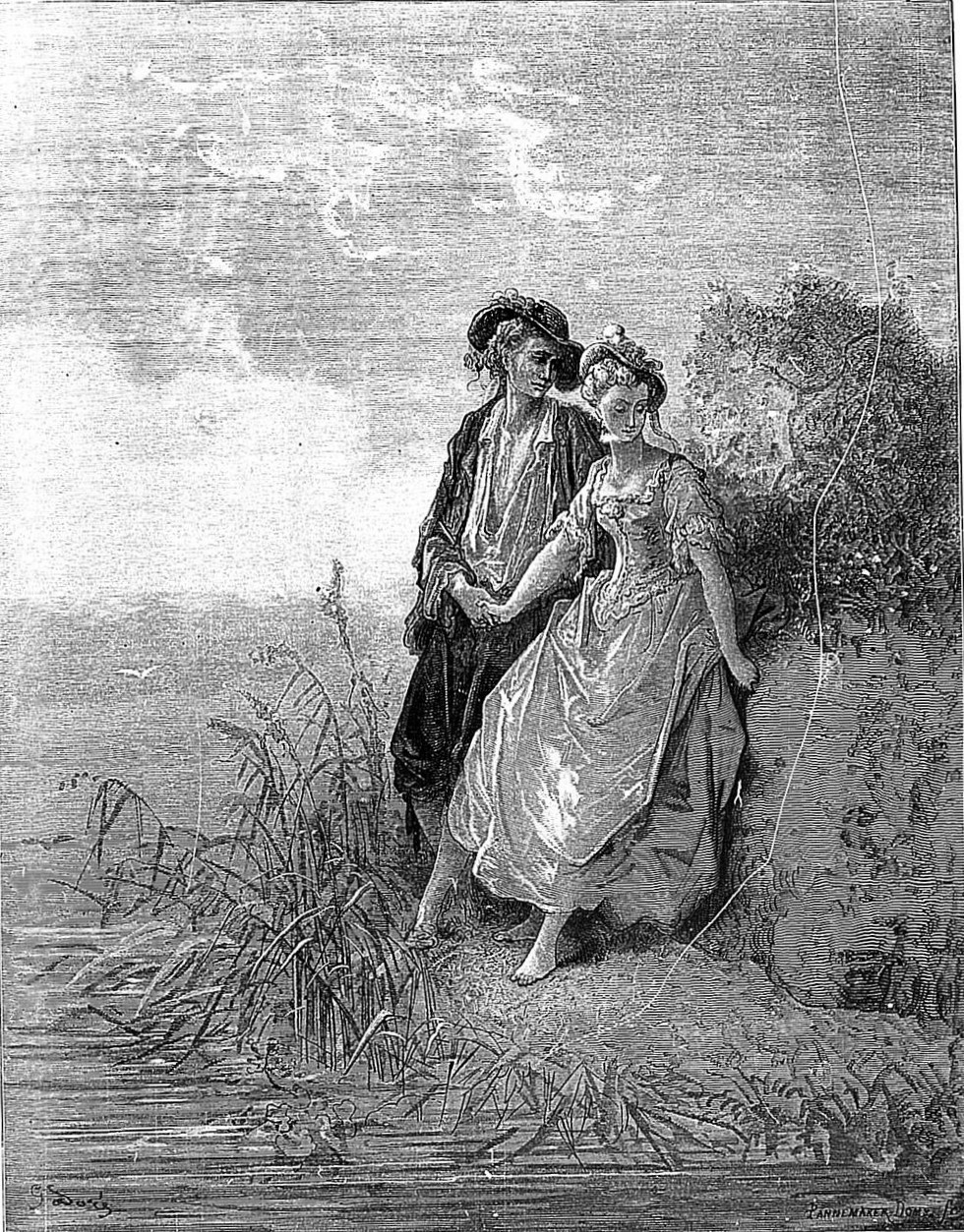
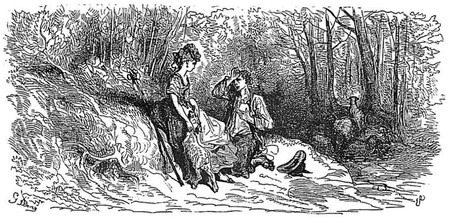
I quitted Æsop, long ago, For pleasant old Boccaccio; But now a fair Divinity Would once more from Parnassus see Fables in my poor manner; so To answer with a boorish "No," Without a valid, stout excuse, To goddesses would be no use; Divinities need more than this, And belles especially, I wis. Her wishes are all queens, you see; She rules us all, does Sillery; Who wishes once again to know Of Master Wolf, and Master Crow. Who can refuse her majesty? None can deny her. How can I? Well, to her mind my stories are Obscure, and too mysterious far; For, sometimes, even beaux esprits Are puzzled and astray, you see. Let us, then, write in plainer tune, That she may so decipher soon. I'll sing of simple shepherds, then, Before I rhyme of wolves again. Tircis to youthful Amaranth, one day, Said, "Ah! but if you knew the griefs that slay! Pleasing enchantments! Heaven-kindled woe! The greatest joy of earth you then would know. Oh, let me picture them! you need not fear. Could I deceive you? Stay, then, sweet, and hear. What! I betray?—I, whose poor heart is cleft By fondest hopes that cruel Love has left?" Then Amaranth exclaimed, "What is this pain? How call you it?—now, tell me once again!" "'Tis Love!" "A pretty word, its symptoms tell: How shall I know it—I, who am so well?" "A malady, to which all pleasant things— Yes, even all the pleasures of great kings— Seem poor and faded. Lovers thus are known: In gloomy forests they will walk alone; Muse by the river, watch the stream beside, Yet their own faces rise not from the tide; One image only in the flood shows day by day; This lovely shadow comes, but to betray: To other things they're blind. A shepherd speaks; His voice, his name, raise blushes on your cheeks: You like to think of him, yet know not why; You wonder at the wish, and yet you sigh; You fear to see him, and yet, absent, cry." Amaranth leaped for joy: "Is this, then, love? Is that the pain you rank all things above? It is not new to me: I think I know it." Tircis thought he was safe, but dared not show it. The maid said, "Yes, and that, I freely grant, Is what I feel for dear, dear Clidamant." Then Tircis almost burst with rage and spite; But yet it served the cheating fellow right. Thinking to gain the prize, he lost the game, And only cleared the road for him who came.
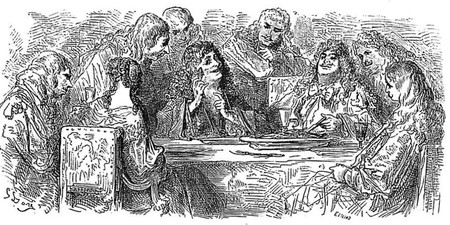
FABLE CLII.
THE JOKER AND THE FISHES.
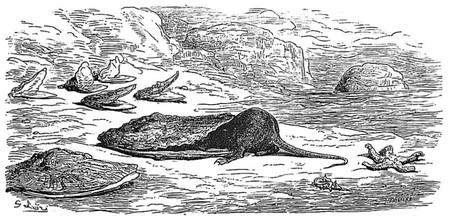
He's vastly popular, your "Funny Man;" For my part I avoid him when I can. I generally find him rather hollow;— The joker's is no easy art to follow. I think sarcastic people were created For fools to grin at, when exhilarated. Let me present one at a dinner-table, To point a moral and adorn a fable. A wag, dining out at a banker's, one day, Had some very small fishes put near him. He saw there were finer ones farther away, So, pretending the fishes could hear him, He mutter'd some words to the poor little creatures, And feign'd to receive their replies. It was done with such grave and unchangeable features, That people all opened their eyes. Then he said that some very particular friend Was en route for the Indies, or thereabouts; And he feared he might come to a watery end, So he wanted some hints of his whereabouts. "The fishes had answered," he added, politely, "That they were too young to reply; But they fancied their fathers could answer him rightly, Should one of them chance to be by." To say that the company relished the jest, Or the jester, is more than I'm able; But it answered his end, for they gave him the best Of the fishes that lay on the table. 'Twas a monster that might have related him stories As much as a century old; Long tales of the sea, of its perils and glories, As wondrous as ever were told.
FABLE CLIII.
THE RAT AND THE OYSTER.
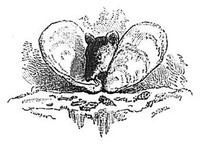
A Rustic Rat, of mighty little sense, Weary of home, would needs go travel thence; And quitted the paternal hearth, one day, To study life in places far away. At each wide prospect, hitherto unscanned, He murmured, "Oh, how beautiful! how grand! Yon mount is Caucasus, begirt with pines; That range, methinks, must be the Apennines." For every molehill, to his wondering eyes, Became a mountain of terrific size. He reached a province of the land, at last, Where Tethys, deity of seas, had cast Some Oysters on the sand, which looked at least Like first-rate frigates to our simple beast. "My father is a timid soul," he said, "Who fears to travel: what an empty dread! As to myself, what marvels I have seen; What scores of wonders, earthly and marine!" Thus boasted he, in magisterial tone, And boasted loud, though speaking all alone. Most rats, I beg to say, are more discreet, And use their lips but when they wish to eat. Meanwhile, one Oyster—a luxurious one— With shells apart, was basking in the sun. Tasting the balmy breeze, it lay agape,— A fine fat morsel of seductive shape. The Rat, with moistenings of the under lip (Mistaking still the Oyster for a ship), Ran up, and, smelling something nice to eat, Prepared, straightway, his grinders for a treat. "The crew," quoth he, "have left a feast on board,— A cold collation, fit for any lord; If it deceive me not, I've got a prize, Or else I do not know the use of eyes." So saying, Master Rat, resolving well, Peered round the pearly margin of the shell. It held him fast: the Oyster from his nap Had woke, and sharply shut his treacherous trap. This all arose from fatal ignorance: The fable's useful to the folks of France,— Nor France alone: it shows with what surprise The simplest object strikes a booby's eyes. And notice, oftentimes, for want of wit, The fool, who thinks he's biting, is first bit.
FABLE CLIV.
THE TWO FRIENDS.
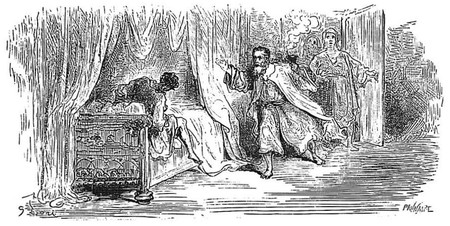
Two steadfast Friends lived once in Monomtàpa; They loved as if really they'd had the same pàpa: What one earned the other earned. Ah! for that land; It's worth ten such countries as ours, understand. One night, when a deep sleep had fallen on all, And the sun had gone off in the dark, beyond call, One of these worthy men, woke by a nightmare, Ran to his friend, in a shiver, and quite bare. The other at once takes his purse and his sword, Accosts his companion, and says, "'Pon my word You seldom are up when all other men snore; You make better use of the night than to pore Over books; but come, tell me, you're ruined at play, Or you have quarrelled with some one; now, speak out, I say. Here's my sword and my purse; or, if eager to rest On a fond wife's compassionate, fondling breast, Take this slave: she is fair." "No, no," said the other, "'Twas neither of these things that startled me, brother. Thanks, thanks for your zeal; 'twas a dream that I had: I saw you appear to me, looking so sad; I feared you were ill, and ran to you to see: 'Twas that dream, so detestable, brought me to thee." Which friend loved the most?—come, reader, speak out! The question is hard, and leaves matter for doubt. A true friend is choicest of treasures indeed; In the depths of your heart he will see what you need: He'll spare you the pain to disclose woes yourself, Indifferent to either his trouble or pelf: A dream, when he loves, or a trifle—mere air— Will strike him with terror, lest danger be there.
FABLE CLV.
THE PIG, THE GOAT, AND THE SHEEP.
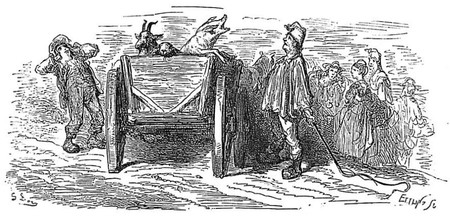
A Goat, a Sheep, and a fat Pig were sent To market, to their mutual discontent; Not for the pleasures of the noisy fair, But just to sell—the farmer's only care. Not to see jugglers' tricks drove on the carter, Bent only on his traffic and his barter. Sir Porker screeched, as if he felt the knife, Or heard ten butchers plotting 'gainst his life. It was a noise to deafen any one: His mild companions prayed him to have done. The carter shouts, "Good heavens! why this riot? You'll drive us silly; fool! can't you be quiet? These honest folks should teach you manners, man; So hold your tongue, you coward, if you can. Observe this sheep, he has not said a word, And he is wise." "Now, fool! you talk absurd. If he the dangers knew as well as I, Till he was hoarse and blind he'd bleat and cry. And this my other friend, so calm and still, Would scream his life out, as I, carter, will. They think you're only going, on the morrow, From this his milk, from that his wool to borrow: They may be right or wrong, I do not know; But I am certain of the deadly blow: I'm good but for the spit. Farewell to you, My house, and wife, and children! now, adieu." Sir Porker reasoned with sufficient skill; But all was useless: he was fit to kill. Fear nor complaint could change his destiny: He who looks forward least will wisest be.
FABLE CLVI.
THE RAT AND THE ELEPHANT.
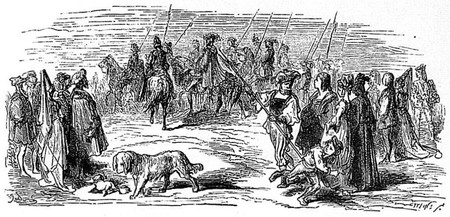
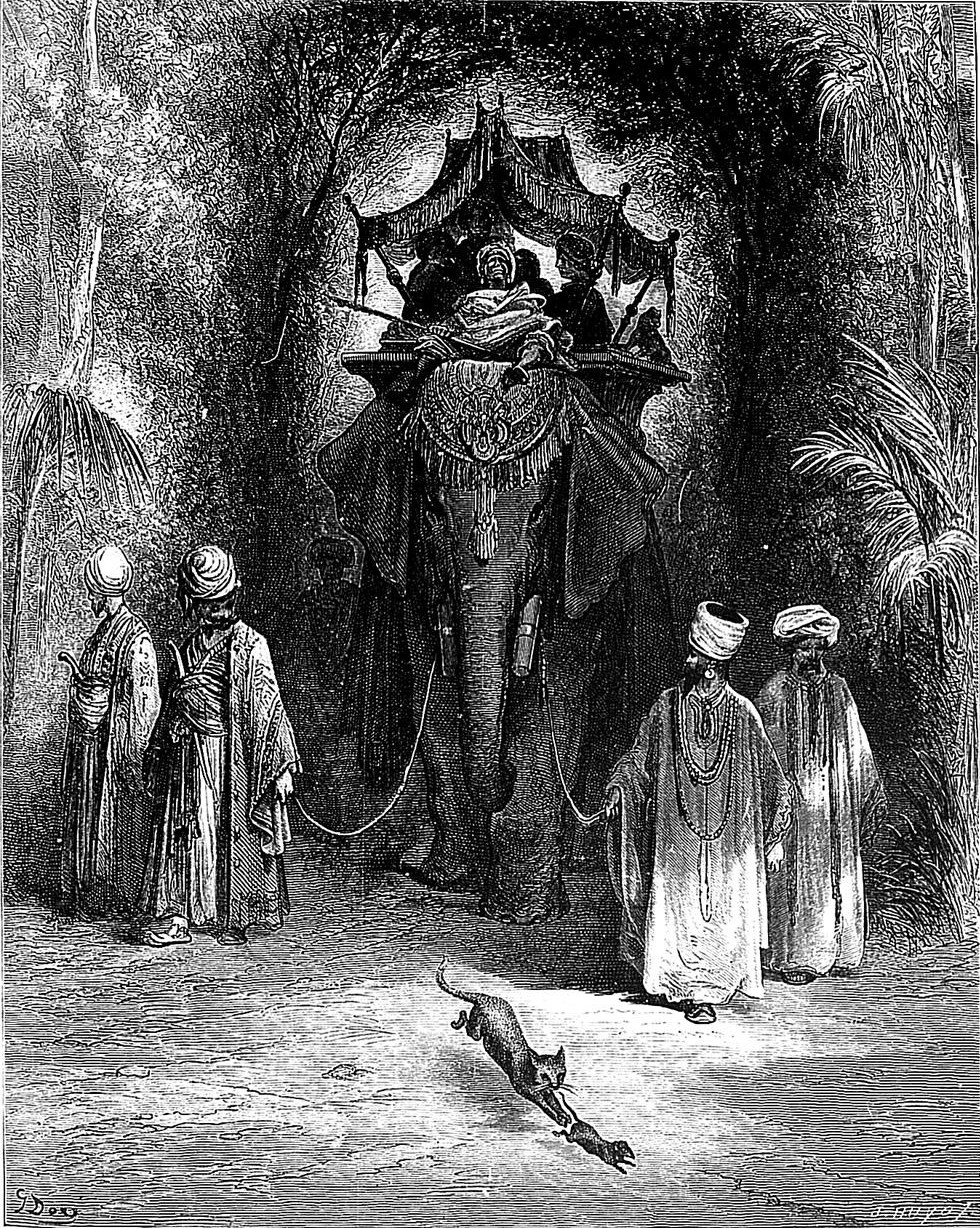
In France there's many a man of small degree Fond of asserting his own mightiness: A "nobody" turns "somebody." We see In this the nation's natural flightiness. In Spain men are not vain; their high-flown schools Have made them proud, yet have not made them fools. A tiny Rat saw a huge Elephant Travelling slowly with his equipage; 'Mongst beasts a sultan, knowing not a want. His suite comprised within a monstrous cage
THE RAT AND THE ELEPHANT.
His household gods, his favourite dog and cat, His parroquet, his monkey, and all that. The Rat, astonished to see people stare At so much bulk and state, which took up all The space where he of right should have his share, Upon the citizens began to call: "Fools! know you not that smallest rats are equal To biggest elephants?" (Alas! the sequel.) "Is it his monstrous bulk you're staring at? It can but frighten little girls and boys; Why, I can do the same. You see, a Rat Is scarce less than an Elephant." A noise! The Cat sprang from her cage; and, with one pant, The Rat found he was not an Elephant.
FABLE CLVII.
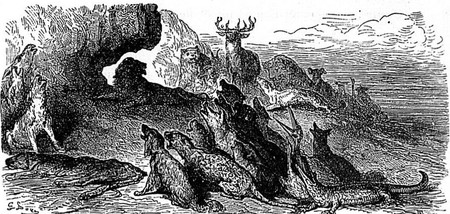
THE FUNERAL OF THE LIONESS.
The Lion lost his wife, one day; And everybody made his way To bring the prince that consolation Which makes us feel our desolation. The King announced the funeral On such a day, to one and all. They regulate the obsequy, And marshal the vast company: As you may guess, each one was there; The prince's groanings filled the air; And the den shook, above, below— Lions have got great lungs, you know. As the King does, all the others do; So the best courtiers blubbered too. Let me define a court: a place Sad—gay; where every changeful face, Careless of joy, is ready still To change again at the King's will; And if some cannot change, they try To watch the change in the King's eye: Chameleons, apes, in every feature; Plastic and pliant in their nature. One soul by turns fills many bodies: These knaves are soulless, which more odd is. But to return. The Stag alone Uttered no single sigh or groan. It could not well be otherwise; This death avenged old injuries. The Queen had cruel, mischief done; Strangled his wife, and slain his son: Therefore he shed no single tear. A flatterer noticed, hovering near; Moreover, the spy saw him smile. The anger of a King, meanwhile (I may observe, with Solomon, The wisest man beneath the sun), Is terrible; but to our friend No book could much instruction lend. "Base creature of the woods!" with scorn The Lion cried, "you do not mourn! What should prevent our sacred claws Teaching you friendship's holy laws? Come, Wolves, avenge that Queen of mine: Offer this victim on her shrine!" The Stag replied, "The time for grief Is passed; tears now are useless, Chief. Your wife, whose features well I know, Appeared to me an hour ago, Half hid in flowers. 'My friend,' she said, 'For me your tears are vainly shed. Weep not: in the Elysian fields I've every pleasure that life yields, Conversing with my holy friends; But for a time the King descends To a despair that charms me so.'" Scarce had he spoken thus, when, lo! "A miracle!" the courtiers cry. The Stags rewarded, instantly; And safely, without punishment, Back to his native woods is sent. With dreams amuse a listening king, With falsehoods sweet and flattering; Whatever rage within may burn, He'll gorge the bait, and friendly turn.
FABLE CLVIII
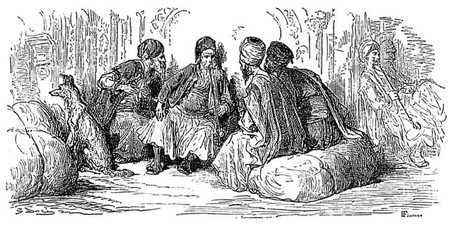
THE BASHAW AND THE MERCHANT.
An old Greek Merchant, one day, sought Protection from a Bashaw, bought At pasha's, not at merchant's, price (Such guardians are not very nice). It cost so much, that he complained His purse and coffer were both drained. Three other Turks, of lower station, Offered, from sheer commiseration, Their joint help, by word and deed, For less than half the first to cede:
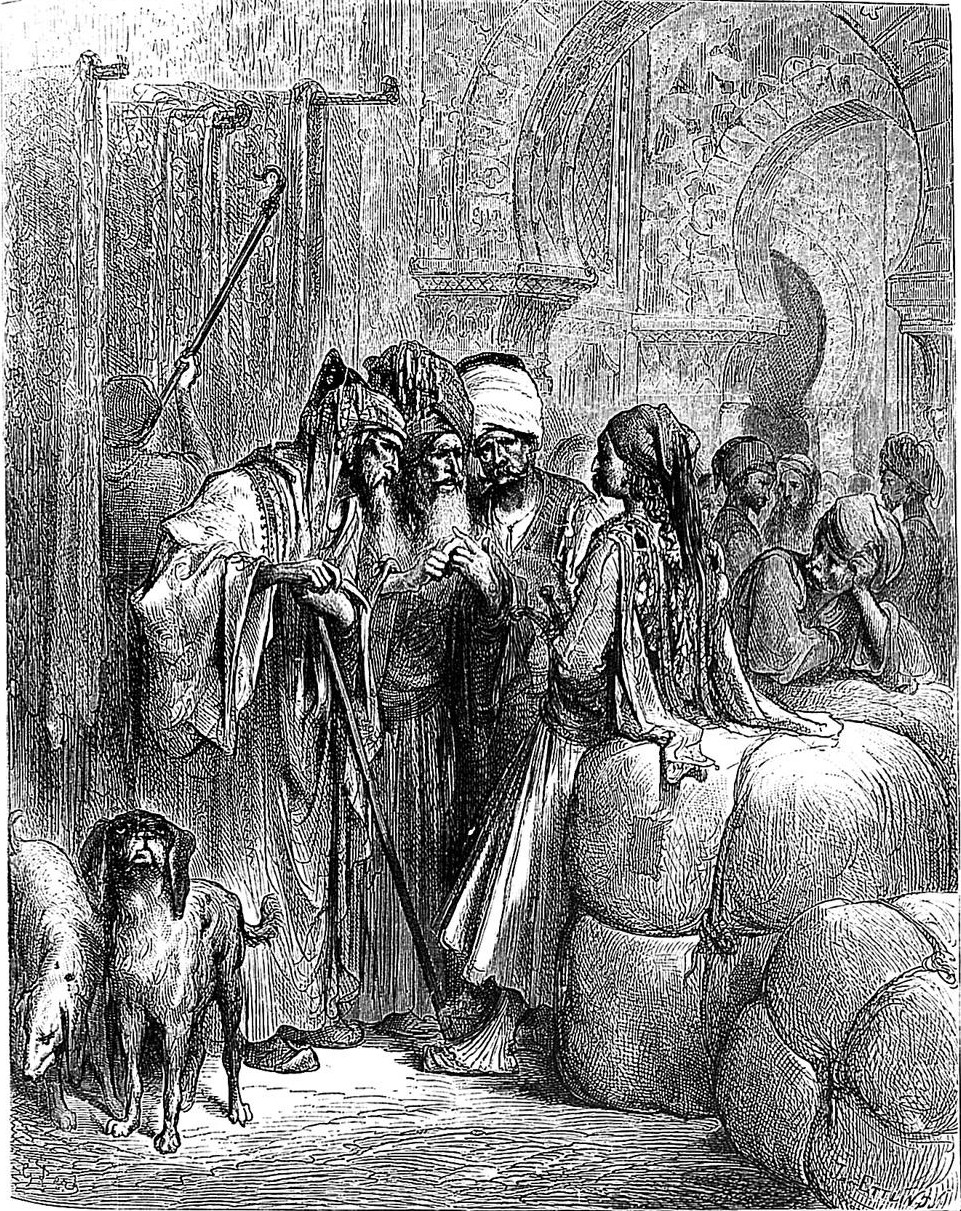
THE BASHAW AND THE MERCHANT.
The Greek he listens, then agrees. The Bashaw, cheated of his fees, Is told that if of time the nick He'd seize, these rascals he must trick— Send them to Mahomet, to bear A message for his private ear; And quickly, too, or they united, Knowing his friends, would see him righted; Would send him some vile poison-broth, To show the keenness of their wrath; And that would send him to protect The Stygian merchants, they expect. The Turk—an Alexander—strode Unto the Merchant's snug abode: Down at the table sat—his air Generous, bold, and free from care, For he feared nothing,—how could he? "My friend," he said, "you're quitting me; And people tell me to watch keenly.— You are too worthy: so serenely No poisoner ever looks, I know; So no more on that tack we'll go. But for these patrons you have found, Hear me,—to tell a tale I'm bound. To wrong you I have no intent, With reasoning, or with argument. "Once a poor shepherd used to keep A dog, to guard his silly sheep; Till some one asked him, plain and pat, How he could keep a beast like that, With such a ravenous appetite: It really wasn't fair or right. 'Twas their and every one's desire He'd give the dog up to the squire. Three terriers were best for him, To guard his flocks, in life and limb: The cur ate three times more than they.— But the fool meddlers did not say He also fought with treble teeth, When wolves came howling out for death. The shepherd listened—three dogs bought: They cost him less, but never fought. The flock discovered their ill lot Almost as soon as you, I wot. Your wretched choice will quickly do: Now mark what I have said to you; If you'll do well, return to me." The Greek obeyed him speedily. 'Tis good the provinces should heed: 'Tis better, in good faith I plead, Unto one powerful king to bend, Than on poor princelings to depend.
FABLE CLIX.
THE HOROSCOPE.
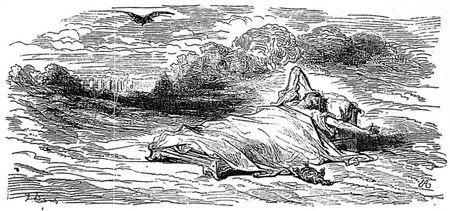
A Man will sometimes meet his destiny The moment that he turns ill-luck to flee. A father had an only son, and dear He held him; so, as love is kin to fear, He with astrologers held a debate About the stars that ruled the infant's fate. One of these people said the father's care Should of all lions specially beware. Till he was twenty, he should keep him in, And, after that, his safety would begin. The cautious father, resolute to save His offspring from the ever-yawning grave, Knowing the danger turned on one neglect, Guarded him carefully, in this respect;— Forbad him exit; barred up every door; But other pleasures lavished more and more. With his companions, all the live-long day, He was allowed to walk, and run, and play. When he had reached the age that loves the chase, A closer ward they kept upon the place. They talked with scorn of all the huntsman's joys, Spoke of the dangers—mocked the trumpet's noise. But all in vain were sermons, though well meant; Nothing can change the force of temperament. The youth was restless, fiery, hot, and brave; The stormy impulses came, wave on wave. He sighed for pleasure;—more the obstacle, The more desire; in vain they try to quell: He knew the cause of all his misery. The spacious house, so rich with luxury, Was full of pictures, and of tapestry,— The subjects hunting scenes, and forest glades: Here animals, there men, strong lights, dark shades,— The weaver made the lion chief of all: "Out, monster!" cried the youth, and eyed the wall With foaming rage: "'tis you that keep me here, In gloom and fetters. Is it you I fear?" He spoke, and struck, with all a madman's might, The beast so innocent. There, out of sight, Under the hanging, a sharp nail was stuck: It pricked him deeply, by the worst of luck. The arts of Æsculapius were in vain: He joined the shadows that own Pluto's reign. His death was due to his fond sire's regard, That in the locked-up palace kept him barred. It was precaution, too, that whilom slew The poet Æschylus, if they say true. It had been prophesied a house should fall Upon his head, so he shunned tower and wall, The city left, and camped out on the plain. Far from all roofs and danger, he was slain: An eagle, with a tortoise in his grip, flew by; The poet's bald head, from the upper sky, Looked like a smooth boulder; the bird let drop The prey he wished to crush upon the top. So perished Æschylus. From hence, we see, The art, if true, led to the misery That they would shun, all who in it had trust; But I maintain it's false, and quite unjust. I'll ne'er believe that Nature ties our hands, Or would submit herself to such vile bands, As in the skies to write our future fate; Times, persons, places, have far greater weight Than the conjunctions of a charlatan, Under the self-same planet, tell the man. Are kings and shepherds born, though one may sway With golden sceptre, and the other play With ashen crook? "The will of Jupiter,"— A star has not a soul, my worthy sir; Why should its influence affect these two So diversely? How can it pierce through That sea of air,—those cloudy gulfs profound, Mars and the Sun, and pass each fiery bound? An atom would disturb it on its path. Horoscope-mongers, let me rouse your wrath: The state of Europe,—who predicted that? Did you foresee it?—now, then, answer pat. Think of each planet's distance, and its speed; These sage's passions, it is well agreed, Prevent their judging of our actions right. On them our fate depends: a planet's course Goes like our minds, with a still-varying force. And yet these fools, with compass and with line, Of men's whole lives would map out a design! But do not let the tales that I repeat Weigh in the balance more than it is meet. The fate of boy and Æschylus came true, Blind and deceitful though the art be, too. Once in a thousand times the bull's eye's hit; That is the good luck of your juggling wit.
FABLE CLX.
THE TORRENT AND THE RIVER.
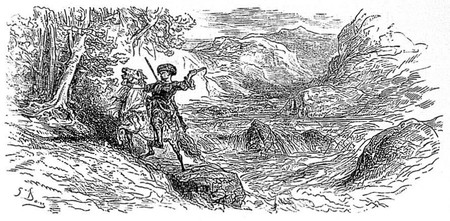
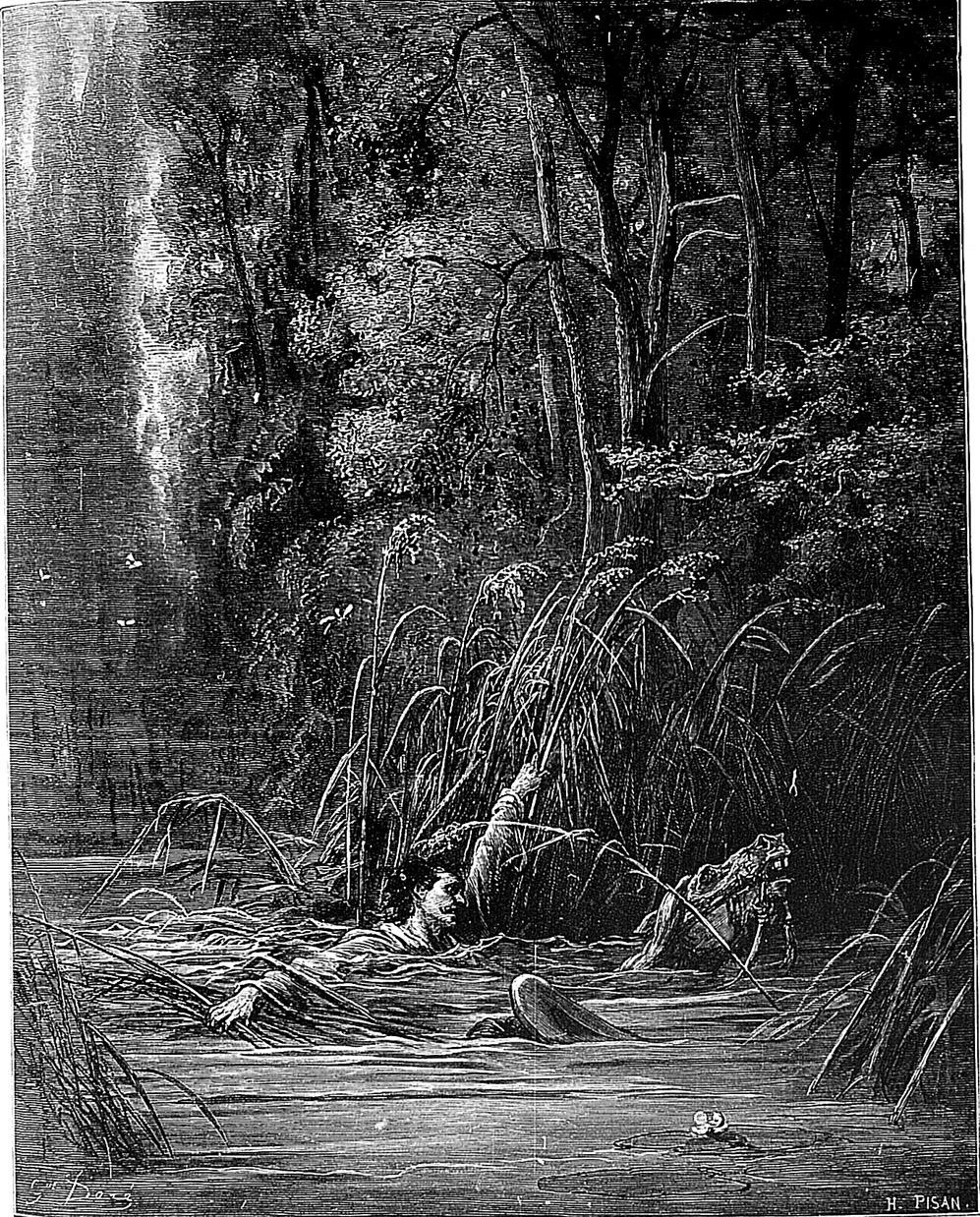
With a roar and a dreadful sound, The Torrent dashed down the rock. All fled from its mighty bound; And horror followed the shock, Shaking the fields around. No Traveller dared essay To cross the Torrent, save one, Who, meeting thieves by the way, And, finding all chances gone, Rode straight through the foam and spray. No depth! All menace and din! The Traveller drew his breath With courage, and laughed within Himself at escape from death; But the thieves resolved to win. His path they pursue and keep, Till he comes to a River clear, Peaceful and tranquil as sleep, And as far removed from fear: Its banks are in no way steep. But pure and glistening sand Border the placid wave; He leaves the dangerous land, To find a treacherous grave: It was deep, you'll understand. He drinks of the awful Styx, For deepest waters are still. Beware of quiet men's tricks; But for noisy men—they will Battle with words, not sticks.
THE TORRENT AND THE RIVER.
FABLE CLXI.
THE ASS AND THE DOG.
We ought to help each other, wise men say: An Ass forgot this motto, one fine day. I know not how our beast ignored the rule, For he's an amiable, good-natured fool. A trusty Dog so gravely paced along, The master took his nap at even-song: The Ass began to roam about and feed, And found, at last, a rank and savoury mead. There were no thistles,—that he must endure: One must not be too much an epicure. The feast was still not bad: while aught remains; 'Twould pass for once, the air's fresh on these plains. The Dog, half dead with hunger, said, at last, "My dear companion, all this time I fast. Stoop down a bit, and let the panniers fall; I'll take my dinner out." No word at all The Ass vouchsafed, fearing to lose a bite; At length he deigned to answer the poor wight: "Friend, when your master rouses from his nap, He's sure at once to call you on his lap, And give you a good meal." A Wolf, just then, Ran forth, half famished, from his forest den. The Ass called loudly to the Dog to aid; The Dog stood still. "My friend," he quickly said, "Fly till your master wakes—he'll not be long;— Run fast. If caught, avert the coming wrong With a hard kick, and break the wretch's jaw: They've shod you lately, and you're right in law. Mind, stretch him flat." The Dog spoke wise and well. But the Wolf choked the Ass, and down he fell. Conclusion:—We should always help each other; And every man help carry his lame brother.
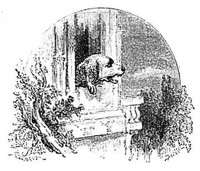
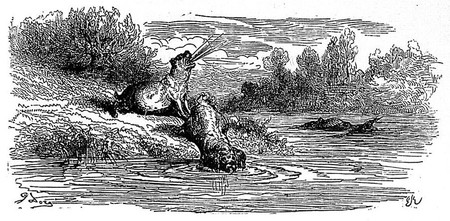
FABLE CLXII.
THE TWO DOGS AND THE DEAD ASS.
The Virtues must, surely, sisters be, For that Vices are brothers, we all well know. And if but to one a man's heart be free, All the others, like hurricanes, inward blow. Yet, of course, both of virtues and vices 'tis true That one heart holds but of either few; And not more than once in an age we see The Virtues in one small heart agree. For if a man be valiant, 'tis sure, In a thousand cases, he's also rash; And if he be prudent, the greed for more Will that respectable virtue dash. Above all animals beside, In faithfulness the Dog takes pride; But, far too oft, for food he craves, And even dogs are Folly's slaves. Two Mastiffs, on a certain day, Beheld a Donkey's carcase floating, And fain had seized it for their prey, But baffling winds deceived their gloating. At length one said, "Your eyes are good, My friend, so look on yonder flood, And tell me what is that I see; If savoury ox or horse it be." "Of what it is," replied the other, "What boots it, friend, to make a bother? For dogs like us, in want of food, Even a scurvy Ass is good. The thing that now the most concerns us Is, how to swim to such a distance, Against this plaguy wind's resistance. But, stay! let's quench the thirst that burns us, By drinking up the river dry; And when we've quenched our thirst, we'll pass And gorge us on that savoury Ass." With haste the Mastiffs now began To quaff the river as it ran; But, well-a-day! it came to pass That, long ere they had reached the Ass, The twain had long since quenched their thirst, And, still persisting, nobly burst. With us weak mortals 'tis the same, When eager seeking wealth or fame. What is hopeless seems not so; So on from ill to ill we go. A king whose states are amply round, Will conquer still, to make them square; And wealthy men, with gold to spare, Sigh for just fifty thousand pound; Whilst others, just as foolish, seek To learn all science,—Hebrew, Greek! In short, we most of us agree, 'Tis easy work to drain the sea! A mortal man, to carry out The projects of his single soul, Would need four bodies, strong and stout,
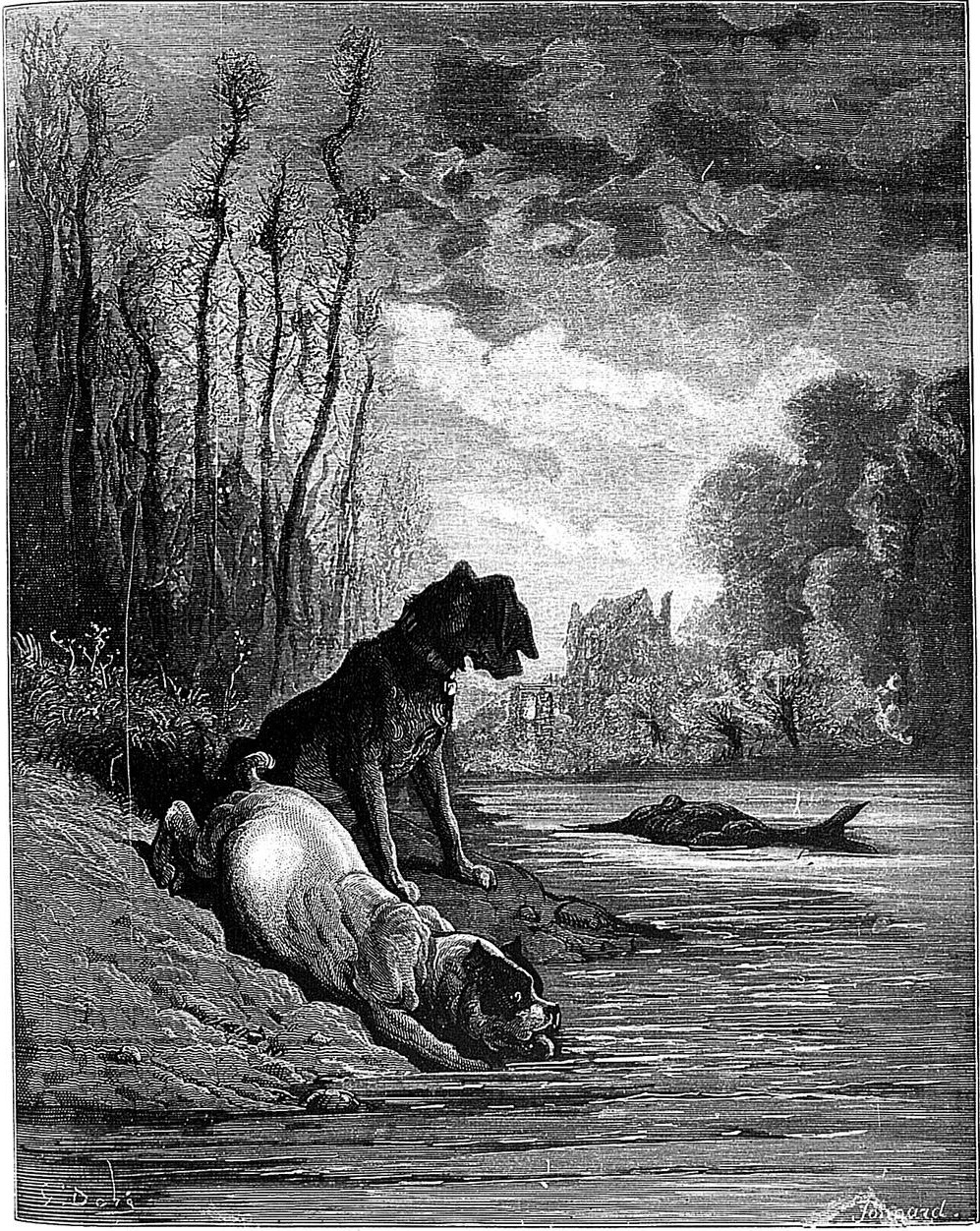
THE TWO DOGS AND THE DEAD ASS.
And then would not complete the whole. For, even should his life extend To twice Methuselah's, depend Ten thousand years would find him still Where he began—the total nil.
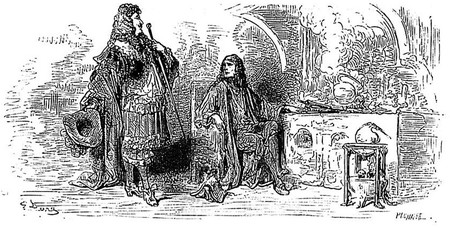
FABLE CLXIII.
THE ADVANTAGE OF BEING CLEVER.
Between two citizens there once Arose a quarrel furious; The one was poor, but full of knowledge Ripe, and rare, and curious; The other had not been to college, And was, though rich, a perfect dunce. He, far too fondly oft proclaiming The items of his hoarded pelf, Declared that learned men but came in A rank far underneath himself. The man was quite a fool, and I Can never understand the why Or wherefore wealth alone should place A man above the learned race. The rich one to the wise one said, Full often, "Is your table spread As well as mine? And if not, tell What boots it that you read so well? Night after night you sadly clamber To the dull third-floor's backmost chamber; And in December's cold you wear What in hot June would be too bare; Whilst as for servants, you have none, Unless you call your shadow one. Alack! explain to me the fate Of this or any other State, If all were there like you, and I Spent nothing on my luxury? We rich ones use our wealth, God knows! And forth from us to artisan, To tradesman and to courtesan, In glorious golden floods it flows. And even you, who write your works Chiefly to use the knives and forks Of rich financiers, get your meed Of what you call our hoarded greed." These foolish words, need scarce be said, Simply contemptuous answer had. The wise man had too much to say In answer, and so went away. But, worse than sarcasm, the sword Of rough invader met the hoard Of him who had the wealth: the town In which he dwelt was toppled down. They left the city, and the one Who ignorant was [was] soon undone, And met all men's contempt; whilst he Who knew the sciences was free Of all men call society. The quarrel so at last was ended; But this is what I always say: In spite of the fool's yea or nay, The wise must be commended.
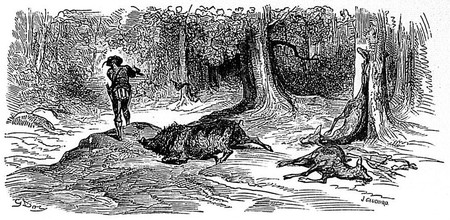
FABLE CLXIV.
THE WOLF AND THE HUNTER.
O Avarice! thou monster, mad for gain; Whose mind takes in but one idea of good! How often shall I use my words in vain? When shall my tales by thee be understood? Oh, when will man, with heart so cold, Still ever heaping gold on gold, Deaf to the bard as to the wise, At length from his dull drudgery rise, And learn how sagely to employ it,— Or know, in plain truth, to enjoy it? Towards this course make haste, my friend, For human life has soon an end. And yet, again, a volume in one word compressing, I tell you, wealth is only, when enjoyed, a blessing. "Well," you reply, "to-morrow 'twill be done!" My friend, you may not see to-morrow's sun; Ah! like the Hunter and the Wolf, you'll find 'Tis hard to die, and leave your wealth behind. A Hunter, having deftly slain A Stag of ten, beheld a Doe; So, having taken aim again, Upon the green sward laid it low. This booty was sufficient quite For modest Hunter's appetite; But, lo! a Boar, of form superb, Starting from the tangled herb, Tempted the Archer's greed anew,— The bow was twanged, the arrow flew,— With futile shears the sister dread Had frayed his boarship's vital thread. Full grimly did she now resume The work at her Tartarean loom, Nor yet achieved the monsters doom.
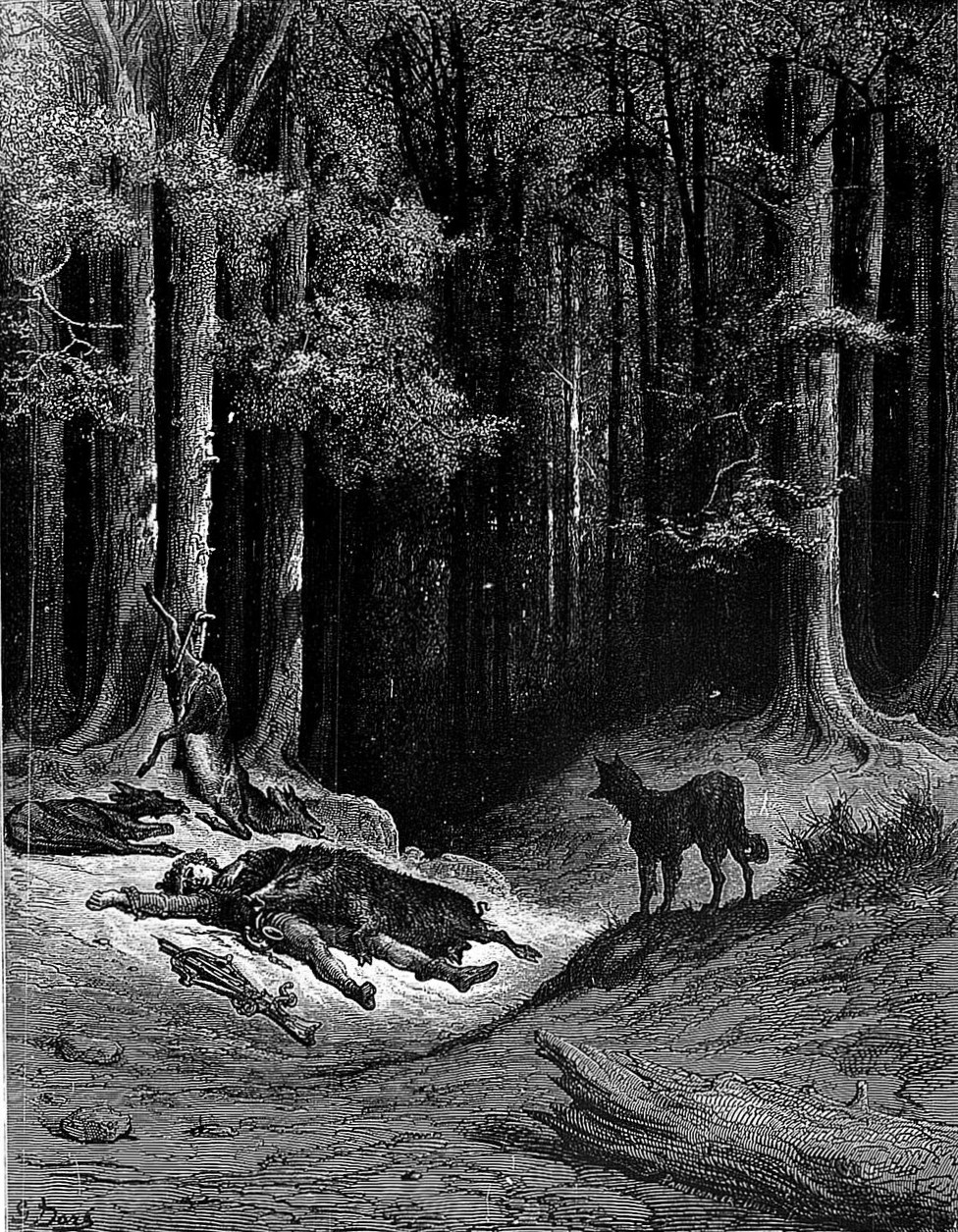
THE WOLF AND THE HUNTER.
Not yet content?—nor ever will be he Who once has quaffed the cup of victory. The Boar has just begun to rise, When, swift, a red-legged partridge flies Right in the greedy Hunter's view,— A wretched prize, 'tis very true, Compared with those already got: And yet the sportsman takes a shot; But ere the trigger's pulled, the Boar, Grown strong for just one effort more, The Hunter slays, and on him dies: With thanks, away the partridge flies. The covetous shall have the best; The miserly may take the rest.— A Wolf that, passing by, took note Of this sad scene, said, "I devote To Mistress Luck a sumptuous fane. What! corpses four together slain? It seems scarce true! But I must be Prudent midst this satiety, For such good seldom comes to me." (This is, of many vain excuses, The one the miser mostly uses.) "Enough," the Wolf continued, "here, To give me for a month good cheer. Four bodies with four weeks will fit, But, nathless, I will wait a bit, And first this Hunter's bowstring chew, For scent proclaims it catgut true." Thus saying, on the bow he flings His hungry form; when, taking wings, The undischarged bolt quickly flies Through the Wolf's carcase, and he dies. And now my text I will repeat— Wealth, only when enjoyed, is sweet. Oh, reader, from these gluttons twain Take warning, ere it be too late. Through greed was the keen Hunter slain; Through hoarding up Wolf met his fate.
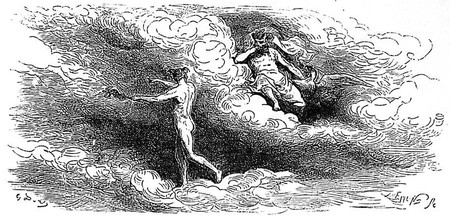
FABLE CLXV.
JUPITER AND THE THUNDERBOLTS.
Jove, viewing from on high our faults, Said, one day, in Cerulean vaults, "Let us 'plenish the earth With a race of new guests; For those of Noah's birth Quite weary me out with their endless requests. Fly to hell, Mercury! And bring unto me The Fury most fierce and most grim of the three! For that race that I've cherished Will all soon have perished!" Thus passionate Jupiter spoke, But quickly from anger awoke. And so, let me warn you, O Kings! Of whom Jupiter makes the mere strings, To rule and to guide as you will; For a brief moment pause, To examine the cause, Ere you torture your subjects, or kill. The god with light feet, And whose tongue's honey sweet, Went, as ordered, to visit the Fates. Tisiphone looked at, Megæra then mocked at; And, after inspection, Fixed his choice, of all persons, on ugly Alecton. Rendered proud by this choice, With a horrible voice, The goddess declared, In the caverns of Death, That she'd stop all men's breath, And not one live thing on the earth should be spared. Unto Mercy's straight path Jove came back from his wrath, Annulled the Eumenide's oath; Nothing loath. Yet his thunders he threw At the vile mortal crew; And one might have thought That destruction were wrought; But the fact was just this— The bolts managed to miss. For the Thund'rer's pride With our fear's satisfied. He was father of men, And so he knew when, As papas mortal know too, What distance to throw to. But, with mercy thus treated, Man, with wickedness heated, Grew so vicious, at last, That Jove swore he would cast And crush our weak race, Their Creator's disgrace. But yet he still smiled; For a father his child Strikes with merciful hand. So at last it was planned That god Vulcan should have The duty of sending us men to the grave. With bolts of two sorts Vulcan fills his black courts; And of these two there's one That Heaven throws straight, When it fills up its hate, And the thread of a man's life is done. The other falls only On mountain tops lonely; And this kind alone By great Jupiter's thrown.