"A Romance of the Land of No Return" (continued 7)
Reading edition
Istar inclined her head slightly in approbation. Then, bidding the white-headed warrior to rise, said aloud,—
“Know, Larsa, this stranger that is within our gates hath discovered the Rock of the Moon-god, and entered into our presence thereby. The curse of Anu, the Progenitor, who changeth not the decree coming forth from his mouth, hath fallen. Go with thine hosts far beyond the Mountains of the Mist even unto the confines of Ea, and there search long and diligently, so that thou mayest discover and defend the secret way. Let not the feet of those of evil defile our land, for assuredly the sign is set upon us, and destruction threateneth. Thy valiant hosts must avert it.”
“Thy will shall be done, O divine patroness,” the old man answered, bowing low till his beard almost swept the pavement. “I will haste to do thy bidding.”
“May Merodach encompass thee with his shield that none can penetrate,” she exclaimed, as, turning, he went forth to lead his soldiers in search of the strange, natural gate by which I had entered.
For an hour the queen-goddess continued to receive those who craved audience, giving advice, hearing petitions, and dispensing justice. Then her brows knit, she grew tired, and at her command the great apartment was cleared of all except the twelve slaves whose duty it was to cool her with their huge fans of flamingoes’ wings.
“Thou hast not told me thy name,” she exclaimed, suddenly turning upon me.
“Thy servant is called Zafar,” I answered.
“So be it,” she said, glancing at me quickly, with sinister look. She paused a moment, then, rising languidly from her seat, slowly descended the steps, followed by all her retinue, including myself.
“Depart not from my sight,” she commanded, turning towards me. “Where I go, there shalt thou go also.”
Through the great hall she led the way into a smaller apartment, hung with gorgeous stuffs, where, in an alcove beyond, was a great couch supported by four lions in silver, with curtains of purple worked with silver. In the centre of the chamber was an upright conical stone, black, with many lines of arrowheads engraved thereon. It was, I afterwards learned, the symbol of Baal, the ruler and vivifier of nature.
Her women, priestesses of Istar, attired in loose robes of pure white, with their unbound hair secured by a golden fillet, unloosed her heavy girdle of emeralds which confined her waist, removed her little slippers of snake skin, and again bathed her face with some delicate perfume. Then they tenderly laid her to rest upon the couch, and while four men-at-arms, with drawn swords, took up their positions as guards, two at head and two at foot, they threw themselves down upon the lion-skins spread about. Before the alcove, wherein reclined the queen, a veil of silver sheen descended, for already her wondrous eyes had closed, and, tired out, she had fallen into a light slumber.
I, her slave, sat upon the floor, hugging my knees, deep in thought, and waiting, with the silent guards, until the dawn. Truly my position was a remarkable one. I had found that which all men before had failed to discover. I was actually living in a world unknown.
Chapter Forty.
The Festival of Tammuz.
But one desire possessed me—to return to Azala.
In the many days which followed the first night of my captivity I witnessed innumerable marvels. The pageantry in the palace, known to all as E Sagilla, “The House of the Raising of the Head,” was of amazing brilliance; and in the great city, sixty English miles in circumference, and built with extreme regularity, with broad, straight streets crossing one another at right angles, the sights which met my gaze filled me with astonishment. Though the dwellers in that long-forgotten kingdom possessed many inventions similar to those I had witnessed in London, yet their religion, manners and customs were the same as those which existed four thousand years ago, when the all-powerful Semiramis caused her record to be engraved in the foundations of the rock she consecrated to her supposed father, the Moon-god, Sin, “the lord of the waxing and the waning.” The buildings were on colossal scale, with towers reaching to a far greater height than any I had seen in European cities, and the display of gold, silver and gems, mostly brought there ages ago by the notable woman who founded Babylon and conquered Ethiopia, held me in constant wonderment. In the great courts of the temple-palace I watched the sacrifice of rams upon the triangular fire-altars, attended by long-bearded priests of Gibil, the Fire-god, in robes whereon were embroidered fir cones, apt emblems of fire; and everywhere I noticed symbols of the celestial deities, while power was typified indiscriminately on every hand by colossal figures of winged, human-headed, and sometimes eagle-headed, lions and bulls.
Through one whole moon I had been slave of Istar, and scarcely left her side for a single instant by night or day, hourly witnessing sights that were amazing, and occupying my leisure in deciphering the profuse cuneiform inscriptions graven on almost every wall or door-lintel by hands that ages ago had crumbled to dust. From them I learned much regarding the history of that wondrous kingdom; how, before the death of Semiramis, she was worshipped as Istar, Goddess of Love. In some inscriptions I found her referred to as “Queen of the Crescent Moon,” “Queen of the Stars,” and “Queen of Heaven”; in others as “Queen of War and Battle,” “Archeress of the Gods,” and “Queen of all the Gods;” but it was distinctly stated in several of the colossal wall-pictures that, before she died, she decreed that her daughter should be ruler of Ea, and that all should worship her as Istar. Each Queen should remain unmarried until the age of forty, and should be worshipped as Goddess of Love, and each King should be known as Hea, and should place his daughter upon the throne in preference to his son. Through four thousand years this wonderful kingdom had existed in all its magnificence, in defiance to Anu, the god of Destruction, and during that period the dignity of queen-goddess had been handed down from generation to generation, its bearer dwelling within that great temple raised by the autocratic Empress who founded Babylon. Those giant walls, with their sculptured feasts and victories, had remained intact, black and polished like iron, colossal monuments of Assyria’s greatness, and as in the silence of night, when I watched while Istar slept, I gazed upon them and reflected, wondering whether Allah would ever allow me to escape to tell the world of my amazing discovery of this mysterious, unknown realm.
Many were the feasts held within that colossal palace, but chief among them was the Festival of Tammuz, “The only-begotten son of Dav-Kina, the lady of the earth.” This, held about one moon after my captivity, was upon a scale of unsurpassed magnificence, the feasting, drinking and merry-making continuing throughout seven days and nights. The court of the garden of the palace wherein Istar feasted the people of Ea was fitted up with white, green and blue hangings, fastened with cords of fine linen and purple to silver rings and pillars of marble; the couches of the female guests were of gold and silver upon the pavement of red, blue, white and black marble. Men sat in high chairs of ivory, and drank wine from golden vessels, slaves served them with various fruits and viands, and each hour the guests were entertained with music and dancing. Of musical instruments there were but two kinds—a drum, and a sort of triangular lyre with ten strings, held in the left hand, and struck with a plectrum held in the right. Exalted upon her dais, in the centre of the beautiful garden, sat Istar, with queenly hauteur gazing down upon the animated scene. Every house throughout the city was illuminated, for the Festival of Tammuz was celebrated by all, and many were the magnificent banquets given by high officers and notabilities. Twice Istar drove through the streets in her gilded chariot, drawn by eight milk-white stallions, I, her slave, sitting at her side. She did this, no doubt, to publicly demonstrate to the populace the fact that she held me captive, for as we passed along the straight, broad thoroughfares she was greeted by the wild plaudits of the multitude, while upon my head curses most terrible were showered.
When on the last night of the great festival the music had been silenced, the guests had left their couches, the dancing-girls had retired, and we were alone together in the silent, moonlit garden, she sighed deeply, glanced at me for an instant, and rose. Her heavy anklets of gold clinked as she descended the silver steps of her throne, and, as mutely I followed, I saw that high above us still shone the single shaft of intense white light from the summit of the towering Temple of the Seven Lights. It was, I had learned from one of the priests, known as The Eye of Istar, a light that had shone forth, night and day without ceasing, ever since Semiramis herself made the first sacrifice in that high temple tower of seven coloured stories, consecrated to the Goddess of Love. On the summit of that tower every woman was bound by the law of Babylon’s founder to make sacrifice to Istar, and it was the duty of the white-robed vestal virgins to keep the light burning incessantly, to remind the people that Istar watched over them and was their ruler. Ofttimes I had been seized with curiosity to ascend that tower where all women, rich and poor alike, were compelled to prostrate themselves at least once in their lives, and it was with satisfaction that I now saw my royal mistress slowly approach the entrance to the temple tower. As we crossed the great court the huge crowd that had assembled bowed in silence. At the portals twelve fair-haired girls, in robes of pure white, greeted her with great ceremony; then, headed by a wizened old priest, with snowy beard and horned cap of gold, surmounted by a star, we commenced to climb the wide flight of winding marble stairs. The ascent was long and toilsome. At each stage we halted, and a prayer was recited to the god to whom it was dedicated, until at length we reached the great domed pavilion that formed its summit.
From above, the unquenchable light shone down upon the gigantic city, while the roof of pale blue, decorated with golden stars, was supported by twisted columns of gilded marble. Ibises, the sacred birds of love, flitted in and out at will, and in the centre, raised upon a silver pedestal from the pearl and ebony mosaic pavement, stood an undraped statue of Istar herself. Its sight entranced me, for in her right hand she was represented as holding two asps entwined, the same symbol as that branded upon my breast!
Around the image of the Goddess of Love, a crowd of young women and girls from the city were kneeling. Some had their lips pressed to its feet; others were lounging upon skins gazing away out upon the brightly-lit city. The scene was indeed a striking one. The bright moon shed her light full upon the statue, causing it to stand out in bold relief, while the golden braziers, here and there, burned perfumes which filled the air with a delicious, intoxicating fragrance. When we entered all was silence, but the instant it became known that Istar herself was present, with one accord the worshippers rose, struggling with one another to kiss the hem of her gold-embroidered robe.
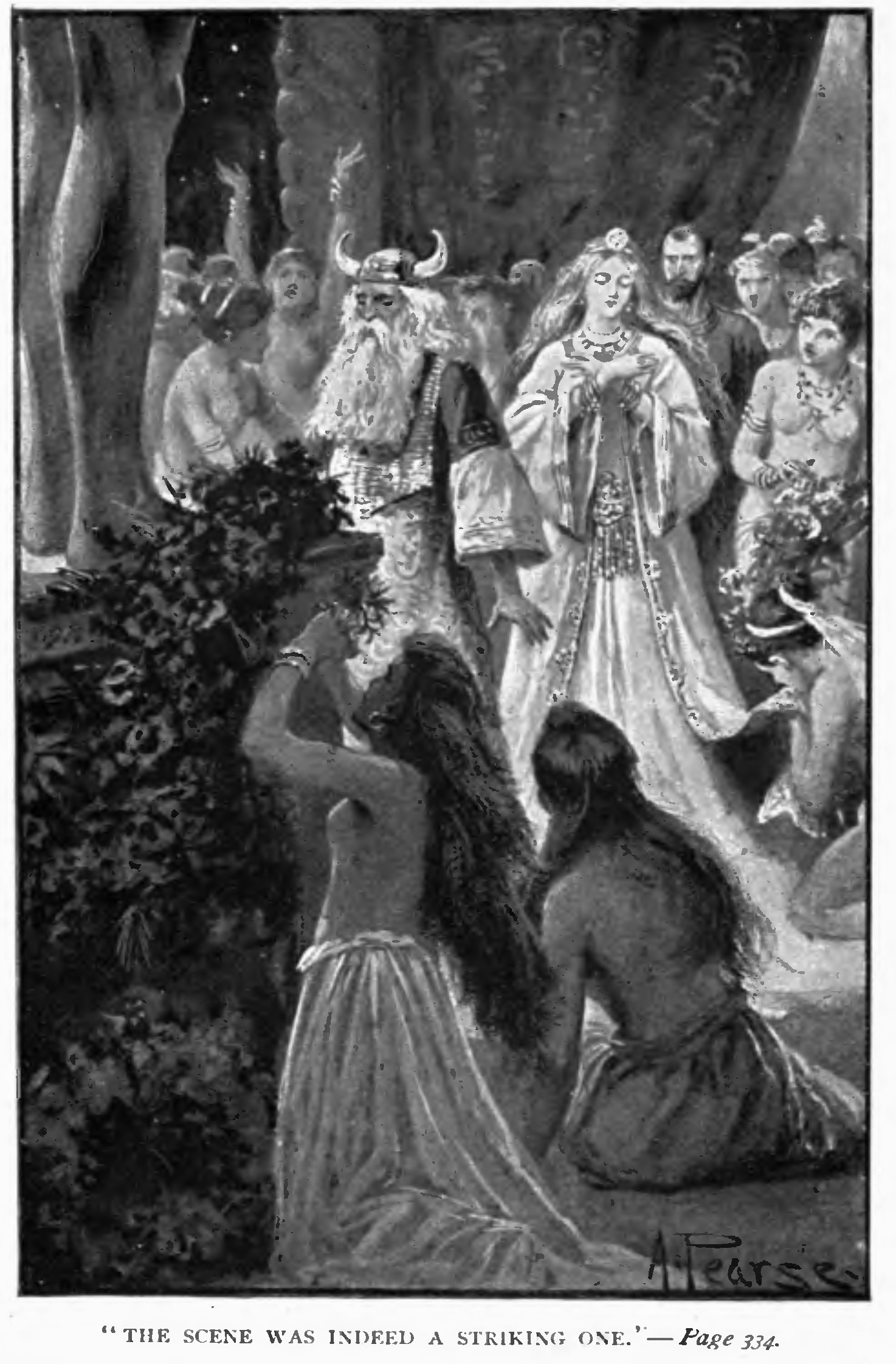
Once each year, at the conclusion of the Festival of Tammuz, Istar herself ascended to pass the night within the temple, and pose in the flesh as the Goddess of Love. Hence, on that night, great crowds assembled to see her enter the tower, and the unmarried women of Ea, who had not before made sacrifice, congregated at the summit. The scene was strangely impressive. Surrounded by her white-robed priestesses, she stood before the image in the ekal, or main nave, and raised her bare white arms to heaven.
When all her votaries had kissed her robe, and ranged themselves around her, a dead silence fell. Suddenly, in clear, musical tones, her hands still raised above her head, whereon was fixed the golden star, she commenced to chant the beautiful hymn to the Moon-god, Sin,—
“Merciful one, begotten of the universe, who foundeth his illustrious seat among living creatures. Long-suffering father, full of forgiveness, whose hand upholdeth the lives of mankind. Lord, thy divinity is as the wide heavens, and filleth the unknown seas with its fear. On the surface of the peopled world he biddeth the sanctuary be placed—he proclaimeth their name. The father, the begotten of gods and men, who causeth the shrine to be founded, who established the offering, who proclaimeth dominion, who giveth the sceptre, who shall fix destiny unto a far-distant day, look down upon this our House of Lustre, and let it never be cast down.”
Then the women, casting aside their outer garments of silk and purple, knelt and prayed long, invoking the indwelling spirit of life, called “Zi,” following it by a supplication to Mul-lil “lord of the night sky,” and concluding with an appeal to Istar herself, crying,—
“In heaven, who is supreme? Thou alone art supreme! On earth, who is supreme? Thou alone art supreme!”
It was a curious and weird form of adoration and worship. The Goddess of Love stood erect and statuesque, without moving a muscle, as each worshipper, advancing, paid her homage. Some kissed her finger-tips, others her bare feet, each making declaration that they were henceforward her slaves. Meanwhile, the priestesses, all young women of extreme beauty, chanted softly strange hymns to the great Baal, head-father and creator of the universe, and with the moonlight streaming full upon her, Istar looked, indeed, one of entrancing beauty, yet cold as an icicle. Above her head the statue, its stone arm outstretched, held the strange symbol that Azala and I bore upon our breasts, and as I stood watching I saw with what intense devotion the women worshipped her. Unseemly rites were undoubtedly connected with the worship of Istar, the Babylonian Venus, in the time-effaced city of Sardanapalus, but here there were no degrading symbols; indeed, the surroundings in this elevated temple showed considerable purity of taste and feeling, and the sacrifices were in the form of gold, jewels, food and wine.
At length, after many prayers and supplications to each of the gods of the celestial triad, Istar turned, and, accompanied by her priestesses, slowly moved away, her votaries still remaining prostrate upon their faces.
Behind the ekal in which she had been standing was a veil of golden thread, which, being drawn aside, disclosed the sacred seat or couch called the papakha, the holy of holies of the Goddess of Love.
When we had passed beyond the veil, it fell behind us, and the priestesses, having attended Istar at her elaborate toilet, she reclined with languor upon the purple velvet cushions of her soft couch. Meanwhile, the votaries were leaving, and, when the veil was again raised, the ekal was deserted. But only for a moment. An aged man, in long, black gown, came forth from the darkness, and, standing on the spot where the goddess had stood, raised both hands towards her. His appearance was evidently part of the annual custom, for it was apparent that the priestesses and slaves, cooling their mistress with their great fans, had expected him.
Scarcely, however, had he opened his mouth, when Istar, springing from her couch, stood glaring at him with threatening gesture. Her hands trembled as words escaped her, “Ah! I had forgotten! Forgotten!” she wailed. Unsteadily she swayed forward for a moment, then sank back again upon her couch with blanched countenance.
“Lo!” cried the aged prophet, in a croaking voice, “through three-score years have I uttered warning!—the same warning, that since the day of the founder of Ea, hath been spoken at the conclusion of each Festival of Tammuz, son of the Lady of the Earth.”
“Yea, I know! I know!” gasped Istar. “Loose not thy tongue’s strings. Each year thou hast repeated thy prophecy; spare me its recital to-night!”
“Semiramis, our great queen, commanded that it should be uttered, therefore seek not to stay my words,” he answered reproachfully, in a grave voice. “Thus saith Anu, god of Destruction, ‘Semiramis, when she built Ea, made no sacrifice, because she feared me not. Behold, I will direct unto Ea a stranger, who shall enter within its gates, and the day of whose coming none shall know. He shall be as a sign unto you that I will bring upon Ea a king of kings from the north, with horses and with chariots, and with horsemen, and with companies, and with much people. He—’”
“No!” cried Istar, covering her haggard face with her hands, while the tame lioness stood watching, her tail sweeping the ground. “I know thou art the skeleton of the Feast of Tammuz, but spare me thy disconcerting words.”
The prophet, however, continued, heedless of her earnest supplications.
”‘He shall kill the daughters of Ea in the field; and he shall make a fort against thee, and cast a mount against thee, and lift up the buckler against thee. And he shall set engines of war against thy walls, and with his axes shall he break down these towers. By reason of the abundance of his horses, their dust shall cover thee; the walls of Ea shall shake at the noise of the horsemen, and of the wheels and of the chariots, when he shall enter into thy gates, as men enter into a city wherein is made a breach. With the hoofs of his horses shall he tread down all thy streets; he shall put thy people to the sword, and thy strong garrisons shall be against them as a weak reed. And they shall kill thee and send thee to the city of Ninkigat, ruler of the great land of evil, whose palace walls are clothed in dust, the inhabitants thereof wearing robes of feathers like birds. And they shall make a spoil of thy riches and a prey of thy merchandise; and they shall break down thy walls and destroy thine houses; and they shall root up thy foundation-stones, and lay thy timber and thy dust in the midst of the water.’”
Istar set her teeth. For an instant she glanced at me, the stranger foretold by the prophet; then her eyes were turned upon the man who had prophesied her downfall. I saw in their violet depths a steely glitter, as with one hand she fondled her pet Ninep. Almost as the last word left the old man’s lips she rose to her feet, and, with a word to the lioness, she pointed to the aged man who had dared to incur her displeasure. Ninep crouched at the feet of her mistress for a single instant, then, flying through the air, fixed her deadly fangs in the sage’s throat.
One loud scream of agony sounded as man and beast rolled over in deadly embrace. Next second I saw the polished pavement was defiled by blood.
Obedient to the call of her mistress, Ninep trotted back and licked her hand, leaving the prophet mangled and dead. Slaves quickly removed all evidences of the tragedy, and while they did so Istar sank back, her fair face buried among the cushions, a single sob escaping her.
Chapter Forty One.
The Temple of Love.
That night, in gloomy mood, Istar reclined dreamily upon her soft papakha, dismissing all her priestesses and slaves, so that I remained alone with her. With my back to one of the golden pillars supporting the roof, I sat silent in thought, scarce daring to move, for fear of the dozing lioness. Istar had fallen into a troubled sleep, and lay tossing upon her couch with tumbled tresses.
A sudden murmur from her caused me to glance in her direction, when I saw her lying, still asleep, ghastly pale beneath the light of the moon. Her robe was disarranged; her delicate chest, that slowly heaved and fell, had become revealed. As I looked, I discerned, to my amazement, that it bore the device of the entwined asps, identically the same as had been branded upon me; the same as appeared on the rock-tablet of Semiramis!
Azala had spoken the truth. So far had the Mystery of the Asps been revealed. The strange link that joined me with the daughter of the Sultan ’Othman joined us both, in some unaccountable manner, to the goddess-queen of this ancient land of marvels. I rose, and, creeping nearer, minutely examined the mystic mark upon her chest. It was seared as deeply, and presented a blemish as hideous, as my own. Lying, as she was, in graceful abandon, with one arm flung over her head, her chest rose and fell each time she breathed, but suddenly she drew a long, deep-drawn sigh, and her eyes opened.
I started back, but already she had detected me. “Well?” she exclaimed, regarding me with dreamy glance through her half-opened lashes, slowly readjusting the white silken robe that had come apart at the neck. “Why hast thou approached me?”
“Thou hast slept uneasily,” I answered, “and a hideous mark upon thy breast became revealed.”
Languidly she raised her head upon her arm, and with eyes still half-closed, like Ninep, her dozing lioness, she said,—
“Come hither, Zafar. Come to my side.”
Obediently I approached her couch. Her breast rose, causing her diamonds to sparkle. During the past few days I had not failed to notice in her manner an entire change. She accorded me more liberty; she no longer placed her spiteful heel upon my neck as sign of triumph, and seldom she spoke to me with wilful gesture. Once, the amazing thought had flashed across my mind that she actually loved me, but at such absurd notion I had laughed and placed it aside.
“What seest thou in the Mark of the Asps to amaze thee?” she asked, when I had drawn nigh to her, and Ninep sniffed my legs inquisitively.
“It is as a strange mark,” I answered. “I was wondering what its meaning might be.”
“Ah!” she sighed. “Its meaning none can tell, save that those who bear it are the doomed.”
“The doomed!” I gasped. “Why?”
“Upon his accursed Anu setteth his mark. Hence it is that I bear it,” she answered, gravely. “Thou art mine enemy, Zafar,” she added, after a slight, painful pause. “To-night have I sent away my women, so that I may speak with thee, the stranger whose coming hath been prophesied for ages. By all men in Ea I am supposed to hate thee, yet—yet—”
Again she paused, looking at me intently with eyes in which burned the unmistakable light of love.
“Yet thou canst not bring thyself to cast me into the lions’ pit,” I observed, smiling bitterly. “Better that thou shouldst give me my liberty, and allow me to depart.”
“Never,” she cried, starting up. “Thou shalt never leave me. If I am doomed to die, thou shalt die also.”
“Why?” I asked. “I have wrought thee no ill.”
“Thou hast struck the chord of affection within my heart, Zafar,” she said, passionately.
“Already have I told thee that Azala, daughter of the Sultan ’Othman, is betrothed to me,” I answered, not in the least surprised at this passionate declaration.
“Heed her not,” she cried. “Already I know that Anu, though he sendeth thee hither as sign of the overthrow of Ea, hath, nevertheless, placed upon thee also the Mark of the Asps.”
I started. I had no idea that she had ascertained the secret hidden beneath my robe of crimson silk. Some slave must, at her bidding, have examined my chest as I slept.
“And if so?”
“Then thou wilt assuredly meet with a violent end.” I smiled, and she regarded me with knit brows.
“If thou art my friend,” I said, “then thou wilt release me.”
“No. None departs from or enters the Land of the No Return,” she answered. “Since the foundation of Ea one man only escaped into the outer world. It happened ages ago. He never returned hither, for on the day the calamity befel us Anu was wroth, a great earthquake occurred, and the gate by which he made his exit became closed for ever.”
Already had I heard a similar legend during my long and eager search for the Rock of Sin, the Moon-god, the “illuminator of the earth and lord of laws.”
“Who was the man who escaped?” I inquired.
“Legend saith his name was Nebo,” she answered. “Knowest thou any of that name?”
In the negative I replied, reflecting upon the strange story of the escape of this man beyond the confines of Ea, and wondering what adventures befel him.
Then she went on to relate how, on many occasions, there had appeared in cloud-pictures, or mirages, inverted pictures of the unapproachable world beyond; and I, in turn, explained how the Rock of the Moon-god and the Mountains of the Mist appeared frequently in the desert mirage in far-off Kano.
“Hast thou ever seen Ea mirrored on the clouds?” she inquired.
“Never,” I answered. “Thy city is unknown, hence my speechless amazement at its discovery.”
“Why desirest thou to return to thy land of evil?” she asked, stretching forth her hand and softly stroking Ninep’s sleek back.
“Because of the woman I love.”
She bit her lip to the blood, and glanced at me with an evil glint in her bright eyes.
“Thou carest naught for me,” she observed, reproachfully, regarding me sharply with narrowing brows.
“I am but thy captive,” I responded. “As Queen of Ea thou mayest not allow love to enter thine heart until thou growest old. Why dost thou taunt me?”
Mention of the rigid law of her great ancestress, Semiramis, caused her to frown.
“So be it,” she answered, hoarsely. “If thou wilt not renounce thy love for this woman who dwelleth in thine accursed land, then thou art still my slave.”
“I am content,” I said.
“Thou hast chosen?” she inquired, slowly rising to her feet and standing erect before me.
“I have chosen.”
“Then to-morrow the lions shall rend thee in full gaze of the assembled people of Ea, who shall make sport of thy supplications, and thy cries shall be as music unto their ears,” she burst forth, in a sudden fury of passion. “Anu shall rend thee, Nergal, lord of death, shall seize thee, and thou shalt be accursed by the Fever-god, and cast into the dread kingdom of Niffer. Baal shall show thee no mercy; Adarmalik, lord of the noonday sun, shall hide his light from thee; Shamas shall blind thee, and thou shalt exist for ever in the torments prepared by Ninkigat in the burning land where all is dust. Thou hast disdained the favours that I would have bestowed upon thee, despised me, and flung back the love that I would have given thee. Therefore shalt thou die. I, Istar, ruler of Ea, have spoken.”
Her beautiful face was distorted by fierce, uncontrolled passion, vituperation fell from her lips with a rapidity which almost choked her, her mass of dead gold hair had escaped from its fillet and fell in profusion about her shoulders, while her white, filmy robe, open again at the neck, disclosed the hideous, mysterious blemish scarred dark red upon the white flesh—the mark that was branded upon the woman I loved as well as the queen-goddess who had condemned me to death.
My dogged silence enraged her. It seemed as though during the weeks of my captivity she had unconsciously grown to regard me with affection, and held me as slave of her caprice. Yet my thoughts, ever of Azala, were so full that I had never before actually realised the position in which I now suddenly found myself.
“Thou utterest no word!” she cried. “Thou art still defiant. To-morrow wilt thou crave mercy at my feet, but I will show thee none. Thou hast sneered at my power, set at naught my good-will, and refused to abandon all thought of return to thy land of evil, and the woman who holdeth thee entranced. Thou shalt never look upon her face again!”
I turned away from the irate beauty, whose hands were clenched within their palms until the nails drew blood, and without replying, slowly crossed the polished pavement of the temple, passing over the spot whereon the hapless prophet had fallen beneath Ninep’s deadly claws, and advancing to the sculptured parapet of alabaster, whereon I leaned in thought, gazing down upon the gay, brightly-lit city, and the great buildings and courts which comprised the wonderful House of the Raising of the Head. Ninep uttered a low growl. The moon shone brightly, lighting up the extensive view on every hand. Below lay the well-remembered flight of steps, brilliantly illuminated, with their double row of guards in shining breastplates. Beyond the palace walls the lights of the streets showed in long, straight lines. Above, the shaft of intense white brilliance, the inextinguishable Eye of Istar, still streamed forth upon the wondrous city of Ea, lighting up its terraces, its obelisks and colossal temples like day, while, far away in the distance, the snowy, serrated crests of the Mountains of the Mist showed high, ghost-like, mysterious.
Beyond lay freedom and Azala. Already had I witnessed that Istar, quick-tempered and passionate, was capable of any cruelty or treachery, even towards her most trusted friends. This woman, worshipped as Goddess of Love, was, indeed, full of grace, beautiful in form, with a face almost flawless; but the cruelties she practised almost daily were revolting. To incur her anger meant death, either upon the torture-wheel or in the lion-pit, and ofttimes, while standing beside her, I had noticed the exultant pleasure with which she condemned men and women to torture or to the grave. The people of Ea called her goddess; I thought her a fiend.
As over the parapet I gazed aimlessly away across the gigantic capital of this world-forgotten race, it became impressed upon me that, to save my life, I must at once seek means of escape. But how? As Istar’s personal slave, it seemed impossible to elude her vigilance; even if I escaped outside the city my way back to the Rock of the Moon-god was uncertain. I recollected also that within the gloomy cavern there existed an utterly impassable barrier between myself and the world I had left—that roaring inrush of water descending to feed the subterranean river. Times without number thoughts of freedom had possessed me, but on each occasion I had been forced to abandon hope, resign myself to the galling captivity in which I existed, and possess my soul in patience.
Now, however, I had become desperate. The moon, while I stood watching long and earnestly, became obscured by a dense black cloud shaped like a falcon’s wing, which left only a patch of green sky half round its disc. On either side of the city the great plain stretched dark and wide. The shapes of the mountains could not be discerned, but showed like a heavy cloud bank against the horizon. My strained eyes could discern a speck of light afar off, which, as it was too low for a star, could only mark the existence of some house on the distant mountain side. The silence could be felt.
The day of feasting and mad gaiety had, it seemed, exhausted all the voices of nature as well as those of men.
At length I turned towards the papakha. Istar had sunk back upon her purple couch, wearied by the continuous gaiety of the festival, and forgetful of her wrath, had again fallen asleep, her head thrown back upon a great, tasselled cushion of rose silk. One of her slippers had fallen off, disclosing her bare foot, with its heavy, bejewelled anklets, while near her Ninep had stretched her long body, with her snout between her paws. Between us stood the life-sized statue upon its pedestal, the image of Love, before which all women of Ea bowed and made sacrifice. Ghostly it looked in the pale half-light with the symbol of the entwined asps held within its right hand, and as I advanced towards it I touched its base. The stone had been worn smooth as glass by the lips of priestesses and votaries who had worshipped at that shrine through all the ages since Semiramis; the feet and legs were worn hollow and out of symmetry by the osculations of the millions of women who had ascended that tower to the gorgeous Temple of Istar to prostrate themselves. The image stretched forth its arm over me ominously, and the perfumed smoke from the braziers, whirled up by a breath of the night wind, wrapped around me a subtle, almost suffocating, fragrance.
Istar slept on with heaving breasts. One chance alone remained to me—a dash for liberty.
Advancing cautiously a few paces I craned my neck to satisfy myself that her slumber was not feigned; then, with a last look upon her, I turned and crept silently away into the shadow where the stairs descended.
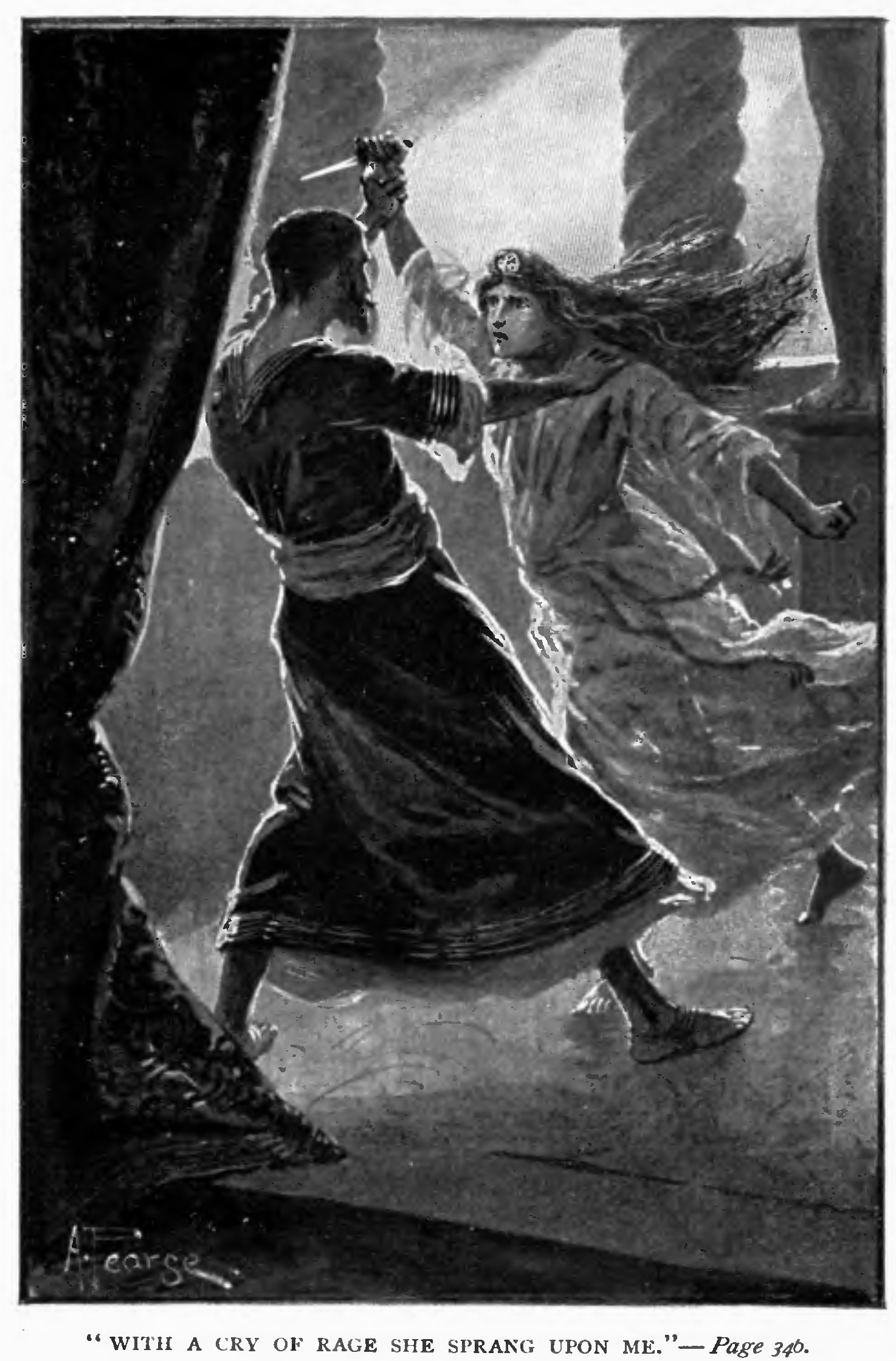
I had just reached them, when a faint rustling behind me caused me to glance quickly round. In an instant I recognised the truth. Istar had followed me. With a cry of rage she sprang upon me, her poniard gleaming in her hand. Long ago she had vowed to kill me if I attempted to leave her side, and it was now her intention to carry out her threat. One fierce blow she aimed at my heart, and in warding it off the blade gashed my arm. At the same moment, however, I wrested the weapon from her hand, and held her tightly by the wrists.
To free herself she struggled violently, but I held her powerless, when suddenly there was a low, ominous growl, and Ninep, in defence of her mistress, pounced upon me, her great claws fixing themselves in my left shoulder. Instantly I recognised the ferocity of my second adversary, and releasing Istar, I plunged the long, keen knife full into the eye of the lioness.
Fortunately my aim proved true, for in a few seconds the great brute, her brain penetrated, fell back helpless and dying.
Again Istar, with the fury of a virago, rushed upon me, declaring that I should not escape. My first impulse was to kill her. Indeed, I confess I raised my knife to plunge it into her breast, but next second gripped her by the throat, and hurled her back upon the pavement where she lay huddled in a heap, stunned, motionless, and unconscious.
With a final glance at her inanimate form, I secreted the knife within my silken girdle, then dashed down the stairs—down, down, through the six deserted temples, tier on tier, until I reached the silent courtyard, which I hastily crossed and went to Istar’s private apartment, whence I took a small tablet of sun-dried clay whereon a message had been impressed. This I placed in my pouch, and, taking a staff, set forth to gain my freedom.
In fear each moment lest Istar should regain consciousness, and raise the alarm, I hurried on through the great apartments with their colossal sculptures, where scribes and courtiers, officials and soldiers, were slumbering after the week’s festivities, and at length gained the head of the brilliantly-lit flight of steps, the one way by which the royal palace could be approached.
As soon as I drew near to the head of the broad stairs the lances of the guards were interlaced from top to bottom. My passage was barred until I had explained to the two officers that I was bearer of an urgent message from Istar, and exhibited to them the tablet bearing her seal. Then only was I allowed to proceed. At each of the seven gates between the actual entrance to the palace and the brazen gate of the city, I presented my credential and was afforded free passage. In trepidation I approached one of the great doors of polished brass that closed the entrance to the city, and again drew forth the tablet. The officer of the watch scrutinised it long and carefully by the aid of his lantern, then, finding everything satisfactory, gave orders that the gate should be opened to pass out a messenger of Istar.
One of the ponderous doors creaked at last, and groaning, slowly fell back just sufficiently to allow me to pass.
“May Merodach guard thee, messenger,” shouted the officer as I went forth.
“And thee also,” I answered, as out upon the plain I sped quickly in the direction of freedom. Behind me the shaft of white light still streamed from the summit of the Temple of the Seven Lights; before me were the half-obscured Mountains of the Mist.
Once I glanced back upon the wonderful centre of a civilisation unknown to the world, then resolutely I set my face towards the pole-star, determined to put as great a distance as possible between myself and those who would undoubtedly pursue me ere the first saffron streak of dawn showed the direction of Mecca.
Chapter Forty Two.
Crooked Paths.
Full of increasing anxiety were the days following my escape from Ea. At dawn, while high in the shadowy Mountains of the Mist, I heard the alarm beaten in the distant city below, and could just distinguish, through the cloud of vapour, troops of horsemen leaving the brazen gates to scour the country in search of me. Istar had, no doubt, recovered, and, perhaps, had declared that I had made an attempt upon her life. A determined effort would, I knew, be made to secure me; therefore, having found the path I recognised as having before traversed, I pushed onward, day by day, until I reached the ruins of the great temple which had held me in wonderment when first I had entered that mysterious realm; then, striking due north, through forest and fertile, park-like country, I came to a river which I remembered was not far-distant from the small, half-concealed hole whence I had emerged. Proceeding along its sedgy bank at early morning, I came round a sharp bend, espying, to my amazement, a cluster of tents before me, and held back only just in time to escape detection. Already my pursuers were ahead of me! Nevertheless, taking a circuitous route, and sleeping in a tree that night, my eyes, after long and diligent search, were gladdened by the sight of the spot I sought.
As I stood before it, I reflected that, although I had defeated the evil design of Istar, I was still in a position equally as perilous as before, because of the raging, foaming torrent, which, descending from the Lake of the Accursed through its funnel-like aperture, formed a natural and insurmountable barrier to my freedom. Ea was indeed the Land of the No Return.
I had eaten my frugal morning meal, and was about to leisurely enter the long, natural chamber beneath the rock, and there decide upon some plan of action, when suddenly the bright gleam of arms through the greenery attracted my attention, and a moment later I found myself confronted by two of Istar’s soldiers, who had evidently been watching me.
They called upon me to surrender, at the same time shouting to their comrades; but, without an instant’s hesitation, I evaded their grasp and scrambling up into the hole, plunged into the dark fissure and sped quickly along over rocks and stones, heedless of where I went. Hurrying footsteps sounded behind me, the voices of my eager pursuers echoing loudly through the place, causing the flock of bats and birds nesting there to fly out into the sunlight in a dense, screaming crowd, while I, dashing onward, fled like a rat before a ferret.
The chase in the pitch darkness was long, wearying and desperate. It was a race for life. By their voices I could distinguish that the soldiers were gradually gaining upon me; yet, struggling on, now and then falling and cutting my knees as I scrambled over the sharp rocks, being always compelled to keep my hands stretched forth lest I should stun myself against the rough sides of the natural passage. Still, I was determined to hold out until the last, although not a single ray of hope glimmered through the dispiriting gloom. Istar had told me that, as bearer of the Mark of the Asps, I was doomed. Although I struggled forward I had been compelled to abandon all hope of returning again to Azala.
Close behind me were my pursuers, yelling like fiends. The place sent back weird, unearthly echoes from its uneven, vaulted roof, yet, in the utter darkness, they could not see me, but only pressed forward, eager to run me to earth and ascertain the extent of the strange, unknown grotto.
Suddenly I held my breath, feeling myself treading for an instant upon air, and uttering a loud shriek when I realised the truth. I had forgotten the great chasm into which I had so nearly fallen when last I had passed there, and had now plunged headlong into it! Down, down, I felt myself falling, until the fearful velocity with which I descended rendered me giddy. Those moments in mid-air seemed an hour, until, after dropping a long distance, I felt a sudden blow on the back that drove the breath from my body and held me paralysed. I knew then that I was lost.
When, a few minutes later, I again became conscious, I heard excited voices far above uttering words of caution. My shriek had evidently been noticed by my pursuers, who, surmising that some evil had befallen me, halted, and feeling their way carefully forward, had discovered the wide chasm which I had believed unfathomable. I was lying in soft dust which, preventing any of my bones being broken, had also deadened the sound when, long ago, I had cast stones into the pit to ascertain its depth. Slowly I struggled to my feet, and finding myself uninjured, began groping about in the darkness to ascertain the accurate dimensions of the abyss. Half choked by the fine dust, I stumbled about, with outstretched hands, but could discover neither sides nor roof, when suddenly a soldier’s robe, which had been saturated in some oil from a lantern and was flaming, tumbled down upon the spot where I had fallen. My pursuers had done this to ascertain the depth of the chasm.
The welcome light revealed to me that, instead of being in an abyss, I had been precipitated into a lower and larger cavern, the roof of which was hung with huge stalactites, glittering with prismatic fire, and of dimensions so enormous that the fitful glare did not reveal its opposite extremity.
Fortunately, in my efforts to discover the extent of the weird place, I had advanced some little distance from the bottom of the pit, therefore my pursuers saw me not.
“He hath vanished!” I heard one man cry. “Of a verity he is the Destroyer, the son of Anu, whom to attempt to capture is as futile as the endeavour to make water run up hill.”
“He sprang into the gulf, and disappeared like a spirit,” cried another, as he peered over into the yawning chasm. “It was his intention that we should follow and be dashed to pieces on the rocks. His cry alone saved us.”
“Come,” I heard another voice exclaim, “let us leave this noisome abode of Anu, or his hand may wither and destroy us as it destroyed the Temple of Sin.”
Soon the light died down to glowing tinder, and the voices, growing fainter, were quickly lost in distant echoes.
I knew I was entombed. To search for any exit seemed hopeless. Nevertheless, with a supplication to Allah to lighten his servant’s burdens, I tore a strip from my robe, unravelled it, and by blowing upon the glowing tinder, obtained a light for my torch. Then, having improvised several more torches in case of necessity, I started forward. On every side was a cavernous blackness, so large was the natural chamber into which I had fallen. Still I strove on, determined at least to ascertain its true dimensions.
Presently I raised a loud shout, and listened. In a thousand distant echoes my voice came back, showing that the cavern was of wondrous extent. The ground was not uneven, though here and there were large masses of rock, thrown up, as if by the same earthquake as had formed the Lake of the Accursed, and, hurrying forward, I gazed about me to discover something in the impenetrable blackness on every hand.
One fact alone gave me courage. The air was good, showing that somewhere was an outlet to the world above.
Thus, with frantic effort, I struggled on, lighting a second torch, and keeping straight ahead, until at last, to my dismay, I was confronted by the damp wall of rock that formed the end of the cavern. Turning at right angles, I walked beside this wall to ascertain the width of the chamber, when, having proceeded about thirty paces, I discovered a fissure, or tunnel-like passage of considerable width, which led away into the deep gloom beyond.
Determined, at least, to explore its length, I plunged into it, holding my torch high above my head. At first it descended slowly, then rose with gradual ascent, sometimes narrowing, at others widening, until I again came to a blank wall of rock.
I had been deceived. It was a mere fantastic cul-de-sac.
A moment’s pause, then, turning with sinking heart, I retraced my steps a considerable distance until, just before I emerged into the great cavern again, I became aware of a second grotto leading out of the natural tunnel wherein I stood. This I had not before noticed, therefore, with eager steps, started forward to explore it. Here again the ground rose, but the cavern was spacious, and leading out of it was another grotto rising gradually and leading to a third, slightly narrower, through which I toiled for fully half-an-hour, burning the whole of my outer robe as torches, until by accident my light became entirely extinguished. Unable to rekindle it, I was plunged in darkness that could be felt. Striving on undaunted, however, my eager hands came at last in contact with a wall of rock before me; but, scarce had I made this dismaying discovery, ere I found that the subterranean burrow took a sudden turn at right angles, and again ascended sharply.
To my surprise the rocky roof above me became just distinguishable. A grey light showed ghostly and indistinct. Then, a moment later, as I mounted the steep ascent, I saw, straight before me, the blessed light of day, and uttered a loud cry of relief and joy.
In eagerness I sped forward, rushing out of the cave, the mouth of which was half choked by brushwood and brambles, to find that I had actually passed beneath the Lake of the Accursed, and was beyond the confines of the Land of the No Return.
Only by a miracle had I escaped death. Of a verity Allah maketh abundant provision for such of his servants as he pleaseth, therefore I knelt to return thanks for my deliverance.
My exit had been made at the edge of the forest, within actual sight of the towering Rock of the Moon-god, and having riveted its exact position upon my memory, I plucked some bananas and ate them, afterwards setting my face to the north on my long journey back to Kano.
Following the directions given me by my lost friend Yakul, I searched for the track which he had told me ran through the great forest to Ipoto, and after some little difficulty discovered it; then, traversing it for many days amid the forest gloom, I at length reached the town he had named. To detail my journey northward is unnecessary. Ever pressing forward, and without meeting with much adventure, I swam the Ihourou river, and joining a party of traders, crossed the rocky country of the Mbelia, passing beneath the snow-capped summit of the mountain called Nai, eventually arriving at Niam-Niam. Here I was fortunate enough to fall in with a caravan bound for Katsena, within the Empire of the Sultan ’Othman; and three moons after my escape from Ea I experienced the delight of seeing the minarets and cupolas of Kano rise dark against the blood-red sunset.
News I gained in Katsena, however, had caused me most intense anxiety. Although, as far as I could learn, no conspiracy against the Sultan had been attempted, yet I heard from Arab traders in the market-place that Azala, my beloved, was to be given as bride to the Khalifa, in order to further cement the friendship between Sokoto and the Eastern Soudan. It had been arranged months ago, before the Khalifa’s return to Omdurman, and the date of Azala’s departure for the east was already past. Therefore, in fear lest the woman I loved should have already left, under escort, to become bride of the brutal autocrat, I spurred forward over the desert to Kano.
My first breathless question of the guards at the gate was of Azala. She had not left, they answered, but preparations were complete, and she would go forth, with a large armed escort, at noon on the morrow. Then I made sudden resolve, and entered the great Fada to boldly seek audience of the Sultan ’Othman, the ruler who had forbidden me to re-enter his Empire on pain of death.
While passing beneath the high, sun-blanched wall of the harem, on my way to the Hall of Audience, I came face to face with the dwarf Tiamo, who, on beholding me whom he thought dead, stood petrified. When I had reassured him, he briefly explained how he had returned to Azala with news of my tragic end; how, overwhelmed by bitter grief, she had become careless of everything, even of her betrothal to the Khalifa. Hastily I scribbled a message of reassurance in Arabic to my well-beloved, and the impish little man hobbled away with it secreted in his gaudy sash, while I continued my way to crave speech with the autocrat. After many formalities, I was allowed to approach the divan, where he sat in his green silk robe, calmly smoking; but as I advanced his keen eyes recognised my face, and his brow darkened grimly.
“Well?” he exclaimed in anger, as I bowed the knee before him. “What seekest thou? Have I not already expelled thee from this my kingdom?”
“Yea, O Sultan,” I answered. “But I would have a word with thee in private. I desire to impart unto thee a secret.”
“Of what?” he inquired, with a quick look of suspicion.
“I have witnessed that which the eyes of men have never before beheld,” I answered, “I have discovered the Land of the No Return!”
The Sultan started up at my words, and the greatest sensation was created among his assembled court. For a moment Azala’s father regarded me keenly; then, uttering a word, waved his hand, signifying his desire to speak with me in private. Instantly the crowd of courtiers, slaves, eunuchs and soldiers retired, and a few minutes later we were alone.
“Well?” he exclaimed, pulling at his bejewelled pipe thoughtfully. “Explain unto me thy discovery.”
Seated on the mat before the royal divan, I told him the whole story; how Azala had rescued me; how I had reached his daughter a second time, and my strange quest at her instigation.
When I mentioned the latter his brows knit severely, and displeasure was betrayed upon his dark face. Then I related the conversation between the two conspirators who were plotting to bring about the overthrow of Sokoto, explained how I had discovered the Rock of the Great Sin, and described the magnificence and enormous wealth of the kingdom of Ea. I told him of my adventures within the mysterious realm, of my captivity in the hands of Istar, and of the strange wall-picture of Semiramis.
During an hour we conversed together; then, at last, I referred to Azala’s forthcoming journey to Omdurman, and hazarded an opinion that she should not be united to one who was an enemy of his Empire. Upon my words he pondered deeply, slowly stroked his full, dark beard, but made no response. Then, not without trepidation, I offered a suggestion. It was that, in return for Azala’s hand, I would lead his hosts by the secret way into Ea, and conquer that wealthy country, which could then be annexed to Sokoto.
He reflected, apparently doubting my ability to lead an expedition of such magnitude; but after I had explained my previous experiences as a Dervish soldier, he at last accepted the terms of my offer, and very soon we had arranged the details. He would give me, he promised, twenty thousand men, armed with European rifles, together with all the cannon which had been captured in a recent campaign against the French, and the four Maxim guns and ammunition sent to him as a present a few months before by the Royal Niger Company. One condition I laid down was, that I might hold converse with Azala ere I set forth upon the hazardous undertaking. To this he raised no voice of dissent, therefore, later that evening, I spent a joyous hour with my well-beloved in the room I knew so well.
To describe our meeting is unnecessary. Suffice it to say that, when she set eyes upon me, she burst into a torrent of tears. Long ago had she mourned for me as one who had lost his life in attempting to fulfil her wish, and could scarce believe her eyes when Tiamo had given her the scrap of paper with my message. I explained my discoveries, my ambitions, and the generous promise of the Sultan. Then, after a protracted interview, I bade her farewell until such time as I could claim her, and departed with her fond kiss warm upon my lips.
That she watched the preparations hourly from her lattice I knew, but at sunrise, three days later, all being ready, I set forth at the head of the Sultan’s army. Tiamo again came with me as body-servant, our journey over the deserts being of a far different character to when we had fled like thieves from Kano. With our green standards flying, and our bright arms and accoutrements glittering in the sun, ours was a brilliant cavalcade, every man intensely eager to view the mystic, unknown land of which story-tellers had told through countless ages.
By forced marches we reached, within six weeks, the Rock of the Moon-god, our army augmented by thousands of black followers from Niam-Niam, and, on making careful reconnoissance, I soon discovered the natural, tunnel-like passage whence I had emerged on escaping from Ea. Taking with me a strong pioneer party, we thoroughly explored the huge caverns below, fixed lights in various parts, placed ladders against the wall of rock over which I had tumbled, and above, at the edge of the chasm, suspended strong ropes and pulleys for raising cannon, horses, and heavy material. This work occupied us four days, but when at length everything was complete, we found the entrance to the gallery too small to admit horses and guns. We therefore blew away the rock with some dynamite, procured long ago from the Niger traders, and without many mishaps passed through, and at last gained the fertile Land of the No Return.
The eagerness of the soldiers of Sokoto and our pagan followers, who had joined us out of curiosity, to penetrate this strange, legendary land, knew no bounds, and the excitement on the first night we encamped upon the grass plain rose to fever heat.
I had sent forward trusty scouts, attired in the garments of citizens of Ea, copied from my own, lest we should fall into an ambush, and already had watchers secreted on the Mountains of the Mist, in full view of the city we were preparing to surprise.
Well I knew the colossal strength of Ea, “the place with walls unbreakable,” and when addressing the army after we had recited the sunset prayer that evening, I disguised not the fact that the struggle must be desperate.
All were, however, undaunted. Each man announced his readiness to go forward, bent on conquest.
Chapter Forty Three.
Doom.
Our assault upon Ea was sudden and unexpected. Under cover of night we cautiously advanced on our last march, and having placed our guns in position, halted in readiness. From the high summit of the Temple of the Seven Lights the unquenchable Eye of Istar still streamed, white and brilliant. The giant city was ablaze with lights, as if for another festival, and at first sight of this colossal centre of a forgotten civilisation the soldiers, awe-stricken, feared that our expedition against such a gigantic fortress was foredoomed to failure.
Before commencing the attack, however, I urged them to valiant deeds, repeating those words from our Korân which have given heart to Moslem armies ever since the days of the Prophet—“If there be a hundred of you that persevere with constancy, they shall overcome two hundred; and if there be a thousand of you they shall overcome two thousand, by the permission of Allah; for Allah is with those who persevere. It hath not been granted unto any prophet that he should possess captives until he had made a great slaughter of the infidels in the earth. Allah is mighty and wise.”
After many bows and genuflections, my companions rose, and, mounting, spurred forth, in readiness to their posts. In silence half-an-hour went by, when, by prearranged signal, six of the French guns loaded with explosive shell suddenly crashed forth, at the same instant, sending their deadly missiles right into the centre of the city, almost as far as Istar’s palace. We listened. The sound of the explosions echoed weirdly among the misty heights above.
With such infinite care had we approached that this signal was the first notification received by the people of Ea of the presence of enemies. The instant the cannons had roared forth, our great storming parties spurred across the plain to certain of the city gates, armed with engines for battering them in, and charges of dynamite for blowing them into air. So well guarded, however, were those gigantic walls that, ere our squadrons could reach the gates, they were assailed by withering showers of arrows and spears. Indeed, a moment after we had sent our first shells into the city, the high, frowning battlements seemed alive with defenders. Volleys of stones from ancient catapults were showered on every hand, while bowmen, from the slits in the flanking towers, discharged upon us a deadly arrow storm.
Our black contingent, with their long bows and poisoned arrows, quickly turned their attention upon the archers of Ea. Expert marksmen these pagans were, and at this moment proved themselves of the utmost value. Each soldier who showed himself upon the high walls was picked off with an aim unerring by our archers, behind whom were the well-drilled soldiers of the Sultan making careful shots with their rifles, and away upon the high ground at the rear the cannons kept up their thunder, each shell bursting and spreading terrible devastation within the city. The constant explosion of shells and firearms appalled the defenders beyond measure, for this was their first knowledge of the art of modern warfare, and, as I afterwards learned, it was believed that because gunpowder was used by us that Anu himself, the dread god of Destruction, was directing us, and against him they were powerless. Nevertheless, the pugilistic spirit was still fierce within the hearts of those descendants of the valiant hosts of Semiramis, and they fought desperately for the defence of their capital and their goddess-queen. In the lurid glare, shed by the fires caused by our shells, we could discern huge, cranelike machines mounted on the walls, discharging at us arrows and volleys of stones, while other ancient mechanical contrivances emptied upon our scaling parties great caldrons of boiling pitch or water.
Throughout that well-remembered night we kept up a continuous and galling hail of lead upon the city, but with little effect save that, time after time, we swept away hundreds of soldiers from the walls and caused conflagrations in every quarter, the majority of our force remaining safely beyond the narrow zone of the defender’s fire. As dawn crept on, times without number our scaling parties attempted to fix their ladders of rope and cane, but on each occasion were hurled back, leaving many of their number dead or dying. The sun rose. Arrows and javelins fell thick and fast, while, from plain and hill, we poured a continuous and deadly shower of death-dealing missiles over those ponderous, time-worn walls. The hundred enormous brazen gates resisted every attempt of those of our men who dashed forward to batter them in. Their thickness and strength were colossal. Whole parties of the young and dauntless, who rushed across the plain up to the very walls, dark-faced and determined, were sometimes swept into eternity even to the last man, by the frightful showers of jagged arrows and sharp flint stones discharged from catapults.
Noon came. The breathless hours passed but slowly. Hundreds of our soldiers and pagan followers were stretched dead, yet, with the exception of causing a few alarming conflagrations within the city, we seemed to achieve but little progress towards victory. Our ability to project our missiles to far greater distance than the defenders was of greatest advantage, and our losses in these earlier hours of the siege were never serious.
Towards sundown, after a long and toilsome day, we decided to make a sudden and vigorous assault, with our advance covered by artillery in our rear. The military tactics of the soldiers of Sokoto were perhaps primitive as compared with European standards; nevertheless, our men, at the roll of the war drums, dashed forward in force to make a strenuous and frantic endeavour to enter the ancient, mysterious capital. Yet we met again an opposition so terrific that some of our squadrons fell back appalled, while others were literally riddled by arrows from the battlements. Long and valiantly we fought to batter down the gates or scale the walls, but without avail. Stones, bullets, spears and boiling liquids fell in showers upon us from every point. Many fell dead or mortally wounded upon the sand, and it appeared as though the remainder would be wiped out, until, with one accord, they beat a hasty retreat, followed by the cheers and yells of the defenders.
This reverse almost disheartened us.
Each moment the conflict increased in vigour. Although the soldiers of Ea possessed no firearms, the defence they made was of a character desperate and remarkable. From every point our guns blazed away with monotonous regularity, and our rifles flashed everywhere, yet we seemed not to effect the slightest impression upon that city of colossal strength. Every turret, every battlement, shed showers of arrows and sharp stones which inflicted terribly painful wounds, while, in reply, our pagan allies let loose their flights of poisoned darts with unerring and deliberate aim.
Once an arrow struck me in the forearm, but, fortunately, inflicted only a slight wound; yet almost at the same moment Tiamo, who was standing beside me, unfortunately received another dart, which caught him full in the throat and stuck quivering there. Instantly I recognised the terrible nature of the wound, and knew it must prove fatal, as, alas! it did ere our savage assault terminated. Now that we had advanced within the range of the defender’s fire, our loss of life was becoming serious. By the tragic end of the dwarf I had lost a sincere and genuine friend, and Azala a devoted slave. I had, however, but short space to keep beside him, as my presence was urgently required elsewhere. Therefore, with a few words of comfort, I was compelled to leave him and ascend to where the guns were thundering.
The afterglow was burning in the sky, when, looking forward, I discerned, standing upon the wall, Istar herself, white-robed, with streaming, unbound hair. Her arms were upraised as if in the act of encouraging her men, and directing the defence.
I chanced to be standing beside one of those deadly, rapid-firing guns captured from the French, and, as I looked, our gunners sighted their weapon.
“See!” cried one. “That woman there! A little lower. Now!”
Instantly the gun crashed forth. Next second there was a flash of fire upon the battlement where Istar had stood, and when the dust and smoke cleared a few moments later a breach in the wall showed that the shell had blown to atoms everything within its reach.
It seemed absolutely certain that the woman who had held me captive must have been killed instantaneously. If she had escaped, it was little short of marvellous.
Daylight faded, evening crept on, still our bombardment continued with unceasing vigour. None of us had appeased our hunger since long before dawn, and few had been able to snatch a draught from their waterskins. Darkness fell, and the stars appeared through the choking smoke clouds, clear cut as gems, when suddenly, to the astonishment of all, the long shaft of white light, kept burning night and day at the summit of the Temple of Love, increased in brilliancy, streaming over the city and plain. Our enemies now used it as a search-light, such as I had seen on the battleships in the bay of Algiers, and thus were they enabled to narrowly watch our movements.
Nevertheless, we were able after considerable effort to outwit them, for, the fire from the walls having slackened as darkness prevailed, we sent a large body again forward, our reinforcements standing formed up in a huge square in readiness. The squadron sent as pioneers were all picked men, who, like myself, had seen battle in many parts of Africa, and were determined to bring matters to a crisis. Quickly and noiselessly they sped forth, and were lost in the darkness. While our main body harassed the defenders and kept them fully engaged, these men worked their way silently towards the great gate through which my captors had led me when I had been taken prisoner. Fully half-an-hour elapsed without a sign. Standing, with eyes strained in the direction they had taken, I began to fear they had met with disaster. Indeed, I had already given orders to two scouts to ride forward and bring back report, when suddenly there was a bright, blinding flash. The very earth was shaken by a terrific, deafening explosion, followed instantly by a second report which awakened the echoes of the mountains far and wide.
Almost the next moment a great tongue of flame shot up behind the city wall, revealing the reassuring fact that the gate, with its huge flanking towers manned by hundreds of the defenders, had been entirely demolished, and that a great fire had been started. Loud, exultant shouts rose from every throat when this truth became realised. Our war drums rolled loudly, our heavy guns were silenced, and instantly, ten thousand well-armed and valiant men dashed forward to spring through the breach and enter the gigantic city. I headed them, but at the ruins of the gate we found that half the number of the brave ones who had so effectively used the dynamite had been slaughtered, and that a huge, compact body of troops had massed within, determined to resist our advance. Hence we were compelled to fight hand-to-hand, while engines of war, like the ancient mangonels and ballistae, worked over our heads, laying us low by dozens. A hundred stratagems we had already practised, but to no avail, therefore, we determined upon taking the city by sheer force. In numbers, we were vastly inferior to the defenders, but sight of our firearms held them terrified.
The mêlée among the heaped ruins of that ponderous gate was frightful. Bigotry, revenge, love of loot, and all the voices that unite to hurry men to evil, pressed us forward at this crisis time. Veterans, who had fought in all the desperate battles with the French towards the Niger bank, and away beyond Lake Tsad, were not to be disheartened. They were desperate and furious.
Still the defenders held out. Their ranks presented the appearance of a wall of lowered spears.
While we strove on, fearing that this last bold venture might fail, a loud rattling like musketry sounded in front of us. Instantly I knew the truth. One of our Maxim guns had at last been brought into play.
The effect of that most deadly of modern weapons was appalling. Thrice it spat out its leaden hail, sweeping along the lines of spearmen from end to end. Then, with loud, fierce yells of triumph, we poured into the city over the heaps of bullet-riddled bodies, fighting amid a chaos of writhing limbs, gashed faces and bleeding, trampled humanity.
Thus, we at last passed the high masses of Babylonian masonry, which had once seemed so dark, sheer and impregnable, and dashed forward into the mystic capital of Ea, engaging the defenders hand-to-hand in every hole and corner, while our comrades, having witnessed our success, sped on after us great bodies of reinforcements, against whom it was impossible for either citizens or soldiers to struggle. The darkness of night was dispelled by the red glare of the fires, as the incendiary’s brand was applied to wooden structures, while the curses of the vanquished mingled with wails of the dying and shouts of the victors.
The carnage was frightful.
After an hour’s desperate street fighting, during which time my garments were torn from off my back in shreds, the defenders began to cry for quarter, but, although we granted it, our black allies, drunk with the frenzy of battle, refused to show mercy, and hundreds of those who had defended their homes so bravely were impaled by spears, or laid low by poisoned darts. Many were the ghastly scenes I witnessed, as, amid that terrible massacre of the vanquished, we pressed on in force towards the dazzling House of the Raising of the Head. Again we met with a determined opposition, which cost us considerable loss ere we could break it down and ascend the long flight of steps to the palace itself. On gaining the top, I rushed forward, at the head of the storming party, into the great pavilion, with its sculptured walls, and was amazed to find it deserted.
Alone, I dashed away across court after court, until I reached the entrance of the great hall, wherein stood the crystal throne. Without ceremony I tore aside the heavy curtain and entered.
Istar, who had, by some almost miraculous circumstance, escaped destruction on the city wall, was lounging upon her seat of royalty, her beautiful face pale as death, her teeth firm set, and in her eyes a look of unutterable dread. All her brilliant court had deserted her and fled, leaving her alone to face her enemies.
As I entered, her gaze met mine, and she rose to her feet with slow hauteur. I advanced to seize her, but, raising her shapely, trembling hand, she screamed, “Stand back, thou son of Anu! Stand back!”
“Thou art now my captive!” I shouted, halting an instant before ascending the steps of polished silver.
She clenched her teeth, held her breath, and trembled. With a quick movement, she raised her left hand and placed it against her velvet cheek. Next instant, I saw a tiny streak of blood trickle down upon the strings of jewels which adorned her neck.
Then, horrified, I noticed that in her hand there writhed a small black asp of the most venomous species. She had placed its flat head against her cheek and deliberately allowed it to bite her.
“What hast thou done?” I cried, aghast.
“I, Istar, will never be taken captive!” she answered, with imperious gesture. “Thou hast brought thine accursed hosts within my kingdom, broken down my walls, burnt the Temple of Baal, and entered this my palace to sack it and break down the foundation-stones of my fathers. Therefore thou shalt, at least, have no satisfaction in securing me.”
She swayed slightly, and from her grasp the small reptile wriggled and fell upon the polished pavement, hissing viciously.
I knew she was doomed, and made a movement to ascend the steps.
“Ah! don’t touch me!” she shrieked wildly, her wealth of unbound hair falling in profusion about her shoulders. “Canst thou not see that the asp’s poison is fatal?” she gasped hoarsely, her face, with its ugly streak of blood, a ghastly hue. “Anu hath seized my kingdom. Merodach hath forsaken me. See!” she cried with difficulty, reeling and clutching for support at the arm of her glittering throne. “See! I leave thee! The word of the prophet—is fulfilled!”
Her thin, blanched lips moved, but no further sound escaped them. Her face was drawn and haggard, her limbs were convulsed by icy shiverings, and her bejewelled fingers, hitching themselves in her filmy garments, tore them in a paroxysm of pain as the deadly venom throbbed through her blue veins.
She glared at me with a ferocity that showed how desperate she was.
But only for a moment. Her nerveless hand refused to support her, and, staggering forward unevenly, she suddenly threw up her shapely arms, with a wild, shrill shriek, and fell heavily forward upon the pavement before the ancient throne of Babylon’s queen.
I dashed up to where she had fallen, and, bending, raised her fair head and placed my hand upon her white scarred breast.
Her heart had ceased its beating. Istar, the direct descendant of Semiramis, the beautiful woman worshipped as goddess and queen, was dead.
I rose and stood gazing upon her lifeless, prostrate form. Horror held me dumb. Yet I was conqueror of the most ancient and remarkable city in the world.
Chapter Forty Four.
The Talisman.
With lightning speed the news of Istar’s death spread from mouth to mouth throughout Ea, and all opposition to our occupation quickly ceased. Priests, eunuchs, populace and soldiery regarded our entry, and the death of their goddess-queen, as the fulfilment of the dreaded curse of Anu, and openly declared that to fight against the decree of the great Destroyer, supreme on earth, was utterly futile. Hence the Moslem hosts, acknowledging me as leader, poured into every part of the once-impregnable city, and proceeded to seek suitable quarters in the best residences and in the House of the Raising of the Head, the wonders of which held them entranced.
During the first few hours the soldiers of the Sultan, with that inborn love of loot which has characterised every Arab man-at-arms since the days of the Prophet, sacked the houses of the wealthy, and would have wrecked the palace of Istar had I not taken precautions, threatening that any discovered pilfering would be cast into the lion-pit without ado. By dint of most strenuous exertion I thus managed to preserve the palace intact, but our negro allies, on entering the city, intoxicated by success, had at once become entirely beyond control, and I fear that many citizens and their property fared badly at their pagan hands.
As soon as I had arranged for an efficient guard in every hall throughout the great palace, and had taken precautions to confine the soldiers of Ea in one quarter of the city, lest they should return to resume the defensive, I ascended to the Temple of Love, and there, in presence of three of my chief officers, extinguished that great light called the Eye of Istar, as sign of my complete conquest of Queen and people.
The seething populace of Ea, when they saw that the light which had burned uninterruptedly for ages no longer shone, regarded its failure as sign that Shamas and Merodach had for ever forsaken them, and that city and people had, by Istar’s death, been given over to the designs of Anu, the dreaded, and his evil hosts. They remained inert, cowed, trembling. The luxurious Temple of Love, with its worn statue of the goddess, presented the same appearance as it had done on that memorable night after the Feast of Tammuz, when the Queen slept while I had watched in silence. Her couch, with its purple cushions, was tumbled, as if she had recently lain there, and the fresh offerings of food and wine at the foot of the statue showed that votaries had recently ascended to prostrate themselves in conformity with the rigid law of Semiramis.
Leaning over the balustrade, I stood gazing down in wonder at the magnificence of the city I had conquered, and watching the breaking of the dawn. Paper being brought at my command, I sat down and wrote a report to the Sultan, urging him to come and witness his mysterious, newly-acquired possession, and at the same time claiming Azala’s hand. To my well-beloved also I wrote a message of affection, and these I dispatched in charge of six trusty messengers, who had acted as scouts, with orders to speed on the wings of haste back to Kano.
As I again looked down upon the terraces and courts an imam from the Fada at Kano came forward, and placing himself at my side, raised his arms and uttered, in a firm, loud voice, our call to prayer.
Thus, for the first time in the history of Ea, was the Temple of the Seven Lights used as mosque, and the name of Allah uttered from its high minaret. Thrice he shouted, with all his might, those well-known words which cause the Faithful to bend the knee towards the Holy City wherever they may be, and the soldiers lounging about the courts below, hearing it, prostrated themselves and recited their thanks to the One Merciful with heartfelt fervency. Verily Allah is endued with indulgence towards mankind; but the greater part of them are not thankful.
At first, as representative of the Sultan, there was much to occupy me; but the people, finding our rule unoppressive, quickly became well-disposed towards us, and soon, the defenders being disarmed, my task was rendered easy. Then day followed day—bright, sunny, indolent, never-to-be-forgotten days of waiting in patience for the coming of the Sultan.
The high-priests of the Temple of the Seven Lights undertook the obsequies of their dead Queen, which they carried out with great pomp and ceremony, the body being carried by twelve vestal virgins to the summit of the tower and there cremated, the ashes being afterwards cast to the winds amid the singing of hymns to the Moon-god and much weeping and wailing. Still, the fact that upon my breast was a mark exactly identical with the one she had borne puzzled me, and during the long period of waiting for the arrival of the Sultan ’Othman I used every endeavour to discover some elucidation of the mystery. Soon I grew impatient, and ofttimes wandered alone through the magnificent courts, plunged deep in oppressive thoughts. The non-arrival of the Sultan caused me serious apprehension that, during our absence, the Khalifa had attacked Kano. If so, I feared for the safety of Azala. To distract my attention from the one subject which occupied me both by night and by day I applied myself diligently to the study of the gigantic wall-sculptures and inscriptions, and succeeded in deciphering some exceedingly interesting records of the luxury in which lived Semiramis and her successors.
The treasures we discovered within the palace were enormous. Jewels of great price, which had belonged to the founder of Babylon herself, golden ornaments of every kind, many of that antique design shown in the wall-pictures, dishes and drinking-vessels of gold, golden armour, bejewelled breastplates, and swords with hilts set with magnificent gems were stored in great profusion in the spacious vaults below the palace, while the ornaments worn by priests, priestesses and high functionaries in the daily exercise of their religious duties, were all of amazing worth. Besides these treasures of gems and gold, we discovered a vault filled to overflowing with the records of the dead monarchs of Ea, cylinders and square cakes of sun-dried clay, with cuneiform inscriptions impressed upon them by the hands of scribes who had lived three thousand years ago. In later centuries it appeared that a kind of papyrus had been used by the inhabitants of this world-forgotten kingdom, nevertheless, all the earlier records had been impressed upon clay or chipped on stones in like manner to those discovered beneath the mounds where once stood the giant cities of Nineveh and Babylon. Through many weeks I occupied myself with them, the result of my investigations having been recently given to the world in the form of two substantial volumes published in Paris.
One day, while engaged in translating a record of the historic victory of Semiramis over the Ethiopians, neatly impressed upon a hollow cylinder of white clay, the commander of the guard entered hastily with the glad tidings that the cavalcade of the Sultan was actually within sight, and half-an-hour later I received the great ’Othman and his daughter in the glittering throne-room where first I had encountered the Queen whose beauty had been amazing.
The Sultan’s reception was wildly enthusiastic. War drums rolled, the conquering green banners of Al-Islâm waved in the brilliant sunshine, and the soldiers of Sokoto, who had fought so valiantly, were cheered again and again by the great escort of their autocratic ruler. Even the vanquished citizens of Ea lost their sullenness, and having found our rule beneficent and devoid of the harsh oppression they had anticipated, united in applauding the conqueror.
Amid ringing cheers he entered the magnificent hall wherein the luxurious Istar had held sway, and, greeting him at the steps of the throne, I motioned to him to ascend to the royal seat of prismatic crystal. This he did, and in obedience to his desire, Azala and myself followed, standing by him at either hand.
Then, when quiet had, with difficulty, been restored, he addressed those present in congratulatory terms, thanking Allah for the success of our arms, and turning to myself, publicly declared me worthy the hand of his daughter Azala.
This announcement was followed by thunders of applause. Outside, firearms were discharged, cannons roared, and news of our betrothal spread away into every corner of the city.
When again the Sultan could obtain a hearing, he added that, having discovered this mysterious kingdom hitherto unknown, it was but just that its rule should be given into my hands. Henceforward, he said, I was Governor of Ea, and as soon as arrangements could be made for fitting marriage festivity I should be wedded to Azala. Advancing to the woman I loved, we clasped hands joyously, and her eyes met mine with an expression full of tender passion. Then, turning to the Sultan, I acknowledged his gracious bounty, and declared that now I had Azala at my side I would spend the remainder of my life in his service as Governor of this new, far-removed portion of his Empire.
Azala, too, in musical voice, trembling slightly with emotion, declared that I had successfully fought a fight that few would have attempted, and others united to heap praise upon me of so laudatory a character that I confess to entertaining a desire for its cessation.
After a protracted audience, the Sultan made sign that he wished to be alone, and when all had withdrawn, except my betrothed and myself, he turned to me, saying—
“Of a verity, Zafar, thou hast fought a valiant fight. Strange it is that thou returnest to that which is thine own.”
“How?” I inquired, puzzled at his words.
“Thou bearest the Mark of the Asps,” he answered.
“The same symbol was borne by Istar,” I said. “I discovered it while she slept.”
“Upon my breast also is the mark,” Azala observed.
“The mysterious emblem hath, of course, puzzled thee,” the Sultan said, smiling as he addressed me. “Azala hath ofttimes asked its meaning, but I have rendered no explanation until now. Because thou art betrothed unto my daughter, it is but fitting that I should make explanation. Thou hast witnessed the symbol upon the foundation-stone of Semiramis, and I have to-day learned that Istar, as represented in image at the summit of the Seven Lights, beareth in her hand the asps entwined. The Mark of the Asps is the Babylonian sign of royal sonship, the symbol with which the first-born of every ruler since Semiramis hath been branded.”
“But how came I to bear the mark?” I inquired, eagerly.
“Thou hast heard the oft-repeated story of the man who, long ages ago, before the great earthquake, succeeded in eluding the vigilance of the guards at the Rock of the Great Sin, and escaped into our world.”
“Yea. I have often pondered deeply over that legendary tale,” I replied.
“It was no legend,” he asserted. “One man did actually escape from Ea. He was son of the reigning queen, and bore upon his breast a mark identical with thine. Far and wide he travelled over the Great Desert, and obeying the injunction of his ancestor, seared with a white-hot iron the mystic symbol upon his eldest son. Thus through many generations was the Mark of the Asps placed upon the breast of the eldest child of either sex, until a legend became rife that ill would befall the family if that mark were not impressed. For ages the practice, descended from father to child, until it came to thy father, who branded thee.”
“My father!” I cried. “Surely he was not a lineal descendant of the Queens of Ea!”
“He was. Thy father and myself were brothers, but early in life we parted in Constantine, I to the south, where I met with many adventures, becoming commander-in-chief of the army of Sokoto, and subsequently being placed upon the royal divan as Sultan. Some years after parting with thy father I heard that he was dead, and, unaware that he had a son, I, desiring to perpetuate the family legend, impressed upon the breast of Azala the mark that thou hast witnessed.”
“Then it is now easy to account for thine amazement at finding the mark upon the breast of myself, thy captive in Kano,” I observed, smiling.
“I had never dreamed of thine existence, and as it was alleged that evil would accrue if the mark of royalty were placed on any but the person entitled to it, I banished thee, in fear, from my kingdom,” he replied. “After I had sent thee out of Sokoto I became seized with regret, and used every endeavour to rediscover thee, but without avail. Meanwhile, it seemeth that thou wert beloved of thy cousin Azala, and wert striving to elucidate the mystery. Thine efforts have at last been crowned by success, and assuredly the expressions of good-will I have uttered towards thee are genuine.”
“I accept them,” I answered, amazed at this unexpected revelation. “Thou art brother of my father, and I thy nephew.”
“It is but just that thou shouldst rule over Ea,” Azala said, laughing joyously, after she had explained that the marvels she had revealed in Kano in order to impress me were produced, as I had suspected, by mechanical means. “The mark was branded upon me under the misapprehension that thou didst not exist. But in thee, the Unknown, I have found a husband; and Ea, thine estate by right, a conqueror and ruler.”
“Hast thou still an amulet thy father gavest unto thee before his death?” the Sultan asked, presently.
“I have,” I answered, placing my hand beneath my silken robe, and drawing therefrom the small bag of soft kid-skin I had worn for years suspended, with other talismans, about my neck.
“Open it, and let us gaze upon it.”
I obeyed, and drew from the well-worn charm-case a small, cylindrical seal of chalcedony. It was of ancient design, like those discovered by Layard, the Englishman, in the mounds at Nimroud, about the length of the little finger, semi-transparent and blue almost as the morning sky, drilled from end to end with a hole, to allow its suspension from the neck.
“Yea,” said the Sultan, taking it from my hand, and examining it with greatest care. “Thou hast truly preserved intact the relic which hath been in our family through countless generations. Now will I reveal unto thee its strange secret.”
“What secret doth it contain?” I asked, glancing at it eagerly.
“Upon it are words,” he answered, “but so minute is the inscription that only by placing it in the sun’s rays, and watching the shadows, can the inequalities of its surface be detected. Come hither.”
He rose, and we followed him across the great, empty hall to where the sunlight streamed full through an aperture in the high, gilded roof. Then, placing the cylinder upon a small, golden stool, inlaid with amethysts, that Istar had used as a table, he told me to examine it and say what words were thereon inscribed. At first I could detect nothing, but presently, by placing it at a certain angle, I could detect that its surface was entirely covered by an inscription in cuneiform character, so minute that none would dream of its existence. Only by allowing the sun’s rays to fall at a certain angle across the blue stone could the tiny rows of arrowheads be deciphered, but after a long examination, with the Sultan and Azala eagerly gazing over my shoulder, I was at length enabled to gain the knowledge it imparted.
The first portion of the ancient inscription was a brief supplication, in the picturesque language of Assyria, to Istar, Goddess of Love, followed by a statement that the stone itself was the talisman of Semiramis, founder of Babylon, who had decreed that her son should bear the royal mark upon his breast in such a form as should be indelible, and that the first-born of the royal line should be branded in the same manner by an iron heated until it glowed white. There was a tiny sketch of the symbol, together with full directions as to the manner in which the flesh must be seared, and the whole concluded with an exhortation to Merodach to preserve the bearer of the talisman, and a fervent prayer to Baal, head-father and creator of the universe. At the end was the signature of some scribe, and appended the seal of Semiramis herself.
This strange historic talisman had, I recollected, been carried by my father in all his travels, and on his deathbed he had bequeathed it to me, with strict injunctions never to part with it, as it secured its wearer immunity from disease or violent death. Around my neck I had carried it through all the fights against the English in the Soudan, and during all the long and toilsome journeys which I have related. Now it had explained to me a secret so strange that, without its unimpeachable evidence, I could never have credited the truth.
Again and again I re-read the curious inscription, graven by a hand that must have crumbled into dust more than four thousand years ago; then, witnessing Azala’s great interest in it, I tenderly placed my hand around her jewel-begirt waist and kissed her.
The Sultan smiled benignly, and telling me to mount the steps, and seat myself upon the crystal throne that was my birthright, he gave orders for the curtains to be drawn aside so that those assembled might witness the high position to which I had been exalted.
The Sultan, again mounting the steps of polished silver, addressed the brilliantly attired crowd, explaining briefly that I was the direct descendant of the founder of that kingdom; that upon my breast I bore the mystic Mark of the Asps; and that, in my hand, I held the long-lost talisman of Semiramis, which ages ago had been carried away to the outer world by the adventurous son of Istar who made his escape and never returned. It was, he declared, but meet that I should occupy the crystal throne whereon had lounged the languid, luxurious queens through so many centuries, a statement which won the loud and long-continued plaudits of the multitude.
Chapter Forty Five.
Conclusion.
That night I wandered through the ancient, gigantic palace, hand-in-hand with my well-beloved, pointing out its many marvels, explaining the curious inscriptions upon its colossal foundation-stones, and, taking her to the summit of the Temple of the Seven Lights, showed her the giant city by night. Happy were we in each other’s love; yet happier still when, seven days later, amid feasting and merry-making, that was continued throughout a whole moon, we were made man and wife. Our rule has, I believe, found favour with the people. We fear not invasion nor rebellion, because our impregnable country is still the Land of the No Return, at any moment when we choose to block the one single gate by which it may be entered.
As Prince of Ea I have complete control of its ancient treasures, and at Azala’s instigation have sent many wall-sculptures, and other relics of interest, to various national museums in the European capitals. To Paris I sent a colossal block of black stone, strangely sculptured, representing the great feast held by Semiramis after she had built the walls of Ea, which she declared unbreakable. To Vienna we dispatched the stone, triangular altar of the Fire-god, Gibil, which stood at the entrance of the House of Lustre. To Berlin went a conical stone, bearing a beautiful hymn to Baal in well-preserved cuneiform character; and to the British Museum, in London, an institution to which my father had sent many relics he had collected, I presented a collection of ancient gems, among them being the little chalcedony cylinder, in order that all should be enabled to inspect the strange heirloom, the possession of which led to the discovery of a long-forgotten civilisation.
The visitor to England’s national collection of antiquities may discover it in the Assyrian Room, reposing upon its tiny cushion of purple velvet, fashioned from the papakha of the Goddess of Love, the couch of Istar, a mute relic of one of the greatest monarchs the world has ever known. Before it a neat black tablet, with gold lettering, gives a translation of the injunction regarding the placing on the breast of the first-born the device known as the Mark of the Asps, together with a statement as to its date. Many, perhaps, have seen it during the past twelve months, but none know its real history, which I have here written for the first time. After reading this record they may possibly linger before the case containing it a trifle longer, and reflect upon the curious chain of incidents which caused the ragged, wandering Dervish, who carried it forgotten in his charm-case, to become ruler of a land the existence of which was hitherto unknown, and to secure as wife the sweetest woman his eyes had ever beheld.