"A Romance of the Land of No Return" (continued 2)
Reading edition
“Even so, O Sultan.”
The excess of his rage was only equalled by the promptness of his remorse.
Bending in his saddle for a moment, he examined closely the puzzling mark upon me, and then, after a few moments’ silence, he turned to Khazneh, who had been standing aghast and amazed, and said,—
“Let the spy’s life be spared, but let him be expelled from our midst. If thou findest him within the confines of our empire after three suns have set, then let him die. Mount him upon the swiftest meheri, and let twenty guards similarly mounted journey with him until he hath passed beyond the boundary of Sokoto. I have ordained it. Let it be done accordingly.”
Turning to me he said: “If thou ridest on the wings of haste thy life shall be spared; but enter not again into this my kingdom, or of a verity thine head shall fall.” And as he turned to ride forward, he added, in a harsh, strained voice that became softened towards me: “Go, leave my rose-garden of happiness quickly. Go, and may the peace of Allah, the Omniscient, rest upon thee in the hour of thine adversity.”
The all-powerful Sultan, with face pale and agitated, moved slowly onward across the great court with bowed head, followed by his wondering councillors and cringing slaves. Next second I was free.
Chapter Seven.
The White City.
All sounds had gradually died away in the town. A marabout had climbed to the terrace of the great mosque and was crying “Allah is great! Allah is great!” The surrounding terraces were peopled with white forms which stood out against the summits of the palm trees and the green of the baobab. Their backs were turned to the purple splendours of the dying light, for their faces looked towards the already darkened east, lighted for them by that eternal light in which Mecca is to be found. The silence was harshly broken by a brazen sound. It was the tam-tams in the Kasbah sounding the call for prayer.
The plain was now a vast desert phantasmagorically illuminated. Above, the sky flamed into every imaginable colour, and the small water-channel, scarcely visible a moment before, blazed into a reflection of the ardour of the sky, while the rows of ospreys on its banks looked like necklaces of pink pearls. Then all the enchantment was overwhelmed by the sudden twilight that heralds the tropical night.
Well mounted on a swift camel, with water-skin and provision-bag filled, and escorted by my guards, I had ridden through the crowded markets, and passing out of the Kofa-n-Magaidi, or eastern gate, set forth across the wide, sandy plain in the direction of prayer. The brief glimpse I caught of the place as I passed hurriedly through its streets surprised me. The inhabitants seemed to some extent a cultured people, and the women apparently enjoyed considerable personal freedom, although the majority were veiled. The men, despite their bellicose spirit and the chronic state of warfare maintained, were not naturally cruel, and treated their slaves kindly.
The towers, cupolas and high white walls of the great, impregnable palace, wherein dwelt the woman who had enchanted me, stood dark and frowning against the crimson brilliance of the afterglow, and from my exalted position on the back of my meheri I turned once to glance at them, wondering if Azala knew of my expulsion. Perhaps from her lattice in the great square tower rising above the city she was watching my departure, but she had given no sign, and sorrowfully I at length turned my back upon the White City of the Sultan ’Othman, and urged my camel onward towards the horizon, which seemed a sea of mirage, with a feeling that Fate had, indeed, laid her hand upon me with undeserved harshness.
In the cooler hours that succeeded, when the light had entirely faded, and the wind, whirling up clouds of find sand into our faces, compelled us to cover them as we rode on, leaving only our eyes visible, Shu’ba, the chief of the black horsemen accompanying me, declared that if we were to reach Kukawa, in Bornu, within three days, we should be compelled to press forward constantly, resting but a few hours during the heat of noon. My guards were heavily armed, each carrying a very keen, straight sword, a dagger suspended from the left wrist, and a spear six feet long, while with several this arsenal was also supplemented by a rifle. Acting no doubt under the Sultan’s orders, they treated me with every consideration, and proved themselves light-hearted, genial fellows; yet the long ride through the great, silent wilderness, eternally warm, eternally gloomy, gave me many opportunities for dismal reflections upon the strange turn events had taken. Azala had fascinated, entranced me, and I loved her with all the strength of my being. Yet I had been thus forcibly torn from her, never to return on penalty of death. Each long stride of the animal beneath me took me further from her, yet she trusted in me to save her. From the words uttered by Khazneh in reply to the Sultan, it was evident that the latter had had no knowledge of my capture and imprisonment, and Azala had, on account of her father’s absence, been unable to secure my release.
The mysterious symbol that seemed to link me in some inexplicable manner to the woman I loved had apparently produced in the Sultan a feeling of dismay, for when he noticed it a sudden terror had enthralled him. Awe-stricken at its significance, he had instantly rescinded the order for my execution, sending me forth from his empire as if apprehensive that my presence was a harbinger of some dreaded evil.
For a brief space we halted in the date-grove of Maifoura at midnight, eating a little tiggra with curdled milk diluted with water, and some ngaji or paste of sorghum, and having thus recruited our strength the cry of “Ala e’dhahar! ala e dhahar!” (Mount! mount!) sounded, and we resumed our ride over the low hills of Kobiri, and through the great, gloomy forest of Gounel. South of the Lake Tsad the country is fertile, and only here and there are there wide, sandy deserts reminding one of the waterless, sterile regions of Azawagh and Taganet in the Great Sahara, that arid, monotonous, and almost impassable gulf that separates the regions of Sokoto, Bornu, Baguirmi and Gando from the European civilisation of Northern Algeria. Having passed through the forest, the wooded level became interrupted from time to time by bare-naked concavities, or shallow hollows, consisting of black, sedimentary soil, where, during the rainy season, the water collects, and drying up gradually leaves a most fertile sediment for the cultivation of the masakwa, a kind of holcus which is the most important article in the agriculture of Sokoto. We saw herds of ostriches, troops of gazelles and many moufflons as, on our forced march, we passed the great ruins of Thaba, grim, grey, time-worn monuments of the Roman occupation, forded the Yoobe river at Ngouroutoua—where my guards told me an English traveller named Richardson had died many years ago—skirted the lagoon of Mouggobi, and continuing for nearly eight hours along narrow, verdant valleys, where, side by side with the diminutive, stunted palms, grew the colossal baobabs, the mastodons of the vegetable kingdom, whose gigantic branches were inhabited by vultures, serpents, bats and lizards. Then at last we passed out upon the great granite plateau of Koyam, dotted over with hillocks and in part strewn with quartz sand, home of the nomad Uled-Delim, “pirates of the desert,” a sun-baked, stony wilderness devoid of any living thing. The third day was occupied wholly in crossing this vast solitude, where incessantly we were compelled to shout “Hai! Hai!” the ejaculation of caution to our camels, as the beasts, weary and jaded, plodded on until, about an hour after we had knelt to repeat our majhrib, while the shadows were lengthening as the sun declined, the tall, white watch-tower at the principal gate of Kukawa rose before us, and beyond lay the waters of Lake Tsad shimmering like liquid gold in the glorious evening light.
When the cry was raised that the town was in sight, my guards held consultation and halted. Then Shu’ba, drawing up his camel close to mine, exclaimed,—
“Thou hast performed the journey within the time stipulated by our lord the Sultan, therefore we now leave thee to continue thy way alone.”
“Wilt thou not rest yonder for a while before returning?” I asked, surprised.
“Nay,” he answered, shrugging his shoulders significantly. “The people of Bornu are our enemies. We would rather take our ease upon the plains than within the city of those who seek our overthrow”—a speech that was greeted by low, guttural sounds of approbation by the others perched on their camels around. Then, continuing, he said, “It is our Sultan’s will that the meheri thou ridest shall be given unto thee, together with this rifle, ammunition and jambiyah,” and as he uttered these words he handed me the gun he carried, together with his pouch and a crooked knife in a silver scabbard he drew from his sash.
“Alone in these regions thou mayest require them,” observed a light-hearted young negro, with a broad grin.
“Unto thy Sultan, whose dignity be increased, render thanks in my name. Tell him that Zafar-Ben-A’Ziz is his grateful servant, and that he beareth neither malice nor hatred,” I answered.
“Behold, I am also charged with a further duty,” said Shu’ba, with a solemnity quite unusual to him. “Before we left the Fada one of the eunuchs of the Courts of Enchantment gave this unto me to deliver into thine hands,” and he drew from the breast of his gandoura a small box of delicately-chased gold, securely sealed.
“Whence didst thou obtain it?” I asked, in surprise, taking it in my hands.
“From Hisham, the eunuch. He refused to tell who had given it unto him, but gave me strict command to place it in thine hands at the moment when we parted, with an injunction that it must not be opened until thou art actually within the walls of Kukawa.”
“May I not investigate its contents now?” I asked, puzzled.
“Nay, curb thine impatience. Behold, the sun is already declining,” he answered, glancing around. “Spur onward, or, of a verity, thou wilt not obtain entrance to yonder city ere its gate is closed.”
His prompting influenced me to make hurried adieu, and, as with one accord they gave me “Peace,” I sped away in the direction of the town, turning once to wave back a farewell. As I rode forward, four armed horsemen, their white burnouses flying in the wind, sped across the plain to meet me. With rifles held high in air with threatening gesture, they in a few minutes pulled their horses to their haunches before me, loudly demanding whence I came.
“I am Zafar-Ben-A’Ziz of the Ansar of thine ally, the Khalifa of Omdurman,” I replied, laughing a moment later at the effect my words had produced.
“From Omdurman?” they gasped. “How earnest thou hither in company with horsemen of the Sultan ’Othman, who fled at our approach?”
Briefly, I told them how I had been held prisoner, and subsequently expelled by the Sultan.
“Allah hath indeed covered thee with the cloak of protection,” observed one of the men, “None who descends to the terrible dungeons beneath the Fada of Kano ever comes forth alive.”
“Yea, thou hast assuredly narrowly escaped,” agreed another, and, as they turned to ride back with me, they related news of how, on the advance of the Khalifa’s troops towards Sokoto, the iron cymbals of war had been silenced, for the Dervishes had been attacked and routed by the Kanouri and Tuaregs in the swamps outside Massenya, after which it was believed the survivors had returned in confusion to Omdurman. Thus I found myself in sorry plight, without resources, and with a thousand miles of gloomy forest and burning desert between myself and the Dervish headquarters beside the Nile. With my companions I entered the ponderous gate which was being kept open for our arrival, and, passing the little daily market (the dyrriya), which was crowded, we rode along the deudal, or promenade, past groups of Arabs and native courtiers in all the finery of their dress and of their brightly-caparisoned horses, until we came to the house of the sheikh, a spacious place with a single chedia or caoutchouc-tree in front. But the sand into which we had floundered as if it were a mire pursued us everywhere—in the streets, in the houses. The lounging slaves stared at my ragged attire, but the Sheikh Mohammed Ben Bu-Sad, to whom I was conducted, was very gracious, and after hearing the story of the defeat of my comrades-in-arms, my captivity, and my narrow escape, gave orders that for the present I should be lodged with one of the horsemen who had met me, and whom I discovered was named Lamino (properly El-Amin), his confidential officer. Thus, an hour later, I found myself installed in a small, clay-built house in the billa gedibe, or eastern town, and when alone I drew forth the small, golden box Shu’ba had given me. It was square, about the length of the middle finger, covered with quaintly-graven arabesques, and securely sealed with yellow wax.
Chapter Eight.
Veiled Men of the Desert.
Eagerly I broke the seals and tremblingly opened the lid of the tiny casket, taking out a folded piece of paper covered with lines of Arabic hastily-scrawled in yellow ink. These, in the dim twilight, I deciphered only with difficulty, and found they read as follows:—
“Know, O Stranger, now thou hast escaped from the wrath of our lord the Sultan, that thy presence within the walls of the Fada hath placed Azala, Princess of Sokoto, in deadly Peril. If thou wilt lend her thine aid, return, for thou alone canst solve the mysterious symbol of the asps, rescue her from death, and bring her unto the garden of happiness. Know, O Stranger, that even though she cannot communicate or have speech with thee, that she loveth thee; that each hour of thine enforced absence is as a year, and that the gilded pavilion wherein she dwelleth is but a house of sorrow because of thy departure. Keep the seal of silence ever upon thy lips and obey the command of Azala Fathma quickly, that thine endeavours may be approved. Return unto her speedily in such disguise that thou canst not be recognised; then will she tear aside the veil of secrecy and reveal unto thee strange marvels. Pause not in thine efforts to return, for each day bringeth her nearer unto cruel and ignominious Certainty. May the rose-grove of thy prosperity and good fortune be increased daily in freshness and magnificence, and the foundation of thy belief in the purity of thy One of Beauteous Countenance be more firmly established from hour to hour.—Thy Friend.”
After the heat and burden of the long African day the respite at twilight always gives one a sensation of physical solace, yet nevertheless it brings with it a feeling of intense sadness and melancholy.
Again and again I read the curious missive. Evidently at Azala’s instigation it had been penned in order to reassure me, and to induce me to return so that I could assist her in solving the mysterious problem to which she had hinted so pointedly when we had been alone. But foreseeing plainly the serious risk I should run if I attempted to re-enter Kano, and the absolute impossibility of obtaining access to the innermost courts of the Fada, I regarded the suggestion as utterly hopeless. Had not the Sultan warned me that if I again set foot within his empire my life would pay the penalty? Might not his dread of the mysterious evil that I might bring upon him cause him to take my life, notwithstanding his daughter’s fervent supplications?
Yet Azala was in sore need of help, and sought my aid. Her promise to “tear aside the veil of secrecy” I felt inclined to construe into a pledge to render me explanation of the curious marks that both of us bore. Was it not more than an extraordinary coincidence that with a thousand miles of arid, stony desert, and a similar distance of fertile land separating us at our birth, we should each bear the Brand of the Asps—the mystic symbol the sight of which terrified even the powerful Ruler of Sokoto.
From the demeanour of both the Sultan and his daughter I felt that the strange device was the key of some greater secret underlying it, and the thought of Azala in peril, and trusting in me alone for assistance, urged me to a resolution to obey the injunctions of my anonymous correspondent. I had both a stout heart and a strong arm. My true Bedouin parentage had imparted to me the reckless nonchalance of the vagabond adventurer, and my life during the past ten years had been a strange series of nomadic ups and downs, desert wandering, fighting, slave-raiding, trading; in fact, I had picked up a precarious livelihood in the same manner as the majority of Sons of the Desert whose camels are their only wealth, and whose ragged tents their only dwelling-place.
The Mystery of the Asps seemed inexplicable, but in that cool night beneath the stars in the little open court I made solemn determination to return to Kano and seek its solution, even though compelled to risk my life in the attempt.
Until the going down of the sun on the Nahr-el-arba following my arrival at Kukawa was I the guest of Lamino; then, refreshed by rest, I prayed my Fatiha in the Great Mosque, and assuming the loose robe of dark blue cotton, wrapping a white litham around my face and twisting some yards of camel’s hair around my head, set out upon my meheri to accompany a caravan of Buzawe conveying merchandise to El Fasher, whence I intended to travel alone back to Omdurman, there to report the annihilation of my comrades.
In the whole of that vast region from Lake Tsad to El Fasher, comprising thousands of square miles, there is not a single carriage road, not a mile of navigable waters, not a wheeled vehicle, canoe or boat of any kind. There are scarcely any beaten tracks, for most of the routes, though followed for ages without divergence to right or left, are temporarily effaced with every sandstorm, and recovered only by means of the permanent landmarks—wells, prominent dunes, a solitary knoll crowned with a solitary bush, or perchance a ghastly line of bleached bones of men and animals, the remains of slaves, camels, or travellers that may have perished of thirst or exhaustion between the oases. Few venture to travel alone, or even in small parties, which could offer but little resistance to the bands of marauders hovering about all the main lines of traffic. Hence the caravans usually comprise hundreds and even thousands of men and pack animals, all under a kebir, or guide, whose word is law. Under him are assistants, armed escorts and scouts to reconnoitre the land in dangerous neighbourhoods, besides notaries to record contracts and agreements, sometimes even public criers, and an imam to recite the prescribed prayers.
The caravan, belonging to Abu Talib, a wealthy merchant of Yô, was a small one, consisting of about one hundred camels heavily laden with ivory, kola nuts, spices, and other goods from the far south, destined for the great market at El Fasher, and was guarded by twenty fierce-looking Arabs and a number of negro and Arab drivers, all well-armed, for the country through which we were to pass was infested by the marauding Tuaregs, those black-veiled terrors of the plains, who know nothing of anything but the desert and the implacable sun.
Abu Talib, who accompanied us in person, was an aged, good-hearted man of the tribe of Aulad Hamed, who had spent the greater part of his life trading between In Salah and Timbuktu, or between Yô and Mourkouk, over the boundless Sahara, and in the darkness, as we rode together and our camels with silent tread loomed like phantoms in the midnight air, we told each other of our journeys and adventures. His companions were true sons of the sands, active, vigorous and enterprising, inured to hardships, and with the mental faculties sharpened almost to a preternatural degree by the hard struggle for existence in their arid, rocky homes. In making their way across those trackless solitudes they seemed endowed with that “sense of direction,” the existence of which has recently been discussed by students of psychology. In the whole of the Great Sahara no race is more shrewd or cunning than the Buzawe, and their tact and skill enable them to get the better both of Arabs and negroes in the markets of the oases. Greed and harshness were stamped upon their hard features, but nevertheless they treated me, a lonely wanderer, with considerable kindness.
On leaving Kukawa we passed across a great plain, then through a dense forest, afterwards entering a fine, undulating country, covered with a profusion of herbage, with here and there large gamshi-trees with broad, fleshy leaves of brightest green. The moon shone bright as day, and as our file of camels strode on with slow, rhythmic movement under their burdens, the drivers would now and then sing snatches of wild songs of daring in the Hausa tongue.
Thus, resting by day and journeying by night, we moved forward around the marshy shore of Lake Tsad to Missene, thence through the cool, shady forest of Dekena Kreda, enlivened by many birds, along the densely-populated valleys of Boulala to the strange little town of Amm Chererib situate in the hollow formed between four great mountains, at length, when the moon was again at the full, reaching Abecher, at the foot of the hills of Outoulo, without much exciting incident. Halting for one day under the fortified walls to fill our camels’ kewas with provisions, we again pushed forward unceasingly in order to accomplish the two hundred and fifty miles of barren, waterless land unmercifully scorched and burnt by a devouring sun, that stretches between the capital of Darmaba and El Fasher. This portion of the journey was the most difficult we had encountered, for the rough stones played terrible havoc with the spongy feet of our camels, and the heat was insufferable, even at night, on account of the poison-wind sweeping across us continuously. For five days we pushed forward by short stages only, until at sunrise one day we espied an oasis, and, encamping in the small shade it afforded, Abu Talib decided to give the animals rest. The packs were therefore removed, our tents erected, and having eaten our dakkwa, a dry paste made of pounded Guinea-corn with dates and pepper, washed it down with some giya made of sorghum, we reclined and slept during the warm, drowsy hours of the siesta.
Some noise had awakened me, and lighting my keef-pipe I was squatting in the shadow cast by one of the camel’s packs, deep in my own sad thoughts, when the crack of a rifle startled me. Next second, even before my companions could seize their arms, the whole neighbourhood was alive with yelling Tuaregs on horseback, armed to the teeth, with their draperies floating in the wind. I saw they all wore the black litham about their faces. One, as he advanced on foot, levelled his gun at me and fired, but missed. In a moment I threw myself full length upon the sand behind a camel’s pack, and opened fire upon our enemies. With deliberate aim I had picked off three with as many shots, when suddenly I heard old Abu Talib cry,—
“Lost are we! Our enemies are the Aoulemidens!”
Almost before the words died upon his lips a bullet struck the old man full in the breast; he staggered back and fell, within a few yards of me, a corpse. To resist these fierce outlaws, the most relentless tribe of Tuaregs who lived in the depths of that arid, desolate country, with no knowledge of the outside world, was, we knew, hopeless, for there were fully three hundred of them, and as they found our little band disinclined to surrender, they began shooting us down ruthlessly. Already four of our party had been captured and bound, while three were lying dead, nevertheless our rapid fusillade kept at bay those preparing to dash in and seize our camels’ packs.
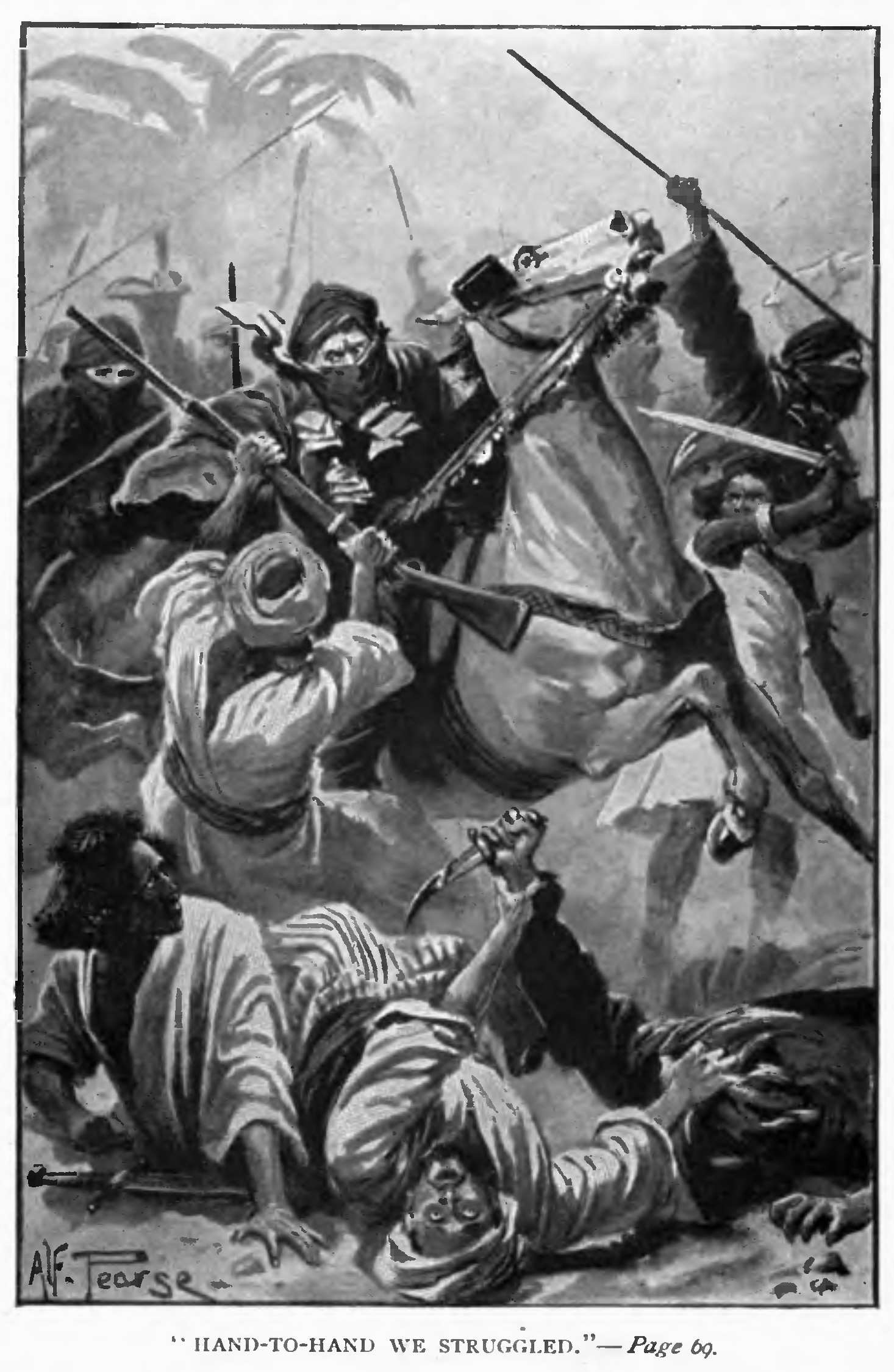
Fiercely we fought for life. We knew that if we fell into the hands of this brigandish tribe who called themselves “The Breath of the Wind,” by which their victims were to understand that they might as well seek the wind as hope to recover their stolen property, we should either be sold at the nearest market, or placed under some horrible and fiendish torture to die a slow, agonising death. Suddenly a wild yell rent the air, and before we were aware of it a troop of some fifty horsemen dashed in among us, so quickly that resistance was impossible. Hand-to-hand we struggled, straining every muscle to evade our enemies, but ere long the obstinate, heroic courage of my companions could no longer blind them to the approach of the inevitable, and we were each secured and bound, captives in the hands of the merciless veiled men of the desert, whose fierce brutality was feared alike by slaves and Sultans throughout the sun-parched land.
Our arms were twisted from our grasp, our camels’ packs seized, and, linked together ignominiously by chains around our necks, we were secured to three palm trunks, under a strong guard with loaded rifles, to wait while our captors investigated their booty and reloaded our camels. Nearly two hours this occupied, when at length the grey-bearded, sinister-faced leader of the band of free-booters gave the order to mount, and before long the party, numbering nearly three hundred horsemen armed to the teeth, moved away into the sandy wilderness, compelling us to trudge over the hot, stony ground on foot under the fiery rays of the blazing sun. It was evident that we were to be sold as slaves. One unfortunate camel-driver, who had been wounded, fell from sheer exhaustion within the first hour, and was left to die, for slave-raiders like “The Breath of the Wind” regard the wounded only as an encumbrance, and as they will not sell they are either put out of their misery by a shot, or left to die of thirst and become food for the vultures. Fortunately, with the exception of a slight cut on the left hand received from a jambiyah with which one of my captors had slashed at me, I sustained no injury, and with my companions, a little band of silent, despairing men, I plodded wearily onward—onward to be sold into slavery.
Upon all the perpendicular rays of the sun beat down with a heat as burning and intense as that of a fiery furnace, and always—always for a horizon—the desert, the infinite breadth of glaring sands.
Chapter Nine.
An Audience of the Khalifa.
Those days of burning heat were full of horrors. Treated with scant humanity, we were half-starved, allowed only sufficient water to slake our thirst once a day, and beaten mercilessly with thongs of rhinoceros hide whenever one, more faint and weary than the rest, lagged behind. Eastward we travelled for six days, until, at the well of Lassera Dar Abd-er-Rahman, we were sold for two small bags of gold to some nomad Dasas encamped there. The Tuaregs dare not enter a town in the Eastern Soudan, although, in the West, they are universally dreaded on account of their depredations; therefore they always sell their captives to other slavers, who dispose of their human wares at the nearest trade centre. Hence, by our new masters we were conveyed to Dara, a town one day’s journey south of El Fasher, placed in the slave market, and, after considerable haggling, disposed of.
My new master was a well-dressed, keen-eyed, wizen-faced old Arab of the tribe known as Jalin, who, after inspecting me and looking into my mouth as he would a horse, handed payment with ill grace to the black-faced scoundrel who sold me, and ordered me to follow him. Together we passed out of the busy, bustling crowd, when he addressed me, asking my name.
“Art thou an Arab from the North?” he exclaimed in surprise, when I had told him who I was, and the place of my birth. “How earnest thou hither?”
“I fell into the hands of the Tuaregs, upon whom may the curse of Eblis rest!” I answered, hesitating to inform him at present that I was a Dervish.
As we walked to the city gate, where he said his camels were tethered, he told me his name was Shazan, and, judge my extreme satisfaction when he added that he was about to return to Omdurman, where he lived opposite the Beit-el-Amana. Hence, my stroke of ill-fortune turned out advantageous, for within a week I found myself once again within the great walls of the Khalifa’s stronghold. Then my new master having treated me harshly, I resolved at last that he should suffer, therefore I applied to the Kaid for release from slavery, on the ground that I was a member of the Ansar of the Khalifa. Old Shazan, amazed that his latest purchase should turn out to be one of his great ruler’s bodyguard, rated me soundly for not informing him at first, but I laughed, telling him that I had desired to get to Omdurman, and kept my own counsel, until such time as it suited me. Knowing that he would lose the money he had paid for me, the close-fisted old merchant refused to comply with the order made by the Kaid for my release, but the rumour of my escape from Kano, coming to the ears of the great Abdullah, the latter one day sent six of his personal attendants with orders to release me, and to bring me before him.
The shadows were lengthening in the marble courts of the “Bab,” or great palace of the Mahdi’s tyrannical successor, when I was conducted across the outer square, where brightly-dressed guards were lounging on their rifles, or playing damma beneath the cool, vine-veiled arches. Never before had I been permitted to set foot inside the court, although many times had I passed under the shadow of the Iron Mosque near by, and gazed with curiosity at the high walls, smeared with red sand, which encircled the marble courts, gilded pavilions and cool gardens of the ruler of the Soudan—the ruler whose only idea was self-aggrandisement. The extent of the palace amazed me, for, even if it was scarcely as luxurious as the wonderful Fada at Kano, it was assuredly quite as large. Through one open, sunlit court after another we passed, until we were challenged by four of the royal bodyguard with drawn swords, but a word propitiated them, and a few seconds later I found myself in the great, marble-built Hall of Audience, in the presence of the stout, sinister-faced man of middle age and kingly bearing, with black, scraggy beard, whose name was a power throughout the Soudan. He wore a robe of bright purple, embroidered with gold, a turban of white silk, and his fat, brown hands were loaded with rings of enormous value.
Beneath a great baldachin of bright yellow silk, with tassels and fringes of gold, surmounted by the standard of the Mahdi, the powerful Abdullah, the ruler before whom all trembled, reclined upon his luxurious silken divan, fanned by black slaves on either side, while a negro lad sat at his feet, ready to hand him a pipe, the mouth-piece of which was studded with diamonds. Around him were grouped his body-servants, the mulazimin, and officers, while near him was Abdel Gayum, the chief eunuch, his hand resting upon his sword, and Ali Wad Helu, chief of the Baggara, who had led the ill-fated expedition of which I had been a member.
Conducted by my guides up to the scarlet mat spread before the potentate, who thought himself master of the whole world, I fell upon my knees in obeisance, expressing thanks for my rescue from bondage.
“Let him be seated,” the Khalifa ordered, turning to his slaves, and in an instant cushions were brought, and I sat myself, cross-legged, awaiting questions to fall from his lips. “What, I wondered, had I done that I was allowed to sit in the royal presence?”
“So thou art the Arab Zafar-Ben-A’Ziz, the horseman who alone escaped death at the well of Sabo-n-Gari?” exclaimed the vain, cruel, quick-tempered man who ruled the Soudan under the guise of Mahdiism.
“I am, O King,” I answered, bowing until my forehead touched the carpet.
“Of a verity will I punish those enemies who attacked my Jehadieh,” he cried suddenly, in fiercest rage. “Where be those owls, those oxen of the oxen, those beggars, those cut-off ones, those aliens, those Sons of Flight? Withered be their hands! palsied be their fingers! the foul moustachioed fellows! basest of the Arabs who ever hammered tent-peg! sneaking cats! goats of Al-Akhfash! Truly will I torture them with the torture of oil, the mines of infamy, the cold of countenance! By Allah, and by Allah, and by Allah, we will crush those sons of Ach Chaitan like snakes, and throw their bodies to the dogs!” Then, turning to me in calmer mood, the autocrat of the Soudan exclaimed, “Some of thine adventures have already reached mine ear, and I would hear from thine own lips how thou didst escape and how farest thou in the Fada of ’Othman of Sokoto. Let not thy tongue hurry, but relate carefully in thine own words what things occurred to thee.”
“Thy servant is honoured, O Ruler of our Empire,” I answered. “Under thy Raya Zerga did I go forth, but returned hither as the slave of the merchant Shazan—”
“Already have we full knowledge of that,” the tyrannical monarch interrupted, and turning to one of his officers he added, with an imperious wave of his fat hand, “Let the merchant Shazan, the dog of a Jalin, receive fifty strokes with the bastinado and be fined two bags of gold for purchasing a slave belonging to his Sultan.”
Then, as the official hastened out lo do his capricious master’s bidding, the Khalifa turned towards me, his thick red lips parted in a smile, lolling back lazily on his divan as he exclaimed,—
“Continue thy story. Our ears are open for information regarding the city of ’Othman, therefore describe in detail all that thou knowest.”
Briefly I related how we had been attacked at night by the Tuaregs, how my comrades had been slaughtered fighting till the last, and how I awoke to find myself within the palace of the Sultan ’Othman, when suddenly the injunction contained in the anonymous letter recurred to me: “Keep the seal of silence ever upon thy lips.” Therefore I deemed it expedient to omit from my narrative all reference to Azala, making it appear that I had been rescued by a kind-hearted soldier of the palace guard. I knew that Abdullah delighted in listening to calumnies and hearing evil spoken of other people, and for half-an-hour entertained him by describing the situation and aspect of Kano, the dimensions of the Fada, the horrors of my dungeon, and the personal appearance and character of the Sultan ’Othman, to which all listened with breathless attention.
When I had finished he remained silent a moment, as if reflecting, then raising his head he bestowed a few words of commendation upon me, concluding by the declaration,—
“Of a verity thou art a faithful and valiant servant. Henceforward thou shalt be chief of my mulazimin, and honoured among men.”
I was expressing thanks in flowery speech to the autocrat for this appointment, which, as chief of his Majesty’s body-servants, was a position of great honour, with substantial emoluments, when suddenly the silk-robed heralds posted at the entrance to the Hall of Audience sounded three loud blasts upon their shining onbeias. Then, as every one’s attention was directed towards the great horse-shoe arch from which the curtains of blue silk were ceremoniously drawn aside by black guards, there entered a tall, commanding figure in gorgeous robe, attended by a dozen followers less showily dressed, but all armed, making great show of ostentation. With swaggering gait the stranger strode up the spacious hall, and as the Khalifa motioned me to rise and step aside to allow the new-comer to make obeisance in the royal presence, I was amazed and alarmed to suddenly recognise in him the man I least desired to meet.
It was Khazneh, the brutal Aga of the Eunuchs at the court of ’Othman, Sultan of Sokoto.
Chapter Ten.
By Imperial Request.
In fear of recognition I held my breath, and, withdrawing among the crowd of guards and courtiers assembled around the royal divan, watched the obsequious homage paid the Khalifa by Khazneh, who I discovered was accompanied by Mahaza, Grand Vizier of Sokoto.
Abdullah, reclining lazily upon his silken cushions, at first paid little heed to their salaams. On his brow was a dark, forbidding look; probably he was thinking of the ill-fated expedition he had dispatched, and the apparent hopelessness of ever conquering his enemy ’Othman. Long ago had he overstepped the dignity of a sovereign, and now coveted the honours of a god. The two ambassadors from the Fada at Kano prostrated themselves, pressing their foreheads to the ground, and assured the powerful head of the Mahdists that they were charged by their Sultan to convey to him most fervent salutations. Yet he affected not to notice their presence.
Surprised at the haughty coolness of his reception, Khazneh, still upon his knees, continued to address the mighty Khalifa.
“Know, O One of Exalted Dignity, Ruler of the Soudan, who holdeth thy servants’ destinies in the hollow of thine hand, the object of our journey hither is to spread out the carpet of apologies, to become ennobled by meeting thine exalted person, to regenerate and to refresh the meadow of our expectations by the showers of the fountain-head of thy wisdom, and to see the rosebuds of our hopes opening and smiling from the breeze of thy regard. Our lord the Sultan has sent us to deliver this, therefore command and deal with us as thou listeth,” and from the breast of his gorgeous robe he drew forth a sealed letter, which was ceremoniously handed to the reclining potentate by one of the black slaves.
The Khalifa Abdullah, suddenly interested, opened it, and, having read the missive, crushed it in his hand with impatient gesture.
“Behold,” added Khazneh, “we are charged to deliver unto thee a few gems for thine acceptance as a peace-offering, and to assure thee of our lord ’Othman’s good will and high esteem,” and as he uttered the words, the gaudily-dressed members of the mission advanced, and, kneeling, deposited before the royal divan a golden salver heaped with costly jewels.
With a cursory glance at them, the occupant of the divan at length motioned the ambassadors to rise, saying in a deep, impressive voice,—
“The request of the Sultan is granted, and his presents accepted, O messengers. Assure thy lord that the knot of our amity is to-day strengthened by this invitation to travel unto Kano, and that ere many moons have risen we shall have the felicity of conversing with him. At present Allah hath not on the face of the earth a servant more excellent nor wise than he, and we are invested with the robe of being the elect and favoured. May the path of our association never become obstructed.”
The dead silence that had fallen upon the Court was broken by rustling movement and low murmurings of approbation.
“Truly thou art wise and generous, O Ruler, upon whom be the blessing of the pardoning Sovereign,” exclaimed Mahaza. “Thou, who art distinguished by great possessions, abundant revenues, innumerable quantities of cattle, and multitudes of servants and slaves, showerest upon thy servants copious favours. May the enemies of the threshold of thy dignity and station be overtaken by the deluge of affliction, and may they in the sea of exclusion be drowned by the waves of perdition.”
“Verily, if thou comest unto Kano, our lord will receive thee with befitting welcome,” added Khazneh.
“Thou, successor to the holy Mahdi who possessest the three greatest blessings, namely, meekness in the time of anger, liberality in the time of dearth, and pardon in a powerful position, wilt find a reception awaiteth thee such as none have hitherto received within the walls of our city. The relation of a king unto his subjects is like the relation of a soul to the body; in the same way as the soul doth not neglect the body for a single instant, so the king must not forget the care of his subjects even during the twinkling of an eye. Thou hast never swerved from the straight path, hence thou art honoured throughout the Soudan, even to the uttermost ends of Sokoto, and if thou wilt deign to visit our Sultan he will offer unto thee and thine officers, guards and slaves, generous entertainment within the Fada, for he desireth an understanding with thee that our countries may unite to defeat and discomfort our mutual enemies.”
The reason of the unlooked-for invitation to visit the great White City he had plotted to besiege immediately commended itself to the Khalifa, who, with a benign smile, took from his finger two great emerald rings, and, handing one to each of the Sultan’s ambassadors, assured them that the sun of his personal favours shone upon them, adding, in prophetic tones,—
“Take your ease here, for ye must be spent with long travel. I know not the day when I can set forth, for I act according to hidden knowledge, the visible effects of which are ofttimes evil, but the consequences always beneficent and salutary.”
Then, as the two men from Kano again pressed their brows to the carpet, renewed laudations and gratitude for blessings received emanated from their lips, and from those assembled there rose panegyrical murmurs that Abdullah had decided to visit the Sultan ’Othman as honoured guest instead of arrogant conqueror.
Thus was the meeting between the two powerful rulers of the Sahara and the Soudan arranged, a meeting destined to mark an epoch in the history of Central Africa. The Khalifa’s curiosity to investigate the extent of the wealthy country which acknowledged ’Othman as Sultan probably accounted for his sudden decision to undertake the long and tedious journey. Although the invitation had been sent with a view to effecting an offensive and defensive alliance between the two peoples, yet, in my new office as chief of the Khalifa’s body-servants, I had ample means of knowing that he still cherished hopes of eventually overthrowing his whilom ally, and annexing the Empire of Sokoto. Two days after the reception of the envoys, Mahaza left on his return to inform ’Othman of his friend’s intended visit, while Khazneh remained to accompany his master’s guest. Being permitted as a favoured servant to approach Abdullah closely, I was fortunately enabled to express to him a hope that the Aga of the Sultan’s Eunuchs would not be made aware of my identity with the hapless victim of his wrath, and it was with satisfaction I found that in my silk robes of bright crimson and gold and picturesque head-dress my enemy failed to recognise me.
The day was an eventful one in Omdurman when, at first flush of dawn, my royal master seated himself under the thatched rukuba and addressed his Ansar, urging upon them the necessity of loyalty and discipline during his absence. Then, after a great review of seventy thousand troops in the square of Abu nga, the Mahdist chieftain, with a portion of his harem, one thousand male slaves and four thousand courtiers and picked horsemen with banners, moved down the Road of the Martyrs on the first stage of the long journey westward. Prayers for the safety of the Khalifa were at that moment being said by nearly one hundred thousand men and women in the Great Mosque—not a mosque in its usual sense, but a huge yard—and their murmurings sounded like a distant roar as, in the cool hour before sunrise, we rode at walking pace along the winding Nile bank towards the misty hills where dwelt the Jinns.
Eager as were my companions to feast their eyes on the glories of Kano, none was so eager as myself lo pass the grim, prison-like portals of the great l’ada and rest beside those cool, ever-plashing fountains within the wonderful labyrinth of wide courts and shady arcades. The wheel of fortune had indeed taken a strange turn and was spinning in my favour, for I was actually returning to Azala in disguise so effectual that even Khazneh could not detect me, and as each day brought me nearer to her I racked my brain in vain to devise some means by which I could, on arrival, inform her of my presence and obtain an interview.
To fathom the hidden secret of the Mark of the Asps I was determined, and on the hot, tedious journey across the dreary, sandy waste, infested by marauders, and known by the ominous name of Ur immandess—“He (Allah) hears not;” that is, is deaf to the cry of the waylaid traveller—I served my capricious master with patience and diligence, awaiting such time as I could seek the woman who had entranced me, and learn from her lips the strange things she had promised to reveal.
By day the journey was terribly fatiguing, but in the cool nights, when we encamped for our kayf, there was feasting, dancing and merry-making. The night hours were enlivened by Safk (clapping of hands) and the loud sounds of songs. There were many groups of dancing-girls, surrounded by crowds of onlookers. Though sometimes they performed Al-Nahl, the Bee dance, their performances were wild in the extreme, resembling rather the hopping of bears than the graceful dances of the harem, and the bystanders joined in the song—an interminable recitative, as usual in the minor key, and so well tuned that it sounded like one voice, with the refrain “La Yayha! La Yayha!” Through the brief, brilliant night always “La Yayha!”
Chapter Eleven.
Tiamo the Dwarf.
A whole moon passed ere the sun-whitened walls and minarets of Kano became visible. The sandy approaches of the city were strewn with bones and carcasses that had been disinterred by wild beasts, the remains of camels, horses and asses that had fallen and died in the last stages of the journey. The cities of the desert are invariably encircled by their bones, and the roads across the glaring wilderness are lined by their bodies. The sun had risen about four hours when the advance guard of the Ansar spurred hurriedly back to announce that the town was in sight, and very shortly the details of the distant shape grew clearer, and we espied a body of troops, bearing the green-and-gold standard of the Sultan, riding forth to welcome us. They were gaudily-attired in bright blue, and, as they dashed forward, indulged in their La’ab al-Barut (gunpowder play) while their bright shields and unsheathed swords flashed and gleamed in the sun, as now and then the wind parted the cloud of dust and smoke which enveloped them. The faint sound of trumpets and clash of cymbals came from the distant city, enthroned upon the horizon a dark silhouette, large and long, an image of grandeur in immensity, wherein all my hopes were centred, and as we approached we saw that Mahaza, the Grand Vizier, had been sent by the Sultan ’Othman to give us peace and conduct us into the Fada.
My master’s retinue, consisting as it did of nearly five thousand persons, was indeed an imposing one, and when an hour later we entered the city gate and passed up the hill to where the well-remembered tower of the Fada stood white against the intensely blue sky, the brass cannon mounted on the walls belched forth thundering salutes, and a cloud of soft white smoke floated up in the still, warm air. Strange it was, I reflected, that the houses of Kano everywhere displayed that essential characteristic of early Egyptian art—the pyramidal form, which represented solidity to those ancient architects. The walls of the oldest constructions had a slight inward inclination, and possessed no windows, or only the roughest sketch of them. Light and air entered through openings cut in the roof. The summits of the dwellings were ornamented by those triangular battlements which may be seen on the palaces of Rameses Meiamoun. The pylon, which is another characteristic of Egyptian architecture, gave access to the dwellings. In short, the effect of the whole, their harmonious proportions, the symmetrical distribution of their ornamental mottoes, and their massiveness, proclaimed the art of Egypt, bearing out the legend that the people of Sokoto came originally from the far east. The multitude was wild with excitement. In their eagerness to catch a glimpse of the Khalifa, world-famous for his piety and his cruelty, they rendered the streets almost impassable, shouting themselves hoarse in welcome. Blatant tam-tams beat a monotonous accompaniment to the roar of artillery, and as the Sultan’s guest, mounted on a magnificent camel at the head of his black Jihadieh, passed onward, the shout of “Alhahu Akhbar!” rose from fifty thousand throats, echoing again and again. Progress was slow on account of the immense crowds, and even the Sultan’s spearmen, who preceded us, had considerable difficulty in clearing a path. Numbers were bruised, kicked by the horses or fatally injured by the long spears, but they were left unnoticed—a mere remark “Umru Khalas,” (It is the end of life) being all the sympathy ever offered. Yet the impetuous populace continued to yell enthusiastic words of welcome, the guns thundered, and the three stately men preceding the Khalifa blew long, piercing blasts on their immense onbeias fashioned from elephants’ tusks.
At length, on arrival at the great, gloomy portal of the Fada, the iron-studded gates suddenly opened, revealing the Sultan ’Othman clad in golden casque and royal robe of amaranth velvet, with a handsomely-caparisoned, milk-white horse curveting under him, and surrounded by his gaudily-attired bodyguards and mukuddums, who filled the air with their adulations, declaring that their Imperial master was Ma al-Sama (the splendour of Heaven).
Alone he came forward wishing his guest “Peace” in a loud voice, then adroitly dismounting, embraced the Khalifa. Abdullah, much pleased at this mark of respect and homage, greeted him warmly and ordered him to remount, but the Sultan remained on foot, uttering some rapid instructions to his emirs, who had also dismounted to stand beside him.
Passing through the archway into the great outer court, the Jihadieh and the Ansar remaining outside, we all dismounted with the exception of my royal master and the ladies of his harem, whose camels were led onward to the inner pavilion that had been set apart for them. As chief of the mulazimin I followed my royal master, and as we passed from court to court, Janissaries, eunuchs, slaves and courtiers made salaam and raised their voices in shouts of welcome. The reception was throughout marked by the most frantic enthusiasm, even the two gigantic negro mutes at the gate of the Imperial harem—who usually stood with drawn swords motionless as statues—raising their hands to give peace unto the great Ruler of the Soudan.
The extensive palace echoed with the sounds of feasting and merry-making. The Ansar fraternised with the Janissaries, the Jihadieh with the Sultan’s bodyguards, and the slaves of the Sultan ’Othman with those of the Ruler of the Soudan. The Khalifa, as religious head of the Dervishes and successor of the holy Mahdi, stood upon his “farwa” or white sheepskin, under the shadow of an ilex-tree in the Court of the Eunuchs, and conducted prayers in which all joined. Such was the wild fanaticism and enthusiasm that had prevailed during the firing of salutes that several men had dashed up to the very muzzles of the guns on the walls of the palace and were blown to pieces. The souls of these unfortunate people had, the Khalifa assured us, gone straight to Paradise, there to have their abode among lote-trees free from thorns, and fruitful trees of mauz, under an extended shade near a flowing water in gardens of delight, and every word that fell from his lips was regarded as the utterance of a prophet by the people as they murmured and told their beads.
After prayers, when the sura entitled “The Inevitable” had been recited, a great feast was held in the Sultan’s sumptuous pavilion. The Khalifa was seated on his Imperial host’s right hand, and over five hundred officials and courtiers were present. The dishes upon which the viands were served were of beaten gold, the goblets of chased gold studded with gems, while in the centre of the gilded pavilion a large fountain of crystal diffused a subtle perfume. Behind both the Sultan and his guest stood court tasters, who broke the seal of each dish and ate portions of the food before it was handed to their masters, lest poison should be introduced.
After the meal, jugglers entered and performed clever feats of magic, dancing-girls of every tribe under the Sultan’s rule performed in turn various terpsichorean feats upon the great mat spread in the centre of the pavilion, and to the loud thumping of derboukas and the plaintive twanging of curiously-shaped stringed instruments, they danced until they sank upon their cushions from sheer exhaustion. These were followed by snake-charmers, wrestlers of herculean strength and story-tellers—the entertainment, which was on the most lavish scale, being continued until, at the going down of the sun, the clear voice of the mueddin was heard droning the azan.
The leisure at my disposal when, after the shadows lengthened and declined into the glory and vivid charm of the tropical twilight the Khalifa had retired to his private pavilion, I occupied in exploring those parts of the palace to which I had free access. Its vast proportions and its sumptuous decorations and appointments surprised me. When, on the previous occasion, I had passed through its great arcaded courts I was on my way to execution, therefore little opportunity had been afforded to me of ascertaining the full extent of the buildings; but now, in the cool evening hour, as, alone and thoughtful, I strolled under the dark colonnades and across the great open squares with their tall palms, time-worn fountains and wealth of roses, I noted its magnificence.
Around me on every side were sounds of revelry—barefooted girls were trilling and quavering, accompanied by noisy tambourines and serannel pipes of abominable discordance and the constant beating of derboukas and the clapping of hands; but holding aloof from my companions, I wandered from court to court in order to obtain a view of the great square tower wherein Azala’s chamber was situated. At last, on entering the court where dwelt the serving-men of the Grand Vizier Mahaza, the tower rose high in the gathering gloom. From which of its small, closely-barred lattices had the city been revealed to me? Halting in the garden and looking up at its white walls, I tried in vain to recognise the window of the apartment where Azala had nursed me back to consciousness. Had she, I wondered, lonely and sad, watched from behind the lattice the festivities in the courts below? If so, might she not discern me now, gazing up at her chamber, and by some means or other contrive a meeting! Yet to deceive the watchfulness of the Grand Eunuch and his satellites was impossible. The square wherein I stood was almost deserted, for in the court beyond there was feasting and marissa-drinking among the Janissaries and the Jehadieh, and all had been attracted thither. I must have been standing there, oblivious to my surroundings, a considerable time, for it had grown almost dark, when a voice behind me brought me back to a knowledge of things about me.
“Why standest thou here aloof from thy comrades, O friend?” the voice inquired, and on turning quickly I was confronted by a black dwarf, whose face was the most hideous my eyes had ever witnessed, and his crooked stature certainly the smallest. His head, which scarcely reached to my hip, seemed too large for his hump-backed body, while his hands and feet were abnormal. Indeed, his personal appearance was the reverse of prepossessing, even though he was well-dressed in an Arab fez and a robe of bright blue silk with yellow sash. His age was difficult to guess. He might have been any age between thirty and fifty, but his thin, squeaking voice suggested senile weakness. His smile increased his ugliness as, perpetually, his eyes, like flaming fire-lances, darted towards me.
“The cool air of this thy garden is refreshing after the heat of the desert,” I replied in Arabic, as he had addressed me in that language.
“But I have been watching thee,” the human monstrosity continued, looking up at me as his mouth elongated, showing an even set of white teeth. “While thy fellows have been making merry thou hast been gazing up at yonder lattice? Hast thou seen her?”
“Whom dost thou mean?” I inquired, startled that this ugly imp should be aware of my quest.
“Affect not ignorance,” he said, lowering his voice to almost a whisper. “Thou hast knowledge as full as myself that high up yonder there dwelleth the Lalla Azala, the beauteous daughter of his Majesty.”
“Well,” I said, anxiously, “tell me of her. I know so little.”
“She hath rescued thee from death, and for many moons hath awaited thy return. She sendeth thee health and peace,” he answered, slowly.
“But how dost thou know my innermost secrets?” I inquired, regarding the strange, unearthly-looking figure with some suspicion.
“Fear not betrayal, O friend,” he replied. “I am called Tiamo, khaddan (servitor) of the Lalla Azala, and thy devoted servant. By day and night alike hath her bright eyes sought for sign of thee, for she ascertained, through one of our spies in Omdurman, of thy promotion unto the chieftainship of the Khalifa’s body-servants, and knew that thou wouldst accompany him hither.”
“Art thou bearer of a message from her?” I asked, bending towards him in eagerness.
“Yes. Hers is indeed a joyless life. Through the long day hath she stood at her lattice trying in vain to distinguish thee amid the crowds. Yet even now she is most probably standing there, and hath recognised thee. Yea. Behold!” he cried, excitedly. “See! There is the sign?”
I strained my eyes upward, and could just distinguish in the darkness something white fluttering from a lattice high up near the summit of the tower. It showed for an instant, then disappeared; but it was sufficient to tell me that I was not forgotten.
“Such means of communication are unsafe,” the black dwarf growled, as if to himself.
“What message bearest thou?” I asked, turning to him and remarking the frown of displeasure that had overspread his hideous countenance.
“The One of Beauty hath ordered me to tell thee to wait patiently. She is in sore peril, being so zealously watched by eunuchs and harem-guards that at present she cannot have speech with thee. Wait, and she will communicate with thee when it is safe.”
“What is the nature of her peril?” I inquired.
But the dwarf frowned, glanced up at the little lattice to assure himself that there was no longer a signal there, sighed, and then replied,—
“I am forbidden to tell thee. Rest in the knowledge that Tiamo, her servant and thine, will render thee what assistance thou requirest.”
“Is the Lalla so carefully guarded that none can approach her?” I asked, as together we moved on into the adjoining court, where the fighting-men were making merry.
“Alas!” he answered, “she leadeth a lonely life. Forbidden to enter the great Courts of Enchantment wherein dwell the wives and houris of the Sultan amid every luxury, and where every diversion and gaiety is provided, she is compelled by the Sultan, whom she hath displeased, to live alone with her companions, slaves and waiting-women, in the rooms in yonder tower until such time as she shall be given in marriage.”
“And shall I see her?”
“She is striving toward that end,” the dwarf answered briefly, adding, “May thine Allah, who hath created seven heavens, and as many different stories of the earth, keep thee in peace and safety.”
Gradually I overcame the distrust with which I at first regarded the hideous little pagan. From words he let drop in our subsequent conversation it was evident he was Azala’s trusted servant, and was no doubt admitted to her apartments because of his personal deformity and ugliness of countenance. Until near midnight we squatted together in his little den in the Court of the Eunuchs, smoked, drank marissa and chatted; but he was discreet, silent as the Sphinx upon the affairs of his mistress, and to all my questions made the stereotyped reply, “Wait; a message will be conveyed unto thee.”
Day by day, amid the round of bountiful entertainment, I waited in patience, glancing ever and anon up at the dwelling-place of the woman who besought my aid. Still no message came. Sometimes after the isha had been prayed I met Tiamo, but to all inquiry he remained practically dumb. “The Lalla is still unable to see thee,” he always replied, if I expressed surprise that the promised message had not reached me. But he would invariably add a word of hope, expressing regret that circumstances had conspired against us.
One night, after superintending the duties of the mulazimin, I was crossing the Court of the Grand Vizier when Tiamo hurriedly approached me. By his face I could see that something had occurred, and as he brushed past me in full view of others about him he whispered, “Come to me one hour after midnight.” Then he walked on without waiting for me to reply.
Punctually at the hour appointed I entered his little den with beating heart. The shutter was closed, therefore we were unobserved.
“Hasten. There is but brief space,” he exclaimed quickly, and pulling from beneath his divan a blue silk robe and yellow turban similar to those worn by the eunuchs, he added, “Attire thyself in these. The Lalla biddeth thee repair unto her chamber.”
I obeyed him without doubt or hesitation.
“Now, come with me,” he said, when at last I had buckled on a scimitar and thrust my feet into slippers of crimson leather, and together we went out into the open court.
A deep silence rested on the great palace, broken only by the cool plashing of the fountains in their marble basins. The heavens, blue as a sapphire, were profound and mysterious. Myriads of stars twinkled in the clear depths of the skies, and all objects were defined with a wonderful accuracy in the silver moonlight. The Fada was hushed in sleep. On the marble steps of the Bab-Seadet, the gate of the Imperial harem, the black guards stood on either side, mute, erect, motionless, their naked swords gleaming in the moonbeams. How many scenes of gorgeous festivity had been witnessed beyond that great door of iron! how many terrible and bloody dramas had been enacted within those grim, grey walls—dramas of love and hatred, of ambition, disappointment and revenge, of all the fiercest passions of the human heart! By night and day the bewitching pearls of the harem intrigued, schemed and plotted—themselves, through their Imperial Master, ruling the world outside. Too often, alas! in the history of the Empire of Sokoto it had occurred that some dark eye, some bewitching face masking a beautiful slave’s ignorance and cunning, had mastered her irresponsible and irresistible lord, and been the means of striking off the heads of not only her rivals within the harem, but those of even the wisest councillors and the bravest fighting-men outside.
As together we crossed the silent court our echoing footsteps broke the quiet. In the gateway of the harem a single light glimmered yellow in contrast with the white moonbeams; but turning our backs upon it we passed through one court after another, receiving salutes from the guards at each gateway. My disguise as eunuch was complete, and as we strolled onward without apparent haste my confidence grew until, on crossing the Court of the Armourers and entering the Court of the Pages, we discerned a white-robed figure enveloped in a haick and wearing the ugly baggy trousers which are the out-door garments of Moslem women.
“Behold!” I exclaimed, with bated breath. “The Lalla Azala awaiteth us!”
“No,” answered the strange, grotesque being. “It is her mute slave, Ayesha. Place thyself in her hands. She will conduct thee unto her mistress.”
As we advanced, the woman, whose face I could not distinguish, raised her hand with commanding gesture, and opening a small door beckoned me to follow. This I did, Tiamo remaining behind. Across many courts and through several doors, which the woman carefully bolted after us, we sped until, skirting a pretty garden where pomegranates, almonds, cypresses and myrtles alternated regularly, and roses in full bloom embowered the long alley, we came to a door in a wall near the tower. Having looked well around to see that nobody remarked us, she introduced me into a passage so small that I was compelled to bend to enter it. Taking up a lamp that had apparently been placed there in readiness, she went on before, and I followed through some intricate wanderings; then, instead of ascending, we began to go down a flight of broken stone steps.
The air became hot and stifling, and foul odours rose from the place into which we were descending. Suddenly a loud, piercing shriek of pain sounded weirdly, followed by another and yet another. Then I recognised the uneven steps as those leading to the foul dungeon with its maniac prisoners.
The rough, exultant laugh of my enemy, Khazneh, reached my ears from below, mingled with the imploring cry of some unfortunate wretch who was undergoing torture. Next second a suspicion flashed across my mind that I had been betrayed.
Chapter Twelve.
Mysteries of Eblis.
My mute conductress halted, listened intently, then placed her finger significantly on her lips. As she turned her half-veiled face towards me I saw in the flickering lamplight that her tattooed forehead was brown and wizened, that her dark, gleaming eyes were deeply sunken, and that her hand holding the lamp was thin, brown and bony.
The sounds that alarmed us ceased, and, after waiting a few moments, scarce daring to breathe, she descended several more stairs to a turn in the flight, and I found myself before a small, black door, which she quickly opened and closed again after we had passed through. Raising her finger to command silence, she moved along a narrow passage and then there commenced a toilsome ascent over great, roughly-hewn steps that I well remembered descending when, in the clutches of my captors, I had been roughly dragged from the apartment of my enchantress. With a nimbleness that showed a familiarity with their unevenness, she mounted, while I stumbled on behind, nearly coming to grief once or twice, and being compelled to save myself with my hands. In my eagerness to meet the woman who had entranced me, upward I toiled, until my breath came and went in short, quick gasps, and I was forced to rest a moment, while she also halted, smiling and turning the lamp towards me. The intricacies of these secret passages were puzzling and fatiguing, and I was anxious to pass into the well-remembered room wherein the Sultan’s daughter had, during so many weary moons, awaited me.
At last we stood before a door secured by a large iron bar, so heavy that old Ayesha could not draw it from its socket, but quickly I removed the barrier. The slave who had acted as my guide opened the door, drew aside the heavy curtain, and then stepping forward I found myself once again before the bright-eyed girl who desired my aid.
The place was dimly illumined by great hanging lamps of gold, which shed a soft and dubious light through cut crystals of green and crimson, and the air was sweetly scented by the odours of musk and cinnamon rising from the perfuming-pans. Azala, pale and beautiful, in her gorgeous harem dress, with arms, ankles and neck laden with jewels, was reclining with languorous grace upon her divan of light blue satin fringed with gold, that was placed in the alcove at the end of the apartment, her wealth of dark hair straying in profusion over the great, tasselled cushion of yellow silk. Her feet, tiny and well-formed, were bare, her pearl-embroidered slippers having been kicked aside, her pipe stood near, and upon a coffee-stool of ebony and gold stood a large silver dish of rare fruit, while kneeling beside her was a black female slave cooling her slowly with a fan of peacock’s feathers. Unnoticed by her, I stood for a few seconds, bewitched by her loveliness as she lay there in graceful abandon, her body saturated with perfumes, her soul filled with prayers.
“Welcome, O Zafar! Allah favoureth us!” she cried excitedly, springing to her feet the instant she recognised me, and, rushing across, grasping both my hands. “Thou hast brought happiness with thee.”
“At last, Azala,” I said, clasping her soft hands tenderly, and gazing into those brilliant black eyes that seemed to delight in the anxious curiosity which they aroused in my features. “Of a verity Allah is all-powerful and all-merciful. Our destinies are written in the Book, and therefore what is there left but to submit? For many moons have I striven to seek thee, to redeem the pledge I made unto thee, and now at last is our meeting accomplished.”
Noticing that I looked askance at the presence of Ayesha and the young negress, she waved her hand to them to retire. Then, when the curtains had fallen behind them, she led me slowly to her divan, saying in serious tones, “Come hither, O Zafar, I would have long and serious speech with thee.”
She having ensconced herself comfortably among her rich, downy cushions, I seated myself beside her, and as one arm stole around her slim waist, encircled by its bejewelled girdle, I drew her tenderly towards me with the intention of imprinting on her white, sequin-covered brow a passionate caress. Gently but firmly she disengaged herself from my embrace. At first the marvellous beauty of my divinity held me spellbound, but fortified by her smile I found courage to pour out a rhapsody of love and admiration, to which she listened, blushing deeply.
Thus, in the bliss of whispering love, we forgot the heavy sorrows oppressing us, and put aside all apprehension for the present and all care for the future.
After a recital of my adventures on being torn from her presence, I told her how wearily the hours had passed and of my mad desire to be again at her side, to which she answered,—
“In thee, O Zafar, have I placed my trust. The sun of the favour of the One Merciful shineth upon us, therefore let us abandon all fear.”
“The firmament possesseth but one sun, and the Empire of Sokoto but one Princess. That life, light, joy and prosperity may attend thee is my most fervent desire.”
“May perfect peace attend thee in the rose-grove of thine happiness,” she answered, turning towards me the most beautiful face that Allah had ever formed. “For many moons have I waited at yonder lattice for thy coming, knowing full well that thou art ready to serve me.”
“Ay, ready to serve thee, O Pearl of Sokoto,” I said fervently. “I love only thee, and am thy slave.”
She was toying in hesitation with her broad gold armlet that contained a talisman. Spells and charms are believed in as strongly by the ladies of Kano as those of Omdurman. The eye and knuckle-bone of a fox hung upon the neck of a boy gives him courage; its fat rubbed on a woman will convert her husband’s love into indifference. The dried liver of a cat is believed to bring back the love of a desired object to the person who possesses it; the skin of its nose, if worn on the ankle, is a preventive against murder by poison; while its ashes, if taken internally, will give all the shrewd, cunning qualities of the cat. The one Azala wore was the kus kaftar—a portion of the dried skin of a female leopard one moon old, which always bears the greatest price in the seraglios, because, if worn on the arm, it is believed to conciliate the affections of all to its wearer; and as she fingered it she uttered some kind of incantation that I failed to understand.
Her head had fallen back upon the great gold-tasselled pillow, and with her white arm thrown out above she looked up smiling into my face, uttering words of courage, declaring that I was the only man she had ever asked to perform a service.
“But,” she added, suddenly raising herself into a sitting position and gazing straight into my eyes, “how little—how very little we are thinking of the deadly peril which threateneth us! Both of us are confident in each other’s love; but, alas! no safety can there be until the Great Secret be solved.”
“What secret?” I asked, endeavouring to read her story in her brilliant eyes.
“The Secret of the Asps,” she answered, in a calm, low tone. “The secret of the strange, mysterious mark that is upon my breast and thine. When it is solved, then only may peace be ours.”
“Tell me all thou knowest regarding the curious imprint,” I said eagerly, lifting her bejewelled hand and pressing it tenderly. “Now that I am thy best beloved, ready to serve thee blindly and implicitly, surely I may know the secret of things concerning both of us,” I argued.
But with a sigh she answered, “No. Some knowledge hath been conveyed to me upon condition that I should preserve its secret until such time as the mystery shall be elucidated. Suffice it to thee to know that thou art the person to whom the truth may be revealed if thou hast forbearance and courage.”
“Will any act of mine place about thee the walls of security and the stillness of peace?” I inquired, with eagerness.
“Already have I told thee that, if thou wilt, thou canst save me.”
“From what destiny?”
“From one unknown, yet horrible—undecided, yet terrible,” she answered, hoarsely.
“Then I am thine to command, O Azala,” I answered. “In Zafar thou hast a servant who will serve thee with faith and fearlessness, unto even the uttermost ends of the earth.”
“When the dawn cometh we shall be compelled to part, for full well thou knowest what fate awaiteth thee if thou wert discovered by Khazneh or his brutal myrmidons,” she said, slowly. “But ere we bid each other farewell we have much to arrange, for upon the success of our plans dependeth whether our hands again clasp in welcome, or our lips meet in salutation. In receiving thee here I have run many risks in common with thee. If our enemies conveyed word unto the Sultan, assuredly would the vials of his wrath be poured out upon me, and he would execute his threat of giving me in marriage to some common soldier of the palace guard.”
“Has his Majesty given utterance to such a threat?”
“Yea. Because I fell into the displeasure of Khadidja, the scheming slave who now ruleth the harem as his chief wife, I became banished from the Courts of Enchantment. Indeed, only by the intercession of mine own mother, who hath long ago been deposed from her position of Sultana, and is now a mere slave, compelled to wash the feet of many who once served her, was I spared the indignity of being cast out from the palace and given as drudge to one of the horsemen who guard the Kofa-n-Kura. Indeed, the hand of misfortune hath fallen heavily upon me,” and she drew a long sigh, as in deep thought her pointed chin rested in her dainty palm.
“What was the nature of thine offence?” I inquired, interested.
“Involuntarily I acted as eavesdropper. One morning, lying in my hammock in a corner of the harem-garden where the rose-bushes grow thickly, I suddenly heard voices beyond. One I recognised as that of Khadidja, and the two others those of Shekerleb and Leilah, Arab slaves. Listening, I heard them discuss in detail an ingenious plot they had arranged to poison my mother, myself and three others, for Khadidja expressed herself determined to be supreme mistress of the seraglio. Appalled by this bold scheme of wholesale revenge, I lay silent, scarce daring to breathe, but when they had left I went straightway to the Sultan and in my mother’s presence explained all to him. The woman Khadidja was brought before him, but denied the accusation, swore on the Korân that she had not walked into the garden that morning, and brought Shekerleb and Leilah to corroborate her false statement. My father was convinced of her innocence, and believed also her allegation that a plot hatched by my mother was on foot to encompass her death. He grew angry, degraded my unfortunate mother from her position of Sultana to the meanest slavery, and subsequently banished me to the loneliness of this high abode.”
“Of a verity thy lot, O beloved, hath been an unhappy one, but let us now look forward to the dawn of a joyous day, to a noonday of prosperity, and to a sunset of peace. Azala, I love thee,” and as our lips met for the first time in a hot, passionate kiss, her bare, scented chest, with its profusion of jewels, rose and fell with an emotion she was unable to suppress.
In the dead, unbroken silence that followed, the distant roll of a drum, and the cry of the sentinels on the watch-towers at the city gates came up through the silk-curtained lattice, announcing that another hour had passed.
“Harken,” she cried quickly, springing to her feet, clutching me by the arm, and looking earnestly into my face. “We have but brief space wherein to plan our emancipation. Fearest thou to investigate the mysteries of Eblis, or to serve his handmaiden?”
“Fear dwelleth not in mine heart when the Pearl of Sokoto is nigh,” I answered gallantly, bending to kiss her hand.
“Even though thy Pearl may be daughter of the Evil One, and able to accomplish things superhuman?” she asked, in a strange, harsh voice.
“He who believeth in the one Allah and in his Prophet, holdeth in his hand a two-edged sword against the Ghul (Devil) and all the evil spirits of Al-Hawiyat,” I replied, surprised at this latter speech, and at the strange, haggard look that had suddenly overspread her beautiful countenance. “At the moment before our enemy Khazneh laid hands upon me, thou didst promise to reveal unto me some hidden marvel, the nature of which thou wouldst not disclose. For that purpose have I come hither, and now await the fulfilment of thy promise.”
Grasping my right wrist and looking into my face with eyes that seemed to emit fire, so strangely brilliant were they, she said,—
“Hast thou no fear of the future, or of the power of the Evil Eye?”
“The curse of Eblis himself shall not deter me from seeking to fathom the Mystery of the Asps. A voice that is dead hath commanded me, and I shall obey, even though I am compelled to engage Azrael in single combat. There is some strange secret in the mystic links that bind our existence—a secret I intend to discover at any hazard.”
“Bravely spoken, O Zafar,” she answered, her cheeks flushing with excitement and her sequins tinkling musically as she moved. “Thine heart is true as thy trusty Masser blade. May it be the will of Allah, who made the earth for a carpet, that thy courage never fail thee in thine attempt to rescue me from the plots that encompass me, and to penetrate the veil that hath so long hidden the truth of the entwined serpents.” She raised her face with a fond, wistful look.
Our lips met, and with her arms about my neck she clung to me, trembling, as if in fear. Then, fortifying herself for an effort, she slowly withdrew from my embrace, and led me across to the heavily-curtained door of the inner chamber, saying,—
“Thou hast declared thyself fearless and undaunted in the coming fight to possess the secret which none may know, even though it is imperative that thou shouldst pass barriers hitherto considered by all insurmountable. Truly thou art worthy a woman’s love.”
“Thou knowest how the unquenchable fire of love burneth within me, O light of mine eyes,” I answered, in fervent adoration. “With thee as the sun of my firmament, and with a stout heart within me, I am not afraid.”
For answer she turned, and with her hand upon the curtain, said,—
“Come hither. As a preliminary to thine encounter with the Invisible, I will reveal unto thee an undreamed-of marvel that will cause thine eyes to open wide in wonderment, and thine heart to cease its beating. Fear abideth not within thee. Enter therefore this portal whereat Malec, powerful yet invisible, mounteth guard, and learn the means by which the Mystery of the Asps may be unravelled.”
Chapter Thirteen.
The Prism of Destiny.
With sudden movement she drew aside the silken curtain, and we stepped into a small, dark, stone chamber, almost a cell. Then with a word of warning she guided my footsteps to a narrow flight of stairs, which she descended with caution, her golden anklets jingling as she went. As I followed, there clung about her soft draperies those sweet perfumes of the harem, the fragrance of which had intoxicated me.
Again she flung back a second heavy curtain that barred a horse-shoe arch at the foot of the stairs, when instantly my eyes were blinded by a flood of brilliant light. Under my feet I felt a carpet so thick that my slipper sank deep into it, and gradually as my dazzled vision grew accustomed to the unusual glare, I realised that I was in a chamber about the size of the one we had just quitted, but decorated entirely in bright green, the hue of which, reflected into Azala’s anxious countenance, gave her a complexion pallid and ghastly. The walls and ceiling were painted green, with good counsels from the Korân in long, lean letters of darker shade, the divans and cushions were of green silk, the stools of malachite, the large alcoves at the end fashioned from dark green marble, beautifully carved, while a malachite table, shaped like a crescent, near the end of the apartment, was studded with huge green crystals that glittered in the light like emeralds. The effect was weird and startling, for the bright white light came from a thousand lamps cunningly arranged overhead, while screens of glass, the colour of the deep sea, shot from the walls slanting beams of brilliant green.
The place was luxurious, yet, as I gazed around it, I could not repress a shudder.
“Go! Take thine ease upon yonder divan,” Azala said in a strange voice, pointing to the great couch within the alcove, and as I obeyed her, she took from her arm the gold band with its talisman of leopard’s skin and handed it to me. Apparently she dare not wear it there.
Standing in the centre of the curious chamber, she clapped her hands loudly, and instantly a curtain opposite was drawn aside, and there appeared the ugly, hunchbacked form of the grinning dwarf, Tiamo, followed by two female Arab slaves handsomely dressed in tissue of white and gold, and wearing long strings of talismans, and embroidered bags containing mysterious powders, cabalistic figures, and prayers in the language of Maghrib.
The trio, advancing, knelt before their mistress, and with a murmured blessing kissed her feet, prostrating themselves before her.
“Rise,” she commanded, almost breathless with excitement. “Know ye that in one brief hour the dawn will show in the direction of the holy city. Speed therefore on the wings of haste and execute my will.”
“We, thy slaves, obey thee, O Mistress,” they answered with one accord, and, rising, disappeared for a few moments. The two girls presently came forth bearing between them a huge golden bowl full of some sweet yet pungent perfume, which they set on a tripod upon the table of green malachite while Tiamo produced a small golden brazier which he lit and placed beneath the bowl. Then the girls produced green-painted derboukas, and seating themselves upon the mats at the horns of the crescent-shaped table, commenced a monotonous thumping on their drums, while the hideous dwarf, grinning from ear to ear, beat a rapid tattoo upon a double tambourine or kalango, all three chanting a weirdly-intoned accompaniment.
The curious spectacle held me on the tiptoe of expectation, for while the music was continued with a regularity that quickly became monotonous, Azala stood with her bejewelled hands outstretched over the bowl, repeating some words in the Hausa tongue which I could not understand. Her face had now grown deathly pale; surrounding her eyes were large, dark rings that betrayed the terrible anxiety at her heart. As the golden bowl became heated, the colourless liquid perfume gave off a vapour so pungent that it caused water to well in my eyes and my head to swim as if I had drunk marissa too freely. I was afraid to rise to my feet lest I should stagger and fall, so upon the edge of the divan I sat entranced and fascinated. The brighter the brazier grew the more dimly burned the lamps above until the brilliant light vanished and we remained in a semi-darkness, made brighter now and then by the uncertain flicker of the fire. Emerald crystals everywhere in ceiling and walls flashed like jewels with a bright green brilliance each time the flames shot up, producing a weird and dazzling effect, while in the shadow Azala prostrated herself, uttering an appeal to some power unseen.
Eagerly I watched the next development of this remarkable experiment. Suddenly the woman I loved struggled to her feet and with her right forefinger touched the edge of the steaming bowl. As she did this, a bright flash, blinding as lightning, shot through the chamber, causing the music to cease and the slaves, awe-stricken, to bow their heads until their brows touched the carpet.
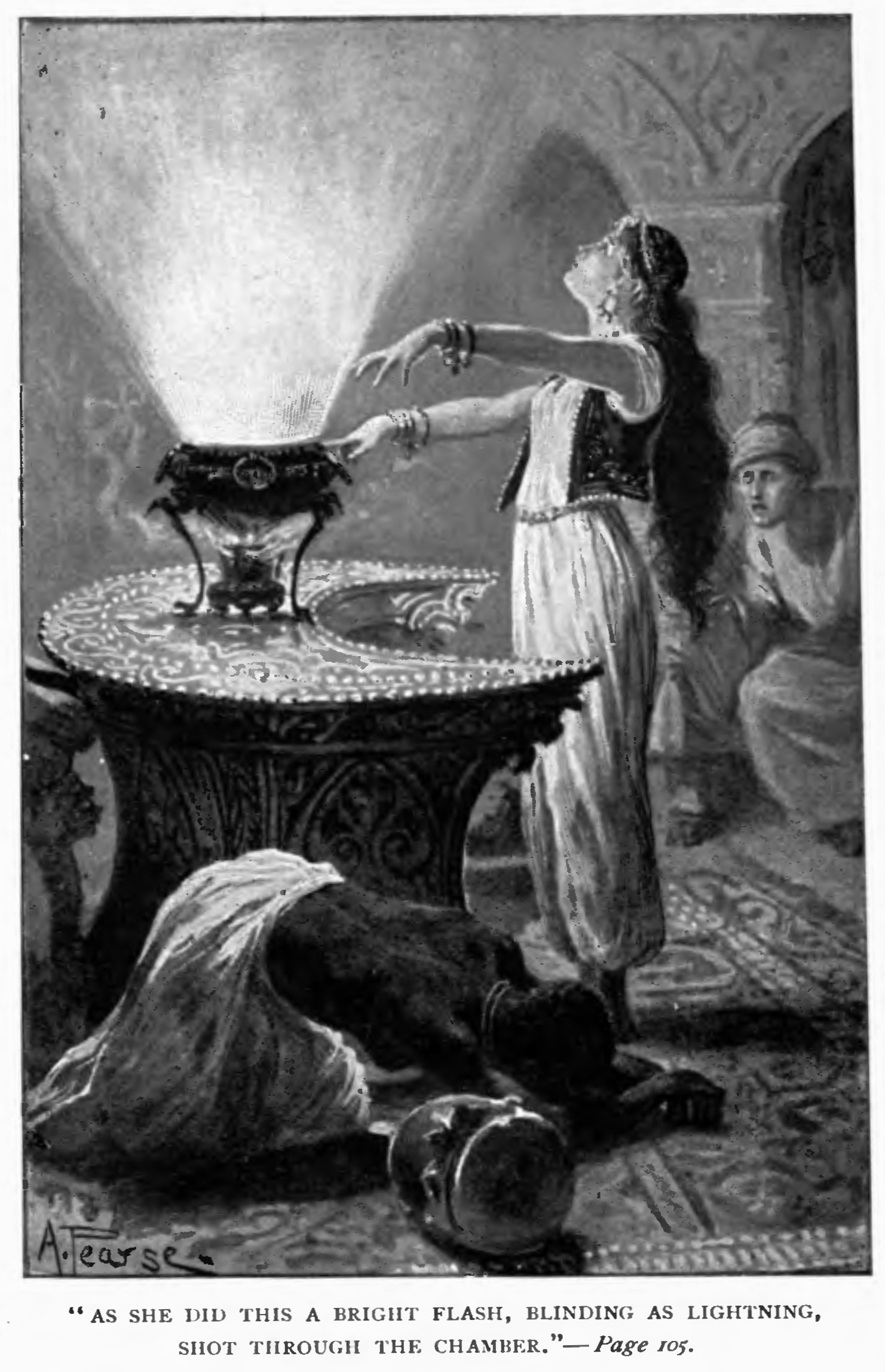
“Malec, iron-hearted Janitor of Hell, hath been overthrown!” they exclaimed, in voices hushed in fear.
Again was the flash repeated as Azala’s hand touched the edge of the bowl of repoussé gold, and the slaves gasped in Arabic,—
“Lo! the Guardian of Al-Hawiyat is vanquished by the sword of Eblis!”
Then, a third time my eyes became dazzled by the sudden brilliance which apparently proceeded from the great basin of perfume, and the slaves lifted their voices, saying,—
“The Pillars of Hell have indeed fallen!—the sword of Eblis is sheathed, and Malec, trembling, hath hidden his dog’s face before the incomparable beauty of her Highness, the Lalla Azala!”
Tiamo, whom Azala addressed as El-Sadic (the Sincere), rose at the bidding of his mistress. With her hand pressed to her heart, as if to stay its wild beating, she stood close to me with her face upturned and her lips moving as if invoking the aid of some unseen power.
“Behold!” she cried, with a suddenness that caused me to start. “Behold, the Prism of Destiny!” And as the words fell from her white, trembling lips, there was a wild noise like the rushing of great waters, and a circular portion of the wall of the chamber directly opposite appeared to fall asunder, disclosing a huge gold ring, within which, placed perpendicularly, was a large crystal prism, the length of a man’s body, which, as it revolved in its setting, showed all the gorgeous hues of the spectrum with a rapidity that was bewildering.
Azala, standing motionless, gazed at it, while the slaves remained kneeling with eyes riveted upon it in fear and expectation. Propelled by some unseen agency, it revolved noiselessly within its golden circle, emitting shafts of multi-coloured light that illumined parts of the strange chamber, leaving the remainder in deepest shadow. Gradually, however, the speed with which the great crystal turned slackened, and Azala, advancing towards me, placed her hand lightly upon my shoulder, exclaiming in a low, intense tone,—
“Lo! that which we sought is revealed! Behold! before us is the forbidden Prism of Destiny, into which none may gaze without incurring the displeasure of the One Merciful, and the curse of Eblis the Terrible.”
The lights flashing full upon my face seemed to enthral my senses, for her words sounded distant, discordant and indistinct. But a sudden exclamation of hers aroused me.
“See!” she cried, pointing to the three-sided crystal. “Its motion steadies! It mirrors life in its wondrous depths, but those who dare discern their future ofttimes pay the penalty of their folly by being struck with blindness, and ignominy attendeth them. Allah, though merciful, is just, and it is written in the Book of Everlasting Will that we may know nought of the hereafter, save what holy writ teacheth us.”
“But how is the extraordinary effect produced?” I asked, marvelling greatly at the curious chimera, for though it appeared but a phantom, the prism actually revolved, and the illusion could not be caused by reflected light, as I at first had been inclined to believe.
“By offering sacrifice to Eblis,” she answered, looking into my eyes, an intoxicating gaze of promise, triumph, tenderness. On her lips dawned a smile which was pledge of the future—the future all light, all hope, all love. Then, pointing to the boiling bowl, she said, “He giveth sight of it to those of his slaves and handmaidens who invoke his aid.”
“Art thou actually one of his handmaidens?” I gasped in fear, amazed to observe that her beauty seemed to gradually fade, leaving her face yellow, care-lined and withered.
“I am,” she answered in a deep, discordant voice. “Once before, after thou wert taken from me, the Prism of Destiny made its revelation. The temptation to gaze therein proved too great, and, alas! I fell.”
“What didst thou discern?” I eagerly inquired, my eyes still fixed in fascination upon the mysterious, rotating crystal, my senses gradually becoming more than ever confused.
“I pierced the impenetrable veil of futurity.”
“And what manner of things were revealed?”
“I beheld many marvels,” she answered, in a slow, impressive voice. “Marvels that thou, too, canst behold if thou darest brave the wrath.”
She spoke so earnestly, fixing her searching eyes upon me, that I felt my courage failing. The constant flashing of brilliant colours in my eyes seemed to unnerve me, throwing me into a kind of helpless stupor, in which my senses became frozen by the ghastly mysteries practised before me. It was this feeling of helplessness that caused my heart to sink.
“Didst thou not declare thou wouldst engage Malec in single combat in thine endeavour to fathom the Secret of the Asps?” she observed, half reproachfully. “Yet thine hand quivereth like the aspen, and thou carest not to seek the displeasure consequent upon such an action.”
Erect, almost statuesque, she stood before me, pale and of incomparable beauty, holding my sun-browned hand in hers.
“Hearken, O Azala,” I cried, struggling with difficulty to my feet, and passing my hand across my aching brow to steady the balance of my brain. “No man hath yet accused Zafar-Ben-A’Ziz of cowardice. If, in order to seek the key to the mystery of the strange marks we both bear, it is imperative that I should gaze into yonder crystal, then I fear nought.”
“It is imperative,” she stammered. “If it were not, I, of all persons, would not endeavour to induce thee to invoke the curse upon thyself.”
“Then let me gaze,” I said, and with uneven steps went forward, my hand in hers, to where the great prism had so miraculously appeared. It was moving very slowly, the only light in the chamber being that emitted from its triangular surfaces, and as I halted before it my head reeled with a strange sensation of dizziness I had never before experienced.
Aloud the prostrate slaves cried,—
“O Malec, Angel of Terror, vanquished by a woman’s beauty, let the eyes of this friend of thy conqueror witness the sight which is forbidden, so that he may drink of the fountain of truth, and repose in the radiance of her countenance.” Tiamo was thumping his kalango and grinning hideously.
Bewildered, and only half-conscious of my surroundings, I felt Azala dragging me forward. Though the objects swam around me and I had a curious sensation as if I were treading on air, I advanced to within an arm’s length of the slowly-moving prism. My eyes were cast down to the green carpet, for in the sudden terror that had seized me I feared to look.
“Speak!” cried Azala, in a voice that seemed afar off. “What beholdest thou?”
But no answer passed my lips.
“Gaze long and earnestly, O Zafar, so that the image of things revealed may be graven upon the tablets of thy memory for use for our well-being hereafter,” she urged in a voice sounding like the distant cry of a night-bird.
The thought of her peril flashed in an instant across my unbalanced mind. Her appeal, I remembered, was for our mutual benefit, in order that I should be enabled to elucidate the Mystery of the Asps and bring peace upon her. What, I wondered, was the nature of this strange revelation which she herself had already witnessed.
Ashamed at this terror that branded me as coward, and determined to strive towards the solution of the remarkable mystery that bound me in a bond of love to the beautiful daughter of the Sultan, I held my breath and slowly raised my head.
Next second my heart stood still as, fascinated in amazement and aghast in horror, I gazed deep into the prism’s crystal depths, where an omination, wondrous and entrancing, met my eyes.
There was indeed revealed unto me a marvel of which I had not dreamed.
Chapter Fourteen.
A Sign Afar.
The movement of the huge crystal was so slow as to be almost imperceptible, but the kaleidoscope of life and movement it presented held me spellbound.
By this strange combination of dactyliomancy with christallomantia, an effect was produced so amazing and unaccountable that my wondering vision became riveted upon it, as gradually my mind cleared of the chaotic impression it had received.