"A Romance of the Land of No Return" (continued 5)
Reading edition
“Have thine eyes ever gazed upon the Rock of the Great Sin?” I asked presently, when he had described how he had followed the men of Tippu-Tib for many days at imminent risk of detection.
“Yes. Once, years ago, I gazed upon it from afar, but dared not to approach it.”
“Why?” I inquired.
“Of a verity the spot is sacred. He who endeavoureth to ascertain its secret, will assuredly be smitten by a terrible pestilence—the hand of the Evil One who dwelleth therein, will strike swiftly, and the adventurous investigator will wither like a rootless flower beneath the sun.”
Tiamo, silent, with eyes opened wide, hugged his knees and drank in every word Yakul uttered. My curiosity was also thoroughly aroused, and I urged the chief to relate to me all he knew regarding the strange, unexplored spot. Its mystery had been deepened by each superstition or legend I had heard regarding it, yet it was curious that nearly every popular belief asserted that some strange deity of good or evil dwelt therein, or in its vicinity. But at length I had now discovered one who had actually gazed upon it with his own eyes, and knew the way thither. There was no longer doubt of its reality; it actually existed, rising lonely and solitary from the dark waters of the Lake of the Accursed, just as it had been mirrored in the heavens.
For the first time during our long and fatiguing search, sometimes across great tracts of virgin forest wherein man had never before set foot, we now at last heard it described minutely from the lips of an eyewitness. Eager and elated, we both felt that we were on the point of a discovery, and were prepared to risk the strange pestilence so dreaded by the pagans and the touch of the unseen evil hand, in order to explore the dark and gloomy crag, where it had been asserted by Azala the Mystery of the Asps remained hidden.
Yakul, as he munched his bananas, told us how, eight years before, when assisting the Iyuku and Indebeya peoples against the Manuyema, there had been severe fighting, and with his warriors he had followed a host of the invaders south through an unknown part of the Great Forest, until at length he had driven the enemy into a natural trap, for, on account of the Lake of the Accursed and the range of inaccessible mountains beyond, they were unable to retreat further, and being compelled to again fight, they were completely wiped out by the Avejeli.
During the battle in that little-known region he discovered they were within actual sight of the Rock of the Great Sin, but of the whole of his brave warriors not a man dared to venture nearer on account of the declarations of their wise men, that if any attempted to approach the forbidden spot a terrible pestilence and total destruction would inevitably fall upon the tribe. In consequence of this he had stood afar off and viewed the rock and the unknown and unapproachable land beyond, fearing lest, by going nearer, he should invoke the wrath of his pagan gods, or cause revolt among his warriors, who had become cowed and terrified at discovering themselves in the shadow of the dark rock, which was the seat of the dreaded Evil Spirit of the Kivira.
While within sight of the Rock of the Great Sin, they declared the air was deadly. They began to suffer from joint aches, he told us; their knees were stiff, and pains travelled through their bodies, causing them to shiver and their teeth to chatter, after which their heads would burn and the hot sweat would pour from them, so that they knew no rest. During the two days they remained there life was but one continuous ague, and they left the country declaring it to be bewitched.
Chapter Thirty.
A Prophecy.
“Fearest thou to return?” I asked the chief of the Avejeli, when he had concluded his interesting description of the overthrow of the Manuyema.
“If thou desirest me to bear thee company, I will guide thee until thine eyes can discern the black rock, and the poisonous waters surrounding it,” he answered. “Then, if thou art fully determined to approach it, I will remain until thou returnest.”
“I cannot sufficiently thank thee for thy promise, O friend,” I answered. “For many moons have I wandered with my slave, over the desert and through the endless and terrible Kivira, in search of some one who could direct me unto the spot I seek. Now that thou hast given me thy promise to conduct me thither, thou hast of a verity revived my hopes with the refreshing shower of thy good favour.”
“Are we not friends?” Yakul asked. “Already thou hast shown, in manner plain, a boundless generosity towards me; therefore gladly will I conduct thee to the sacred place thou seekest.”
“Indeed thou art my friend. May the most perfect peace ever rest upon thee, and may wisdom always distinguish thee above thy fellows,” I answered, adding, “Thou hast spoken of the rock as the seat of the Evil Spirit of the Forest. Tell me, why do thy people of the Avejeli regard it as sacred?”
“Because, beyond the rock is an inaccessible and mysterious tableland which none have ever gained. Some believe it to be a country filled to overflowing with bananas, yams, manioc, corn, honey and fruit, and peopled by a strange race of monkeys, who live in huts like ourselves, and are armed with bows and spears. Others declare that the plateau, though covered with grass at the edge, where visible, is nevertheless a glaring, barren, and uninhabited wilderness of endless extent.”
“And what is the name of this unknown country?” I asked, curious to know whether the pagan tribes entertained a belief similar to ours.
“It is called the Land of the Myriad Mysteries, because, to the dwellers on the edge of the forest, the first flush of dawn appeareth always like a mysterious blood-red streak from behind the rock. By our wise men it is said that away there dwelleth the great Evil Spirit, whose invisible myrmidons lurk in the silent depths of the forest, ever ready to bring destruction and death upon those they may seize.”
“Believest thou that the Evil Spirit hath power supreme?” I inquired.
“Yea, most assuredly. Once, many years ago, the Good Spirit, who dwelleth in the sun, reigned supreme in the Kivira, until a rivalry arose between the god of Life, and the god of Destruction, and they struggled fiercely for the mastery. At first, the Good Spirit was the most powerful, for into the bright light which he shed the Evil One dared not venture. But at length the god of Darkness, with considerable ingenuity, invoked the aid of the trees of the forest, and they, obedient to him always, raised high their spreading heads, interlaced their giant branches, and shut out the sun’s light, thus allowing their master, the Evil Spirit, to obtain complete control of the earth. It was then that he took up his abode in the Land of the Myriad Mysteries, placing between his seat and the dwelling-place of mortals a lake, the water of which will, it is said, poison arrows dipped into it, and a chain of mountains, unapproachable by reason of the death-dealing odours exhaled from the swamp in the deep valley at their base.”
The chief paused, hugged his knees, and gazed gravely into the dying embers.
“Hath no man ever been able to penetrate into the mysterious abode?” I asked.
“Many lives have, it is said, been lost in foolhardy attempts by the curious,” he answered, slowly. “None has, however, successfully braved the wrath of the One of Evil, who dealeth death with aim unerring. Our wise men have said that when, generations ago, the Evil Spirit conquered his rival, entrance was gained to his kingdom by a remarkable cave in the rock, and that in the cave there lived a hideous wild beast with eight legs, whose tusks were each the length of a spear, whose claws were each an arrow’s length, whose eyes were like flaming brands, and whose breath was as the smoke of a camp fire. The god’s attendant spirits were forbidden to pass beyond the zealously-guarded portal, but one day a spirit, more adventurous than the rest, managed to escape into the abode of men. His spiritual form enabled him to cross the poisoned waters without a canoe, but as he was passing rapidly over the plain his absence was detected by the god of Darkness, who, in his wrath, suddenly turned him into a human being, and doomed him to wander the earth as an outcast forever. He is wandering now, for aught we know. Truly, the wrath of the King of the Land of the Myriad Mysteries is to be feared, and death cometh swiftly to those who offer him not offerings of flesh, and arouse his anger by expressing disbelief that he ruleth the earth.”
“Then, according to thy belief, the Good Spirit is powerless?” I said.
“Yea, he hath, alas! been vanquished, and the god of Darkness holdeth supreme sway over men,” he answered. “Among mine own people I have witnessed more than one case where a man expressed disbelief in the One of Evil at dawn, and ere darkness hath fallen he has come to a violent and unexpected end. The punishment of the sceptical is always death.”
“And the dwelling-place of the Ruler of the World is that high land, towards which, at sunrise, we shall be pushing forward to discover?” I said.
“Yea. But have a care of thy life, O friend,” he urged, in a tone of consternation. “Thou mayest gaze upon it from afar, but to approach it will be to encompass thine own end.”
“When we reach within sight of it I shall decide how to act,” I laughed, amused at the pagan’s apprehensions. “Strangely enough we have, in our land, a legend very similar to thine, which telleth how one adventurous man escaped from the mysterious region, after which the cave became closed and all entrance and egress barred. The mystery fascinateth me, and I am determined at all hazards to seek its solution.”
“Dost thou think thou wilt succeed where valiant men for ages past have failed?” he asked, in a tone of reproach.
“I may fail also,” I said. “If thou wilt lead me thither, I will make at least an effort.”
The black chief did not reply, but sat silent and motionless, still hugging his knees, and gazing with thoughtful, heavy expression into the fire. Perhaps he was trying to devise some scheme whereby I might be deterred from committing an act which he considered sheer folly. But I was determined to keep the promise I had made to Azala, and seek some explanation of the mystic marks upon our breasts. It was strange that every tribe—followers of the Prophet and pagans alike—possessed some curious legend regarding the unapproachable country; strange, also, that so many of the quaint beliefs coincided in two facts; namely, the escape of an adventurous spirit and the subsequent disappearance of the cavern. These legends had apparently been handed down through so many ages that they had now become bound up in the quaint and simple religious belief of the pagans, proving the great antiquity of the original incident or story upon which they were founded.
That some extraordinary mystery was therein hidden, I felt instinctively, and longed for the days to pass in order to stand before the gigantic rock and examine it closely. Tiamo, much impressed by what Yakul had said, was likewise eager to view the spot; but the chief’s declaration that it was the dwelling-place of the Evil Spirit caused him considerable perturbation, for, as a pagan himself, he believed implicitly in the existence of Jinns, and in the One of Evil, which he constantly declared lurked in the most gloomy depths of the Forest of Perpetual Night. Once or twice on our lonely journey he had been terrified at seeing in the darkness some mysterious object moving, but it generally turned out to be a monkey, a leopard, or some other animal startled by our sudden invasion of his domain.
At such times I laughed at his dread of darkness, but I confess that more than once in that weird and terrible wilderness of trees I, myself, had become infected by his abject fear, and stood in readiness to witness some uncanny being advance towards us. Now, however, my little apelike companion expressed a profound belief that the seat of the Evil Spirit was actually beyond the Rock of the Great Sin, and that the story, as related by Yakul, was the most sensible solution of the mystery he had yet heard. I could not reprimand him, because I did not wish to cast doubt upon the belief of the grateful savage who had proved our sincere friend. Therefore I held my peace, declaring that I would express no opinion before I saw the spot.
Yakul laughed when I thus made reply to my slave, and turning to him, said,—
“Thy master acteth with discretion. Ofttimes, we trip in the hurry of the tongue. They are wise who speak not before examining a matter themselves.”
“For many moons have we journeyed in search of the Rock of the Great Sin,” the dwarf answered, “and, even though I may fear him who dwelleth therein, yet I, like my master, will not be deterred from approaching it closely.”
“Then, thy life will pay the penalty of thy rashness,” the chief observed, slowly nodding his head to emphasise his words.
“The result of any folly will be upon us alone,” Tiamo said, in a resentful tone. “Lead us thither, and leave us to our own devices.”
“Such is my intention,” answered the chief of the Avejeli. “If thou hadst searched through the Forest of Perpetual Night, thou wouldst not have obtained a guide, even though thou hadst offered him a sack of cowries, or an ass’s load of brass rods.”
“Why?” I inquired.
“Because the secret of the existence of the seat of the Evil Spirit in our midst is carefully guarded by the forest tribes, and to lead a stranger thither is an offence punishable by death. Our prophets have for centuries urged upon us the necessity for keeping the whereabouts of the rock secret, declaring that some day a stranger will come from the north, and seek to penetrate the mystery. If the stranger is successful, then the vengeance of the Evil One will descend upon all forest-dwellers in whose keeping the secret remaineth, and sweep them out of existence by means of a terrible scourge of leprosy. Therefore, the tribe of pigmies holding the country near the rock are deadly hostile towards those who approach them, and none, save the Manuyema, have ever been permitted to go near, and even they were all quickly massacred by us, not one being spared to spread the news among his compatriots.”
“Then, in acting as our guide, thou art running a risk of death?” I exclaimed, in surprise.
The chief nodded assent, adding: “It is the only means by which I can repay thee for giving me my life.”
“If our efforts are satisfactory, thou wilt assuredly receive ample reward,” I said.
“I want none,” he replied. “But bring not upon our people the doom that hath so long been prophesied,” he added, with earnest fervency.
“I may be the stranger whose coming hath been foretold,” I observed, laughing.
El-Sadic, the dwarf, grinned from ear to ear, and rubbed his thighs, while Yakul moved uneasily, and, taking up a stick, slowly stirred the fire.
“I trust not,” he said, in a harsh tone. “It would be better that I had died where the murderers of Tippu-Tib bound me, than I should be instrumental in leading the destroyer of our race unto victory.”
“Destroyer of thy race!” I echoed. “I have no desire to destroy either the pigmies of the forest, or the stalwart dwellers of the river banks. My campaign is not one of conquest, but of curiosity. In searching for the rock I am but redeeming a pledge to the woman I love. Therefore, have no fear as to my intentions;” and laughing again, I added, “Whatever may occur, thou wilt assuredly be remembered.”
“But the prophecy, it is—”
“Heed it not, be it what it may,” I urged, interrupting him. “Be thou our guide, and give us thy protection through the country of the pigmies. Assuredly wilt thou be fitly rewarded.”
“I take no reward from one to whom I owe so much,” he answered, proudly. For a few moments he hesitated, then added: “I have promised to direct thy footsteps unto the mysterious region of the Evil One, and will do so, notwithstanding the prophecy. The pledge of Yakul is never broken. Therefore, trust in me, and within twelve days thine eyes shall be gladdened by the sight of the gloomy rock for which thou hast so long searched.”
I thanked him, assuring him that by such an action he would repay my small service a thousandfold, and he accepted my expressions of pleasure with that calm dignity which had held him exalted above all others of his tribe.
“Then let us rest,” he said. “To-morrow we must retrace our steps one march, and then strike in the direction of the sunrise. Yakul shall lead thee, but if thine adventurous expedition shouldst cost thee thy life, let it not be upon my head, for already have I given thee full warning of the dangers that must beset thee.”
“Thou art exonerated from every blame, O my friend,” I answered. “Of our own free desire we go forward unto the Land of the Myriad Mysteries, and we are ready that the consequences rest with us.”
“Well hast thou spoken, O master,” my slave exclaimed. “Wheresoever thou seekest for truth, there also will I bear thee company.”
“Then let us refresh ourselves by sleep, and let us proceed at sunrise,” said the chief of the Avejeli; and soon afterwards, having made couches of leaves, we stretched ourselves around the embers of our fire, the flickering of which cast weird, grotesque shadows upon the boles of the giants of the forest.
How long I slept I have no knowledge, but the crackling of wood awakened me. Opening my eyes quickly, without moving, I saw the flames had sunk and sleep had stolen over my two companions. Tiamo lay on his side, his hand on his jambiyah at his waist, while Yakul snored and rolled as if he did not like the ground to lie upon. The single ember that blazed threw its light upon some dark bushes within my line of sight.
Suddenly I thought I detected a small object moving in the deep shadow, and strained my eyes into the gloom. Yes! I was not deceived! Another dark form moved, then another and another, and as one crept out on tiptoe from the thick undergrowth, I saw it was a tiny, half-naked dwarf, wearing a curious square head-dress, advancing noiselessly, a small poisoned arrow held in his bow ready to fly at the first sign of our awakening.
The one creeping towards us did so with evil intent, for there was a keen, murderous look in his tiny, bead-like eyes. During the first few moments of this discovery I remained spellbound, allowing our adversaries to creep forward until within two spears’ length of us.
Then I sent up a loud shout of alarm that rang through the great forest and came back again with strange, almost sepulchral echo.
Chapter Thirty One.
On the Horizon.
Instantly the tiny people of the Wambutti, none of whom reached higher than my waist, scampered back into the undergrowth, startled by my unearthly yells, but at the same moment Yakul jumped to his feet in alarm, an arrow in his bow.
“Why hast thou given warning?” he cried, glancing at me. “What hideous shape hath frightened thee?”
“See! in yonder bushes, the pigmies are lurking,” I gasped in alarm, pointing to the spot where they had concealed themselves.
“How didst thou detect their presence?” he inquired.
“I watched them.”
Turning towards the thick bushes, the savage chieftain shouted some words in a tongue unknown to me, and next second the impish little denizens of the forest depths sprang from their hiding-places, and recognising their friend, came crowding around, dancing and greeting us effusively.
Briefly Yakul explained our position. His eyes were fire; his passion for his slaughtered and enslaved race, and his passion for revenge, were as the lode-star of his life. After consultation, the hunters of the Wambutti relit our fire by rubbing two sticks together, and squatted around it, laughing and chattering in their strange language until the grey light, glimmering through the tall trees, told us that dawn had come. Times innumerable had the Avejeli assisted the dwarfs against the raiding dwellers on the grasslands and on the river banks. The yellow-complexioned pigmies, dwelling as they do deep in the impenetrable depths of the boundless Forest of Perpetual Night, are formidable enemies, for they conceal themselves so cleverly that their arrows and spears pierce the intruder before he is aware of their presence. As hunters, these little-known men stand first among the pagan tribes of Central Africa, and in return for food and bark-cloth supply the neighbouring tribes with quantities of ivory, and the deadliest of arrow-poisons. Their complexions are much lighter than the dwellers by the river or on the plains, and their villages are mere collections of tiny huts that appear like little straw-covered mounds placed in the centre of a forest clearing.
At first our weird little friends seemed inclined to regard me with considerable distrust, but on Yakul’s assurance that I was no ally of Tippu-Tib’s, their distrust gave place to curiosity as to my purpose in travelling through the forest. Yakul reminded them of the promise of assistance they had many times given him, and told them of my mission; whereupon, after consultation with their headman, they consented—not, however, without some reluctance—to guide us towards the Land of the Myriad Mysteries; and after re-arranging their elephant-trap into which we had fallen, our fire was extinguished and we struck camp, turning our faces in a north-easterly direction. Through a great, gloomy tract of primeval forest, where the foliage was so dense that scarcely a ray of light could struggle through to illuminate our weary footsteps, we passed over marshy ground, where poisonous vapours hung undisturbed by the faintest breath of air, and where neither animals nor birds could live; on over the decaying vegetation of centuries; on, day after day, now scrambling over fallen giants of the forest, and ever and anon sinking knee-deep in quagmires of foetid slime. Often we struck an elephant track which assisted us, but were always compelled to leave it very soon in order to continue our course. Thus through many dreary hours we pressed forward in the dull, dispiriting gloom.
Confident in the knowledge that each bivouac brought us nearer the spot for which I searched, I heeded neither fatigue nor peril, and judge my satisfaction, joy and eagerness, when at last we suddenly emerged from the forest gloom into the blessed light of day. Halting, I inhaled the first invigorating breath of pure air I had breathed for many weeks.
The dwarfs raising their hands above their heads, gave vent to some cabalistic utterances; then, trembling with fear, stood, not daring to proceed further into the country forbidden. Yakul called us to witness that our friends had guided us in the right path, and Tiamo, turning to me, cried excitedly in Arabic,—
“Of a verity, O master, soon will our eyes be delighted at the sight of the great rock. The chief Yakul is assuredly as sincere a friend as if he had made blood brotherhood with thee.”
Facing towards the holy Ka’aba, I thanked Allah for his deliverance, and recited the Testification with some verses from the book of Everlasting Will.
Under a brilliant noonday sun the open country spread wide before us, a beautiful plain, covered with grass of freshest green, and stretching away into the far-off horizon, where a range of mountains rose blue, misty and indistinct.
“Behold!” shouted Yakul, pointing with his spear to the distant serrated line a moment later. “Behold, yonder peak that standeth higher than the rest, and is shaped like the prow of a canoe, is the spot which thou seekest. Lo! it is the Rock of the Great Sin!”
My eyes, strained in the direction indicated, could just distinguish the point where one mountain rose higher than its neighbours, its summit apparently obscured by the vapours that hung about it.
“Art thou certain that yonder crest is actually the rock we seek?” I asked, shading my eyes with my hands, and eagerly gazing away to the blue haze that enshrouded a mystery upon the elucidation of which my whole future depended.
“Of a verity the grassland beneath thy feet is the same field whereon my people gained the signal victory over their enemies. Behold! their whitening bones remain as relics of that fight; and yonder, afar, lieth the forbidden Land of the Myriad Mysteries.”
“Let us hasten thither, O master,” urged Tiamo, who had been standing agape in amazement, eagerly drinking in every word uttered by the sable chieftain.
“In short space shall we reach the shore of the wondrous Lake of the Accursed,” Yakul exclaimed. “By to-morrow’s noon our faces shall be mirrored in its waters.”
“Let us speed on the wings of haste,” I said; and then, remembering Yakul’s confidence in the non-success of my strange mission, I added, “Each hour is of serious moment. Already have I tarried too great a space on my way hither, and must return more quickly than I came. How I shall journey back to Kano I know not.”
“Thou needest not retrace thy footsteps along the route thou hast traversed,” answered the chief. “Due north of yonder rock there runneth a track which leadeth through the Great Forest to Ipoto. Thence, crossing the Ihourou river, the way leadeth on through the desolate country of the Mbelia unto the mountain called Nai, whence thou canst journey in six marches to Niam-Niam, and onward unto thine own desert land.”
Our friends, the dwarfs, had grouped themselves under the shadow of the trees on the edge of the forest, conversing seriously. None summoned sufficient courage to wander forth upon the verdant land, where flowers grew in wild abundance, and where herds of buffalo grazed undisturbed. This strange land, unknown to all except themselves, they held in utmost awe. They dared not approach it more closely, lest the dreaded pestilence that had been prophesied should fall and sweep them from the face of the earth.
Yakul approached their headman, urging him to accompany us and explore the mysterious rock, but the tiny man only shook his head, and drawing himself up, answered,—
“Verily, we are thy friends, O friend, but seek not to cause us to invoke the wrath of the Destroyer, lest the pestilence should fall upon us. He who resteth his eyes on yonder rock will assuredly be smitten, and his entrails withered by the breath of the Evil Spirit of the Forest that scorcheth like the flame of a burning brand. To pass over yonder grassland is forbidden.”
“We go forward in search of the Land of the Myriad Mysteries,” the chief of the Avejeli explained.
“Then assuredly thou goest unto certain death,” the dwarfs replied, almost with one accord, shaking their heads and shrugging their narrow shoulders.
“Be warned,” their headman added. “The Destroyer is mighty; he ruleth the Great Forest and its people. Assuredly he is swift to punish!”
“He who will bear us company unto the Lake of the Accursed, let him stand forth, or if he dare not venture, then let him hold his peace,” said Yakul, standing erect, spear in hand.
But not a dwarf advanced. All feared to pass across the fertile plain, and investigate the mysterious country beyond.
Then, after much parleying and many solemnly-uttered warnings on the part of the pigmies, my two companions and myself left them, setting our faces resolutely towards the sacred lake, the approach to which was prohibited to all.
The grass was soft beneath our feet after the difficult march through the untrodden forest; the sight of flowers, of animals and of birds refreshed our eyes after the eternal silence and appalling gloom in which we had existed through so many weary days; and as the sun sank in a sea of crimson behind us, and our shadows lengthened across the grass, I halted for a few moments to repeat the sunset prayer, remembering that there was one afar off who had opened her lattice and breathed upon the hot, stifling desert wind a fervent message of love.
Within sight of the entrance to the mysterious Land of the No Return I wondered, as I strode forward, what the result of my mission would be; whether, by good fortune, I should be enabled to reach the Rock of the Great Sin in safety; whether the explanation of the mysterious Mark of the Asps upon my breast would ever be revealed; whether the true-hearted woman I loved so dearly still stood in peril of the vile intrigues around her; whether the Khalifa’s plot had been frustrated, and whether, by Allah’s grace, my feet would ever again tread the well-remembered courts of the luxurious Fada at Kano.
The traditions of the sons of Al-Islâm and those of the pagans were alike so ominous that, as the dark mountains gradually became misty and indistinct when the night clouds enveloped them, I became filled with gloomy apprehensions, fearing failure, and the fulfilment of the strange, terrifying prophecies of the dwarfs.
Chapter Thirty Two.
The Great Sin.
Hastily we sped forward early next morning, our eyes eagerly riveted upon our goal.
The saffron streak of dawn showed behind the great, gloomy range of blue and grey, and as the fleecy clouds lifted, we saw that the higher peaks beyond were tipped with snow. The lofty crests were tinted with an unusual blood-red light. Truly the country beyond had been justly named by the pagans the Land of the Myriad Mysteries.
Soon we ascended a knoll, and at its summit were enabled to distinguish, straight in front of us, a pool of dark water which, at that distance, seemed only a leopard’s leap in width, lying immediately beneath the Rock of the Great Sin.
“Behold!” cried Tiamo, who had sped forward a few paces and gazed around. “See! O master! Yonder must be the Lake of the Accursed, the poisonous waters that all men fear!”
Even as I gazed, the sun shone forth from behind the mountains which Yakul called the Jebel el-Mantar (Mountains of the Look-out), and the shadow cast by the dark, towering rock fell across the black, silent pool. We quickened our pace, each of us breathlessly eager to investigate the mysterious spot. A great golden eagle came from his nest on the summit of the rock, soaring high above us, while a crowd of grey vultures hovered around with a persistency which seemed precursory of death.
“Alas! The birds of evil follow us,” exclaimed Yakul, observing them; but neither Tiamo nor myself answered, for we were both too full of our own thoughts, fearing lest our mission should prove abortive. My slave fingered his amulets, uttering many strange exhortations, while my companion, the chief of the Avejeli, raised his long, sinewy arms towards the rock and cried aloud to the Evil Spirit, humbly acknowledging that he had broken the commandment, and earnestly craving forgiveness.
Nevertheless, we still hurried forward, and, half-an-hour before the sun reached the noon, were standing at the shore of the black pool, upon the unruffled surface of which the high, inaccessible face of the rock descending sheer into the water was faithfully reflected, with every detail of colour and form.
The scene was exactly similar in every particular to that which, from the lattice in the palace of Kano, I had seen reflected upon the sky. The mirage, though inverted, had been an exact reproduction of the wild, gloomy landscape.
With wondering eyes I gazed around, seeking to discover some clue to the mystery, but was at a loss how to commence.
The width of the Lake of the Accursed, from the spot where we stood to the base of the rock, was about a gunshot, and it extended on either side along the bases of the mountains as far as the eye could reach. The Rock of the Great Sin rose, a wall of dark grey stone devoid of any vestige of herbage, towering rough and rugged to enormous height, and overhanging in such a manner that it could not be scaled. Like the giant mountains and rocky pinnacles around and beyond, it was utterly inaccessible. Even if the water had not formed a natural barrier no man could ascend its precipitous face or climb its rugged, overhanging crags; while all around a chain of impassable rocks and mountains reared their mighty crests between us and the mysterious Land of the No Return. Suddenly I felt in my throat a strange sensation as of asphyxiation. Violent fits of coughing seized both my companions, while my own throat seemed to contract strangely, until I could only breathe in short, painful gasps.
Just at that moment my eyes fell upon the long, narrow pool, and I saw, wafted slowly along its glassy surface, a thin blue vapour. Bending, I placed my hand in the water; it was just tepid, and strongly impregnated with sulphur. Then I noticed that, within an arrow’s flight of the shore, not even a blade of grass grew. The Lake of the Accursed was evidently fed by a large number of hot springs, and the strong sulphurous fumes given off exterminated life in every form. The assertions of the pigmies were correct. Those who approached the waters were in imminent peril of death.
Finding ourselves in this critical position, we all three sped away to the zone where the grass grew abundantly, and there found that we could again breathe freely. Without approaching nearer to the Lake of the Accursed, we proceeded to investigate the rocks to right and left. Apparently these high, grey crags flanked the bases of the giant, snow-capped mountains that beyond, in the unknown Land of the No Return, reared their heads to the cloudless heavens; but though we searched throughout the long and brilliant day, we were unable to discover any means of approach to the unknown and unexplored plateau that lay behind. As far as we travelled east or west the poisonous waters and soft, slimy swamps formed a natural gulf that precluded any attempt to scale the dizzy heights forming the outer, impregnable limits to the strange, rock-girt realm.
Times without number I stood gazing up at the dark mysterious rock, the spot held in awe alike by pagans of the Forest of Perpetual Night and true Believers. It had remained for me to discover that which for generations my kinsmen had sought and failed. So far, indeed, Allah had allowed me to be successful, but the promised elucidation of the mystery seemed as far off as ever, and as evening fell and the gigantic mountains, magnificent in their wild ruggedness, became crimsoned by the fiery afterglow, I began to realise the utter impossibility of obtaining from that grey, frowning wall any explanation of the Mark of the Asps, or of gaining the Land of the No Return, whereon the foot of man had never fallen.
When the plain was flooded with roseate radiance, we held earnest consultation together, and agreed that to remain nearer the lake for any length of time would prove fatal. Even Tiamo, who had been so sanguine of success, now expressed a fear that, with the exception of discovering the rock, our journey could have no further result. Yakul endorsed the dwarf’s opinion, as, sitting upon his haunches, hugging his knees, he repeated a prayer to the Evil Spirit whose vengeance he feared.
Night came soon, and the mountains were silver with moonlight. The waters of the lake glittered in the white beams; the silver moon queened heaven amid her court of silver stars. What was there beyond that impassable barrier? A world all purity, all peace; a blanched world, bleached of blood and shame; a world of mystery, so fair it seemed to wait for some ethereal being, tall and radiant, winged with light, to path its unknown valleys. Sleep came not to my eyes. By some strange intuition I felt that at that spot some weird mystery remained hidden, and having travelled thus far, and actually discovered the Rock of the Great Sin, the spot that had remained a mystery through ages, I was determined that nothing should deter me from exploring further.
Yakul and the dwarf were eating their morning meal as I strolled alone at the edge of the zone, beyond reach of the poisonous, insidious vapours. Once again I gazed up at the weird, precipitous crag in abject wonderment. With its towering summit standing out boldly against the vault of cloudless blue, and its delicate tints of brown and grey faithfully reflected upon the still waters, it rose, a barrier between the Known and the Unknown—mysterious, marvellous, magnificent.
With arms folded and chin upon my breast, I surveyed its inaccessible base, seeking for the hundredth time to discover some means of gaining the land beyond, when suddenly my eyes were attracted by a portion of the rock close to where the waveless waters lapped its enormous base. In its aspect there was nothing very remarkable, yet my eyes, on the alert for the slightest clue, detected that for a short distance the black strata of the rock ran at an entirely different angle to the remainder, as if at some time or other the base had been disturbed by some violent upheaval. Covering my mouth with my hand to exclude the suffocating vapours, I rushed down to the edge of the lake, straining my gaze in its direction. At about a spear’s length above the surface, this strange inequality extended, but apparently the rock above had remained undisturbed by the volcanic action.
The legend alleging that the savage serpent, which ages ago guarded the entrance to the Land of the No Return, had smote the rock in his wrath, and that its rocky portals had instantly closed, recurred to me. Could that spot have been the actual entrance to the Unknown Land? Might not the zealously-guarded gate have closed and sunk beneath the surface of the unfathomable waters?
I held my breath, feeling myself on the verge of a discovery. Yet to investigate seemed impossible, for we had no wood from which to construct a raft, and the very air was poisoned by noxious vapours that wafted in serpentine gusts across the surface with the faintest zephyr.
Yakul shouted, but I heeded him not. I was gazing fixedly at the Rock of the Great Sin, striving to devise some means by which to reach and examine the disturbed portion of its base. It occurred to me that, by diving into the water, I could perhaps swim across and return without becoming asphyxiated, therefore I walked back to where my two companions were squatting, and amazed them by announcing my intention to cross the Lake of the Accursed.
“But are not its waters fatal? Thou wilt, of a verity, be poisoned!” cried Tiamo, springing to his feet and clutching my arm in alarm.
“Unto the Lalla Azala I gave my pledge that I would strive to elucidate this mystery,” I answered, calmly. “I shall plunge in yonder, and strike towards the rock. If I fail, return quickly unto her and tell her in what manner I died. Tell her that for many moons have I journeyed until at last I discovered the Rock of the Great Sin, and that, in seeking what was hidden, I was brought unto Certainty. But, by the grace of the One Merciful, who hath guided me by the sun of his favour, I hope to find strength sufficient to make my investigation, and return hither in safety. In case I should not,” I added, removing one of my amulets from the little string of talismans, sewn carefully in soft leather, that I had worn always next my skin ever since I could remember, and handing it to him, “in case I should fail, take this to the Lalla Azala, and tell her that my last thoughts were of her.”
“Truly I will, O master,” answered the dwarf, grasping the small golden circle, and feeling it with nervous, trembling fingers.
“Is it not folly, O friend, to trust thyself in yon sacred lake? There is death in its breath,” Yakul urged, regarding me with a strange look of pitying suspicion, as if fearing that I had taken leave of my senses. To him the very suggestion seemed preposterous. He had feared to approach the waters, and my resolution to desecrate them by plunging in filled him with awe.
“It cannot be avoided,” I answered. “I seek that which I desire to find, and am determined to make the attempt if Allah—whose name be exalted!—willeth it.”
“And if thou failest?” he asked.
“Allah alone knoweth the hearts of men. He leadeth me, and I am not afraid,” I answered.
“Alas! I fear thou wilt find naught,” the savage chieftain exclaimed. “Yon mystery is hidden from man, and vengeance falleth upon him who seeketh to tear aside the veil.”
“I know,” I said. “A hundred times hath the same words been spoken unto me. Each man to whom I mentioned the object of my journey prophesied failure, yet their prognostications have, up to the present, proved untrue. I stand here, before the rock which followers of the Prophet have sought for ages, but could not find, and I tell thee I am resolved to investigate further.”
“Have a care of thy life, O master,” cried my slave. “Think, the Lalla Azala, who loveth thee, could live no longer if thou wert dead.”
“It is to aid her, El-Sadic, to fulfil my pledge, to gain that which she hath said will bring us together never to part, that I essay this attempt. I go. If I fail, act as I have spoken. May Allah accord thee his favours.”
Convinced of the fruitlessness of any effort to deter me from diving into the poisonous pool, the pagan dwarf bowed his head, while Yakul drove his spear viciously into the ground and turned from me with a gesture of impatience. Addressing Tiamo, I asked him to accompany me, and we walked along the edge of the grass to a point opposite where the strata of the rock had apparently been disturbed. Then, halting a few moments, I gave him a further message of affection to deliver to my enchantress in case my strength should fail. Overcome with emotion, the faithful slave again and again pointed out the perils of such a rash attempt, urging me to abandon it, but I was determined, and quickly divested myself of a portion of my clothing.
Aloud I besought the Omniscient One to bear me on the strong arm of his aid, and shouting a word of encouragement to my alarmed companions, I dashed across the strip of parched, barren ground, holding my breath, throwing myself upon the mercy of the One Merciful—then, a moment later, I plunged headlong into the reeking, malodorous waters.
The strange sensation of asphyxiation seized me as I rose to the surface, but, determined not to turn back, I struck out boldly for the opposite side, where the rock descended sheer into the lake. Keeping my mouth well closed I took long, bold strokes, each of which brought me nearer to the precipitous face of the giant rock. The shouts of my excited companions broke upon my ears, but I swam on, striving with all my might.
Exerting every muscle, I clave the waters, propelling myself towards the point that had been disturbed by the singular upheaval. Very soon, however, my breathing became shorter and more difficult. The surface of the water seemed gloomy and ominous in the shadow cast by the sacred rock, and although I had long considered myself a strong swimmer, yet the difficulty of gaining breath paralysed my muscles, and a strange cramp that I had never before experienced seemed to seize me in iron grip.
In the centre of the dreaded Lake of the Accursed I felt my strength fast ebbing.
With set teeth I struggled against the fate that threatened each moment to overwhelm me, and, after resting a few seconds, struck out again straight towards my goal. As I neared it I was astonished to find that swimming was much easier, and my pace increased. Then suddenly I became aware that a current was carrying me swiftly towards the very spot I desired to reach. The dark rock rose before me, bare and imposing, and the black strata, that from the shore had appeared like lines thin as bow strings, now showed wide, rugged and distinct. My satisfaction at being thus assisted by a current, the existence of which I was ignorant, was quickly succeeded by a fear that froze my blood, as suddenly I noticed, right under the disturbed portion of the rock, a great eddying whirlpool, towards which I was being swiftly carried.
To enter those circling waters meant certain death. With all my might I fought and struggled, endeavouring to turn back, but, alas! found myself utterly powerless, being carried helplessly forward towards the funnel-shaped depression in the centre of the whirlpool, where all objects that entered were sucked down into its deep, unfathomable depths. When in England, I read of fatal circling currents in the sea, but the discovery of one in a still lake dismayed me.
Onward I was swept, the current gaining greater rapidity every moment. Knowing that no hand could be outstretched to rescue me, I cried farewell words to my companions. But my voice, thin and weak as a child’s, could not reach them. For life I fought desperately, but all effort was futile. Like a mere chip of wood floating upon the surface I was drawn into the fatal circle, and carried round the outer edge of the strange whirlpool with such terrible velocity that my head reeled, and a sickening dizziness overcrept me.
So near I passed to the mysterious rock, that in order to steady and save myself, I clutched at its smooth, gigantic base with both hands. But only for a second. Over the pale yellow slime with which the stone was covered my frantic fingers slipped, and falling back powerless into the eddying waters, I was again swept into the fatal, ever-narrowing circle.
The eddying current whirled me round and round with amazing swiftness for a few moments, until suddenly I reached its centre, and felt myself being sucked down by an irresistible force. An instant later I knew that the black waters had closed over me. Confused sounds roared in my ears like the thunder in Ramadan, but ere my sensibility became utterly obliterated I knew I was being carried deep down into a darkness that, even in my critical state of breathless half-consciousness, filled me with an all-consuming terror and chilled my heart.
Chapter Thirty Three.
Where Dwelt the Devourer.
In the appalling darkness that overwhelmed me, I fought, blindly beating the water with frantic hands. As I struggled to extricate myself from the power of the whirling current my arms suddenly struck against stones on either side. With desperate effort I put out my hands, and to my amazement found myself being carried onward, by a rushing flood, through what appeared to be a narrow tunnel in the face of the rock, deep below the lake’s surface. Though but half-conscious, I remember distinctly reflecting that the whirlpool had no doubt been caused by this violent outrush of water descending to feed some subterranean river, and that the chasm had probably been caused by the volcanic disturbance that had first attracted my attention. Half suffocated, and powerless against the roaring torrent, I was sucked downward, deep into the fathomless chasm.
Suddenly my fingers came in contact with a projecting ledge of rock, which I gripped with all my might, just managing to steady myself, and so arrest my further progress. Drawing breath, I was amazed to find that my head was above water, although the wild roar of the flood was deafening, and in the total darkness I could distinguish nothing. With set teeth I strained every muscle, and after several futile attempts, at length succeeded in scrambling over black, slime-covered stones beyond reach of the roaring torrent rushing down to mysterious subterranean depths. Strangely enough, the air seemed fresher than outside in the lake, for here, in the heart of the rock, there appeared to be ventilation. This discovery renewed my hopes. The aperture that admitted air would prove a means of egress from that dark, loathsome place, if only I could discover it. Though still giddy from the effects of the whirling waters, I rose slowly to my feet, and found that I could stand upright. With eager fingers outstretched before me I felt my way carefully onward over the rocks, rendered slippery by the sulphurous deposits of ages. In fear and trepidation lest I should slip and fall into some yawning fissure, I nevertheless groped on up a steady incline until suddenly my eyes caught a faint but welcome glimmer of grey light.
Towards this I stumbled on, falling once upon my hands and severely grazing them, but taking no heed of the accident in my breathless eagerness to discover some means of escape. I stood facing the mute darkness, all mystery, and gloom.
Clambering on over some rough boulders, and passing between the great rocks that had fallen so near to one another that it was with difficulty I squeezed between them, I at length found myself in an enormous cavern, from the vaulted roof of which depended gigantic stalactites, while high up, and inaccessible, was an aperture that admitted light and air, but, in front of me, all was a black, impenetrable darkness. The great place had, undoubtedly, been formed by the action of the water, but the process had involved an enormous length of time, and now the course of the subterranean stream had been diverted by some upheaval.
With the evil-smelling waters dripping from my ragged gandoura, I stood gazing around the great, natural chamber in wonderment. Was this the cavern described in the legends as the entrance to the Land of the No Return? the dwelling-place of the savage reptile that acted as janitor? My eyes were fixed upon the Cimmerian gloom beyond, for I feared to come face to face with some unknown and uncanny tenant of that chamber, where my timid footsteps echoed away into the impenetrable blackness, in which every sound became exaggerated, and every object weirdly distorted.
The sides of the cavern were apparently of rough, black granite, but in the grey light that fell across the place, the long crystals of fantastic shape glistened and shone with the brilliance of diamonds, and the floor, rough and uneven, was formed of huge boulders, that had evidently been tossed hither and thither by the violent volcanic eruption that had altered the angle of the strata outside. Little rivulets flowed over the floor, cutting deep channels in the stones, where blind and colourless crayfish of enormous size, and of unknown type, slowly crept, while, disporting themselves in the water, were strange, finny denizens of the subterranean river. On examination, I found they had no eyes, and had lost the colouration characteristic of their outer-world relatives, by reason of passing their whole time in total darkness. There were also great, grey toads, and fat, slowly-moving lizards, alike sightless and uncanny. From where I stood, the distant, roaring waters sounded like the continual, monotonous moaning of the storm-wind, and it was with failing heart that I proceeded with my explorations, for I well knew that to reach the exit high above was utterly impossible.
Without food or fresh water, I had been drawn into that great cavern by the whirlpool and entombed. Tiamo and Yakul, watching for me to rise to the surface, and finding that I had utterly disappeared, would, I knew, conclude that I had been drowned; and the dwarf, acting upon my instructions, would return to Kano, bearing the sad tidings to Azala. Alas! I could not communicate with them. In my helplessness I cried aloud unto Allah, the Most High, to show me the right path, but my wild wail only echoed through the hollow cavern, like the mocking voice of Azrael.
Under the great opening, that was overshadowed by a huge boulder, but into which blew fresh air in stormy gusts, showing that near the spot the rocks were open to the sky. I stood in full consciousness that could I but climb to that altitude I should be enabled to enter the forbidden land. Yet all thought of gaining that exit had to be abandoned. Even if I could scale the steep wall of the cavern, to reach the opening in its roof was impossible.
Here was yet another barrier between myself and the unknown.
Having carefully surveyed the cavern to right and left, I went forward at last, clambering over great, sharp stones that hurt my feet and grazed my elbows, and splashing into deep black pools, until, passing beyond the circle of light towards the portion of the strange place that remained in total darkness, my eager eyes suddenly caught sight of a portion of the black wall of the cave that had evidently been rendered flat and smooth by the hand of man, and upon it, deeply graven in the stone, but now half-obliterated by Time’s effacing finger, was a wall-picture, the extraordinary character of which held me amazed, petrified.
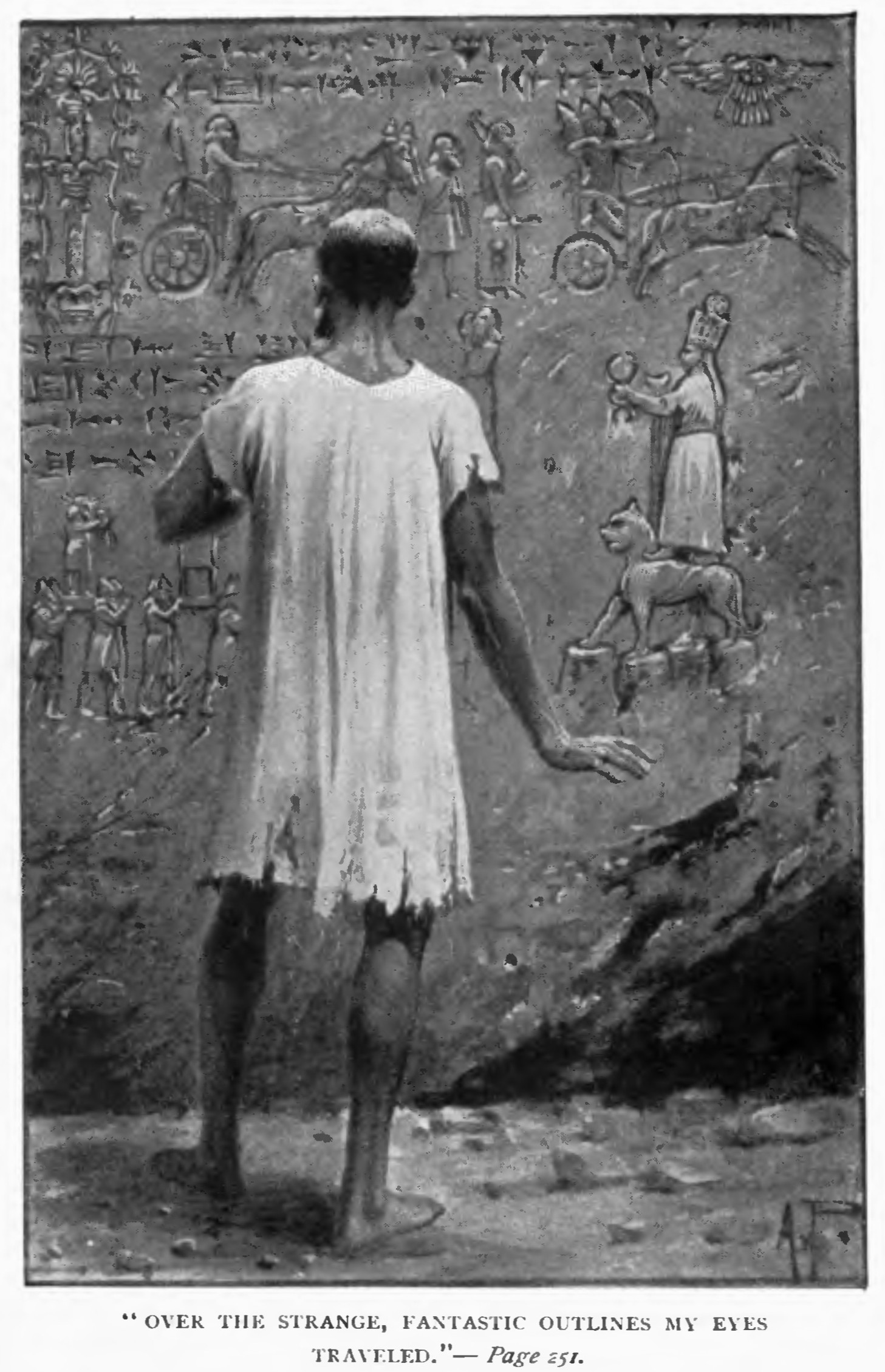
Over the strange, fantastic outlines my eyes travelled, deciphering the ancient scene it was intended to represent. An exclamation of amazement involuntarily escaped my parched lips, for it furnished me with the first clue to the mystery I was striving to elucidate. It told me of things of which I had never before dreamed.
Truly, I had struggled through the natural, and hitherto impassable barrier between the known world and that unknown, and was now actually on the threshold of a land of a thousand wonders.
The earnest, appealing words Azala had uttered, when requesting me to seek the truth, recurred to me, and, as I gazed upon these outlines, limned upon the rock-tablet by hands that ages ago had fallen to dust, I felt myself on the verge of a discovery even more extraordinary than any my wildest thoughts had ever framed.
The detail of the mysterious picture was amazing. Its art was unique—the art of a cultured, luxurious civilisation which had long been forgotten, even in the age when our lord Mahomet lived—but in it was one feature so curious and remarkable that its sight held me breathless, agape, transfixed.
The tablet, fashioned from the solid rock, was of great extent, with life-sized figures in bas-relief, sculptured with consummate skill, and as soon as my eyes caught sight of it I recognised its great antiquarian value. The study of forgotten nations had always attracted me from boyhood. Indeed, I had followed the example set by my father, who was perhaps the best-known antiquarian among the Arabs of Algeria, and was frequently sought out by travellers interested in the relics of bygone ages. While I was still a lad, he, at that time living in Constantine, met an Englishman named Layard, who came to examine the inscriptions at the Bab-el-Djabia and the ruins at Sidi Mecid, and subsequently embraced the opportunity of accompanying him through Kurdistan and Mesopotamia as interpreter. Afterwards, he assisted in the excavations on the sites of ancient Babylon and Nineveh, where many wonderful archaeological treasures were brought to light. He was present when the great winged bull was discovered beneath the mound of Nimroud, and on account of the keen interest he took in the various sculptures unearthed, and his ability to sketch them, he was promoted to be one of the Englishman’s chief assistants. Thus, from the first great discovery of Assyrian remains, my father had been enabled to study them, and when he returned home four years later, he brought with him many copies of strange cuneiform inscriptions, and drawings of curious sculptures, all of which interested me intensely. From him I thus derived my knowledge of the inscriptions of Babylonia, imperfect though it might be, but yet of sufficient extent to enable me to discern the Arabic equivalents of the strange lines of arrowheads graven upon this rock, and forming part of the picture I had so unexpectedly discovered. While at college in Algiers, I had eagerly devoured the few books in French, explaining the monuments of Babylonia, and in London had continued the study, by that means adding to the knowledge I had already gained under the tuition of my father. Few sons of Al-Islâm are archaeologists, but, as with my father, so also with me, the study had been a hobby, and on many occasions the French professors had expressed surprise at the extent of my knowledge of that strange language known as cuneiform.
By the dress and physiognomy of the figures portrayed upon the rock-tablet, I at once discerned they were not ancient Egyptian, as I at first believed, but Assyrian. The general arrangement of the picture showed it to be a record of similar character to those found in the wonderful buried palaces of Nineveh and Babylon.
In the faint glimmer of light I stood straining my eyes upon this silent record of a forgotten age. The first object I distinguished was a winged circle at the right-hand corner; the emblem of the Babylonian supreme deity. Below, in a chariot drawn by three handsomely-caparisoned horses, were three warriors in coats of mail, one being in the act of discharging an arrow at the enemy, one driving, and the third shielding his companions. The trappings of the horses, and the decorations of the chariot itself consisted of stars and other sacred devices, while at the side was suspended a quiver full of arrows, and the helmets of the warriors showed them to belong to the early Babylonian period. Following the chariot was a eunuch on foot, with a bow over his shoulder, a quiver slung behind, and bearing in his hand a kind of mace.
He was represented attired in a dress ornamented richly with gold and heavy fringe, while his upper garment was apparently a golden breastplate, across which showed the band by which the quiver was suspended. He wore no head-dress, and his feet were bare, but his position and bearing denoted that he was the servant of a monarch. Behind him there was depicted a chariot, not so gorgeously decorated as the first, drawn by two horses and led by two men, probably eunuchs. Over the horses’ heads rose high plumes, three in number, tassels fell over their foreheads and hung around their necks, together with rosettes, engraved beads and the sacred star; their tails were bound in the centre by ribbons, and suspended from the axle of the chariot was a large tassel. Standing behind, as if already passed by the expedition, the sacred tree was elaborately and tastefully portrayed, the tree bearing a large number of those mystic flowers that are so prominent a feature in early Babylonian decoration, showing that the dwellers within that wonderful city were possessed of highly-refined taste. Below was a picture of two scribes, writing down the number of heads and the amount of spoil, while the tablet behind them was occupied by many lines of graven arrowheads.
Underneath was pictured, in graphic detail, a peaceful, religious procession of gods, borne on the shoulders of warriors. Each figure was carried by four men: the first was that of a female seated on a throne, holding in one hand a ring, in the other a kind of fan, and on the top of her square, horned cap was a star. The next figure was also that of a female, wearing a similar cap, seated in a chair, and holding in her left hand a ring; she was also carrying something in her right hand, but its form I could not distinguish. The third figure puzzled me considerably; it was much smaller in its proportions than those preceding it, was half-concealed in a case or box, and had a ring in the left hand; while the fourth was that of a man in the act of walking, holding in one hand a thunderbolt, and the other an axe, evidently the Babylonian deity, Belus or Baal. Upon the identity of the other gods I was undecided, but in the right-hand corner of the tablet was sculptured a figure of the goddess Istar, the Assyrian Venus, draped and standing erect on a lion, crowned with a mural coronet, upon which was a star, denoting her divinity. In one hand she was represented as bearing the moon, and the other grasped two objects which had first attracted my attention and riveted my gaze. She was holding out two serpents, entwined in such a manner as to form the puzzling device with which my breast was branded—the Mark of the Asps!
Taking a small, flat stone, I stood on tiptoe and carefully scraped away the dirt of ages from that portion of the sculpture, finding underneath the two serpents engraven in minute detail. Then I scraped the dress of the eunuch and found the same symbol there depicted. Save in one or two instances, the ages that had passed since the great rock-tablet had been hewn had left it untouched. The deeper portions of the picture were, however, filled with dark grey moss and the accumulated dirt of centuries, but with the aid of the stone I commenced to scrape the inscriptions and very soon succeeded in so far cleaning them that the lines were decipherable.
It was apparent that the intention of the sculptor had been to portray, at the base of the picture, the procession of gods being carried into the Temple of Istar, or Astarte, but the reason she bore in her hand the entwined serpents was a mystery inscrutable. Upon the walls of the palaces at Nimroud, many representations of the goddess, bearing in her hand a single serpent, had been discovered, but never before had she been found pictured with the mystic symbol that had been the problem of my life.
I stood before the dark face of rock, speechless in wonderment, for here, as Azala had predicted, I had actually made a discovery, amazing and bewildering. The mark that we both bore upon our breasts had for ages remained engraven there, a symbol of forgotten deity, a device, no doubt, held in reverence and awe by a civilisation now vanished.
That vast, weird cavern, filled with the monotonous roar of tumbling waters, inhabited by blind, unknown animals and reptiles, yet rendered almost fairylike by its wonderful stalactites, which glittered whenever a shaft of pale light caught them, was indeed peopled by ghosts of the past. By whose hand had those marvellous pictures been chiselled? By whose order had that tablet been prepared? The dark, gloomy place was, indeed, well named the Gate of the Land of the No Return. Was I not actually within the Rock of the Great Sin? What, I wondered, was the nature of the great sin to which the rock had remained a mute witness?
With arms folded, I stood gazing upon the sculptured stone, long and earnestly, thinking, with affection, of the graceful, trustful woman who loved me, and for whose sake I had struggled to set foot upon ground that for ages had remained untrodden by man. Even at that moment I knew, alas! that her slave, Tiamo, would be on his way back to Kano to impart the news of my death, and I myself was powerless. To return was impossible. I was compelled to proceed.
But if I failed to discover any exit? The dread thought chilled my heart. Perhaps, after all, I had been entombed, and my fate would be death from starvation.
With only an impenetrable darkness beyond, the outlook was by no means reassuring; nevertheless, I struggled desperately to stifle my apprehensions, determined to decipher, as far as my knowledge served me, the cuneiform inscription, which I anticipated might explain the mystery of the symbol borne by the goddess Istar, whose worship formed such a historical feature in the religion of Babylon.
As I gazed around the dull, dispiriting, natural chamber, there crept over my heart a terrible sense of loneliness, such as I have never before experienced. Seized by an appalling, indescribable dread, I shuddered.
Next second, however, I set my teeth firmly, arguing within myself that upon my coolness my escape might depend, and then commenced a careful study of the parallel lines of chiselled characters. For fully an hour I was engaged in scraping and deciphering each word, finding their study so fascinating, that I actually forgot that I was alone in that wonderful natural prison. A considerable time elapsed before I could discover the commencement of the inscription, but having done so, I found that, with the exception of one or two small places, where the action of time upon the stone had caused it to fall in scales and thus efface the words, I could decipher it sufficiently well to ascertain its purport.
The words I read caused me to stand aghast. The statement, quaintly expressed and sometimes vague, staggered belief. Commencing about the centre of the tablet, it read as follows:—
“Ruler of the World and Builder of Babylon, the City of Cities, I, Semiramis, daughter of the Moon-god, Sin, who conquered the hosts of my enemies, who is never triumphed over by my foes, who put my captives to the sword and offered sacrifices, caused this record to be written by Nebu-sum-Iskum, my scribe, in the month Elul, day 18th, year 25th. Semiramis, Queen of Babylon.
“The record of my warriors, the battle-shout of my fighting, the submission of enemies hostile, whom Anu and Rimmon to destruction have given, on this my tablet and my foundation-stone have I written. The tablets of my father duly I cleaned; victims I sacrificed; to their places I restored for future days, for a day long hereafter, for whatsoever queen hereafter reigneth. When the temple of Anu and Rimmon, the gods great, my lords, its walls grow old and palaces decay, their ruins may she renew, my tablets and my foundation-stones duly may she cleanse, victims may she slay, to their places may she restore, and her name with mine may she write. Like myself, may Anu and Rimmon, the great gods, in soundness of heart and conquest in battle bountifully keep her. He who my inscriptions and my foundation-stones shall conceal, shall hide, to the water shall lay, to the fire shall burn, in dust shall cower in a home underground, a place, not seen for interpretation shall set, the name written shall erase and his own name shall write, and an attack evil shall devise; he also, from the world I have left, who seeketh to enter this my kingdom called Ea, the Land of the Lord of Wisdom, may Anu and Assur, the gods great, my lords, strongly injure him, and with a curse grievous may they curse him. May he wither beneath the touch of Niffer, lord of the Ghost Land, his kingdom may the gods dissipate, and may he be rooted up and destroyed from out of his country; the armies of his lordship may they devour, his weapons may they break, the destruction of his army may they cause; in the presence of his enemies wholly may they cause him to dwell; may the Air-god with pestilence and destruction his land cut off; want of crops famine and corpses against his land may he lay; against the sovereignty of his full power may he speak; his name, his seed in the land may he destroy.
“To extend my empire I left Ninyas, my son, to govern Babylon, and went forth with my legions into the land of the Ethiopians, and there overthrew mine enemies, of captives taken forty thousand, and of oxen twenty thousand, and much spoils of gold and silver and precious stones. And the number of the slaughtered men amounted to thirty thousand. Even while my warriors were counting their great spoils came there unto them news astounding, that over Babylon my son, Ninyas, had proclaimed himself king, whereupon my army that I had led rose up against me, their quern, and marched northward, through the land of the Egyptians, to the banks of the river where I built Babylon and constructed my gardens that overhang and are unsurpassed. May they enter the regions of corruption, the dwelling of the deity Irkalla: may dust be their food, their victuals mud; may the light they not see, and in a terrible darkness dwell. Of my legions and my slaves as many as have remained loyal unto me, numbering twenty thousand, renounced their citizenship, and after wandering and fighting for twenty moons, accompanied me unto this place, the road whose way is without return, to the house whose entrance is without exit, there to found a country that I have named Ea, and raised up my throne in a city which standeth from this Rock of Sin, the Moon-god, fifteen marches towards the sunrise... Here have I offered sacrifices to the Sun-god and to Anu, and set up this my record. To this, my land, none may enter and none may leave on pain of a death terrible and swift. Upon him who breaketh this my commandment may the wrath of the Air-god most avenging fall, may he be smitten with pestilence, may his limbs rot and drop asunder, and may he fall captive in the hands of the great Devourer of the Living... Lo! I am Astarte, worshipped by men in the temples of Babylon, and the star is set upon my head. This my commandment have I written here, at the Gate of the Land of the No Return, which is the only entrance to the country without exit; the country in which I have raised the city called Ea, the gates of which are of brass, and the magnificence of which surpasseth even Babylon which I built, and upon which my curse hath now fallen. These are the words of Semiramis, the queen whom men call Istar, daughter of the Moon-god, the conqueror of all enemies, who founded the Kingdom of Ea, to which men from the world we have left may not enter, neither may a single man, woman or child among my subjects leave. Verily, this my kingdom is the Land of the No Return, and I, Semiramis, who ruled over Babylon, and who, as Istar, ruleth all men throughout the world, have here built my palace and established my foundation-stones and set up my monuments. This throne have I, the goddess-queen of the world and of the heavens, erected. He who seeketh to enter my forbidden kingdom, to tear it out or overthrow it, so shall he and his family be torn out and be overthrown, and from his place shall he be uprooted. And I have set up this throne in the strength of the Sun-god Shamas, lord of light, and driver away of evil, to whom I have offered sacrifices and burnt-offerings abundant. These words I speak.”
Thrice I deciphered this strange record from beginning to end, to reassure myself that my eyes did not deceive me, until at length I became convinced that I had elucidated its meaning correctly; that I was actually on the threshold of the Land of the No Return; that could I only escape from my subterranean prison, I might actually discover the hidden, unknown and mysterious Kingdom of Ea, founded by the great queen, who, ages ago, built the most wonderful city of cities.
I stretched forth my hands above my head, and with a loud voice implored the aid, protection and guidance of the One. But my words only came back to me from the dark, damp recesses of the cavern, deep, distinct and dismal. There was no exit.
Chapter Thirty Four.
The Land of the No Return.
With strained eyes and failing heart, I gazed around the gloomy, sepulchral cavern. High above, a faint grey light glimmered far beyond my reach, while before me was only an impenetrable darkness, wherein I feared to venture, lest I should fall into some abyss. The curious wall-picture looked weird in the faint rays, and the long row of warriors, bearing the figures of their strange gods, presented a fantastic, but dismal, appearance. Once again I stood gazing at the strange sculpture, fascinated by the device of the asps, the strange symbol that had linked Azala’s destiny with mine, and the meaning of which it was my sole object to discover.
Beyond, in the undiscovered Land of the No Return, an explanation might await me, if only I could reach that mysterious region; but, as again I gazed about me, I could not rid myself of a horrible presage that the rushing, poisonous waters had drawn me to my doom. I had taken in every detail of that scene sculptured in the black rock with such minuteness that, if called upon, I could have made a drawing of it with accuracy, for therein lay the first clue to the mystery. This remarkable record of Semiramis, besides putting an end to the doubts which for ages had existed regarding her deposition as Queen of Babylon, also announced the establishment of a new colony, of which the world, up to that moment, had gained no knowledge. Historians, antiquarians, professors, imams and wise men of Al-Islâm had for centuries been puzzled by the strange legends, but had never penetrated the veil of mystery. It had remained for me to unearth a record of the highest interest, which for ages had lain hidden within its natural tomb. Deciphering those chipped lines of curious arrowheads, I felt myself on the threshold of a world unknown, and trembled lest I should encounter any uncanny or undreamed-of object in that wonderful chamber below the earth.
As I stepped across the sulphur-stained rocks, in order to examine the opposite wall of the cavern, my foot caught some object, and stooping, I picked it up. It was a short, straight sword of very ancient pattern, still in its scabbard, with a wonderfully wrought crosshilt of gold thickly encrusted with dirt. I endeavoured to draw the weapon, but failed, for the blade was firmly rusted in its sheath, therefore, finding it useless and only an encumbrance, I was compelled to cast it aside.
From where I stood I gazed upon the curious monument of a momentous but forgotten period, and the sight of the strange symbol brought vividly to my mind my faithful promise to Azala, and my dead mother’s injunction to prosecute the search after truth. I remembered that upon the result of my mission Azala’s happiness, perhaps even her life, depended; therefore, with sudden resolve, I saw that to escape by the way I had entered was impossible; to penetrate the rayless darkness beyond was the only chance remaining to me.
At first I shuddered at the suggestion, not because I entertained any foolish superstition, but the place was altogether so weird and extraordinary that I deemed it more than probable I should witness some terrible sight, or encounter some strange being unknown to our world. Unarmed, clothed only in a wet and ragged gandoura, but with my little string of charms I had worn since childhood still around my neck, I stood breathless in hesitation.
For Azala’s sake I had plunged into the Unknown, and I decided that to secure our mutual happiness I must face the consequences, which meant the exploration of that dark, sepulchral pit. Already Tiamo was on his way to her to impart news which I knew would cause her despair. Dire consequences might follow. Therefore I knew it was imperative that I should, in order that her grief might not be unduly prolonged, lose no time in seeking the truth and returning to her. Thus, at last, after considerable trepidation and hesitation, I strove to overcome my fears, and decided to proceed with my investigations, and search in the darkness for some exit.
Many were the perils I had faced fearlessly during my adventurous career as one of the Ansar of the Khalifa, and through the tedious journey in search of the Land of the No Return, but never in the darkest hours had I experienced such abject, indescribable fear as now froze my heart and held me inanimate and powerless. I clenched my hand, and, turning my eager ear towards the invisible portion of the great natural chamber, listened. But I could detect no sound beyond the roaring of the torrent; then, with a sudden determination to penetrate and explore the place, I strode forward into the very bowels of the earth, entering a darkness that could almost be felt, as impenetrable, indeed, as that to which our holy Korân tells us the tormented dwellers in Al-Hotama are doomed.
On, with both hands outstretched, I groped, now tripping in the fissures cut deeply in the rock by the tiny rivulets which seemed to traverse the floor of the cavern in every direction, now floundering through a quagmire of slush which emitted an unpleasant, sulphurous odour, often cutting my feet upon the sharp, jagged rocks, and frequently grazing my knees and elbows. But I was too excited to notice pain. Of the size or extent of the place I had no idea, but, having ventured therein, I was compelled to proceed, and continued my explorations, penetrating deeper and deeper into the tunnel-like cave. At first I had proceeded very slowly and with great caution, but soon, anxious to ascertain whether exit were possible, my feet hurried, and I stumbled quickly onward, eager to discover the extent and nature of the honeycombed labyrinth, fearing lest, after all, it might be merely a cul-de-sac.
I was actually in the very heart of the giant base of the Rock of the Great Sin, the wonderful black, towering crag which had only existed in the morning mirage of the desert and in the legends of the story-tellers throughout the Soudan. Over ground that foot of man had not trodden for ages I stumbled, seeking the unknown alone, unarmed, and in darkness appalling and complete. Reflection brought with it a sense of impending danger, an evil presage that, strive how I would, I could not get rid of its depressing influence. Yet the calm face of Azala, with her dark, serious, trusting eyes rose before me, and the thought continued to recur to me that for her sake I had striven, and, so far, been successful. Once again the knowledge of her passionate love held me to my purpose; once again I pressed forward blindly to seek the knowledge that for all time had been withheld from man.
On I went through the everlasting gloom, clambering over the rough, uneven rocks, then sinking knee-deep in the slimy deposits left by the rivulets. In the impenetrable darkness of the noisome place, strange noises startled me as blind, unseen reptiles escaped from my path, plunging into the water with a splash, and great lizards scuttled to their holes beneath the stones.
Between giant boulders, which had apparently fallen from the roof, I squeezed myself, climbing over high barriers of stone and creeping on all-fours through crevices that were all but impassable, I had proceeded for more than one hour. I shouted, but the distant echoes above and around showed that the extent of the gloomy place was bewildering, and so complete was the darkness that the terrible dread oppressing me became intensified. Nevertheless, one important fact gave me heart, causing me to persevere, namely, the atmosphere was not poisonous, showing that somewhere in that wonderful grotto air was admitted. Where there was air there must be light, I argued, and where light, then means of exit. Therefore I proceeded, with eyes strained in the blackness before me, hoping each moment to discern some welcome glimmer of the blessed light of day. But, alas! although my wandering footsteps took me deeper and deeper, no welcome ray was I enabled to detect. Had I but a torch, my progress would have been more rapid, for I could have avoided sinking into those sloughs of icy-cold slush, and could have stepped across the water-courses instead of stumbling clumsily into them. Half the horrors surrounding me would have been dispelled if my path had been lighted; but when I had stood before the graven picture I had sought carefully, but in vain, for wood that I might ignite by rubbing, and so construct a flambeau. Compelled to plunge into the impenetrable gloom, without light or means to defend myself, I was truly in unenviable predicament.
With dogged pertinacity of purpose, engendered, perhaps, by the knowledge that to escape from that subterranean chamber was imperative if I did not seek starvation and death, I kept on until my legs grew weary and almost gave way beneath me. My feet were so pained by the sharp stones that I at last tore strips from my gandoura and tied them up, obtaining considerable relief thereby. Then, starting forward again, faint and hungry, I plodded still onward towards the dreaded unknown. Some knowledge of the enormous extent of the place may be gathered from the fact that for fully three hours I had proceeded, when suddenly an incident occurred which caused me to pull up quickly and stand motionless, not daring to move.
Beads of perspiration broke upon my forehead as I realised an imminent peril. In walking I had accidentally sent some pebbles flying before me, and my quick ears had discerned that they had struck and bounded down into some abyss in the immediate vicinity. Instantly I halted, and it proved a stroke of good fortune that I did so, for on going upon my knees and carefully stretching forth my hands, I was horrified to discover myself on the very edge of a yawning chasm, the depth or extent of which it was impossible to determine.
Here, then, was an impassable barrier to my further progress! For three long hours I had struggled to penetrate the horrible place, but now, in despair, I told myself that all had been in vain.
My eager fingers felt the jagged edge of the abyss before me. Then, lying full length upon the damp, slimy rock, with head over the great pit, I shouted in order to ascertain its depth. My voice, though echoing above, sounded hollow and became lost in the depths below. Groping about, I discovered a stone the size of my fist, and hurling it over, listened, with bated breath. The minutes passed, but no sound rose. Again I threw down another piece of rock, but, as before, I could detect no noise of it striking the bottom. The chasm was unfathomable.
Again, taking some small pebbles worn smooth by the action of the water, I flung them a considerable distance into the darkness. Apparently they struck the rocks on the opposite side of the terrible pit, for I could hear them bounding down from crag to crag until the noise became so faint that they were lost entirely. Once more I shouted, but my voice echoed not in that vast, immeasurable abyss that had evidently been caused by the same great upheaval which had, ages before, closed the entrance to the cavern, and formed the dreaded Lake of the Accursed. Might not the exit have been sealed in the same manner as the entrance? The suggestion crossed my mind and held me appalled.
Finding myself unable to proceed further, I crept, still upon my hands and knees, along near the edge of the chasm for a considerable distance, until at last I found, to my delight, that it extended no further, and by the exercise of constant caution I crawled onward, length by length, until I discovered, by casting pebbles about, that I had passed it. Then gladly, with a feeling of apprehension lifted from my heart, I rose again, and with renewed energy continued my way.
After this incident I took every precaution, consequently my progress was slow and painful. The thought of how narrowly I had escaped a horrible death caused me to shudder, nevertheless my eyes were eager to discover some welcome gleam of light and hope. During yet another hour I struggled forward over ground that rose gradually, then descended again so steeply, until I began to fear that another chasm lay before. My fears, however, in this direction proved groundless. Yet, as I proceeded, the little stream seemed to increase in volume, and there was a damp, noxious smell about the noisome place which gave rise to a belief that, after all, there was no exit, and that the cavern, like the forbidden land, was a place whence, if once entered, there was no return. Just as that conviction was forced strongly upon me, I also discovered another more startling fact, which rendered my despair complete, and told me plainly that in that dwelling of the Great Devourer I should find my grave.
My progress had been arrested; my hands had come into contact with a wall of rock which stretched before me on either side. I shouted, and the unseen rock gave back my voice, proving that I had gained the extreme end of the cavern.
Determined to thoroughly investigate this abrupt termination of the place before seeking an exit in another direction, I crept forward, feeling the rough, rocky wall with eager, trembling hands. Having proceeded for some distance, my heart suddenly bounded with excitement as I discovered another outlet beyond, and eagerly stumbled forward, still in impenetrable gloom. All the strange legends and tales of the story-tellers I had heard related regarding this weird place surged through my mind, and, as I pressed forward, I admit that I was in constant fear and trepidation lest I should meet, face to face, the legendary tenant of this limitless subterranean labyrinth, the terrible being referred to on the tablet of Semiramis as the Great Devourer, or Guardian of the Gate of the Land of the No Return.
But the entrance to the forbidden land, if thus it proved to be, was difficult enough, and guarded by horrors and pitfalls sufficient without the necessity of a janitor such as that described so luridly by tellers of strange romances in the desert-camps. Stumbling on up a steep incline I was at length compelled to halt to regain breath. Weakened by the desperate fight I had had for life amid the roaring torrent which had sucked me down, fatigued by the struggle to penetrate the deep recesses of the cavern, I rested for a few moments, my head reeling and my legs trembling as if unable to support my body. Suddenly a loud, shrill cry caused me to start, and next second a gust of air was swept into my face by the flapping of enormous wings. For an instant I felt the presence of some uncanny object near me, but in a moment it had gone, and when I recovered from my sudden alarm, I knew that it was some great bird which probably had its nest in some deep and secret crevice. Its shrill, plaintive cry echoed among the vast recesses, but grew fainter as it flew on before me. My sudden terror was quickly succeeded by feelings of satisfaction, for the presence of the bird was sufficient proof that there was an exit in the vicinity.
With heart quickened by excitement I once again moved forward, gained the summit of the incline, clambered quickly over some gigantic masses of fallen rock, and at last, when I had mounted to the top of what at first seemed an impassable barrier, my eyes were gladdened by a sight which caused me to cry aloud with joy.
Far below me, so distant as to appear like a mere speck of grey, the light of day was shining.
Its approach was by a rough and exceedingly steep descent, but I hurried on with foolish disregard of the perils which beset my path, on account of the slippery deposits on the stones. Once or twice I nearly came to grief. In places the descent was so abrupt that I had to turn and crawl down, steadying myself with my hands and knees; but I heeded nothing in my frantic eagerness to escape and gain the dreaded Land of the Myriad Mysteries.
As I neared the opening, I discovered it was not large, and half choked by masses of rock that had either fallen or been placed there to bar the entrance, while about them were tangled masses of profuse vegetation, which no doubt hid the existence of the cavern to any who should chance to pass it outside. In the high roof near the exit, hundreds of birds of brilliant plumage had their nests, and were flying in and out, singing and uttering shrill cries, while in the light and air, moss, plants and giant ferns grew in wild profusion. Great green snakes, too, lay curled beneath the stones, and I was compelled to be wary, lest I should be bitten. Even on arrival here my escape was barred by a huge mass of stone three times higher than myself, and so wide that it entirely filled up the exit. Nevertheless, I managed, after considerable difficulty, to scale the rocky obstacle, and pausing on its summit for a moment, I ascertained that a dense forest lay beyond. Then I descended through the tangled bushes and creepers to the ground outside, and once more stood free in the fresh air, with a brilliant, cloudless sky above.
I had actually set foot in the forbidden Land of the No Return!
But it was already the hour of the maghrib, and the fast dying day showed that the time I had spent in the wonderful dwelling of the Great Devourer, was longer than I had imagined. Remembering that at that hour Azala had opened her lattice and breathed to me her silent message of love, I sank upon my knees, and turning in the direction of prayer, went through my sunset devotions with an earnest fervency which I fear was unusual, thanking Allah in a loud and thrice-repeated Fatiha. Rising, and lifting my hands to heaven, I uttered the words that pilgrims repeat before the Black Stone in the Holy Ca’aba: “There is no God but Allah alone, Whose Covenant is Truth, and Whose Servant is Victorious. There is no God but Allah without Sharer; His is the Kingdom, to him be Praise, and He over all Things is potent.”
Then, having kissed my fingers, I made a meal from bananas I plucked from a neighbouring tree, and having slacked my thirst at a tiny stream, the water of which was as cool as that of the well Zem Zem, I skirted the forest for a considerable distance, but finding my further progress barred by a wide river, that, emerging from the wood, ran in serpentine wanderings around the base of the high, inaccessible mountains, I was compelled to plunge into the forest. Upon the tablets of Semiramis, it was stated that the unknown city of Ea had been built at a spot fifteen marches towards the sunrise, therefore in that direction I proceeded.
At first, the forest was rendered dark and gloomy by the entangled bushes, but the trees soon grew thinner, yet more luxurious. Many of them were in blossom; many bore strange fruits that I had never before beheld; while the ground was carpeted with moss and an abundance of bright-hued flowers. Everywhere was an air of peaceful repose. Birds were chattering before roosting in the branches above, the rays of the sinking sun gilded the leaves and fell in golden shafts across my path, a bubbling brook ran with rippling music over the pebbles, and the air was heavily laden with the subtle scent of a myriad perfumes. Presently, when I had penetrated the belt of forest and emerged into the open grassland, I stood in amazement, gazing upon one of the fairest and most picturesque landscapes that my wondering eyes had ever beheld.
The country I had entered was the dreaded kingdom of the Myriad Mysteries; yet, judging from its fertility and natural beauties, it appeared to me more like the paradise our Korân promises for our enjoyment than a land of dread. Indeed, as I stood there in the cool sunset hour, amid the fruitful trees, sweet flowers and smiling plains, bounded far away by ranges of purple mountains, I doubt whether it would have surprised me to have met in that veritable garden of delights the black-eyed houris which the Book of Everlasting Will describes as dwelling in pavilions, among trees of mauz and lote-trees free from thorns. Such, indeed, I thought, must be the dwelling-place prepared for the Companions of the Right Hand, for are they not promised couches adorned with gold and precious stones, under an extended shade, near a flowing water, and amidst fruits of abundance which shall not fail nor shall be forbidden to be gathered?
Slowly turning, I gazed back upon the Rock of Sin, the Moon-god, the name of which in the centuries that had passed had been so strangely corrupted by Arabs and pagans alike, and noticed that although from where I stood its summit looked similar in form to its aspect from the other side of the Lake of the Accursed, yet it was not so lofty here, and evidently this hitherto undiscovered region was considerably higher than the countries surrounding it, although even here the mountains forming its boundary were of great altitude, many of their summits being tipped with snow. Dark, frowning and mysterious, the rock rose high among the many peaks of the unknown range, while behind the giant crests to the left the western sky was literally ablaze, and the sun, having already disappeared, caused them to loom darkly in the shadows.
Out upon the plain I passed, keeping still to eastward, but soon the light blue veil of the mountains before me became tinted with violet and indigo, and finally settled into leaden death. Then night crept on, and the stars shone bright as diamonds in a sultan’s aigrette. During several silent hours I could discover no sign of man, but at length, when I had crossed the plain, with the moon lighting my footsteps like a lamp, I approached, at the foot of a hill, a wonderful colonnade of colossal stone columns, some of which had broken off half-way up and fallen, while across the quaintly-sculptured capitals of others there still remained great square blocks that had once supported a roof. Here and there in the vicinity were other columns, singly, and in twos and threes, while the intervening ground was covered with débris, over which crept a growth of tangled vegetation, as if striving to hide the ravages of time.