"A Romance of the Land of No Return" (continued 6)
Reading edition
The great ruin, apparently of an ancient palace or temple, stood in desolate grandeur, ghostly in the white moonlight, while behind rose verdant hills, steep and difficult of ascent. Approaching close to the columns, through a mass of fallen masonry and wildly-luxuriant verdure, I examined them, and was struck by the enormous size of the blocks of stone from which they had been fashioned, and the curious and grotesque manner in which they had been sculptured with figures. The art was of the same character on these monoliths as upon the tablet of Semiramis, the beautiful and brilliant queen who was worshipped as a goddess. There were many representations of the Assyrian deity, and in places lines of cuneiform writing, but the suns and rains of ages had almost obliterated them, and had also caused much damage to the sculptured figures.
In the silence of the brilliant night I stood beneath those amazing relics of a forgotten civilisation and pictured the departed magnificence of the wonderful structure. There remained portions of an enormous gateway, with giant winged human figures carved out of huge blocks of stone; and on examining one of these I found a portion of an inscription, in long, thin lines of arrowheads, easily decipherable in the full light of the moon. After a little difficulty I succeeded in reading it as follows:—
“In the beginning of my everlasting reign there was revealed to me a dream. Merodach, the Great Lord, and Sin, the Illuminator of Heaven and Earth, stood round about me. Merodach spake to me, ‘O Semiramis, Queen of Babylon, with the horses of thy chariot come, the bricks of the House of Light make, and the Moon, the Great Lord within it caused to be raised his dwelling.’ Reverently I spake to the lord of the gods, Merodach, ‘This house, of which thou speakest, I will build, and the temple shall be the dwelling of the Moon-god in Ea’.”
What a magnificent pile it must have been in those long-forgotten days when the legions of Semiramis marched, in glittering array, through the long colonnade to worship the Moon-god, Sin, beneath the statues of illustrious Babylonians! or when their luxurious ruler, enthroned a queen in the hearts of her people, and dowered with charms that inspired to heroism, flashed through those great corridors in her gilded chariot, surrounded by her crowd of martial courtiers and fair slaves! or when, with bare arms and golden helmet on her head, with all the pomp of war, she sallied forth on her fleet steed, caparisoned in crimson and gold, to review and harangue her warriors on the plain.
Allah had destroyed it because it was ungodly.
No trace of the presence of living man had I discovered, and I began to wonder whether, after all, this Land of the No Return was uninhabited; for was it not likely that in the ages that had passed since its discovery by Babylon’s queen, the colony, like the once-powerful race beside the Euphrates, had dwindled away and become entirely extinct! There were no signs of these ruins having been visited, no trace of any recent encampment, or the dead ashes of the fires of recent travellers. Upon the stretch of bare, stony ground, before the half-ruined gateway which would have served as a good camping-ground, I searched diligently, but discovered nothing that proved the existence of inhabitants; therefore, wearied and footsore, I at length threw myself down at the base of one of the giant monoliths, and with part of my gandoura over my face to shield it from the evil influence of the moonbeams, sank into heavy, dreamless slumber.
Chapter Thirty Five.
A Visitant from the Mists.
Day had dawned fully three hours ere I arose. The great ruins, revealed by the brilliant morning sun, were much more extensive than I had at first believed. For fully half a mile mighty columns rose, here and there, like gigantic, moveless giants; many had fallen, and their walls of enormous blocks and their prostrate pillars looked up piteously to the day. Time alone had worn down their rigid strength, and swept the capstones from the towers. Time, too, had clad some of them in a disintegrating mantle of green.
There was not one of the hundred columns and monoliths in which did not lurk some tale, or many tales, of loyalty, or treason, or despair. There was not one of the five great gates I could distinguish whose portal had not swung open wide for processions of triumphal pageantry, of exalted grief, of pagan pomp, or military expedition. Thick as the leaves of the climbing plants, festooning crevice, niche and broken parapet, must be the legends, traditions and true tales that enwrapped those walls if man still inhabited that land. Upon the stones, chipped with surprising neatness and regularity, were many uneffaced inscriptions; the pompous eulogies therein contained being the only epitaphs the long-dead founders of the Kingdom of Ea possessed. This prodigious pile, useless centuries ago, torn by earthquakes and half levelled by time, was indeed a fitting monument to the great Semiramis, the self-indulgent Queen, the conqueror of all lands from the Indus to the Mediterranean, and builder of Babylon, the most extensive and wonderful capital in the world.
At last, turning my back upon the desolate scene, I went forward and commenced to ascend the steep hillside. It was a stiff ascent, but, on gaining the summit, I looked down upon a panorama of beauty impossible to adequately describe. Streams, forests and verdant valleys stretched out below, bounded far away by a range of fantastic mountains rising in finger points in all directions. Proceeding in search of the mysterious, unknown city, which, according to the inscription, lay in the direction of prayer, I descended the steep hill, passed through vast entanglements of jungle in the valleys, suddenly coming across a delightful stream watering a narrow valley with precipitous walls of rock on either side, and densely filled with all kinds of tropical vegetation. I ate some bananas, revelled in the luxury of a bath, and then continued my journey towards the sunrise by plunging into a forest of quol-quol trees, some of which reached to the height of sixty feet, stretching out their weird arms in every direction. The quol-quol is an uncanny-looking tree, exuding a poisonous, milky gum, which is exceedingly dangerous. The Dervishes, in making their roads around Khartoum and Omdurman, had much difficulty with this tree, for the milk from it, if it squirts into the eyes when the tree is cut, produces blindness. Beneath the trees were flowering, rich-coloured gladioli, long, hanging orchids, sugar plants, and many thorny trees of a species I had never before seen.
Lonely, and half convinced that I had entered a land uninhabited and forgotten, I threaded the mazes of this veritable poison forest, at length emerging into a clump of gigantic baobabs, and thence into a slightly undulating district, sparsely clothed with thorns and euphorbia, and teeming with game. At last I found myself crossing a beautiful, park-like track where herds of buffalo grazed undisturbed, and at sundown came to a rich, fertile country, dotted with clumps of pine-trees and large patches of forest, abounding in pretty glades and glens of mimosa brush full of beautiful blue birds and monkeys.
That night I sought sleep under a huge sycamore, and next day continued my tramp towards the distant range of mountains, over the crests of which showed the first rosy tint of dawn. Compelled sometimes to wade streams, and often climbing and descending precipitous rocks, passing through narrow, romantic gorges, and coming now and then upon beautiful and unexpected cascades, I toiled onward through that day, and although I passed some ruins, apparently of a house, half hidden by wild vegetation, yet I discovered no trace of the existence of living man. Never before had I experienced such a sense of utter loneliness. I had the bright sun and cloudless sky above. I was free to wander hither and thither, and around me grew fruits that were the necessaries of life; but I was alive in a region which, as far as I could observe, had remained untrodden for many centuries. Again I spent the night beneath a tree, my head pillowed on a fallen branch; and again I set forth to reach my goal, as recorded on the rock-tablet of Semiramis. Forward, ever in the direction of the Holy Ca’aba across grass plains, through rocky ravines and shady woods bright with flowers, and as sweetly scented as the harem of a sultan, I trudged onward, in my hand a long, stout staff which I had broken from a tree, in my heart a feeling that I alone was monarch of this smiling, unknown Land of the No Return that I had discovered.
Yet I remembered that, after all, I had not yet elucidated the mystery of which I was in search—the reason of the Mark of the Asps; and although I had discovered it in the hand of the Assyrian goddess, yet such discovery only increased its mystery. So I kept on my toilsome path, stage by stage, still pious, still hopeful, still believing that the secret of the linked reptiles would eventually be explained.
Never swerving from the direction of the sunrise, and each day at the maghrib making a mark upon my staff with the sharp stone I carried, I continued in search of the city of Semiramis. Up the almost inaccessible face of one of the great mountains of the range I had seen afar I toiled many hours, until, stepping from sunshine into mist and drizzle, my feet were upon the snow that covered their summits, and the intense cold chilled me to the bone. Higher yet was I compelled to climb, until, as if by magic, I passed through the belt of mist into brilliant sunshine again. The effect was one of the most curious I had ever witnessed. Below was a sea of crumpled clouds, extending as far as the eye could reach, out of which peered high mountain peaks like islands in a sea of fleecy wool. During two whole days I clambered, half-starved and chilled, across this vast, towering range. The air was health-giving and invigorating. In the early morning everything was clear and bright; as the day advanced the clouds would gather from the plains and gradually roll up the mountain side, enveloping the lowlands and valleys in a dense mist; occasionally, towards sundown, this mist would roll over the edge and envelop a little of the high plateau in its clammy folds, but it quickly dispersed as the sun went down, and the morning would again break bright, with hoar frost sparkling everywhere.
At the foot of the mountains the ground was swampy and enveloped perpetually in a white mist, so dense that, for a further period of two days, I wandered over the marshes, not knowing the direction in which I was travelling, but trusting to the keen natural instinct with which men of my race are endowed. So dense was this mist hanging over the trackless, pestilential bog that I could distinguish nothing a leopard’s leap distant, and my gandoura was as soaked with moisture as if I had waded a river. Judge my surprise, however, when suddenly I found that the vapours had veiled from my eager eyes another more inaccessible and still higher belt of mountain than the first.
Darkness was already creeping on when I made this discovery, therefore I resolved to rest and sleep before attempting to climb the rugged heights before me. It was necessary, in order to discover the direction of the mysterious city, that I should climb above the belt of impenetrable mist and take bearings in the clear atmosphere. Fortunately I had found a banana-tree a few hours previously and carried some of its fruit with me, therefore I ate my fill, and afterwards threw myself down to snatch a few hours’ slumber.
How long I lay I know not, but I was startled by feeling a soft, clammy object steal slowly across my breast. It was as icy cold as the hand of a corpse. Opening my eyes quickly, I was dazzled by a brilliant light shining into them, but in an instant the bright flash disappeared and an unearthly and demoniac yell sounded about me. In the impenetrable darkness, caused by night and the dense mist combined, I could distinguish nothing, but, starting up, held my breath in alarm, listening to the echoing yells receding in the distance. They sounded like three loud shouts in the same strain, followed by a long, plaintive wail.
At first I endeavoured to reassure myself that my breast had not been touched by the clammy snout of some wandering animal which had been startled by my sudden movement, but try how I would I could not convince myself that those yells proceeded from any but a human being. Again, as I felt my gandoura, I discovered that it had been unloosened with care, evidently for the purpose of closely examining the mark I bore upon my breast! The bright light, too, was an undeniable fact which pointed conclusively to the presence of human inhabitants of this mist-enveloped ravine.
Sleep came no more to my eyes, for through the long, dreary night I kept a watchful vigil. Strange noises, as if of some one moving cautiously in my vicinity, sounded about me, but in which direction I could never detect with certainty, for both shadows and sounds became distorted by the thick vapours by which I was surrounded. Several times I heard the same mysterious, mournful cry, now close to me, and again sounding afar, as if in answer to the plaintive call. Scarcely daring to move, I patiently awaited the light of day, which came at last, spreading gradually at first, but soon causing the darkness around me to fall, and the white, choking vapours to become more dense and bewildering. There was the same strange, sulphurous odour that I had experienced when swimming the Lake of the Accursed, and I began to fear that the poisonous gases exuded from the swamps would cause asphyxiation. As soon, therefore, as the light grew strong enough to enable me to see where I placed my feet, I started forward to face the huge mountain. I had not taken three paces before my eyes, keeping careful watch upon the ground, detected something which caused me to involuntarily utter a cry of surprise.
At my feet was lying a short, straight sword, in a scabbard of beautifully-chased gold, with a magnificently jewelled cross hilt. It was attached to a leather girdle, the buckle of which was thickly set with fine emeralds, and the bright condition of the scabbard, and the keen, unrusted appearance of the blued-steel blade told me that it had not remained there many hours. Then it occurred to me that the weapon was similar in design to the ancient one I had found in the Cavern of the Devourer, and that it must have been dropped by my mysterious visitant. It was plain that, after all, I was not the only human being in that mysterious Land of the No Return; equally certain, also, that my intrusion had been discovered.
Was this the Land of the Myriad Mysteries, that region dreaded by my clansmen of the deserts from the Atlas to the Niger? Was this weird, misty gorge, devoid of herbage, and exuding a death-dealing breath, the actual entrance of the territory of all-consuming terror?
I paused, examining the weapon curiously, wondering who might be its owner. Fearing, however, to remain there longer, I buckled the girdle about my waist, and aided by my staff, commenced the steep and toilsome ascent.
An hour’s hard climbing took me above the heavy vapours into the brilliant light of day, and I then discovered that the mountain I was negotiating was of greater altitude than any of the peaks of my native Atlas. At first the slopes were grass-covered, and mimosa bushes grew plentifully, but as I went higher there were only patches of stunted herbage, and higher still no herbage grew. As hour by hour I toiled upward, in places so steep that I had to use both hands and knees, I gradually neared the region of eternal snow. Soon after noon I halted, seating myself upon a rock to rest. Gloomy thoughts oppressed me. Below was nothing but a sea of vapour; above a sky brilliant, without a cloud.
Being compelled to pass through that curious gorge of grey, eternal mist, I had lost my bearings entirely, and knew not in what direction I was now journeying. For the past two days I had been travelling through a shadowy and inhospitable region, wherein I had seen not a beast of the field nor fowl of the air. The action of the mysterious visitant puzzled me. If it were a man, as I supposed, why should the mark upon my breast have such attraction for him? In his hurried flight he had lost his sword, and apparently feared to return to seek it. The enigma puzzled me, occupying my thoughts during the whole of that fatiguing and perilous climb.
Having rested for nearly an hour, my eye suddenly caught the notches upon my staff. I picked it up and carefully counted them.
They were already fourteen. On this, the fifteenth day, I ought, if credence were to be placed in the rock-tablet of Semiramis, to reach the mystic city of Ea.
Eager to gain the summit and gaze upon the land beyond, I rose and once more plodded onward with dogged pertinacity. Upwards I strode, until the perspiration rolled in great beads from my brow, and my matted, unkempt hair became wet from the same cause. As I gained a kind of small plateau, covered deeply by untrodden snow, an icy blast chilled me to the marrow, causing me to wrap my rags closer about me; but heeding not fatigue, I sped rapidly over the small plain and commenced the final ascent to the lowest crest over which I could pass. This occupied me fully two hours, for the ascent was the most difficult I had yet encountered; but presently I found myself upon a stretch of comparatively level ground, with snow lying thickly everywhere, and the surface frozen so hard that my feet left no imprints. Beyond this plain was only the sky, therefore I knew that I had at last reached the highest point.
In order to regain breath I was compelled to halt for a few seconds, but those moments were full of intense eagerness. What lay beyond I feared to ascertain. Whether I had travelled in the right direction I was unaware; but if I had, then it was time that I should reach the goal for which I had so long and so arduously striven.
The iron of despair was entering my soul, but next second, shaking if off, I dashed forward at full speed to the edge of the lofty plateau, and gazed with wondering, wide-open eyes into the land beyond.
The panorama below held me speechless in wonderment. Dumbfounded, I stood open-mouthed, rigid, rooted to the spot.
Chapter Thirty Six.
The Torture-Wheel.
The scene which burst upon me was so unexpected and startling, that at first I found myself doubting my own senses, and was inclined to believe that it was merely a mirage, or some fantastic chimera of my own imagination. As I continued to gaze upon it, taking in all the details discernible from that distance, I was compelled to admit that the objects I saw existed in reality, and to congratulate myself that I was actually within sight of my longed-for goal.
Behind me the sun was fast declining, but deep below, there stretched on either hand a broad river, winding far away into the distant, purple haze. At the foot of the giant mountain whereon I stood was a great stretch of grassland, across which ran a road paved like those the Franks construct in Algeria, and straight as a spear shaft, leading to a most wonderful and amazing city.
Surrounded by stone walls of colossal size and enormous height, houses extended as far as the eye could reach, and even from where I stood I could detect that the thoroughfares, running at right angles to each other, were all broad and handsome. The architecture, as far as I could distinguish, was such as I had never before seen, and the houses, built upon a great hill rising abruptly from the plain, rose tier upon tier to the summit, which was crowned by an enormous palace with a roof of burnished gold, which glistened with blinding brightness in the brilliant rays of the declining sun. Close by, from the extreme summit of the hill, rose a square tower of such colossal proportions that it seemed to reach to such a height that the building, at its summit, was in the gathering clouds of evening. The highest portion of the tower was of silver, then, counting downwards, it was blue, then pale yellow, then bright gold, red, orange and black. Each of these stages, I knew, represented one of the chief heavenly bodies—the silver being that of the Moon, the blue Mercury, the yellow Astarte, the gold the Sun, the red Mars, the orange Jupiter, and the black Saturn. I had read long ago, in the records of Babylonia, of the similar temple tower that Nebuchadnezzar built at Birs-i-Nimrud, and, glancing in other directions, saw similar edifices dotted everywhere.
The great palace on the hilltop was so extensive that its buildings and gardens stretched away into the blue distance, and its walls and colonnades were, like everything within that wonderful place, so enormous in their proportions as to be amazing. Through the centre of the palace gardens ran a beautiful river, spanned by many bridges, and as it wound away, it branched out into another stream that meandered through the city. Upon the very summit of the hill, in close proximity to the temple tower, and within the impregnable walls of the palace, rose a pavilion, the walls of which appeared to be constructed entirely of gold.
But it was not only there where the eye was dazzled. The hundred enormous gates in the strong walls that girt the city were of gold, and even as I looked I saw a cavalcade of horsemen crossing the plain, the sun’s rays slanting upon the breastplates of polished gold, giving the well-drilled band the appearance of a broad, glittering thread.
At each entrance to the city were high watch-towers whereon soldiers stood ever-watchful night and day, and the wonderful walls, that even Time could not throw down, were evidently used for promenading, for I could distinguish many objects, like tiny, black specks, moving over the broad thoroughfare formed thereon. On either side, as far as my keen vision could penetrate, nothing presented itself but a colossal and magnificent city of villas, palaces and temples, of pavilions of red and silver, of beautiful, shady gardens, and wonderful structures in tiers of various colour, of temple and tomb towers, of square, solidly-built, flat-roofed residences, of bridges of polished marble and alabaster, and wonderful brazen gates. The proportions of its buildings, even though I could only obtain but a bird’s-eye view, were marvellous, the wideness of its thoroughfares astounding; its thousand towers and pinnacles beggared description; its extent so great as to cause me to stand aghast.
This, then, must be the majestic city of Ea, the wonderful capital, founded by the beautiful but frail woman who had constructed it in imitation of Babylon. While the latter city had ages ago fallen to decay, and sunk forgotten beneath the earth’s surface, this magnificent place, with its ostentatious display of wealth, even in its very gates, had remained through a hundred generations; the same amazing, impregnable citadel of the great queen’s faithful followers; the same collection of palaces of bewildering luxury; the same time-defying stronghold of a warlike race, the same stupendous centre of incredible extent; the same unapproachable capital of an unapproachable land, as when Semiramis herself, surrounded by her lovers and courtiers, entered its brazen gates with pomp and splendour, amid the clash of cymbals, the beating of drums, and the flourish of trumpets.
Her great temple, with its unequalled colonnade, which I had passed some days ago, had, for some reason unaccountable, been allowed to crumble and fall away, but here, in this marvellous city of a thousand wonders of imposing forms and harmonious outlines, the memory of one of the most notable of queens was perpetuated. And I was the first man from the outer world to gaze upon this one glorious and unique monument of a long-forgotten past!
I stood leaning upon my staff, lost in astonishment, watching agape the incredible scene. Fascinated and stupefied by its magnificence, I contemplated it in bewilderment, while the afterglow, shedding a ruddy light upon its wonderful towers, caused the burnished gates and roofs to shine red as blood. Soon it died away, and when the sun sank in the mists behind me, a sudden gloom fell, and chill night crept rapidly on. As the stars appeared in the heavens, a million lights shone everywhere in the city, the broad streets of which seemed bright as day. Great sacrificial fires threw an uncertain light from the summits of some of the taller towers, and from the wonderful fabric on the summit of the hill one single light of intense whiteness shone brilliant as a star.
An hour sped by, yet still I remained lost in astonishment. The myriad lights gave the strange city a curiously weird aspect, and I feared to meet any of its denizens. Were they, I wondered, of the same form as my fellows of the outer world, or were they veritable giants in stature, that they should build structures of such incredible proportions?
Though I dreaded to meet them, yet I longed to be able to pass those ponderous brazen gates, to tread those wondrous streets, to enter those curiously graduated temple towers, and wander in those shady gardens beside the running waters.
With my bejewelled sword and girdle strapped over my dirty, ragged gandoura, should I be enabled to pass those gates and enter the city forbidden to those outside the rock-girt boundary of this unknown kingdom? This question I asked myself a hundred times, compelled to doubt whether such attempt would not result in my arrest and perhaps execution as a spy. I had faced without fear the thousand perils of my journey from the City of the Mirage; but to encounter the guards of mighty, mystic Ea would, I knew, require all the courage of which I, as an adventurer, was possessed.
When, however, the moon shone out, I began slowly to descend towards my goal. With exceeding difficulty I let myself down over those slippery, snow-covered rocks, treading ofttimes on perilous ledges, where a false step meant instant death on the crags beneath. Naught cared I of the risks I ran in descending so rashly, but, eager to set foot upon the plain, I stumbled on, now jumping, now crawling, until I gained a grass-grown slope where progress was not fraught by so many dangers.
Suddenly I came to a rocky gorge, down which roared a broad, swift torrent, and, as it came into view, a scream of pain and despair broke upon my ear. The sound seemed suddenly smothered, then, a few moments later, echoed again. I listened, and found that it sounded with regularity above the roaring of the waters. Whence it proceeded was a mystery, but, as I followed the stream in my descent, I suddenly encountered a great chasm in the earth, before which was an enormous wooden wheel, revolved by the current which flowed beneath, and then disappeared to feed some subterranean river.
As I watched it in the full moonlight, puzzled as to its use, the scream startled me again, and, at the same moment, I perceived something white upon the moss-grown wheel flash above for a moment, and then plunge beneath the water. Again it rose, and was again plunged in. A third time it rose, and my eyes, now on the alert, caught the form of a man, who, tightly-bound to the wheel, was being every moment plunged into the icy stream.
Then I knew that the wheel was used for one of the most horrible forms of torture and death. Alone, the wretched victim was slowly dying, dreading every moment to meet the water, and each time, as he rose in the air, awakening the echoes by his despairing cries for rescue. He passed me so closely that I could touch him with outstretched hand where I stood, but so swiftly that, although a dozen times I strove to cut his cords with my sword, I failed. The manner in which the wheel could be stopped I knew not, and was thus compelled to stand and see the poor wretch die before my eyes. Apparently he recognised that my efforts to release him had been unavailing, and swooned, his unconsciousness being quickly followed by suffocation.
Even as I stood watching, I heard footsteps, and, slinking back in the shadow behind a great rock, saw approaching four tall men of fine physique, wearing shining breastplates, bearing between them the frail, inanimate form of a woman. They were followed by two other men, who, by screwing down a block of wood on the axle of the wheel, raised it above the raging torrent. With a few swift strokes of their swords, the men severed the bonds that held the body of the victim, and, as it fell with a splash into the whirling stream, it was speedily engulfed, and swept down the chasm into the bowels of the earth.
The men, who spoke a tongue unknown to me, laughed roughly among themselves as it disappeared, and then, tearing from the woman her golden ornaments, they bound her upon the wheel. While doing so she recovered consciousness, and, recognising her impending fate, gave vent to a shrill, heart-rending scream. But her cruel captors merely jeered, and, having ascertained that she was secure, again lowered the wheel, which immediately began to revolve.
For a few moments the soldiers watched the monotonous punishment, then, in response to a word from the one apparently in authority, descended the path and were lost to view.
As soon as they were out of hearing I emerged from my hiding-place, and, acting as I had seen the men act, succeeded at length in raising the wheel, and, grasping the trembling form of the woman, severed her bonds and dragged her from her perilous position, afterwards lowering the terrible wheel and allowing it to again revolve.
Taking her in my arms I bore her some little distance, and, after some effort, restored her to consciousness. Her hair, which fell to her knees, was like golden sheen, and her complexion as pale as those of the women of the Infidels who come to see the Desert at Biskra, or seek renewed health from the waters of Hamman R’hira. Indeed, the people of Ea all seemed white-skinned, for the brutal soldiers had in their faces no trace of negro origin.
When the woman I had rescued opened her eyes there was a terrified look in them, but on finding that I was supporting her head and endeavouring to bring her round, she uttered some words. Not being able to understand her, I shook my head. Again she addressed me with like result. Then, sitting up, she suddenly asked me yet another question, but again I shook my head.
Springing to her feet as if electrified, she gave me one look of abject fear and fled away among the bushes, screaming, leaving me standing in mute astonishment. Was it my ragged, unkempt appearance that had caused her such terror? She had apparently been seized with a sudden insanity; but whether the horrible torture of the wheel had unhinged her mind I knew not.
Retracing my steps to the torture-wheel, I followed the path which the soldiers had taken, and in half-an-hour reached the plain.
Then I hesitated, undecided whether to walk forward and inspect the walls and closed gates of the gigantic city, or wait until its brazen portals were opened at dawn. It occurred to me that, if detected by the watchmen, I should be seized as a spy, therefore I decided to snatch a brief rest and wait for morning.
Finding a great tree at the foot of the mountain, I made a pillow of leaves and was soon dreaming of weird adventures and tortures applied by fiendish captors. I had evidently been more fatigued than I had imagined, for suddenly I found myself roughly handled by two soldiers of colossal stature, wearing curiously-fashioned robes, reaching nearly to the ground, and was surprised to discover the sun shining brilliantly.
They addressed to me a question which I could not understand; then, next second I found myself surrounded by men with drawn swords as my arms were quickly pinioned by a dozen eager hands, then amid loud shouts of triumph I was dragged across the plain towards the brazen gate, to enter which had been my sole desire.
My courage failed me. Had I not read on the tablet of Semiramis that no stranger was permitted to enter the Kingdom of Ea on penalty of death? It was plain that my fierce-bearded captors had discovered I was not of their world, and as they hurried me towards their mysterious stronghold I felt that, by my own recklessness in sleeping within an enemy’s camp, I had sought my doom.
Chapter Thirty Seven.
Ea.
As across the plain my captors hurried me, I was amazed at the strength of the colossal walls of the mysterious city. Approaching one of the great brazen gates, flanked on either side by gigantic, sculptured figures of human-headed monsters, I saw that the walls were fully two hundred feet in height, their base being constructed of huge blocks of a polished stone full of shells, and their upper portions of sun-dried brick, cased with great slabs of granite cemented with bitumen. They exceeded in thickness any I had previously seen; the ramparts, used as a promenade and drive, being fully eighty feet in breadth, and surmounted by hundreds of high watch-towers, each bearing a huge sculpture of an eagle-headed monster, apparently the national emblem.
Even from beneath the shadow of these enormous, unbreakable walls the crowd standing thereon, watching our advance, looked small as a swarm of bees, and as we neared the open gate an excited, strangely-attired mob came forth to meet us, leaping, yelling and pressing round my captors, as if eager to obtain sight of me. All were of pale complexion. The men, tall and muscular, were dressed in flowing linen robes reaching to the feet, over which were garments of wool and short white, or crimson, cloaks with embroidered edges, while those who who were not soldiers each wore a cylindrical seal suspended from the neck, and in their hands bore staves, the head of each being carved with an apple, a rose, a lily, or an eagle. The women, mostly handsome but all dark-haired, were invariably attired in white, their bare, finely-moulded arms loaded with ornaments, and their waists girt by broad double girdles of leather or gold set with gems. Rich and poor alike had apparently turned out to view me. The men, many of them gilt-helmeted warriors, drew their swords and flourished them, yelling imprecations in their unknown tongue, while the women, some of whom were evidently the wives and daughters of wealthy citizens, hurled execrations upon me, and took up stones as if to fling at me.
Mine was indeed a hostile reception. The people of this race I had so strangely discovered seemed notable for their extraordinary tallness and grace, their handsome, clear-cut features, and their artistic mode of dress. The wealth of the city must, I thought, be immense, for the women of the lowest class were plentifully adorned with gold ornaments and jewels, and the raven locks of the men of the upper classes were curled and perfumed, as if aping a fashionable effeminacy.
Arrived at the gate, I was struck by its stupendous proportions. The great human-headed lions standing on either side of the entrance were fully a hundred feet in height, while the road itself between the two sculptured colossi consisted of a single slab of black stone, whereon was an inscription in the cuneiform character, the signs of which had been filled in with copper kept bright by the hurrying sandals of the inhabitants.
As I passed through and entered the city, teeming with a civilisation forgotten by the world outside, I was enabled to judge better the great thickness of the impregnable fortifications which had, ages ago, been raised by blows of the lash. Of such gigantic proportions were they that I marvelled how they had ever been constructed. The moment we entered the city fifty trumpets blared forth in all directions, soldiers in helmets of gold and bronze, alarmed by the warning note, seized their arms and dashed to their posts, while behind us the great gate quickly closed, and guards scrambled to the walls and watch-towers in such numbers that they appeared like swarms of ants.
Held secure by a dozen sinewy hands of armed warriors, and surrounded by a yelling populace, I was hurried forward along great thoroughfares of enormous houses, any of which would, in my own world, be termed a palace. All were great, square, solid structures of stone, constructed in three tiers, with broad terraces adorned with fine sculpture, and mostly painted in bright blues, reds and greens. One feature, however, struck me as curious; there were neither windows nor lattices. There were a few apertures, these being mostly closed by silken hangings or squares of talc. The great paved thoroughfares, through which handsome chariots, drawn by three horses abreast, passed and re-passed, were entirely different from any I had previously seen.
A clamour had been raised. The people understood; consternation ensued; then an immense rage possessed them. Each residence was surrounded by a high wall, enclosing shady gardens full of great, ancient trees and cool, open-air baths, while from the terrace of nearly every house women, white-robed and anxious, gazed down upon me with evident curiosity, while their slaves beside them fanned or shielded them from the sun.
The magnificence of the city was unequalled. There was an air of strength in every stone, and wealth in every residence. Armed warriors were everywhere; and as we proceeded, the crowd increased and the excitement rose to fever heat. Patricians left their palaces, tradesmen their shops, women abandoned their children. The report of my discovery and capture had apparently passed rapidly from mouth to mouth, and those responsible for the defence of the great city had alarmed the guard, and closed its hundred gates, fearing lest spies should enter or leave.
As we passed through one handsome street after another, the multitude following, straining their necks to catch a glimpse of me, acted in a manner that aroused my curiosity. The girls and women, after gazing into my face, turned westward to where, high upon the hilltop, the huge, handsome tower, painted in many colours, loomed against the bright sky, and raising their right hands towards it, they placed their left upon their heads, crying aloud some strange, cabalistic words. Their actions puzzled me, but subsequently I ascertained that the tower towards which they turned was the temple of Astarte, and that they invoked upon me the curse of the goddess, to whom they were by law each compelled to make sacrifice once in their lives. The men also lifted their hands to the temple of Rimmon, the Air-god and Destroyer, the tower of which rose on the opposite side of the great city, and from their thousand brazen throats cried maledictions upon me, and called forth the most terrible vengeance of their gods.
Many rushed towards me with uplifted staves, and even the soldiers themselves shook their naked blades at me threateningly, but any such hostile demonstration was promptly suppressed by my escort pressing closely around me, guarding me from the irate mob, yet, at the same time, looking upon me with suspicious dread.
With closed gates the city was agog, the guards watchful, the excited populace on their housetops and terraces, wringing their hands in sheer desperation, straining their eyes to catch sight of my ragged, unkempt form; while the surging, turbulent crowd about me went mad with rage. What treatment I was about to receive at the hands of my captors I dreaded to contemplate, but remembering the ominous words engraven on the tablet of Semiramis I felt that the penalty for being found in the precincts of that forbidden region was death; for was I not in the Land of the No Return? Yet, ignorant of this strange tongue, I could neither appeal for clemency nor make explanation; therefore, forced to keep the seal of silence upon my lips, I took in every detail of the extraordinary scene, the magnificence and architectural wonders of the city, and the dress and habits of this newly-discovered race.
At a distance of about half a league from the gate whereat we had entered we passed through a second brazen portal of equal dimensions to the first, guarded, as before, by a colossal winged monster in black stone on either side. The single slab placed between the two figures was, in the same manner as that at the outer gate, inscribed with many lines of half-obliterated arrowheads, but above, suspended from a great chain stretched between the stone monsters, was a large figure of the human-headed lion in burnished copper. Here again the walls, fully a hundred feet in height, were of enormous thickness, and as we entered the great paved court the ponderous gates were closed in face of the howling, execrating mob.
Warriors of Ea in their bright helmets and shining breastplates, bearing glittering spears, swarmed everywhere, and as I was hurried across the open court they pressed around, as eager to view me as if I were, of some unknown species. A magnificent war-chariot, the sides of which were of beaten gold, with quivers full of arrows hanging in readiness in the front, was standing. The four splendid white horses harnessed to it champed their bits and pawed the ground ready to start, and the driver, with shield and spear in hand, held the reins, prepared to step in and drive on through the opposite gate at any instant.
The man craned his neck as I passed, but my face was more eagerly scanned by a richly-dressed woman in gold-embroidered robes who stood beside him. The look of abject terror in her eyes caused me to give her a second glance, and next instant I recollected her features.
It was the woman who had been placed upon the torture-wheel, and whose bonds I had severed. Who was she? What was she? I wondered. Our eyes met, and she started. The colour left her face when she saw I had recognised her. Then turning from me in the direction of the temple of Astarte, she raised her long, white arm, and with her hair falling to her waist, gave utterance to that unknown invocation that fell from each woman’s lips.
A moment later I lost sight of her, being conducted up a gradual incline and through many gates, strongly guarded by soldiers, whose arms flashed and gleamed in the brilliant sunlight. The blare of brazen horns and the clash of cymbals echoed everywhere among the great windowless buildings ranged around the courtyard, until suddenly we came to yet another gate, which was closed. Thrice a trumpeter blew long, deep blasts, and when at length it opened there was revealed, standing alone, an aged priest, whose snow-white beard swept to his waist. Attired in white robes of gold-embroidered silk, with a strange head-dress of gold, fashioned to represent the sun, he uttered some unintelligible words in a deep voice, slowly raising his arms as if in supplication to heaven.
As he did so a dead silence fell upon my captors, who, impressed by his presence, halted and bent their heads, mumbling strangely. For a few minutes the old priest remained calm and statuesque, then, with a few final words, he walked slowly aside and was lost to view, while we continued our way across a court where the exteriors of the buildings were beautifully sculptured, and where there were many shady trees and sweet-smelling flowers. These people were a nation of Infidels, who knew nothing of Allah, or his Prophet, and who bowed before images of wood and stone. They had faith in the sun, moon and stars, and consulted them. When good or evil befell them, they ascribed it to their celestial gods being favourable or unfavourable. The worship of these gods was directed by the priests, who were guided in their turn by soothsayers and magicians.
Half-way across this open space, however, my captors pulled up before a wide door, guarded by two recumbent figures of winged monsters similar to those at the outer gates, and entering a long, dark, stone corridor, the walls of which were formed of strange bas-reliefs, they led me at last down a flight of steps to a spacious, dimly-lit apartment with walls, roof and floor of stone.
When they had left me, and their receding footsteps and strangely-hushed voices had died away, I started to examine the cell. It was a large place, air being admitted by a door of strong iron bars that led into a kind of paved and covered patio. Towards the door I strode, and with my face against the bars was peering out into the gloomy place beyond, when suddenly a deep roar, that made the very walls shake, startled me, causing me to draw back.
I did so only just in time, for at the same moment a great, shaggy body hurled itself against the bars, bending them, causing them to rattle, and for an instant shutting out the faint glimmer of grey light. Then, as it fell back, gnashing its teeth, lashing its tail and roaring with rage at having lost its prey, I saw, to my horror, that it was a great lion, a veritable king of the forest.
With its snout against the bars it stood, rolling its eyes, lashing its tail from side to side and glaring at me, while I shrank back trembling, for I now knew the intention of my captors was to cast me to the lions to be torn limb from limb.
What I had at first imagined to be a courtyard or patio was, in reality, part of the lion-pit, above which were ranged many tiers of seats for spectators who came on holidays to witness the helpless victims being devoured by the beasts. The cell in which I was confined was where captives were kept in readiness for the entertainments, for on examination I found that the iron door could be raised from above, the beasts being thus admitted to my cell without the gaoler running the risk of entering to admit the animals.
Many inscriptions were rudely scratched upon the walls; but although I endeavoured to decipher some of them, the only signs I could, in that dim light, distinguish were, “Li-ru-ru-su lu-bal-lu.” These oft-repeated Assyrian words, scratched and engraven by many hands, meant, “May the gods curse her, may they devour her!”
Slowly the hours crept on, but the fierce animal, crouching at the door of my cell, held himself in readiness to pounce upon me if I should emerge. He never took his fiery eyes from me. My every movement he watched, silent and cat-like, scarcely moving for an hour together. I knew that sooner or later I should be torn asunder by those cruel teeth the beast displayed as he yawned widely in contemplation of appeasing his hunger, and upon me there fell a settled despair. Alone and helpless I paced the stones, worn smooth and bright by the nervous tramp of thousands of previous victims, longing for the end. Death was preferable to that terrible, breathless suspense.
Presently, when I had been there fully three hours, I heard the sounds of reed instruments, clashing cymbals and rolling drums outside, followed by the hum of human voices, at first low and distant, but, as another hour wore on, increasing in volume. Shouts and light laughter reached me, and, by the excited manner the dozen lions paced and repaced before my cell, I felt instinctively that the great amphitheatre was now filled with eager spectators.
Each moment seemed an hour. Awaiting my doom, I stood with my back against the heavy-bolted door by which I had entered, with bated breath, striving to meet my end with fortitude. Hoping against hope, my strained eyes were watching the iron bars that separated me from the hungry beasts, dreading each moment that they would be lifted.
Suddenly, as I stood thinking of Azala, wondering how she had fared, and whether Tiamo had yet reached Kano with news of my death, one of the shaggy beasts sprang past my bars, and next second a dull roar of applause and the loud clapping of hands broke upon my ear.
A dead silence was again followed by the wild plaudits of the multitude.
Again and again this was repeated; then there seemed a long wait. Apparently I was considered a valuable prize, and it was probable that my turn was next.
At that moment one of the lions slunk past my cell to his lair, his tail trailing on the ground and bearing between his teeth some object.
There crept over me a strange faintness such as I had never before experienced. Yet I strove against it, supporting myself against the wall, and knowing that my fate could not be much longer delayed.
Those moments were full of breathless horror. From where I stood I could hear the animals crunching bones between their teeth. They were preparing themselves for another victim. My blood froze in my veins.
The fatal moment at last came. A loud, grating noise sounded in the roof of the cell, and slowly the iron bars were lifted bodily, removing the barrier between myself and death.
I stood paralysed by fear. Another moment and I should cease to live! Yet in that brief instant a flood of memories surged though my turbulent brain, and the thought of my terrible doom was rendered the more acute because I had actually succeeded in gaining the Land of the No Return when all others had failed.
But before me was only a death most terrible, and I had no means by which to defend myself.
One of the beasts, slinking slowly across the pavement some distance away, espied me. Turning, he sniffed quickly, crouched, and with an exultant bound sprang towards me.
In that instant, however, by what means I know not, the iron gate fell with a metallic clang into its place, and the animal, thus frustrated, crashed against the bars and tumbled back with a terrible roar of rage.
It was a hairbreadth escape. For a moment I was saved.
Seconds, full of breathless suspense, passed. Horror-stricken, my eyes were fixed upon those iron bars, fearing lest they should rise again, but it seemed that by design, and not by accident, the gate had fallen. Time after time the shouts of the assembled multitude rent the hot air as the prowling beasts pounced upon the captives. Still the iron bars of my cell rose not again, and at last, when the animals had slunk into their lairs to sleep, and the spectators had departed, I cast myself into a corner of my cell to rest and think.
Darkness crept on apace; the quiet was broken only by the low, uneasy roar of the lions, and at length a single streak of bright moonlight fell across the paved court outside. In order to occupy my thoughts, I tried to decipher some of the engraven inscriptions by feeling them with my finger-tips. This, however, was not successful, because the unfortunate wretches confined there had possessed no proper tools with which to chip the stone. At length, however, footsteps resounded outside, the bolts of the heavy door grated in their sockets, and as I started up, four soldiers, two of whom bore lighted flambeaux, entered, ordering me, by signs, to accompany them.
Eager to escape from the lion-pit! Waited not for a second invitation, but hurried with them away up the steps, along the echoing corridor and out into the moonlit court. All four grinned sardonically at the eagerness with which I left the dreaded cell, but directing my footsteps across two magnificent courts, we came to a great open space, in the centre of which rose the enormous temple tower of Astarte, before the entrance of which a fire-altar burned. The high tower, which I had seen from afar, was, I found, erected in seven square stages, each smaller than the other and coloured differently, rising to such an enormous height that its summit seemed almost beyond human gaze. The base was of stupendous dimensions, and as we skirted it two clean-shaven eunuchs, in flowing robes of bright crimson, guarded its alabaster portals, while others stood beside the fire-altar, silent and motionless. Over the great entrance to this temple of the Seven Lights, approached by a broad flight of marble steps, was an enormous representation of the circle, in which was the winged figure of a man in the act of discharging an arrow, but having the tail of a bird. This symbol, denoting time without bounds, or eternity, the image with its wings and tail of a dove showing the association of Astarte, was the sacred emblem of Baal, and I therefore knew that this magnificent and wonderful temple was devoted to the supreme deity Belus, the altar of which stood ever ready for the sacrifice. Women, in soft, clinging robes of white and gold, flitted in and out like shadows, while others wandered in pairs under the great trees, chatting, laughing and enjoying the cool, bright night.
Presently we came to yet another huge gateway, consisting of two colossal female figures carved from the solid rock, rising to a terrific height, and bearing upon their heads the enormous block of stone forming the top of the imposing entrance. The stupendous proportions of the gate amazed me, but facing us, as we passed through, was a wonderful structure, more extensive and more imposing than I had ever seen, rising high above us and approached by a flight of a thousand stone steps of great width. Upon each step stood two spearmen, one on either side, so that the approach to the magnificent entrance to the royal palace was guarded day and night by no fewer than two thousand armed men, standing there, veritable giants, mute, silent, and ever-watchful.
The scene was weird and imposing. As we stood at the foot of the steps we gazed up between the files of warriors armed with shining steel. Above, on either side of the giant portal, great fires leaped from enormous braziers, the red flames illuminating, with a lurid brilliancy, the wonderful, massive sculptured façade, and shedding a fitful glow upon the lines of statuesque warriors.
Having passed through the gateway, we started to ascend the steps, but ere we set foot on the first, our passage was barred by two thousand glittering spears meeting one another with a ringing clash, and presenting an impassable barrier of steel. Our progress thus arrested, we halted, and at the same time one of my conductors shouted some strange words, producing from the leathern pouch suspended at his side a small hollow cylinder of grey baked clay, which he held above his head. In a moment two stalwart men, evidently officers, wearing breastplates of beaten gold, advanced and eagerly scrutinised the cylinder. Having carefully read some words thereon inscribed, they examined the impression of the seal. Both men having satisfied themselves that our credential was genuine, regarded me with mixed curiosity and awe, then shouted an order which caused the long lines of guards to withdraw their spears with a clash at the same moment, almost as if they were one man.
The great steps were high and steep, and the ascent long and tedious. Once or twice we halted to regain breath, then panting on again, climbed higher and yet higher towards the most gigantic and wonderful palace in the world. Half-way up I turned, and saw the immense city of Ea, full of bright lights and gaiety, lying deep below, while beyond was a background of towering, snow-capped mountains, looking almost fairylike under the brilliant moon.
So extraordinary was the scene, and of such colossal proportions was the palace, that I felt inclined to doubt my own eyes; yet it was no dream. I was actually in Ea, approaching a structure, the mere, fantastically-sculptured façade of which was of such height and magnitude that, even though my eyes were dazzled, I marvelled at the many slaves who had doubtless been engaged in its construction.
At last, gaping and bewildered, I stood upon the great paved area before the gigantic entrance, on either side of which were colossal winged bulls sculptured from white alabaster. Ere we were allowed to proceed we were compelled to again exhibit the strange clay cylinder, and then were permitted to pass between the enormous bulls, finding ourselves in a vast hall lit by flaming braziers. Upon the alabaster walls were the sculptured records of the empire. Battles, sieges, triumphs, the exploits of the chase, the ceremonies of religion were there portrayed, delicately sculptured and painted in bright colours. Beneath each picture was engraved, in characters filled up with bright copper, inscriptions describing the scene represented. Above these sculptures were painted other events—monarchs, attended by eunuchs and warriors, receiving their prisoners, entering into alliances with other monarchs, or performing some sacred duty. The emblematic tree, similar to the one I had discovered upon the tablet of Semiramis, winged bulls and monstrous, eagle-headed animals were conspicuous among the ornaments of the coloured borders enclosing these strange wall-pictures. At the upper end of the hall was a colossal statue of a queen, evidently Semiramis herself, in adoration before the supreme deity, her robes being adorned by lines of arrowheads, groups of figures, animals and flowers, all painted in brilliant hues, a group of white-robed women praying before her. Several doorways, formed by gigantic winged horses and lions, or human-headed monsters, led into other apartments, in each of which were more sculptures, while the alabaster slabs upon which we trod each bore an inscription recording the titles, genealogy and achievements of some monarch of past ages.
It was indeed an entrance of amazing magnificence, with ceiling of massive beams of dull gold, but mere stupendous still were the many vast apartments through which I was ushered. Elegant women of the court, unveiled, reclining on couches, and attended by slaves who slowly fanned them, gazed at us languidly as we passed, and from some of the great chambers there came sounds of stringed instruments and cymbals where women were revelling and dancing. At each door were stationed four warriors, wearing breastplates of gold, and standing motionless, with drawn blades, while above the entrances the brazen sign of the deity was invariably suspended by a chain.
The palace was bewildering in magnificence, amazing in extent.
At last, turning suddenly to the right, we entered a small chamber crowded by courtiers, soldiers and slaves, who, however, spoke only in hushed tones. Here our appearance caused the utmost consternation, and the men drew back, as if fearing that my touch might contaminate them. Two courtiers, however, emerged from the crowd, and, having held a conversation with my guides in an undertone, they produced under-robes of linen, a rich outer garment of green silk, and sandals such as they themselves wore. By signs they commanded me to assume them, and when I had discarded my old, dirty and tattered gandoura, and attired myself in their strange dress, I paused, wondering what strange adventure would next befall me.
Great curtains of yellow silk, upon which hideous monsters had been embroidered, hid the opposite entrance, which was guarded by a body of twelve armed men, whom I knew to be eunuchs by their clean-shaven faces and curious, golden head-dresses.
Suddenly four trumpeters—two stationed on either side—raised their enormous horns of gold, and with one accord blew three ear-piercing blasts, at sound of which all present bowed low in the direction of the curtains, an example which my guides motioned me to follow.
As we did so the great silken hangings slowly parted, revealing a scene so unexpected and dazzling that I stood agape in stupefaction. It was marvellous, incredible, astounding; its brilliancy caused my bewildered eyes to blind; its striking splendour filled me with amazement. I stood lost in wonder; held in fascination.
Chapter Thirty Eight.
Istar.
The great apartment was very lofty. Innumerable openings pierced its vaulted ceiling, through which the bright stars were visible. Upon the walls of alabaster, half hidden by rich hangings of purple silk, were portrayed winged priests or presiding deities standing before the sacred trees, armed men and eunuchs following their queen, warriors laden with spoil, leading prisoners, or bearing presents and offerings to their gods. The pavement, highly polished, was encrusted with gold, mother-of-pearl and glass; the ceiling was of ivory, and in the knots of the gilded beams were set great turquoises and shining amethysts.
At every step in this wonderful temple and palace combined, an increasing immensity had surrounded me, and now, as the veil was withdrawn, revealing this most gorgeous and luxurious apartment, I knew not how to act. An incertitude intimidated me.
With body still bent, like those of the crowd of courtiers and eunuchs among whom I stood, I nevertheless raised my eyes. Beyond the pearl and golden pavement before me rose twelve semi-circular steps of silver, leading up to a great throne of glittering crystal, which, in the bright white light shining upon it from four apertures in the ceiling, gleamed with an iridescent fire. Upon this couch, the supports of which were four winged bulls, fashioned from solid blocks of flawless crystal, the back consisting of an enormous crystal representation of the winged figure in the circle, the supreme deity, and adorned with the heads and feet of the lion and the ram, a lion’s skin was spread. Reclining upon it in graceful abandon, the rings of her wavy hair tumbled about her in such abundance that she appeared actually to lie on a mass of golden sheen, was a woman of exquisite beauty. Attired in a loose, white robe, sparkling with diamonds from neck to foot, her waist girt by a wide girdle of wonderful emeralds, her bare neck, arms and ankles loaded with magnificent jewels, the effect under the bright rays was absolutely dazzling. The crystal throne shed all colours of the spectrum, but its bejewelled occupant at every movement seemed to flash and gleam with a thousand fires.
She was of amazing beauty, with white, delicately-moulded limbs, tiny hands and feet, eyes half-closed, and as her dimpled chin rested upon her bejewelled arm her clinging robe indistinctly defined the graceful outlines of her form, and her breasts rose and fell slowly as she breathed.
Two gorgeously-attired priests, on either side of the great crystal throne, stood with crossed hands, silent as statues. In strange, high head-dresses, surmounted by silver stars, and attired in robes of silver, they gazed down upon us without moving a muscle. Near the throne, three gigantic negro slaves in leopard-skins, cooled the reclining beauty with great fans of flamingoes’ wings, while, grouped around, ready at any moment to execute their mistress’s slightest wish, stood a hundred waiting-women, eunuchs and slaves. The vapours of exquisite perfumes floated everywhere.
As we halted, with bent heads, before the wonderful throne, its occupant slowly stretched her white arm beyond her head, and, opening her eyes, her gaze fell upon us. Two female attendants immediately advanced and encased her tiny, bare feet in slippers of serpent skin.
When they had returned to their places she slowly raised herself upon her elbow, and, with her chin upon her palm, raised her right hand, pointing upward. Instantly there appeared, high upon the wall above the crystal throne, where the signs of the deity were sculptured, in letters of fire the height of a man, an inscription in the cuneiform character. As it appeared, priests, eunuchs, slaves and attendants surrounding her sank upon their knees, and, in awed silence, pressed their brows to the pavement.
Lifting my bewildered eyes to the fiery lines, I gazed beyond the wondrous medley of inshot colours and precious stones, and read,—
“I am Istar, Supreme on Earth and in Heaven, Ruler of the Present and the Hereafter, who holdeth the lives of all men in the hollow of my hand. Every man is my slave: every woman shall sacrifice unto me in the House of Lustre. Those who break my commandments Anu and Rimmon, the gods great, shall destroy and devour. Thus I speak.”
Thrice the Queen of Ea raised her slim hand, and thrice the lines of enormous arrowheads glowed red and fiery like living coals, each time disappearing and leaving no trace upon the wall. The silence was complete, broken only by the crackling of the herbs as they burned in the great, golden perfuming-pans, but, as the letters of fire died away for the last time, the beautiful woman, with tranquil eyes, slowly placed her foot upon the bare backs of the two women who were lying upon their faces, forming a footstool before the throne, and, with languorous grace, rose and stood upon their prostrate bodies. Then, outstretching her arms, she stood gazing upon us, as if giving us her blessing, and next second my companions, raising themselves, shouted with one voice, “Istar sa-la-dhu yusapri. I la-tu nahdu nemicu banat sini makhri naku ci nasu-sa-eni!”
These words, in the ancient language of Babylon, I was able to understand. Outside the palace a corrupted tongue was spoken, but here, before the Queen, worshipped as goddess, only the original tongue was heard. The words uttered by my companions were,—
“Lo! Istar, the Ruler, is revealed! Thou art the glorious Lady of Wisdom, beauteous daughter of the Moon-god, Sin. Before thee our wives and our daughters make sacrifice, and to thee we, thy suppliant slaves, raise our eyes. Thou art our deity!”
As their echoing voices died away, the Queen, fanned by her sphinx-like attendants, slowly re-seated herself upon the crystal throne. A languid expression settled upon her features, and, with her foot upon the neck of one of the women before her, she lounged, one hand thrown carelessly over the crystal, human-headed monster that formed the arm of the gorgeous seat of royalty, and the other toying with the emeralds in her girdle.
From the crowd surrounding me, there stepped forward upon the pavement of pearl and gold, a tall, white-bearded man in a breastplate of green serpent skin, denoting that he was a high-priest, on either side of him standing a trumpeter. Thrice their loud blasts awakened the echoes of the chambers around, then Istar, casting an inquiring glance towards the man, commanded him to speak.
He hesitated, his trembling hand resting upon the bejewelled hilt of his sword, and the little gold bells, sewn at the hem of his robe, tinkling musically.
“Speak! O Rabbani, son of Nabu-ahe-iddina. Why demandest thou an audience in this my dwelling-place? Why goest thou not unto the temple to make sacrifice before the golden image?”
“Let not anger consume thee, O Queen of All the Gods,” cried Rabbani, lifting his hand in supplication, and falling upon his knees. “We have ventured into this Everlasting House, passed the Gate of Glory, and entered into the House of the Raising of the Head, because there is one evil-doer among us, with whom thou alone in thy majesty and power canst deal.”
A smile crossed the face of the living goddess, and at the same moment a tame lioness, walking past the silent priests of Istar, halted before its royal mistress, who, with her soft hand, patted its sleek back, as a woman caresses a spaniel.
“I am in no mood to decide what punishment shall be meted out to evil-doers. I leave that to my judges,” she answered, with a quick gesture of impatience.
“Lend us thine ear, O Queen, whose name we dare not utter beyond these walls, whose tongue is unknown, save to thy priests, eunuchs and courtiers, and to whom every woman maketh sacrifice. Cast us not forth from thy presence, for assuredly thy slaves are faithful and bear the information which, though it be of amazing character, yet, nevertheless, the truth must be told, and that quickly.”
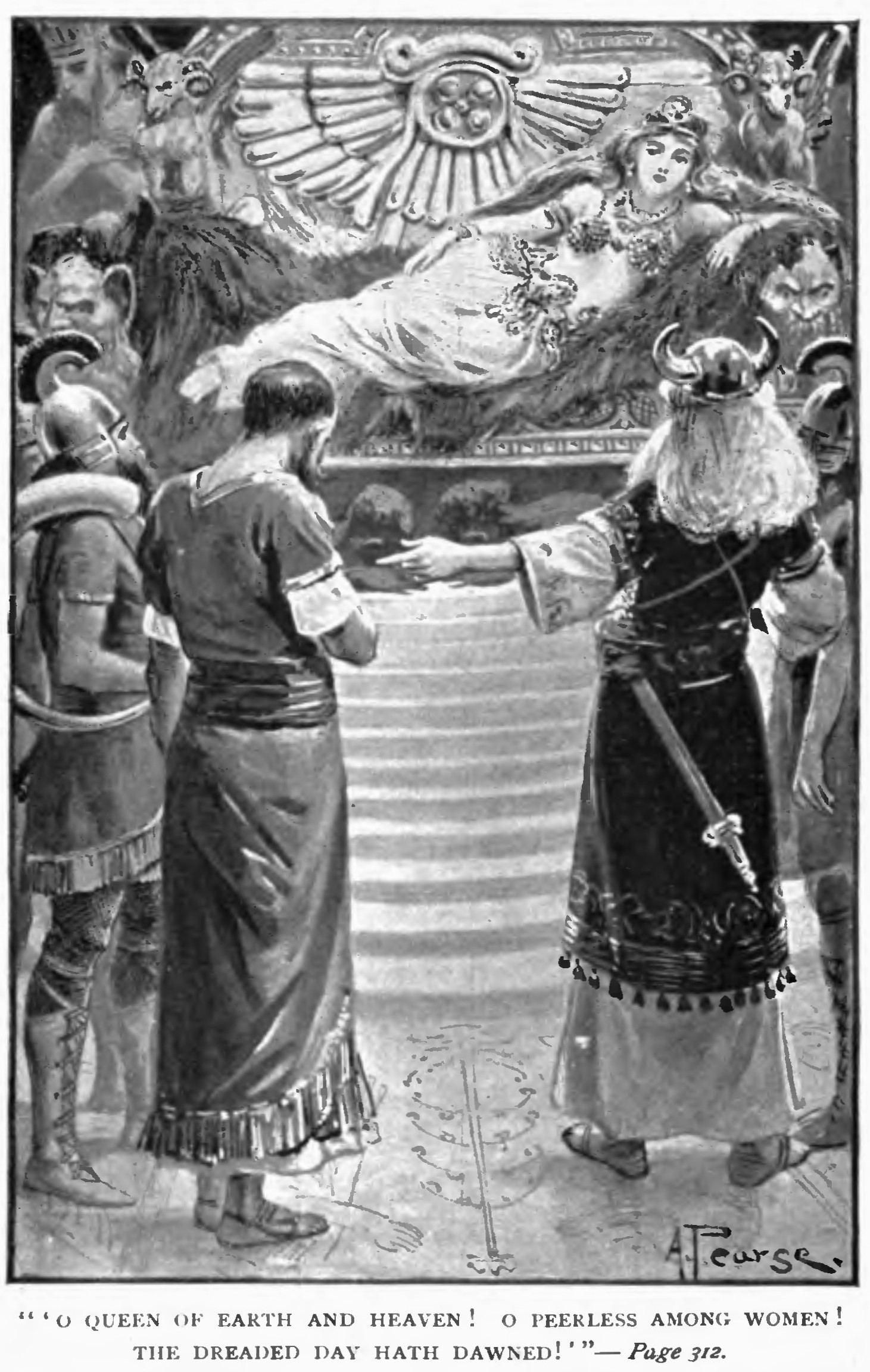
“Then utter it, and be gone,” Istar said, glancing at him sharply.
“Know then, O Queen of Earth and Heaven, O Peerless among Women, the dreaded day hath dawned! The Great Destroyer is in our midst!”
Istar, pale and startled, sprang to her feet, clutching her jewel-laden breasts frantically, as if to stay the beating of her heart.
“The Devourer!” she gasped, white to the lips. “Speak! I command thee! Speak quickly, son of Nabu-ahe-iddina, or thou shalt be cast for ever into the realm of Niffer, lord of the Ghost Land.”
“I speak, O Mighty One,” he answered. “Would that my tongue had been torn from its roots, and my lips sealed by the seal of the Death-god, ere it should have been my duty to make this my announcement. The Devourer from the outer world hath been discovered wandering upon the mountains. How he gained this land, which is without entrance and without exit, no man knoweth. The wise men believe that he came hither like a fowl of the air.”
Istar, trembling, clutched the glittering arm of her crystal throne for support, while a dark, sinister expression settled upon her flawless countenance. The crowd about me, awe-stricken and hushed in expectation, awaited her words breathlessly.
“Lo!” cried the high-priest of the Temple of the Seven Lights, suddenly stepping back and dragging me roughly forward, “Lo! O Beauteous Queen of all the Gods, he is here, in thine holy presence!”
I lifted my face. Our eager eyes met.
Her tiny hands were so tightly clenched that the nails were driven into her palms, her breasts heaved and fell quickly, her brows knit in a fierce anger, but in her eyes was a look of unutterable dread.
For a moment she covered her face with her hands, as if to shut me out of her gaze, but next instant she raised her narrow eyebrows, her blanched lips parted, and she turned upon the high-priest in a sudden outburst of fury. Extending her bare arm towards him she cursed him.
“Knowest thou not the writing upon my foundation-stones, offspring of Anu, defiler of the holy Ziggurratu?” she screamed in rage.
The aged high-priest uttered a cry, as if he had been struck a blow. But he answered not.
“Knowest thou the words graven upon the great image? Speak, accursed one. Speak!”
“I do, O Queen,” he faltered.
“Then, malediction upon thee. Vengeance and hate, sorrow and torture of the flesh. May the Air-god rend thee; may Shamas, the lord of Light, hide his face from thee for ever; and may Niffer, lord of the Ghost Land, take thee for his slave! May Ninkigat, the lady of the great Land of Terrors, strangle thee, and may the other—whom I dare not name—fill thy vitals with molten metal and consume thee!”
“Mercy!” cried the wretched man, falling upon his knees, and grovelling upon the polished pavement. “Mercy, O Istar, Queen of Ea, and ruler of all creatures! Have mercy upon thy servant!”
“Nay, unto me thou hast shown no mercy, accursed spawn of a scorpion; thou shalt receive none,” she answered. Then, lifting her hand towards the file of soldiers that lined the walls, she commanded,—
“Abla, Nabu-nur-ili, Akabi-ilu, forward quickly, ye guards of our majesty. Take this son of Nergal forth to the top of the steps and cast him down with force like a dog, so that his bones be broken and his body mutilated. Then, with his blood, let the words graven upon the image be re-written on the lintel of the Temple of the Seven Lights, so that all may remember. Away with him. Let his body be cast into the lion-pit,” she added, with a majestic sweep of her white arm. “I have spoken.”
“Have compassion, O Istar! At least, let me live!” cried the aged priest; but ere he could utter the last sentence the soldiers had dragged him forth, with the dreaded Queen’s imprecation resounding in his ears in multiplied echoes.
In the full fury of her ungovernable rage this beautiful goddess of the Mysterious Land, at first so graceful and languorous, looked magnificent. With her unbound hair falling about her shoulders and reaching below her girdle, she raised her arms in mad rage, pouring forth a string of curses so terrible that those surrounding her visibly shuddered.
“And thou!” she cried, suddenly turning and gazing intently upon me with eyes sharp as arrows. “So thou art the stranger!”
The people around me were full of passionate anger and abject terror. Behind, before me, everywhere, I saw only glaring eyes, strained wide-open as if to devour me, defiant faces, eager hands fingering sword-hilts, and heard the gnashing of teeth between threatening lips.
“So thou hast dared to accompany that viper Rabbani, and enter my presence!” she cried, in a second outburst of indignation. Her strange terror had been succeeded by rage and defiance terrible to behold. The veins in her brow stood out like blue cords as she spoke, and her soft, perfumed cheeks were suffused by anger.
“I was brought before thee by thy people, O Queen,” I answered, endeavouring to appease her. “I knew not thine high-priest, ere I entered thine House of Lustre.”
“I have spoken; and he shall die,” she snapped, apparently thinking I was making an appeal on the aged man’s behalf. “Ascend to me, so that I may see thee more closely.”
Thus commanded, I crossed the inlaid pavement and ascended the broad, silver steps leading to the great throne of crystal, before which she now stood upon her prostrate women, erect and queenly. Gaining the pavement of gold whereon the throne was set, I was drawing nearer, when two great eunuchs sprang forward, motioning me not to approach her further.
“Arrest thy steps,” they cried, frantically. “The person of Istar, our ruler, is sacred. None but dwellers within this, her temple, may look upon her.”
“Retire,” she cried to the eunuchs. “I commanded him to approach me.”
The men slunk back to their places in chagrin, and as they did so I advanced yet another couple of paces, and dropped upon one knee before her. Her beauty was amazing. The sweet perfumes that exuded from her ample draperies filled my nostrils.
“Whence comest thou?” she asked me in calm, serious voice, gazing upon me with her huge, wonderful eyes.
“From the world that lieth beyond the impregnable limits of thy kingdom, O Queen,” I answered.
“Who art thou, that thou shouldst speak our sacred tongue?” she inquired quickly, in surprise.
“I am but a wanderer,” I replied. “The language of ancient Assyria hath been recovered by our wise men from the monuments of Nimroud and of Babylon.” Her surprise found echo in the murmurings of the eager, excited crowd; but a moment later she asked,—
“How camest thou hither?”
“By an entrance which I followed. It led me through the Valley of Mists, until I came hither unto this thy city.”
“An entrance!” she cried, in alarm. “Then thou earnest not as a bird of the air!”
I replied in the negative, and was about to explain the extraordinary manner by which I had gained access to the mysterious Land of the No Return, when she turned upon me with clenched hands, in a paroxysm of rage so sudden that I was startled.
“Then thou art actually a pagan from the unknown land beyond,” she cried, trembling with anger. “Be thou accursed! accursed! accursed! May the celestial triad cut thee off, and may Rimmon tear and devour thee!”
A murmur of approbation went round those assembled, and at the mention of the dreaded god all bowed, while the priests in their horned caps raised their arms and lifted their deep voices in adulation.
Speechless, I stood before her while she poured out upon me the vials of her uncurbed wrath. I trembled, fearing lest she should condemn me to a similar doom to which the aged high-priest had been hurried for what appeared to be a petty offence. In her anger she stamped her tiny foot upon the neck of one of the prostrate women, causing her to writhe. But the half-nude pair acting as her footstool uttered no cry. They were worshipping the goddess and sacrificing themselves to her.
“Thou accursed son of the Unknown!” she cried, addressing me. “Thou hast dared to enter this my forbidden land, therefore thou art my captive, my slave, my servant!” She had folded her arms with an air so terrible that I was immediately as one rooted to the golden pavement.
“Kill him, O Istar!” the people cried. “Suffer not his baneful presence to contaminate us! Suffer not his unclean hand to touch the hem of thy sacred robe! Kill him! Let us witness the lions tearing him!”
At the raising of her white, bejewelled hand there was complete silence. She looked at me, crushing me with her haughty beauty.
“He came hither,” she said, addressing her courtiers and slaves, “in order to feast his eyes upon what is forbidden, to discover that which for a hundred generations hath been hidden from the pagans of the other world. He therefore shall, ere his soul is given unto Rimmon, witness that which he desireth. He is my captive. My name shall gnaw him like remorse. I will be to him more execrable than the pest, and he shall feel every moment, until the day he is cast into the lion-pit, the chastisement of a goddess.”
Ghastly, and with hands clenched, I quivered like a stringed instrument when the over-tense strings are about to snap. Words choked me, and I bowed my head before her.
“My slave thou art,” she cried, turning suddenly upon me. “Thou shalt ever grovel in the dust before me; thou shalt take the place of those women who have prostrated themselves before me, and are from this time forth absolved. In future thou shalt be as my footstool. Neither by night nor day shalt thou leave my presence. In my waking hours my heel shall be upon thy neck; in my hours of slumber thou shalt still be wakeful. Whithersoever I go there also shalt thou go, placing thyself as rest for my feet, and thus be ever in my sight. If thou attemptest to fly, I will draw the bears from the mountains, and the lions shall hunt thee, even unto the ends of the earth.”
Stepping from the women, upon whose quivering bodies she had been standing, she commanded them to rise, and at signal from her the eunuchs tore from my shoulders the robe in which I had been attired. Then, although struggling vainly in their iron grip, I was cast, face downwards, upon the pavement before the throne, and a moment later the mysterious Queen of Ea stood with her feet upon my back. Her weight crushed my breast, causing my breathing to become difficult; but, applauded by her subjects, she remained in that position addressing them, cursing me for daring to enter her kingdom, and assuring them that ere long they should be entertained by my death beneath the claws of the lions.
“I heed not the graven lines upon the foundation-stone,” she exclaimed, in conclusion. “Three hundred thousand soldiers are ready day and night to do my bidding, and if men fail me, I will call down the wrath of the gods most terrible. I will overthrow this my city and burn its temples. Not a single tower, nor tree, nor wall shall remain, and the galleys shall float on streams of blood. I fear not this slave beneath my heel. I would kill him now, with this my poniard; but ere he dies he shall feel the chastisement of Istar. I am thy ruler, and his punishment is in my hands.”
“Wisely hast thou spoken, O Goddess, whom we worship with one accord, and to whom we sacrifice those of thy sex. Thou art indeed our just ruler, at whose word mountains tremble and rivers stand still. Thine armed men shall ever be faithful unto thee, and beneath thine heel we leave the wanderer from the Unknown.”
“Then go; let the veil fall,” she answered. “In my temple, before the graven lines upon my foundation-stone, let full thanksgiving be offered at moonset for our discovery of this wanderer, who is safe in our hands, and thus prevented from escaping back unto his own execrable, accursed race.”
“We obey thee, O mighty Istar!” rose from the throats of the assembled multitude as, with one accord, they moved back towards the ante-chamber, still keeping their faces towards the beautiful woman they worshipped. Confusion spread for a few minutes, but at last all retired, save those grouped around the throne, and the great yellow curtain fell, leaving the brilliant Queen in ease and semi-privacy.
Wearied, she threw herself upon her great crystal lounge, lying gracefully back, with the toes of one bare foot just touching me, while her women crowded about and attended her at her elaborate toilet.
Chapter Thirty Nine.
Foretokens.
Istar’s white-robed women brushed out her hair, which fell about her like a cascade of rippling gold, bathed her face in a golden bowl filled with perfume, and gently washed her white hands. Then, when her toilet was complete, they retired at a sign, leaving me alone with her.
When all was silent she lifted her tiny foot from my neck and commanded me to rise.
“Tell me, whence comest thou?” she inquired, in a hard rasping voice, when I stood before her.
Our eyes met. Hers were of that unusual tint—almost violet. They held me in fascination.
“I came from the desert land two moon’s march beyond thine,” I answered, noticing, at the same moment, that her shapely hands trembled. “I entered thy dominion by the gate known to us as the Rock of the Great Sin, the secret way that no man hath before penetrated.”
“Thou hast discovered it!” she gasped excitedly, half rising from her crystal seat of royalty, gleaming with its thousand iridescent fires. “Tell me, in which direction doth it lie?”
“Far north, beyond the Mountains of the Mist, beyond the ruins of the wondrous temple thine ancestor raised to Sin, the Moon-god.”
“But tell me the exact position of the rock of the great god Sin,” she demanded, eagerly. “It is a spot which existeth in the sayings of the priests, but it hath been lost to all men in the mazes of legendary lore.”
“Its exact position I cannot accurately describe,” I answered. “Since passing through it and deciphering the rock-tablet of Semiramis, I have travelled many days in forest and over plain and mountain.”
“Couldst thou not guide me thither?” she asked, eagerly.
“I fear I could not, O Queen,” I answered.
“Thou art, indeed, the Destroyer; the man who is my bitterest enemy,” she observed, in a deeply reflective tone.
“How?” I inquired. “Surely I have done thee no wrong!”
“Since the day of Semiramis, the founder of Babylon and of Ea, it hath been told to each generation by our sages that a dark-faced stranger from the north shall one day enter our impregnable kingdom and approach its ruler,” she said, hoarsely. “His entry shall be the curse that Anu, god of Destruction, hath placed upon our land, and this our city, with walls unbreakable, shall be overthrown and crumble into dust. When Semiramis founded this our land of Ea, she made not sufficient sacrifice unto Anu, therefore the dread god overthrew her colossal Temple of the Sun, and laid a curse upon the city, saying that he would one day direct hereto the steps of a man from the world beyond, and that this man should be the Destroyer. Thou art the one sent by Anu.”
She had fixed her brilliant eyes upon me, holding me transfixed. There was in her face a strange look of combined terror and hatred.
“Well,” I said, after a pause, “believest thou that I am the prophesied doer of evil?”
“Assuredly thou art,” she answered. “All is evil in thine accursed world beyond.”
“And thou, the goddess Istar, believest that I am capable of working evil against this thy giant city!” I observed, smiling. “Thou fearest that I am possessed of the evil eye.”
“Thy coming fulfilleth the prophecies of our priests through ages,” she answered, in a low, harsh tone. “Thou art mine enemy. I, my people and my land are doomed.”
“This, then, was the reason that I was cast into the lion-pit,” I observed.
She nodded in acquiescence, adding, “It was proposed that thou shouldst be devoured by the wild beasts as recompense for thine intrepidity; but I rescued thee because—because, I wished to hear thy story from thine own lips.”
“Already have I told thee all,” I answered. “This thy land is known to the world beyond only by vague legends and the unwritten romances of story-tellers. When I return, I will tell my fellows of the wonders I have witnessed within thy brilliant kingdom.”
“No,” she answered, rising with true regal dignity, yet trembling with anger. “Thou shalt never go back, for to thee, as to all men, this is the Land of the No Return. To kill thee will only hasten disaster upon myself, therefore, thou shalt remain my slave, and lest thou shouldst attempt to escape, thou shalt never leave my side, either by day or by night. I hold thee in servitude irrevocably. When the Day of Destruction, foretold by the prophets, cometh, then shall thine heart be torn out whilst thou art still alive, and given to Ninep, my tame lioness, to devour at a mouthful.”
I bowed, smiling bitterly; but no retort escaped my lips. Her strange, weird manner held me spellbound.
“At least it shall be known,” she cried, angrily, “that I hold in bondage, as my personal slave, the man who hath entered our land to bring evil upon us. Attempt not to escape, or assuredly will I slay thee with mine own hand,” and she drew from her girdle of emeralds a short, keen knife, with hilt fashioned like a winged bull, which she kept therein concealed.
“Thou appearest to consider me as harbinger of ill,” I answered, with knit brows. “I have no design upon thee or thine. Love of adventure and a secret quest have led me hither.”
“A secret quest!” she cried. “What was it?”
“I had heard stories of wonders within thy land, and sought its whereabouts,” I said, ambiguously.
“Then, thou didst discover the secret entrance; the mystery that hath remained hidden through an hundred ages?”
“I did, O Istar,” I replied. “Long I toiled in the darkness beneath the foundations of the rock of thy Moon-god, and emerged into thy wondrous country, with its city more amazing than any mine eyes have ever beheld.”
“Art thou dazzled?” she asked, smiling for the first time.
“Indeed I am, O Queen,” I replied. “The magnificence of thy city, the splendour of this thy palace, and the beauty of thy face entranceth me. Of a verity thine is a world apart, and thou art goddess and queen in one.”
She fixed her clear, wonderful eyes upon me, and her breast, covered with jewels, slowly heaved and fell. In her gaze I noticed, for the first time, a curious expression, and her manner was undisguisedly coquettish.
“Then, why dost thou desire to leave our land of Ea? Why not remain here in happiness and contentment?” she asked, raising her pencilled brows, and toying with the long, gold pendant hanging from her ear.
“Because,” I answered, frankly, “because I am pledged to a woman who loveth me.”
“Who loveth thee!” she cried, fiercely. “Who is the woman?”
“Azala, daughter of the Sultan ’Othman, of Sokoto,” I answered.
She was silent for a long time. Her white, well-formed hands twitched nervously.
“Azala,” she repeated slowly, in a hollow voice. “And thou desirest to return because thou lovest her?”
I nodded.
“The penalty for thine intrepidity is death,” she continued, gravely. “For the present I spare thee, but thou shalt die when it pleaseth me. I am Istar, the ruler who holdeth her enemies in the hollow of her hand.”
“I am not thine enemy,” I protested.
“Thou art!” she cried, with flashing eyes. “Thou, son of Anu, art the Destroyer whose coming hath been foretold.”
“I am prepared to serve thee, and to prove to thee that I have entered thy land without evil intent,” I said.
“Be it so,” she answered, drawing herself up suddenly. “Thou shalt serve me as slave, and attend me everywhere; but while I have breath thou shalt never return unto thy master Anu, the god of Destruction, who dwelleth in the land afar.”
Her agitation was intense. In her excitement she stood beside her great crystal throne, grasping with both hands one of the human-headed monstrosities which served as arms, while her pale face had assumed a haggard look, and around her eyes were large, dark rings. This woman who, as Queen of the ancient realm, was also worshipped by every man and woman as Istar, the Goddess of Love, possessed an extraordinary personality. In features, in manner, in her luxurious mode of life, she was remarkable; while, as I had already had illustration, she was cruel, quick-tempered and relentless, overlooking no fault, and holding her unique position as some supernatural ruler of earth. The legend current throughout Ea, prophesying the appearance of a visitant and the downfall of the city, was extremely unfavourable to me, I knew; nevertheless, I recollected my pledge to Azala, my long and adventurous journey thither, and now that I was actually at last in Ea I was more than ever determined to fathom the mystery that my well-beloved had alleged would be revealed unto me. The strange life about me held me entranced with wonder. Everything was upon a scale so colossal and extravagantly luxurious that I gazed about lost in wonder. The dwelling-place of the beautiful woman who held me captive, a palace and temple combined, was, indeed, a magnificent pile of amazing proportions and was well named the House of the Raising of the Head, for it was full of marvels at every turn. Istar’s firm determination that I should not leave her side was certainly disconcerting; nevertheless the Korân telleth us that by patience much can be accomplished; therefore, I decided to stifle the voice of protest, endure my lot, and bow to the woman who had held me humiliated as slave in sight of her brilliant court.
Again, with eyes flashing, she heaped fierce curses upon me, declaring that my life should be made a burden; that ere a moon had passed I should long for death; and that my face should never again be brightened by the eyes of the woman I loved. In the midst of a string of epithets bestowed upon me with a terrible volubility, two heralds, in golden breastplates and white-plumed helmets, entered the chamber, and raising their great brazen horns blew three loud blasts, whereat Istar, the words of reproach dying on her lips, sank among the cushions of her throne, while, almost at the same instant, the great silken curtains again parted, revealing the assembled multitude of soldiers, courtiers, eunuchs and priests, who had apparently remained awaiting their Queen’s pleasure. Erect, I stood beside the gleaming throne gazing upon the brilliant court of this curious monarch, while Ninep, the tame lioness, walked slowly past, sniffing inquiringly at her mistress, then stood licking her soft, bejewelled hand, the hand that she declared would strike me dead if I attempted to return to the world outside. Impetuosity was one of her many peculiarities. One moment so fierce was she that she would herself assassinate any who hesitated to obey her wish; the next she would smile good-humouredly, as though she knew not a moment of anger, and malice found no resting-place within her heart.
Suddenly she raised her hand, and a silence, deep and complete, fell upon the gorgeous, perfumed multitude. Ninep yawned, stretched herself at her mistress’s feet, and placing her head upon her paws, blinked lazily at those below the steps of polished silver.
“Know,” she said a moment later, in a clear, not unmusical voice, “this son of Anu beside me is indeed the Destroyer whom our fathers have expected for ages, and whom the prophets have told us will bring evil upon Ea.”
“Let him be given as food to the lions!” they shouted. “Kill him, O Istar, that he may not betray us into the hands of those who seek our destruction! Anu hath set his seal upon Ea, and our city must be overthrown, but let the spy be killed so that he may not furnish report unto those who sent him hither.”
“He shall die,” Istar replied, briefly.
A roar of approbation instantly broke forth; but next instant, again raising her hand to command quiet, the queen-goddess continued,—
“He shall die when, as my slave, he hath served me.”
“Let him die now, O Istar!” they shouted. “Gladden our hearts by letting us see the lions tear him limb from limb. He is the Destroyer, the visitant against whom the sages have warned us. Through him will the vengeance of Anu, the dread god, descend upon us. Let him die!”
“No,” she answered, both hands resting upon the crystal arms of her glittering throne. “I have spoken. He is my personal slave, bound to my side by night and by day.”
“Dost thou not fear to have a son of Anu as thy body-servant?” asked an aged priest, with flowing white beard and high head-dress of shining gold, surmounted by a star, the emblem of Istar. “He may wreak vengeance upon thee.”
“I am Istar, and know not fear,” she answered, haughtily. “Men bow to me, and women make sacrifice in my temple. For those who incur my displeasure, Merodach, the protector of mankind, will not mediate.”
Then the queen-goddess nodded towards a man of tall stature, attired in a robe of dead black. Again the trumpets sounded thrice, as signal for her captains to come forward and present their reports. They came, one by one, advancing to the foot of the steps, bowing upon one knee, and obtaining the sanction of their sovereign upon various matters.
At last, when about twenty had been received and dismissed, a man older than the rest, and wearing a breastplate in which rubies were set in the form of a great star within a circle, advanced, knelt before the bewitching Queen, and mumbled some words that I could not catch.