THE LOWER EXTREMITY.
Reading edition
For adults the most useful width for the rollers is 3 inches, and the length the ordinary one of 8 yards.
The Foot is usually bandaged without covering the heel, and the bandage is begun as follows:—
The roller being held in the right hand for the right foot, or in the left hand for the left foot; the unoccupied hand takes the end, and passing it under the sole, brings it up on the back of the foot just behind the toes, where it is made fast by carrying the roller outwards over the back. When one turn is completed, the bandaging is continued by reverses until the metatarsus is covered, then one or two figures of 8 round the foot and ankle carry the bandage to the leg, where it proceeds upwards by spiral turns round the small of the leg, and by reverses up the calf. The reverses lie at equal distance up the leg, on the muscles, not over the bone, that the skin be not pinched between the crease of the bandage and the bone. When the calf is passed, the roller is continued by figures of 8 above and below the knee, until that joint is covered in, then by reverses up the thigh to the groin, where the bandage terminates by a spica round the body (see page 9). This is the ordinary bandage for the lower limb. There are some varieties for particular parts, these are:—
To cover the Heel.—Holding the roller as for the foot, pass the end behind the heel, bring it out by the outside over the front of the ankle-joint, and complete the turn with the roller. In doing this, the point of the heel must catch the middle of the bandage. If the foot is a long one, the roller should be three inches broad; but a narrower bandage is more easily fitted on a small foot. After the first turn, the bandaging is continued by carrying the roller in figures of 8 round the foot and ankle, passing alternately above and below the first turn until the ankle is covered as in fig. 19.
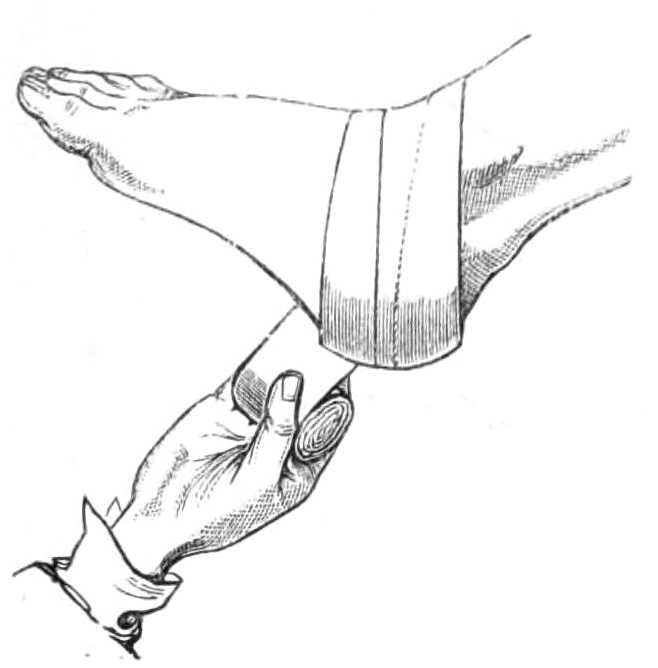
Fig. 19.—Covering the Heel.
To bandage a Toe.—Take two turns round the foot, with a bandage one inch wide, then go round the toe to be raised, and back again round the foot. This figure of 8 lifts a toe above the rest if taken from the dorsal, and depresses it if taken from the plantar surface.
The Knee is bandaged by beginning with a simple turn round the leg above the calf, then carrying the roller across the patella to the thigh above the knee: and next entwining it in a circular turn round the thigh before descending over the patella to the leg below the knee, where this is repeated until the knee is covered.
To bandage a Stump.—The flaps are first supported by two or more strips of plaster, one inch wide and ten or twelve long, carried from the under surface of the limb over the face of the stump, and a slip of wet lint and oilskin is applied to the wound. The muscles and soft parts are next confined by a bandage. This is first fixed by simple turns below the nearest joint, and brought downwards in figures of 8 round the limb till the end of the stump is reached, which is next covered in by oblique and circular turns carried alternately over the face of the stump and round the limb, as is shown in fig. 2 for bandaging the head. Or, if a double-headed roller be used, in the manner directed for the capelline bandage on page 5.
Extending a Stump.—When the soft parts fall away from the bone they may be drawn down by attaching a weight by cord and pulley, as described for extending the hip-joint (see fig. 80). The stump should be lightly bandaged and the cord fastened to its upper and under surface. The weight is very small at first, and should be increased from time to time as required.
Many-tail, or 18-tail Bandage, or bandage of Scultetus.—A roller is cut into short lengths long enough to encircle the limb and to let the ends overlap 2 or 3 inches; these are applied separately, the lowest first, the next overlapping it, and the next overlapping the second until the requisite number are applied. Sometimes the tails are attached to each other before they are applied. To do this, the tails are laid out on a table, so that the second overlaps one-third of the width of the first strip, and the third strip overlaps the second, and so on. When all the tails are arranged, a strip is laid across their middle and fastened to each tail by a stitch; but this is not a necessary part of the bandage, and it prevents single tails from being removed. This bandage is used in compound fractures and other wounds, as the soiled strips can be replaced without raising the limb to pass the roller under it.
Elastic Socks and Stockings are made to support varicose veins of the legs. They are woven of india-rubber webbing with silk or cotton. The latter are the lowest priced and often even the most comfortable to wear. The stockings should fit carefully everywhere, especially at the small of the leg, where they generally are too slack, while they cut at the upper end below the knee.